

- Industry Size (2026)
- USD 2.4 Bn
- Forecast (2036)
- USD 7.8 Bn
- CAGR (2026 to 2036)
- 12.5%
Flight Scheduling Software Market Forecast and Outlook 2026 to 2036
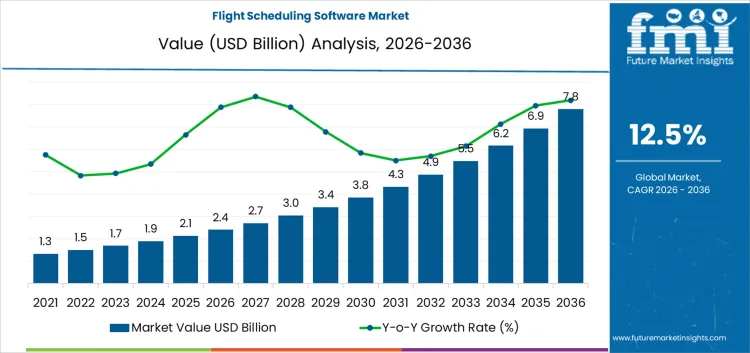
The flight scheduling software market increases from USD 2.4 billion in 2026 to USD 7.8 billion by 2036, representing a CAGR of 12.50%. Value creation is driven less by license volume and more by control over optimization engines, data integration layers, and certification ready deployment frameworks. Cost structures favor vendors that maintain proprietary algorithms and reusable integration modules, which reduces marginal delivery expense and strengthens pricing authority. Airlines and operators tend to contract at group or alliance level, which concentrates revenue among suppliers able to meet audit, reliability, and interoperability requirements. Margin concentration therefore aligns with ownership of core logic and long term support obligations rather than with simple user counts.
Over the period, competitive performance depends on the ability to sustain contractual lock in through data dependencies and workflow embedding. Implementation effort, validation cycles, and training investments raise switching costs, which protects incumbent positions once systems are embedded in operations control centers. Pricing power is further supported where vendors control update cadence and regulatory compliance roadmaps. Smaller providers often compete on project fees and customization, which dilutes returns despite comparable deployment footprints. The market expands in scale, yet economic gains accrue disproportionately to firms that combine product control, certification capacity, and multi-year service contracts.
Quick Stats of the Flight Scheduling Software Market
- Flight Scheduling Software Market Value (2026): USD 2.4 billion
- Flight Scheduling Software Forecast Value (2036): USD 7.8 billion
- Flight Scheduling Software Forecast CAGR 2026 to 2036: 12.5%
- Leading Deployment Type in Flight Scheduling Software Market: Cloud-Based Platforms (52 % share)
- Leading End User in Flight Scheduling Software Market: Commercial Airlines (48 % share)
- Key Growth Regions in Flight Scheduling Software Market: India, China, Brazil, USA, UK
- Top Players in Flight Scheduling Software Market: Sabre Corporation, Amadeus IT Group, SITA, IBM, INFOR, Ryanair Labs, Rex Software
What is the Growth Forecast for Flight Scheduling Software Market through 2036?
Between 2026 and 2031, the flight scheduling software market is projected to expand from USD 2.4 billion along a growth path consistent with a 12.5% CAGR, driven by the operational reset of airline networks rather than by IT refresh cycles. Carriers rebuild schedules with tighter turnaround times, higher aircraft utilization targets, and more frequent network adjustments, which turns scheduling into a continuous optimization task instead of a seasonal planning exercise. Cloud-based deployments gain momentum because they support rapid scenario testing and cross-department coordination between fleet, crew, and network planning teams. Value creation in this phase comes from disruption recovery tools, slot management, and rolling re-optimization capabilities, not from basic timetable generation. Procurement decisions increasingly sit with operations leadership focused on resilience and controllability rather than with pure IT cost centers.
From 2031 to 2036, the market is expected to reach USD 7.8 billion, with growth shaped by the integration of scheduling into broader operational decision platforms. Scheduling engines become the core layer that connects demand forecasting, crew planning, maintenance routing, and revenue management, which raises software criticality and contract values. API-driven and hybrid architectures gain relevance as airlines combine legacy systems with newer optimization modules. Competitive advantage shifts toward vendors that can support complex network structures, real-time adjustments, and regulatory constraints at scale. Long-term contracts and platform dependence increase switching costs, favoring established providers such as Sabre Corporation, Amadeus IT Group, SITA, IBM, INFOR, Ryanair Labs, and Rex Software as airlines prioritize reliability, scalability, and proven operational depth over feature experimentation.
Flight Scheduling Software Market Key Takeaways
| Metric | Value |
|---|---|
| Market Value (2026) | USD 2.4 billion |
| Forecast Value (2036) | USD 7.8 billion |
| Forecast CAGR 2026 to 2036 | 12.5% |
How Is Flight Scheduling Software Optimizing Airline Operations?
Flight scheduling software is increasingly adopted to enhance operational efficiency, reduce delays, and optimize aircraft utilization for airlines and air transport operators. Historically, flight planning relied on manual processes and static schedules, which limited adaptability, increased operational errors, and reduced fleet efficiency. Modern software integrates AI, real-time data analytics, and automated optimization algorithms to manage crew assignments, aircraft rotations, slot availability, and maintenance windows dynamically. Airlines, airport operators, and aviation service providers prioritize system reliability, scalability, and integration with operational control centers. Early adoption focused on large carriers and hub-based airlines, while current demand spans low-cost carriers, regional airlines, and cargo operators, driven by rising passenger traffic, fuel cost optimization, and regulatory compliance. System accuracy, real-time responsiveness, and integration capabilities influence supplier selection.
Increasing air traffic volumes, the need for operational efficiency, and cost optimization requirements are shaping market growth. Compared with manual scheduling methods, modern flight scheduling software emphasizes predictive analytics, real-time updates, and integration with crew, maintenance, and air traffic management systems. Cost structures depend on software development, data integration, and cloud infrastructure, concentrating margins among providers capable of delivering reliable, high-performance solutions. Airlines adopt these platforms to reduce delays, optimize fleet utilization, and improve on-time performance. By 2036, flight scheduling software is expected to become standard across commercial and cargo airlines, supporting efficient operations, regulatory compliance, and enhanced passenger and cargo service reliability.
What Factors Are Shaping the Demand for Flight Scheduling Software by Deployment Model and Airline Operating Profile in 2026?
The flight scheduling software market in 2026 is segmented by deployment type and by end user category. By deployment model, demand is divided into cloud based, on premise, hybrid, and API integrated solutions, each offering different trade offs between control, scalability, and integration effort. By end user, demand is organized around commercial airlines, charter operators, cargo and logistics carriers, and regional or low cost airlines, which differ in fleet size, network complexity, and planning cadence. These segments reflect how operators manage planning risk, IT governance, and disruption recovery while aligning scheduling tools with regulatory requirements, cost structures, and the operational tempo of their networks.
Why Do Cloud Based Platforms Account for the Majority of New Deployments?
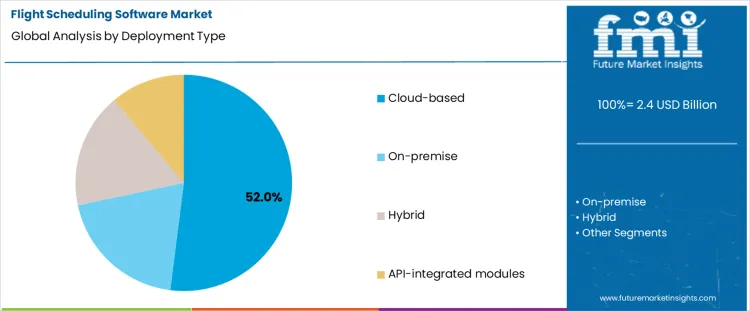
Cloud based solutions account for about 52% of demand in 2026, reflecting the need for rapid scalability and continuous update cycles in airline operations. Scheduling environments must react to weather disruptions, crew availability, and maintenance events in near real time. Centralized cloud platforms allow planners in different locations to work on the same data set without version conflicts. They also reduce the burden of local infrastructure maintenance and software patching. For airlines with seasonal route changes and fluctuating capacity, the ability to scale computing resources up or down matters more than owning fixed hardware. This operational flexibility, combined with predictable subscription cost models, keeps cloud deployment as the preferred option for many operators.
On premise, hybrid, and API integrated models address different governance and integration needs. Some airlines retain on premise systems because of data sovereignty rules or long established IT policies. Hybrid setups appear where legacy systems must be kept while new functions move to hosted environments. API based modules are often added to existing planning suites to extend specific capabilities without full system replacement. These approaches solve real constraints, yet they require more coordination and internal support. Their adoption is therefore driven by organizational structure rather than by pure efficiency, which limits their share compared with the straightforward expansion path offered by cloud based platforms.
Why Do Commercial Airlines Represent the Largest End User Segment?
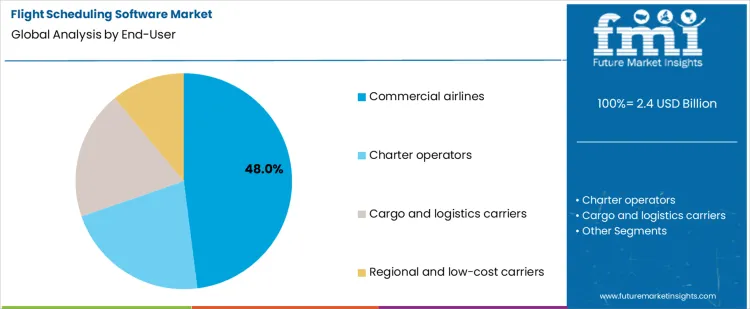
Commercial airlines represent about 48% of demand in 2026 because they operate the most complex and dense scheduling environments. Large fleets, multiple hubs, and interconnected route networks create constant optimization problems that require advanced planning tools. Even small changes in one part of the network can cascade into crew, aircraft, and gate conflicts elsewhere. These carriers also face strict regulatory and slot coordination requirements, which increases reliance on formal scheduling systems. The scale of their operations justifies continuous investment in software upgrades and optimization features. This combination of network complexity, regulatory exposure, and financial impact of disruptions concentrates a large share of overall software spending among commercial airlines.
Charter, cargo, and regional or low cost carriers follow different planning rhythms. Charter operators work on variable, customer driven schedules with fewer long term commitments. Cargo carriers focus on night operations and hub consolidation, which simplifies certain planning dimensions while adding others tied to logistics timing. Regional and low cost airlines run simpler networks with faster aircraft turnarounds and fewer connection dependencies. These operators still need scheduling tools, yet their operational scale and complexity are lower. As a result, their aggregate software spend remains below that of large commercial airlines, even though they form an important and growing part of the overall user base.
Why Are Network Complexity and Utilization Pressure Driving the Flight Scheduling Software Market through 2036?
Demand is being pulled by how tightly airlines and operators run their assets. Narrow turnaround windows, slot constraints, crew rules, and aircraft rotation dependencies leave little room for manual planning. Even small disruptions cascade across networks, turning schedule quality into a direct cost driver. As fleets diversify and mixed mission profiles increase, planners need tools that can model constraints and tradeoffs quickly. Cargo integrators and charter operators face similar pressure to maximize daily utilization while protecting service commitments. Once schedules become the backbone for revenue management, maintenance planning, and crew pairing, software shifts from a planning aid to a core operating system embedded in daily decision making.
What Data Integration Friction, Change Management, and ROI Proof Burden Are Slowing Adoption?
Constraints come from organizational reality. Scheduling touches many departments, each with its own data, rules, and incentives, and aligning them inside one system is slow and political. Legacy IT stacks and bespoke processes complicate integration and migration. Planners often rely on local expertise and spreadsheets, and trust in automated outcomes takes time to build. Proving return on investment is also difficult because benefits appear as avoided disruption rather than visible savings. Training, model tuning, and parallel runs extend deployment timelines. These factors stretch sales cycles and favor incremental upgrades over wholesale system replacement, even where current processes are visibly inefficient.
How Are Operations Control, Predictive Inputs, and Procurement Models Reshaping This Category?
The category is moving closer to real time operations. Scheduling tools are increasingly linked to operations control centers, maintenance systems, and crew management, blurring the line between planning and execution. Users want continuous re optimization as weather, demand, or technical status changes. This pushes value toward data pipelines and scenario engines rather than static timetable builders. Procurement is also shifting from perpetual licenses to service contracts tied to uptime and performance metrics. Some operators standardize platforms across subsidiaries to simplify governance. The role of scheduling software is evolving into a network coordination layer that supports ongoing decision cycles, not just seasonal timetable construction.
What is the Demand for Flight Scheduling Software by Country?
| Country | CAGR (%) |
|---|---|
| USA | 11.8% |
| UK | 11.5% |
| China | 13.0% |
| India | 14.2% |
| Brazil | 12.0% |
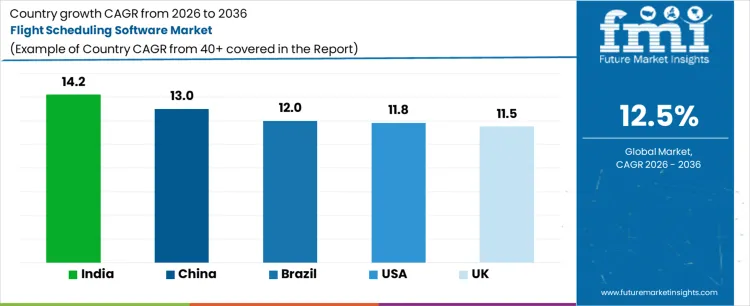
Demand for flight scheduling software is rising as airlines and aviation operators adopt digital tools to optimize flight operations, improve efficiency, and enhance passenger experience. India leads with a 14.2% CAGR, driven by rapid growth in domestic and regional air travel, increased airline fleet expansion, and adoption of advanced scheduling systems. China follows at 13.0%, supported by growing airline networks, government aviation initiatives, and digital transformation of airline operations. Brazil records 12.0% growth, shaped by domestic airline expansion and efficiency-focused operational tools. The USA grows at 11.8%, influenced by adoption of advanced software solutions for scheduling, crew management, and operational optimization. The UK shows 11.5% CAGR, reflecting steady adoption in commercial aviation and airline network planning.
How is the United States experiencing growth in the flight scheduling software market?
United States is experiencing growth at a CAGR of 11.8%, driven by the need to optimize airline operations, reduce delays, and improve fleet utilization. Flight scheduling software is optimized for real-time data integration, crew management, and regulatory compliance. Demand is concentrated in major airline hubs such as Atlanta, Chicago, and Dallas, where high flight volumes and complex routing require advanced software solutions. Investments focus on system reliability, data security, and FAA compliance. Growth reflects increasing airline traffic, adoption of digital operational tools, and emphasis on cost-efficient and punctual flight management.
- Airline operational efficiency drives adoption.
- Software optimizes crew management and route planning.
- Major airline hubs concentrate demand.
- System reliability and regulatory compliance guide investment.
How is the United Kingdom witnessing growth in the flight scheduling software market?
United Kingdom is witnessing growth at a CAGR of 11.5%, supported by airline operational optimization in London, Manchester, and Edinburgh. Flight scheduling software is optimized for fleet planning, crew allocation, and real-time schedule adjustments. Demand is concentrated in commercial airlines, low-cost carriers, and regional operators. Investments prioritize software accuracy, data security, and adherence to CAA regulations. Growth reflects increasing passenger traffic, adoption of digital scheduling tools, and efforts to minimize operational disruptions in busy airports.
- Airline efficiency and passenger management drive adoption.
- Software enhances crew allocation and real-time adjustments.
- Major airports concentrate demand.
- Accuracy and regulatory compliance guide investment.
How is China experiencing growth in the flight scheduling software market?
China is experiencing growth at a CAGR of 13%, fueled by the rapid expansion of domestic airlines and high passenger volumes in hubs such as Beijing, Shanghai, and Guangzhou. Flight scheduling software is optimized for complex route networks, fleet optimization, and integration with air traffic control systems. Demand is concentrated in large airline operators and airport management centers. Investments focus on system reliability, data processing speed, and compliance with CAAC regulations. Growth reflects China’s rising domestic air travel demand, airline expansion, and adoption of digital solutions to improve punctuality and operational efficiency.
- Domestic airline growth drives adoption.
- Software optimizes route networks and fleet utilization.
- Major airline hubs concentrate demand.
- Reliability and regulatory compliance guide investment.
How is India witnessing growth in the flight scheduling software market?
India is witnessing growth at a CAGR of 14.2%, supported by expanding airline fleets, increasing passenger traffic, and modernization of airport operations in Delhi, Mumbai, and Bengaluru. Flight scheduling software is optimized for real-time scheduling, crew management, and delay mitigation. Demand is concentrated in major domestic carriers, regional airlines, and busy international airports. Investments focus on software scalability, operational reliability, and adherence to DGCA regulations. Growth reflects rapid airline industry expansion, adoption of digital tools for efficiency, and a focus on improving operational punctuality.
- Airline fleet expansion drives adoption.
- Software enhances real-time scheduling and crew management.
- Major domestic airports concentrate demand.
- Scalability and regulatory compliance guide investment.
How is Brazil experiencing growth in the flight scheduling software market?
Brazil is experiencing growth at a CAGR of 12%, fueled by airline modernization, increasing domestic and international traffic, and complex route management in São Paulo, Rio de Janeiro, and Brasília. Flight scheduling software is optimized for operational efficiency, delay reduction, and crew planning. Demand is concentrated in major airlines and airport management operations. Investments prioritize software reliability, integration with traffic control systems, and compliance with ANAC regulations. Growth reflects expansion of domestic aviation, adoption of advanced digital scheduling solutions, and focus on reducing operational inefficiencies.
- Domestic aviation growth drives adoption.
- Software optimizes efficiency and crew planning.
- Major airports concentrate demand.
- Reliability and regulatory compliance guide investment.
Who Competes in the Flight Scheduling Software Market and How Do They Differ?
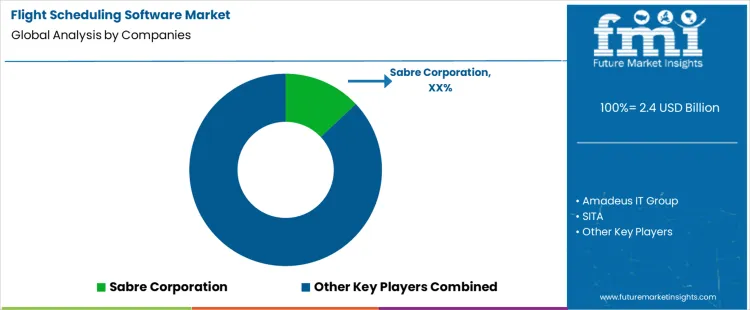
Competition in the flight scheduling software market is determined by scalability, integration with airline operations management, and ability to optimize complex schedules. Sabre Corporation supplies flight scheduling solutions designed for large global carriers, integrating with reservations, crew planning, and network control systems to maintain consistency across operations. Amadeus IT Group provides modular scheduling tools that work with airline enterprise systems and enable dynamic adjustments based on demand and operational constraints. SITA offers solutions focused on air transport community integration, helping airlines align schedules with airport systems, check in, and departure control services. IBM delivers scheduling and optimization software that leverages analytics and automation to support decision making across airline networks with large data volumes. INFOR supplies enterprise scheduling modules that integrate with broader enterprise resource planning functions used by mid sized carriers.
Ryanair Labs develops proprietary scheduling tools tailored to its low cost carrier model, emphasizing turnaround efficiency and robust conflict resolution. Rex Software provides flexible scheduling platforms aimed at regional and charter operators, enabling rapid reconfiguration and ease of use for smaller fleets. Other niche and regional providers deliver solutions with specific strengths in crew pairing, maintenance planning, or integration with third party optimization engines. Competitive differentiation arises from algorithm sophistication, ability to handle irregular operations and disruptions, real time integration with operations control systems, and compatibility with broader airline IT infrastructure. Market relevance is shaped by reliability, analytical depth, and the capacity to improve utilization and punctuality across varied carrier business models.
Key Players in the Flight Scheduling Software Market
- Sabre Corporation
- Amadeus IT Group
- SITA
- IBM
- INFOR
- Ryanair Labs
- Rex Software
Scope of the Report
| Items | Values |
|---|---|
| Quantitative Units (2026) | USD billion |
| Deployment Type | Cloud-based, On-premise, Hybrid, API-integrated Modules |
| End User | Commercial Airlines, Charter Operators, Cargo and Logistics Carriers, Regional and Low-Cost Carriers |
| Regions Covered | Asia Pacific, Europe, North America, Latin America, Middle East & Africa |
| Countries Covered | China, Japan, South Korea, India, Australia & New Zealand, ASEAN, Germany, United Kingdom, France, Italy, Spain, Nordic, BENELUX, United States, Canada, Mexico, Brazil, Chile, Saudi Arabia, Turkey, South Africa, and other regional markets |
| Key Companies Profiled | Sabre Corporation, Amadeus IT Group, SITA, IBM, INFOR, Ryanair Labs, Rex Software |
| Additional Attributes | Dollar sales by deployment type and end user category, cloud-based platforms forming the largest deployment share due to scalability and real-time collaboration needs, commercial airlines representing the largest user segment due to network complexity and regulatory exposure, demand driven by continuous schedule optimization, disruption recovery, and aircraft utilization pressure, value creation concentrated in optimization engines, data integration layers, and certification-ready deployment frameworks, high switching costs due to workflow embedding and validation cycles, long-term contracts and platform dependence supporting vendor lock-in, increasing integration with operations control, crew planning, maintenance routing, and revenue management systems, and competitive positioning based on algorithm sophistication, interoperability, scalability, and regulatory compliance support. |
Flight Scheduling Software Market Segmentation
Deployment Type:
- Cloud-based
- On-premise
- Hybrid
- API-integrated modules
End-User:
- Commercial airlines
- Charter operators
- Cargo and logistics carriers
- Regional and low-cost carriers
Region
- Asia Pacific
- China
- Japan
- South Korea
- India
- Australia & New Zealand
- ASEAN
- Rest of Asia Pacific
- Europe
- Germany
- United Kingdom
- France
- Italy
- Spain
- Nordic
- BENELUX
- Rest of Europe
- North America
- United States
- Canada
- Mexico
- Latin America
- Brazil
- Chile
- Rest of Latin America
- Middle East & Africa
- Kingdom of Saudi Arabia
- Other GCC Countries
- Turkey
- South Africa
- Other African Union
- Rest of Middle East & Africa
Bibliography
- International Air Transport Association. (2023). World air transport statistics 2023. International Air Transport Association.
- International Civil Aviation Organization. (2023). Global air navigation plan 2023 edition (Doc 9750). International Civil Aviation Organization.
- European Union Aviation Safety Agency. (2023). European aviation environmental report 2023. Publications Office of the European Union.
Frequently Asked Questions
How big is the flight scheduling software market in 2026?
The global flight scheduling software market is estimated to be valued at USD 2.4 billion in 2026.
What will be the size of flight scheduling software market in 2036?
The market size for the flight scheduling software market is projected to reach USD 7.8 billion by 2036.
How much will be the flight scheduling software market growth between 2026 and 2036?
The flight scheduling software market is expected to grow at a 12.5% CAGR between 2026 and 2036.
What are the key product types in the flight scheduling software market?
The key product types in flight scheduling software market are cloud-based, on-premise, hybrid and api-integrated modules.
Which end-user segment to contribute significant share in the flight scheduling software market in 2026?
In terms of end-user, commercial airlines segment to command 48.0% share in the flight scheduling software market in 2026.
Preview the report firsthand - request a free sample
Get SampleGet the brochure for pricing and purchase details.
Get PDFTable of Content
- Executive Summary
- Global Market Outlook
- Demand-side Trends
- Supply-side Trends
- Technology Roadmap Analysis
- Analysis and Recommendations
- Market Overview
- Market Coverage / Taxonomy
- Market Definition / Scope / Limitations
- Market Background
- Market Dynamics
- Drivers
- Restraints
- Opportunity
- Trends
- Scenario Forecast
- Demand in Optimistic Scenario
- Demand in Likely Scenario
- Demand in Conservative Scenario
- Opportunity Map Analysis
- Product Life Cycle Analysis
- Supply Chain Analysis
- Investment Feasibility Matrix
- Value Chain Analysis
- PESTLE and Porter’s Analysis
- Regulatory Landscape
- Regional Parent Market Outlook
- Production and Consumption Statistics
- Import and Export Statistics
- Market Dynamics
- Global Market Analysis 2021 to 2025 and Forecast, 2026 to 2036
- Historical Market Size Value (USD Million) Analysis, 2021 to 2025
- Current and Future Market Size Value (USD Million) Projections, 2026 to 2036
- Y-o-Y Growth Trend Analysis
- Absolute $ Opportunity Analysis
- Global Market Pricing Analysis 2021 to 2025 and Forecast 2026 to 2036
- Global Market Analysis 2021 to 2025 and Forecast 2026 to 2036, By Deployment Type
- Introduction / Key Findings
- Historical Market Size Value (USD Million) Analysis By Deployment Type, 2021 to 2025
- Current and Future Market Size Value (USD Million) Analysis and Forecast By Deployment Type, 2026 to 2036
- Cloud-based
- On-premise
- Hybrid
- API-integrated modules
- Cloud-based
- Y-o-Y Growth Trend Analysis By Deployment Type, 2021 to 2025
- Absolute $ Opportunity Analysis By Deployment Type, 2026 to 2036
- Global Market Analysis 2021 to 2025 and Forecast 2026 to 2036, By End-User
- Introduction / Key Findings
- Historical Market Size Value (USD Million) Analysis By End-User, 2021 to 2025
- Current and Future Market Size Value (USD Million) Analysis and Forecast By End-User, 2026 to 2036
- Commercial airlines
- Charter operators
- Cargo and logistics carriers
- Regional and low-cost carriers
- Commercial airlines
- Y-o-Y Growth Trend Analysis By End-User, 2021 to 2025
- Absolute $ Opportunity Analysis By End-User, 2026 to 2036
- Global Market Analysis 2021 to 2025 and Forecast 2026 to 2036, By Region
- Introduction
- Historical Market Size Value (USD Million) Analysis By Region, 2021 to 2025
- Current Market Size Value (USD Million) Analysis and Forecast By Region, 2026 to 2036
- North America
- Latin America
- Western Europe
- Eastern Europe
- East Asia
- South Asia and Pacific
- Middle East & Africa
- Market Attractiveness Analysis By Region
- North America Market Analysis 2021 to 2025 and Forecast 2026 to 2036, By Country
- Historical Market Size Value (USD Million) Trend Analysis By Market Taxonomy, 2021 to 2025
- Market Size Value (USD Million) Forecast By Market Taxonomy, 2026 to 2036
- By Country
- USA
- Canada
- Mexico
- By Deployment Type
- By End-User
- By Country
- Market Attractiveness Analysis
- By Country
- By Deployment Type
- By End-User
- Key Takeaways
- Latin America Market Analysis 2021 to 2025 and Forecast 2026 to 2036, By Country
- Historical Market Size Value (USD Million) Trend Analysis By Market Taxonomy, 2021 to 2025
- Market Size Value (USD Million) Forecast By Market Taxonomy, 2026 to 2036
- By Country
- Brazil
- Chile
- Rest of Latin America
- By Deployment Type
- By End-User
- By Country
- Market Attractiveness Analysis
- By Country
- By Deployment Type
- By End-User
- Key Takeaways
- Western Europe Market Analysis 2021 to 2025 and Forecast 2026 to 2036, By Country
- Historical Market Size Value (USD Million) Trend Analysis By Market Taxonomy, 2021 to 2025
- Market Size Value (USD Million) Forecast By Market Taxonomy, 2026 to 2036
- By Country
- Germany
- UK
- Italy
- Spain
- France
- Nordic
- BENELUX
- Rest of Western Europe
- By Deployment Type
- By End-User
- By Country
- Market Attractiveness Analysis
- By Country
- By Deployment Type
- By End-User
- Key Takeaways
- Eastern Europe Market Analysis 2021 to 2025 and Forecast 2026 to 2036, By Country
- Historical Market Size Value (USD Million) Trend Analysis By Market Taxonomy, 2021 to 2025
- Market Size Value (USD Million) Forecast By Market Taxonomy, 2026 to 2036
- By Country
- Russia
- Poland
- Hungary
- Balkan & Baltic
- Rest of Eastern Europe
- By Deployment Type
- By End-User
- By Country
- Market Attractiveness Analysis
- By Country
- By Deployment Type
- By End-User
- Key Takeaways
- East Asia Market Analysis 2021 to 2025 and Forecast 2026 to 2036, By Country
- Historical Market Size Value (USD Million) Trend Analysis By Market Taxonomy, 2021 to 2025
- Market Size Value (USD Million) Forecast By Market Taxonomy, 2026 to 2036
- By Country
- China
- Japan
- South Korea
- By Deployment Type
- By End-User
- By Country
- Market Attractiveness Analysis
- By Country
- By Deployment Type
- By End-User
- Key Takeaways
- South Asia and Pacific Market Analysis 2021 to 2025 and Forecast 2026 to 2036, By Country
- Historical Market Size Value (USD Million) Trend Analysis By Market Taxonomy, 2021 to 2025
- Market Size Value (USD Million) Forecast By Market Taxonomy, 2026 to 2036
- By Country
- India
- ASEAN
- Australia & New Zealand
- Rest of South Asia and Pacific
- By Deployment Type
- By End-User
- By Country
- Market Attractiveness Analysis
- By Country
- By Deployment Type
- By End-User
- Key Takeaways
- Middle East & Africa Market Analysis 2021 to 2025 and Forecast 2026 to 2036, By Country
- Historical Market Size Value (USD Million) Trend Analysis By Market Taxonomy, 2021 to 2025
- Market Size Value (USD Million) Forecast By Market Taxonomy, 2026 to 2036
- By Country
- Kingdom of Saudi Arabia
- Other GCC Countries
- Turkiye
- South Africa
- Other African Union
- Rest of Middle East & Africa
- By Deployment Type
- By End-User
- By Country
- Market Attractiveness Analysis
- By Country
- By Deployment Type
- By End-User
- Key Takeaways
- Key Countries Market Analysis
- USA
- Pricing Analysis
- Market Share Analysis, 2025
- By Deployment Type
- By End-User
- Canada
- Pricing Analysis
- Market Share Analysis, 2025
- By Deployment Type
- By End-User
- Mexico
- Pricing Analysis
- Market Share Analysis, 2025
- By Deployment Type
- By End-User
- Brazil
- Pricing Analysis
- Market Share Analysis, 2025
- By Deployment Type
- By End-User
- Chile
- Pricing Analysis
- Market Share Analysis, 2025
- By Deployment Type
- By End-User
- Germany
- Pricing Analysis
- Market Share Analysis, 2025
- By Deployment Type
- By End-User
- UK
- Pricing Analysis
- Market Share Analysis, 2025
- By Deployment Type
- By End-User
- Italy
- Pricing Analysis
- Market Share Analysis, 2025
- By Deployment Type
- By End-User
- Spain
- Pricing Analysis
- Market Share Analysis, 2025
- By Deployment Type
- By End-User
- France
- Pricing Analysis
- Market Share Analysis, 2025
- By Deployment Type
- By End-User
- India
- Pricing Analysis
- Market Share Analysis, 2025
- By Deployment Type
- By End-User
- ASEAN
- Pricing Analysis
- Market Share Analysis, 2025
- By Deployment Type
- By End-User
- Australia & New Zealand
- Pricing Analysis
- Market Share Analysis, 2025
- By Deployment Type
- By End-User
- China
- Pricing Analysis
- Market Share Analysis, 2025
- By Deployment Type
- By End-User
- Japan
- Pricing Analysis
- Market Share Analysis, 2025
- By Deployment Type
- By End-User
- South Korea
- Pricing Analysis
- Market Share Analysis, 2025
- By Deployment Type
- By End-User
- Russia
- Pricing Analysis
- Market Share Analysis, 2025
- By Deployment Type
- By End-User
- Poland
- Pricing Analysis
- Market Share Analysis, 2025
- By Deployment Type
- By End-User
- Hungary
- Pricing Analysis
- Market Share Analysis, 2025
- By Deployment Type
- By End-User
- Kingdom of Saudi Arabia
- Pricing Analysis
- Market Share Analysis, 2025
- By Deployment Type
- By End-User
- Turkiye
- Pricing Analysis
- Market Share Analysis, 2025
- By Deployment Type
- By End-User
- South Africa
- Pricing Analysis
- Market Share Analysis, 2025
- By Deployment Type
- By End-User
- USA
- Market Structure Analysis
- Competition Dashboard
- Competition Benchmarking
- Market Share Analysis of Top Players
- By Regional
- By Deployment Type
- By End-User
- Competition Analysis
- Competition Deep Dive
- Sabre Corporation
- Overview
- Product Portfolio
- Profitability by Market Segments (Product/Age /Sales Channel/Region)
- Sales Footprint
- Strategy Overview
- Marketing Strategy
- Product Strategy
- Channel Strategy
- Amadeus IT Group
- SITA
- IBM
- INFOR
- Ryanair Labs
- Rex Software
- Sabre Corporation
- Competition Deep Dive
- Assumptions & Acronyms Used
- Research Methodology


