

- Industry Size (2026)
- USD 0.7 Bn
- Forecast (2036)
- USD 1.0 Bn
- CAGR (2026 to 2036)
- 4.4%
Flux Injection System Market Size, Forecast and Outlook By FMI
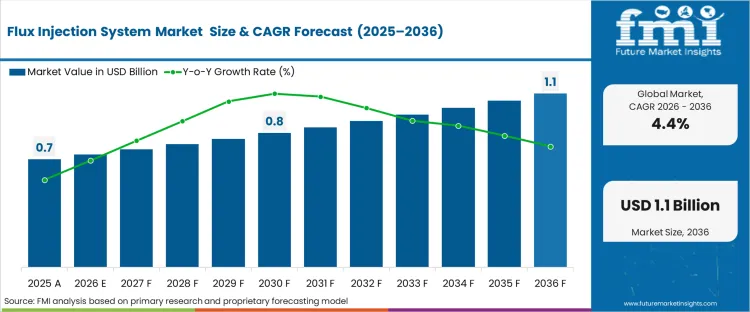
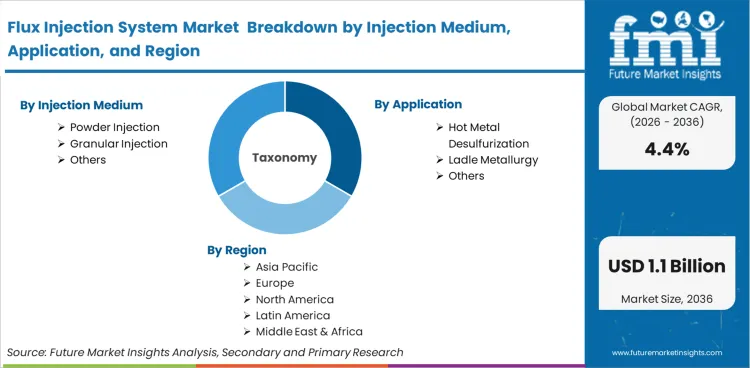
The flux injection system market was valued at USD 0.7 billion in 2025. The market is projected to reach USD 0.7 billion in 2026 and USD 1.0 billion by 2036, expanding at a CAGR of 4.4% during the forecast period. Powder injection is expected to lead the injection medium segment with a 52.3% share in 2026. Hot metal desulfurization is projected to remain the leading application with a 36.8% share in 2026. Steelmaking is expected to account for 58.7% of market revenue in 2026. The market is being supported by continued demand for low-sulfur steel, tighter refining control in secondary metallurgy, and persistent investment in hot metal treatment systems. Primetals continues to position desulfurization and hot metal treatment as core steelmaking solutions, while research published in 2025 reinforces the importance of injection rate, flow behavior, and ladle design in desulfurization efficiency.
Summary of Flux Injection System Market
- Key Drivers
- Low-sulfur steel demand remains the main driver. Flux injection systems are used where steel plants need tighter sulfur control before downstream refining and casting. Primetals explicitly markets hot metal treatment solutions for desulfurization, dephosphorization, and impurity reduction as part of steel quality improvement.
- The second driver is productivity. A commissioned Primetals desulfurization and dedusting system at ArcelorMittal Monlevade was described as reducing desulfurization-agent consumption and cutting processing times to below 30 minutes, which shows why plants still spend on this equipment category.
- The third driver is process optimization. A 2025 study in Steel Research International found that increasing powder injection rate increased total desulfurization rate, which supports continued spending on better-controlled injection, lance, and stirring systems rather than treating reagent addition as a crude bulk operation.
- Key Segments Analyzed in the Report
- Injection medium: powder injection, granular injection, combined reagent injection
- Application: hot metal desulfurization, ladle metallurgy, secondary refining, foundry metallurgy, others
- End use industry: steelmaking, foundries, non-ferrous metallurgy, others
- Region: North America, Latin America, Western Europe, Eastern Europe, East Asia, South Asia & Pacific, and Middle East & Africa
- Analyst Opinion
- Nikhil Kaitwade, Principal Consultant at Future Market Insights, says value in the flux injection system market sits less in the consumable itself and more in controlled metallurgy. Suppliers win when they combine injection accuracy, mixing efficiency, and plant-specific process engineering into a system that lowers sulfur reliably without turning treatment into a time and cost penalty.
Flux Injection System Market Definition
The flux injection system market includes equipment and integrated process systems used to inject powdered, granular, or blended reagents into molten metal for impurity control, desulfurization, inclusion modification, and related metallurgical treatment. It typically covers storage vessels, dosing systems, pressure conveying units, injection lances, stirring interfaces, control software, and associated engineering services. In practical terms, the market is most closely tied to hot metal desulfurization and ladle-based refining in steelmaking.
Flux Injection System Market Inclusions
- Revenue generated from reagent injection equipment used in hot metal and ladle treatment
- Control systems, dosing units, lances, vessels, and pressure-conveying packages tied to flux injection
- Engineering, retrofit, commissioning, and service revenue associated with metallurgical injection systems
Flux Injection System Market Exclusions
- Bulk flux sales not sold as part of equipment or system scope
- General ladle or furnace equipment without dedicated injection functionality
- Gas stirring systems that do not include reagent injection architecture
Flux Injection System Market Research Methodology
This study evaluates the flux injection system market across injection medium, application, end use industry, and region, using 2025 as the base year and 2026 to 2036 as the forecast period. Market value is expressed in USD billion. Evidence inputs include supplier solution pages for hot metal treatment and secondary metallurgy, steel-sector technical literature on desulfurization-agent injection, and industrial references describing lime and magnesium injection in hot metal treatment. Market sizing is built through triangulation across steel production intensity, hot metal treatment penetration, refining complexity, and replacement demand for process-control and conveying equipment.
Key Drivers, Restraints, and Trends in Flux Injection System Market
Drivers
Steel quality requirements continue to support demand. Sulfur control matters because downstream steel performance is sensitive to impurity levels, especially in higher-grade applications. Primetals positions hot metal treatment as a direct route to reducing impurities and improving refining economics. SMS group also continues to emphasize secondary metallurgy as a key quality-enabling stage in modern steel production.
Restraints
This is a specialist market with project-based demand. Adoption is constrained by high installation cost, plant-layout limitations, downtime sensitivity, and the fact that performance depends on the full metallurgy setup rather than the injection skid alone. A plant may need compatible ladle design, stirring conditions, dedusting, and process control to capture the full benefit. The 2025 ladle-structure study showed that geometry itself affects flow and agent dispersion, which means equipment performance is partly dependent on site conditions beyond the supplier’s package.
Trends
The trend is toward more engineered and model-driven treatment. Primetals’ older but still relevant Monlevade case described a Level 2 system that predicted end sulfur content with average deviations below 5 ppm, showing that the market is moving beyond simple reagent blowing toward predictive treatment control. Academic work published in 2025 also points to more systematic optimization of injection rate and flow dynamics.
Segmental Analysis
Flux Injection System Market Analysis by Injection Medium
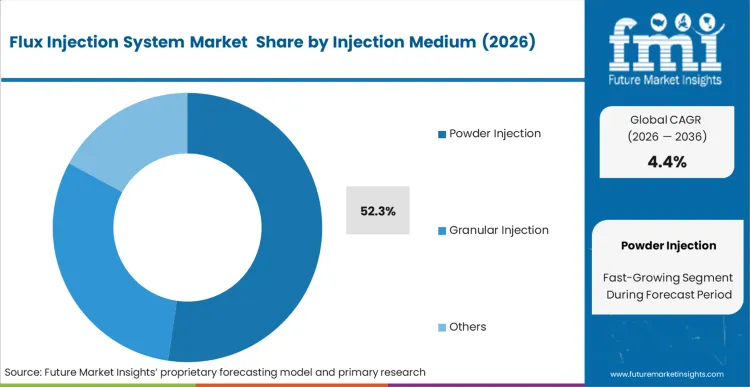
Powder injection is expected to hold the leading 52.3% share in 2026. Powder injection leads because fine reagents such as lime- and magnesium-based materials are widely used in hot metal desulfurization, and the process benefits from controllable pneumatic conveying and fast dispersion in molten metal. Industrial references from steel project documentation explicitly describe desulfurization through injection of lime powder and magnesium, while recent technical literature continues to focus on powder injection parameters.
Flux Injection System Market Analysis by Application
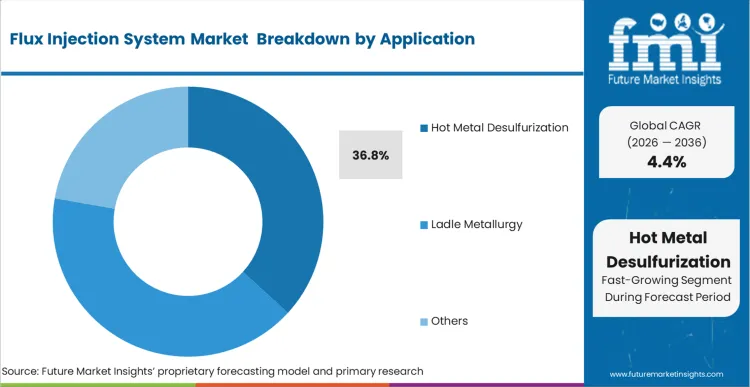
Hot metal desulfurization is projected to account for 36.8% of market revenue in 2026. It remains the anchor application because sulfur removal before converter or downstream refining improves process control and supports final steel quality. Primetals directly markets desulfurization under hot metal treatment, and its Monlevade project illustrates the commercial benefits in lower reagent consumption and faster treatment.
Competitive Aligners for Market Players
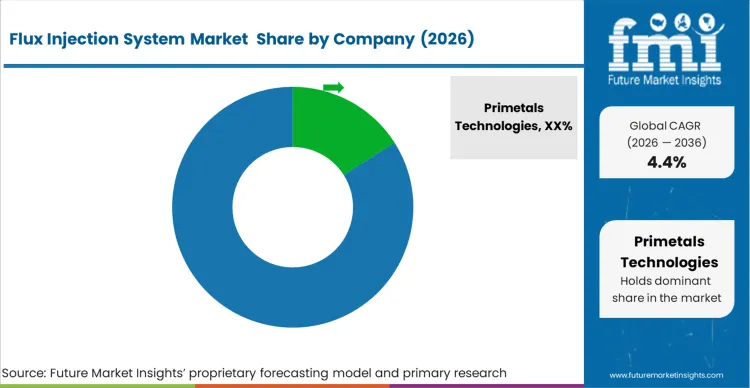
Competition in this market is rarely decided by the vessel, lance, or powder-delivery hardware alone. Buyers usually evaluate suppliers on whether the system can deliver consistent metallurgical outcomes inside the realities of plant operation, where temperature loss, treatment time, reagent efficiency, slag behavior, safety, and downstream steel quality all interact. That shifts competitive advantage toward firms that can combine metallurgical know-how with stable reagent-delivery control, plant integration capability, process modeling, automation support, and environmental systems such as fume extraction and dedusting. In practice, the customer is not buying an injection unit in isolation. The customer is buying a process result: cleaner metal, lower variability, better desulfurization or refining efficiency, and fewer operational disruptions.
The competitive field also favors companies that can participate earlier in capex and modernization decisions. Steelmakers often assess injection systems as one layer inside a wider secondary-metallurgy or hot-metal-treatment architecture. That means vendors with capabilities across adjacent refining equipment, automation platforms, and process-control systems often have an advantage because they can position their offering as part of a coherent operating philosophy rather than a standalone machine purchase. Primetals is clearly active in hot metal treatment and ladle furnace positioning, which strengthens its relevance where customers want injection capability tied to wider melt-shop logic. SMS group remains active across secondary metallurgy more broadly, and that matters because many buyers compare suppliers on total refining-line fit, future upgrade potential, and control-system compatibility rather than on injection equipment alone.
After-sales support is another serious competitive divider. These systems operate in harsh, interruption-sensitive environments, so buyers place real weight on commissioning support, operator training, maintenance response, spare-parts availability, and troubleshooting capability. A technically strong installation can still become a commercial disappointment if the supplier cannot stabilize performance quickly after startup or help the plant adapt the system to changing raw materials and production schedules. Firms that provide strong service, process optimization support, and data-led performance improvement are therefore better positioned than those relying on one-time equipment sales.
Key Players in Flux Injection System Market
- Primetals Technologies
- SMS group GmbH
- Danieli & C. Officine Meccaniche S.p.A.
- Tenova S.p.A.
- HASA Inc.
- REMONDIS QR GmbH
- Shandong Metallurgical Machinery Factory Co., Ltd.
- CISDI Group Co., Ltd.
- Sinosteel Equipment & Engineering Co., Ltd.
- MECON Limited
Strategic Outlook by FMI on Flux Injection System Market
The flux injection system market should expand steadily rather than dramatically. It is tied to steel plant metallurgy, not to broad discretionary capital spending. Growth will come from hot metal treatment upgrades, replacement of aging reagent-injection packages, tighter sulfur-control requirements, and continued demand for cleaner and more predictable refining. The firms best placed to grow are those that can show measurable sulfur reduction, lower reagent loss, tighter treatment time, and better plant integration.
Scope of the Report
| Metric | Value |
|---|---|
| Market Value | USD 0.7 billion in 2025 to USD 1.0 billion by 2036 |
| CAGR | 4.4% from 2026 to 2036 |
| Base Year | 2025 |
| Forecast Period | 2026 to 2036 |
| Injection Medium Segmentation | Powder Injection, Granular Injection, Combined Reagent Injection |
| Application Segmentation | Hot Metal Desulfurization, Ladle Metallurgy, Secondary Refining, Foundry Metallurgy, Others |
| End Use Industry Segmentation | Steelmaking, Foundries, Non-ferrous Metallurgy, Others |
| Regions Covered | North America, Latin America, Western Europe, Eastern Europe, East Asia, South Asia & Pacific, and Middle East & Africa |
Bibliography
- Primetals Technologies. Current. Hot Metal Treatment: Desulfurization for Steel Quality.
- Primetals Technologies. Current. Steelmaking.
- Primetals Technologies. Current. Innovative Secondary Metallurgy Solutions.
- Primetals Technologies. 2019. Hot Metal Desulfurization and Dedusting System from Primetals Technologies Successfully Commissioned at ArcelorMittal Monlevade.
- SMS group GmbH. Current. Secondary Metallurgy.
- Arruda, J. D., et al. 2025. Physical Modeling and Fluid Dynamic Simulation of Steel Desulfurization Powder Injection Process. Steel Research International.
- Wang, L., et al. 2025. A Study on the Effect of Ladle Structures and Stirrer Configurations on the Desulfurization Efficiency of Molten Iron. Metals.
Frequently Asked Questions
What is the current size of the flux injection system market?
The flux injection system market was valued at USD 0.7 billion in 2025.
What is the expected market value of the flux injection system market in 2026?
The market is projected to reach USD 0.7 billion in 2026.
What will be the flux injection system market value by 2036?
The market is forecast to reach USD 1.0 billion by 2036.
What is the projected CAGR of the flux injection system market?
The flux injection system market is projected to expand at a CAGR of 4.4% from 2026 to 2036.
The flux injection system market is projected to expand at a CAGR of 4.4% from 2026 to 2036.
Powder injection is expected to lead the market with a 52.3% share in 2026.
Which application leads the flux injection system market in 2026?
Hot metal desulfurization is projected to remain the leading application with a 36.8% share in 2026.
Which end-use industry leads the flux injection system market in 2026?
Steelmaking is expected to account for 58.7% of market revenue in 2026.
Preview the report firsthand - request a free sample
Get SampleGet the brochure for pricing and purchase details.
Get PDFTable of Content
- Executive Summary
- Global Market Outlook
- Demand-side Trends
- Supply-side Trends
- Technology Roadmap Analysis
- Analysis and Recommendations
- Market Overview
- Market Coverage / Taxonomy
- Market Definition / Scope / Limitations
- Research Methodology
- Chapter Orientation
- Analytical Lens and Working Hypotheses
- Market Structure, Signals, and Trend Drivers
- Benchmarking and Cross-market Comparability
- Market Sizing, Forecasting, and Opportunity Mapping
- Research Design and Evidence Framework
- Desk Research Programme (Secondary Evidence)
- Company Annual and Sustainability Reports
- Peer-reviewed Journals and Academic Literature
- Corporate Websites, Product Literature, and Technical Notes
- Earnings Decks and Investor Briefings
- Statutory Filings and Regulatory Disclosures
- Technical White Papers and Standards Notes
- Trade Journals, Industry Magazines, and Analyst Briefs
- Conference Proceedings, Webinars, and Seminar Materials
- Government Statistics Portals and Public Data Releases
- Press Releases and Reputable Media Coverage
- Specialist Newsletters and Curated Briefings
- Sector Databases and Reference Repositories
- FMI Internal Proprietary Databases and Historical Market Datasets
- Subscription Datasets and Paid Sources
- Social Channels, Communities, and Digital Listening Inputs
- Additional Desk Sources
- Expert Input and Fieldwork (Primary Evidence)
- Primary Modes
- Qualitative Interviews and Expert Elicitation
- Quantitative Surveys and Structured Data Capture
- Blended Approach
- Why Primary Evidence is Used
- Field Techniques
- Interviews
- Surveys
- Focus Groups
- Observational and In-context Research
- Social and Community Interactions
- Stakeholder Universe Engaged
- C-suite Leaders
- Board Members
- Presidents and Vice Presidents
- R&D and Innovation Heads
- Technical Specialists
- Domain Subject-matter Experts
- Scientists
- Physicians and Other Healthcare Professionals
- Governance, Ethics, and Data Stewardship
- Research Ethics
- Data Integrity and Handling
- Primary Modes
- Tooling, Models, and Reference Databases
- Desk Research Programme (Secondary Evidence)
- Data Engineering and Model Build
- Data Acquisition and Ingestion
- Cleaning, Normalisation, and Verification
- Synthesis, Triangulation, and Analysis
- Quality Assurance and Audit Trail
- Market Background
- Market Dynamics
- Drivers
- Restraints
- Opportunity
- Trends
- Scenario Forecast
- Demand in Optimistic Scenario
- Demand in Likely Scenario
- Demand in Conservative Scenario
- Opportunity Map Analysis
- Product Life Cycle Analysis
- Supply Chain Analysis
- Investment Feasibility Matrix
- Value Chain Analysis
- PESTLE and Porter’s Analysis
- Regulatory Landscape
- Regional Parent Market Outlook
- Production and Consumption Statistics
- Import and Export Statistics
- Market Dynamics
- Global Market Analysis 2021 to 2025 and Forecast, 2026 to 2036
- Historical Market Size Value (USD Million) Analysis, 2021 to 2025
- Current and Future Market Size Value (USD Million) Projections, 2026 to 2036
- Y-o-Y Growth Trend Analysis
- Absolute $ Opportunity Analysis
- Global Market Pricing Analysis 2021 to 2025 and Forecast 2026 to 2036
- Global Market Analysis 2021 to 2025 and Forecast 2026 to 2036, By Injection Medium
- Introduction / Key Findings
- Historical Market Size Value (USD Million) Analysis By Injection Medium , 2021 to 2025
- Current and Future Market Size Value (USD Million) Analysis and Forecast By Injection Medium , 2026 to 2036
- Powder Injection
- Granular Injection
- Others
- Powder Injection
- Y-o-Y Growth Trend Analysis By Injection Medium , 2021 to 2025
- Absolute $ Opportunity Analysis By Injection Medium , 2026 to 2036
- Global Market Analysis 2021 to 2025 and Forecast 2026 to 2036, By Application
- Introduction / Key Findings
- Historical Market Size Value (USD Million) Analysis By Application, 2021 to 2025
- Current and Future Market Size Value (USD Million) Analysis and Forecast By Application, 2026 to 2036
- Hot Metal Desulfurization
- Ladle Metallurgy
- Others
- Hot Metal Desulfurization
- Y-o-Y Growth Trend Analysis By Application, 2021 to 2025
- Absolute $ Opportunity Analysis By Application, 2026 to 2036
- Global Market Analysis 2021 to 2025 and Forecast 2026 to 2036, By Region
- Introduction
- Historical Market Size Value (USD Million) Analysis By Region, 2021 to 2025
- Current Market Size Value (USD Million) Analysis and Forecast By Region, 2026 to 2036
- North America
- Latin America
- Western Europe
- Eastern Europe
- East Asia
- South Asia and Pacific
- Middle East & Africa
- Market Attractiveness Analysis By Region
- North America Market Analysis 2021 to 2025 and Forecast 2026 to 2036, By Country
- Historical Market Size Value (USD Million) Trend Analysis By Market Taxonomy, 2021 to 2025
- Market Size Value (USD Million) Forecast By Market Taxonomy, 2026 to 2036
- By Country
- USA
- Canada
- Mexico
- By Injection Medium
- By Application
- By Country
- Market Attractiveness Analysis
- By Country
- By Injection Medium
- By Application
- Key Takeaways
- Latin America Market Analysis 2021 to 2025 and Forecast 2026 to 2036, By Country
- Historical Market Size Value (USD Million) Trend Analysis By Market Taxonomy, 2021 to 2025
- Market Size Value (USD Million) Forecast By Market Taxonomy, 2026 to 2036
- By Country
- Brazil
- Chile
- Rest of Latin America
- By Injection Medium
- By Application
- By Country
- Market Attractiveness Analysis
- By Country
- By Injection Medium
- By Application
- Key Takeaways
- Western Europe Market Analysis 2021 to 2025 and Forecast 2026 to 2036, By Country
- Historical Market Size Value (USD Million) Trend Analysis By Market Taxonomy, 2021 to 2025
- Market Size Value (USD Million) Forecast By Market Taxonomy, 2026 to 2036
- By Country
- Germany
- UK
- Italy
- Spain
- France
- Nordic
- BENELUX
- Rest of Western Europe
- By Injection Medium
- By Application
- By Country
- Market Attractiveness Analysis
- By Country
- By Injection Medium
- By Application
- Key Takeaways
- Eastern Europe Market Analysis 2021 to 2025 and Forecast 2026 to 2036, By Country
- Historical Market Size Value (USD Million) Trend Analysis By Market Taxonomy, 2021 to 2025
- Market Size Value (USD Million) Forecast By Market Taxonomy, 2026 to 2036
- By Country
- Russia
- Poland
- Hungary
- Balkan & Baltic
- Rest of Eastern Europe
- By Injection Medium
- By Application
- By Country
- Market Attractiveness Analysis
- By Country
- By Injection Medium
- By Application
- Key Takeaways
- East Asia Market Analysis 2021 to 2025 and Forecast 2026 to 2036, By Country
- Historical Market Size Value (USD Million) Trend Analysis By Market Taxonomy, 2021 to 2025
- Market Size Value (USD Million) Forecast By Market Taxonomy, 2026 to 2036
- By Country
- China
- Japan
- South Korea
- By Injection Medium
- By Application
- By Country
- Market Attractiveness Analysis
- By Country
- By Injection Medium
- By Application
- Key Takeaways
- South Asia and Pacific Market Analysis 2021 to 2025 and Forecast 2026 to 2036, By Country
- Historical Market Size Value (USD Million) Trend Analysis By Market Taxonomy, 2021 to 2025
- Market Size Value (USD Million) Forecast By Market Taxonomy, 2026 to 2036
- By Country
- India
- ASEAN
- Australia & New Zealand
- Rest of South Asia and Pacific
- By Injection Medium
- By Application
- By Country
- Market Attractiveness Analysis
- By Country
- By Injection Medium
- By Application
- Key Takeaways
- Middle East & Africa Market Analysis 2021 to 2025 and Forecast 2026 to 2036, By Country
- Historical Market Size Value (USD Million) Trend Analysis By Market Taxonomy, 2021 to 2025
- Market Size Value (USD Million) Forecast By Market Taxonomy, 2026 to 2036
- By Country
- Kingdom of Saudi Arabia
- Other GCC Countries
- Turkiye
- South Africa
- Other African Union
- Rest of Middle East & Africa
- By Injection Medium
- By Application
- By Country
- Market Attractiveness Analysis
- By Country
- By Injection Medium
- By Application
- Key Takeaways
- Key Countries Market Analysis
- USA
- Pricing Analysis
- Market Share Analysis, 2025
- By Injection Medium
- By Application
- Canada
- Pricing Analysis
- Market Share Analysis, 2025
- By Injection Medium
- By Application
- Mexico
- Pricing Analysis
- Market Share Analysis, 2025
- By Injection Medium
- By Application
- Brazil
- Pricing Analysis
- Market Share Analysis, 2025
- By Injection Medium
- By Application
- Chile
- Pricing Analysis
- Market Share Analysis, 2025
- By Injection Medium
- By Application
- Germany
- Pricing Analysis
- Market Share Analysis, 2025
- By Injection Medium
- By Application
- UK
- Pricing Analysis
- Market Share Analysis, 2025
- By Injection Medium
- By Application
- Italy
- Pricing Analysis
- Market Share Analysis, 2025
- By Injection Medium
- By Application
- Spain
- Pricing Analysis
- Market Share Analysis, 2025
- By Injection Medium
- By Application
- France
- Pricing Analysis
- Market Share Analysis, 2025
- By Injection Medium
- By Application
- India
- Pricing Analysis
- Market Share Analysis, 2025
- By Injection Medium
- By Application
- ASEAN
- Pricing Analysis
- Market Share Analysis, 2025
- By Injection Medium
- By Application
- Australia & New Zealand
- Pricing Analysis
- Market Share Analysis, 2025
- By Injection Medium
- By Application
- China
- Pricing Analysis
- Market Share Analysis, 2025
- By Injection Medium
- By Application
- Japan
- Pricing Analysis
- Market Share Analysis, 2025
- By Injection Medium
- By Application
- South Korea
- Pricing Analysis
- Market Share Analysis, 2025
- By Injection Medium
- By Application
- Russia
- Pricing Analysis
- Market Share Analysis, 2025
- By Injection Medium
- By Application
- Poland
- Pricing Analysis
- Market Share Analysis, 2025
- By Injection Medium
- By Application
- Hungary
- Pricing Analysis
- Market Share Analysis, 2025
- By Injection Medium
- By Application
- Kingdom of Saudi Arabia
- Pricing Analysis
- Market Share Analysis, 2025
- By Injection Medium
- By Application
- Turkiye
- Pricing Analysis
- Market Share Analysis, 2025
- By Injection Medium
- By Application
- South Africa
- Pricing Analysis
- Market Share Analysis, 2025
- By Injection Medium
- By Application
- USA
- Market Structure Analysis
- Competition Dashboard
- Competition Benchmarking
- Market Share Analysis of Top Players
- By Regional
- By Injection Medium
- By Application
- Competition Analysis
- Competition Deep Dive
- Primetals Technologies
- Overview
- Product Portfolio
- Profitability by Market Segments (Product/Age /Sales Channel/Region)
- Sales Footprint
- Strategy Overview
- Marketing Strategy
- Product Strategy
- Channel Strategy
- SMS group GmbH
- Danieli & C. Officine Meccaniche S.p.A.
- Tenova S.p.A.
- HASA Inc.
- REMONDIS QR GmbH
- Primetals Technologies
- Competition Deep Dive
- Assumptions & Acronyms Used


