

- Market Size (2026)
- USD 0.8 Bn
- Forecast (2036)
- USD 1.1 Bn
- CAGR (2026 to 2036)
- 4.2%
How big is Fountain Solution Additives Market in 2026?
USD 0.8 Billion in 2026 and USD 1.1 Billion by 2036 at a 4.2% CAGR.
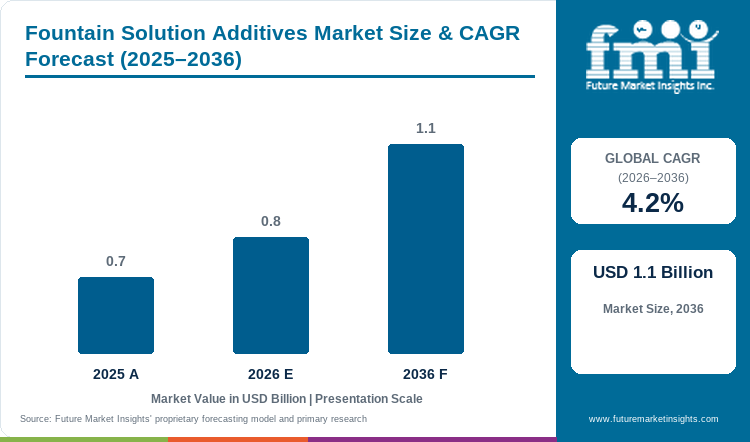
The Fountain Solution Additives market stood at USD 0.7 Billion in 2025, is estimated at USD 0.8 Billion in 2026, and is forecast to reach USD 1.1 Billion by 2036 at a 4.2% CAGR from 2026 to 2036.
Growth is anchored in a pressroom requirement rather than a broad expansion in all printed media. Offset printers need the dampening circuit to keep non-image areas water receptive while the image areas accept ink.
U.S. EPA guidance describes fountain solution as water mixed with buffer salts, wetting agents, and other additives. It also documents the long-running shift away from isopropyl alcohol toward alcohol substitutes to reduce volatile organic compound emissions.
That operating logic favors concentrates that control pH, lower surface tension, limit deposits and stabilize the ink-water window. High-speed sheetfed packaging presses raise the cost of instability because a short period of scumming or emulsification can waste sellable sheets.
The purchasing response is therefore selective: printers pay for chemistry when it reduces makeready loss, supports consistent density, and avoids unplanned cleaning rather than simply because an additive has a lower unit price.
Evidence basis: U.S. Environmental Protection Agency, Control Techniques Guidelines for Offset Lithographic Printing and Letterpress Printing, September 2006.
Country conditions produce different conversion rates even when the same technical problem exists. USA demand comes from a large and fragmented installed base where labor and waste control matter. Germany combines a sizable printing economy with formal qualification habits around press and material compatibility.
Japan places visible attention on chemical management and VOC control in print operations. Brazil has a regionally diverse printing structure where technical support and distribution reach can determine whether a chemistry change is practical.
France adds another contrast because publication printing has contracted more sharply than several specialized printed products. A supplier must prove that its concentrate works with local water and press configuration as well as the ink set and maintenance practice before interest becomes a purchase.
Qualification support is therefore as important as the formulation itself.
Key Takeaways
- The market is estimated at USD 0.8 Billion in 2026 and is forecast to reach USD 1.1 Billion by 2036 at a 4.2% CAGR.
- pH buffers lead 2026 Additive Type demand. Sheetfed offset leads 2026 Printing Process demand.
- Ink-water balance leads 2026 Function demand. Packaging printing leads 2026 End Use demand. Printing chemical suppliers lead 2026 Sales Channel demand.
- Driver: Printers need stable ink-water performance with lower IPA use, less waste, and fewer pressroom interruptions.
- Restraint: Fountain chemistry must be qualified against press materials, local water, inks and operating settings before a printer can switch with confidence.
- Opportunity: Suppliers can combine buffering, wetting, deposit control and alcohol replacement in low-dose formulations backed by technical service. Hungary has the highest profiled country CAGR at 5.4% compared with Japan at 3.4%.
Analyst Perspective
Revenue capture depends on proving lower pressroom risk rather than offering chemistry in isolation. A credible offer needs stable pH and conductivity behavior under the printer’s actual water conditions.
- Nikhil Kaitwade, Principal Consultant, Future Market Insights
How is the Fountain Solution Additives Market segmented?
The market is analyzed by Additive Type, Printing Process, Function, End Use, and Sales Channel.
Additive Type distinguishes the chemical task delivered into the dampening circuit. Printing Process separates operating conditions across sheetfed, web, packaging, and UV work. Function organizes demand by the pressroom problem that the additive is expected to control.
End Use captures the economics and quality thresholds of packaging, commercial, publication, book, and security printing. Sales Channel distinguishes how technical chemistry reaches the printer and how much application support accompanies the sale.
These axes matter because the same product can be selected for a different reason on a packaging press than on a coldset newspaper line. Purchase decisions also vary when the supplier sells through a specialist chemical channel rather than a general distributor or direct account.
What makes pH buffers central to the Additive Type category?
pH buffering is central because lithography depends on a controlled aqueous phase. The U.S. EPA identifies acids and buffer salts as standard fountain-solution components that maintain pH. Fogra’s fountain-concentrate test procedure also records pH and conductivity before corrosion or polymer-swell assessment.
That sequence reflects practical buying logic. Printers first need a repeatable chemical window before they assess secondary benefits. Buffer demand recurs because paper and ink can shift the working solution away from its target range. Make-up water and contamination can do the same.
Suppliers that combine buffering with hardness and deposit control can reduce the number of separate pressroom corrections needed during a shift.
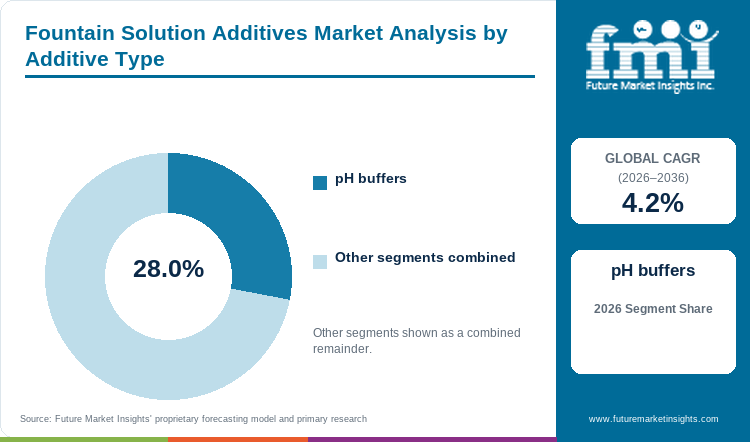
- pH buffers represent 28.0% of 2026 Additive Type demand because pH control is a continuous operating requirement in the fountain circuit.
- In January 2026, Fogra’s Heidelberg approval list continued to use controlled pH and conductivity testing for fountain-concentrate qualification.
Why does Sheetfed offset lead the Printing Process category?
Sheetfed offset combines a broad installed base with demanding changes in job mix. Commercial work requires fast makeready while folding-carton and label jobs raise expectations for repeatability. Sheetfed upgrades in the printing machines market raise the value of stable fountain chemistry.
UV and LED-UV ink systems increase the value of stable dampening because press settings and consumables must work together. Heidelberg offers current Saphira fountain products for conventional and UV sheetfed printing as well as LED and hybrid use.
The company’s 2025 Cartonmaster CX 145 launch shows continued investment in large-format sheetfed packaging equipment. As speed and substrate variety rise, printers have less tolerance for foaming or calcium deposits. Slow plate clean-up and unstable water transfer also become costlier.
- Sheetfed offset holds 34.0% of 2026 Printing Process demand because it spans commercial and packaging workflows with varied fountain-chemistry requirements.
- In June 2025, Heidelberg introduced the Cartonmaster CX 145 for folding-carton production. The launch reinforces the need for compatible chemistry around high-output sheetfed assets.
How does Ink-water balance shape the Function category?
Ink-water balance is the core control point because excess fountain solution can emulsify ink while inadequate wetting can allow non-image areas to accept ink. Direct supplier descriptions repeatedly frame fountain chemistry around stable balance and faster recovery after a stop.
Fujifilm markets formulations for conventional and UV work with claims around stable ink-water balance, reduced waste, and quicker restarts. Huber Group also positions several fountain concentrates around rapid plate free-running and stable dampening. The commercial value is measurable inside the pressroom.
A stable balance reduces operator intervention, protects usable sheet yield, and makes color control more repeatable across longer runs or frequent job changes.
- Ink-water balance leads 2026 Function demand because the dampening system must keep water and ink in a controlled relationship throughout production.
- In March 2022, Huber Group launched PERFECT-DRY-FIX for high-speed conventional and UV offset with emphasis on stable ink-water behavior and clean circulation.
What supports Packaging printing in End Use?
Packaging printing benefits from a different demand profile than publication printing. Folding cartons, labels, and branded packs require controlled color and consistent converting performance. Food and sensitive packaging can also add migration and odor constraints to the wider consumables set.
Heidelberg’s 2025 Cartonmaster launch targeted industrial folding-carton production, while Siegwerk continues to develop conventional and UV offset inks for sheetfed packaging. These investments do not prove fountain-additive volume on their own.
They do show why packaging printers need chemistry that remains compatible with faster presses and specialized ink systems. Additives that reduce deposits or support alcohol-free operation can therefore protect both uptime and finished-pack consistency.
- Packaging printing leads 2026 End Use demand because quality-sensitive sheetfed production creates recurring needs for stable dampening chemistry.
- In July 2026, France’s Insee reported that commercial printed matter including labels remained a large share of printing value even as overall printed volumes had declined since 2010.
What drives Printing chemical suppliers in the Sales Channel category?
Printing chemical suppliers lead because printers rarely select fountain additives as generic liquids. The dose must fit the press and ink system. Make-up water and the target pH or conductivity range also determine the specification.
Specialist suppliers can therefore add value through technical selection, troubleshooting, and operator guidance. Flint Group’s Varn business and Fujifilm’s pressroom-chemistry portfolio show this model directly.
Fogra approval lists add another layer because printers can use recognized qualification as a filter before on-press trials. Distributors remain important for local stock and service. Direct printer sales are strongest where the account is large enough to support tailored technical coverage.
- Printing chemical suppliers lead 2026 Sales Channel demand because technical fit and dosing support are part of the purchase decision.
- In April 2026, Flint Group stated that Varn Chemicals would remain a global solutions partner for Sheetfed Offset within its new packaging-solutions structure.
What are the drivers, restraints, and opportunities in the Fountain Solution Additives Market?
Demand is supported by lower-alcohol and more stable press operation, while qualification risk slows switching and multifunctional low-VOC chemistry creates the clearest product opportunity.
- Driver: Printers need stable ink-water performance with lower IPA use, less waste, and fewer pressroom interruptions.
- Restraint: Fountain chemistry must be qualified against press materials, local water, inks and operating settings before a printer can switch with confidence.
- Opportunity: Suppliers can combine buffering, wetting, deposit control and alcohol replacement in low-dose formulations backed by technical service.
The main demand mechanism is the cost of unstable dampening under tighter environmental and productivity expectations. EPA guidance formalized the move toward lower alcohol content and alcohol substitutes in offset fountain solutions. That change matters because IPA historically improved wetting and viscosity.
Replacing it requires surfactants and other chemistry that must still keep the plate clean without causing foam or emulsification. Modern pressrooms also put a high value on rapid restarts and reduced waste.
The purchasing response is more frequent use of tailored concentrates rather than simple water-plus-alcohol recipes. Suppliers that demonstrate stable operation at lower VOC levels can tie product value directly to usable sheets and press availability.
The restraint appears at qualification and changeover. Fogra evaluates fountain concentrates through pH, conductivity, corrosion and polymer compatibility tests. Press manufacturers also maintain release lists or approve materials for specific equipment families.
A printer that changes chemistry without this assurance risks roller swelling, plate problems, deposits or prolonged retuning. Local water hardness adds another variable because the same dose can behave differently from one plant to another. This does not remove demand.
It slows conversion and favors incumbent formulations once operators have a stable recipe. New suppliers therefore face a technical proof burden before price or procurement terms can decide the order.
The clearest opportunity is a multifunctional formulation that reduces the number of pressroom corrections while supporting alcohol-free or low-alcohol operation. Fujifilm markets fountain products that combine wetting with calcium control, plate protection, or zero-VOC positioning.
Huber Group offers related products for alcohol reduction and water-hardness adjustment. The opportunity becomes revenue when such claims are validated on the printer’s actual press and water conditions.
Suppliers with application laboratories, local technical staff, and qualification records are best placed to capture this opening. The product must be easier to run and easier to approve. A lower chemical dose alone is not enough if it raises downtime or troubleshooting cost.
Which country CAGRs are profiled in the Fountain Solution Additives Market?
| Country | CAGR |
|---|---|
| USA | 4.4% |
| Germany | 4.1% |
| Japan | 3.4% |
| Brazil | 4.8% |
| France | 3.7% |
| Hungary | 5.4% |
| Mexico | 5.1% |
How do country-level CAGRs compare in the Fountain Solution Additives Market?
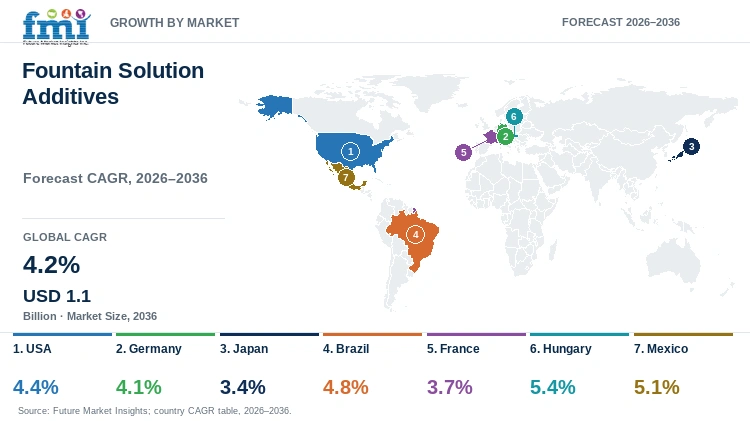
The seven profiled countries span a 2.0 percentage-point range. Hungary leads at 5.4% CAGR from 2026 to 2036 and Mexico follows at 5.1%. Brazil forms the next band at 4.8% while the USA and Germany sit near the market average at 4.4% and 4.1%. France is lower at 3.7% and Japan records the most measured rate at 3.4%.
These differences indicate the pace at which suppliers may need to add channel support or technical resources. They do not indicate the absolute revenue size of each country. Installed press base and print mix still matter.
- Hungary’s 0.3-point lead over Mexico supports earlier attention to technical channel development in Central Europe, especially where packaging investment is adding new production capability.
- Mexico’s 0.3-point lead over Brazil suggests both Latin American markets merit distributor depth, but Mexico offers the faster compounding path across a highly fragmented printing base.
- Brazil’s 0.4-point lead over USA reflects faster forecast expansion rather than a larger buyer pool. Regional logistics and service access remain more decisive in Brazil.
- Germany’s 0.4-point lead over France and France’s 0.3-point lead over Japan point to a mature-market pattern where supplier gains depend more on replacement, qualification, and efficiency than greenfield print growth.
CAGR should be read with installed capacity, press utilization, print-sector mix and the cost of serving the account. A smaller market can grow quickly from a narrower base. A larger market can still generate more absolute demand at a lower rate. Supplier planning should therefore combine these country growth rates with the broader regional coverage in the full report and with plant-level qualification requirements.
Country-wise Analysis
- USA: The USA combines a large installed print base with a fragmented buyer structure. Demand for fountain solution additives in the USA is forecast to expand at 4.4% CAGR from 2026 to 2036. U.S. Bureau of Labor Statistics data extracted on 3 September 2026 showed 27,291 private printing and related-support establishments in first-quarter 2026. That breadth creates many application conditions and places pressure on distributors to carry proven chemistry. The local friction is structural pressure on some commercial and publication printing volumes. Suppliers can win by linking low-alcohol chemistry to waste reduction, faster restarts and technical service that covers diverse press fleets.
- Germany: German printers buy into a mature technical culture where process control and material qualification carry weight. Demand for fountain solution additives in Germany is forecast to rise at 4.1% CAGR from 2026 to 2036. BVDM reported in 2026 that the German printing industry generated an estimated EUR 18.3 billion of revenue in 2025 and consisted of about 6,000 mostly small and medium-sized businesses. The friction is cost pressure alongside conservative change control. Suppliers need Fogra or OEM-relevant evidence, stable regional distribution and clear dosage economics before a printer replaces a proven fountain recipe.
- Japan: Japanese printers operate under visible chemical-management and emissions discipline. Demand for fountain solution additives in Japan is forecast to expand at 3.4% CAGR from 2026 to 2036. On 9 July 2026 the Japan Federation of Printing Industries opened its annual survey on VOC emissions and treatment across member printing businesses. JFPI also continued seminars on new chemical-management rules that entered full implementation in 2024. The friction is the time required to validate safety documentation and process stability. Suppliers need precise SDS support, low-VOC options and disciplined technical trials rather than a broad substitution pitch.
- Brazil: Brazilian demand is shaped by large geographic distances and uneven access to specialized pressroom support. Demand for fountain solution additives in Brazil is forecast to grow at 4.8% CAGR from 2026 to 2036. In June 2026, Abigraf Nacional reported that it had completed the incorporation of Andigraf and restored representation across northern and northeastern states. The same update highlighted regional differences in labor availability and cost sensitivity. The friction is therefore not only chemistry price. Suppliers need local stock, Portuguese-language technical support and regional service partners that can tune formulations to water and press conditions.
- France: French printers are balancing a fragmented enterprise base against long-term contraction in several publication categories. Demand for fountain solution additives in France is forecast to rise at 3.7% CAGR from 2026 to 2036. Insee reported on 28 July 2026 that France had about 16,000 printing businesses and that printed-product volume had declined by roughly 30% from 2010 to 2023. Commercial printed matter including labels still represented 45% of production value. The friction is weak volume growth in traditional work. Suppliers should focus on labels and commercial work alongside books, security applications and packaging-oriented sheetfed production.
- Hungary: Hungary offers a smaller but faster-growing profile with packaging investment as a practical demand signal. Demand for fountain solution additives in Hungary is forecast to expand at 5.4% CAGR from 2026 to 2036. On November 25, 2024, the Hungarian Investment Promotion Agency announced a EUR 34.4 million DS Smith program across three Hungarian facilities that was expected to raise packaging capacity by more than 40%. The friction is the limited scale of the domestic buyer base compared with larger Western European markets. Suppliers should secure distributor coverage and target packaging converters where new equipment raises the value of stable pressroom chemistry.
- Mexico: Mexico has a broad population of small print establishments that creates demand for accessible technical support. Demand for fountain solution additives in Mexico is forecast to expand at 5.1% CAGR from 2026 to 2036. Data México reported 20,818 printing and related-support economic units in May 2026 with the majority employing ten or fewer people. The friction is fragmented purchasing power and inconsistent access to specialist pressroom expertise. Suppliers can improve conversion through distributor training and smaller pack sizes. Local inventory and troubleshooting can help printers move from generic dampening recipes to controlled low-alcohol formulations.
Who are the notable companies in the Fountain Solution Additives Market?
Fujifilm and Agfa are profiled. Kodak and Heidelberg are also covered. Huber Group and Flint Group are also covered. Toyo Ink and Siegwerk are also covered. DIC Corporation and Varn International complete the notable-company set.
The competitive set extends beyond direct fountain-concentrate manufacturers because offset consumables are specified as a system. Fujifilm and Heidelberg sit alongside Huber Group and Flint Group. Varn International also serves pressrooms through fountain products or technical supply.
Toyo Ink has additional direct relevance through Fogra-listed ReneuFount products, while Siegwerk and DIC Corporation influence the operating window through conventional and UV offset ink systems. Kodak contributes through plates and prepress technology that affect press setup and process consistency.
Agfa’s role requires a qualification: it completed the sale of its Offset Solutions business in April 2023. The buyer therefore compares chemistry performance alongside the supplier’s offset expertise, service reach, and ability to support qualification on installed equipment.
- Pressroom chemistry and systems integration: Fujifilm and Heidelberg compete alongside Huber Group and Flint Group. Varn International also serves this group through fountain formulations and consumables support close to pressroom operations.
- Offset ink and consumables ecosystems: Toyo Ink, Siegwerk and DIC Corporation influence fountain performance through ink-water interaction, UV or conventional offset expertise and technical customer relationships.
- Prepress and legacy offset-platform influence: Kodak and Agfa shape the wider offset workflow through plates, prepress, or former offset-solution relationships. Agfa’s direct offset-solutions ownership changed after the 2023 divestiture.
Competitive Benchmarking: Fountain Solution Additives Market
| Company | Direct Fountain Chemistry | Offset Process Integration | OEM/Technical Access | Geographic Reach |
|---|---|---|---|---|
| Fujifilm | High | High | Medium | Global pressroom-supplies network |
| Agfa | Low | Low | Unscored | Global corporate reach; direct Offset Solutions business divested in 2023 |
| Kodak | Unscored | Medium | Medium | Global offset plate and prepress network |
| Heidelberg | High | High | High | Global press, service, and consumables network |
| Huber Group | High | Medium | Medium | Europe, Asia, and the Americas through group operations |
| Flint Group | High | High | High | Global print consumables and technical-service network |
| Toyo Ink | High | Medium | High | Asia and international group network |
| Siegwerk | Unscored | Medium | Medium | Global packaging ink and coatings network |
| DIC Corporation | Unscored | Medium | Medium | Global printing ink and materials network |
| Varn International | High | High | High | Global reach through the Flint Group pressroom-chemistry business |
Scoring basis: Direct Fountain Chemistry measures documented fountain-solution or fountain-additive offerings. High indicates broad direct evidence, Medium would indicate narrower evidence, and Low indicates a documented structural limitation such as Agfa’s completed divestiture of its Offset Solutions business.
Offset Process Integration measures how directly the supplier’s offset consumables or equipment position connects with dampening performance. OEM/Technical Access measures documented press-manufacturer linkage, qualification evidence, or specialist pressroom support.
High indicates deep documented capability and Medium indicates credible but narrower coverage. Unavailable public evidence is marked Unscored rather than Low. Geographic Reach describes evidenced operating or service scope and is not a company market-share measure.
Key Developments in the Fountain Solution Additives Market
- In June 2025, Heidelberg introduced the Cartonmaster CX 145 for folding-carton production in very-large-format sheetfed offset. The launch targeted industrial packaging output and extended Heidelberg’s press platform in a segment where stable dampening and consumable compatibility are critical to usable sheet yield. The commercial implication for fountain-additive suppliers is a larger technical requirement around high-output packaging presses rather than an automatic increase in additive volume.
Key Players in the Fountain Solution Additives Market
Pressroom Chemistry and Systems Integration
- Fujifilm
- Heidelberg
- Huber Group
- Flint Group
- Varn International
Offset Ink and Consumables Ecosystems
- Toyo Ink
- Siegwerk
- DIC Corporation
Prepress and Legacy Offset-Platform Influence
- Kodak
- Agfa
Fountain Solution Additives Market - Report Scope
| Coverage field | Report scope |
|---|---|
| Market breakdown | Additive Type, Printing Process, Function, End Use, and Sales Channel |
| Quantitative Units | USD Billion |
| Market Definition | Revenue includes fountain solution additives sold for use in offset-printing dampening circuits within the stated segmentation universe. It excludes downstream printed-product revenue, inks and coatings sold as separate categories, press hardware, plates, and adjacent or substitute chemistry outside the fountain-solution application. |
| Regions Covered | North America; Latin America; Western Europe; Eastern Europe; East Asia; South Asia and Pacific; Middle East and Africa |
| Countries Covered | USA, Germany, Japan, Brazil, France, Hungary, Mexico, and more than twenty-five additional countries in the full report |
| Key Companies Profiled | Fujifilm, Agfa, Kodak, Heidelberg, Huber Group, Flint Group, Toyo Ink, Siegwerk, DIC Corporation, Varn International |
| Forecast Period | 2026 to 2036 |
| Approach | Market sizing uses a hybrid bottom-up and top-down approach that reconciles supplier activity, application demand, installed printing capacity, channel checks, and macro or sector indicators within the defined revenue boundary. |
Fountain Solution Additives Market - Research Methodology
| Method | Approach |
|---|---|
| Primary Research | FMI consults printing chemical suppliers and pressroom service providers. Printers and distributors explain product qualification and replacement cycles. The research tests purchase criteria and adoption barriers. |
| Desk Research | FMI reviews environmental guidance and printing statistics. Company documentation and industry standards support the defined fountain-solution boundary. Sources are retained when they support the defined market boundary. |
| Market Sizing and Forecasting | FMI reconciles supplier revenue with additive use in offset printing. Forecasts reflect packaging activity and alcohol-reduction trends. Country conditions and channel structure are checked against the revenue boundary. |
| Data Validation | Findings are checked against independent evidence. The estimate excludes finished-print revenue and separately sold inks or hardware. Duplicate channel value and unsupported shares are removed. |
Fountain Solution Additives Market by Segments
Fountain Solution Additives Market segmented by Additive Type:
- pH buffers
- Alcohol substitutes
- Wetting agents
- Anti-foaming additives
- Biocides/cleaning additives
Fountain Solution Additives Market segmented by Printing Process:
- Sheetfed offset
- Heatset web offset
- Coldset web offset
- Packaging offset
- UV offset
Fountain Solution Additives Market segmented by Function:
- Ink-water balance
- Plate protection
- Drying support
- Conductivity control
- Deposit control
Fountain Solution Additives Market segmented by End Use:
- Packaging printing
- Commercial printing
- Newspaper printing
- Book printing
- Security printing
Fountain Solution Additives Market segmented by Sales Channel:
- Printing chemical suppliers
- Distributors
- Pressroom service providers
- Direct printers
Fountain Solution Additives Market segmented by Region:
- North America
- United States
- Canada
- Latin America
- Brazil
- Mexico
- Argentina
- Chile
- Western Europe
- Germany
- France
- United Kingdom
- Italy
- Spain
- Benelux
- Nordics
- Eastern Europe
- Poland
- Czech Republic
- Romania
- Hungary
- East Asia
- China
- Japan
- South Korea
- South Asia and Pacific
- India
- ASEAN
- Australia and New Zealand
- Middle East and Africa
- GCC Countries
- South Africa
- Türkiye
- Israel
Research Sources and Bibliography
- U.S. Environmental Protection Agency (2006, September). Control Techniques Guidelines for Offset Lithographic Printing and Letterpress Printing.
- Fogra Research Institute for Media Technologies (2026, January 16). Fountain Concentrate Approval.
- Fogra Research Institute for Media Technologies (2026, September 4). Fountain Concentrates: Test Criteria and Certification Information.
- Fujifilm (2026, September 4). Fountain Solutions for Offset Printing.
- Huber Group (2022, March 1). New Fountain Solution Additive PERFECT-DRY-FIX for High-Speed Offset Printing.
- Flint Group (2026, April 1). Flint Group Packaging Solutions Opens a New Chapter in Packaging Innovation.
- Agfa-Gevaert Group (2023, April 4). Agfa-Gevaert Group Completes Sale of its Offset Solutions Division.
- Heidelberg (2025, June 2). HEIDELBERG Launches Cartonmaster CX 145 for Industrial Folding Carton Production.
- U.S. Bureau of Labor Statistics (2026, September 3). Printing and Related Support Activities: NAICS 323.
- Bundesverband Druck und Medien e.V. (2026, September 4). Wirtschaftliche Lage & Branchendaten: Druckindustrie.
- Japan Federation of Printing Industries (2026, July 9). 2026 VOC Emissions and Treatment Survey for the Printing Industry.
- Abigraf Nacional (2026, June 8). Abigraf Nacional Concludes Incorporation of Andigraf and Expands National Representation.
- Insee (2026, July 28). Les entreprises de l’imprimerie depuis 2010 : la production recule, les usages se modifient.
- Hungarian Investment Promotion Agency (2024, November 25). A Global Player in Packaging Technology Expands Operations in Hungary at Three Locations.
- Ministry of Economy of Mexico, Data México (2026, May). Impresión e Industrias Conexas: Rama Industrial 3231.
This bibliography is provided for reader reference and is not exhaustive. The full report contains the complete reference list and detailed citations.
This Report Answers
- What is the Fountain Solution Additives Market size in 2026 and what value is forecast for 2036?
- Which pressroom, environmental, and productivity pressures support demand for fountain solution additives?
- Why do pH buffers hold the leading position within Additive Type?
- How does Sheetfed offset influence downstream demand for fountain solution chemistry?
- Why does Ink-water balance hold the leading position within the Function category?
- How do the profiled country growth rates compare for the Fountain Solution Additives market?
- Which companies provide direct fountain chemistry and which participate through wider offset consumables or platform roles?
- What qualification, compatibility, and switching frictions limit adoption of new fountain formulations?
Frequently Asked Questions
What is driving growth in the Fountain Solution Additives Market?
Growth is driven by the need to hold a stable ink-water window while printers reduce IPA use and control waste. Packaging and higher-speed sheetfed work increase the cost of deposits, foaming, emulsification and slow press recovery.
Who are the key players in the Fountain Solution Additives Market?
Fujifilm, Agfa and Kodak are among the profiled suppliers. The wider group listed under Key Players spans pressroom chemistry and linked ink, plate and press platforms.
What notable restraint affects the Fountain Solution Additives Market?
The working solution interacts with water hardness and rollers as well as plates, inks and press settings. Printers rarely change a stable recipe without proof of compatibility and controlled pH or conductivity.
Why should executives track the Fountain Solution Additives Market?
Fountain chemistry affects usable sheet yield, press uptime, restart performance and the ability to operate with lower alcohol content. Executives should track the category because a low-cost chemical decision can create much larger costs through waste or downtime.
What business problem does the Fountain Solution Additives Market address?
The additive keeps non-image plate areas wet while allowing clean ink transfer. It also manages pH and surface tension, plus foam and deposits. Plate protection and conductivity remain part of the maintenance case.
What should pressroom managers evaluate in the Fountain Solution Additives Market?
Pressroom managers should test water chemistry and dose before checking pH and conductivity. Ink compatibility and roller or plate effects also matter. They need a clear VOC profile, qualification status and supplier troubleshooting.
What limits return on investment in the Fountain Solution Additives Market?
A cheaper concentrate can erode returns through waste and slow makeready. Deposits and frequent cleaning add cost, while unstable color control creates further loss. Operator retuning can raise switching cost without strong supplier support.
What supports long-term commercial confidence in the Fountain Solution Additives Market?
Long-term confidence comes from the continuing need for controlled dampening in offset printing and the persistence of packaging-oriented sheetfed work. Low-alcohol operation, qualification discipline, and demand for reliable press uptime support recurring purchases even as some publication print segments contract.
Preview the report firsthand - request a free sample
Get SampleGet the brochure for pricing and purchase details.
Get PDFTable of Content
- Key Takeaways
- Market Size and CAGR
- Top Growth Driver
- Fastest Growing Segment
- Leading Region
- Key Companies
- Emerging Opportunities
- Executive Summary
- Global Market Outlook
- Demand-side Trends
- Supply-side Trends
- Technology Roadmap Analysis
- Analysis and Recommendations
- Analyst Perspective (What is happening? Why now? What should investors know?)
- Key Questions Answered
- How large is the market?
- What is the CAGR?
- What are key trends?
- Which region dominates?
- Who are the leaders?
- Market Overview
- Market Coverage / Taxonomy
- Market Definition / Scope / Limitations
- Research Methodology
- Chapter Orientation
- Analytical Lens and Working Hypotheses
- Market Structure, Signals, and Trend Drivers
- Benchmarking and Cross-market Comparability
- Market Sizing, Forecasting, and Opportunity Mapping
- Research Design and Evidence Framework
- Desk Research Programme (Secondary Evidence)
- Expert Input and Fieldwork (Primary Evidence)
- Tooling, Models, and Reference Databases
- Data Engineering and Model Build
- Quality Assurance and Audit Trail
- Market Background
- Market Dynamics (Drivers, Restraints, Opportunity, Trends)
- Scenario Forecast (Optimistic, Likely, Conservative)
- Impact Analysis
- AI Impact
- Sustainability Impact
- Regulatory Impact
- Technology Impact
- Consumer / Buyer Analysis
- Purchase Drivers
- Adoption Barriers
- Buyer Journey
- Opportunity Map Analysis
- Product Life Cycle Analysis
- Supply Chain Analysis
- Investment Feasibility Matrix
- Value Chain Analysis
- PESTLE and Porter's Analysis
- Regulatory Landscape
- Regional Parent Market Outlook
- Production and Consumption Statistics
- Import and Export Statistics
- Global Market Analysis and Forecast, 2021 to 2036
- Historical Market Size Value (USD Billion) Analysis, 2021 to 2025
- Current and Future Market Size Value (USD Billion) Projections, 2026 to 2036
- Y-o-Y Growth Trend Analysis
- Absolute $ Opportunity Analysis
- Global Market Pricing Analysis, 2021 to 2036
- Global Market Analysis and Forecast, By Additive Type, 2021 to 2036
- Introduction / Key Findings
- Historical Market Size Value (USD Billion) Analysis By Additive Type, 2021 to 2025
- Current and Future Market Size Value (USD Billion) Analysis and Forecast By Additive Type, 2026 to 2036
- pH buffers
- Alcohol substitutes
- Wetting agents
- Anti-foaming additives
- Biocides/cleaning additives
- Y-o-Y Growth Trend Analysis By Additive Type, 2021 to 2025
- Absolute $ Opportunity Analysis By Additive Type, 2026 to 2036
- Global Market Analysis and Forecast, By Printing Process, 2021 to 2036
- Introduction / Key Findings
- Historical Market Size Value (USD Billion) Analysis By Printing Process, 2021 to 2025
- Current and Future Market Size Value (USD Billion) Analysis and Forecast By Printing Process, 2026 to 2036
- Sheetfed offset
- Heatset web offset
- Coldset web offset
- Packaging offset
- UV offset
- Y-o-Y Growth Trend Analysis By Printing Process, 2021 to 2025
- Absolute $ Opportunity Analysis By Printing Process, 2026 to 2036
- Global Market Analysis and Forecast, By Function, 2021 to 2036
- Introduction / Key Findings
- Historical Market Size Value (USD Billion) Analysis By Function, 2021 to 2025
- Current and Future Market Size Value (USD Billion) Analysis and Forecast By Function, 2026 to 2036
- Ink-water balance
- Plate protection
- Drying support
- Conductivity control
- Deposit control
- Y-o-Y Growth Trend Analysis By Function, 2021 to 2025
- Absolute $ Opportunity Analysis By Function, 2026 to 2036
- Global Market Analysis and Forecast, By End Use, 2021 to 2036
- Introduction / Key Findings
- Historical Market Size Value (USD Billion) Analysis By End Use, 2021 to 2025
- Current and Future Market Size Value (USD Billion) Analysis and Forecast By End Use, 2026 to 2036
- Packaging printing
- Commercial printing
- Newspaper printing
- Book printing
- Security printing
- Y-o-Y Growth Trend Analysis By End Use, 2021 to 2025
- Absolute $ Opportunity Analysis By End Use, 2026 to 2036
- Global Market Analysis and Forecast, By Sales Channel, 2021 to 2036
- Introduction / Key Findings
- Historical Market Size Value (USD Billion) Analysis By Sales Channel, 2021 to 2025
- Current and Future Market Size Value (USD Billion) Analysis and Forecast By Sales Channel, 2026 to 2036
- Printing chemical suppliers
- Distributors
- Pressroom service providers
- Direct printers
- Y-o-Y Growth Trend Analysis By Sales Channel, 2021 to 2025
- Absolute $ Opportunity Analysis By Sales Channel, 2026 to 2036
- Global Market Analysis and Forecast, By Region, 2021 to 2036
- Introduction
- Historical Market Size Value (USD Billion) Analysis By Region, 2021 to 2025
- Current Market Size Value (USD Billion) Analysis and Forecast By Region, 2026 to 2036
- North America
- Latin America
- Western Europe
- Eastern Europe
- East Asia
- South Asia and Pacific
- Middle East and Africa
- Market Attractiveness Analysis By Region
- North America Market Analysis and Forecast, By Country, 2021 to 2036
- Historical Market Size Value (USD Billion) Trend Analysis By Market Taxonomy, 2021 to 2025
- Market Size Value (USD Billion) Forecast By Market Taxonomy, 2026 to 2036
- By Country
- United States
- Canada
- By Additive Type
- By Printing Process
- By Function
- By End Use
- By Sales Channel
- By Country
- Market Attractiveness Analysis
- By Country
- By Additive Type
- By Printing Process
- By Function
- By End Use
- By Sales Channel
- Key Takeaways
- Latin America Market Analysis and Forecast, By Country
- Historical Market Size Value (USD Billion) Trend Analysis By Market Taxonomy, 2021 to 2025
- Market Size Value (USD Billion) Forecast By Market Taxonomy, 2026 to 2036
- By Country
- Brazil
- Mexico
- Argentina
- Chile
- By Additive Type
- By Printing Process
- By Function
- By End Use
- By Sales Channel
- By Country
- Market Attractiveness Analysis
- By Country
- By Additive Type
- By Printing Process
- By Function
- By End Use
- By Sales Channel
- Key Takeaways
- Western Europe Market Analysis and Forecast, By Country
- Historical Market Size Value (USD Billion) Trend Analysis By Market Taxonomy, 2021 to 2025
- Market Size Value (USD Billion) Forecast By Market Taxonomy, 2026 to 2036
- By Country
- Germany
- France
- United Kingdom
- Italy
- Spain
- Benelux
- Nordics
- By Additive Type
- By Printing Process
- By Function
- By End Use
- By Sales Channel
- By Country
- Market Attractiveness Analysis
- By Country
- By Additive Type
- By Printing Process
- By Function
- By End Use
- By Sales Channel
- Key Takeaways
- Eastern Europe Market Analysis and Forecast, By Country
- Historical Market Size Value (USD Billion) Trend Analysis By Market Taxonomy, 2021 to 2025
- Market Size Value (USD Billion) Forecast By Market Taxonomy, 2026 to 2036
- By Country
- Poland
- Czech Republic
- Romania
- Hungary
- By Additive Type
- By Printing Process
- By Function
- By End Use
- By Sales Channel
- By Country
- Market Attractiveness Analysis
- By Country
- By Additive Type
- By Printing Process
- By Function
- By End Use
- By Sales Channel
- Key Takeaways
- East Asia Market Analysis and Forecast, By Country
- Historical Market Size Value (USD Billion) Trend Analysis By Market Taxonomy, 2021 to 2025
- Market Size Value (USD Billion) Forecast By Market Taxonomy, 2026 to 2036
- By Country
- China
- Japan
- South Korea
- By Additive Type
- By Printing Process
- By Function
- By End Use
- By Sales Channel
- By Country
- Market Attractiveness Analysis
- By Country
- By Additive Type
- By Printing Process
- By Function
- By End Use
- By Sales Channel
- Key Takeaways
- South Asia and Pacific Market Analysis and Forecast, By Country
- Historical Market Size Value (USD Billion) Trend Analysis By Market Taxonomy, 2021 to 2025
- Market Size Value (USD Billion) Forecast By Market Taxonomy, 2026 to 2036
- By Country
- India
- ASEAN
- Australia and New Zealand
- By Additive Type
- By Printing Process
- By Function
- By End Use
- By Sales Channel
- By Country
- Market Attractiveness Analysis
- By Country
- By Additive Type
- By Printing Process
- By Function
- By End Use
- By Sales Channel
- Key Takeaways
- Middle East and Africa Market Analysis and Forecast, By Country
- Historical Market Size Value (USD Billion) Trend Analysis By Market Taxonomy, 2021 to 2025
- Market Size Value (USD Billion) Forecast By Market Taxonomy, 2026 to 2036
- By Country
- GCC Countries
- South Africa
- Türkiye
- Israel
- By Additive Type
- By Printing Process
- By Function
- By End Use
- By Sales Channel
- By Country
- Market Attractiveness Analysis
- By Country
- By Additive Type
- By Printing Process
- By Function
- By End Use
- By Sales Channel
- Key Takeaways
- Key Countries Market Analysis
- United States
- Pricing Analysis
- Market Share Analysis, 2025
- By Additive Type
- By Printing Process
- By Function
- By End Use
- By Sales Channel
- Canada
- Pricing Analysis
- Market Share Analysis, 2025
- By Additive Type
- By Printing Process
- By Function
- By End Use
- By Sales Channel
- Mexico
- Pricing Analysis
- Market Share Analysis, 2025
- By Additive Type
- By Printing Process
- By Function
- By End Use
- By Sales Channel
- Brazil
- Pricing Analysis
- Market Share Analysis, 2025
- By Additive Type
- By Printing Process
- By Function
- By End Use
- By Sales Channel
- Chile
- Pricing Analysis
- Market Share Analysis, 2025
- By Additive Type
- By Printing Process
- By Function
- By End Use
- By Sales Channel
- Germany
- Pricing Analysis
- Market Share Analysis, 2025
- By Additive Type
- By Printing Process
- By Function
- By End Use
- By Sales Channel
- United Kingdom
- Pricing Analysis
- Market Share Analysis, 2025
- By Additive Type
- By Printing Process
- By Function
- By End Use
- By Sales Channel
- Italy
- Pricing Analysis
- Market Share Analysis, 2025
- By Additive Type
- By Printing Process
- By Function
- By End Use
- By Sales Channel
- Spain
- Pricing Analysis
- Market Share Analysis, 2025
- By Additive Type
- By Printing Process
- By Function
- By End Use
- By Sales Channel
- France
- Pricing Analysis
- Market Share Analysis, 2025
- By Additive Type
- By Printing Process
- By Function
- By End Use
- By Sales Channel
- India
- Pricing Analysis
- Market Share Analysis, 2025
- By Additive Type
- By Printing Process
- By Function
- By End Use
- By Sales Channel
- ASEAN
- Pricing Analysis
- Market Share Analysis, 2025
- By Additive Type
- By Printing Process
- By Function
- By End Use
- By Sales Channel
- Australia and New Zealand
- Pricing Analysis
- Market Share Analysis, 2025
- By Additive Type
- By Printing Process
- By Function
- By End Use
- By Sales Channel
- China
- Pricing Analysis
- Market Share Analysis, 2025
- By Additive Type
- By Printing Process
- By Function
- By End Use
- By Sales Channel
- Japan
- Pricing Analysis
- Market Share Analysis, 2025
- By Additive Type
- By Printing Process
- By Function
- By End Use
- By Sales Channel
- South Korea
- Pricing Analysis
- Market Share Analysis, 2025
- By Additive Type
- By Printing Process
- By Function
- By End Use
- By Sales Channel
- Poland
- Pricing Analysis
- Market Share Analysis, 2025
- By Additive Type
- By Printing Process
- By Function
- By End Use
- By Sales Channel
- Hungary
- Pricing Analysis
- Market Share Analysis, 2025
- By Additive Type
- By Printing Process
- By Function
- By End Use
- By Sales Channel
- Türkiye
- Pricing Analysis
- Market Share Analysis, 2025
- By Additive Type
- By Printing Process
- By Function
- By End Use
- By Sales Channel
- South Africa
- Pricing Analysis
- Market Share Analysis, 2025
- By Additive Type
- By Printing Process
- By Function
- By End Use
- By Sales Channel
- United States
- Market Structure Analysis
- Competition Dashboard
- Competition Benchmarking
- Market Share Analysis of Top Players
- By Regional
- By Additive Type
- By Printing Process
- By Function
- By End Use
- By Sales Channel
- Emerging Startups
- Innovation Benchmarking
- Competition Analysis
- Competition Deep Dive
- Fujifilm
- Overview
- Product Portfolio
- Profitability by Market Segments
- Sales Footprint
- Strategy Overview
- Marketing Strategy
- Product Strategy
- Channel Strategy
- Agfa
- Kodak
- Heidelberg
- Huber Group
- Flint Group
- Toyo Ink
- Siegwerk
- DIC Corporation
- Varn International
- Fujifilm
- Case Studies
- Success Stories
- Recent Developments
- Competition Deep Dive
- Assumptions & Acronyms Used


