

- Market Size (2026)
- USD 6.5 Bn
- Forecast (2036)
- USD 12.9 Bn
- CAGR (2026 to 2036)
- 7.0%
Green UPS Market Size, Market Forecast and Outlook By FMI
Summary of the Green UPS Market
- Demand and Growth Drivers
- Data center energy efficiency mandates and corporate sustainability commitments are driving procurement of green UPS systems that achieve 96 to 99% operating efficiency compared to 85 to 92% for legacy systems.
- Renewable energy integration requirements are creating demand for UPS platforms that can interface with solar, wind, and battery energy storage systems while maintaining power protection functionality.
- Total cost of ownership awareness is accelerating replacement of legacy UPS systems with energy efficient alternatives where electricity savings over 10 year lifecycles exceed the premium purchase price.
- Product and Segment View
- Data centers hold 37.5% of the application segment in 2026, reflecting the concentration of green UPS investment in facilities where power protection and energy efficiency directly impact operating costs and carbon footprint.
- 5 KVA to 20 KVA UPS System accounts for 31.2% of the KVA rating segment, reflecting broad demand across small data centers, network closets, and commercial IT infrastructure applications.
- Online UPS topology leads technology demand as double conversion systems provide the highest power quality while modern designs achieve efficiency levels approaching line-interactive alternatives.
- Geography and Competitive Outlook
- South Korea is expected to register a CAGR of 6.7% through 2036, supported by data center investment, semiconductor manufacturing power requirements, and corporate sustainability commitments.
- Japan at 6.6% reflects advanced data center infrastructure, energy efficiency regulation, and earthquake resilient power protection requirements.
- Schneider Electric leads through its Galaxy and APC product lines providing energy efficient UPS solutions across data center, industrial, and commercial applications globally.
- Analyst Opinion
- 'Green UPS demand is driven by the convergence of energy costs, sustainability mandates, and total cost of ownership awareness. Data center operators that upgrade to 97%+ efficiency UPS systems achieve electricity savings that deliver payback within 2 to 3 years, making efficiency upgrades economically compelling,' says Sudip Saha, Managing Director at FMI.
- The market is evolving from basic backup power toward intelligent energy management platforms that integrate UPS, battery storage, and renewable energy sources into coordinated power systems.
- Adoption is increasing as lithium-ion battery UPS systems offer 50% smaller footprint, 2 to 3 times longer service life, and broader operating temperature range compared to VRLA lead-acid alternatives.
- Demand is further shaped by edge computing deployment creating distributed UPS requirements in retail, healthcare, manufacturing, and telecommunications locations where power protection is essential but space and energy resources are constrained.
Key Takeaways, Market Size, and Forecast
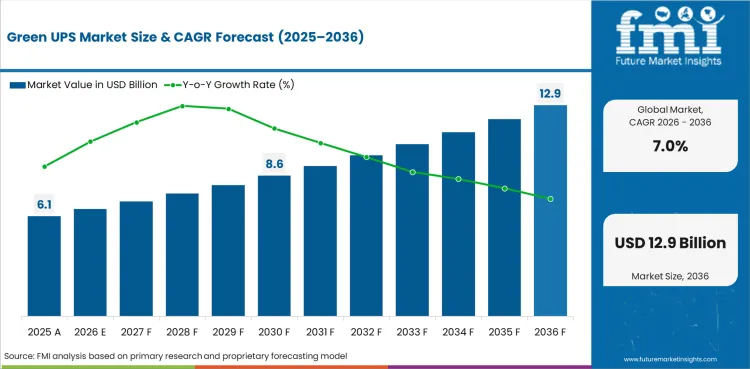
- The green UPS market was valued at USD 6.1 billion in 2025.
- The market is projected to reach USD 6.5 billion in 2026 and USD 12.9 billion by 2036, growing at a CAGR of 7.0%.
- By 2036, the green UPS market is expected to be worth USD 12.9 billion.
- From 2026 to 2036, the market is projected to expand at a CAGR of 7.0%.
- The market is projected to create an incremental opportunity of USD 6.33 billion between 2026 and 2036.
- In 2026, 5 KVA to 20 KVA UPS Systems are expected to account for 31.2% of the capacity segment, driven by increasing adoption across commercial facilities, IT infrastructure, and small-to-medium industrial applications requiring energy-efficient backup power solutions.
- Data centers are expected to lead the application segment with a 37.5% share, driven by data center operators prioritizing energy efficiency, carbon footprint reduction, and renewable energy integration in power protection infrastructure.
- South Korea (6.7%) and Japan (6.6%) are two of the fastest growing markets in the world.
Green UPS Market Definition
The Green UPS Market covers energy efficient uninterruptible power supply systems designed to minimize energy losses, reduce carbon footprint, and support renewable energy integration while providing critical power protection. Products include high efficiency online, line-interactive, and standalone UPS systems with advanced battery management, power factor correction, and renewable energy integration capabilities across multiple KVA ratings.
Green UPS Market Inclusions
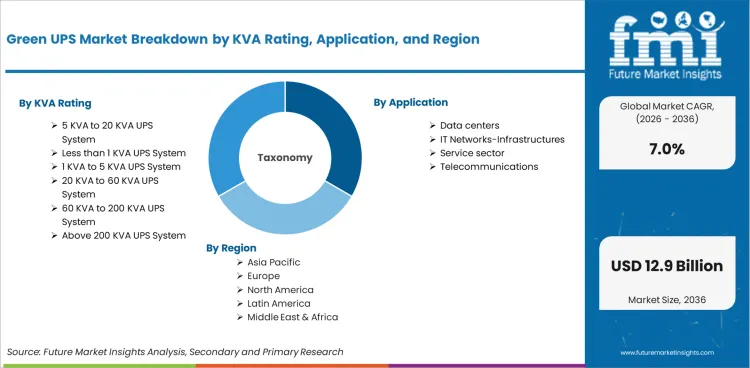
Market scope includes products classified by KVA rating (less than 1 KVA, 1 to 5 KVA, 5 to 20 KVA, 20 to 60 KVA, 60 to 200 KVA, above 200 KVA), application (data centers, IT networks and infrastructure, service sector, telecommunications), UPS technology (online, line-interactive, standalone), end user (IT and data centers, telecom providers, healthcare, industrial, commercial, residential), and technology (energy efficient power conversion, battery management, renewable energy integration). Revenue coverage spans 2026 to 2036.
Green UPS Market Exclusions
The scope does not include conventional UPS systems without energy efficiency optimization, standalone battery energy storage systems without UPS functionality, diesel generators, or power distribution units without integrated UPS capability.
Green UPS Market Research Methodology
- Primary Research: FMI analysts conducted interviews with industry participants, technology providers, and end users across key markets.
- Desk Research: Combined data from industry associations, regulatory filings, and manufacturer disclosures.
- Market Sizing and Forecasting: Bottom up aggregation across segments and regions with top down validation against industry benchmarks.
- Data Validation: Cross checked quarterly against industry production data, procurement records, and manufacturer disclosures.
Why is the Green UPS Market Growing?
- Data center PUE (Power Usage Effectiveness) reduction targets are driving replacement of 90% efficiency legacy UPS systems with 97%+ efficiency models, where each percentage point improvement eliminates thousands of MWh in annual energy waste for large facilities.
- Lithium-ion battery adoption in UPS systems is accelerating as total cost of ownership analysis demonstrates lower lifecycle costs despite higher initial prices, driven by longer battery life, reduced cooling requirements, and smaller physical footprint.
Demand for green UPS systems reflects the growing economic and regulatory pressure to reduce energy waste in power protection infrastructure. Traditional UPS systems operating at 88 to 92% efficiency waste 8 to 12% of all electricity passing through them as heat, which then requires additional cooling energy to remove. For a 1 MW data center UPS, this represents 80 to 120 kW of continuous energy waste. Modern green UPS designs achieve 96 to 99% efficiency in normal operation, reducing this waste by 60 to 90% and delivering electricity cost savings that justify the investment premium.
The integration of lithium-ion batteries represents a significant technology shift in UPS systems. Lithium-ion batteries offer 8 to 10 year service life compared to 3 to 5 years for traditional VRLA lead-acid batteries, operate reliably at higher ambient temperatures reducing cooling requirements, and occupy 50 to 70% less floor space. While initial purchase costs are higher, total cost of ownership analysis consistently favors lithium-ion over 10 year evaluation periods.
Edge computing deployment is creating distributed green UPS demand as computing infrastructure moves closer to end users in retail locations, healthcare facilities, manufacturing plants, and telecommunications sites. Edge computing requires reliable power protection in locations where space, cooling, and energy resources are limited, creating demand for compact, efficient UPS systems that minimize infrastructure footprint while maintaining critical load protection.
Market Segmentation Analysis
- Data centers hold 37.5% of the application segment, reflecting the concentration of green UPS investment where power efficiency directly impacts operating costs and sustainability metrics.
- 5 KVA to 20 KVA systems account for 31.2% of KVA rating, reflecting broad demand across small data centers, network infrastructure, and commercial IT applications.
The Green UPS Market is segmented by KVA rating, application, UPS technology, end user, and technology. Data centers lead application demand. The 5 to 20 KVA segment dominates by unit volume.
Insights into the Data Centers Application Segment
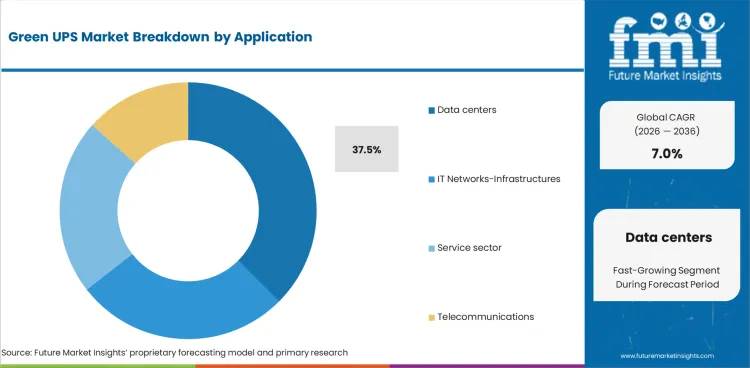
In 2026, Data centers are expected to represent 37.5% of the application segment. Data center operators face direct financial incentives for UPS efficiency improvement, as power protection infrastructure handles 100% of the facility electrical load continuously. Each efficiency percentage point improvement in a 10 MW data center eliminates approximately 876 MWh of annual energy waste.
Growth reflects hyperscale and colocation data center expansion, corporate PUE reduction commitments, and the growing regulatory focus on data center energy consumption in the EU, Singapore, and other markets.
Insights into the 5 to 20 KVA Segment
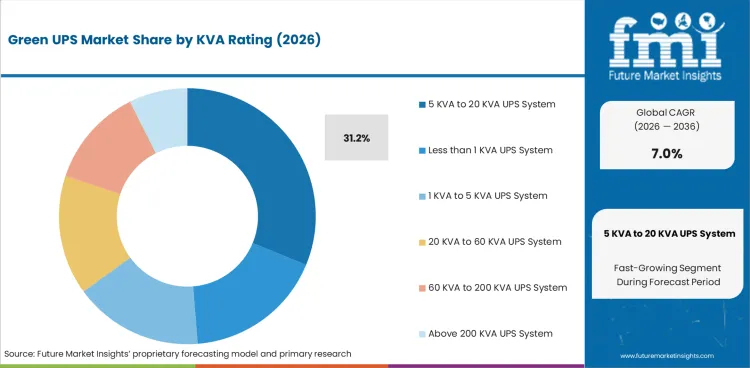
The 5 to 20 KVA segment accounts for 31.2% in 2026. This KVA range serves small data centers, server rooms, network closets, retail IT systems, and commercial building power protection applications where moderate power capacity with high efficiency is required.
Growth reflects edge computing deployment, small and medium business IT infrastructure investment, and the replacement of legacy inefficient UPS systems with energy optimized alternatives across distributed commercial installations.
Green UPS Market Drivers, Restraints, and Opportunities
- Data center energy efficiency mandates and TCO awareness create sustained demand for green UPS systems replacing legacy inefficient infrastructure.
- Higher initial purchase cost compared to conventional UPS creates procurement barriers in price-sensitive segments.
- Lithium-ion battery adoption and renewable energy integration expand the green UPS value proposition beyond efficiency into comprehensive energy management.
The Green UPS Market is shaped by energy efficiency regulation, TCO economics, and technology advancement. Growth is supported by data center expansion, while initial cost premiums create barriers in price sensitive applications.
Data Center Efficiency Mandates
Demand is shaped by regulatory and voluntary PUE reduction targets that compel data center operators to upgrade UPS infrastructure. EU Energy Efficiency Directive requirements, Singapore BCA Green Mark standards, and corporate sustainability commitments create structured procurement demand.
Purchase Cost Premium Barriers
Growth is moderated by the 15 to 30% higher initial purchase cost of green UPS systems compared to conventional alternatives. Price-sensitive commercial and residential segments may defer efficiency upgrades despite favorable TCO analysis.
Lithium-Ion and Renewable Integration
Adoption benefits from lithium-ion battery UPS systems that reduce lifecycle costs and physical footprint, and from UPS platforms that integrate with solar panels, battery storage, and utility demand response programs, creating energy management value beyond basic power protection.
Analysis of Green UPS Market By Key Countries
.webp "Top Country Growth Comparison Green Ups Market Cagr (2026 2036)")
| Country | CAGR |
|---|---|
| South Korea | 6.7% |
| Japan | 6.6% |
| European Union | 6.5% |
| USA | 6.4% |
| UK | 6.3% |
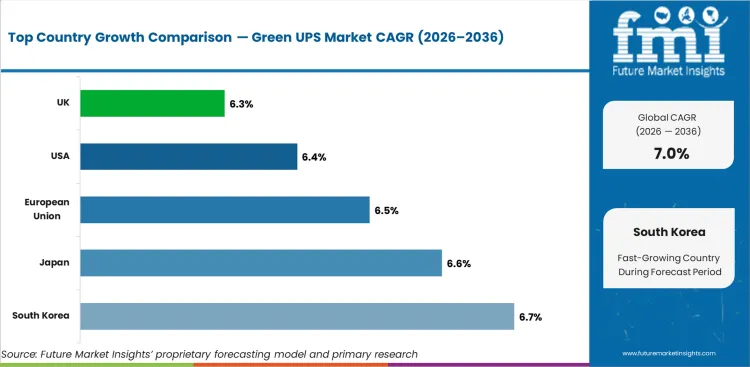
- South Korea leads with 6.7% through 2036, supported by data center investment, semiconductor power requirements, and sustainability commitments.
- Japan at 6.6% reflects advanced data center infrastructure and energy efficiency regulation.
- The EU (6.5%) and USA (6.4%) show growth driven by data center expansion, efficiency mandates, and edge computing deployment.
The global Green UPS Market is projected to grow at a CAGR of 7.0% from 2026 to 2036. The analysis covers more than 30 countries.
Demand Outlook for Green UPS Market in South Korea
South Korea is expected to grow at 6.7% through 2036, driven by data center construction, semiconductor manufacturing power protection needs, and corporate sustainability investment.
- Data center construction drives high efficiency UPS procurement for hyperscale and enterprise facilities.
- Semiconductor manufacturing requires premium power protection with minimal efficiency losses.
- Corporate sustainability commitments drive UPS infrastructure upgrade programs.
Future Outlook for Green UPS Market in Japan
Japan at 6.6% through 2036, reflecting advanced data center infrastructure, strict energy efficiency standards, and earthquake resilient power protection requirements.
- Advanced data center infrastructure supports premium green UPS deployment.
- Energy efficiency standards drive procurement of highest efficiency UPS systems.
- Earthquake resilience requirements sustain investment in reliable power protection.
Opportunity Analysis of Green UPS Market in the European Union
The EU at 6.5% through 2036, driven by Energy Efficiency Directive compliance, data center PUE regulation, and renewable energy integration mandates.
- EU Energy Efficiency Directive creates regulatory mandated efficiency improvement requirements.
- Data center specific regulation drives PUE optimization through UPS upgrades.
- Renewable energy integration mandates create demand for UPS systems with solar and wind compatibility.
In-depth Analysis of Green UPS Market in the United States
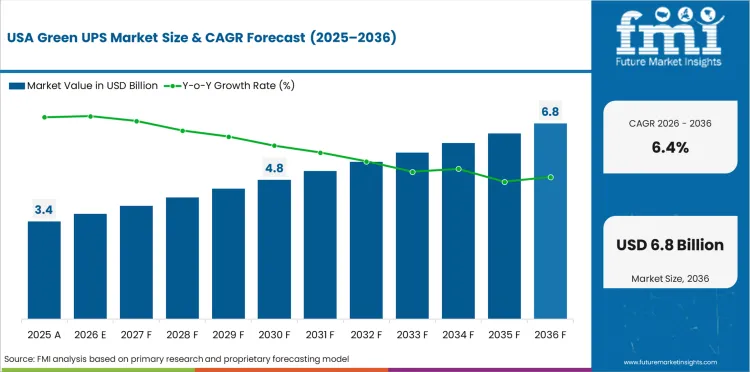
The USA at 6.4% through 2036, supported by hyperscale data center expansion, edge computing deployment, and corporate sustainability programs.
- Hyperscale data center expansion by AWS, Microsoft, Google creates large scale green UPS procurement.
- Edge computing deployment drives distributed UPS demand across retail, healthcare, and telecom locations.
- Corporate sustainability programs drive enterprise UPS infrastructure efficiency upgrades.
Sales Analysis of Green UPS Market in the United Kingdom
The UK at 6.3% through 2036, supported by data center growth, net zero carbon commitments, and commercial building energy efficiency standards.
- Data center growth drives high efficiency UPS deployment in London and regional data center clusters.
- Net zero carbon commitments accelerate replacement of inefficient legacy UPS systems.
- Commercial building energy standards create green UPS demand across office and retail properties.
Competitive Landscape and Strategic Positioning
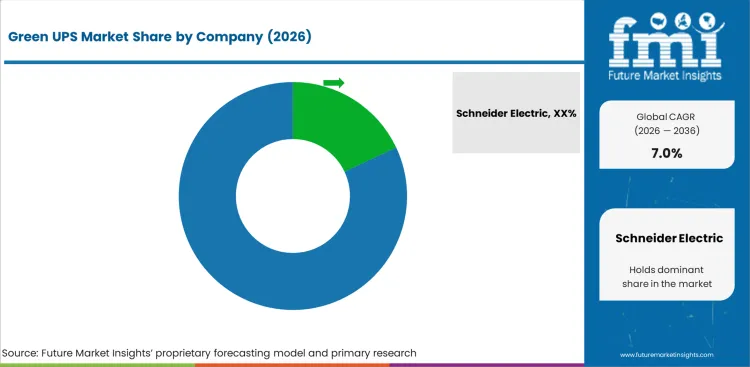
- Schneider Electric leads through Galaxy and APC product lines providing high efficiency UPS across data center, industrial, and commercial applications with lithium-ion and renewable integration options.
- Eaton Corporation and Vertiv maintain strong positions through comprehensive power protection portfolios with growing green UPS capabilities.
- Huawei Technologies and Delta Electronics are expanding market presence with high efficiency UPS platforms targeting data center and telecom applications.
Schneider Electric maintains a leading position through its Galaxy VS and VL UPS series achieving up to 99% efficiency in ECOnversion mode, combined with its APC product line serving smaller installations. The company offers lithium-ion battery options and SmartConnect cloud monitoring across its UPS portfolio.
Eaton Corporation provides green UPS solutions including the 93PM and 9395P series with high efficiency operating modes and lithium-ion battery compatibility. Vertiv Group delivers Liebert GXT5 and EXL S1 UPS platforms for data center and IT infrastructure applications.
Huawei Technologies offers UPS5000 series targeting data center and telecom applications with high efficiency and AI-powered energy management. Delta Electronics provides Ultron HPH and DPH series with modular scalable architecture.
Riello UPS provides European market focused green UPS solutions. Toshiba Infrastructure Systems delivers UPS for industrial and data center applications in Asian markets.
Barriers to entry include the R and D investment for power conversion efficiency improvement, established data center customer relationships, global service and support infrastructure, and the certification requirements for safety and performance standards. Strategic priorities include achieving 99%+ efficiency, expanding lithium-ion integration, developing renewable energy management capabilities, and building edge computing UPS portfolios.
Key Companies in the Green UPS Market
Key global companies leading the green ups market include:
- Schneider Electric, Eaton Corporation, Vertiv Group Corporation maintain leadership through established market presence, broad capabilities, and global infrastructure.
- Huawei Technologies, Delta Electronics, Riello UPS have established strong positions through specialized capabilities and focused expertise.
- Toshiba Infrastructure Systems, CyberPower Systems, APC by Schneider Electric, Socomec are among the emerging players gaining traction through technology advancement and focused innovation.
Competitive Benchmarking: Green UPS Market
| Company | Efficiency Rating | Li-Ion Integration | Data Center Access | Geographic Coverage |
|---|---|---|---|---|
| Schneider Electric | High | Strong | Strong | Global |
| Eaton Corporation | High | Strong | Strong | Global |
| Vertiv Group | High | Strong | Strong | Global |
| Huawei Technologies | High | Strong | Growing | Asia, Global |
| Delta Electronics | High | Moderate | Moderate | Asia, Global |
| Riello UPS | Medium | Moderate | Moderate | Europe |
| Toshiba Infrastructure | Medium | Moderate | Moderate | Asia |
| CyberPower Systems | Medium | Moderate | Moderate | Global |
Source: Future Market Insights competitive analysis, 2026.
Key Players in the Green UPS Market
Major Global Players
- Schneider Electric
- Eaton Corporation
- Vertiv Group Corporation
- Huawei Technologies
- Delta Electronics
- Riello UPS
Emerging Players/Startups
- Toshiba Infrastructure Systems
- CyberPower Systems
- APC by Schneider Electric
- Socomec
- Fuji Electric
Report Scope and Coverage
| Metric | Value |
|---|---|
| Quantitative Units | USD 6.55 billion to USD 12.88 billion, at a CAGR of 7.0% |
| Market Definition | The Green UPS Market covers energy efficient uninterruptible power supply systems designed to minimize energy losses and support renewable energy integration while providing critical power protection. |
| Regions Covered | North America, Latin America, Europe, East Asia, South Asia and Pacific, Middle East and Africa |
| Countries Covered | USA, UK, Germany, South Korea, Japan, China, India, France, 30 plus countries |
| Key Companies Profiled | Schneider Electric, Eaton Corporation, Vertiv Group, Huawei Technologies, Delta Electronics, Riello UPS, Toshiba Infrastructure Systems, CyberPower Systems, Socomec, Fuji Electric |
| Forecast Period | 2026 to 2036 |
| Approach | Hybrid bottom up and top down methodology starting with verified transaction data, projecting adoption velocity across segments and regions. |
Segmentation
Green UPS Market Segmented by KVA Rating:
- 5 KVA to 20 KVA UPS System
- Less than 1 KVA UPS System
- 1 KVA to 5 KVA UPS System
- 20 KVA to 60 KVA UPS System
- 60 KVA to 200 KVA UPS System
- Above 200 KVA UPS System
Green UPS Market Segmented by Application:
- Data centers
- IT Networks-Infrastructures
- Service sector
- Telecommunications
Green UPS Market Segmented by UPS technology:
- Online
- Line-interactive
- Standalone
Green UPS Market Segmented by End User:
- Information Technology and Data Centers
- Telecommunication Providers
- Healthcare Institutions
- Industrial Enterprises
- Commercial Enterprises
- Residential Users
Green UPS Market Segmented by Technology:
- Energy Efficient Power Conversion
- High Efficiency Transformer Design
- Advanced Power Factor Correction
- Battery Management Technology
- Smart Battery Monitoring Systems
- Battery Lifecycle Optimization
- Renewable Energy Integration
- Solar Integrated UPS Systems
- Wind Integrated UPS Systems
Green UPS Market by Region:
- North America
- USA
- Canada
- Mexico
- Latin America
- Brazil
- Chile
- Rest of Latin America
- Western Europe
- Germany
- UK
- Italy
- Spain
- France
- Nordic
- BENELUX
- Rest of Western Europe
- Eastern Europe
- Russia
- Poland
- Hungary
- Balkan & Baltic
- Rest of Eastern Europe
- East Asia
- China
- Japan
- South Korea
- South Asia and Pacific
- India
- ASEAN
- Australia & New Zealand
- Rest of South Asia and Pacific
- Middle East & Africa
- Kingdom of Saudi Arabia
- Other GCC Countries
- Turkiye
- South Africa
- Other African Union
- Rest of Middle East & Africa
Research Sources and Bibliography
- 1. European Commission. (2024). EU Energy Efficiency Directive and Data Center Regulation. EC.
- 2. International Electrotechnical Commission. (2025). IEC 62040 UPS Performance and Efficiency Standards. IEC.
- 3. USA Department of Energy. (2025). DOE Energy Star UPS Efficiency Criteria. DOE.
- 4. Uptime Institute. (2025). Uptime Institute Global Data Center PUE Survey. Uptime Institute.
- 5. The Green Grid. (2025). Green Grid Data Center Power Efficiency Best Practices. TGG.
This bibliography is provided for reader reference. The full Future Market Insights report contains the complete reference list with publication dates, URLs, and supporting data for all cited works.
This Report Answers
- Estimating market size and revenue projections from 2026 to 2036.
- Segmentation by KVA rating, application, UPS technology, end user, and technology.
- Regional insights covering more than 30 markets.
- Analysis of online, line-interactive, and standalone UPS technologies with efficiency benchmarking.
- Competitive landscape assessment including efficiency rating and data center access benchmarking.
- Growth opportunities in lithium-ion integration, renewable energy compatibility, and edge computing deployment.
- Supply chain and battery technology evaluation.
- Data delivery in PDF and Excel formats.
Frequently Asked Questions
What is the global market demand for Green UPS in 2026?
In 2026, the global Green UPS Market is expected to be worth USD 6.55 billion, reflecting growing procurement of energy efficient UPS systems driven by data center PUE reduction targets, corporate sustainability commitments, and total cost of ownership analysis demonstrating favorable lifecycle economics.
How big will the Green UPS Market be in 2036?
By 2036, the market is expected to reach USD 12.88 billion, supported by continued data center expansion globally, lithium-ion battery adoption reducing lifecycle costs, renewable energy integration creating new UPS functionality requirements, and edge computing deployment driving distributed green UPS demand.
How much is demand expected to grow?
Between 2026 and 2036, demand is expected to grow at a CAGR of 7.0%, driven by data center energy efficiency mandates, legacy UPS replacement cycles favoring high efficiency alternatives, lithium-ion battery technology maturation, and expanding edge computing infrastructure requiring compact, efficient power protection.
Which application segment leads?
Data centers hold 37.5% of the application segment in 2026, reflecting the concentration of green UPS investment in facilities where power protection handles 100% of electrical load continuously and each efficiency percentage point improvement eliminates significant annual energy waste and cooling costs.
What drives demand in South Korea?
South Korea at 6.7% reflects data center construction investment, semiconductor manufacturing facilities requiring premium power protection with minimal efficiency losses, and corporate sustainability programs driving enterprise-wide UPS infrastructure upgrades to high efficiency platforms.
What drives demand in Japan?
Japan at 6.6% reflects advanced data center infrastructure supporting premium green UPS deployment, strict national energy efficiency standards driving procurement of highest efficiency systems, and earthquake resilience requirements sustaining investment in reliable power protection technology.
What is the definition?
The Green UPS Market covers energy efficient uninterruptible power supply systems that minimize energy losses through advanced power conversion, support renewable energy integration through solar and wind input compatibility, and incorporate lithium-ion and advanced battery management technologies while providing critical power protection across data center, commercial, and industrial applications.
How is the forecast validated?
Forecasting models use a hybrid bottom up and top down approach, starting with verified data center construction data, UPS shipment statistics, and enterprise IT infrastructure spending, validating against global data center market reports, power equipment manufacturer disclosures, and energy efficiency certification databases.
Preview the report firsthand - request a free sample
Get SampleGet the brochure for pricing and purchase details.
Get PDFTable of Content
- Executive Summary
- Global Market Outlook
- Demand-side Trends
- Supply-side Trends
- Technology Roadmap Analysis
- Analysis and Recommendations
- Market Overview
- Market Coverage / Taxonomy
- Market Definition / Scope / Limitations
- Research Methodology
- Chapter Orientation
- Analytical Lens and Working Hypotheses
- Market Structure, Signals, and Trend Drivers
- Benchmarking and Cross-market Comparability
- Market Sizing, Forecasting, and Opportunity Mapping
- Research Design and Evidence Framework
- Desk Research Programme (Secondary Evidence)
- Company Annual and Sustainability Reports
- Peer-reviewed Journals and Academic Literature
- Corporate Websites, Product Literature, and Technical Notes
- Earnings Decks and Investor Briefings
- Statutory Filings and Regulatory Disclosures
- Technical White Papers and Standards Notes
- Trade Journals, Industry Magazines, and Analyst Briefs
- Conference Proceedings, Webinars, and Seminar Materials
- Government Statistics Portals and Public Data Releases
- Press Releases and Reputable Media Coverage
- Specialist Newsletters and Curated Briefings
- Sector Databases and Reference Repositories
- FMI Internal Proprietary Databases and Historical Market Datasets
- Subscription Datasets and Paid Sources
- Social Channels, Communities, and Digital Listening Inputs
- Additional Desk Sources
- Expert Input and Fieldwork (Primary Evidence)
- Primary Modes
- Qualitative Interviews and Expert Elicitation
- Quantitative Surveys and Structured Data Capture
- Blended Approach
- Why Primary Evidence is Used
- Field Techniques
- Interviews
- Surveys
- Focus Groups
- Observational and In-context Research
- Social and Community Interactions
- Stakeholder Universe Engaged
- C-suite Leaders
- Board Members
- Presidents and Vice Presidents
- R&D and Innovation Heads
- Technical Specialists
- Domain Subject-matter Experts
- Scientists
- Physicians and Other Healthcare Professionals
- Governance, Ethics, and Data Stewardship
- Research Ethics
- Data Integrity and Handling
- Primary Modes
- Tooling, Models, and Reference Databases
- Desk Research Programme (Secondary Evidence)
- Data Engineering and Model Build
- Data Acquisition and Ingestion
- Cleaning, Normalisation, and Verification
- Synthesis, Triangulation, and Analysis
- Quality Assurance and Audit Trail
- Market Background
- Market Dynamics
- Drivers
- Restraints
- Opportunity
- Trends
- Scenario Forecast
- Demand in Optimistic Scenario
- Demand in Likely Scenario
- Demand in Conservative Scenario
- Opportunity Map Analysis
- Product Life Cycle Analysis
- Supply Chain Analysis
- Investment Feasibility Matrix
- Value Chain Analysis
- PESTLE and Porter’s Analysis
- Regulatory Landscape
- Regional Parent Market Outlook
- Production and Consumption Statistics
- Import and Export Statistics
- Market Dynamics
- Global Market Analysis 2021 to 2025 and Forecast, 2026 to 2036
- Historical Market Size Value (USD Million) Analysis, 2021 to 2025
- Current and Future Market Size Value (USD Million) Projections, 2026 to 2036
- Y-o-Y Growth Trend Analysis
- Absolute $ Opportunity Analysis
- Global Market Pricing Analysis 2021 to 2025 and Forecast 2026 to 2036
- Global Market Analysis 2021 to 2025 and Forecast 2026 to 2036, By KVA Rating
- Introduction / Key Findings
- Historical Market Size Value (USD Million) Analysis By KVA Rating, 2021 to 2025
- Current and Future Market Size Value (USD Million) Analysis and Forecast By KVA Rating, 2026 to 2036
- 5 KVA to 20 KVA UPS System
- Less than 1 KVA UPS System
- 1 KVA to 5 KVA UPS System
- 20 KVA to 60 KVA UPS System
- 60 KVA to 200 KVA UPS System
- Above 200 KVA UPS System
- 5 KVA to 20 KVA UPS System
- Y-o-Y Growth Trend Analysis By KVA Rating, 2021 to 2025
- Absolute $ Opportunity Analysis By KVA Rating, 2026 to 2036
- Global Market Analysis 2021 to 2025 and Forecast 2026 to 2036, By Application
- Introduction / Key Findings
- Historical Market Size Value (USD Million) Analysis By Application, 2021 to 2025
- Current and Future Market Size Value (USD Million) Analysis and Forecast By Application, 2026 to 2036
- Data centers
- IT Networks-Infrastructures
- Service sector
- Telecommunications
- Data centers
- Y-o-Y Growth Trend Analysis By Application, 2021 to 2025
- Absolute $ Opportunity Analysis By Application, 2026 to 2036
- Global Market Analysis 2021 to 2025 and Forecast 2026 to 2036, By UPS technology
- Introduction / Key Findings
- Historical Market Size Value (USD Million) Analysis By UPS technology, 2021 to 2025
- Current and Future Market Size Value (USD Million) Analysis and Forecast By UPS technology, 2026 to 2036
- Online
- Line-interactive
- Standalone
- Online
- Y-o-Y Growth Trend Analysis By UPS technology, 2021 to 2025
- Absolute $ Opportunity Analysis By UPS technology, 2026 to 2036
- Global Market Analysis 2021 to 2025 and Forecast 2026 to 2036, By End User
- Introduction / Key Findings
- Historical Market Size Value (USD Million) Analysis By End User, 2021 to 2025
- Current and Future Market Size Value (USD Million) Analysis and Forecast By End User, 2026 to 2036
- Information Technology and Data Centers
- Telecommunication Providers
- Healthcare Institutions
- Industrial Enterprises
- Commercial Enterprises
- Residential Users
- Information Technology and Data Centers
- Y-o-Y Growth Trend Analysis By End User, 2021 to 2025
- Absolute $ Opportunity Analysis By End User, 2026 to 2036
- Global Market Analysis 2021 to 2025 and Forecast 2026 to 2036, By Technology
- Introduction / Key Findings
- Historical Market Size Value (USD Million) Analysis By Technology, 2021 to 2025
- Current and Future Market Size Value (USD Million) Analysis and Forecast By Technology, 2026 to 2036
- Energy Efficient Power Conversion
- High Efficiency Transformer Design
- Advanced Power Factor Correction
- Battery Management Technology
- Smart Battery Monitoring Systems
- Battery Lifecycle Optimization
- Renewable Energy Integration
- Solar Integrated UPS Systems
- Wind Integrated UPS Systems
- Energy Efficient Power Conversion
- Y-o-Y Growth Trend Analysis By Technology, 2021 to 2025
- Absolute $ Opportunity Analysis By Technology, 2026 to 2036
- Global Market Analysis 2021 to 2025 and Forecast 2026 to 2036, By Region
- Introduction
- Historical Market Size Value (USD Million) Analysis By Region, 2021 to 2025
- Current Market Size Value (USD Million) Analysis and Forecast By Region, 2026 to 2036
- North America
- Latin America
- Western Europe
- Eastern Europe
- East Asia
- South Asia and Pacific
- Middle East & Africa
- Market Attractiveness Analysis By Region
- North America Market Analysis 2021 to 2025 and Forecast 2026 to 2036, By Country
- Historical Market Size Value (USD Million) Trend Analysis By Market Taxonomy, 2021 to 2025
- Market Size Value (USD Million) Forecast By Market Taxonomy, 2026 to 2036
- By Country
- USA
- Canada
- Mexico
- By KVA Rating
- By Application
- By UPS technology
- By End User
- By Technology
- By Country
- Market Attractiveness Analysis
- By Country
- By KVA Rating
- By Application
- By UPS technology
- By End User
- By Technology
- Key Takeaways
- Latin America Market Analysis 2021 to 2025 and Forecast 2026 to 2036, By Country
- Historical Market Size Value (USD Million) Trend Analysis By Market Taxonomy, 2021 to 2025
- Market Size Value (USD Million) Forecast By Market Taxonomy, 2026 to 2036
- By Country
- Brazil
- Chile
- Rest of Latin America
- By KVA Rating
- By Application
- By UPS technology
- By End User
- By Technology
- By Country
- Market Attractiveness Analysis
- By Country
- By KVA Rating
- By Application
- By UPS technology
- By End User
- By Technology
- Key Takeaways
- Western Europe Market Analysis 2021 to 2025 and Forecast 2026 to 2036, By Country
- Historical Market Size Value (USD Million) Trend Analysis By Market Taxonomy, 2021 to 2025
- Market Size Value (USD Million) Forecast By Market Taxonomy, 2026 to 2036
- By Country
- Germany
- UK
- Italy
- Spain
- France
- Nordic
- BENELUX
- Rest of Western Europe
- By KVA Rating
- By Application
- By UPS technology
- By End User
- By Technology
- By Country
- Market Attractiveness Analysis
- By Country
- By KVA Rating
- By Application
- By UPS technology
- By End User
- By Technology
- Key Takeaways
- Eastern Europe Market Analysis 2021 to 2025 and Forecast 2026 to 2036, By Country
- Historical Market Size Value (USD Million) Trend Analysis By Market Taxonomy, 2021 to 2025
- Market Size Value (USD Million) Forecast By Market Taxonomy, 2026 to 2036
- By Country
- Russia
- Poland
- Hungary
- Balkan & Baltic
- Rest of Eastern Europe
- By KVA Rating
- By Application
- By UPS technology
- By End User
- By Technology
- By Country
- Market Attractiveness Analysis
- By Country
- By KVA Rating
- By Application
- By UPS technology
- By End User
- By Technology
- Key Takeaways
- East Asia Market Analysis 2021 to 2025 and Forecast 2026 to 2036, By Country
- Historical Market Size Value (USD Million) Trend Analysis By Market Taxonomy, 2021 to 2025
- Market Size Value (USD Million) Forecast By Market Taxonomy, 2026 to 2036
- By Country
- China
- Japan
- South Korea
- By KVA Rating
- By Application
- By UPS technology
- By End User
- By Technology
- By Country
- Market Attractiveness Analysis
- By Country
- By KVA Rating
- By Application
- By UPS technology
- By End User
- By Technology
- Key Takeaways
- South Asia and Pacific Market Analysis 2021 to 2025 and Forecast 2026 to 2036, By Country
- Historical Market Size Value (USD Million) Trend Analysis By Market Taxonomy, 2021 to 2025
- Market Size Value (USD Million) Forecast By Market Taxonomy, 2026 to 2036
- By Country
- India
- ASEAN
- Australia & New Zealand
- Rest of South Asia and Pacific
- By KVA Rating
- By Application
- By UPS technology
- By End User
- By Technology
- By Country
- Market Attractiveness Analysis
- By Country
- By KVA Rating
- By Application
- By UPS technology
- By End User
- By Technology
- Key Takeaways
- Middle East & Africa Market Analysis 2021 to 2025 and Forecast 2026 to 2036, By Country
- Historical Market Size Value (USD Million) Trend Analysis By Market Taxonomy, 2021 to 2025
- Market Size Value (USD Million) Forecast By Market Taxonomy, 2026 to 2036
- By Country
- Kingdom of Saudi Arabia
- Other GCC Countries
- Turkiye
- South Africa
- Other African Union
- Rest of Middle East & Africa
- By KVA Rating
- By Application
- By UPS technology
- By End User
- By Technology
- By Country
- Market Attractiveness Analysis
- By Country
- By KVA Rating
- By Application
- By UPS technology
- By End User
- By Technology
- Key Takeaways
- Key Countries Market Analysis
- USA
- Pricing Analysis
- Market Share Analysis, 2025
- By KVA Rating
- By Application
- By UPS technology
- By End User
- By Technology
- Canada
- Pricing Analysis
- Market Share Analysis, 2025
- By KVA Rating
- By Application
- By UPS technology
- By End User
- By Technology
- Mexico
- Pricing Analysis
- Market Share Analysis, 2025
- By KVA Rating
- By Application
- By UPS technology
- By End User
- By Technology
- Brazil
- Pricing Analysis
- Market Share Analysis, 2025
- By KVA Rating
- By Application
- By UPS technology
- By End User
- By Technology
- Chile
- Pricing Analysis
- Market Share Analysis, 2025
- By KVA Rating
- By Application
- By UPS technology
- By End User
- By Technology
- Germany
- Pricing Analysis
- Market Share Analysis, 2025
- By KVA Rating
- By Application
- By UPS technology
- By End User
- By Technology
- UK
- Pricing Analysis
- Market Share Analysis, 2025
- By KVA Rating
- By Application
- By UPS technology
- By End User
- By Technology
- Italy
- Pricing Analysis
- Market Share Analysis, 2025
- By KVA Rating
- By Application
- By UPS technology
- By End User
- By Technology
- Spain
- Pricing Analysis
- Market Share Analysis, 2025
- By KVA Rating
- By Application
- By UPS technology
- By End User
- By Technology
- France
- Pricing Analysis
- Market Share Analysis, 2025
- By KVA Rating
- By Application
- By UPS technology
- By End User
- By Technology
- India
- Pricing Analysis
- Market Share Analysis, 2025
- By KVA Rating
- By Application
- By UPS technology
- By End User
- By Technology
- ASEAN
- Pricing Analysis
- Market Share Analysis, 2025
- By KVA Rating
- By Application
- By UPS technology
- By End User
- By Technology
- Australia & New Zealand
- Pricing Analysis
- Market Share Analysis, 2025
- By KVA Rating
- By Application
- By UPS technology
- By End User
- By Technology
- China
- Pricing Analysis
- Market Share Analysis, 2025
- By KVA Rating
- By Application
- By UPS technology
- By End User
- By Technology
- Japan
- Pricing Analysis
- Market Share Analysis, 2025
- By KVA Rating
- By Application
- By UPS technology
- By End User
- By Technology
- South Korea
- Pricing Analysis
- Market Share Analysis, 2025
- By KVA Rating
- By Application
- By UPS technology
- By End User
- By Technology
- Russia
- Pricing Analysis
- Market Share Analysis, 2025
- By KVA Rating
- By Application
- By UPS technology
- By End User
- By Technology
- Poland
- Pricing Analysis
- Market Share Analysis, 2025
- By KVA Rating
- By Application
- By UPS technology
- By End User
- By Technology
- Hungary
- Pricing Analysis
- Market Share Analysis, 2025
- By KVA Rating
- By Application
- By UPS technology
- By End User
- By Technology
- Kingdom of Saudi Arabia
- Pricing Analysis
- Market Share Analysis, 2025
- By KVA Rating
- By Application
- By UPS technology
- By End User
- By Technology
- Turkiye
- Pricing Analysis
- Market Share Analysis, 2025
- By KVA Rating
- By Application
- By UPS technology
- By End User
- By Technology
- South Africa
- Pricing Analysis
- Market Share Analysis, 2025
- By KVA Rating
- By Application
- By UPS technology
- By End User
- By Technology
- USA
- Market Structure Analysis
- Competition Dashboard
- Competition Benchmarking
- Market Share Analysis of Top Players
- By Regional
- By KVA Rating
- By Application
- By UPS technology
- By End User
- By Technology
- Competition Analysis
- Competition Deep Dive
- Schneider Electric
- Overview
- Product Portfolio
- Profitability by Market Segments (Product/Age /Sales Channel/Region)
- Sales Footprint
- Strategy Overview
- Marketing Strategy
- Product Strategy
- Channel Strategy
- Eaton Corporation
- Vertiv Group Corporation
- Huawei Technologies
- Delta Electronics
- Riello UPS
- Schneider Electric
- Competition Deep Dive
- Assumptions & Acronyms Used


