

- Industry Size (2026)
- USD 980.0 Mn
- Forecast (2036)
- USD 2257.0 Mn
- CAGR (2026 to 2036)
- 8.7%
Harvesting Aids and Trimming Equipment Market Forecast and Outlook 2026 to 2036
The harvesting aids and trimming equipment market is likely to be valued at USD 980.0 million in 2026 and is forecasted to reach USD 2,256.9 million by 2036 at a CAGR of 8.7%. Value behavior is shaped by labor substitution economics within time constrained harvest windows rather than discretionary mechanization. Equipment adoption reflects structural exposure to seasonal labor shortages, wage volatility, and output variability tied to manual handling. Capital spending prioritizes tools that raise per worker throughput while preserving crop integrity, especially where harvest timing directly affects shelf life and grading outcomes. Investment decisions align with crop cycle intensity, frequency of harvest events, and sensitivity of product presentation to trimming consistency. Demand persistence follows commercial scale horticulture where labor cost inflation exerts continuous pressure on operating margins.
Scaling dynamics remain bounded by crop heterogeneity, utilization rates, and sanitation requirements. Equipment effectiveness varies with plant morphology, moisture content, and biomass density, limiting universal deployment across mixed crop portfolios. Capital efficiency weakens when harvest periods are short or crop rotation reduces machine run time. Cleaning downtime, blade wear, and adjustment complexity affect operational continuity during peak harvest. Smaller producers face financing constraints, while larger operations balance semi automation against full line integration risk. Value growth remains anchored to expansion of labor intensive specialty crop production rather than broad replacement of manual harvesting across all farming systems.
Quick Stats for Harvesting Aids and Trimming Equipment Market
- Harvesting Aids and Trimming Equipment Market Value (2026): USD 980.0 million
- Harvesting Aids and Trimming Equipment Market Forecast Value (2036): USD 2,256.9 million
- Harvesting Aids and Trimming Equipment Market Forecast CAGR 2026 to 2036: 8.7%
- Leading Equipment Type by Demand Share: Mechanical Trimmers
- Fastest-Growing Countries: India, China, Brazil, Mexico, Turkey
- Top Players in Global Demand: CenturionPro, Twister Trimmer, Mobius, GreenBroz, JBT Corporation, Wyma Solutions, Maf Roda, Vanmark, Tumoba, Bühler Group
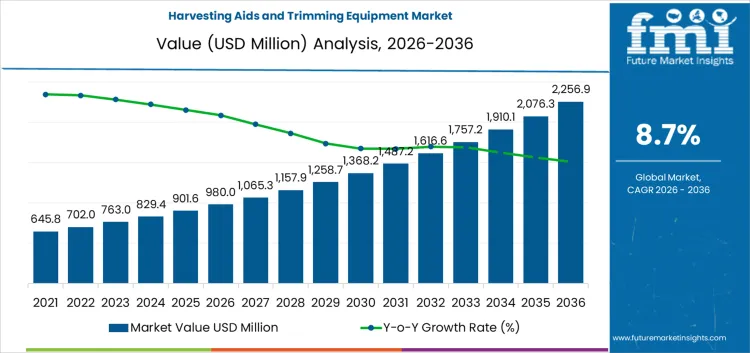
Harvesting Aids and Trimming Equipment Market Key Takeaways
| Metric | Value |
|---|---|
| Market Value (2026) | USD 980.0 million |
| Market Forecast Value (2036) | USD 2,256.9 million |
| Forecast CAGR 2026 to 2036 | 8.7% |
Why is the Demand for Harvesting Aids and Trimming Equipment Growing?
Demand for harvesting aids and trimming equipment is increasing as commercial horticulture and specialty crop producers seek to improve labor efficiency and harvest consistency. Manual harvesting and trimming are labor intensive, time sensitive activities where variability directly affects product quality, yield recovery, and post-harvest shelf life. Growers of fruits, vegetables, herbs, and floriculture crops specify mechanical and semi-mechanical aids to reduce dependence on seasonal labor availability and to manage rising labor costs. Equipment such as trimming machines, conveyor-based harvest aids, and ergonomic cutting tools support uniform cut quality and reduce physical strain on workers during peak harvest windows.
Procurement decisions are influenced by equipment throughput, crop compatibility, ease of cleaning, and ability to operate in field and controlled environment settings without damaging delicate plant material. Expansion of protected cultivation, vertical farming, and high-value crop production reinforces adoption of trimming and harvesting equipment that supports repeatable output and faster turnaround between crop cycles. Post-harvest standards for appearance and sizing drive use of precision trimming solutions that improve pack-out rates and reduce downstream sorting losses. Equipment designs that allow quick adjustment for different crop varieties support operational flexibility across seasons. These production-specific efficiency and quality requirements are sustaining demand for harvesting aids and trimming equipment.
How Are the Segments Classified in the Harvesting Aids and Trimming Equipment Market?
Demand for harvesting aids and trimming equipment is shaped by labor availability constraints, harvest efficiency requirements, and post-harvest quality preservation needs. Growers adopt mechanized and assisted solutions to reduce manual handling time and maintain crop integrity during harvesting operations. Adoption aligns with expansion of controlled environment agriculture, high-value crop cultivation, and scale-up of commercial farming operations. Equipment selection prioritizes throughput consistency, ergonomics, and adaptability to crop formats. Segment classification reflects differentiation by equipment function, crop focus, and automation intensity influencing productivity, labor dependence, and operational standardization.
Which Equipment Type Represents the Largest Share of Demand?
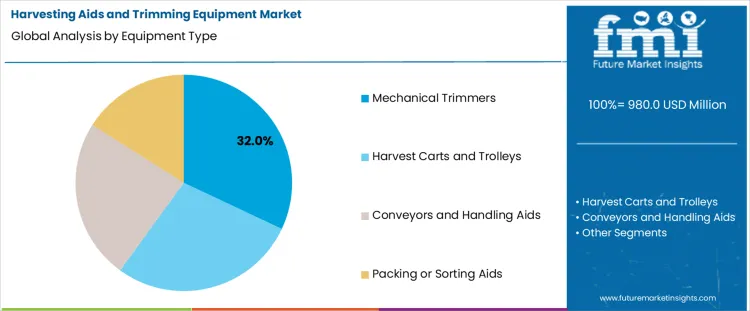
Mechanical trimmers hold 32.0%, representing the largest share among equipment types due to their role in post-harvest processing efficiency. These machines standardize trimming quality while reducing labor intensity for leaf removal and finishing tasks. Consistent output supports uniform product presentation and packaging readiness. Integration with small processing lines suits indoor farms and specialty crop operations. Harvest carts and trolleys support material movement across grow areas with high unit usage. Conveyors and handling aids facilitate transfer between harvest and processing zones. Equipment type segmentation reflects preference for mechanized solutions directly improving harvest labor productivity.
Key Points
- Mechanical trimmers reduce labor intensity during post-harvest processing.
- Standardized trimming improves product uniformity.
- Other equipment supports movement and handling efficiency.
Which Crop Segment Accounts for the Highest Share of Demand?
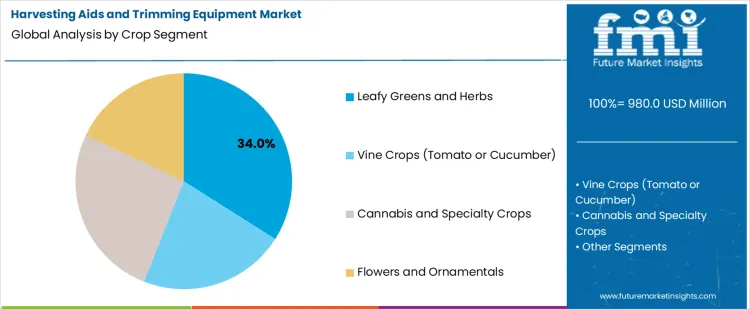
Leafy greens and herbs hold 34.0%, representing the largest share among crop segments due to frequent harvest cycles. These crops require regular cutting, trimming, and handling to maintain freshness and appearance. High planting density increases need for efficient harvesting aids. Equipment supports gentle handling to prevent bruising and yield loss. Vine crops apply harvesting aids for larger fruit handling with lower trimming needs. Cannabis and specialty crops rely on trimming for quality differentiation. Ornamentals emphasize appearance preservation. Crop segmentation reflects concentration where harvest frequency and handling sensitivity drive consistent equipment utilization.
Key Points
- Leafy crops require frequent and repetitive harvesting.
- Handling sensitivity increases need for specialized aids.
- Other crops apply equipment for quality or volume management.
Which Automation Level Drives the Largest Share of Demand?
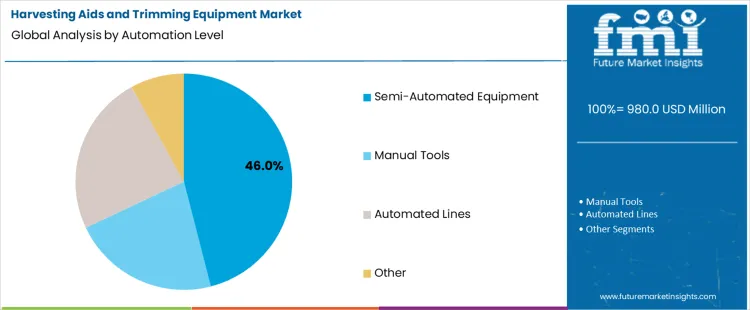
Semi-automated equipment holds 46.0%, representing the largest share among automation levels due to balance of efficiency and flexibility. These systems combine mechanical assistance with operator control to adapt to variable crop sizes. Capital requirements remain accessible for small and mid-scale operations. Throughput improvement reduces labor strain without full process automation. Manual tools remain relevant for small farms and selective harvesting. Automated lines serve high-volume operations with standardized output. Automation level segmentation reflects preference for adaptable solutions improving productivity while retaining operational control across diverse harvesting environments.
Key Points
- Semi-automation balances efficiency with operational flexibility.
- Moderate investment suits diverse farm scales.
- Other levels address manual precision or high-volume automation.
What are the Key Dynamics in the Harvesting Aids and Trimming Equipment Market?
Demand for harvesting aids and trimming equipment reflects labor efficiency and quality control requirements during crop harvest and post-harvest preparation. Adoption concentrates in horticulture, specialty crops, medicinal plants, and high-value leafy produce operations. Global scope aligns with labor availability constraints and consistency requirements at harvest peaks. Usage centers on manual aids, semi-automatic trimmers, and automated systems designed to improve throughput, cut uniformity, and product presentation.
How do labor intensity and product quality requirements shape adoption?
Harvest windows compress labor demand into short periods, increasing reliance on tools that raise output per worker. Demand increases where hand harvesting dominates and skilled labor availability fluctuates. Trimming equipment standardizes cut length, removes excess biomass, and improves visual uniformity critical for fresh market and processed products. Specialty crops with delicate structures require adjustable cutting speed and low-damage handling. Semi-automatic systems support small to mid-scale operations seeking productivity gains without full automation. Automated trimmers enable higher throughput where volumes justify capital outlay. Adoption reflects operational need to balance speed with preservation of product integrity, aroma, and moisture content.
How do crop variability, capital cost, and maintenance exposure influence market scalability?
Equipment performance varies by crop morphology, moisture level, and stem strength, limiting one-size applicability. Demand sensitivity rises where crop mix changes seasonally, reducing utilization rates. Capital cost remains a barrier for small producers with narrow harvest margins. Cleaning and sanitation requirements increase downtime, particularly for resinous or sticky plant materials. Blade wear and calibration affect cut consistency and waste rates. Noise and debris management constrain use in enclosed facilities. Training requirements persist for safe operation. Supply dependence on precision blades, motors, and food-grade materials constrains rapid scaling across diverse grower profiles.
How Is Demand for Harvesting Aids and Trimming Equipment Evolving Globally?
Demand for harvesting aids and trimming equipment is expanding globally due to labor shortages, crop handling efficiency requirements, and quality standardization across horticulture and specialty crops. Mechanized aids support faster harvesting, reduced crop damage, and consistent trimming outcomes under tight harvest windows. Adoption aligns with fruits, vegetables, floriculture, and plantation crops where post-harvest losses directly affect realizations. Farm consolidation and export compliance reinforce equipment uptake. Growth rates in India at 11.1%, China at 10.3%, Brazil at 9.4%, Mexico at 9.2%, and Turkey at 8.6% indicate strong expansion driven by labor substitution, productivity pressure, and quality-controlled harvesting systems.
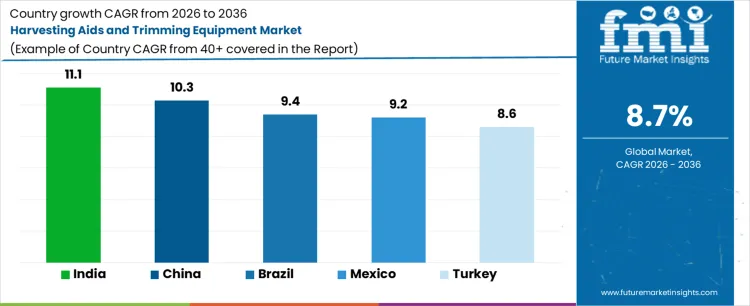
| Country | CAGR (%) |
|---|---|
| India | 11.1% |
| China | 10.3% |
| Brazil | 9.4% |
| Mexico | 9.2% |
| Turkey | 8.6% |
What Is Driving Strong Expansion of Harvesting Aids Adoption in India?
Demand for harvesting aids and trimming equipment in India is growing at a CAGR of 11.1%, supported by acute farm labor availability constraints and rising horticulture output. Manual harvesting inefficiencies increase reliance on hand tools, portable trimmers, and assisted platforms. High-value fruits, vegetables, and floriculture crops require careful handling to limit damage. Export-oriented producers emphasize uniform trimming and presentation. Government-backed mechanization schemes improve affordability for small and mid-sized farms. Growth reflects labor substitution and post-harvest loss reduction rather than transition to fully automated harvesting.
- Seasonal farm labor shortages
- Growth in high-value horticulture crops
- Export quality and presentation requirements
- Mechanization support for smallholders
Why Is China Sustaining High Growth in Harvesting Aids Utilization?
Harvesting aids and trimming equipment demand in China is expanding at a CAGR of 10.3%, driven by scale-intensive horticulture and labor cost escalation. Large orchards and vegetable bases deploy trimming tools to improve throughput consistency. Standardization of post-harvest handling supports domestic distribution and processing. Equipment adoption aligns with cooperative farming structures and centralized packing operations. Domestic manufacturing ensures wide availability across price tiers. Growth reflects productivity optimization across large farms rather than replacement of advanced automated harvesters.
- Large-scale orchard and vegetable operations
- Rising rural labor costs
- Centralized packing and handling requirements
- Broad availability of domestically produced equipment
How Are Harvesting Aids Supporting Productivity Gains in Brazil?
Sales of harvesting aids and trimming equipment in Brazil are growing at a CAGR of 9.4%, shaped by plantation agriculture and export-driven crop handling. Fruit, coffee, and specialty crop producers adopt trimming tools to reduce harvest time variability. Large farm sizes favor durable, high-capacity equipment. Quality control requirements for export markets increase focus on uniform trimming. Mechanized aids complement manual labor rather than replace it fully. Growth reflects efficiency improvements and export compliance rather than structural labor displacement.
- Plantation-scale fruit and specialty crop production
- Export market quality requirements
- Focus on harvest speed and consistency
- Preference for robust, high-capacity tools
What Is Supporting Expansion of Harvesting Aid Sales in Mexico?
Harvesting aids and trimming equipment sales in Mexico are expanding at a CAGR of 9.2%, supported by export-oriented horticulture and labor management needs. Fresh produce exporters require consistent trimming to meet buyer specifications. Labor availability volatility increases adoption of assisted harvesting tools. Farms supplying North American markets invest in equipment to reduce handling damage. Seasonal harvest intensity sustains repeat procurement cycles. Growth reflects export discipline and labor risk management rather than transition toward fully mechanized harvesting systems.
- Export horticulture serving North American markets
- Labor availability volatility during peak seasons
- Buyer-driven trimming and quality specifications
- Recurrent seasonal procurement cycles
Why Is Turkey Experiencing Steady Growth in Harvesting Aid Demand?
Demand for harvesting aids and trimming equipment in Turkey is growing at a CAGR of 8.6%, driven by diversified horticulture and regional export activity. Fruit, nut, and vegetable producers use trimming tools to improve post-harvest handling. Medium-sized farms adopt equipment to balance labor use and output quality. Export routes to Europe emphasize standardized presentation. Local equipment suppliers support accessible pricing. Growth reflects gradual mechanization and export alignment rather than consolidation into large industrial farms.
- Diversified fruit and vegetable production base
- Export presentation standards for European markets
- Mechanization adoption by medium-sized farms
- Availability of locally supplied equipment
What is the competitive landscape of demand for the harvesting aids and trimming equipment market globally?
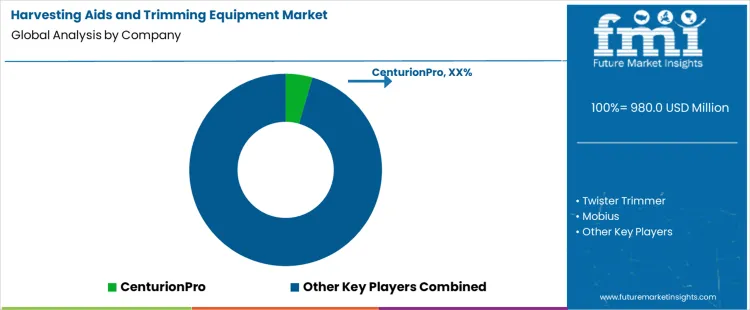
Demand for harvesting aids and trimming equipment is driven by labor-intensive crop harvesting, precision processing requirements, and growth in high-value horticultural, cannabis, and specialty crop sectors. Buyers evaluate equipment throughput, cut quality, adjustability for varied plant architectures, durability in field conditions, ease of cleaning, and compatibility with downstream processing workflows. Procurement teams prioritize suppliers with proven performance, reliable service networks, global distribution channels, and technical support to integrate equipment into harvesting and post-harvest operations. Trend in the global market reflects automation adoption to reduce labor costs, emphasis on product quality and uniformity, and solutions that support sustainability and throughput efficiency across diverse crop types.
CenturionPro holds leading positioning through a broad portfolio of harvesting and trimming systems designed for high-speed processing and minimal manual intervention. Twister Trimmer supports demand with rotary and automated trimming platforms that balance throughput with quality finish for leafy and sensitive crops. Mobius contributes precision trimming and harvesting solutions with modular designs adaptable to varied production scales. GreenBroz participates with compact and scalable trimming equipment optimized for commercial and craft operations prioritizing ergonomic design and ease of use. JBT Corporation supplies integrated harvesting aid solutions and automated processing equipment leveraged by large-scale horticultural enterprises. Competitive differentiation depends on equipment reliability under field conditions, processing speed, modularity, serviceability, and ability to support varied crop harvesting and trimming needs.
Key Players in the Harvesting Aids and Trimming Equipment Market
- CenturionPro
- Twister Trimmer
- Mobius
- GreenBroz
- JBT Corporation
- Wyma Solutions
- Maf Roda
- Vanmark
- Tumoba
- Bühler Group
Scope of the Report
| Items | Values |
|---|---|
| Quantitative Units | USD million |
| Equipment Type | Mechanical Trimmers; Harvest Carts and Trolleys; Conveyors and Handling Aids; Packing or Sorting Aids |
| Crop Segment | Leafy Greens and Herbs; Vine Crops (Tomato or Cucumber); Cannabis and Specialty Crops; Flowers and Ornamentals |
| Automation Level | Semi-Automated Equipment; Manual Tools; Automated Lines; Other |
| Sales Channel | Direct OEM Sales; System Integrators; Distributors; Rental |
| Regions Covered | Asia Pacific, Europe, North America, Latin America, Middle East & Africa |
| Countries Covered | India, China, Brazil, Mexico, Turkey, and 40+ countries |
| Key Companies Profiled | CenturionPro; Twister Trimmer; Mobius; GreenBroz; JBT Corporation; Wyma Solutions; Maf Roda; Vanmark; Tumoba; Buhler Group |
| Additional Attributes | Dollar sales by equipment type, crop segment, automation level, and sales channel; throughput capacity and cut-quality consistency across mechanical and automated trimmers; labor reduction and ergonomics benefits for carts, conveyors, and handling aids; suitability for delicate crops versus high-biomass specialty crops; sanitation, cleanability, and food-contact compliance considerations; modularity and scalability for greenhouse and vertical farming operations; procurement patterns favoring system integrators for automated lines and rental models for seasonal harvesting peaks. |
Harvesting Aids and Trimming Equipment Market by Segment
Equipment Type:
- Mechanical Trimmers
- Harvest Carts and Trolleys
- Conveyors and Handling Aids
- Packing or Sorting Aids
Crop Segment:
- Leafy Greens and Herbs
- Vine Crops (Tomato or Cucumber)
- Cannabis and Specialty Crops
- Flowers and Ornamentals
Automation Level:
- Semi-Automated Equipment
- Manual Tools
- Automated Lines
- Other
Sales Channel:
- Direct OEM Sales
- System Integrators
- Distributors
- Rental
Region:
- Asia Pacific
- China
- Japan
- South Korea
- India
- Australia & New Zealand
- ASEAN
- Rest of Asia Pacific
- Europe
- Germany
- United Kingdom
- France
- Italy
- Spain
- Nordic
- BENELUX
- Rest of Europe
- North America
- United States
- Canada
- Mexico
- Latin America
- Brazil
- Chile
- Rest of Latin America
- Middle East & Africa
- Kingdom of Saudi Arabia
- Other GCC Countries
- Turkey
- South Africa
- Other African Union
- Rest of Middle East & Africa
Bibliography
- Food and Agriculture Organization of the United Nations. (2023). Mechanization strategies for horticulture and high-value crop harvesting. FAO.
- International Labour Organization. (2023). Labour productivity and mechanization in agriculture and horticulture. ILO.
- Organisation for Economic Co-operation and Development. (2023). Agricultural machinery adoption and labour substitution in specialty crops. OECD Publishing.
- United States Department of Agriculture. (2024). Post-harvest handling, trimming, and quality preservation for fruits and vegetables. USDA National Agricultural Library.
- World Bank. (2023). Agricultural mechanization and productivity improvement in high-value crops. World Bank Publications.
Frequently Asked Questions
How big is the harvesting aids and trimming equipment market in 2026?
The global harvesting aids and trimming equipment market is estimated to be valued at USD 980.0 million in 2026.
What will be the size of harvesting aids and trimming equipment market in 2036?
The market size for the harvesting aids and trimming equipment market is projected to reach USD 2,256.9 million by 2036.
How much will be the harvesting aids and trimming equipment market growth between 2026 and 2036?
The harvesting aids and trimming equipment market is expected to grow at a 8.7% CAGR between 2026 and 2036.
What are the key product types in the harvesting aids and trimming equipment market?
The key product types in harvesting aids and trimming equipment market are mechanical trimmers, harvest carts and trolleys, conveyors and handling aids and packing or sorting aids.
Which crop segment segment to contribute significant share in the harvesting aids and trimming equipment market in 2026?
In terms of crop segment, leafy greens and herbs segment to command 34.0% share in the harvesting aids and trimming equipment market in 2026.
Preview the report firsthand - request a free sample
Get SampleGet the brochure for pricing and purchase details.
Get PDFTable of Content
- Executive Summary
- Global Market Outlook
- Demand-side Trends
- Supply-side Trends
- Technology Roadmap Analysis
- Analysis and Recommendations
- Market Overview
- Market Coverage / Taxonomy
- Market Definition / Scope / Limitations
- Market Background
- Market Dynamics
- Drivers
- Restraints
- Opportunity
- Trends
- Scenario Forecast
- Demand in Optimistic Scenario
- Demand in Likely Scenario
- Demand in Conservative Scenario
- Opportunity Map Analysis
- Product Life Cycle Analysis
- Supply Chain Analysis
- Investment Feasibility Matrix
- Value Chain Analysis
- PESTLE and Porter’s Analysis
- Regulatory Landscape
- Regional Parent Market Outlook
- Production and Consumption Statistics
- Import and Export Statistics
- Market Dynamics
- Global Market Analysis 2021 to 2025 and Forecast, 2026 to 2036
- Historical Market Size Value (USD Million) Analysis, 2021 to 2025
- Current and Future Market Size Value (USD Million) Projections, 2026 to 2036
- Y-o-Y Growth Trend Analysis
- Absolute $ Opportunity Analysis
- Global Market Pricing Analysis 2021 to 2025 and Forecast 2026 to 2036
- Global Market Analysis 2021 to 2025 and Forecast 2026 to 2036, By Equipment Type
- Introduction / Key Findings
- Historical Market Size Value (USD Million) Analysis By Equipment Type, 2021 to 2025
- Current and Future Market Size Value (USD Million) Analysis and Forecast By Equipment Type, 2026 to 2036
- Mechanical Trimmers
- Harvest Carts and Trolleys
- Conveyors and Handling Aids
- Packing or Sorting Aids
- Mechanical Trimmers
- Y-o-Y Growth Trend Analysis By Equipment Type, 2021 to 2025
- Absolute $ Opportunity Analysis By Equipment Type, 2026 to 2036
- Global Market Analysis 2021 to 2025 and Forecast 2026 to 2036, By Crop Segment
- Introduction / Key Findings
- Historical Market Size Value (USD Million) Analysis By Crop Segment, 2021 to 2025
- Current and Future Market Size Value (USD Million) Analysis and Forecast By Crop Segment, 2026 to 2036
- Leafy Greens and Herbs
- Vine Crops (Tomato or Cucumber)
- Cannabis and Specialty Crops
- Flowers and Ornamentals
- Leafy Greens and Herbs
- Y-o-Y Growth Trend Analysis By Crop Segment, 2021 to 2025
- Absolute $ Opportunity Analysis By Crop Segment, 2026 to 2036
- Global Market Analysis 2021 to 2025 and Forecast 2026 to 2036, By Automation Level
- Introduction / Key Findings
- Historical Market Size Value (USD Million) Analysis By Automation Level, 2021 to 2025
- Current and Future Market Size Value (USD Million) Analysis and Forecast By Automation Level, 2026 to 2036
- Semi-Automated Equipment
- Manual Tools
- Automated Lines
- Other
- Semi-Automated Equipment
- Y-o-Y Growth Trend Analysis By Automation Level, 2021 to 2025
- Absolute $ Opportunity Analysis By Automation Level, 2026 to 2036
- Global Market Analysis 2021 to 2025 and Forecast 2026 to 2036, By Sales Channel
- Introduction / Key Findings
- Historical Market Size Value (USD Million) Analysis By Sales Channel, 2021 to 2025
- Current and Future Market Size Value (USD Million) Analysis and Forecast By Sales Channel, 2026 to 2036
- Direct OEM Sales
- System Integrators
- Distributors
- Rental
- Direct OEM Sales
- Y-o-Y Growth Trend Analysis By Sales Channel, 2021 to 2025
- Absolute $ Opportunity Analysis By Sales Channel, 2026 to 2036
- Global Market Analysis 2021 to 2025 and Forecast 2026 to 2036, By Region
- Introduction
- Historical Market Size Value (USD Million) Analysis By Region, 2021 to 2025
- Current Market Size Value (USD Million) Analysis and Forecast By Region, 2026 to 2036
- North America
- Latin America
- Western Europe
- Eastern Europe
- East Asia
- South Asia and Pacific
- Middle East & Africa
- Market Attractiveness Analysis By Region
- North America Market Analysis 2021 to 2025 and Forecast 2026 to 2036, By Country
- Historical Market Size Value (USD Million) Trend Analysis By Market Taxonomy, 2021 to 2025
- Market Size Value (USD Million) Forecast By Market Taxonomy, 2026 to 2036
- By Country
- USA
- Canada
- Mexico
- By Equipment Type
- By Crop Segment
- By Automation Level
- By Sales Channel
- By Country
- Market Attractiveness Analysis
- By Country
- By Equipment Type
- By Crop Segment
- By Automation Level
- By Sales Channel
- Key Takeaways
- Latin America Market Analysis 2021 to 2025 and Forecast 2026 to 2036, By Country
- Historical Market Size Value (USD Million) Trend Analysis By Market Taxonomy, 2021 to 2025
- Market Size Value (USD Million) Forecast By Market Taxonomy, 2026 to 2036
- By Country
- Brazil
- Chile
- Rest of Latin America
- By Equipment Type
- By Crop Segment
- By Automation Level
- By Sales Channel
- By Country
- Market Attractiveness Analysis
- By Country
- By Equipment Type
- By Crop Segment
- By Automation Level
- By Sales Channel
- Key Takeaways
- Western Europe Market Analysis 2021 to 2025 and Forecast 2026 to 2036, By Country
- Historical Market Size Value (USD Million) Trend Analysis By Market Taxonomy, 2021 to 2025
- Market Size Value (USD Million) Forecast By Market Taxonomy, 2026 to 2036
- By Country
- Germany
- UK
- Italy
- Spain
- France
- Nordic
- BENELUX
- Rest of Western Europe
- By Equipment Type
- By Crop Segment
- By Automation Level
- By Sales Channel
- By Country
- Market Attractiveness Analysis
- By Country
- By Equipment Type
- By Crop Segment
- By Automation Level
- By Sales Channel
- Key Takeaways
- Eastern Europe Market Analysis 2021 to 2025 and Forecast 2026 to 2036, By Country
- Historical Market Size Value (USD Million) Trend Analysis By Market Taxonomy, 2021 to 2025
- Market Size Value (USD Million) Forecast By Market Taxonomy, 2026 to 2036
- By Country
- Russia
- Poland
- Hungary
- Balkan & Baltic
- Rest of Eastern Europe
- By Equipment Type
- By Crop Segment
- By Automation Level
- By Sales Channel
- By Country
- Market Attractiveness Analysis
- By Country
- By Equipment Type
- By Crop Segment
- By Automation Level
- By Sales Channel
- Key Takeaways
- East Asia Market Analysis 2021 to 2025 and Forecast 2026 to 2036, By Country
- Historical Market Size Value (USD Million) Trend Analysis By Market Taxonomy, 2021 to 2025
- Market Size Value (USD Million) Forecast By Market Taxonomy, 2026 to 2036
- By Country
- China
- Japan
- South Korea
- By Equipment Type
- By Crop Segment
- By Automation Level
- By Sales Channel
- By Country
- Market Attractiveness Analysis
- By Country
- By Equipment Type
- By Crop Segment
- By Automation Level
- By Sales Channel
- Key Takeaways
- South Asia and Pacific Market Analysis 2021 to 2025 and Forecast 2026 to 2036, By Country
- Historical Market Size Value (USD Million) Trend Analysis By Market Taxonomy, 2021 to 2025
- Market Size Value (USD Million) Forecast By Market Taxonomy, 2026 to 2036
- By Country
- India
- ASEAN
- Australia & New Zealand
- Rest of South Asia and Pacific
- By Equipment Type
- By Crop Segment
- By Automation Level
- By Sales Channel
- By Country
- Market Attractiveness Analysis
- By Country
- By Equipment Type
- By Crop Segment
- By Automation Level
- By Sales Channel
- Key Takeaways
- Middle East & Africa Market Analysis 2021 to 2025 and Forecast 2026 to 2036, By Country
- Historical Market Size Value (USD Million) Trend Analysis By Market Taxonomy, 2021 to 2025
- Market Size Value (USD Million) Forecast By Market Taxonomy, 2026 to 2036
- By Country
- Kingdom of Saudi Arabia
- Other GCC Countries
- Turkiye
- South Africa
- Other African Union
- Rest of Middle East & Africa
- By Equipment Type
- By Crop Segment
- By Automation Level
- By Sales Channel
- By Country
- Market Attractiveness Analysis
- By Country
- By Equipment Type
- By Crop Segment
- By Automation Level
- By Sales Channel
- Key Takeaways
- Key Countries Market Analysis
- USA
- Pricing Analysis
- Market Share Analysis, 2025
- By Equipment Type
- By Crop Segment
- By Automation Level
- By Sales Channel
- Canada
- Pricing Analysis
- Market Share Analysis, 2025
- By Equipment Type
- By Crop Segment
- By Automation Level
- By Sales Channel
- Mexico
- Pricing Analysis
- Market Share Analysis, 2025
- By Equipment Type
- By Crop Segment
- By Automation Level
- By Sales Channel
- Brazil
- Pricing Analysis
- Market Share Analysis, 2025
- By Equipment Type
- By Crop Segment
- By Automation Level
- By Sales Channel
- Chile
- Pricing Analysis
- Market Share Analysis, 2025
- By Equipment Type
- By Crop Segment
- By Automation Level
- By Sales Channel
- Germany
- Pricing Analysis
- Market Share Analysis, 2025
- By Equipment Type
- By Crop Segment
- By Automation Level
- By Sales Channel
- UK
- Pricing Analysis
- Market Share Analysis, 2025
- By Equipment Type
- By Crop Segment
- By Automation Level
- By Sales Channel
- Italy
- Pricing Analysis
- Market Share Analysis, 2025
- By Equipment Type
- By Crop Segment
- By Automation Level
- By Sales Channel
- Spain
- Pricing Analysis
- Market Share Analysis, 2025
- By Equipment Type
- By Crop Segment
- By Automation Level
- By Sales Channel
- France
- Pricing Analysis
- Market Share Analysis, 2025
- By Equipment Type
- By Crop Segment
- By Automation Level
- By Sales Channel
- India
- Pricing Analysis
- Market Share Analysis, 2025
- By Equipment Type
- By Crop Segment
- By Automation Level
- By Sales Channel
- ASEAN
- Pricing Analysis
- Market Share Analysis, 2025
- By Equipment Type
- By Crop Segment
- By Automation Level
- By Sales Channel
- Australia & New Zealand
- Pricing Analysis
- Market Share Analysis, 2025
- By Equipment Type
- By Crop Segment
- By Automation Level
- By Sales Channel
- China
- Pricing Analysis
- Market Share Analysis, 2025
- By Equipment Type
- By Crop Segment
- By Automation Level
- By Sales Channel
- Japan
- Pricing Analysis
- Market Share Analysis, 2025
- By Equipment Type
- By Crop Segment
- By Automation Level
- By Sales Channel
- South Korea
- Pricing Analysis
- Market Share Analysis, 2025
- By Equipment Type
- By Crop Segment
- By Automation Level
- By Sales Channel
- Russia
- Pricing Analysis
- Market Share Analysis, 2025
- By Equipment Type
- By Crop Segment
- By Automation Level
- By Sales Channel
- Poland
- Pricing Analysis
- Market Share Analysis, 2025
- By Equipment Type
- By Crop Segment
- By Automation Level
- By Sales Channel
- Hungary
- Pricing Analysis
- Market Share Analysis, 2025
- By Equipment Type
- By Crop Segment
- By Automation Level
- By Sales Channel
- Kingdom of Saudi Arabia
- Pricing Analysis
- Market Share Analysis, 2025
- By Equipment Type
- By Crop Segment
- By Automation Level
- By Sales Channel
- Turkiye
- Pricing Analysis
- Market Share Analysis, 2025
- By Equipment Type
- By Crop Segment
- By Automation Level
- By Sales Channel
- South Africa
- Pricing Analysis
- Market Share Analysis, 2025
- By Equipment Type
- By Crop Segment
- By Automation Level
- By Sales Channel
- USA
- Market Structure Analysis
- Competition Dashboard
- Competition Benchmarking
- Market Share Analysis of Top Players
- By Regional
- By Equipment Type
- By Crop Segment
- By Automation Level
- By Sales Channel
- Competition Analysis
- Competition Deep Dive
- CenturionPro
- Overview
- Product Portfolio
- Profitability by Market Segments (Product/Age /Sales Channel/Region)
- Sales Footprint
- Strategy Overview
- Marketing Strategy
- Product Strategy
- Channel Strategy
- Twister Trimmer
- Mobius
- GreenBroz
- JBT Corporation
- Wyma Solutions
- Maf Roda
- Vanmark
- Tumoba
- Bühler Group
- CenturionPro
- Competition Deep Dive
- Assumptions & Acronyms Used
- Research Methodology


