

- Market Size (2026)
- USD 978.7 Mn
- Forecast (2036)
- USD 1660.5 Mn
- CAGR (2026 to 2036)
- 5.4%
How big is Heat Sink Interface Pastes Market in 2026?
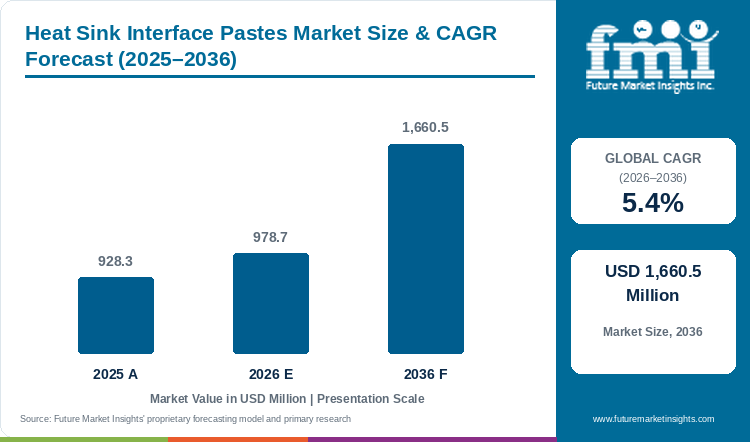
Demand for heat sink interface pastes is projected to expand at 5.4% CAGR between 2026 and 2036. Industry value grows from USD 928.3 million in 2025 to USD 978.7 million in 2026 and is projected to reach USD 1,660.5 million by 2036.
FMI estimates heat sink interface pastes market at USD 978.7 million in 2026, increasing from USD 928.3 million in 2025. The market is projected to reach USD 1,660.5 million by 2036 and is expected to witness 5.4% CAGR during the forecast period. Heat sink interface paste is applied between heat producing component and heat sink for filling the small surface gaps. Due to this, the paste improves contact and supports movement of heat from processors. Lawrence Berkeley National Laboratory estimated in June 2026 that U.S. data centers could consume 649 TWh in 2030 under its reference case.[1] Increasing installation of servers and accelerator equipment is resulting in higher processor heat, which is anticipated to support the heat sink interface pastes market growth.
Demand profiles differ across countries as UK heat sink interface pastes market is projected to grow at 6.0% CAGR, whereas South Korea is estimated to expand at 5.7% CAGR through 2036. The UK government reported in its 2026 progress update that the first AI Growth Zone cohort is set to deliver USD 38.2 billion in investment and more than 15,000 jobs.[2] South Korean demand is supported by semiconductor and HBM production, which uses thermal materials in processing and computing equipment. Germany is also adding data-center capacity, whereas its industrial and automotive buyers follows longer material approval. Server manufacturers requires measured bond-line thickness and stable performance after power cycling. Electronics producers also checks dispensing speed and silicone contamination. Availability of test records and production documents will remain the final factor before the paste enters regular purchasing.
Key Takeaways
- Increasing processor heat load is expected to boost demand for stable interface paste between chips and heat sinks.
- Silicone thermal pastes are expected to account for 39.0% of paste type demand in 2026. Their position reflects a broad balance of thermal stability, electrical insulation and process familiarity.
- CPUs/GPUs are projected to hold a 34.0% share of application demand in 2026. The category benefits from direct contact with high-heat processors and frequent cooler-to-device assembly.
- The 3-6 W/mK band is projected to represent 36.0% of thermal conductivity demand in 2026. Buyers use this range where thermal performance must coexist with practical bond-line and dispensing behavior.
- UK is projected to grow at 6.0% CAGR, whereas South Korea is expected to expand at 5.7% through 2036 owing to compute and semiconductor investment.
- Notable companies in the Heat Sink Interface Pastes market include Shin-Etsu Chemical, Henkel, Dow, 3M, Wacker Chemie.
Analyst Perspective
“I expect increasing processor power to keep paste demand growing beyond conductivity claims. Materials holding contact after power cycling will receive more repeat orders.”
- Nikhil Kaitwade, Principal Consultant, Future Market Insights.
How is the heat sink interface pastes market segmented?
The heat sink interface pastes market is segmented by Paste Type, Application, Thermal Conductivity, End Use and Sales Channel, plus region. In 2026, the leading subsegments are silicone thermal pastes at 39.0% of paste type demand, cpus/gpus at 34.0% of application demand, 3-6 w/mk at 36.0% of thermal conductivity demand, consumer electronics at 30.0% of end use demand and electronics oems at 34.0% of sales channel demand.
On the basis of paste type, heat sink interface pastes market is segmented into silicone thermal pastes, non-silicone pastes, metal oxide pastes, ceramic-filled pastes and phase-change pastes.
On the basis of application, heat sink interface pastes market is segmented into CPUs/GPUs, power modules, LED lighting, telecom electronics and industrial controllers.
On the basis of thermal conductivity, heat sink interface pastes market is segmented into below 3 W/mK, 3-6 W/mK, 6-10 W/mK and above 10 W/mK.
On the basis of end use, heat sink interface pastes market is segmented into consumer electronics, data centers, automotive electronics, industrial electronics and telecom.
On the basis of sales channel, heat sink interface pastes market is segmented into electronics OEMs, thermal material distributors, e-commerce/catalog and contract manufacturers.
Depending on the geographic region, heat sink interface pastes market is segmented into North America, Latin America, Western Europe, Eastern Europe, East Asia, South Asia and Pacific, and Middle East and Africa.
What makes Silicone thermal pastes central to the Paste Type category?
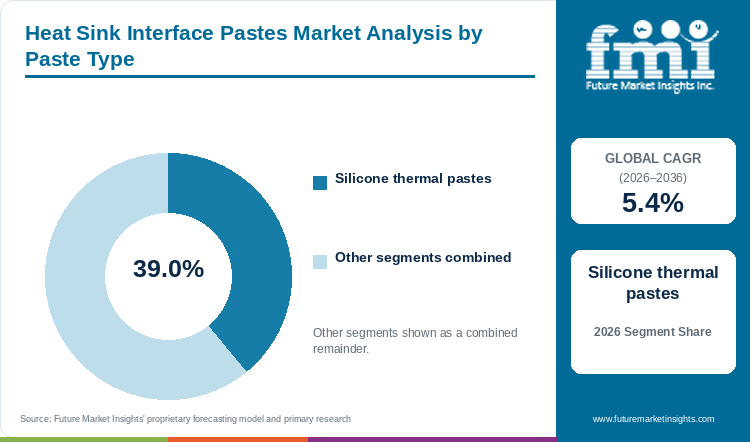
In 2026, silicone thermal pastes are expected to account for 39.0% of paste type demand in the global market.
Silicone thermal pastes are made by combining silicone carrier with thermally conductive fillers. These pastes are electrically insulating in many formulations and continues to remain flexible during repeated temperature change. Silicone thermal pastes can be applied through dispensing, screen printing or manual methods, due to which it is used in different electronics assembly. However, optical and contamination-sensitive products may select non-silicone paste where silicone movement is a concern. Increasing use of familiar application methods along with stable contact is expected to support the silicone thermal pastes segment.
- Silicone thermal pastes account for 39.0% of paste type demand in 2026. Their position reflects a broad balance of thermal stability, electrical insulation and process familiarity.
- In 2026, IEEE Electronics Packaging Society reported that top-end AI GPU modules approach or exceed 700 W, increasing the need for stable thermal interfaces.[16]
Why do CPUs/GPUs anchor the Application category?
In 2026, CPUs/GPUs are forecast to represent 34.0% of application demand in the global market.
CPUs and GPUs produce concentrated heat and uses paste between the processor surface and cooler base. Heat sink interface paste fills the small surface gaps, due to which thermal resistance and processor temperature can be reduced. Rapid movement between idle and loaded operation may cause pump-out in unsuitable paste. In May 2025, a Shin-Etsu Chemical patent application described thermally conductive compositions used between heat-generating electronic parts and heat-dissipating parts.[9] Increasing use of high-power processors is anticipated to support the CPUs/GPUs application segment.
- CPUs/GPUs hold a 34.0% share of application demand in 2026. The category benefits from direct contact with high-heat processors and frequent cooler-to-device assembly.
- In April 2026, the U.S. Patent and Trademark Office granted Super Micro Computer patent US 12,615,707 B2 for confining thermal interface material between a heat sink and electronic device.[19]
How does 3-6 W/mK lead the Thermal Conductivity category?
In 2026, 3-6 W/mK is projected to hold 36.0% of thermal conductivity demand in the global market.
The 3-6 W/mK range is increasingly used in electronics where heat transfer and easy dispensing are required together. Higher filler content can increase bulk conductivity; however, it may also increase viscosity and affect uniform application. The 3-6 W/mK paste can form a thin contact layer in processors, power electronics and industrial controls. Wider application with familiar processing is expected to support the growth of 3-6 W/mK segment over the forecast period.
- The 3-6 W/mK band represents 36.0% of thermal conductivity demand in 2026. Buyers use this range where thermal performance must coexist with practical bond-line and dispensing behavior.
- NIST reported in April 2026 that thermal conductivity governs processor performance and reliability, while improved measurement data is needed for semiconductor thermal management.[17]
What supports Consumer electronics within the End Use category?
In 2026, consumer electronics is estimated to make up 30.0% of end use demand in the global market.
Consumer electronics uses heat sink interface pastes in PCs, gaming hardware and other processor-based products. The paste is a small part of cooler cost but it can affect heat movement from CPU and GPU surfaces. Different cooler designs requires paste that can spread under available mounting pressure without reaching nearby electrical contacts. In June 2026, Dow presented thermal-management materials for AI computing, advanced packaging and data-center cooling.[10] Increasing availability of processor-based electronics is expected to support consumer electronics demand for heat sink interface pastes.
- Consumer electronics account for 30.0% of end use demand in 2026. The segment combines a large installed device base with frequent CPU and GPU thermal interfaces.
- The Semiconductor Industry Association reported in September 2026 that global chip sales reached USD 146.8 billion in July, up 135.1% year over year.[18]
What drives Electronics OEMs in the Sales Channel category?
In 2026, electronics OEMs are anticipated to capture 34.0% of sales channel demand in the global market.
Electronics OEMs select paste thickness, mounting pressure and application method during product design. A paste approved at this stage can continue through volume production, whereas later material changes requires another performance test. Manufacturers also checks whether paste strings during dispensing or changes between production lots. In March 2025, Henkel launched BERGQUIST LIQUI FORM TLF 6500 CGel-SF for high-speed dispensing in ADAS electronics.[11] Increasing requirement for measured production performance is expected to support electronics OEMs sales channel.
- Electronics OEMs hold a 34.0% share of sales channel demand in 2026. Their position reflects control over design qualification and production specifications.
- In September 2026, the U.S. Patent and Trademark Office granted Dell patent US 12,733,106 B2 for attaching thermal interface material to a heat sink through treated perimeter sections.[20]
What are the drivers, restraints, and opportunities in the heat sink interface pastes market?
Rising heat density raises the value of low-resistance interfaces while qualification friction slows switching and silicone-free process-ready formulations open new design opportunities.
- Driver: Higher compute density and power-electronics loading increase the cost of thermal resistance at the component-to-heat-sink interface.
- Restraint: Qualification around pump-out, bleed, viscosity and thermal cycling can delay supplier changes after a paste enters production.
- Opportunity: Silicone-free formulations and dispensing-stable pastes can win designs where contamination control and manufacturing throughput are decisive.
Processor Heat Raises Paste Demand
Increasing thermal load in data centers and power electronics is one of the primary factors driving heat sink interface pastes market. High-power processors and accelerator systems produces concentrated heat, due to which cooling assemblies requires stable contact between package and heat sink. Heat sink interface paste reduces small air gaps and supports heat movement from component surface. Growth of AI computing, power modules and industrial electronics is increasing the number of these interfaces. Increasing installation of high-power computing equipment is expected to drive the heat sink interface pastes market growth.
Qualification Slows Formula Changes
Pump-out, oil separation and change in viscosity can limit the use of a new heat sink interface paste. Parker LORD specified controlled dispensing, frozen storage and resistance to temperature cycling for CoolTherm TC-501 grease.[13] A different paste can change bond-line thickness or application behavior, due to which electronics manufacturers repeats reliability testing before replacement. High testing requirement and controlled storage may hamper adoption of new paste formulations in established production lines.
Power Devices Broaden Paste Applications
Silicone-free and automated-dispensing materials are creating growth opportunities in heat sink interface pastes market. In July 2025, T-Global Technology introduced TG-ASD50AB thermal gel with 5.0 W/mK conductivity for automated dispensing in computing and power applications.[12] Henkel also introduced a silicone-free thermal curable gel in March 2025 for ADAS controllers. These gels are outside paste revenue where used as gap fillers; however, the developments shows increasing demand for low-bleed and process-ready thermal materials. Similar paste formulations are expected to create new application opportunities.
Which country CAGRs are profiled in the heat sink interface pastes market?
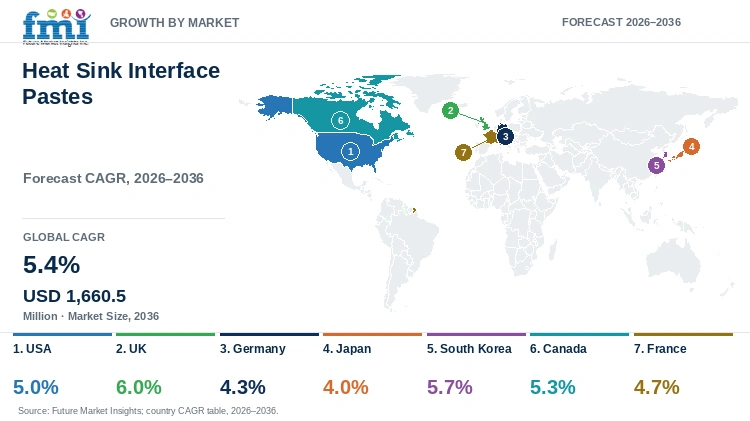
| Country | CAGR |
|---|---|
| USA | 5.0% from 2026 to 2036 |
| UK | 6.0% from 2026 to 2036 |
| Germany | 4.3% from 2026 to 2036 |
| Japan | 4.0% from 2026 to 2036 |
| South Korea | 5.7% from 2026 to 2036 |
| Canada | 5.3% from 2026 to 2036 |
| France | 4.7% from 2026 to 2036 |
How do country-level CAGRs compare in the heat sink interface pastes market?
Country outlook in heat sink interface pastes market differs owing to data-center construction, semiconductor production and use of power electronics. Increasing installation of computing hardware is expected to support paste demand, whereas testing requirement can affect the speed of supplier replacement.
- The UK outlook is supported by AI Growth Zones and planned data-center construction, whereas South Korea demand follows semiconductor and HBM production.
- Canada is adding sovereign compute capacity, while USA demand is connected with hyperscale servers and accelerator platforms.
- France is attracting AI infrastructure projects, whereas Germany combines data-center development with automotive and industrial electronics demand.
- Japan market is supported by semiconductor investment; however, established electronics manufacturers requires longer testing before replacing thermal materials.
The full report provides country-wise CAGR outlooks across North America, Latin America, Western Europe, Eastern Europe, East Asia, South Asia and Pacific, and the Middle East and Africa.
Country-wise Analysis
- Heat sink interface pastes demand in USA is forecast to expand at 5.0% CAGR from 2026 to 2036 owing to high use in servers and processor platforms. The U.S. Department of Energy reported in August 2025 that data centers used about 176 TWh in 2023, equal to around 4.4% of national electricity use.[3] Increasing electricity requirement is connected with growing number of servers and accelerator equipment producing high heat. These processors requires stable contact between package and cooler during repeated loading. Expansion of hyperscale data centers and advanced computing hardware is expected to support the heat sink interface pastes market in USA.
- UK heat sink interface pastes market is projected to grow at 6.0% CAGR through 2036 owing to expanding compute and data-center projects. Increase in AI Growth Zones is encouraging development of data centers and supporting power infrastructure. New computing facilities requires processors, cooler assemblies and power electronics, which in turn increases requirement for thermal interface materials. However, project announcements will create paste demand only when the facilities enters equipment purchase and installation. Continued movement of UK compute projects into hardware deployment is anticipated to support heat sink interface pastes demand over the forecast period.
- Sales of heat sink interface pastes in Germany are forecast to expand at 4.3% CAGR from 2026 to 2036. In October 2025, the German Federal Government identified artificial intelligence and microelectronics among six technologies receiving focus under the Hightech Agenda.[4] Apart from data centers, automotive and industrial electronics uses thermal paste in power modules and control equipment. German electronics manufacturers generally follows measured material validation, which can slow replacement of existing paste. Increasing installed electronic equipment along with expansion of microelectronics is expected to support German market growth.
- Adoption of heat sink interface pastes in Japan is estimated to expand at 4.0% CAGR through 2036 owing to semiconductor and data-center investment. In September 2025, Japan METI added a seventh certified semiconductor production plan, showing continued expansion of domestic chip manufacturing support.[5] Semiconductor production equipment and computing devices uses thermal materials at different heat-producing interfaces. Japanese electronics manufacturers also follows longer product testing before changing an approved material. Increasing semiconductor output is expected to widen thermal paste applications, whereas longer testing may keep replacement gradual during the forecast period.
- Heat sink interface pastes demand in South Korea is forecast to rise at 5.7% CAGR over the forecast period owing to semiconductor and HBM manufacturing. In August 2026, South Korea announced a USD 3.52 billion semiconductor fund for materials, components and fabless companies, along with the same amount in trade finance.[6] The country has high-volume memory and computing hardware production, due to which thermal materials are required in equipment and processor assemblies. Fast production increase can raise requirement for paste that supports automated dispensing and repeated thermal cycling. Expansion of AI-oriented semiconductor output is anticipated to support South Korean market growth.
- Sales of heat sink interface pastes in Canada are forecast to expand at 5.3% CAGR through 2036 owing to sovereign compute and data-center development. In January 2026, Canada invited proposals for sovereign AI data centers having planned capacity above 100 MW.[7] Movement of these projects into hardware purchasing will add processors, cooling assemblies and power electronics. High compute cost and limited domestic capacity may affect the speed of installation. New server facilities are expected to create gradual demand for qualified heat sink interface paste in Canada.
- Demand for heat sink interface pastes in France is projected to rise at 4.7% CAGR through 2036 owing to AI infrastructure and advanced electronics projects. In February 2025, France reported more than USD 109 billion of announced AI infrastructure projects and identified low-carbon sites for data centers.[8] Data-center construction will increase the installation of servers, processors and cooling equipment. However, announced projects will support paste demand only after hardware enters purchasing and installation. Increasing conversion of planned sites into operational computing facilities is expected to support the heat sink interface pastes market in France.
Who are the notable companies in the heat sink interface pastes market?
Shin-Etsu Chemical, Henkel, Dow, 3M, Wacker Chemie, Momentive, Parker LORD, T-Global Technology, Arctic, and Wakefield Thermal are the notable companies profiled in this market.
Heat sink interface pastes market is moderately fragmented with silicone manufacturers, electronics material suppliers and cooling-product companies. Shin-Etsu Chemical, Dow, Wacker Chemie and Momentive offers silicone and specialty chemistry products. Henkel, 3M, Parker LORD and T-Global Technology are focusing on electronics materials and application support. Arctic and Wakefield Thermal supplies processor paste through distributor and cooling-product channels. Companies are expanding product range for higher heat load, automated dispensing and stable performance after thermal cycling, which is expected to increase competition in heat sink interface pastes market.
- Silicone and specialty chemistry platforms: Shin-Etsu Chemical, Dow, Wacker Chemie and Momentive compete through formulation know-how and thermal-interface chemistry depth.
- OEM thermal-management material specialists: Henkel, 3M, Parker LORD and T-Global Technology compete through application engineering, electronics materials and production-process support.
- Cooling and aftermarket interface suppliers: Arctic and Wakefield Thermal compete through direct paste portfolios, cooler-oriented use cases and distributor or catalog access.
Competitive Benchmarking: Heat Sink Interface Pastes Market
| Company | Paste/Grease Offer | High-Power Electronics Fit | Process & Qualification Support | Geographic Reach |
|---|---|---|---|---|
| Shin-Etsu Chemical | High | High | High | High |
| Henkel | High | High | High | High |
| Dow | High | High | High | High |
| 3M | Low | Medium | High | High |
| Wacker Chemie | Medium | High | High | High |
| Momentive | High | High | Medium | High |
| Parker LORD | High | High | High | High |
| T-Global Technology | High | High | High | High |
| Arctic | High | Medium | Medium | Low |
| Wakefield Thermal | High | High | Medium | High |
High indicates wider documented product range, application activity and geographic reach. Medium represents a comparatively limited documented role, whereas Low indicates one narrow route. Ratings does not represent product quality, revenue or market share.
Key Developments in the Heat Sink Interface Pastes Market
- In June 2025, Wacker Chemie announced SEMICOSIL 9649 TC, a two-part silicone gap filler for electric and hybrid vehicle power electronics. The company reported about 4 W/mK conductivity and thermal-shock resistance from -40°C to +150°C.[14]
- In December 2025, Arctic introduced MX-7 thermal compound for processor cooling. The launch expanded its thermal paste range for CPUs, GPUs and gaming systems.[15]
Key Players in the Heat Sink Interface Pastes Market
Silicone and Specialty Chemistry Platforms
- Shin-Etsu Chemical
- Dow
- Wacker Chemie
- Momentive
OEM Thermal Management Material Specialists
- Henkel
- 3M
- Parker LORD
- T-Global Technology
Cooling and Aftermarket Interface Suppliers
- Arctic
- Wakefield Thermal
Heat Sink Interface Pastes Market - Report Scope
| Coverage field | Report scope |
|---|---|
| Market breakdown | Paste Type, Application, Thermal Conductivity, End Use, and Sales Channel |
| Quantitative Units | USD Million |
| Market Definition | Revenue includes heat sink interface pastes sold within the stated segmentation universe for use between heat-generating electronic components and heat sinks or other cooling surfaces. Downstream finished-product revenue and adjacent thermal pads, tapes, gels, adhesives or other substitute products are excluded. |
| Regions Covered | North America; Latin America; Western Europe; Eastern Europe; East Asia; South Asia and Pacific; Middle East and Africa |
| Countries Covered | USA, UK, Germany, Japan, South Korea, Canada, France, and more than twenty-five additional countries in the full report |
| Key Companies Profiled | Shin-Etsu Chemical, Henkel, Dow, 3M, Wacker Chemie, Momentive, Parker LORD, T-Global Technology, Arctic, Wakefield Thermal |
| Forecast Period | 2026 to 2036 |
| Approach | Hybrid bottom-up and top-down sizing that triangulates supplier and product revenues with application demand, channel activity, electronics production and country-level operating indicators. |
Heat Sink Interface Pastes Market - Research Methodology
| Method | Approach |
|---|---|
| Market inputs | FMI analysts gathered input from manufacturers, material suppliers, distributors, electronics OEMs, procurement teams and industry experts. Interviews covers product selection, application requirement, pricing, adoption barrier and approval requirement. |
| Desk Research | Desk research includes government data, regulations, technical literature, company filings, product information and official company announcements. Sources are reviewed on the basis of date, geography and relevance to heat sink interface pastes market. |
| Market Sizing and Forecasting | Market sizing includes baseline value, historical performance, segment structure, pricing, company participation and country-level demand. Forecast assumptions considers electronics output, data-center investment, technology adoption and barriers affecting the market. |
| Data Validation | Market estimates are validated through public data, company activity, industry developments and primary interviews. Thermal pads, tapes, gels, adhesives and other adjacent products are excluded in order to reduce double counting. |
Heat Sink Interface Pastes Market by Segments
Heat Sink Interface Pastes Market segmented by Paste Type:
- Silicone thermal pastes
- Non-silicone pastes
- Metal oxide pastes
- Ceramic-filled pastes
- Phase-change pastes
Heat Sink Interface Pastes Market segmented by Application:
- CPUs/GPUs
- Power modules
- LED lighting
- Telecom electronics
- Industrial controllers
Heat Sink Interface Pastes Market segmented by Thermal Conductivity:
- 3-6 W/mK
- Below 3 W/mK
- 6-10 W/mK
- Above 10 W/mK
Heat Sink Interface Pastes Market segmented by End Use:
- Consumer electronics
- Data centers
- Automotive electronics
- Industrial electronics
- Telecom
Heat Sink Interface Pastes Market segmented by Sales Channel:
- Electronics OEMs
- Thermal material distributors
- E-commerce/catalog
- Contract manufacturers
Heat Sink Interface Pastes Market by Region:
- North America
- United States
- Canada
- Latin America
- Brazil
- Mexico
- Argentina
- Chile
- Western Europe
- Germany
- France
- United Kingdom
- Italy
- Spain
- Benelux
- Nordics
- Eastern Europe
- Poland
- Czech Republic
- Romania
- Hungary
- East Asia
- China
- Japan
- South Korea
- South Asia and Pacific
- India
- ASEAN
- Australia and New Zealand
- Middle East and Africa
- GCC Countries
- South Africa
- Türkiye
- Israel
Research Sources and Bibliography
- [1] Lawrence Berkeley National Laboratory. (2026, June 18). United States Data Center Energy Usage Report: 2025 Update. https://www.energy.gov/documents/united-states-data-center-energy-usage-report-2025-update
- [2] Department for Science, Innovation and Technology. (2026, January 29). AI Opportunities Action Plan: 2026 progress. https://delivery.ai.gov.uk/4/
- [3] U.S. Department of Energy. (2025, August). Data Center Energy Efficiency.
- [4] German Federal Government. (2025, October 29). We trust our country to be an innovation leader.
- [5] Ministry of Economy, Trade and Industry, Japan. (2025, September 16). Certified plans for specified semiconductor production facilities.
- [6] Government of the Republic of Korea. (2026, August 10). Semiconductor materials, components and fabless investment support announcement.
- [7] Innovation, Science and Economic Development Canada. (2026, January 15). Enabling large-scale sovereign AI data centres. https://ised-isde.canada.ca/site/ised/en/enabling-large-scale-sovereign-ai-data-centres
- [8] Élysée. (2025, February 11). Make France an AI powerhouse. https://www.elysee.fr/en/emmanuel-macron/2025/02/11/make-france-an-ai-powerhouse
- [9] Shin-Etsu Chemical Co., Ltd. (2025, May 1). Thermally conductive composition and cured product of same (U.S. Patent Application No. US20250136783A1).
- [10] Dow. (2026, June). Thermal-management materials for AI computing, advanced packaging and data-center cooling.
- [11] Henkel. (2025, March 19). Henkel launches BERGQUIST LIQUI FORM TLF 6500 CGel-SF: Advanced heat dissipation for the age of autonomous driving.
- [12] T-Global Technology. (2025, July 22). Tackle high-heat challenges: TG-ASD50AB thermally conductive gel officially launched.
- [13] Parker LORD. (2025). CoolTherm TC-501 thermally conductive grease technical data sheet.
- [14] Wacker Chemie AG. (2025, June 2). Battery Show Europe 2025: WACKER presents new gap filler for electromobility.
- [15] ARCTIC. (2025, December). MX-7 thermal compound for processor cooling.
- [16] IEEE Electronics Packaging Society. (2026). Thermal Interface Materials (TIM) Strategy for Thermal Management in AI and HPC Applications. https://eps.ieee.org/wp-content/uploads/2026/03/M-and-P-TC-Thermal-Interface-Materials-TIM-Strategy-for-Thermal-Management-in-AI-and-HPC-Applications-2026-IEEE-EPS-Newsletter_Final_YL2.pdf
- [17] National Institute of Standards and Technology. (2026, April 3). Thermal Property Measurements. https://www.nist.gov/programs-projects/transport-property-measurements-semiconductors-and-energy-materials/thermal
- [18] Semiconductor Industry Association. (2026, September 4). Global Semiconductor Sales Increase 6.4% Month-to-Month in July. https://www.semiconductors.org/global-semiconductor-sales-increase-6-4-month-to-month-in-july/
- [19] U.S. Patent and Trademark Office. (2026, April 28). Confinement and protection of a thermal interface material between a heat sink and an electronic device (U.S. Patent No. 12,615,707 B2). https://patentsgazette.uspto.gov/week17/OG/html/1545-4/US12615707-20260428.html
- [20] U.S. Patent and Trademark Office. (2026, September 8). System for attaching a thermal interface material to a heat sink (U.S. Patent No. 12,733,106 B2). https://patentsgazette.uspto.gov/week36/OG/html/1550-2/US12733106-20260908.html
- [21] National Institute of Standards and Technology. (2026, July 29). Department of Commerce Announces Letters of Intent With 7 Companies for $874 Million to Accelerate Semiconductor R&D for the Compute Supply Chain. https://www.nist.gov/news-events/news/2026/07/department-commerce-announces-letters-intent-7-companies-874-million
This bibliography is provided for reader reference. The full report contains the complete reference list and detailed citations.
This Report Answers
- How big is the Heat Sink Interface Pastes market in 2026?
- What value is the Heat Sink Interface Pastes market projected to reach by 2036?
- Which segment leads the Heat Sink Interface Pastes market in 2026?
- Which sales channel is prominent in the Heat Sink Interface Pastes market?
- Which countries show notable Heat Sink Interface Pastes market growth through 2036?
- Who are notable companies in the Heat Sink Interface Pastes market?
Frequently Asked Questions
How large is the Heat Sink Interface Pastes Market expected to be in 2026?
Future Market Insights estimates that the heat sink interface pastes market will reach USD 978.7 million in 2026. The market is projected to expand further and reach USD 1,660.5 million by 2036.
What CAGR is forecast for the Heat Sink Interface Pastes Market through 2036?
As per FMI, the heat sink interface pastes market is projected to grow at a 5.4% CAGR from 2026 to 2036. Growth is supported by increasing processor heat load across computing and electronics applications.
Which paste type holds a notable Heat Sink Interface Pastes demand share in 2026?
Future Market Insights projects silicone thermal pastes to hold 39.0% of paste type demand in 2026. The segment benefits from thermal stability, electrical insulation, and familiar processing methods.
Which application segment holds a notable Heat Sink Interface Pastes share in 2026?
FMI finds that CPUs/GPUs will hold 34.0% of application demand in 2026. Demand is supported by direct contact with high-heat processors and frequent cooler-to-device assembly.
Which country has a notable Heat Sink Interface Pastes expansion outlook during the forecast period?
Future Market Insights predicts UK to expand at a 6.0% CAGR during the 2026 to 2036 assessment period. Growth is supported by expanding compute and data-center projects.
Which companies are active in the Heat Sink Interface Pastes Market during 2026?
As per FMI analysis, notable companies include Shin-Etsu Chemical, Henkel, Dow, 3M, Wacker Chemie, Momentive, Parker LORD, T-Global Technology, Arctic, and Wakefield Thermal. These companies are focusing on higher heat loads, automated dispensing, and stable performance after thermal cycling.
Preview the report firsthand - request a free sample
Get SampleGet the brochure for pricing and purchase details.
Get PDFTable of Content
- Key Takeaways
- Market Size and CAGR
- Top Growth Driver
- Fastest Growing Segment
- Leading Region
- Key Companies
- Emerging Opportunities
- Executive Summary
- Global Market Outlook
- Demand-side Trends
- Supply-side Trends
- Technology Roadmap Analysis
- Analysis and Recommendations
- Analyst Perspective (What is happening? Why now? What should investors know?)
- Key Questions Answered
- How large is the market?
- What is the CAGR?
- What are key trends?
- Which region dominates?
- Who are the leaders?
- Market Overview
- Market Coverage / Taxonomy
- Market Definition / Scope / Limitations
- Research Methodology
- Chapter Orientation
- Analytical Lens and Working Hypotheses
- Market Structure, Signals, and Trend Drivers
- Benchmarking and Cross-market Comparability
- Market Sizing, Forecasting, and Opportunity Mapping
- Research Design and Evidence Framework
- Desk Research Programme (Secondary Evidence)
- Expert Input and Fieldwork (Primary Evidence)
- Tooling, Models, and Reference Databases
- Data Engineering and Model Build
- Quality Assurance and Audit Trail
- Market Background
- Market Dynamics (Drivers, Restraints, Opportunity, Trends)
- Scenario Forecast (Optimistic, Likely, Conservative)
- Impact Analysis
- AI Impact
- Sustainability Impact
- Regulatory Impact
- Technology Impact
- Consumer / Buyer Analysis
- Purchase Drivers
- Adoption Barriers
- Buyer Journey
- Opportunity Map Analysis
- Product Life Cycle Analysis
- Supply Chain Analysis
- Investment Feasibility Matrix
- Value Chain Analysis
- PESTLE and Porter's Analysis
- Regulatory Landscape
- Regional Parent Market Outlook
- Production and Consumption Statistics
- Import and Export Statistics
- Global Market Analysis and Forecast, 2021 to 2036
- Historical Market Size Value (USD Million) Analysis, 2021 to 2025
- Current and Future Market Size Value (USD Million) Projections, 2026 to 2036
- Y-o-Y Growth Trend Analysis
- Absolute $ Opportunity Analysis
- Global Market Pricing Analysis, 2021 to 2036
- Global Market Analysis and Forecast, By Paste Type, 2021 to 2036
- Introduction / Key Findings
- Historical Market Size Value (USD Million) Analysis By Paste Type, 2021 to 2025
- Current and Future Market Size Value (USD Million) Analysis and Forecast By Paste Type, 2026 to 2036
- Silicone thermal pastes
- Non-silicone pastes
- Metal oxide pastes
- Ceramic-filled pastes
- Phase-change pastes
- Y-o-Y Growth Trend Analysis By Paste Type, 2021 to 2025
- Absolute $ Opportunity Analysis By Paste Type, 2026 to 2036
- Global Market Analysis and Forecast, By Application, 2021 to 2036
- Introduction / Key Findings
- Historical Market Size Value (USD Million) Analysis By Application, 2021 to 2025
- Current and Future Market Size Value (USD Million) Analysis and Forecast By Application, 2026 to 2036
- CPUs/GPUs
- Power modules
- LED lighting
- Telecom electronics
- Industrial controllers
- Y-o-Y Growth Trend Analysis By Application, 2021 to 2025
- Absolute $ Opportunity Analysis By Application, 2026 to 2036
- Global Market Analysis and Forecast, By Thermal Conductivity, 2021 to 2036
- Introduction / Key Findings
- Historical Market Size Value (USD Million) Analysis By Thermal Conductivity, 2021 to 2025
- Current and Future Market Size Value (USD Million) Analysis and Forecast By Thermal Conductivity, 2026 to 2036
- 3-6 W/mK
- Below 3 W/mK
- 6-10 W/mK
- Above 10 W/mK
- Y-o-Y Growth Trend Analysis By Thermal Conductivity, 2021 to 2025
- Absolute $ Opportunity Analysis By Thermal Conductivity, 2026 to 2036
- Global Market Analysis and Forecast, By End Use, 2021 to 2036
- Introduction / Key Findings
- Historical Market Size Value (USD Million) Analysis By End Use, 2021 to 2025
- Current and Future Market Size Value (USD Million) Analysis and Forecast By End Use, 2026 to 2036
- Consumer electronics
- Data centers
- Automotive electronics
- Industrial electronics
- Telecom
- Y-o-Y Growth Trend Analysis By End Use, 2021 to 2025
- Absolute $ Opportunity Analysis By End Use, 2026 to 2036
- Global Market Analysis and Forecast, By Sales Channel, 2021 to 2036
- Introduction / Key Findings
- Historical Market Size Value (USD Million) Analysis By Sales Channel, 2021 to 2025
- Current and Future Market Size Value (USD Million) Analysis and Forecast By Sales Channel, 2026 to 2036
- Electronics OEMs
- Thermal material distributors
- E-commerce/catalog
- Contract manufacturers
- Y-o-Y Growth Trend Analysis By Sales Channel, 2021 to 2025
- Absolute $ Opportunity Analysis By Sales Channel, 2026 to 2036
- Global Market Analysis and Forecast, By Region, 2021 to 2036
- Introduction
- Historical Market Size Value (USD Million) Analysis By Region, 2021 to 2025
- Current Market Size Value (USD Million) Analysis and Forecast By Region, 2026 to 2036
- North America
- Latin America
- Western Europe
- Eastern Europe
- East Asia
- South Asia and Pacific
- Middle East and Africa
- Market Attractiveness Analysis By Region
- North America Market Analysis and Forecast, By Country, 2021 to 2036
- Historical Market Size Value (USD Million) Trend Analysis By Market Taxonomy, 2021 to 2025
- Market Size Value (USD Million) Forecast By Market Taxonomy, 2026 to 2036
- By Country
- United States
- Canada
- By Paste Type
- By Application
- By Thermal Conductivity
- By End Use
- By Sales Channel
- By Country
- Market Attractiveness Analysis
- By Country
- By Paste Type
- By Application
- By Thermal Conductivity
- By End Use
- By Sales Channel
- Key Takeaways
- Latin America Market Analysis and Forecast, By Country
- Historical Market Size Value (USD Million) Trend Analysis By Market Taxonomy, 2021 to 2025
- Market Size Value (USD Million) Forecast By Market Taxonomy, 2026 to 2036
- By Country
- Brazil
- Mexico
- Argentina
- Chile
- By Paste Type
- By Application
- By Thermal Conductivity
- By End Use
- By Sales Channel
- By Country
- Market Attractiveness Analysis
- By Country
- By Paste Type
- By Application
- By Thermal Conductivity
- By End Use
- By Sales Channel
- Key Takeaways
- Western Europe Market Analysis and Forecast, By Country
- Historical Market Size Value (USD Million) Trend Analysis By Market Taxonomy, 2021 to 2025
- Market Size Value (USD Million) Forecast By Market Taxonomy, 2026 to 2036
- By Country
- Germany
- France
- United Kingdom
- Italy
- Spain
- Benelux
- Nordics
- By Paste Type
- By Application
- By Thermal Conductivity
- By End Use
- By Sales Channel
- By Country
- Market Attractiveness Analysis
- By Country
- By Paste Type
- By Application
- By Thermal Conductivity
- By End Use
- By Sales Channel
- Key Takeaways
- Eastern Europe Market Analysis and Forecast, By Country
- Historical Market Size Value (USD Million) Trend Analysis By Market Taxonomy, 2021 to 2025
- Market Size Value (USD Million) Forecast By Market Taxonomy, 2026 to 2036
- By Country
- Poland
- Czech Republic
- Romania
- Hungary
- By Paste Type
- By Application
- By Thermal Conductivity
- By End Use
- By Sales Channel
- By Country
- Market Attractiveness Analysis
- By Country
- By Paste Type
- By Application
- By Thermal Conductivity
- By End Use
- By Sales Channel
- Key Takeaways
- East Asia Market Analysis and Forecast, By Country
- Historical Market Size Value (USD Million) Trend Analysis By Market Taxonomy, 2021 to 2025
- Market Size Value (USD Million) Forecast By Market Taxonomy, 2026 to 2036
- By Country
- China
- Japan
- South Korea
- By Paste Type
- By Application
- By Thermal Conductivity
- By End Use
- By Sales Channel
- By Country
- Market Attractiveness Analysis
- By Country
- By Paste Type
- By Application
- By Thermal Conductivity
- By End Use
- By Sales Channel
- Key Takeaways
- South Asia and Pacific Market Analysis and Forecast, By Country
- Historical Market Size Value (USD Million) Trend Analysis By Market Taxonomy, 2021 to 2025
- Market Size Value (USD Million) Forecast By Market Taxonomy, 2026 to 2036
- By Country
- India
- ASEAN
- Australia and New Zealand
- By Paste Type
- By Application
- By Thermal Conductivity
- By End Use
- By Sales Channel
- By Country
- Market Attractiveness Analysis
- By Country
- By Paste Type
- By Application
- By Thermal Conductivity
- By End Use
- By Sales Channel
- Key Takeaways
- Middle East and Africa Market Analysis and Forecast, By Country
- Historical Market Size Value (USD Million) Trend Analysis By Market Taxonomy, 2021 to 2025
- Market Size Value (USD Million) Forecast By Market Taxonomy, 2026 to 2036
- By Country
- GCC Countries
- South Africa
- Türkiye
- Israel
- By Paste Type
- By Application
- By Thermal Conductivity
- By End Use
- By Sales Channel
- By Country
- Market Attractiveness Analysis
- By Country
- By Paste Type
- By Application
- By Thermal Conductivity
- By End Use
- By Sales Channel
- Key Takeaways
- Key Countries Market Analysis
- United States
- Pricing Analysis
- Market Share Analysis, 2025
- By Paste Type
- By Application
- By Thermal Conductivity
- By End Use
- By Sales Channel
- Canada
- Pricing Analysis
- Market Share Analysis, 2025
- By Paste Type
- By Application
- By Thermal Conductivity
- By End Use
- By Sales Channel
- Mexico
- Pricing Analysis
- Market Share Analysis, 2025
- By Paste Type
- By Application
- By Thermal Conductivity
- By End Use
- By Sales Channel
- Brazil
- Pricing Analysis
- Market Share Analysis, 2025
- By Paste Type
- By Application
- By Thermal Conductivity
- By End Use
- By Sales Channel
- Chile
- Pricing Analysis
- Market Share Analysis, 2025
- By Paste Type
- By Application
- By Thermal Conductivity
- By End Use
- By Sales Channel
- Germany
- Pricing Analysis
- Market Share Analysis, 2025
- By Paste Type
- By Application
- By Thermal Conductivity
- By End Use
- By Sales Channel
- United Kingdom
- Pricing Analysis
- Market Share Analysis, 2025
- By Paste Type
- By Application
- By Thermal Conductivity
- By End Use
- By Sales Channel
- Italy
- Pricing Analysis
- Market Share Analysis, 2025
- By Paste Type
- By Application
- By Thermal Conductivity
- By End Use
- By Sales Channel
- Spain
- Pricing Analysis
- Market Share Analysis, 2025
- By Paste Type
- By Application
- By Thermal Conductivity
- By End Use
- By Sales Channel
- France
- Pricing Analysis
- Market Share Analysis, 2025
- By Paste Type
- By Application
- By Thermal Conductivity
- By End Use
- By Sales Channel
- India
- Pricing Analysis
- Market Share Analysis, 2025
- By Paste Type
- By Application
- By Thermal Conductivity
- By End Use
- By Sales Channel
- ASEAN
- Pricing Analysis
- Market Share Analysis, 2025
- By Paste Type
- By Application
- By Thermal Conductivity
- By End Use
- By Sales Channel
- Australia and New Zealand
- Pricing Analysis
- Market Share Analysis, 2025
- By Paste Type
- By Application
- By Thermal Conductivity
- By End Use
- By Sales Channel
- China
- Pricing Analysis
- Market Share Analysis, 2025
- By Paste Type
- By Application
- By Thermal Conductivity
- By End Use
- By Sales Channel
- Japan
- Pricing Analysis
- Market Share Analysis, 2025
- By Paste Type
- By Application
- By Thermal Conductivity
- By End Use
- By Sales Channel
- South Korea
- Pricing Analysis
- Market Share Analysis, 2025
- By Paste Type
- By Application
- By Thermal Conductivity
- By End Use
- By Sales Channel
- Poland
- Pricing Analysis
- Market Share Analysis, 2025
- By Paste Type
- By Application
- By Thermal Conductivity
- By End Use
- By Sales Channel
- Hungary
- Pricing Analysis
- Market Share Analysis, 2025
- By Paste Type
- By Application
- By Thermal Conductivity
- By End Use
- By Sales Channel
- Türkiye
- Pricing Analysis
- Market Share Analysis, 2025
- By Paste Type
- By Application
- By Thermal Conductivity
- By End Use
- By Sales Channel
- South Africa
- Pricing Analysis
- Market Share Analysis, 2025
- By Paste Type
- By Application
- By Thermal Conductivity
- By End Use
- By Sales Channel
- United States
- Market Structure Analysis
- Competition Dashboard
- Competition Benchmarking
- Market Share Analysis of Top Players
- By Regional
- By Paste Type
- By Application
- By Thermal Conductivity
- By End Use
- By Sales Channel
- Emerging Startups
- Innovation Benchmarking
- Competition Analysis
- Competition Deep Dive
- Shin-Etsu Chemical
- Overview
- Product Portfolio
- Profitability by Market Segments
- Sales Footprint
- Strategy Overview
- Marketing Strategy
- Product Strategy
- Channel Strategy
- Henkel
- Dow
- 3M
- Wacker Chemie
- Momentive
- Parker LORD
- T-Global Technology
- Arctic
- Wakefield Thermal
- Shin-Etsu Chemical
- Case Studies
- Success Stories
- Recent Developments
- Competition Deep Dive
- Assumptions & Acronyms Used


