

- Market Size (2026)
- USD 5.3 Bn
- Forecast (2036)
- USD 8.6 Bn
- CAGR (2026 to 2036)
- 5.0%
How big is Heated Apparel Market in 2026?
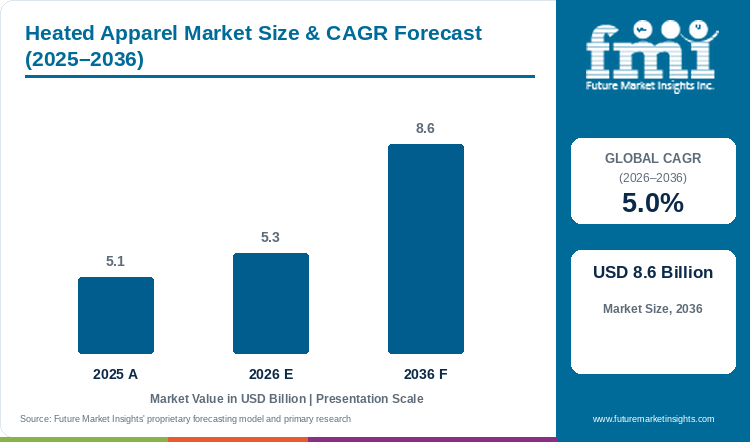
Sales of heated apparel are estimated to rise at 5.0% CAGR through 2036. Market valuation increases from USD 5.1 billion in 2025 to USD 5.3 billion in 2026 and is estimated to reach USD 8.6 billion by 2036.
Heated apparel market was valued at USD 5.1 billion in 2025 and is estimated to reach USD 5.3 billion in 2026. As per FMI, the market is projected to reach USD 8.6 billion by 2036, expanding at 5.0% CAGR between 2026 and 2036. Heated jackets and vests holds 38.2% share in 2026 as one outer layer provides adjustable warmth during work, travel and winter sport. Milwaukee lists 12 hours on low setting, three heating zones and washer-safe construction for its M12 heated jacket.[1] ORORO provides up to 9.5 hours of warmth in selected heated sweatsuit products, taking active heating into daily-use clothing.[13] GOBI served more than 300,000 customers by July 2026 and operates stores for the USA, Canada and Australia.[14] Longer runtime, wider clothing formats and replacement battery demand is expected to support heated apparel market growth.
Key Market Trends & Insights
- By product type, heated jackets and vests led with 38.2% share in 2026, owing to wider use across work, travel and winter sport.
- Rechargeable lithium-ion systems accounted for 44.8% of power source demand in 2026, due to repeat charging and removable battery packs.
- Carbon-based heating elements represented 34.7% in 2026, as thin panels can be placed around chest, back and pocket areas.
- Specialty outdoor and workwear retail held 46.2% share in 2026, supported by product demonstration and battery guidance before purchase.
Regional Highlights
- Fastest-growing profiled country: Canada (5.5% CAGR, 2026 to 2036).
- France (4.4%) and the USA (4.3%) follow, while the UK records the lowest CAGR at 3.5%.
Market Size & Forecast
Table 1: Market Size and Forecast for the Heated Apparel Market (USD billion and percentage), 2025 to 2036
| Metric | Value |
|---|---|
| 2025 Market Size | USD 5.1 billion |
| Estimated Market Size in 2026 | USD 5.3 billion |
| Projected Market Size by 2036 | USD 8.6 billion |
| CAGR, 2026 to 2036 | 5.0% |
| Added Revenue, 2026 to 2036 | USD 3.3 billion |
| Market Expansion Multiple | 1.6x |
Battery runtime and garment care are becoming important factors while selecting thermal comfort wearables for repeated use. Fieldsheer specifies up to 10 hours of runtime on low setting and Bluetooth temperature regulation for its Mobile Warming Backcountry heated vest.[24] ActionHeat lists up to 5+ hours of continuous warmth across three built-in heating zones for its 5V battery-heated jacket.[25] These runtime ranges show that low, medium and high settings are used for different wearing conditions. Products balancing useful heat, battery weight and washing requirement are likely to gain wider use across work shifts and longer travel.
Runtime and Wearing-Occasion Analysis
Heated garments are purchased according to runtime, heat coverage and the activities for which they are worn. Longer low-setting runtime supports work shifts and travel, whereas multiple heating zones allows the garment to cover different cold conditions. Product format and outdoor participation also increases the occasions where heated apparel can be used.
Table 2: Runtime and Wearing-Occasion Indicators for the Heated Apparel Market (hours, zones, customers, percentages, and USD billion), mixed reporting years from 2024 to 2026
| Indicator | Data Point | Why It Matters | Source |
|---|---|---|---|
| Fieldsheer Mobile Warming vest runtime | Up to 10 hours low; Bluetooth control | Shows mobile Bluetooth-regulated battery runtime across outdoor vests. | [24] |
| ActionHeat 5V jacket runtime | Up to 5+ hours; 3 heat zones | Shows power-bank-compatible heating performance across standard outerwear. | [25] |
| ORORO Toasty sweatsuit runtime | Up to 9.5 hours | Shows active heating entering hoodies and sweatpants used beyond technical outerwear. | [13] |
| Therm-ic Powerjacket Speed | 6 heating elements; up to 5 hours low | Provides a winter-sport example where fitted heat coverage matters beside runtime. | [23] |
| GOBI customer reach | More than 300,000 customers by July 2026 | A wider installed customer base can support replacement and multi-product purchasing. | [14] |
| France weekly sport participation | 61% in 2025; 46% mainly outdoors | Outdoor participation increases occasions where adjustable heated layers can be used. | [2] |
| USA outdoor recreation value added | USD 696.7 billion in 2024; snow activities USD 7.6 billion | Shows the size of outdoor and snow-related activity connected with cold-weather apparel use. | [3] |
Analyst Perspective
“Daily-use heated layers will expand faster as buyers move beyond technical jackets into familiar clothing formats. Certified batteries, washable garments and replacement packs will decide which brands receive repeat purchases during colder seasons.”
- Rahul Pandita, Principal Consultant, Future Market Insights.
How is the heated apparel market segmented?
Heated apparel market is segmented by four primary commercial axes and region: product type, power source, heating element, distribution channel, and region. In 2026, heated jackets and vests are projected at 38.2%, rechargeable lithium-ion systems at 44.8%, carbon-based heating elements at 34.7%, and specialty outdoor and workwear retail at 46.2%.
By product type: heated jackets and vests, heated hoodies and base layers, heated gloves, heated socks and insoles, heated pants, and other heated accessories.
By power source: rechargeable lithium-ion battery systems, USB power-bank systems, vehicle-connected systems, and hybrid or replaceable-battery systems.
By heating element: carbon-fiber and carbon-nanotube elements, conductive-thread systems, metallic-wire elements, graphene-based elements, and other flexible heating systems.
By distribution channel: specialty outdoor and workwear retail, e-commerce direct-to-consumer, home-improvement and tool retail, department and sporting-goods stores, and other channels.
By region: North America, Latin America, Western Europe, Eastern Europe, East Asia, South Asia and Pacific, and Middle East and Africa.
Why do heated jackets and vests retain a notable product share?
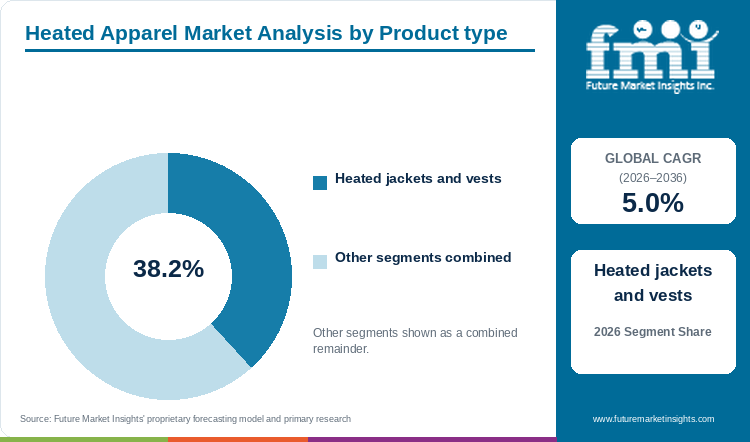
Heated jackets and vests are projected to hold 38.2% of product type demand in 2026, supported by broad cold-weather use.
Table 3: Product Type Share for the Heated Apparel Market (percentage share), 2026
| Product Type | Share (2026) |
|---|---|
| Heated Jackets and Vests | 38.2% |
| Other Segments Combined | 61.8%* |
| Total | 100.0% |
*Calculated as the balance remaining after deducting the leading segment's reported share from 100.0%.
Table 4: Product Type Leadership and Market Growth for the Heated Apparel Market (segment and CAGR percentage), 2026 to 2036
| Metric | Value |
|---|---|
| Global CAGR (2026 to 2036) | 5.0% |
| Leading Segment | Heated Jackets and Vests |
Heated jackets and vests provides active warmth around chest and back areas and are easily used as normal outerwear. Therm-ic lists six heating elements, Bluetooth temperature control and up to five hours of low-setting heat for its Powerjacket Speed.[23] Due to its wider use in work, travel and winter wear, heated jackets and vests segment is expected to witness continued growth.
- Heated jackets and vests account for 38.2% share in 2026 because one outer layer can serve different cold-weather applications.
- Separate zone control and washer-safe construction supports wider use in workwear and outdoor activities.
What supports lithium-ion systems as the preferred power source?
Rechargeable lithium-ion systems are estimated to hold 44.8% in 2026, owing to repeat charging and familiar battery handling.
Rechargeable lithium-ion systems supplies power to heating elements placed inside the garment and can be removed before washing. ORORO stated in October 2026 that its heated kids products use UL-certified rechargeable batteries with smart temperature regulation.[4] Repeat charging and availability of replacement packs is anticipated to support rechargeable lithium-ion systems demand across consumer smart clothing.
- Lithium-ion systems hold 44.8% share in 2026 as reusable packs support daily charging and replacement purchases.
- Removable batteries allows washing of garments and continued use with separately purchased battery packs.
How do carbon-based elements meet changing heating needs?
Carbon-based heating elements are forecast to represent 34.7% in 2026, enabled by flexible placement across garment panels.
Carbon-fiber heating elements are thin in construction and can be fitted around chest, back and pocket areas without rigid parts. Venture Heat lists heat-sealed carbon-fiber panels, insulated wiring and overheat-protection microchips in its heated jacket range.[5] Lighter and flexible heat panels are therefore expected to support carbon-based heating element demand.
- Carbon-based elements account for 34.7% share in 2026 because flexible layouts supports different garment shapes.
- Flexible panels allows heat placement in several garment areas without increasing garment weight.
Why does specialty retail remain central to heated apparel sales?
Specialty outdoor and workwear retail is set to lead distribution with 46.2% share in 2026, underpinned by hands-on product demonstration.
Specialty outdoor and workwear retail stores allows buyers to check garment size, battery placement and heating zones before purchasing heated apparel. ORORO reported in October 2025 that its heated products were available in six countries including the USA, Canada, Germany and the UK.[21] Product guidance and availability of replacement batteries is expected to support specialty retail sales.
- Specialty retail commands 46.2% share in 2026 as store staff can explain fit, battery care and runtime.
- E-commerce is widening access, however physical demonstration remains useful while comparing warmth, weight and mobility.
What are the drivers, restraints, and opportunities in the heated apparel market?
In the heated apparel market, wider cold-weather use is the key driver, battery and care limits are the restraint, and connected controls are the opportunity.
- Driver: Outdoor work and recreation expand demand for adjustable warmth without thick layering.
- Restraint: Battery weight, replacement cost, charging time and care requirements can limit frequent use.
- Opportunity: App control, zoned heating and shared battery platforms can extend use beyond winter sport.
Outdoor Use Extends Wearing Occasions
Outdoor activity is creating more wearing occasions for outdoor apparel, heated jackets, gloves and base layers. Natural England reported in September 2026 that around two in three adults visited green and natural spaces during the previous 14 days, whereas poor weather remained the main reason for not visiting.[6] While recreational visits indicate cold-weather exposure occasions, commercial heated apparel sales are directly underpinned by consumer battery-heated garment purchases, cold-climate outdoor workwear adoption, and distributor sell-through.
Battery Care Limits Routine Adoption
Battery price and garment care requirement are some of the factors limiting routine adoption of heated apparel. ORORO's November 2025 AeroPro jacket provided up to 16 hours of heat when an optional second battery was installed.[17] Longer runtime may therefore require another battery, while washing needs battery removal and protected connectors. These requirements raises ownership cost and may hamper the heated apparel market growth.
Connected Controls Broaden Product Design
App controls and separate heating zones are creating new opportunities in heated apparel market. Venture Heat lists Bluetooth-controlled 7V and 12V jackets that allows temperature adjustment from a smartphone.[7] Easy heat adjustment and batteries which can be used with several garments is expected to create new growth opportunities over the forecast period.
Which country CAGRs are profiled in the heated apparel market?
Table 5: Country CAGR Comparison for the Heated Apparel Market (CAGR percentage), 2026 to 2036
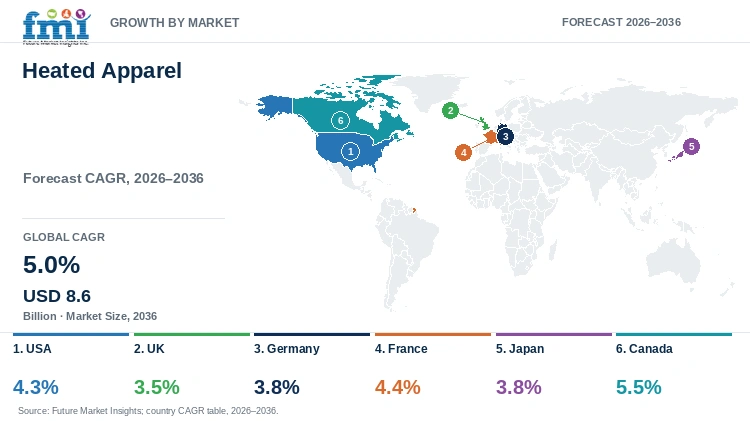
| Country | CAGR |
|---|---|
| USA | 4.3% |
| UK | 3.5% |
| Germany | 3.8% |
| France | 4.4% |
| Japan | 3.8% |
| Canada | 5.5% |
How do country-level CAGRs compare in the heated apparel market?
Country demand differs according to winter duration, outdoor habits, workwear channels and availability of rechargeable garments. According to FMI, Canada and France are expected to witness wider expansion, whereas the USA is supported by an established workwear and outdoor retail base.
Presence of specialty stores, replacement packs and tool-battery platforms is expected to influence heated apparel adoption across the profiled countries.
- USA demand is supported by outdoor recreation, workwear, home-improvement and direct-to-consumer channels.
- UK demand benefits from walking, winter commuting and specialist outdoor retail.
- Germany combines winter travel, trade work and tool-platform distribution.
- France links weekly sport participation with outdoor activity in urban and natural settings.
- Japan supports compact heated layers through domestic travel and commuting.
- Canada combines long cold seasons with workwear, winter sport and camping demand.
Full report country CAGRs cover: North America; Latin America; Western Europe; Eastern Europe; East Asia; South Asia and Pacific; Middle East and Africa.
Country-wise Analysis
- Sales of heated apparel in the USA are forecast to rise at 4.3% CAGR through 2036, supported by outdoor recreation and workwear channels. The U.S. Bureau of Economic Analysis reported outdoor recreation value of USD 696.7 billion during 2024, representing 2.4% of national GDP. Retail trade contributed USD 169.1 billion, while snow activities generated USD 7.6 billion.[3] Heated jackets and gloves fits workwear, industrial protective clothing and home-improvement channels. Established product availability limits faster expansion, although worksite use is expected to support the USA heated apparel market growth.
- The UK heated apparel market is anticipated to advance at 3.5% CAGR over the assessment period, influenced by walking and short-duration outdoor activity. The Department for Culture, Media and Sport published nationally representative participation results for adults in England during July 2025.[8] Heated vests, gloves and base layers can be used for local travel, outdoor events and winter commuting. Mild winters and established insulated clothing limits active heating on several days. Lightweight products which remain comfortable when switched off are expected to support regular use in the UK market.
- Germany is estimated to post 3.8% CAGR over the forecast period, owing to winter travel, trade work and developed tool retail networks. The German National Tourist Board reported that overseas holiday trips to Germany increased by 8% during 2025.[9] Heated apparel can serve visitors and outdoor workers when cold exposure changes between travel and activity. Tool-platform distribution also allows trade users to purchase heated garments beside batteries and work equipment. Demand for washable garments is anticipated to support Germany heated apparel market growth.
- FMI research indicates that France is projected to grow at 4.4% CAGR through 2036, supported by regular sport participation and sports inspired clothing adoption. The 2025 national sport barometer reported that 23% of participants attended a sporting event, while 48% travelled to their activity place on foot.[20] Heated jackets, gloves and base layers can support cold starts, mountain use and outdoor events. Specialty sport retailers also explains battery use and garment care. These factors are anticipated to support France heated apparel market revenue growth.
- Japan heated apparel sales are forecast to expand at 3.8% CAGR through 2036, supported by domestic travel and compact personal-heating products. The Japan Productivity Center reported that the leisure market increased by 5.6% during 2024, whereas tourism and outings increased by 9.9%. Domestic sightseeing remained the most participated leisure activity with 46.8 million participants.[10] Electric heated shoes, insoles, gloves and base layers suits movement between transport, outdoor areas and heated buildings. Rechargeable compact products are expected to support Japan heated apparel market growth.
- Canada is projected to register 5.5% CAGR through 2036, owing to long winters and wider outdoor participation. Protect Our Winters Canada estimated that 23 outdoor recreation activities contribute more than USD 101 billion equivalent annually and supports around 1.1 million full-time-equivalent jobs.[11] Outdoor employment creates demand for heated workwear, ski gear and equipment, gloves and camping apparel. Rechargeable garments can reduce repeated layering when activity levels change during the day. Presence of specialty stores and direct online brands is anticipated to support Canada heated apparel market growth.
Who are the notable companies in the heated apparel market?
Milwaukee Tool, ORORO, Venture Heat, ActionHeat, Mobile Warming, Gobi Heat, Volt Resistance, Savior Heat, and Therm-ic are notable companies profiled in this market.
Heated apparel market is moderately fragmented with presence of workwear brands, consumer specialists and winter-sport manufacturers. Milwaukee Tool supplies heated garments using its M12 battery platform, whereas ORORO and Gobi Heat provides wider consumer product ranges. Venture Heat is focusing on technical outerwear and motorcycle heating, while Therm-ic provides heated layers and accessories for winter sport users. Some of the prominent players are expanding its product portfolio in order to cater the increasing cold-weather demand.
- Workwear and tool-platform participants: Milwaukee Tool and ActionHeat.
- Consumer heated-apparel specialists: ORORO, Gobi Heat, Mobile Warming, Volt Resistance, and Savior Heat.
- Technical and sport-focused participants: Venture Heat and Therm-ic.
Competitive Benchmarking: Heated Apparel Market
Table 6: Competitive Benchmarking for the Heated Apparel Market (qualitative capability ratings), 2026
| Company | Product breadth | Power ecosystem | Current activity | Geographic reach |
|---|---|---|---|---|
| Milwaukee Tool | High | High | High | High |
| ORORO | High | High | High | High |
| Venture Heat | High | Medium | High | Medium |
| ActionHeat | Medium | Medium | Medium | Medium |
| Mobile Warming | Medium | Medium | Medium | Medium |
| Gobi Heat | High | High | High | Medium |
| Volt Resistance | Medium | Low | Medium | Low |
| Savior Heat | Medium | Medium | Medium | Medium |
| Therm-ic | High | Medium | High | High |
High indicates wider public evidence across the stated aspect, Medium indicates narrower evidence, and Low indicates limited current evidence. These ratings do not represent product quality, market share or company ranking.
Key Developments in the Heated Apparel Market
- In October 2025, ORORO marked its tenth anniversary with limited-edition heated jackets, vests and scarves. Selected products provided four heating zones and up to 10 hours of warmth.[12]
- In September 2026, Fieldsheer introduced its Mobile Warming UTW Pro and Backcountry Xtera Bluetooth heated jacket collection with integrated smartphone temperature controls.[26]
- In August 2026, ORORO launched a portable heated home collection using UL-certified rechargeable batteries. The range included a pillowcase, blanket, seat cushion and portable pad.[19]
- In July 2026, Venture Heat launched its HeatSync Bluetooth 12V MAX heated bomber jacket and vest line for powersport and cold-weather outdoor applications.[27]
Key Players in the Heated Apparel Market
Workwear and tool-platform brands
- Milwaukee Tool
- ActionHeat
Consumer heated-apparel specialists
- ORORO
- Mobile Warming
- Gobi Heat
- Volt Resistance
- Savior Heat
Technical and winter-sport specialists
- Venture Heat
- Therm-ic
Heated Apparel Market - Report Scope
Table 7: Report Scope for the Heated Apparel Market (coverage fields and definitions), 2026 to 2036
| Coverage field | Report scope |
|---|---|
| Market breakdown | Product type; power source; heating element; distribution channel; region |
| Quantitative units | USD billion |
| Market definition | First-sale revenue from garments and wearable accessories with integrated powered heating. Standalone room-heating products and non-wearable pads are excluded. |
| Regions covered | North America; Latin America; Western Europe; Eastern Europe; East Asia; South Asia and Pacific; Middle East and Africa |
| Countries covered | USA; UK; Germany; France; Japan; Canada |
| Key companies profiled | Milwaukee Tool, ORORO, Venture Heat, ActionHeat, Mobile Warming, Gobi Heat, Volt Resistance, Savior Heat, Therm-ic |
| Forecast period | 2026 to 2036 |
| Approach | Hybrid bottom-up and top-down sizing based on product availability, channel demand, battery systems, outdoor use and country conditions. |
Heated Apparel Market - Research Methodology
Table 8: Research Methodology for the Heated Apparel Market (research methods and approach), 2026 edition
| Method | Approach |
|---|---|
| Primary Research | The research study includes interviews with manufacturers, technology developers, distributors, end users, procurement teams and industry experts. Interviews covers purchasing decision, product evaluation, pricing and adoption barriers. |
| Desk Research | Desk research includes government statistics, regulatory publications, trade data, industry associations, company announcements, filings and product information. Sources are reviewed for date, market relevance and geographic coverage. |
| Market Sizing and Forecasting | Market sizing combines base value, segment structure, product pricing, adoption, company participation and country demand condition. Forecast considers economic activity, technology adoption, purchasing cycle and product availability. |
| Data Validation | Market estimates are checked with public data, company activity, trade pattern and primary research findings. Adjacent products, unsupported claims and overlapping revenue are excluded. |
Heated Apparel Market by Segments
Product type
- Heated jackets and vests
- Heated hoodies and base layers
- Heated gloves
- Heated socks and insoles
- Heated pants
- Other heated accessories
Power source
- Rechargeable lithium-ion battery systems
- USB power-bank systems
- Vehicle-connected systems
- Hybrid or replaceable-battery systems
Heating element
- Carbon-fiber and carbon-nanotube elements
- Conductive-thread systems
- Metallic-wire elements
- Graphene-based elements
- Other flexible heating systems
Distribution channel
- Specialty outdoor and workwear retail
- E-commerce direct-to-consumer
- Home-improvement and tool retail
- Department and sporting-goods stores
- Other channels
Heated Apparel Market by Region
- North America
- United States
- Canada
- Latin America
- Brazil
- Mexico
- Argentina
- Chile
- Western Europe
- Germany
- France
- United Kingdom
- Italy
- Spain
- Benelux
- Nordics
- Eastern Europe
- Poland
- Czech Republic
- Romania
- Hungary
- East Asia
- Japan
- South Korea
- South Asia and Pacific
- ASEAN
- Australia and New Zealand
- Middle East and Africa
- GCC Countries
- South Africa
- Türkiye
- Israel
Research Sources and Bibliography
- [1] Milwaukee Tool. (2026). M12 heated gear and apparel.
- [2] Fédération Française de la Randonnée Pédestre. (2026, January 20). Le sport en France en 2025: le bilan.
- [3] U.S. Bureau of Economic Analysis. (2026, March 5). Outdoor recreation economic statistics, U.S. and states, 2024.
- [4] ORORO Heated Apparel. (2026, October 8). ORORO adds three new whimsical styles to its heated kids collection.
- [5] Venture Heat. (2026). Heated jackets for men and women.
- [6] Natural England. (2026, September 30). Adults year 5 annual report, April 2024 to March 2025.
- [7] Venture Heat. (2026). Men’s 12V down Bluetooth battery heated jacket.
- [8] Department for Culture, Media and Sport. (2025, July 30). Participation Survey 2024-25 annual publication.
- [9] German National Tourist Board. (2026). Annual report 2025.
- [10] Japan Productivity Center. (2025, October 28). Leisure white paper 2025.
- [11] Protect Our Winters Canada. (2025). Outdoor recreation economic report.
- [12] ORORO Heated Apparel. (2025, October 9). ORORO heated apparel celebrates 10th anniversary.
- [13] ORORO Heated Apparel. (2026, September 8). ORORO launches first-ever Toasty Collection.
- [14] GOBI. (2026, July 30). 10 years of GOBI.
- [15] ORORO Heated Apparel. (2025, August 28). ORORO announces juniors heated apparel line.
- [16] ORORO Heated Apparel. (2025, October 21). ORORO partners with Bauer Hockey.
- [17] ORORO Heated Apparel. (2025, November 6). AeroPro 8-zone heated down jacket project.
- [18] ORORO Heated Apparel. (2025, November 19). Three heated down jacket styles.
- [19] ORORO Heated Apparel. (2026, August 12). Portable heated home collection.
- [20] Institut national de la jeunesse et de l’éducation populaire. (2026). Baromètre national des pratiques sportives 2025.
- [21] ORORO Heated Apparel. (2025, October 9). Tenth anniversary heated apparel collection.
- [22] GOBI. (2025, April 19). Earth Day 2025 with GOBI Heat.
- [23] Therm-ic. (2025). Heated jacket: Powerjacket Speed men black.
- [24] Fieldsheer. (2026). Mobile Warming Backcountry heated vest specifications.
- [25] ActionHeat. (2026). ActionHeat 5V battery heated softshell jacket.
- [26] Fieldsheer. (2026, September 15). Mobile Warming launches UTW Pro and Backcountry Xtera heated apparel collection.
- [27] Venture Heat. (2026, July 31). Venture Heat introduces 12V MAX Bluetooth heated jacket collection.
This bibliography is provided for reader reference. The full report contains the complete reference list and detailed citations.
This Report Answers
- How big is the heated apparel market during 2026?
- What market value is projected for heated apparel by 2036?
- Which product type holds a notable market share in 2026?
- Which power source holds a notable market share in 2026?
- Which countries have a notable heated apparel expansion outlook?
- Which companies are notable in the heated apparel market?
Frequently Asked Questions
How large is the heated apparel market expected in 2026?
Future Market Insights estimates that the heated apparel market will be valued at USD 5.3 billion in 2026. The market is projected to reach USD 8.6 billion by 2036.
What CAGR is projected for heated apparel through 2036?
The heated apparel market is projected to grow at 5.0% CAGR from 2026 to 2036. Growth is supported by outdoor work, winter recreation and rechargeable garments.
Which product type holds a notable market share in 2026?
Heated jackets and vests are projected to hold 38.2% of product type demand in 2026. The segment benefits from adjustable warmth across work, travel and winter sport.
Which power source holds a notable share in 2026?
Rechargeable lithium-ion systems are estimated to account for 44.8% of power source demand in 2026. Demand is supported by repeat charging, removable packs and familiar temperature controls.
Which country has a notable expansion outlook through 2036?
FMI finds that Canada is projected to register 5.5% CAGR from 2026 to 2036. Growth is supported by long cold seasons and combined occupational and outdoor use.
Who are the key companies in the heated apparel market?
Key participants include Milwaukee Tool, ORORO, Venture Heat, ActionHeat, Mobile Warming, Gobi Heat, Volt Resistance, Savior Heat, and Therm-ic. These companies are increasing product range, battery options and cold-weather applications.
Preview the report firsthand - request a free sample
Get SampleGet the brochure for pricing and purchase details.
Get PDFTable of Content
- Key Takeaways
- Market Size and CAGR
- Top Growth Driver
- Fastest Growing Segment
- Leading Region
- Key Companies
- Emerging Opportunities
- Executive Summary
- Global Market Outlook
- Demand-side Trends
- Supply-side Trends
- Technology Roadmap Analysis
- Analysis and Recommendations
- Analyst Perspective (What is happening? Why now? What should investors know?)
- Key Questions Answered
- How large is the market?
- What is the CAGR?
- What are key trends?
- Which region dominates?
- Who are the leaders?
- Market Overview
- Market Coverage / Taxonomy
- Market Definition / Scope / Limitations
- Research Methodology
- Chapter Orientation
- Analytical Lens and Working Hypotheses
- Market Structure, Signals, and Trend Drivers
- Benchmarking and Cross-market Comparability
- Market Sizing, Forecasting, and Opportunity Mapping
- Research Design and Evidence Framework
- Desk Research Programme (Secondary Evidence)
- Expert Input and Fieldwork (Primary Evidence)
- Tooling, Models, and Reference Databases
- Data Engineering and Model Build
- Quality Assurance and Audit Trail
- Market Background
- Market Dynamics (Drivers, Restraints, Opportunity, Trends)
- Scenario Forecast (Optimistic, Likely, Conservative)
- Impact Analysis
- AI Impact
- Sustainability Impact
- Regulatory Impact
- Technology Impact
- Consumer / Buyer Analysis
- Purchase Drivers
- Adoption Barriers
- Buyer Journey
- Opportunity Map Analysis
- Product Life Cycle Analysis
- Supply Chain Analysis
- Investment Feasibility Matrix
- Value Chain Analysis
- PESTLE and Porter's Analysis
- Regulatory Landscape
- Regional Parent Market Outlook
- Production and Consumption Statistics
- Import and Export Statistics
- Global Market Analysis and Forecast, 2021 to 2036
- Historical Market Size Value (USD Billion) Analysis, 2021 to 2025
- Current and Future Market Size Value (USD Billion) Projections, 2026 to 2036
- Y-o-Y Growth Trend Analysis
- Absolute $ Opportunity Analysis
- Global Market Pricing Analysis, 2021 to 2036
- Global Market Analysis and Forecast, By Product type, 2021 to 2036
- Introduction / Key Findings
- Historical Market Size Value (USD Billion) Analysis By Product type, 2021 to 2025
- Current and Future Market Size Value (USD Billion) Analysis and Forecast By Product type, 2026 to 2036
- Heated jackets and vests
- Heated hoodies and base layers
- Heated gloves
- Heated socks and insoles
- Heated pants
- Other heated accessories
- Y-o-Y Growth Trend Analysis By Product type, 2021 to 2025
- Absolute $ Opportunity Analysis By Product type, 2026 to 2036
- Global Market Analysis and Forecast, By Power source, 2021 to 2036
- Introduction / Key Findings
- Historical Market Size Value (USD Billion) Analysis By Power source, 2021 to 2025
- Current and Future Market Size Value (USD Billion) Analysis and Forecast By Power source, 2026 to 2036
- Rechargeable lithium-ion battery systems
- USB power-bank systems
- Vehicle-connected systems
- Hybrid or replaceable-battery systems
- Y-o-Y Growth Trend Analysis By Power source, 2021 to 2025
- Absolute $ Opportunity Analysis By Power source, 2026 to 2036
- Global Market Analysis and Forecast, By Heating element, 2021 to 2036
- Introduction / Key Findings
- Historical Market Size Value (USD Billion) Analysis By Heating element, 2021 to 2025
- Current and Future Market Size Value (USD Billion) Analysis and Forecast By Heating element, 2026 to 2036
- Carbon-fiber and carbon-nanotube elements
- Conductive-thread systems
- Metallic-wire elements
- Graphene-based elements
- Other flexible heating systems
- Y-o-Y Growth Trend Analysis By Heating element, 2021 to 2025
- Absolute $ Opportunity Analysis By Heating element, 2026 to 2036
- Global Market Analysis and Forecast, By Distribution channel, 2021 to 2036
- Introduction / Key Findings
- Historical Market Size Value (USD Billion) Analysis By Distribution channel, 2021 to 2025
- Current and Future Market Size Value (USD Billion) Analysis and Forecast By Distribution channel, 2026 to 2036
- Specialty outdoor and workwear retail
- E-commerce direct-to-consumer
- Home-improvement and tool retail
- Department and sporting-goods stores
- Other channels
- Y-o-Y Growth Trend Analysis By Distribution channel, 2021 to 2025
- Absolute $ Opportunity Analysis By Distribution channel, 2026 to 2036
- Global Market Analysis and Forecast, By Region, 2021 to 2036
- Introduction
- Historical Market Size Value (USD Billion) Analysis By Region, 2021 to 2025
- Current Market Size Value (USD Billion) Analysis and Forecast By Region, 2026 to 2036
- North America
- Latin America
- Western Europe
- Eastern Europe
- East Asia
- South Asia and Pacific
- Middle East and Africa
- Market Attractiveness Analysis By Region
- North America Market Analysis and Forecast, By Country, 2021 to 2036
- Historical Market Size Value (USD Billion) Trend Analysis By Market Taxonomy, 2021 to 2025
- Market Size Value (USD Billion) Forecast By Market Taxonomy, 2026 to 2036
- By Country
- United States
- Canada
- By Product type
- By Power source
- By Heating element
- By Distribution channel
- By Country
- Market Attractiveness Analysis
- By Country
- By Product type
- By Power source
- By Heating element
- By Distribution channel
- Key Takeaways
- Latin America Market Analysis and Forecast, By Country
- Historical Market Size Value (USD Billion) Trend Analysis By Market Taxonomy, 2021 to 2025
- Market Size Value (USD Billion) Forecast By Market Taxonomy, 2026 to 2036
- By Country
- Brazil
- Mexico
- Argentina
- Chile
- By Product type
- By Power source
- By Heating element
- By Distribution channel
- By Country
- Market Attractiveness Analysis
- By Country
- By Product type
- By Power source
- By Heating element
- By Distribution channel
- Key Takeaways
- Western Europe Market Analysis and Forecast, By Country
- Historical Market Size Value (USD Billion) Trend Analysis By Market Taxonomy, 2021 to 2025
- Market Size Value (USD Billion) Forecast By Market Taxonomy, 2026 to 2036
- By Country
- Germany
- France
- United Kingdom
- Italy
- Spain
- Benelux
- Nordics
- By Product type
- By Power source
- By Heating element
- By Distribution channel
- By Country
- Market Attractiveness Analysis
- By Country
- By Product type
- By Power source
- By Heating element
- By Distribution channel
- Key Takeaways
- Eastern Europe Market Analysis and Forecast, By Country
- Historical Market Size Value (USD Billion) Trend Analysis By Market Taxonomy, 2021 to 2025
- Market Size Value (USD Billion) Forecast By Market Taxonomy, 2026 to 2036
- By Country
- Poland
- Czech Republic
- Romania
- Hungary
- By Product type
- By Power source
- By Heating element
- By Distribution channel
- By Country
- Market Attractiveness Analysis
- By Country
- By Product type
- By Power source
- By Heating element
- By Distribution channel
- Key Takeaways
- East Asia Market Analysis and Forecast, By Country
- Historical Market Size Value (USD Billion) Trend Analysis By Market Taxonomy, 2021 to 2025
- Market Size Value (USD Billion) Forecast By Market Taxonomy, 2026 to 2036
- By Country
- Japan
- South Korea
- By Product type
- By Power source
- By Heating element
- By Distribution channel
- By Country
- Market Attractiveness Analysis
- By Country
- By Product type
- By Power source
- By Heating element
- By Distribution channel
- Key Takeaways
- South Asia and Pacific Market Analysis and Forecast, By Country
- Historical Market Size Value (USD Billion) Trend Analysis By Market Taxonomy, 2021 to 2025
- Market Size Value (USD Billion) Forecast By Market Taxonomy, 2026 to 2036
- By Country
- ASEAN
- Australia and New Zealand
- By Product type
- By Power source
- By Heating element
- By Distribution channel
- By Country
- Market Attractiveness Analysis
- By Country
- By Product type
- By Power source
- By Heating element
- By Distribution channel
- Key Takeaways
- Middle East and Africa Market Analysis and Forecast, By Country
- Historical Market Size Value (USD Billion) Trend Analysis By Market Taxonomy, 2021 to 2025
- Market Size Value (USD Billion) Forecast By Market Taxonomy, 2026 to 2036
- By Country
- GCC Countries
- South Africa
- Türkiye
- Israel
- By Product type
- By Power source
- By Heating element
- By Distribution channel
- By Country
- Market Attractiveness Analysis
- By Country
- By Product type
- By Power source
- By Heating element
- By Distribution channel
- Key Takeaways
- Key Countries Market Analysis
- United States
- Pricing Analysis
- Market Share Analysis, 2025
- By Product type
- By Power source
- By Heating element
- By Distribution channel
- Canada
- Pricing Analysis
- Market Share Analysis, 2025
- By Product type
- By Power source
- By Heating element
- By Distribution channel
- Mexico
- Pricing Analysis
- Market Share Analysis, 2025
- By Product type
- By Power source
- By Heating element
- By Distribution channel
- Brazil
- Pricing Analysis
- Market Share Analysis, 2025
- By Product type
- By Power source
- By Heating element
- By Distribution channel
- Chile
- Pricing Analysis
- Market Share Analysis, 2025
- By Product type
- By Power source
- By Heating element
- By Distribution channel
- Germany
- Pricing Analysis
- Market Share Analysis, 2025
- By Product type
- By Power source
- By Heating element
- By Distribution channel
- United Kingdom
- Pricing Analysis
- Market Share Analysis, 2025
- By Product type
- By Power source
- By Heating element
- By Distribution channel
- Italy
- Pricing Analysis
- Market Share Analysis, 2025
- By Product type
- By Power source
- By Heating element
- By Distribution channel
- Spain
- Pricing Analysis
- Market Share Analysis, 2025
- By Product type
- By Power source
- By Heating element
- By Distribution channel
- France
- Pricing Analysis
- Market Share Analysis, 2025
- By Product type
- By Power source
- By Heating element
- By Distribution channel
- ASEAN
- Pricing Analysis
- Market Share Analysis, 2025
- By Product type
- By Power source
- By Heating element
- By Distribution channel
- Australia and New Zealand
- Pricing Analysis
- Market Share Analysis, 2025
- By Product type
- By Power source
- By Heating element
- By Distribution channel
- Japan
- Pricing Analysis
- Market Share Analysis, 2025
- By Product type
- By Power source
- By Heating element
- By Distribution channel
- South Korea
- Pricing Analysis
- Market Share Analysis, 2025
- By Product type
- By Power source
- By Heating element
- By Distribution channel
- Poland
- Pricing Analysis
- Market Share Analysis, 2025
- By Product type
- By Power source
- By Heating element
- By Distribution channel
- Hungary
- Pricing Analysis
- Market Share Analysis, 2025
- By Product type
- By Power source
- By Heating element
- By Distribution channel
- Türkiye
- Pricing Analysis
- Market Share Analysis, 2025
- By Product type
- By Power source
- By Heating element
- By Distribution channel
- South Africa
- Pricing Analysis
- Market Share Analysis, 2025
- By Product type
- By Power source
- By Heating element
- By Distribution channel
- United States
- Market Structure Analysis
- Competition Dashboard
- Competition Benchmarking
- Market Share Analysis of Top Players
- By Regional
- By Product type
- By Power source
- By Heating element
- By Distribution channel
- Emerging Startups
- Innovation Benchmarking
- Competition Analysis
- Competition Deep Dive
- Milwaukee Tool
- Overview
- Product Portfolio
- Profitability by Market Segments
- Sales Footprint
- Strategy Overview
- Marketing Strategy
- Product Strategy
- Channel Strategy
- ORORO
- Venture Heat
- ActionHeat
- Mobile Warming
- Gobi Heat
- Volt Resistance
- Savior Heat
- Therm-ic
- Milwaukee Tool
- Case Studies
- Success Stories
- Recent Developments
- Competition Deep Dive
- Assumptions & Acronyms Used


