

- Market Size (2026)
- USD 291.8 Mn
- Forecast (2036)
- USD 678.1 Mn
- CAGR (2026 to 2036)
- 8.8%
How big is Heritage & Landrace Wheat Flour Market in 2026?
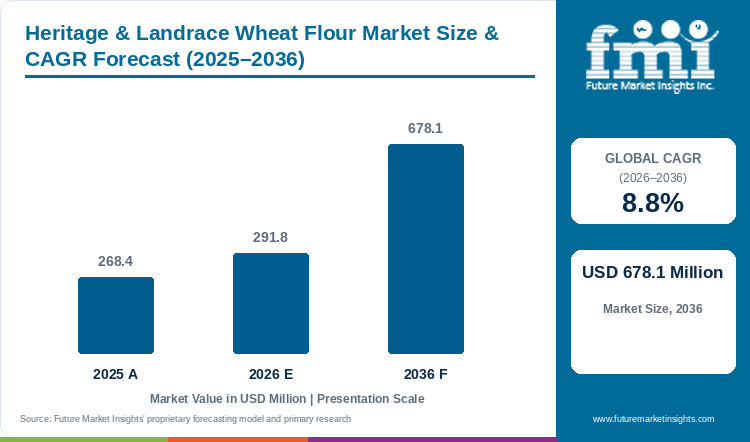
Registering a value of USD 268.4 million in 2025, the global heritage & landrace wheat flour market expanded to USD 291.8 million in 2026 and is anticipated to achieve USD 678.1 million by 2036, driven by an 8.8% CAGR.
Artisan bakeries and specialty pasta manufacturers are replacing anonymous commodity wheat with named ancient and pre-Green Revolution landrace cultivars to justify premium retail menu pricing, even though high gliadin-to-glutenin ratios make these doughs slacken under intensive mixing. For instance, in October 2025, cereal geneticist Rahman Ebrahimzadegan and colleagues publishing in PLOS ONE analyzed HMW and LMW glutenin subunits with gliadin fractions across hexaploid and ancient-derived wheat lines and showed how shifts in gliadin-to-glutenin balance govern dough extensibility and Zeleny sedimentation volume [1]. Driven by identity-preserved grain contracting across craft boulangeries and specialty grocers, global heritage & landrace wheat flour market value expands from USD 268.4 million recorded in 2025 toward a 2026 figure of USD 291.8 million and an anticipated 2036 valuation of USD 678.1 million, logging an 8.8% CAGR and USD 386.3 million in added market value. Within the wheat species & varietal class category, Spelt (Triticum spelta) is expected to attain 45.4% of 2026 varietal demand because bakers upgrade cereal and grain fortification profiles, whereas 22% to 28% mechanical dehulling chaff losses on hulled spikelets keep raw grain costs elevated.
Key Market Trends & Insights
- By wheat species & varietal class: Spelt (Triticum spelta) is expected to secure a 45.4% share of the wheat species & varietal class segment in 2026, supported by widespread Dinkel cultivation in Europe and functional hexaploid gluten strength.
- By milling extraction & granulation: Within the milling extraction & granulation category, Whole-Grain & Stone-Ground Integral Flour is projected to claim 42.8% of 2026 extraction demand by preserving germ-retained carotenoid aroma.
- By end-use application: Sourdough & Hearth Bread & Rolls are estimated to concentrate a 44.2% share across end-use applications in 2026 because long bulk fermentation strengthens extensible landrace gluten.
- By agronomic & provenance claim: Certified Organic & Biodynamic is anticipated to attain 48.7% of agronomic & provenance claim demand in 2026, driven by low-input hulled wheat agronomy that thrives without synthetic fungicides.
- By sales channel: Artisan Bakeries, Pizzerias & Foodservice is forecast to claim 38.6% of 2026 buyer orders via single-origin varietal menu storytelling.
Regional Highlights
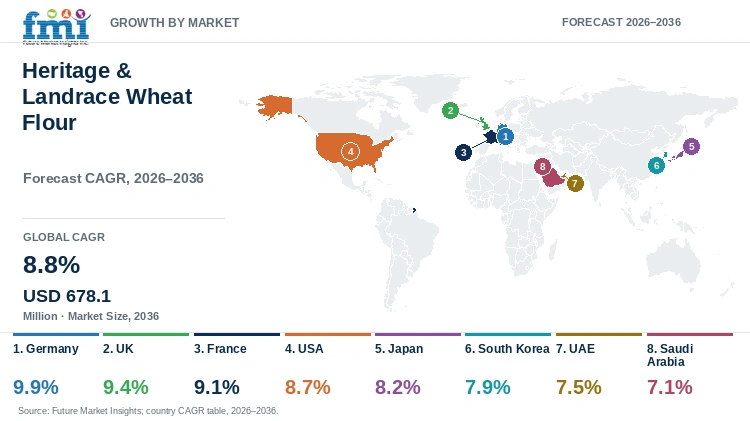
- European Dinkel and ancient-wheat anchor: Germany heads national growth at a 9.9% yearly pace through 2036, supported by deep domestic spelt and einkorn milling capacity.
- Craft boulangerie and North America grain sheds: The UK posts 9.4% annual expansion ahead of 9.1% growth in France and 8.7% in the USA, with Saudi Arabia advancing at 7.1% per year.
Market Size & Forecast
Table 1: Market Size and Forecast for the Heritage & Landrace Wheat Flour Market (USD million and CAGR percentage), 2025 to 2036
| Metric | Value |
|---|---|
| 2025 Market Size | USD 268.4 million |
| Estimated Market Size in 2026 | USD 291.8 million |
| Projected Market Size by 2036 | USD 678.1 million |
| CAGR, 2026 to 2036 | 8.8% |
| Added Revenue, 2026 to 2036 | USD 386.3 million |
Commercial bakeries cannot process hulled ancient species such as einkorn (Triticum monococcum) and emmer (Triticum dicoccum) on standard commodity wheat lines because tightly adhering glumes require rubber-roll decortication and weak gluten networks tear under high-speed shear. To help commercial bakeries overcome this dough-handling limitation, specialty mills calibrate tempering moisture separately for each species while supplying companion sorghum flour ingredients to multi-grain accounts. In April 2025, cereal chemist Anandu Valsalan and co-authors at the University of Manitoba reported in a Journal of Food Science paper that targeted hydrothermal and emulsifier conditioning significantly improves gas retention and loaf volume in ancient emmer and einkorn as well as spelt breadmaking [2].
Hulled-Grain Dehulling & Stone/Roller Milling Sizing
Table 2: Hulled-Grain Dehulling and Milling Sizing for the Heritage & Landrace Wheat Flour Market (USD million and operational ranges), 2025 to 2036
| Metric | 2025 | 2026 | 2036 |
|---|---|---|---|
| Market size (USD million) | 268.4 | 291.8 | 678.1 |
| Commercial heritage & landrace wheat flour milled (thousand metric tons) | 112.0 to 126.0 | 120.0 to 135.0 | 258.0 to 292.0 |
| Realized wholesale & B2B price per metric ton (USD) | 2,130 to 2,420 | 2,160 to 2,460 | 2,320 to 2,650 |
| Average hulled-spikelet dehulling chaff loss (%) | 22.0% to 28.0% | 21.5% to 27.5% | 20.0% to 25.5% |
Operational note: Milled tonnage covers un-sprouted and un-fermented spelt and emmer along with einkorn and Khorasan as well as named historical landrace wheats after deducting 20% to 28% hull-chaff removal on hulled Triticum species.
In 2026, specialty mills price wholesale contracts at USD 2,160-2,460 per metric ton since removing tough outer glumes from harvested spikelets strips away 21.5% to 27.5% of raw weight as chaff before milling even begins. Despite this dehulling yield penalty, artisan bakeries and pasta makers willingly pay higher per-ton prices when mills grind dehulled kernels on cool granite burr stones and blend them with prebiotic dietary fibers to retain yellow lutein pigments and nutty germ oils.
Per Capita & Identity-Preserved Acreage Sizing
Table 3: Per Capita and Artisan Bakery Valuation Indicators for the Heritage & Landrace Wheat Flour Market (USD), 2025 to 2036
| Metric | 2025 | 2026 | 2036 |
|---|---|---|---|
| World population (billion) | 8.2 | 8.3 | 9.0 |
| Market value per 1,000 people (USD) | 32.7 | 35.2 | 75.3 |
| Annual heritage wheat flour spend per craft bakery / pasta account (USD thousand) | 38.0 to 48.0 | 41.0 to 52.0 | 76.0 to 96.0 |
| Typical heritage wheat grist share in artisan sourdough loaves (%) | 25.0% to 100.0% | 30.0% to 100.0% | 35.0% to 100.0% |
Table 4: Identity-Preserved Mill & Varietal Allocation Indicators for the Heritage & Landrace Wheat Flour Market (USD and percentages), 2026
| Metric | Value | Institutional Reference Basis |
|---|---|---|
| Market size, 2026 | USD 291.8 million | 2026 global heritage & landrace wheat flour valuation baseline |
| Craft bakeries, pasta makers & B2B plants served | 6,300 accounts | Global specialty boulangerie, pizzeria, pasta & retail base |
| Spelt (Triticum spelta) flour share, 2026 | 45.4% (USD 132.5 million allocation) | 45.4% wheat species & varietal class allocation |
| Certified organic & biodynamic share, 2026 | 48.7% (USD 142.1 million allocation) | 48.7% agronomic & provenance claim allocation |
Craft bakery and pasta accounts spend USD 41.0-52.0 thousand annually on heritage wheat flour in 2026 and reach USD 76.0 thousand to USD 96.0 thousand in 2036 since tall-straw landrace wheats such as Red Fife and White Sonora yield 30% to 45% less grain per hectare than modern dwarf wheat and require identity-preserved farmgate premiums. Because synthetic nitrogen causes these 110-to-140-centimeter stalks to lodge, growers rotate heritage wheats with deep-rooting perennial forage seeds, locking in organic and regenerative price premiums from specialty mills.
Analyst Perspective
"Heritage and landrace wheats cannot be milled or mixed like commodity hard red winter wheat because high gliadin-to-glutenin ratios cause dough slackening under intensive mechanical shear. Specialty millers that pair single-cultivar identity preservation with fine micro-granulation and clear hydration guidance will capture premium artisan bakery and pasta accounts."
- Nandini Roy Choudhury, Principal Consultant, Future Market Insights.
How is the heritage & landrace wheat flour market segmented?
Segmentation across the heritage & landrace wheat flour market spans wheat species & varietal class and milling extraction & granulation with end-use application as well as agronomic & provenance claim and sales channel. Primary 2026 shares belong to Spelt (45.4%) and Whole-Grain & Stone-Ground Integral Flour (42.8%) along with Sourdough & Hearth Bread & Rolls (44.2%) and Certified Organic & Biodynamic (48.7%).
By wheat species & varietal class: Spelt (Triticum spelta), Emmer / Farro Medio (Triticum dicoccum), Einkorn / Petit Épeautre (Triticum monococcum), Khorasan / Kamut (Triticum turgidum ssp. turanicum), and Named Historical Landrace & Heirloom Common Wheats (Red Fife, White Sonora, Turkey Red, Rouge de Bordeaux, Barbera, Öland).
By milling extraction & granulation: Whole-Grain & Stone-Ground Integral Flour, Bolted / High-Extraction Flour (Type 80 to Type 110), White / Sifted Specialty Extraction (Type 630 / Type 550), and Semolina, Middlings & Micro-Granulated Concentrates.
By end-use application: Sourdough & Hearth Bread & Rolls, Artisanal & Bronze-Die Pasta & Noodles, Pizza, Focaccia & Flatbreads, Biscuits, Pastries, Crackers & Viennoiserie, and Retail Home-Baking Flour Packs.
By agronomic & provenance claim: Certified Organic & Biodynamic, Regenerative & Single-Origin Identity-Preserved, and Conventional Heritage Varietal.
By sales channel: Artisan Bakeries, Pizzerias & Foodservice, Industrial Bakery & Pasta Manufacturers, Specialty, Natural & Supermarket Retail, and Direct-to-Consumer & Mill-Direct Online.
Why does Spelt (Triticum spelta) lead the wheat species & varietal class category?
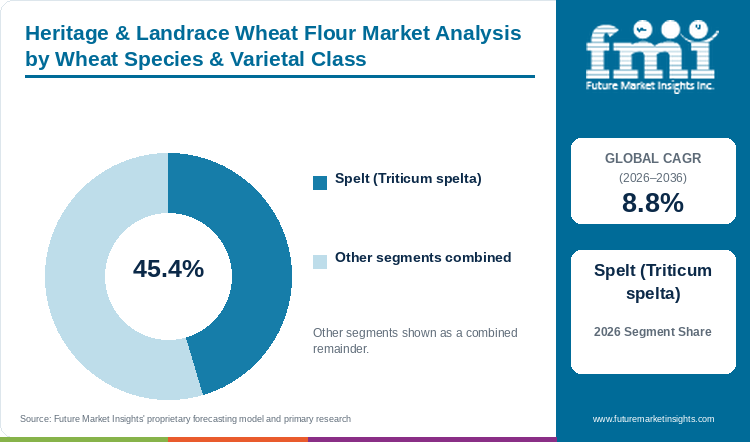
Spelt (Triticum spelta) is expected to secure a 45.4% share of the wheat species & varietal class segment in 2026 because its hexaploid genome delivers dependable loaf volume across commercial bakeries.
Table 5: Wheat Species & Varietal Class Share for the Heritage & Landrace Wheat Flour Market (percentage share), 2026
| Wheat Species & Varietal Class | Share (2026) |
|---|---|
| Spelt (Triticum spelta) | 45.4% |
| Other Segments Combined* | 54.6% |
| Total | 100.0% |
*Calculated as the balance remaining after deducting the leading segment's reported share from 100.0%.
Table 6: Wheat Species & Varietal Class Leadership and Market Growth for the Heritage & Landrace Wheat Flour Market (segment and CAGR percentage), 2026 to 2036
| Metric | Value |
|---|---|
| Global CAGR (2026 to 2036) | 8.8% |
| Leading Segment | Spelt (Triticum spelta) |
Commercial bakeries order far more spelt than diploid einkorn or tetraploid emmer because spelt shares the hexaploid (2n = 42) genome of common bread wheat, which gives doughs enough gluten tenacity to run on mechanical dividers without collapsing. Because of this baking reliability, bakeries substitute 50% to 100% sifted Type 630 or wholemeal spelt flour into hearth bread and pretzel formulas with diastatic malt ingredients, whereas sprouted spelt is excluded here and tracked strictly under the Sprouted Flour Market.
- Within the wheat species & varietal class category, Spelt (Triticum spelta) is expected to claim 45.4% of 2026 varietal demand thanks to established Dinkel milling infrastructure in Germany and Switzerland as well as Austria and the UK.
- In line with this commercial breadth, in its May 2025 trade product catalog UK organic miller Doves Farm Foods details dedicated white and wholemeal spelt flours with ancient emmer and einkorn bakery sacks for foodservice and manufacturing accounts [3].
Why does Whole-Grain & Stone-Ground Integral Flour lead milling extraction & granulation?
By retaining golden lutein carotenoids and germ lipids during single-pass grinding, Whole-Grain & Stone-Ground Integral Flour is projected to claim 42.8% of the milling extraction & granulation category in 2026.
Bakers paying a hefty price premium for identity-preserved einkorn or Khorasan as well as Red Fife rarely want roller-sifted white flour that strips away the germ and aleurone layer where nutty lipid aromatics and golden lutein pigments reside. Because single-pass stone milling preserves these signature sensory compounds and pairs well with resistant starch fiber ingredients, whole-grain integral grades capture the largest share of extraction volume while micro-granulated wholegrain spelt concentrates grow rapidly in soft roll lines.
- To preserve natural vitamin E and phenolic antioxidants in artisan loaves, bakers help Whole-Grain & Stone-Ground Integral Flour claim 42.8% of 2026 milling extraction & granulation demand.
- To serve industrial bakers who want wholegrain nutrition without dark bran specks, in April 2026 GoodMills Innovation introduced SNOW SPELT wholegrain microgranulate to produce light and voluminous wholegrain spelt baked goods [4].
What keeps Sourdough & Hearth Bread & Rolls ahead by end-use application?
Across the end-use application breakdown, Sourdough & Hearth Bread & Rolls are estimated to concentrate 44.2% of 2026 demand because slow coil-fold fermentation builds gas retention in extensible doughs.
High-speed pan-bread mixers tear the gliadin-heavy gluten network of ancient and landrace wheats, whereas slow sourdough bulk fermentation and gentle hand or coil folding build organic acidity that tightens extensible doughs naturally. Because artisan sourdough boules also command USD 8 to USD 14 per loaf at retail, independent boulangeries anchor application volume while biscuit and snack makers blend White Sonora and emmer flours into baked and extruded savory snacks for a tender, flaky bite.
- Supported by premium country-loaf pricing across independent boulangeries and in-store bakeries, Sourdough & Hearth Bread & Rolls are estimated to concentrate 44.2% of the end-use application segment in 2026.
- To explain why bronze-die pasta is the second-fastest application, in January 2025 food chemist Dario Mercatante and co-researchers at Bologna University demonstrated in Foods that wholegrain diploid einkorn pasta retains higher carotenoid and tocol antioxidant levels during cooking and digestion than modern durum wheat pasta [5].
Why does Certified Organic & Biodynamic lead the agronomic & provenance claim category?
Certified Organic & Biodynamic is anticipated to attain a 48.7% share of the agronomic & provenance claim segment in 2026, reinforced by low-input hulled wheat agronomy.
Conventional synthetic nitrogen fertilizers cause tall-straw ancient and landrace wheats to lodge in the field, whereas organic crop rotations following nitrogen-fixing clover or alfalfa match the low-input physiology of hulled spelt and emmer along with einkorn. Because tightly closed glumes also shield kernels from fungal ear blight without synthetic fungicides, organic farmers supply nearly half of all commercial heritage wheat tonnage.
- Driven by the natural agronomic fit between hulled ancient wheats and certified organic crop rotations, Certified Organic & Biodynamic is anticipated to attain 48.7% of the agronomic & provenance claim category in 2026.
- To reinforce this organic supply base, in October 2026 DEFRA officials in England published the Organic Action Plan for England establishing supply-chain funding and public procurement targets to expand domestic organic cereal and heritage grain acreage [6].
What gives Artisan Bakeries, Pizzerias & Foodservice the leading sales channel position?
Artisan Bakeries, Pizzerias & Foodservice is forecast to generate 38.6% of 2026 channel demand via single-cultivar menu callouts.
Independent sourdough bakeries and craft pizzerias along with fresh-pasta restaurants lead buyer orders because naming single-origin cultivars such as Rouge de Bordeaux or Red Fife on menus directly lifts average guest checks. To secure fresh stone-milled batches with high germ-oil aroma, these foodservice accounts purchase 20-to-50-pound multi-wall sacks through specialty distributors or mill-direct pallet programs.
- High-margin sourdough loaf and fresh-pasta menu differentiation enables Artisan Bakeries, Pizzerias & Foodservice to capture 38.6% of 2026 channel sales.
- To benchmark the broader whole-wheat milling base, USDA NASS statisticians in their May 2026 Flour Milling Products 2025 Summary documented 422.5 million hundredweight of total wheat flour milled in the USA including 20.6 million hundredweight of whole-wheat flour across commercial mills [7].
What are the drivers, restraints, and opportunities in the heritage & landrace wheat flour market?
Carotenoid-rich sensory profiles and clinical digestive tolerance trials propel heritage & landrace wheat flour demand. Conversely, 22% to 28% dehulling losses and post-harvest grain storage sensitivity restrain mass-market pricing while micro-granulated ancient-wheat concentrates support industrial bakery adoption.
- Driver: Elevated lutein carotenoid pigments and clinical evidence supporting ancient-grain digestive comfort in einkorn and Khorasan as well as spelt support premium artisan bread and bronze-die pasta pricing.
- Restraint: Lower field yields and 22% to 28% spikelet dehulling chaff losses combine with gliadin-induced dough slackening and whole-grain lipid storage sensitivity to restrict mass-market substitution.
- Opportunity: Micro-milled ancient-wheat concentrates (such as SNOW SPELT) and low-dust process flours allow high-speed commercial bakeries to run heritage grains without dough tearing.
Growth Analysis and Future Potential: Qualitative Demand Catalysts
Consumer willingness to pay premium prices for breads and pasta that offer easier digestive tolerance and farm-level provenance is the primary catalyst driving heritage & landrace wheat flour demand. For instance, in December 2025, clinical nutritionist Samantha Maurotti and colleagues at Magna Graecia University published a trial in the European Journal of Nutrition showing that ancient wheat flour consumption (einkorn and emmer along with Khorasan) significantly reduces abdominal distension and symptom severity in irritable bowel syndrome patients compared with modern wheat [8]. Because einkorn and Khorasan flours also impart golden lutein color and buttery aromatics when paired with clean-label modified starch, bakeries command strong retail margins. To demonstrate the durability of this demand, in January 2025 UK miller Doves Farm documented its farm-to-mill cultivation of spelt since 1996 and einkorn since 2009 along with emmer since 2013 [9].
Risk Assessment of the Heritage & Landrace Wheat Flour Market: Operational and Formulation Friction
Elevated unit costs from low field yields and 22% to 28% dehulling chaff losses combine with post-harvest storage vulnerability and gluten-allergen limits to restrain mass-market adoption. In October 2025, agricultural engineer Hafiz Muhammad Bilal Yousuf and co-authors including Kurt Rosentrater at Iowa State University reported in Scientific Reports that conventional non-hermetic wheat storage allows moisture migration and Tribolium castaneum pest damage along with wet-gluten degradation compared with hermetic grain silos [10]. Because stone-ground heritage flours also retain unsaturated germ lipids that oxidize rapidly in warm warehouses, mills face shorter inventory turnover windows. Furthermore, since all hulled and landrace wheats belong to the genus Triticum, consumers with celiac disease or wheat allergy must purchase commercial gluten-free flours instead.
Commercial Opportunity Analysis: Formulation Differentiation and Value-Add Formats
Specialty millers are capturing industrial bakery volume by engineering micro-granulated ancient-wheat concentrates that eliminate coarse bran specking and dough tearing on automated make-up lines. For example, in August 2026, GoodMills Innovation announced its südback 2026 bakery portfolio featuring SNOW SPELT micro-granulated wholegrain spelt paired with functional protein- and fiber-enriched baking concentrates designed for commercial dough lines [11]. By standardizing particle size and alveograph extensibility, millers allow multi-store branch bakeries to run wholegrain ancient wheats on standard roll lines while also partnering with nixtamalized corn flour buyers to launch single-origin White Sonora wheat-and-masa flatbreads.
Heritage & Landrace Wheat Flour Market by Country (2026 to 2036)
Country-level milling and bakery adoption patterns show Germany anchoring heritage & landrace wheat flour growth with a 9.9% annual gain through 2036 ahead of 9.4% expansion in the UK and 9.1% in France, while Saudi Arabia logs a 7.1% yearly clip. Established European Dinkel and petit épeautre cultivation combined with North America regional grain-shed networks and Asian artisan-bakery imports shape country-level demand.
Table 7: Country CAGR and Primary Growth Levers for the Heritage & Landrace Wheat Flour Market (CAGR percentage and operational drivers), 2026 to 2036
| Country | CAGR (2026 to 2036) | Primary Growth Lever |
|---|---|---|
| Germany | 9.9% | Widespread Dinkel (spelt), emmer & einkorn cultivation and micro-milled spelt innovation |
| UK | 9.4% | Doves Farm ancient-grain heritage and resilient spring/winter organic wheat rotations |
| France | 9.1% | IGP Petit Épeautre de Haute-Provence and ARVALIS regional wheat quality programs |
| USA | 8.7% | Ardent Mills regenerative wheat acreage and regional White Sonora & Red Fife stone mills |
| Japan | 8.2% | Imported organic spelt & Khorasan flours for Tokyo/Kyoto artisan boulangeries |
| South Korea | 7.9% | Whole-grain sourdough gut-health demand and premium ancient-grain café loaves |
| UAE | 7.5% | Luxury hospitality ancient-grain pasta and specialty imported flour programs |
| Saudi Arabia | 7.1% | Drought-tolerant wheat genotype research and traditional Arabian landrace pastry demand |
Source: Future Market Insights analysis
Germany Heritage & Landrace Wheat Flour Market Outlook (2026 to 2036)
Whereas ancient wheats remain confined to niche health-food stores in many countries, Germany treats Dinkel (spelt) as a mainstream commercial bread and pretzel grain because of deep contract farming across Baden-Württemberg and Bavaria. During March 2026, GoodMills Innovation in Hamburg commercialized its low-dust process flour technology engineered to cut airborne fine flour particles and improve bakery workplace safety across industrial dough make-up lines in Germany [12]. Across Germany commercial mill shipments of heritage & landrace wheat flour are projected to expand at a 9.9% CAGR between 2026 and 2036, driven by retail bakery chains replacing standard wheat rolls with Urgetreide (ancient-grain) loaves, although seasonal harvest protein swings require careful multi-region blending.
Key takeaway: In Germany, deep domestic Dinkel and Urgetreide cultivation paired with industrial micro-milling capacity is projected to sustain market-leading ancient-wheat flour growth.
UK Heritage & Landrace Wheat Flour Market Outlook (2026 to 2036)
Weather-driven volatility in conventional winter wheat yields is prompting organic and regenerative arable farmers in the UK to plant hardy spring and winter spelt and emmer along with einkorn varieties that tolerate wet soils. According to agricultural statisticians at DEFRA in their Agriculture in the UK 2024 crop report published in June 2025, wet autumn planting weather reduced the 2024 UK wheat harvest by 21% to 11.1 million tonnes, encouraging specialty growers to diversify into resilient heritage cereal rotations [13]. Against this tight domestic grain backdrop, UK craft-bakery orders for heritage & landrace wheat flour are expected to record a 9.4% yearly gain through 2036, owing to supermarket artisan sourdough expansion and DEFRA organic conversion incentives.
Key takeaway: In the UK, resilient organic spelt and emmer farm rotations and independent sourdough bakery demand are expected to drive steady heritage wheat flour expansion.
France Heritage & Landrace Wheat Flour Market Outlook (2026 to 2036)
Demand in France is anchored by protected geographical indications such as Petit Épeautre de Haute-Provence (einkorn) and paysan-boulanger networks milling heirloom Rouge de Bordeaux and Touselle wheats on stone burrs. In July 2026, agronomic institute ARVALIS published its 2025/2026 wheat campaign synthesis for Bourgogne documenting how variable rainfall and heat stress across France elevate grower interest in hardy regional wheat cultivars and diversified crop rotations [14]. While low field yields keep certified IGP einkorn prices three to four times higher than commodity wheat, urban shoppers pay for verified terroir loaves. Artisanal boulangerie procurement of heritage & landrace wheat flour across France is estimated to climb at a 9.1% annual clip through 2036, supported by regional provenance demand.
Key takeaway: In France, protected Petit Épeautre provenance and ARVALIS-benchmarked regional milling networks are estimated to support artisanal boulangerie demand for heritage flours.
USA Heritage & Landrace Wheat Flour Market Outlook (2026 to 2036)
Unlike Europe's centuries-old Dinkel supply chain, market expansion in the USA relies on pairing regional stone-milling hubs (such as Barton Springs Mill and Central Milling) with corporate regenerative grain-contracting programs across the Great Plains and Pacific Northwest. Across the USA, commercial adoption of heritage & landrace wheat flour is anticipated to climb at an 8.7% yearly pace through 2036 across craft bakeries and pizzerias, where buyers contract identity-preserved White Sonora and Red Fife lots with organic spelt. In September 2025, Ardent Mills published its FY2025 ESG Report confirming that its regenerative agriculture programs reached nearly 940,000 acres across North America while cutting operational Scope 1 and 2 emissions by 24% [15]. However, segregated railcar and elevator storage costs restrain mass-grocery pricing.
Key takeaway: In the USA, regional stone-milling hubs and Ardent Mills regenerative wheat acreage are anticipated to propel commercial demand for named landrace and ancient wheat flours.
Japan Heritage & Landrace Wheat Flour Market Outlook (2026 to 2036)
Across Japan, bakery demand for heritage & landrace wheat flour is forecast to climb at an 8.2% yearly clip from 2026 through 2036 because high-end department-store boulangeries and artisanal pasta restaurants in Tokyo and Kyoto market single-origin European spelt and North America Khorasan loaves to quality-focused shoppers. Because domestic wheat farming in Hokkaido and Kyushu focuses on soft udon and modern bread wheats, bakeries in Japan rely on containerized specialty imports. USDA ERS economists in their October 2026 Wheat Outlook report tracked steady high-protein food-wheat import demand across East Asia milling corridors including Japan [16]. Even so, strict state import markups and pesticide-residue testing add landed cost to imported organic ancient-wheat sacks.
Key takeaway: In Japan, department-store boulangerie menu differentiation and specialty pasta manufacturing are forecast to drive container imports of organic spelt and Khorasan flours.
South Korea Heritage & Landrace Wheat Flour Market Outlook (2026 to 2036)
Consumer demand in South Korea is driven by urban millennials and older adults in Seoul and Busan who seek out Kamut Khorasan and spelt along with einkorn sourdough breads for post-meal digestive comfort and lower glycemic spikes. To validate this metabolic positioning, in September 2025 nutrition researcher Ye-Tae Kim and co-authors including Jong-Hee Lee at South Korea's Rural Development Administration reported in Food Research International that dietary intervention with high-fiber and sourdough whole-wheat breads improves metabolic and gut-microbial balance [17]. Across South Korea, specialty bakery uptake of heritage & landrace wheat flour is projected to deliver a 7.9% yearly expansion through 2036, fueled by premium bakery cafés featuring organic Khorasan and stone-ground einkorn boules despite high refrigerated import freight rates.
Key takeaway: In South Korea, Rural Development Administration gut-health validation and premium bakery-café adoption of organic Khorasan and spelt loaves are projected to sustain ancient-wheat flour imports.
UAE Heritage & Landrace Wheat Flour Market Outlook (2026 to 2036)
Because hyper-arid conditions prevent commercial rain-fed cultivation of hulled European wheats in the Gulf, the UAE market operates purely as a high-margin import hub serving luxury hotels and fine-dining Italian restaurants in Dubai and Abu Dhabi. Across the UAE, hospitality orders for heritage & landrace wheat flour are projected to progress at a 7.5% annual rate over the ten-year period to 2036, attributable to five-star resort commissaries baking artisan sourdough loaves and extruding bronze-die emmer and Khorasan pasta. However, in September 2026 the Food and Agriculture Organization of the United Nations (FAO) GIEWS Food Price Monitoring bulletin highlighted elevated international wheat flour prices across import-dependent Near East foodservice markets, which keeps landed specialty flour costs high [18].
Key takeaway: In the UAE, five-star hospitality pasta and artisan bread programs paired with gourmet retail grocers are projected to drive air- and sea-freight imports of European and North America ancient-wheat flours.
Saudi Arabia Heritage & Landrace Wheat Flour Market Outlook (2026 to 2036)
Unlike the UAE where demand is almost entirely driven by imported European farro and spelt, Saudi Arabia combines luxury hotel flour imports in Riyadh and Jeddah with domestic agronomic programs preserving heat- and drought-tolerant Arabian wheat landraces used in traditional whole-grain pastries. In February 2026, agronomist Mesfer M. Alqahtani at Shaqra University published field trials in PeerJ evaluating drought tolerance and grain yield stability across diverse wheat genotypes in Al-Dawadmi, Saudi Arabia to guide national breeding efforts that preserve stress-resilient local wheat lines [19]. Although groundwater irrigation limits cap domestic landrace acreage, specialty foodservice adoption of heritage & landrace wheat flour across Saudi Arabia is likely to record a 7.1% yearly pace through 2036 through gourmet grocers and heritage bakeries.
Key takeaway: In Saudi Arabia, boutique urban boulangeries and agronomic interest in drought-resilient heritage wheat genotypes are likely to support steady growth in ancient-wheat flours.
Full report country CAGRs cover: North America; Latin America; Western Europe; Eastern Europe; East Asia; South Asia and Pacific; Middle East and Africa.
Who are the notable companies in the heritage & landrace wheat flour market?
Ardent Mills, Doves Farm Foods, GoodMills Group, Bob's Red Mill, King Arthur Baking, Bay State Milling, Central Milling, Barton Springs Mill, ADM, and Scoular are the notable companies in the heritage & landrace wheat flour market.
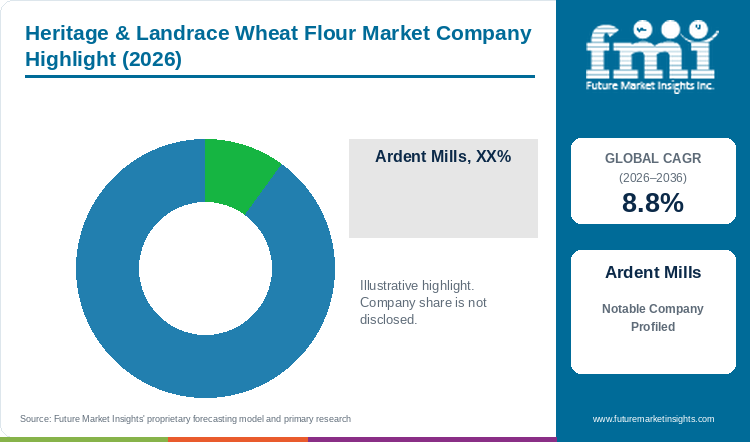
Competitive positioning in the heritage & landrace wheat flour market depends on contracted farm-level seed purity and specialized hulled-grain decortication because uncleaned glumes ruin flour ash specifications. To serve craft bakers, dedicated heritage and organic millers including Doves Farm Foods in the UK and USA stone millers Central Milling and Barton Springs Mill along with Bob's Red Mill produce named spelt and einkorn flours as well as Khorasan and White Sonora grades. Industrial milling groups GoodMills Group (via GoodMills Innovation SNOW SPELT) and Ardent Mills (via The Annex) supply standardized B2B ancient-wheat flours and concentrates. Meanwhile, King Arthur Baking and Bay State Milling join ADM and Scoular in supporting varietal breeding and identity-preserved grain origination.
- Dedicated Stone-Ground & Organic Heritage Flour Millers: Doves Farm Foods and Bob's Red Mill along with regional stone millers Central Milling and Barton Springs Mill grind single-cultivar spelt and einkorn as well as Khorasan and Red Fife flours.
- Industrial Specialty & Micro-Granulated Ancient-Wheat Millers: Ardent Mills and GoodMills Group as well as Bay State Milling and King Arthur Baking supply standardized B2B and professional ancient-wheat flours and micro-milled concentrates.
- Identity-Preserved Grain Origination & Multigrain Milling Platforms: ADM and Scoular coordinate segregated farm-to-mill identity-preserved grain supply chains and multiseed ancient-grain bakery mixes.
Competitive Benchmarking: Heritage & Landrace Wheat Flour Market
Table 8: Competitive Benchmarking for the Heritage & Landrace Wheat Flour Market (qualitative capability ratings), 2026
| Company | Named Heritage & Hulled-Wheat Breadth | Dehulling & Stone/Roller Milling Depth | Identity-Preserved & Organic Traceability | Geographic Reach |
|---|---|---|---|---|
| Ardent Mills | High | High | High | North America (USA, Canada, Puerto Rico) |
| Doves Farm Foods | High | High | High | UK, Europe & international specialty export |
| GoodMills Group | High | High | High | Germany, Austria, Poland & Central European network |
| Bob's Red Mill | High | High | High | USA, Canada & global retail/foodservice export |
| King Arthur Baking | High | Medium | High | USA retail & professional bakery channels |
| Bay State Milling | Medium | High | High | North America national B2B bakery network |
| Central Milling | High | High | High | Western & national USA artisan bakery supply |
| Barton Springs Mill | High | High | High | Texas & national USA craft bakery/chef direct |
| ADM | Medium | High | Medium | North America, UK & European B2B milling network |
| Scoular | Medium | Medium | High | North America & Asia identity-preserved grain supply |
Scoring basis: Named Heritage & Hulled-Wheat Breadth evaluates documented hulled and landrace wheat flour SKUs. Dehulling & Stone/Roller Milling Depth assesses dedicated spikelet decortication and granite burr or micro-milling equipment, while Identity-Preserved & Organic Traceability reflects farm-to-lot varietal certification.
Key Developments in the Heritage & Landrace Wheat Flour Market
- During April 2026, Vermont-based King Arthur Baking broadened its retail specialty flour and baking mix lineup with five new spring releases addressing celebratory baking and specialty grain convenience across USA grocery channels [20].
- During May 2026, GoodMills Innovation broadened its specialty grain-processing portfolio following its April 2026 SNOW SPELT micro-granulated ancient-wheat launch by introducing stone-ground wholegrain SNACKMAXX flours for industrial bakeries and snack manufacturers [21].
- In October 2026, ARVALIS and FranceAgriMer released the 2026 French durum and tetraploid wheat harvest quality brochure detailing protein content and vitreousness along with semolina yellow-index benchmarks for millers and pasta manufacturers [22].
Key Players in the Heritage & Landrace Wheat Flour Market
Dedicated Stone-Ground & Organic Heritage Flour Millers
- Doves Farm Foods
- Bob's Red Mill
- Central Milling
- Barton Springs Mill
Industrial Specialty & Micro-Granulated Ancient-Wheat Millers
- Ardent Mills
- GoodMills Group
- King Arthur Baking
- Bay State Milling
Identity-Preserved Grain Origination & Multigrain Milling Platforms
- ADM
- Scoular
Heritage & Landrace Wheat Flour Market - Report Scope
Table 9: Report Scope for the Heritage & Landrace Wheat Flour Market (coverage fields and definitions), 2026 to 2036
| Coverage field | Report scope |
|---|---|
| Market breakdown | Wheat Species & Varietal Class; Milling Extraction & Granulation; End-Use Application; Agronomic & Provenance Claim; Sales Channel; Region |
| Quantitative Units | USD Million |
| Market Definition | Includes commercial B2B and retail supplier revenue from un-germinated, un-fermented flours, semolina, and micro-granulated concentrates milled from hulled ancient wheat species (spelt/Triticum spelta, emmer/Triticum dicoccum, einkorn/Triticum monococcum), Khorasan wheat (Triticum turgidum ssp. turanicum), and named pre-Green Revolution historical landrace common/durum wheats (Red Fife, White Sonora, Turkey Red, Rouge de Bordeaux, Barbera, Öland). Category Scope & Overlap Note: Sprouted ancient-wheat flours are excluded and counted exclusively in the Sprouted Flour Market; fermented spelt/einkorn sourdough flours are excluded and counted exclusively in the Fermented & Cultured Flour Market; non-Triticum pseudocereals (quinoa, amaranth, buckwheat), modern semi-dwarf commodity wheat flours, unmilled grain berries, and finished baked goods are excluded. |
| Regions Covered | North America; Latin America; Western Europe; Eastern Europe; East Asia; South Asia and Pacific; Middle East and Africa |
| Countries Covered | Germany, UK, France, USA, Japan, South Korea, UAE, Saudi Arabia, and additional countries in the full report |
| Key Companies Covered | Ardent Mills, Doves Farm Foods, GoodMills Group, Bob's Red Mill, King Arthur Baking, Bay State Milling, Central Milling, Barton Springs Mill, ADM, Scoular |
| Forecast Period | 2026 to 2036 |
| Approach | Primary and secondary research with top-down and bottom-up market triangulation. |
Heritage & Landrace Wheat Flour Market - Research Methodology
Table 10: Research Methodology for the Heritage & Landrace Wheat Flour Market (research methods and approach), 2026 edition
| Method | Approach |
|---|---|
| Primary Research | Structured interviews with stone- and roller-mill head millers, hulled-grain decortication engineers, artisan sourdough bakers, bronze-die pasta manufacturers, and identity-preserved organic grain buyers to validate dehulling yield losses (22% to 28%), gliadin-to-glutenin dough handling, and B2B/retail pricing. |
| Secondary Research | Analysis of 2025-2026 peer-reviewed cereal proteomics and kernel-quality studies (PLOS ONE, Journal of Food Science, Foods, European Journal of Nutrition, Scientific Reports, Food Research International, PeerJ), DEFRA 2025-2026 UK crop and organic reports, USDA NASS and ERS 2026 milling reports, and ARVALIS / FranceAgriMer 2026 wheat surveys. |
| Market Sizing and Forecasting | Bottom-up identity-preserved hulled and landrace wheat acreage, post-dehulling flour extraction tonnage, and realized wholesale/retail pricing reconciled against specialty boulangerie, pasta, and retail flour expenditure from 2025 to 2036. |
| Country Forecasting Model | Econometric country projections weight domestic spelt/emmer/einkorn harvested acreage, certified organic bakery demand, artisan sourdough boulangerie density, and specialty grain import tariffs across eight national markets. |
| Operational Benchmark Traceability | Spikelet dehulling chaff-loss percentages, gliadin-to-glutenin extensibility ratios, and per-bakery procurement indicators in Tables 2, 3, and 4 trace to published cereal chemistry literature and commercial stone/roller miller specification sheets. |
| Data Triangulation and Validation | Segment and regional estimates are cross-checked against organic seed certification registries and miller catalog SKUs while enforcing a strict botanical and primary-process boundary that excludes sprouted ancient wheats, fermented sourdough flours, non-Triticum pseudocereals, and modern commodity wheat. |
Heritage & Landrace Wheat Flour Market by Segments
Heritage & Landrace Wheat Flour Market segmented by Wheat Species & Varietal Class:
- Spelt (Triticum spelta)
- Emmer / Farro Medio (Triticum dicoccum)
- Einkorn / Petit Épeautre (Triticum monococcum)
- Khorasan / Kamut (Triticum turgidum ssp. turanicum)
- Named Historical Landrace & Heirloom Common Wheats (Red Fife, White Sonora, Turkey Red, Rouge de Bordeaux, Barbera, Öland)
Heritage & Landrace Wheat Flour Market segmented by Milling Extraction & Granulation:
- Whole-Grain & Stone-Ground Integral Flour
- Bolted / High-Extraction Flour (Type 80 to Type 110)
- White / Sifted Specialty Extraction (Type 630 / Type 550)
- Semolina, Middlings & Micro-Granulated Concentrates
Heritage & Landrace Wheat Flour Market segmented by End-Use Application:
- Sourdough & Hearth Bread & Rolls
- Artisanal & Bronze-Die Pasta & Noodles
- Pizza, Focaccia & Flatbreads
- Biscuits, Pastries, Crackers & Viennoiserie
- Retail Home-Baking Flour Packs
Heritage & Landrace Wheat Flour Market segmented by Agronomic & Provenance Claim:
- Certified Organic & Biodynamic
- Regenerative & Single-Origin Identity-Preserved
- Conventional Heritage Varietal
Heritage & Landrace Wheat Flour Market segmented by Sales Channel:
- Artisan Bakeries, Pizzerias & Foodservice
- Industrial Bakery & Pasta Manufacturers
- Specialty, Natural & Supermarket Retail
- Direct-to-Consumer & Mill-Direct Online
Heritage & Landrace Wheat Flour Market by Region
- North America
- United States
- Canada
- Latin America
- Brazil
- Mexico
- Argentina
- Chile
- Western Europe
- Germany
- France
- United Kingdom
- Italy
- Spain
- Benelux
- Nordics
- Eastern Europe
- Poland
- Czech Republic
- Romania
- Hungary
- East Asia
- China
- Japan
- South Korea
- South Asia and Pacific
- India
- ASEAN
- Australia and New Zealand
- Middle East and Africa
- GCC Countries
- South Africa
- Türkiye
- Israel
Research Sources and Bibliography
- [1] Ebrahimzadegan, R., Sanati, A., & Mirzaghaderi, G. (2025, October 10). High variation in the gluten composition and grain protein content among synthetic wheat lines. PLOS ONE, 20(10), e0331619 (PubMed PMID 41071781).
- [2] Valsalan, A., Swaminathan, I., Kadam, A., Koksel, F., & Malalgoda, M. (2025, April 18). Enhancing the breadmaking quality of ancient grains through synergistic emulsifier treatment and extrusion processing. Journal of Food Science, 90(4), e70206 (PubMed PMID 40260780).
- [3] Doves Farm Foods Ltd. (2025, May 01). PRODUCT CATALOGUE - Doves Farm Foods. Doves Farm Foods.
- [4] GoodMills Innovation GmbH. (2026, April 09). Lighter, finer, milder: wholemeal reimagined - GoodMills Innovation. GoodMills Innovation Newsroom.
- [5] Mercatante, D., Santoni, M., Nissen, L., Didos, S., Salvatori, G., D'Ambrosio, G. J., Farneti, A., Chiarello, E., Casciano, F., Picone, G., Mouchtaropoulou, E., Bordoni, A., Danesi, F., Argiriou, A., Ayfantopoulou, G., Gianotti, A., & Rodriguez-Estrada, M. T. (2025, January 23). Nutritional, Chemical, and Functional Properties of Wholegrain Einkorn Pasta Through Cooking and Digestion: A Comparative Study with Wholegrain Durum Wheat Pasta. Foods, 14(3), 370 (PubMed PMID 39941963).
- [6] UK Department for Environment, Food & Rural Affairs (DEFRA). (2026, October 14). Organic Action Plan for England - GOV.UK. GOV.UK.
- [7] U.S. Department of Agriculture, National Agricultural Statistics Service (USDA NASS). (2026, May 01). Flour Milling Products 2025 Summary 05/01/2026. U.S. Department of Agriculture.
- [8] Maurotti, S., Ferro, Y., Mazza, E., Tirinato, L., Mare, R., Frosina, M., Mirarchi, A., Noto, F. R., Doldo, P., Colaci, C., d'Avanzo, N., Galluccio, A., Greco, S., Pujia, A., & Montalcini, T. (2025, December 19). Ancient grain flour consumption as a novel therapeutic approach for irritable bowel syndrome. European Journal of Nutrition, 65(1), 11 (PubMed PMID 41417098).
- [9] Doves Farm Foods Ltd. (2025, January 15). The Things We Mill - Doves Farm. Doves Farm.
- [10] Yousuf, H. M. B., Yasin, M., Rebouh, N. Y., Aldawood, A. S., Ali, U., & Rosentrater, K. A. (2025, October 06). Comparative assessment of conventional and hermetic storage facilities on wheat grain quality, pest infestation, and bread development. Scientific Reports, 15(1), 34725 (PubMed PMID 41053191).
- [11] GoodMills Innovation GmbH. (2026, August 25). Enrichment, naturalness and process efficiency: GoodMills Innovation to present contemporary solutions for the baking trade at südback 2026 - GoodMills Innovation. GoodMills Innovation Newsroom.
- [12] GoodMills Innovation GmbH. (2026, March 02). Low-dust process flour from GoodMills Innovation reduces fine particle content, extends cleaning intervals and improves workplace safety - GoodMills Innovation. GoodMills Innovation Newsroom.
- [13] UK Department for Environment, Food & Rural Affairs (DEFRA). (2025, June 12). Chapter 7: Crops - GOV.UK. GOV.UK.
- [14] ARVALIS - Institut du végétal. (2026, July 28). Blé : bilan de la campagne 2025/26 en Bourgogne | ARVALIS. ARVALIS Institut du Végétal.
- [15] Ardent Mills. (2025, September 09). Ardent Mills FY25 ESG Report | Ardent Mills. Ardent Mills Newsroom.
- [16] U.S. Department of Agriculture, Economic Research Service (USDA ERS). (2026, October 14). Wheat Outlook: October 2026 | Economic Research Service. U.S. Department of Agriculture.
- [17] Kim, Y.-T., Kwak, J.-E., Kwon, J.-G., Lee, D. Y., Kim, H. B., & Lee, J.-H. (2025, September 01). Dietary intervention with sourdough and high-fiber breads enhances metabolic and microbial homeostasis in mice. Food Research International, 221(Pt 3), 117433 (PubMed PMID 41214943).
- [18] Food and Agriculture Organization of the United Nations (FAO). (2026, September 14). Wheat flour prices followed mixed trends in August 2026 and were significantly above their year-earlier levels | Food Price Monitoring and Analysis (FPMA) | Food and Agriculture Organization of the United Nations. FAO GIEWS.
- [19] Alqahtani, M. M. (2026, February 24). Improving drought tolerance in some wheat genotypes with foliar application of silicon nanoparticles in Al-Dawadmi, Saudi Arabia. PeerJ, 14, e20823 (PubMed PMID 41769396).
- [20] King Arthur Baking Company. (2026, April 21). King Arthur Baking Taps Celebrations, Gluten-Free Demand, and Everyday Ease with Five New Mixes This Spring | King Arthur Baking. King Arthur Baking Company Newsroom.
- [21] GoodMills Innovation GmbH. (2026, May 22). SNACKMAXX® Masa Flours: Authentic Corn Flavour and Process Reliability for Snack Applications - GoodMills Innovation. GoodMills Innovation Newsroom.
- [22] ARVALIS / FranceAgriMer. (2026, October 08). Récolte française de blés durs : la qualité en chiffres | ARVALIS. ARVALIS Institut du Végétal.
- [23] The Scoular Company. (2026, May 13). Scoular recognized as a US Best Managed Company for fourth year. Scoular Newsroom.
- [24] The Scoular Company. (2026, August 03). Scoular is investing in a soybean dehuller at its Covington, Ohio . Scoular Newsroom.
This bibliography is provided for reader reference and is not exhaustive. The full report contains the complete reference list and detailed citations.
This Report Answers
- What is the heritage & landrace wheat flour market size in 2026 and projection for 2036?
- How do gliadin-to-glutenin ratios and hulled spikelets affect ancient-wheat milling and baking?
- Why does Spelt (Triticum spelta) lead the wheat species & varietal class breakdown?
- Why does Whole-Grain & Stone-Ground Integral Flour lead extraction grades?
- How do country growth rates compare across Germany, the UK, France, and the USA?
- Which specialty stone mills and industrial millers supply genuine heritage wheat flours?
- Why do dehulling losses and post-harvest storage requirements constrain market scale?
- What varietal identity and rheology metrics should bakery buyers verify before contracting?
Frequently Asked Questions
How big is the heritage & landrace wheat flour market in 2026, and what is forecast for 2036?
Advancing beyond 2025 demand of USD 268.4 million, the global heritage & landrace wheat flour valuation is estimated at USD 291.8 million in 2026 and reaches a projected USD 678.1 million by 2036 across craft boulangerie, pasta, and retail accounts.
What is the CAGR for the heritage & landrace wheat flour market from 2026 to 2036?
Specialty milling and artisan bakery adoption patterns point to an 8.8% compound annual growth rate over the 2026 to 2036 decade, yielding USD 386.3 million in added annual revenue for identity-preserved wheat millers.
Which wheat species segment leads the heritage & landrace wheat flour market?
Spelt (Triticum spelta) is expected to secure 45.4% of the wheat species & varietal class segment in 2026, supported by its hexaploid gluten structure and established European Dinkel and North America supply chains.
Which milling extraction segment holds the largest share in 2026?
Whole-Grain & Stone-Ground Integral Flour is projected to claim 42.8% of milling extraction & granulation demand in 2026, driven by baker preference for golden lutein carotenoids and germ-oil aromatics.
Which country leads national growth through 2036?
Germany leads national expansion at a 9.9% CAGR from 2026 to 2036, anchored by extensive domestic Dinkel and ancient-wheat cultivation as well as micro-milled spelt innovation.
Which companies are the key players in the heritage & landrace wheat flour market?
Ardent Mills, Doves Farm Foods, GoodMills Group, Bob's Red Mill, King Arthur Baking, Bay State Milling, Central Milling, Barton Springs Mill, ADM, and Scoular are the notable companies in the heritage & landrace wheat flour market.
Preview the report firsthand - request a free sample
Get SampleGet the brochure for pricing and purchase details.
Get PDFTable of Content
- Key Takeaways
- Market Size and CAGR
- Top Growth Driver
- Fastest Growing Segment
- Leading Region
- Key Companies
- Emerging Opportunities
- Executive Summary
- Global Market Outlook
- Demand-side Trends
- Supply-side Trends
- Technology Roadmap Analysis
- Analysis and Recommendations
- Analyst Perspective (What is happening? Why now? What should investors know?)
- Key Questions Answered
- How large is the market?
- What is the CAGR?
- What are key trends?
- Which region dominates?
- Who are the leaders?
- Market Overview
- Market Coverage / Taxonomy
- Market Definition / Scope / Limitations
- Research Methodology
- Chapter Orientation
- Analytical Lens and Working Hypotheses
- Market Structure, Signals, and Trend Drivers
- Benchmarking and Cross-market Comparability
- Market Sizing, Forecasting, and Opportunity Mapping
- Research Design and Evidence Framework
- Desk Research Programme (Secondary Evidence)
- Expert Input and Fieldwork (Primary Evidence)
- Tooling, Models, and Reference Databases
- Data Engineering and Model Build
- Quality Assurance and Audit Trail
- Market Background
- Market Dynamics (Drivers, Restraints, Opportunity, Trends)
- Scenario Forecast (Optimistic, Likely, Conservative)
- Impact Analysis
- AI Impact
- Sustainability Impact
- Regulatory Impact
- Technology Impact
- Consumer / Buyer Analysis
- Purchase Drivers
- Adoption Barriers
- Buyer Journey
- Opportunity Map Analysis
- Product Life Cycle Analysis
- Supply Chain Analysis
- Investment Feasibility Matrix
- Value Chain Analysis
- PESTLE and Porter's Analysis
- Regulatory Landscape
- Regional Parent Market Outlook
- Production and Consumption Statistics
- Import and Export Statistics
- Global Market Analysis and Forecast, 2021 to 2036
- Historical Market Size Value (USD Million) Analysis, 2021 to 2025
- Current and Future Market Size Value (USD Million) Projections, 2026 to 2036
- Y-o-Y Growth Trend Analysis
- Absolute $ Opportunity Analysis
- Global Market Pricing Analysis, 2021 to 2036
- Global Market Analysis and Forecast, By Wheat Species & Varietal Class, 2021 to 2036
- Introduction / Key Findings
- Historical Market Size Value (USD Million) Analysis By Wheat Species & Varietal Class, 2021 to 2025
- Current and Future Market Size Value (USD Million) Analysis and Forecast By Wheat Species & Varietal Class, 2026 to 2036
- Spelt (Triticum spelta)
- Emmer / Farro Medio (Triticum dicoccum)
- Einkorn / Petit Épeautre (Triticum monococcum)
- Khorasan / Kamut (Triticum turgidum ssp. turanicum)
- Named Historical Landrace & Heirloom Common Wheats (Red Fife, White Sonora, Turkey Red, Rouge de Bordeaux, Barbera, Öland)
- Y-o-Y Growth Trend Analysis By Wheat Species & Varietal Class, 2021 to 2025
- Absolute $ Opportunity Analysis By Wheat Species & Varietal Class, 2026 to 2036
- Global Market Analysis and Forecast, By Milling Extraction & Granulation, 2021 to 2036
- Introduction / Key Findings
- Historical Market Size Value (USD Million) Analysis By Milling Extraction & Granulation, 2021 to 2025
- Current and Future Market Size Value (USD Million) Analysis and Forecast By Milling Extraction & Granulation, 2026 to 2036
- Whole-Grain & Stone-Ground Integral Flour
- Bolted / High-Extraction Flour (Type 80 to Type 110)
- White / Sifted Specialty Extraction (Type 630 / Type 550)
- Semolina, Middlings & Micro-Granulated Concentrates
- Y-o-Y Growth Trend Analysis By Milling Extraction & Granulation, 2021 to 2025
- Absolute $ Opportunity Analysis By Milling Extraction & Granulation, 2026 to 2036
- Global Market Analysis and Forecast, By End-Use Application, 2021 to 2036
- Introduction / Key Findings
- Historical Market Size Value (USD Million) Analysis By End-Use Application, 2021 to 2025
- Current and Future Market Size Value (USD Million) Analysis and Forecast By End-Use Application, 2026 to 2036
- Sourdough & Hearth Bread & Rolls
- Artisanal & Bronze-Die Pasta & Noodles
- Pizza, Focaccia & Flatbreads
- Biscuits, Pastries, Crackers & Viennoiserie
- Retail Home-Baking Flour Packs
- Y-o-Y Growth Trend Analysis By End-Use Application, 2021 to 2025
- Absolute $ Opportunity Analysis By End-Use Application, 2026 to 2036
- Global Market Analysis and Forecast, By Agronomic & Provenance Claim, 2021 to 2036
- Introduction / Key Findings
- Historical Market Size Value (USD Million) Analysis By Agronomic & Provenance Claim, 2021 to 2025
- Current and Future Market Size Value (USD Million) Analysis and Forecast By Agronomic & Provenance Claim, 2026 to 2036
- Certified Organic & Biodynamic
- Regenerative & Single-Origin Identity-Preserved
- Conventional Heritage Varietal
- Y-o-Y Growth Trend Analysis By Agronomic & Provenance Claim, 2021 to 2025
- Absolute $ Opportunity Analysis By Agronomic & Provenance Claim, 2026 to 2036
- Global Market Analysis and Forecast, By Sales Channel, 2021 to 2036
- Introduction / Key Findings
- Historical Market Size Value (USD Million) Analysis By Sales Channel, 2021 to 2025
- Current and Future Market Size Value (USD Million) Analysis and Forecast By Sales Channel, 2026 to 2036
- Artisan Bakeries, Pizzerias & Foodservice
- Industrial Bakery & Pasta Manufacturers
- Specialty, Natural & Supermarket Retail
- Direct-to-Consumer & Mill-Direct Online
- Y-o-Y Growth Trend Analysis By Sales Channel, 2021 to 2025
- Absolute $ Opportunity Analysis By Sales Channel, 2026 to 2036
- Global Market Analysis and Forecast, By Region, 2021 to 2036
- Introduction
- Historical Market Size Value (USD Million) Analysis By Region, 2021 to 2025
- Current Market Size Value (USD Million) Analysis and Forecast By Region, 2026 to 2036
- North America
- Latin America
- Western Europe
- Eastern Europe
- East Asia
- South Asia and Pacific
- Middle East and Africa
- Market Attractiveness Analysis By Region
- North America Market Analysis and Forecast, By Country, 2021 to 2036
- Historical Market Size Value (USD Million) Trend Analysis By Market Taxonomy, 2021 to 2025
- Market Size Value (USD Million) Forecast By Market Taxonomy, 2026 to 2036
- By Country
- United States
- Canada
- By Wheat Species & Varietal Class
- By Milling Extraction & Granulation
- By End-Use Application
- By Agronomic & Provenance Claim
- By Sales Channel
- By Country
- Market Attractiveness Analysis
- By Country
- By Wheat Species & Varietal Class
- By Milling Extraction & Granulation
- By End-Use Application
- By Agronomic & Provenance Claim
- By Sales Channel
- Key Takeaways
- Latin America Market Analysis and Forecast, By Country
- Historical Market Size Value (USD Million) Trend Analysis By Market Taxonomy, 2021 to 2025
- Market Size Value (USD Million) Forecast By Market Taxonomy, 2026 to 2036
- By Country
- Brazil
- Mexico
- Argentina
- Chile
- By Wheat Species & Varietal Class
- By Milling Extraction & Granulation
- By End-Use Application
- By Agronomic & Provenance Claim
- By Sales Channel
- By Country
- Market Attractiveness Analysis
- By Country
- By Wheat Species & Varietal Class
- By Milling Extraction & Granulation
- By End-Use Application
- By Agronomic & Provenance Claim
- By Sales Channel
- Key Takeaways
- Western Europe Market Analysis and Forecast, By Country
- Historical Market Size Value (USD Million) Trend Analysis By Market Taxonomy, 2021 to 2025
- Market Size Value (USD Million) Forecast By Market Taxonomy, 2026 to 2036
- By Country
- Germany
- France
- United Kingdom
- Italy
- Spain
- Benelux
- Nordics
- By Wheat Species & Varietal Class
- By Milling Extraction & Granulation
- By End-Use Application
- By Agronomic & Provenance Claim
- By Sales Channel
- By Country
- Market Attractiveness Analysis
- By Country
- By Wheat Species & Varietal Class
- By Milling Extraction & Granulation
- By End-Use Application
- By Agronomic & Provenance Claim
- By Sales Channel
- Key Takeaways
- Eastern Europe Market Analysis and Forecast, By Country
- Historical Market Size Value (USD Million) Trend Analysis By Market Taxonomy, 2021 to 2025
- Market Size Value (USD Million) Forecast By Market Taxonomy, 2026 to 2036
- By Country
- Poland
- Czech Republic
- Romania
- Hungary
- By Wheat Species & Varietal Class
- By Milling Extraction & Granulation
- By End-Use Application
- By Agronomic & Provenance Claim
- By Sales Channel
- By Country
- Market Attractiveness Analysis
- By Country
- By Wheat Species & Varietal Class
- By Milling Extraction & Granulation
- By End-Use Application
- By Agronomic & Provenance Claim
- By Sales Channel
- Key Takeaways
- East Asia Market Analysis and Forecast, By Country
- Historical Market Size Value (USD Million) Trend Analysis By Market Taxonomy, 2021 to 2025
- Market Size Value (USD Million) Forecast By Market Taxonomy, 2026 to 2036
- By Country
- China
- Japan
- South Korea
- By Wheat Species & Varietal Class
- By Milling Extraction & Granulation
- By End-Use Application
- By Agronomic & Provenance Claim
- By Sales Channel
- By Country
- Market Attractiveness Analysis
- By Country
- By Wheat Species & Varietal Class
- By Milling Extraction & Granulation
- By End-Use Application
- By Agronomic & Provenance Claim
- By Sales Channel
- Key Takeaways
- South Asia and Pacific Market Analysis and Forecast, By Country
- Historical Market Size Value (USD Million) Trend Analysis By Market Taxonomy, 2021 to 2025
- Market Size Value (USD Million) Forecast By Market Taxonomy, 2026 to 2036
- By Country
- India
- ASEAN
- Australia and New Zealand
- By Wheat Species & Varietal Class
- By Milling Extraction & Granulation
- By End-Use Application
- By Agronomic & Provenance Claim
- By Sales Channel
- By Country
- Market Attractiveness Analysis
- By Country
- By Wheat Species & Varietal Class
- By Milling Extraction & Granulation
- By End-Use Application
- By Agronomic & Provenance Claim
- By Sales Channel
- Key Takeaways
- Middle East and Africa Market Analysis and Forecast, By Country
- Historical Market Size Value (USD Million) Trend Analysis By Market Taxonomy, 2021 to 2025
- Market Size Value (USD Million) Forecast By Market Taxonomy, 2026 to 2036
- By Country
- GCC Countries
- South Africa
- Türkiye
- Israel
- By Wheat Species & Varietal Class
- By Milling Extraction & Granulation
- By End-Use Application
- By Agronomic & Provenance Claim
- By Sales Channel
- By Country
- Market Attractiveness Analysis
- By Country
- By Wheat Species & Varietal Class
- By Milling Extraction & Granulation
- By End-Use Application
- By Agronomic & Provenance Claim
- By Sales Channel
- Key Takeaways
- Key Countries Market Analysis
- United States
- Pricing Analysis
- Market Share Analysis, 2025
- By Wheat Species & Varietal Class
- By Milling Extraction & Granulation
- By End-Use Application
- By Agronomic & Provenance Claim
- By Sales Channel
- Canada
- Pricing Analysis
- Market Share Analysis, 2025
- By Wheat Species & Varietal Class
- By Milling Extraction & Granulation
- By End-Use Application
- By Agronomic & Provenance Claim
- By Sales Channel
- Mexico
- Pricing Analysis
- Market Share Analysis, 2025
- By Wheat Species & Varietal Class
- By Milling Extraction & Granulation
- By End-Use Application
- By Agronomic & Provenance Claim
- By Sales Channel
- Brazil
- Pricing Analysis
- Market Share Analysis, 2025
- By Wheat Species & Varietal Class
- By Milling Extraction & Granulation
- By End-Use Application
- By Agronomic & Provenance Claim
- By Sales Channel
- Chile
- Pricing Analysis
- Market Share Analysis, 2025
- By Wheat Species & Varietal Class
- By Milling Extraction & Granulation
- By End-Use Application
- By Agronomic & Provenance Claim
- By Sales Channel
- Germany
- Pricing Analysis
- Market Share Analysis, 2025
- By Wheat Species & Varietal Class
- By Milling Extraction & Granulation
- By End-Use Application
- By Agronomic & Provenance Claim
- By Sales Channel
- United Kingdom
- Pricing Analysis
- Market Share Analysis, 2025
- By Wheat Species & Varietal Class
- By Milling Extraction & Granulation
- By End-Use Application
- By Agronomic & Provenance Claim
- By Sales Channel
- Italy
- Pricing Analysis
- Market Share Analysis, 2025
- By Wheat Species & Varietal Class
- By Milling Extraction & Granulation
- By End-Use Application
- By Agronomic & Provenance Claim
- By Sales Channel
- Spain
- Pricing Analysis
- Market Share Analysis, 2025
- By Wheat Species & Varietal Class
- By Milling Extraction & Granulation
- By End-Use Application
- By Agronomic & Provenance Claim
- By Sales Channel
- France
- Pricing Analysis
- Market Share Analysis, 2025
- By Wheat Species & Varietal Class
- By Milling Extraction & Granulation
- By End-Use Application
- By Agronomic & Provenance Claim
- By Sales Channel
- India
- Pricing Analysis
- Market Share Analysis, 2025
- By Wheat Species & Varietal Class
- By Milling Extraction & Granulation
- By End-Use Application
- By Agronomic & Provenance Claim
- By Sales Channel
- ASEAN
- Pricing Analysis
- Market Share Analysis, 2025
- By Wheat Species & Varietal Class
- By Milling Extraction & Granulation
- By End-Use Application
- By Agronomic & Provenance Claim
- By Sales Channel
- Australia and New Zealand
- Pricing Analysis
- Market Share Analysis, 2025
- By Wheat Species & Varietal Class
- By Milling Extraction & Granulation
- By End-Use Application
- By Agronomic & Provenance Claim
- By Sales Channel
- China
- Pricing Analysis
- Market Share Analysis, 2025
- By Wheat Species & Varietal Class
- By Milling Extraction & Granulation
- By End-Use Application
- By Agronomic & Provenance Claim
- By Sales Channel
- Japan
- Pricing Analysis
- Market Share Analysis, 2025
- By Wheat Species & Varietal Class
- By Milling Extraction & Granulation
- By End-Use Application
- By Agronomic & Provenance Claim
- By Sales Channel
- South Korea
- Pricing Analysis
- Market Share Analysis, 2025
- By Wheat Species & Varietal Class
- By Milling Extraction & Granulation
- By End-Use Application
- By Agronomic & Provenance Claim
- By Sales Channel
- Poland
- Pricing Analysis
- Market Share Analysis, 2025
- By Wheat Species & Varietal Class
- By Milling Extraction & Granulation
- By End-Use Application
- By Agronomic & Provenance Claim
- By Sales Channel
- Hungary
- Pricing Analysis
- Market Share Analysis, 2025
- By Wheat Species & Varietal Class
- By Milling Extraction & Granulation
- By End-Use Application
- By Agronomic & Provenance Claim
- By Sales Channel
- Türkiye
- Pricing Analysis
- Market Share Analysis, 2025
- By Wheat Species & Varietal Class
- By Milling Extraction & Granulation
- By End-Use Application
- By Agronomic & Provenance Claim
- By Sales Channel
- South Africa
- Pricing Analysis
- Market Share Analysis, 2025
- By Wheat Species & Varietal Class
- By Milling Extraction & Granulation
- By End-Use Application
- By Agronomic & Provenance Claim
- By Sales Channel
- UAE
- Pricing Analysis
- Market Share Analysis, 2025
- By Wheat Species & Varietal Class
- By Milling Extraction & Granulation
- By End-Use Application
- By Agronomic & Provenance Claim
- By Sales Channel
- Saudi Arabia
- Pricing Analysis
- Market Share Analysis, 2025
- By Wheat Species & Varietal Class
- By Milling Extraction & Granulation
- By End-Use Application
- By Agronomic & Provenance Claim
- By Sales Channel
- United States
- Market Structure Analysis
- Competition Dashboard
- Competition Benchmarking
- Market Share Analysis of Top Players
- By Regional
- By Wheat Species & Varietal Class
- By Milling Extraction & Granulation
- By End-Use Application
- By Agronomic & Provenance Claim
- By Sales Channel
- Emerging Startups
- Innovation Benchmarking
- Competition Analysis
- Competition Deep Dive
- Ardent Mills
- Overview
- Product Portfolio
- Profitability by Market Segments
- Sales Footprint
- Strategy Overview
- Marketing Strategy
- Product Strategy
- Channel Strategy
- Doves Farm Foods
- GoodMills Group
- Bob's Red Mill
- King Arthur Baking
- Bay State Milling
- Central Milling
- Barton Springs Mill
- ADM
- Scoular
- Ardent Mills
- Case Studies
- Success Stories
- Recent Developments
- Competition Deep Dive
- Assumptions & Acronyms Used


