

- Market Size (2026)
- USD 980.6 Mn
- Forecast (2036)
- USD 1893.2 Mn
- CAGR (2026 to 2036)
- 6.8%
How big is Hermetic Connectors Market in 2026?
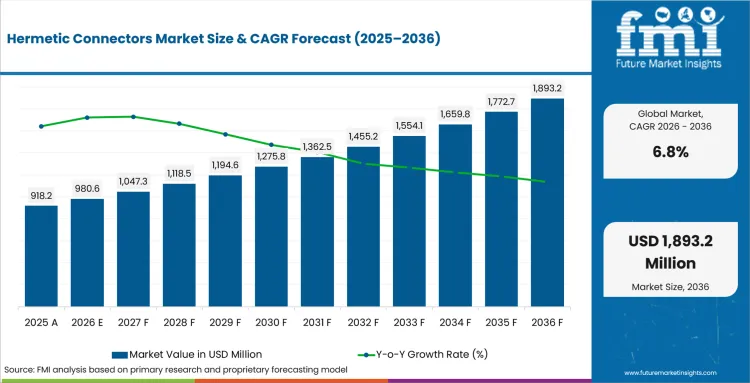
USD 980.6 million in 2026 and USD 1893.2 million by 2036 at a 6.8% CAGR.
Demand for hermetic connectors is projected to expand at 6.8% CAGR between 2026 and 2036, increasing valuation from USD 980.6 million in 2026 to USD 1893.2 million by 2036. Qualification work grows as aircraft and pressure-boundary programs require aviation connector configurations that preserve leak control across several mounting arrangements. The Defense Logistics Agency posted four draft Series III hermetic receptacle specifications in August 2025 covering box, jam-nut, solder and weld mounting. The four mounting paths give program engineers established configuration routes without reopening the complete connector design. Projects using aircraft cables also require compatible materials and terminations throughout approved operating fleets and maintenance cycles. Service teams handling harsh-environment wiring need traceable replacement configurations, so lengthy approval cycles protect established positions but delay revenue from custom designs.
Key Takeaways of Hermetic Connectors Market
- Aerospace and pressure-boundary programs increase demand for sealed interfaces with documented leak performance and configuration control.
- Glass-to-metal seals are projected to represent 43.0% share in 2026 owing to stable insulation during thermal and pressure cycling.
- Circular hermetic connectors are estimated to account for 34.0% share in 2026 due to familiar coupling across established platforms.
- Stainless steel is forecast to capture 38.0% share in 2026 driven by corrosion resistance and glass-sealing compatibility.
- Custom qualification cycles restrain adoption as altered shells or terminations can require renewed engineering approval.
- Amphenol Aerospace, TE Connectivity, Glenair, SOURIAU by Eaton, PAVE Technology, Douglas Electrical Components, AMETEK Hermetic Seal and Winchester Interconnect serve qualified and custom programs.
Analyst Perspective
"A hermetic connector earns program value through a seal record that survives drawing changes and field replacement. Reusing qualified shells and glass-to-metal interfaces reduces approval work without weakening traceability across long-life aerospace systems."
- Nikhil Kaitwade, Principal Consultant, Future Market Insights
How is the Hermetic Connectors Market segmented?
The hermetic connectors industry is segmented by seal technology, connector form, material, application, sales model and region.
The market is organized by seal technology, connector form, material, application, sales model and region as each category changes qualification and selection. Seal technology covers glass-to-metal, ceramic-to-metal, epoxy-sealed and welded designs, while connector form includes circular, D-sub, RF or coaxial, custom header and fiber optic formats. Material covers stainless steel, Kovar or nickel alloy, titanium and aluminum, while applications include aerospace avionics, space systems, medical devices, oil and gas sensors and vacuum instrumentation, and sales models cover custom engineered, standard catalog and qualified program supply.
What makes glass-to-metal seals central to the seal technology category?
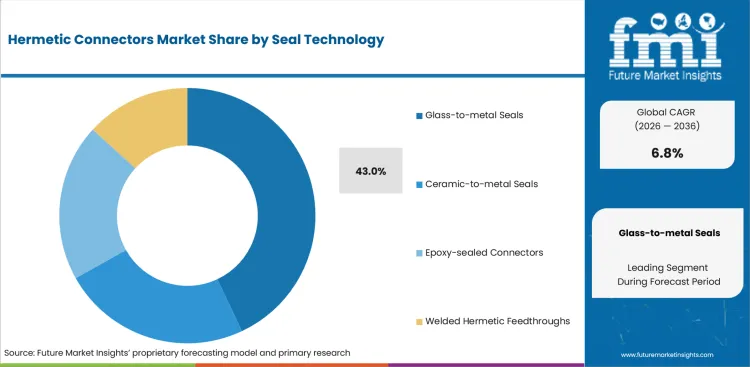
Glass-to-metal seals fuse conductive pins into matched shells across vacuum or pressure boundaries during extended service. Glenair’s January 2026 hermetic capabilities issue documents glass-sealed connector systems across military and commercial formats. The format range gives engineers established sealing routes for recurring military and commercial assembly platforms.
- Glass-to-metal seals are set to lead the seal technology category with 43.0% share in 2026 due to stable insulation across repeated thermal and pressure cycles.
- Engine and vacuum-equipment manufacturers increasingly select glass-to-metal seals as predictable helium-leak testing and stable material expansion support replacement planning across moisture-sensitive assemblies.
How do aerospace engineers evaluate circular hermetic connectors?
Circular layouts combine keyed coupling with established insert arrangements across engines and sealed equipment bulkheads. Familiar envelopes let engineers preserve mating geometry as termination style or mounting position changes throughout service.
- By connector form, circular hermetic connectors are estimated to hold 34.0% in 2026 owing to familiar coupling arrangements across established aircraft platforms.
- Circular hermetic connectors support aerospace avionics through established shell envelopes and several hermetic termination choices documented by TE Connectivity. The familiar interface can reduce tooling changes across qualified replacement work, maintenance planning and several common approved mounting positions throughout operating fleets.
How does stainless steel influence selection within the material category?
Stainless steel shells resist corrosion and support matched glass seals across demanding pressure boundaries and repeated thermal cycles. Amphenol Japan’s September 2025 JULUS launch paired 316L stainless steel with an Alloy 52 glass seal rated to 250°C, giving design teams a documented reference for demanding thermal and pressure limits.
- The stainless steel segment is likely to capture 38.0% share in 2026 attributable to pressure stability and corrosion resistance across harsh equipment environments.
- Production engineers favor stainless steel for proven sealing compatibility whereas lighter alloys support weight-sensitive assemblies and replacements for oil and gas sensors.
What drives aerospace avionics within the application category?
Avionics systems place sealed connectors at pressure boundaries and engine instrumentation points throughout aircraft and spacecraft. Approved connector families reduce redesign risk across long platform lives with tightly controlled replacement configurations.
- By application, aerospace avionics is forecast to represent 28.0% in 2026 driven by qualification-intensive interfaces across critical aircraft systems.
- Aerospace avionics draws demand from flight-system engineers as approved hermetic families preserve sealed power and signal paths across vibration, temperature changes and pressure differences. The same replacement continuity applies to radiation-hardened electronics across long aircraft and spacecraft programs throughout mission service.
What are the drivers, restraints and opportunities in the hermetic connectors market?
Driver: Qualified platforms require documented leak performance. Restraint: Custom configurations extend drawing and test approvals. Opportunity: Reusable shell variants reduce repeat engineering across recurring programs.
- Driver: Aerospace programs need sealed electrical continuity across vibration, temperature changes and controlled internal atmospheres.
- Restraint: Custom shells and terminations require fresh drawings across every assembly affected by a configuration change.
- Opportunity: Reusable shell variants can preserve proven materials, pin layouts and leak-test methods across recurring programs.
Aircraft and space programs qualify sealed RF interconnect boundaries through records that combine impedance control with helium-leak limits. A March 2025 Defense Logistics Agency amendment formalized both requirements for an SMA feedthrough and gives engineers a clearer approval baseline.
A changed shell dimension or termination can trigger new drawings and renewed leak-test documentation across every affected assembly. Low-volume programs spread that engineering cost across few units, so approval work can delay replacement availability for operators.
Documented shell variants preserve approved materials and leak-test methods across recurring aerospace and industrial platform requirements. Engineers can adapt terminations for fiber optic connectors without reopening the complete pressure-boundary analysis, which shortens quotation and approval work.
Which country CAGRs are profiled in the Hermetic Connectors Market?
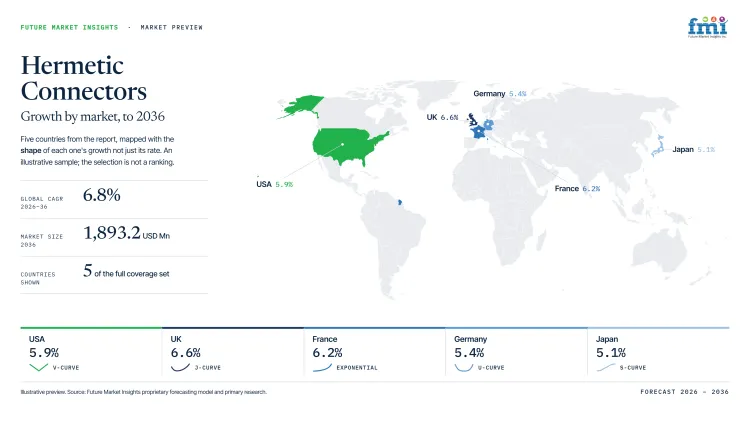
| Country | CAGR |
|---|---|
| United States | 5.9% |
| United Kingdom | 6.6% |
| Germany | 5.4% |
| France | 6.2% |
| Japan | 5.1% |
How do country-level CAGRs compare in the Hermetic Connectors Market?
The CAGR range spans 1.5 percentage points without describing current market size or installed program value. The spacing reflects local qualification capacity and service access across every profiled national program base.
- United Kingdom growth benefits from aerospace networks maintaining engineering contact through long approval and replacement cycles.
- France follows closely as concentrated airframe production supports component qualification and recurring maintenance planning locally.
- The United States forms a separate band through replacement demand and slower configuration changes across qualified programs.
- Germany remains below that band as documentation costs weigh more heavily on customized interconnect projects.
- Japan closes the range as domestic quality systems require detailed validation for imported custom configurations.
Comparable CAGRs produce different entry conditions as qualification routes and service networks vary by country. The full report provides country-level CAGR analysis across North America, Latin America, Europe, East Asia, South Asia and Pacific, and the Middle East and Africa.
Country-wise Analysis
- United States aerospace and defense programs approve hermetic interfaces through DLA specifications and qualified product records that guide distributors across major manufacturing hubs and depot-level repair networks serving long-life aircraft and mission systems through specialized local service channels. United States is estimated to post 5.9% CAGR over the forecast period, supported by recurring maintenance demand and accessible application engineering across established aircraft programs. The Defense Logistics Agency issued a draft MIL-DTL-38999 amendment in June 2026 that provides a current configuration-control reference for fixed hermetic contacts yet revised assemblies require fresh drawings and separate replacement inventories throughout long equipment service lives.
- United Kingdom aircraft and engine programs rely on regional engineering networks that connect component qualification with technical distribution and aftermarket service across long-lived civil and defense fleets near major OEM and maintenance sites throughout the country. ADS reported 468,500 direct jobs across the UK's aerospace, defence, security and space sectors in July 2026 and documented the scale of the national technical workforce near major program sites. Hermetic connector demand in the United Kingdom is forecast to rise at 6.6% CAGR over the forecast period, aided by domestic engineering access but specialist capacity and program-specific approvals can extend lead times across smaller distribution channels.
- German aerospace manufacturers require formal drawing reviews and material documentation for sealed connector changes across aircraft systems and precision instrumentation programs supported by established distributors near major production clusters and specialized maintenance centers serving civil and defense production across long program cycles. The German hermetic connectors sector is projected to record 5.4% CAGR during the assessment period, reinforced by concentrated aerospace manufacturing and accessible technical engineering for recurring platform work. BDLI reported 130,000 aerospace employees in May 2026 and established the scale of Germany’s technical workforce even as low-volume configurations can extend validation across separate program authorities and replacement channels.
- French aerospace programs concentrate airframe production and specialist component engineering within regional clusters that support direct qualification reviews and replacement planning across civil and defense fleets through established technical distribution and maintenance organizations near major production centers nationwide. GIFAS reported 230,500 aerospace employees in May 2026 and documented the scale of France’s technical workforce across major production networks and recurring aircraft programs. By 2036 France is projected to grow at 6.2% CAGR, driven by recurring aircraft requirements although capacity pressure and controlled change procedures can lengthen approvals for custom configurations and imported replacement parts across specialized maintenance channels during major overhaul cycles.
- Japanese aerospace and precision-equipment programs approve hermetic interfaces through detailed material traceability and repeatable quality records supported by domestic technical distributors near major manufacturing centers and regional maintenance organizations serving long-life instrumentation platforms. Hermetic connector sales in Japan are forecast to expand at 5.1% CAGR by 2036, shaped by local engineering contact and disciplined qualification practices across domestic production networks. Japan’s economy ministry launched an aerospace support program in September 2025 covering equipment investment and production demonstrations with new-process certification whereas language-specific documentation and separate line validation can slow imported custom configurations across individual production sites and regional maintenance depots.
Who are the notable companies in the Hermetic Connectors Market?
Amphenol Aerospace, TE Connectivity, Glenair, SOURIAU by Eaton, PAVE Technology, Douglas Electrical Components, AMETEK Hermetic Seal and Winchester Interconnect are the notable companies shaping this market.
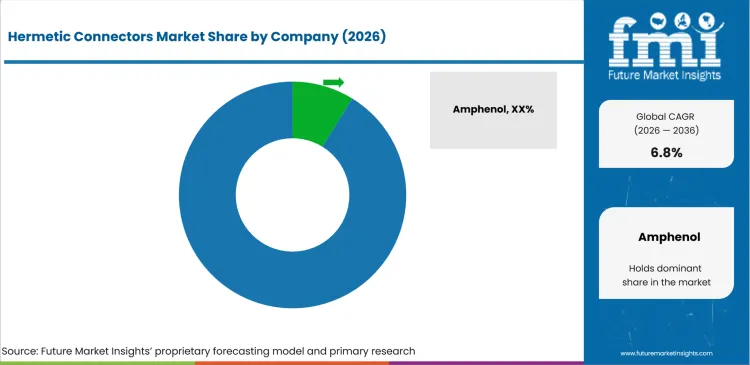
The industry is fragmented between global military-specification platforms and specialist feedthrough manufacturers serving narrow pressure, temperature and geometry requirements. Entry is possible through application engineering, but qualified drawings and replacement continuity give established providers an advantage across long programs.
- Amphenol Aerospace, TE Connectivity and Glenair compete through broad qualified circular portfolios and global technical support.
- SOURIAU by Eaton and AMETEK Hermetic Seal focus on aerospace interfaces requiring controlled materials and documented leakage performance.
- PAVE Technology, Douglas Electrical Components and Winchester Interconnect extend custom coverage across industrial equipment, medical devices and gas sensors.
Competitive Benchmarking: Hermetic Connectors Market
| Company | Qualification Breadth | Seal and Material Range | Critical-Use Traceability | Geographic Reach |
|---|---|---|---|---|
| Amphenol Aerospace | High | High | High | Global |
| TE Connectivity | High | High | High | Global |
| Glenair | High | High | High | Global |
| SOURIAU by Eaton | Medium | Medium | Low | Global |
| PAVE Technology | Medium | High | Medium | North America and selected export markets |
| Douglas Electrical Components | High | High | Medium | North America and Europe |
| AMETEK Hermetic Seal | High | High | High | Global |
| Winchester Interconnect | High | Medium | High | Global |
Scoring basis: Qualification breadth is High for several families, Medium for selective ones and Low for one verified route. Seal range is High for multiple technologies, Medium for narrow portfolios and Low for one approach. Traceability is High across critical programs, Medium for selective programs and Low for one documented application.
Key Developments in the Hermetic Connectors Market
- In May 2026, AMETEK Hermetic Seal disclosed that custom hermetic connectors supported life-support and thermal-control systems on NASA’s Artemis II mission.
- In December 2025, Douglas Electrical Components launched push-through feedthroughs and expanded backpotted MIL-DTL-38999 configuration support for custom bulkhead programs.
- In September 2025, Amphenol Japan added Phoenix high-temperature hermetic connectors designed for continuous service reaching 450°C through a MIL-DTL-38999 Series III interface.
Hermetic Connectors Market - Report Scope
| Coverage field | Report scope |
|---|---|
| Market breakdown | By seal technology, connector form, material, application, sales model and region. |
| Quantitative Units | Revenue in USD million and CAGR in %. |
| Market Definition | The market covers hermetic electrical connectors and feedthrough assemblies sold for controlled pressure, vacuum, temperature or contamination boundaries. |
| Regions Covered | North America, Latin America, Western Europe, Eastern Europe, East Asia, South Asia and Pacific and Middle East and Africa. |
| Countries Covered | United States, United Kingdom, Germany, France, Japan and 20+ countries included in the full report. |
| Key Companies Profiled | Amphenol Aerospace, TE Connectivity, Glenair, SOURIAU by Eaton, PAVE Technology, Douglas Electrical Components, AMETEK Hermetic Seal and Winchester Interconnect. |
| Forecast Period | 2026 to 2036. |
| Approach | Primary and secondary research with market triangulation. |
Hermetic Connectors Market - Research Methodology
| Method | Approach |
|---|---|
| Primary Research | FMI analysts gathered input from manufacturers, service providers, technology developers, distributors, end users, procurement teams, and subject-matter experts. Interviews examined purchasing decisions, product or service evaluation, adoption barriers, approval requirements, pricing considerations, and expectations for technical or commercial support. Respondents were also asked what evidence is required before a trial, pilot, or initial order develops into regular purchasing. |
| Desk Research | Desk research covered government statistics, regulatory publications, trade data, industry associations, technical literature, standards, company filings, product information, and official corporate announcements. Sources were reviewed for relevance, publication date, geographic coverage, and consistency with the defined market scope. Claims relating to performance, applications, approvals, capacity, investment, and commercial activity were retained only when supported by credible public evidence. |
| Market Sizing and Forecasting | The market model combined the baseline value with historical performance, segment structure, pricing and volume indicators, adoption levels, company participation, and country-level demand conditions. Forecast assumptions considered economic activity, investment trends, regulatory developments, technology adoption, purchasing cycles, supply availability, and barriers to wider market use. Segment and regional estimates were reconciled before the final market total was calculated. |
| Data Validation | Estimates were checked against multiple independent indicators, including public data, company activity, trade patterns, industry developments, and findings from primary interviews. Validation also tested whether products, services, applications, and company revenues fell within the defined market boundaries. Adjacent categories, unsupported claims, overlapping revenues, and activities without direct market relevance were excluded to reduce double counting and maintain consistency across segments and countries. |
Hermetic Connectors Market by Segments
Hermetic Connectors Market segmented by Seal Technology:
- Glass-to-metal Seals
- Ceramic-to-metal Seals
- Epoxy-sealed Connectors
- Welded Hermetic Feedthroughs
Hermetic Connectors Market segmented by Connector Form:
- Circular Hermetic Connectors
- D-sub Hermetic Connectors
- RF / Coaxial Feedthroughs
- Custom Hermetic Headers
- Fiber Optic Hermetic Connectors
Hermetic Connectors Market segmented by Material:
- Stainless Steel
- Kovar / Nickel Alloy
- Titanium
- Aluminum
Hermetic Connectors Market segmented by Application:
- Aerospace Avionics
- Space Systems
- Medical Implants / Devices
- Oil & Gas Sensors
- Vacuum / Instrumentation
Hermetic Connectors Market segmented by Sales Model:
- Custom Engineered
- Standard Catalog
- Qualified Program Supply
Hermetic Connectors Market by Region:
- North America
- United States
- Canada
- Latin America
- Brazil
- Mexico
- Argentina
- Chile
- Western Europe
- Germany
- France
- United Kingdom
- Italy
- Spain
- Benelux
- Nordics
- Eastern Europe
- Poland
- Czech Republic
- Romania
- Hungary
- East Asia
- China
- Japan
- South Korea
- South Asia and Pacific
- India
- ASEAN
- Australia and New Zealand
- Middle East and Africa
- GCC Countries
- South Africa
- Türkiye
- Israel
Research Sources and Bibliography
- Defense Logistics Agency. (2025, August 22). MIL-DTL-38999.
- Defense Logistics Agency. (2025, March 13). Connector, receptacle, electrical, coaxial, radio frequency, Series SMA (socket contact) feedthrough, hermetic (MIL-DTL-83517/13A with Amendment 2).
- Amphenol Aerospace. (n.d.). Hermetically sealed connectors.
- Amphenol Japan. (2025, September 19). 「JULUS - −55℃~+250℃対応、1.0x 10⁻⁸ cm3/sの高気密フィードスルー」を追加.
- Amphenol Japan. (2025, September 8). 「Phoenix - 耐450℃、1.0x 10⁻⁷ cm3/sの高気密、耐環境ハーメチックコネクタ」を追加.
- TE Connectivity. (n.d.). Hermetic MIL-DTL-38999 standard connectors.
- Glenair. (2026, January). Glenair worldwide hermetic capabilities.
- Eaton. (n.d.). 8LT hermetic series.
- PAVE Technology. (n.d.). PAVE-Mate II hermetic electrical feedthrough connectors.
- Douglas Electrical Components. (2025, December 24). Your goals, our drive: Delivering practical solutions that mattered in 2025 to strengthen 2026.
- AMETEK Hermetic Seal. (2026, May 26). Hermetic Seal engineers mission-critical connectors for NASA’s Artemis II mission.
- Winchester Interconnect. (n.d.). Hermetic connectors.
- ADS Group. (2026, July 9). Value of aerospace, defence, security and space to the UK grew two thirds since 2015, ADS finds.
- German Aerospace Industries Association. (2026, May 27). BDLI industry data 2026: Aerospace industry sets new records for revenue and employment.
- French Aerospace Industries Association. (2026, May 11). 2025 results: The French aerospace industry remains strongly positioned for the future.
- Ministry of Economy, Trade and Industry. (2025, September 2). 令和7年度「次期航空機開発等支援事業(サプライチェーン現代化投資支援)」に係る公募について.
- Defense Logistics Agency. (2026, June 9). MIL-DTL-38999N with Amendment 2 (Initial Draft).
This bibliography is provided for reader reference and is not exhaustive. The full report contains the complete reference list and detailed citations
This Report Answers
- How large is the hermetic connectors market in 2026 and 2036?
- Which operating conditions are increasing demand for qualified hermetic connector assemblies?
- Why do glass-to-metal seals hold the largest seal technology share in 2026?
- How do circular connector forms shape qualification and replacement decisions?
- Why does stainless steel retain a major material position across pressure-boundary applications?
- How do country growth rates differ across the five profiled hermetic connector markets?
- Which companies provide qualified hermetic connector platforms and custom feedthrough engineering?
- What currently limits hermetic connector adoption across regulated aerospace and industrial programs?
- Which factors should engineering teams evaluate during approval of a hermetic connector configuration?
Frequently Asked Questions
How big is the Hermetic Connectors Market in 2026?
The hermetic connectors market is valued at USD 980.6 million in 2026 and is forecast to reach USD 1893.2 million by 2036. Growth is supported by aerospace and pressure-boundary programs requiring documented leak performance and configuration control across established qualification routes and mounting arrangements.
What is the CAGR of the Hermetic Connectors Market from 2026 to 2036?
The hermetic connectors market grows at a CAGR of 6.8% between 2026 and 2036, supported by qualification-intensive aerospace platforms that reuse proven glass-to-metal seals and shell variants to preserve leak-test traceability across recurring military, space and commercial programs.
Which seal technology leads the Hermetic Connectors Market?
Glass-to-metal seals account for 43.0% of the hermetic connectors market by seal technology in 2026, driven by stable insulation across repeated thermal and pressure cycles that support predictable helium-leak testing across moisture-sensitive aerospace and industrial assemblies.
How much will the Hermetic Connectors Market add between 2026 and 2036?
The hermetic connectors market is set to add USD 912.6 million between 2026 and 2036, growing from USD 980.6 million to USD 1893.2 million as qualified sealed-interface programs expand across aerospace avionics, space systems and pressure-boundary instrumentation worldwide.
Who are the leading companies in the Hermetic Connectors Market?
Eight companies lead the hermetic connectors market consistently, including Amphenol Aerospace, TE Connectivity, Glenair, SOURIAU by Eaton, PAVE Technology, Douglas Electrical Components, AMETEK Hermetic Seal and Winchester Interconnect, competing through qualification breadth, seal and material range, and critical-use traceability worldwide.
Preview the report firsthand - request a free sample
Get SampleGet the brochure for pricing and purchase details.
Get PDFTable of Content
- Key Takeaways
- Market Size and CAGR
- Top Growth Driver
- Fastest Growing Segment
- Leading Region
- Key Companies
- Emerging Opportunities
- Executive Summary
- Global Market Outlook
- Demand-side Trends
- Supply-side Trends
- Technology Roadmap Analysis
- Analysis and Recommendations
- Analyst Perspective (What is happening? Why now? What should investors know?)
- Key Questions Answered
- How large is the market?
- What is the CAGR?
- What are key trends?
- Which region dominates?
- Who are the leaders?
- Market Overview
- Market Coverage / Taxonomy
- Market Definition / Scope / Limitations
- Research Methodology
- Chapter Orientation
- Analytical Lens and Working Hypotheses
- Market Structure, Signals, and Trend Drivers
- Benchmarking and Cross-market Comparability
- Market Sizing, Forecasting, and Opportunity Mapping
- Research Design and Evidence Framework
- Desk Research Programme (Secondary Evidence)
- Expert Input and Fieldwork (Primary Evidence)
- Tooling, Models, and Reference Databases
- Data Engineering and Model Build
- Quality Assurance and Audit Trail
- Market Background
- Market Dynamics (Drivers, Restraints, Opportunity, Trends)
- Scenario Forecast (Optimistic, Likely, Conservative)
- Impact Analysis
- AI Impact
- Sustainability Impact
- Regulatory Impact
- Technology Impact
- Consumer / Buyer Analysis
- Purchase Drivers
- Adoption Barriers
- Buyer Journey
- Opportunity Map Analysis
- Product Life Cycle Analysis
- Supply Chain Analysis
- Investment Feasibility Matrix
- Value Chain Analysis
- PESTLE and Porter's Analysis
- Regulatory Landscape
- Regional Parent Market Outlook
- Production and Consumption Statistics
- Import and Export Statistics
- Global Market Analysis and Forecast, 2021 to 2036
- Historical Market Size Value (USD Million) Analysis, 2021 to 2025
- Current and Future Market Size Value (USD Million) Projections, 2026 to 2036
- Y-o-Y Growth Trend Analysis
- Absolute $ Opportunity Analysis
- Global Market Pricing Analysis, 2021 to 2036
- Global Market Analysis and Forecast, By Seal Technology, 2021 to 2036
- Introduction / Key Findings
- Historical Market Size Value (USD Million) Analysis By Seal Technology, 2021 to 2025
- Current and Future Market Size Value (USD Million) Analysis and Forecast By Seal Technology, 2026 to 2036
- Glass-to-metal Seals
- Ceramic-to-metal Seals
- Epoxy-sealed Connectors
- Welded Hermetic Feedthroughs
- Glass-to-metal Seals
- Y-o-Y Growth Trend Analysis By Seal Technology, 2021 to 2025
- Absolute $ Opportunity Analysis By Seal Technology, 2026 to 2036
- Global Market Analysis and Forecast, By Connector Form, 2021 to 2036
- Introduction / Key Findings
- Historical Market Size Value (USD Million) Analysis By Connector Form, 2021 to 2025
- Current and Future Market Size Value (USD Million) Analysis and Forecast By Connector Form, 2026 to 2036
- Circular Hermetic Connectors
- D-sub Hermetic Connectors
- RF / Coaxial Feedthroughs
- Custom Hermetic Headers
- Fiber Optic Hermetic Connectors
- Circular Hermetic Connectors
- Y-o-Y Growth Trend Analysis By Connector Form, 2021 to 2025
- Absolute $ Opportunity Analysis By Connector Form, 2026 to 2036
- Global Market Analysis and Forecast, By Material, 2021 to 2036
- Introduction / Key Findings
- Historical Market Size Value (USD Million) Analysis By Material, 2021 to 2025
- Current and Future Market Size Value (USD Million) Analysis and Forecast By Material, 2026 to 2036
- Stainless Steel
- Kovar / Nickel Alloy
- Titanium
- Aluminum
- Stainless Steel
- Y-o-Y Growth Trend Analysis By Material, 2021 to 2025
- Absolute $ Opportunity Analysis By Material, 2026 to 2036
- Global Market Analysis and Forecast, By Application, 2021 to 2036
- Introduction / Key Findings
- Historical Market Size Value (USD Million) Analysis By Application, 2021 to 2025
- Current and Future Market Size Value (USD Million) Analysis and Forecast By Application, 2026 to 2036
- Aerospace Avionics
- Space Systems
- Medical Implants / Devices
- Oil & Gas Sensors
- Vacuum / Instrumentation
- Aerospace Avionics
- Y-o-Y Growth Trend Analysis By Application, 2021 to 2025
- Absolute $ Opportunity Analysis By Application, 2026 to 2036
- Global Market Analysis and Forecast, By Sales Model, 2021 to 2036
- Introduction / Key Findings
- Historical Market Size Value (USD Million) Analysis By Sales Model, 2021 to 2025
- Current and Future Market Size Value (USD Million) Analysis and Forecast By Sales Model, 2026 to 2036
- Custom Engineered
- Standard Catalog
- Qualified Program Supply
- Custom Engineered
- Y-o-Y Growth Trend Analysis By Sales Model, 2021 to 2025
- Absolute $ Opportunity Analysis By Sales Model, 2026 to 2036
- Global Market Analysis and Forecast, By Region, 2021 to 2036
- Introduction
- Historical Market Size Value (USD Million) Analysis By Region, 2021 to 2025
- Current Market Size Value (USD Million) Analysis and Forecast By Region, 2026 to 2036
- North America
- Latin America
- Western Europe
- Eastern Europe
- East Asia
- South Asia and Pacific
- Middle East & Africa
- Market Attractiveness Analysis By Region
- North America Market Analysis and Forecast, By Country, 2021 to 2036
- Historical Market Size Value (USD Million) Trend Analysis By Market Taxonomy, 2021 to 2025
- Market Size Value (USD Million) Forecast By Market Taxonomy, 2026 to 2036
- By Country
- USA
- Canada
- By Seal Technology
- By Connector Form
- By Material
- By Application
- By Sales Model
- By Country
- Market Attractiveness Analysis
- By Country
- By Seal Technology
- By Connector Form
- By Material
- By Application
- By Sales Model
- Key Takeaways
- Latin America Market Analysis and Forecast, By Country
- Historical Market Size Value (USD Million) Trend Analysis By Market Taxonomy, 2021 to 2025
- Market Size Value (USD Million) Forecast By Market Taxonomy, 2026 to 2036
- By Country
- Brazil
- Mexico
- Chile
- Rest of Latin America
- By Seal Technology
- By Connector Form
- By Material
- By Application
- By Sales Model
- By Country
- Market Attractiveness Analysis
- By Country
- By Seal Technology
- By Connector Form
- By Material
- By Application
- By Sales Model
- Key Takeaways
- Western Europe Market Analysis and Forecast, By Country
- Historical Market Size Value (USD Million) Trend Analysis By Market Taxonomy, 2021 to 2025
- Market Size Value (USD Million) Forecast By Market Taxonomy, 2026 to 2036
- By Country
- Germany
- UK
- Italy
- Spain
- France
- Nordic
- BENELUX
- Rest of Western Europe
- By Seal Technology
- By Connector Form
- By Material
- By Application
- By Sales Model
- By Country
- Market Attractiveness Analysis
- By Country
- By Seal Technology
- By Connector Form
- By Material
- By Application
- By Sales Model
- Key Takeaways
- Eastern Europe Market Analysis and Forecast, By Country
- Historical Market Size Value (USD Million) Trend Analysis By Market Taxonomy, 2021 to 2025
- Market Size Value (USD Million) Forecast By Market Taxonomy, 2026 to 2036
- By Country
- Russia
- Poland
- Hungary
- Balkan & Baltic
- Rest of Eastern Europe
- By Seal Technology
- By Connector Form
- By Material
- By Application
- By Sales Model
- By Country
- Market Attractiveness Analysis
- By Country
- By Seal Technology
- By Connector Form
- By Material
- By Application
- By Sales Model
- Key Takeaways
- East Asia Market Analysis and Forecast, By Country
- Historical Market Size Value (USD Million) Trend Analysis By Market Taxonomy, 2021 to 2025
- Market Size Value (USD Million) Forecast By Market Taxonomy, 2026 to 2036
- By Country
- China
- Japan
- South Korea
- By Seal Technology
- By Connector Form
- By Material
- By Application
- By Sales Model
- By Country
- Market Attractiveness Analysis
- By Country
- By Seal Technology
- By Connector Form
- By Material
- By Application
- By Sales Model
- Key Takeaways
- South Asia and Pacific Market Analysis and Forecast, By Country
- Historical Market Size Value (USD Million) Trend Analysis By Market Taxonomy, 2021 to 2025
- Market Size Value (USD Million) Forecast By Market Taxonomy, 2026 to 2036
- By Country
- India
- ASEAN
- Australia & New Zealand
- Rest of South Asia and Pacific
- By Seal Technology
- By Connector Form
- By Material
- By Application
- By Sales Model
- By Country
- Market Attractiveness Analysis
- By Country
- By Seal Technology
- By Connector Form
- By Material
- By Application
- By Sales Model
- Key Takeaways
- Middle East & Africa Market Analysis and Forecast, By Country
- Historical Market Size Value (USD Million) Trend Analysis By Market Taxonomy, 2021 to 2025
- Market Size Value (USD Million) Forecast By Market Taxonomy, 2026 to 2036
- By Country
- Kingdom of Saudi Arabia
- Other GCC Countries
- Türkiye
- South Africa
- Other African Union
- Rest of Middle East & Africa
- By Seal Technology
- By Connector Form
- By Material
- By Application
- By Sales Model
- By Country
- Market Attractiveness Analysis
- By Country
- By Seal Technology
- By Connector Form
- By Material
- By Application
- By Sales Model
- Key Takeaways
- Key Countries Market Analysis
- USA
- Pricing Analysis
- Market Share Analysis, 2025
- By Seal Technology
- By Connector Form
- By Material
- By Application
- By Sales Model
- Canada
- Pricing Analysis
- Market Share Analysis, 2025
- By Seal Technology
- By Connector Form
- By Material
- By Application
- By Sales Model
- Mexico
- Pricing Analysis
- Market Share Analysis, 2025
- By Seal Technology
- By Connector Form
- By Material
- By Application
- By Sales Model
- Brazil
- Pricing Analysis
- Market Share Analysis, 2025
- By Seal Technology
- By Connector Form
- By Material
- By Application
- By Sales Model
- Chile
- Pricing Analysis
- Market Share Analysis, 2025
- By Seal Technology
- By Connector Form
- By Material
- By Application
- By Sales Model
- Germany
- Pricing Analysis
- Market Share Analysis, 2025
- By Seal Technology
- By Connector Form
- By Material
- By Application
- By Sales Model
- UK
- Pricing Analysis
- Market Share Analysis, 2025
- By Seal Technology
- By Connector Form
- By Material
- By Application
- By Sales Model
- Italy
- Pricing Analysis
- Market Share Analysis, 2025
- By Seal Technology
- By Connector Form
- By Material
- By Application
- By Sales Model
- Spain
- Pricing Analysis
- Market Share Analysis, 2025
- By Seal Technology
- By Connector Form
- By Material
- By Application
- By Sales Model
- France
- Pricing Analysis
- Market Share Analysis, 2025
- By Seal Technology
- By Connector Form
- By Material
- By Application
- By Sales Model
- India
- Pricing Analysis
- Market Share Analysis, 2025
- By Seal Technology
- By Connector Form
- By Material
- By Application
- By Sales Model
- ASEAN
- Pricing Analysis
- Market Share Analysis, 2025
- By Seal Technology
- By Connector Form
- By Material
- By Application
- By Sales Model
- Australia & New Zealand
- Pricing Analysis
- Market Share Analysis, 2025
- By Seal Technology
- By Connector Form
- By Material
- By Application
- By Sales Model
- China
- Pricing Analysis
- Market Share Analysis, 2025
- By Seal Technology
- By Connector Form
- By Material
- By Application
- By Sales Model
- Japan
- Pricing Analysis
- Market Share Analysis, 2025
- By Seal Technology
- By Connector Form
- By Material
- By Application
- By Sales Model
- South Korea
- Pricing Analysis
- Market Share Analysis, 2025
- By Seal Technology
- By Connector Form
- By Material
- By Application
- By Sales Model
- Russia
- Pricing Analysis
- Market Share Analysis, 2025
- By Seal Technology
- By Connector Form
- By Material
- By Application
- By Sales Model
- Poland
- Pricing Analysis
- Market Share Analysis, 2025
- By Seal Technology
- By Connector Form
- By Material
- By Application
- By Sales Model
- Hungary
- Pricing Analysis
- Market Share Analysis, 2025
- By Seal Technology
- By Connector Form
- By Material
- By Application
- By Sales Model
- Kingdom of Saudi Arabia
- Pricing Analysis
- Market Share Analysis, 2025
- By Seal Technology
- By Connector Form
- By Material
- By Application
- By Sales Model
- Türkiye
- Pricing Analysis
- Market Share Analysis, 2025
- By Seal Technology
- By Connector Form
- By Material
- By Application
- By Sales Model
- South Africa
- Pricing Analysis
- Market Share Analysis, 2025
- By Seal Technology
- By Connector Form
- By Material
- By Application
- By Sales Model
- USA
- Market Structure Analysis
- Competition Dashboard
- Competition Benchmarking
- Market Share Analysis of Top Players
- By Regional
- By Seal Technology
- By Connector Form
- By Material
- By Application
- By Sales Model
- Emerging Startups
- Innovation Benchmarking
- Competition Analysis
- Competition Deep Dive
- Amphenol
- Overview
- Product Portfolio
- Profitability by Market Segments
- Sales Footprint
- Strategy Overview
- Marketing Strategy
- Product Strategy
- Channel Strategy
- TE Connectivity
- Glenair
- Souriau / Eaton
- Smiths Interconnect
- PAVE Technology
- Douglas Electrical Components
- Hermetic Seal Corporation
- Winchester Interconnect
- Detoronics
- Amphenol
- Case Studies
- Success Stories
- Recent Developments
- Competition Deep Dive
- Assumptions & Acronyms Used


