

- Market Size (2026)
- USD 47.0 Bn
- Forecast (2036)
- USD 98.1 Bn
- CAGR (2026 to 2036)
- 7.6%
How big is High Protein Yogurt Market in 2026?
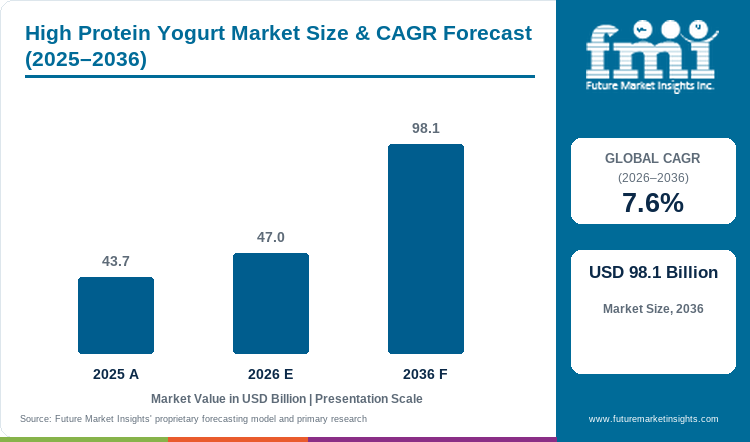
USD 47.0 billion in 2026 and USD 98.1 billion by 2036 at a 7.6% CAGR.
Demand for high protein yogurt is projected to expand at a 7.6% CAGR between 2026 and 2036. It rises from USD 43.7 billion in 2025 to USD 47.0 billion in 2026 and reaches USD 98.1 billion by 2036. Protein-focused dairy purchases are moving through familiar refrigerated formats because consumers can raise protein intake without changing established eating habits. Arla Foods reported in August 2026 that Arla Skyr recorded 39.6% volume-driven revenue growth during the first half. The performance reflects continued demand for protein-positioned yogurt products within mainstream dairy aisles.
The United States has a large national yogurt production base that is supporting rapid retail testing of protein-led formats. USDA National Agricultural Statistics Service recorded 5.29 billion pounds of plain and flavored yogurt production in 2025, up from 4.87 billion pounds in 2024. Germany and Japan are relying more heavily on established cultured-dairy formats and frequent product rotation to shape local assortment strategies. Suppliers are managing different price expectations and texture standards within each national yogurt aisle. Pack formats are also changing how quickly protein claims convert into regular purchases.
Key Takeaways
- Protein-led breakfast and snacking demand is increasing interest in yogurt formats that display clear protein amounts within familiar refrigerated eating habits.
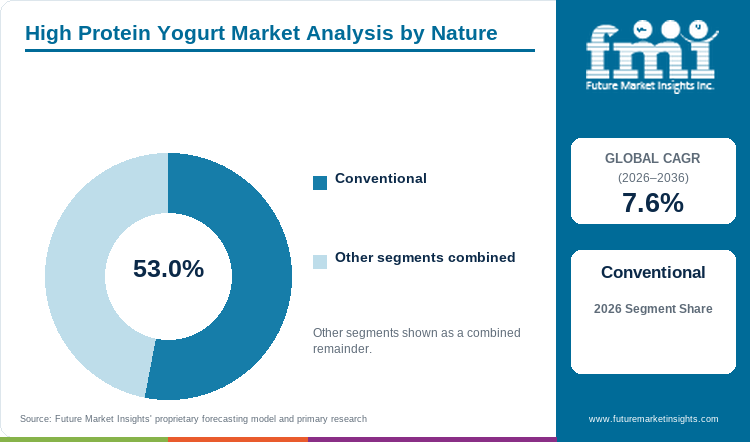
- In 2026, conventional is expected to lead the nature category with 53.0% share attributable to familiar dairy taste and established chilled merchandising.
- By product type, spoonful is forecast to represent 66.0% in 2026 owing to established cup routines and broad space for visible protein claims.
- Drinkable cultured formats are extending use occasions by pairing workable protein density with portable packaging and a recognizable yogurt proposition.
- Shoppers are comparing high protein yogurt directly with ordinary refrigerated yogurt, so taste and price are constraining repeat purchases.
- Some of the key players in this market include Chobani, Danone (Oikos), FAGE International, Lactalis Group (siggi’s), Müller Group, Arla Foods, Ehrmann SE, Morinaga Milk Industry Co., Ltd. (Partheno), Meiji Co., Ltd. (SAVAS), and Icelandic Provisions.
Analyst Perspective
“High protein yogurt is earning repeat space because the nutrition claim survives direct comparison with ordinary yogurt on taste and price. Suppliers managing texture and refrigerated availability are broadening protein use beyond specialized sports nutrition occasions.”
- Nandini Roy Choudhury, Principal Consultant, Future Market Insights
How is the high protein yogurt market segmented?
The high protein yogurt market is segmented by Nature and Product Type.
The high protein yogurt market is segmented by nature and product type to separate formulation routes from physical consumption formats. Nature includes conventional, natural, organic and vegan products, while product type covers spoonful and drinkable formats for analysis.
How does conventional dairy reduce the formulation burden for high protein yogurt?
Manufacturers are using cultured dairy concentration and familiar refrigeration to raise protein without changing the basic yogurt format. Retailers are positioning conventional high protein products beside greek yogurt because shoppers already recognize the thick texture and chilled cup presentation. Producers are also using straining and milk-protein concentration within routine yogurt processing and labeling systems. Natural and organic variants are using the same dairy base with added sourcing requirements that raise input scrutiny. Vegan products require different protein and texture systems, so their formulation work transfers less readily from dairy processing.
- Conventional is likely to capture 53.0% of nature demand in 2026 influenced by dairy concentration that preserves familiar yogurt identity and raises protein density.
- Danone Japan renewed its Oikos plain protein yogurts in February 2025 and increased protein per cup alongside larger pack sizes. The renewal strengthened the protein claim within a conventional dairy base without moving consumers into another food category.
What makes spoonful formats easier to merchandise as high protein yogurt?
Spoonful yogurt is giving manufacturers enough pack space to display protein grams and texture cues beside the nutrition panel. Single-serve cups are common in dairy snacks because portion control and refrigerated availability support repeated chilled purchases. Strained yogurt carries dense texture without requiring a narrow bottle opening or drinkable viscosity. Manufacturers are also adding fruit layers and sweetener changes while keeping the cultured base recognizable. Drinkable products improve portability, but manufacturers must balance protein concentration against flow and package size.
- Spoonful is set to lead the product type category with 66.0% share in 2026 reinforced by strained texture and familiar cup-based yogurt consumption.
- Danone Japan launched an Oikos mixed-berry protein yogurt nationwide in January 2026 with 10.1g of protein per cup. The seasonal cup kept flavor rotation inside a familiar spoonful format while preserving a direct protein message.
What are the drivers, restraints and opportunities in the High Protein Yogurt Market?
Clear protein information is expanding demand, but taste and price are constraining repeat purchase as cultured formats extend refrigerated occasions.
- Driver: Protein-focused shoppers are comparing grams per serving directly and are choosing high protein yogurt within familiar breakfast and snack routines.
- Restraint: Manufacturers are balancing higher protein levels against price and sensory expectations that determine repeat refrigerated purchases.
- Opportunity: Manufacturers are adding capacity and cultured drink formats to reach more refrigerated eating occasions without abandoning familiar dairy or skyr credentials.
Protein Information Converts More Easily in Familiar Refrigerated Formats
Protein demand is translating into purchases as shoppers compare a clear amount per serving inside a familiar food category. IFIC reported in July 2025 that one in three USA adults had increased protein intake during the prior year. The same survey found grams per serving was the protein information shoppers used most often on food packaging. High protein yogurt is converting that behavior into a simple chilled choice because the protein claim appears beside a familiar meal or snack. Manufacturers are using protein ingredients to broaden formulation options, but the final yogurt purchase still depends on recognizable taste and texture.
Taste and Price Can Break the Repeat Purchase
Protein content alone does not protect high protein yogurt from ordinary food-choice tradeoffs. IFIC reported in April 2026 that price and taste dominated USA food choices in its protein quality and labeling survey. The same research found many shoppers review nutrition information on both the front and back of food packages. Front- and back-of-pack review is placing the protein claim beside immediate sensory and budget checks. Concentrated dairy recipes are requiring more milk solids as brands raise protein density. Plant-based recipes often need added proteins or texture systems. Suppliers are therefore balancing repeatable taste with a price gap shoppers accept beyond the first trial purchase.
New Capacity and Cultured Formats Widen the Addressable Occasion
School meal programs are providing a defined institutional route for high protein yogurt under nutrition and chilled-delivery requirements. USDA Food and Nutrition Service requires yogurt in the National School Lunch and School Breakfast Programs to meet a tighter added-sugar limit. From July 1, 2025 the limit is 12 grams of added sugars per six ounces. Protein-forward cups meeting that limit can compete inside a familiar reimbursable food category instead of relying solely on retail snacking. Manufacturers are also developing yogurt and probiotic drinks for chilled service as institutional operators retain familiar refrigerated routines. Suppliers are pairing compliant recipes with dependable cold-chain execution to turn protein density into repeat institutional orders.
Which country CAGRs are profiled in the High Protein Yogurt Market?
| Country | CAGR |
|---|---|
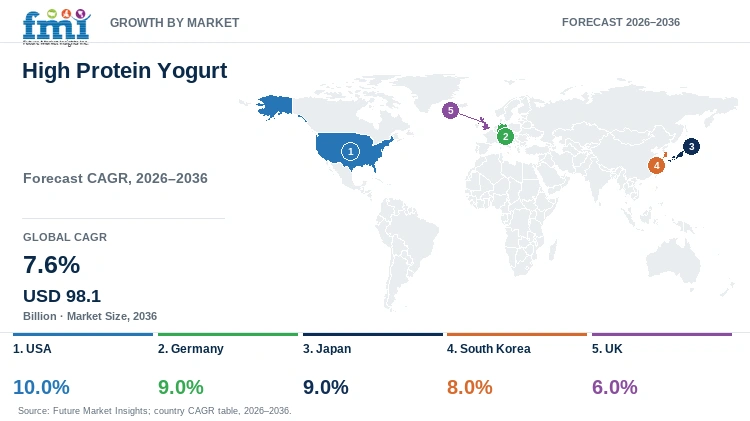
| USA | 10.0% |
| Germany | 9.0% |
| Japan | 9.0% |
| South Korea | 8.0% |
| UK | 6.0% |
How do country-level CAGRs compare in the High Protein Yogurt Market?
The country forecasts span four percentage points from the USA at 10.0% to the UK at 6.0%. Germany and Japan share a 9.0% outlook while South Korea occupies the middle at 8.0%. These rates describe growth paths and do not establish current country market size or installed retail demand. Local yogurt habits and household price tolerance change how quickly protein-led trial converts into repeat purchase.
- The USA has a large refrigerated yogurt base that is giving protein-focused formats room for broad retail testing ahead of wider distribution.
- Germany’s routine dairy consumption supports high protein yogurt familiarity while varied natural and organic choices reward products that defend a premium through taste and ingredient positioning.
- Frequent single-serve flavor rotation in Japan keeps protein yogurt visible and supports repeat trial without asking shoppers to change the familiar spoonful eating occasion.
- South Korea’s nutrition-focused refrigerated set places protein yogurt beside probiotic fermented-milk formats and rewards brands that make protein content easy to compare during purchase.
- UK supermarkets use familiar spoonful packs and retailer promotions to widen trial while household value pressure keeps repeat pricing central to assortment decisions.
Comparable CAGRs can produce different entry conditions because national production bases and labeling rules change the route from trial to repeat purchase. The full report provides country-level CAGR analysis across North America, Latin America, Western Europe, Eastern Europe, East Asia, South Asia and Pacific, and the Middle East and Africa.
Country-wise Analysis
- USA high protein yogurt manufacturers are working within a federal yogurt standard under review for newer protein-concentration processes. The USA high protein yogurt sector is projected to record a 10.0% CAGR during the assessment period. The outlook is shaped by brands that are moving concentrated protein into regular chilled eating occasions. In January 2025 the FDA requested information because the existing yogurt standard may not accommodate some ingredients and processes used to make high-protein yogurt. Manufacturers are refining formulations and product names as the agency reviews current national practice. Portable cups and cultured drinks are competing with sports nutrition products for protein occasions in everyday retail channels.
- Germany's acidified-milk manufacturing base is giving high protein yogurt a familiar production setting for premium protein claims. High protein yogurt demand in Germany is forecast to rise at a 9.0% CAGR over the forecast period. Existing acidified-milk capacity is supporting protein-dense variants without requiring a new chilled processing route. Eurostat reported in November 2025 that Germany produced 27.1% of EU acidified milk products during 2024. Manufacturers are using whey protein ingredients to widen formulation choices without removing the sensory test at purchase.
- Japan's high protein yogurt market operates inside a large fermented-milk category with familiar compact portions and frequent flavor rotation. Japan's high protein yogurt outlook is anticipated to advance at a 9.0% CAGR over the assessment period. Current demand is influenced by protein products competing within established spoonful and drinkable routines. Japan's Agriculture & Livestock Industries Corporation reported in May 2025 that national fermented-milk production reached 1.23 million kiloliters in fiscal 2023. The review attributed weaker volume to price increases and documented broad dairy price revisions of 5% to 10%. High protein yogurt is competing with mainstream yogurt products through familiar formats, but pricing freedom remains limited.
- South Korean labeling rules are placing formal nutrition information beside everyday fermented-milk purchasing and making protein content easier to compare at the shelf. Adoption of high protein yogurt in South Korea is estimated to expand at an 8.0% CAGR through 2036. The outlook is reinforced by more visible nutrition-label obligations and a health-oriented refrigerated set. The Ministry of Food and Drug Safety revised national food-labeling standards in April 2025 with implementation from January 2026. Fermented milk labels now carry a clearer compliance burden as brands emphasize protein as a purchase cue. Probiotic yogurt products are competing for the same health-oriented attention.
- The UK high protein yogurt aisle is facing a value test as shoppers compare premium protein claims with mainstream dairy prices. In the UK, high protein yogurt sales are predicted to advance at a 6.0% CAGR through 2036. The outlook is constrained by household budget pressure and repeat-purchase price comparisons. The Office for National Statistics placed the 2025 CPIH yoghurt index at 147.1 compared with 145.6 in 2024. Pack size and promotion are becoming more important as protein cups ask shoppers to trade up. Households avoiding dairy are comparing plant-based yogurt with protein-led dairy cups.
Who are the notable companies in the High Protein Yogurt Market?
Chobani, Danone (Oikos), FAGE International, Lactalis Group (siggi’s), Müller Group, Arla Foods, Ehrmann SE, Morinaga Milk Industry Co., Ltd. (Partheno), Meiji Co., Ltd. (SAVAS), and Icelandic Provisions serve the defined high protein yogurt market.
Competition centers on concentrated dairy protein and chilled formats that make protein claims easy to compare during routine shopping. Greek yogurt and skyr specialists are using straining or ultrafiltration. Broader dairy groups are using existing retail routes and manufacturing networks. Plant-based skyr is expanding the dairy-free route within dairy alternatives, but formulation consistency and refrigerated distribution remain practical entry barriers for every format.
- Greek yogurt and skyr platforms include Chobani and Danone (Oikos) alongside FAGE International and Lactalis Group (siggi’s). Arla Foods and Morinaga Milk Industry Co., Ltd. (Partheno) are competing in the same concentrated-dairy group with Icelandic Provisions.
- Ehrmann SE and Meiji Co., Ltd. (SAVAS) are extending dedicated high-protein dairy ranges beside other protein-oriented chilled formats.
- Müller Group is using co-branded high-protein yogurt and mix-in formats to place performance nutrition inside mainstream UK chilled snacking.
Competitive Benchmarking: High Protein Yogurt Market
| Company | Spoonable Protein Range | Cultured Drink Range | Nature / Format Breadth | Geographic Reach |
|---|---|---|---|---|
| Chobani | High | High | Medium | North America |
| Danone (Oikos) | High | High | High | North America, Europe and Japan |
| FAGE International | High | Low | Medium | Europe, North America and Asia |
| Lactalis Group (siggi’s) | High | Medium | Medium | North America and Europe |
| Müller Group | High | Low | Medium | United Kingdom, Ireland and exports |
| Arla Foods | High | Medium | Medium | Europe and international dairy markets |
| Ehrmann SE | High | Medium | Medium | Europe and international retail |
| Morinaga Milk Industry Co., Ltd. (Partheno) | High | Low | Medium | Japan |
| Meiji Co., Ltd. (SAVAS) | Medium | High | Medium | Japan |
| Icelandic Provisions | High | Low | High | United States |
Scoring basis: High requires multiple current exact-market products or formats that satisfy the named criterion in more than one documented route. Medium requires one direct route with narrower breadth while Low identifies a limited documented route under the same criterion. Geographic reach describes verified market presence and remains separate from the three scored capability criteria.
Key Developments in the High Protein Yogurt Market
- In March 2026, Müller Group and Myprotein launched Mixers in the UK with 15g of protein per 140g yogurt pot. The range combined high-protein yogurt with separate mix-ins and launched first at Morrisons ahead of broader retailer rollout.
- In November 2025, Morinaga Milk Industry launched a limited Partheno pear-sauce Greek yogurt nationwide in Japan with 10g of protein per cup. The release extended seasonal flavor rotation inside the existing strained-yogurt platform without changing its spoonful protein proposition.
- In June 2025, Lactalis USA completed its acquisition of General Mills' USA yogurt business and added the :ratio brand alongside Yoplait and related assets. The transaction transferred two yogurt manufacturing facilities and gave Lactalis direct production assets alongside the acquired brands.
Key Players in the High Protein Yogurt Market
Greek Yogurt and Skyr Protein Platforms
- Chobani
- Danone (Oikos)
- FAGE International
- Lactalis Group (siggi’s)
- Arla Foods
- Morinaga Milk Industry Co., Ltd. (Partheno)
- Icelandic Provisions
High-Protein Yogurt and Multi-Format Dairy Brands
- Müller Group
- Ehrmann SE
- Meiji Co., Ltd. (SAVAS)
High Protein Yogurt Market - Report Scope
| Coverage field | Report scope |
|---|---|
| Market breakdown | By nature, product type and region. |
| Quantitative Units | USD billion. |
| Market Definition | Revenue from yogurt, skyr-style products and cultured yogurt drinks marketed or positioned as high protein within conventional, natural, organic and vegan nature categories. Ordinary yogurt without a protein-forward position and non-yogurt protein beverages are excluded. |
| Regions Covered | North America, Latin America, Western Europe, Eastern Europe, East Asia, South Asia and Pacific, and Middle East and Africa. |
| Countries Covered | USA, Germany, Japan, South Korea, UK, and 20+ countries included in the full report. |
| Key Companies Profiled | Chobani, Danone (Oikos), FAGE International, Lactalis Group (siggi’s), Müller Group, Arla Foods, Ehrmann SE, Morinaga Milk Industry Co., Ltd. (Partheno), Meiji Co., Ltd. (SAVAS), Icelandic Provisions. |
| Forecast Period | 2026 to 2036. |
| Approach | Primary and secondary research with market triangulation. |
High Protein Yogurt Market - Research Methodology
| Method | Approach |
|---|---|
| Primary Research | FMI analysts gathered input from manufacturers, service providers, technology developers, distributors, end users, procurement teams, and subject-matter experts. Interviews examined purchasing decisions, product or service evaluation, adoption barriers, approval requirements, pricing considerations, and expectations for technical or commercial support. Respondents were also asked what evidence is required before a trial, pilot, or initial order develops into regular purchasing. |
| Desk Research | Desk research covered government statistics, regulatory publications, trade data, industry associations, technical literature, standards, company filings, product information, and official corporate announcements. Sources were reviewed for relevance, publication date, geographic coverage, and consistency with the defined market scope. Claims relating to performance, applications, approvals, capacity, investment, and commercial activity were retained only when supported by credible public evidence. |
| Market Sizing and Forecasting | The market model combined the baseline value with historical performance, segment structure, pricing and volume indicators, adoption levels, company participation, and country-level demand conditions. Forecast assumptions considered economic activity, investment trends, regulatory developments, technology adoption, purchasing cycles, supply availability, and barriers to wider market use. Segment and regional estimates were reconciled before the final market total was calculated. |
| Data Validation | Estimates were checked against multiple independent indicators, including public data, company activity, trade patterns, industry developments, and findings from primary interviews. Validation also tested whether products, services, applications, and company revenues fell within the defined market boundaries. Adjacent categories, unsupported claims, overlapping revenues, and activities without direct market relevance were excluded to reduce double counting and maintain consistency across segments and countries. |
High Protein Yogurt Market by Segments
High Protein Yogurt Market segmented by Nature:
- Conventional
- Natural
- Organic
- Vegan
High Protein Yogurt Market segmented by Product Type:
- Spoonful
- Drinkable
High Protein Yogurt Market by Region:
- North America
- United States
- Canada
- Latin America
- Brazil
- Mexico
- Argentina
- Chile
- Western Europe
- Germany
- France
- United Kingdom
- Italy
- Spain
- Benelux
- Nordics
- Eastern Europe
- Poland
- Czech Republic
- Romania
- Hungary
- East Asia
- China
- Japan
- South Korea
- South Asia and Pacific
- India
- ASEAN
- Australia and New Zealand
- Middle East and Africa
- GCC Countries
- South Africa
- Türkiye
- Israel
Research Sources and Bibliography
- Arla Foods. (2026, August 27). Surging brands and strong protein demand drive Arla Foods to a standout first half.
- USA Department of Agriculture, National Agricultural Statistics Service. (2026, April 24). Dairy Products 2025 Summary.
- Danone Japan. (2025, February 26).
- Danone Japan. (2026, January 14).
- International Food Information Council. (2025, July 9). IFIC Spotlight Survey: Americans’ Perceptions Of Protein.
- International Food Information Council. (2026, April 7). IFIC Spotlight Survey: Americans’ Perceptions of Protein Quality & Labeling.
- Arla Foods. (2025, June 5). Arla Foods makes major investment in Linköping to meet boom in skyr demand.
- USA Food and Drug Administration. (2025, January 14). FDA Issues Request for Information on High-Protein Yogurt.
- Eurostat. (2025, November 20). Milk production reached 161.8 million tonnes in 2024.
- Agriculture & Livestock Industries Corporation. (2025, May).
- Ministry of Food and Drug Safety, Republic of Korea. (2025, April 21).
- Office for National Statistics. (2026, August 19). CPIH INDEX 01.1.4.4 Yoghurt 2015=100.
- Müller UK & Ireland. (2026, March 13). Mix-ins meet macros: Müller and Myprotein launch Mixers with 15g protein per pot.
- Morinaga Milk Industry Co., Ltd. (2025, November 6).
- Lactalis USA. (2025, June 30). Successful completion of Lactalis USA Acquisition of General Mills USA Yogurt Business.
- Morinaga Milk Industry Co., Ltd. (2026, May 21).
- Danone Japan. (2026, April 8).
- New York State, Office of the Governor. (2025, April 22). Governor Hochul Announces Chobani to Make the Nation’s Largest Investment Ever in a Natural Food Production Facility in the Mohawk Valley.
- Pennsylvania Department of Agriculture. (2026, September 1). Governor Shapiro Secures Historic $1.2 Billion Investment from Chobani to Establish its First Dairy Operation in Pennsylvania and Create 900 Jobs, the Largest Single Investment in Agriculture in Commonwealth History.
- USA Department of Agriculture, Food and Nutrition Service. (2025). USDA Food Buying Guide for Child Nutrition Programs - Meats/Meat Alternates.
- City of Twin Falls. (2025, March 20). Chobani Announces $500 Million Twin Falls Plant Expansion.
- Danone North America. (2025, August 11). OIKOS® Launches First-of-Its-Kind Cultured Dairy Drink Featuring A Patented Blend of Nutrients Designed to Help Build & Retain Muscle Mass During Weight Loss.
- Association of European Coeliac Societies. (2026, June 10). Luxembourg Licensed Gluten Free Products.
- Halal Monitoring Authority. (n.d.). Yogurt. Retrieved September 17, 2026.
- Müller UK & Ireland. (2025, May 6). Müller and Myprotein extend high-protein range with two new products.
- Trevo Lácteos S. A. | Ehrmann. (2025, March 25). Durante a visita da Alemanha ao Brasil, finalmente chegamos ao tão aguardado lançamento do Iogurte Ehrmann High Protein [LinkedIn post].
- Morinaga Milk Industry Co., Ltd. (2026, February 13).
- Meiji Co., Ltd. (n.d.). MILK PROTEIN 250g. Retrieved September 17, 2026.
- Icelandic Provisions. (2025, July 15). Bowl Half Full: Icelandic Provisions unveils 2025 survey on what makes a good day.
- Danone USA (2025, August 25). Danone Invests into America's Heartland, Creating 30 New Full-Time Jobs through Minster, Ohio Yogurt Plant Expansion.
This bibliography is provided for reader reference and is not exhaustive. The full report contains the complete reference list and detailed citations
This Report Answers
- How large is the high protein yogurt market in 2026 and 2036?
- Which operating conditions support repeat demand for high protein yogurt purchases?
- Why does conventional dairy hold 53.0% of the nature category?
- What makes spoonful products account for 66.0% of product type demand?
- Which companies supply protein-forward yogurt, skyr and cultured drink formats?
- What limits repeat purchasing beyond the first high protein yogurt trial?
- Which capacity and format changes could expand commercial demand through 2036?
Frequently Asked Questions
How big is the high protein yogurt market in 2026?
The high protein yogurt market is valued at USD 47.0 billion in 2026 and is projected to reach USD 98.1 billion by 2036. Protein-focused breakfast and snack occasions are supporting the forecast as repeat purchasing depends on acceptable taste and premium pricing.
What is the CAGR of the high protein yogurt market from 2026 to 2036?
The high protein yogurt market is projected to expand at a 7.6% CAGR between 2026 and 2036. Visible grams-per-serving claims are moving protein-focused eating occasions into familiar refrigerated yogurt formats used for regular meals and snacks.
Which nature segment leads the high protein yogurt market?
The conventional segment is expected to hold 53.0% of nature demand in the high protein yogurt market in 2026. Concentrated dairy is preserving familiar taste and refrigeration routines that reduce formulation changes for manufacturers and repeat-purchase friction for shoppers.
Which product type segment leads the high protein yogurt market?
The spoonful segment is projected to account for 66.0% of product type demand in the high protein yogurt market in 2026. Cup-based routines and broad label space are making protein density easier to communicate during refrigerated purchases.
Which countries are projected to record the highest growth in the high protein yogurt market?
The USA is projected to grow at 10.0% CAGR through 2036 with Germany and Japan each expected at 9.0%. South Korea is anticipated at 8.0% and the UK at 6.0% as retail habits and pricing conditions differ.
Which companies are active in the high protein yogurt market?
Key companies in the high protein yogurt market include Chobani, Danone (Oikos), FAGE International, Lactalis Group (siggi’s), Müller Group, Arla Foods, Ehrmann SE, Morinaga Milk Industry Co., Ltd. (Partheno), Meiji Co., Ltd. (SAVAS), and Icelandic Provisions. They are competing in spoonful and drinkable protein formats.
Preview the report firsthand - request a free sample
Get SampleGet the brochure for pricing and purchase details.
Get PDFTable of Content
- Key Takeaways
- Market Size and CAGR
- Top Growth Driver
- Fastest Growing Segment
- Leading Region
- Key Companies
- Emerging Opportunities
- Executive Summary
- Global Market Outlook
- Demand-side Trends
- Supply-side Trends
- Technology Roadmap Analysis
- Analysis and Recommendations
- Analyst Perspective (What is happening? Why now? What should investors know?)
- Key Questions Answered
- How large is the market?
- What is the CAGR?
- What are key trends?
- Which region dominates?
- Who are the leaders?
- Market Overview
- Market Coverage / Taxonomy
- Market Definition / Scope / Limitations
- Research Methodology
- Chapter Orientation
- Analytical Lens and Working Hypotheses
- Market Structure, Signals, and Trend Drivers
- Benchmarking and Cross-market Comparability
- Market Sizing, Forecasting, and Opportunity Mapping
- Research Design and Evidence Framework
- Desk Research Programme (Secondary Evidence)
- Expert Input and Fieldwork (Primary Evidence)
- Tooling, Models, and Reference Databases
- Data Engineering and Model Build
- Quality Assurance and Audit Trail
- Market Background
- Market Dynamics (Drivers, Restraints, Opportunity, Trends)
- Scenario Forecast (Optimistic, Likely, Conservative)
- Impact Analysis
- AI Impact
- Sustainability Impact
- Regulatory Impact
- Technology Impact
- Consumer / Buyer Analysis
- Purchase Drivers
- Adoption Barriers
- Buyer Journey
- Opportunity Map Analysis
- Product Life Cycle Analysis
- Supply Chain Analysis
- Investment Feasibility Matrix
- Value Chain Analysis
- PESTLE and Porter's Analysis
- Regulatory Landscape
- Regional Parent Market Outlook
- Production and Consumption Statistics
- Import and Export Statistics
- Global Market Analysis and Forecast, 2021 to 2036
- Historical Market Size Value (USD Billion) Analysis, 2021 to 2025
- Current and Future Market Size Value (USD Billion) Projections, 2026 to 2036
- Y-o-Y Growth Trend Analysis
- Absolute $ Opportunity Analysis
- Global Market Pricing Analysis, 2021 to 2036
- Global Market Analysis and Forecast, By Nature, 2021 to 2036
- Introduction / Key Findings
- Historical Market Size Value (USD Billion) Analysis By Nature, 2021 to 2025
- Current and Future Market Size Value (USD Billion) Analysis and Forecast By Nature, 2026 to 2036
- Conventional
- Natural
- Organic
- Vegan
- Y-o-Y Growth Trend Analysis By Nature, 2021 to 2025
- Absolute $ Opportunity Analysis By Nature, 2026 to 2036
- Global Market Analysis and Forecast, By Product Type, 2021 to 2036
- Introduction / Key Findings
- Historical Market Size Value (USD Billion) Analysis By Product Type, 2021 to 2025
- Current and Future Market Size Value (USD Billion) Analysis and Forecast By Product Type, 2026 to 2036
- Spoonful
- Drinkable
- Y-o-Y Growth Trend Analysis By Product Type, 2021 to 2025
- Absolute $ Opportunity Analysis By Product Type, 2026 to 2036
- Global Market Analysis and Forecast, By Region, 2021 to 2036
- Introduction
- Historical Market Size Value (USD Billion) Analysis By Region, 2021 to 2025
- Current Market Size Value (USD Billion) Analysis and Forecast By Region, 2026 to 2036
- North America
- Latin America
- Western Europe
- Eastern Europe
- East Asia
- South Asia and Pacific
- Middle East and Africa
- Market Attractiveness Analysis By Region
- North America Market Analysis and Forecast, By Country, 2021 to 2036
- Historical Market Size Value (USD Billion) Trend Analysis By Market Taxonomy, 2021 to 2025
- Market Size Value (USD Billion) Forecast By Market Taxonomy, 2026 to 2036
- By Country
- United States
- Canada
- By Nature
- By Product Type
- By Country
- Market Attractiveness Analysis
- By Country
- By Nature
- By Product Type
- Key Takeaways
- Latin America Market Analysis and Forecast, By Country
- Historical Market Size Value (USD Billion) Trend Analysis By Market Taxonomy, 2021 to 2025
- Market Size Value (USD Billion) Forecast By Market Taxonomy, 2026 to 2036
- By Country
- Brazil
- Mexico
- Argentina
- Chile
- By Nature
- By Product Type
- By Country
- Market Attractiveness Analysis
- By Country
- By Nature
- By Product Type
- Key Takeaways
- Western Europe Market Analysis and Forecast, By Country
- Historical Market Size Value (USD Billion) Trend Analysis By Market Taxonomy, 2021 to 2025
- Market Size Value (USD Billion) Forecast By Market Taxonomy, 2026 to 2036
- By Country
- Germany
- France
- United Kingdom
- Italy
- Spain
- Benelux
- Nordics
- By Nature
- By Product Type
- By Country
- Market Attractiveness Analysis
- By Country
- By Nature
- By Product Type
- Key Takeaways
- Eastern Europe Market Analysis and Forecast, By Country
- Historical Market Size Value (USD Billion) Trend Analysis By Market Taxonomy, 2021 to 2025
- Market Size Value (USD Billion) Forecast By Market Taxonomy, 2026 to 2036
- By Country
- Poland
- Czech Republic
- Romania
- Hungary
- By Nature
- By Product Type
- By Country
- Market Attractiveness Analysis
- By Country
- By Nature
- By Product Type
- Key Takeaways
- East Asia Market Analysis and Forecast, By Country
- Historical Market Size Value (USD Billion) Trend Analysis By Market Taxonomy, 2021 to 2025
- Market Size Value (USD Billion) Forecast By Market Taxonomy, 2026 to 2036
- By Country
- China
- Japan
- South Korea
- By Nature
- By Product Type
- By Country
- Market Attractiveness Analysis
- By Country
- By Nature
- By Product Type
- Key Takeaways
- South Asia and Pacific Market Analysis and Forecast, By Country
- Historical Market Size Value (USD Billion) Trend Analysis By Market Taxonomy, 2021 to 2025
- Market Size Value (USD Billion) Forecast By Market Taxonomy, 2026 to 2036
- By Country
- India
- ASEAN
- Australia and New Zealand
- By Nature
- By Product Type
- By Country
- Market Attractiveness Analysis
- By Country
- By Nature
- By Product Type
- Key Takeaways
- Middle East and Africa Market Analysis and Forecast, By Country
- Historical Market Size Value (USD Billion) Trend Analysis By Market Taxonomy, 2021 to 2025
- Market Size Value (USD Billion) Forecast By Market Taxonomy, 2026 to 2036
- By Country
- GCC Countries
- South Africa
- Türkiye
- Israel
- By Nature
- By Product Type
- By Country
- Market Attractiveness Analysis
- By Country
- By Nature
- By Product Type
- Key Takeaways
- Key Countries Market Analysis
- United States
- Pricing Analysis
- Market Share Analysis, 2025
- By Nature
- By Product Type
- Canada
- Pricing Analysis
- Market Share Analysis, 2025
- By Nature
- By Product Type
- Mexico
- Pricing Analysis
- Market Share Analysis, 2025
- By Nature
- By Product Type
- Brazil
- Pricing Analysis
- Market Share Analysis, 2025
- By Nature
- By Product Type
- Chile
- Pricing Analysis
- Market Share Analysis, 2025
- By Nature
- By Product Type
- Germany
- Pricing Analysis
- Market Share Analysis, 2025
- By Nature
- By Product Type
- United Kingdom
- Pricing Analysis
- Market Share Analysis, 2025
- By Nature
- By Product Type
- Italy
- Pricing Analysis
- Market Share Analysis, 2025
- By Nature
- By Product Type
- Spain
- Pricing Analysis
- Market Share Analysis, 2025
- By Nature
- By Product Type
- France
- Pricing Analysis
- Market Share Analysis, 2025
- By Nature
- By Product Type
- India
- Pricing Analysis
- Market Share Analysis, 2025
- By Nature
- By Product Type
- ASEAN
- Pricing Analysis
- Market Share Analysis, 2025
- By Nature
- By Product Type
- Australia and New Zealand
- Pricing Analysis
- Market Share Analysis, 2025
- By Nature
- By Product Type
- China
- Pricing Analysis
- Market Share Analysis, 2025
- By Nature
- By Product Type
- Japan
- Pricing Analysis
- Market Share Analysis, 2025
- By Nature
- By Product Type
- South Korea
- Pricing Analysis
- Market Share Analysis, 2025
- By Nature
- By Product Type
- Poland
- Pricing Analysis
- Market Share Analysis, 2025
- By Nature
- By Product Type
- Hungary
- Pricing Analysis
- Market Share Analysis, 2025
- By Nature
- By Product Type
- Türkiye
- Pricing Analysis
- Market Share Analysis, 2025
- By Nature
- By Product Type
- South Africa
- Pricing Analysis
- Market Share Analysis, 2025
- By Nature
- By Product Type
- United States
- Market Structure Analysis
- Competition Dashboard
- Competition Benchmarking
- Market Share Analysis of Top Players
- By Regional
- By Nature
- By Product Type
- Emerging Startups
- Innovation Benchmarking
- Competition Analysis
- Competition Deep Dive
- Chobani
- Overview
- Product Portfolio
- Profitability by Market Segments
- Sales Footprint
- Strategy Overview
- Marketing Strategy
- Product Strategy
- Channel Strategy
- Danone (Oikos)
- FAGE International
- Lactalis Group (siggi’s)
- Müller Group
- Arla Foods
- Ehrmann SE
- Morinaga Milk Industry Co., Ltd. (Partheno)
- Meiji Co., Ltd. (SAVAS)
- Icelandic Provisions
- Chobani
- Case Studies
- Success Stories
- Recent Developments
- Competition Deep Dive
- Assumptions & Acronyms Used


