

- Industry Size (2026)
- USD 1.74 Bn
- Forecast (2036)
- USD 2.23 Bn
- CAGR (2026 to 2036)
- 2.50%
Horizontal Flow Wrapping Machines Market Size, Market Forecast and Outlook By FMI
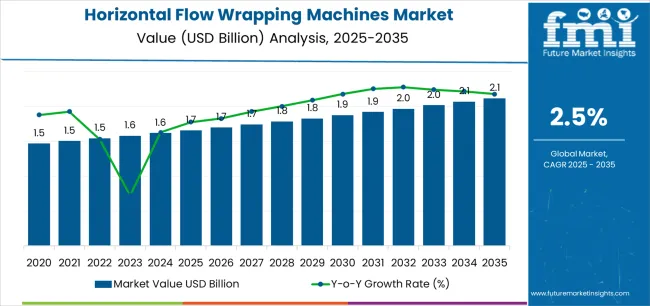
The horizontal flow wrapping machines market was valued at USD 1.70 billion in 2025, projected to reach USD 1.74 billion in 2026, and is forecast to expand to USD 2.23 billion by 2036 at a 2.50% CAGR. As per FMI, demand trajectories are shaped by end-user capital expenditure cycles, regulatory compliance mandates, and geographic shifts in deployment footprints. Procurement decision-makers are increasingly evaluating total cost of ownership rather than unit acquisition price, compressing evaluation timelines for suppliers unable to demonstrate lifecycle value.
Summary of Horizontal Flow Wrapping Machines Market
- The market is forecast to reach USD 2.23 billion by 2036.
- The market is expected to grow at a CAGR of 2.50% from 2026 to 2036.
- The market was estimated at USD 1.70 billion in 2025.
- The forecast period represents an incremental opportunity of USD 0.49 billion.
- Demand is driven by rising adoption of automated packaging systems and compliance with food safety and regulatory standards.
- Procurement decisions are shifting toward total cost of ownership and lifecycle performance evaluation.
- India and China are the fastest-growing markets, with India at 4.7% CAGR and China at 3.7% CAGR.
- Automatic machines lead the segment with a 65.0% share in 2026.
- Powder applications account for 43.7% share, while food leads end use with 41.1% share.
- Syntegon, BW Flexible Systems, Omori Machinery, Tokyo Automatic Machinery Works Ltd, ULMA Packaging, Coesia Group, and Pro Mach are among the key players in the market.
Horizontal Flow Wrapping Machines Market Key Takeaways
| Metric | Details |
|---|---|
| Industry Size (2026) | USD 1.74 billion |
| Industry Value (2036) | USD 2.23 billion |
| CAGR (2026 to 2036) | 2.50% |
Source: Future Market Insights, 2026
FMI analysts observe that the horizontal flow wrapping machines market is driven by food safety packaging compliance and high-speed production line integration requirements. Automatic machines command 65.0% share because they meet throughput and hygiene specifications mandated under FSMA and EU food contact material regulations. Powder filling applications lead at 43.7% as confectionery, bakery, and snack manufacturers prioritize hermetic sealing consistency across multi-shift production environments. Packaging line consolidation toward single-vendor flow wrapping platforms is reducing changeover time and spare parts inventory complexity.
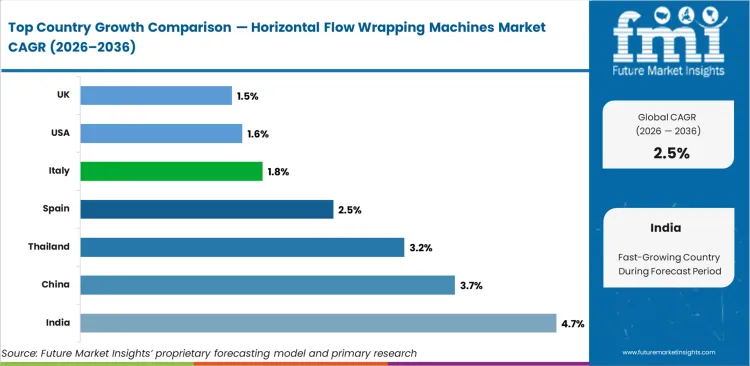
Regional growth trajectories reflect divergent adoption maturity levels. India sets the pace with a 4.7% CAGR, followed by China at 3.7% and Thailand at 3.2%. Spain tracks at 2.5%. Italy tracks at 1.8%. USA tracks at 1.6%. UK tracks at 1.5%. Mature markets generate replacement and specification-driven upgrade demand, while emerging economies are building installed capacity from greenfield deployment conditions.
Horizontal Flow Wrapping Machines Market Definition
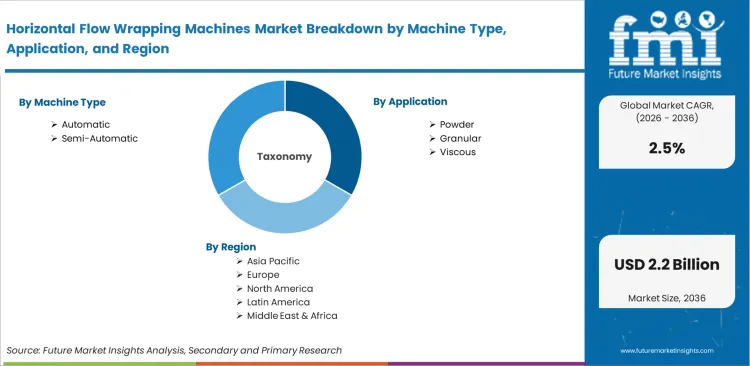
The Horizontal Flow Wrapping Machines Market covers automated packaging equipment that wraps individual products in a continuous film web using a horizontal feed path. Machine categories include fully automatic and semi-automatic configurations serving food, personal care, pharmaceutical, and homecare product packaging lines. The scope includes machines handling powder, granular, and viscous product formats.
Horizontal Flow Wrapping Machines Market Inclusions
Market scope includes global and regional market size estimates, a ten-year forecast from 2026 to 2036, segmentation by machine type (automatic, semi-automatic), by application (powder, granular, viscous), and by region. Pricing trend analysis and competitive positioning assessments are incorporated.
Horizontal Flow Wrapping Machines Market Exclusions
The scope excludes vertical form-fill-seal machines, thermoforming packaging systems, shrink wrapping equipment, and standalone film converting machinery. Packaging films and consumables are outside the analytical boundary.
Horizontal Flow Wrapping Machines Market Research Methodology
- Primary Research: Analysts conducted structured interviews with procurement managers, distribution channel operators, and product engineering leads to map purchase decision triggers and supplier evaluation criteria.
- Desk Research: Data collection aggregated regulatory compliance schedules, industry standards publications, trade association reports, and public financial disclosures from listed manufacturers.
- Market-Sizing and Forecasting: Baseline values derive from a bottom-up aggregation of product shipment records and channel sell-through data, applying region-specific adoption curves to project ten-year demand trajectories for the horizontal flow wrapping machines market.
- Data Validation and Update Cycle: Projections are cross-validated against publicly reported revenue guidance from leading manufacturers and adjusted quarterly against updated trade statistics.
Key Industry Highlights
Increasing Market of Packaged Food is a Major Driver
The increasing demand for packaged food has driven the horizontal flow wrapping machines market. Also, the volume to value ratio of packaged food is comparatively very high than other products.
The machine used for food packaging is also equipped with various sterilization methods which packages food products without any contamination. This has LED horizontal flow wrapping machines to be used majorly in the food and beverage industry, contributing with the 40% of market share of global HFFS machines market.
As per recent estimates, the global packaged food market was valued at over USD 40 billion, with a CAGR of 4.5%. North America has the largest share in the market due to increasing demand of packaged food.
Asia Pacific also plays a crucial role in the growth of the packaged food market due to changing trends in developing countries and growing population. Growth in the packaged food industry has secured the market for horizontal flow wrapping machines.
Key Players are Developing HFFS Machines for Multiple Applications
Flow wrapping machine manufacturers are increasingly focusing on developing versatile machines capable of catering to multiple applications across various industries. For instance, in November 2025, Viking Masek announced the launch of its new range of state-of-the-art flow wrapping machines, which consists of 3 different lines of flow wrapping machines, each catering to different products such as side seal, flat products, multipacks, as well as easy to package products.
Manufacturers are incorporating technologies such as automated changeovers, and intuitive control systems to enhance the versatility and functionality of their machines so that end users can use a single machine for different packaging formats, thereby reducing downtime and driving efficiency.
Horizontal Flow Wrapping Machines Mostly Suitable for High Volume Producers
The purpose of horizontal flow wrapping machines is to pack high volume of products with high speed of packaging by reducing the need for material handling between the three operations of forming packaging, filling the product, and sealing the packaging. The reason for lower global value of form-fill-seal machines than expected from its applicability is high price for a single machine.
The high speed packaging of the machine might result in ideal time of the machine for low volume of products which is directly loss of productivity for a manufacturer. Thus, form-fill-seal machines are only profitable for very high and stable volume producers. Moreover, the high costs translates to the fact that several SMEs are unable to afford such machineries, thereby hampering the potential growth of the market.
2021 to 2025 Global Horizontal Flow Wrapping Machines Sales Outlook Compared to Demand Forecast from 2026 to 2036
The global horizontal flow wrapping machines industry recorded a CAGR of 1.8% during the historical period between 2021 and 2025. The growth of horizontal flow wrapping machines industry was positive as it reached a value of USD 1,518.9 million in 2025, from USD 1,414.3 million in 2021.
The increasing popularity horizontal flow wrapping machinery across multiple end use industries owing to the growing demand for packaged goods is a significant driver during the historic study period.
Additionally, e-commerce witnessed rapid growth during the historic period, leading to increased demand for several products. Manufacturers needed to ramp up their production speed and capabilities which LED to the adoption of horizontal flow wrapping machines owing to their faster output over several other alternatives.
This consequently propelled the market upwards. Moreover, significant technological advancements during this time period in packaging machinery, improved efficiency, precision, and versatility of these machines which further LED to an increase in their adoption.
Several of the above factors have persisted and have become some of the key factors driving the market throughout the forecast period. For instance, there has been a continued growth in the convenient and packaged goods market, and e-commerce penetration across several countries, especially developing and underdeveloped countries, have increased significantly.
Additionally, rising disposable income and rapid urbanization across both developing and developed nations is driving investments in sectors such as personal care and healthcare, thereby influencing the horizontal flow wrapping machines market during the forecast period. Overall, the horizontal flow wrapping machines market is projected to expand at a faster pace during the forecast period (2026 to 2036).
Market Concentration
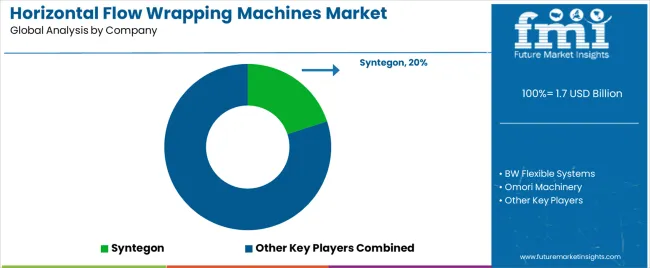
Tier 1 companies comprise market leaders with market revenue of above USD 100 million capturing a significant market share of 10% to 15% in the global market. These market leaders are distinguished by their extensive expertise in manufacturing horizontal flow wrapping machines across multiple types of applications for different end uses and boast a broad geographical reach, underpinned by a robust consumer base.
They provide a wide range of products and solutions for multiple industries and have extensive distribution and service networks across the globe. Companies in Tier 1 comprise of BW Flexible Systems, Omori Machinery, Syntegon, and Tokyo Automatic Machinery Works Ltd.
Tier 2 companies include mid-size players with revenue of USD 10 to 100 million having presence in specific regions and highly influencing the local market. These are characterized by a nominal presence overseas and well maintained market knowledge.
These market players have good technology but not the most advanced one and provide certain types of horizontal flow Wrapping Machines for specific industries. Prominent companies in tier 2 include ULMA Packaging, Coesia Group, Pro Mach, Ilapak International, Triangle Package Machinery, Viking Masek, and FUJI MACHINERY among others.
Tier 3 includes the majority of small-scale companies operating at the local presence and serving niche markets having revenue below USD 10 million. These companies are notably oriented towards fulfilling local market demands and are consequently classified within the tier 3 share segment.
They are small-scale players and have limited geographical reach. Tier 3, within this context, is recognized as an unorganized market, denoting a sector characterized by a lack of extensive structure and formalization when compared to organized competitors.
Country-wise Insights
.webp "Top Country Growth Comparison Horizontal Flow Wrapping Machines Market Cagr (2026 2036)")
The section below covers the industry analysis for the horizontal flow wrapping machines market for different countries. Market demand analysis on key countries in several regions of the globe, including North America, Asia Pacific, Western Europe, Eastern Europe, and others, is provided. The United States is anticipated to remain at the forefront in North America, with a value share of over 50% through 2035. In South Asia Pacific, India is projected to witness a remarkable CAGR of 4.7% by 2035.
| Countries | Value CAGR (2026 to 2036) |
|---|---|
| USA | 1.6% |
| Canada | 1.4% |
| Italy | 1.8% |
| UK | 1.5% |
| Spain | 2.5% |
| China | 3.7% |
| India | 4.7% |
| Thailand | 3.2% |
Thriving Pharmaceutical Industry in Spain is Driving Demand for Horizontal Flow Wrapping Machines in the Country
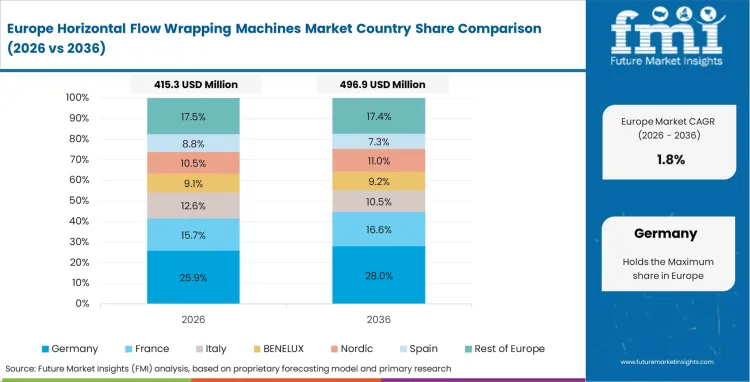
The pharmaceutical industry is one of the main drivers of the economy in Spain and accounts for almost 20% of the industrial investments in the country, as per data provided by ICEX España Exportación e Inversiones. According to ICEX, investments in the pharmaceutical industry in Spain grew by 10% y-o-y in 2025, with a significant part of it coming from the government. Spain also boasts of being one of the largest exporters of pharmaceutical products in the world.
This robust growth of the pharmaceutical industry is positively impacting the demand for horizontal flow wrapping machines in the country since such machines are known to be widely utilized by pharmaceutical manufacturers. Additionally, the increasing investments in R&D is also is leading to the introduction of new innovative products which is driving the necessity for sophisticated packaging machinery such as horizontal flow wrapping machines.
Growth of the Food Processing Sector in India is Propelling the Market Growth
The horizontal flow wrapping machines market in India is anticipated to grow at a CAGR of 4.7% throughout the forecast period.
India's food ecosystem presents tremendous investment potential with attractive fiscal incentives, supportive economic policies, and growing expansion in the food retail sector. Moreover, the Indian Government is making all the required efforts to increase investments in the food processing sector in India through the Ministry of Food Processing Industries (MoFPI).
For instance, according to Invest India, the total FDI received in the food processing sector in the last 20 years surpasses USD 1.7 Billion. Additionally, by 2025 the Indian food Processing market is estimated to reach USD 535 Billion and growing at a compound annual growth rate of 15.2%.
In the forecast period, there will be a significant increase in demand for affordable, transparent, and adaptable packaging options like horizontal flow wrapping machines owing to the growing food processing sector, the rising market for organized retail, and beneficial government regulations as well as investments.
Category-wise Insights
The section contains information about the leading segments in the industry. By application, the powder segment is estimated to grow at a CAGR of 3.4% throughout 2036. Additionally, the food industry is projected to account for over 40% of the market share in 2025.
Plastic Based Horizontal Flow Wrapping Machines Dominate owing to Affordability Aspects
| Application | Powder |
|---|---|
| Value Share (2036) | 43.7% |
By application, the powder segment dominate the horizontal flow wrapping machines market in terms of market share, accounting for almost 45% of the market in 2025. Powdered products are produced by a wide range of industries which include food, pharmaceuticals as well as chemicals. This wide range of products in this particular format has LED to the high demand for packaging solutions tailored for powder based products.
Additionally, the high speeds of new generation horizontal flow wrapping machines have made them the ideal choice for handling large volumes of powdered products. Moreover, several powdered products, especially in the food and pharmaceutical industry, are bound by regulations which further push the popularity of HFFS machines owing to their precise and tamper evident packaging capabilities.
Growing Demand
| End Use | Food |
|---|---|
| Value Share (2036) | 41.1% |
The food industry accounts for the highest share of the horizontal flow wrapping machines market, amounting for over 40% of the market share in 2025. The versatility of horizontal flow wrapping machines makes them suitable for packaging a diverse array of food products, from snacks and confectioneries to ready-to-eat meals and frozen foods. This versatility has allowed food manufacturers to use a single wrapping solution across various product lines, thereby simplifying packaging processes.
Additionally, the growing demand of on-the-go snacks and single-serve portions have also made horizontal flow wrapping machines a popular and convenient means of wrapping such products.
Competitive Landscape
The majority of the manufacturers operating in the global market are focusing on the development of horizontal flow wrapping machines that can satisfy the regulatory requirements of multiple regions at once. Some of the other key players are aiming to come up with horizontal flow wrapping machines which are more user friendly. Meanwhile, a few other firms are striving for additional capital to broaden their operations and aiming to generate more sales and attract a large customer base globally.
Key manufacturers in the market are focusing on expanding their geographical presence, technological innovations, improving material compatibility, performing mergers and acquisitions, and improving customer service to maintain their competitive edge.
Recent Industry Developments in Horizontal Flow Wrapping Machines Market
- In March 2025 BW Flexible Systems announced the launch of the Hayssen R300 horizontal flow wrapping machine for baked goods. The Hayssen R300 has an enhanced user-friendly interface which assists first-time users in getting quickly familiarized with the machine.
- In December 2025 ULMA Packaging announced the North American launch of the ULMA FR 400 TWIN Flow horizontal wrapping machine. The machine will mainly cater to the thriving confectionery and bakery industries in North America.
Scope of the Report
| Metric | Value |
|---|---|
| Quantitative Units | USD 1.74 billion to USD 2.23 billion, at a CAGR of 2.50% |
| Market Definition | The Horizontal Flow Wrapping Machines Market covers automated packaging equipment that wraps individual products in a continuous film web using a horizontal feed path. Machine categories include fully... |
| Machine Type Segmentation | Automatic, Semi-Automatic |
| Application Segmentation | Powder, Granular, Viscous |
| End Use Segmentation | Food, Personal Care & Cosmetics, Pharmaceuticals, Homecare, Other Industrial |
| Regions Covered | North America, Latin America, Europe, East Asia, South Asia, Oceania, Middle East & Africa |
| Countries Covered | India, China, Thailand, Spain, Italy, USA, UK, and 40 plus countries |
| Key Companies Profiled | Syntegon, BW Flexible Systems, Omori Machinery, Tokyo Automatic Machinery Works Ltd, ULMA Packaging, Coesia Group, Pro Mach, Ilapak International |
| Forecast Period | 2026 to 2036 |
| Approach | Forecasting models apply a bottom-up methodology starting with global installed base metrics and project conversion rates using region-specific adoption curves. |
Key Segments of Horizontal Flow Wrapping Machines Industry
By Machine Type:
In terms of machine type, the industry is divided into automatic, and semi-automatic machines.
By Application:
In terms of application, the industry is segregated into powder, granular & viscous.
By End Use:
In terms of packaging format, the industry is segregated into food, personal care & cosmetics, pharmaceuticals, homecare and other industrial.
By Region:
Key countries of North America, Latin America, Europe, Oceania, East Asia, South Asia, and Middle East and Africa (MEA) have been covered in the report.
Bibliography
- USA Food and Drug Administration. (2025). Food Safety Modernization Act (FSMA) Implementation Status. FDA.
- European Commission. (2025). Regulation (EC) No 1935/2004 on Food Contact Materials Update. European Commission.
- Syntegon Technology GmbH. (2025). Annual Report 2025. Syntegon.
- International Organization for Standardization. (2025). ISO 22000: Food Safety Management Systems. ISO.
- Packaging Machinery Manufacturers Institute. (2025). State of the Packaging Industry Report 2025. PMMI.
- Organisation for Economic Co-operation and Development. (2025). Food and Agriculture Statistics. OECD.
This bibliography is provided for reader reference. The full Future Market Insights report contains the complete reference list with primary research documentation.
This Report Addresses
- Market sizing and quantitative forecast metrics detailing expenditure allocation across horizontal flow wrapping machines market categories through 2036.
- Segmentation analysis mapping adoption velocity of specific automatic configurations and evaluating technical drivers behind application migration patterns.
- Regional deployment intelligence comparing growth trajectories in India and China against mature market replacement patterns in North America and Europe.
- Regulatory compliance assessment analyzing how evolving standards frameworks influence procurement specifications and product qualification timelines.
- Competitive posture evaluation tracking integration strategies, distribution alignment, and market share concentration among leading manufacturers.
- Capital project strategic guidance defining procurement specifications and performance thresholds for next-generation product deployments.
- Supply chain risk analysis identifying sourcing concentration, logistics dependencies, and component availability constraints.
- Custom data delivery formats encompassing interactive dashboards, raw Excel datasets, and PDF narrative reports.
Frequently Asked Questions
How large is the demand for Horizontal Flow Wrapping Machines Market in the global market in 2026?
Demand for horizontal flow wrapping machines market in the global market is estimated to be valued at USD 1.74 billion in 2026.
What will be the market size of Horizontal Flow Wrapping Machines Market in the global market by 2036?
Market size for horizontal flow wrapping machines market is projected to reach USD 2.23 billion by 2036.
What is the expected demand growth for Horizontal Flow Wrapping Machines Market between 2026 and 2036?
Demand for horizontal flow wrapping machines market is expected to grow at a CAGR of 2.50% between 2026 and 2036.
Which Machine Type is poised to lead global sales by 2026?
Automatic accounts for 65.0% in 2026 as it addresses the largest share of end-user procurement requirements within the machine type category.
How does Powder perform by Application in 2026?
Powder holds 43.7% of application share as established procurement channels and application requirements concentrate volume through this segment.
What is the India growth outlook in this report?
India is projected to grow at a CAGR of 4.7% during 2026 to 2036.
What is China's growth outlook in this report?
China is projected to expand at a CAGR of 3.7% during 2026 to 2036.
Preview the report firsthand - request a free sample
Get SampleGet the brochure for pricing and purchase details.
Get PDFTable of Content
- Executive Summary
- Global Market Outlook
- Demand-side Trends
- Supply-side Trends
- Technology Roadmap Analysis
- Analysis and Recommendations
- Market Overview
- Market Coverage / Taxonomy
- Market Definition / Scope / Limitations
- Research Methodology
- Chapter Orientation
- Analytical Lens and Working Hypotheses
- Market Structure, Signals, and Trend Drivers
- Benchmarking and Cross-market Comparability
- Market Sizing, Forecasting, and Opportunity Mapping
- Research Design and Evidence Framework
- Desk Research Programme (Secondary Evidence)
- Company Annual and Sustainability Reports
- Peer-reviewed Journals and Academic Literature
- Corporate Websites, Product Literature, and Technical Notes
- Earnings Decks and Investor Briefings
- Statutory Filings and Regulatory Disclosures
- Technical White Papers and Standards Notes
- Trade Journals, Industry Magazines, and Analyst Briefs
- Conference Proceedings, Webinars, and Seminar Materials
- Government Statistics Portals and Public Data Releases
- Press Releases and Reputable Media Coverage
- Specialist Newsletters and Curated Briefings
- Subscription Datasets and Paid Sources
- Social Channels, Communities, and Digital Listening Inputs
- Additional Desk Sources
- Expert Input and Fieldwork (Primary Evidence)
- Primary Modes
- Qualitative Interviews and Expert Elicitation
- Quantitative Surveys and Structured Data Capture
- Blended Approach
- Why Primary Evidence is Used
- Field Techniques
- Interviews
- Surveys
- Focus Groups
- Observational and In-context Research
- Social and Community Interactions
- Stakeholder Universe Engaged
- C-suite Leaders
- Board Members
- Presidents and Vice Presidents
- R&D and Innovation Heads
- Technical Specialists
- Domain Subject-matter Experts
- Scientists
- Physicians and Other Healthcare Professionals
- Governance, Ethics, and Data Stewardship
- Research Ethics
- Data Integrity and Handling
- Primary Modes
- Tooling, Models, and Reference Databases
- Desk Research Programme (Secondary Evidence)
- Data Engineering and Model Build
- Data Acquisition and Ingestion
- Cleaning, Normalisation, and Verification
- Synthesis, Triangulation, and Analysis
- Quality Assurance and Audit Trail
- Market Background
- Market Dynamics
- Drivers
- Restraints
- Opportunity
- Trends
- Scenario Forecast
- Demand in Optimistic Scenario
- Demand in Likely Scenario
- Demand in Conservative Scenario
- Opportunity Map Analysis
- Product Life Cycle Analysis
- Supply Chain Analysis
- Investment Feasibility Matrix
- Value Chain Analysis
- PESTLE and Porter’s Analysis
- Regulatory Landscape
- Regional Parent Market Outlook
- Production and Consumption Statistics
- Import and Export Statistics
- Market Dynamics
- Global Market Analysis 2021 to 2025 and Forecast, 2026 to 2036
- Historical Market Size Value (USD Million) Analysis, 2021 to 2025
- Current and Future Market Size Value (USD Million) Projections, 2026 to 2036
- Y-o-Y Growth Trend Analysis
- Absolute $ Opportunity Analysis
- Global Market Pricing Analysis 2021 to 2025 and Forecast 2026 to 2036
- Global Market Analysis 2021 to 2025 and Forecast 2026 to 2036, By Machine Type
- Introduction / Key Findings
- Historical Market Size Value (USD Million) Analysis By Machine Type , 2021 to 2025
- Current and Future Market Size Value (USD Million) Analysis and Forecast By Machine Type , 2026 to 2036
- Automatic
- Semi-Automatic
- Automatic
- Y-o-Y Growth Trend Analysis By Machine Type , 2021 to 2025
- Absolute $ Opportunity Analysis By Machine Type , 2026 to 2036
- Global Market Analysis 2021 to 2025 and Forecast 2026 to 2036, By Application
- Introduction / Key Findings
- Historical Market Size Value (USD Million) Analysis By Application, 2021 to 2025
- Current and Future Market Size Value (USD Million) Analysis and Forecast By Application, 2026 to 2036
- Powder
- Granular
- Viscous
- Powder
- Y-o-Y Growth Trend Analysis By Application, 2021 to 2025
- Absolute $ Opportunity Analysis By Application, 2026 to 2036
- Global Market Analysis 2021 to 2025 and Forecast 2026 to 2036, By End Use
- Introduction / Key Findings
- Historical Market Size Value (USD Million) Analysis By End Use, 2021 to 2025
- Current and Future Market Size Value (USD Million) Analysis and Forecast By End Use, 2026 to 2036
- Food
- Personal Care & Cosmetics
- Pharmaceuticals
- Homecare
- Other Industrial
- Food
- Y-o-Y Growth Trend Analysis By End Use, 2021 to 2025
- Absolute $ Opportunity Analysis By End Use, 2026 to 2036
- Global Market Analysis 2021 to 2025 and Forecast 2026 to 2036, By Region
- Introduction
- Historical Market Size Value (USD Million) Analysis By Region, 2021 to 2025
- Current Market Size Value (USD Million) Analysis and Forecast By Region, 2026 to 2036
- North America
- Latin America
- Western Europe
- Eastern Europe
- East Asia
- South Asia and Pacific
- Middle East & Africa
- Market Attractiveness Analysis By Region
- North America Market Analysis 2021 to 2025 and Forecast 2026 to 2036, By Country
- Historical Market Size Value (USD Million) Trend Analysis By Market Taxonomy, 2021 to 2025
- Market Size Value (USD Million) Forecast By Market Taxonomy, 2026 to 2036
- By Country
- USA
- Canada
- Mexico
- By Machine Type
- By Application
- By End Use
- By Country
- Market Attractiveness Analysis
- By Country
- By Machine Type
- By Application
- By End Use
- Key Takeaways
- Latin America Market Analysis 2021 to 2025 and Forecast 2026 to 2036, By Country
- Historical Market Size Value (USD Million) Trend Analysis By Market Taxonomy, 2021 to 2025
- Market Size Value (USD Million) Forecast By Market Taxonomy, 2026 to 2036
- By Country
- Brazil
- Chile
- Rest of Latin America
- By Machine Type
- By Application
- By End Use
- By Country
- Market Attractiveness Analysis
- By Country
- By Machine Type
- By Application
- By End Use
- Key Takeaways
- Western Europe Market Analysis 2021 to 2025 and Forecast 2026 to 2036, By Country
- Historical Market Size Value (USD Million) Trend Analysis By Market Taxonomy, 2021 to 2025
- Market Size Value (USD Million) Forecast By Market Taxonomy, 2026 to 2036
- By Country
- Germany
- UK
- Italy
- Spain
- France
- Nordic
- BENELUX
- Rest of Western Europe
- By Machine Type
- By Application
- By End Use
- By Country
- Market Attractiveness Analysis
- By Country
- By Machine Type
- By Application
- By End Use
- Key Takeaways
- Eastern Europe Market Analysis 2021 to 2025 and Forecast 2026 to 2036, By Country
- Historical Market Size Value (USD Million) Trend Analysis By Market Taxonomy, 2021 to 2025
- Market Size Value (USD Million) Forecast By Market Taxonomy, 2026 to 2036
- By Country
- Russia
- Poland
- Hungary
- Balkan & Baltic
- Rest of Eastern Europe
- By Machine Type
- By Application
- By End Use
- By Country
- Market Attractiveness Analysis
- By Country
- By Machine Type
- By Application
- By End Use
- Key Takeaways
- East Asia Market Analysis 2021 to 2025 and Forecast 2026 to 2036, By Country
- Historical Market Size Value (USD Million) Trend Analysis By Market Taxonomy, 2021 to 2025
- Market Size Value (USD Million) Forecast By Market Taxonomy, 2026 to 2036
- By Country
- China
- Japan
- South Korea
- By Machine Type
- By Application
- By End Use
- By Country
- Market Attractiveness Analysis
- By Country
- By Machine Type
- By Application
- By End Use
- Key Takeaways
- South Asia and Pacific Market Analysis 2021 to 2025 and Forecast 2026 to 2036, By Country
- Historical Market Size Value (USD Million) Trend Analysis By Market Taxonomy, 2021 to 2025
- Market Size Value (USD Million) Forecast By Market Taxonomy, 2026 to 2036
- By Country
- India
- ASEAN
- Australia & New Zealand
- Rest of South Asia and Pacific
- By Machine Type
- By Application
- By End Use
- By Country
- Market Attractiveness Analysis
- By Country
- By Machine Type
- By Application
- By End Use
- Key Takeaways
- Middle East & Africa Market Analysis 2021 to 2025 and Forecast 2026 to 2036, By Country
- Historical Market Size Value (USD Million) Trend Analysis By Market Taxonomy, 2021 to 2025
- Market Size Value (USD Million) Forecast By Market Taxonomy, 2026 to 2036
- By Country
- Kingdom of Saudi Arabia
- Other GCC Countries
- Turkiye
- South Africa
- Other African Union
- Rest of Middle East & Africa
- By Machine Type
- By Application
- By End Use
- By Country
- Market Attractiveness Analysis
- By Country
- By Machine Type
- By Application
- By End Use
- Key Takeaways
- Key Countries Market Analysis
- USA
- Pricing Analysis
- Market Share Analysis, 2025
- By Machine Type
- By Application
- By End Use
- Canada
- Pricing Analysis
- Market Share Analysis, 2025
- By Machine Type
- By Application
- By End Use
- Mexico
- Pricing Analysis
- Market Share Analysis, 2025
- By Machine Type
- By Application
- By End Use
- Brazil
- Pricing Analysis
- Market Share Analysis, 2025
- By Machine Type
- By Application
- By End Use
- Chile
- Pricing Analysis
- Market Share Analysis, 2025
- By Machine Type
- By Application
- By End Use
- Germany
- Pricing Analysis
- Market Share Analysis, 2025
- By Machine Type
- By Application
- By End Use
- UK
- Pricing Analysis
- Market Share Analysis, 2025
- By Machine Type
- By Application
- By End Use
- Italy
- Pricing Analysis
- Market Share Analysis, 2025
- By Machine Type
- By Application
- By End Use
- Spain
- Pricing Analysis
- Market Share Analysis, 2025
- By Machine Type
- By Application
- By End Use
- France
- Pricing Analysis
- Market Share Analysis, 2025
- By Machine Type
- By Application
- By End Use
- India
- Pricing Analysis
- Market Share Analysis, 2025
- By Machine Type
- By Application
- By End Use
- ASEAN
- Pricing Analysis
- Market Share Analysis, 2025
- By Machine Type
- By Application
- By End Use
- Australia & New Zealand
- Pricing Analysis
- Market Share Analysis, 2025
- By Machine Type
- By Application
- By End Use
- China
- Pricing Analysis
- Market Share Analysis, 2025
- By Machine Type
- By Application
- By End Use
- Japan
- Pricing Analysis
- Market Share Analysis, 2025
- By Machine Type
- By Application
- By End Use
- South Korea
- Pricing Analysis
- Market Share Analysis, 2025
- By Machine Type
- By Application
- By End Use
- Russia
- Pricing Analysis
- Market Share Analysis, 2025
- By Machine Type
- By Application
- By End Use
- Poland
- Pricing Analysis
- Market Share Analysis, 2025
- By Machine Type
- By Application
- By End Use
- Hungary
- Pricing Analysis
- Market Share Analysis, 2025
- By Machine Type
- By Application
- By End Use
- Kingdom of Saudi Arabia
- Pricing Analysis
- Market Share Analysis, 2025
- By Machine Type
- By Application
- By End Use
- Turkiye
- Pricing Analysis
- Market Share Analysis, 2025
- By Machine Type
- By Application
- By End Use
- South Africa
- Pricing Analysis
- Market Share Analysis, 2025
- By Machine Type
- By Application
- By End Use
- USA
- Market Structure Analysis
- Competition Dashboard
- Competition Benchmarking
- Market Share Analysis of Top Players
- By Regional
- By Machine Type
- By Application
- By End Use
- Competition Analysis
- Competition Deep Dive
- Syntegon
- Overview
- Product Portfolio
- Profitability by Market Segments (Product/Age /Sales Channel/Region)
- Sales Footprint
- Strategy Overview
- Marketing Strategy
- Product Strategy
- Channel Strategy
- BW Flexible Systems
- Omori Machinery
- Tokyo Automatic Machinery Works Ltd
- ULMA Packaging
- Coesia Group
- Pro Mach
- Ilapak International
- PAC Machinery
- Viking Masek
- FUJI MACHINERY
- PFM Packaging Machinery
- KAWASHIMA
- Campbell Wrapper Corporation
- Pakona Engineers
- Syntegon
- Competition Deep Dive
- Assumptions & Acronyms Used


