

- Market Size (2026)
- USD 245.2 Mn
- Forecast (2036)
- USD 391.9 Mn
- CAGR (2026 to 2036)
- 4.8%
How big is Hospital Meal Tray Systems Market in 2026?
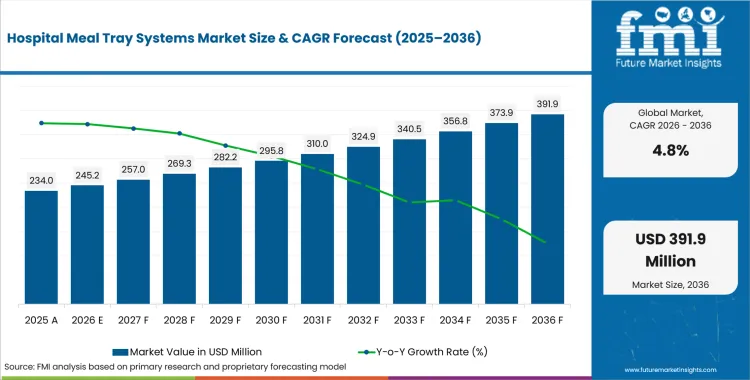
USD 245.2 million in 2026 and USD 391.9 million by 2036 at a 4.8% CAGR.
Demand for hospital meal tray systems is projected to rise from USD 245.2 million in 2026 to USD 391.9 million by 2036 at a 4.8% CAGR. Replacement spending follows recurring patient-meal service because every ward round needs reliable food service equipment. The American Hospital Association reported 6,100 USA hospitals and 907,216 staffed beds in its February 2026 national update. That installed care base keeps temperature control and repeated sanitation central whenever tray systems are replaced.
Country economics change the budget and operating model behind that replacement cycle. Japan's 2026 medical-fee schedule sets qualifying inpatient meal therapy at 730 yen per meal with up to three meals reimbursable each day. A defined national payment route supports disciplined meal-service purchasing while other countries use different hospital funding and catering structures. Those differences help explain country CAGR variation even when temperature retention and cleaning remain common technical requirements.
Key Takeaways
- Recurring patient-meal rounds sustain demand for tray systems that preserve temperature and support accurate ward delivery.
- By tray type, insulated trays are estimated to hold 48.0% in 2026 because they protect meal temperatures during ward delivery.
- Plastic is projected to hold 42.0% of material demand in 2026 because durable lightweight components suit repeated healthcare meal-service handling.
- In 2026, centralized tray delivery systems are expected to account for 44.0% of system type demand because central assembly supports controlled ward distribution.
- Uneven recycling and composting access slows substitution because acceptable tray materials may lack the intended recovery route.
- Key companies include Cambro Manufacturing, Aladdin Temp-Rite, temp-rite International GmbH, Burlodge, Dinex Healthcare, Socamel Technologies, E&R Moffat and Hupfer. Inclusion follows healthcare meal-delivery evidence rather than general foodservice portfolios.
Analyst Perspective
"Hospital meal trays change slowly because kitchens cannot trade meal integrity for a material claim. Replacement formats earn repeat orders after barrier performance and portion fit survive routine handling."
- Nandini Roy Choudhury, Principal Consultant, Future Market Insights
How is the hospital meal tray systems market segmented?
The hospital meal tray systems market is segmented by tray type, material, system type, end use, sales channel, and region.
Tray type covers insulated trays, non-insulated trays, compartmentalized trays, and disposable trays. Material includes plastic, stainless steel, and melamine. System type covers centralized tray delivery systems, decentralized service systems, and cafeteria-style service. End use includes hospitals, long-term care facilities, rehabilitation centers, psychiatric facilities, and home healthcare. Sales channels include institutional sales, distributors, and e-commerce.
What drives institutional sales in the sales channel category?
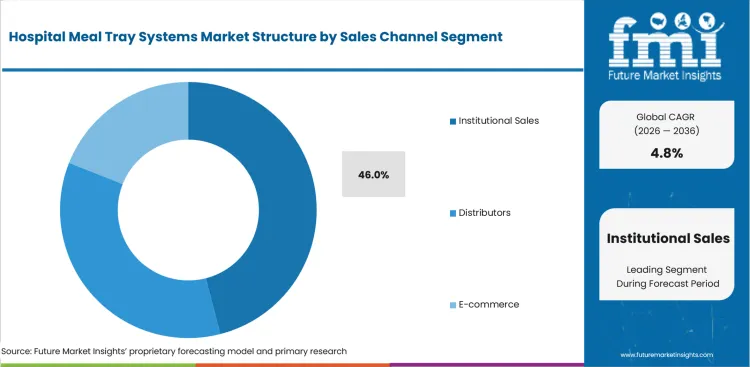
Institutional sales matter when hospitals buy compatible trays and delivery equipment through formal procurement routes. NHS England's 2024/25 Estates Returns Information Collection reported GBP 0.8 billion in total inpatient food costs across NHS trusts and was updated in June 2026. That national spending base makes commercial catering equipment specification a recurring institutional decision rather than a small retail purchase. Suppliers can win repeat orders when service support and replacement components fit the existing meal route after the initial installation.
- Institutional sales are anticipated to hold 46.0% of sales channel demand in 2026 because healthcare buyers procure compatible meal-delivery components through formal purchasing routes.
- Institutional purchasing can align tray-system specifications with ward capacity and cleaning procedures before recurring replacement orders begin.
Why does plastic lead the material category?
Plastic remains important where hospitals need lightweight components that tolerate repeated cleaning and handling. In May 2026 the USA Food and Drug Administration released a scientific evaluation of eight phthalates still authorized as plasticizers for food-contact use. That review keeps polymer chemistry inside formal food-contact assessment instead of treating reusable packaging as automatically suitable. Procurement teams therefore need material records that match the actual tray component and cleaning cycle before a plastic format enters recurring patient-meal service.
- Plastic is projected to hold 42.0% of material demand in 2026 because durable lightweight components fit repeated healthcare handling.
- Plastic tray components must remain easy to clean and stable through storage and patient-meal service.
What makes insulated trays central to the tray type category?
Insulated trays protect meal condition while prepared food moves from kitchen assembly to patient wards. In August 2026 Cambro introduced the Laguna Meal Delivery System for healthcare operations and described stackable insulated components for tray-top preparation. The launch keeps temperature retention and storage efficiency inside one replacement decision. Hospitals comparing insulated food containers therefore evaluate whether the full tray route can protect hot and cold components without forcing dietary teams to redesign routine ward delivery.
- By tray type, insulated trays are estimated to hold 48.0% in 2026 because they preserve meal condition during internal delivery.
- Insulated systems let dietary teams combine hot and cold meal components while keeping the delivery sequence compatible with ward routines.
How do centralized tray delivery systems shape the system type category?
Centralized systems concentrate meal assembly before finished trays move through a controlled distribution route. In September 2026 Cwm Taf Morgannwg University Health Board awarded Socamel UK Ltd a contract for 20 meal regeneration trolleys with digital temperature monitoring and integrated food probes. The award shows how food serving equipment becomes a system purchase when hospitals need temperature control and service resilience across repeated meal rounds. Centralized formats gain value when compatible trays and transport equipment reduce handoffs from kitchen assembly to the ward.
- By system type, centralized tray delivery systems are forecast to represent 44.0% in 2026 because central assembly supports controlled ward distribution.
- Centralized systems require tray, cart, and meal-identification components that keep each patient order together through the delivery route.
What supports hospitals in the end use category?
Hospitals create recurring demand because inpatient meals are delivered every day under clinical and sanitation requirements. Germany's Federal Statistical Office reported 1,841 hospitals on its national hospital statistics page in 2026. That installed care network creates a large base for tray replacement and service-equipment procurement without proving that one design suits every facility. Buyers comparing tray systems still need compatibility with kitchen workflow and cleaning procedures before a replacement can support routine patient-meal rounds.
- In 2026, hospitals are expected to hold 38.0% of end use demand because recurring patient meals require controlled internal distribution.
- Hospitals adopt tray systems after the equipment preserves meal condition, supports identification, and fits the movement pattern between kitchen and bedside.
What are the drivers, restraints and opportunities in the Hospital Meal Tray Systems Market?
Food-contact rules trigger tray requalification, local recovery access limits uniform material choices, and foam restrictions move replacement trials toward fiber and recyclable formats.
- Driver: Food-contact and packaging rules are moving material choice into formal specification reviews for institutional and commercial meal-service formats.
- Restraint: Recycling and composting routes differ by location, so one material claim cannot support identical disposal instructions at every foodservice site.
- Opportunity: Fiber and recyclable plastic trays can replace restricted formats after comparable barrier performance and routine meal handling are confirmed.
Food-contact rules move material choice into formal tray specifications
Food-contact oversight moves material choice into formal tray qualification. The European Commission published a February 2026 food-contact materials factsheet confirming that packaging and articles touching food must meet safety rules designed to prevent harmful migration. Hospital kitchens therefore need documentation that matches the selected tray material and service temperature. Foodservice disposables or reusable formats can enter replacement programs only after buyers confirm that the material remains suitable for the intended patient-meal route.
Local recovery access limits one-material policies
Operational constraints rise when hospitals need one system to protect food quality across different ward routes and staffing conditions. Hupfer reported in March 2026 that its cold-warm plate received a Product Green Award for a design using R290 refrigeration and separate temperature zones. The development shows why replacement decisions increasingly compare utility choice and holding performance together. Buyers still face switching costs when a new holding concept requires different cleaning routines or service equipment around the existing trayline.
Foam restrictions put fiber and recyclable trays into replacement trials
Integrated regeneration creates an upgrade path when hospitals want stronger temperature control without rebuilding the entire meal process. In February 2026 temp-rite presented the new Temp-Serve Pro generation for Cook and Chill or Cook and Freeze applications and described clinic use within its official news release. The launch gives buyers a current hospital meal-delivery development rather than a generic equipment claim. Suppliers can capture replacement demand when new systems fit established tray handling and sanitation procedures.
Which country CAGRs are profiled in the Hospital Meal Tray Systems Market?
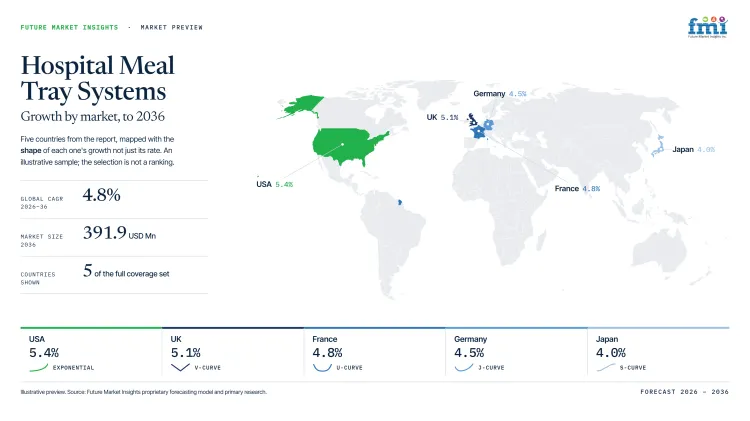
| Country | CAGR |
|---|---|
| South Korea | 5.7% |
| USA | 5.4% |
| UK | 5.1% |
| Germany | 4.5% |
| Japan | 4.0% |
How do country-level CAGRs compare in the Hospital Meal Tray Systems Market?
The countries span a 1.7 percentage-point CAGR range and operate under different hospital funding and food-service requirements. South Korea leads at 5.7%, followed by the USA at 5.4%, the UK at 5.1%, Germany at 4.5% and Japan at 4.0%. CAGR measures forecast pace rather than equipment suitability, so each country still requires evidence around temperature control and procurement routes.
- Saudi Arabia’s expanding tourism infrastructure is increasing purchasing activity across hotels, restaurants, and catering operations.
- Heavy restaurant traffic in South Korea favors products that simplify preparation and support quick service execution.
- The USA’s extensive restaurant network and packaged-bakery distribution system provide broad market access across channels.
- In the UK, demand is supported by both grocery multipacks and a well-established eating-out culture.
- Germany’s restaurant operators face growing pressure to control waste, making yield and portion management more important.
- France’s strong bakery tradition creates competition from established bread and roll categories, raising differentiation requirements.
The full report provides country-level CAGR analysis across North America, Latin America, Western Europe, Eastern Europe, East Asia, South Asia and Pacific, and Middle East and Africa.
Country-wise Analysis
- Hospital meal tray systems demand in the USA is projected to record 5.4% CAGR through 2036 as a large installed hospital base sustains repeated patient-meal rounds. The American Hospital Association reported 6,100 hospitals and more than 907,000 staffed beds in its February 2026 national update. That operating base gives suppliers a broad replacement pool without removing site-level compatibility tests. Buyers comparing commercial cooking equipment with tray delivery assets still need systems that fit staffing patterns and ward movement. Replacement spending therefore favors equipment that preserves meal condition without adding avoidable handoffs between kitchen assembly and bedside service.
- UK hospital procurement operates within an NHS estate where patient food is a measurable national operating cost. NHS England's 2024/25 Estates Returns Information Collection reported GBP 0.8 billion in total inpatient food costs and was updated in June 2026. Hospital meal tray systems demand in the UK is forecast to expand at 5.1% CAGR over the forecast period as hospitals balance meal quality with constrained replacement budgets. Within that budget, food trays gain purchasing priority when a replacement system reduces service disruption rather than merely changing material. Suppliers need compatible tray and trolley support because the economic test extends beyond the purchase price of one component.
- Germany is estimated to post 4.5% CAGR for hospital meal tray systems by 2036 as its mature hospital base sustains recurring replacement decisions. Destatis published the national 2024 hospital directory on May 29 2026 and its hospital statistics page lists 1,841 hospitals. That infrastructure base gives suppliers a national frame for replacement potential without proving fit at any individual facility. Procurement teams comparing tray systems still need sanitation records and delivery compatibility for the installed kitchen. The commercial advantage goes to configurations that integrate with existing routines and limit the disruption caused by changing several meal-service components at once.
- Japan links inpatient meal service to a national reimbursement schedule that defines the economics of routine hospital feeding. The Ministry of Health Labour and Welfare's 2026 amendment sets qualifying inpatient meal therapy at 730 yen per meal with a limit of three meals per day. Japan's hospital meal tray systems outlook is predicted to expand at 4.0% CAGR through 2036. Reusable tray systems must deliver operating value inside that structured payment environment. Mature providers are likely to favor upgrades that protect temperature and cleaning performance without forcing a broad redesign of established ward distribution or adding avoidable labor to each meal round.
- South Korea's hospital meal tray systems outlook is anticipated to advance at 5.7% CAGR during the forecast period. South Korea is strengthening oversight of institutional foodservice as hospitals place greater emphasis on documented sanitation practices. In June 2026 the Ministry of Food and Drug Safety announced an expanded food-safe designation covering institutional cafeterias including hospitals and named 176 first-round facilities nationwide. That program raises the value of equipment that supports controlled holding and repeatable cleaning across patient-meal service. Suppliers of food holding equipment still need tray and delivery configurations that fit the care setting rather than importing a general catering setup without qualification.
Who are the notable companies in the Hospital Meal Tray Systems Market?
Cambro Manufacturing, Aladdin Temp-Rite, temp-rite International GmbH, Burlodge, Dinex Healthcare, Socamel Technologies, E&R Moffat, Hupfer.
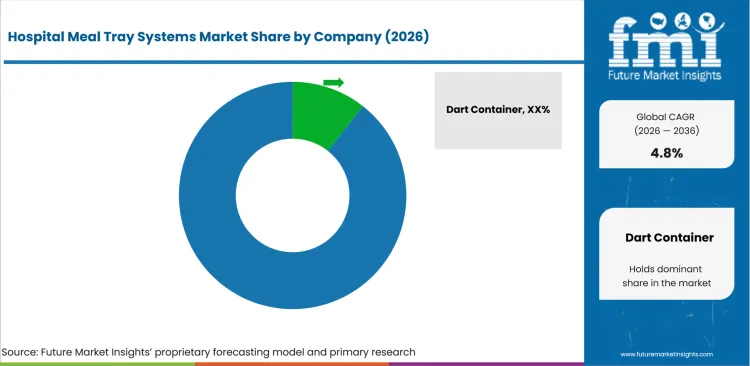
Competition separates healthcare meal-delivery specialists from broader foodservice manufacturers because hospitals buy coordinated tray and transport systems under sanitation constraints.
- Cambro, Aladdin Temp-Rite, temp-rite, Burlodge, Dinex, Socamel, E&R Moffat and Hupfer remain the reconciled company set for healthcare meal delivery.
- Purchasers compare system compatibility and service support against current hospital procurement evidence rather than product-catalog breadth alone.
- Providers strengthen position when dated launches or institutional awards show that their equipment is entering real healthcare meal-service routes.
Competitive Benchmarking: Hospital Meal Tray Systems Market
| Company | Healthcare Tray-System Depth | Material and Service Compatibility | Centralized Delivery Support | Geographic Reach |
|---|---|---|---|---|
| Cambro Manufacturing | High | High | High | International |
| Aladdin Temp-Rite | High | High | High | United States and international |
| temp-rite International GmbH | High | High | High | Europe and international |
| Burlodge | High | High | High | United Kingdom and international |
| Dinex Healthcare | High | High | High | North America |
| Socamel Technologies | High | High | High | Europe and international |
| E&R Moffat | Medium | High | High | United Kingdom and international |
| Hupfer | Medium | High | High | Europe and international |
Scoring basis: High requires three verified routes under the named criterion while Medium requires two and Low one. Ratings are reconciled against current official news and institutional procurement records, with product pages excluded from the scoring evidence.
Key Developments in the Hospital Meal Tray Systems Market
- In August 2026, Cambro introduced the Laguna Meal Delivery System for healthcare operations with stackable insulated meal-delivery components.
- In September 2026, Socamel UK Ltd received a Cwm Taf Morgannwg University Health Board award for 20 MultiServ meal regeneration trolleys.
- In February 2026, temp-rite introduced the new Temp-Serve Pro generation for clinic meal distribution across Cook and Chill or Cook and Freeze workflows.
Key Players in the Hospital Meal Tray Systems Market
Only direct hospital, healthcare, care-home, or institutional meal-distribution evidence is used in the following supplier set.
Healthcare Tray and Meal Delivery System Suppliers
- Cambro Manufacturing
- Aladdin Temp-Rite
- temp-rite International GmbH
Tray, Trolley, and Meal-Distribution Suppliers
- Burlodge
- Dinex Healthcare
- Socamel Technologies
- E&R Moffat
- Hupfer
Hospital Meal Tray Systems Market - Report Scope
| Coverage field | Report scope |
|---|---|
| Market breakdown | By tray type, material, system type, end use, sales channel, and region. |
| Quantitative Units | USD million. |
| Market Definition | Hospital meal tray systems for healthcare and care settings that use trays, tray-top components, transport equipment, and the stated meal-delivery configuration. |
| Regions Covered | North America, Latin America, Western Europe, Eastern Europe, East Asia, South Asia and Pacific, and Middle East and Africa. |
| Countries Covered | South Korea, USA, UK, Germany, Japan, and 20+ countries included in the full report. |
| Key Companies Profiled | Cambro Manufacturing, Aladdin Temp-Rite, temp-rite International GmbH, Burlodge, Dinex Healthcare, Socamel Technologies, E&R Moffat, Hupfer. |
| Forecast Period | 2026 to 2036. |
| Approach | Primary and secondary research with market triangulation. |
Hospital Meal Tray Systems Market - Research Methodology
| Method | Approach |
|---|---|
| Primary Research | FMI analysts gathered input from manufacturers, service providers, technology developers, distributors, end users, procurement teams, and subject-matter experts. Interviews examined purchasing decisions, product or service evaluation, adoption barriers, approval requirements, pricing considerations, and expectations for technical or commercial support. Respondents were also asked what evidence is required before a trial, pilot, or initial order develops into regular purchasing. |
| Desk Research | Desk research covered government statistics, regulatory publications, trade data, industry associations, technical literature, standards, company filings, product information, and official corporate announcements. Sources were reviewed for relevance, publication date, geographic coverage, and consistency with the defined market scope. Claims relating to performance, applications, approvals, capacity, investment, and commercial activity were retained only when supported by credible public evidence. |
| Market Sizing and Forecasting | The market model combined the baseline value with historical performance, segment structure, pricing and volume indicators, adoption levels, company participation, and country-level demand conditions. Forecast assumptions considered economic activity, investment trends, regulatory developments, technology adoption, purchasing cycles, supply availability, and barriers to wider market use. Segment and regional estimates were reconciled before the final market total was calculated. |
| Data Validation | Estimates were checked against multiple independent indicators, including public data, company activity, trade patterns, industry developments, and findings from primary interviews. Validation also tested whether products, services, applications, and company revenues fell within the defined market boundaries. Adjacent categories, unsupported claims, overlapping revenues, and activities without direct market relevance were excluded to reduce double counting and maintain consistency across segments and countries. |
Hospital Meal Tray Systems Market by Segments
Hospital Meal Tray Systems Market segmented by Tray Type:
- Insulated Trays
- Non-Insulated Trays
- Compartmentalized Trays
- Disposable Trays
Hospital Meal Tray Systems Market segmented by Material:
- Plastic
- Stainless Steel
- Melamine
Hospital Meal Tray Systems Market segmented by System Type:
- Centralized Tray Delivery System
- Decentralized Service System
- Cafeteria-style Service
Hospital Meal Tray Systems Market segmented by End Use:
- Hospitals
- Long-Term Care Facilities
- Rehabilitation Centers
- Psychiatric Facilities
- Home Healthcare
Hospital Meal Tray Systems Market segmented by Sales Channel:
- Institutional Sales
- Distributors
- E-commerce
Hospital Meal Tray Systems Market by Region:
- North America
- United States
- Canada
- Latin America
- Brazil
- Mexico
- Chile
- Rest of Latin America
- Western Europe
- Germany
- United Kingdom
- Italy
- Spain
- France
- Nordics
- Benelux
- Rest of Western Europe
- Eastern Europe
- Russia
- Poland
- Hungary
- Balkan and Baltic States
- Rest of Eastern Europe
- East Asia
- China
- Japan
- South Korea
- South Asia and Pacific
- India
- ASEAN
- Australia and New Zealand
- Rest of South Asia and Pacific
- Middle East and Africa
- Kingdom of Saudi Arabia
- Other GCC Countries
- Türkiye
- South Africa
- Other African Union Countries
- Rest of Middle East and Africa
Research Sources and Bibliography
- American Hospital Association. (2026, February). Fast Facts on USA Hospitals, 2026.
- Ministry of Health, Labour and Welfare. (2026). Standards for calculating inpatient meal therapy and inpatient living therapy costs.
- Cambro Manufacturing. (2026, August 27). Stack, Save, Serve: Cambro's New Laguna Meal Delivery System.
- USA Food and Drug Administration. (2026, May 27). FDA Advances Post-Market Review of Phthalates Used in Food Contact Materials.
- Cwm Taf Morgannwg University Health Board. (2026, September 2). Supply, Installation and Maintenance of Socamel MultiServ Regeneration Trolleys.
- Federal Statistical Office of Germany. (2026, May 29). Directory of hospitals and preventive or rehabilitation facilities in Germany 2024.
- NHS England Digital. (2026, June 29). Estates Returns Information Collection, Summary page and dataset for ERIC 2024/25.
- European Commission. (2026, February 23). Food Contact Materials.
- Hupfer. (2026, March 9). Hupfer cold-warm plate wins silver at the Product Green Award 2026.
- temp-rite International GmbH. (2026, February 13). temp-rite at Internorga 2026.
- Ministry of Food and Drug Safety. (2026, June 4). Expansion of food-safe designation for institutional foodservice including hospitals.
- Aladdin Temp-Rite. (2026, February 6). Strengthening Hospital Foodservice & Nursing for Better Outcomes.
- Burlodge. (2026, June 14). Sue Austin named as recipient of once-in-a-lifetime international exchange study opportunity.
- USA Department of Veterans Affairs. (2026, February). Meal delivery carts for Roseburg VA Medical Center, solicitation 36C26026Q0344.
- University Hospitals Dorset NHS Foundation Trust. (2026, February). Supplier transactions over GBP 25,000: February 2026.
This bibliography is provided for reader reference and is not exhaustive. The full report contains the complete reference list and detailed citations
This Report Answers
- How large is the hospital meal tray systems market in 2026 and 2036?
- Which hospital operating conditions sustain recurring tray-system replacement?
- Which tray type holds the leading approved share in 2026?
- Why does plastic remain the leading material within the authorized segmentation?
- How do centralized delivery and institutional procurement shape system selection?
- How do country growth rates differ across the five profiled healthcare markets?
- Which companies have current healthcare meal-delivery launches or procurement evidence?
- What limits replacement when material or service-route requirements change?
Frequently Asked Questions
How big is the Hospital Meal Tray Systems Market in 2026?
The hospital meal tray systems market is valued at USD 245.2 million in 2026 and is projected to reach USD 391.9 million by 2036. Growth follows material requalification as food-contact and waste rules change accepted tray specifications for institutional service.
What is the CAGR of the Hospital Meal Tray Systems Market from 2026 to 2036?
The hospital meal tray systems market is projected to grow at a CAGR of 4.8% between 2026 and 2036. Expansion is supported by replacement activity where compliant trays preserve heat resistance and normal meal-service handling.
Which tray type leads the Hospital Meal Tray Systems Market?
The insulated trays segment is expected to hold 48.0% of the hospital meal tray systems market in 2026, driven by temperature retention during internal meal delivery. Their operating fit helps hospitals protect meal condition while following repeated ward routes.
Which countries record the profiled growth comparison in the Hospital Meal Tray Systems Market?
South Korea is projected to grow at 5.7% CAGR, followed by the USA at 5.4%, the UK at 5.1%, Germany at 4.5%, and Japan at 4.0% through 2036. Each market still requires the tray type, material, delivery system, end-use setting, and sales channel to fit the facility’s stated meal route.
Which companies are active in the Hospital Meal Tray Systems Market?
Players in the hospital meal tray systems market include Cambro Manufacturing, Aladdin Temp-Rite, temp-rite International GmbH, Burlodge, Dinex Healthcare, Socamel Technologies, E&R Moffat, and Hupfer. Purchasers assess tray-system compatibility, material durability, and delivery support before using any supplier for institutional meal service.
Preview the report firsthand - request a free sample
Get SampleGet the brochure for pricing and purchase details.
Get PDFTable of Content
- Key Takeaways
- Market Size and CAGR
- Top Growth Driver
- Fastest Growing Segment
- Leading Region
- Key Companies
- Emerging Opportunities
- Executive Summary
- Global Market Outlook
- Demand-side Trends
- Supply-side Trends
- Technology Roadmap Analysis
- Analysis and Recommendations
- Analyst Perspective (What is happening? Why now? What should investors know?)
- Key Questions Answered
- How large is the market?
- What is the CAGR?
- What are key trends?
- Which region dominates?
- Who are the leaders?
- Market Overview
- Market Coverage / Taxonomy
- Market Definition / Scope / Limitations
- Research Methodology
- Chapter Orientation
- Analytical Lens and Working Hypotheses
- Market Structure, Signals, and Trend Drivers
- Benchmarking and Cross-market Comparability
- Market Sizing, Forecasting, and Opportunity Mapping
- Research Design and Evidence Framework
- Desk Research Programme (Secondary Evidence)
- Expert Input and Fieldwork (Primary Evidence)
- Tooling, Models, and Reference Databases
- Data Engineering and Model Build
- Quality Assurance and Audit Trail
- Market Background
- Market Dynamics (Drivers, Restraints, Opportunity, Trends)
- Scenario Forecast (Optimistic, Likely, Conservative)
- Impact Analysis
- AI Impact
- Sustainability Impact
- Regulatory Impact
- Technology Impact
- Consumer / Buyer Analysis
- Purchase Drivers
- Adoption Barriers
- Buyer Journey
- Opportunity Map Analysis
- Product Life Cycle Analysis
- Supply Chain Analysis
- Investment Feasibility Matrix
- Value Chain Analysis
- PESTLE and Porter's Analysis
- Regulatory Landscape
- Regional Parent Market Outlook
- Production and Consumption Statistics
- Import and Export Statistics
- Global Market Analysis and Forecast, 2021 to 2036
- Historical Market Size Value (USD Million) Analysis, 2021 to 2025
- Current and Future Market Size Value (USD Million) Projections, 2026 to 2036
- Y-o-Y Growth Trend Analysis
- Absolute $ Opportunity Analysis
- Global Market Pricing Analysis, 2021 to 2036
- Global Market Analysis and Forecast, By Tray Type, 2021 to 2036
- Introduction / Key Findings
- Historical Market Size Value (USD Million) Analysis By Tray Type, 2021 to 2025
- Current and Future Market Size Value (USD Million) Analysis and Forecast By Tray Type, 2026 to 2036
- Insulated Trays
- Non-Insulated Trays
- Compartmentalized Trays
- Disposable Trays
- Insulated Trays
- Y-o-Y Growth Trend Analysis By Tray Type, 2021 to 2025
- Absolute $ Opportunity Analysis By Tray Type, 2026 to 2036
- Global Market Analysis and Forecast, By Material, 2021 to 2036
- Introduction / Key Findings
- Historical Market Size Value (USD Million) Analysis By Material, 2021 to 2025
- Current and Future Market Size Value (USD Million) Analysis and Forecast By Material, 2026 to 2036
- Plastic
- Stainless Steel
- Melamine
- Plastic
- Y-o-Y Growth Trend Analysis By Material, 2021 to 2025
- Absolute $ Opportunity Analysis By Material, 2026 to 2036
- Global Market Analysis and Forecast, By System Type, 2021 to 2036
- Introduction / Key Findings
- Historical Market Size Value (USD Million) Analysis By System Type, 2021 to 2025
- Current and Future Market Size Value (USD Million) Analysis and Forecast By System Type, 2026 to 2036
- Centralized Tray Delivery System
- Decentralized Service System
- Cafeteria-style Service
- Centralized Tray Delivery System
- Y-o-Y Growth Trend Analysis By System Type, 2021 to 2025
- Absolute $ Opportunity Analysis By System Type, 2026 to 2036
- Global Market Analysis and Forecast, By End Use, 2021 to 2036
- Introduction / Key Findings
- Historical Market Size Value (USD Million) Analysis By End Use, 2021 to 2025
- Current and Future Market Size Value (USD Million) Analysis and Forecast By End Use, 2026 to 2036
- Hospitals
- Long-Term Care Facilities
- Rehabilitation Centers
- Psychiatric Facilities
- Home Healthcare
- Hospitals
- Y-o-Y Growth Trend Analysis By End Use, 2021 to 2025
- Absolute $ Opportunity Analysis By End Use, 2026 to 2036
- Global Market Analysis and Forecast, By Sales Channel, 2021 to 2036
- Introduction / Key Findings
- Historical Market Size Value (USD Million) Analysis By Sales Channel, 2021 to 2025
- Current and Future Market Size Value (USD Million) Analysis and Forecast By Sales Channel, 2026 to 2036
- Institutional Sales
- Distributors
- E-commerce
- Institutional Sales
- Y-o-Y Growth Trend Analysis By Sales Channel, 2021 to 2025
- Absolute $ Opportunity Analysis By Sales Channel, 2026 to 2036
- Global Market Analysis and Forecast, By Region, 2021 to 2036
- Introduction
- Historical Market Size Value (USD Million) Analysis By Region, 2021 to 2025
- Current Market Size Value (USD Million) Analysis and Forecast By Region, 2026 to 2036
- North America
- Latin America
- Western Europe
- Eastern Europe
- East Asia
- South Asia and Pacific
- Middle East & Africa
- Market Attractiveness Analysis By Region
- North America Market Analysis and Forecast, By Country, 2021 to 2036
- Historical Market Size Value (USD Million) Trend Analysis By Market Taxonomy, 2021 to 2025
- Market Size Value (USD Million) Forecast By Market Taxonomy, 2026 to 2036
- By Country
- USA
- Canada
- By Tray Type
- By Material
- By System Type
- By End Use
- By Sales Channel
- By Country
- Market Attractiveness Analysis
- By Country
- By Tray Type
- By Material
- By System Type
- By End Use
- By Sales Channel
- Key Takeaways
- Latin America Market Analysis and Forecast, By Country
- Historical Market Size Value (USD Million) Trend Analysis By Market Taxonomy, 2021 to 2025
- Market Size Value (USD Million) Forecast By Market Taxonomy, 2026 to 2036
- By Country
- Brazil
- Mexico
- Chile
- Rest of Latin America
- By Tray Type
- By Material
- By System Type
- By End Use
- By Sales Channel
- By Country
- Market Attractiveness Analysis
- By Country
- By Tray Type
- By Material
- By System Type
- By End Use
- By Sales Channel
- Key Takeaways
- Western Europe Market Analysis and Forecast, By Country
- Historical Market Size Value (USD Million) Trend Analysis By Market Taxonomy, 2021 to 2025
- Market Size Value (USD Million) Forecast By Market Taxonomy, 2026 to 2036
- By Country
- Germany
- UK
- Italy
- Spain
- France
- Nordic
- BENELUX
- Rest of Western Europe
- By Tray Type
- By Material
- By System Type
- By End Use
- By Sales Channel
- By Country
- Market Attractiveness Analysis
- By Country
- By Tray Type
- By Material
- By System Type
- By End Use
- By Sales Channel
- Key Takeaways
- Eastern Europe Market Analysis and Forecast, By Country
- Historical Market Size Value (USD Million) Trend Analysis By Market Taxonomy, 2021 to 2025
- Market Size Value (USD Million) Forecast By Market Taxonomy, 2026 to 2036
- By Country
- Russia
- Poland
- Hungary
- Balkan & Baltic
- Rest of Eastern Europe
- By Tray Type
- By Material
- By System Type
- By End Use
- By Sales Channel
- By Country
- Market Attractiveness Analysis
- By Country
- By Tray Type
- By Material
- By System Type
- By End Use
- By Sales Channel
- Key Takeaways
- East Asia Market Analysis and Forecast, By Country
- Historical Market Size Value (USD Million) Trend Analysis By Market Taxonomy, 2021 to 2025
- Market Size Value (USD Million) Forecast By Market Taxonomy, 2026 to 2036
- By Country
- China
- Japan
- South Korea
- By Tray Type
- By Material
- By System Type
- By End Use
- By Sales Channel
- By Country
- Market Attractiveness Analysis
- By Country
- By Tray Type
- By Material
- By System Type
- By End Use
- By Sales Channel
- Key Takeaways
- South Asia and Pacific Market Analysis and Forecast, By Country
- Historical Market Size Value (USD Million) Trend Analysis By Market Taxonomy, 2021 to 2025
- Market Size Value (USD Million) Forecast By Market Taxonomy, 2026 to 2036
- By Country
- India
- ASEAN
- Australia & New Zealand
- Rest of South Asia and Pacific
- By Tray Type
- By Material
- By System Type
- By End Use
- By Sales Channel
- By Country
- Market Attractiveness Analysis
- By Country
- By Tray Type
- By Material
- By System Type
- By End Use
- By Sales Channel
- Key Takeaways
- Middle East & Africa Market Analysis and Forecast, By Country
- Historical Market Size Value (USD Million) Trend Analysis By Market Taxonomy, 2021 to 2025
- Market Size Value (USD Million) Forecast By Market Taxonomy, 2026 to 2036
- By Country
- Kingdom of Saudi Arabia
- Other GCC Countries
- Türkiye
- South Africa
- Other African Union
- Rest of Middle East & Africa
- By Tray Type
- By Material
- By System Type
- By End Use
- By Sales Channel
- By Country
- Market Attractiveness Analysis
- By Country
- By Tray Type
- By Material
- By System Type
- By End Use
- By Sales Channel
- Key Takeaways
- Key Countries Market Analysis
- USA
- Pricing Analysis
- Market Share Analysis, 2025
- By Tray Type
- By Material
- By System Type
- By End Use
- By Sales Channel
- Canada
- Pricing Analysis
- Market Share Analysis, 2025
- By Tray Type
- By Material
- By System Type
- By End Use
- By Sales Channel
- Mexico
- Pricing Analysis
- Market Share Analysis, 2025
- By Tray Type
- By Material
- By System Type
- By End Use
- By Sales Channel
- Brazil
- Pricing Analysis
- Market Share Analysis, 2025
- By Tray Type
- By Material
- By System Type
- By End Use
- By Sales Channel
- Chile
- Pricing Analysis
- Market Share Analysis, 2025
- By Tray Type
- By Material
- By System Type
- By End Use
- By Sales Channel
- Germany
- Pricing Analysis
- Market Share Analysis, 2025
- By Tray Type
- By Material
- By System Type
- By End Use
- By Sales Channel
- UK
- Pricing Analysis
- Market Share Analysis, 2025
- By Tray Type
- By Material
- By System Type
- By End Use
- By Sales Channel
- Italy
- Pricing Analysis
- Market Share Analysis, 2025
- By Tray Type
- By Material
- By System Type
- By End Use
- By Sales Channel
- Spain
- Pricing Analysis
- Market Share Analysis, 2025
- By Tray Type
- By Material
- By System Type
- By End Use
- By Sales Channel
- France
- Pricing Analysis
- Market Share Analysis, 2025
- By Tray Type
- By Material
- By System Type
- By End Use
- By Sales Channel
- India
- Pricing Analysis
- Market Share Analysis, 2025
- By Tray Type
- By Material
- By System Type
- By End Use
- By Sales Channel
- ASEAN
- Pricing Analysis
- Market Share Analysis, 2025
- By Tray Type
- By Material
- By System Type
- By End Use
- By Sales Channel
- Australia & New Zealand
- Pricing Analysis
- Market Share Analysis, 2025
- By Tray Type
- By Material
- By System Type
- By End Use
- By Sales Channel
- China
- Pricing Analysis
- Market Share Analysis, 2025
- By Tray Type
- By Material
- By System Type
- By End Use
- By Sales Channel
- Japan
- Pricing Analysis
- Market Share Analysis, 2025
- By Tray Type
- By Material
- By System Type
- By End Use
- By Sales Channel
- South Korea
- Pricing Analysis
- Market Share Analysis, 2025
- By Tray Type
- By Material
- By System Type
- By End Use
- By Sales Channel
- Russia
- Pricing Analysis
- Market Share Analysis, 2025
- By Tray Type
- By Material
- By System Type
- By End Use
- By Sales Channel
- Poland
- Pricing Analysis
- Market Share Analysis, 2025
- By Tray Type
- By Material
- By System Type
- By End Use
- By Sales Channel
- Hungary
- Pricing Analysis
- Market Share Analysis, 2025
- By Tray Type
- By Material
- By System Type
- By End Use
- By Sales Channel
- Kingdom of Saudi Arabia
- Pricing Analysis
- Market Share Analysis, 2025
- By Tray Type
- By Material
- By System Type
- By End Use
- By Sales Channel
- Türkiye
- Pricing Analysis
- Market Share Analysis, 2025
- By Tray Type
- By Material
- By System Type
- By End Use
- By Sales Channel
- South Africa
- Pricing Analysis
- Market Share Analysis, 2025
- By Tray Type
- By Material
- By System Type
- By End Use
- By Sales Channel
- USA
- Market Structure Analysis
- Competition Dashboard
- Competition Benchmarking
- Market Share Analysis of Top Players
- By Regional
- By Tray Type
- By Material
- By System Type
- By End Use
- By Sales Channel
- Emerging Startups
- Innovation Benchmarking
- Competition Analysis
- Competition Deep Dive
- Dart Container
- Overview
- Product Portfolio
- Profitability by Market Segments
- Sales Footprint
- Strategy Overview
- Marketing Strategy
- Product Strategy
- Channel Strategy
- Pactiv Evergreen
- Graphic Packaging
- Duni
- Sabert
- Berry Global
- Detmold Group
- Novolex
- Genpak
- Huhtamaki
- Dart Container
- Case Studies
- Success Stories
- Recent Developments
- Competition Deep Dive
- Assumptions & Acronyms Used


