

- Market Size (2026)
- USD 1.8 Bn
- Forecast (2036)
- USD 3.7 Bn
- CAGR (2026 to 2036)
- 7.4%
How big is the hydrolysis chemicals market in 2026?
USD 1.8 Billion in 2026 and USD 3.7 Billion by 2036 at a 7.4% CAGR.
The hydrolysis chemicals market is projected to rise from USD 1.7 billion in 2025 to USD 3.7 Billion by 2036. Demand is building around controlled bond-cleavage chemistry used in polymer recovery and regulated process applications.
Market expansion is being driven by rising pressure to improve waste recycling and growing investment in advanced recycling technologies. Eurostat reported that the EU generated 79.7 million tonnes of packaging waste in 2023, while the USA EPA reported 35.7 million tons of plastics generation in the United States. Commercial-scale projects are also advancing, with KBR stating in April 2025 that Samsara Eco's enzymatic recycling plant is expected to be completed in early 2028. As hydrolysis-based recycling processes move toward larger-scale deployment, buyers are increasingly looking beyond commodity acids and caustics toward inputs and suppliers that can demonstrate conversion efficiency and technical support.
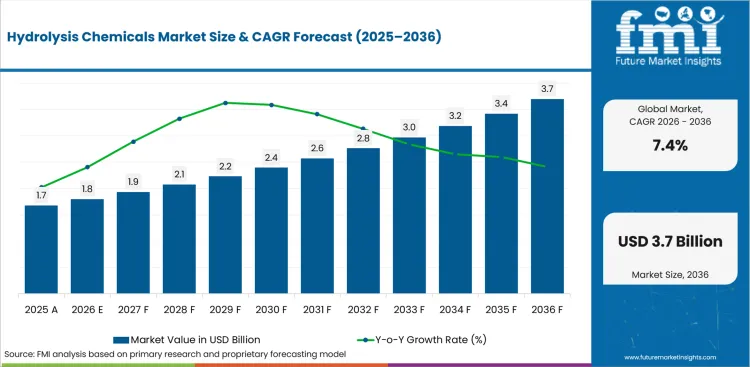
| Metric | Value |
|---|---|
| 2026 Market Size | USD 1.8 Billion |
| 2036 Market Size | USD 3.7 Billion |
| Forecast CAGR (2026-2036) | 7.4% |
| Leading Chemical Type | Acid Catalysts |
| Acid Catalysts Share (2026) | 39.0% |
| Leading Application | Polymer Recycling |
| Polymer Recycling Share (2026) | 41.0% |
| Fastest-growing Country | China |
| China CAGR by 2036 | 8.6% |
Summary of the Hydrolysis Chemicals Market
| Market Signal | Commercial Impact |
|---|---|
| Demand and Growth Drivers | Demand for hydrolysis chemicals is expected to expand steadily through 2036, supported by growing polymer recycling, biomass conversion, and process-driven industrial applications.
|
| Product and Segment View | Acid catalysts, polymer recycling applications, polyester feedstocks, chemical recycling, and direct supply channels continue to lead their respective market segments.
|
| Geography and Growth Outlook | Asia continues to lead market expansion, while North America maintains steady growth through recycling and bioprocessing investments.
|
| Competitive Landscape | Competition increasingly centers on catalyst performance, enzyme efficiency, and technical process support.
|
| Analyst Perspective | Hydrolysis chemicals are evolving into a process-performance market where yield consistency, catalyst selectivity, and technical support increasingly determine supplier competitiveness.
- Nikhil Kaitwade, Principal Consultant at Future Market Insights |
Which factors support expansion in the hydrolysis chemicals market?
Market value is built on repeated process-input consumption in recycling and regulated industrial channels.
- Recycling plants buy hydrolysis inputs repeatedly after PET and polyester recovery moves beyond trial batches.
- Biorefineries depend on cellulase and acid systems before sugars can enter fuel or chemical conversion.
- Pharma and CDMO users use controlled hydrolysis to manage impurity profiles and validation cost exposure.
- Food processors apply enzymes to modify proteins and starches without damaging texture or digestibility targets.
- Buyers compare catalyst price against cleanup cost before approving full-scale supply.
Difficult mixed feedstocks push recyclers to compare hydrolysis systems against chemical recycling services before approving new supply programs.
Why is the hydrolysis chemicals market growing?
Demand is rising because buyers need controlled recovery more than low-cost reagent supply alone.
Plastic recovery gives hydrolysis chemicals a clear demand base. EPA updated plastics data in March 2026 and reported 35.7 million tons of plastics generation in the United States. Biomass processors compare dosing economics against waste-based biofuels demand before selecting pretreatment systems. Protein hydrolysis buyers review activity ranges against protease applications before changing approved formulations.
How is the hydrolysis chemicals market segmented?
The hydrolysis chemicals industry is segmented by chemical type and application. Feedstock and end use add the second layer. Sales channel and region complete the market view.
- Acid catalysts are projected to secure 39.0% share in 2026 owing to ester and carbohydrate routes that still need fast conversion.
- Polymer recycling is anticipated to hold 41.0% share in 2026, driven by PET and polyester recovery that gives this application the clearest repeat-use case.
- Polyesters and PET are forecast to account for 46.0% feedstock share in 2026, backed by bottle and textile waste streams that give suppliers defined trial material.
- Chemical recycling is expected to represent 43.0% end-use share in 2026, attributable to recovered intermediates that give recyclers a clearer output target.
- Direct supply is projected to hold 57.0% share in 2026, led by plant support and batch records that make direct contracts more useful than spot buying.
Which chemical type category holds a notable share in the hydrolysis chemicals market?
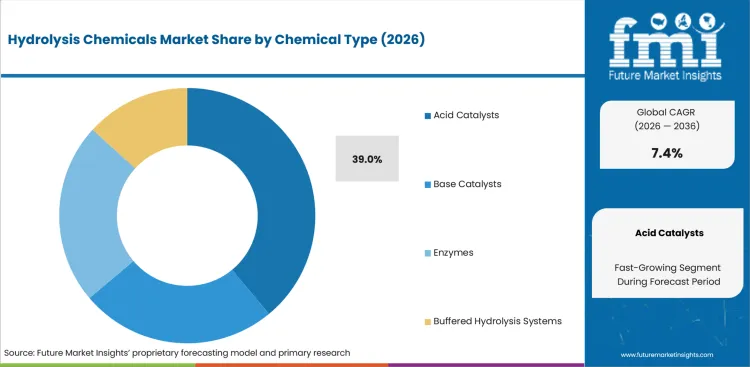
- Acid catalysts are expected to account for 39.0% share in 2026 owing to established routes that reward fast conversion.
- Enzyme systems gain relevance in PET and biomass routes, strengthened by milder reaction conditions that help suppliers address selectivity and cleanup pressure.
How does the application segment perform in the hydrolysis chemicals market?
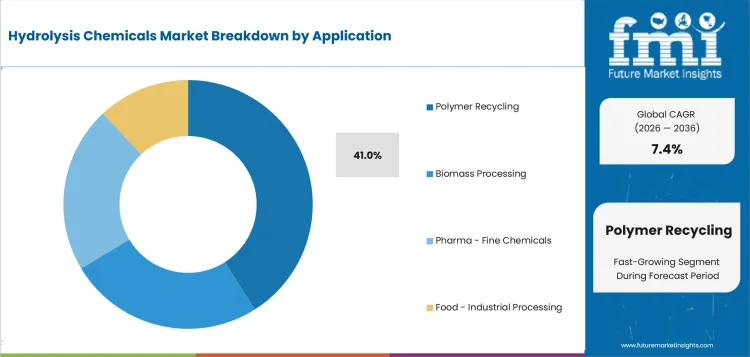
- Polymer recycling is projected to represent 41.0% share in 2026, driven by PET depolymerization and polyester textile recovery that create repeat reagent need.
- Biomass processing adds a second demand route owing to buyer need for sugars before fermentation or chemical upgrading can begin.
What drives demand across feedstock options in the hydrolysis chemicals market?
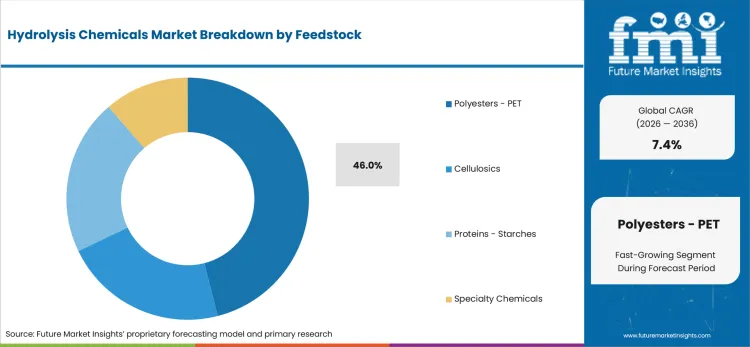
- Polyesters and PET are anticipated to hold 46.0% share in 2026, attributable to clearer monomer recovery economics than mixed plastics.
- Cellulosic feedstocks create demand for enzyme and acid systems because value depends on releasing sugars from resistant biomass.
Which end-use segment shows a prominent position in the hydrolysis chemicals market?
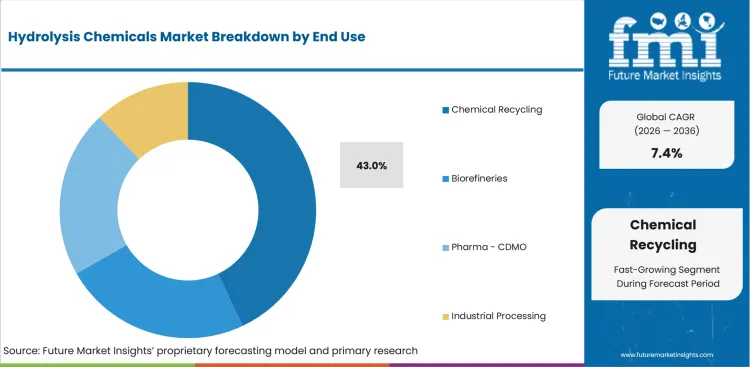
- Chemical recycling is expected to account for 43.0% share in 2026, led by saleable monomer and intermediate outputs that give recyclers a defined revenue target.
- Biorefineries create repeat demand for hydrolysis systems, led by prepared sugars that support later conversion into bioethanol production.
How are buyers selecting across sales channel options in the hydrolysis chemicals market?
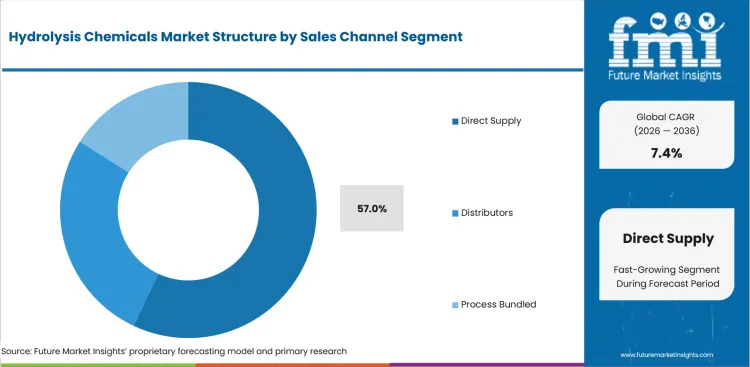
- Direct supply is forecast to represent 57.0% share in 2026 owing to plant trials and lot documentation that make direct support important.
- Distributors remain useful for smaller processors driven by lower-volume needs for acids and enzymes.
What are the drivers, restraints, and opportunities in the hydrolysis chemicals market?
Polymer recovery and bioprocessing support market growth. Separation cost still limits adoption in accounts that handle poor feedstock.
- Driver: PET depolymerization demand raises catalyst and enzyme use in recovery routes that target cleaner monomer output.
- Restraint: Downstream neutralization and purification costs can erase reagent savings from poorly sorted feedstock.
- Opportunity: Bundled process packages can combine chemistry and testing support for accounts that need verified yield.
PET Monomer Recovery Demand Outlook
PET recovery buyers are shifting from collection volume toward output quality. NAPCOR reported in December 2025 that the United States PET bottle recycling rate reached 30.2% in 2024. That gap gives chemical depolymerization routes a practical role in degraded polyester streams. Suppliers still need proof that monomer purity can justify reagent and cleanup cost.
Cellulosic Sugar Release Analysis
Biomass processing demand begins with sugar release. IEA reported in October 2025 that projected liquid biofuel demand growth was revised upward by 50% through 2030. Bioethanol production systems therefore need cellulase and acid pretreatment economics that work across seasonal feedstock variation. Suppliers reduce risk when dosing support is matched to each feedstock.
Pharma and Food Process Chemistry Outlook
Regulated users treat hydrolysis inputs as qualified process chemistry. Codexis stated in December 2025 that engineered enzymes synthesize oligonucleotides under mild aqueous conditions. Food processors compare enzyme activity against food enzymes requirements before changing supplier specifications. Both buyer groups need evidence that cleanup load remains manageable after reaction completion.
Which countries are growing fastest in the hydrolysis chemicals market?
China 8.6% CAGR, India 8.2% CAGR, United States 7.8% CAGR, South Korea 7.5% CAGR, Germany 7.2% CAGR, France 7.0% CAGR, United Kingdom 6.8% CAGR, and Japan 6.6% CAGR by 2036.
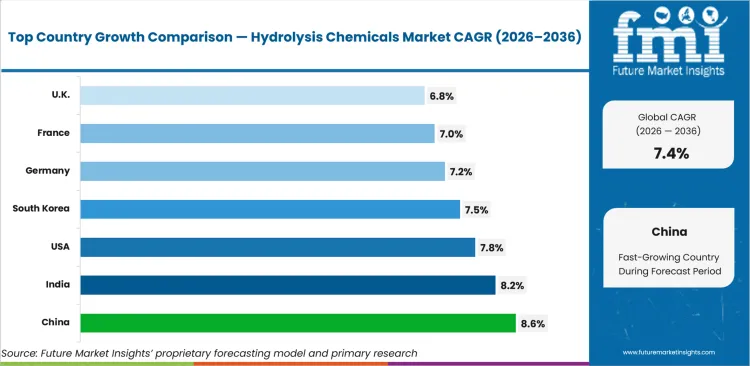
| Country | CAGR |
|---|---|
| China | 8.6% |
| India | 8.2% |
| United States | 7.8% |
| South Korea | 7.5% |
| Germany | 7.2% |
| France | 7.0% |
| United Kingdom | 6.8% |
| Japan | 6.6% |
Source: Future Market Insights, 2026.
How do country-level CAGRs compare in the hydrolysis chemicals market?
China and India show the most material growth profiles. Japan remains more measured because buyer qualification cycles are stricter.
- China is forecast to record 8.6% CAGR by 2036 led by large plastics output and circularity investment that make process testing more visible.
- India is estimated at 8.2% CAGR by 2036, led by EPR formalization that gives suppliers better visibility into processors and brand-owner accounts.
- United States demand is projected to grow at 7.8% CAGR by 2036, reflecting PET recovery gaps and bioprocessing depth that keep qualification work active.
- South Korea is anticipated to post 7.5% CAGR by 2036, driven by petrochemical integration and export documentation needs that shape demand.
- Germany is expected to reach 7.2% CAGR by 2036, attributable to qualified recycling systems and process chemistry demand that support the outlook.
- France is projected to record 7.0% CAGR by 2036, strengthened by PET biorecycling visibility and EPR systems that give buyers a clearer route.
- United Kingdom is forecast to reach 6.8% CAGR by 2036, owing to specialty chemical distribution and controlled trials that keep supplier access practical.
- Japan is estimated at 6.6% CAGR by 2036, shaped by sorting quality and cautious supplier selection that keep adoption selective.
How fast is the hydrolysis chemicals market growing in China?
An 8.6% CAGR by 2036 reflects broad plastics scale and fast supplier testing in industrial provinces.
Country Market Snapshot Table
| Parameter | Value |
|---|---|
| Market Size in 2025 (Value) | USD 377.5 million |
| Market Size in 2026 (Value) | USD 410.0 million |
| Market Forecast in 2036 (Value) | USD 935.6 million |
| CAGR (2026 to 2036) | 8.6% |
| Years Considered | 2021 to 2036 |
| Base Year | 2025 |
| Forecast Period | 2026 to 2036 |
| Units Considered | Value (USD million) |
| Leading Sub-Region | Yangtze River Delta and Pearl River Delta industrial corridors |
China Hydrolysis Chemicals Market Outlook
China demand is forming around PET recovery and textile recycling trials in major manufacturing corridors. Local processors need hydrolysis systems that can handle price pressure and feedstock variation.
Supplier access depends on local sampling and fast technical response. Export-oriented converters are expected to test recycled-content routes before domestic-only processors.
Key Growth Drivers
- Large resin trade keeps feedstock and process input demand visible after the National Bureau of Statistics reported 26.84 million tonnes of plastics in primary forms imports in 2025.
- Circular economy planning gives chemical recovery trials a policy link following a National Development and Reform Commission plan that targeted a 5 trillion yuan resources recycling industry by 2025.
- Export customer audits can strengthen demand for controlled monomer recovery systems.
- Local sampling capacity can shorten qualification cycles for acid and enzyme suppliers.
Key Restraints
- Virgin resin price pressure can weaken recycled monomer economics after national statistics showed plastics in primary forms imports fell 7.4% in 2025.
- Feedstock quality remains uneven across city collection systems and textile recovery routes.
- Hydrolysis suppliers need cleanup economics before large processors move beyond mechanical or thermal routes.
What makes China unique
China stands out for large plastics scale and a purchasing culture that tests supplier claims quickly.
Key Companies
- Novonesis China
- IFF China
- BASF China
- Sinopec
- Wanhua Chemical
- Cathay Biotech
Sales & Marketing Channels
- Direct enterprise supply
- Local distributor networks
- Industrial park sales
- Textile recycler channels
- Joint pilot programs
- Converter partnerships
Country Segment Breakdown Table
| Segment | Sub-Segments |
|---|---|
| By Chemical Type | Acid Catalysts · Base Catalysts · Enzymes · Buffered Hydrolysis Systems |
| By Application | Polymer Recycling · Biomass Processing · Pharma / Fine Chemicals · Food / Industrial Processing |
| By Feedstock | Polyesters / PET · Cellulosics · Proteins / Starches · Specialty Chemicals |
| By End Use | Chemical Recycling · Biorefineries · Pharma / CDMO · Industrial Processing |
| By Sales Channel | Direct Supply · Distributors · Process Bundled |
| Key Sub-Regions Covered, Manufacturing and processing corridors | Yangtze River Delta · Pearl River Delta · Bohai Rim · Chengdu-Chongqing · Fujian coast · Central China |
Frequently Asked Questions
How fast is China hydrolysis chemicals market growing?
Sales in China are expected to expand at 8.6% CAGR from 2026 to 2036.
Who leads China hydrolysis chemicals market?
Novonesis China and IFF China have verified local or regional market presence.
What is driving adoption in China hydrolysis chemicals market?
Adoption is shaped by polymer recovery goals and local technical support needs.
What is the hydrolysis chemicals market outlook in India?
An 8.2% CAGR by 2036 is supported by formal plastic EPR systems and broad process industry demand.
Country Market Snapshot Table
| Parameter | Value |
|---|---|
| Market Size in 2025 (Value) | USD 166.4 million |
| Market Size in 2026 (Value) | USD 180.0 million |
| Market Forecast in 2036 (Value) | USD 395.9 million |
| CAGR (2026 to 2036) | 8.2% |
| Years Considered | 2021 to 2036 |
| Base Year | 2025 |
| Forecast Period | 2026 to 2036 |
| Units Considered | Value (USD million) |
| Leading Sub-Region | Maharashtra, Gujarat, Telangana and Tamil Nadu processing corridors |
India Hydrolysis Chemicals Market Outlook
India demand is expanding across PET recovery and industrial bioprocessing. Formal EPR systems are improving visibility for recyclers and process-chemical suppliers.
Regional distributors remain important outside large chemical clusters. Larger CDMO and food accounts are expected to prefer direct technical supply during qualification.
Key Growth Drivers
- Formal waste registration widens the addressable buyer base following India’s Press Information Bureau reporting 60,128 registered producers and importers on the EPR portal in March 2026.
- Processor registration gives suppliers clearer account mapping following the same government release listing 3,012 registered plastic waste processors in March 2026.
- Pharma and CDMO procurement can support buffered hydrolysis systems for controlled reaction steps.
- Food and starch processors can use enzymes to improve yield and functional performance.
Key Restraints
- Informal collection can weaken feedstock consistency for higher-value recycling, since the Central Pollution Control Board portal still requires separate registration for producers and processors.
- Smaller processors often lack testing budgets for enzyme or catalyst optimization.
- Price-sensitive buyers can delay direct contracts until yield evidence offsets reagent cost.
What makes India unique
India stands out for fast EPR formalization and broad demand from pharma and food processing.
Key Companies
- Advanced Enzyme Technologies
- Novonesis India
- IFF India
- BASF India
- Merck Life Science India
- Brenntag India
Sales & Marketing Channels
- Direct supply to large processors
- Regional chemical distributors
- EPR processor partnerships
- CDMO procurement teams
- Food ingredient networks
- Biorefinery project channels
Country Segment Breakdown Table
| Segment | Sub-Segments |
|---|---|
| By Chemical Type | Acid Catalysts · Base Catalysts · Enzymes · Buffered Hydrolysis Systems |
| By Application | Polymer Recycling · Biomass Processing · Pharma / Fine Chemicals · Food / Industrial Processing |
| By Feedstock | Polyesters / PET · Cellulosics · Proteins / Starches · Specialty Chemicals |
| By End Use | Chemical Recycling · Biorefineries · Pharma / CDMO · Industrial Processing |
| By Sales Channel | Direct Supply · Distributors · Process Bundled |
| Key Sub-Regions Covered, Manufacturing and processing corridors | Maharashtra · Gujarat · Telangana · Tamil Nadu · Karnataka · Delhi NCR |
Frequently Asked Questions
How fast is India hydrolysis chemicals market growing?
Sales in India are expected to expand at 8.2% CAGR from 2026 to 2036.
Who leads India hydrolysis chemicals market?
Advanced Enzyme Technologies and Novonesis India have verified local or regional market presence.
What is driving adoption in India hydrolysis chemicals market?
Adoption is shaped by EPR registration, PET recovery trials and enzyme use in process industries.
How is the United States performing in the hydrolysis chemicals market?
A 7.8% CAGR by 2036 reflects PET recovery gaps and stronger testing of biochemical routes.
Country Market Snapshot Table
| Parameter | Value |
|---|---|
| Market Size in 2025 (Value) | USD 375.7 million |
| Market Size in 2026 (Value) | USD 405.0 million |
| Market Forecast in 2036 (Value) | USD 858.3 million |
| CAGR (2026 to 2036) | 7.8% |
| Years Considered | 2021 to 2036 |
| Base Year | 2025 |
| Forecast Period | 2026 to 2036 |
| Units Considered | Value (USD million) |
| Leading Sub-Region | Gulf Coast, Midwest and California recycling corridors |
United States Hydrolysis Chemicals Market Outlook
United States demand centers on PET recovery and bioprocessing accounts. Buyers in recycled PET packaging need proof of monomer purity before direct contracts scale.
Procurement favors suppliers that can support pilot work and documentation. Recycling capacity exists but feedstock quality decides whether hydrolysis improves value recovery.
Key Growth Drivers
- PET collection gaps create demand for selective recovery routes tied to NAPCOR reporting a United States PET bottle recycling rate of 30.2% in 2024.
- Existing recycling assets create a path for higher plant output following APR’s 2025 estimate that PET recycling volume could rise 36% at full installed capacity.
- Bioprocessing customers can support enzyme demand across biomass and food applications.
- Specialty chemical buyers are likely to pay for batch documentation and plant trial support.
Key Restraints
- Low plastic recycling performance keeps feedstock cleanup costly reflected in EPA’s updated plastics data page listing a 29.1% recycling rate for PET bottles and jars.
- Permitting scrutiny can slow chemical recovery projects near residential communities.
- Virgin resin and rPET price swings can delay hydrolysis supply agreements.
What makes United States unique
The United States stands out for large PET volumes and a buyer base that tests total recovery cost closely.
Key Companies
- IFF
- Codexis
- Protein Evolution
- Novonesis North America
- BASF Corporation
- Univar Solutions
Sales & Marketing Channels
- Direct technical supply
- Specialty chemical distribution
- Recycling plant pilots
- CDMO procurement
- Biofuel project channels
- Food ingredient sales
Country Segment Breakdown Table
| Segment | Sub-Segments |
|---|---|
| By Chemical Type | Acid Catalysts · Base Catalysts · Enzymes · Buffered Hydrolysis Systems |
| By Application | Polymer Recycling · Biomass Processing · Pharma / Fine Chemicals · Food / Industrial Processing |
| By Feedstock | Polyesters / PET · Cellulosics · Proteins / Starches · Specialty Chemicals |
| By End Use | Chemical Recycling · Biorefineries · Pharma / CDMO · Industrial Processing |
| By Sales Channel | Direct Supply · Distributors · Process Bundled |
| Key Sub-Regions Covered, Manufacturing and processing corridors | Gulf Coast · Midwest · California · Northeast · Carolinas · Pacific Northwest |
Frequently Asked Questions
How fast is United States hydrolysis chemicals market growing?
Sales in United States are expected to expand at 7.8% CAGR from 2026 to 2036.
Who leads United States hydrolysis chemicals market?
IFF and Codexis have verified local or regional market presence.
What is driving adoption in United States hydrolysis chemicals market?
Adoption is shaped by PET recovery gaps, plant trials and bioprocessing account depth.
What supports hydrolysis chemicals growth in South Korea?
A 7.5% CAGR by 2036 is tied to petrochemical integration and circular material verification needs.
Country Market Snapshot Table
| Parameter | Value |
|---|---|
| Market Size in 2025 (Value) | USD 116.3 million |
| Market Size in 2026 (Value) | USD 125.0 million |
| Market Forecast in 2036 (Value) | USD 257.6 million |
| CAGR (2026 to 2036) | 7.5% |
| Years Considered | 2021 to 2036 |
| Base Year | 2025 |
| Forecast Period | 2026 to 2036 |
| Units Considered | Value (USD million) |
| Leading Sub-Region | Ulsan, Yeosu and Seoul capital industrial corridors |
South Korea Hydrolysis Chemicals Market Outlook
South Korea demand is developing around petrochemical integration and export supply chain documentation. Hydrolysis suppliers must prove product recovery and residue control before plant adoption.
Buyer evaluation remains technical and centralized. Large chemical groups can test circular routes but compare hydrolysis against pyrolysis and mechanical recycling.
Key Growth Drivers
- Chemical recycling policy improves buyer acceptance under Korea’s Ministry of Environment criteria for pyrolysis oil use in naphtha production.
- Reported recycling claims keep circularity evidence under scrutiny, reflecting public reporting that cited a claimed 73% national plastic recycling rate before closer review.
- Petrochemical clusters can support integration of recovered intermediates into existing chains.
- Electronics and brand exporters are likely to require clearer circular material documentation.
Key Restraints
- Credibility pressure can raise validation costs for recovery claims after public reporting cited a 27% estimate for genuinely recycled plastic waste.
- Energy intensity concerns can slow high-temperature or multi-step chemical recovery routes.
- Feedstock testing costs can rise from household plastic quality differences across collection streams.
What makes South Korea unique
South Korea stands out for integrated petrochemical assets and strict buyer scrutiny of circularity claims.
Key Companies
- SK Chemicals
- LG Chem
- CJ CheilJedang
- Novonesis Korea
- IFF Korea
- BASF Korea
Sales & Marketing Channels
- Direct petrochemical accounts
- Recycling technology partnerships
- Industrial distributor routes
- Export supply chain qualification
- Technical trial programs
- OEM material approval channels
Country Segment Breakdown Table
| Segment | Sub-Segments |
|---|---|
| By Chemical Type | Acid Catalysts · Base Catalysts · Enzymes · Buffered Hydrolysis Systems |
| By Application | Polymer Recycling · Biomass Processing · Pharma / Fine Chemicals · Food / Industrial Processing |
| By Feedstock | Polyesters / PET · Cellulosics · Proteins / Starches · Specialty Chemicals |
| By End Use | Chemical Recycling · Biorefineries · Pharma / CDMO · Industrial Processing |
| By Sales Channel | Direct Supply · Distributors · Process Bundled |
| Key Sub-Regions Covered, Manufacturing and processing corridors | Ulsan · Yeosu · Seoul Capital Area · Incheon · Daejeon · Busan |
Frequently Asked Questions
How fast is South Korea hydrolysis chemicals market growing?
Sales in South Korea are expected to expand at 7.5% CAGR from 2026 to 2036.
Who leads South Korea hydrolysis chemicals market?
SK Chemicals and LG Chem have verified local or regional market presence.
What is driving adoption in South Korea hydrolysis chemicals market?
Adoption is shaped by petrochemical integration, export documentation and recovery-claim scrutiny.
How does Germany compare in the hydrolysis chemicals market?
A 7.2% CAGR by 2036 reflects qualified demand from recycling systems and chemical process buyers.
Country Market Snapshot Table
| Parameter | Value |
|---|---|
| Market Size in 2025 (Value) | USD 149.3 million |
| Market Size in 2026 (Value) | USD 160.0 million |
| Market Forecast in 2036 (Value) | USD 320.7 million |
| CAGR (2026 to 2036) | 7.2% |
| Years Considered | 2021 to 2036 |
| Base Year | 2025 |
| Forecast Period | 2026 to 2036 |
| Units Considered | Value (USD million) |
| Leading Sub-Region | North Rhine-Westphalia and southern chemical corridors |
Germany Hydrolysis Chemicals Market Outlook
Germany demand is qualification-led and shaped by safety data and plant fit requirements. Mature waste systems give recyclers a cleaner base for evaluating higher-value recovery.
Supplier access depends on technical documentation and distributor reach. Buyers often expect application support before testing new catalyst or enzyme systems.
Key Growth Drivers
- Dual-system packaging flows support hydrolysis trials underpinned by ZSVR reporting roughly 5.5 million tonnes of packaging waste recovered by dual systems in 2024.
- Plastic packaging recovery creates a testing base for higher-value processes reinforced by ZSVR reporting that statutory plastic packaging quotas were met in 2024.
- Chemical process depth can support catalyst and buffered system qualification.
- EU packaging obligations can encourage converters to assess chemical depolymerization options.
Key Restraints
- Energy and safety compliance can extend qualification after Germany’s dual systems missed three of eight statutory recycling targets in 2024.
- Strict plant documentation raises entry barriers for smaller suppliers.
- Mechanical recycling strength can slow chemical recovery in cleaner PET streams.
What makes Germany unique
Germany stands out for mature recovery systems and deep process chemistry qualification standards.
Key Companies
- BASF
- Evonik
- Merck KGaA
- AB Enzymes
- Clariant
- Brenntag
Sales & Marketing Channels
- Direct technical supply
- Chemical distributor networks
- Converter partnerships
- Engineering contractor routes
- CDMO qualification channels
- Recycling plant pilot programs
Country Segment Breakdown Table
| Segment | Sub-Segments |
|---|---|
| By Chemical Type | Acid Catalysts · Base Catalysts · Enzymes · Buffered Hydrolysis Systems |
| By Application | Polymer Recycling · Biomass Processing · Pharma / Fine Chemicals · Food / Industrial Processing |
| By Feedstock | Polyesters / PET · Cellulosics · Proteins / Starches · Specialty Chemicals |
| By End Use | Chemical Recycling · Biorefineries · Pharma / CDMO · Industrial Processing |
| By Sales Channel | Direct Supply · Distributors · Process Bundled |
| Key Sub-Regions Covered, Manufacturing and processing corridors | North Rhine-Westphalia · Bavaria · Baden-Württemberg · Hesse · Saxony · Hamburg |
Frequently Asked Questions
How fast is Germany hydrolysis chemicals market growing?
Sales in Germany are expected to expand at 7.2% CAGR from 2026 to 2036.
Who leads Germany hydrolysis chemicals market?
BASF and Evonik have verified local or regional market presence.
What is driving adoption in Germany hydrolysis chemicals market?
Adoption is shaped by packaging recovery systems, technical documentation and chemical-process depth.
What is shaping hydrolysis chemicals demand in France?
A 7.0% CAGR by 2036 reflects PET biorecycling visibility and EPR-backed packaging recovery.
Country Market Snapshot Table
| Parameter | Value |
|---|---|
| Market Size in 2025 (Value) | USD 123.4 million |
| Market Size in 2026 (Value) | USD 132.0 million |
| Market Forecast in 2036 (Value) | USD 259.7 million |
| CAGR (2026 to 2036) | 7.0% |
| Years Considered | 2021 to 2036 |
| Base Year | 2025 |
| Forecast Period | 2026 to 2036 |
| Units Considered | Value (USD million) |
| Leading Sub-Region | Grand Est, Auvergne-Rhône-Alpes and Île-de-France project corridors |
France Hydrolysis Chemicals Market Outlook
France demand gains visibility from enzymatic PET recycling projects and EPR-backed packaging systems. Brand owners and recyclers need proof that recovered outputs can re-enter packaging or textiles.
Project-based channels matter more than spot chemical sales. Enzyme suppliers and engineering partners can gain access after plant trials prove recovery economics.
Key Growth Drivers
- Household packaging recovery supports higher-value plastic treatment reinforced by Citeo reporting a 69% recycling rate for household packaging in 2024.
- Industrial PET biorecycling raises buyer confidence following CARBIOS celebrating the groundbreaking of its Longlaville plant in April 2024.
- Food and pharma users can sustain demand for selective enzyme and buffered hydrolysis systems.
- Eco-organization programs can connect suppliers to brand-owner recovery projects.
Key Restraints
- Project finance can delay chemical demand conversion after CARBIOS adjusted its Longlaville timeline during a 2025 reorganization update.
- Recovered feedstock quality can differ across collection systems and packaging formats.
- Engineering integration can slow enzyme scale-up after laboratory proof is clear.
What makes France unique
France stands out for its visible enzymatic PET recycling platform and packaging EPR influence.
Key Companies
- CARBIOS
- Novonesis France
- IFF France
- Roquette
- Arkema
- IMCD France
Sales & Marketing Channels
- Direct project partnerships
- Eco-organization programs
- Brand-owner collaborations
- Specialty chemical distributors
- Food ingredient channels
- Engineering contractor support
Country Segment Breakdown Table
| Segment | Sub-Segments |
|---|---|
| By Chemical Type | Acid Catalysts · Base Catalysts · Enzymes · Buffered Hydrolysis Systems |
| By Application | Polymer Recycling · Biomass Processing · Pharma / Fine Chemicals · Food / Industrial Processing |
| By Feedstock | Polyesters / PET · Cellulosics · Proteins / Starches · Specialty Chemicals |
| By End Use | Chemical Recycling · Biorefineries · Pharma / CDMO · Industrial Processing |
| By Sales Channel | Direct Supply · Distributors · Process Bundled |
| Key Sub-Regions Covered, Manufacturing and processing corridors | Grand Est · Île-de-France · Auvergne-Rhône-Alpes · Hauts-de-France · Normandy · Provence-Alpes-Côte d’Azur |
Frequently Asked Questions
How fast is France hydrolysis chemicals market growing?
Sales in France are expected to expand at 7.0% CAGR from 2026 to 2036.
Who leads France hydrolysis chemicals market?
CARBIOS and Novonesis France have verified local or regional market presence.
What is driving adoption in France hydrolysis chemicals market?
Adoption is shaped by PET biorecycling projects, EPR systems and project-based supplier access.
How is the hydrolysis chemicals forecast developing in the United Kingdom?
A 6.8% CAGR by 2036 reflects controlled recycling trials and specialty chemical procurement.
Country Market Snapshot Table
| Parameter | Value |
|---|---|
| Market Size in 2025 (Value) | USD 110.5 million |
| Market Size in 2026 (Value) | USD 118.0 million |
| Market Forecast in 2036 (Value) | USD 227.8 million |
| CAGR (2026 to 2036) | 6.8% |
| Years Considered | 2021 to 2036 |
| Base Year | 2025 |
| Forecast Period | 2026 to 2036 |
| Units Considered | Value (USD million) |
| Leading Sub-Region | North West, Midlands and South East chemical corridors |
United Kingdom Hydrolysis Chemicals Market Outlook
United Kingdom demand is developing around specialty recycling and process chemistry accounts. Buyers need hydrolysis evidence that improves local recovery economics before wider use.
Distributor-led access remains important for smaller trial volumes. Larger recyclers and CDMOs are likely to request direct technical support during qualification.
Key Growth Drivers
- Packaging recycling rules keep recovery investment visible tied to Defra reporting 64.1% of UK packaging waste was recycled in 2024.
- Material-specific recovery supports feedstock evaluation following Defra reporting paper and cardboard reached a 74.3% recycling rate in 2024.
- Specialty chemical and CDMO accounts can support selective hydrolysis demand.
- University and industrial pilot routes can support enzyme testing before commercial orders.
Key Restraints
- Plastic recovery gaps can limit clean feedstock supply after UK data placed the plastic packaging recycled or recovered rate at 51.0% in 2024.
- Smaller processors may avoid direct supply contracts until trial volumes expand.
- Waste export and collection complexity can reduce certainty for local hydrolysis feedstock planning.
What makes United Kingdom unique
The United Kingdom stands out for qualification-led buying and strong specialty chemical distribution.
Key Companies
- Brenntag UK
- Univar Solutions UK
- IMCD UK
- Novonesis UK
- IFF UK
- Johnson Matthey
Sales & Marketing Channels
- Specialty chemical distributors
- Direct supply to recyclers
- University-industry pilot projects
- CDMO procurement teams
- Food ingredient technical sales
- Waste processor partnerships
Country Segment Breakdown Table
| Segment | Sub-Segments |
|---|---|
| By Chemical Type | Acid Catalysts · Base Catalysts · Enzymes · Buffered Hydrolysis Systems |
| By Application | Polymer Recycling · Biomass Processing · Pharma / Fine Chemicals · Food / Industrial Processing |
| By Feedstock | Polyesters / PET · Cellulosics · Proteins / Starches · Specialty Chemicals |
| By End Use | Chemical Recycling · Biorefineries · Pharma / CDMO · Industrial Processing |
| By Sales Channel | Direct Supply · Distributors · Process Bundled |
| Key Sub-Regions Covered, Manufacturing and processing corridors | North West England · Midlands · South East England · Scotland Central Belt · Wales · Yorkshire |
Frequently Asked Questions
How fast is United Kingdom hydrolysis chemicals market growing?
Sales in United Kingdom are expected to expand at 6.8% CAGR from 2026 to 2036.
Who leads United Kingdom hydrolysis chemicals market?
Brenntag UK and Univar Solutions UK have verified local or regional market presence.
What is driving adoption in United Kingdom hydrolysis chemicals market?
Adoption is shaped by packaging recovery rules, distributor access and controlled plant trials.
What is the hydrolysis chemicals market forecast for Japan?
A 6.6% CAGR by 2036 reflects selective demand from PET and specialty chemical users.
Country Market Snapshot Table
| Parameter | Value |
|---|---|
| Market Size in 2025 (Value) | USD 117.3 million |
| Market Size in 2026 (Value) | USD 125.0 million |
| Market Forecast in 2036 (Value) | USD 236.9 million |
| CAGR (2026 to 2036) | 6.6% |
| Years Considered | 2021 to 2036 |
| Base Year | 2025 |
| Forecast Period | 2026 to 2036 |
| Units Considered | Value (USD million) |
| Leading Sub-Region | Kanto, Kansai and Chubu industrial corridors |
Japan Hydrolysis Chemicals Market Outlook
Japan demand is selective and shaped by strong sorting quality in mechanical PET routes. Hydrolysis gains relevance in degraded PET and polyester textiles.
Procurement favors proven suppliers that provide stable specifications and long technical support. Local enzyme manufacturing gives buyers a credible route for protein and starch hydrolysis.
Key Growth Drivers
- High PET recovery quality strengthens selective monomer recovery trials underpinned by the Council for PET Bottle Recycling reporting an 85.0% PET bottle recycling rate for fiscal 2023.
- Circular economy policy supports business collaboration following J4CE reporting the Act Concerning Sophistication of Recycling Business was enacted in May 2024.
- Food manufacturers can use enzymes for protein and starch modification.
- Specialty chemical buyers are likely to value predictable reagent behavior in controlled processes.
Key Restraints
- Mature mechanical recycling can slow chemical route urgency, since clean bottle streams often stay in established recovery channels before chemical routes are tested.
- Conservative qualification cycles can slow new enzyme and catalyst introductions.
- Imported specialty inputs can encounter approval delays if suppliers lack long performance histories.
What makes Japan unique
Japan stands out for high sorting discipline and cautious supplier selection in technical applications.
Key Companies
- Amano Enzyme
- Nagase ChemteX
- Mitsubishi Chemical Group
- Asahi Kasei
- Novonesis Japan
- IFF Japan
Sales & Marketing Channels
- Direct industrial supply
- Specialty chemical distributors
- Food ingredient technical channels
- Recycling consortiums
- Pharma process suppliers
- Long-term supplier agreements
Country Segment Breakdown Table
| Segment | Sub-Segments |
|---|---|
| By Chemical Type | Acid Catalysts · Base Catalysts · Enzymes · Buffered Hydrolysis Systems |
| By Application | Polymer Recycling · Biomass Processing · Pharma / Fine Chemicals · Food / Industrial Processing |
| By Feedstock | Polyesters / PET · Cellulosics · Proteins / Starches · Specialty Chemicals |
| By End Use | Chemical Recycling · Biorefineries · Pharma / CDMO · Industrial Processing |
| By Sales Channel | Direct Supply · Distributors · Process Bundled |
| Key Sub-Regions Covered, Manufacturing and processing corridors | Kanto · Kansai · Chubu · Kyushu · Tohoku · Hokkaido |
Frequently Asked Questions
How fast is Japan hydrolysis chemicals market growing?
Sales in Japan are expected to expand at 6.6% CAGR from 2026 to 2036.
Who leads Japan hydrolysis chemicals market?
Amano Enzyme and Nagase ChemteX have verified local or regional market presence.
What is driving adoption in Japan hydrolysis chemicals market?
Adoption is shaped by selective PET recovery, stable supplier specifications and local enzyme expertise.
Who are the leading companies in the hydrolysis chemicals market?
Novonesis, IFF, CARBIOS, Samsara Eco, BASF, Merck KGaA.
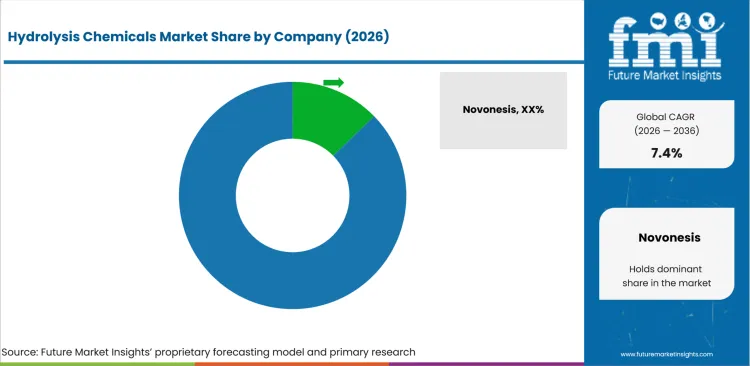
- Competition depends on proof that chemistry performs consistently across feedstock variation.
- Catalyst suppliers compete on process compatibility and safety documentation.
- Recycling technology developers build influence by linking PET and textile depolymerization to plant projects.
- Distributors remain relevant for smaller processors that need lower-volume access and local service.
Competitive differentiation is shifting from commodity chemical supply toward demonstrated process performance and technology integration. Enzyme developers compete on catalytic efficiency process consistency and scalability while recycling technology firms focus on improving recovery economics across complex waste streams. CARBIOS and Samsara Eco exemplify this trend through platforms that combine enzyme development with commercial process design. Across molecular recycling and polyester renewal markets companies that can validate feedstock flexibility and support stable plant operations are likely to strengthen their competitive positioning. Suppliers with proven operating data and application expertise may gain an advantage in large-scale deployment projects.
How do top hydrolysis chemicals market companies compare?
Enzyme specialists compare well on activity data. Catalyst companies compare well on regulated process documentation.
| Company | Portfolio/Focus | Account Access | Footprint/Service Reach |
|---|---|---|---|
| Novonesis | Industrial enzymes and PET enzyme partnerships | Direct and partner-led | Global |
| IFF | Industrial and food enzymes | Direct and regional | Global |
| AB Enzymes | Food and industrial enzyme systems | Direct and distributor | Global |
| Amano Enzyme | Specialty enzymes and protein hydrolysis | Direct and partner-led | Japan, Europe, North America |
| Codexis | Biocatalysis and pharma enzymes | Direct technical | United States and Europe |
| CARBIOS | Enzymatic PET depolymerization | Project partnerships | Europe and global partners |
| Samsara Eco | Enzymatic plastics and textile recycling | Brand and engineering partners | Australia and global partners |
| Protein Evolution | Plastic-degrading enzyme technology | Partner-led | United States |
| BASF | Specialty process chemistry | Direct and distributor | Global |
| Merck KGaA | Life science and process chemistry | Direct and distributor | Global |
Source: Future Market Insights competitive analysis, 2026.
Who are the key players in the hydrolysis chemicals market?
Global companies active in the hydrolysis chemicals market include enzyme specialists, catalyst suppliers and recycling technology developers.
Key global companies leading the hydrolysis chemicals market include:
- Novonesis
- IFF
- AB Enzymes
- Amano Enzyme
- Codexis
- CARBIOS
- Samsara Eco
- Protein Evolution
- BASF
- Merck KGaA
- Evonik
- Clariant
Key Developments in Hydrolysis Chemicals Market
- In January 2024, Novonesis completed the combination of Novozymes and Chr. Hansen and widened biosolutions coverage for industrial accounts.
- In April 2024, CARBIOS celebrated the groundbreaking of its PET biorecycling plant in Longlaville and gave enzymatic PET hydrolysis a clearer industrial reference.
- In April 2025, KBR was selected to support Samsara Eco’s first enzymatic recycling plant and connected enzyme design with plant engineering.
Key Players in the Hydrolysis Chemicals Market
Enzyme and Biocatalyst Specialists
- Novonesis
- IFF
- AB Enzymes
- Amano Enzyme
- Codexis
- Advanced Enzyme Technologies
Catalyst and Specialty Chemistry Suppliers
- BASF
- Merck KGaA
- Evonik
- Clariant
- Wanhua Chemical
- Mitsubishi Chemical Group
Recycling Technology Developers
- CARBIOS
- Samsara Eco
- Protein Evolution
- SK Chemicals
- LG Chem
Hydrolysis Chemicals Market - Report Scope
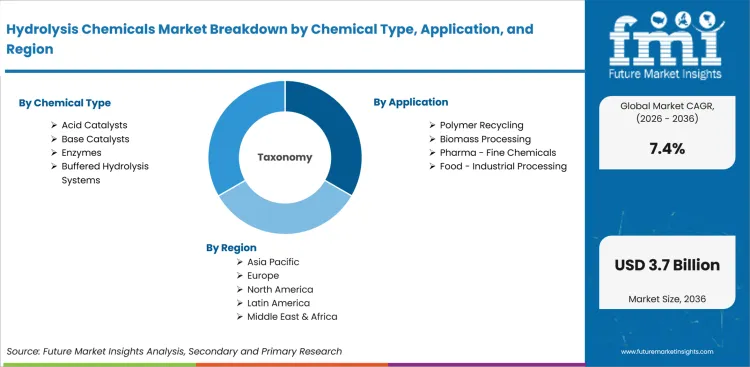
| Parameter | Details |
|---|---|
| Forecast period | 2026 to 2036 |
| Historical period | 2021 to 2025 |
| Quantitative unit | Revenue in USD million |
| By chemical type | Acid catalysts, base catalysts, enzymes, buffered hydrolysis systems |
| By application | Polymer recycling, biomass processing, pharma / fine chemicals, food / industrial processing |
| By feedstock | Polyesters / PET, cellulosics, proteins / starches, specialty chemicals |
| By end use | Chemical recycling, biorefineries, pharma / CDMO, industrial processing |
| By sales channel | Direct supply, distributors, process bundled |
| Regions covered | North America, Latin America, Western Europe, Eastern Europe, East Asia, South Asia and Pacific, Middle East and Africa |
| Countries covered | China, India, United States, South Korea, Germany, France, United Kingdom, Japan |
| Key companies profiled | Novonesis, IFF, AB Enzymes, Amano Enzyme, Codexis, CARBIOS, Samsara Eco, BASF |
| Approach | Hybrid bottom-up and top-down methodology using process input demand, country readiness and supplier evidence |
Source: Future Market Insights, 2026.
Hydrolysis Chemicals Market - Scope & Definition
| Attribute | Detail |
|---|---|
| Market Definition | Hydrolysis chemicals include acids, bases, enzymes and buffered systems used to break chemical bonds using water-assisted reaction pathways. |
| Functions Covered | Bond cleavage, catalyst support, enzyme-assisted conversion, pH control, monomer recovery, sugar release and intermediate synthesis. |
| Applications Covered | Polymer recycling, biomass processing, pharma / fine chemicals and food / industrial processing. |
| End-Use Industries | Chemical recycling, biorefineries, pharma / CDMO and industrial processing. |
| Grades Covered | Industrial catalyst grades, enzyme activity grades, buffered systems and specialty process grades. |
| Inclusions | Commercial hydrolysis inputs used in PET recovery, polyester recycling, biomass conversion, regulated synthesis and food processing. |
| Exclusions | Bulk cleaning acids, wastewater pH adjusters, unrelated solvent recovery chemicals and thermal-only depolymerization routes without hydrolysis chemistry. |
Hydrolysis Chemicals Market - Research Methodology
| Method | Description |
|---|---|
| Primary Research | FMI analyst interviews involving recyclers, biorefineries, CDMOs, food processors, industrial buyers and specialty chemical distributors. |
| Desk Research | Review of packaging regulation, PET recovery data, biofuel outlooks, waste policy, company portfolios and official company announcements. |
| Market Sizing & Forecasting | Hybrid sizing model using process input demand, dosage ranges, segment penetration, country readiness and channel structure. |
| Data Validation | Cross-verification against supplier evidence, country policy signals, segment use rates and buyer qualification behavior. |
Hydrolysis Chemicals Market Breakdown by Chemical Type, Application, Feedstock, End Use, Sales Channel, and Region
Hydrolysis Chemicals Market Segmented by Chemical Type
- Acid Catalysts
- Base Catalysts
- Enzymes
- Buffered Hydrolysis Systems
Hydrolysis Chemicals Market Segmented by Application
- Polymer Recycling
- Biomass Processing
- Pharma / Fine Chemicals
- Food / Industrial Processing
Hydrolysis Chemicals Market Segmented by Feedstock
- Polyesters / PET
- Cellulosics
- Proteins / Starches
- Specialty Chemicals
Hydrolysis Chemicals Market Segmented by End Use
- Chemical Recycling
- Biorefineries
- Pharma / CDMO
- Industrial Processing
Hydrolysis Chemicals Market Segmented by Sales Channel
- Direct Supply
- Distributors
- Process Bundled
Hydrolysis Chemicals Market by Region
- North America
- United States
- Europe
- United Kingdom
- Germany
- France
- East Asia
- China
- Japan
- South Korea
- South Asia and Pacific
- India
Research Sources and Bibliography
- European Commission. (2025, February). Packaging waste. European Commission.
- Eurostat. (2025, October 22). Plastic packaging waste in the EU: 35.3 kg per person. Eurostat.
- European Union. (2025, January). Regulation (EU) 2025/40 on packaging and packaging waste. EUR-Lex.
- International Energy Agency. (2025, October 7). Renewables 2025. IEA.
- National Association for PET Container Resources. (2025, December 10). 2024 PET Recycling Report. NAPCOR.
- Association of Plastic Recyclers. (2025, May 21). 2025 Plastic Recycling Capacity in the US and Canada. APR.
- USA Environmental Protection Agency. (2026, March 13). Plastics: Material-specific data. EPA.
- Department for Environment, Food & Rural Affairs. (2025, July 23). UK statistics on waste. GOV.UK.
- Stiftung Zentrale Stelle Verpackungsregister. (2026, January 27). Fighting myths with facts: Recycling packaging waste in Germany works. ZSVR.
- Citeo. (2025). Why join Citeo? Citeo.
- The Council for PET Bottle Recycling. (2024, November). PET Bottle Recycling Annual Report 2024. CPBR.
- Japan Partnership for Circular Economy. (2025, February). J4CE 2024 Noteworthy Cases. Ministry of the Environment Japan.
- National Bureau of Statistics of China. (2026, February 28). Statistical communiqué of the People’s Republic of China on the 2025 national economic and social development. NBS China.
- National Development and Reform Commission. (2021, July 28). Circular economy gets 5-year regulator boost. NDRC.
- Ministry of Environment Republic of Korea. (2024). Reference materials related to waste plastic pyrolysis and recycling criteria. ME Korea.
- Press Information Bureau. (2026, March 23). Parliament question: Plastic waste management. Government of India.
- Central Pollution Control Board. (2026). Centralized EPR portal for plastic packaging. Government of India.
- Codexis. (2025, December 10). Powering the sustainable RNA therapeutics revolution with enzymatic synthesis. Codexis.
- Novonesis. (2024, January 29). Combination of Novozymes and Chr. Hansen is completed. Novonesis.
- CARBIOS. (2024, April 25). CARBIOS celebrates the groundbreaking of its PET biorecycling plant. CARBIOS.
- KBR. (2025, April 29). KBR selected as key commercialization partner for Samsara Eco’s first-of-a-kind enzymatic recycling plant. KBR.
- Novonesis. (2024, April 22). The Biosolutions Bulletin: Enzymes tackling plastic pollution. Novonesis.
- IFF. (2026). Industrial markets overview. IFF.
- Amano Enzyme. (2025, May 27). Market insights: The growing demand for protease applications. Amano Enzyme.
- Advanced Enzyme Technologies. (2026). Advanced Enzyme Technologies company overview. Advanced Enzymes.
This bibliography is provided for reader reference and is not exhaustive. The full report contains the complete reference list and detailed citations.
This Report Answers
- The report estimates market size in 2026 and forecasts value by 2036.
- Regional analysis explains how country markets use hydrolysis inputs in recycling and process chemistry.
- Demand analysis connects growth drivers with buyer requirements and channel behavior.
- Segmentation review evaluates parent categories across product logic and sales channel structure.
- Regulatory coverage shows how recycling targets and bioprocessing signals affect supplier selection.
- Opportunity analysis identifies PET depolymerization, biomass processing and selective fine chemical reactions.
- Competitive assessment compares enzyme specialists, specialty chemistry suppliers and recycling technology developers.
- Country coverage reviews eight profiled markets across Asia, Europe and North America.
- Company review checks portfolios, current developments and local or regional presence in profiled countries.
- The report delivers market data and supporting analysis in Word-ready report format.
Frequently Asked Questions
What is the growth prospect for hydrolysis chemicals?
Demand is expected to rise in recycling and bioprocessing accounts that need controlled reaction inputs.
Which companies are expected to shape the hydrolysis chemicals market?
Novonesis and IFF shape enzyme competition. CARBIOS and Samsara Eco shape recycling technology competition.
Why are chemical recyclers investing in hydrolysis chemicals?
Chemical recyclers use hydrolysis chemicals to convert PET and polyester streams into recoverable monomers.
Why are direct supply channels important in the hydrolysis chemicals market?
Direct supply channels help buyers secure lot documentation, activity checks and technical troubleshooting for plant trials.
Which hydrolysis systems are gaining attention?
Acid catalysts and enzyme systems attract attention because PET recovery and biomass conversion need controlled bond cleavage.
How do regulations influence hydrolysis chemical demand?
Regulations influence demand by increasing pressure for verified recycled content and traceable recovery routes.
Why is feedstock quality important for hydrolysis chemicals?
Feedstock quality affects reagent dose and conversion yield. It also changes cleanup cost and recovered output purity.
What role do enzymes play in hydrolysis chemicals?
Enzymes support milder hydrolysis conditions for PET and biomass. They also support protein and starch processing applications.
How do distributors support smaller hydrolysis chemical buyers?
Distributors support smaller buyers by supplying lower volumes and local account service before direct contracts are justified.
Preview the report firsthand - request a free sample
Get SampleGet the brochure for pricing and purchase details.
Get PDFTable of Content
- Key Takeaways
- Market Size and CAGR
- Top Growth Driver
- Fastest Growing Segment
- Leading Region
- Key Companies
- Emerging Opportunities
- Executive Summary
- Global Market Outlook
- Demand-side Trends
- Supply-side Trends
- Technology Roadmap Analysis
- Analysis and Recommendations
- Analyst Perspective (What is happening? Why now? What should investors know?)
- Key Questions Answered
- How large is the market?
- What is the CAGR?
- What are key trends?
- Which region dominates?
- Who are the leaders?
- Market Overview
- Market Coverage / Taxonomy
- Market Definition / Scope / Limitations
- Research Methodology
- Chapter Orientation
- Analytical Lens and Working Hypotheses
- Market Structure, Signals, and Trend Drivers
- Benchmarking and Cross-market Comparability
- Market Sizing, Forecasting, and Opportunity Mapping
- Research Design and Evidence Framework
- Desk Research Programme (Secondary Evidence)
- Expert Input and Fieldwork (Primary Evidence)
- Tooling, Models, and Reference Databases
- Data Engineering and Model Build
- Quality Assurance and Audit Trail
- Market Background
- Market Dynamics (Drivers, Restraints, Opportunity, Trends)
- Scenario Forecast (Optimistic, Likely, Conservative)
- Impact Analysis
- AI Impact
- Sustainability Impact
- Regulatory Impact
- Technology Impact
- Consumer / Buyer Analysis
- Purchase Drivers
- Adoption Barriers
- Buyer Journey
- Opportunity Map Analysis
- Product Life Cycle Analysis
- Supply Chain Analysis
- Investment Feasibility Matrix
- Value Chain Analysis
- PESTLE and Porter's Analysis
- Regulatory Landscape
- Regional Parent Market Outlook
- Production and Consumption Statistics
- Import and Export Statistics
- Global Market Analysis and Forecast, 2021 to 2036
- Historical Market Size Value (USD Billion) & Volume (Unit) Analysis, 2021 to 2025
- Current and Future Market Size Value (USD Billion) & Volume (Unit) Projections, 2026 to 2036
- Y-o-Y Growth Trend Analysis
- Absolute $ Opportunity Analysis
- Global Market Pricing Analysis, 2021 to 2036
- Global Market Analysis and Forecast, By Chemical Type, 2021 to 2036
- Introduction / Key Findings
- Historical Market Size Value (USD Billion) & Volume (Unit) Analysis By Chemical Type, 2021 to 2025
- Current and Future Market Size Value (USD Billion) & Volume (Unit) Analysis and Forecast By Chemical Type, 2026 to 2036
- Acid Catalysts
- Base Catalysts
- Enzymes
- Buffered Hydrolysis Systems
- Acid Catalysts
- Y-o-Y Growth Trend Analysis By Chemical Type, 2021 to 2025
- Absolute $ Opportunity Analysis By Chemical Type, 2026 to 2036
- Global Market Analysis and Forecast, By Application, 2021 to 2036
- Introduction / Key Findings
- Historical Market Size Value (USD Billion) & Volume (Unit) Analysis By Application, 2021 to 2025
- Current and Future Market Size Value (USD Billion) & Volume (Unit) Analysis and Forecast By Application, 2026 to 2036
- Polymer Recycling
- Biomass Processing
- Pharma - Fine Chemicals
- Food - Industrial Processing
- Polymer Recycling
- Y-o-Y Growth Trend Analysis By Application, 2021 to 2025
- Absolute $ Opportunity Analysis By Application, 2026 to 2036
- Global Market Analysis and Forecast, By Feedstock, 2021 to 2036
- Introduction / Key Findings
- Historical Market Size Value (USD Billion) & Volume (Unit) Analysis By Feedstock, 2021 to 2025
- Current and Future Market Size Value (USD Billion) & Volume (Unit) Analysis and Forecast By Feedstock, 2026 to 2036
- Polyesters - PET
- Cellulosics
- Proteins - Starches
- Specialty Chemicals
- Polyesters - PET
- Y-o-Y Growth Trend Analysis By Feedstock, 2021 to 2025
- Absolute $ Opportunity Analysis By Feedstock, 2026 to 2036
- Global Market Analysis and Forecast, By End Use, 2021 to 2036
- Introduction / Key Findings
- Historical Market Size Value (USD Billion) & Volume (Unit) Analysis By End Use, 2021 to 2025
- Current and Future Market Size Value (USD Billion) & Volume (Unit) Analysis and Forecast By End Use, 2026 to 2036
- Chemical Recycling
- Biorefineries
- Pharma - CDMO
- Industrial Processing
- Chemical Recycling
- Y-o-Y Growth Trend Analysis By End Use, 2021 to 2025
- Absolute $ Opportunity Analysis By End Use, 2026 to 2036
- Global Market Analysis and Forecast, By Sales Channel, 2021 to 2036
- Introduction / Key Findings
- Historical Market Size Value (USD Billion) & Volume (Unit) Analysis By Sales Channel, 2021 to 2025
- Current and Future Market Size Value (USD Billion) & Volume (Unit) Analysis and Forecast By Sales Channel, 2026 to 2036
- Direct Supply
- Distributors
- Process Bundled
- Direct Supply
- Y-o-Y Growth Trend Analysis By Sales Channel, 2021 to 2025
- Absolute $ Opportunity Analysis By Sales Channel, 2026 to 2036
- Global Market Analysis and Forecast, By Region, 2021 to 2036
- Introduction
- Historical Market Size Value (USD Billion) & Volume (Unit) Analysis By Region, 2021 to 2025
- Current Market Size Value (USD Billion) & Volume (Unit) Analysis and Forecast By Region, 2026 to 2036
- North America
- Latin America
- Western Europe
- Eastern Europe
- East Asia
- South Asia and Pacific
- Middle East & Africa
- Market Attractiveness Analysis By Region
- North America Market Analysis and Forecast, By Country, 2021 to 2036
- Historical Market Size Value (USD Billion) & Volume (Unit) Trend Analysis By Market Taxonomy, 2021 to 2025
- Market Size Value (USD Billion) & Volume (Unit) Forecast By Market Taxonomy, 2026 to 2036
- By Country
- USA
- Canada
- Mexico
- By Chemical Type
- By Application
- By Feedstock
- By End Use
- By Sales Channel
- By Country
- Market Attractiveness Analysis
- By Country
- By Chemical Type
- By Application
- By Feedstock
- By End Use
- By Sales Channel
- Key Takeaways
- Latin America Market Analysis and Forecast, By Country
- Historical Market Size Value (USD Billion) & Volume (Unit) Trend Analysis By Market Taxonomy, 2021 to 2025
- Market Size Value (USD Billion) & Volume (Unit) Forecast By Market Taxonomy, 2026 to 2036
- By Country
- Brazil
- Chile
- Rest of Latin America
- By Chemical Type
- By Application
- By Feedstock
- By End Use
- By Sales Channel
- By Country
- Market Attractiveness Analysis
- By Country
- By Chemical Type
- By Application
- By Feedstock
- By End Use
- By Sales Channel
- Key Takeaways
- Western Europe Market Analysis and Forecast, By Country
- Historical Market Size Value (USD Billion) & Volume (Unit) Trend Analysis By Market Taxonomy, 2021 to 2025
- Market Size Value (USD Billion) & Volume (Unit) Forecast By Market Taxonomy, 2026 to 2036
- By Country
- Germany
- UK
- Italy
- Spain
- France
- Nordic
- BENELUX
- Rest of Western Europe
- By Chemical Type
- By Application
- By Feedstock
- By End Use
- By Sales Channel
- By Country
- Market Attractiveness Analysis
- By Country
- By Chemical Type
- By Application
- By Feedstock
- By End Use
- By Sales Channel
- Key Takeaways
- Eastern Europe Market Analysis and Forecast, By Country
- Historical Market Size Value (USD Billion) & Volume (Unit) Trend Analysis By Market Taxonomy, 2021 to 2025
- Market Size Value (USD Billion) & Volume (Unit) Forecast By Market Taxonomy, 2026 to 2036
- By Country
- Russia
- Poland
- Hungary
- Balkan & Baltic
- Rest of Eastern Europe
- By Chemical Type
- By Application
- By Feedstock
- By End Use
- By Sales Channel
- By Country
- Market Attractiveness Analysis
- By Country
- By Chemical Type
- By Application
- By Feedstock
- By End Use
- By Sales Channel
- Key Takeaways
- East Asia Market Analysis and Forecast, By Country
- Historical Market Size Value (USD Billion) & Volume (Unit) Trend Analysis By Market Taxonomy, 2021 to 2025
- Market Size Value (USD Billion) & Volume (Unit) Forecast By Market Taxonomy, 2026 to 2036
- By Country
- China
- Japan
- South Korea
- By Chemical Type
- By Application
- By Feedstock
- By End Use
- By Sales Channel
- By Country
- Market Attractiveness Analysis
- By Country
- By Chemical Type
- By Application
- By Feedstock
- By End Use
- By Sales Channel
- Key Takeaways
- South Asia and Pacific Market Analysis and Forecast, By Country
- Historical Market Size Value (USD Billion) & Volume (Unit) Trend Analysis By Market Taxonomy, 2021 to 2025
- Market Size Value (USD Billion) & Volume (Unit) Forecast By Market Taxonomy, 2026 to 2036
- By Country
- India
- ASEAN
- Australia & New Zealand
- Rest of South Asia and Pacific
- By Chemical Type
- By Application
- By Feedstock
- By End Use
- By Sales Channel
- By Country
- Market Attractiveness Analysis
- By Country
- By Chemical Type
- By Application
- By Feedstock
- By End Use
- By Sales Channel
- Key Takeaways
- Middle East & Africa Market Analysis and Forecast, By Country
- Historical Market Size Value (USD Billion) & Volume (Unit) Trend Analysis By Market Taxonomy, 2021 to 2025
- Market Size Value (USD Billion) & Volume (Unit) Forecast By Market Taxonomy, 2026 to 2036
- By Country
- Kingdom of Saudi Arabia
- Other GCC Countries
- Türkiye
- South Africa
- Other African Union
- Rest of Middle East & Africa
- By Chemical Type
- By Application
- By Feedstock
- By End Use
- By Sales Channel
- By Country
- Market Attractiveness Analysis
- By Country
- By Chemical Type
- By Application
- By Feedstock
- By End Use
- By Sales Channel
- Key Takeaways
- Key Countries Market Analysis
- USA
- Pricing Analysis
- Market Share Analysis, 2025
- By Chemical Type
- By Application
- By Feedstock
- By End Use
- By Sales Channel
- Canada
- Pricing Analysis
- Market Share Analysis, 2025
- By Chemical Type
- By Application
- By Feedstock
- By End Use
- By Sales Channel
- Mexico
- Pricing Analysis
- Market Share Analysis, 2025
- By Chemical Type
- By Application
- By Feedstock
- By End Use
- By Sales Channel
- Brazil
- Pricing Analysis
- Market Share Analysis, 2025
- By Chemical Type
- By Application
- By Feedstock
- By End Use
- By Sales Channel
- Chile
- Pricing Analysis
- Market Share Analysis, 2025
- By Chemical Type
- By Application
- By Feedstock
- By End Use
- By Sales Channel
- Germany
- Pricing Analysis
- Market Share Analysis, 2025
- By Chemical Type
- By Application
- By Feedstock
- By End Use
- By Sales Channel
- UK
- Pricing Analysis
- Market Share Analysis, 2025
- By Chemical Type
- By Application
- By Feedstock
- By End Use
- By Sales Channel
- Italy
- Pricing Analysis
- Market Share Analysis, 2025
- By Chemical Type
- By Application
- By Feedstock
- By End Use
- By Sales Channel
- Spain
- Pricing Analysis
- Market Share Analysis, 2025
- By Chemical Type
- By Application
- By Feedstock
- By End Use
- By Sales Channel
- France
- Pricing Analysis
- Market Share Analysis, 2025
- By Chemical Type
- By Application
- By Feedstock
- By End Use
- By Sales Channel
- India
- Pricing Analysis
- Market Share Analysis, 2025
- By Chemical Type
- By Application
- By Feedstock
- By End Use
- By Sales Channel
- ASEAN
- Pricing Analysis
- Market Share Analysis, 2025
- By Chemical Type
- By Application
- By Feedstock
- By End Use
- By Sales Channel
- Australia & New Zealand
- Pricing Analysis
- Market Share Analysis, 2025
- By Chemical Type
- By Application
- By Feedstock
- By End Use
- By Sales Channel
- China
- Pricing Analysis
- Market Share Analysis, 2025
- By Chemical Type
- By Application
- By Feedstock
- By End Use
- By Sales Channel
- Japan
- Pricing Analysis
- Market Share Analysis, 2025
- By Chemical Type
- By Application
- By Feedstock
- By End Use
- By Sales Channel
- South Korea
- Pricing Analysis
- Market Share Analysis, 2025
- By Chemical Type
- By Application
- By Feedstock
- By End Use
- By Sales Channel
- Russia
- Pricing Analysis
- Market Share Analysis, 2025
- By Chemical Type
- By Application
- By Feedstock
- By End Use
- By Sales Channel
- Poland
- Pricing Analysis
- Market Share Analysis, 2025
- By Chemical Type
- By Application
- By Feedstock
- By End Use
- By Sales Channel
- Hungary
- Pricing Analysis
- Market Share Analysis, 2025
- By Chemical Type
- By Application
- By Feedstock
- By End Use
- By Sales Channel
- Kingdom of Saudi Arabia
- Pricing Analysis
- Market Share Analysis, 2025
- By Chemical Type
- By Application
- By Feedstock
- By End Use
- By Sales Channel
- Türkiye
- Pricing Analysis
- Market Share Analysis, 2025
- By Chemical Type
- By Application
- By Feedstock
- By End Use
- By Sales Channel
- South Africa
- Pricing Analysis
- Market Share Analysis, 2025
- By Chemical Type
- By Application
- By Feedstock
- By End Use
- By Sales Channel
- USA
- Market Structure Analysis
- Competition Dashboard
- Competition Benchmarking
- Market Share Analysis of Top Players
- By Regional
- By Chemical Type
- By Application
- By Feedstock
- By End Use
- By Sales Channel
- Emerging Startups
- Innovation Benchmarking
- Competition Analysis
- Competition Deep Dive
- Novonesis
- Overview
- Product Portfolio
- Profitability by Market Segments (Product/Region/Sales Channel)
- Sales Footprint
- Strategy Overview
- Marketing Strategy
- Product Strategy
- Channel Strategy
- IFF
- AB Enzymes
- Amano Enzyme
- Codexis
- CARBIOS
- Samsara Eco
- BASF
- Novonesis
- Case Studies
- Success Stories
- Recent Developments
- Competition Deep Dive
- Assumptions & Acronyms Used


