

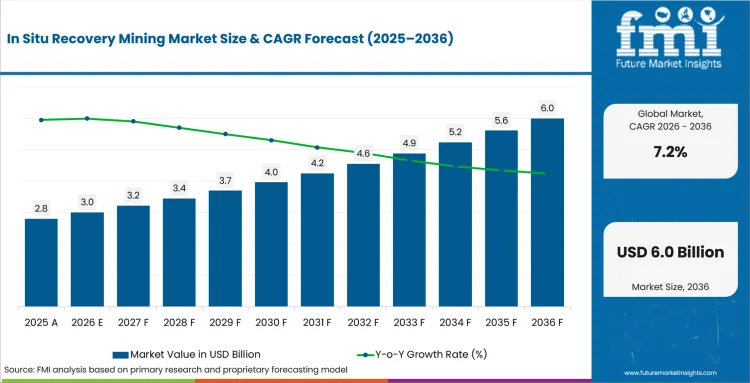
- Market Size (2026)
- USD 3.0 Bn
- Forecast (2036)
- USD 6.0 Bn
- CAGR (2026 to 2036)
- 7.2%
How big is In Situ Recovery Mining Market in 2026?
USD 3 billion in 2026 and USD 6 billion by 2036 at a 7.2% CAGR.
Demand for in situ recovery mining is projected to expand at 7.2% CAGR between 2026 and 2036, increasing valuation from USD 3 billion in 2026 to USD 6 billion by 2036. Uranium demand needs a dependable production route that can deliver concentrate across long reactor fuel cycles. The World Nuclear Association reported in September 2025 that reactor requirements were about 68,920 tU in 2025 and could exceed 150,000 tU by 2040. The long planning horizon supports staged wellfield investment at licensed projects with proven recovery control across each planned production area. Specialized uranium mining services become commercially relevant as drilling and processing capacity expand together across licensed production systems. Investment in mineral processing equipment follows at sites that convert recovered solution into saleable concentrate without weakening groundwater controls.
United States operators expand through licensed hubs that process recovered solution from satellite wellfields across one production system. Kazakhstan relies on larger integrated systems that coordinate mine units and central processing through state-linked ownership. Both operating models need replacement drilling to maintain plant feed as individual production patterns decline across mature resource areas. The U.S. Energy Information Administration reported in June 2026 that five operating ISR plants provided 13.3 million pounds of annual capacity at year-end 2025. The installed base lets American operators add wellfields without building a separate drying plant for every production area. The estimate includes active wellfields and connected processing systems but excludes conventional mines and heap-leach facilities. Conventional surface mining equipment remains outside the defined scope except for machines that directly support a licensed ISR system.
Key Takeaways of In Situ Recovery Mining Market
- Commercial demand depends on permeable deposits that support stable fluid circulation and dependable processing without weakening the approved groundwater restoration plan.
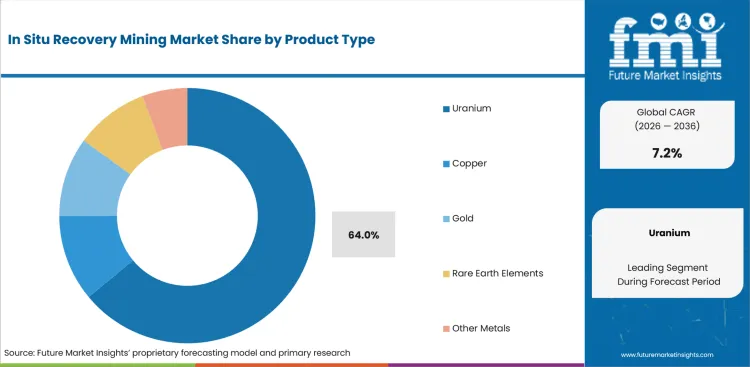
- The uranium segment is projected to hold 64.0% share in 2026 supported by its established use across licensed sandstone-hosted wellfields.
- Nuclear power generation is estimated to represent 61.0% by application in 2026 due to recurring uranium requirements across long reactor fuel cycles.
- Mining companies are forecast to capture 48.0% of end user in 2026 attributable to direct control of resource licenses and production schedules.
- Uneven permeability and groundwater restoration obligations can interrupt production across projects that lack repeatable circulation or dependable containment evidence.
- Competition spans NAC Kazatomprom JSC and Cameco Corporation through established Central Asian production systems across the market. Uranium Energy Corp. and enCore Energy Corp. operate active United States ramp-ups, Boss Energy Limited and Peninsula Energy Limited rebuild output, Orano and Denison Mines Corp. advance construction-stage projects.
Analyst Perspective
"Successful in situ recovery projects depend less on resource size than on stable circulation across each planned wellfield. Permeability tests must support dependable recovery across the complete production area and its connected processing route. Operators also need enough plant headroom to absorb changing solution grades as older recovery patterns decline. Staged additions through a licensed hub lower surface infrastructure costs across suitable deposits but lose value if groundwater restoration remains uncertain."
- Nikhil Kaitwade Principal Analyst, Future Market Insights
How is the In Situ Recovery Mining Market segmented?
The in situ recovery mining industry is segmented by product type, application, end user, distribution channel, mining solution type, and region. The analysis evaluates how geology, solution chemistry, licensing, processing capacity, and restoration obligations affect each commercial route.
The framework separates product type by recovered mineral, application by final industrial use, and end user by the organization controlling the resource or purchasing concentrate. Distribution channel distinguishes direct utility agreements from trading and public purchasing routes, while mining solution type separates leaching chemistry from oxidation, restoration, and process-control systems. Regional analysis compares geology, regulation, service access, and operating infrastructure across producing and developing locations. The category boundaries separate identical leaching chemistry that faces different contracts and approval burdens across countries. Continuous environmental monitoring systems cover groundwater and radiation records throughout production, closure, and aquifer restoration. The complete structure therefore connects each approved share with a distinct operating decision instead of treating every segment as another description of uranium extraction.
Why does uranium lead the product type category?
Uranium has the deepest commercial ISR record across roll-front sandstone deposits that support repeated injection and recovery patterns. Commercial production depends on permeability and aquifer confinement across every planned production area within the licensed resource. Uranium Energy Corp. announced in April 2026 that Burke Hollow commenced production following approval from the Texas Commission on Environmental Quality. The project sends recovered solution through a satellite ion-exchange plant to the licensed Hobson central processing plant. Shared processing supports phased production without duplicating stripping and drying infrastructure across every separate wellfield.
- The uranium segment is likely to capture 64.0% share in 2026 attributable to established use across licensed sandstone-hosted wellfields. Operators can add production through repeated recovery patterns and shared processing hubs across qualified deposits. Copper and other minerals require different chemistry and project economics that remain less established across current commercial ISR portfolios.
- Mining companies use uranium ISR to recover suitable deposits without removing complete ore bodies through open pits or underground workings. Staged wellfields align drilling with available processing capacity and reduce the initial surface plant burden. Adoption slows across deposits with uneven permeability or uncertain restoration costs throughout the planned production area.
How does nuclear power generation shape demand in the application category?
Nuclear utilities plan uranium purchases across long fuel cycles that require reliable concentrate output and contract delivery schedules. Producers therefore need licensed processing capacity and replacement wellfields that protect delivery volume across several reload periods. Related nuclear engineering services support fuel-cycle planning and supply assurance across utility portfolios with long operating commitments. ISR projects gain commercial support through planned output that matches contracted fuel requirements across repeatable production stages.
- In 2026, nuclear power generation is expected to lead application with 61.0% share because recurring reactor requirements support dependable uranium deliveries. Reactor operators schedule reloads years ahead and cannot treat concentrate availability as a short-cycle purchase. The segment reflects continuing fuel demand rather than one-time exploration or speculative activity across undeveloped uranium resources.
- Utilities favor ISR production that combines stable head grades with licensed processing and contract-quality uranium concentrate. The U.S. Energy Information Administration reported in September 2025 that civilian reactor operators purchased 55.9 million pounds of uranium during 2024. Long-term contracts covered most deliveries and gave producers clearer volume signals for planned wellfield expansion.
What keeps mining companies ahead within end user?
Mining companies control resource licenses and connect drilling schedules with processing capacity across the complete recovery system. Their investment decisions determine which production areas enter service and how restoration liabilities are funded. Utilities and contractors influence project economics but do not control the resource license or final wellfield sequence. The ownership structure gives mine operators direct responsibility for production continuity across declining and replacement patterns.
- The end user category is forecast to be led by mining companies at 48.0% share in 2026 due to their control of licensed resources and processing capacity. Cameco reported in February 2026 that Joint Venture Inkai produced 8.4 million pounds during 2025 and delivered 3.7 million pounds attributable to Cameco. Cameco’s attributable volume reflects the ownership share that governs commercial output from the joint venture.
- Mining companies expand ISR capacity through replacement wellfields that enter service as older patterns lose recovery efficiency. Each production stage requires drilling crews and enough processing headroom to turn new well output into saleable concentrate at planned commercial rates. Phased investment controls initial capital exposure but leaves production gaps if replacement drilling falls behind the decline schedule.
Which buying mechanism supports direct supply contracts in the distribution channel category?
Direct supply contracts connect mine plans with utility delivery schedules and give producers a bankable basis for staged wellfield investment. Planning for uranium isotope supply remains separate from mining output but depends on dependable natural uranium entering the fuel cycle. Kazatomprom announced in December 2025 that its group signed a U3O8 supply agreement with Kansai Electric for Japanese nuclear power plants. The agreement links named utility demand with Kazakh production instead of an undefined spot-market outlet.
- By distribution channel, direct supply contracts are estimated to hold 46.0% share in 2026 owing to their connection between planned recovery volumes and defined utility deliveries. Multi-year commitments support drilling and processing decisions across successive wellfield patterns during the complete contract period. Contract terms also allocate quality and timing obligations that spot transactions cannot manage across extended fuel-planning periods.
- Producers use direct contracts to coordinate pricing formulas and shipment windows with planned recovery volumes. Utilities gain clearer delivery accountability without assuming mine development or long-term groundwater restoration obligations throughout the contract term. Contract adoption weakens if committed volumes exceed recoverable wellfield output or remote transport delays interrupt concentrate movement across international fuel supply routes.
What supports the position of acid leaching within the mining solution type category?
Acid leaching increases uranium dissolution across mineralized zones that respond well to lower-pH chemistry during sustained wellfield circulation. Reagent strength must remain compatible with aquifer conditions and restoration commitments throughout commercial production and closure. Related industrial water treatment supports solution chemistry and recycle control across connected wellfields and surface processing equipment. Alkaline systems remain preferable across deposits whose mineralogy causes excessive acid consumption or complicates groundwater restoration.
- By mining solution type, acid leaching is forecast to represent 42.0% share in 2026 driven by faster dissolution across suitable uranium mineralogy. The method requires disciplined reagent balance and corrosion control across production wells and connected surface processing equipment. Its position weakens in aquifers that require alkaline chemistry for acceptable recovery and manageable groundwater restoration.
- Operating teams select acid systems following laboratory and field tests that confirm acceptable recovery across the planned production area. Peninsula Energy reported in April 2026 that Header House 14 completed acidification and delivered uranium-rich solution to the Lance central processing plant. The company also adjusted reagent dosing to address gas-related flow constraints across active production wellfields.
What are the drivers, restraints, and opportunities in the In Situ Recovery Mining Market?
Long-term uranium requirements support staged wellfield development, groundwater containment limits weak projects and integrated flow monitoring improves output from licensed processing hubs.
- Driver: Restarted uranium capacity raises demand for replacement wells and process support across licensed hub-and-spoke recovery systems.
- Restraint: Groundwater releases can suspend production and extend remediation across active wellfields with weak fluid containment.
- Opportunity: Integrated flow data can improve uranium recovery from existing wells without matching growth in central processing capacity.
Restarted United States uranium capacity supports demand for wellfields that feed existing processing hubs without a conventional mill. Operators add output through new header houses and satellite plants that use available ion-exchange capacity. Uranium Energy Corp. reported in June 2026 that Burke Hollow entered production and made two United States hub-and-spoke platforms operational. The additional platform broadens current demand for drilling crews and process support across licensed facilities. Revenue depends on sustained head grade and timely replacement drilling across the complete operating schedule.
Groundwater containment remains a material restraint across production areas that circulate leach solution through dense well networks. A release interrupts output and requires remediation even if fluid remains inside a controlled operating area. Operators therefore need reliable well records and inspection programs across older exploration infrastructure throughout the licensed production zone. South Australia recorded a 25,912-liter barren leach solution release beside an injection well at Honeymoon in August 2025. The contained incident reinforces the need for prompt detection and water treatment chemicals across active wellfields.
Integrated flow monitoring can improve wellfield recovery without expanding central processing capacity at the same rate. Operators need current injection and extraction data so declining wells do not reduce plant feed across an active production area. Uranium Energy Corp. reported in June 2025 that Header House 10-7 entered service and began feeding the Christensen Ranch satellite ion-exchange plant. Higher head grade during the restart connected new wellfields with stronger feed entering the satellite ion-exchange plant. Connected smart mining systems can combine flow balance with maintenance planning across each recovery pattern.
Which country CAGRs are profiled in the In Situ Recovery Mining Market?
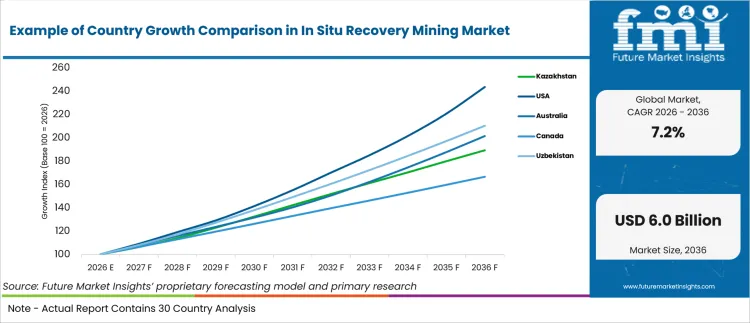
| Country | CAGR |
|---|---|
| USA | 9.3% |
| Mongolia | 8.8% |
| Namibia | 8.2% |
| Uzbekistan | 7.7% |
| Australia | 7.3% |
| Kazakhstan | 6.6% |
| Canada | 5.2% |
How do country-level CAGRs compare in the In Situ Recovery Mining Market?
The forecasts span 4.1 percentage points between the USA at 9.3% CAGR and Canada at 5.2% CAGR. The USA and Mongolia is within 0.5 point but follow different routes through restarted capacity and greenfield construction. Namibia follows 0.6 point behind Mongolia through conventional uranium operations rather than an established commercial ISR system. Uzbekistan and Australia form a 0.4-point band supported by active solution-mining routes with different processing and service conditions. Kazakhstan sits 0.7 point below Australia despite operating a substantially larger established ISR production base. Canada trails Kazakhstan by 1.4 points as Phoenix remains under construction and needs a future operating license.
- The USA combines operating hubs with separate restart and expansion applications across federal and Agreement State licensing routes.
- Mongolia depends on one large greenfield project whose construction program must establish local operating depth ahead of commercial production.
- Namibia brings uranium labor and export experience from conventional mines but lacks comparable evidence from an operating commercial ISR system.
- Uzbekistan expands through state-operated solution-mining deposits that share drilling teams and processing infrastructure across the Central Kyzylkum region.
- Australia concentrates commercial activity in South Australia through acid-leach wellfields and a regulator familiar with operating uranium projects.
- Kazakhstan combines mature production with continuous demand for replacement drilling and dependable reagent delivery across remote wellfield systems.
- Canada depends on Phoenix progressing from full-scale construction into a separately licensed operating system within a remote service environment.
The full report provides country-level CAGR analysis across North America, Latin America, Europe, East Asia, South Asia, Oceania and the Middle East and Africa.
Country-wise Analysis
- United States ISR projects operate under NRC licensing or Agreement State programs, so each development needs an approved wellfield and licensed processing route. The USA’s in situ recovery mining outlook is anticipated to advance at 9.3% CAGR over the assessment period, supported by restarted production areas and available hub capacity. The NRC facility directory listed current NRC-licensed ISR sites in May 2026 and linked separate applications for new plants or restarts. The federal route gives developers a defined sequence from license review through construction and commercial concentrate production. Existing hubs provide the main enabler through shared stripping and drying infrastructure across several connected satellite wellfields. Permit sequencing and groundwater restoration remain material frictions across remote projects that also need calibrated environmental radiation monitors.
- Commercial ISR entry in Mongolia depends on the Zuuvch-Ovoo construction program and a governance model accepted by national agencies and local communities. By 2036, Mongolia’s in situ recovery mining market is projected to grow at 8.8% CAGR, supported by a large licensed resource and planned domestic operating capacity. Project execution requires trained personnel and water-management systems for routine wellfield production across the planned resource area. Orano reported in May 2025 that Mongolia and the company established a Stakeholders’ Council and planned an accredited radiological laboratory. The governance measures provide a formal route for scientific review and structured community dialogue throughout project development. Construction scale and limited local service depth remain material frictions that increase imported technical support requirements.
- Namibia has uranium mining skills and export logistics but current production uses conventional open-pit and processing routes rather than commercial ISR. Any solution-mining proposal needs deposit-specific permeability evidence and a workable water-management plan in an arid operating setting. Paladin Energy reported in April 2025 that Langer Heinrich completed its first blast in nearly a decade and fed newly mined ore into processing. The Namibia in situ recovery mining sector is projected to record 8.2% CAGR during the assessment period, shaped by uranium capability but limited by scarce commercial ISR evidence. The conventional restart provides skilled labor and logistics capacity without proving a viable local commercial ISR route. Water availability and limited specialist service coverage remain material frictions for any separate solution-mining development.
- Uzbekistan expands uranium output through state-operated solution-mining deposits that share drilling and processing capabilities across the Central Kyzylkum region. Navoiyuran announced in April 2026 that Qizilkok entered commercial production with planned capacity of 1,200 tonnes of uranium each year. In situ recovery mining sales in Uzbekistan are forecast to expand at 7.7% CAGR by 2036, reinforced by additional wellfields and low-reagent oxygen leaching. Qizilkok provides a direct enabler through a pilot phase that advanced into full production within an established national system. Centralized ownership coordinates investment and production planning across several connected resource areas and processing routes. Limited independent service competition and state-controlled purchasing remain frictions for outside equipment providers seeking recurring local revenue.
- Commercial ISR activity in Australia is concentrated in South Australia through Honeymoon wellfields connected with ion-exchange and drying facilities. In situ recovery mining demand in Australia is forecast to rise at 7.3% CAGR over the forecast period, supported by operating capacity and an established state approval route. Boss Energy reported in January 2026 that Honeymoon produced 456,000 pounds of drummed uranium during the December quarter. The quarterly result connects active acid-leach wellfields with established processing capacity and existing uranium export arrangements. Regulator experience and specialized remote contractors provide the direct enabler for maintaining licensed field operations. Long service distances and variable wellfield performance remain material frictions that require spare equipment and disciplined sequencing.
- Kazakhstan operates a large network of sandstone-hosted ISR mines through state-linked ownership and central processing routes across remote production regions. Kazatomprom reported in February 2026 that uranium production reached 25,839 tonnes on a 100% basis during 2025. Adoption of in situ recovery mining in Kazakhstan is estimated to expand at 6.6% CAGR through 2036, reflecting a mature base that grows through replacement wellfields. Established drilling teams and processing infrastructure provide the direct enabler for replacing declining production areas across operating mine units. Sulfuric acid availability and long transport routes remain material frictions across remote wellfields and planned processing hubs. New entrants need a local operating partnership and field-service role that fit the established production system.
- Canada’s commercial ISR route centers on Phoenix through a high-grade Saskatchewan project that remains under construction and is not licensed for operation. Frozen-ground engineering and remote construction logistics distinguish Phoenix from the sandstone-hosted wellfields used across producing regions. Canada is estimated to post 5.2% CAGR over the forecast period, supported by a defined construction route and specialized Athabasca Basin expertise. The Canadian Nuclear Safety Commission confirmed in February 2026 that Wheeler River received a site preparation and construction license. The decision provides a formal development route but commercial recovery requires completed infrastructure and a future operating license. Remote service access and limited domestic ISR experience remain material frictions for commissioning and maintenance.
Who are the notable companies in the In Situ Recovery Mining Market?
NAC Kazatomprom JSC, Cameco Corporation, Orano, Uranium Energy Corp., enCore Energy Corp., Boss Energy Limited, Peninsula Energy Limited, and Denison Mines Corp. are notable companies shaping the in situ recovery mining market.
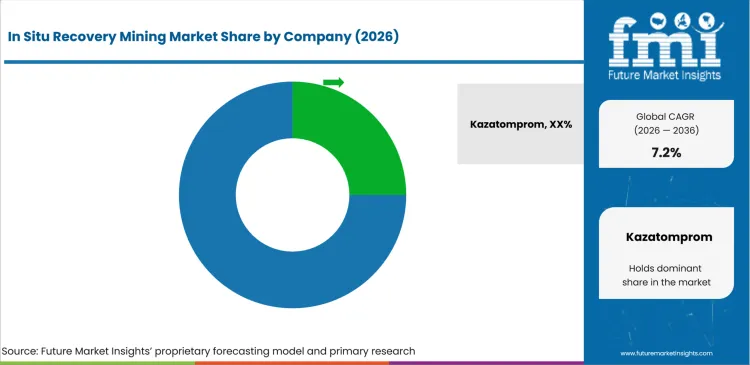
Competition remains concentrated among companies that control licensed uranium resources and processing hubs across established or advancing ISR jurisdictions. NAC Kazatomprom JSC and Cameco Corporation hold operating positions through large Central Asian wellfield systems. United States specialists compete by restarting hub-and-spoke assets and adding satellite fields against available processing headroom. Boss Energy Limited and Peninsula Energy Limited are rebuilding operating performance through assets in Australia and Wyoming. Orano and Denison Mines Corp. represent separate construction-stage entry routes through Mongolia and Canada respectively. New entrants face high barriers across projects that require hydrogeological proof and project-specific licensing for construction. Restoration capability and dependable remote field support further restrict rapid entry by other mining groups.
- NAC Kazatomprom JSC and Cameco Corporation provide established production depth through large commercial wellfield systems in Kazakhstan. Their operating advantage comes from integrated processing infrastructure and repeated field development across mature sandstone-hosted deposits. Both companies must maintain reagent supply and replacement drilling across remote production areas throughout each operating schedule.
- Uranium Energy Corp. and enCore Energy Corp. compete through active United States hub-and-spoke platforms with licensed processing capacity. Boss Energy Limited and Peninsula Energy Limited are rebuilding output through current production wellfield programs in Australia and Wyoming. Each group depends on timely drilling and stable plant feed throughout every stage of its production ramp-up.
- Orano and Denison Mines Corp. represent construction-stage routes through Mongolia and Canada without current commercial output from their named projects. Both companies need extensive engineering and regulatory execution to begin production of packaged uranium concentrate from either project. Their entry scope depends on building local operating depth and dependable remote technical support across each development area.
Competitive Benchmarking: In Situ Recovery Mining Market
| Company | Operating ISR Production | Wellfield and Processing Evidence | Project Licensing Status | Geographic Reach |
|---|---|---|---|---|
| NAC Kazatomprom JSC | High | High | High | Kazakhstan |
| Cameco Corporation | Medium | High | High | Kazakhstan |
| Orano | Low | Medium | Medium | Mongolia |
| Uranium Energy Corp. | High | High | High | United States |
| enCore Energy Corp. | High | High | High | United States |
| Boss Energy Limited | Medium | Medium | High | Australia and United States |
| Peninsula Energy Limited | Medium | Medium | High | United States |
| Denison Mines Corp. | Low | Medium | Medium | Canada |
Key Developments in the In Situ Recovery Mining Market
- In January 2025, Orano signed an investment agreement with Mongolia to develop the Zuuvch-Ovoo uranium project through Badrakh Energy. The agreement assigned an initial investment of about USD 500 million and a four-year program for construction and operating preparation. The planned ISR project combines a licensed resource with local workforce training and structured community engagement throughout development and early operations.
- In February 2025, Uranium Energy Corp. completed drying and drumming of uranium concentrate at the Irigaray central processing plant following the Christensen Ranch restart. The milestone confirmed the complete route from operating wellfields through satellite ion exchange to packaged uranium concentrate at the licensed Wyoming hub. Commercial output could then proceed under the restarted program through an established processing and packaging route.
- In March 2025, enCore Energy Corp. started a second ion-exchange circuit at the operating Alta Mesa central processing plant. Total solution flow capacity doubled from 2.5 thousand to 5 thousand gallons per minute during the expansion program. The added circuit increased uranium capture capacity but also raised the need for faster development drilling to replace declining wellfield output and maintain plant feed.
- In July 2026, Denison Mines Corp. completed site preparation and started full-scale construction at the Phoenix ISR uranium mine in Saskatchewan. Work then advanced into perimeter freeze-wall installation for the first planned commercial uranium production phase. The project moved from regulatory approval into physical construction but remained outside commercial uranium production during the 2026 market base year and construction period.
In Situ Recovery Mining Market - Report Scope
| Coverage field | Report scope |
|---|---|
| Market breakdown | Product type, application, end user, distribution channel, mining solution type, and region. |
| Market Definition | Commercial systems and services used to dissolve minerals underground through controlled wellfields, recover mineral-bearing solution at the surface, and restore the affected groundwater system. |
| Regions Covered | North America, Latin America, Western Europe, Eastern Europe, East Asia and Central Asia, South Asia and Pacific, and the Middle East and Africa. |
| Countries Covered | USA, Mongolia, Namibia, Uzbekistan, Australia, Kazakhstan, and Canada, with coverage across more than 30 countries. |
| Key Companies Profiled | NAC Kazatomprom JSC, Cameco Corporation, Orano, Uranium Energy Corp., enCore Energy Corp., Boss Energy Limited, Peninsula Energy Limited, and Denison Mines Corp. |
| Forecast Period | 2026 to 2036. |
| Approach | Hybrid bottom-up and top-down market sizing supported by primary research and official desk research. |
In Situ Recovery Mining Market - Research Methodology
| Method | Approach |
|---|---|
| Primary Research | FMI analysts gathered input from manufacturers, service providers, technology developers, distributors, end users, procurement teams, and subject-matter experts. Interviews examined purchasing decisions, product or service evaluation, adoption barriers, approval requirements, pricing considerations, and expectations for technical or commercial support. Respondents were also asked what evidence is required before a trial, pilot, or initial order develops into regular purchasing. |
| Desk Research | Desk research covered government statistics, regulatory publications, trade data, industry associations, technical literature, standards, company filings, product information, and official corporate announcements. Sources were reviewed for relevance, publication date, geographic coverage, and consistency with the defined market scope. Claims relating to performance, applications, approvals, capacity, investment, and commercial activity were retained only when supported by credible public evidence. |
| Market Sizing and Forecasting | The market model combined the baseline value with historical performance, segment structure, pricing and volume indicators, adoption levels, company participation, and country-level demand conditions. Forecast assumptions considered economic activity, investment trends, regulatory developments, technology adoption, purchasing cycles, supply availability, and barriers to wider market use. Segment and regional estimates were reconciled before the final market total was calculated. |
| Data Validation | Estimates were checked against multiple independent indicators, including public data, company activity, trade patterns, industry developments, and findings from primary interviews. Validation also tested whether products, services, applications, and company revenues fell within the defined market boundaries. Adjacent categories, unsupported claims, overlapping revenues, and activities without direct market relevance were excluded to reduce double counting and maintain consistency across segments and countries. |
In Situ Recovery Mining Market by Segments
In Situ Recovery Mining Market segmented by Product Type:
- Uranium
- Sandstone-hosted
- Roll-front
- Copper
- Oxide
- Sulfide
- Gold
- Rare Earths
- Other Metals
In Situ Recovery Mining Market segmented by Application:
- Nuclear Power Generation
- Metal Production
- Industrial Manufacturing
- Energy Storage
- Research and Exploration
In Situ Recovery Mining Market segmented by End User:
- Mining Companies
- Nuclear Fuel Suppliers
- Metal Processing Companies
- Government Agencies
- Research Institutions
In Situ Recovery Mining Market segmented by Distribution Channel:
- Direct Supply Contracts
- Commodity Traders
- Industrial Distributors
- Government Procurement
- Online Commodity Platforms
In Situ Recovery Mining Market segmented by Mining Solution Type:
- Acid Leaching
- Sulfuric Acid
- Hydrochloric Acid
- Alkaline Leaching
- Sodium Bicarbonate
- Sodium Carbonate
- Oxidation Systems
- Hydrogen Peroxide
- Oxygen
- Groundwater Restoration
- Water Treatment
- Aquifer Restoration
- Monitoring and Control Systems
- Real-time Monitoring
- Remote Process Control
In Situ Recovery Mining Market by Region:
- North America
- USA
- Canada
- Mexico
- Latin America
- Brazil
- Argentina
- Rest of Latin America
- Western Europe
- Germany
- France
- United Kingdom
- Rest of Western Europe
- Eastern Europe
- Poland
- Romania
- Rest of Eastern Europe
- East Asia and Central Asia
- China
- Japan
- South Korea
- Mongolia
- Kazakhstan
- Uzbekistan
- South Asia and Pacific
- India
- Australia
- New Zealand
- Rest of South Asia and Pacific
- Middle East and Africa
- Namibia
- South Africa
- Other African Union
- Rest of Middle East and Africa
Research Sources and Bibliography
- World Nuclear Association. (2025, September 17).
- U.S. Energy Information Administration. (2026, June 23).
- Uranium Energy Corp. (2026, April 8).
- U.S. Energy Information Administration. (2025, September 30).
- Cameco Corporation. (2026, February 13)
- NAC Kazatomprom JSC. (2025, December 22)
- Peninsula Energy Limited. (2026, April 30).
- Uranium Energy Corp. (2026, June 9).
- Government of South Australia, Department for Energy and Mining. (2025, August 18).
- Uranium Energy Corp. (2025, June 2).
- U.S. Nuclear Regulatory Commission. (2026, May 26).
- Orano. (2025, May 19)
- Paladin Energy Limited. (2025, April 23).
- Navoiyuran State Enterprise. (2026, April 24).
- Boss Energy Limited. (2026, January 28).
- NAC Kazatomprom JSC. (2026, February 2).
- Canadian Nuclear Safety Commission. (2026, February 19)
- Uranium Energy Corp. (2025, February 19).
- enCore Energy Corp. (2025, March 13).
- Denison Mines Corp. (2026, July 28).
- Uranium Energy Corp. (2026, March 23).
This bibliography is provided for reader reference and is not exhaustive. The full report contains the complete reference list and detailed citations.
This Report Answers
- How large is the in situ recovery mining market in 2026 and 2036?
- Which geological and operating conditions determine whether an ISR project reaches commercial production?
- Why does uranium account for the largest product type share during 2026?
- How does nuclear power generation shape long-term demand for ISR production capacity?
- Why do direct supply contracts support wellfield and processing investment decisions?
- How do country growth conditions differ across the USA, Mongolia, Namibia, Uzbekistan, Australia, Kazakhstan, and Canada?
- Which companies operate, restart, or develop notable ISR uranium projects?
- What limits recovery performance and groundwater restoration across marginal deposits?
- How does better wellfield monitoring improve production reliability and project economics?
Frequently Asked Questions
How big is the In Situ Recovery Mining Market in 2026?
The in situ recovery mining market is valued at USD 3 billion in 2026 and is forecast to reach USD 6 billion by 2036. Growth is supported by long-term reactor fuel requirements that sustain staged wellfield investment across licensed projects with proven recovery control and dependable concentrate output throughout extended uranium supply programs.
What is the CAGR of the In Situ Recovery Mining Market from 2026 to 2036?
The in situ recovery mining market grows at a CAGR of 7.2% between 2026 and 2036, supported by restarted uranium capacity raising demand for replacement wells and process support across licensed hub-and-spoke recovery systems that deliver concentrate against long-term utility contracts without duplicating central processing infrastructure.
Which product type leads the In Situ Recovery Mining Market?
Uranium accounts for 64.0% of the in situ recovery mining market by product type in 2026, driven by established use across licensed sandstone-hosted wellfields where operators add production through repeated recovery patterns and shared processing hubs without removing complete ore bodies through conventional mining methods.
How much will the In Situ Recovery Mining Market add between 2026 and 2036?
The in situ recovery mining market is set to add USD 3 billion between 2026 and 2036, growing from USD 3 billion to USD 6 billion as restarted United States capacity, Central Asian expansion, and advancing construction-stage projects in Mongolia and Canada broaden the commercial wellfield and processing base across uranium-producing regions.
Who are the leading companies in the In Situ Recovery Mining Market?
Eight companies lead the in situ recovery mining market, including NAC Kazatomprom JSC, Cameco Corporation, Orano, Uranium Energy Corp., enCore Energy Corp., Boss Energy Limited, Peninsula Energy Limited, and Denison Mines Corp., competing through established Central Asian systems, active United States hub-and-spoke platforms, and construction-stage development programs worldwide.
Preview the report firsthand - request a free sample
Get SampleGet the brochure for pricing and purchase details.
Get PDFTable of Content
- Key Takeaways
- Market Size and CAGR
- Top Growth Driver
- Fastest Growing Segment
- Leading Region
- Key Companies
- Emerging Opportunities
- Executive Summary
- Global Market Outlook
- Demand-side Trends
- Supply-side Trends
- Technology Roadmap Analysis
- Analysis and Recommendations
- Analyst Perspective (What is happening? Why now? What should investors know?)
- Key Questions Answered
- How large is the market?
- What is the CAGR?
- What are key trends?
- Which region dominates?
- Who are the leaders?
- Market Overview
- Market Coverage / Taxonomy
- Market Definition / Scope / Limitations
- Research Methodology
- Chapter Orientation
- Analytical Lens and Working Hypotheses
- Market Structure, Signals, and Trend Drivers
- Benchmarking and Cross-market Comparability
- Market Sizing, Forecasting, and Opportunity Mapping
- Research Design and Evidence Framework
- Desk Research Programme (Secondary Evidence)
- Expert Input and Fieldwork (Primary Evidence)
- Tooling, Models, and Reference Databases
- Data Engineering and Model Build
- Quality Assurance and Audit Trail
- Market Background
- Market Dynamics (Drivers, Restraints, Opportunity, Trends)
- Scenario Forecast (Optimistic, Likely, Conservative)
- Impact Analysis
- AI Impact
- Sustainability Impact
- Regulatory Impact
- Technology Impact
- Consumer / Buyer Analysis
- Purchase Drivers
- Adoption Barriers
- Buyer Journey
- Opportunity Map Analysis
- Product Life Cycle Analysis
- Supply Chain Analysis
- Investment Feasibility Matrix
- Value Chain Analysis
- PESTLE and Porter's Analysis
- Regulatory Landscape
- Regional Parent Market Outlook
- Production and Consumption Statistics
- Import and Export Statistics
- Global Market Analysis and Forecast, 2021 to 2036
- Historical Market Size Value (USD Billion) Analysis, 2021 to 2025
- Current and Future Market Size Value (USD Billion) Projections, 2026 to 2036
- Y-o-Y Growth Trend Analysis
- Absolute $ Opportunity Analysis
- Global Market Pricing Analysis, 2021 to 2036
- Global Market Analysis and Forecast, By Product Type, 2021 to 2036
- Introduction / Key Findings
- Historical Market Size Value (USD Billion) Analysis By Product Type, 2021 to 2025
- Current and Future Market Size Value (USD Billion) Analysis and Forecast By Product Type, 2026 to 2036
- Uranium
- Sandstone-Hosted Uranium
- Roll-Front Uranium Deposits
- Copper
- Oxide Copper Deposits
- Sulfide Copper Deposits
- Gold
- Oxide Gold Deposits
- Refractory Gold Deposits
- Rare Earth Elements
- Heavy Rare Earth Elements
- Light Rare Earth Elements
- Other Metals
- Molybdenum
- Nickel
- Uranium
- Y-o-Y Growth Trend Analysis By Product Type, 2021 to 2025
- Absolute $ Opportunity Analysis By Product Type, 2026 to 2036
- Global Market Analysis and Forecast, By Application, 2021 to 2036
- Introduction / Key Findings
- Historical Market Size Value (USD Billion) Analysis By Application, 2021 to 2025
- Current and Future Market Size Value (USD Billion) Analysis and Forecast By Application, 2026 to 2036
- Nuclear Power Generation
- Commercial Nuclear Reactors
- Small Modular Reactors
- Metal Production
- Copper Refining
- Gold Processing
- Industrial Manufacturing
- Electronics Manufacturing
- Alloy Production
- Energy Storage
- Battery Materials
- Critical Minerals
- Research & Exploration
- Geological Studies
- Pilot Mining Projects
- Nuclear Power Generation
- Y-o-Y Growth Trend Analysis By Application, 2021 to 2025
- Absolute $ Opportunity Analysis By Application, 2026 to 2036
- Global Market Analysis and Forecast, By End User, 2021 to 2036
- Introduction / Key Findings
- Historical Market Size Value (USD Billion) Analysis By End User, 2021 to 2025
- Current and Future Market Size Value (USD Billion) Analysis and Forecast By End User, 2026 to 2036
- Mining Companies
- Major Mining Companies
- Junior Mining Companies
- Nuclear Fuel Suppliers
- Uranium Processors
- Fuel Fabricators
- Metal Processing Companies
- Smelters
- Refineries
- Government Organizations
- State Mining Enterprises
- National Resource Agencies
- Research Institutions
- Universities
- Geological Survey Organizations
- Mining Companies
- Y-o-Y Growth Trend Analysis By End User, 2021 to 2025
- Absolute $ Opportunity Analysis By End User, 2026 to 2036
- Global Market Analysis and Forecast, By Distribution Channel, 2021 to 2036
- Introduction / Key Findings
- Historical Market Size Value (USD Billion) Analysis By Distribution Channel, 2021 to 2025
- Current and Future Market Size Value (USD Billion) Analysis and Forecast By Distribution Channel, 2026 to 2036
- Direct Supply Contracts
- Long-Term Supply Agreements
- Spot Contracts
- Commodity Traders
- Global Trading Houses
- Metal Brokers
- Industrial Distributors
- Raw Material Distributors
- Mineral Suppliers
- Government Procurement
- State Procurement Programs
- Strategic Reserve Purchases
- Online Commodity Platforms
- Digital Trading Platforms
- B2B Commodity Exchanges
- Direct Supply Contracts
- Y-o-Y Growth Trend Analysis By Distribution Channel, 2021 to 2025
- Absolute $ Opportunity Analysis By Distribution Channel, 2026 to 2036
- Global Market Analysis and Forecast, By Mining Solution Type, 2021 to 2036
- Introduction / Key Findings
- Historical Market Size Value (USD Billion) Analysis By Mining Solution Type, 2021 to 2025
- Current and Future Market Size Value (USD Billion) Analysis and Forecast By Mining Solution Type, 2026 to 2036
- Acid Leaching
- Sulfuric Acid Leaching
- Hydrochloric Acid Leaching
- Alkaline Leaching
- Sodium Bicarbonate Leaching
- Sodium Carbonate Leaching
- Oxidation Systems
- Hydrogen Peroxide Oxidation
- Oxygen Injection
- Groundwater Restoration
- Water Treatment
- Aquifer Restoration
- Monitoring & Control Systems
- Real-Time Monitoring
- Remote Process Control
- Acid Leaching
- Y-o-Y Growth Trend Analysis By Mining Solution Type, 2021 to 2025
- Absolute $ Opportunity Analysis By Mining Solution Type, 2026 to 2036
- Global Market Analysis and Forecast, By Region, 2021 to 2036
- Introduction
- Historical Market Size Value (USD Billion) Analysis By Region, 2021 to 2025
- Current Market Size Value (USD Billion) Analysis and Forecast By Region, 2026 to 2036
- North America
- Latin America
- Western Europe
- Eastern Europe
- East Asia
- South Asia and Pacific
- Middle East & Africa
- Market Attractiveness Analysis By Region
- North America Market Analysis and Forecast, By Country, 2021 to 2036
- Historical Market Size Value (USD Billion) Trend Analysis By Market Taxonomy, 2021 to 2025
- Market Size Value (USD Billion) Forecast By Market Taxonomy, 2026 to 2036
- By Country
- USA
- Canada
- By Product Type
- By Application
- By End User
- By Distribution Channel
- By Mining Solution Type
- By Country
- Market Attractiveness Analysis
- By Country
- By Product Type
- By Application
- By End User
- By Distribution Channel
- By Mining Solution Type
- Key Takeaways
- Latin America Market Analysis and Forecast, By Country
- Historical Market Size Value (USD Billion) Trend Analysis By Market Taxonomy, 2021 to 2025
- Market Size Value (USD Billion) Forecast By Market Taxonomy, 2026 to 2036
- By Country
- Brazil
- Mexico
- Chile
- Rest of Latin America
- By Product Type
- By Application
- By End User
- By Distribution Channel
- By Mining Solution Type
- By Country
- Market Attractiveness Analysis
- By Country
- By Product Type
- By Application
- By End User
- By Distribution Channel
- By Mining Solution Type
- Key Takeaways
- Western Europe Market Analysis and Forecast, By Country
- Historical Market Size Value (USD Billion) Trend Analysis By Market Taxonomy, 2021 to 2025
- Market Size Value (USD Billion) Forecast By Market Taxonomy, 2026 to 2036
- By Country
- Germany
- UK
- Italy
- Spain
- France
- Nordic
- BENELUX
- Rest of Western Europe
- By Product Type
- By Application
- By End User
- By Distribution Channel
- By Mining Solution Type
- By Country
- Market Attractiveness Analysis
- By Country
- By Product Type
- By Application
- By End User
- By Distribution Channel
- By Mining Solution Type
- Key Takeaways
- Eastern Europe Market Analysis and Forecast, By Country
- Historical Market Size Value (USD Billion) Trend Analysis By Market Taxonomy, 2021 to 2025
- Market Size Value (USD Billion) Forecast By Market Taxonomy, 2026 to 2036
- By Country
- Russia
- Poland
- Hungary
- Balkan & Baltic
- Rest of Eastern Europe
- By Product Type
- By Application
- By End User
- By Distribution Channel
- By Mining Solution Type
- By Country
- Market Attractiveness Analysis
- By Country
- By Product Type
- By Application
- By End User
- By Distribution Channel
- By Mining Solution Type
- Key Takeaways
- East Asia Market Analysis and Forecast, By Country
- Historical Market Size Value (USD Billion) Trend Analysis By Market Taxonomy, 2021 to 2025
- Market Size Value (USD Billion) Forecast By Market Taxonomy, 2026 to 2036
- By Country
- China
- Japan
- South Korea
- By Product Type
- By Application
- By End User
- By Distribution Channel
- By Mining Solution Type
- By Country
- Market Attractiveness Analysis
- By Country
- By Product Type
- By Application
- By End User
- By Distribution Channel
- By Mining Solution Type
- Key Takeaways
- South Asia and Pacific Market Analysis and Forecast, By Country
- Historical Market Size Value (USD Billion) Trend Analysis By Market Taxonomy, 2021 to 2025
- Market Size Value (USD Billion) Forecast By Market Taxonomy, 2026 to 2036
- By Country
- India
- ASEAN
- Australia & New Zealand
- Rest of South Asia and Pacific
- By Product Type
- By Application
- By End User
- By Distribution Channel
- By Mining Solution Type
- By Country
- Market Attractiveness Analysis
- By Country
- By Product Type
- By Application
- By End User
- By Distribution Channel
- By Mining Solution Type
- Key Takeaways
- Middle East & Africa Market Analysis and Forecast, By Country
- Historical Market Size Value (USD Billion) Trend Analysis By Market Taxonomy, 2021 to 2025
- Market Size Value (USD Billion) Forecast By Market Taxonomy, 2026 to 2036
- By Country
- Kingdom of Saudi Arabia
- Other GCC Countries
- Türkiye
- South Africa
- Other African Union
- Rest of Middle East & Africa
- By Product Type
- By Application
- By End User
- By Distribution Channel
- By Mining Solution Type
- By Country
- Market Attractiveness Analysis
- By Country
- By Product Type
- By Application
- By End User
- By Distribution Channel
- By Mining Solution Type
- Key Takeaways
- Key Countries Market Analysis
- USA
- Pricing Analysis
- Market Share Analysis, 2025
- By Product Type
- By Application
- By End User
- By Distribution Channel
- By Mining Solution Type
- Canada
- Pricing Analysis
- Market Share Analysis, 2025
- By Product Type
- By Application
- By End User
- By Distribution Channel
- By Mining Solution Type
- Mexico
- Pricing Analysis
- Market Share Analysis, 2025
- By Product Type
- By Application
- By End User
- By Distribution Channel
- By Mining Solution Type
- Brazil
- Pricing Analysis
- Market Share Analysis, 2025
- By Product Type
- By Application
- By End User
- By Distribution Channel
- By Mining Solution Type
- Chile
- Pricing Analysis
- Market Share Analysis, 2025
- By Product Type
- By Application
- By End User
- By Distribution Channel
- By Mining Solution Type
- Germany
- Pricing Analysis
- Market Share Analysis, 2025
- By Product Type
- By Application
- By End User
- By Distribution Channel
- By Mining Solution Type
- UK
- Pricing Analysis
- Market Share Analysis, 2025
- By Product Type
- By Application
- By End User
- By Distribution Channel
- By Mining Solution Type
- Italy
- Pricing Analysis
- Market Share Analysis, 2025
- By Product Type
- By Application
- By End User
- By Distribution Channel
- By Mining Solution Type
- Spain
- Pricing Analysis
- Market Share Analysis, 2025
- By Product Type
- By Application
- By End User
- By Distribution Channel
- By Mining Solution Type
- France
- Pricing Analysis
- Market Share Analysis, 2025
- By Product Type
- By Application
- By End User
- By Distribution Channel
- By Mining Solution Type
- India
- Pricing Analysis
- Market Share Analysis, 2025
- By Product Type
- By Application
- By End User
- By Distribution Channel
- By Mining Solution Type
- ASEAN
- Pricing Analysis
- Market Share Analysis, 2025
- By Product Type
- By Application
- By End User
- By Distribution Channel
- By Mining Solution Type
- Australia & New Zealand
- Pricing Analysis
- Market Share Analysis, 2025
- By Product Type
- By Application
- By End User
- By Distribution Channel
- By Mining Solution Type
- China
- Pricing Analysis
- Market Share Analysis, 2025
- By Product Type
- By Application
- By End User
- By Distribution Channel
- By Mining Solution Type
- Japan
- Pricing Analysis
- Market Share Analysis, 2025
- By Product Type
- By Application
- By End User
- By Distribution Channel
- By Mining Solution Type
- South Korea
- Pricing Analysis
- Market Share Analysis, 2025
- By Product Type
- By Application
- By End User
- By Distribution Channel
- By Mining Solution Type
- Russia
- Pricing Analysis
- Market Share Analysis, 2025
- By Product Type
- By Application
- By End User
- By Distribution Channel
- By Mining Solution Type
- Poland
- Pricing Analysis
- Market Share Analysis, 2025
- By Product Type
- By Application
- By End User
- By Distribution Channel
- By Mining Solution Type
- Hungary
- Pricing Analysis
- Market Share Analysis, 2025
- By Product Type
- By Application
- By End User
- By Distribution Channel
- By Mining Solution Type
- Kingdom of Saudi Arabia
- Pricing Analysis
- Market Share Analysis, 2025
- By Product Type
- By Application
- By End User
- By Distribution Channel
- By Mining Solution Type
- Türkiye
- Pricing Analysis
- Market Share Analysis, 2025
- By Product Type
- By Application
- By End User
- By Distribution Channel
- By Mining Solution Type
- South Africa
- Pricing Analysis
- Market Share Analysis, 2025
- By Product Type
- By Application
- By End User
- By Distribution Channel
- By Mining Solution Type
- USA
- Market Structure Analysis
- Competition Dashboard
- Competition Benchmarking
- Market Share Analysis of Top Players
- By Regional
- By Product Type
- By Application
- By End User
- By Distribution Channel
- By Mining Solution Type
- Emerging Startups
- Innovation Benchmarking
- Competition Analysis
- Competition Deep Dive
- Kazatomprom
- Overview
- Product Portfolio
- Profitability by Market Segments
- Sales Footprint
- Strategy Overview
- Marketing Strategy
- Product Strategy
- Channel Strategy
- Cameco Corporation
- Uranium Energy Corp.
- Orano
- Rosatom
- Boss Energy
- Energy Fuels Inc.
- Peninsula Energy
- Paladin Energy
- BHP
- Kazatomprom
- Case Studies
- Success Stories
- Recent Developments
- Competition Deep Dive
- Assumptions & Acronyms Used


