

- Market Size (2026)
- USD 603.1 Mn
- Forecast (2036)
- USD 1388.9 Mn
- CAGR (2026 to 2036)
- 8.7%
How big is Injera Market in 2026?
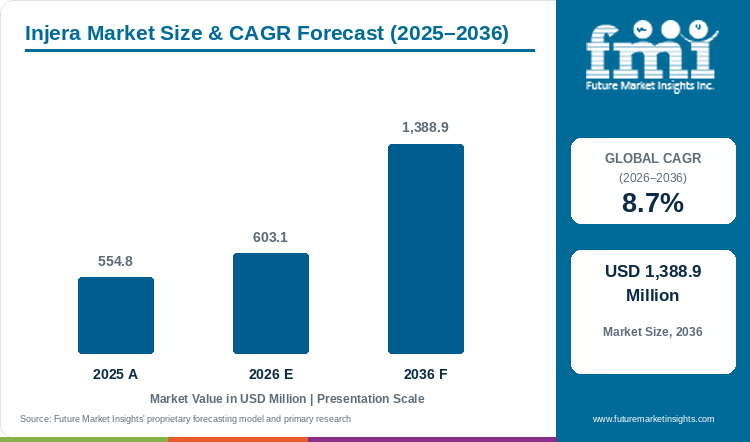
Registering a value of USD 554.8 million in 2025, the injera market expanded to USD 603.1 million in 2026 and is anticipated to achieve USD 1,388.9 million by 2036, driven by an 8.7% CAGR.
A four-day ambient mold clock is the hardest number in injera distribution, because the fermented porous flatbread that wins plate share at fresh counters loses the same share on long-haul grocery shelves. The global injera market was valued at USD 554.8 million in 2025 and is estimated to reach USD 603.1 million in 2026. The market is projected to reach USD 1,388.9 million by 2036, expanding at a compound annual growth rate (CAGR) of 8.7% between 2026 and 2036. Classic original injera is projected to capture 37.0% of 2026 product type demand on traditional fermented sourness and teff-surface absorption recognized by household cooks [1]. Demand growth runs materially ahead of the gluten-free flours market at 3.6% CAGR, since injera monetizes a recurring staple occasion where gluten-free flours only substitute an ingredient inside someone else's recipe [6]. The growth in teff consumption is also reflected in supply-side investment, with The Teff Company introducing certified organic brown teff flour and grain for retail and foodservice bakeries in January 2025 [19], while October 2025 research confirmed teff flour performance in blended commercial systems [20]. Importers expand distribution by extending the shelf clock rather than by adding SKUs, and whoever controls post-fermentation spoilage control converts diaspora staple demand into national grocery placements through 2036.
Key Market Trends & Insights
- By product type: Classic / Original is projected to capture 37.0% of the Product Type segment in 2026 because traditional fermented sourness and porous surface structure anchor stew-based meals.
- By claim / nature: Conventional recipes are estimated to command 55.0% of the Claim / Nature segment in 2026 as daily staple buyers prioritize affordable sheet pricing over specialty seals.
- By format: Frozen sheets are expected to concentrate 27.0% of the Format segment in 2026 by enabling transcontinental distribution without chemical preservatives.
- By packaging format: Multipack sleeves are forecast to generate 29.0% of the Packaging Format segment in 2026 owing to shared multi-sheet family platter consumption.
- By sales channel: Supermarkets & Hypermarkets are anticipated to account for 32.0% of the Sales Channel segment in 2026 through refrigerated and frozen ethnic-aisle listings.
Regional Highlights
- Top national expansion: Germany is projected to lead evaluated national markets at a 10.1% CAGR through 2036 as specialty retailers and diaspora grocers formalize chilled and frozen replenishment.
- Broader country progression: Sweden is expected to expand at a 9.8% CAGR ahead of Canada at 9.4% and Ethiopia at 9.1%, while the UK is forecast to advance at a 7.8% CAGR.
Market Size & Forecast
Table 1: Market Size and Forecast for the Injera Market (USD million and CAGR percentage), 2025 to 2036
| Metric | Value |
|---|---|
| 2025 Market Size | USD 554.8 million |
| Estimated Market Size in 2026 | USD 603.1 million |
| Projected Market Size by 2036 | USD 1,388.9 million |
| CAGR, 2026 to 2036 | 8.7% |
| Added Revenue, 2026 to 2036 | USD 785.8 million |
Commercial transition of injera production from manual clay griddles to automated rotary mitad lines requires overcoming volatile raw teff grain prices and multi-day batter fermentation bottlenecks. Pure *Eragrostis tef* batters need 48 to 72 hours of backslopped lactic-acid and yeast fermentation to build the gas-trapping viscosity (`absit`) required for porous eyes. In March 2026, factorial fermentation trials published in Food Science & Nutrition demonstrated that fermenting composite teff batters for 72 hours optimizes titratable acidity and microbial shelf life while moderating raw flour costs [2]. As a result, industrial bakers are standardizing starter cultures and sourcing graded ancient and specialty grain flour to eliminate batch-to-batch sourness drift.
Production-Volume and Sheet-Consumption Sizing
Table 2: Production-Volume and Sheet-Consumption Sizing for the Injera Market (USD million and operational ranges), 2025 to 2036
| Metric | 2025 | 2026 | 2036 |
|---|---|---|---|
| Market size (USD million) | 554.8 | 603.1 | 1,388.9 |
| Commercial injera volume (million sheets) | 1,110 to 1,260 | 1,205 to 1,370 | 2,650 to 3,020 |
| Multipack retail & foodservice packs (million) | 222 to 252 | 241 to 274 | 530 to 604 |
| Average wholesale price per 5-sheet pack (USD) | 2.2 to 2.5 | 2.2 to 2.5 | 2.3 to 2.6 |
Operational note: Sheet-volume ranges apply a standardized 310-gram to 350-gram finished fermented injera sheet weight across 5-count and 10-count commercial multipacks.
Higher catering volume across East Africa restaurants and urban supermarkets has increased demand for uniform 45-to-50-centimeter sheet diameters that fold cleanly without tearing under hot stew (`wat`) servings. so automated bakeries are pairing gelatinized `absit` starch starters with temperature-controlled sourdough fermentation tanks to hold batter pH between 3.8 and 4.2.
Per Capita & Retail Channel Sizing
Table 3: Per Capita and Household Spending Indicators for the Injera Market (USD), 2025 to 2036
| Metric | 2025 | 2026 | 2036 |
|---|---|---|---|
| World population (billion) | 8.2 | 8.3 | 9.0 |
| Spend per 1,000 people (USD) | 67.7 | 72.7 | 154.3 |
| Annual spend per regular consuming household (USD) | 68.0 to 84.0 | 72.0 to 89.0 | 110.0 to 135.0 |
| Frozen & chilled commercial pack share (%) | 44.0% to 47.0% | 46.0% to 49.0% | 54.0% to 58.0% |
Table 4: Channel & Segment Revenue Indicators for the Injera Market (USD and percentages), 2026
| Metric | Value | Institutional Reference Basis |
|---|---|---|
| Market size, 2026 | USD 603.1 million | 2026 global revenue baseline |
| Supermarkets & hypermarkets revenue, 2026 | USD 193.0 million | 32.0% sales channel segment allocation |
| Classic / Original revenue, 2026 | USD 223.1 million | 37.0% product type segment allocation |
| Frozen format revenue, 2026 | USD 162.8 million | 27.0% format segment allocation |
Protection against inter-sheet sticking and starch retrogradation during refrigerated or frozen transport requires interleaving films and low-permeability polyethylene bread bags. Due to these preservation advantages, export bakeries in Addis Ababa and automated diaspora commissaries are installing blast-freezing tunnels to lock in crumb pliability before air-freight or reefer dispatch.
Analyst Perspective
"Cultural familiarity creates baseline meal demand, but commercial injera revenue depends on whether a bakery can deliver a pliable, mold-free fermented sheet after days in transit. Producers that master 72-hour fermentation control and freeze-thaw moisture protection will convert informal neighborhood buying into recurring supermarket and restaurant contracts."
- Nandini Roy Choudhury, Principal Analyst at Future Market Insights
How is the injera market segmented?
The injera market is segmented by Product Type, Claim / Nature, Format, Packaging Format, and Sales Channel. In 2026, Classic / Original is projected at 37.0%, Conventional at 55.0%, Frozen at 27.0%, Multipack at 29.0%, and Supermarkets & Hypermarkets at 32.0%.
By product type: Classic / Original, Whole Grain & Seeded, Flavored & Filled, Mini & Snacking Formats, and Premium / Artisan.
By claim / nature: Conventional, Clean Label, Organic, Gluten-Free, and High-Protein / Fortified.
By format: Frozen, Fresh, Ambient Packaged, Chilled, and Par-Baked / Thaw-and-Serve.
By packaging format: Multipack, Single-Serve, Family / Loaf Pack, and Bulk Foodservice.
By sales channel: Supermarkets & Hypermarkets, Artisan & Specialty Bakeries, Convenience & Forecourt, Online & DTC, and Foodservice Distributors.
Why does Classic / Original anchor the Product Type segment?
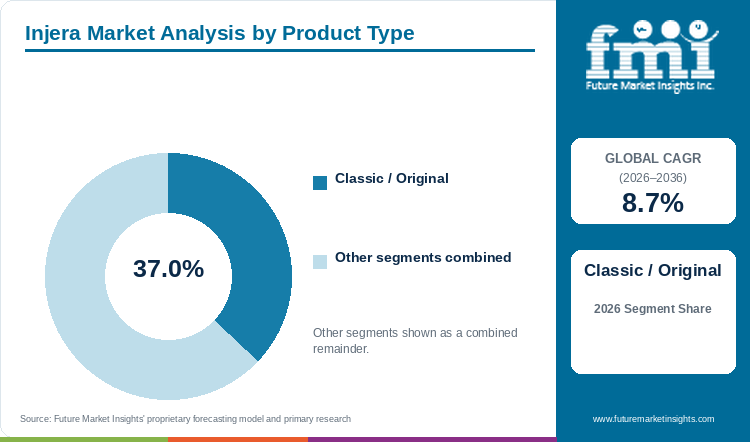
Classic / Original is projected to capture 37.0% of the Product Type segment in 2026, supported by traditional fermented flavor and porous sheet structure.
Table 5: Product Type Share for the Injera Market (percentage share), 2026
| Product Type | Share (2026) |
|---|---|
| Classic / Original | 37.0% |
| Other Segments Combined | 63.0%* |
| Total | 100.0% |
*Note: Remaining product type segments sum to 100.0% of 2026 injera revenue.
Table 6: Product Type Leadership and Market Growth for the Injera Market (segment and CAGR percentage), 2026 to 2036
| Metric | Value |
|---|---|
| Global CAGR (2026 to 2036) | 8.7% |
| Leading Segment | Classic / Original |
Injera functions simultaneously as the edible serving platter and hand-tearing utensil for spiced lentil and meat stews, which makes tangy lactic-acid sourness and spongy top-surface eyes critical for buyers. As a result, commercial bakers maintain dedicated backslopped starter vats (`ersho`) with standardized sourdough ingredients so high-speed griddles reproduce authentic household texture.
- Classic / Original is projected to account for 37.0% of the Product Type segment in 2026 because traditional meal occasions require unflavored fermented sheets with high sauce absorption.
- Storage and sensory trials published in the International Journal of Food Science in January 2025 showed that standard 100% teff control injera spoils within 3 to 4 days at room temperature whereas targeted amaranth grain blending extends shelf life to 9 to 10 days [3].
What keeps Conventional ahead in Claim / Nature?
Conventional formulations are estimated to secure 55.0% of the Claim / Nature segment in 2026, driven by everyday staple economics.
High-frequency household and restaurant buyers purchase injera several times per week and prioritize fresh acidity and sheet diameter over third-party certification premiums. In addition to this, while pure teff is naturally devoid of wheat gluten, commercial bakeries frequently blend sorghum or wheat with clean label flour to lower raw grain cost and keep uncertified conventional packs dominant.
- Conventional options are estimated to command 55.0% of the Claim / Nature segment in 2026 as routine staple consumption favors accessible retail pricing.
- Fermentation kinetics research published in Food Science & Nutrition in July 2025 confirmed that multi-day natural fermentation of composite pearl millet and maize injera batters significantly degrades phytic acid and raffinose antinutrients without requiring specialty additives [4].
How does Frozen gain the lead within Format?
Frozen sheets are expected to command 27.0% of the Format segment in 2026, reflecting long-distance cold-chain replenishment.
Ambient fresh injera develops visible mold within 96 hours and stales rapidly through starch retrogradation, confining fresh delivery to neighborhoods near urban bakeries. Due to sub-zero preservation, freezing folded or interleaved sheets enables exporters and national frozen bakery distributors to ship pallets across Europe and North America while eliminating store shrink.
- Frozen injera is expected to hold 27.0% of the Format segment in 2026 because sub-zero distribution bridges the gap between centralized baking plants and dispersed retail stores.
- Mixture-design optimization published in Scientific Reports in February 2025 demonstrated that balancing teff with sorghum and rice flours with flaxseed improves water-binding capacity and softens sheet texture for extended storage [5].
Why is Multipack the main Packaging Format?
Multipack bags are forecast to generate 29.0% of the Packaging Format segment in 2026, owing to shared family dining platters.
A single shared East Africa dinner requires one base liner sheet (`fitfit` or platter base) plus three to five rolled side sheets for diners to tear by hand. so five-sheet and ten-sheet polyethylene multipacks match household and small catering batch sizes, provided inner barrier films prevent condensation from welding stacked sheets together.
- Multipack configurations are forecast to account for 29.0% of the Packaging Format segment in 2026 as multi-sheet bags align with communal platter service.
- Compositional assays conducted by Addis Ababa University and CSIC Spain in May 2025 verified that traditional fermented injera supplies bioactive phenolic compounds and dietary fiber with gamma-aminobutyric acid across daily multi-sheet servings [6].
What makes Supermarkets & Hypermarkets the largest Sales Channel?
Supermarkets & Hypermarkets are anticipated to account for 32.0% of the Sales Channel segment in 2026, reinforced by mainstream grocery consolidation.
Mainstream supermarket chains in North America and Western Europe stock barcoded, date-coded chilled and frozen injera packs beside international flatbreads to capture weekly diaspora and health-food grocery trips. also retail category integration of injera into modern grocery checkouts requires strict lot traceability and verified microbial shelf life.
- Supermarkets & Hypermarkets are anticipated to capture 32.0% of the Sales Channel segment in 2026 because one-stop grocery convenience expands purchase frequency beyond neighborhood bakeries.
- Microbiological biofortification trials published in the International Journal of Food Microbiology in January 2025 showed that inoculating injera batters with selected propionic and lactic acid bacteria yields up to 19.2 micrograms of vitamin B12 and 180.2 micrograms of folate per 100 grams of dry matter [7].
What are the drivers, restraints, and opportunities in the injera market?
In the injera market, recurring staple consumption and gluten-free ancient-grain demand propel commercial baking whereas 4-day ambient mold spoilage and amylopectin staling restrain distribution and automated rotary mitad lines unlock export opportunities.
- Driver: High-frequency staple consumption across Ethiopia and Eritrea with global diaspora communities converts manual home fermentation into commercial bakery orders.
- Restraint: Rapid mold growth within 96 hours and amylopectin retrogradation during cold storage cause crumbly texture and retail shrink.
- Opportunity: Automated electric mitad baking lines paired with certified gluten-free 100% teff multipacks open mainstream supermarket free-from bays.
Growth Analysis and Future Potential: Qualitative Demand Catalysts
Urban working households and East Africa restaurants outsource injera preparation because traditional three-day batter fermentation and manual clay-griddle pouring are labor- and fuel-intensive. Beyond cultural staple buyers, health-conscious shoppers seeking iron- and calcium-rich gluten-free products are adopting pure teff flatbreads. In February 2026, phytochemical assays published in Molecules identified 18 phenolic compounds totaling 398.3 micrograms per milliliter in white teff flour extracts, confirming strong antioxidant and anti-inflammatory bioactivity [8]. Commercial bakeries that standardize 100% teff fermentation capture both ethnic foodservice accounts and mainstream specialty retail shelves.
Risk Assessment of the Injera Market: Operational and Formulation Friction
Short ambient shelf life with starch retrogradation under refrigeration and allergen cross-contact between pure teff and wheat-blended recipes represent the primary operational restraints. Because teff lacks a viscoelastic gluten network, cooled injera sheets lose pliability rapidly at 4 degrees Celsius and crack when rolled unless hydrocolloids or composite starches are balanced carefully with gluten-free bakery premix inputs. In December 2025, oscillatory rheology research published in Molecules demonstrated that pure brown teff batters exhibit high storage modulus (1,948 Pa) and firmness (7.60 N) that require precision hydration and pulse blending to soften crumb texture [9]. also European Union Regulation (EU) No 828/2014 and FDA rules mandate less than 20 mg/kg gluten for gluten-free claims, barring bakeries that run wheat-blended injera on shared griddles.
Commercial Opportunity Analysis: Formulation Differentiation and Value-Add Formats
Industrial bakers can unlock national supermarket distribution by combining energy-efficient automated mitad ovens with modified-atmosphere or freeze-thaw-stable packaging and calibrated sourdough flavor systems. In January 2026, baking optimization trials published in the Journal of Food Science confirmed that whole teff flour incorporation into composite gluten-free bread formulations significantly improves sensory acceptance and crumb softness [10]. Automated temperature-controlled griddles paired with vacuum-interleaved frozen 5-packs enable producers to ship consistent, preservative-free injera into distant metropolitan grocers with minimal staling waste.
Injera Market by Country (2026 to 2036)
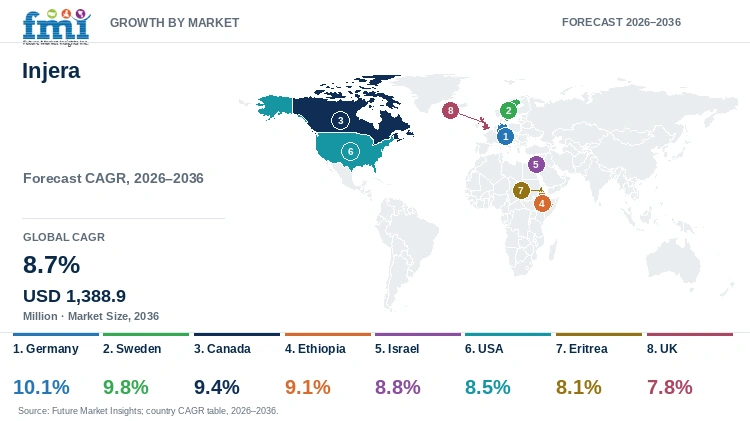
As per FMI, Germany is projected to lead injera expansion across evaluated national markets at a 10.1% CAGR through 2036, whereas the UK is forecast to progress at a 7.8% CAGR. Commercial realization across Europe and North America diaspora hubs with origin markets in Ethiopia and Eritrea depends on cold-chain distribution and verified grain-composition labeling.
Table 7: Country CAGR and Primary Growth Levers for the Injera Market (CAGR percentage and operational drivers), 2026 to 2036
| Country | CAGR (2026 to 2036) | Primary Growth Lever |
|---|---|---|
| Germany | 10.1% | Expanded chilled and frozen supermarket listings and air-freighted Addis Ababa bakery imports |
| Sweden | 9.8% | Consolidated grocery retail distribution and frozen multipack replenishment across urban centers |
| Canada | 9.4% | Long-distance frozen cold-chain fulfillment and strict <20 ppm gluten-free retail auditing |
| Ethiopia | 9.1% | Urban household conversion from home baking to automated commercial Kality-style bakeries |
| Israel | 8.8% | Established Ethiopia-origin community demand and transparent pure-teff retail labeling |
| USA | 8.5% | Automated regional commissaries paired with nationwide specialty and organic teff distribution |
| Eritrea | 8.1% | Daily staple flatbread consumption and institutional urban bakery standardization |
| UK | 7.8% | London teff-milling infrastructure and Prepacked for Direct Sale allergen compliance |
Source: Future Market Insights analysis
Germany Injera Market Outlook (2026 to 2036)
Germany is projected to record a 10.1% CAGR from 2026 to 2036, the fastest expansion among all eight evaluated national markets. Air-freighted fresh multipacks from Addis Ababa bakeries with expanding frozen ethnic-aisle listings in Frankfurt and Berlin supermarkets anchor national demand. In February 2026, the German Federal Statistical Office (Destatis) reported that food prices in Germany rose 2.1% year-on-year in January 2026, encouraging East Africa restaurants to outsource labor-heavy 72-hour batter fermentation to wholesale commissaries [11]. However, food-safety inspectors in Germany enforce strict European Union 20 mg/kg gluten limits whenever retail packages claim pure-teff gluten-free status, requiring commercial bakeries and importers to operate dedicated wheat-free baking and packaging lines across retail supply chains.
Key takeaway: In Germany, restaurant labor outsourcing and mainstream supermarket ethnic-aisle listings are projected to accelerate demand for packaged chilled and frozen injera.
Sweden Injera Market Outlook (2026 to 2036)
High grocery chain concentration in Sweden channels packaged ethnic flatbread volume through centralized chilled and frozen supermarket distribution depots rather than informal neighborhood shops. Commercial injera revenue in Sweden is forecast to expand at a 9.8% CAGR between 2026 and 2036 across metropolitan grocers and municipal catering tenders. In January 2026, a national grain-food assessment published in Current Research in Food Science established that whole-grain nutrient density indices strongly guide Nordic retail sustainability procurement [12]. Because long winter transport distances between Stockholm and northern towns penalize short-life fresh bread, freeze-thaw-stable 5-sheet multipacks remain the decisive commercial format for regional supermarket chains and institutional catering buyers in Sweden.
Key takeaway: In Sweden, centralized supermarket cold chains and Nordic whole-grain nutrition priorities are forecast to favor frozen multipack injera suppliers.
Canada Injera Market Outlook (2026 to 2036)
Long inter-provincial freight corridors between diaspora hubs in Toronto and Calgary make sub-zero pallet stability and verified allergen labeling the primary commercial filters across Canada. In February 2026, a national retail survey of 657 inherently gluten-free grain products in Canada published in Foods found that 99.6% of items carrying a formal gluten-free claim met the 20 mg/kg Codex threshold versus 18.9% contamination in precautionary-labeled items [13]. Injera sales in Canada are anticipated to advance at a 9.4% CAGR through 2036 across supermarket free-from bays and foodservice distributors. National grocery chains in Canada therefore require batch ELISA gluten testing before listing 100% teff injera multipacks across regional distribution centers.
Key takeaway: In Canada, inter-provincial frozen distribution and strict 20 mg/kg gluten verification are anticipated to govern supermarket onboarding of packaged injera.
Ethiopia Injera Market Outlook (2026 to 2036)
Ethiopia represents the global production heartland where fermented teff injera acts as the daily household and institutional table staple rather than a niche specialty item. In February 2025, the World Bank Food Security Update 113 documented persistent domestic cereal price inflation across East Africa, pressuring urban bakeries in Addis Ababa to optimize flour extraction and stove energy use [14]. Busy dual-income household schedules are shifting urban residents from three-day home fermentation toward commercial multipacks, while high teff grain prices push bakeries such as Mama Fresh to run insulated electric mitad lines and calibrated sorghum-teff blends. Commercial injera turnover in Ethiopia is expected to grow at a 9.1% CAGR over 2026 to 2036.
Key takeaway: In Ethiopia, urban dual-income household convenience and energy-efficient commercial mitad bakeries are expected to convert home baking into formal retail sales.
Israel Injera Market Outlook (2026 to 2036)
Israel is estimated to expand at an 8.8% CAGR from 2026 to 2036, supported by an established Ethiopia-origin community and rising mainstream consumption of gluten-free ancient grains. Short domestic transport distances allow commercial bakeries in central Israel to operate daily fresh and chilled delivery routes to neighborhood supermarkets and institutional cafeterias without relying on deep-frozen sea freight. In January 2026, flatbread formulation research published in Foods demonstrated that mineral-salt substitution in gluten-free flatbreads preserves sheet extensibility while lowering sodium and glycemic response [15]. However, supermarket category buyers in Israel require clear Hebrew ingredient declarations separating 100% brown or ivory teff injera from lower-cost wheat-blended sheets.
Key takeaway: In Israel, dense urban delivery routes and transparent pure-teff ingredient labeling are estimated to sustain repeat supermarket and bakery sales.
USA Injera Market Outlook (2026 to 2036)
Domestic irrigated teff cultivation in Idaho and Nevada combined with automated continuous-line baking commissaries in Washington, D.C. and Dallas gives the USA a vertically integrated supply advantage. Commercial injera expenditure in the USA is projected to climb at an 8.5% CAGR between 2026 and 2036 across natural-food supermarkets and restaurant distributors. According to the U.S. Department of Agriculture Economic Research Service in April 2026, food-at-home prices increased 2.3% in 2025, encouraging diaspora and gluten-free households to buy multi-sheet retail packs for home meals [16]. High air-freight rates on Addis Ababa imports continue to favor domestic bakeries milling U.S.-grown Maskal Teff and Bob's Red Mill flours.
Key takeaway: In the USA, domestic teff flour supply chains and automated regional baking commissaries are projected to anchor retail and foodservice injera growth.
Eritrea Injera Market Outlook (2026 to 2036)
Daily household and institutional consumption of fermented teff and sorghum flatbread makes Eritrea a foundational origin market where affordability and fuel availability govern commercial bakery output. In May 2025, the Food Security Information Network Global Report on Food Crises documented regional cereal supply constraints across the Horn of Africa that make composite teff-sorghum milling critical for urban bread stability [17]. Commercial injera demand in Eritrea is slated to progress at an 8.1% CAGR over the 2026 to 2036 forecast period across urban bakeries and public catering kitchens. However, intermittent municipal power grids and limited cold-chain warehousing in Asmara keep commercial sales concentrated in same-day fresh multipacks.
Key takeaway: In Eritrea, urban institutional catering and composite teff-sorghum flour economics are slated to guide formal bakery conversion through 2036.
UK Injera Market Outlook (2026 to 2036)
Dedicated teff-milling infrastructure in London operated by Lovegrass Ethiopia with strict Food Standards Agency allergen rules shapes commercial injera supply across the UK. In May 2026, a cross-sectional audit of major UK restaurant chains published in PLoS Medicine documented wide nutritional variance across out-of-home menus and reinforced retailer scrutiny of sodium and calorie declarations [18]. Because UK Prepacked for Direct Sale (PPDS) regulations require fresh bakery sleeves to display full allergen warnings whenever wheat or barley is co-milled with teff, supermarket category managers strongly favor certified gluten-free 100% teff multipacks. Commercial injera sales in the UK are forecast to advance at a 7.8% CAGR from 2026 to 2036.
Key takeaway: In the UK, local teff-milling capability and strict PPDS allergen labeling compliance are forecast to shape retail and foodservice injera procurement.
Full report country CAGRs cover: North America; Latin America; Western Europe; Eastern Europe; East Asia; South Asia and Pacific; Middle East and Africa.
Who are the notable companies in the injera market?
Mama Fresh Injera, Zelalem Injera, The Teff Company (Maskal Teff), Lovegrass Ethiopia, Bob's Red Mill, and Ardent Mills are the notable companies evaluated in the injera market.
FMI analysis indicates that the competitive ecosystem divides between finished fermented-injera bakeries and upstream specialty teff grain and flour processors. Mama Fresh Injera operates commercial baking and international export routes out of Addis Ababa, while Zelalem Injera pioneered continuous automated baking lines in the USA. Upstream specialists The Teff Company (Maskal Teff) and Lovegrass Ethiopia with Bob's Red Mill and Ardent Mills supply identity-preserved brown and ivory teff flours to commercial injera bakeries, although standalone flour revenue is excluded from finished-injera market sizing.
- Prepared-Injera Bakers and Exporters: Mama Fresh Injera and Zelalem Injera manufacture ready-to-eat fermented sheets for retail grocers and restaurants.
- Specialist Teff Brands and Processors: The Teff Company (Maskal Teff) and Lovegrass Ethiopia manage identity-preserved teff contracting and fine flour milling.
- Diversified Flour and Grain Suppliers: Bob's Red Mill and Ardent Mills distribute bulk 25-pound and industrial tote ancient-grain teff flours across North America.
Competitive Benchmarking: Injera Market
Table 8: Competitive Benchmarking for the Injera Market (qualitative capability ratings), 2026
| Company | Finished-Injera Production | Teff Ingredient Range | Packaged Route to Market | Geographic Reach |
|---|---|---|---|---|
| Mama Fresh Injera | High | Medium | High | Ethiopia; exports to North America; Europe; Middle East |
| Zelalem Injera | Medium | Unscored | Medium | United States (Washington, D.C. and Dallas automated baking) |
| The Teff Company (Maskal Teff) | Unscored | High | High | United States retail and foodservice ingredient channels |
| Lovegrass Ethiopia | Unscored | High | Medium | Ethiopia and UK processing; European specialty food channels |
| Bob's Red Mill | Unscored | Medium | High | United States and international retail and 25-lb bulk foodservice |
| Ardent Mills | Unscored | High | High | North America industrial bakery and foodservice grain milling |
Scoring basis: Finished-Injera Production evaluates verified commercial baking of ready-to-eat fermented injera sheets. Teff Ingredient Range and Packaged Route to Market assess brown/ivory teff flour specifications and retail or B2B distribution, while Unscored indicates that the company supplies upstream grain inputs rather than baked injera sheets.
Key Developments in the Injera Market
- The Teff Company (Maskal Teff) introduced certified organic brown teff flour and organic teff grain for retail and foodservice bakeries in January 2025 [19].
- Bob's Red Mill updated its commercial Gluten-Free 1-to-1 and specialty baking flour shipper specifications in May 2025 [20], aligning with October 2025 food-application research confirming teff flour's water-binding role in gluten-free baking [22].
- Ardent Mills published its 2025 Flour Trend Guide in January 2025 documenting teff and ancient-grain formulations [21] while scaling specialty grain supply across North America commercial bakeries.
Key Players in the Injera Market
Prepared-Injera Bakers and Exporters
- Mama Fresh Injera
- Zelalem Injera
Specialist Teff Brands and Processors
- The Teff Company (Maskal Teff)
- Lovegrass Ethiopia
Diversified Flour and Grain Suppliers
- Bob's Red Mill
- Ardent Mills
Injera Market - Report Scope
Table 9: Report Scope for the Injera Market (coverage fields and definitions), 2026 to 2036
| Coverage field | Report scope |
|---|---|
| Market breakdown | Product Type; Claim / Nature; Format; Packaging Format; Sales Channel |
| Quantitative Units | USD Million |
| Market Definition | Includes commercial sales revenue from prepared, ready-to-eat fermented injera sheets sold through retail and foodservice channels across all listed formats. Category Scope Note: Strictly excludes standalone unbaked teff grain or flour sales, electric mitad griddles, unfermented flatbreads, and full restaurant meal receipts. |
| Regions Covered | North America; Latin America; Western Europe; Eastern Europe; East Asia; South Asia and Pacific; Middle East and Africa |
| Countries Covered | Germany, Sweden, Canada, Ethiopia, Israel, USA, Eritrea, UK, and additional countries in the full report |
| Key Companies Covered | Mama Fresh Injera, Zelalem Injera, The Teff Company (Maskal Teff), Lovegrass Ethiopia, Bob's Red Mill, Ardent Mills |
| Forecast Period | 2026 to 2036 |
| Approach | Primary and secondary research with top-down and bottom-up market triangulation. |
Injera Market - Research Methodology
Table 10: Research Methodology for the Injera Market (research methods and approach), 2026 edition
| Method | Approach |
|---|---|
| Primary Research | Structured interviews with commercial injera bakery operators in Addis Ababa with North America and Europe commissaries, specialty teff millers, and ethnic grocery category buyers to validate fermentation yields and pack pricing. |
| Secondary Research | Analysis of PubMed and Wiley injera fermentation and stove-efficiency studies, EU Regulation 828/2014 and UK PPDS allergen standards, World Bank and FSIN East Africa cereal updates, and corporate flour catalogs. |
| Market Sizing and Forecasting | Top-down ethnic and gluten-free flatbread expenditure models reconciled against bottom-up commercial mitad baking throughput (standardized 310-to-350-gram finished sheet equivalents at a 1:1.5 teff-to-water batter hydration ratio) from 2026 to 2036. |
| Country Forecasting Model | Econometric country projections weight East Africa diaspora household formation, urban dual-income bakery outsourcing in Ethiopia and Eritrea, frozen supermarket listings, and gluten-free retail audits across eight national markets. |
| Operational Benchmark Traceability | Sheet-volume and pricing indicators in Tables 2, 3, and 4 trace to Food Science & Nutrition 72-hour fermentation studies, International Journal of Food Science shelf-life trials, and commercial 5-sheet multipack weights. |
| Data Triangulation and Validation | Demand estimates isolate finished baked injera revenue and exclude upstream teff grain/flour ingredient sales, domestic home-baked consumption, and restaurant stew-platter receipts to eliminate double counting. |
Injera Market by Segments
Injera Market segmented by Product Type:
- Classic / Original
- Whole Grain & Seeded
- Flavored & Filled
- Mini & Snacking Formats
- Premium / Artisan
Injera Market segmented by Claim / Nature:
- Conventional
- Clean Label
- Organic
- Gluten-Free
- High-Protein / Fortified
Injera Market segmented by Format:
- Frozen
- Fresh
- Ambient Packaged
- Chilled
- Par-Baked / Thaw-and-Serve
Injera Market segmented by Packaging Format:
- Multipack
- Single-Serve
- Family / Loaf Pack
- Bulk Foodservice
Injera Market segmented by Sales Channel:
- Supermarkets & Hypermarkets
- Artisan & Specialty Bakeries
- Convenience & Forecourt
- Online & DTC
- Foodservice Distributors
Injera Market by Region
- North America
- United States
- Canada
- Latin America
- Brazil
- Mexico
- Argentina
- Chile
- Western Europe
- Germany
- France
- United Kingdom
- Italy
- Spain
- Benelux
- Nordics
- Eastern Europe
- Poland
- Czech Republic
- Romania
- Hungary
- East Asia
- China
- Japan
- South Korea
- South Asia and Pacific
- India
- ASEAN
- Australia and New Zealand
- Middle East and Africa
- GCC Countries
- South Africa
- Türkiye
- Israel
Research Sources and Bibliography
- [1] Abebe, H., Legassa, O., & Mengistu, G. (2026, June 25). Impact of Injera Baking Stoves on Injera Quality: A Comprehensive Assessment. Journal of Food Processing and Preservation, 2026, 8854993.
- [2] Cherinet, Y. L., Tenagashaw, M. W., & Ambaw, B. A. (2026, March 8). Effect of Blending Ratio and Fermentation Time on the Quality and Acceptability of Injera Produced from a Composite of Teff, Maize, and Potato Flours. Food Science & Nutrition, 14(3), e71606 (PubMed PMID 41804344).
- [3] Abera, S., Bekele, T., & Tadesse, A. (2025, January 30). Development of Nutrient-Rich Injera Using Amaranthus Leaf/Grain and Teff Flours: A Study on Nutritional Value, Sensory Characteristics, and Storage Stability. International Journal of Food Science, 2025, 2877941 (PubMed PMID 39949858).
- [4] Yehuala, T. F., Atlabachew, M., Aslam, M. F., Allen, L., Griffith, H., Ward, J. L., & Shewry, P. R. (2025, July 9). Fermentation Kinetics and Changes in Levels of Antinutrients in Pearl Millet and Pearl Millet-Maize Composite Dough Recipes Used to Prepare Injera. Food Science & Nutrition, 13(7), e70598 (PubMed PMID 40641565).
- [5] Kassahun, E., Tamene, A., & Tadesse, Y. (2025, February 1). Nutritional and anti-nutritional evaluation of injera made from Sorghum, Rice, Teff, and Flaxseed flours using D-optimal mixture design. Scientific Reports, 15(1), 3959 (PubMed PMID 39893231).
- [6] Amare, E., Villaluenga, C. M., & Peñas, E. (2025, May 15). Unveiling the nutritional composition and bioactivity of Ethiopian native fermented foods: Kocho and Injera. Food Chemistry, 475, 143210 (PubMed PMID 39919426).
- [7] Humblot, C., Turpin, W., & Guyot, J. P. (2025, January 2). The use of propionic and lactic acid bacteria to produce cobalamin and folate in injera, an Ethiopian cereal-based fermented food. International Journal of Food Microbiology, 426, 110909 (PubMed PMID 39288569).
- [8] Ferențiu, I., Pop, T. I., Pârvu, A. E., & Morar, I. I. (2026, February 13). White Teff Flour Ethanolic Extract: Phytochemical Profile, Antioxidant and Anti-Inflammatory Activity. Molecules, 31(4), 644 (PubMed PMID 41752421).
- [9] Harasym, J., & Oledzki, R. (2025, December 18). Functional and Rheological Properties of Gluten-Free Flour Blends from Brown Eragrostis tef (Zucc.) Trotter and Glycine max (L.) Merr. Molecules, 30(24), 4817 (PubMed PMID 41471838).
- [10] Silva, R. C., Pirozi, M. R., & Minim, V. P. R. (2026, January 15). Enhancing Gluten-Free Bread With Whole Flours From Forage Palm, Buckwheat, and Teff: Physicochemical Composition, Technological Properties, and Sensory Evaluation. Journal of Food Science, 91(1), e70812 (PubMed PMID 41491645).
- [11] German Federal Statistical Office. (2026, February 17). Inflation rate at +2.1% in January 2026. Statistisches Bundesamt (Destatis).
- [12] Eriksson, M., & Röös, E. (2026, January 12). Nutritional quality indicators as complementary functional units for the sustainability assessment of grain-based foods in Sweden. Current Research in Food Science, 12, 101310 (PubMed PMID 41625288).
- [13] Gélinas, P., McKinnon, C., & Mena, M. C. (2026, February 10). Canadian Retail Survey of Gluten-Free Products and Precautionary Labelling. Foods, 15(4), 618 (PubMed PMID 42000041).
- [14] World Bank Group. (2025, February 14). Food Security Update 113: Global and East Africa Cereal Market Developments. The World Bank.
- [15] Talavera-Bianchi, M., & Vázquez-Araújo, L. (2026, January 26). Substitution of Salt with Choline Chloride in Double-Layer Flatbreads. Foods, 15(3), 412 (PubMed PMID 41586942).
- [16] U.S. Department of Agriculture, Economic Research Service. (2026, April 30). U.S. food-at-home prices increased 2.3 percent in 2025, compared with 2024. USDA Economic Research Service.
- [17] Food Security Information Network / World Food Programme. (2025, May 16). Global Report on Food Crises (GRFC) 2025. Food Security Information Network (FSIN).
- [18] Scarborough, P., & Kaur, A. (2026, May 5). Adherence to voluntary UK sugar, salt, and calorie reduction targets in the highest-grossing restaurant chains: A cross-sectional study. PLoS Medicine, 23(5), e1004681 (PubMed PMID 42085343).
- [19] The Teff Company / Specialty Food Association. (2025, January 6). Maskal Teff Introduces Certified Organic Teff Flour and Teff Grain for Retail and Foodservice. Specialty Food Association Member Press Releases.
- [20] Bob's Red Mill Natural Foods. (2025, May 9). Gluten Free 1-to-1 Baking Flour and Specialty Almond Flour Commercial Shipper Specifications. Bob's Red Mill Official Document Center.
- [21] Ardent Mills. (2025, January 21). CPG, Bread & Bakery Flour Trend Guide: The 2025 (and Beyond) Flour Trend Guide. Ardent Mills Insights.
- [22] Gebru, Y. A., Sbhatu, D. B., & Kim, K. P. (2025, October 15). Nutritional Characteristics, Health-Related Properties, and Food Applications of Teff (Eragrostis tef). Foods / PubMed Central PMC12524473.
- [23] Acar, C., & Bilgiçli, N. (2025, July 10). Effect of teff and flaxseed flours on physicochemical, textural, and sensory properties of gluten-free noodles. Journal of the Science of Food and Agriculture, 105(14), 6812-6821 (PubMed PMID 40635519).
This bibliography is provided for reader reference and is not exhaustive. The full report contains the complete reference list and detailed citations.
This Report Answers
- How large is the injera market in 2026 and what is forecast for 2036?
- Which staple-food and cold-chain pressures support commercial injera demand?
- Why does Classic / Original lead the Product Type segment in 2026?
- Why does Conventional remain the largest Claim / Nature segment globally?
- How do growth rates differ across Germany and Sweden versus Canada and Ethiopia?
- Which leading companies bake finished injera versus supplying upstream teff flours?
- What limits adoption of packaged or frozen injera and supplier switching?
- What should buyers evaluate before purchasing commercial injera packs?
Frequently Asked Questions
How big is the injera market in 2026, and what is forecast for 2036?
According to FMI, global prepared injera revenue is estimated to reach USD 603.1 million in 2026 from USD 554.8 million in 2025. Sales are forecast to hit USD 1,388.9 million by 2036 as urban households and restaurants transition from home baking to commercial multipacks.
What is the CAGR for the injera market from 2026 to 2036?
Future Market Insights projects an 8.7% compound annual growth rate between 2026 and 2036, representing an anticipated USD 785.8 million increase in annual finished-injera revenue across retail and foodservice channels.
Which Product Type segment leads the injera market?
Classic / Original is projected to capture 37.0% of the Product Type segment in 2026 because traditional lactic-acid sourness and uniform surface eyes with rollable elasticity define stew-based meal service.
Which Claim / Nature segment leads the injera market?
Conventional formulations are estimated to secure 55.0% of the Claim / Nature segment in 2026 as high-frequency staple buyers prioritize affordable sheet pricing over specialty certification seals.
Which country has a notable growth outlook during the assessment period?
Germany is projected to lead evaluated national growth at a 10.1% CAGR through 2036, supported by air-freighted Addis Ababa bakery imports and expanding frozen ethnic-aisle supermarket listings.
Who are the key players in the market?
Mama Fresh Injera, Zelalem Injera, The Teff Company (Maskal Teff), Lovegrass Ethiopia, Bob's Red Mill, and Ardent Mills are the notable companies evaluated across commercial prepared-injera bakeries and upstream teff grain and flour processors.
Preview the report firsthand - request a free sample
Get SampleGet the brochure for pricing and purchase details.
Get PDFTable of Content
- Key Takeaways
- Market Size and CAGR
- Top Growth Driver
- Fastest Growing Segment
- Leading Region
- Key Companies
- Emerging Opportunities
- Executive Summary
- Global Market Outlook
- Demand-side Trends
- Supply-side Trends
- Technology Roadmap Analysis
- Analysis and Recommendations
- Analyst Perspective (What is happening? Why now? What should investors know?)
- Key Questions Answered
- How large is the market?
- What is the CAGR?
- What are key trends?
- Which region dominates?
- Who are the leaders?
- Market Overview
- Market Coverage / Taxonomy
- Market Definition / Scope / Limitations
- Research Methodology
- Chapter Orientation
- Analytical Lens and Working Hypotheses
- Market Structure, Signals, and Trend Drivers
- Benchmarking and Cross-market Comparability
- Market Sizing, Forecasting, and Opportunity Mapping
- Research Design and Evidence Framework
- Desk Research Programme (Secondary Evidence)
- Expert Input and Fieldwork (Primary Evidence)
- Tooling, Models, and Reference Databases
- Data Engineering and Model Build
- Quality Assurance and Audit Trail
- Market Background
- Market Dynamics (Drivers, Restraints, Opportunity, Trends)
- Scenario Forecast (Optimistic, Likely, Conservative)
- Impact Analysis
- AI Impact
- Sustainability Impact
- Regulatory Impact
- Technology Impact
- Consumer / Buyer Analysis
- Purchase Drivers
- Adoption Barriers
- Buyer Journey
- Opportunity Map Analysis
- Product Life Cycle Analysis
- Supply Chain Analysis
- Investment Feasibility Matrix
- Value Chain Analysis
- PESTLE and Porter's Analysis
- Regulatory Landscape
- Regional Parent Market Outlook
- Production and Consumption Statistics
- Import and Export Statistics
- Global Market Analysis and Forecast, 2021 to 2036
- Historical Market Size Value (USD Million) Analysis, 2021 to 2025
- Current and Future Market Size Value (USD Million) Projections, 2026 to 2036
- Y-o-Y Growth Trend Analysis
- Absolute $ Opportunity Analysis
- Global Market Pricing Analysis, 2021 to 2036
- Global Market Analysis and Forecast, By Product Type, 2021 to 2036
- Introduction / Key Findings
- Historical Market Size Value (USD Million) Analysis By Product Type, 2021 to 2025
- Current and Future Market Size Value (USD Million) Analysis and Forecast By Product Type, 2026 to 2036
- Classic / Original
- Whole Grain & Seeded
- Flavored & Filled
- Mini & Snacking Formats
- Premium / Artisan
- Y-o-Y Growth Trend Analysis By Product Type, 2021 to 2025
- Absolute $ Opportunity Analysis By Product Type, 2026 to 2036
- Global Market Analysis and Forecast, By Claim / Nature, 2021 to 2036
- Introduction / Key Findings
- Historical Market Size Value (USD Million) Analysis By Claim / Nature, 2021 to 2025
- Current and Future Market Size Value (USD Million) Analysis and Forecast By Claim / Nature, 2026 to 2036
- Conventional
- Clean Label
- Organic
- Gluten-Free
- High-Protein / Fortified
- Y-o-Y Growth Trend Analysis By Claim / Nature, 2021 to 2025
- Absolute $ Opportunity Analysis By Claim / Nature, 2026 to 2036
- Global Market Analysis and Forecast, By Format, 2021 to 2036
- Introduction / Key Findings
- Historical Market Size Value (USD Million) Analysis By Format, 2021 to 2025
- Current and Future Market Size Value (USD Million) Analysis and Forecast By Format, 2026 to 2036
- Frozen
- Fresh
- Ambient Packaged
- Chilled
- Par-Baked / Thaw-and-Serve
- Y-o-Y Growth Trend Analysis By Format, 2021 to 2025
- Absolute $ Opportunity Analysis By Format, 2026 to 2036
- Global Market Analysis and Forecast, By Packaging Format, 2021 to 2036
- Introduction / Key Findings
- Historical Market Size Value (USD Million) Analysis By Packaging Format, 2021 to 2025
- Current and Future Market Size Value (USD Million) Analysis and Forecast By Packaging Format, 2026 to 2036
- Multipack
- Single-Serve
- Family / Loaf Pack
- Bulk Foodservice
- Y-o-Y Growth Trend Analysis By Packaging Format, 2021 to 2025
- Absolute $ Opportunity Analysis By Packaging Format, 2026 to 2036
- Global Market Analysis and Forecast, By Sales Channel, 2021 to 2036
- Introduction / Key Findings
- Historical Market Size Value (USD Million) Analysis By Sales Channel, 2021 to 2025
- Current and Future Market Size Value (USD Million) Analysis and Forecast By Sales Channel, 2026 to 2036
- Supermarkets & Hypermarkets
- Artisan & Specialty Bakeries
- Convenience & Forecourt
- Online & DTC
- Foodservice Distributors
- Y-o-Y Growth Trend Analysis By Sales Channel, 2021 to 2025
- Absolute $ Opportunity Analysis By Sales Channel, 2026 to 2036
- Global Market Analysis and Forecast, By Region, 2021 to 2036
- Introduction
- Historical Market Size Value (USD Million) Analysis By Region, 2021 to 2025
- Current Market Size Value (USD Million) Analysis and Forecast By Region, 2026 to 2036
- North America
- Latin America
- Western Europe
- Eastern Europe
- East Asia
- South Asia and Pacific
- Middle East and Africa
- Market Attractiveness Analysis By Region
- North America Market Analysis and Forecast, By Country, 2021 to 2036
- Historical Market Size Value (USD Million) Trend Analysis By Market Taxonomy, 2021 to 2025
- Market Size Value (USD Million) Forecast By Market Taxonomy, 2026 to 2036
- By Country
- United States
- Canada
- By Product Type
- By Claim / Nature
- By Format
- By Packaging Format
- By Sales Channel
- By Country
- Market Attractiveness Analysis
- By Country
- By Product Type
- By Claim / Nature
- By Format
- By Packaging Format
- By Sales Channel
- Key Takeaways
- Latin America Market Analysis and Forecast, By Country
- Historical Market Size Value (USD Million) Trend Analysis By Market Taxonomy, 2021 to 2025
- Market Size Value (USD Million) Forecast By Market Taxonomy, 2026 to 2036
- By Country
- Brazil
- Mexico
- Argentina
- Chile
- By Product Type
- By Claim / Nature
- By Format
- By Packaging Format
- By Sales Channel
- By Country
- Market Attractiveness Analysis
- By Country
- By Product Type
- By Claim / Nature
- By Format
- By Packaging Format
- By Sales Channel
- Key Takeaways
- Western Europe Market Analysis and Forecast, By Country
- Historical Market Size Value (USD Million) Trend Analysis By Market Taxonomy, 2021 to 2025
- Market Size Value (USD Million) Forecast By Market Taxonomy, 2026 to 2036
- By Country
- Germany
- France
- United Kingdom
- Italy
- Spain
- Benelux
- Nordics
- By Product Type
- By Claim / Nature
- By Format
- By Packaging Format
- By Sales Channel
- By Country
- Market Attractiveness Analysis
- By Country
- By Product Type
- By Claim / Nature
- By Format
- By Packaging Format
- By Sales Channel
- Key Takeaways
- Eastern Europe Market Analysis and Forecast, By Country
- Historical Market Size Value (USD Million) Trend Analysis By Market Taxonomy, 2021 to 2025
- Market Size Value (USD Million) Forecast By Market Taxonomy, 2026 to 2036
- By Country
- Poland
- Czech Republic
- Romania
- Hungary
- By Product Type
- By Claim / Nature
- By Format
- By Packaging Format
- By Sales Channel
- By Country
- Market Attractiveness Analysis
- By Country
- By Product Type
- By Claim / Nature
- By Format
- By Packaging Format
- By Sales Channel
- Key Takeaways
- East Asia Market Analysis and Forecast, By Country
- Historical Market Size Value (USD Million) Trend Analysis By Market Taxonomy, 2021 to 2025
- Market Size Value (USD Million) Forecast By Market Taxonomy, 2026 to 2036
- By Country
- China
- Japan
- South Korea
- By Product Type
- By Claim / Nature
- By Format
- By Packaging Format
- By Sales Channel
- By Country
- Market Attractiveness Analysis
- By Country
- By Product Type
- By Claim / Nature
- By Format
- By Packaging Format
- By Sales Channel
- Key Takeaways
- South Asia and Pacific Market Analysis and Forecast, By Country
- Historical Market Size Value (USD Million) Trend Analysis By Market Taxonomy, 2021 to 2025
- Market Size Value (USD Million) Forecast By Market Taxonomy, 2026 to 2036
- By Country
- India
- ASEAN
- Australia and New Zealand
- By Product Type
- By Claim / Nature
- By Format
- By Packaging Format
- By Sales Channel
- By Country
- Market Attractiveness Analysis
- By Country
- By Product Type
- By Claim / Nature
- By Format
- By Packaging Format
- By Sales Channel
- Key Takeaways
- Middle East and Africa Market Analysis and Forecast, By Country
- Historical Market Size Value (USD Million) Trend Analysis By Market Taxonomy, 2021 to 2025
- Market Size Value (USD Million) Forecast By Market Taxonomy, 2026 to 2036
- By Country
- GCC Countries
- South Africa
- Türkiye
- Israel
- By Product Type
- By Claim / Nature
- By Format
- By Packaging Format
- By Sales Channel
- By Country
- Market Attractiveness Analysis
- By Country
- By Product Type
- By Claim / Nature
- By Format
- By Packaging Format
- By Sales Channel
- Key Takeaways
- Key Countries Market Analysis
- United States
- Pricing Analysis
- Market Share Analysis, 2025
- By Product Type
- By Claim / Nature
- By Format
- By Packaging Format
- By Sales Channel
- Canada
- Pricing Analysis
- Market Share Analysis, 2025
- By Product Type
- By Claim / Nature
- By Format
- By Packaging Format
- By Sales Channel
- Mexico
- Pricing Analysis
- Market Share Analysis, 2025
- By Product Type
- By Claim / Nature
- By Format
- By Packaging Format
- By Sales Channel
- Brazil
- Pricing Analysis
- Market Share Analysis, 2025
- By Product Type
- By Claim / Nature
- By Format
- By Packaging Format
- By Sales Channel
- Chile
- Pricing Analysis
- Market Share Analysis, 2025
- By Product Type
- By Claim / Nature
- By Format
- By Packaging Format
- By Sales Channel
- Germany
- Pricing Analysis
- Market Share Analysis, 2025
- By Product Type
- By Claim / Nature
- By Format
- By Packaging Format
- By Sales Channel
- United Kingdom
- Pricing Analysis
- Market Share Analysis, 2025
- By Product Type
- By Claim / Nature
- By Format
- By Packaging Format
- By Sales Channel
- Italy
- Pricing Analysis
- Market Share Analysis, 2025
- By Product Type
- By Claim / Nature
- By Format
- By Packaging Format
- By Sales Channel
- Spain
- Pricing Analysis
- Market Share Analysis, 2025
- By Product Type
- By Claim / Nature
- By Format
- By Packaging Format
- By Sales Channel
- France
- Pricing Analysis
- Market Share Analysis, 2025
- By Product Type
- By Claim / Nature
- By Format
- By Packaging Format
- By Sales Channel
- India
- Pricing Analysis
- Market Share Analysis, 2025
- By Product Type
- By Claim / Nature
- By Format
- By Packaging Format
- By Sales Channel
- ASEAN
- Pricing Analysis
- Market Share Analysis, 2025
- By Product Type
- By Claim / Nature
- By Format
- By Packaging Format
- By Sales Channel
- Australia and New Zealand
- Pricing Analysis
- Market Share Analysis, 2025
- By Product Type
- By Claim / Nature
- By Format
- By Packaging Format
- By Sales Channel
- China
- Pricing Analysis
- Market Share Analysis, 2025
- By Product Type
- By Claim / Nature
- By Format
- By Packaging Format
- By Sales Channel
- Japan
- Pricing Analysis
- Market Share Analysis, 2025
- By Product Type
- By Claim / Nature
- By Format
- By Packaging Format
- By Sales Channel
- South Korea
- Pricing Analysis
- Market Share Analysis, 2025
- By Product Type
- By Claim / Nature
- By Format
- By Packaging Format
- By Sales Channel
- Poland
- Pricing Analysis
- Market Share Analysis, 2025
- By Product Type
- By Claim / Nature
- By Format
- By Packaging Format
- By Sales Channel
- Hungary
- Pricing Analysis
- Market Share Analysis, 2025
- By Product Type
- By Claim / Nature
- By Format
- By Packaging Format
- By Sales Channel
- Türkiye
- Pricing Analysis
- Market Share Analysis, 2025
- By Product Type
- By Claim / Nature
- By Format
- By Packaging Format
- By Sales Channel
- South Africa
- Pricing Analysis
- Market Share Analysis, 2025
- By Product Type
- By Claim / Nature
- By Format
- By Packaging Format
- By Sales Channel
- Sweden
- Pricing Analysis
- Market Share Analysis, 2025
- By Product Type
- By Claim / Nature
- By Format
- By Packaging Format
- By Sales Channel
- Ethiopia
- Pricing Analysis
- Market Share Analysis, 2025
- By Product Type
- By Claim / Nature
- By Format
- By Packaging Format
- By Sales Channel
- Israel
- Pricing Analysis
- Market Share Analysis, 2025
- By Product Type
- By Claim / Nature
- By Format
- By Packaging Format
- By Sales Channel
- Eritrea
- Pricing Analysis
- Market Share Analysis, 2025
- By Product Type
- By Claim / Nature
- By Format
- By Packaging Format
- By Sales Channel
- United States
- Market Structure Analysis
- Competition Dashboard
- Competition Benchmarking
- Market Share Analysis of Top Players
- By Regional
- By Product Type
- By Claim / Nature
- By Format
- By Packaging Format
- By Sales Channel
- Emerging Startups
- Innovation Benchmarking
- Competition Analysis
- Competition Deep Dive
- Mama Fresh Injera
- Overview
- Product Portfolio
- Profitability by Market Segments
- Sales Footprint
- Strategy Overview
- Marketing Strategy
- Product Strategy
- Channel Strategy
- Zelalem Injera
- The Teff Company (Maskal Teff)
- Lovegrass Ethiopia
- Bob's Red Mill
- Ardent Mills
- Mama Fresh Injera
- Case Studies
- Success Stories
- Recent Developments
- Competition Deep Dive
- Assumptions & Acronyms Used


