

- Market Size (2026)
- USD 621.1 Mn
- Forecast (2036)
- USD 1041.0 Mn
- CAGR (2026 to 2036)
- 5.3%
How big is Isothermal Pallet Covers Market in 2026?
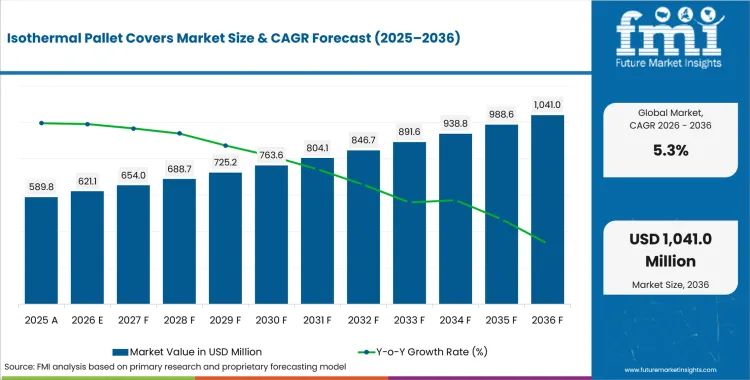
USD 621.1 Million in 2026 and USD 1,041.0 Million by 2036 at a 5.3% CAGR.
Demand for isothermal pallet covers is projected to rise at 5.3% CAGR between 2026 and 2036 as palletized goods pass through more short uncontrolled transfers. The USA Census Bureau reported in August 2026 that second-quarter retail e-commerce sales reached USD 340.2 billion and represented 17.1% of total retail sales. More fulfillment handoffs increase the number of docks and yards where cold chain packaging must control exposure without assigning every pallet to powered equipment.
Country qualification thresholds differ because heat exposure and handling intensity change the proof required before purchase. GASTAT reported in December 2025 that Saudi Arabia’s retail e-commerce sales index rose 33.9% year on year in the third quarter. The increase matters in a high-heat market because denser digital distribution places more loads into transfer and staging workflows. UAE programs place similar weight on solar-load evidence, while France requires sustainable packaging recovery instructions that fit high-volume parcel operations.
Key Takeaways
- More pallet transfers through docks and staging points support isothermal pallet cover demand during brief exposure outside controlled environments.
- By format type, standard formats are estimated to hold 45.0% in 2026 owing to repeatable dimensions that simplify specification and warehouse handling.
- In 2026, paper-based systems are expected to lead material with 35.0% share because established recovery routes simplify fiber-based end-of-life handling.
- Standard duty is set to lead the performance class with 37.0% share in 2026 due to frequent short exposure windows during pallet handling.
- Adoption slows when passive covers cannot prove performance for the actual solar load and dwell period or when handling labor offsets risk reduction.
- Some of the key players in this market include Cold Chain Technologies, CSafe, Mettcover Global, Peli BioThermal, QProducts & Services, Nordic Cold Chain Solutions, Pregis, and Ranpak.
Analyst Perspective
"Isothermal pallet covers earn value when packaging engineers match cover construction to the actual solar load and dwell window instead of comparing insulation thickness alone. Commercial evaluation should weigh lane-test evidence and fitting labor against the cost of moving the same shipment into a qualified pallet shipper."
- Nandini Roy Choudhury, Principal Consultant, Future Market Insights
How is the isothermal pallet covers market segmented?
The market covers format type, material, performance class, end use, sales channel and region.
The taxonomy covers format type, material, performance class, end use, sales channel and region. Format types include standard, recyclable-optimized, premium and branded, and custom-engineered formats. Materials cover paper-based, foam, air and film, and thermal insulated systems. Performance classes include standard duty, heavy duty and temperature-assured. End uses cover e-commerce and parcel, electronics and industrial, pharma and healthcare, and food and grocery. Sales channels include direct accounts, packaging distributors and online B2B.
Why do standard formats lead the format type category?
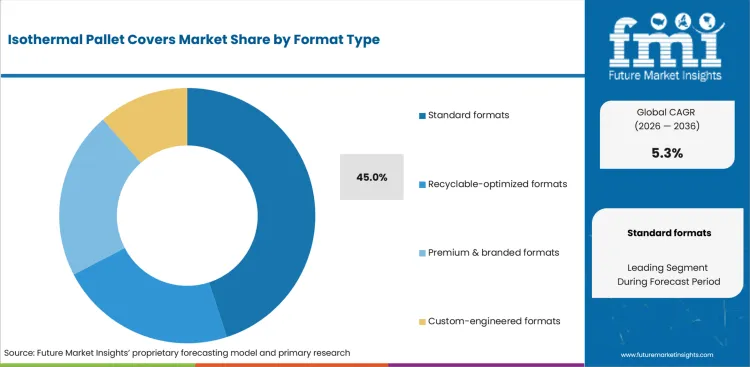
Standard formats fit recurring pallet sizes and let transport packaging teams use one fitting procedure across multiple lanes. Their commercial value comes from lowering specification effort without implying that every route needs identical thermal protection. Standard sizing also simplifies stock planning when the same cover family serves several facilities and recurring customer programs.
- By format type, standard formats are estimated to hold 45.0% in 2026 owing to repeatable dimensions that reduce ordering and fitting variation.
- EPAL reported in November 2025 that more than 675 million Euro pallets were circulating worldwide, giving cover manufacturers a large standardized load base for repeatable sizing.
Why do paper-based systems lead the material category?
Paper-based systems suit operations that already recover paper packaging and need short-duration insulation without managing a reusable asset pool. Humidity and compression still determine whether a fiber construction can survive the intended lane without tearing or losing insulating structure. That tradeoff keeps material selection tied to route conditions instead of a broad preference for fiber.
- In 2026, paper-based systems are expected to lead the material category with 35.0% share because established paper recovery routes simplify end-of-life instructions.
- The European Commission reported in August 2026 that PPWR rules began applying across the EU, making material composition and recovery evidence more consequential during paper-based cover qualification.
Why does standard duty lead the performance class category?
Standard-duty covers address brief staging and transfer exposure without assuming multiday temperature assurance. The segment suits loads needing heat-gain moderation around docks or yards while passive temperature-controlled packaging protects the longer route. Fast application also matters in high-volume cross-dock operations because added labor directly weakens adoption economics.
- Standard duty is set to lead the performance class with 37.0% share in 2026 due to frequent short exposure windows during routine pallet handling.
- ThermoSafe launched the ChillTherm Bio pallet shipper in April 2025 with 120-hour performance at 2°C to 8°C, illustrating the higher qualification path used for longer pharmaceutical exposure.
What supports e-commerce & parcel in the end use category?
E-commerce and parcel operations generate frequent handoffs between fulfillment centers and transport nodes where pallets face short ambient exposure. E-commerce packaging must fit high-throughput workflows because added labor can erase passive protection economics. Receiving sites also need clear recovery instructions that do not interrupt normal pallet handling.
- By end use, e-commerce and parcel is forecast to represent 35.0% in 2026 driven by distributed fulfillment that raises transitional pallet movements.
- France's economy ministry reported in April 2025 that nearly 1.5 billion parcels are delivered annually, increasing the number of loading and staging events that packaging teams must control.
What are the drivers, restraints and opportunities in the Isothermal Pallet Covers Market?
More short pallet exposures support demand, lane-specific qualification limits higher-risk use, and reusable or recyclable covers offer the clearest route to broader commercial adoption.
- Driver: Parcelized and temperature-sensitive distribution increases short handoffs where pallet loads can sit outside conditioned space.
- Restraint: Passive insulation cannot replace a qualified shipper or active system when temperature limits and exposure duration are strict.
- Opportunity: Reusable or recoverable cover designs can reduce disposal burden when manufacturers document thermal performance across defined pallet lanes.
More Transfer Points Increase Short Exposure Risk
Parcelized distribution puts more pallet loads into brief staging periods between controlled facilities and final delivery points. The Office for National Statistics reported in June 2026 that online sales represented 28.8% of British retail spending in May and were 12.2% higher year on year. More handoffs increase the number of short exposure gaps that temperature controlled packaging must cover without powered equipment.
Lane Qualification Limits Higher-Risk Use
Thermal covers face a higher approval burden when shipment risk depends on narrow temperature limits or long dwell periods. Cold Chain Technologies reported in September 2025 that it had defined comparative criteria and begun initial thermal-cover testing at CCT Madrid. Pharmaceutical cold chain teams need lane evidence before assigning a passive cover a higher-risk role because wider approval depends on comparable field conditions.
Reusable Covers Shift the Cost Discussion
Reusable covers change the cost equation only when inspection and return handling are organized across shipping locations. Peli BioThermal partnered with Polar Group in March 2026 to extend sales and leasing support for reusable and single-use cold-chain systems across Brazil. That service route can support reusable cold chain packaging programs if cleaning and reverse-logistics costs stay below repeated single-use purchasing.
Which country CAGRs are profiled in the Isothermal Pallet Covers Market?
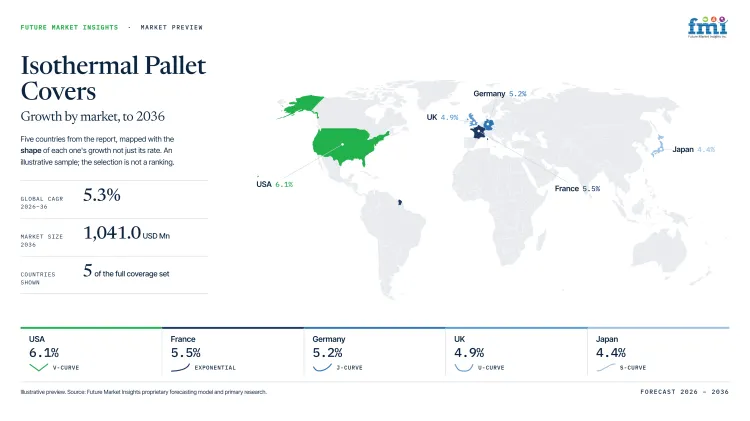
| Country | CAGR |
|---|---|
| UAE | 6.7% |
| Saudi Arabia | 6.4% |
| USA | 6.1% |
| South Korea | 5.8% |
| France | 5.5% |
How do country-level CAGRs compare in the Isothermal Pallet Covers Market?
The profiled range spans 1.2 percentage points from UAE at 6.7% CAGR to France at 5.5% through 2036. UAE and Saudi Arabia form an upper heat-exposure group while USA follows on freight scale. South Korea and France cluster lower as dense digital distribution produces transfers under different climate and recovery conditions.
- UAE airport logistics expose sensitive pallets to sharp outdoor heat during transfers.
- Saudi Arabia’s road lanes make loading delays costly for sensitive freight.
- USA freight scale rewards standard covers backed by repeatable lane-test evidence nationwide.
- South Korea’s fulfillment favors covers that fit quickly during dispatch operations.
- France pairs high parcel volume with stricter packaging recovery checks during qualification.
Comparable CAGRs therefore mask different order-conversion economics across national operating routes today. The full report provides country-level CAGR analysis across North America, Latin America, Europe, East Asia, South Asia, Oceania and the Middle East and Africa.
Country-wise Analysis
- UAE pharmaceutical and perishables lanes pass through airport ramps and free-zone warehouses where intense solar exposure changes quickly between conditioned spaces, while the Emirates Drug Establishment reported more than 568 medical-warehouse inspection visits in March 2026. Isothermal pallet cover demand in UAE is forecast to expand at 6.7% CAGR through 2036 as regulated healthcare distribution keeps short outdoor handoffs visible during qualification. Regional inspection activity supports spending on documented handling controls, but new entrants still need hot-lane tests and rapid local replenishment because generic insulation claims do not resolve performance risk across recurring airport and regional healthcare distribution programs.
- Saudi distribution networks depend on long road lanes between Riyadh and Jeddah with major airport logistics zones, which makes loading delays and trailer transfers material exposure points for food and healthcare pallets. GASTAT reported in December 2025 that the retail-trade operating-revenue index rose 17.0% year on year during the third quarter, yet severe summer heat keeps thermal evidence central to commercial approval for passive protection. The Saudi isothermal pallet covers sector is projected to record 6.4% CAGR during the assessment period as expanding logistics capacity rewards firms that pair heat-lane data with distributor training and clear escalation rules for refrigeration.
- USA shippers move palletized goods through large warehouse and truck-terminal networks where standardized handling must coexist with lane-specific thermal risk, and BTS reported USD 94.2 billion in trucked North American transborder freight during March 2025. USA is estimated to post 6.1% CAGR over the forecast period because freight scale increases the number of exposed transfer points that can justify lightweight pallet protection. National logistics coverage makes broad account access possible, but approval ownership differs across food and healthcare programs so manufacturers need rapid fitting plus documented exposure limits and escalation rules for loads requiring active control nationally.
- South Korean fulfillment networks compress high order volumes into dense urban corridors where packing labor and removal speed can decide whether an extra protective layer survives operational review. The Ministry of Data and Statistics reported in July 2026 that May online-shopping transaction value reached KRW 25.013 trillion and grew 10.3% year on year, but fast dispatch leaves little tolerance for complicated fitting. Adoption of isothermal pallet covers in South Korea is estimated to expand at 5.8% CAGR through 2036 since compact standard formats and local validation partners help convert trial use into routine purchasing across pharmaceutical and food programs.
- French parcel and grocery hubs process frequent consolidation moves where pallets leave controlled interiors briefly, and FEVAD reported in February 2026 that France recorded 3.2 billion online transactions during 2025 with transaction count rising 10%. France's isothermal pallet covers outlook is anticipated to advance at 5.5% CAGR over the assessment period as dense parcel activity keeps short transfer exposure commercially relevant. Established recovery infrastructure supports paper-based designs, but labor cost and tighter packaging obligations make unnecessary material hard to defend so entrants need low-touch fitting and commercial lane tests that quantify exposure reduction at scale before wider approval.
Who are the notable companies in the Isothermal Pallet Covers Market?
Cold Chain Technologies, CSafe, Mettcover Global, Peli BioThermal, QProducts & Services, Nordic Cold Chain Solutions, Pregis and Ranpak are the notable companies serving this market.
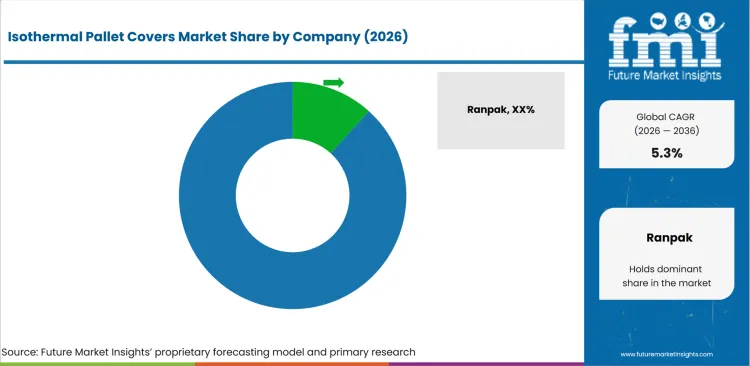
Competition is fragmented between direct thermal-cover specialists and broader cold-chain packaging platforms. Entry barriers depend on test depth, reusable-service infrastructure and the ability to prove pallet-scale performance across live lanes. A thermal liner position can support adjacent demand, but exact-market credibility requires evidence that the company can protect full pallet loads under defined exposure conditions.
- Cold Chain Technologies, CSafe and Mettcover Global hold direct thermal-cover positions with broader temperature-control portfolios.
- Peli BioThermal, QProducts & Services and Nordic Cold Chain Solutions compete on regulated logistics support and pallet-scale passive protection.
- Pregis and Ranpak bring fiber-based thermal materials and packaging-engineering routes that can influence recyclable pallet-cover design.
Competitive Benchmarking: Isothermal Pallet Covers Market
| Company | Thermal-Cover Breadth | Qualification Support | Reuse and Recovery Route | Geographic Reach |
|---|---|---|---|---|
| Cold Chain Technologies | High | High | High | Global |
| CSafe | Medium | High | High | Global |
| Mettcover Global | High | High | Medium | North America, Europe, Asia and Australia |
| Peli BioThermal | Low | High | High | Global |
| QProducts & Services | Medium | Medium | Medium | International project coverage with North American base |
| Nordic Cold Chain Solutions | High | High | High | North America |
| Pregis | Low | High | Medium | North America and Europe |
| Ranpak | Low | Low | Medium | North America and Europe |
Scoring basis: High thermal-cover breadth requires multiple verified pallet-cover constructions or a cover plus another pallet-scale format. Medium identifies one cover family with broader cold-chain support, while Low identifies an adjacent pallet-scale or thermal-material format. High qualification support requires documented test programs or validation services for complex lanes. Medium covers defined application testing, while Low covers documented application guidance without dedicated qualification service. High reuse and recovery requires managed return, refurbishment or lifecycle service. Medium identifies a reusable or recyclable thermal format without full lifecycle management, while Low identifies a documented single-use recovery route.
Key Developments in the Isothermal Pallet Covers Market
- In August 2026, Pregis acquired MP Global Packaging’s cold-chain and thermal-packaging business to expand its paper-based temperature-sensitive shipping platform.
- In December 2025, Mettcover Global launched Mettcool as a passive PCM-based thermal cover for controlled-room-temperature pallet shipments.
- In October 2025, CSafe launched Silverskin RE as a reusable thermal cover with purchase and rental lifecycle options for life-sciences shipments.
Key Players in the Isothermal Pallet Covers Market
Thermal-Cover and Reusable Platform Specialists
- Cold Chain Technologies
- CSafe
- Mettcover Global
Regulated Cold-Chain and Pallet Protection Specialists
- Peli BioThermal
- QProducts & Services
- Nordic Cold Chain Solutions
Fiber-Based Thermal Packaging Platforms
- Pregis
- Ranpak
Isothermal Pallet Covers Market - Report Scope
| Coverage field | Report scope |
|---|---|
| Market breakdown | By format type, material, performance class, end use, sales channel and region. |
| Quantitative Units | USD million. |
| Market Definition | Commercial passive pallet covers used to moderate short-duration temperature and weather exposure around palletized goods. The scope excludes active refrigeration and rigid qualified pallet shippers sold as complete systems. |
| Regions Covered | North America, Latin America, Europe, East Asia, South Asia and Pacific, and Middle East and Africa. |
| Countries Covered | UAE, Saudi Arabia, USA, South Korea, France, and 20+ countries included in the full report. |
| Key Companies Profiled | Cold Chain Technologies, CSafe, Mettcover Global, Peli BioThermal, QProducts & Services, Nordic Cold Chain Solutions, Pregis, Ranpak. |
| Forecast Period | 2026 to 2036. |
| Approach | Primary and secondary research with market triangulation. |
Isothermal Pallet Covers Market - Research Methodology
| Method | Approach |
|---|---|
| Primary Research | FMI analysts gathered input from manufacturers, service providers, technology developers, distributors, end users, procurement teams, and subject-matter experts. Interviews examined purchasing decisions, product or service evaluation, adoption barriers, approval requirements, pricing considerations, and expectations for technical or commercial support. Respondents were also asked what evidence is required before a trial, pilot, or initial order develops into regular purchasing. |
| Desk Research | Desk research covered government statistics, regulatory publications, trade data, industry associations, technical literature, standards, company filings, product information, and official corporate announcements. Sources were reviewed for relevance, publication date, geographic coverage, and consistency with the defined market scope. Claims relating to performance, applications, approvals, capacity, investment, and commercial activity were retained only when supported by credible public evidence. |
| Market Sizing and Forecasting | The market model combined the baseline value with historical performance, segment structure, pricing and volume indicators, adoption levels, company participation, and country-level demand conditions. Forecast assumptions considered economic activity, investment trends, regulatory developments, technology adoption, purchasing cycles, supply availability, and barriers to wider market use. Segment and regional estimates were reconciled before the final market total was calculated. |
| Data Validation | Estimates were checked against multiple independent indicators, including public data, company activity, trade patterns, industry developments, and findings from primary interviews. Validation also tested whether products, services, applications, and company revenues fell within the defined market boundaries. Adjacent categories, unsupported claims, overlapping revenues, and activities without direct market relevance were excluded to reduce double counting and maintain consistency across segments and countries. |
Isothermal Pallet Covers Market by Segments
Isothermal Pallet Covers Market segmented by Format Type:
- Standard formats
- Recyclable-optimized formats
- Premium & branded formats
- Custom-engineered formats
Isothermal Pallet Covers Market segmented by Material:
- Paper-based systems
- Foam systems
- Air & film systems
- Thermal insulated systems
Isothermal Pallet Covers Market segmented by Performance Class:
- Standard duty
- Heavy duty
- Temperature-assured
Isothermal Pallet Covers Market segmented by End Use:
- E-commerce & parcel
- Electronics & industrial
- Pharma & healthcare
- Food & grocery
Isothermal Pallet Covers Market segmented by Sales Channel:
- Direct accounts
- Packaging distributors
- Online B2B
Isothermal Pallet Covers Market by Region:
- North America
- United States
- Canada
- Latin America
- Brazil
- Mexico
- Chile
- Rest of Latin America
- Western Europe
- Germany
- United Kingdom
- Italy
- Spain
- France
- Nordics
- Benelux
- Rest of Western Europe
- Eastern Europe
- Russia
- Poland
- Hungary
- Balkan and Baltic States
- Rest of Eastern Europe
- East Asia
- China
- Japan
- South Korea
- South Asia and Pacific
- India
- ASEAN
- Australia and New Zealand
- Rest of South Asia and Pacific
- Middle East and Africa
- Kingdom of Saudi Arabia
- Other GCC Countries
- Türkiye
- South Africa
- Other African Union Countries
- Rest of Middle East and Africa
Research Sources and Bibliography
- USA Census Bureau. (2026, August 18). Quarterly Retail E-Commerce Sales Report.
- General Authority for Statistics. (2025, December 30). Wholesale and Retail Trade Statistics, Q3 2025.
- European Pallet Association e.V. (2025, November 17). 4 million EPAL Euro Pallets QR in circulation.
- European Commission. (2026, August 11). New EU packaging rules start to apply, including restrictions on PFAS in food-contact packaging.
- ThermoSafe. (2025, April 3). Transforming Cold Chain Logistics: ThermoSafe Launches NEW Biodegradable EPS QPMC Pallet Shipper.
- Ministère de l’Économie, des Finances et de la Souveraineté industrielle et numérique. (2025, April 29). Un plan d’action pour la régulation et la sécurité du e-commerce.
- Office for National Statistics. (2026, June 19). Retail sales, Great Britain: May 2026.
- Cold Chain Technologies. (2025, September 5). The Need for Industry Standards in Pharmaceutical Thermal Covers.
- Peli BioThermal. (2026, March 12). Peli BioThermal Announces Strategic Partnership with Polar Group in Brazil.
- Emirates Drug Establishment. (2026, March 23). Emirates Drug Establishment conducts more than 568 regulatory inspection visits to medical warehouses.
- Bureau of Transportation Statistics. (2025, May 21). North American Transborder Freight rose 8.4% in March 2025 from March 2024.
- Ministry of Data and Statistics. (2026, July 1). Online Shopping in May 2026.
- Fédération du e-commerce et de la vente à distance. (2026, February 11). Bilan du e-commerce en France : Les Français ont dépensé près de 200 milliards d’euros sur internet en 2025.
- Peli BioThermal. (2025, November 14). Peli BioThermal Expands Allentown Facility to Strengthen Global Cold Chain Support.
- Cold Chain Technologies. (2025, April 15). Cold Chain Technologies Looks to “Go Further” with Launch of Universal CCT Tower Elite.
- Nordic Cold Chain Solutions. (2026, January 20). Pallet Shippers for Large-Scale Frozen Distribution in Retail and Foodservice.
- Ranpak Holdings Corp. (2026, March 5). Annual Report on Form 10-K for the year ended December 31, 2025.
- Mettcover Global. (2025, December 10). Mettcover’s Two New Bold Innovations Poised to Redefine Temperature-Controlled Supply Chains.
- CSafe. (2025, October 7). CSafe Strengthens Temperature-Controlled Portfolio with the Launch of a Reusable Thermal Cover: Silverskin RE.
- QProducts & Services. (2025, August 15). Last Minute Protection of a Rush Air Pharma Shipment with PalletQuilt.
- Pregis. (2026, August 6). Pregis Acquires MP Global Packaging Cold Chain and Thermal Packaging Business.
- Cold Chain Technologies. (2026, April). Cold Chain Technologies to launch orchestration platform MedAssure at LogiPharma 2026.
- CSafe. (2026, August 11). CSafe Launches Mobile App for CSafe Connect, Bringing Real-Time Shipment Visibility and Control to the Field.
- ThermoSafe. (2026, May 27). ThermoSafe Expands USA Based VIP Manufacturing to Strengthen Cold Chain Supply Assurance for Life Sciences Customers.
- Nordic Cold Chain Solutions. (2026, March 25). Nordic Cold Chain Solutions Launches GLP-1 & Small-Format Packaging Innovation Lab.
- Pregis. (2026, June 23). Pregis Opens Customer Experience Centers in Atlanta and Los Angeles, Creating More Access to Customers Nationwide.
- Peli BioThermal. (2025, October 9). Peli BioThermal Announces Acquisition to Expand Cold Chain Logistics Solutions and Advance Cryogenic Cell and Gene Therapy Transport.
- Envirotainer. (2026, January 22). Envirotainer x Mercy Ships - Delivering Hope Through Cold Chain Innovation.
- va-Q-tec Thermal Solutions GmbH. (2025, September 16). Secure home delivery over the last mile.
This bibliography is provided for reader reference and is not exhaustive. The full report contains the complete reference list and detailed citations.
This Report Answers
- How large is the isothermal pallet covers market in 2026 and 2036?
- Which logistics conditions support recurring demand for passive pallet exposure protection?
- Why do standard formats hold 45.0% of the format type category in 2026?
- Why do paper-based systems hold 35.0% of the material category in 2026?
- How does standard-duty protection differ from qualified pallet shipping systems?
- Which five countries record the highest profiled CAGRs through 2036?
- Which eight companies are active across thermal covers and adjacent pallet-scale cold-chain protection?
- What evidence should packaging teams review before approving an isothermal pallet cover for a live lane?
Frequently Asked Questions
How big is the Isothermal Pallet Covers Market in 2026?
The isothermal pallet covers market is valued at USD 621.1 million in 2026 and is projected to reach USD 1,041.0 million by 2036. Growth is supported by more short exposure points around palletized temperature-sensitive shipments during fulfillment and distribution transfers.
What is the CAGR of the Isothermal Pallet Covers Market from 2026 to 2036?
The isothermal pallet covers market is projected to grow at a CAGR of 5.3% between 2026 and 2036. Expansion is supported by parcelized distribution and greater scrutiny of temperature exposure during pallet transfers.
Which format type leads the Isothermal Pallet Covers Market?
The standard formats segment is expected to hold 45.0% within the isothermal pallet covers market’s format type category in 2026, driven by repeatable pallet geometry. Standardized sizing reduces specification work and fitting variation across recurring warehouse operations.
Which material leads the Isothermal Pallet Covers Market?
The paper-based systems segment is expected to hold 35.0% within the isothermal pallet covers market’s material category in 2026, supported by established paper recovery routes. Familiar recovery instructions simplify end-of-life handling for operations evaluating fiber-based thermal protection.
Which countries are projected to record the highest growth in the Isothermal Pallet Covers Market?
UAE is projected to grow at 6.7% CAGR followed by Saudi Arabia at 6.4% and USA at 6.1% through 2036. Growth is supported by high-heat logistics exposure and large freight flows that keep short pallet transfers commercially relevant.
Which companies are active in the Isothermal Pallet Covers Market?
Key companies operating in the market include Cold Chain Technologies, CSafe, Mettcover Global, Peli BioThermal, QProducts & Services, Nordic Cold Chain Solutions, Pregis, and Ranpak. These companies compete on testing depth plus service coverage and reusable design expertise for application-specific material engineering.
Preview the report firsthand - request a free sample
Get SampleGet the brochure for pricing and purchase details.
Get PDFTable of Content
- Key Takeaways
- Market Size and CAGR
- Top Growth Driver
- Fastest Growing Segment
- Leading Region
- Key Companies
- Emerging Opportunities
- Executive Summary
- Global Market Outlook
- Demand-side Trends
- Supply-side Trends
- Technology Roadmap Analysis
- Analysis and Recommendations
- Analyst Perspective (What is happening? Why now? What should investors know?)
- Key Questions Answered
- How large is the market?
- What is the CAGR?
- What are key trends?
- Which region dominates?
- Who are the leaders?
- Market Overview
- Market Coverage / Taxonomy
- Market Definition / Scope / Limitations
- Research Methodology
- Chapter Orientation
- Analytical Lens and Working Hypotheses
- Market Structure, Signals, and Trend Drivers
- Benchmarking and Cross-market Comparability
- Market Sizing, Forecasting, and Opportunity Mapping
- Research Design and Evidence Framework
- Desk Research Programme (Secondary Evidence)
- Expert Input and Fieldwork (Primary Evidence)
- Tooling, Models, and Reference Databases
- Data Engineering and Model Build
- Quality Assurance and Audit Trail
- Market Background
- Market Dynamics (Drivers, Restraints, Opportunity, Trends)
- Scenario Forecast (Optimistic, Likely, Conservative)
- Impact Analysis
- AI Impact
- Sustainability Impact
- Regulatory Impact
- Technology Impact
- Consumer / Buyer Analysis
- Purchase Drivers
- Adoption Barriers
- Buyer Journey
- Opportunity Map Analysis
- Product Life Cycle Analysis
- Supply Chain Analysis
- Investment Feasibility Matrix
- Value Chain Analysis
- PESTLE and Porter's Analysis
- Regulatory Landscape
- Regional Parent Market Outlook
- Production and Consumption Statistics
- Import and Export Statistics
- Global Market Analysis and Forecast, 2021 to 2036
- Historical Market Size Value (USD Million) Analysis, 2021 to 2025
- Current and Future Market Size Value (USD Million) Projections, 2026 to 2036
- Y-o-Y Growth Trend Analysis
- Absolute $ Opportunity Analysis
- Global Market Pricing Analysis, 2021 to 2036
- Global Market Analysis and Forecast, By Format Type, 2021 to 2036
- Introduction / Key Findings
- Historical Market Size Value (USD Million) Analysis By Format Type, 2021 to 2025
- Current and Future Market Size Value (USD Million) Analysis and Forecast By Format Type, 2026 to 2036
- Standard formats
- Recyclable-optimized formats
- Premium & branded formats
- Custom-engineered formats
- Standard formats
- Y-o-Y Growth Trend Analysis By Format Type, 2021 to 2025
- Absolute $ Opportunity Analysis By Format Type, 2026 to 2036
- Global Market Analysis and Forecast, By Material, 2021 to 2036
- Introduction / Key Findings
- Historical Market Size Value (USD Million) Analysis By Material, 2021 to 2025
- Current and Future Market Size Value (USD Million) Analysis and Forecast By Material, 2026 to 2036
- Paper-based systems
- Foam systems
- Air & film systems
- Thermal insulated systems
- Paper-based systems
- Y-o-Y Growth Trend Analysis By Material, 2021 to 2025
- Absolute $ Opportunity Analysis By Material, 2026 to 2036
- Global Market Analysis and Forecast, By Performance Class, 2021 to 2036
- Introduction / Key Findings
- Historical Market Size Value (USD Million) Analysis By Performance Class, 2021 to 2025
- Current and Future Market Size Value (USD Million) Analysis and Forecast By Performance Class, 2026 to 2036
- Standard duty
- Heavy duty
- Temperature-assured
- Standard duty
- Y-o-Y Growth Trend Analysis By Performance Class, 2021 to 2025
- Absolute $ Opportunity Analysis By Performance Class, 2026 to 2036
- Global Market Analysis and Forecast, By End Use, 2021 to 2036
- Introduction / Key Findings
- Historical Market Size Value (USD Million) Analysis By End Use, 2021 to 2025
- Current and Future Market Size Value (USD Million) Analysis and Forecast By End Use, 2026 to 2036
- E-commerce & parcel
- Electronics & industrial
- Pharma & healthcare
- Food & grocery
- E-commerce & parcel
- Y-o-Y Growth Trend Analysis By End Use, 2021 to 2025
- Absolute $ Opportunity Analysis By End Use, 2026 to 2036
- Global Market Analysis and Forecast, By Sales Channel, 2021 to 2036
- Introduction / Key Findings
- Historical Market Size Value (USD Million) Analysis By Sales Channel, 2021 to 2025
- Current and Future Market Size Value (USD Million) Analysis and Forecast By Sales Channel, 2026 to 2036
- Direct accounts
- Packaging distributors
- Online B2B
- Direct accounts
- Y-o-Y Growth Trend Analysis By Sales Channel, 2021 to 2025
- Absolute $ Opportunity Analysis By Sales Channel, 2026 to 2036
- Global Market Analysis and Forecast, By Region, 2021 to 2036
- Introduction
- Historical Market Size Value (USD Million) Analysis By Region, 2021 to 2025
- Current Market Size Value (USD Million) Analysis and Forecast By Region, 2026 to 2036
- North America
- Latin America
- Western Europe
- Eastern Europe
- East Asia
- South Asia and Pacific
- Middle East & Africa
- Market Attractiveness Analysis By Region
- North America Market Analysis and Forecast, By Country, 2021 to 2036
- Historical Market Size Value (USD Million) Trend Analysis By Market Taxonomy, 2021 to 2025
- Market Size Value (USD Million) Forecast By Market Taxonomy, 2026 to 2036
- By Country
- USA
- Canada
- By Format Type
- By Material
- By Performance Class
- By End Use
- By Sales Channel
- By Country
- Market Attractiveness Analysis
- By Country
- By Format Type
- By Material
- By Performance Class
- By End Use
- By Sales Channel
- Key Takeaways
- Latin America Market Analysis and Forecast, By Country
- Historical Market Size Value (USD Million) Trend Analysis By Market Taxonomy, 2021 to 2025
- Market Size Value (USD Million) Forecast By Market Taxonomy, 2026 to 2036
- By Country
- Brazil
- Mexico
- Chile
- Rest of Latin America
- By Format Type
- By Material
- By Performance Class
- By End Use
- By Sales Channel
- By Country
- Market Attractiveness Analysis
- By Country
- By Format Type
- By Material
- By Performance Class
- By End Use
- By Sales Channel
- Key Takeaways
- Western Europe Market Analysis and Forecast, By Country
- Historical Market Size Value (USD Million) Trend Analysis By Market Taxonomy, 2021 to 2025
- Market Size Value (USD Million) Forecast By Market Taxonomy, 2026 to 2036
- By Country
- Germany
- UK
- Italy
- Spain
- France
- Nordic
- BENELUX
- Rest of Western Europe
- By Format Type
- By Material
- By Performance Class
- By End Use
- By Sales Channel
- By Country
- Market Attractiveness Analysis
- By Country
- By Format Type
- By Material
- By Performance Class
- By End Use
- By Sales Channel
- Key Takeaways
- Eastern Europe Market Analysis and Forecast, By Country
- Historical Market Size Value (USD Million) Trend Analysis By Market Taxonomy, 2021 to 2025
- Market Size Value (USD Million) Forecast By Market Taxonomy, 2026 to 2036
- By Country
- Russia
- Poland
- Hungary
- Balkan & Baltic
- Rest of Eastern Europe
- By Format Type
- By Material
- By Performance Class
- By End Use
- By Sales Channel
- By Country
- Market Attractiveness Analysis
- By Country
- By Format Type
- By Material
- By Performance Class
- By End Use
- By Sales Channel
- Key Takeaways
- East Asia Market Analysis and Forecast, By Country
- Historical Market Size Value (USD Million) Trend Analysis By Market Taxonomy, 2021 to 2025
- Market Size Value (USD Million) Forecast By Market Taxonomy, 2026 to 2036
- By Country
- China
- Japan
- South Korea
- By Format Type
- By Material
- By Performance Class
- By End Use
- By Sales Channel
- By Country
- Market Attractiveness Analysis
- By Country
- By Format Type
- By Material
- By Performance Class
- By End Use
- By Sales Channel
- Key Takeaways
- South Asia and Pacific Market Analysis and Forecast, By Country
- Historical Market Size Value (USD Million) Trend Analysis By Market Taxonomy, 2021 to 2025
- Market Size Value (USD Million) Forecast By Market Taxonomy, 2026 to 2036
- By Country
- India
- ASEAN
- Australia & New Zealand
- Rest of South Asia and Pacific
- By Format Type
- By Material
- By Performance Class
- By End Use
- By Sales Channel
- By Country
- Market Attractiveness Analysis
- By Country
- By Format Type
- By Material
- By Performance Class
- By End Use
- By Sales Channel
- Key Takeaways
- Middle East & Africa Market Analysis and Forecast, By Country
- Historical Market Size Value (USD Million) Trend Analysis By Market Taxonomy, 2021 to 2025
- Market Size Value (USD Million) Forecast By Market Taxonomy, 2026 to 2036
- By Country
- Kingdom of Saudi Arabia
- Other GCC Countries
- Türkiye
- South Africa
- Other African Union
- Rest of Middle East & Africa
- By Format Type
- By Material
- By Performance Class
- By End Use
- By Sales Channel
- By Country
- Market Attractiveness Analysis
- By Country
- By Format Type
- By Material
- By Performance Class
- By End Use
- By Sales Channel
- Key Takeaways
- Key Countries Market Analysis
- USA
- Pricing Analysis
- Market Share Analysis, 2025
- By Format Type
- By Material
- By Performance Class
- By End Use
- By Sales Channel
- Canada
- Pricing Analysis
- Market Share Analysis, 2025
- By Format Type
- By Material
- By Performance Class
- By End Use
- By Sales Channel
- Mexico
- Pricing Analysis
- Market Share Analysis, 2025
- By Format Type
- By Material
- By Performance Class
- By End Use
- By Sales Channel
- Brazil
- Pricing Analysis
- Market Share Analysis, 2025
- By Format Type
- By Material
- By Performance Class
- By End Use
- By Sales Channel
- Chile
- Pricing Analysis
- Market Share Analysis, 2025
- By Format Type
- By Material
- By Performance Class
- By End Use
- By Sales Channel
- Germany
- Pricing Analysis
- Market Share Analysis, 2025
- By Format Type
- By Material
- By Performance Class
- By End Use
- By Sales Channel
- UK
- Pricing Analysis
- Market Share Analysis, 2025
- By Format Type
- By Material
- By Performance Class
- By End Use
- By Sales Channel
- Italy
- Pricing Analysis
- Market Share Analysis, 2025
- By Format Type
- By Material
- By Performance Class
- By End Use
- By Sales Channel
- Spain
- Pricing Analysis
- Market Share Analysis, 2025
- By Format Type
- By Material
- By Performance Class
- By End Use
- By Sales Channel
- France
- Pricing Analysis
- Market Share Analysis, 2025
- By Format Type
- By Material
- By Performance Class
- By End Use
- By Sales Channel
- India
- Pricing Analysis
- Market Share Analysis, 2025
- By Format Type
- By Material
- By Performance Class
- By End Use
- By Sales Channel
- ASEAN
- Pricing Analysis
- Market Share Analysis, 2025
- By Format Type
- By Material
- By Performance Class
- By End Use
- By Sales Channel
- Australia & New Zealand
- Pricing Analysis
- Market Share Analysis, 2025
- By Format Type
- By Material
- By Performance Class
- By End Use
- By Sales Channel
- China
- Pricing Analysis
- Market Share Analysis, 2025
- By Format Type
- By Material
- By Performance Class
- By End Use
- By Sales Channel
- Japan
- Pricing Analysis
- Market Share Analysis, 2025
- By Format Type
- By Material
- By Performance Class
- By End Use
- By Sales Channel
- South Korea
- Pricing Analysis
- Market Share Analysis, 2025
- By Format Type
- By Material
- By Performance Class
- By End Use
- By Sales Channel
- Russia
- Pricing Analysis
- Market Share Analysis, 2025
- By Format Type
- By Material
- By Performance Class
- By End Use
- By Sales Channel
- Poland
- Pricing Analysis
- Market Share Analysis, 2025
- By Format Type
- By Material
- By Performance Class
- By End Use
- By Sales Channel
- Hungary
- Pricing Analysis
- Market Share Analysis, 2025
- By Format Type
- By Material
- By Performance Class
- By End Use
- By Sales Channel
- Kingdom of Saudi Arabia
- Pricing Analysis
- Market Share Analysis, 2025
- By Format Type
- By Material
- By Performance Class
- By End Use
- By Sales Channel
- Türkiye
- Pricing Analysis
- Market Share Analysis, 2025
- By Format Type
- By Material
- By Performance Class
- By End Use
- By Sales Channel
- South Africa
- Pricing Analysis
- Market Share Analysis, 2025
- By Format Type
- By Material
- By Performance Class
- By End Use
- By Sales Channel
- USA
- Market Structure Analysis
- Competition Dashboard
- Competition Benchmarking
- Market Share Analysis of Top Players
- By Regional
- By Format Type
- By Material
- By Performance Class
- By End Use
- By Sales Channel
- Emerging Startups
- Innovation Benchmarking
- Competition Analysis
- Competition Deep Dive
- Ranpak
- Overview
- Product Portfolio
- Profitability by Market Segments
- Sales Footprint
- Strategy Overview
- Marketing Strategy
- Product Strategy
- Channel Strategy
- Cold Chain Technologies
- Sonoco ThermoSafe
- va-Q-tec
- Peli BioThermal
- Signode
- Smurfit Westrock
- Storopack
- Pregis
- Sealed Air
- Ranpak
- Case Studies
- Success Stories
- Recent Developments
- Competition Deep Dive
- Assumptions & Acronyms Used


