

- Industry Size (2025)
- USD 651.1 Mn
- Forecast (2035)
- USD 1584.4 Mn
- CAGR (2025 to 2035)
- 9.3%
Demand for Classified Platform in Japan Forecast and Outlook 2025 to 2035
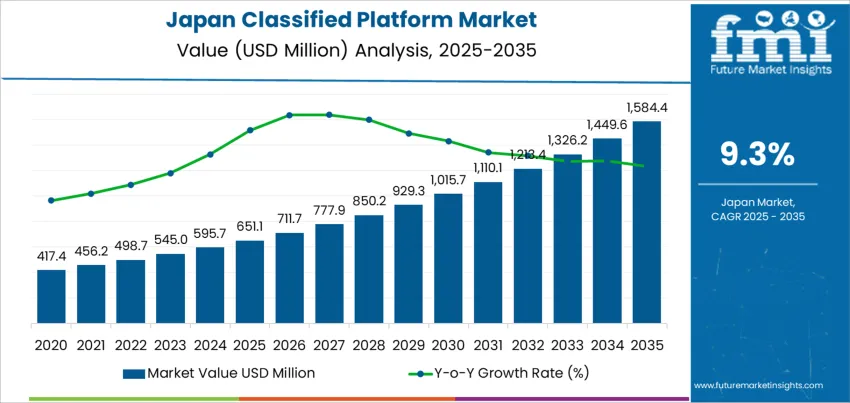
In 2025, demand for classified platforms in Japan is valued at USD 651.1 million and is projected to reach USD 1,584.4 million by 2035 at a CAGR of 9.3%. Early growth is driven by strong migration of local buying and selling activity from offline listings to mobile-first digital marketplaces. Used vehicles, residential rentals, part-time jobs, and secondhand consumer goods form the core traffic drivers in the initial phase. Urban prefectures such as Tokyo, Kanagawa, Osaka, and Aichi account for the highest listing density due to population concentration and high transaction churn. Platform usage expands through app-based discovery, in-app payments, and integrated messaging, which lower friction between private sellers and buyers. Revenue growth in this phase is supported by featured listings, dealer subscriptions, and proximity-based advertising rather than pure transaction fees.
After 2030, market expansion becomes more verticalized and data-driven than volume-led. Demand rises from about USD 1,015.7 million in 2030 toward USD 1,584.4 million by 2035 as classified platforms deepen penetration in autos, property, and employment services with specialized search tools and verification layers. AI-based matching, identity authentication, and fraud prevention raise platform operating costs but also improve user trust and conversion rates. Small businesses and local service providers increase reliance on paid listings as alternatives to traditional directory advertising. Cross-border resale activity also adds incremental value through luxury goods and collectibles. Long-term growth reflects rising monetization per active user, stronger dealer-side subscription models, and tighter integration with logistics, escrow, and local delivery networks across Japan.
Quick Stats of the Demand for Classified Platforms in Japan
- Demand for Classified Platforms in Japan Value (2025): USD 651.1 million
- Demand for Classified Platforms in Japan Forecast Value (2035): USD 1,584.4 million
- Demand for Classified Platforms in Japan Forecast CAGR (2025–2035): 9.3%
- Demand for Classified Platforms in Japan Leading Platform Type: B2C (60%)
- Demand for Classified Platforms in Japan Key Growth Regions: Kyushu & Okinawa, Kanto, Kansai, Chubu, Tohoku, Rest of Japan
- Demand for Classified Platforms in Japan Top Players: Craigslist Inc., Finn.no, Gumtree (eBay Classifieds), Quikr India (including CommonFloor), OLX Inc. (OLX Group)
What is the Demand Forecast for Classified Platform in Japan through 2035?
Classified platforms in Japan operate at the intersection of consumer resale behavior, small business digital reach, and local service discovery, giving their demand curve a structurally network-driven profile rather than a pure advertising-led one. Demand increases from USD 651.1 million in 2025 to USD 1,015.7 million by 2030, adding USD 364.6 million in absolute value. This phase reflects rising monetization of mobile-first listings across used vehicles, real estate rentals, electronics, and local services. Growth is supported by higher paid visibility tools, transaction-linked commissions, and trust-layer services such as identity verification and escrow. Platform usage expands beyond urban cores into regional cities, broadening the revenue base without relying solely on national traffic concentration.
From 2030 to 2035, the market expands from USD 1,015.7 million to USD 1,584.4 million, adding a larger USD 568.7 million in the second half of the decade. This back weighted acceleration reflects deeper integration of classifieds with digital payments, last-mile logistics, and AI-driven matching engines that raise conversion rates and pricing power. Platforms transition from passive listing boards into managed transaction ecosystems for vehicles, property, and services. As peer-to-peer commerce formalizes and small merchants shift from social selling into structured marketplaces, classified platforms evolve into persistent local commerce infrastructure, driving sustained demand expansion across Japan through 2035.
Classified Platform Industry in Japan Key Takeaways
| Metric | Value |
|---|---|
| Industry Value (2025) | USD 651.1 million |
| Forecast Value (2035) | USD 1,584.4 million |
| Forecast CAGR (2025–2035) | 9.3% |
How Is the Market for Classified Platforms Evolving in Japan?
The classified platform segment in Japan has expanded as internet and smartphone penetration reached nearly universal levels among urban and suburban populations. Digital classifieds replaced traditional print-based ads for jobs, real estate, second-hand goods, and services. Online marketplaces and mobile apps offered convenience, speed, and broader reach that appealed to individuals and small businesses earlier using bulletin boards or newspapers. Growth was especially strong for resale goods and peer-to-peer trade, where ease of listing and payment integration reduced transaction friction. The shift toward online commerce and increasing consumer comfort with digital transactions laid a foundation for sustained classified platform adoption.
Future growth of classified platforms in Japan will be driven by evolving consumer behaviour, platform diversification, and tighter integration with e-commerce ecosystems. Continued urbanisation and mobility restrictions make peer-to-peer sales and local service listings more relevant for convenience and cost efficiency. Platforms that provide secure payment, identity verification, and user protections will attract a wider demographic including older users. Expansion into niche verticals such as vehicle sales, part-time jobs, rental services, and local community services will widen use cases. Barriers include platform competition, regulatory or privacy concerns around online trading, and the need to build trust among users for high-value or second-hand transactions. Adoption will depend on reliability, transparency, and convenience rather than novelty alone.
How Are Platform Type and Application Structuring the Demand for Classified Platforms in Japan?
The demand for classified platforms in Japan is structured by platform type and application sector. Business to consumer platforms account for 60% of total demand, followed by consumer to consumer platforms used for peer based listings and resale activity. By application, commercial use represents 45.0% of total consumption, followed by manufacturing, services, and other sectors. Demand behavior is shaped by urban population density, mobile internet penetration, small business advertising needs, and consumer resale participation. These segments reflect how structured seller buyer relationships and industry level advertising requirements guide classified platform adoption across metropolitan and regional markets in Japan.
Why Do B2C Platforms Lead the Classified Platform Type Demand in Japan?
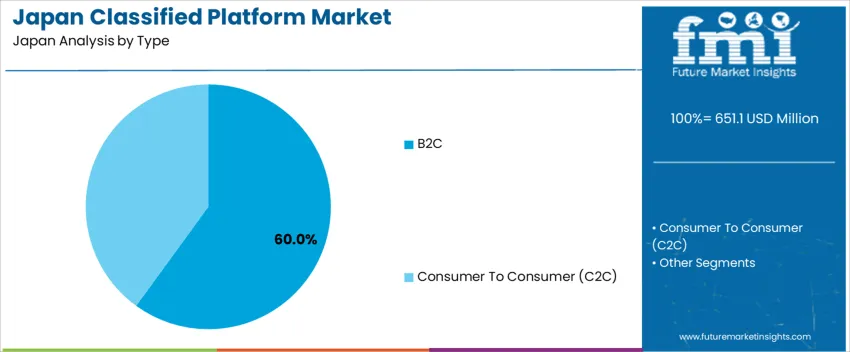
Business to consumer platforms account for 60% of total classified platform demand in Japan due to their central role in structured retail advertising, service promotion, and verified business listings. These platforms enable retailers, real estate firms, automotive dealers, and service providers to publish standardized product and service listings with pricing transparency and location based targeting. Businesses rely on B2C classified platforms to reach high intent buyers searching for specific categories such as housing, used vehicles, jobs, and local services.
B2C platforms also benefit from stronger trust frameworks supported by seller verification, dispute resolution tools, and payment protections. Advertising subscription models provide predictable revenue flows, which supports continuous platform enhancements. Small and medium enterprises depend heavily on B2C classified visibility for customer acquisition in competitive urban markets. These trust mechanisms, seller structure, and commercial dependency factors collectively sustain B2C platforms as the dominant classified platform type in Japan.
Why Does Commercial Application Dominate Classified Platform Demand in Japan?
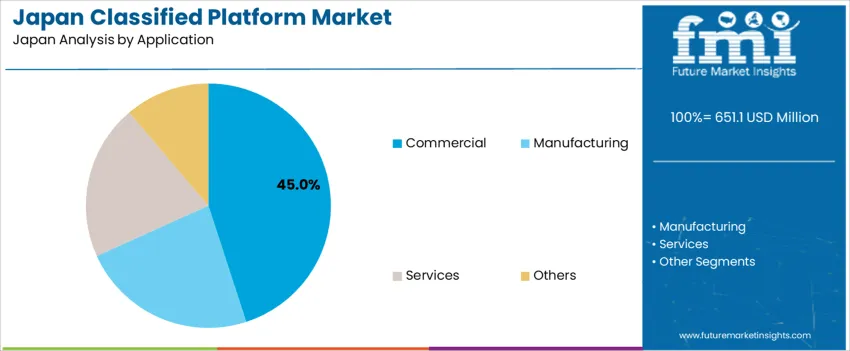
Commercial applications account for 45.0% of total classified platform demand in Japan due to the heavy use of listings for real estate transactions, vehicle sales, recruitment services, and equipment leasing. These sectors require constant listing updates to reflect pricing changes, property availability, and job openings. Classified platforms provide cost efficient digital visibility compared with traditional print advertising, which supports frequent listing rotation across commercial categories.
Commercial users also rely on classified platforms for lead generation, appointment scheduling, and inquiry management through integrated messaging tools. Transaction volume remains high in urban commercial centers where service competition is intense. Platform analytics help sellers optimize listing performance and pricing strategies. These transaction frequency, visibility dependence, and sales optimization requirements position commercial use as the dominant application segment within the Japan classified platform demand structure.
Why Are Classified Platforms in Japan Treated as Local Utility Markets Rather Than Pure Digital Marketplaces?
Demand for classified platforms in Japan is shaped by their role as neighborhood-level transaction infrastructure rather than open national trading spaces. Users rely on these platforms to handle hyper-local exchanges for housing, used goods, jobs, and services within short geographic ranges. High population density and precise address systems make same-city matching efficient and trusted. Face-to-face completion remains common, which reinforces geographic filtering and scheduling features over long-distance shipping. This local utility behavior differentiates Japanese classified demand from markets where logistics and national listings dominate platform usage.
How Do Workforce Mobility, Urban Renting, and Secondary Goods Trade Drive Platform Activity?
Frequent job transfers, university relocation, and compact urban housing create steady circulation of furniture, appliances, and short-term rentals through classified platforms. Young professionals use listings to offset moving costs by reselling items quickly. Part-time and contract employment structures also rely on classified job listings for rapid hiring in retail, hospitality, and logistics. Automotive and two-wheeler resale further anchors activity in commuter regions. This recurring cycle of movement, downsizing, and job switching sustains transaction velocity across multiple verticals inside Japanese classified ecosystems.
What Trust Calibration and Identity Verification Constraints Shape Platform Design?
Classified platform demand in Japan is tightly linked to trust mechanisms rather than scale alone. Users expect strict moderation, identity verification, and transaction history visibility before engaging in peer-to-peer exchanges. Platforms invest heavily in escrow-style payments, pickup confirmation flows, and dispute resolution controls to avoid reputational damage. Privacy sensitivity limits aggressive data sharing while still requiring user accountability. These trust and identity expectations slow rapid onboarding but create high platform stickiness once users establish verified reputations within closed community trading environments.
How Are Mobile Wallets, In-App Logistics, and AI Sorting Reshaping User Behavior?
Future classified platform demand in Japan is shifting toward fully integrated transaction loops. Mobile wallets now enable instant settlement without external banking steps. In-app courier booking simplifies shipping for users who avoid face-to-face exchange. AI-driven listing categorization reduces posting friction and improves discovery accuracy across dense urban listings. Price suggestion tools based on transaction history stabilize resale values and reduce negotiation friction. These changes show Japanese classified platforms moving from listing boards into end-to-end micro-commerce operating systems.
What is the Demand for Classified Platform in Japan by Region?
| Region | CAGR (%) |
|---|---|
| Kyushu & Okinawa | 11.6% |
| Kanto | 10.7% |
| Kansai | 9.4% |
| Chubu | 8.3% |
| Tohoku | 7.3% |
| Rest of Japan | 6.9% |
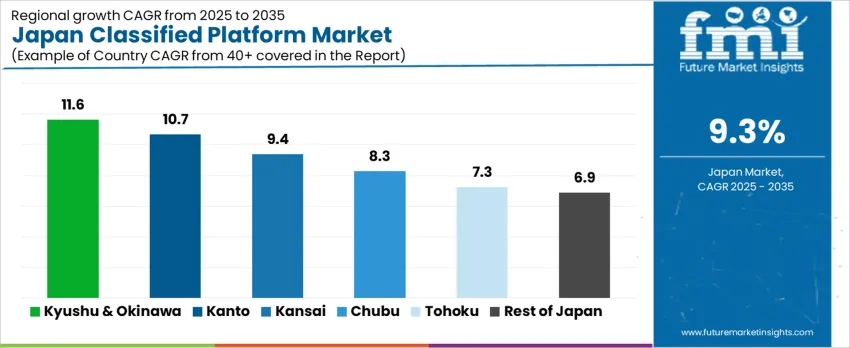
The demand for classified platforms in Japan is expanding steadily across all regions, with Kyushu & Okinawa leading at an 11.6% CAGR. Growth in this region is supported by rising mobile internet usage, increasing participation of small businesses in digital marketplaces, and growing local services advertising. Kanto follows at 10.7%, driven by dense urban population, strong real estate listings activity, vehicle resale demand, and high digital transaction volumes. Kansai at 9.4% reflects steady growth from consumer goods resale, job listings, and service based classifieds. Chubu at 8.3% shows moderate expansion linked to regional automotive, industrial, and housing activity. Tohoku and Rest of Japan, at 7.3% and 6.9%, reflect gradual adoption shaped by smaller population bases and slower digital commerce penetration.
How Is Regional Digital Commerce Strengthening Platform Demand in Kyushu And Okinawa?
Kyushu and Okinawa reflects a CAGR of 11.6% through 2035 for classified platform demand, supported by rising small business participation, secondhand goods trading, and steady growth in local service listings. Tourism related rentals, used vehicles, and short term job postings generate strong listing activity. Mobile first users drive most transactions, with strong reliance on local discovery features. Informal retail channels transition toward digital classifieds for reach expansion. Demand remains transaction driven and community focused, with repeat usage supported by everyday commerce and service sourcing across local consumer networks.
- Tourism rentals drive steady listing volume
- Used vehicle sales support high transaction frequency
- Mobile users dominate local platform engagement
- Small merchants shift toward digital selling channels
What Is Sustaining High Platform Activity Across Kanto?
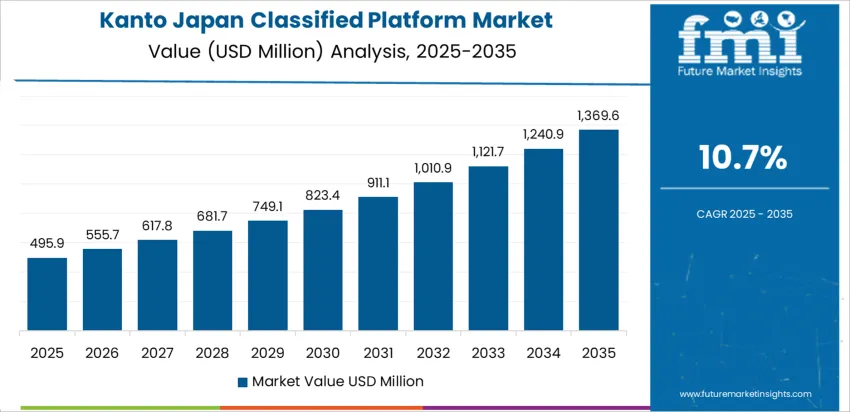
Kanto records a CAGR of 10.7% through 2035 for classified platform demand, driven by dense urban populations, high consumer turnover, and strong participation from real estate, auto resale, and job posting segments. Metropolitan mobility supports constant property and employment listing flow. E commerce sellers also use classified platforms for customer acquisition and liquidation sales. Data driven targeting tools improve listing performance. Demand remains scale driven and usage intensive, supported by continuous user inflow, high transaction velocity, and platform monetization through premium placement and verified seller services.
- Real estate and job listings anchor platform traffic
- Urban mobility sustains frequent user turnover
- Resale commerce supports daily transaction flow
- Premium listings drive platform revenue stability
Why Is Kansai Developing as a Balanced Classified Platform Market?
Kansai shows a CAGR of 9.4% through 2035 for classified platform demand, supported by strong local retail trade, used electronics resale, and regional employment mobility. Student housing, freelance service listings, and refurbished product sales account for significant activity. Small retailers expand digital presence through localized classified advertising. Trust based transaction features raise user confidence. Demand remains commerce oriented and replacement led, with steady posting volume tied to daily household transactions, small business outreach, and consumer budget optimization across regional population centers.
- Student housing supports rental listing activity
- Refurbished electronics drive resale traffic
- Local merchants rely on classified promotion
- Trust features support repeat buyer engagement
How Is Manufacturing Region Digitization Supporting Demand in Chubu?
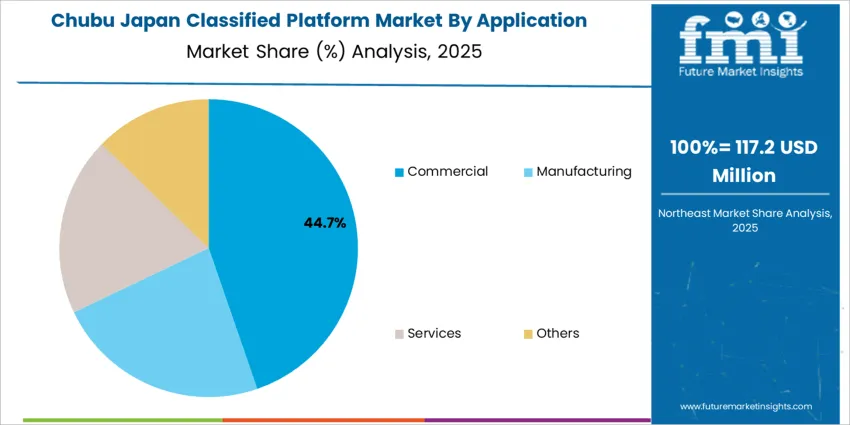
Chubu posts a CAGR of 8.3% through 2035 for classified platform demand, driven by industrial workforce mobility, used equipment trading, and automotive resale activity. Manufacturing workers use job classifieds for contract and shift based employment. Machinery and auto parts resale platforms attract steady professional buyers. Small suppliers advertise services through digital listings rather than traditional print. Demand remains utility driven and business focused, with transaction patterns shaped by employment cycles, industrial supply turnover, and asset liquidation across regional production corridors.
- Workforce mobility supports active job postings
- Machinery resale anchors business user participation
- Automotive listings drive steady buyer traffic
- Supplier services expand through digital classifieds
What Is Guiding Steady Platform Expansion Across Tohoku?
Tohoku reflects a CAGR of 7.3% through 2035 for classified platform demand, shaped by rural commerce digitization, agriculture equipment resale, and gradual smartphone adoption among older users. Local services, housing rentals, and used farming tools dominate platform listings. Municipal promotion of digital trade channels supports local platform awareness. Transaction volumes remain moderate due to lower population density. Demand stays necessity driven and community centered, guided by practical exchange needs rather than high frequency consumption or commercial scale listing activity.
- Agricultural equipment resale supports platform relevance
- Municipal promotion improves digital trade awareness
- Local services dominate listing categories
- Population dispersion moderates transaction volumes
Why Does the Rest of Japan Show Measured but Stable Demand Trends?
Across the rest of Japan, growth records a CAGR of 6.9% through 2035 for classified platform demand, supported by community level trading, regional real estate listings, and steady use for vehicle and service exchanges. Small towns rely on classified platforms for peer to peer sales and service discovery. Limited broadband reach slows advanced feature adoption. Platform usage remains transactional rather than commercial. Demand stays stable and replacement focused, with predictable listing cycles tied to housing turnover, vehicle resale, and household goods circulation across smaller population clusters.
- Peer to peer trading sustains baseline usage
- Housing and vehicle resale drive recurring listings
- Limited broadband constrains advanced feature adoption
- Household goods exchange supports consistent platform traffic
What Is Driving the Demand for Classified Platforms in Japan and Who Are the Key Players Shaping the Industry?
Demand for online classified platforms in Japan is rising as mobile and internet penetration increase, supporting a shift from traditional marketplaces to digital platforms. Consumers use these platforms for secondhand goods, rentals, job listings, and local services, benefiting from convenience, broader choice, and competitive pricing. Urban and suburban populations increasingly rely on mobile access for instant browsing and listing, while younger and digitally literate demographics adopt classifieds for both buying and selling. Rising interest in sustainable consumption, resale culture, and cost-efficient transactions drives platform usage. Seasonal demand peaks occur during housing transitions, holiday shopping, and employment cycles. Expanding digital literacy and trust in online platforms also enhance user adoption, making online classifieds an essential channel for community and commercial exchanges across Japan.
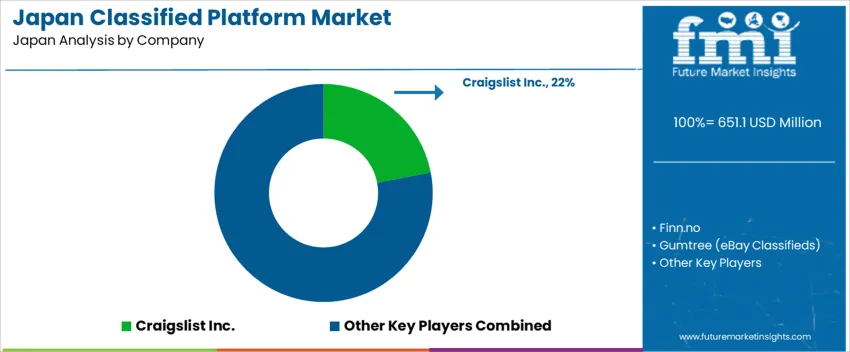
Key players in Japan’s classified platform market include Craigslist Inc., Finn.no, Gumtree (eBay Classifieds), Quikr (including CommonFloor), and OLX Inc. (OLX Group). Craigslist and Gumtree provide global reach, standardized listing formats, and experience in peer-to-peer transactions that support user confidence. Quikr and OLX offer scalable technology platforms optimized for local listings and secure transactions. Finn.no extends experience from the Nordic market, contributing insights into property, automotive, and service classifieds. These providers combine international infrastructure with lessons from mature markets, shaping expectations for user experience, verification processes, and cross-border capabilities. While domestic platforms maintain strong presence, these global players influence competition and adoption trends by introducing technological innovation, enhanced usability, and structured marketplace frameworks across Japan.
Key Players in Demand for Classified Platforms Industry in Japan
- Craigslist Inc.
- Finn.no
- Gumtree (eBay Classifieds)
- Quikr India (including CommonFloor)
- OLX Inc. (OLX Group)
Scope of the Report
| Items | Values |
|---|---|
| Quantitative Units (2025) | USD 651.1 million |
| Type | B2C, Consumer to Consumer (C2C) |
| Application | Commercial, Manufacturing, Services, Others |
| Region | Kyushu & Okinawa, Kanto, Kansai, Chubu, Tohoku, Rest of Japan |
| Key Companies Profiled | Craigslist Inc., Finn.no, Gumtree (eBay Classifieds), Quikr India (including CommonFloor), OLX Inc. (OLX Group) |
| Additional Attributes | Dollar by sales by platform type, application, region, user engagement, trust and verification features, featured listings, dealer subscriptions, proximity-based advertising, mobile app usage, cross-border transactions, AI matching, identity authentication, and escrow integration |
Demand for Classified Platforms Industry in Japan Segmentation
Type:
- B2C
- Consumer to Consumer (C2C)
Application:
- Commercial
- Manufacturing
- Services
- Others
Region:
- Kyushu & Okinawa
- Kanto
- Kansai
- Chubu
- Tohoku
- Rest of Japan
Frequently Asked Questions
How big is the demand for classified platform in Japan in 2025?
The demand for classified platform in Japan is estimated to be valued at USD 651.1 million in 2025.
What will be the size of classified platform in Japan in 2035?
The market size for the classified platform in Japan is projected to reach USD 1,584.4 million by 2035.
How much will be the demand for classified platform in Japan growth between 2025 and 2035?
The demand for classified platform in Japan is expected to grow at a 9.3% CAGR between 2025 and 2035.
What are the key product types in the classified platform in Japan?
The key product types in classified platform in Japan are b2c and consumer to consumer (c2c).
Which application segment is expected to contribute significant share in the classified platform in Japan in 2025?
In terms of application, commercial segment is expected to command 45.0% share in the classified platform in Japan in 2025.
Preview the report firsthand - request a free sample
Get SampleGet the brochure for pricing and purchase details.
Get PDFTable of Content
- Executive Summary
- Japan Market Outlook
- Demand-side Trends
- Supply-side Trends
- Technology Roadmap Analysis
- Analysis and Recommendations
- Market Overview
- Market Coverage / Taxonomy
- Market Definition / Scope / Limitations
- Market Background
- Market Dynamics
- Drivers
- Restraints
- Opportunity
- Trends
- Scenario Forecast
- Demand in Optimistic Scenario
- Demand in Likely Scenario
- Demand in Conservative Scenario
- Opportunity Map Analysis
- Product Life Cycle Analysis
- Supply Chain Analysis
- Investment Feasibility Matrix
- Value Chain Analysis
- PESTLE and Porter’s Analysis
- Regulatory Landscape
- Regional Parent Market Outlook
- Production and Consumption Statistics
- Import and Export Statistics
- Market Dynamics
- Japan Market Analysis 2020 to 2024 and Forecast, 2025 to 2035
- Historical Market Size Value (USD Million) Analysis, 2020 to 2024
- Current and Future Market Size Value (USD Million) Projections, 2025 to 2035
- Y-o-Y Growth Trend Analysis
- Absolute $ Opportunity Analysis
- Japan Market Pricing Analysis 2020 to 2024 and Forecast 2025 to 2035
- Japan Market Analysis 2020 to 2024 and Forecast 2025 to 2035, By Type
- Introduction / Key Findings
- Historical Market Size Value (USD Million) Analysis By Type , 2020 to 2024
- Current and Future Market Size Value (USD Million) Analysis and Forecast By Type , 2025 to 2035
- B2C
- Consumer To Consumer (C2C)
- Y-o-Y Growth Trend Analysis By Type , 2020 to 2024
- Absolute $ Opportunity Analysis By Type , 2025 to 2035
- Japan Market Analysis 2020 to 2024 and Forecast 2025 to 2035, By Application
- Introduction / Key Findings
- Historical Market Size Value (USD Million) Analysis By Application, 2020 to 2024
- Current and Future Market Size Value (USD Million) Analysis and Forecast By Application, 2025 to 2035
- Commercial
- Manufacturing
- Services
- Others
- Y-o-Y Growth Trend Analysis By Application, 2020 to 2024
- Absolute $ Opportunity Analysis By Application, 2025 to 2035
- Market Structure Analysis
- Competition Dashboard
- Competition Benchmarking
- Market Share Analysis of Top Players
- By Regional
- By Type
- By Application
- Competition Analysis
- Competition Deep Dive
- Craigslist Inc.
- Overview
- Product Portfolio
- Profitability by Market Segments (Product/Age /Sales Channel/Region)
- Sales Footprint
- Strategy Overview
- Marketing Strategy
- Product Strategy
- Channel Strategy
- Finn.no
- Gumtree (eBay Classifieds)
- Quikr India (including CommonFloor)
- OLX Inc. (OLX Group)
- Craigslist Inc.
- Competition Deep Dive
- Assumptions & Acronyms Used
- Research Methodology


