

- Industry Size (2026)
- USD 208.7 Mn
- Forecast (2036)
- USD 392.4 Mn
- CAGR (2026 to 2036)
- 6.5%
Demand for Asset Financing Platform in Japan 2026 to 2036
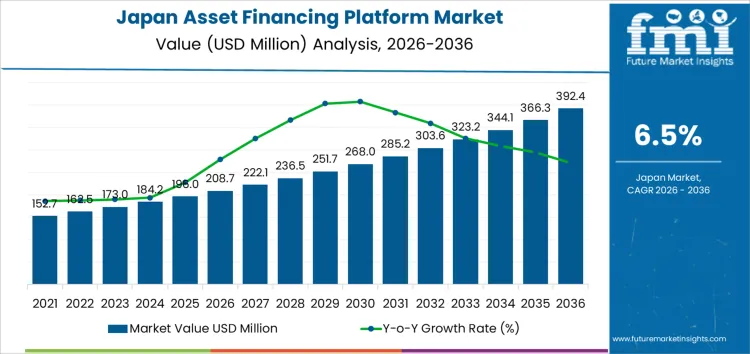
Demand for asset financing platform in Japan is valued at USD 208.7 million in 2026 and is forecasted to reach USD 392.4 million by 2036, reflecting a CAGR of 6.5%. Demand expands as enterprises seek flexible capital solutions to support equipment upgrades, digital transformation, and productivity improvements. Platform-based financing models improve access to structured funding, shorten approval cycles, and enhance transparency for small and mid-sized enterprises.
Equipment financing leads asset-type usage because manufacturing, construction, healthcare, and logistics sectors require regular capital investment in machinery and technology. Platforms that integrate credit assessment, asset valuation, and lifecycle management enable efficient deployment of financing solutions. Digital interfaces and data-driven risk evaluation strengthen adoption across corporate users.
Quick Stats for Demand for Asset Financing Platform in Japan
- Japan Asset Financing Platform Sales Value (2026): USD 208.7 million
- Japan Asset Financing Platform Forecast Value (2036): USD 392.4 million
- Japan Asset Financing Platform Forecast CAGR (2026 to 2036): 6.5%
- Leading Asset Type in Japan: Equipment Financing
- Key Growth Regions in Japan: Kyushu & Okinawa, Kanto, Kansai, Chubu, Tohoku
- Top Players in Japan: Mitsui & Co. Auto Finance, ORIX Corporation, Sony Financial Ventures, Sumitomo Mitsui Finance and Leasing Company, Hitachi Capital Corporation
Kyushu & Okinawa, Kanto, Kansai, Chubu, and Tohoku represent key growth regions supported by industrial activity, regional SME density, and infrastructure investment. Mitsui & Co. Auto Finance, ORIX Corporation, Sony Financial Ventures, Sumitomo Mitsui Finance and Leasing Company, and Hitachi Capital Corporation anchor competitive activity through diversified financial services, technology-enabled platforms, and strong corporate networks aligned with Japan’s financing and leasing landscape.
Japan Asset Financing Platform Key Takeaways
| Metric | Value |
|---|---|
| Japan Asset Financing Platform Sales Value (2026) | USD 208.7 million |
| Japan Asset Financing Platform Forecast Value (2036) | USD 392.4 million |
| Japan Asset Financing Platform Forecast CAGR (2026-2036) | 6.5% |
Why is the Demand for Asset Financing Platform in Japan Growing?
Demand for asset financing platforms in Japan grows due to structural shifts in corporate funding behavior and digital transformation across financial services. Small and mid-sized enterprises seek alternatives to traditional bank lending to manage equipment acquisition, fleet expansion, and technology upgrades. Digital platforms enable faster credit assessment, transparent terms, and efficient documentation, which aligns with operational efficiency priorities. Capital intensive sectors such as manufacturing, logistics, healthcare, and construction rely on asset backed financing to preserve liquidity while supporting modernization. Aging business ownership increases succession related restructuring, where asset based financing supports balance sheet optimization.
Financial institutions adopt platform based models to improve risk assessment using data driven underwriting and real time asset valuation. Regulatory clarity around fintech operations supports wider institutional participation. Integration with accounting systems improves cash flow visibility for borrowers and lenders. Leasing and hire purchase structures gain traction due to predictable repayment schedules and tax planning considerations. Supply chain digitization increases demand for platforms that connect vendors, financiers, and end users within a single ecosystem. Economic uncertainty reinforces preference for flexible financing tied to asset utilization rather than unsecured borrowing.
How Are the Segments Classified in the Demand for Asset Financing Platforms in Japan?
Demand for asset financing platforms in Japan is shaped by capital efficiency needs, long asset lifecycles, and preference for structured financing governance. Buyers assess platform reliability, compliance with domestic financial regulations, integration with accounting systems, and data control requirements. Adoption patterns reflect conservative IT strategies, strong enterprise oversight, and financing demand linked to equipment, vehicles, and property assets across established Japanese organizations.
By Asset Type, Does Equipment Financing Account for the Largest Share of Demand in Japan?
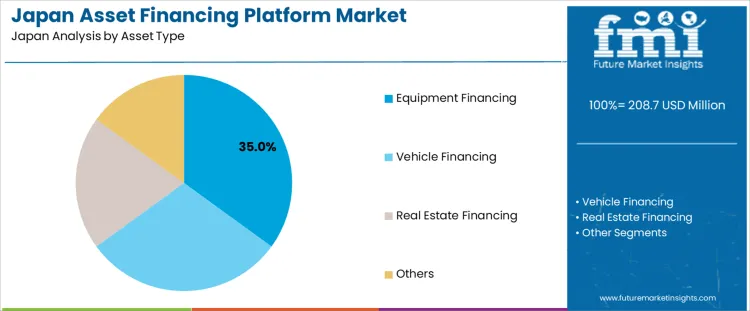
Equipment financing holds 35.0%, making it the leading asset-type segment in Japan. Manufacturing, construction, and industrial enterprises rely on financing platforms to manage high-value equipment with long depreciation cycles. Platforms support repayment scheduling, asset tracking, and compliance reporting aligned with corporate governance norms. Vehicle financing holds 30.0%, supporting fleet management and logistics operations. Real estate financing accounts for 20.0%, addressing property-backed financing needs. Other asset types hold 15.0%, covering diversified financing use cases. Asset-type distribution reflects emphasis on productive capital assets central to Japan’s industrial operations.
Key Points:
- Equipment financing leads due to capital-intensive asset structures.
- Platforms support lifecycle and compliance management.
- Vehicles and real estate represent significant secondary assets.
By Deployment, Does On-Premises Implementation Represent the Largest Share of Demand in Japan?
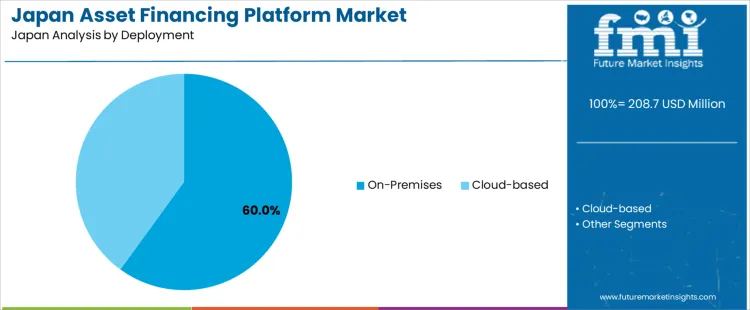
On-premises deployment holds 60.0%, making it the leading deployment segment in Japan. Enterprises prefer on-premises platforms to retain direct control over financial data, system customization, and security governance. This approach aligns with internal IT policies and regulatory compliance expectations. Cloud-based deployment holds 40.0%, supporting scalability and faster implementation for selected use cases. Deployment distribution reflects Japan’s cautious cloud adoption approach for financial systems, prioritizing data sovereignty and operational stability.
Key Points:
- On-premises systems dominate due to data control priorities.
- Internal governance influences deployment decisions.
- Cloud platforms serve controlled scalability needs.
By Enterprise Size, Do Very Large Enterprises Account for the Largest Share of Demand in Japan?
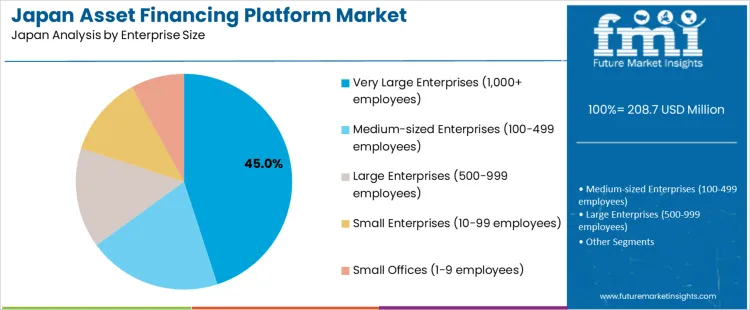
Very large enterprises hold 45.0%, making them the leading enterprise-size segment in Japan. These organizations manage complex financing portfolios across multiple asset classes and subsidiaries. Platforms support centralized oversight, audit readiness, and standardized financing workflows. Medium-sized enterprises hold 20.0%, adopting platforms to improve financing visibility. Large enterprises account for 15.0%, while small enterprises and small offices together hold 20.0%, reflecting limited but growing adoption. Enterprise-size distribution reflects concentration of structured financing activity within Japan’s largest corporate groups.
Key Points:
- Very large enterprises lead due to financing complexity.
- Centralized oversight drives platform adoption.
- Smaller firms show selective, gradual uptake.
What are the Key Dynamics in the Asset Financing Platform Industry in Japan?
Demand increases as Japanese enterprises, SMEs, and financial institutions adopt digital platforms to manage leasing, installment financing, and asset-backed lending with higher operational efficiency. Asset financing platforms support equipment procurement, vehicle leasing, and machinery financing across manufacturing, logistics, and services sectors. Adoption aligns with Japan’s bank-centered financial system, aging SME base, and gradual digitization of financial operations. Usage concentrates among leasing companies, regional banks, captive finance arms, and fintech providers serving domestic businesses.
How do SME financing needs and digital transformation in financial services drive demand in Japan?
Japan’s economy relies heavily on SMEs that require financing for machinery, vehicles, and production equipment. Asset financing platforms enable streamlined credit assessment, contract management, and repayment tracking, reducing manual processing. Leasing companies use digital systems to manage long-term equipment leases common in manufacturing and construction. Captive finance units within automotive and industrial groups adopt platforms to integrate sales and financing workflows. Regional banks deploy platforms to improve risk visibility and operational efficiency while serving local enterprises. Government initiatives promoting digital transformation encourage financial institutions to modernize legacy systems, supporting steady platform adoption across asset-heavy industries.
How do regulatory structure, legacy systems, and conservative adoption behavior influence demand stability?
Japan’s financial regulations require strict compliance with data security, customer verification, and reporting standards, increasing platform development complexity. Many financial institutions operate legacy core systems, making integration time-consuming and costly. Conservative risk management culture favors proven vendors and gradual implementation over rapid platform replacement. Decision cycles remain lengthy due to consensus-based governance structures. Customization demands vary by asset type, limiting standardization benefits. Workforce familiarity with traditional processes slows transition pace. Demand remains stable among leasing and equipment finance providers, while broader growth depends on successful system integration, regulatory clarity, and continued progress in Japan’s financial digitalization efforts.
How Is Demand for Asset Financing Platform in Japan Evolving by Region?
Demand for asset financing platforms in Japan is increasing due to digitalization of lending workflows, SME funding needs, and adoption of data-driven credit assessment. Kyushu and Okinawa lead with an 8.1% CAGR, supported by SME concentration and regional financing programs. Kanto follows at 7.4%, driven by fintech adoption, enterprise financing, and platform-based credit distribution. Kansai records a 6.5% CAGR, shaped by manufacturing SMEs and equipment financing demand. Chubu posts 5.7%, reflecting automotive supplier financing requirements. Tohoku shows 5.0%, supported by regional business continuity funding. Rest of Japan records 4.8%, reflecting gradual platform adoption. Regional variation reflects enterprise density, digital readiness, and financing structure across Japan.
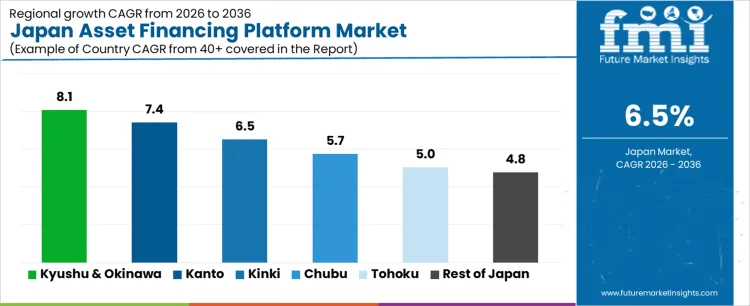
| Region | CAGR (2026-2036) |
|---|---|
| Kyushu & Okinawa | 8.1% |
| Kanto | 7.4% |
| Kansai | 6.5% |
| Chubu | 5.7% |
| Tohoku | 5.0% |
| Rest of Japan | 4.8% |
How is Kyushu and Okinawa driving demand for Asset Financing Platforms in Japan?
Kyushu and Okinawa drive demand through high SME presence, equipment-intensive industries, and regional development financing. Region’s CAGR of 8.1% reflects growing use of digital asset financing platforms for machinery leasing, vehicle financing, and working capital support. SMEs value simplified application processes, faster credit decisions, and transparent repayment structures. Local financial institutions collaborate with platform providers to extend reach and reduce underwriting time. Tourism, logistics, and food processing sectors contribute to financing volume volatility, increasing reliance on flexible platforms. Demand favors platforms offering credit scoring based on transaction data and asset utilization. Growth remains SME-led and efficiency-driven.
- SME-focused machinery and vehicle financing
- Faster credit approval and onboarding
- Bank and fintech collaboration models
- Data-driven credit assessment demand
How is Kanto driving demand for Asset Financing Platforms in Japan?
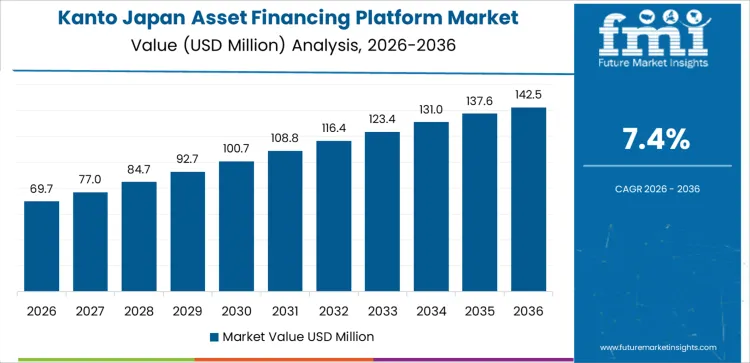
Kanto demand is shaped by fintech concentration, enterprise financing activity, and digital-first financial services adoption. Region’s CAGR of 7.4% reflects extensive use of asset financing platforms by corporates, startups, and leasing firms. Platforms support equipment financing, IT asset funding, and structured repayment models. Enterprises prioritize integration with ERP systems, compliance reporting, and scalable transaction processing. Financial institutions deploy platforms to expand credit access while managing risk exposure. Demand emphasizes automation, analytics, and regulatory alignment. Growth aligns with financial digitalization initiatives and enterprise technology adoption.
- Enterprise and startup asset financing
- ERP-integrated financing workflows
- Advanced analytics and automation usage
- Strong fintech ecosystem participation
How is Kansai driving demand for Asset Financing Platforms in Japan?
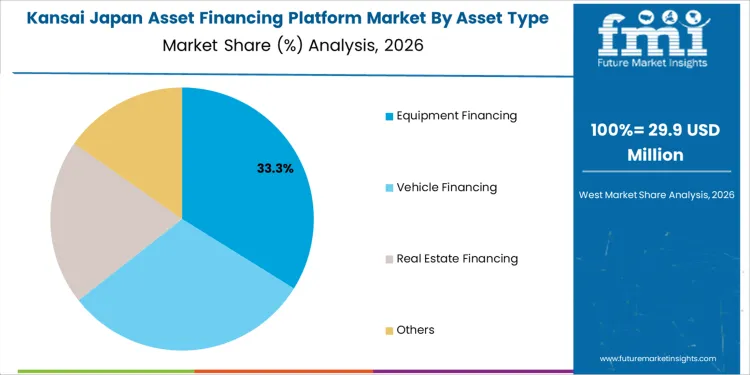
Kansai demand reflects manufacturing SMEs, regional enterprises, and equipment renewal cycles. Region’s CAGR of 6.5% is supported by use of asset financing platforms for production machinery, logistics assets, and energy-efficient equipment. Businesses value predictable repayment schedules and cost transparency. Regional banks and leasing companies leverage platforms to streamline portfolio management. Adoption remains practical and operations-focused. Demand growth remains steady, aligned with capital expenditure planning and gradual digital transition.
- Manufacturing and logistics asset funding
- Predictable and transparent repayment structures
- Regional bank and leasing firm usage
- Capex-linked financing demand
How is Chubu driving demand for Asset Financing Platforms in Japan?
Chubu demand is anchored in automotive supply chains, component manufacturing, and industrial equipment investment. Region’s CAGR of 5.7% reflects platform use for financing production equipment, tooling, and fleet assets. Firms prioritize reliability, long-term cost visibility, and contract management features. Financing decisions align with production schedules and supplier requirements. Platform adoption supports standardization of financing processes across supplier tiers. Growth remains moderate and industry-driven.
- Automotive and supplier equipment financing
- Long-term contract and cost visibility
- Standardized supplier financing workflows
- Production-cycle-aligned adoption
How is Tohoku driving demand for Asset Financing Platforms in Japan?
Tohoku demand is influenced by regional SMEs, infrastructure projects, and business continuity planning. Region’s CAGR of 5.0% reflects adoption of asset financing platforms for construction equipment, agricultural machinery, and transport assets. Users prioritize accessibility, ease of use, and local financial support. Platforms support funding in areas with limited physical bank presence. Demand growth remains cautious and necessity-driven, aligned with regional economic stability initiatives.
- Construction and agricultural asset financing
- Accessibility-focused digital platforms
- Support for regional SMEs
- Stability-driven financing adoption
How is Rest of Japan driving demand for Asset Financing Platforms in Japan?
Rest of Japan shows stable demand driven by gradual digital adoption and replacement of manual financing processes. Region’s CAGR of 4.8% reflects use of platforms for routine asset financing and lease management. Buyers prioritize affordability, reliability, and compliance support. Adoption remains incremental, aligned with maintaining operational efficiency rather than expanding financing scope.
- Routine asset and lease financing
- Replacement of manual workflows
- Cost-sensitive platform selection
- Stable and incremental adoption
What is the competitive landscape of demand for asset financing platforms in Japan?
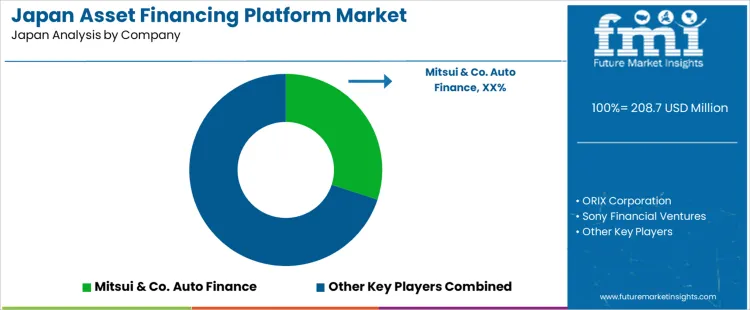
Demand for asset financing platforms in Japan is driven by corporate requirements to fund capital equipment purchases, fleet acquisitions, and digital transformation investments without large upfront capital expenditures. Use cases span small and medium enterprise (SME) procurement, large corporate balance-sheet optimization, and leasing of production equipment and technology infrastructure. Buyers evaluate platform flexibility, credit assessment tools, integration with enterprise resource planning systems, and compliance with Japan’s financial regulations. Procurement teams prioritize digital platforms that accelerate approval cycles, provide transparent pricing, and support automated documentation workflows. Trend in the Japan market reflects growth in subscription-based business models, interest in embedded finance capabilities, and increasing adoption of software-driven credit decisioning.
Mitsui & Co. Auto Finance, through digital asset financing solutions, holds a strong presence in Japan by supporting corporate and consumer equipment leasing and loan origination tailored to local business needs. ORIX Corporation participates with comprehensive asset financing services backed by digital platforms supporting fleet, technology, and industrial equipment financing. Sony Financial Ventures engages in embedded and platform-centric financing solutions linked to broader digital ecosystems. Sumitomo Mitsui Finance and Leasing Company maintains visibility with technology-enabled financing offerings for capital assets and machinery used by domestic enterprises. Hitachi Capital Corporation supports demand through integrated leasing and financing platforms adapted to Japan’s SME segment and digital transformation initiatives. Competitive positioning in Japan reflects regulatory alignment, underwriting sophistication, platform usability, integration depth with enterprise systems, and capacity to accelerate capital deployment for varied asset classes.
Key Players in Japan Asset Financing Platform Demand
- Mitsui & Co. Auto Finance
- ORIX Corporation
- Sony Financial Ventures
- Sumitomo Mitsui Finance and Leasing Company
- Hitachi Capital Corporation
Scope of the Report
| Items | Values |
|---|---|
| Quantitative Units | USD million |
| Asset Type | Equipment Financing; Vehicle Financing; Real Estate Financing; Others |
| Deployment | On-Premises; Cloud-based |
| Enterprise Size | Very Large Enterprises (1,000+ employees); Large Enterprises (500–999 employees); Medium-sized Enterprises (100–499 employees); Small Enterprises (10–99 employees); Small Offices (1–9 employees) |
| Industry | Finance; Manufacturing & Resources; Distribution Services; Services; Public Sector; Infrastructure |
| Regions Covered | Kyushu & Okinawa; Kanto; Kansai; Chubu; Tohoku; Rest of Japan |
| Key Companies Profiled | Mitsui & Co. Auto Finance; ORIX Corporation; Sony Financial Ventures; Sumitomo Mitsui Finance and Leasing Company; Hitachi Capital Corporation |
| Additional Attributes | Dollar sales by asset type, deployment model, and enterprise size; regional CAGR and platform adoption across Japanese business clusters; increasing preference for cloud-based financing platforms; integration with leasing, credit risk assessment, and asset lifecycle management systems; regulatory alignment with Japanese financial services and digital lending standards. |
Japan Asset Financing Platform Demand by Segments
Asset Type:
- Equipment Financing
- Vehicle Financing
- Real Estate Financing
- Others
Deployment:
- On-Premises
- Cloud-based
Enterprise Size:
- Very Large Enterprises (1,000+ employees)
- Medium-sized Enterprises (100-499 employees)
- Large Enterprises (500-999 employees)
- Small Enterprises (10-99 employees)
- Small Offices (1-9 employees)
Industry:
- Finance
- Manufacturing & Resources
- Distribution Services
- Services
- Public Sector
- Infrastructure
Region:
- Kyushu & Okinawa
- Kanto
- Kansai
- Chubu
- Tohoku
- Rest of Japan
Frequently Asked Questions
How big is the demand for asset financing platform in Japan in 2026?
The demand for asset financing platform in Japan is estimated to be valued at USD 208.7 million in 2026.
What will be the size of asset financing platform in Japan in 2036?
The market size for the asset financing platform in Japan is projected to reach USD 392.4 million by 2036.
How much will be the demand for asset financing platform in Japan growth between 2026 and 2036?
The demand for asset financing platform in Japan is expected to grow at a 6.5% CAGR between 2026 and 2036.
What are the key product types in the asset financing platform in Japan?
The key product types in asset financing platform in Japan are equipment financing, vehicle financing, real estate financing and others.
Which deployment segment is expected to contribute significant share in the asset financing platform in Japan in 2026?
In terms of deployment, on-premises segment is expected to command 60.0% share in the asset financing platform in Japan in 2026.
Preview the report firsthand - request a free sample
Get SampleGet the brochure for pricing and purchase details.
Get PDFTable of Content
- Executive Summary
- Japan Market Outlook
- Demand-side Trends
- Supply-side Trends
- Technology Roadmap Analysis
- Analysis and Recommendations
- Market Overview
- Market Coverage / Taxonomy
- Market Definition / Scope / Limitations
- Market Background
- Market Dynamics
- Drivers
- Restraints
- Opportunity
- Trends
- Scenario Forecast
- Demand in Optimistic Scenario
- Demand in Likely Scenario
- Demand in Conservative Scenario
- Opportunity Map Analysis
- Product Life Cycle Analysis
- Supply Chain Analysis
- Investment Feasibility Matrix
- Value Chain Analysis
- PESTLE and Porter’s Analysis
- Regulatory Landscape
- Regional Parent Market Outlook
- Production and Consumption Statistics
- Import and Export Statistics
- Market Dynamics
- Japan Market Analysis 2021 to 2025 and Forecast, 2026 to 2036
- Historical Market Size Value (USD Million) Analysis, 2021 to 2025
- Current and Future Market Size Value (USD Million) Projections, 2026 to 2036
- Y-o-Y Growth Trend Analysis
- Absolute $ Opportunity Analysis
- Japan Market Pricing Analysis 2021 to 2025 and Forecast 2026 to 2036
- Japan Market Analysis 2021 to 2025 and Forecast 2026 to 2036, By Asset Type
- Introduction / Key Findings
- Historical Market Size Value (USD Million) Analysis By Asset Type , 2021 to 2025
- Current and Future Market Size Value (USD Million) Analysis and Forecast By Asset Type , 2026 to 2036
- Equipment Financing
- Vehicle Financing
- Real Estate Financing
- Others
- Equipment Financing
- Y-o-Y Growth Trend Analysis By Asset Type , 2021 to 2025
- Absolute $ Opportunity Analysis By Asset Type , 2026 to 2036
- Japan Market Analysis 2021 to 2025 and Forecast 2026 to 2036, By Deployment
- Introduction / Key Findings
- Historical Market Size Value (USD Million) Analysis By Deployment, 2021 to 2025
- Current and Future Market Size Value (USD Million) Analysis and Forecast By Deployment, 2026 to 2036
- On-Premises
- Cloud-based
- On-Premises
- Y-o-Y Growth Trend Analysis By Deployment, 2021 to 2025
- Absolute $ Opportunity Analysis By Deployment, 2026 to 2036
- Japan Market Analysis 2021 to 2025 and Forecast 2026 to 2036, By Enterprise Size
- Introduction / Key Findings
- Historical Market Size Value (USD Million) Analysis By Enterprise Size, 2021 to 2025
- Current and Future Market Size Value (USD Million) Analysis and Forecast By Enterprise Size, 2026 to 2036
- Very Large Enterprises (1,000+ employees)
- Medium-sized Enterprises (100-499 employees)
- Large Enterprises (500-999 employees)
- Small Enterprises (10-99 employees)
- Small Offices (1-9 employees)
- Very Large Enterprises (1,000+ employees)
- Y-o-Y Growth Trend Analysis By Enterprise Size, 2021 to 2025
- Absolute $ Opportunity Analysis By Enterprise Size, 2026 to 2036
- Japan Market Analysis 2021 to 2025 and Forecast 2026 to 2036, By Industry
- Introduction / Key Findings
- Historical Market Size Value (USD Million) Analysis By Industry, 2021 to 2025
- Current and Future Market Size Value (USD Million) Analysis and Forecast By Industry, 2026 to 2036
- Finance
- Manufacturing & Resources
- Distribution Services
- Services
- Public Sector
- Infrastructure
- Finance
- Y-o-Y Growth Trend Analysis By Industry, 2021 to 2025
- Absolute $ Opportunity Analysis By Industry, 2026 to 2036
- Market Structure Analysis
- Competition Dashboard
- Competition Benchmarking
- Market Share Analysis of Top Players
- By Regional
- By Asset Type
- By Deployment
- By Enterprise Size
- By Industry
- Competition Analysis
- Competition Deep Dive
- Mitsui & Co. Auto Finance
- Overview
- Product Portfolio
- Profitability by Market Segments (Product/Age /Sales Channel/Region)
- Sales Footprint
- Strategy Overview
- Marketing Strategy
- Product Strategy
- Channel Strategy
- ORIX Corporation
- Sony Financial Ventures
- Sumitomo Mitsui Finance and Leasing Company
- Hitachi Capital Corporation
- Mitsui & Co. Auto Finance
- Competition Deep Dive
- Assumptions & Acronyms Used
- Research Methodology


