

- Industry Size (2026)
- USD 1.5 Bn
- Forecast (2036)
- USD 3.3 Bn
- CAGR (2026 to 2036)
- 8.2%
Demand for Asset Financing Platform in USA 2026 to 2036
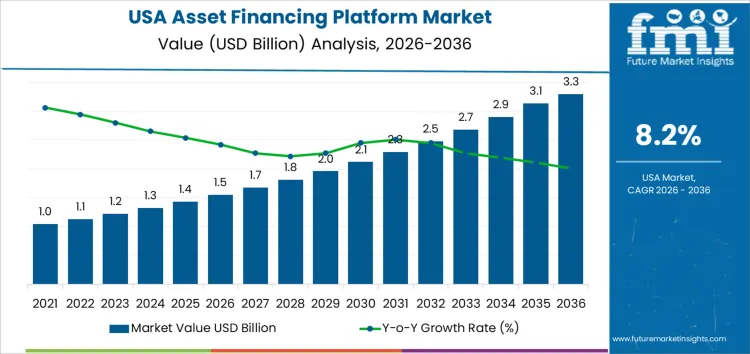
Demand for asset financing platform in USA is valued at USD 1.5 billion in 2026 and is forecasted to reach USD 3.3 billion by 2036, reflecting a CAGR of 8.2%. Demand expands as enterprises prioritize flexible capital access to support equipment modernization, digital transformation, and capacity expansion. Platform-based models streamline credit assessment, shorten approval cycles, and improve transparency for small, mid-sized, and large organizations.
Quick Stats for Demand for Asset Financing Platform in USA
- USA Asset Financing Platform Sales Value (2026): USD 1.5 billion
- USA Asset Financing Platform Forecast Value (2036): USD 3.3 billion
- USA Asset Financing Platform Forecast CAGR (2026 to 2036): 8.2%
- Leading Asset Type in USA: Equipment Financing
- Key Growth Regions in USA: West USA, South USA, Northeast USA, Midwest USA
- Top Players in USA: Crest Capital, DLL, Wells Fargo Equipment Finance, CIT Group (First Citizens), Bank of America Leasing & Capital Company
Equipment financing leads asset-type usage because manufacturing, construction, healthcare, transportation, and logistics require continuous investment in machinery and technology. Platforms that integrate asset valuation, lifecycle tracking, and risk analytics improve funding efficiency and utilization outcomes. Digital onboarding, automated underwriting, and data-driven decisioning strengthen adoption across corporate users.
West USA, South USA, Northeast USA, and Midwest USA represent key growth regions supported by diversified industrial bases, SME density, and infrastructure investment. Crest Capital, DLL, Wells Fargo Equipment Finance, CIT Group (First Citizens), and Bank of America Leasing & Capital Company anchor competitive activity through nationwide reach, sector-specific financing expertise, and technology-enabled platforms aligned with evolving capital expenditure strategies across USA enterprises.
USA Asset Financing Platform Key Takeaways
| Metric | Value |
|---|---|
| USA Asset Financing Platform Sales Value (2026) | USD 1.5 billion |
| USA Asset Financing Platform Forecast Value (2036) | USD 3.3 billion |
| USA Asset Financing Platform Forecast CAGR (2026 to 2036) | 8.2% |
Why is the Demand for Asset Financing Platform in USA Growing?
Demand for asset financing platforms in the United States grows due to changing capital management practices across enterprises and accelerated adoption of digital financial infrastructure. Small and mid-sized businesses seek funding models that preserve working capital while enabling access to equipment, vehicles, and technology assets. Asset backed financing aligns with operational needs in manufacturing, logistics, construction, and healthcare, where equipment modernization supports productivity targets. Digital platforms streamline credit assessment, documentation, and asset valuation, which improves transaction speed and transparency. Financial institutions adopt platform based models to manage risk through data driven underwriting and real time performance tracking.
Expansion of subscription based business models increases preference for flexible financing linked to asset usage cycles. Supply chain volatility encourages firms to avoid large upfront capital expenditure, supporting leasing and structured financing arrangements. Integration with accounting and enterprise resource planning systems improves cash flow visibility and compliance management. Growth in private credit participation increases availability of non-bank financing through digital channels. Regulatory clarity around fintech operations supports institutional confidence and broader adoption. Economic uncertainty reinforces reliance on financing structures secured by tangible assets rather than unsecured borrowing.
How Are the Segments Classified in the Demand for Asset Financing Platforms in USA?
Demand for asset financing platforms in USA is shaped by capital allocation complexity, regulatory compliance requirements, and digitization of financing workflows. Enterprises evaluate platform security, integration with accounting systems, audit readiness, and deployment flexibility. Adoption reflects structured financing practices across equipment, vehicle, and property assets, supported by established financial governance models and preference for controlled system environments within USA enterprise operations.
By Asset Type, Does Equipment Financing Hold the Largest Share of Demand in USA?
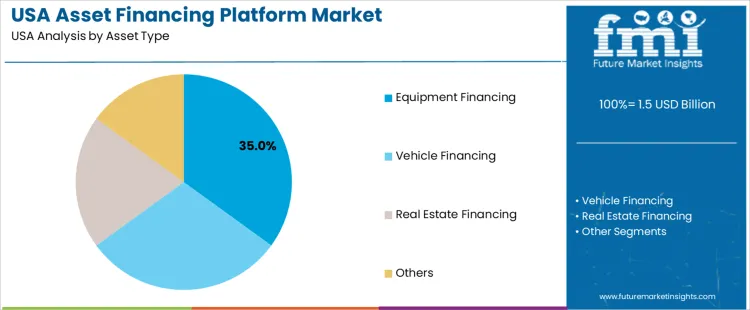
Equipment financing holds 35.0%, making it the leading asset-type segment in USA demand. Manufacturing, construction, healthcare, and infrastructure operators rely on platforms to manage high-value equipment with long depreciation cycles. Platforms support repayment scheduling, asset tracking, and compliance documentation aligned with financial reporting standards. Vehicle financing holds 30.0%, driven by fleet management needs across logistics, utilities, and service organizations. Real estate financing accounts for 20.0%, supporting property-backed financing and lease administration. Other asset types hold 15.0%, covering technology assets and specialized financing cases. Asset-type distribution reflects emphasis on productive capital assets central to operational continuity and balance-sheet management.
Key Points
- Equipment financing leads due to capital-intensive asset bases.
- Vehicle financing supports fleet and mobility operations.
- Real estate financing serves structured property portfolios.
By Deployment, Does On-Premises Implementation Represent the Largest Share of Demand in USA?
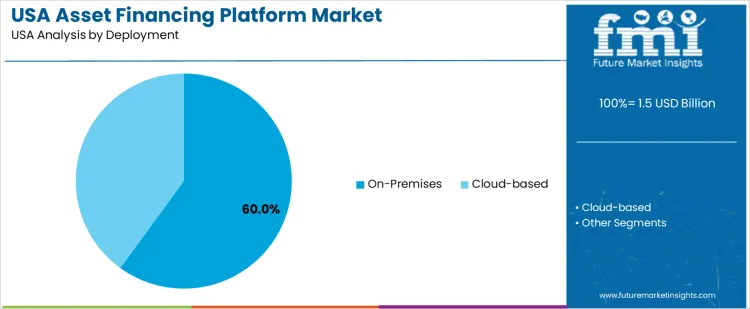
On-premises deployment holds 60.0%, making it the leading deployment segment in USA. Enterprises prioritize direct control over financial data, internal security governance, and customization of financing workflows. On-premises systems support integration with legacy ERP platforms and internal compliance processes. Cloud-based deployment holds 40.0%, offering scalability, faster updates, and reduced infrastructure management. Cloud adoption is selective, often applied where regulatory sensitivity is lower or hybrid IT strategies exist. Deployment distribution reflects continued preference for controlled environments within financial operations, balanced by gradual acceptance of cloud platforms for flexibility and cost management.
Key Points
- On-premises systems dominate due to data control priorities.
- Integration with legacy systems supports on-premises preference.
- Cloud platforms serve scalability and deployment speed needs.
By Enterprise Size, Do Very Large Enterprises Account for the Largest Share of Demand in USA?
Very large enterprises with 1,000 or more employees hold 45.0%, representing the largest enterprise-size segment in USA demand. These organizations manage complex financing portfolios across multiple asset categories and subsidiaries. Platforms enable centralized oversight, audit readiness, and standardized financing policies. Medium-sized enterprises hold 20.0%, adopting platforms to improve visibility and control. Large enterprises account for 15%, while small enterprises hold 12.0%. Small offices hold 8.0%, reflecting limited financing complexity. Enterprise-size distribution highlights concentration of structured financing activity within large organizational environments.
Key Points
- Very large enterprises lead due to portfolio complexity.
- Centralized governance drives platform adoption.
- Smaller organizations show selective platform usage.
What are the Key Dynamics in the Asset Financing Platform Industry?
Demand rises as USA businesses, banks, and non-bank lenders adopt digital platforms to streamline equipment financing, leasing, and asset-based lending. Asset financing platforms automate credit assessment, documentation, portfolio management, and compliance workflows. Adoption aligns with strong small and medium enterprise activity, digitization imperatives across financial services, and integration with broader commercial lending ecosystems. Usage concentrates among regional banks, fintech lenders, and captive finance arms of equipment OEMs.
How do SME financing needs and digital transformation in US financial services drive demand?
USA small and medium enterprises require access to capital for acquisition of machinery, vehicles, and technology assets. Asset financing platforms enable automated underwriting, risk scoring, and contract lifecycle management that reduce processing time and operational costs. Regional and community banks adopt platforms to compete with larger institutions and fintech entrants. Captive finance divisions of equipment manufacturers use digital systems to integrate point-of-sale financing with dealer networks. Fintech lenders leverage cloud-native platforms to expand asset financing into under-served segments. Demand is reinforced by corporate digitization strategies seeking improved customer experience, data analytics, and real-time decisioning.
How do regulatory compliance, legacy system integration, and cost considerations influence demand stability in USA?
The USA financial institutions operate under rigorous compliance regimes including consumer protection, anti-money-laundering, and data security standards, requiring robust platform controls. Integration with legacy core banking systems and loan servicing infrastructure adds complexity and slows deployment. Cost of implementation, customization, and ongoing maintenance influences platform selection, especially for smaller lenders. Training and change management for staff affect adoption pace. Risk aversion and cautious technology procurement behavior can extend evaluation cycles. Demand remains concentrated where clear ROI and compliance benefits are evident, while broader expansion depends on cost rationalization, seamless system integration, and demonstrable operational efficiency gains within USA financial industries.
How Is Demand for Asset Financing Platforms in the USA Evolving by Region?
Demand for asset financing platforms in the USA is increasing due to digitization of lending workflows, SME capital access needs, and data-driven credit assessment adoption. West USA leads with a 9.4% CAGR, supported by fintech concentration and technology-driven enterprises. South USA follows at 8.4%, driven by SME expansion, equipment financing, and regional banking partnerships. Northeast USA records a 7.5% CAGR, shaped by enterprise leasing, compliance-heavy industries, and structured financing demand. Midwest USA posts 6.5%, reflecting manufacturing asset renewal and conservative credit adoption. Regional variation reflects enterprise density, digital maturity, sectoral financing needs, and pace of platform-based lending adoption across the USA.
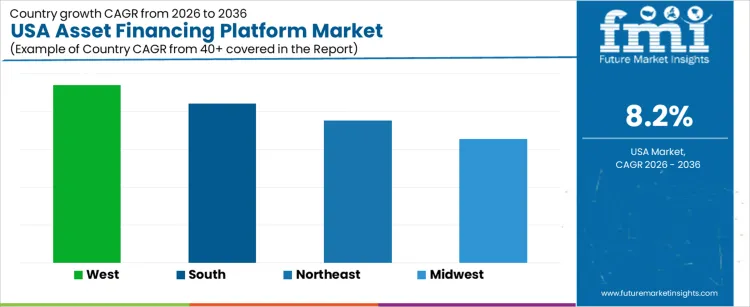
| Region | CAGR (2026 to 2036) |
|---|---|
| West USA | 9.4% |
| South USA | 8.4% |
| Northeast USA | 7.5% |
| Midwest USA | 6.5% |
How is West USA driving demand for Asset Financing Platforms in the USA?
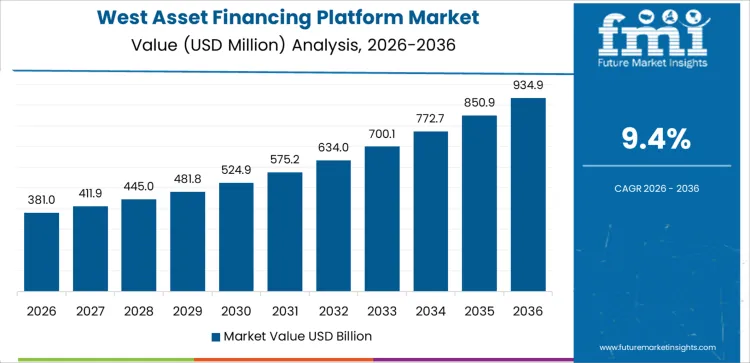
West USA drives demand through strong fintech ecosystems, startup density, and asset-light business models requiring flexible financing. Region’s CAGR of 9.4% reflects extensive use of asset financing platforms for technology equipment, renewable assets, and fleet financing. Enterprises prioritize rapid credit decisions, API-based integration, and real-time portfolio visibility. Platforms support alternative credit scoring using transaction and usage data. Venture-backed firms and leasing companies adopt automated underwriting to scale efficiently. Demand favors platforms offering analytics, fraud controls, and regulatory reporting. Growth remains innovation-led, aligned with digital-first financing models and expansion of platform-based lending across diverse asset classes.
- Fintech-driven platform adoption
- Technology and renewable asset financing
- API-enabled underwriting and analytics
- Digital-first enterprise financing models
How is South USA driving demand for Asset Financing Platforms in the USA?
South USA demand is shaped by SME growth, equipment-intensive industries, and cost-sensitive financing needs. Region’s CAGR of 8.4% reflects adoption of asset financing platforms for machinery, vehicles, construction equipment, and logistics assets. Regional banks and credit unions partner with platform providers to expand lending reach and improve processing efficiency. Businesses value simplified onboarding, predictable repayment structures, and faster funding cycles. Platforms support seasonal cash flow management across agriculture, construction, and transportation sectors. Demand favors standardized, scalable solutions supporting high transaction volumes. Growth remains SME-led and efficiency-focused within expanding regional economies.
- SME-focused equipment and fleet financing
- Bank and platform partnership models
- Simplified onboarding and faster funding
- Seasonal and sector-linked financing demand
How is Northeast USA driving demand for Asset Financing Platforms in the USA?
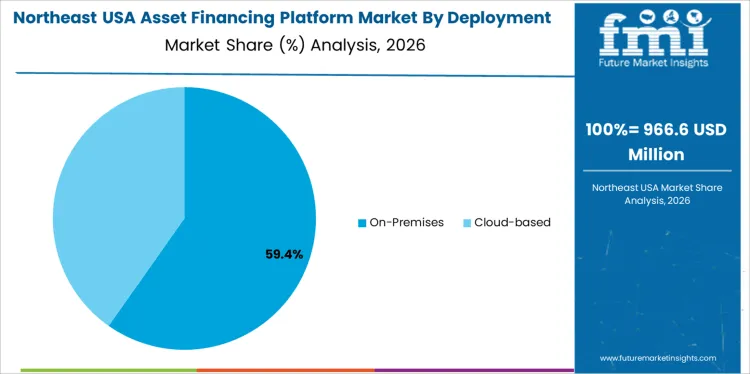
Northeast USA demand is driven by enterprise leasing, compliance-intensive industries, and structured financing practices. Region’s CAGR of 7.5% reflects platform use for IT asset financing, healthcare equipment, and industrial leases. Enterprises emphasize regulatory compliance, audit trails, and integration with ERP and accounting systems. Financial institutions deploy platforms to manage risk, documentation, and portfolio performance. Demand favors configurable platforms supporting complex contracts and multi-asset portfolios. Growth aligns with modernization of legacy financing processes and increasing reliance on digital workflow management.
- Enterprise and institutional asset leasing
- Compliance and audit-focused platform features
- ERP and accounting system integration
- Modernization of legacy financing workflows
How is Midwest USA driving demand for Asset Financing Platforms in the USA?
Midwest USA demand reflects manufacturing renewal cycles, conservative credit behavior, and long-term asset investment planning. Region’s CAGR of 6.5% is supported by use of asset financing platforms for production machinery, tooling, and industrial equipment. Manufacturers prioritize reliability, cost transparency, and contract lifecycle management. Financing decisions align with capital expenditure planning and supplier requirements. Platform adoption supports standardization across supplier networks and financing partners. Growth remains steady and process-driven, aligned with operational stability rather than aggressive expansion.
- Manufacturing and industrial asset financing
- Long-term cost visibility and planning
- Supplier-linked financing workflows
- Conservative and process-focused adoption
What is the competitive landscape of demand for asset financing platforms in the USA?
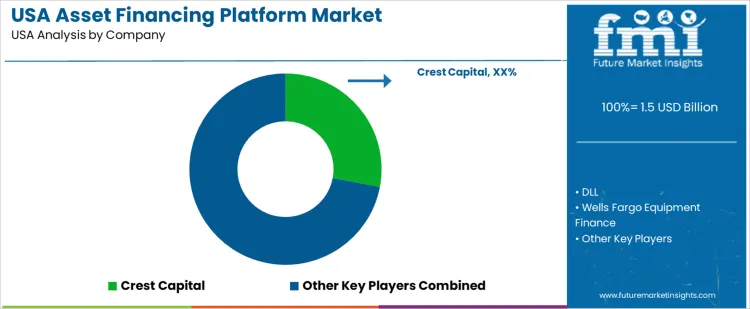
Demand for asset financing platforms in the USA is driven by corporate capital management, equipment acquisition cycles, and digital transformation initiatives that favor flexible financing over large upfront spending. Use cases span technology infrastructure, industrial machinery, fleet and transportation assets, and medical equipment where buyers seek optimized cash flow, automated credit assessments, and integration with enterprise systems. Buyers evaluate platform capabilities for credit decisioning, documentation workflows, real-time tracking, and compliance with USA financial regulations. Procurement teams prioritize scalable solutions, integration with ERP systems, and strong analytics that support risk management and pricing transparency. Trend in the USA market reflects embedded finance adoption, growth in subscription-based business models, and interest in software-driven risk scoring.
Crest Capital holds a strong position in the USA with flexible asset financing platforms tailored to small and medium enterprise equipment acquisition and cash-flow optimization needs. DLL USA participates by offering globally integrated asset-financing solutions adapted to USA regulatory and tax environments. Wells Fargo Equipment Finance supports demand through comprehensive financing platforms linked to extensive dealer and corporate networks. CIT Group, now part of First Citizens, provides technology-enabled asset financing for a broad range of equipment and industry sectors. Bank of America Leasing & Capital Company contributes with scalable financing tools that integrate with corporate procurement systems. Competitive positioning in the USA reflects platform flexibility, regulatory compliance, integration capability, and depth of financial underwriting expertise.
Key Players in USA Asset Financing Platform Demand
- Crest Capital
- DLL
- Wells Fargo Equipment Finance
- CIT Group (First Citizens)
- Bank of America Leasing & Capital Company
Scope of the Report
| Items | Details |
|---|---|
| Quantitative Units | USD billion |
| Asset Type | Equipment Financing; Vehicle Financing; Real Estate Financing; Others |
| Deployment | On-Premises; Cloud-based |
| Enterprise Size | Small Offices (1-9 employees); Small Enterprises (10-99 employees); Medium-sized Enterprises (100–499 employees); Large Enterprises (500–999 employees); Very Large Enterprises (1,000+ employees) |
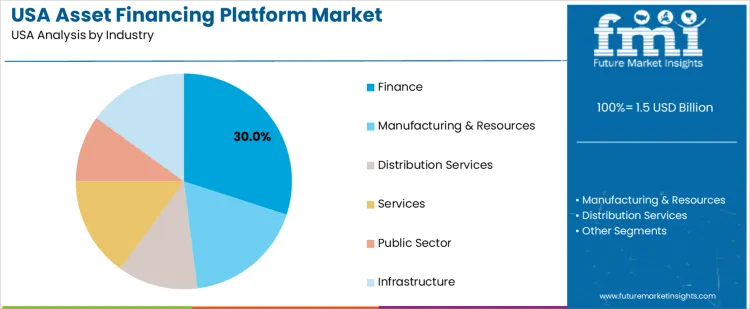
| Industry | Finance; Manufacturing & Resources; Distribution Services; Services; Public Sector; Infrastructure |
| Regions Covered | West USA; South USA; Northeast USA; Midwest USA |
| Key Companies Profiled | Crest Capital; DLL; Wells Fargo Equipment Finance; CIT Group (First Citizens); Bank of America Leasing & Capital Company |
| Additional Attributes | Demand reflects digitization of lending workflows, increased preference for cloud-based financing platforms, and strong uptake among SMEs for equipment and vehicle financing. Financial institutions focus on automation, credit risk analytics, and compliance integration, while manufacturing and distribution sectors drive recurring platform adoption. |
USA Asset Financing Platform Demand by Segments
Asset Type:
- Equipment Financing
- Vehicle Financing
- Real Estate Financing
- Others
Deployment:
- On-Premises
- Cloud-based
Enterprise Size:
- Very Large Enterprises (1,000+ employees)
- Small Offices (1-9 employees)
- Small Enterprises (10-99 employees)
- Medium-sized Enterprises (100-499 employees)
- Large Enterprises (500-999 employees)
Industry:
- Finance
- Manufacturing & Resources
- Distribution Services
- Services
- Public Sector
- Infrastructure
Region:
- West USA
- South USA
- Northeast USA
- Midwest USA
Frequently Asked Questions
How big is the demand for asset financing platform in USA in 2026?
The demand for asset financing platform in USA is estimated to be valued at USD 1.5 billion in 2026.
What will be the size of asset financing platform in USA in 2036?
The market size for the asset financing platform in USA is projected to reach USD 3.3 billion by 2036.
How much will be the demand for asset financing platform in USA growth between 2026 and 2036?
The demand for asset financing platform in USA is expected to grow at a 8.2% CAGR between 2026 and 2036.
What are the key product types in the asset financing platform in USA?
The key product types in asset financing platform in USA are equipment financing, vehicle financing, real estate financing and others.
Which deployment segment is expected to contribute significant share in the asset financing platform in USA in 2026?
In terms of deployment, on-premises segment is expected to command 60.0% share in the asset financing platform in USA in 2026.
Preview the report firsthand - request a free sample
Get SampleGet the brochure for pricing and purchase details.
Get PDFTable of Content
- Executive Summary
- USA Market Outlook
- Demand-side Trends
- Supply-side Trends
- Technology Roadmap Analysis
- Analysis and Recommendations
- Market Overview
- Market Coverage / Taxonomy
- Market Definition / Scope / Limitations
- Market Background
- Market Dynamics
- Drivers
- Restraints
- Opportunity
- Trends
- Scenario Forecast
- Demand in Optimistic Scenario
- Demand in Likely Scenario
- Demand in Conservative Scenario
- Opportunity Map Analysis
- Product Life Cycle Analysis
- Supply Chain Analysis
- Investment Feasibility Matrix
- Value Chain Analysis
- PESTLE and Porter’s Analysis
- Regulatory Landscape
- Regional Parent Market Outlook
- Production and Consumption Statistics
- Import and Export Statistics
- Market Dynamics
- USA Market Analysis 2021 to 2025 and Forecast, 2026 to 2036
- Historical Market Size Value (USD Million) Analysis, 2021 to 2025
- Current and Future Market Size Value (USD Million) Projections, 2026 to 2036
- Y-o-Y Growth Trend Analysis
- Absolute $ Opportunity Analysis
- USA Market Pricing Analysis 2021 to 2025 and Forecast 2026 to 2036
- USA Market Analysis 2021 to 2025 and Forecast 2026 to 2036, By Asset Type
- Introduction / Key Findings
- Historical Market Size Value (USD Million) Analysis By Asset Type , 2021 to 2025
- Current and Future Market Size Value (USD Million) Analysis and Forecast By Asset Type , 2026 to 2036
- Equipment Financing
- Vehicle Financing
- Real Estate Financing
- Others
- Equipment Financing
- Y-o-Y Growth Trend Analysis By Asset Type , 2021 to 2025
- Absolute $ Opportunity Analysis By Asset Type , 2026 to 2036
- USA Market Analysis 2021 to 2025 and Forecast 2026 to 2036, By Deployment
- Introduction / Key Findings
- Historical Market Size Value (USD Million) Analysis By Deployment, 2021 to 2025
- Current and Future Market Size Value (USD Million) Analysis and Forecast By Deployment, 2026 to 2036
- On-Premises
- Cloud-based
- On-Premises
- Y-o-Y Growth Trend Analysis By Deployment, 2021 to 2025
- Absolute $ Opportunity Analysis By Deployment, 2026 to 2036
- USA Market Analysis 2021 to 2025 and Forecast 2026 to 2036, By Enterprise Size
- Introduction / Key Findings
- Historical Market Size Value (USD Million) Analysis By Enterprise Size, 2021 to 2025
- Current and Future Market Size Value (USD Million) Analysis and Forecast By Enterprise Size, 2026 to 2036
- Very Large Enterprises (1,000+ employees)
- Small Offices (1-9 employees)
- Small Enterprises (10-99 employees)
- Medium-sized Enterprises (100-499 employees)
- Large Enterprises (500-999 employees)
- Very Large Enterprises (1,000+ employees)
- Y-o-Y Growth Trend Analysis By Enterprise Size, 2021 to 2025
- Absolute $ Opportunity Analysis By Enterprise Size, 2026 to 2036
- USA Market Analysis 2021 to 2025 and Forecast 2026 to 2036, By Industry
- Introduction / Key Findings
- Historical Market Size Value (USD Million) Analysis By Industry, 2021 to 2025
- Current and Future Market Size Value (USD Million) Analysis and Forecast By Industry, 2026 to 2036
- Finance
- Manufacturing & Resources
- Distribution Services
- Services
- Public Sector
- Infrastructure
- Finance
- Y-o-Y Growth Trend Analysis By Industry, 2021 to 2025
- Absolute $ Opportunity Analysis By Industry, 2026 to 2036
- Market Structure Analysis
- Competition Dashboard
- Competition Benchmarking
- Market Share Analysis of Top Players
- By Regional
- By Asset Type
- By Deployment
- By Enterprise Size
- By Industry
- Competition Analysis
- Competition Deep Dive
- Crest Capital
- Overview
- Product Portfolio
- Profitability by Market Segments (Product/Age /Sales Channel/Region)
- Sales Footprint
- Strategy Overview
- Marketing Strategy
- Product Strategy
- Channel Strategy
- DLL
- Wells Fargo Equipment Finance
- CIT Group (First Citizens)
- Bank of America Leasing & Capital Company
- Crest Capital
- Competition Deep Dive
- Assumptions & Acronyms Used
- Research Methodology


