

- Industry Size (2025)
- USD 162.4 Mn
- Forecast (2035)
- USD 236.3 Mn
- CAGR (2025 to 2035)
- 3.8%
Demand for Clinical Alarm Management in Japan Forecast and Outlook 2025 to 2035
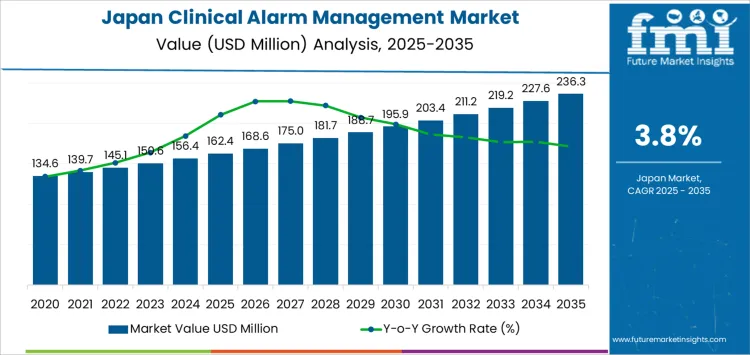
Demand for clinical alarm management in Japan is valued at USD 162.4 million in 2025 and is projected to reach USD 236.3 million by 2035, reflecting a CAGR of 3.8%. Market valuation increased from USD 134.6 million in 2020 to USD 162.4 million in 2025, reflecting steady system expansion across hospital care settings. Solutions account for the larger share of spending as facilities prioritize centralized alarm aggregation and notification control. On-premises deployment still holds a significant base due to integration with legacy monitoring infrastructure. Hospitals represent key end user group, as inpatient monitoring density remains high. Clinics and ambulatory surgical centers contribute a smaller but steady demand tied to growth in procedure volume. Early-phase investment reflects patient safety compliance, staff response optimization, and alarm-fatigue reduction rather than broad digital-transformation programs.
Demand advances from USD 168.6 million to USD 203.4 million by 2030, then increases to USD 236.3 million by 2035 through consistent annual additions. Cloud-based deployment is expanding at a faster rate as newer facilities adopt remote access and cross-departmental alert coordination. Services grow alongside software upgrades, validation, and system tuning requirements. Long-term and palliative care centers increase adoption as the duration of patient monitoring rises. Home care remains a small segment due to limited integration with hospital alarm platforms. After 2030, replacement cycles for early installations become a key driver of spending. Annual value additions remain narrow, indicating limited volatility.
Quick Stats of the Demand for Clinical Alarm Management in Japan
- Demand for Clinical Alarm Management in Japan Value (2025): USD 162.4 million
- Demand for Clinical Alarm Management in Japan Forecast Value (2035): USD 236.3 million
- Demand for Clinical Alarm Management in Japan Forecast CAGR (2025–2035): 3.8%
- Demand for Clinical Alarm Management in Japan Leading Component: Solutions (65%)
- Demand for Clinical Alarm Management in Japan Key Growth Regions: Kyushu & Okinawa, Kanto, Kansai
- Demand for Clinical Alarm Management in Japan Top Players: Medtronic, GE Healthcare, Koninklijke Philips N.V., Baxter, Mindray Medical International
What is the Growth Forecast for Clinical Alarm Management in Japan through 2035?
Between 2025 and 2030, demand for clinical alarm management in Japan is projected to rise from USD 162.4 million to USD 195.9 million, delivering an absolute increase of USD 33.5 million and accounting for nearly 45.3% of total decade growth. This phase reflects steady deployment across tertiary hospitals, diagnostic centers, and emergency care units. Replacement of fragmented nurse call and monitoring alert systems supports baseline demand. Historical growth relied on gradual digitization of patient monitoring. Near term performance is shaped by workload reduction requirements for clinical staff, rising intensive care utilization, and broader adoption of centralized alert escalation platforms across multi ward hospital environments.
From 2030 to 2035, demand is forecast to expand from USD 195.9 million to USD 236.3 million, adding USD 40.4 million and representing about 54.7% of total ten year growth. This stage reflects wider use in long term care facilities, home based remote monitoring networks, and high acuity outpatient settings. Integration with electronic medical records and multi device patient monitoring becomes more standardized. Earlier growth depended on hospital capital budgets, while future expansion is guided by aging population care demand, tighter clinical risk management protocols, and growing reliance on automated alarm prioritization across regionally distributed healthcare delivery systems.
Clinical Alarm Management Industry in Japan Key Takeaways
| Metric | Value |
|---|---|
| Industry Value (2025) | USD 162.4 million |
| Forecast Value (2035) | USD 236.3 million |
| Forecast CAGR (2025–2035) | 3.8% |
What Is Driving Demand for Clinical Alarm Management in Japan
Adoption for clinical alarm management in Japan has grown as hospitals, long-term care facilities, and medical institutions respond to rising alarm fatigue among clinical staff and stricter expectations for patient safety. Use of monitoring devices has increased overall, generating a high volume of alarms for vital signs, equipment status, and patient alerts. Alarm overload often leads to missed critical alerts or delayed responses.
Growth in demand also reflects broader shifts in healthcare infrastructure, including more intensive care units, greater use of electronic medical record integration, and expanded elderly care services. Innovations such as algorithm-based alarm filtering, contextual alert generation, remote monitoring, and integration with hospital information systems encourage adoption. Facilities seek scalable, interoperable systems that handle alarms across devices and locations. As healthcare delivery becomes more complex, driven by demographic trends, chronic disease prevalence, and higher standards for care coordination, the need for effective alarm-management systems gains urgency.
What Is the Demand for Clinical Alarm Management in Japan by Component and Deployment Mode?
High patient monitoring intensity, strict hospital safety standards, and staffing pressure in acute care settings shape demand for clinical alarm management in Japan. Solutions led by component due to the need for centralized alarm filtering, routing, and escalation control across critical care units. Cloud-based deployment leads by deployment mode as hospitals seek scalable data processing and remote system access across multi-facility networks. Tertiary hospitals, emergency care centers, and medical system integrators drive procurement. Import reliance remains present for alarm middleware platforms and data aggregation engines. Substitution pressure exists from basic bedside alarm systems. Demand stability is supported by continuous ICU utilization and national emphasis on patient safety metrics.
Why do solutions account for 65% of the demand for clinical alarm management in Japan by component?
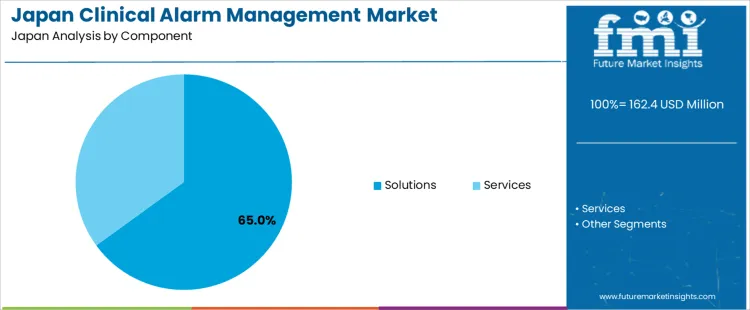
Solutions account for 65% of the demand for clinical alarm management in Japan by component, reflecting their role in consolidating alarms across monitors, ventilators, infusion pumps, and telemetry systems. Consumption intensity is driven by intensive care units, emergency departments, and surgical recovery wards where alarm volume remains high. Usage remains stable because alarm fatigue reduction relies on algorithm-driven prioritization rather than manual response. Procurement is led by hospital IT departments and clinical engineering units managing integrated monitoring platforms. Price sensitivity remains moderate because alarm failure directly affects patient safety outcomes. Specification control emphasizes real-time data processing speed, rule-based filtering logic, interoperability with device vendors, and clinical workflow alignment.
Solution platforms also generate steady repeat demand through version upgrades, expansion into new wards, and integration with electronic medical records. Repeat utilization remains predictable as hospitals extend alarm coverage beyond critical care into general wards. Buyers favor platforms that support vendor-neutral device connectivity to reduce lock-in risk. Margin structure remains controlled under multi-year system licensing and maintenance agreements. Regulatory exposure remains elevated due to patient safety reporting, audit trail requirements, and medical software certification. Import reliance persists for proprietary alarm engines and interface middleware. Substitution pressure from standalone device alarms remains limited due to a lack of centralized visibility.
Why does cloud-based deployment represent 60.0% of the demand for clinical alarm management in Japan by deployment mode?
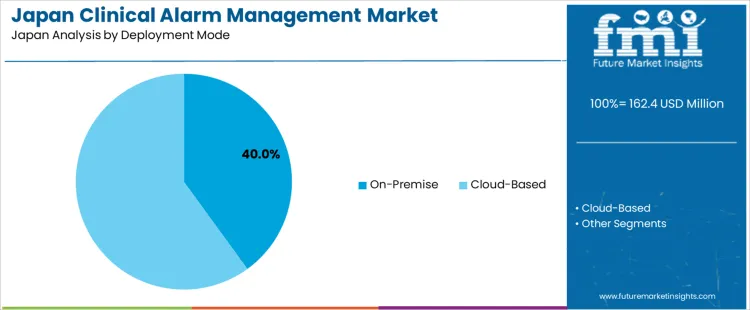
Cloud based deployment represents 60.0% of the demand for clinical alarm management in Japan by deployment mode, reflecting the shift toward centralized data processing and remote system administration. Consumption intensity is driven by hospital network consolidation, multi site monitoring expansion, and offsite clinical oversight programs. Usage remains stable because cloud platforms support continuous software updates and unified configuration control. Procurement is dominated by large hospital groups and digital health platform providers operating under subscription models. Price sensitivity remains moderate because cloud delivery reduces in-house server maintenance costs. Specification control emphasizes uptime reliability, data encryption strength, latency control, and compliance with national health data security standards.
Cloud-based systems also generate consistent repeat demand through user expansion, storage scaling, and analytics module activation. Repeat utilization remains predictable as hospitals add new monitored beds and care units. Buyers favor platforms that support hybrid connectivity with legacy on-premises systems. Margin structure remains controlled under recurring subscription revenue structures. Regulatory exposure remains elevated due to compliance with patient data protection laws and cross-facility access governance. Import reliance persists for cloud infrastructure software and distributed data processing frameworks. Substitution pressure from on-premises deployment persists in facilities with restrictive network policies.
What Is Driving the Demand for Clinical Alarm Management in Japan Patient Safety and Workload Stabilization?
Demand for clinical alarm management in Japan is shaped by high device density in intensive care units, aging inpatient demographics, and strict patient safety governance. Hospitals manage thousands of alerts each day from monitors, ventilators, infusion pumps, and dialysis systems. Staff fatigue from excessive non actionable alarms creates risk for delayed response. National quality programs emphasize measurable reduction of nuisance alarms and documented escalation pathways. Electronic medical records integrate alarm data for audit trails and workflow routing. Demand aligns with workload stabilization, patient risk control, and compliance with safety inspections rather than with optional digital optimization projects within hospital operations.
How Are Intensive Care Workflows Driving Alarm Prioritization Systems in Japan?
Japan intensive care wards operate with continuous physiologic monitoring across cardiac, respiratory, and neurological patients. Alarm floods arise during suctioning, repositioning, and medication adjustment. Clinical alarm management platforms filter redundancy, apply patient specific thresholds, and route only actionable signals to assigned nurses. Mobile alert delivery reduces overhead paging noise inside closed wards. Charge nurses view unit wide alarm maps that reveal clustering and response gaps. This workflow control supports faster intervention for true deterioration while lowering background stress. Demand follows ICU expansion for oncology, stroke, and post surgical recovery where alarm density rises with acuity in tertiary hospitals nationwide settings.
Why Are Aging Patient Profiles Increasing Alarm Burden in Japan Hospitals?
Older inpatients in Japan present higher rates of arrhythmia, oxygen desaturation, renal instability, and blood pressure fluctuation. These conditions trigger frequent threshold crossings that escalate alarm volume across wards. Polypharmacy and complex infusion regimens increase infusion pump alerts related to occlusion, empty reservoirs, and dose limits. Night time monitoring intensifies due to fall risk and sudden respiratory events. Alarm management tools consolidate multi device signals into single patient views to reduce duplication. Demand strengthens in general medicine, cardiology, nephrology, and long term acute units where elderly occupancy remains high across municipal hospitals and regional care centers under standardized staffing models.
How Do Regulation, Cyber Risk, and Integration Demands Shape Adoption in Japan?
Clinical alarm systems in Japan operate within regulated medical device and data protection frameworks. Hospitals require documented validation, time-stamped audit logs, and secure network segmentation for alarm traffic. Cyber risk awareness has grown following ransomware incidents across healthcare networks. Integration with electronic records, nurse call systems, and middleware platforms raises implementation complexity. Many facilities run mixed-generation monitors that require protocol translation. Capital budgeting follows multiyear equipment plans linked to ward renovation.
What is the Demand for Clinical Alarm Management in Japan by Region?
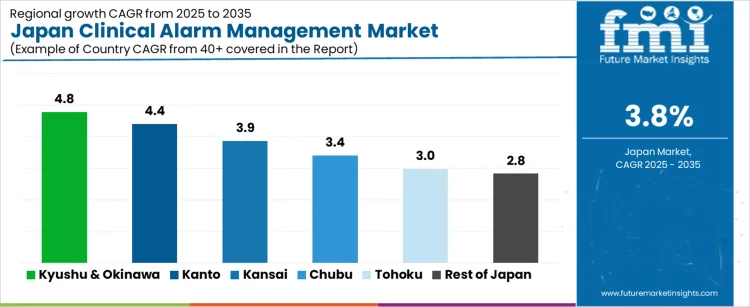
| Region | CAGR (%) |
|---|---|
| Kyushu & Okinawa | 4.8% |
| Kanto | 4.4% |
| Kansai | 3.9% |
| Chubu | 3.4% |
| Tohoku | 3.0% |
| Rest of Japan | 2.8% |
The demand for clinical alarm management in Japan is increasing steadily across hospital and critical care environments, led by Kyushu and Okinawa at a 4.8% CAGR. Growth in this region is supported by rising patient monitoring volumes, modernization of intensive care units, and stronger focus on reducing alarm fatigue in nursing workflows. Kanto follows at 4.4%, driven by dense concentrations of tertiary hospitals, advanced patient monitoring infrastructure, and early adoption of integrated clinical IT systems. Kansai records 3.9% growth, reflecting stable deployment across university hospitals and private medical centers. Chubu at 3.4% shows moderate uptake linked to regional hospital automation programs. Tohoku and the Rest of Japan, at 3.0% and 2.8%, reflect slower growth shaped by smaller hospital sizes, tighter procurement budgets, and longer upgrade cycles for digital monitoring platforms.
How Is Acute Care Infrastructure Strengthening Clinical Alarm Management Demand in Kyushu and Okinawa?
Demand for clinical alarm management in Kyushu and Okinawa is advancing at a CAGR of 4.8% through 2035, supported by steady expansion of hospital capacity, rising use of multi parameter patient monitors, and growing attention to alarm fatigue reduction. Emergency units and intensive care wards rely on centralized alarm routing to improve staff response efficiency. Regional hospitals apply alarm prioritization tools to manage nurse workload. Growth reflects increasing deployment of networked patient monitoring systems, higher patient turnover in emergency care, and gradual integration of digital workflow coordination in clinical operations.
- Emergency care units drive centralized alarm adoption
- Nurse workload management supports alarm prioritization use
- Networked patient monitors expand active alarm volumes
- Hospital digital workflows support system integration
Why Is High Hospital Density Sustaining Clinical Alarm Management Growth in Kanto?
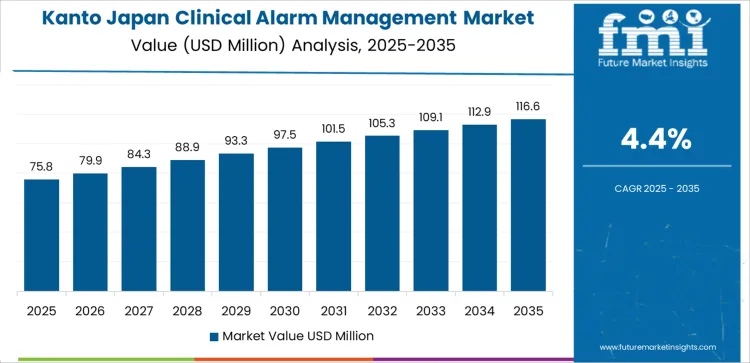
Demand for clinical alarm management in Kanto is rising at a CAGR of 4.4% through 2035, driven by dense concentration of tertiary hospitals, advanced diagnostic centers, and continuous modernization of critical care infrastructure. Kanto records high adoption of integrated alarm middleware platforms connected with electronic medical records. Teaching hospitals rely on alarm analytics to improve patient safety protocols. Growth reflects strong capital investment in digital health systems, high patient volumes, and strict clinical governance standards across metropolitan healthcare networks.
- Tertiary hospitals anchor high volume system deployments
- Alarm middleware integrates with electronic medical records
- Teaching hospitals apply alarm data for safety audits
- Digital health investment sustains regular platform upgrades
What Is Supporting Controlled Clinical Alarm Management Expansion Across Kansai?
Demand for clinical alarm management in Kansai is progressing at a CAGR of 3.9% through 2035, supported by stable hospital admissions, steady upgrade of patient monitoring equipment, and gradual rollout of alarm integration platforms. Kansai hospitals focus on reducing nuisance alarms in general wards and post surgical recovery units. Adoption remains balanced across private and public healthcare facilities. Growth reflects moderate healthcare spending growth, standardization of monitoring protocols, and increasing awareness of alarm related clinical risks.
- Post surgical wards drive alarm filtering use
- Public hospitals support standardized monitoring protocols
- Balanced private and public facility adoption sustains volume
- Nuisance alarm reduction strengthens system value
How Is Mid Scale Hospital Modernization Shaping Alarm Management Demand in Chubu?
Demand for clinical alarm management in Chubu is advancing at a CAGR of 3.4% through 2035, supported by hospital modernization programs, rising surgical procedure volumes, and steady deployment of centralized monitoring stations. Chubu facilities rely on alarm escalation tools to manage patient safety across operating theaters and recovery units. Integration with nurse call systems remains a key procurement driver. Growth reflects controlled healthcare infrastructure investment, increasing surgical case loads, and steady replacement of analog alarm systems with digital platforms.
- Surgical recovery units drive centralized alarm routing
- Nurse call integration shapes system procurement criteria
- Operating theaters apply alarm escalation workflows
- Analog system replacement sustains baseline demand
Why Is Regional Healthcare Scale Influencing Alarm Management Growth in Tohoku?
Demand for clinical alarm management in Tohoku is advancing at a CAGR of 3.0% through 2035, supported by public hospital upgrades, gradual digitization of monitoring systems, and steady patient load across regional medical centers. Tohoku facilities focus on alarm standardization across intensive care and step down units. Adoption remains gradual due to budget controls. Growth reflects public sector healthcare modernization programs, patient safety improvement initiatives, and gradual transition from standalone monitors to connected alarm networks.
- Public medical centers anchor system deployment
- Intensive care units drive alarm standardization
- Budget controls guide phased implementation
- Connected monitor adoption increases networked alarm use
How Is Community Hospital Digitization Guiding Alarm Management Demand in Rest of Japan?
Demand for clinical alarm management in Rest of Japan is advancing at a CAGR of 2.8% through 2035, supported by community hospital digitization, steady installation of basic patient monitoring systems, and rising attention to nurse workflow efficiency. These areas prioritize essential alarm routing rather than advanced analytics platforms. Adoption remains led by small multi-specialty hospitals and long term care facilities. Growth remains steady and guided by local healthcare funding cycles, staff safety priorities, and gradual shift toward centralized monitoring practices.
- Community hospitals rely on basic alarm routing platforms
- Long term care facilities support steady installation demand
- Nurse workflow efficiency drives functional adoption
- Local funding programs regulate procurement cycles
What Is Driving the Demand for Clinical Alarm Management in Japan and Which Companies Shape Hospital Deployment?
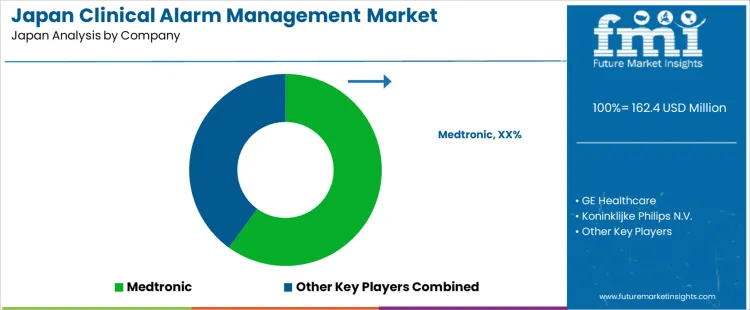
The demand for clinical alarm management in Japan is shaped by rising patient acuity, nursing staff shortages, and national attention on alarm fatigue in intensive and acute care wards. Nihon Kohden holds a central domestic position through bedside monitors, central monitoring stations, and alarm integration software used across public and private hospitals. Fukuda Denshi supports demand through cardiovascular monitoring and alarm distribution systems widely deployed in emergency and cardiac units. Medtronic participates through connected patient monitoring and smart alarm platforms used in tertiary care and surgical recovery areas. GE Healthcare supports adoption through centralized monitoring environments linked to imaging and anesthesia systems used in operating suites and ICUs. These suppliers anchor deployment through long term hospital relationships and domestic service coverage.
Koninklijke Philips N V contributes through alarm aggregation and workflow management platforms used in large academic hospitals and stroke centers. Baxter participates where infusion system alarms integrate with central nurse station software in dialysis and critical care units. Mindray Medical International serves selected hospitals through cost focused patient monitoring and alarm distribution systems supplied via Japanese distributors. System selection in Japan is governed by alarm accuracy, false alert reduction, cybersecurity certification, and interoperability with existing nurse call and electronic medical record systems. Buyer preference favors suppliers with Japanese language interfaces, on site clinical training, and stable long cycle maintenance support. Demand visibility tracks ICU bed expansion, digital hospital funding programs, and steady replacement of legacy bedside monitoring systems across regional medical networks.
Key Players in the Clinical Alarm Management Industry in Japan
- Medtronic
- GE Healthcare
- Koninklijke Philips N.V.
- Baxter
- Mindray Medical International Limited
Scope of the Report
| Items | Values |
|---|---|
| Quantitative Units (2025) | USD million |
| Type | Solutions, Services |
| Application | Intensive Care Monitoring, Emergency Care Alerts, Post-Surgical Recovery Monitoring, Long Term Patient Monitoring, Nurse Call and Alarm Integration |
| End User | Hospitals, Clinics, Ambulatory Surgical Centers, Long Term and Palliative Care Centers, Home Care Providers |
| Regions Covered | Kyushu and Okinawa, Kanto, Kansai, Chubu, Tohoku, Rest of Japan |
| Countries Covered | Japan |
| Key Companies Profiled | Medtronic, GE Healthcare, Koninklijke Philips N V, Baxter, Mindray Medical International Limited |
| Additional Attributes | Dollar sales by component and deployment mode, cloud based and on premise system adoption trends, replacement driven upgrades of legacy nurse call and monitoring alarm systems, regulatory compliance with patient safety and health data protection laws, alarm fatigue reduction requirements in intensive care workflows, integration with electronic medical records and nurse call platforms, regional demand linked to hospital capacity expansion and digital healthcare funding programs |
Clinical Alarm Management Industry in Japan Segmentation
Component:
- Solutions
- Services
Deployment Mode:
- On-Premise
- Cloud-Based
End User:
- Hospitals
- Clinics
- Ambulatory Surgical Centers
- Long Term & Palliative Care Centers
- Home Care
- Others
Application:
- Orthopedic Implants
- Dental Implants
- Craniomaxillofacial Implant
Region
- Kyushu & Okinawa
- Kanto
- Kansai
- Chubu
- Tohoku
- Rest of Japan
Frequently Asked Questions
How big is the demand for clinical alarm management in Japan in 2025?
The demand for clinical alarm management in Japan is estimated to be valued at USD 162.4 million in 2025.
What will be the size of clinical alarm management in Japan in 2035?
The market size for the clinical alarm management in Japan is projected to reach USD 236.3 million by 2035.
How much will be the demand for clinical alarm management in Japan growth between 2025 and 2035?
The demand for clinical alarm management in Japan is expected to grow at a 3.8% CAGR between 2025 and 2035.
What are the key product types in the clinical alarm management in Japan?
The key product types in clinical alarm management in Japan are solutions and services.
Which deployment mode segment is expected to contribute significant share in the clinical alarm management in Japan in 2025?
In terms of deployment mode, on-premise segment is expected to command 40.0% share in the clinical alarm management in Japan in 2025.
Preview the report firsthand - request a free sample
Get SampleGet the brochure for pricing and purchase details.
Get PDFTable of Content
- Executive Summary
- Japan Market Outlook
- Demand-side Trends
- Supply-side Trends
- Technology Roadmap Analysis
- Analysis and Recommendations
- Market Overview
- Market Coverage / Taxonomy
- Market Definition / Scope / Limitations
- Market Background
- Market Dynamics
- Drivers
- Restraints
- Opportunity
- Trends
- Scenario Forecast
- Demand in Optimistic Scenario
- Demand in Likely Scenario
- Demand in Conservative Scenario
- Opportunity Map Analysis
- Product Life Cycle Analysis
- Supply Chain Analysis
- Investment Feasibility Matrix
- Value Chain Analysis
- PESTLE and Porter’s Analysis
- Regulatory Landscape
- Regional Parent Market Outlook
- Production and Consumption Statistics
- Import and Export Statistics
- Market Dynamics
- Japan Market Analysis 2020 to 2024 and Forecast, 2025 to 2035
- Historical Market Size Value (USD Million) Analysis, 2020 to 2024
- Current and Future Market Size Value (USD Million) Projections, 2025 to 2035
- Y-o-Y Growth Trend Analysis
- Absolute $ Opportunity Analysis
- Japan Market Pricing Analysis 2020 to 2024 and Forecast 2025 to 2035
- Japan Market Analysis 2020 to 2024 and Forecast 2025 to 2035, By Component
- Introduction / Key Findings
- Historical Market Size Value (USD Million) Analysis By Component , 2020 to 2024
- Current and Future Market Size Value (USD Million) Analysis and Forecast By Component , 2025 to 2035
- Solutions
- Services
- Y-o-Y Growth Trend Analysis By Component , 2020 to 2024
- Absolute $ Opportunity Analysis By Component , 2025 to 2035
- Japan Market Analysis 2020 to 2024 and Forecast 2025 to 2035, By Deployment Mode
- Introduction / Key Findings
- Historical Market Size Value (USD Million) Analysis By Deployment Mode, 2020 to 2024
- Current and Future Market Size Value (USD Million) Analysis and Forecast By Deployment Mode, 2025 to 2035
- On-Premise
- Cloud-Based
- Y-o-Y Growth Trend Analysis By Deployment Mode, 2020 to 2024
- Absolute $ Opportunity Analysis By Deployment Mode, 2025 to 2035
- Japan Market Analysis 2020 to 2024 and Forecast 2025 to 2035, By End User
- Introduction / Key Findings
- Historical Market Size Value (USD Million) Analysis By End User, 2020 to 2024
- Current and Future Market Size Value (USD Million) Analysis and Forecast By End User, 2025 to 2035
- Hospitals
- Clinics
- Ambulatory Surgical Centers
- Long Term & Palliative Care Centers
- Home Care
- Others
- Y-o-Y Growth Trend Analysis By End User, 2020 to 2024
- Absolute $ Opportunity Analysis By End User, 2025 to 2035
- Japan Market Analysis 2020 to 2024 and Forecast 2025 to 2035, By Application
- Introduction / Key Findings
- Historical Market Size Value (USD Million) Analysis By Application, 2020 to 2024
- Current and Future Market Size Value (USD Million) Analysis and Forecast By Application, 2025 to 2035
- Orthopedic Implants
- Dental Implants
- Craniomaxillofacial Implant
- Y-o-Y Growth Trend Analysis By Application, 2020 to 2024
- Absolute $ Opportunity Analysis By Application, 2025 to 2035
- Market Structure Analysis
- Competition Dashboard
- Competition Benchmarking
- Market Share Analysis of Top Players
- By Regional
- By Component
- By Deployment Mode
- By End User
- By Application
- Competition Analysis
- Competition Deep Dive
- Medtronic
- Overview
- Product Portfolio
- Profitability by Market Segments (Product/Age /Sales Channel/Region)
- Sales Footprint
- Strategy Overview
- Marketing Strategy
- Product Strategy
- Channel Strategy
- GE Healthcare
- Koninklijke Philips N.V.
- Baxter
- Mindray Medical International Limited
- Medtronic
- Competition Deep Dive
- Assumptions & Acronyms Used
- Research Methodology


