

- Industry Size (2025)
- USD 485.8 Mn
- Forecast (2035)
- USD 691.9 Mn
- CAGR (2025 to 2035)
- 3.6%
Demand for Medical Specialty Bag in Japan Forecast and Outlook 2025 to 2035
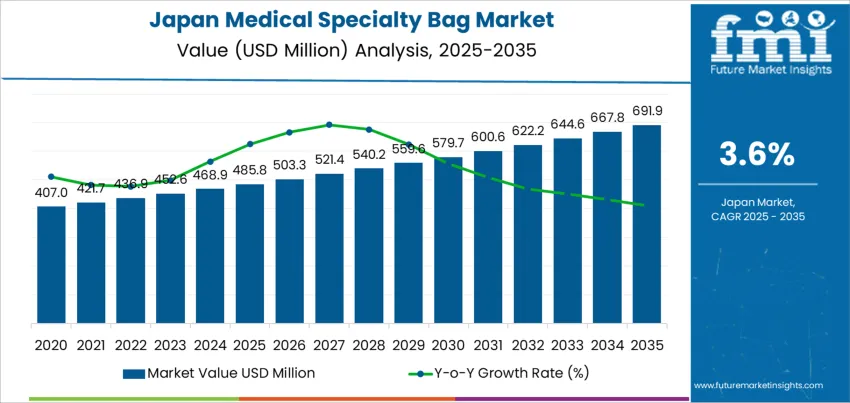
In 2025, the demand for medical specialty bags in Japan is valued at USD 485.8 million and is projected to reach USD 691.9 million by 2035, driven by a compound annual growth rate (CAGR) of 3.6%. Early growth in this sector reflects the increasing adoption of specialty bags for the storage, transport, and disposal of medical fluids, waste, and other essential healthcare packaging materials. The rising number of medical procedures, hospital admissions, and outpatient treatments is contributing to the growing need for these specialized bags, which play a vital role in ensuring proper medical waste management, infection control, and patient safety. Advances in materials and bag design, including enhanced durability and ease of use, further support this growth.
From 2030 onward, the demand for medical specialty bags will continue to rise, driven by an aging population and expanding healthcare infrastructure. Demand is expected to grow from approximately USD 579.7 million in 2030 to USD 691.9 million by 2035, contributing USD 112.2 million in value. The focus on patient safety, sanitation, and effective medical waste management in healthcare facilities will continue to drive the demand for specialty bags. Innovations in eco-friendly materials and eco-friendly options will further support continued growth as healthcare providers focus on reducing environmental impact while maintaining high standards of infection prevention.
Quick Stats of the Demand for Medical Specialty Bag in Japan
- Demand for Medical Specialty Bag in Japan Value (2025): USD 485.8 million
- Demand for Medical Specialty Bag in Japan Forecast Value (2035): USD 691.9 million
- Demand for Medical Specialty Bag in Japan Forecast CAGR (2025-2035): 3.6%
- Demand for Medical Specialty Bag in Japan Leading Material Type: Polypropylene (PP)
- Demand for Medical Specialty Bag in Japan Key Growth Regions: Kyushu & Okinawa, Kanto, Kansai, Chubu, Tohoku, Rest of Japan
- Demand for Medical Specialty Bag in Japan Top Players: Baxter International Inc., B. Braun SE, Coloplast A/S, Convatec Group PLC, Fresenius SE & Co. KGaA
What is the Growth Forecast for the Medical Specialty Bag Demand through 2035?
Between 2025 and 2030, demand for medical specialty bags is projected to grow from USD 485.8 million to USD 579.7 million, adding USD 93.9 million in value and setting a 3.6% compound annual growth trajectory. This growth will be fueled by the increasing adoption of specialty bags across various healthcare sectors, including the rise in hospital admissions and procedures. The development of more effective, durable, and eco-friendly bags will further support the expansion. Manufacturers will focus on increasing production capacity, improving strain stability, and enhancing design to meet evolving healthcare needs.
From 2030 to 2035, demand will continue to rise from USD 579.7 million to USD 691.9 million, contributing USD 112.2 million in value. The focus on durability, better waste management practices, and improved patient safety will drive demand during this phase. As the healthcare sector continues to grow and evolve, the need for high-quality, reliable specialty bags will increase. The introduction of biodegradable options and advanced waste management solutions will further support growth, making these bags essential in healthcare facilities across Japan.
Demand for Medical Specialty Bag in Japan Key Takeaways
| Metric | Value |
|---|---|
| Demand for Medical Specialty Bag in Japan Value (2025) | USD 485.8 million |
| Demand for Medical Specialty Bag in Japan Forecast Value (2035) | USD 691.9 million |
| Demand for Medical Specialty Bag in Japan Forecast CAGR (2025-2035) | 3.6% |
Why is the Demand for Medical Specialty Bag in Japan Growing?
The demand for medical specialty bags in Japan is growing as the healthcare sector continues to prioritize safe and efficient storage solutions for fluids, blood, and other medical supplies. These specialty bags are essential in medical procedures for fluid management, blood storage, and drug delivery. As the healthcare system in Japan becomes more advanced and the need for more specialized medical solutions increases, the demand for these bags is expanding.
A key driver behind this growth is the increasing number of medical procedures, surgeries, and treatments that require secure storage and transportation of medical fluids and materials. With Japan’s aging population, the demand for healthcare services and specialized medical supplies is expected to increase, further driving the need for medical specialty bags. Japan's high standards of healthcare and the push toward more advanced medical equipment and supplies are contributing to the growth of this industry.
Technological innovations in the design and materials used in medical specialty bags are making them more reliable and efficient. The introduction of materials that improve the shelf life of blood and medications, as well as reduce contamination risk, is contributing to their increased adoption in hospitals and healthcare centers. As the need for safe and efficient healthcare solutions grows, the demand for medical specialty bags in Japan is expected to rise steadily through 2035.
What is the Segment-Wise Analysis of Demand for Medical Specialty Bags in Japan?
Demand for medical specialty bags in Japan is segmented by material type, capacity, and region. By material type, demand is divided into polypropylene (PP), polyethylene (PE), polyvinyl chloride (PVC), ethylene-vinyl acetate (EVA), and others (such as aluminum and latex-free), with polypropylene (PP) leading at 35%. The demand is also segmented by capacity, including 501 - 1000 ml, 251 - 500 ml, up to 250 ml, and above 1000 ml, with the 501 - 1000 ml capacity leading at 42.7%. Regionally, demand is spread across Kyushu & Okinawa, Kanto, Kansai, Chubu, Tohoku, and the rest of Japan.
Why Does Polypropylene (PP) Lead the Demand for Medical Specialty Bags in Japan?
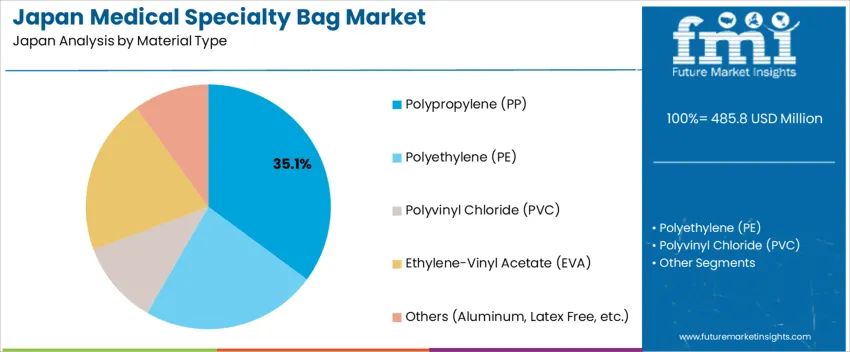
Polypropylene (PP) accounts for 35% of the demand for medical specialty bags in Japan due to its excellent strength, durability, and versatility. PP is widely used in the healthcare industry for its ability to withstand sterilization processes, making it ideal for medical applications. It is chemical-resistant, non-toxic, and lightweight, which are crucial qualities for medical bags that store fluids, medications, and other sensitive materials. PP is cost-effective and reliable, which makes it a preferred material in healthcare settings where quality and safety are paramount. As the demand for high-quality, durable medical products grows in Japan, PP remains the dominant material for specialty bags due to its practicality and performance in various medical procedures.
Why Does the 501 - 1000 ml Capacity Lead the Demand for Medical Specialty Bags in Japan?
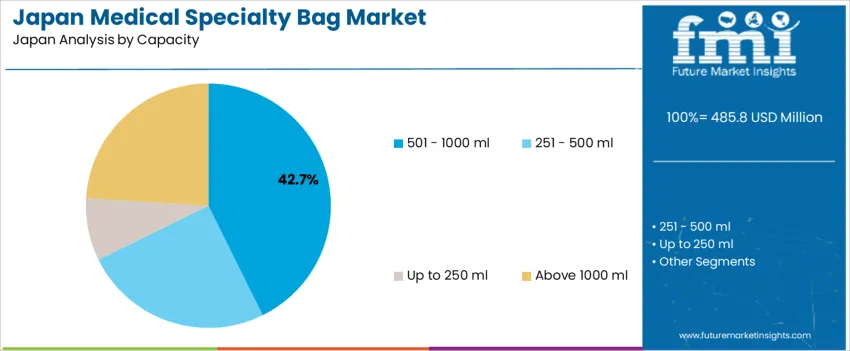
The 501 - 1000 ml capacity accounts for 42.7% of the demand for medical specialty bags in Japan, driven by its versatility and optimal volume for medical applications. This size is commonly used for intravenous (IV) fluids, nutrient infusions, and other medical treatments that require moderate to large amounts of liquid. The 501 - 1000 ml capacity offers the ideal balance between providing enough fluid for effective treatment while being easy to handle and store. It is widely used in hospitals and clinics for patient care, particularly in situations where precise control over liquid administration is essential. As the demand for IV therapies, wound care, and fluid management grows, the 501 - 1000 ml size remains the most popular choice, ensuring its leadership in the medical specialty bag industry.
What are the Key Trends, Drivers, and Restraints in Demand for Medical Specialty Bag in Japan?
Demand for medical specialty bags in Japan is growing, driven by the increasing need for efficient, secure, and sterilized medical packaging solutions. These bags are used across various healthcare settings, including hospitals, clinics, and long-term care facilities, to safely contain medical waste, deliver fluids, and store medical devices. The growing aging population in Japan and a higher number of surgeries and medical treatments are boosting the demand for these bags. Innovations in materials and design are enhancing the quality and usability of medical specialty bags. However, the growth is constrained by regulatory barriers, the high cost of production, and the relatively limited availability of advanced materials.
Why is Demand for Medical Specialty Bag Growing in Japan?
The demand for medical specialty bags is increasing as Japan’s healthcare system evolves to meet the needs of its aging population. With a higher incidence of chronic diseases and an aging demographic, there is a rising demand for medical treatments, surgeries, and emergency services, all of which require specialized medical bags. Increasing healthcare expenditure and technological advancements in medical packaging are making these bags more widely available and more effective. Healthcare providers are increasingly focusing on safety, hygiene, and convenience, which drives the need for reliable, user-friendly medical specialty bags.
How are Technological & Industry Innovations Driving Demand for Medical Specialty Bag in Japan?
Technological advancements in the production and design of medical specialty bags are supporting their increasing adoption. New materials, such as biodegradable plastics and advanced polymers, are improving the bags' durability, sterilization properties, and environmental footprint. Innovations in bag design, including easy-to-seal closures and integrated safety features, are enhancing the functionality and usability of medical bags. These innovations help meet the growing demand for higher-quality packaging solutions in the healthcare sector. The rise of personalized healthcare and advanced treatment options further fuels the need for specialized medical bags.
What are the Key Challenges and Risks That Could Limit Medical Specialty Bag Demand in Japan?
Despite the growing demand, several challenges could limit the widespread adoption of medical specialty bags in Japan. The production of medical bags involves high costs, driven by the need for sterilization, compliance with strict regulatory standards, and the use of specialized materials. The higher price point of these bags can limit adoption, especially in smaller healthcare facilities with budget constraints. Regulatory hurdles, particularly around the approval and certification of new materials and designs, can slow the development of more advanced medical specialty bags. Competition from alternative packaging solutions, including reusable options, could also pose a challenge to growth.
What is the Regional Demand Outlook for Medical Specialty Bag in Japan?
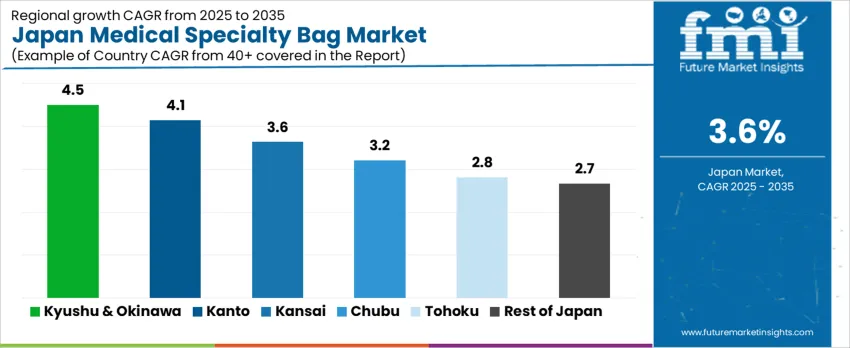
| Region | CAGR (%) |
|---|---|
| Kyushu & Okinawa | 4.5% |
| Kanto | 4.1% |
| Kansai | 3.6% |
| Chubu | 3.2% |
| Tohoku | 2.8% |
| Rest of Japan | 2.7% |
Demand for medical specialty bags in Japan is steadily growing, with Kyushu & Okinawa leading at a 4.5% CAGR, driven by expanding healthcare infrastructure and patient care needs. Kanto follows with a 4.1% CAGR, supported by a dense population and increasing healthcare requirements. Kansai shows a 3.6% CAGR, fueled by its healthcare focus and rising demand for eco-friendly options. Chubu experiences a 3.2% CAGR, with steady growth driven by healthcare expansion and durability initiatives. Tohoku and the Rest of Japan see moderate growth at 2.8% and 2.7%, respectively, with demand driven by the aging population and healthcare improvements in rural areas.
How is Demand for Medical Specialty Bags Growing in Kyushu & Okinawa?
Kyushu & Okinawa leads the demand for medical specialty bags, growing at a 4.5% CAGR. The region’s expanding healthcare infrastructure and increasing demand for specialized medical products, such as those used for medical waste, specimen collection, and IV fluids, are driving this growth. The rise in both the aging population and the number of outpatient care centers in Kyushu & Okinawa contributes to the need for medical specialty bags tailored to specific healthcare applications. The region's growing emphasis on improving hospital hygiene and patient care standards supports the demand for high-quality and efficient medical bag solutions. As healthcare facilities continue to modernize and expand, the demand for specialized bags in Kyushu & Okinawa is expected to remain strong, supported by both regional healthcare trends and rising patient care needs.
Why is Demand for Medical Specialty Bags Rising in Kanto?
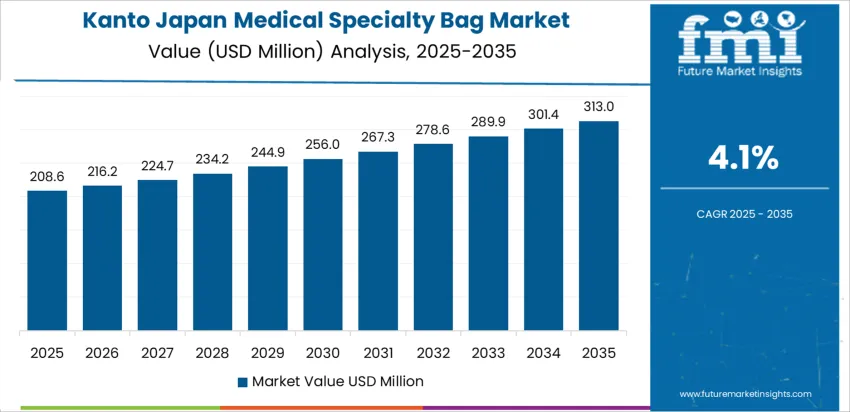
Kanto is experiencing steady demand for medical specialty bags, with a 4.1% CAGR. The region’s dense population and robust healthcare infrastructure, particularly in Tokyo, contribute to the rise in demand for medical specialty bags used in hospitals, clinics, and outpatient care facilities. As healthcare services expand and the need for specific medical solutions grows, Kanto’s demand for medical specialty bags continues to increase. The region’s focus on hygiene, patient safety, and environmental durability is driving healthcare providers to adopt efficient, high-quality medical bags that meet regulatory standards. With a growing aging population and continued investment in healthcare technology and infrastructure, the demand for medical specialty bags in Kanto is expected to grow steadily, supported by increasing healthcare needs and operational efficiency.
How is Demand for Medical Specialty Bags Expanding in Kansai?
Kansai is seeing steady demand for medical specialty bags, with a 3.6% CAGR. The region’s established healthcare infrastructure, including large hospitals and outpatient care centers, contributes to the increasing need for medical bags used in a variety of medical applications such as specimen transport, IV fluid storage, and waste management. The growing aging population in Kansai, coupled with the region’s focus on improving healthcare access and quality, is driving demand for specialty medical bags. Kansai’s emphasis on durability and clean hospital environments is encouraging the adoption of eco-friendly medical bag solutions. As healthcare facilities continue to evolve and expand, demand for medical specialty bags in Kansai is expected to grow steadily, supported by a combination of regional healthcare demands and durability initiatives.
Why is Demand for Medical Specialty Bags Growing in Chubu?
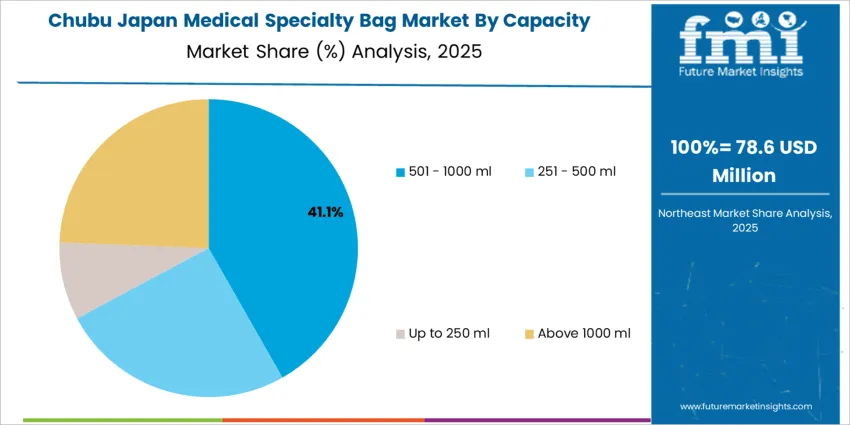
Chubu is experiencing steady demand for medical specialty bags, growing at a 3.2% CAGR. The region’s expanding healthcare infrastructure, particularly in urban centers like Nagoya, is driving the need for medical specialty bags used for a variety of purposes, including storage, transportation, and disposal of medical materials. Chubu’s focus on improving patient care and safety, combined with the increasing adoption of outpatient care models, contributes to this growth. The region’s commitment to durability and eco-friendly practices is pushing healthcare providers to adopt more environmentally friendly medical bag options. With Chubu’s growing healthcare sector and increasing consumer awareness of the importance of safety and hygiene in medical settings, demand for medical specialty bags is expected to continue expanding.
How is Demand for Medical Specialty Bags Expanding in Tohoku?
Tohoku is seeing moderate demand for medical specialty bags, with a 2.8% CAGR. While the region’s healthcare industry is smaller compared to more urbanized areas, demand is steadily rising as Tohoku focuses on improving healthcare access and quality. The need for medical specialty bags in hospitals and outpatient care facilities is growing, particularly for waste management, specimen collection, and IV fluid storage. The region’s aging population and increasing focus on healthcare modernization are contributing to this trend. As healthcare providers in Tohoku invest in better patient care, hygiene, and safety standards, the demand for medical specialty bags is expected to grow gradually. Although growth is slower compared to major urban regions, Tohoku’s steady adoption of healthcare innovations supports a consistent increase in the use of specialized medical bags.
Why is Demand for Medical Specialty Bags Steady in the Rest of Japan?
The Rest of Japan is experiencing steady demand for medical specialty bags, with a 2.7% CAGR. While the industry is smaller compared to major urban regions, the growing interest in healthcare modernization and the rising need for medical solutions in rural areas are driving steady growth in demand. Local hospitals and healthcare facilities are increasingly adopting specialty bags for safe and efficient medical waste management, specimen collection, and IV storage. As healthcare services improve in rural and suburban regions and the aging population increases, the demand for medical specialty bags will continue to grow gradually. The growing availability of specialized products and rising awareness of hygiene and patient safety will further support steady demand for these products across the Rest of Japan.
What Is Driving the Demand for Medical Specialty Bags in Japan and Who Are the Key Players Shaping the Industry?
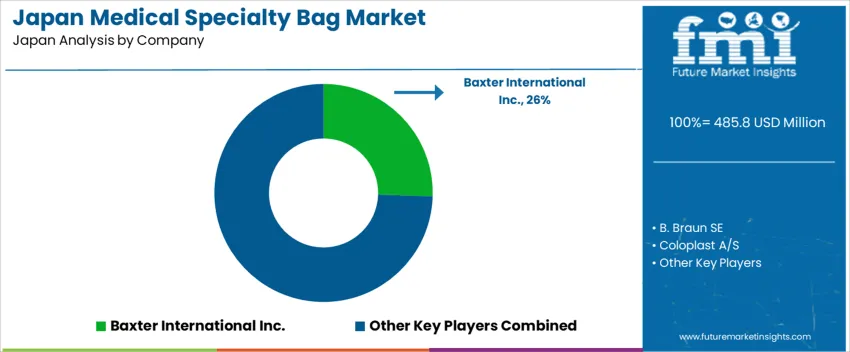
The demand for medical specialty bags in Japan is rising, driven by the country's aging population and the growing need for healthcare solutions that support chronic care, post-surgical recovery, and intensive medical treatments. These bags are essential for a range of medical applications, including fluid management, wound care, and ostomy management, providing effective and safe solutions for patients in need of specialized care. With Japan’s healthcare system facing increasing pressure from the aging population, the demand for medical specialty bags that ensure patient safety and convenience is expected to continue to grow. The ongoing advancements in medical technologies and the increasing adoption of personalized patient care are also boosting industry demand.
Key players shaping the medical specialty bags industry in Japan include Baxter International Inc., B. Braun SE, Coloplast A/S, Convatec Group PLC, and Fresenius SE & Co. KGaA. Baxter International Inc. holds a significant industry share of 25.5%, benefiting from its extensive portfolio of high-quality products designed for patient care, including medical specialty bags. These companies lead the industry by providing innovative solutions that meet stringent regulatory standards, focusing on product safety and performance. Smaller, specialized providers also contribute by offering customized bags to meet specific patient needs, ensuring a dynamic and competitive industry landscape.
The continued growth of the medical specialty bags industry in Japan is expected, with a focus on products that support the efficient management of health conditions and promote quicker patient recovery. As the demand for such medical solutions rises, particularly in the aging population, the industry is poised for sustained expansion.
Key Players in Japan Medical Specialty Bag Demand
- Baxter International Inc.
- B. Braun SE
- Coloplast A/S
- Convatec Group PLC
- Fresenius SE & Co. KGaA
Scope of Report
| Items | Values |
|---|---|
| Quantitative Units (2025) | USD million |
| Material Type | Polypropylene (PP), Polyethylene (PE), Polyvinyl Chloride (PVC), Ethylene-Vinyl Acetate (EVA), Others (Aluminum, Latex Free, etc.) |
| Capacity | 501 - 1000 ml, 251 - 500 ml, Up to 250 ml, Above 1000 ml |
| Region | Kyushu & Okinawa, Kanto, Kansai, Chubu, Tohoku, Rest of Japan |
| Countries Covered | Japan |
| Key Companies Profiled | Baxter International Inc., B. Braun SE, Coloplast A/S, Convatec Group PLC, Fresenius SE & Co. KGaA |
| Additional Attributes | Dollar sales by material type and capacity; regional CAGR and growth outlook; adoption trends in medical specialty bags for different applications; rising demand for latex-free and eco-friendly materials; regulatory compliance and quality assurance standards; supply chain trends including distribution and manufacturing practices in Japan. |
Japan Medical Specialty Bag Demand by Key Segments
Material Type
- Polypropylene (PP)
- Polyethylene (PE)
- Polyvinyl Chloride (PVC)
- Ethylene-Vinyl Acetate (EVA)
- Others (Aluminum, Latex Free, etc.)
Capacity
- 501 - 1000 ml
- 251 - 500 ml
- Up to 250 ml
- Above 1000 ml
Region
- Kyushu & Okinawa
- Kanto
- Kansai
- Chubu
- Tohoku
- Rest of Japan
Bibliography
- Ministry of Health, Labour and Welfare (Japan). (2025). Healthcare materials management and waste reduction policy in Japan’s medical sector. Government of Japan.
- Ministry of Economy, Trade and Industry (Japan). (2025). Polymer materials and packaging technology developments in Japan’s medical manufacturing industry. METI.
- Japan Packaging Institute. (2025). Medical-grade packaging trends and material innovations in Japan. Japan Packaging Institute.
Frequently Asked Questions
How big is the demand for medical specialty bag in Japan in 2025?
The demand for medical specialty bag in Japan is estimated to be valued at USD 485.8 million in 2025.
What will be the size of medical specialty bag in Japan in 2035?
The market size for the medical specialty bag in Japan is projected to reach USD 691.9 million by 2035.
How much will be the demand for medical specialty bag in Japan growth between 2025 and 2035?
The demand for medical specialty bag in Japan is expected to grow at a 3.6% CAGR between 2025 and 2035.
What are the key product types in the medical specialty bag in Japan?
The key product types in medical specialty bag in Japan are polypropylene (pp), polyethylene (pe), polyvinyl chloride (pvc), ethylene-vinyl acetate (eva) and others (aluminum, latex free, etc.).
Which capacity segment is expected to contribute significant share in the medical specialty bag in Japan in 2025?
In terms of capacity, 501 - 1000 ml segment is expected to command 42.7% share in the medical specialty bag in Japan in 2025.
Preview the report firsthand - request a free sample
Get SampleGet the brochure for pricing and purchase details.
Get PDFTable of Content
- Executive Summary
- Japan Market Outlook
- Demand-side Trends
- Supply-side Trends
- Technology Roadmap Analysis
- Analysis and Recommendations
- Market Overview
- Market Coverage / Taxonomy
- Market Definition / Scope / Limitations
- Market Background
- Market Dynamics
- Drivers
- Restraints
- Opportunity
- Trends
- Scenario Forecast
- Demand in Optimistic Scenario
- Demand in Likely Scenario
- Demand in Conservative Scenario
- Opportunity Map Analysis
- Product Life Cycle Analysis
- Supply Chain Analysis
- Investment Feasibility Matrix
- Value Chain Analysis
- PESTLE and Porter’s Analysis
- Regulatory Landscape
- Regional Parent Market Outlook
- Production and Consumption Statistics
- Import and Export Statistics
- Market Dynamics
- Japan Market Analysis 2020 to 2024 and Forecast, 2025 to 2035
- Historical Market Size Value (USD Million) Analysis, 2020 to 2024
- Current and Future Market Size Value (USD Million) Projections, 2025 to 2035
- Y-o-Y Growth Trend Analysis
- Absolute $ Opportunity Analysis
- Japan Market Pricing Analysis 2020 to 2024 and Forecast 2025 to 2035
- Japan Market Analysis 2020 to 2024 and Forecast 2025 to 2035, By Material Type
- Introduction / Key Findings
- Historical Market Size Value (USD Million) Analysis By Material Type , 2020 to 2024
- Current and Future Market Size Value (USD Million) Analysis and Forecast By Material Type , 2025 to 2035
- Polypropylene (PP)
- Polyethylene (PE)
- Polyvinyl Chloride (PVC)
- Ethylene-Vinyl Acetate (EVA)
- Others (Aluminum, Latex Free, etc.)
- Y-o-Y Growth Trend Analysis By Material Type , 2020 to 2024
- Absolute $ Opportunity Analysis By Material Type , 2025 to 2035
- Japan Market Analysis 2020 to 2024 and Forecast 2025 to 2035, By Capacity
- Introduction / Key Findings
- Historical Market Size Value (USD Million) Analysis By Capacity, 2020 to 2024
- Current and Future Market Size Value (USD Million) Analysis and Forecast By Capacity, 2025 to 2035
- 501 - 1000 ml
- 251 - 500 ml
- Up to 250 ml
- Above 1000 ml
- Y-o-Y Growth Trend Analysis By Capacity, 2020 to 2024
- Absolute $ Opportunity Analysis By Capacity, 2025 to 2035
- Market Structure Analysis
- Competition Dashboard
- Competition Benchmarking
- Market Share Analysis of Top Players
- By Regional
- By Material Type
- By Capacity
- Competition Analysis
- Competition Deep Dive
- Baxter International Inc.
- Overview
- Product Portfolio
- Profitability by Market Segments (Product/Age /Sales Channel/Region)
- Sales Footprint
- Strategy Overview
- Marketing Strategy
- Product Strategy
- Channel Strategy
- B. Braun SE
- Coloplast A/S
- Convatec Group PLC
- Fresenius SE & Co. KGaA
- Baxter International Inc.
- Competition Deep Dive
- Assumptions & Acronyms Used
- Research Methodology


