

- Industry Size (2025)
- USD 48.5 Mn
- Forecast (2035)
- USD 60.2 Mn
- CAGR (2025 to 2035)
- 2.2%
Demand for Plastic Bottle in Japan 2025 to 2035
The Japan plastic bottle demand is valued at USD 48.5 million in 2025 and is forecasted to reach USD 60.2 million by 2035, reflecting a CAGR of 2.2%. Demand is influenced by steady consumption of packaged beverages, personal-care liquids, and household fluids across retail channels. Lightweight packaging preferences, coupled with container standardization for vending distribution and convenience retail, underpin ongoing use of rigid plastics. Bottles with capacities below 1 liter lead requirements. These formats support single-serve beverages, ready-to-drink tea, water, and health-focused formulations widely adopted in urban commuter lifestyles. Polyethylene terephthalate (PET) remains the preferred material. Its clarity, barrier strength, and suitability for bottle-to-bottle recycling reinforce compliance with national circular-packaging directives and corporate sustainability thresholds.
Kyushu & Okinawa and Kanto register the strongest consumption due to their population clusters, developed beverage-processing infrastructure, and high penetration of vending and convenience-store networks. These factors support recurring procurement from fillers and packaging converters. Key suppliers include Yoshino Kogyosho Co., Ltd., Nihon Yamamura Glass Co., Ltd., Takemoto Yohki Co., Ltd., Kureha Corporation, and Alpla Japan. Their portfolios focus on food-grade PET packaging with weight-reduction designs, standardised neck finishes, and compatibility with high-speed filling lines used in beverage and consumer-goods applications.
Quick Stats for Japan Plastic Bottle Demand
- Japan Plastic Bottle Sales Value (2025): USD 48.5 million
- Japan Plastic Bottle Forecast Value (2035): USD 60.2 million
- Japan Plastic Bottle Forecast CAGR (2025–2035): 2.2%
- Leading Capacity Type in Japan Plastic Bottle Demand: Below 1 liter
- Key Growth Regions in Japan Plastic Bottle Demand: Kyushu & Okinawa, Kanto
- Top Players in Japan Plastic Bottle Demand: Yoshino Kogyosho Co., Ltd., Nihon Yamamura Glass Co., Ltd., Takemoto Yohki Co., Ltd., Kureha Corporation, Alpla Japan
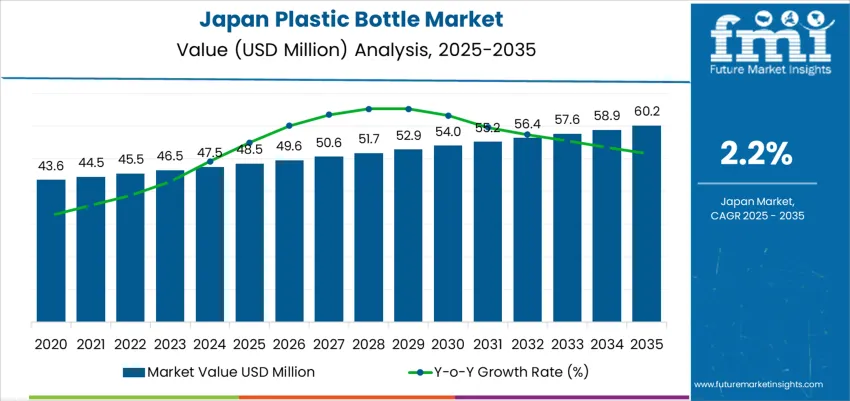
What is the Growth Forecast for Plastic Bottle Industry in Japan through 2035?
Demand for plastic bottles in Japan demonstrates a relatively low volatility pattern linked to established consumption within beverages, household products, and pharmaceuticals. Growth rates show limited fluctuation because underlying demand is driven by essential packaged goods with stable purchasing cycles. Variations in unit consumption remain modest, even when economic or seasonal shifts occur. Increased collection and recycling obligations contribute to gradual changes rather than sharp swings in annual demand.
Volatility risks arise from regulatory pressure, sustainability targets, and substitution trends toward refillable or paper-based packaging. These influences can temporarily slow growth, but compliance-led innovation, such as lightweight PET and chemical-recycling integration, supports consistent recovery. Industrial beverage distribution sustains baseline stability, particularly in ready-to-drink tea and functional beverages. Annual growth dispersion is therefore concentrated within a narrow band, reflecting predictable replacement demand rather than bulk expansion. The category maintains resilient volume fundamentals, with volatility driven more by packaging-material transitions than by consumption variability.
Japan Plastic Bottle Key Takeaways
| Metric | Value |
|---|---|
| Japan Plastic Bottle Sales Value (2025) | USD 48.5 million |
| Japan Plastic Bottle Forecast Value (2035) | USD 60.2 million |
| Japan Plastic Bottle Forecast CAGR (2025-2035) | 2.2% |
Why is the Demand for Plastic Bottles in Japan Growing?
Demand for plastic bottles in Japan is increasing because beverage companies, personal care brands and household product manufacturers rely on packaging that is lightweight, durable and suitable for automated filling lines. Bottles made from PET and HDPE remain widely used for bottled water, tea, soft drinks, hygiene products and detergents. Growth in single-person households and on-the-go consumption supports strong sales of single-serve formats through convenience stores and vending machines. E-commerce distribution also demands packaging that resists damage during transport and provides reliable leak protection.
Manufacturers in Japan invest in lightweight designs and bottles with recycled content to align with circular economy policies and corporate sustainability goals. Collection and sorting systems for PET bottles are well established across the country, which supports continued adoption of packaging compatible with national recycling infrastructure. Constraints include increasing consumer concern about single-use plastics, competition from aluminum cans and refill-pack formats and pressure from government regulations aimed at reducing plastic waste. Fluctuations in resin and energy prices can influence packaging costs, which may affect procurement decisions for lower-margin product categories.
Which Capacity Types, Materials, and End Uses Lead Demand for Plastic Bottles in Japan?
Demand for plastic bottles in Japan is driven by packaged beverage consumption, regulated pharmaceutical distribution, and industrial fluid handling. Buyers prioritize lightweight strength, recycling compatibility under Japan’s container and packaging recovery framework, and barrier properties that protect product freshness or chemical stability. Manufacturers focus on clarity, formability, and automation suitability across high-speed filling systems. Adoption aligns with logistics efficiency, consumer handling convenience, and compliance with labeling and food-contact standards. Industrial users require consistent material performance in chemical transport and workplace storage conditions common across manufacturing regions.
By Capacity, Bottles Below 1 Liter Hold the Largest Share
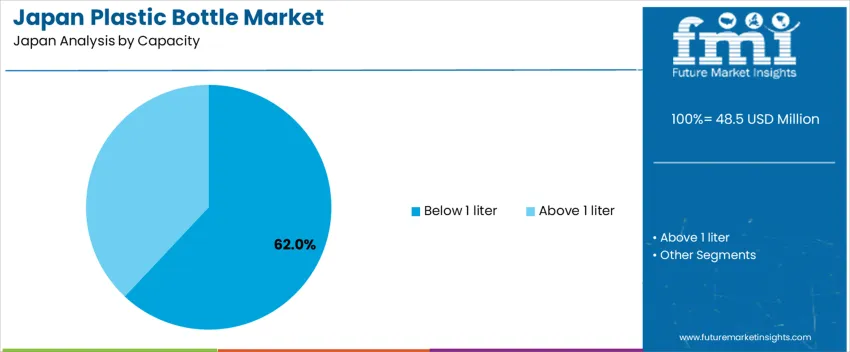
Bottles below 1 liter account for 62.0%, used heavily in single-serve and multi-serve packaged beverages, condiments, and personal-care goods. Their lighter weight and ergonomic handling support frequent consumer purchases in convenience-focused retail formats common across Japan. Bottles above 1 liter represent 38.0%, used in bulk liquids such as household cleaners or industrial chemicals requiring stronger wall structure. Capacity selection reflects distribution ergonomics, shelf-space efficiency, and high-frequency replacement patterns within food and drink categories.
Key points:
- Sub-liter formats support dominant beverage consumption.
- Larger volumes used mainly in household and industrial supplies.
- Handling convenience influences retail and transport decisions.
By Material, PET Holds the Largest Share
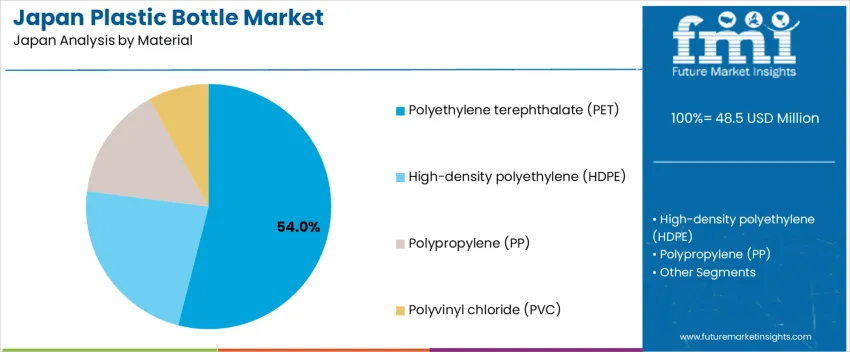
PET represents 54.0%, driven by clarity, rigidity, and strong recycling pathways in Japan’s bottle-to-bottle systems. HDPE holds 23.0%, supporting chemicals and household goods requiring impact resistance and stress-crack protection. PP accounts for 15.0%, valued for heat resistance in certain food and healthcare applications. PVC represents 8.0%, remaining in limited use where specific chemical-barrier characteristics are required. Material preferences align with sustainability requirements, food-grade performance, and standardized molding processes supporting domestic beverage distribution.
Key points:
- PET dominates beverage and transparent packaging.
- HDPE supports durable chemical-handling applications.
- PP adoption tied to heat-sterilization compatibility.
By End Use, Food and Beverages Hold the Largest Share
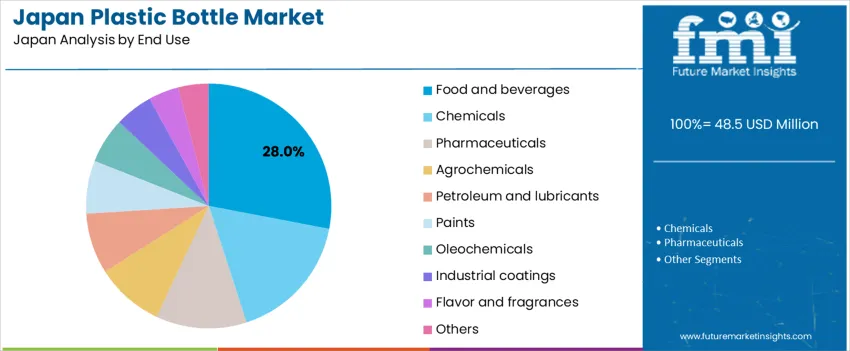
Food and beverages represent 28.0%, driven by bottled drinks, sauces, and high turnover in retail channels. Chemicals account for 17.0%, followed by pharmaceuticals at 12.0%, reflecting compliance with tamper-evident requirements. Agrochemicals hold 9.0%, petroleum and lubricants 8.0%, and paints 7.0%, where durability and chemical resistance are essential. Oleochemicals represent 6.0%, with industrial coatings at 5.0%. Flavors and fragrances total 4.0%, similar to other small-volume uses at 4.0%. End-use distribution reflects diversified handling needs across consumer and industrial supply chains in Japan.
Key points:
- Beverages drive primary consumption.
- Pharmaceuticals and chemicals ensure regulated usage.
- Industrial applications require reinforced protection systems.
What are the Drivers, Restraints, and Key Trends of the Demand for Plastic Bottles in Japan?
Strong consumption of bottled beverages, growth of convenience-store distribution and rising demand for single-serve formats are driving demand.
In Japan, plastic bottle usage remains high due to widespread consumption of bottled tea, water and functional drinks produced by major beverage companies. Convenience stores located densely across urban and suburban areas rely on PET bottles as the dominant format for on-the-go refreshment. Ready-to-drink teas, electrolyte beverages and flavored waters continue to expand shelf presence, supporting stable demand from beverage filling plants in prefectures such as Shizuoka and Fukuoka. Single-serve packaging fits the lifestyle of commuters and office workers who purchase drinks multiple times per day from vending machines and retail kiosks. Household and personal care brands also rely on plastic bottles for detergents, shampoos and cleaning products distributed nationally.
Municipal waste-reduction objectives, competition from aluminum and refill systems and elevated expectations for recyclability restrain adoption.
National and prefectural policies emphasize plastic waste reduction, encouraging beverage makers to review packaging usage. Refillable bottle programs and carton formats challenge PET bottles in selected product lines, especially in cafes and limited-service restaurants targeting sustainability-minded consumers. Some municipalities encourage shoppers to reduce purchasing of single-use plastics, placing behavioral pressure on high-frequency on-the-go consumption. Production costs can rise when companies introduce lighter bottles or alternative-resin formulations, which may delay rapid packaging transitions. These regulatory and consumer influences create gradual demand adjustments across categories.
Shift toward higher recycled content, increased tethered-cap adoption and rising demand for label-free bottles define key trends.
Japanese bottlers are incorporating greater post-consumer recycled PET to meet internal environmental targets and packaging guidelines tied to resource circularity. Tethered caps are being introduced to improve closure retention during disposal and increase recovery rates at material-sorting facilities. Label-free bottles are expanding within bottled water and tea categories, streamlining recycling by reducing contamination in collection streams. Vending machine operators are testing bottle-return bins that support closed-loop material recovery. These trends show continued evolution of plastic bottle demand in Japan as packaging aligns with sustainability expectations.
Analysis of the Demand for Plastic Bottles in Japan by Region
Demand for plastic bottles in Japan reflects requirements in beverage packaging, household liquid products, personal-care formats, and pharmaceutical applications. PET and HDPE usage patterns align with retail logistics, recycling frameworks, and consumer portability preferences. Growth remains steady but incremental due to ongoing packaging reduction policies and rising refill adoption. Kyushu & Okinawa leads at 2.7% CAGR, followed by Kanto (2.5%), Kinki (2.2%), Chubu (1.9%), Tohoku (1.7%), and Rest of Japan (1.6%).
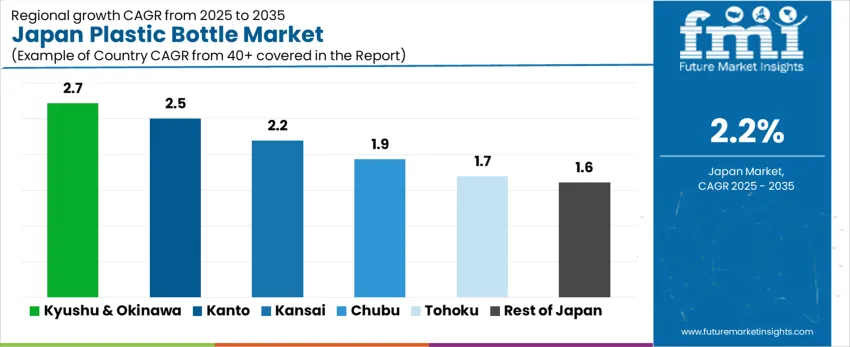
| Region | CAGR (2025-2035) |
|---|---|
| Kyushu & Okinawa | 2.7% |
| Kanto | 2.5% |
| Kinki | 2.2% |
| Chubu | 1.9% |
| Tohoku | 1.7% |
| Rest of Japan | 1.6% |
How is Kyushu & Okinawa driving demand for plastic bottles?
Kyushu & Okinawa records 2.7% CAGR, with beverage consumption, tourism-linked retail, and bottled water distribution supporting consistent plastic bottle requirements. Humid weather contributes to strong single-serve hydration product sales in convenience stores and vending machines positioned across travel routes. PET bottles remain essential for ready-to-drink teas, sports drinks, and flavored beverages distributed through compact retail formats. Household liquid products and cleaning supplies also maintain HDPE bottle demand. Port access supports resin imports and supply chain stability for packaging converters serving local filling operations. Regional recycling programs improve PET recovery, aligning packaging decisions with municipal waste rules. Procurement focuses on maintaining bottle robustness through varying transport conditions while meeting product visibility expectations.
- Single-serve beverage formats shaping PET bottle volumes
- Tourism driving portable packaging requirements
- Resin logistics aligned with port access
- PET recovery supporting sustainability compliance
How is Kanto shaping demand for plastic bottles?
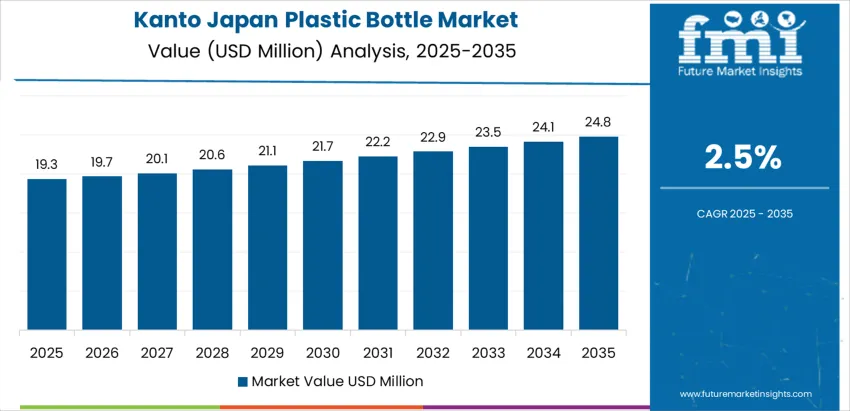
Kanto grows at 2.5% CAGR, driven by Tokyo-centered consumption where on-the-go beverage usage influences high PET bottle turnover across transit networks. Dense retail footprints rely on durable lightweight containers that withstand frequent shelf handling. Pharmaceutical distribution uses HDPE bottles for liquid medications and hygiene solutions circulated through extensive hospital networks. Brand owners test reduced-resin bottles to align with corporate sustainability targets without compromising sealing performance. Recycling infrastructure supports rPET integration into beverage packaging based on availability within sorted waste streams. Procurement teams monitor bottle clarity, dimensional consistency, and line-compatibility for high-speed filling operations in large metropolitan production sites.
- Transit-based consumption supporting portable PET designs
- Healthcare distribution requiring HDPE compliance
- rPET inclusion enabled by dense recycling access
- Packaging durability guiding selection criteria
How is Kinki influencing demand for plastic bottles?
Kinki posts 2.2% CAGR, supported by Osaka and Kyoto distribution hubs where bottled beverages and personal-care products maintain steady plastic bottle use. Convenience retail drives frequent purchases of compact bottles designed for repeated handling and refrigeration cycles. Processing facilities emphasize operational stability and incremental upgrades rather than major packaging redesigns. Cost sensitivity shapes procurement decisions for household and personal-care bottles that require consistent thread profiles for cap fit. Retailers emphasize clean product presentation with scuff-resistant surfaces suited for high-touch environments. Resin supply reliability and minimal bottling line downtime remain priorities for production planning.
- Convenience retail sustaining PET and HDPE formats
- Standardized cap-fit requirements affecting bottle geometry
- High-touch merchandising shaping durability needs
- Incremental equipment alignment guiding adoption pace
How is Chubu contributing to demand for plastic bottles?
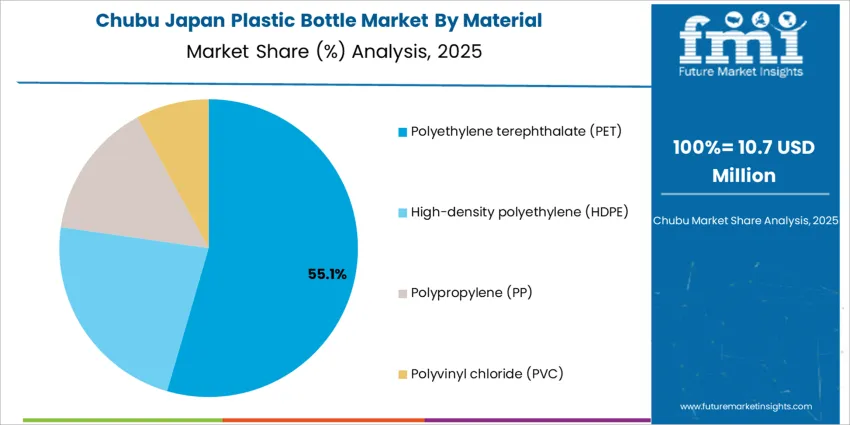
Chubu advances at 1.9% CAGR, supported by food and drink distribution linked to automotive and industrial cluster workforces requiring packaged hydration. Bottled tea and water remain essential in workplace retail environments, encouraging stable PET procurement. Household liquid cleaners also support HDPE bottle volume through national shipment channels. Production efficiency guides packaging choices with emphasis on bottle weight reduction where feasible. Manufacturers evaluate compatibility with existing conveyors and blow-molding infrastructure to avoid processing disruption.
- Workplace beverage consumption maintaining PET demand
- Household liquid packaging supporting HDPE requirements
- Operational continuity influencing bottle design choices
- Weight reduction aiding material-saving efforts
How is Tohoku shaping demand for plastic bottles?
Tohoku records 1.7% CAGR, driven by packaged beverages distributed across wide geography requiring impact-resistant bottles for long-haul transport. HDPE bottle usage persists in local dairy and household packaging lines serving regional communities. Seasonal tourism boosts short-term bottled-drink demand in coastal areas. Procurement emphasizes strong sealing reliability to prevent leakage during colder climate storage. Municipal recovery programs encourage simplified packaging structures that integrate more easily into local recycling networks.
- Wide transport routes guiding durability specifications
- Dairy and household usage supporting HDPE needs
- Seasonal tourism raising beverage packaging throughput
- Local recycling considerations affecting bottle format choices
How is the Rest of Japan adopting plastic bottles?
Rest of Japan posts 1.6% CAGR, reflecting limited production scale and controlled packaging expansion tied to local consumption volumes. Smaller beverage bottlers emphasize cost-stable PET bottles with reliable supply access. Community retail channels sell moderate packaging quantities where portability and leak prevention influence purchase stability. Waste handling guidelines encourage clear labeling and label-size control to ease sorting.
- Small-scale beverage filling sustaining steady use
- Portability needs guiding bottle format selection
- Cost alignment shaping procurement choices
- Sorting-friendly design aiding recycling operations
What is the competitive landscape of demand for plastic bottles in Japan?
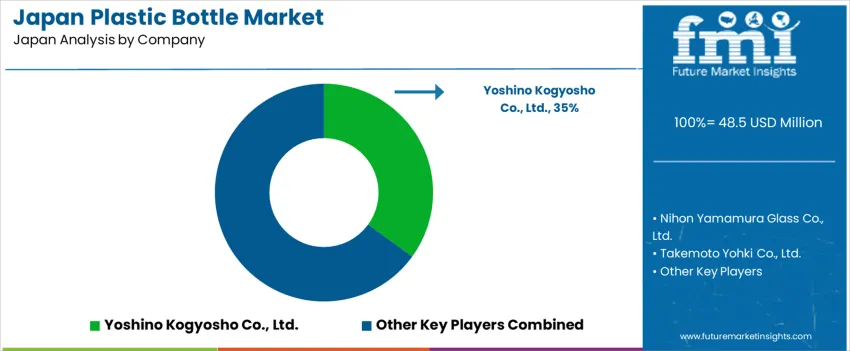
Demand for plastic bottles in Japan is supported by domestic converters supplying PET and HDPE containers for beverages, condiments, and personal-care goods. Yoshino Kogyosho Co., Ltd. holds an estimated 35% share, supported by controlled resin-processing capability, stable wall-thickness precision, and strong supply relationships with leading Japanese beverage bottlers. Its packaging solutions provide consistent sealing performance and reliable compatibility with high-speed filling operations. Nihon Yamamura Glass Co., Ltd. maintains strong participation through PET and hybrid packaging lines used for food and drink applications where dimensional accuracy and controlled barrier properties are required. Takemoto Yohki Co., Ltd. supports demand in cosmetics and personal-care categories with containers offering predictable molding quality and secure closure fit essential for retail handling.
Kureha Corporation contributes presence through high-barrier resin technology applied in specialized containers that preserve flavour retention and shelf-life stability. Alpla Japan provides PET bottle capacity through its regional operations, supplying global and domestic brands with lightweight rigid packaging that aligns with recyclability programs. Competition in Japan focuses on design precision, barrier stability, recyclability compatibility, light weighting, and dependable supply logistics as manufacturers rely on rigid plastic containers that meet product-quality expectations and sustainability requirements in Japanese distribution environments.
Key Players in Japan Plastic Bottle Demand
- Yoshino Kogyosho Co., Ltd.
- Nihon Yamamura Glass Co., Ltd.
- Takemoto Yohki Co., Ltd.
- Kureha Corporation
- Alpla Japan
Scope of the Report
| Items | Values |
|---|---|
| Quantitative Units | USD million |
| Capacity | Below 1 liter, Above 1 liter |
| Material | Polyethylene terephthalate (PET), High-density polyethylene (HDPE), Polypropylene (PP), Polyvinyl chloride (PVC) |
| End Use | Food and beverages, Chemicals, Pharmaceuticals, Agrochemicals, Petroleum and lubricants, Paints, Oleochemicals, Industrial coatings, Flavor and fragrances, Others |
| Regions Covered | Kyushu & Okinawa, Kanto, Kinki, Chubu, Tohoku, Rest of Japan |
| Key Companies Profiled | Yoshino Kogyosho Co., Ltd., Nihon Yamamura Glass Co., Ltd., Takemoto Yohki Co., Ltd., Kureha Corporation, Alpla Japan |
| Additional Attributes | Demand influenced by Japan’s recycling mandates (PET bottle recycling initiatives), growth in convenience beverages and health drinks, adoption of lightweight and eco-efficient designs; sector-wise differentiation with stronger demand from food & beverages and pharmaceuticals; regional consumption driven by industrial clusters in Kanto and Chubu; shift toward bio-based and recycled polymers for sustainability compliance. |
Japan Plastic Bottle Demand by Segments
Capacity:
- Below 1 liter
- Above 1 liter
Material:
- Polyethylene terephthalate (PET)
- High-density polyethylene (HDPE)
- Polypropylene (PP)
- Polyvinyl chloride (PVC)
End Use:
- Food and beverages
- Chemicals
- Pharmaceuticals
- Agrochemicals
- Petroleum and lubricants
- Paints
- Oleochemicals
- Industrial coatings
- Flavor and fragrances
- Others
Region:
- Kyushu & Okinawa
- Kanto
- Kinki
- Chubu
- Tohoku
- Rest of Japan
Frequently Asked Questions
How big is the demand for plastic bottle in Japan in 2025?
The demand for plastic bottle in Japan is estimated to be valued at USD 48.5 million in 2025.
What will be the size of plastic bottle in Japan in 2035?
The market size for the plastic bottle in Japan is projected to reach USD 60.2 million by 2035.
How much will be the demand for plastic bottle in Japan growth between 2025 and 2035?
The demand for plastic bottle in Japan is expected to grow at a 2.2% CAGR between 2025 and 2035.
What are the key product types in the plastic bottle in Japan?
The key product types in plastic bottle in Japan are below 1 liter and above 1 liter.
Which material segment is expected to contribute significant share in the plastic bottle in Japan in 2025?
In terms of material, polyethylene terephthalate (pet) segment is expected to command 54.0% share in the plastic bottle in Japan in 2025.
Preview the report firsthand - request a free sample
Get SampleGet the brochure for pricing and purchase details.
Get PDFTable of Content
- Executive Summary
- Japan Market Outlook
- Demand-side Trends
- Supply-side Trends
- Technology Roadmap Analysis
- Analysis and Recommendations
- Market Overview
- Market Coverage / Taxonomy
- Market Definition / Scope / Limitations
- Market Background
- Market Dynamics
- Drivers
- Restraints
- Opportunity
- Trends
- Scenario Forecast
- Demand in Optimistic Scenario
- Demand in Likely Scenario
- Demand in Conservative Scenario
- Opportunity Map Analysis
- Product Life Cycle Analysis
- Supply Chain Analysis
- Investment Feasibility Matrix
- Value Chain Analysis
- PESTLE and Porter’s Analysis
- Regulatory Landscape
- Regional Parent Market Outlook
- Production and Consumption Statistics
- Import and Export Statistics
- Market Dynamics
- Japan Market Analysis 2020 to 2024 and Forecast, 2025 to 2035
- Historical Market Size Value (USD Million) Analysis, 2020 to 2024
- Current and Future Market Size Value (USD Million) Projections, 2025 to 2035
- Y-o-Y Growth Trend Analysis
- Absolute $ Opportunity Analysis
- Japan Market Pricing Analysis 2020 to 2024 and Forecast 2025 to 2035
- Japan Market Analysis 2020 to 2024 and Forecast 2025 to 2035, By Capacity
- Introduction / Key Findings
- Historical Market Size Value (USD Million) Analysis By Capacity , 2020 to 2024
- Current and Future Market Size Value (USD Million) Analysis and Forecast By Capacity , 2025 to 2035
- Below 1 liter
- Above 1 liter
- Y-o-Y Growth Trend Analysis By Capacity , 2020 to 2024
- Absolute $ Opportunity Analysis By Capacity , 2025 to 2035
- Japan Market Analysis 2020 to 2024 and Forecast 2025 to 2035, By Material
- Introduction / Key Findings
- Historical Market Size Value (USD Million) Analysis By Material, 2020 to 2024
- Current and Future Market Size Value (USD Million) Analysis and Forecast By Material, 2025 to 2035
- Polyethylene terephthalate (PET)
- High-density polyethylene (HDPE)
- Polypropylene (PP)
- Polyvinyl chloride (PVC)
- Y-o-Y Growth Trend Analysis By Material, 2020 to 2024
- Absolute $ Opportunity Analysis By Material, 2025 to 2035
- Japan Market Analysis 2020 to 2024 and Forecast 2025 to 2035, By End Use
- Introduction / Key Findings
- Historical Market Size Value (USD Million) Analysis By End Use, 2020 to 2024
- Current and Future Market Size Value (USD Million) Analysis and Forecast By End Use, 2025 to 2035
- Food and beverages
- Chemicals
- Pharmaceuticals
- Agrochemicals
- Petroleum and lubricants
- Paints
- Oleochemicals
- Industrial coatings
- Flavor and fragrances
- Others
- Y-o-Y Growth Trend Analysis By End Use, 2020 to 2024
- Absolute $ Opportunity Analysis By End Use, 2025 to 2035
- Market Structure Analysis
- Competition Dashboard
- Competition Benchmarking
- Market Share Analysis of Top Players
- By Regional
- By Capacity
- By Material
- By End Use
- Competition Analysis
- Competition Deep Dive
- Yoshino Kogyosho Co., Ltd.
- Overview
- Product Portfolio
- Profitability by Market Segments (Product/Age /Sales Channel/Region)
- Sales Footprint
- Strategy Overview
- Marketing Strategy
- Product Strategy
- Channel Strategy
- Nihon Yamamura Glass Co., Ltd.
- Takemoto Yohki Co., Ltd.
- Kureha Corporation
- Alpla Japan
- Yoshino Kogyosho Co., Ltd.
- Competition Deep Dive
- Assumptions & Acronyms Used
- Research Methodology


