

- Industry Size (2025)
- USD 23.8 Bn
- Forecast (2035)
- USD 34.5 Bn
- CAGR (2025 to 2035)
- 3.8%
Demand for Plastic Bottle in USA 2025 to 2035
The USA plastic bottle demand is valued at USD 23.8 billion in 2025 and is forecasted to reach USD 34.5 billion by 2035, reflecting a CAGR of 3.8%. Demand is driven by extensive use of rigid plastic containers in beverages, household cleaning, packaged foods, pharmaceuticals, and personal care products. Lightweight formats, high production efficiency, and established compatibility with large-scale filling and distribution operations continue to reinforce adoption across consumer and industrial sectors. Bottles with capacities below 1 liter hold the leading share. These formats support convenience-driven consumption, portion-controlled packaging, and competitive pricing in bottled water, soft drinks, on-the-go beverages, and personal care fluids. Design improvements in closures, barrier layers, and recyclability performance also influence procurement decisions for brand owners.
West USA, South USA, and Northeast USA account for the highest consumption due to strong beverage manufacturing clusters, high urban penetration, and active distribution networks linked to major retail chains. Sustainability initiatives, recycling mandates, and the transition toward food-grade recycled PET promote incremental shifts in procurement strategies while maintaining strong baseline demand. Key suppliers include Plastipak Packaging, Inc., Amcor Rigid Packaging, Altium Packaging, Silgan Plastics, and Berry Global Inc. These companies provide PET, HDPE, and PP bottles used for high-volume consumer packaging applications across national brand portfolios and private-label product lines.
Quick Stats for USA Plastic Bottle Demand
- USA Plastic Bottle Sales Value (2025): USD 23.8 billion
- USA Plastic Bottle Forecast Value (2035): USD 34.5 billion
- USA Plastic Bottle Forecast CAGR (2025–2035): 3.8%
- Leading Capacity in USA Plastic Bottle Demand: Below 1 liter
- Key Growth Regions in USA Plastic Bottle Demand: West USA, South USA, Northeast USA
- Top Players in USA Plastic Bottle Demand: Plastipak Packaging, Inc., Amcor Rigid Packaging, Altium Packaging, Silgan Plastics, Berry Global Inc.
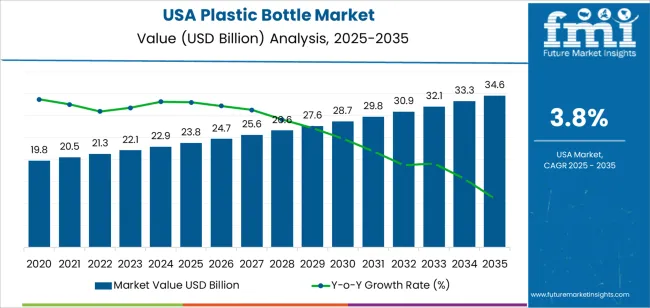
What is the Growth Forecast for Plastic Bottle Industry in USA through 2035?
Demand for plastic bottles in the United States demonstrates a defined peak-to-trough pattern shaped by shifts in packaging regulation, consumer behavior, and material substitution trends. The growth peak in the earlier forecast period is supported by strong volume consumption in beverages, household chemicals, and personal-care products. Lightweight characteristics, cost efficiency, and extensive bottling infrastructure sustain high adoption across mass-market distribution channels. Continued demand for bottled water and ready-to-drink beverages reinforces this upward segment.
The trough emerges in later years as ecofriendly imperatives intensify. State-level restrictions on single-use plastics, expanding bottle-return legislation, and retailer commitments to reduce virgin-plastic USAge contribute to deceleration. Increased penetration of aluminum, paper-based containers, and refill-package formats lowers demand elasticity. Consumer preference for eco-label alternatives, coupled with brand accountability targets, shifts procurement away from conventional PET and HDPE variants.
Recovery potential depends on circular-materials innovation, including food-grade recycled content, bio-resins, and chemical-recycling scale-up. Although demand does not contract sharply, the peak-to-trough curve reflects a structural adjustment from volume-driven growth toward value-driven, regulated consumption aligned with ecofriendly frameworks and environmental-compliance goals in the United States packaging landscape.
USA Plastic Bottle Key Takeaways
| Metric | Value |
|---|---|
| USA Plastic Bottle Sales Value (2025) | USD 23.8 billion |
| USA Plastic Bottle Forecast Value (2035) | USD 34.5 billion |
| USA Plastic Bottle Forecast CAGR (2025-2035) | 3.8% |
Why is the Demand for Plastic Bottles in the USA Growing?
Demand for plastic bottles in the USA is increasing because beverage, personal care and household product companies rely on lightweight and durable packaging that supports high speed filling and nationwide distribution. Bottles made from PET and HDPE remain preferred options for water, carbonated drinks, juices, detergents and nutritional products because they offer clarity, strength and cost efficiency. Growth in on the go consumption and convenience packaging supports steady demand for single serve formats. The rise of e commerce grocery deliveries also encourages the use of shatter resistant bottles that withstand transportation handling. Manufacturers continue to develop improved resin grades and lightweight designs that reduce material use while maintaining performance.
Ecofriendly initiatives drive additional investment in bottles with recycled content and improved recyclability. Many USA brands commit to packaging targets that include higher use of post-consumer resin, which supports domestic recycling infrastructure. Constraints include environmental concerns related to single use plastics, policy shifts promoting waste reduction and competition from alternative packaging such as aluminum cans and cartons. Fluctuation in resin prices may also influence purchasing decisions for cost sensitive product categories.
Which Product Types, Applications, and Distribution Channels Lead Demand for Plastic Bottles in the USA?
Demand for plastic bottles in the United States is driven by high consumption of packaged beverages, personal care items, and chemical products that require lightweight, durable, and portable packaging. The industry remains supported by standardized filling lines, broad recycling infrastructure for common polymers, and compliance with food-contact regulations. Format selection depends on transport efficiency, barrier performance, compatibility with product formulation, and retailer shelf-fit requirements. Manufacturers focus on resin optimization, weight reduction, and enhanced recyclability aligned with ecofriendly policies.
By Capacity, Bottles Below 1 Liter Hold the Largest Share
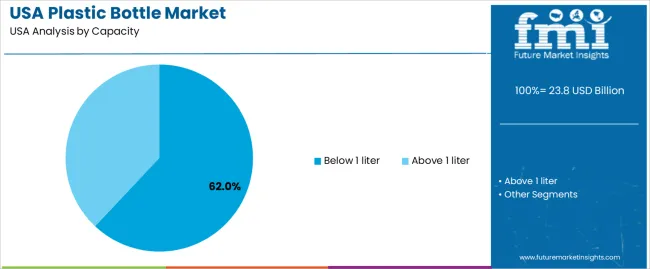
Bottles under 1 liter account for 62.0%, supported by mass-market beverage products, single-serve consumption patterns, and demand from household cleaners and toiletries. These packs align with USA retail expectations for portability, portion control, and ease of handling across logistics operations. Products above 1 liter hold 38.0%, largely servicing bulk formats for chemicals, edible oils, and family-size beverages in club-store channels. Design priorities include stacking strength, cap integrity, and compatibility with automated filling lines. Industry structure favors formats that suit refrigerators, vending, and on-the-go retail. Lower transport weight and high-volume SKU turnover reinforce dominance of the sub-1-liter format in everyday consumer purchasing.
Key points:
- Below-1-liter units dominate due to portability and consumer convenience.
- Larger formats sustain volume in industrial and bulk food channels.
- Design standards support automation and wide retail distribution.
By Material, PET Bottles Hold the Largest Share
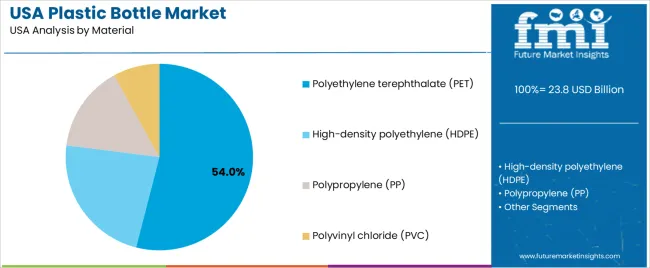
Polyethylene terephthalate (PET) holds 54.0% due to clarity, carbonation retention, and strength needed for beverages. HDPE (23.0%) supports opaque products such as detergents and dairy. Polypropylene (15.0%) serves heat-resistant uses in specialty food and healthcare packaging. PVC (8.0%) remains limited because of recycling challenges and regulatory caution. Material selection in the United States is influenced by recyclability under extended producer responsibility initiatives and contamination control for food-grade applications. PET lifecycle improvements support increased adoption of recycled PET feedstock. Procurement teams evaluate barrier needs, top-load strength, and resin availability, while brand owners optimize designs for lower emissions throughout logistics networks.
Key points:
- PET leads due to strength, clarity, and ecofriendly alignment.
- HDPE supports chemicals and dairy distribution.
- PP expands in heat-resistant and lightweight formats.
By End Use, Food and Beverages Hold the Largest Share

Food and beverage applications represent 28.0%, driven by bottled water, ready-to-drink beverages, and cooking oil packaging with high purchase frequency. Chemicals account for 17.0%, covering industrial cleaning products and hazardous-material compliant formats. Pharmaceuticals hold 12.0%, requiring strict handling and traceability. Remaining segments, including agrochemicals, petroleum lubricants, paints, oleochemicals, industrial coatings, fragrances, and other uses, share the remainder with stability requirements based on product characteristics. Consumer-facing categories maintain streamlined supply chains through national retail networks and online fulfillment. Industrial sectors require specialized caps, internal coatings, and certifications to withstand active ingredients and transport conditions across the United States.
Key points:
- Food and beverage demand leads due to high retail turnover.
- Chemicals and pharmaceuticals require tailored safety compliance
- Industrial formats prioritize durability and distribution efficiency.
What are the Drivers, Restraints, and Key Trends of the Demand for Plastic Bottles in the USA?
Strong consumption of bottled beverages, expansion of household and personal care packaging lines and high retail demand for portable containers are driving demand. In the United States, plastic bottles remain a primary packaging format for bottled water, carbonated soft drinks, sports beverages and ready-to-drink teas produced in large manufacturing hubs across the Midwest and Southeast. Consumers prioritize portability and resealability in daily beverage use, reinforcing demand for PET and HDPE bottles in convenience and grocery channels. Household cleaners, laundry detergents and personal care products rely heavily on plastic bottles for dosing and safety requirements, keeping procurement steady among major CPG producers. Growth in warehouse club sales and multi-pack retail formats further supports high-volume production of plastic bottles for nationwide distribution.
Environmental regulation pressures, increased focus on refill systems and state laws limiting single-use plastics restrain adoption.Several USA states introduce mandates that target reductions in single-use plastics or impose recycled-content requirements, raising compliance costs for manufacturers. Public pressure to reduce plastic waste leads some consumers to prefer aluminum cans, cartons or reusable bottles, especially in coastal states where ecofriendly awareness is high. Retailers and municipalities promote refill programs for cleaning supplies and water stations in public spaces, which reduce reliance on disposable plastic bottles in specific categories. These influences create gradual shifts that temper long-term volume growth in certain product types.
Shift toward higher post-consumer recycled content, increased interest in light weighting technologies and rising demand from e-commerce liquid shipments define key trends.
Brands are increasing recycled PET USAge to meet corporate ecofriendly targets and state regulatory requirements that prioritize recycled content. Light weighting technology reduces resin use and shipping weight, supporting packaging efficiency in large national distribution networks. E-commerce channels for household and personal care liquids rely on durable plastic bottles that resist leakage during parcel transport, maintaining strong packaging demand in online fulfillment. Recyclable closures and simplified label removal are gaining focus to improve bottle recovery in USA recycling facilities. These trends support ongoing modernization of plastic bottle packaging while adapting to ecofriendly priorities in the United States.
Analysis of the Demand for Plastic Bottles in the USA by Region
Demand for plastic bottles in the United States is influenced by consumption patterns in beverages, household-care products, personal-care packaging, and pharmaceutical distribution. Industrial infrastructure, ecofriendly commitments, and resin availability affect regional growth. West USA leads at 3.2%, followed by South USA (2.8%), Northeast USA (2.5%), and Midwest USA (2.2%).
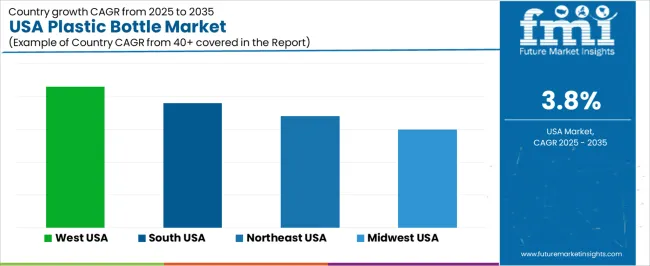
| Region | CAGR (2025-2035) |
|---|---|
| West USA | 3.2% |
| South USA | 2.8% |
| Northeast USA | 2.5% |
| Midwest USA | 2.2% |
How is the West USA driving demand for plastic bottles?
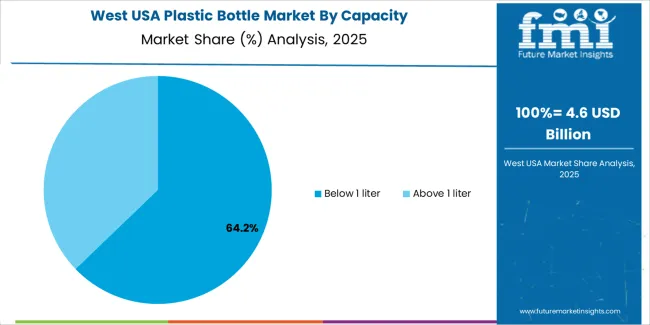
West USA records 3.2% CAGR, shaped by beverage consumption intensity, advanced packaging converters, and proximity to recycling infrastructure. California and Washington retain strong distribution networks for bottled drinking water, ready-to-drink teas, and electrolyte beverages that rely on PET formats for portability and durability. High participation in outdoor and commuting activities results in stable demand for single-serve bottles, while retail club formats distribute multi-pack containers to family households. Personal-care brands concentrated in coastal metros produce HDPE and PET bottles for shampoos, soap, and skincare lines distributed nationwide. Access to maritime ports strengthens resin procurement and recycled PET supply stability, integrating circular-economy processes into manufacturing. The region experiences continuous investments in blow-molding and automated filling equipment supporting efficient changeovers for seasonal demand shifts. Municipal recycling programs improve bale availability for rPET supply, supporting gradual ecofriendly transitions.
- Beverage distribution networks shaping PET packaging demand
- Personal-care filling facilities maintaining consistent bottle use
- Ports supporting resin and rPET logistics
- Recycling access reinforcing packaging ecofriendly plans
How is the South USA shaping demand for plastic bottles?
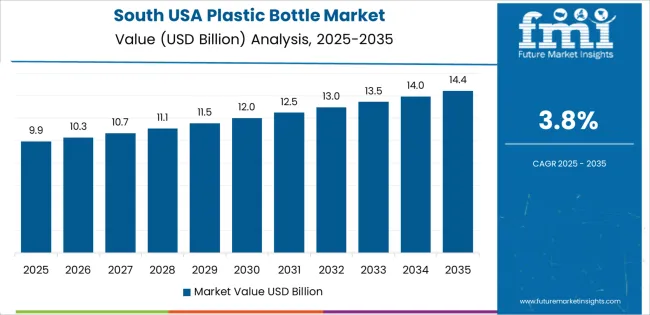
South USA grows at 3.8% CAGR, supported by high-volume beverage bottling, household-care manufacturing, and distribution activity across Texas, Florida, Georgia, and North Carolina. Warm climate zones sustain strong bottled-drink requirements throughout the year, affecting PET and HDPE procurement patterns. Regional consumer-goods plants package detergents, cleaners, and surface-care products using standardized plastic bottles compatible with large-scale filling systems. Inbound logistics through Gulf Coast ports facilitate resin availability, encouraging efficient supply chains for packaging converters. Growth in suburban populations increases demand for multi-serve beverage containers and economy pack household liquids. Distribution centers in Atlanta and Dallas support outbound transportation of packaged liquids to national retailers, reinforcing baseline volumes. Procurement decisions focus on bottle-strength performance, inventory stability, and compatibility with established capping and shrink-label workflows observed across major manufacturing lines.
- Beverage bottling operating in warm-climate states
- Household-care packaging sustaining continuous bottle use
- Ports facilitating resin access for converters
- Large logistics hubs moving packaged goods nationally
How is the Northeast USA influencing demand for plastic bottles?
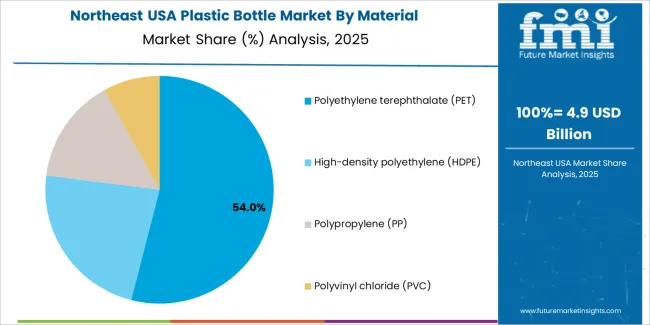
Northeast USA expands at 2.5% CAGR, driven by convenience-driven beverage consumption and pharmacy-linked packaging requirements in New York, New Jersey, and Massachusetts. Compact living spaces and transit-oriented lifestyles support smaller packaged beverage formats intended for immediate use. Retailers in dense metros rely on PET bottles for water and functional drinks that move quickly through convenience and corner-store channels. Healthcare and pharmaceutical distributors require HDPE bottles for prescription medicines, liquid formulations, and medical-grade solutions deployed across hospital systems. Consumer-goods packaging suppliers operate smaller-footprint production sites designed for multi-SKU changeovers. Regional recycling frameworks supply rPET used in selected high-volume bottle lines, improving packaging ecofriendly alignment. Seasonal tourism activity increases bottled-water sales during peak travel months, supporting short-term volume surges in distribution networks.
- Convenience-based consumption sustaining PET bottle demand
- Healthcare packaging requiring compliant HDPE formats
- Multi-SKU production supporting small batch agility
- Regional recycling aiding rPET inclusion in packaging
How is the Midwest USA contributing to demand for plastic bottles?
Midwest USA grows at 2.2% CAGR, influenced by dairy packaging, processed-food distribution, and household-product manufacturing across Illinois, Ohio, Michigan, and Wisconsin. HDPE bottles maintain essential roles in milk, nutritional beverages, and refrigerated product lines widely consumed in the region. Local filling plants use established bottling infrastructure that supports operational continuity rather than rapid expansion. Household-cleaner and automotive-fluid packaging rely on durable bottle designs that deliver handling reliability and compatibility with high-speed manufacturing lines. Procurement cycles reflect cost-focused decision-making tied to long equipment life. Distribution corridors across Chicago and Indianapolis manage transportation of packaged liquids to national retail hubs, maintaining consistent baseline bottle movement. Buyers evaluate new materials only when performance matches legacy standards for sealing strength and shelf-life preservation.
- Dairy operations driving stable HDPE bottle needs
- Value-focused purchasing guiding packaging selection
- Existing bottling infrastructure supporting predictable use
- Distribution corridors maintaining steady product flow
What is the competitive landscape of demand for plastic bottles in the USA?
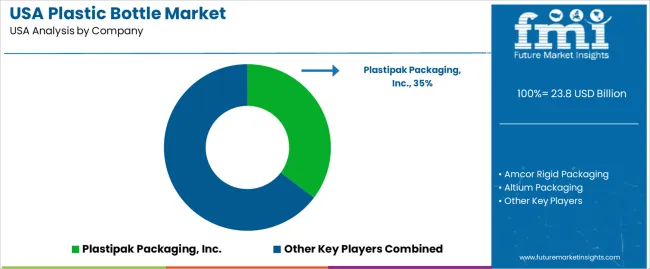
Demand for plastic bottles in the USA is supported by converters supplying PET and HDPE containers to beverage, household-care, and personal-care manufacturers. Plastipak Packaging, Inc. holds an estimated 35.3% share, driven by controlled resin processing, light weighting technology, and extensive supply relationships with soft-drink, dairy, and water bottlers across the country. Its containers deliver consistent wall-thickness stability and production efficiency aligned with high-volume filling lines. Amcor Rigid Packaging maintains strong participation through PET bottle supply for beverages and food products that require reliable barrier performance and predictable throughput on USA packaging equipment. Altium Packaging contributes meaningful share with HDPE bottles manufactured for household cleaners and industrial products, emphasizing durability and nationwide service coverage.
Silgan Plastics supports domestic demand with containers designed for food, dairy, and personal-care categories that require tight dimensional control and secure closure compatibility. Berry Global Inc. adds capacity across personal care, healthcare, and nutraceutical applications with bottles delivering consistent molding precision and established USA distribution. Competition in the USA centers on light weighting, recyclability compatibility, resin-quality control, wall-thickness uniformity, and supply-chain reliability. Demand remains steady as consumer brands require rigid packaging that balances durability with reduced material consumption across USA filling and retail systems.
Key Players in USA Plastic Bottle Demand
- Plastipak Packaging, Inc.
- Amcor Rigid Packaging
- Altium Packaging
- Silgan Plastics
- Berry Global Inc.
Scope of the Report
| Items | Values |
|---|---|
| Quantitative Units | USD billion |
| Capacity | Below 1 liter, Above 1 liter |
| Material | Polyethylene terephthalate (PET), High-density polyethylene (HDPE), Polypropylene (PP), Polyvinyl chloride (PVC) |
| End Use | Food and beverages, Chemicals, Pharmaceuticals, Agrochemicals, Petroleum and lubricants, Paints, Oleochemicals, Industrial coatings, Flavor and fragrances, Others |
| Regions Covered | West USA, South USA, Northeast USA, Midwest USA |
| Key Companies Profiled | Plastipak Packaging, Inc., Amcor Rigid Packaging, Altium Packaging, Silgan Plastics, Berry Global Inc. |
| Additional Attributes | Includes segmentation by capacity and polymer type, recyclability initiatives, light weighting trends, barrier properties enhancement for sensitive products, integration with eco-friendly packaging mandates, high adoption across beverages, household chemicals, and healthcare sectors, with volume demand influenced by FMCG consumption patterns and industrial packaging requirements across USA regions. |
USA Plastic Bottle Demand by Segments
Capacity:
- Below 1 liter
- Above 1 liter
Material:
- Polyethylene terephthalate (PET)
- High-density polyethylene (HDPE)
- Polypropylene (PP)
- Polyvinyl chloride (PVC)
End Use:
- Food and beverages
- Chemicals
- Pharmaceuticals
- Agrochemicals
- Petroleum and lubricants
- Paints
- Oleochemicals
- Industrial coatings
- Flavor and fragrances
- Others
Region:
- West USA
- South USA
- Northeast USA
- Midwest USA
Frequently Asked Questions
How big is the demand for plastic bottle in USA in 2025?
The demand for plastic bottle in USA is estimated to be valued at USD 23.8 billion in 2025.
What will be the size of plastic bottle in USA in 2035?
The market size for the plastic bottle in USA is projected to reach USD 34.6 billion by 2035.
How much will be the demand for plastic bottle in USA growth between 2025 and 2035?
The demand for plastic bottle in USA is expected to grow at a 3.8% CAGR between 2025 and 2035.
What are the key product types in the plastic bottle in USA?
The key product types in plastic bottle in USA are below 1 liter and above 1 liter.
Which material segment is expected to contribute significant share in the plastic bottle in USA in 2025?
In terms of material, polyethylene terephthalate (pet) segment is expected to command 54.0% share in the plastic bottle in USA in 2025.
Preview the report firsthand - request a free sample
Get SampleGet the brochure for pricing and purchase details.
Get PDFTable of Content
- Executive Summary
- USA Market Outlook
- Demand-side Trends
- Supply-side Trends
- Technology Roadmap Analysis
- Analysis and Recommendations
- Market Overview
- Market Coverage / Taxonomy
- Market Definition / Scope / Limitations
- Market Background
- Market Dynamics
- Drivers
- Restraints
- Opportunity
- Trends
- Scenario Forecast
- Demand in Optimistic Scenario
- Demand in Likely Scenario
- Demand in Conservative Scenario
- Opportunity Map Analysis
- Product Life Cycle Analysis
- Supply Chain Analysis
- Investment Feasibility Matrix
- Value Chain Analysis
- PESTLE and Porter’s Analysis
- Regulatory Landscape
- Regional Parent Market Outlook
- Production and Consumption Statistics
- Import and Export Statistics
- Market Dynamics
- USA Market Analysis 2020 to 2024 and Forecast, 2025 to 2035
- Historical Market Size Value (USD Million) Analysis, 2020 to 2024
- Current and Future Market Size Value (USD Million) Projections, 2025 to 2035
- Y-o-Y Growth Trend Analysis
- Absolute $ Opportunity Analysis
- USA Market Pricing Analysis 2020 to 2024 and Forecast 2025 to 2035
- USA Market Analysis 2020 to 2024 and Forecast 2025 to 2035, By Capacity
- Introduction / Key Findings
- Historical Market Size Value (USD Million) Analysis By Capacity , 2020 to 2024
- Current and Future Market Size Value (USD Million) Analysis and Forecast By Capacity , 2025 to 2035
- Below 1 liter
- Above 1 liter
- Y-o-Y Growth Trend Analysis By Capacity , 2020 to 2024
- Absolute $ Opportunity Analysis By Capacity , 2025 to 2035
- USA Market Analysis 2020 to 2024 and Forecast 2025 to 2035, By Material
- Introduction / Key Findings
- Historical Market Size Value (USD Million) Analysis By Material, 2020 to 2024
- Current and Future Market Size Value (USD Million) Analysis and Forecast By Material, 2025 to 2035
- Polyethylene terephthalate (PET)
- High-density polyethylene (HDPE)
- Polypropylene (PP)
- Polyvinyl chloride (PVC)
- Y-o-Y Growth Trend Analysis By Material, 2020 to 2024
- Absolute $ Opportunity Analysis By Material, 2025 to 2035
- USA Market Analysis 2020 to 2024 and Forecast 2025 to 2035, By End Use
- Introduction / Key Findings
- Historical Market Size Value (USD Million) Analysis By End Use, 2020 to 2024
- Current and Future Market Size Value (USD Million) Analysis and Forecast By End Use, 2025 to 2035
- Food and beverages
- Chemicals
- Pharmaceuticals
- Agrochemicals
- Petroleum and lubricants
- Paints
- Oleochemicals
- Industrial coatings
- Flavor and fragrances
- Others
- Y-o-Y Growth Trend Analysis By End Use, 2020 to 2024
- Absolute $ Opportunity Analysis By End Use, 2025 to 2035
- Market Structure Analysis
- Competition Dashboard
- Competition Benchmarking
- Market Share Analysis of Top Players
- By Regional
- By Capacity
- By Material
- By End Use
- Competition Analysis
- Competition Deep Dive
- Plastipak Packaging, Inc.
- Overview
- Product Portfolio
- Profitability by Market Segments (Product/Age /Sales Channel/Region)
- Sales Footprint
- Strategy Overview
- Marketing Strategy
- Product Strategy
- Channel Strategy
- Amcor Rigid Packaging
- Altium Packaging
- Silgan Plastics
- Berry Global Inc.
- Plastipak Packaging, Inc.
- Competition Deep Dive
- Assumptions & Acronyms Used
- Research Methodology


