

- Market Size (2026)
- USD 333.7 Mn
- Forecast (2036)
- USD 681.4 Mn
- CAGR (2026 to 2036)
- 7.4%
How big is Lamingtons Market in 2026?
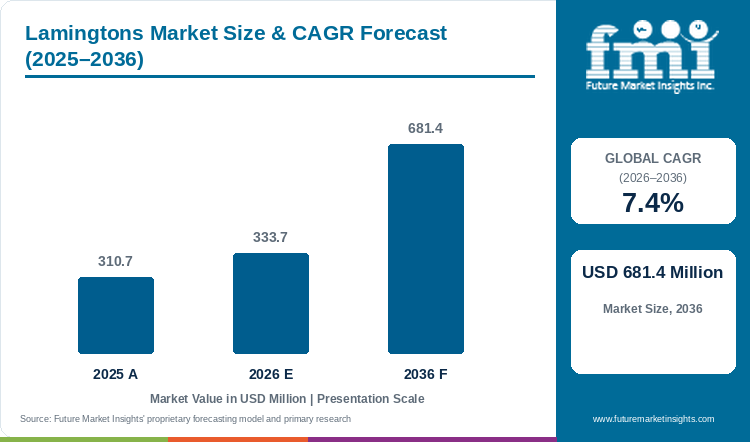
Starting from USD 310.7 million in 2025, the lamingtons market valuation advanced to USD 333.7 million in 2026, with projections pointing toward USD 681.4 million by 2036 at a CAGR of 7.4%.
Consumer appetite for portioned afternoon-tea treats and packaged supermarket cakes is expanding global demand for lamingtons well beyond traditional local bakehouses. Global lamingtons market valuation reached USD 310.7 million in 2025 and is estimated at USD 333.7 million in 2026, with projections reaching USD 681.4 million by 2036 at a 7.4% CAGR. Within the product type segment, Classic / Original is expected to hold a 38.0% share in 2026 because familiar sponge cake dipped in chocolate and coated with coconut appeals to everyday family shoppers. Packaged two-piece and five-piece retail trays are helping the category grow faster than broader bakery products at a 4.5% CAGR, since supermarkets can stock ready-to-eat sponge packs in standard grocery aisles. Major grocers are now introducing the cake to new international shoppers, as seen when Marks & Spencer partnered with Northern Ireland supplier Genesis Bakery in September 2025 to roll out two-piece Chocolate & Coconut and Caramelised Biscuit packs across UK stores [1]. Foodservice brands are also finding new ways to sell bite-sized portions, such as Tokyo Lamington supplying mini cake toppings across 76 Yo-Chi frozen-yogurt outlets in Australia during August 2026. However, keeping the sponge soft while stopping moisture from soaking into the coconut coating and meeting strict allergen labeling rules remain the main hurdles for suppliers shipping across long retail supply chains.
Key Market Trends & Insights
- By product type: Classic / Original is expected to hold a 38.0% share in 2026 because familiar chocolate-and-coconut sponge requires no consumer introduction at supermarket bakery shelves.
- By claim / nature: Conventional is estimated to hold a 56.0% share in 2026 owing to reliable wheat-sponge baking performance and lower ingredient costs across commercial lines.
- By format: Fresh is projected to account for a 35.0% share in 2026 driven by impulse counter appeal and soft cake texture in retail bakery displays.
- By packaging format: Multipack is predicted to record a 38.0% share in 2026 attributable to household tea-time sharing and lower per-unit handling costs in grocery stores.
- By sales channel: Supermarkets & Hypermarkets are forecast to register a 33.0% share in 2026 supported by steady weekly grocery footfall and chilled bakery cabinet space.
Regional Highlights
- Top national expansion: South Africa is projected to lead major national markets at an 8.7% CAGR through 2036 supported by five-piece Halaal-certified supermarket cake-slice packs.
- Broader country progression: Canada is expected to expand at an 8.4% CAGR ahead of Ireland at 8.1% and Australia at 7.7%, while Singapore is forecast to register a 6.4% CAGR.
Market Size & Forecast
Table 1: Market Size and Forecast for the Lamingtons Market (USD million and CAGR percentage), 2025 to 2036
| Metric | Value |
|---|---|
| 2025 Market Size | USD 310.7 million |
| Estimated Market Size in 2026 | USD 333.7 million |
| Projected Market Size by 2036 | USD 681.4 million |
| CAGR, 2026 to 2036 | 7.4% |
| Added Revenue, 2026 to 2036 | USD 347.7 million |
Supermarket bakery buyers and retail bakehouse chains face tight shelf-life limits when shipping cream-filled and chocolate-coated sponge cakes across regional warehouses. Soft sponge cake quickly pulls moisture from liquid chocolate coatings and dairy fillings, which can cause package condensation and early staling during transit. Automated production scale helps leading suppliers keep quality uniform, as shown by October 2026 Society of Baking data reporting that Ferguson Plarre's Melbourne bakery produces pastries and custom cakes at roughly 14,000 units per day for over 80 stores [2]. As a result, grocery buyers are shifting orders from manual back-of-store dipping to central commissary bakeries that adjust cake flour protein levels so sponge cubes stay soft across multi-day retail display.
Bakery-Counter and Retail-Pack Volume Sizing
Table 2: Bakery-Counter and Retail-Pack Volume Sizing for the Lamingtons Market (USD million and operational ranges), 2025 to 2036
| Metric | 2025 | 2026 | 2036 |
|---|---|---|---|
| Market size (USD million) | 310.7 | 333.7 | 681.4 |
| Commercial lamington volume (million pieces) | 185.0 to 210.0 | 198.0 to 225.0 | 395.0 to 445.0 |
| Retail multipack shipments (million packs) | 38.0 to 44.0 | 41.0 to 47.0 | 84.0 to 96.0 |
| Average wholesale price per piece (USD) | 1.5 to 1.7 | 1.5 to 1.7 | 1.6 to 1.8 |
Operational note: Piece-volume and multipack shipment ranges reconcile commercial bakery output across two-piece UK high-street trays and five-piece South Africa cake-slice packs as well as six-piece Australia family boxes.
Commercial cake plants need steady batter thickness and smooth chocolate coating flow so every sponge cube picks up an even layer without clumping shredded coconut. Large bakeries pair continuous tunnel ovens with activated cake emulsifier blends to keep the crumb soft during chilled supermarket delivery.
Per Capita & Retail Bakery Outlet Sizing
Table 3: Per Capita and Outlet Spending Indicators for the Lamingtons Market (USD), 2025 to 2036
| Metric | 2025 | 2026 | 2036 |
|---|---|---|---|
| World population (million) | 8,200.0 | 8,300.0 | 9,000.0 |
| Spend per 1,000 people (USD) | 37.9 | 40.2 | 75.7 |
| Annual spend per stocking bakery outlet (USD) | 2,650.0 to 3,100.0 | 2,800.0 to 3,250.0 | 4,900.0 to 5,650.0 |
| Multipack & prepacked retail share (%) | 58.0% to 62.0% | 60.0% to 64.0% | 68.0% to 72.0% |
Table 4: Retail & Bakery Outlet Spending Indicators for the Lamingtons Market (USD and percentages), 2026
| Metric | Value | Institutional Reference Basis |
|---|---|---|
| Market size, 2026 | USD 333.7 million | 2026 global revenue baseline |
| Stocking grocery & bakery outlets globally | 112,000 outlets | Supermarket in-store bakeries and retail bakehouses |
| Market spend per stocking outlet | USD 2,979.5 | Annualized wholesale lamington procurement |
| Supermarkets & hypermarkets revenue, 2026 | USD 110.1 million | 33.0% sales channel segment allocation |
Store profit margins across supermarket bakery aisles depend on matching pack sizes to family buying habits while stopping loose coconut from spilling inside plastic trays. Retailers stocking multipack sponge cubes beside desiccated coconut treats use fitted tray cavities and moisture-barrier wraps to cut down on damaged store stock.
Analyst Perspective
"Repeat grocery orders for lamingtons depend on suppliers delivering soft sponge crumb and clean chocolate-coconut coating across multi-day chilled or ambient shelf windows without causing high store waste. Bakeries that pair two-piece or family multipack formats with clear plain-English allergen labels will win multi-year supermarket shelf space."
- Nandini Roy Choudhury, Principal Consultant, Future Market Insights.
How is the lamingtons market segmented?
The lamingtons market is segmented by product type, claim / nature, format, packaging format, and sales channel. In 2026, Classic / Original is projected at 38.0%, Conventional at 56.0%, Fresh at 35.0%, Multipack at 38.0%, and Supermarkets & Hypermarkets at 33.0%.
By product type: Classic / Original, Whole Grain & Seeded, Flavored & Filled, Mini & Snacking Formats, and Premium / Artisan.
By claim / nature: Conventional, Clean Label, Organic, Gluten-Free, and High-Protein / Fortified.
By format: Fresh, Frozen, Ambient Packaged, Chilled, and Par-Baked / Thaw-and-Serve.
By packaging format: Multipack, Single-Serve, Family / Loaf Pack, and Bulk Foodservice.
By sales channel: Supermarkets & Hypermarkets, Artisan & Specialty Bakeries, Convenience & Forecourt, Online & DTC, and Foodservice Distributors.
Why does Classic / Original lead the product type category?
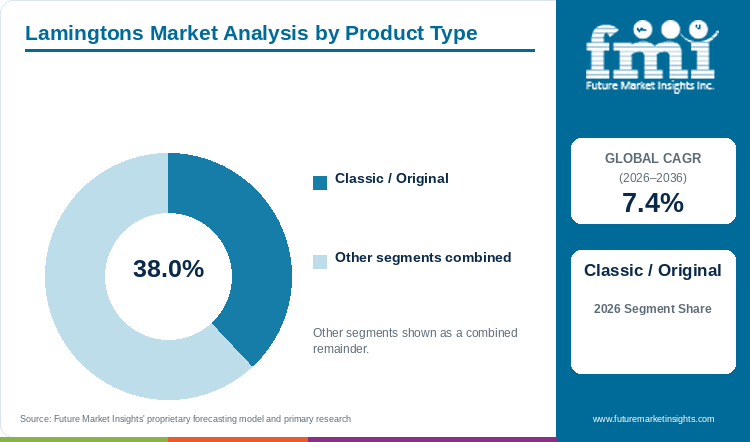
Classic / Original is expected to hold a 38.0% share of the product type segment in 2026, driven by immediate shopper familiarity and everyday afternoon-tea buying.
Table 5: Product Type Share for the Lamingtons Market (percentage share), 2026
| Product Type | Share (2026) |
|---|---|
| Classic / Original | 38.0% |
| Other Segments Combined* | 62.0% |
| Total | 100.0% |
*Calculated as the balance remaining after deducting the leading segment's reported share from 100.0%.
Table 6: Product Type Leadership and Market Growth for the Lamingtons Market (segment and CAGR percentage), 2026 to 2036
| Metric | Value |
|---|---|
| Global CAGR (2026 to 2036) | 7.4% |
| Leading Segment | Classic / Original |
Supermarket bakery buyers treat traditional butter-sponge cubes dipped in chocolate icing and fine coconut as their core everyday item before testing seasonal flavors. Automated coating lines running standard chocolate flavoring compounds help commercial bakeries keep coating weight and unit costs steady across grocery packs.
- Classic / Original is expected to hold a 38.0% share in 2026 because recognizable chocolate-and-coconut sponge needs no explanation at the shelf.
- Retailers entering new overseas markets anchor their launches with the classic recipe and one novelty flavor, as Marks & Spencer did in September 2025 when it debuted two-piece Chocolate & Coconut packs priced at GBP 2.60 made by Genesis Bakery [3].
Why does Conventional define the largest claim / nature segment?
Conventional is estimated to hold a 56.0% share of the claim / nature segment in 2026, supported by reliable wheat-flour sponge softness and affordable grocery price points.
Standard wheat-flour sponge batters and dairy-cocoa icings give bakers dependable oven rise and moisture balance with no extra gums needed in gluten-free or high-protein cakes. Commercial plants using standard bakery mixes can run continuous depositors at full speed while managing wheat and egg allergens under existing factory checks.
- Conventional is estimated to hold a 56.0% share in 2026 owing to lower ingredient costs and uniform sponge texture across automated tunnel ovens.
- Mainstream supermarkets keep conventional packs at entry-level family price points while using clear wheat and dairy allergen labels on the front and back of the pack.
What keeps Fresh ahead by format?
Fresh is projected to account for a 35.0% share of the format segment in 2026, attributable to visible bakery-counter appeal and soft newly coated sponge texture.
Shoppers visiting retail bakehouses and supermarket in-store bakeries prefer freshly finished sponge cubes that have not been frozen or stored for weeks in ambient aisles. Specialty bakeries pair daily batch baking with sugar and chocolate decorations to charge higher single-piece prices at urban café counters.
- Fresh is projected to account for a 35.0% share in 2026 driven by strong impulse buying at glass bakery cabinets and café counters.
- Heritage retail chains rely on daily fresh-cream lamington deliveries to bring repeat morning and afternoon foot traffic into neighborhood bakehouses.
Why does Multipack lead the packaging format category?
Multipack is predicted to record a 38.0% share of the packaging format segment in 2026, linked to household tea-break sharing and efficient supermarket shelf restocking.
Multi-unit trays holding two or six lamingtons reduce per-cake packaging work and fit family afternoon-tea and office-sharing occasions. Plastic tray dividers stop adjacent chocolate coatings from sticking together during truck delivery and home storage.
- Multipack is predicted to record a 38.0% share in 2026 resulting from higher basket spend per checkout trip and neat shelf stacking in grocery aisles.
- Supermarkets in Australia and the UK as well as South Africa use two-piece and six-piece clamshell trays to protect soft sponge corners during shopper handling.
What gives Supermarkets & Hypermarkets the leading position in sales channel?
Supermarkets & Hypermarkets are forecast to register a 33.0% share of the sales channel segment in 2026, reinforced by nationwide cold-chain distribution and weekly grocery trips.
Large grocery chains combine ambient packaged-cake shelves with chilled in-store bakery tables, letting suppliers sell both budget lamington fingers and chilled cream-filled packs. Central retail warehouses require reliable pallet deliveries and verified barcoded allergen labels before awarding national listings.
- Supermarkets & Hypermarkets are forecast to register a 33.0% share in 2026 supported by high weekly shopper footfall and chilled bakery display cases.
- At the same time, specialty bakers are expanding into foodservice dessert chains to reduce reliance on grocery shelves, as seen when Tokyo Lamington placed mini lamington toppings into 76 Yo-Chi frozen-yogurt venues in August 2026 [4].
What are the drivers, restraints, and opportunities in the lamingtons market?
In the lamingtons market, supermarket private-label launches and cross-channel dessert partnerships drive demand, whereas chilled cream-fill spoilage and allergen labeling rules restrain margins, and bite-sized topping formats open new foodservice growth.
- Driver: Mainstream supermarket private-label programs and local contract baking turn a traditional sponge cake from Australia and New Zealand into an everyday packaged grocery item.
- Restraint: Short chilled display windows for fresh-cream variants and strict item-level allergen labeling rules reduce store margins on slow-selling flavors.
- Opportunity: Bite-sized lamington cubes made as toppings for frozen-yogurt and specialty beverage chains create recurring wholesale orders.
Growth Analysis and Future Potential: Qualitative Demand Catalysts
Supermarket category managers in the UK and South Africa as well as Australia are expanding private-label sweet bakery ranges with familiar cakes that need no home preparation. Local contract baking avoids long ocean frozen shipping costs and puts fresher sponge cake onto grocery shelves. Future Market Insights notes that retailers display two-piece and five-piece packs with cake boards and drums in party and celebration aisles to capture both weekday snacking and weekend family gatherings. Public co-investment in regional baking plants is also lowering production costs, such as the state government in Victoria awarding grant funding for George Weston Foods' Ballarat and Tip Top operations under its AUD 150 million investment fund in April 2026 [5]. Steady upgrades to domestic tunnel ovens and packaging lines help commercial bakers meet supermarket replenishment schedules.
Risk Assessment of the Lamingtons Market: Operational and Formulation Friction
Moisture moving between soft sponge cake and dry shredded coconut creates a constant shelf-life challenge during retail distribution. Plain chocolate-coated lamingtons can sit on ambient shelves for several days, but fresh-cream variants must stay refrigerated below 5 degrees Celsius to stop dairy spoilage and cream separation. Bakery counters that pack fresh cakes on site must also follow strict Prepacked for Direct Sale (PPDS) and Plain English Allergen Labelling laws requiring full ingredient lists with bold allergen callouts. When bakeries add nut-praline or berry fillings paired with royal icing mixes, line washdown time and label printing costs rise. Supermarkets quickly drop slow-selling flavored packs whenever daily markdown waste cuts into bakery aisle profits.
Commercial Opportunity Analysis: Formulation Differentiation and Value-Add Formats
Frozen-yogurt chains and specialty coffee shops want pre-cut cake toppings that add texture to cold desserts without requiring kitchen staff to bake from scratch. Small 15-to-20-millimeter sponge cubes sealed with a thin cocoa-butter coating before coconut rolling stay firm when placed on top of soft-serve bowls. Bakeries that run bite-sized lamingtons with fondant and sugar paste finishing lines can supply both retail gift boxes and multi-site foodservice accounts from the same plant. Family-owned bakehouse chains are also modernizing store layouts with drive-thru coffee and cake lanes to capture busy suburban commuters. Suppliers that offer thaw-and-serve mini lamington cartons with complete allergen paperwork are well placed to win national dessert-bar contracts.
Lamingtons Market by Country (2026 to 2036)
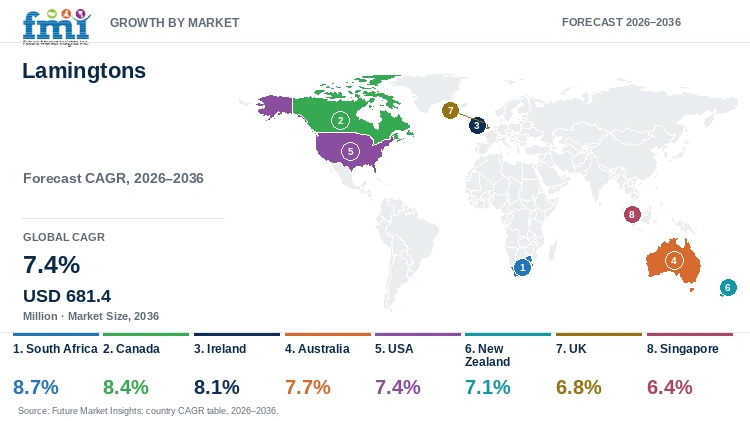
As per FMI, South Africa is projected to lead lamingtons market expansion across major national markets at an 8.7% CAGR through 2036, whereas Singapore is forecast to progress at a 6.4% CAGR. Sales growth across Commonwealth supermarket chains and North America or Asia specialty bakeries depends on local contract-baking capacity and clear allergen labeling.
Table 7: Country CAGR and Primary Growth Levers for the Lamingtons Market (CAGR percentage and operational drivers), 2026 to 2036
| Country | CAGR (2026 to 2036) | Primary Growth Lever |
|---|---|---|
| South Africa | 8.7% | Supermarket five-piece Halaal cake-slice multipacks and ambient teatime merchandising |
| Canada | 8.4% | Independent bakery entertaining platters and bilingual allergen-compliant retail packs |
| Ireland | 8.1% | All-island contract bakery manufacturing spillover and point-of-sale allergen compliance |
| Australia | 7.7% | Tiered supermarket fingers and chilled cream-filled six-packs with QSR mini-topping partnerships |
| USA | 7.4% | Gluten-free and specialty-flour artisan bakery reformulations and online direct-to-consumer gifting |
| New Zealand | 7.1% | Supermarket nine-piece mini multipacks and frozen or fresh-cream grocery segmentation |
| UK | 6.8% | High-street retailer private-label two-packs manufactured by domestic contract bakeries |
| Singapore | 6.4% | Expat-anchored artisan bakery-cafe single servings and prepacked nutrition labeling |
Source: Future Market Insights analysis
South Africa Lamingtons Market Outlook (2026 to 2036)
Unlike Northern Hemisphere markets where lamingtons enter as an unfamiliar imported treat, South Africa stocks chocolate-and-coconut sponge slices as an everyday supermarket tea-time staple. Demand in South Africa is projected to expand at an 8.7% CAGR from 2026 to 2036. Major grocer Woolworths South Africa sells Halaal-certified five-piece Lamington Cake Slices made from vanilla sponge dipped in chocolate sauce and desiccated coconut with free-range eggs for ambient table serving [6]. Retailers pack the cake inside a five-slice ambient family tray that avoids refrigerated cabinet power costs during local electricity disruptions, though higher cocoa-butter and coconut import prices squeeze retail margins across Gauteng and the Western Cape.
Key takeaway: In South Africa, Halaal-certified five-piece supermarket cake-slice trays and ambient store display economics are projected to drive leading national volume growth.
Canada Lamingtons Market Outlook (2026 to 2036)
Whereas Australia and South Africa sell standalone lamington multipacks in supermarket aisles, Canada builds initial demand through mixed event platters sold by neighborhood bakeries and regional grocery store chains. Sales in Canada are expected to advance at an 8.4% CAGR between 2026 and 2036. Independent shops such as Alberta-based JK Bakery Cafe include chocolate-and-coconut sponge squares inside assorted party trays so customers can sample the cake with familiar dessert bars and tarts. However, national dual-language packaging rules and priority wheat and dairy allergen declarations enforced by the Food Inspection Agency in Canada add packaging setup costs that slow coast-to-coast supermarket rollout across major urban provinces.
Key takeaway: In Canada, mixed-pastry catering platters and bilingual priority-allergen labeling rules are expected to shape regional bakery expansion.
Ireland Lamingtons Market Outlook (2026 to 2036)
Ireland benefits from close cross-border access to Northern Ireland contract bakeries and a strong daily tea-and-cake café habit that favors coated sponge slices. Because Genesis Bakery in Magherafelt already bakes hand-finished lamingtons at commercial scale for Marks & Spencer stores across the UK and Ireland, shipping fresh two-packs into Dublin and Cork food halls requires very little supply-chain adjustment. At the same time, national food safety rules in Ireland require cafés and bakery counters selling unpackaged cakes to display written allergen notices at the counter, which increases daily paperwork for small independent coffee shops. The market in Ireland is forecast to record an 8.1% CAGR through 2036.
Key takeaway: In Ireland, island-wide contract baking capacity combined with point-of-sale written allergen rules is forecast to govern retail and café adoption.
Australia Lamingtons Market Outlook (2026 to 2036)
Unlike export markets still introducing the cake to first-time buyers, Australia operates a mature three-tier market covering budget supermarket fingers and chilled fresh-cream bakehouse six-packs as well as specialty flavor partnerships. Demand in Australia is anticipated to progress at a 7.7% CAGR over the 2026 to 2036 forecast period. Large industrial bakers continue to upgrade domestic plants, highlighted by George Weston Foods completing an AUD 130 million automated bakery redevelopment in Canning Vale in March 2026 [7]. Because everyday household awareness is already high across major metropolitan cities, revenue growth depends on specialty flavor rotation at boutiques like Tokyo Lamington and competing for afternoon snack occasions against national retail bakery chains.
Key takeaway: In Australia, artisan flavor partnerships and chilled cream-filled multipacks are anticipated to sustain value growth across a mature domestic base.
USA Lamingtons Market Outlook (2026 to 2036)
Unlike Commonwealth grocery markets with permanent shelf space, the USA treats lamingtons as a specialty café pastry and dietary-friendly gift item centered in coastal cities and online bakery shops. Regional specialty bakers such as Illinois-based Sans Bakery bake gluten-free strawberry-filled and classic chocolate lamingtons to attract wheat-sensitive consumers who want portioned cakes. At the same time, updated federal food allergen guidance requires strict tree-nut and coconut source declarations with cross-contact controls for bakeries shipping across state lines. High insulated parcel shipping rates and regional distributor fragmentation keep national supermarket penetration modest, with the market in the USA predicted to register a 7.4% CAGR from 2026 to 2036.
Key takeaway: In the USA, specialty gluten-free café recipes and federal allergen-labeling rules are predicted to guide selective metro and online growth.
New Zealand Lamingtons Market Outlook (2026 to 2036)
New Zealand stands out for splitting supermarket lamington shelves across ambient nine-piece mini packs and in-store fresh-cream raspberry sponges as well as private-label frozen boxes. Revenue in New Zealand is projected to grow at a 7.1% CAGR between 2026 and 2036. Supermarket chains including Woolworths New Zealand and PAK'nSAVE give families year-round access to Pams frozen mixed lamingtons and chilled bakery counter multipacks across North Island and South Island stores. However, Plain English Allergen Labelling rules enforced by the Ministry for Primary Industries and rising domestic butterfat and imported cocoa prices tighten profit margins for contract bakers supplying entry-level grocery multipacks to national retail chains.
Key takeaway: In New Zealand, multi-temperature supermarket merchandising across mini ambient packs and frozen private-label boxes is projected to support steady replacement demand.
UK Lamingtons Market Outlook (2026 to 2036)
In the UK, growth is being led by premium high-street grocery chains hiring domestic contract bakeries to turn lamingtons into convenient two-piece snack packs. The UK market is estimated to expand at a 6.8% CAGR from 2026 to 2036. Retail coverage in September 2025 showed how Marks & Spencer paired a traditional Chocolate & Coconut lamington with a Caramelised Biscuit version baked in Northern Ireland by Genesis Bakery to win over UK biscuit and cake shoppers [8]. While Speculoos-style flavor twists attract younger shoppers, strict Natasha's Law allergen rules for on-site packed foods and strong competition from Victoria sponge and cake slices require steady weekly turnover.
Key takeaway: In the UK, retailer-backed domestic contract baking and localized two-piece flavor twists are estimated to turn initial trial into repeat grocery demand.
Singapore Lamingtons Market Outlook (2026 to 2036)
In Singapore, warm humid weather and compact apartment kitchens steer lamington buying toward air-conditioned artisan bakery-cafés such as Baker & Cook instead of large family multipack cartons. Updated Food Regulations enforced by the Singapore Food Agency from January 2026 require clear ingredient and nutrition disclosures on all prepacked retail cakes entering domestic supermarkets and specialty food halls. Because imported chilled cakes face strict shelf-life and label checks at border entry ports, local commissary kitchens supply most fresh café counters while high mall rents limit chilled display case space across central shopping districts. The market in Singapore is therefore slated to advance at a 6.4% CAGR through 2036.
Key takeaway: In Singapore, artisan café single-serve counter sales and updated 2026 prepacked labeling rules are slated to govern premium bakery distribution.
Full report country CAGRs cover: North America; Latin America; Western Europe; Eastern Europe; East Asia; South Asia and Pacific; Middle East and Africa.
Who are the notable companies in the lamingtons market?
Ferguson Plarre Bakehouses, Tokyo Lamington, Bakers Delight, Balfours, Sara Lee Australia, Country Chef Bakery Co., and George Weston Foods (Top Taste) are the notable companies in the lamingtons market.
Commercial participation in the lamingtons market divides between dedicated bakehouse specialists and larger industrial cake and frozen-dessert producers. Ferguson Plarre Bakehouses and Tokyo Lamington sell verified single and multipack lamington lines across retail shops and foodservice partnerships. Meanwhile, franchise and industrial bakery groups such as Bakers Delight and Balfours along with Sara Lee Australia and Country Chef Bakery Co. run broad distribution networks where lamington production depends on specific retail contract specifications.
- Lamington-Centric Specialist Bakers: Ferguson Plarre Bakehouses and Tokyo Lamington sell fresh-cream six-packs and specialty flavored cakes as well as wholesale mini lamington toppings.
- Broad Bakery and Dessert Channel Operators: Bakers Delight and Balfours along with Sara Lee Australia and Country Chef Bakery Co. run national bakehouse franchises and frozen-dessert foodservice plants.
- Industrial Bakery & Legacy Cake Platforms: George Weston Foods (Tip Top / historical Top Taste) operates automated bread and sweet-bakery distribution networks across Australia.
Competitive Benchmarking: Lamingtons Market
Table 8: Competitive Benchmarking for the Lamingtons Market (qualitative capability ratings), 2026
| Company | Lamington SKU Breadth | Packaged / DTC Access | Foodservice Lamington Route | Geographic Reach |
|---|---|---|---|---|
| Ferguson Plarre Bakehouses | High | High | Medium | Over 80 Victoria bakehouse stores and drive-thru ordering |
| Tokyo Lamington | High | High | High | Sydney and Melbourne stores plus 76-venue national Yo-Chi partnership |
| Bakers Delight | Medium | Medium | Unscored | Over 600 bakery franchises across Australia and New Zealand |
| Balfours | Medium | Medium | Medium | South Australia and national grocery and foodservice bakery distribution |
| Sara Lee Australia | Unscored | High | High | Australia and New Zealand supermarket freezer and foodservice channels |
| Country Chef Bakery Co. | Unscored | High | High | Sunshine Coast industrial dessert plant serving national retail and foodservice |
| George Weston Foods (Top Taste) | Unscored | High | Medium | National Australia and New Zealand industrial bakery and grocery logistics |
Scoring basis: Lamington SKU Breadth evaluates documented classic and cream-filled or flavored lamington cake listings. Packaged / DTC Access and Foodservice Lamington Route measure verified multipack and multi-outlet wholesale supply, while absent public SKU evidence is marked Unscored.
Key Developments in the Lamingtons Market
- Balfours returned to South Australia ownership under Unique Homestyle Foods in June 2026 with plans to expand its traditional sweet-bakery and cake distribution [9].
- Bakers Delight unveiled its first Melbourne pop-up deli in October 2026 as Chief Marketing Officer Jodi Murray noted changing consumer eating habits toward specialty bakery formats [10].
- George Weston Foods expanded its chilled and ambient supermarket bakery reach across Australia and New Zealand by acquiring Abe's Bagels in May 2026.
Key Players in the Lamingtons Market
Lamington-Centric Specialist Bakers
- Ferguson Plarre Bakehouses
- Tokyo Lamington
Broad Bakery and Dessert Channel Operators
- Bakers Delight
- Balfours
- Sara Lee Australia
- Country Chef Bakery Co.
Industrial Bakery & Legacy Cake Platforms
- George Weston Foods (Top Taste)
Lamingtons Market - Report Scope
Table 9: Report Scope for the Lamingtons Market (coverage fields and definitions), 2026 to 2036
| Coverage field | Report scope |
|---|---|
| Market breakdown | Product Type; Claim / Nature; Format; Packaging Format; Sales Channel |
| Quantitative Units | USD Million |
| Market Definition | Includes commercial revenue attributable to finished lamington sponge cakes coated in chocolate or flavored icing and desiccated coconut sold in fresh, frozen, ambient, chilled, or thaw-and-serve formats. Category Scope Note: Excludes lamington-flavored ice cream, yeast scrolls, unrelated sponge cakes, and downstream composite dessert resale markups. |
| Regions Covered | North America; Latin America; Western Europe; Eastern Europe; East Asia; South Asia and Pacific; Middle East and Africa |
| Countries Covered | South Africa, Canada, Ireland, Australia, USA, New Zealand, UK, Singapore, and additional countries in the full report |
| Key Companies Covered | Ferguson Plarre Bakehouses, Tokyo Lamington, Bakers Delight, Balfours, Sara Lee Australia, Country Chef Bakery Co., George Weston Foods (Top Taste) |
| Forecast Period | 2026 to 2036 |
| Approach | Primary and secondary research with top-down and bottom-up market triangulation. |
Lamingtons Market - Research Methodology
Table 10: Research Methodology for the Lamingtons Market (research methods and approach), 2026 edition
| Method | Approach |
|---|---|
| Primary Research | Structured interviews with supermarket in-store bakery category managers, commercial cake commissary directors, artisan bakehouse owners, and foodservice dessert buyers to validate pack sizes, shelf-life waste, and wholesale pricing. |
| Secondary Research | Review of national food-safety allergen regulations (FSANZ, UK FSA, CFIA, FSAI, US FDA, NZ MPI, SFA), Society of Baking production disclosures, and corporate trade announcements. |
| Market Sizing and Forecasting | Top-down sweet-bakery expenditure models reconciled against bottom-up supermarket multipack facings, bakehouse daily piece output, and foodservice topping volumes from 2026 to 2036. |
| Country Forecasting Model | Country projections weight supermarket private-label cake penetration, local contract-baking capacity, cold-chain cabinet density, and allergen-labeling compliance costs across eight national markets. |
| Operational Benchmark Traceability | Piece-volume and outlet spending indicators in Tables 2, 3, and 4 trace to Society of Baking facility output records, UK high-street two-pack pricing, and national grocery store registries. |
| Data Triangulation and Validation | Revenue estimates are cross-checked against wholesale bakery contract volumes and retail multipack scan data while excluding non-sponge bakery substitutes and composite froyo bowl sales. |
Lamingtons Market by Segments
Lamingtons Market segmented by Product Type:
- Classic / Original
- Whole Grain & Seeded
- Flavored & Filled
- Mini & Snacking Formats
- Premium / Artisan
Lamingtons Market segmented by Claim / Nature:
- Conventional
- Clean Label
- Organic
- Gluten-Free
- High-Protein / Fortified
Lamingtons Market segmented by Format:
- Fresh
- Frozen
- Ambient Packaged
- Chilled
- Par-Baked / Thaw-and-Serve
Lamingtons Market segmented by Packaging Format:
- Multipack
- Single-Serve
- Family / Loaf Pack
- Bulk Foodservice
Lamingtons Market segmented by Sales Channel:
- Supermarkets & Hypermarkets
- Artisan & Specialty Bakeries
- Convenience & Forecourt
- Online & DTC
- Foodservice Distributors
Lamingtons Market by Region
- North America
- United States
- Canada
- Latin America
- Brazil
- Mexico
- Argentina
- Chile
- Western Europe
- Germany
- France
- United Kingdom
- Italy
- Spain
- Benelux
- Nordics
- Eastern Europe
- Poland
- Czech Republic
- Romania
- Hungary
- East Asia
- China
- Japan
- South Korea
- South Asia and Pacific
- India
- ASEAN
- Australia and New Zealand
- Middle East and Africa
- GCC Countries
- South Africa
- Türkiye
- Israel
Research Sources and Bibliography
- [1] Marks & Spencer. (2025, September 9). Northern Ireland Bakery Brings Famous Lamingtons To M&S Stores Across The UK. Marks & Spencer Corporate Press Office.
- [2] Society of Baking. (2026, October 20). 2026 ABINSA national winners: the results are in and Ferguson Plarre facility tour. Baking Business.
- [3] Love Belfast. (2025, September 10). Northern Ireland Bakery Genesis Bakery Brings Lamingtons to M&S Stores Across the UK and Ireland. Love Belfast Business.
- [4] Issa, M.-A. (2026, August 24). ICYMI: Tokyo Lamington Is Taking Over Every Yo-Chi In The Country Across 76 Venues. Social101 Food & Drink.
- [5] Food & Drink Business. (2026, April 22). VIC govt provides funding for GWF operations under Victoria Investment Fund. Food & Drink Business.
- [6] Woolworths South Africa. (2025, November 14). Lamington Cake Slices 5 pk Halaal Bakery Specification. Woolworths Holdings Limited.
- [7] Food & Drink Business. (2026, March 13). Tip Top WA facility receives $130m upgrade in Canning Vale redevelopment. Food & Drink Business.
- [8] Grocery Gazette. (2025, September 11). M&S launches Lamingtons snack in partnership with Genesis Bakery. Grocery Gazette Retail News.
- [9] Balfours Bakery. (2026, June 4). Balfours Is Back in SA Under Unique Homestyle Foods Ownership. Balfours Corporate Release.
- [10] Baking Business. (2026, October 21). Bakers Delight unveils first pop-up deli in Melbourne to capture shifting consumer eating habits. Baking Business Australia.
This bibliography is provided for reader reference and is not exhaustive. The full report contains the complete reference list and detailed citations.
This Report Answers
- How large is the lamingtons market in 2026 and what value is forecast by 2036?
- Which supermarket and foodservice demand mechanisms drive lamington purchasing?
- Why does Classic / Original lead the Product Type segment in 2026?
- Why does Conventional hold the largest share of the Claim / Nature segment?
- How do growth rates differ across South Africa and Canada as well as Ireland and the UK?
- Which companies offer verified lamington SKUs versus adjacent commercial bakery capabilities?
- What moisture-control and allergen-labeling gates limit shelf life and supplier switching?
- What specifications should grocery and café buyers verify before placing recurring orders?
Frequently Asked Questions
How big is the lamingtons market in 2026, and what is forecast for 2036?
According to FMI, the global lamingtons market is estimated to reach USD 333.7 million in 2026 from USD 310.7 million in 2025. The market is projected to achieve USD 681.4 million by 2036 as supermarkets and dessert chains expand packaged multipacks and mini topping formats.
What is the CAGR for the lamingtons market from 2026 to 2036?
Future Market Insights projects a 7.4% compound annual growth rate between 2026 and 2036, generating USD 347.7 million in incremental revenue across grocery and foodservice channels.
Which product type segment leads the lamingtons market?
Classic / Original is expected to hold a 38.0% share of the product type segment in 2026 because chocolate-and-coconut sponge provides an immediately recognizable benchmark for shoppers.
Which claim / nature segment leads the lamingtons market?
Conventional is estimated to hold a 56.0% share of the claim / nature segment in 2026 owing to reliable wheat-sponge crumb structure and economical industrial baking.
Which countries record the fastest growth during the forecast period?
South Africa leads at an 8.7% CAGR through 2036, followed by Canada at 8.4% and Ireland at 8.1%, supported by supermarket cake-slice multipacks and contract bakery expansion.
Who are the notable companies in the lamingtons market?
Ferguson Plarre Bakehouses and Tokyo Lamington lead specialist supply while Bakers Delight and Balfours as well as Sara Lee Australia, Country Chef Bakery Co., and George Weston Foods operate broader commercial bakery routes.
Preview the report firsthand - request a free sample
Get SampleGet the brochure for pricing and purchase details.
Get PDFTable of Content
- Key Takeaways
- Market Size and CAGR
- Top Growth Driver
- Fastest Growing Segment
- Leading Region
- Key Companies
- Emerging Opportunities
- Executive Summary
- Global Market Outlook
- Demand-side Trends
- Supply-side Trends
- Technology Roadmap Analysis
- Analysis and Recommendations
- Analyst Perspective (What is happening? Why now? What should investors know?)
- Key Questions Answered
- How large is the market?
- What is the CAGR?
- What are key trends?
- Which region dominates?
- Who are the leaders?
- Market Overview
- Market Coverage / Taxonomy
- Market Definition / Scope / Limitations
- Research Methodology
- Chapter Orientation
- Analytical Lens and Working Hypotheses
- Market Structure, Signals, and Trend Drivers
- Benchmarking and Cross-market Comparability
- Market Sizing, Forecasting, and Opportunity Mapping
- Research Design and Evidence Framework
- Desk Research Programme (Secondary Evidence)
- Expert Input and Fieldwork (Primary Evidence)
- Tooling, Models, and Reference Databases
- Data Engineering and Model Build
- Quality Assurance and Audit Trail
- Market Background
- Market Dynamics (Drivers, Restraints, Opportunity, Trends)
- Scenario Forecast (Optimistic, Likely, Conservative)
- Impact Analysis
- AI Impact
- Sustainability Impact
- Regulatory Impact
- Technology Impact
- Consumer / Buyer Analysis
- Purchase Drivers
- Adoption Barriers
- Buyer Journey
- Opportunity Map Analysis
- Product Life Cycle Analysis
- Supply Chain Analysis
- Investment Feasibility Matrix
- Value Chain Analysis
- PESTLE and Porter's Analysis
- Regulatory Landscape
- Regional Parent Market Outlook
- Production and Consumption Statistics
- Import and Export Statistics
- Global Market Analysis and Forecast, 2021 to 2036
- Historical Market Size Value (USD Million) Analysis, 2021 to 2025
- Current and Future Market Size Value (USD Million) Projections, 2026 to 2036
- Y-o-Y Growth Trend Analysis
- Absolute $ Opportunity Analysis
- Global Market Pricing Analysis, 2021 to 2036
- Global Market Analysis and Forecast, By Product Type, 2021 to 2036
- Introduction / Key Findings
- Historical Market Size Value (USD Million) Analysis By Product Type, 2021 to 2025
- Current and Future Market Size Value (USD Million) Analysis and Forecast By Product Type, 2026 to 2036
- Classic / Original
- Whole Grain & Seeded
- Flavored & Filled
- Mini & Snacking Formats
- Premium / Artisan
- Y-o-Y Growth Trend Analysis By Product Type, 2021 to 2025
- Absolute $ Opportunity Analysis By Product Type, 2026 to 2036
- Global Market Analysis and Forecast, By Claim / Nature, 2021 to 2036
- Introduction / Key Findings
- Historical Market Size Value (USD Million) Analysis By Claim / Nature, 2021 to 2025
- Current and Future Market Size Value (USD Million) Analysis and Forecast By Claim / Nature, 2026 to 2036
- Conventional
- Clean Label
- Organic
- Gluten-Free
- High-Protein / Fortified
- Y-o-Y Growth Trend Analysis By Claim / Nature, 2021 to 2025
- Absolute $ Opportunity Analysis By Claim / Nature, 2026 to 2036
- Global Market Analysis and Forecast, By Format, 2021 to 2036
- Introduction / Key Findings
- Historical Market Size Value (USD Million) Analysis By Format, 2021 to 2025
- Current and Future Market Size Value (USD Million) Analysis and Forecast By Format, 2026 to 2036
- Fresh
- Frozen
- Ambient Packaged
- Chilled
- Par-Baked / Thaw-and-Serve
- Y-o-Y Growth Trend Analysis By Format, 2021 to 2025
- Absolute $ Opportunity Analysis By Format, 2026 to 2036
- Global Market Analysis and Forecast, By Packaging Format, 2021 to 2036
- Introduction / Key Findings
- Historical Market Size Value (USD Million) Analysis By Packaging Format, 2021 to 2025
- Current and Future Market Size Value (USD Million) Analysis and Forecast By Packaging Format, 2026 to 2036
- Multipack
- Single-Serve
- Family / Loaf Pack
- Bulk Foodservice
- Y-o-Y Growth Trend Analysis By Packaging Format, 2021 to 2025
- Absolute $ Opportunity Analysis By Packaging Format, 2026 to 2036
- Global Market Analysis and Forecast, By Sales Channel, 2021 to 2036
- Introduction / Key Findings
- Historical Market Size Value (USD Million) Analysis By Sales Channel, 2021 to 2025
- Current and Future Market Size Value (USD Million) Analysis and Forecast By Sales Channel, 2026 to 2036
- Supermarkets & Hypermarkets
- Artisan & Specialty Bakeries
- Convenience & Forecourt
- Online & DTC
- Foodservice Distributors
- Y-o-Y Growth Trend Analysis By Sales Channel, 2021 to 2025
- Absolute $ Opportunity Analysis By Sales Channel, 2026 to 2036
- Global Market Analysis and Forecast, By Region, 2021 to 2036
- Introduction
- Historical Market Size Value (USD Million) Analysis By Region, 2021 to 2025
- Current Market Size Value (USD Million) Analysis and Forecast By Region, 2026 to 2036
- North America
- Latin America
- Western Europe
- Eastern Europe
- East Asia
- South Asia and Pacific
- Middle East and Africa
- Market Attractiveness Analysis By Region
- North America Market Analysis and Forecast, By Country, 2021 to 2036
- Historical Market Size Value (USD Million) Trend Analysis By Market Taxonomy, 2021 to 2025
- Market Size Value (USD Million) Forecast By Market Taxonomy, 2026 to 2036
- By Country
- United States
- Canada
- By Product Type
- By Claim / Nature
- By Format
- By Packaging Format
- By Sales Channel
- By Country
- Market Attractiveness Analysis
- By Country
- By Product Type
- By Claim / Nature
- By Format
- By Packaging Format
- By Sales Channel
- Key Takeaways
- Latin America Market Analysis and Forecast, By Country
- Historical Market Size Value (USD Million) Trend Analysis By Market Taxonomy, 2021 to 2025
- Market Size Value (USD Million) Forecast By Market Taxonomy, 2026 to 2036
- By Country
- Brazil
- Mexico
- Argentina
- Chile
- By Product Type
- By Claim / Nature
- By Format
- By Packaging Format
- By Sales Channel
- By Country
- Market Attractiveness Analysis
- By Country
- By Product Type
- By Claim / Nature
- By Format
- By Packaging Format
- By Sales Channel
- Key Takeaways
- Western Europe Market Analysis and Forecast, By Country
- Historical Market Size Value (USD Million) Trend Analysis By Market Taxonomy, 2021 to 2025
- Market Size Value (USD Million) Forecast By Market Taxonomy, 2026 to 2036
- By Country
- Germany
- France
- United Kingdom
- Italy
- Spain
- Benelux
- Nordics
- By Product Type
- By Claim / Nature
- By Format
- By Packaging Format
- By Sales Channel
- By Country
- Market Attractiveness Analysis
- By Country
- By Product Type
- By Claim / Nature
- By Format
- By Packaging Format
- By Sales Channel
- Key Takeaways
- Eastern Europe Market Analysis and Forecast, By Country
- Historical Market Size Value (USD Million) Trend Analysis By Market Taxonomy, 2021 to 2025
- Market Size Value (USD Million) Forecast By Market Taxonomy, 2026 to 2036
- By Country
- Poland
- Czech Republic
- Romania
- Hungary
- By Product Type
- By Claim / Nature
- By Format
- By Packaging Format
- By Sales Channel
- By Country
- Market Attractiveness Analysis
- By Country
- By Product Type
- By Claim / Nature
- By Format
- By Packaging Format
- By Sales Channel
- Key Takeaways
- East Asia Market Analysis and Forecast, By Country
- Historical Market Size Value (USD Million) Trend Analysis By Market Taxonomy, 2021 to 2025
- Market Size Value (USD Million) Forecast By Market Taxonomy, 2026 to 2036
- By Country
- China
- Japan
- South Korea
- By Product Type
- By Claim / Nature
- By Format
- By Packaging Format
- By Sales Channel
- By Country
- Market Attractiveness Analysis
- By Country
- By Product Type
- By Claim / Nature
- By Format
- By Packaging Format
- By Sales Channel
- Key Takeaways
- South Asia and Pacific Market Analysis and Forecast, By Country
- Historical Market Size Value (USD Million) Trend Analysis By Market Taxonomy, 2021 to 2025
- Market Size Value (USD Million) Forecast By Market Taxonomy, 2026 to 2036
- By Country
- India
- ASEAN
- Australia and New Zealand
- By Product Type
- By Claim / Nature
- By Format
- By Packaging Format
- By Sales Channel
- By Country
- Market Attractiveness Analysis
- By Country
- By Product Type
- By Claim / Nature
- By Format
- By Packaging Format
- By Sales Channel
- Key Takeaways
- Middle East and Africa Market Analysis and Forecast, By Country
- Historical Market Size Value (USD Million) Trend Analysis By Market Taxonomy, 2021 to 2025
- Market Size Value (USD Million) Forecast By Market Taxonomy, 2026 to 2036
- By Country
- GCC Countries
- South Africa
- Türkiye
- Israel
- By Product Type
- By Claim / Nature
- By Format
- By Packaging Format
- By Sales Channel
- By Country
- Market Attractiveness Analysis
- By Country
- By Product Type
- By Claim / Nature
- By Format
- By Packaging Format
- By Sales Channel
- Key Takeaways
- Key Countries Market Analysis
- United States
- Pricing Analysis
- Market Share Analysis, 2025
- By Product Type
- By Claim / Nature
- By Format
- By Packaging Format
- By Sales Channel
- Canada
- Pricing Analysis
- Market Share Analysis, 2025
- By Product Type
- By Claim / Nature
- By Format
- By Packaging Format
- By Sales Channel
- Mexico
- Pricing Analysis
- Market Share Analysis, 2025
- By Product Type
- By Claim / Nature
- By Format
- By Packaging Format
- By Sales Channel
- Brazil
- Pricing Analysis
- Market Share Analysis, 2025
- By Product Type
- By Claim / Nature
- By Format
- By Packaging Format
- By Sales Channel
- Chile
- Pricing Analysis
- Market Share Analysis, 2025
- By Product Type
- By Claim / Nature
- By Format
- By Packaging Format
- By Sales Channel
- Germany
- Pricing Analysis
- Market Share Analysis, 2025
- By Product Type
- By Claim / Nature
- By Format
- By Packaging Format
- By Sales Channel
- United Kingdom
- Pricing Analysis
- Market Share Analysis, 2025
- By Product Type
- By Claim / Nature
- By Format
- By Packaging Format
- By Sales Channel
- Italy
- Pricing Analysis
- Market Share Analysis, 2025
- By Product Type
- By Claim / Nature
- By Format
- By Packaging Format
- By Sales Channel
- Spain
- Pricing Analysis
- Market Share Analysis, 2025
- By Product Type
- By Claim / Nature
- By Format
- By Packaging Format
- By Sales Channel
- France
- Pricing Analysis
- Market Share Analysis, 2025
- By Product Type
- By Claim / Nature
- By Format
- By Packaging Format
- By Sales Channel
- India
- Pricing Analysis
- Market Share Analysis, 2025
- By Product Type
- By Claim / Nature
- By Format
- By Packaging Format
- By Sales Channel
- ASEAN
- Pricing Analysis
- Market Share Analysis, 2025
- By Product Type
- By Claim / Nature
- By Format
- By Packaging Format
- By Sales Channel
- Australia and New Zealand
- Pricing Analysis
- Market Share Analysis, 2025
- By Product Type
- By Claim / Nature
- By Format
- By Packaging Format
- By Sales Channel
- China
- Pricing Analysis
- Market Share Analysis, 2025
- By Product Type
- By Claim / Nature
- By Format
- By Packaging Format
- By Sales Channel
- Japan
- Pricing Analysis
- Market Share Analysis, 2025
- By Product Type
- By Claim / Nature
- By Format
- By Packaging Format
- By Sales Channel
- South Korea
- Pricing Analysis
- Market Share Analysis, 2025
- By Product Type
- By Claim / Nature
- By Format
- By Packaging Format
- By Sales Channel
- Poland
- Pricing Analysis
- Market Share Analysis, 2025
- By Product Type
- By Claim / Nature
- By Format
- By Packaging Format
- By Sales Channel
- Hungary
- Pricing Analysis
- Market Share Analysis, 2025
- By Product Type
- By Claim / Nature
- By Format
- By Packaging Format
- By Sales Channel
- Türkiye
- Pricing Analysis
- Market Share Analysis, 2025
- By Product Type
- By Claim / Nature
- By Format
- By Packaging Format
- By Sales Channel
- South Africa
- Pricing Analysis
- Market Share Analysis, 2025
- By Product Type
- By Claim / Nature
- By Format
- By Packaging Format
- By Sales Channel
- Ireland
- Pricing Analysis
- Market Share Analysis, 2025
- By Product Type
- By Claim / Nature
- By Format
- By Packaging Format
- By Sales Channel
- Australia
- Pricing Analysis
- Market Share Analysis, 2025
- By Product Type
- By Claim / Nature
- By Format
- By Packaging Format
- By Sales Channel
- New Zealand
- Pricing Analysis
- Market Share Analysis, 2025
- By Product Type
- By Claim / Nature
- By Format
- By Packaging Format
- By Sales Channel
- Singapore
- Pricing Analysis
- Market Share Analysis, 2025
- By Product Type
- By Claim / Nature
- By Format
- By Packaging Format
- By Sales Channel
- United States
- Market Structure Analysis
- Competition Dashboard
- Competition Benchmarking
- Market Share Analysis of Top Players
- By Regional
- By Product Type
- By Claim / Nature
- By Format
- By Packaging Format
- By Sales Channel
- Emerging Startups
- Innovation Benchmarking
- Competition Analysis
- Competition Deep Dive
- Ferguson Plarre Bakehouses
- Overview
- Product Portfolio
- Profitability by Market Segments
- Sales Footprint
- Strategy Overview
- Marketing Strategy
- Product Strategy
- Channel Strategy
- Tokyo Lamington
- Bakers Delight
- Balfours
- Sara Lee Australia
- Country Chef Bakery Co.
- George Weston Foods (Top Taste)
- Ferguson Plarre Bakehouses
- Case Studies
- Success Stories
- Recent Developments
- Competition Deep Dive
- Assumptions & Acronyms Used


