

- Market Size (2026)
- USD 669.0 Mn
- Forecast (2036)
- USD 1244.1 Mn
- CAGR (2026 to 2036)
- 6.4%
How big is Laser Hair Growth Caps Market in 2026?
USD 669.0 Million in 2026 and USD 1244.1 Million by 2036 at a 6.4% CAGR.
Sales of laser hair growth caps are projected to rise from USD 669.0 million in 2026 to USD 1244.1 million by 2036 at 6.4% CAGR. Demand is attributable to wearable treatment routine that removes clinic scheduling from each light session. In June 2025 the FDA cleared Shenzhen Kaiyan Medical Equipment Co. Ltd.'s CurrentBody Skin Dual Light Hair Growth Helmet for defined androgenetic alopecia populations. That regulatory route gives head-worn photobiomodulation a clearer commercial reference while consumers compare hair regrowth treatments with medication and clinic options.
Channel conditions now determine how forecast demand converts into device purchases across major consumer markets and retail channels. The USA Census Bureau reported in May 2026 that e-commerce represented 16.9% of first-quarter retail sales after seasonal adjustment. That digital share supports specification-led comparison and discreet delivery for premium home-use devices during private purchases. Homecare medical devices also set higher expectations for instructions and post-sale support during treatment outside a clinic.
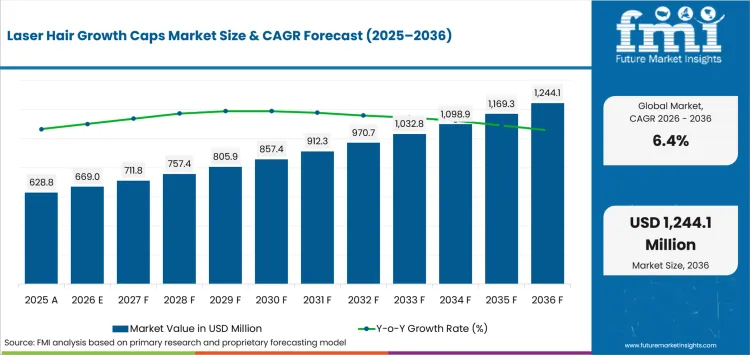
Key Takeaways of Laser Hair Growth Caps Market
- Based on device type, advanced multi-mode devices are projected to account for 40.0% in 2026 due to mixed-light architectures that distinguish head-worn treatment designs.
- In 2026, at-home use is expected to lead use setting with 57.0% share because self-administered routines eliminate travel for repeated treatment.
- The rechargeable cordless segment is likely to capture 54.0% share in 2026 attributable to portable power that removes fixed-location treatment constraints.
- Adoption is constrained by premium pricing and sustained-use requirements as hair-growth claims stay within documented indications.
- Some of the key players in this market include Shenzhen Kaiyan Medical Equipment Co., Ltd., Hubei YJT Technology Co., Ltd., Zdeer Technology (Henan) Co., Ltd., Light Tree Ventures Europe B.V., Cosmo Far East Technology Limited, Shenzhen Idea Light Limited, Dongguan Boyuan Intelligent Technology Co., Ltd., and Shenzhen Chuanghong Zhilian Technology Co., Ltd.
Analyst Perspective
"Cap comparisons should begin with cleared indications and treatment schedules before purchasers compare diode counts or retail price. Commercial value rises when photobiomodulation evidence supports a charging routine consumers can maintain for months."
- Rahul Pandita, Principal Consultant, Future Market Insights
How is the Laser Hair Growth Caps Market segmented?
The laser hair growth caps market is segmented by device type, use setting, power source, price band, sales channel and region.
Device types include advanced multi-mode devices, entry consumer devices and professional-grade devices. Use settings cover at-home, professional and clinic, and hybrid prosumer use. Power sources include rechargeable cordless, corded and battery formats. Price bands cover below USD 100, USD 100-300 and above USD 300. Sales channels include e-commerce and DTC, specialty beauty and electronics, professional distribution and department stores. Region follows seven geographic groupings.
Why do advanced multi-mode devices lead the device type category?
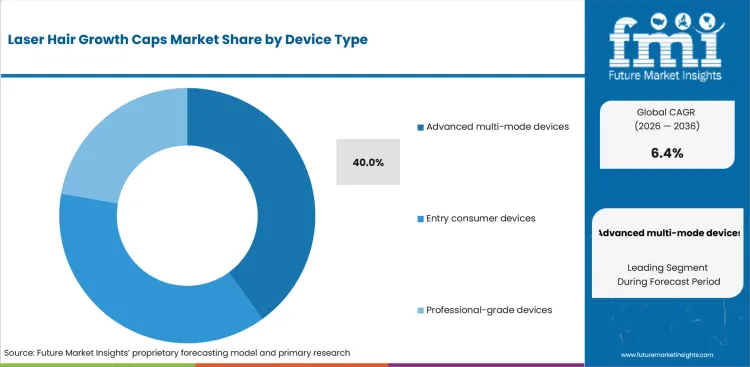
Advanced multi-mode devices appeal to consumers seeking broader light architecture inside one wearable format and carry the instruction burden expected from wearable medical devices used at home. In January 2026 FDA clearance K253669 documented Shenzhen Kaiyan devices using LED-only and combined LED-laser configurations within head-mounted systems, giving mixed-light design a current regulatory example.
- By device type, advanced multi-mode devices are estimated to hold 40.0% in 2026 owing to integrated light options that separate head-worn offers by treatment architecture.
- Premium multi-mode positioning remains credible if protocols and indications justify extra hardware without treating higher emitter counts as proof of better outcomes for purchasers.
Why does at-home use lead the use setting category?
At-home use fits a category that depends on repeated sessions over several months instead of isolated procedures. At-home beauty devices have also trained consumers to expect direct instructions and convenient recurring use for pattern hair loss treatment.
- By use setting, at-home use is forecast to represent 57.0% in 2026 driven by self-administration that removes travel from each scheduled treatment session.
- Portable formats shift the operating burden toward consistent adherence during treatment periods lasting several months. In April 2025 the FDA cleared Dongguan Boyuan Intelligent Technology Co. Ltd.'s portable OTC hair-growth device family with full-scalp laser coverage.
Why do rechargeable cordless products lead the power source category?
Rechargeable cordless designs let users complete scheduled treatment away from a wall outlet and make session planning easier across repeated home routines. In December 2025 FDA clearance K253349 documented Light Tree Ventures Europe B.V.'s rechargeable LED cap and ten-minute daily protocol, linking hair loss prevention hardware to a defined portable treatment schedule.
- Rechargeable cordless products are set to lead the power source category with 54.0% share in 2026 due to portable power that reduces location constraints during repeated treatment.
- Battery design earns commercial preference if charge visibility and stored power remain predictable across the prescribed treatment routine.
Why does e-commerce and DTC lead the sales channel category?
E-commerce suits a private purchase that requires comparison of indications and treatment time ahead of checkout. Professional hair care channels remain useful for consultation but digital selling gives caps a direct specification-led route for a high-consideration medical purchase today.
- The e-commerce and DTC segment is projected to hold 38.0% share in 2026 owing to discreet delivery and detailed specification review during purchase.
- Online channels perform best with evidence and service terms visible during detailed specification-led comparison today. In August 2026 the Ministry of Data and Statistics reported that mobile generated 76.9% of June 2026 online-shopping transaction value.
What are the drivers, restraints and opportunities in the Laser Hair Growth Caps Market?
Home-use routines support demand, evidence and adherence limit conversion, and broader model ranges give manufacturers room for differentiated head-worn offers.
- Driver: Wearable OTC devices reduce the access burden associated with repeated scalp-light treatment schedules at home.
- Restraint: Defined indications and sustained treatment requirements narrow the credible claim set and raise abandonment risk.
- Opportunity: Broader model families let manufacturers separate offers by coverage and routine without leaving the head-worn format.
Home Treatment Moves Access Into the Purchase Decision
Home treatment changes access by removing the need for a clinic appointment for every exposure in the prescribed schedule. In June 2025 the FDA cleared Shenzhen Idea Light Limited's OTC Red Light Hair Growth Cap with selectable ten-to-thirty-minute treatment timing. The lower visit burden matters commercially if instructions make the routine clear enough for sustained use across alopecia treatment options.
Defined Indications Keep Claims Narrow
Hair-growth caps rely on outcomes that users cannot judge immediately so indication wording and treatment duration shape purchase confidence. In October 2025 the FDA cleared Shenzhen Kaiyan Medical Equipment Co. Ltd.'s Q-Renew LLLT Hair Growth Helmet under the hair-laser device classification. Regulatory clearance narrows the permitted claim route but does not remove adherence risk or price comparison across dermatology devices and other hair-loss treatments.
Broader Model Families Support Portfolio Segmentation
Manufacturers can widen their offer by varying head-worn configurations and remaining inside the qualifying cap and helmet revenue boundary. In June 2026 the FDA cleared nine Zdeer Technology (Henan) Co. Ltd. Laser Hair Growth Device models under one submission. A broader cleared family supports more hardware positions across coverage and price tiers without forcing distributors to rely on adjacent aesthetic devices for range expansion.
Which country CAGRs are profiled in the Laser Hair Growth Caps Market?
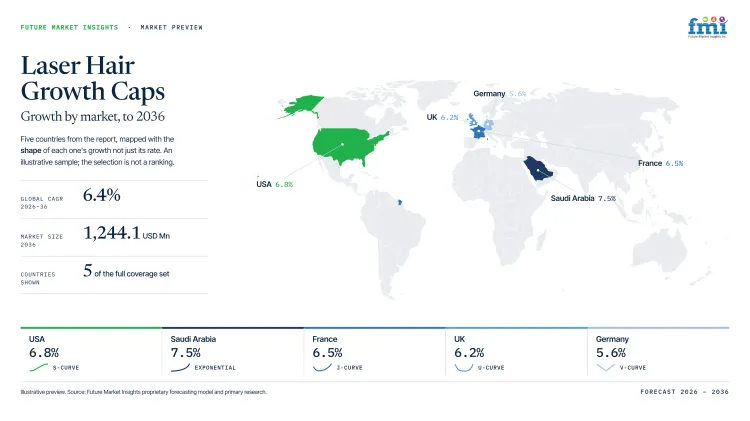
| Country | CAGR |
|---|---|
| UAE | 7.8% |
| Saudi Arabia | 7.5% |
| South Korea | 7.1% |
| USA | 6.8% |
| France | 6.5% |
How do country-level CAGRs compare in the Laser Hair Growth Caps Market?
The CAGR spread is 1.3 percentage points from 7.8% in the UAE to 6.5% in France. The UAE and Saudi Arabia form the higher-growth Gulf group and South Korea and the USA occupy the next band. France remains commercially close despite different regulatory and channel conditions across premium device purchasing routes.
- UAE entry centers on Emirates Drug Establishment registration plus premium digital retail.
- Saudi Arabia pairs high online purchasing with Arabic merchandising and medical-device support.
- South Korea favors mobile-first comparison but dense beauty-device choice raises attention costs.
- USA purchasers use FDA clearance records to distinguish therapeutic from beauty claims.
- France has broad e-commerce participation alongside EU conformity and French-language documentation requirements.
Similar CAGRs can conceal different revenue bases and entry costs across these five markets today. The full report provides country-level CAGR analysis across North America, Latin America, Europe, East Asia, South Asia, Oceania and the Middle East and Africa.
Country-wise Analysis
- UAE distributors route therapeutic device registrations through the Emirates Drug Establishment as premium hair-growth products reach consumers through digital channels across the Gulf. In December 2025 the Ministry of Health and Prevention transferred medical equipment registration and related services to the Emirates Drug Establishment, which gives manufacturers a defined federal approval counterparty but does not replace Arabic claims support or regional warranty coverage. Laser hair growth cap demand in the UAE is forecast to rise at 7.8% CAGR over the forecast period supported by premium online purchasing, but weak local service can undermine confidence during treatment routines that continue for several months.
- Saudi consumers already buy personal-care products online and premium home devices can reach them without depending entirely on specialist retail or clinic channels. Saudi Arabia is estimated to post 7.5% CAGR over the forecast period supported by Arabic merchandising and established online purchasing, although medical claims still require local regulatory support and treatment education must justify a high-priced cap at checkout. In January 2026 the General Authority for Statistics reported that 80.2% of Saudi individuals aged 15 to 74 purchased goods or services online, giving manufacturers a broad digital route with Arabic service and dependable local warranty handling.
- Mobile commerce places treatment claims and hardware specifications beside familiar beauty devices during rapid comparisons across South Korean shopping platforms. In August 2026 the Ministry of Data and Statistics reported June online-shopping transactions of 24.6067 trillion won, confirming a mature digital channel even though fast checkout does not ensure months of treatment adherence in a crowded beauty-device field. Adoption of laser hair growth caps in South Korea is estimated to expand at 7.1% CAGR through 2036 supported by mobile-first discovery, so manufacturers need localized onboarding and responsive local service that keep users engaged following the initial digital purchase.
- USA purchasers can check FDA 510(k) records during evaluation of a therapeutic hair-growth cap as medications and clinic procedures remain familiar alternatives at the same decision point. The USA laser hair growth caps sector is projected to record 6.8% CAGR during the assessment period supported by direct-to-consumer channels and medical-device review, but premium pricing raises the evidence threshold and makes indication limits commercially important at checkout. In February 2025 the American Academy of Dermatology reported that androgenetic alopecia affects an estimated 80 million Americans, giving manufacturers a large addressable population if treatment schedules and expected outcomes remain clear.
- French consumers can compare hair-growth electronics online and therapeutic claims remain tied to EU medical-device obligations plus French-language documentation during listing and after-sales support. In October 2025 INSEE reported that 63% of people aged 15 or older had purchased products or services online during the prior three months in 2024, giving manufacturers broad digital reach without removing the need for clear instructions and dependable returns handling. Laser hair growth cap sales in France are forecast to expand at 6.5% CAGR by 2036 supported by digital discovery, but localized evidence and service remain necessary to separate a therapeutic proposition from familiar beauty electronics.
Who are the notable companies in the Laser Hair Growth Caps Market?
Shenzhen Kaiyan Medical Equipment Co., Ltd., Hubei YJT Technology Co., Ltd., Zdeer Technology (Henan) Co., Ltd., Light Tree Ventures Europe B.V., Cosmo Far East Technology Limited, Shenzhen Idea Light Limited, Dongguan Boyuan Intelligent Technology Co., Ltd., and Shenzhen Chuanghong Zhilian Technology Co., Ltd. are the notable companies profiled in this market.
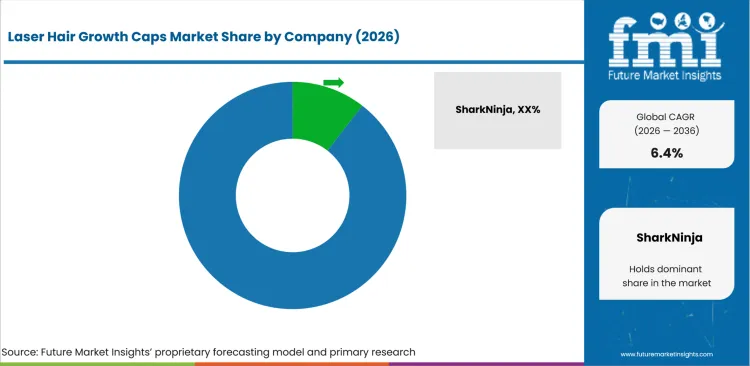
Current FDA records show a fragmented Chinese-European manufacturer field, where qualifying head-worn clearance separates revenue from adjacent hair care products.
- Shenzhen Kaiyan, Hubei YJT, Zdeer Technology and Light Tree Ventures Europe hold the broadest current clearance or FDA record depth.
- Cosmo Far East, Shenzhen Idea Light, Dongguan Boyuan and Shenzhen Chuanghong cover narrower cap families or recent single-decision activity.
Competitive Benchmarking: Laser Hair Growth Caps Market
| Company | Recent Clearance | Latest Models | FDA Records | Geographic Reach |
|---|---|---|---|---|
| Shenzhen Kaiyan Medical Equipment Co., Ltd. | High | Medium | High | China / USA |
| Hubei YJT Technology Co., Ltd. | Medium | High | High | China / USA |
| Zdeer Technology (Henan) Co., Ltd. | Medium | High | Low | China / USA |
| Light Tree Ventures Europe B.V. | Low | Low | High | Netherlands / USA |
| Cosmo Far East Technology Limited | Low | Low | Low | China / USA |
| Shenzhen Idea Light Limited | Low | Low | Low | China / USA |
| Dongguan Boyuan Intelligent Technology Co., Ltd. | Low | High | Low | China / USA |
| Shenzhen Chuanghong Zhilian Technology Co., Ltd. | Medium | Medium | Low | China / USA |
Key Developments in the Laser Hair Growth Caps Market
- In July 2026, Shenzhen Chuanghong Zhilian Technology Co., Ltd. received FDA substantial-equivalence clearance under K261675 for three CHZL Red Light Therapy Hair Growth Cap models.
- In June 2026, Hubei YJT Technology Co., Ltd. received FDA substantial-equivalence clearance under K253231 for Laser Cap 128 plus four Laser Helmet models.
- In October 2025, Cosmo Far East Technology Limited received FDA substantial-equivalence clearance under K252325 for its Hair Growth Laser Cap.
Key Players in the Laser Hair Growth Caps Market
Multi-Record Device Developers
- Shenzhen Kaiyan Medical Equipment Co., Ltd.
- Hubei YJT Technology Co., Ltd.
- Zdeer Technology (Henan) Co., Ltd.
Current Cap Manufacturers
- Light Tree Ventures Europe B.V.
- Cosmo Far East Technology Limited
- Shenzhen Idea Light Limited
Large-Model and Red-Light Cap Manufacturers
- Dongguan Boyuan Intelligent Technology Co., Ltd.
- Shenzhen Chuanghong Zhilian Technology Co., Ltd.
Laser Hair Growth Caps Market - Report Scope
| Coverage field | Report scope |
|---|---|
| Market breakdown | By device type, use setting, power source, price band, sales channel and region. |
| Quantitative Units | Revenue in USD million and CAGR in %. |
| Market Definition | Revenue from qualifying wearable cap or helmet devices sold for laser, LED or combined-light scalp hair-growth treatment. Excludes clinic service revenue, handheld scalp devices, hair-care appliances, topical or oral treatments and transplant procedures. |
| Regions Covered | North America, Latin America, Europe, East Asia, South Asia and Pacific, and Middle East and Africa. |
| Countries Covered | UAE, Saudi Arabia, South Korea, USA, France, and 20+ countries included in the full report. |
| Key Companies Profiled | Shenzhen Kaiyan Medical Equipment Co., Ltd., Hubei YJT Technology Co., Ltd., Zdeer Technology (Henan) Co., Ltd., Light Tree Ventures Europe B.V., Cosmo Far East Technology Limited, Shenzhen Idea Light Limited, Dongguan Boyuan Intelligent Technology Co., Ltd., Shenzhen Chuanghong Zhilian Technology Co., Ltd. |
| Forecast Period | 2026 to 2036. |
| Approach | Primary and secondary research with market triangulation. |
Laser Hair Growth Caps Market - Research Methodology
| Method | Approach |
|---|---|
| Primary Research | FMI analysts gathered input from manufacturers, service providers, technology developers, distributors, end users, procurement teams, and subject-matter experts. Interviews examined purchasing decisions, product or service evaluation, adoption barriers, approval requirements, pricing considerations, and expectations for technical or commercial support. Respondents were also asked what evidence is required before a trial, pilot, or initial order develops into regular purchasing. |
| Desk Research | Desk research covered government statistics, regulatory publications, trade data, industry associations, technical literature, standards, company filings, product information, and official corporate announcements. Sources were reviewed for relevance, publication date, geographic coverage, and consistency with the defined market scope. Claims relating to performance, applications, approvals, capacity, investment, and commercial activity were retained only when supported by credible public evidence. |
| Market Sizing and Forecasting | The market model combined the baseline value with historical performance, segment structure, pricing and volume indicators, adoption levels, company participation, and country-level demand conditions. Forecast assumptions considered economic activity, investment trends, regulatory developments, technology adoption, purchasing cycles, supply availability, and barriers to wider market use. Segment and regional estimates were reconciled before the final market total was calculated. |
| Data Validation | Estimates were checked against multiple independent indicators, including public data, company activity, trade patterns, industry developments, and findings from primary interviews. Validation also tested whether products, services, applications, and company revenues fell within the defined market boundaries. Adjacent categories, unsupported claims, overlapping revenues, and activities without direct market relevance were excluded to reduce double counting and maintain consistency across segments and countries. |
Laser Hair Growth Caps Market by Segments
Laser Hair Growth Caps Market segmented by Device Type:
- Advanced multi-mode devices
- Entry consumer devices
- Professional-grade devices
Laser Hair Growth Caps Market segmented by Use Setting:
- At-home
- Professional & clinic
- Hybrid prosumer
Laser Hair Growth Caps Market segmented by Power Source:
- Rechargeable cordless
- Corded
- Battery
Laser Hair Growth Caps Market segmented by Price Band:
- Entry (below USD 100)
- Mid (USD 100-300)
- Premium (above USD 300)
Laser Hair Growth Caps Market segmented by Sales Channel:
- E-commerce & DTC
- Specialty beauty & electronics
- Professional distribution
- Department stores
Laser Hair Growth Caps Market by Region:
- North America
- United States
- Canada
- Latin America
- Brazil
- Mexico
- Chile
- Rest of Latin America
- Western Europe
- Germany
- United Kingdom
- Italy
- Spain
- France
- Nordics
- Benelux
- Rest of Western Europe
- Eastern Europe
- Russia
- Poland
- Hungary
- Balkan and Baltic States
- Rest of Eastern Europe
- East Asia
- China
- Japan
- South Korea
- South Asia and Pacific
- India
- ASEAN
- Australia and New Zealand
- Rest of South Asia and Pacific
- Middle East and Africa
- Kingdom of Saudi Arabia
- Other GCC Countries
- Türkiye
- South Africa
- Other African Union Countries
- Rest of Middle East and Africa
Research Sources and Bibliography
- USA Food and Drug Administration. (2025, June 17). 510(k) Premarket Notification K251017: CurrentBody Skin Dual Light Hair Growth Helmet.
- USA Food and Drug Administration. (2026, January 23). 510(k) K253669: Trudermal Halo Hair Growth System and Aduro Hair Growth.
- USA Food and Drug Administration. (2025, April 29). 510(k) Premarket Notification K250308: Hair Growth Device.
- USA Food and Drug Administration. (2025, December 24). 510(k) Premarket Notification K253349: Hair Regrowth Cap.
- Ministry of Data and Statistics, Republic of Korea. (2025, October 1). Online Shopping in August 2025.
- USA Food and Drug Administration. (2025, June 5). 510(k) K250467: Red Light Hair Growth Cap.
- USA Food and Drug Administration. (2025, October 30). 510(k) K252414: Q-Renew LLLT Hair Growth Helmet.
- USA Food and Drug Administration. (2026, June 16). 510(k) K260899: Laser Hair Growth Device.
- USA Census Bureau. (2026, May 18). Quarterly Retail E-Commerce Sales Report, First Quarter 2026.
- Ministry of Health and Prevention, United Arab Emirates. (2025, December 30). MOHAP Announces the Transfer of Selected Services to Emirates Drug Establishment.
- General Authority for Statistics, Saudi Arabia. (2026, January 5). ICT Access and Usage Statistics by Households and Individuals 2025.
- Ministry of Data and Statistics, Republic of Korea. (2026, August 3). Online Shopping in June 2026.
- American Academy of Dermatology. (2025, February 11). Skin conditions by the numbers.
- INSEE. (2025, October 14). Achats de produits et de services en ligne.
- USA Food and Drug Administration. (2026, July 17). 510(k) K261675: CHZL Red Light Therapy Hair Growth Cap.
- USA Food and Drug Administration. (2026, June 16). 510(k) K253231: Laser Hair Growth System.
- USA Food and Drug Administration. (2025, October 22). 510(k) K252325: Hair Growth Laser Cap.
- HairMax. (2025, September 10). HairMax launches Lumina 272: Next-generation cordless laser hair growth helmet.
- Capillus. (2025, October 3). Capillus Spectrum: Flagship FDA-cleared dual-wavelength laser cap.
- USA Food and Drug Administration. (2018, January 9). 510(k) Premarket Notification K171775: Theradome LH80 PRO.
- USA Food and Drug Administration. (2019, May 17). 510(k) Premarket Notification K183417: iRestore Professional 282.
- USA Food and Drug Administration. (2026, June 26). 510(k) Premarket Notification K261253: Laser Hair Growth Devices.
- HairMax. (2026, July 14). HairMax now available at Ulta Beauty.
- The Beauty Tech Group plc. (2026, April 16). Final results for the year ended 31 December 2025.
- USA Food and Drug Administration. (2026, August 17). Total Product Life Cycle: Laser, comb, hair (OAP).
This bibliography is provided for reader reference and is not exhaustive. The full report contains the complete reference list and detailed citations.
This Report Answers
- How large is the market in 2026 and 2036?
- What supports repeated at-home photobiomodulation purchases?
- Why do advanced multi-mode devices lead device type?
- How does at-home use affect adherence and channel demand?
- Why do rechargeable cordless products lead power source?
- How do growth rates differ across profiled countries?
- Which companies have current FDA evidence for head-worn devices?
- What limits conversion during sustained treatment?
- What should distributors evaluate before listing a hair-growth cap?
Frequently Asked Questions
How big is the Laser Hair Growth Caps Market in 2026?
The laser hair growth caps market is expected to reach USD 669.0 million in 2026. Repeated home treatment and regulatory clarity support expansion toward USD 1,244.1 million by 2036.
What is the CAGR of the Laser Hair Growth Caps Market from 2026 to 2036?
The laser hair growth caps market is projected to grow at 6.4% CAGR between 2026 and 2036. Growth reflects wider home use and continued differentiation in treatment architecture plus daily convenience for consumers.
Which device type leads the Laser Hair Growth Caps Market?
The advanced multi-mode devices segment is expected to hold 40.0% of the laser hair growth caps market in 2026, driven by mixed-light differentiation. Integrated architectures separate head-worn offers from handheld devices and clinic systems during repeated home treatment routines.
How much value is the Laser Hair Growth Caps Market expected to add between 2026 and 2036?
The laser hair growth caps market is expected to add USD 575.1 million from 2026 to 2036. That increase equals the difference between USD 669.0 million and USD 1,244.1 million across the forecast.
Which companies are active in the Laser Hair Growth Caps Market?
Companies in the laser hair growth caps market include Shenzhen Kaiyan, Hubei YJT, Zdeer Technology, Light Tree Ventures Europe, Cosmo Far East, Shenzhen Idea Light, Dongguan Boyuan and Shenzhen Chuanghong. FDA records document qualifying head-worn devices across this company group and its recent clearance activity.
Preview the report firsthand - request a free sample
Get SampleGet the brochure for pricing and purchase details.
Get PDFTable of Content
- Key Takeaways
- Market Size and CAGR
- Top Growth Driver
- Fastest Growing Segment
- Leading Region
- Key Companies
- Emerging Opportunities
- Executive Summary
- Global Market Outlook
- Demand-side Trends
- Supply-side Trends
- Technology Roadmap Analysis
- Analysis and Recommendations
- Analyst Perspective (What is happening? Why now? What should investors know?)
- Key Questions Answered
- How large is the market?
- What is the CAGR?
- What are key trends?
- Which region dominates?
- Who are the leaders?
- Market Overview
- Market Coverage / Taxonomy
- Market Definition / Scope / Limitations
- Research Methodology
- Chapter Orientation
- Analytical Lens and Working Hypotheses
- Market Structure, Signals, and Trend Drivers
- Benchmarking and Cross-market Comparability
- Market Sizing, Forecasting, and Opportunity Mapping
- Research Design and Evidence Framework
- Desk Research Programme (Secondary Evidence)
- Expert Input and Fieldwork (Primary Evidence)
- Tooling, Models, and Reference Databases
- Data Engineering and Model Build
- Quality Assurance and Audit Trail
- Market Background
- Market Dynamics (Drivers, Restraints, Opportunity, Trends)
- Scenario Forecast (Optimistic, Likely, Conservative)
- Impact Analysis
- AI Impact
- Sustainability Impact
- Regulatory Impact
- Technology Impact
- Consumer / Buyer Analysis
- Purchase Drivers
- Adoption Barriers
- Buyer Journey
- Opportunity Map Analysis
- Product Life Cycle Analysis
- Supply Chain Analysis
- Investment Feasibility Matrix
- Value Chain Analysis
- PESTLE and Porter's Analysis
- Regulatory Landscape
- Regional Parent Market Outlook
- Production and Consumption Statistics
- Import and Export Statistics
- Global Market Analysis and Forecast, 2021 to 2036
- Historical Market Size Value (USD Million) Analysis, 2021 to 2025
- Current and Future Market Size Value (USD Million) Projections, 2026 to 2036
- Y-o-Y Growth Trend Analysis
- Absolute $ Opportunity Analysis
- Global Market Pricing Analysis, 2021 to 2036
- Global Market Analysis and Forecast, By Device Type, 2021 to 2036
- Introduction / Key Findings
- Historical Market Size Value (USD Million) Analysis By Device Type, 2021 to 2025
- Current and Future Market Size Value (USD Million) Analysis and Forecast By Device Type, 2026 to 2036
- Advanced multi-mode devices
- Entry consumer devices
- Professional-grade devices
- Advanced multi-mode devices
- Y-o-Y Growth Trend Analysis By Device Type, 2021 to 2025
- Absolute $ Opportunity Analysis By Device Type, 2026 to 2036
- Global Market Analysis and Forecast, By Use Setting, 2021 to 2036
- Introduction / Key Findings
- Historical Market Size Value (USD Million) Analysis By Use Setting, 2021 to 2025
- Current and Future Market Size Value (USD Million) Analysis and Forecast By Use Setting, 2026 to 2036
- At-home
- Professional & clinic
- Hybrid prosumer
- At-home
- Y-o-Y Growth Trend Analysis By Use Setting, 2021 to 2025
- Absolute $ Opportunity Analysis By Use Setting, 2026 to 2036
- Global Market Analysis and Forecast, By Power Source, 2021 to 2036
- Introduction / Key Findings
- Historical Market Size Value (USD Million) Analysis By Power Source, 2021 to 2025
- Current and Future Market Size Value (USD Million) Analysis and Forecast By Power Source, 2026 to 2036
- Rechargeable cordless
- Corded
- Battery
- Rechargeable cordless
- Y-o-Y Growth Trend Analysis By Power Source, 2021 to 2025
- Absolute $ Opportunity Analysis By Power Source, 2026 to 2036
- Global Market Analysis and Forecast, By Price Band, 2021 to 2036
- Introduction / Key Findings
- Historical Market Size Value (USD Million) Analysis By Price Band, 2021 to 2025
- Current and Future Market Size Value (USD Million) Analysis and Forecast By Price Band, 2026 to 2036
- Entry (below USD 100)
- Mid (USD 100-300)
- Premium (above USD 300)
- Entry (below USD 100)
- Y-o-Y Growth Trend Analysis By Price Band, 2021 to 2025
- Absolute $ Opportunity Analysis By Price Band, 2026 to 2036
- Global Market Analysis and Forecast, By Sales Channel, 2021 to 2036
- Introduction / Key Findings
- Historical Market Size Value (USD Million) Analysis By Sales Channel, 2021 to 2025
- Current and Future Market Size Value (USD Million) Analysis and Forecast By Sales Channel, 2026 to 2036
- E-commerce & DTC
- Specialty beauty & electronics
- Professional distribution
- Department stores
- E-commerce & DTC
- Y-o-Y Growth Trend Analysis By Sales Channel, 2021 to 2025
- Absolute $ Opportunity Analysis By Sales Channel, 2026 to 2036
- Global Market Analysis and Forecast, By Region, 2021 to 2036
- Introduction
- Historical Market Size Value (USD Million) Analysis By Region, 2021 to 2025
- Current Market Size Value (USD Million) Analysis and Forecast By Region, 2026 to 2036
- North America
- Latin America
- Western Europe
- Eastern Europe
- East Asia
- South Asia and Pacific
- Middle East & Africa
- Market Attractiveness Analysis By Region
- North America Market Analysis and Forecast, By Country, 2021 to 2036
- Historical Market Size Value (USD Million) Trend Analysis By Market Taxonomy, 2021 to 2025
- Market Size Value (USD Million) Forecast By Market Taxonomy, 2026 to 2036
- By Country
- USA
- Canada
- By Device Type
- By Use Setting
- By Power Source
- By Price Band
- By Sales Channel
- By Country
- Market Attractiveness Analysis
- By Country
- By Device Type
- By Use Setting
- By Power Source
- By Price Band
- By Sales Channel
- Key Takeaways
- Latin America Market Analysis and Forecast, By Country
- Historical Market Size Value (USD Million) Trend Analysis By Market Taxonomy, 2021 to 2025
- Market Size Value (USD Million) Forecast By Market Taxonomy, 2026 to 2036
- By Country
- Brazil
- Mexico
- Chile
- Rest of Latin America
- By Device Type
- By Use Setting
- By Power Source
- By Price Band
- By Sales Channel
- By Country
- Market Attractiveness Analysis
- By Country
- By Device Type
- By Use Setting
- By Power Source
- By Price Band
- By Sales Channel
- Key Takeaways
- Western Europe Market Analysis and Forecast, By Country
- Historical Market Size Value (USD Million) Trend Analysis By Market Taxonomy, 2021 to 2025
- Market Size Value (USD Million) Forecast By Market Taxonomy, 2026 to 2036
- By Country
- Germany
- UK
- Italy
- Spain
- France
- Nordic
- BENELUX
- Rest of Western Europe
- By Device Type
- By Use Setting
- By Power Source
- By Price Band
- By Sales Channel
- By Country
- Market Attractiveness Analysis
- By Country
- By Device Type
- By Use Setting
- By Power Source
- By Price Band
- By Sales Channel
- Key Takeaways
- Eastern Europe Market Analysis and Forecast, By Country
- Historical Market Size Value (USD Million) Trend Analysis By Market Taxonomy, 2021 to 2025
- Market Size Value (USD Million) Forecast By Market Taxonomy, 2026 to 2036
- By Country
- Russia
- Poland
- Hungary
- Balkan & Baltic
- Rest of Eastern Europe
- By Device Type
- By Use Setting
- By Power Source
- By Price Band
- By Sales Channel
- By Country
- Market Attractiveness Analysis
- By Country
- By Device Type
- By Use Setting
- By Power Source
- By Price Band
- By Sales Channel
- Key Takeaways
- East Asia Market Analysis and Forecast, By Country
- Historical Market Size Value (USD Million) Trend Analysis By Market Taxonomy, 2021 to 2025
- Market Size Value (USD Million) Forecast By Market Taxonomy, 2026 to 2036
- By Country
- China
- Japan
- South Korea
- By Device Type
- By Use Setting
- By Power Source
- By Price Band
- By Sales Channel
- By Country
- Market Attractiveness Analysis
- By Country
- By Device Type
- By Use Setting
- By Power Source
- By Price Band
- By Sales Channel
- Key Takeaways
- South Asia and Pacific Market Analysis and Forecast, By Country
- Historical Market Size Value (USD Million) Trend Analysis By Market Taxonomy, 2021 to 2025
- Market Size Value (USD Million) Forecast By Market Taxonomy, 2026 to 2036
- By Country
- India
- ASEAN
- Australia & New Zealand
- Rest of South Asia and Pacific
- By Device Type
- By Use Setting
- By Power Source
- By Price Band
- By Sales Channel
- By Country
- Market Attractiveness Analysis
- By Country
- By Device Type
- By Use Setting
- By Power Source
- By Price Band
- By Sales Channel
- Key Takeaways
- Middle East & Africa Market Analysis and Forecast, By Country
- Historical Market Size Value (USD Million) Trend Analysis By Market Taxonomy, 2021 to 2025
- Market Size Value (USD Million) Forecast By Market Taxonomy, 2026 to 2036
- By Country
- Kingdom of Saudi Arabia
- Other GCC Countries
- Türkiye
- South Africa
- Other African Union
- Rest of Middle East & Africa
- By Device Type
- By Use Setting
- By Power Source
- By Price Band
- By Sales Channel
- By Country
- Market Attractiveness Analysis
- By Country
- By Device Type
- By Use Setting
- By Power Source
- By Price Band
- By Sales Channel
- Key Takeaways
- Key Countries Market Analysis
- USA
- Pricing Analysis
- Market Share Analysis, 2025
- By Device Type
- By Use Setting
- By Power Source
- By Price Band
- By Sales Channel
- Canada
- Pricing Analysis
- Market Share Analysis, 2025
- By Device Type
- By Use Setting
- By Power Source
- By Price Band
- By Sales Channel
- Mexico
- Pricing Analysis
- Market Share Analysis, 2025
- By Device Type
- By Use Setting
- By Power Source
- By Price Band
- By Sales Channel
- Brazil
- Pricing Analysis
- Market Share Analysis, 2025
- By Device Type
- By Use Setting
- By Power Source
- By Price Band
- By Sales Channel
- Chile
- Pricing Analysis
- Market Share Analysis, 2025
- By Device Type
- By Use Setting
- By Power Source
- By Price Band
- By Sales Channel
- Germany
- Pricing Analysis
- Market Share Analysis, 2025
- By Device Type
- By Use Setting
- By Power Source
- By Price Band
- By Sales Channel
- UK
- Pricing Analysis
- Market Share Analysis, 2025
- By Device Type
- By Use Setting
- By Power Source
- By Price Band
- By Sales Channel
- Italy
- Pricing Analysis
- Market Share Analysis, 2025
- By Device Type
- By Use Setting
- By Power Source
- By Price Band
- By Sales Channel
- Spain
- Pricing Analysis
- Market Share Analysis, 2025
- By Device Type
- By Use Setting
- By Power Source
- By Price Band
- By Sales Channel
- France
- Pricing Analysis
- Market Share Analysis, 2025
- By Device Type
- By Use Setting
- By Power Source
- By Price Band
- By Sales Channel
- India
- Pricing Analysis
- Market Share Analysis, 2025
- By Device Type
- By Use Setting
- By Power Source
- By Price Band
- By Sales Channel
- ASEAN
- Pricing Analysis
- Market Share Analysis, 2025
- By Device Type
- By Use Setting
- By Power Source
- By Price Band
- By Sales Channel
- Australia & New Zealand
- Pricing Analysis
- Market Share Analysis, 2025
- By Device Type
- By Use Setting
- By Power Source
- By Price Band
- By Sales Channel
- China
- Pricing Analysis
- Market Share Analysis, 2025
- By Device Type
- By Use Setting
- By Power Source
- By Price Band
- By Sales Channel
- Japan
- Pricing Analysis
- Market Share Analysis, 2025
- By Device Type
- By Use Setting
- By Power Source
- By Price Band
- By Sales Channel
- South Korea
- Pricing Analysis
- Market Share Analysis, 2025
- By Device Type
- By Use Setting
- By Power Source
- By Price Band
- By Sales Channel
- Russia
- Pricing Analysis
- Market Share Analysis, 2025
- By Device Type
- By Use Setting
- By Power Source
- By Price Band
- By Sales Channel
- Poland
- Pricing Analysis
- Market Share Analysis, 2025
- By Device Type
- By Use Setting
- By Power Source
- By Price Band
- By Sales Channel
- Hungary
- Pricing Analysis
- Market Share Analysis, 2025
- By Device Type
- By Use Setting
- By Power Source
- By Price Band
- By Sales Channel
- Kingdom of Saudi Arabia
- Pricing Analysis
- Market Share Analysis, 2025
- By Device Type
- By Use Setting
- By Power Source
- By Price Band
- By Sales Channel
- Türkiye
- Pricing Analysis
- Market Share Analysis, 2025
- By Device Type
- By Use Setting
- By Power Source
- By Price Band
- By Sales Channel
- South Africa
- Pricing Analysis
- Market Share Analysis, 2025
- By Device Type
- By Use Setting
- By Power Source
- By Price Band
- By Sales Channel
- USA
- Market Structure Analysis
- Competition Dashboard
- Competition Benchmarking
- Market Share Analysis of Top Players
- By Regional
- By Device Type
- By Use Setting
- By Power Source
- By Price Band
- By Sales Channel
- Emerging Startups
- Innovation Benchmarking
- Competition Analysis
- Competition Deep Dive
- SharkNinja
- Overview
- Product Portfolio
- Profitability by Market Segments
- Sales Footprint
- Strategy Overview
- Marketing Strategy
- Product Strategy
- Channel Strategy
- Therabody
- Philips
- FOREO
- Panasonic
- Ya-Man
- NuFACE
- Dyson
- Conair
- CurrentBody
- SharkNinja
- Case Studies
- Success Stories
- Recent Developments
- Competition Deep Dive
- Assumptions & Acronyms Used


