

- Market Size (2026)
- USD 1.3 Bn
- Forecast (2036)
- USD 4.1 Bn
- CAGR (2026 to 2036)
- 12.2%
How big is Legal Bill Review Software Market in 2026?
USD 1.3 billion in 2026 and USD 4.1 billion by 2036 at a 12.2% CAGR.
Demand for legal bill review software is projected to expand at 12.2% CAGR between 2026 and 2036, increasing valuation from USD 1.3 billion in 2026 to USD 4.1 billion by 2036. Legal departments are increasingly investing in technology platforms that combine cost control, compliance, and outside counsel management capabilities. Corporate Legal Operations Consortium reported in March 2026 that technology strategy ranked as a priority for 80% of legal operations teams. Financial management reached 72% and outside counsel management reached 62% among respondents in the same findings. Overlapping priorities create a clear budget route for legal technology that connects invoice control with department governance. AI legal services add review complexity across departments without removing the need for traceable payment decisions. Renewal therefore depends on accepted savings and dependable integration rather than a large volume of unexplained flags.
Corporate legal departments assess bill review platforms through reviewer workload and accepted financial outcomes rather than model accuracy alone. Corporate Legal Operations Consortium reported in February 2025 that 83% of legal departments expected higher demand. The same release found that 63% identified workload and resource capacity as their primary operating challenge. Effective legal risk controls require billing rules and reversible decisions that finance teams can audit. Cloud deployment can shorten implementation through workflow platforms that connect invoices with matters and payment systems. Poor coding remains a material friction; software cannot reconstruct context missing from invoice narratives or matter records. Implementation teams also need clear ownership for disputed entries prior to broader automation across sensitive matters and firms.
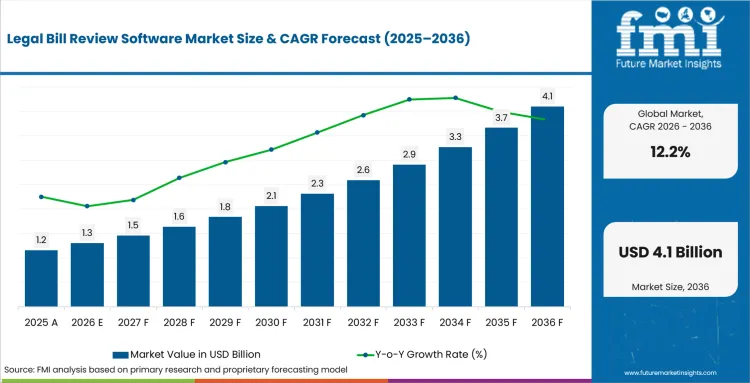
Key Takeaways
- Legal workload and constrained staffing support repeatable invoice checks that reduce manual review across recurring outside counsel portfolios.
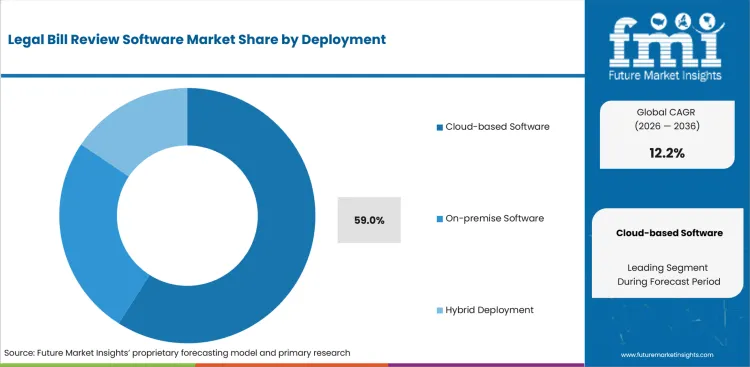
- Cloud-based software is expected to lead deployment with 59.0% share in 2026, supported by centralized configuration across distributed legal departments.
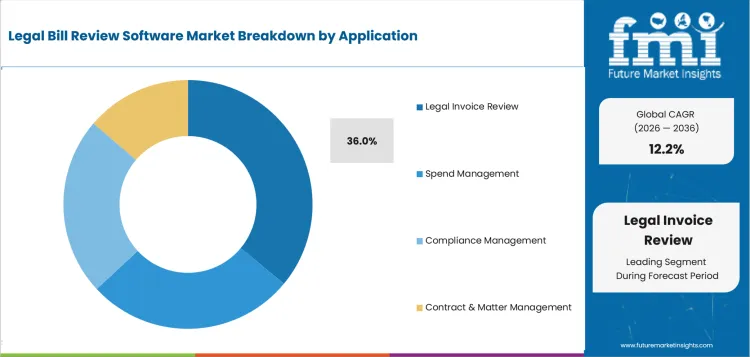
- Legal invoice review is projected to account for 36.0% share in 2026, reflecting its direct connection with billing compliance and payment authorization.
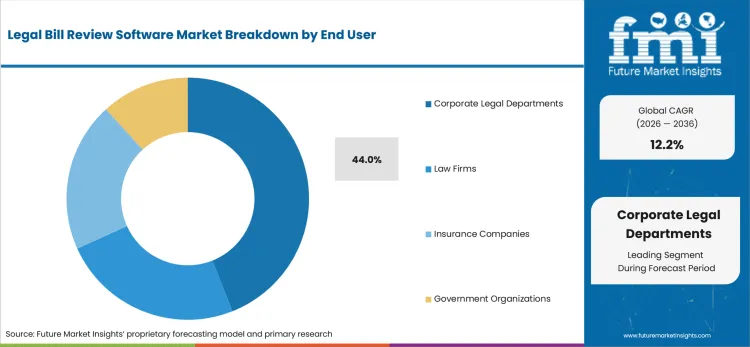
- Corporate legal departments are estimated to capture 44.0% share in 2026, owing to their control over billing guidelines and outside counsel budgets.
- Poor invoice coding and disputed adjustments remain material constraints; weak integration creates duplicate work across legal and finance teams.
- Competition centers on Wolters Kluwer ELM Solutions; Brightflag; Mitratech; Onit; Thomson Reuters; LexisNexis Legal & Professional; LawVu; and PERSUIT, with differentiation based on automated review and spend analytics.
Analyst Perspective
"Legal bill review software earns recurring use through accepted invoice adjustments that shorten review without damaging law-firm relationships. Legal operations leaders need clear billing logic and reversible decisions that finance teams can audit across matter workflows. Platforms need portfolio-level spend insight to support wider deployment across law firms and business units without weakening payment accountability."
- Sudip Saha, Principal Analyst, Future Market Insights
How is the Legal Bill Review Software Market segmented?
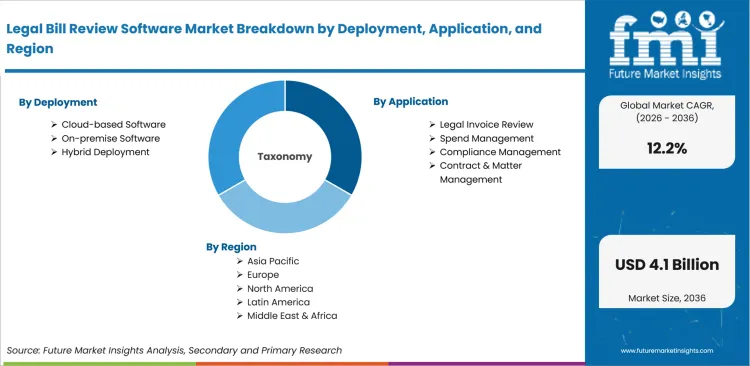
The legal bill review software market is segmented by deployment, application, end user, enterprise size, technology, and region.
Deployment separates cloud-based and on-premise hosting choices, while application identifies the work performed on invoices through review, spend management, compliance, and matter controls. End user distinguishes corporate legal departments, law firms, insurers, and public organizations that follow different billing rules and approval paths. Enterprise size captures invoice volume, operating geography, integration complexity, and the cost of maintaining consistent controls. Technology separates AI-powered analysis from rule-based engines and hybrid review that preserves human judgment for disputed entries. Regional analysis compares invoice standards, data requirements, system connectivity, service coverage, and implementation conditions across countries. The complete framework keeps line-item bill review distinct from broader billing management systems while recognizing the matter records that provide necessary context.
What supports the position of cloud-based software within the deployment category?
Cloud-based software centralizes invoice intake and billing rules across distributed legal departments without maintaining separate local infrastructure. LawVu introduced AI-powered billing guideline review in April 2025 through its integrated legal workspace for in-house teams. The feature compares uploaded guidelines and timekeeper rates with invoices and preserves reviewer control over adjustments and payment decisions. Centralized administration supports consistent configuration across distributed legal departments and reduces duplicated rule maintenance across business units. Production readiness depends on workflow platforms with dependable finance integration and local data controls across each operating jurisdiction.
- Cloud-based software is set to lead the deployment category with 59.0% share in 2026 due to centralized configuration across distributed legal departments. Central administration lets legal operations teams update billing guidelines and reviewer permissions consistently across business units. The position remains dependent on reliable finance integration and data residency controls across each operating jurisdiction.
- Distributed legal teams adopt cloud deployments to compare outside counsel invoices through one governed review process. Implementation teams must map legacy matter codes before automated findings can reach established approval and payment routes. Private cloud and hybrid options remain relevant for organizations that require stricter isolation or customized security controls.
Why does legal invoice review shape the application category?
Legal invoice review turns billing guidelines into repeatable payment decisions for individual line items across outside counsel accounts. The LEDES Oversight Committee authorized XML e-billing version 2.2.2 in April 2026 with 216 data elements across 18 segments. Structured fields improve comparisons across matters and invoice narrative quality continues to affect anomaly analysis and reviewer confidence. The workflow also supports enterprise IP management teams that require auditable adjustments across specialized legal portfolios.
- The application category is forecast to be led by legal invoice review at 36.0% share in 2026 due to its direct position within payment authorization. The application identifies duplicate entries and billing guideline exceptions prior to approved amounts reaching accounts payable workflows. Commercial value depends on net savings after reversals rather than the gross value of every proposed deduction.
- Corporate departments expand invoice review during periods of rate pressure or rising matter volume across outside counsel panels. Teams often begin with high-value firms and widen coverage as adjustment appeals become predictable across recurring billing cycles. Clear dispute records protect firm relationships by preserving consistent reasons for adjustments across different reviewers and matters.
How do corporate legal departments shape demand within the end user category?
Corporate legal departments control the budgets and billing guidelines that determine whether review findings change actual payments. Corporate Legal Operations Consortium launched CLOC Compass in May 2026 to help legal operations teams assess maturity and identify practical improvements. The application turns governance assessment into an operating action plan across financial management and outside counsel functions. Department ownership helps legal AI systems translate established policies into invoice-level controls and documented escalation thresholds.
- In 2026, corporate legal departments are expected to lead the end user category with 44.0% share because they control outside counsel budgets and billing guidelines. In-house teams compare invoice findings with matter budgets and law-firm performance across the same portfolio. The position weakens if finance data cannot be reconciled with legal matter records across business units.
- General counsel offices adopt bill review software to reduce repetitive work across recurring invoices and complex litigation portfolios. Legal operations teams configure billing rules, and attorneys resolve disputed judgments that require matter-specific context. Transparent controls help department leaders defend adjustments during annual budget reviews and complex outside counsel panel negotiations.
What keeps large enterprises ahead within enterprise size?
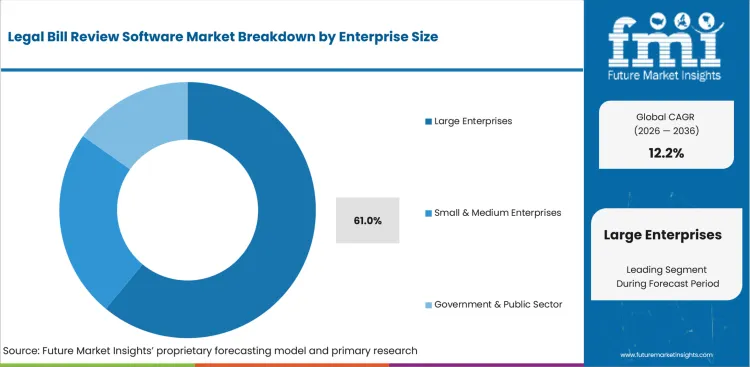
Large enterprises manage invoices across several law firms and business units through different approval routes. Corporate Legal Operations Consortium and Harbor renewed their survey partnership in May 2025 with a focus on large organizations. Most respondent companies represented annual revenue above USD 1 billion and the survey covered legal spending alongside outside counsel management. The operating scale supports robotic process automation for repetitive validation and enterprise integration remains a separate implementation burden.
- Large enterprises are projected to hold 61.0% share in 2026 owing to recurring invoice volume across multiple firms and business units. Central legal operations teams distribute configuration and integration costs across several practice groups and operating jurisdictions. Smaller departments often choose lighter workflows to avoid implementation costs that exceed available review savings.
- Global companies adopt platforms that handle several currencies and local tax rules without fragmenting portfolio reporting. Production use requires dependable integrations with enterprise resource planning systems and identity controls across operating regions. Regional teams also need practical training that explains automated adjustments clearly without transferring established local approval authority or accountability.
Which buying mechanism supports AI-powered bill review within the technology category?
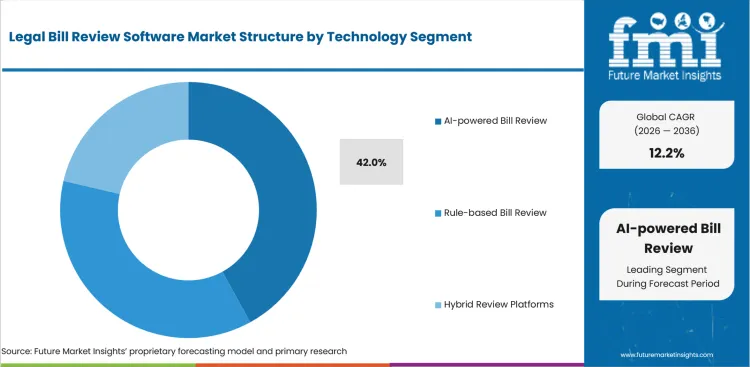
AI-powered bill review analyzes narratives and billing patterns that fixed rules cannot evaluate consistently across law firms. LexisNexis announced Protégé in CounselLink+ during September 2025 with real-time matter and invoice summaries inside existing workflows. The release gives reviewers financial observations and recommendations without removing their responsibility for final payment decisions and disputed adjustments. Reliable agentic automation therefore depends on clean historical outcomes and explicit billing guidelines across representative invoice groups.
- Based on technology, AI-powered bill review is projected to account for 42.0% in 2026 due to demand for narrative analysis and prioritized exceptions. The technology directs reviewer attention toward material issues instead of presenting every unusual line equally. Its position depends on explainable outputs and reversible adjustments that legal teams can defend during law-firm disputes.
- Legal departments introduce AI review through controlled invoice groups that contain stable billing rules and sufficient historical decisions. Broader deployment follows accepted savings and manageable appeal rates across participating firms and matter categories. Adoption slows if model thresholds create excessive false positives or reviewers cannot identify the evidence behind an adjustment.
What are the drivers, restraints, and opportunities in the Legal Bill Review Software market?
Rising legal workload supports automated invoice review, while opaque adjustments limit confidence and connected spend intelligence creates expansion routes.
- Driver: Rising legal workload and constrained staffing support automated invoice review across recurring outside counsel spend.
- Restraint: Poor invoice context and opaque automated adjustments weaken confidence during payment disputes and renewal decisions.
- Opportunity: Connected spend intelligence can extend bill review into budgeting and outside counsel performance management across matter portfolios.
Rising legal workload is expected to drive demand for software that reviews invoices without proportional growth in internal staffing. Mitratech reported in February 2026 that clients using its spend management and managed bill review achieved up to 80% time savings on manual administrative work. The reported result demonstrates how managed review can release legal operations capacity during recurring invoice cycles. Recurring revenue depends on verified savings across representative invoices and predictable payment cycles for outside counsel.
Opaque adjustments create a material restraint because legal teams must defend deductions during law-firm disputes and finance reviews. Wolters Kluwer introduced agentic invoice review in May 2026 with customer-defined guardrails and reversible actions supported by auditable explanations. Customer-defined guardrails and reversible actions show how clear reasons assign responsibility across sensitive invoice decisions. Platforms with weak explanations or unclear escalation routes can materially increase reviewer workload and reduce confidence in broader deployment.
Connected spend intelligence creates an opportunity to extend invoice review into sourcing and outside counsel performance management. PERSUIT announced its acquisition of Apperio in May 2025 to combine counsel selection with real-time spend visibility and invoice validation. The transaction links pre-engagement counsel decisions with invoice controls and accounts payable automation across final payment workflows. Platform companies can capture broader workflows if consistent matter codes support budgeting and performance comparisons across the same legal portfolio.
Which country CAGRs are profiled in the legal bill review software market?
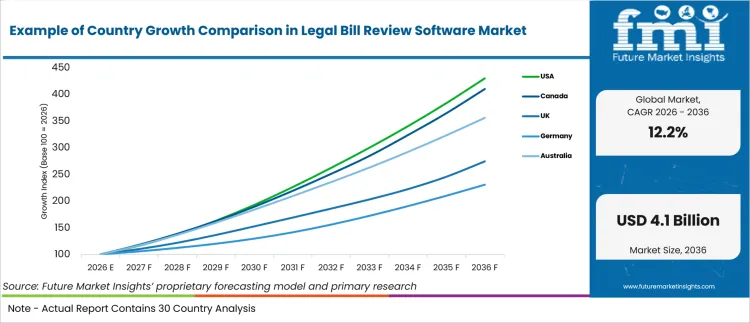
| Country | CAGR |
|---|---|
| USA | 15.7% |
| Canada | 15.2% |
| Australia | 13.6% |
| UK | 10.6% |
| France | 10.3% |
| Japan | 9.2% |
| Germany | 8.7% |
How do country-level CAGRs compare in the Legal Bill Review Software Market?
A 7.0 percentage-point spread separates the USA and Germany across the seven country outlooks. The USA and Canada form a close upper group with a 0.5 percentage-point gap. Australia occupies a middle position with a distinct 3.0-point break separating it from the UK and France. Japan and Germany form the lower pair, but their enterprise invoicing conditions remain commercially distinct.
- The USA benefits from mature e-billing workflows across large corporate legal portfolios, although complex global billing guidelines increase implementation work.
- Detailed federal account controls support Canada’s close position beside the USA within the forecast comparison. Provincial tax differences create a separate configuration burden for legal departments pursuing consistent national platform deployments.
- Australia sits below the North American pair as formal expenditure reporting supports auditability, but long service distances raise implementation costs.
- The UK and France form a narrow European pair despite different rollout schedules for mandatory electronic invoicing and approved platform connectivity.
- Japan remains below the European pair as standardized invoice exchange supports integration, but language configuration and deliberate qualification extend deployment timelines.
- Germany closes the comparison with structured B2B invoice rules, but customized ERP environments and strict data reviews increase integration effort.
- Invoice standards and service coverage determine implementation cost across each country despite similar approved growth rates.
The full report provides country-level CAGR analysis across North America, Latin America, Europe, East Asia, South Asia, Oceania and the Middle East and Africa.
Country-wise Analysis
- Mature e-billing infrastructure and broad outside counsel panels define how legal departments in the United States manage invoice review across large corporate portfolios. The legal bill review software market in the United States is set to post 15.7% CAGR over the forecast period. The Fourth Circuit announced in March 2025 that its CJA eVoucher Vendor Management System had entered operation, requiring registered payment accounts and routing post-March 15 vouchers through electronic funds transfer. That development illustrates how structured billing records connect into governed payment processing, a pattern corporate legal teams are replicating across integrated finance systems with documented approval ownership. Inconsistent matter codes and firm-specific billing guidelines still extend implementation timelines across global portfolios.
- Itemized account rules, federal oversight, and varying provincial tax treatments together shape how Canadian legal-agent billing operates. The market in Canada is forecast to advance at 15.2% CAGR over the assessment period. Justice Canada's standing terms require chronological work descriptions and formal verification before payment authorization. In June 2025 the department updated its annual legal-agent expenditure disclosure covering private firms engaged on federal matters, reinforcing a rules-based review pathway that software platforms are well positioned to support. Bilingual workflow requirements and provincial tax differences remain practical configuration challenges for nationally deployed solutions.
- Formal expenditure reporting obligations and a geographically dispersed enterprise base characterize Australia's legal spending environment. Legal bill review software sales in Australia are likely to expand at 13.6% CAGR by 2036. The Attorney-General's Department published its 2024-25 legal services expenditure statement in October 2025 under the Legal Services Directions, reinforcing the need for auditable invoice records and consistent classification across departmental budgets. Regional implementation partners cover concentrated enterprise accounts in major cities, though long service distances and a smaller specialist talent pool add to support costs beyond initial licensing.
- United Kingdom legal departments are navigating a fragmented adoption landscape while preparing for a national electronic invoicing mandate. The sector is projected to record 10.6% CAGR during the assessment period. HM Revenue and Customs confirmed in November 2025 that all VAT invoices must shift to electronic formats from 2029, though the consultation response acknowledged low current uptake and incompatible approaches across existing business systems. That timetable creates a defined window for structured invoice integration across legal and finance workflows, even as legacy formats and unsettled implementation standards delay purchasing decisions in the earlier forecast years.
- France's near-term electronic invoicing deadline places platform connectivity at the center of legal operations planning rather than leaving it as an optional workflow enhancement. Legal bill review software demand in France is anticipated to rise at 10.3% CAGR over the forecast period. The Directorate General of Public Finances reported in January 2026 that 101 platforms had received approval and 500,000 businesses had registered an electronic invoice reception address. That approved infrastructure creates a workable route for structured legal invoices to enter connected corporate finance and payment systems. Interoperability testing and September 2026 readiness work compete with legal operations budgets during initial deployments.
- Precise workflow definitions and controlled data exchange across finance and legal systems shape how Japanese organizations approach invoice technology. The legal bill review software market in Japan is estimated to expand at 9.2% CAGR through 2036. Japan's Digital Agency updated JP PINT specifications to version 1.1.3 in June 2026 and confirmed its role as Japan Peppol Authority in a July 2026 page refresh, clarifying the national standard for compliant invoice exchange across participating systems. Local language configuration and detailed security review extend platform qualification timelines beyond early corporate accounts and controlled pilot groups.
- Germany's structured B2B electronic invoicing rules, which have applied since January 2025, mean legal bill review platforms enter an environment where machine-readable invoice records are already a baseline compliance requirement. The market in Germany is projected to grow at 8.7% CAGR by 2036. The Federal Ministry of Finance confirmed that position in March 2026, noting that transition provisions remain available for defined periods and specific invoice routes across domestic transactions. Platforms that align with existing ERP integration work across established enterprise finance systems gain a practical entry point, though data protection reviews and customized infrastructure continue to create friction for automated narrative analysis and cloud deployment.
Who are the notable companies in the Legal Bill Review Software Market?
Wolters Kluwer ELM Solutions, Brightflag, Mitratech, Onit, Thomson Reuters, LexisNexis Legal & Professional, LawVu, and PERSUIT are the notable companies shaping this market.
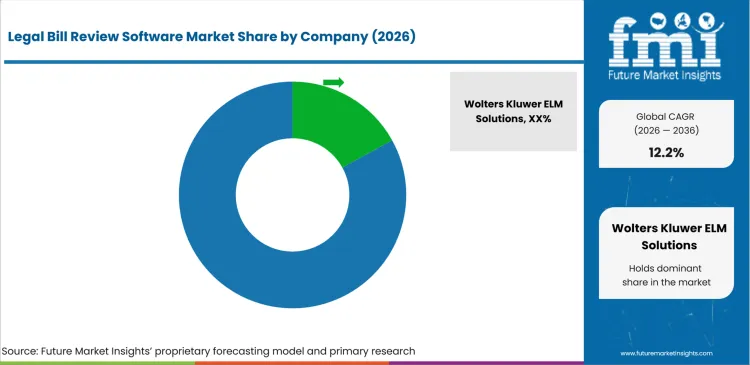
Legal bill review competition combines specialist invoice platforms with broader enterprise legal management providers serving corporate departments. Mitratech reported in November 2025 that its managed bill review combines AI with human expertise and benchmarking. Wolters Kluwer ELM Solutions and Brightflag emphasize automated billing compliance across recurring outside counsel portfolios. Onit and Thomson Reuters connect invoice decisions with matter and spend workflows across corporate legal operations. LexisNexis Legal & Professional and LawVu embed invoice insight inside integrated workspaces designed for in-house departments. PERSUIT combines invoice validation with counsel sourcing and outside counsel performance intelligence across enterprise legal programs. Broader suites can connect bill review with contract lifecycle tools, but accepted savings and explainable adjustments remain separate purchasing tests.
- Wolters Kluwer ELM Solutions and Brightflag focus on native invoice review and configurable billing governance. Mitratech combines managed human review with AI and broader spend analytics across integrated enterprise legal management workflows. Each platform must demonstrate accepted savings across varied law firms rather than isolated test invoices.
- Onit and Thomson Reuters place bill review inside integrated matter and spend systems for corporate departments. LexisNexis Legal & Professional adds invoice summaries alongside wider legal workflow intelligence within the integrated CounselLink+ environment. Their commercial advantage depends on consistent information across approved matters and connected finance records throughout the payment workflow.
- LawVu combines AI-assisted billing guideline review with matters and spend management inside one legal workspace. PERSUIT links invoice validation with outside counsel sourcing and performance intelligence across enterprise legal service portfolios. Both models require reliable integrations before legal departments can compare costs with outcomes across complete portfolios.
Competitive Benchmarking: Legal Bill Review Software Market
| Company | Automated Invoice Review | Billing Governance | Legal Spend Analytics | Geographic Reach |
|---|---|---|---|---|
| Wolters Kluwer ELM Solutions | High | High | High | Global |
| Brightflag | High | High | High | Multi-region |
| Mitratech | High | High | High | Global |
| Onit | High | High | High | Global |
| Thomson Reuters | High | Medium | High | Global |
| LexisNexis Legal & Professional | Medium | High | High | Global |
| LawVu | Medium | High | Medium | Multi-region |
| PERSUIT | Medium | Medium | High | Global |
Key Developments in the Legal Bill Review Software Market
- In March 2026, Onit released Unity ELM with AI-driven invoice review through Spend Agent for corporate legal departments. The platform connects matter and spend records inside one legal operations system for corporate departments. Spend Agent applies billing guidelines and reduces repetitive review across recurring outside counsel invoices during production use. The launch gives in-house teams a governed route to review invoice exceptions and preserve matter context with payment accountability.
- In April 2025, Brightflag announced AI-powered spend management and matter management capabilities for corporate legal departments. The launch expanded invoice analysis alongside matter updates and legal operations insights across connected workflows. The design links billing decisions with current matter status and relevant spend context across departments. Enterprises gain one governed view of legal activity and external costs across recurring outside counsel portfolios.
- In August 2025, Thomson Reuters launched an AI-enhanced Legal Tracker for corporate legal operations teams. The release added automated checks for duplicate charges and administrative billing issues across outside counsel invoices. It also introduced standardized invoice conversion and AI-enabled spend dashboards with natural-language queries for legal teams. The development connects billing compliance with wider analysis across global legal departments and outside counsel panels.
- In May 2025, LexisNexis Legal & Professional unveiled an enhanced CounselLink+ platform for corporate legal departments. The commercial preview combined Protégé invoice insights with intelligent reporting and a unified legal workspace. The design connects invoices with matters and contracts inside one operating environment for in-house teams. In-house departments gain a route to analyze billing activity without separating financial context from legal work across recurring workflows.
Key Players in the Legal Bill Review Software Market
Automated Review and Spend Intelligence Providers
- Wolters Kluwer ELM Solutions
- Brightflag
- Mitratech
Integrated Enterprise Legal Management Providers
- Onit
- Thomson Reuters
- LexisNexis Legal & Professional
Connected Spend and Invoice Intelligence Providers
- LawVu
- PERSUIT
Legal Bill Review Software Market - Report Scope
| Coverage field | Report scope |
|---|---|
| Market breakdown | Deployment, application, end user, enterprise size, technology, and region. |
| Quantitative Units | Revenue in USD Million, CAGR in %. |
| Market Definition | Software that receives outside counsel invoices, applies billing guidelines, identifies errors or anomalies, routes review decisions, and analyzes legal spend. |
| Regions Covered | North America, Latin America, Europe, East Asia, South Asia, Oceania, and Middle East and Africa. |
| Countries Covered | USA, Canada, Australia, UK, France, Japan, and Germany. |
| Key Companies Profiled | Wolters Kluwer ELM Solutions, Brightflag, Mitratech, Onit, Thomson Reuters, LexisNexis Legal & Professional, LawVu, and PERSUIT |
| Forecast Period | 2026 to 2036. |
| Approach | Hybrid bottom-up and top-down market sizing supported by primary interviews and official desk research. |
Legal Bill Review Software Market - Research Methodology
| Method | Approach |
|---|---|
| Primary Research | FMI analysts gathered input from manufacturers, service providers, technology developers, distributors, end users, sourcing teams, and subject-matter experts. Interviews examined purchasing decisions, product or service evaluation, adoption barriers, approval requirements, pricing considerations, and expectations for technical or commercial support. Respondents were also asked what evidence is required before a trial, pilot, or initial order develops into regular purchasing. |
| Desk Research | Desk research covered government statistics, regulatory publications, trade data, industry associations, technical literature, standards, company filings, product information, and official corporate announcements. Sources were reviewed for relevance, publication date, geographic coverage, and consistency with the defined market scope. Claims relating to performance, applications, approvals, capacity, investment, and commercial activity were retained only when supported by credible public evidence. |
| Market Sizing and Forecasting | The market model combined the baseline value with historical performance, segment structure, pricing and volume indicators, adoption levels, company participation, and country-level demand conditions. Forecast assumptions considered economic activity, investment trends, regulatory developments, technology adoption, purchasing cycles, supply availability, and barriers to wider market use. Segment and regional estimates were reconciled before the final market total was calculated. |
| Data Validation | Estimates were checked against multiple independent indicators, including public data, company activity, trade patterns, industry developments, and findings from primary interviews. Validation also tested whether products, services, applications, and company revenues fell within the defined market boundaries. Adjacent categories, unsupported claims, overlapping revenues, and activities without direct market relevance were excluded to reduce double counting and maintain consistency across segments and countries. |
Legal Bill Review Software Market by Segments
Legal Bill Review Software Market segmented by Deployment:
- Cloud-based Software
- Public Cloud
- Private Cloud
- Hybrid Cloud
- On-premise Software
- Enterprise Deployment
- Private Data Center
- Self-hosted Platform
- Hybrid Deployment
- Cloud-connected On-premise
- Multi-cloud Environment
- Edge-enabled Deployment
Legal Bill Review Software Market segmented by Application:
- Legal Invoice Review
- Automated Invoice Validation
- Billing Rule Compliance
- Invoice Auditing
- Spend Management
- Legal Spend Analytics
- Budget Monitoring
- Cost Forecasting
- Compliance Management
- Outside Counsel Guidelines
- Regulatory Compliance
- Audit Trail Management
- Contract & Matter Management
- Matter Tracking
- Contract Analytics
- Document Management
Legal Bill Review Software Market segmented by End User:
- Corporate Legal Departments
- Fortune 500 Companies
- Multinational Enterprises
- In-house Legal Teams
- Law Firms
- Large Law Firms
- Mid-sized Law Firms
- Boutique Law Firms
- Insurance Companies
- Claims Management
- Litigation Management
- Risk Management
- Government Organizations
- Federal Agencies
- State Agencies
- Public Sector Legal Offices
Legal Bill Review Software Market segmented by Enterprise Size:
- Large Enterprises
- Global Enterprises
- National Enterprises
- Publicly Listed Companies
- Small & Medium Enterprises
- Medium-sized Businesses
- Small Businesses
- Legal Startups
- Government & Public Sector
- Government Departments
- Public Institutions
- Regulatory Authorities
Legal Bill Review Software Market segmented by Technology:
- AI-powered Bill Review
- Natural Language Processing
- Machine Learning Models
- Predictive Analytics
- Rule-based Bill Review
- Billing Rule Engines
- Policy Validation
- Exception Detection
- Hybrid Review Platforms
- AI-assisted Human Review
- Workflow Automation
- Custom Review Engines
Legal Bill Review Software Market by Region:
- North America
- United States
- Canada
- Latin America
- Brazil
- Mexico
- Argentina
- Chile
- Western Europe
- Germany
- France
- United Kingdom
- Italy
- Spain
- Benelux
- Nordics
- Eastern Europe
- Poland
- Czech Republic
- Romania
- Hungary
- East Asia
- China
- Japan
- South Korea
- South Asia and Pacific
- India
- ASEAN
- Australia and New Zealand
- Middle East and Africa
- GCC Countries
- South Africa
- Türkiye
- Israel
Research Sources and Bibliography
- Corporate Legal Operations Consortium. (2026, March 2). CLOC Releases 2026 State of the Industry Report: Rising Legal Demand Outpaces Budget and Staffing Growth, Forcing Operational Shift.
- Corporate Legal Operations Consortium. (2025, February 12). 2025 CLOC State of the Industry Report: 83% of Legal Departments Face Rising Demand and AI Adoption Nearly Doubles.
- LawVu. (2025, April 28). How innovative legal spend management and automated billing guideline reviews benefit corporate legal operations.
- Legal Electronic Data Exchange Standard Oversight Committee. (2026, April). LEDES XML Ebilling ver. 2.2.
- Corporate Legal Operations Consortium. (2026, May 12). CLOC Launches Compass, an Interactive Platform To Advance Legal Operations Maturity, in Partnership with Neota Logic.
- Corporate Legal Operations Consortium. (2025, May 6). CLOC and Harbor Renew Survey Partnership to Advance Legal Operations Insights.
- LexisNexis Legal & Professional. (2025, September 16). LexisNexis® Announces Protégé™ in CounselLink+™ for Actionable Matter and Invoice Insights.
- Mitratech. (2026, February 3). Mitratech Marks Record Momentum in Enterprise Legal Market as AI Innovation & Investment Accelerate in 2026.
- Wolters Kluwer. (2026, May 6). Wolters Kluwer introduces agentic AI invoice review to LegalVIEW BillAnalyzer.
- PERSUIT. (2025, May 5). PERSUIT announces acquisition of Apperio.
- United States Court of Appeals for the Fourth Circuit. (2025, March 14). CJA eVoucher Vendor Management System is Live!
- Department of Justice Canada. (2021, August 5). Terms and Conditions of Appointment for Domestic Legal Agents.
- Department of Justice Canada. (2025, June 30). Disclosure of Legal Contracts - Annual Legal Agent Expenditures - 2024-2025.
- Australian Attorney-General’s Department. (2025, October 30). Attorney-General’s Department - Legal services expenditure 2024-25.
- HM Revenue & Customs & Department for Business and Trade. (2025, November 26). Promoting electronic invoicing across UK businesses and the public sector: consultation response.
- Direction générale des Finances publiques. (2026, January 16). Facturation électronique : la Direction générale des Finances publiques publie la liste des 101 premières plateformes agréées.
- Digital Agency. (2026, July 10). JP PINT.
- Bundesministerium der Finanzen. (2026, March 23). Fragen und Antworten zur Einführung der obligatorischen (verpflichtenden) E-Rechnung zum 1. Januar 2025.
- Mitratech. (2025, November 13). Mitratech Awarded Legal Spend Management Solution of the Year.
- Onit. (2026, March 9). Onit Changes the Game with AI-Native Unity ELM for Matter and Spend Management, Announces Commercial Success of Unity Spend Agent.
- Brightflag. (2025, April 22). Brightflag launches new AI-powered spend management, matter management, and insights features for corporate legal teams.
- Thomson Reuters. (2025, August 5). Thomson Reuters Takes Major Step to Transform Corporate Workflows with Launch of CoCounsel Legal, AI-enhanced Legal Tracker, and CoCounsel Tax.
- LexisNexis Legal & Professional. (2025, May 6). LexisNexis® Announces Enhanced CounselLink+™ with Protégé™ AI Assistant, Lex Machina® Integration, and Unified Legal Workspace.
This bibliography is provided for reader reference and is not exhaustive. The full report contains the complete reference list and detailed citations
This Report Answers
- How large is the legal bill review software market in 2026 and 2036?
- Which operating pressures support investment in automated legal invoice review?
- Why does cloud-based software account for the dominant deployment share in 2026?
- How does legal invoice review influence payment approval and billing compliance?
- Why do corporate legal departments represent the largest end user share in 2026?
- How do implementation conditions differ across the seven profiled countries?
- Which companies provide automated review or integrated enterprise legal management?
- What limits accepted savings across poor invoice data and disputed adjustments?
- How can connected spend intelligence extend bill review beyond isolated deductions?
Frequently Asked Questions
How big is the Legal Bill Review Software Market in 2026?
The legal bill review software market is valued at USD 1.3 billion in 2026 and is forecast to reach USD 4.1 billion by 2036. Growth reflects legal departments investing in technology platforms that combine cost control, compliance, and outside counsel management capabilities across recurring invoice portfolios.
What is the CAGR of the Legal Bill Review Software Market from 2026 to 2036?
The legal bill review software market grows at a CAGR of 12.2% between 2026 and 2036, supported by rising legal workload and constrained staffing that drive demand for automated invoice review across recurring outside counsel spend.
Which deployment model leads the Legal Bill Review Software Market?
Cloud-based software accounts for 59.0% of the legal bill review software market by deployment in 2026, supported by centralized configuration that lets legal operations teams update billing guidelines and reviewer permissions consistently across distributed business units.
How much will the Legal Bill Review Software Market add between 2026 and 2036?
The legal bill review software market is set to add USD 2.8 billion between 2026 and 2036, growing from USD 1.3 billion to USD 4.1 billion as automated invoice review extends across a widening base of corporate legal department portfolios.
Who are the leading companies in the Legal Bill Review Software Market?
Five companies lead the legal bill review software market, including Wolters Kluwer ELM Solutions, Brightflag, Mitratech, Onit, and Thomson Reuters, competing through automated invoice review, billing governance, and legal spend analytics capabilities.
Preview the report firsthand - request a free sample
Get SampleGet the brochure for pricing and purchase details.
Get PDFTable of Content
- Key Takeaways
- Market Size and CAGR
- Top Growth Driver
- Fastest Growing Segment
- Leading Region
- Key Companies
- Emerging Opportunities
- Executive Summary
- Global Market Outlook
- Demand-side Trends
- Supply-side Trends
- Technology Roadmap Analysis
- Analysis and Recommendations
- Analyst Perspective (What is happening? Why now? What should investors know?)
- Key Questions Answered
- How large is the market?
- What is the CAGR?
- What are key trends?
- Which region dominates?
- Who are the leaders?
- Market Overview
- Market Coverage / Taxonomy
- Market Definition / Scope / Limitations
- Research Methodology
- Chapter Orientation
- Analytical Lens and Working Hypotheses
- Market Structure, Signals, and Trend Drivers
- Benchmarking and Cross-market Comparability
- Market Sizing, Forecasting, and Opportunity Mapping
- Research Design and Evidence Framework
- Desk Research Programme (Secondary Evidence)
- Expert Input and Fieldwork (Primary Evidence)
- Tooling, Models, and Reference Databases
- Data Engineering and Model Build
- Quality Assurance and Audit Trail
- Market Background
- Market Dynamics (Drivers, Restraints, Opportunity, Trends)
- Scenario Forecast (Optimistic, Likely, Conservative)
- Impact Analysis
- AI Impact
- Sustainability Impact
- Regulatory Impact
- Technology Impact
- Consumer / Buyer Analysis
- Purchase Drivers
- Adoption Barriers
- Buyer Journey
- Opportunity Map Analysis
- Product Life Cycle Analysis
- Supply Chain Analysis
- Investment Feasibility Matrix
- Value Chain Analysis
- PESTLE and Porter's Analysis
- Regulatory Landscape
- Regional Parent Market Outlook
- Production and Consumption Statistics
- Import and Export Statistics
- Global Market Analysis and Forecast, 2021 to 2036
- Historical Market Size Value (USD Billion) Analysis, 2021 to 2025
- Current and Future Market Size Value (USD Billion) Projections, 2026 to 2036
- Y-o-Y Growth Trend Analysis
- Absolute $ Opportunity Analysis
- Global Market Pricing Analysis, 2021 to 2036
- Global Market Analysis and Forecast, By Deployment, 2021 to 2036
- Introduction / Key Findings
- Historical Market Size Value (USD Billion) Analysis By Deployment, 2021 to 2025
- Current and Future Market Size Value (USD Billion) Analysis and Forecast By Deployment, 2026 to 2036
- Cloud-based Software
- Public Cloud
- Private Cloud
- Hybrid Cloud
- On-premise Software
- Enterprise Deployment
- Private Data Center
- Self-hosted Platform
- Hybrid Deployment
- Cloud-connected On-premise
- Multi-cloud Environment
- Edge-enabled Deployment
- Cloud-based Software
- Y-o-Y Growth Trend Analysis By Deployment, 2021 to 2025
- Absolute $ Opportunity Analysis By Deployment, 2026 to 2036
- Global Market Analysis and Forecast, By Application, 2021 to 2036
- Introduction / Key Findings
- Historical Market Size Value (USD Billion) Analysis By Application, 2021 to 2025
- Current and Future Market Size Value (USD Billion) Analysis and Forecast By Application, 2026 to 2036
- Legal Invoice Review
- Automated Invoice Validation
- Billing Rule Compliance
- Invoice Auditing
- Spend Management
- Legal Spend Analytics
- Budget Monitoring
- Cost Forecasting
- Compliance Management
- Outside Counsel Guidelines
- Regulatory Compliance
- Audit Trail Management
- Contract & Matter Management
- Matter Tracking
- Contract Analytics
- Document Management
- Legal Invoice Review
- Y-o-Y Growth Trend Analysis By Application, 2021 to 2025
- Absolute $ Opportunity Analysis By Application, 2026 to 2036
- Global Market Analysis and Forecast, By End User, 2021 to 2036
- Introduction / Key Findings
- Historical Market Size Value (USD Billion) Analysis By End User, 2021 to 2025
- Current and Future Market Size Value (USD Billion) Analysis and Forecast By End User, 2026 to 2036
- Corporate Legal Departments
- Fortune 500 Companies
- Multinational Enterprises
- In-house Legal Teams
- Law Firms
- Large Law Firms
- Mid-sized Law Firms
- Boutique Law Firms
- Insurance Companies
- Claims Management
- Litigation Management
- Risk Management
- Government Organizations
- Federal Agencies
- State Agencies
- Public Sector Legal Offices
- Corporate Legal Departments
- Y-o-Y Growth Trend Analysis By End User, 2021 to 2025
- Absolute $ Opportunity Analysis By End User, 2026 to 2036
- Global Market Analysis and Forecast, By Enterprise Size, 2021 to 2036
- Introduction / Key Findings
- Historical Market Size Value (USD Billion) Analysis By Enterprise Size, 2021 to 2025
- Current and Future Market Size Value (USD Billion) Analysis and Forecast By Enterprise Size, 2026 to 2036
- Large Enterprises
- Global Enterprises
- National Enterprises
- Publicly Listed Companies
- Small & Medium Enterprises
- Medium-sized Businesses
- Small Businesses
- Legal Startups
- Government & Public Sector
- Government Departments
- Public Institutions
- Regulatory Authorities
- Large Enterprises
- Y-o-Y Growth Trend Analysis By Enterprise Size, 2021 to 2025
- Absolute $ Opportunity Analysis By Enterprise Size, 2026 to 2036
- Global Market Analysis and Forecast, By Technology, 2021 to 2036
- Introduction / Key Findings
- Historical Market Size Value (USD Billion) Analysis By Technology, 2021 to 2025
- Current and Future Market Size Value (USD Billion) Analysis and Forecast By Technology, 2026 to 2036
- AI-powered Bill Review
- Natural Language Processing
- Machine Learning Models
- Predictive Analytics
- Rule-based Bill Review
- Billing Rule Engines
- Policy Validation
- Exception Detection
- Hybrid Review Platforms
- AI-assisted Human Review
- Workflow Automation
- Custom Review Engines
- AI-powered Bill Review
- Y-o-Y Growth Trend Analysis By Technology, 2021 to 2025
- Absolute $ Opportunity Analysis By Technology, 2026 to 2036
- Global Market Analysis and Forecast, By Region, 2021 to 2036
- Introduction
- Historical Market Size Value (USD Billion) Analysis By Region, 2021 to 2025
- Current Market Size Value (USD Billion) Analysis and Forecast By Region, 2026 to 2036
- North America
- Latin America
- Western Europe
- Eastern Europe
- East Asia
- South Asia and Pacific
- Middle East & Africa
- Market Attractiveness Analysis By Region
- North America Market Analysis and Forecast, By Country, 2021 to 2036
- Historical Market Size Value (USD Billion) Trend Analysis By Market Taxonomy, 2021 to 2025
- Market Size Value (USD Billion) Forecast By Market Taxonomy, 2026 to 2036
- By Country
- USA
- Canada
- By Deployment
- By Application
- By End User
- By Enterprise Size
- By Technology
- By Country
- Market Attractiveness Analysis
- By Country
- By Deployment
- By Application
- By End User
- By Enterprise Size
- By Technology
- Key Takeaways
- Latin America Market Analysis and Forecast, By Country
- Historical Market Size Value (USD Billion) Trend Analysis By Market Taxonomy, 2021 to 2025
- Market Size Value (USD Billion) Forecast By Market Taxonomy, 2026 to 2036
- By Country
- Brazil
- Mexico
- Chile
- Rest of Latin America
- By Deployment
- By Application
- By End User
- By Enterprise Size
- By Technology
- By Country
- Market Attractiveness Analysis
- By Country
- By Deployment
- By Application
- By End User
- By Enterprise Size
- By Technology
- Key Takeaways
- Western Europe Market Analysis and Forecast, By Country
- Historical Market Size Value (USD Billion) Trend Analysis By Market Taxonomy, 2021 to 2025
- Market Size Value (USD Billion) Forecast By Market Taxonomy, 2026 to 2036
- By Country
- Germany
- UK
- Italy
- Spain
- France
- Nordic
- BENELUX
- Rest of Western Europe
- By Deployment
- By Application
- By End User
- By Enterprise Size
- By Technology
- By Country
- Market Attractiveness Analysis
- By Country
- By Deployment
- By Application
- By End User
- By Enterprise Size
- By Technology
- Key Takeaways
- Eastern Europe Market Analysis and Forecast, By Country
- Historical Market Size Value (USD Billion) Trend Analysis By Market Taxonomy, 2021 to 2025
- Market Size Value (USD Billion) Forecast By Market Taxonomy, 2026 to 2036
- By Country
- Russia
- Poland
- Hungary
- Balkan & Baltic
- Rest of Eastern Europe
- By Deployment
- By Application
- By End User
- By Enterprise Size
- By Technology
- By Country
- Market Attractiveness Analysis
- By Country
- By Deployment
- By Application
- By End User
- By Enterprise Size
- By Technology
- Key Takeaways
- East Asia Market Analysis and Forecast, By Country
- Historical Market Size Value (USD Billion) Trend Analysis By Market Taxonomy, 2021 to 2025
- Market Size Value (USD Billion) Forecast By Market Taxonomy, 2026 to 2036
- By Country
- China
- Japan
- South Korea
- By Deployment
- By Application
- By End User
- By Enterprise Size
- By Technology
- By Country
- Market Attractiveness Analysis
- By Country
- By Deployment
- By Application
- By End User
- By Enterprise Size
- By Technology
- Key Takeaways
- South Asia and Pacific Market Analysis and Forecast, By Country
- Historical Market Size Value (USD Billion) Trend Analysis By Market Taxonomy, 2021 to 2025
- Market Size Value (USD Billion) Forecast By Market Taxonomy, 2026 to 2036
- By Country
- India
- ASEAN
- Australia & New Zealand
- Rest of South Asia and Pacific
- By Deployment
- By Application
- By End User
- By Enterprise Size
- By Technology
- By Country
- Market Attractiveness Analysis
- By Country
- By Deployment
- By Application
- By End User
- By Enterprise Size
- By Technology
- Key Takeaways
- Middle East & Africa Market Analysis and Forecast, By Country
- Historical Market Size Value (USD Billion) Trend Analysis By Market Taxonomy, 2021 to 2025
- Market Size Value (USD Billion) Forecast By Market Taxonomy, 2026 to 2036
- By Country
- Kingdom of Saudi Arabia
- Other GCC Countries
- Türkiye
- South Africa
- Other African Union
- Rest of Middle East & Africa
- By Deployment
- By Application
- By End User
- By Enterprise Size
- By Technology
- By Country
- Market Attractiveness Analysis
- By Country
- By Deployment
- By Application
- By End User
- By Enterprise Size
- By Technology
- Key Takeaways
- Key Countries Market Analysis
- USA
- Pricing Analysis
- Market Share Analysis, 2025
- By Deployment
- By Application
- By End User
- By Enterprise Size
- By Technology
- Canada
- Pricing Analysis
- Market Share Analysis, 2025
- By Deployment
- By Application
- By End User
- By Enterprise Size
- By Technology
- Mexico
- Pricing Analysis
- Market Share Analysis, 2025
- By Deployment
- By Application
- By End User
- By Enterprise Size
- By Technology
- Brazil
- Pricing Analysis
- Market Share Analysis, 2025
- By Deployment
- By Application
- By End User
- By Enterprise Size
- By Technology
- Chile
- Pricing Analysis
- Market Share Analysis, 2025
- By Deployment
- By Application
- By End User
- By Enterprise Size
- By Technology
- Germany
- Pricing Analysis
- Market Share Analysis, 2025
- By Deployment
- By Application
- By End User
- By Enterprise Size
- By Technology
- UK
- Pricing Analysis
- Market Share Analysis, 2025
- By Deployment
- By Application
- By End User
- By Enterprise Size
- By Technology
- Italy
- Pricing Analysis
- Market Share Analysis, 2025
- By Deployment
- By Application
- By End User
- By Enterprise Size
- By Technology
- Spain
- Pricing Analysis
- Market Share Analysis, 2025
- By Deployment
- By Application
- By End User
- By Enterprise Size
- By Technology
- France
- Pricing Analysis
- Market Share Analysis, 2025
- By Deployment
- By Application
- By End User
- By Enterprise Size
- By Technology
- India
- Pricing Analysis
- Market Share Analysis, 2025
- By Deployment
- By Application
- By End User
- By Enterprise Size
- By Technology
- ASEAN
- Pricing Analysis
- Market Share Analysis, 2025
- By Deployment
- By Application
- By End User
- By Enterprise Size
- By Technology
- Australia & New Zealand
- Pricing Analysis
- Market Share Analysis, 2025
- By Deployment
- By Application
- By End User
- By Enterprise Size
- By Technology
- China
- Pricing Analysis
- Market Share Analysis, 2025
- By Deployment
- By Application
- By End User
- By Enterprise Size
- By Technology
- Japan
- Pricing Analysis
- Market Share Analysis, 2025
- By Deployment
- By Application
- By End User
- By Enterprise Size
- By Technology
- South Korea
- Pricing Analysis
- Market Share Analysis, 2025
- By Deployment
- By Application
- By End User
- By Enterprise Size
- By Technology
- Russia
- Pricing Analysis
- Market Share Analysis, 2025
- By Deployment
- By Application
- By End User
- By Enterprise Size
- By Technology
- Poland
- Pricing Analysis
- Market Share Analysis, 2025
- By Deployment
- By Application
- By End User
- By Enterprise Size
- By Technology
- Hungary
- Pricing Analysis
- Market Share Analysis, 2025
- By Deployment
- By Application
- By End User
- By Enterprise Size
- By Technology
- Kingdom of Saudi Arabia
- Pricing Analysis
- Market Share Analysis, 2025
- By Deployment
- By Application
- By End User
- By Enterprise Size
- By Technology
- Türkiye
- Pricing Analysis
- Market Share Analysis, 2025
- By Deployment
- By Application
- By End User
- By Enterprise Size
- By Technology
- South Africa
- Pricing Analysis
- Market Share Analysis, 2025
- By Deployment
- By Application
- By End User
- By Enterprise Size
- By Technology
- USA
- Market Structure Analysis
- Competition Dashboard
- Competition Benchmarking
- Market Share Analysis of Top Players
- By Regional
- By Deployment
- By Application
- By End User
- By Enterprise Size
- By Technology
- Emerging Startups
- Innovation Benchmarking
- Competition Analysis
- Competition Deep Dive
- Wolters Kluwer ELM Solutions
- Overview
- Product Portfolio
- Profitability by Market Segments
- Sales Footprint
- Strategy Overview
- Marketing Strategy
- Product Strategy
- Channel Strategy
- Brightflag
- Mitratech
- Onit
- Legal Tracker
- SimpleLegal
- Aderant
- Thomson Reuters
- LexisNexis
- Datacert
- Wolters Kluwer ELM Solutions
- Case Studies
- Success Stories
- Recent Developments
- Competition Deep Dive
- Assumptions & Acronyms Used


