

- Industry Size (2025)
- USD 209.6 Mn
- Forecast (2035)
- USD 431.2 Mn
- CAGR (2025 to 2035)
- 7.5%
Manjistha Extract Market Forecast and Outlook 2025 to 2035
The global manjistha extract market is valued at USD 209.6 million in 2025 and is forecasted to reach USD 431.2 million by 2035, recording a CAGR of 7.5%. Demand is driven by increasing reliance on herbal actives in cosmetic formulations and rising preference for traditionally used botanicals with evidence-based skin-care functionality.
Manjistha extract is used for hyperpigmentation reduction, inflammation control, and antioxidant protection, supporting its integration into daily skin-care routines. Skin care remains the leading application area. The extract is included in brightening serums, spot-correction treatments, and products designed for uneven tone. Advancements in extraction purity and improved bioavailability continue to strengthen adoption among personal-care manufacturers focused on natural ingredient portfolios.
Quick Stats for Global Manjistha Extract Demand
- Global Manjistha Extract Sales Value (2025): USD 209.6 million
- Global Manjistha Extract Forecast Value (2035): USD 431.2 million
- Global Manjistha Extract Forecast CAGR (2025 to 2035): 7.5%
- Leading Application in Global Manjistha Extract Demand: Skin Care
- Key Growth Regions in Global Manjistha Extract Demand: Asia Pacific, Europe, North America
- Top Players in Global Manjistha Extract Demand: BASF SE, Croda International, Evonik Industries, Symrise, Dow
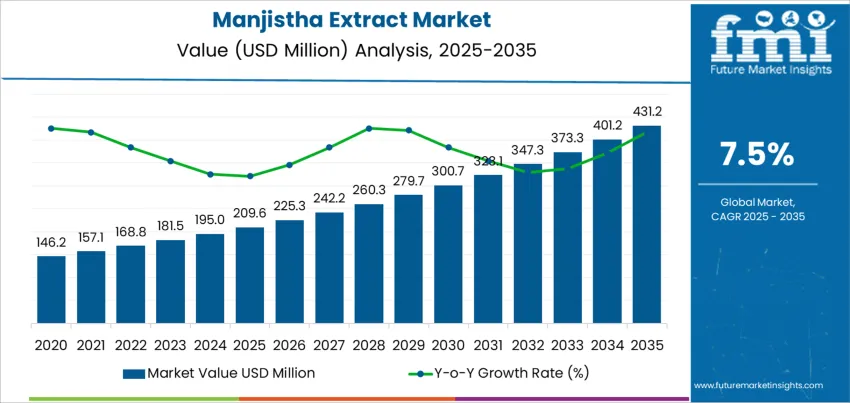
What is the Growth Forecast for the Manjistha Extract Market through 2035?
Asia Pacific, Europe, and North America account for the strongest utilization levels due to consumer familiarity with botanical solutions and consistent product development by major cosmetics producers. These regions maintain structured supply chains and supportive formulation standards that ensure controlled incorporation of manjistha extract. Key suppliers include BASF SE, Croda International, Evonik Industries, Symrise, and Dow. Their priorities involve maintaining ingredient traceability, ensuring stability in leave-on products, and aligning with clinical validation requirements for clean-beauty and dermocosmetic brands.
Peak to trough analysis for the global manjistha extract industry focuses on fluctuations in demand strength across application clusters. Peak phases are associated with increased utilization in Ayurvedic dermatology where manjistha supports blood purification and skin health. Rising consumer preference for natural anti-inflammatory and antioxidant ingredients increases adoption in premium skincare formulations and nutraceutical capsules. Marketing emphasis on wellness traditions and improved extract standardization add to peak demand conditions. Growth is also supported by wider retail availability and interest in herbal detox products.
Trough conditions appear when product substitution and limited awareness slow adoption outside traditional markets. Competing botanical extracts positioned for similar benefits, such as neem and turmeric, can temporarily restrain demand in cosmetics and supplements. Regulatory compliance for international commercialization and slower product approvals may extend trough phases in Europe and North America. Seasonal variations in raw material supply can also contribute to temporary softening in production and distribution. The transition between peaks and troughs remains moderate, indicating stable but selective expansion. Strengthening scientific validation and broader brand communication can reduce trough depth by improving consumer confidence and application diversity.
Manjistha Extract Market Key Takeaways
| Metric | Value |
|---|---|
| Market Value (2025) | USD 209.6 million |
| Market Forecast Value (2035) | USD 431.2 million |
| Forecast CAGR (2025-2035) | 7.5% |
Why is the Demand for Manjistha Extract Growing Globally?
Demand for manjistha extract is increasing worldwide because skincare, nutraceutical and traditional medicine sectors focus on natural ingredients that support detoxification and skin clarity. Manjistha, derived from Rubia cordifolia roots, is used for its antioxidant and anti-inflammatory qualities that help manage uneven tone and redness. Cosmetic manufacturers adopt manjistha extract in serums, face masks and herbal cleansers marketed for sensitive and acne prone skin. Its association with improved complexion supports demand among consumers seeking plant based radiance and blemish care solutions.
Herbal supplement producers include manjistha extract in liver support and blood cleansing formulations to align with growing interest in internal wellness. Demand continues to rise in markets where Ayurveda gains recognition through e commerce and specialty retail channels. Product developers value its compatibility in multi ingredient blends designed for daily detox support. Constraints include variability in active compound concentration depending on soil and processing conditions. Regulatory frameworks in some regions limit therapeutic claims, requiring documentation on purity and safety. Supply chain stability depends on sustainable harvesting and controlled cultivation to protect long term availability.
Which End-Use Applications and Product Forms Lead Global Demand for Manjistha Extract?
Global demand for manjistha extract is driven by its established Ayurvedic use in detoxification, skin clarifying, and anti-inflammatory applications. Brands incorporate the ingredient into brightening and blemish-correcting formulations that support even skin tone and barrier recovery. Clean-label and herbal beauty trends further increase the adoption of manjistha extracts across dermocosmetic and specialty personal care portfolios. Product positioning focuses on its natural pigmentation-balancing and antioxidant capabilities suitable for sensitive and stressed skin types.
By End-Use Application, Skin Care Holds the Largest Share
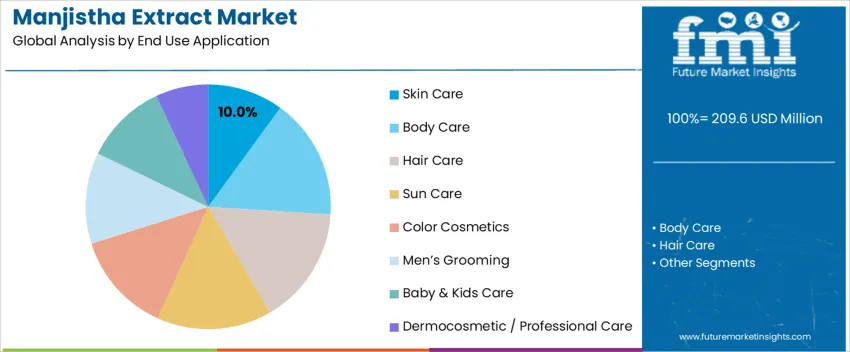
Skin care represents 10.0% of global manjistha extract consumption. This share reflects its deployment in serums, face creams, facial cleansers, and spot-care formulations designed for hyperpigmentation reduction and improved skin clarity. Body-care products apply manjistha extract for soothing and complexion enhancement across lotions and body scrubs. Hair-care applications leverage its scalp-purifying benefits and natural toning properties, while color cosmetics explore its botanical pigment characteristics for natural-finish makeup. Men’s grooming adds opportunities in post-shave and oil-control solutions, and baby-care categories incorporate low-irritation herbal formulas. Dermocosmetics integrate manjistha extract in products positioned for redness management and pollution defense.
Key Points:
- Skin-brightening and blemish-correcting benefits sustain strong skin-care demand
- Supported by multifunctional use in body-care and scalp-care products
- Expanding role in clean-label and sensitive-skin formulations
By Product Form, Powder Leads Global Demand
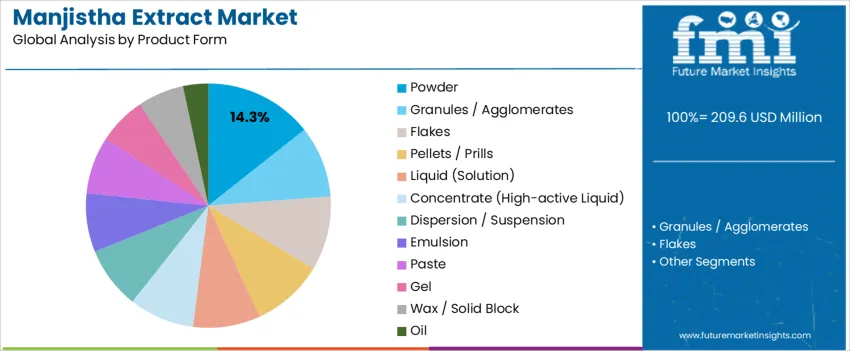
Powder format accounts for 14.3% of global demand, selected for its formulation versatility, stability, and easier transportation and storage across global supply chains. Powdered manjistha extract suits solid bars, dry masks, and exfoliating treatments where higher active concentration is required. Liquid solutions and dispersions are prioritized in serums and lightweight leave-on systems for enhanced bioavailability. Emulsions, pastes, and gels serve premium personal-care experiences, while concentrated active liquids support precise dosing in professional-grade formulas. Form selection aligns with processing methods, final product aesthetics, and performance claims tailored to pigmentation balance and detoxification.
Key Points:
- Powder supports flexible formulation and high-purity active delivery
- Liquid formats enhance spreadability and targeted topical benefits
- Specialized forms used in premium and dermocosmetic applications
What are the Drivers, Restraints, and Key Trends of the Global Manjistha Extract Market?
Growth in demand for natural skincare ingredients, rising interest in Ayurvedic and herbal supplements, and expanding global acceptance of traditional medicine drive demand.
Globally, manjistha extract (from Rubia cordifolia) is increasingly used in skincare, herbal supplements and wellness products that target skin tone, detoxification and anti-inflammation. Consumers in Asia, North America, and Europe seeking natural alternatives to synthetic cosmetics are embracing manjistha for its traditional reputation in improving complexion and supporting skin health. Cosmetic manufacturers integrate manjistha into face creams, cleansers, masks and serums marketed toward pigment reduction and skin-brightening. Nutraceutical brands offer manjistha-based capsules and liquid tonics targeting detox, liver support and general wellness. E-commerce and globalization of Ayurvedic herbal supply chains enable wider distribution, creating new demand beyond traditional markets.
Limited clinical evidence, regulatory scrutiny on health claims and variability in herbal raw-material quality restrain market growth.
Compared with well-studied cosmetic actives, manjistha lacks large-scale clinical trials that confirm efficacy or safety, which limits acceptance among medical professionals and cautious consumers. Regulatory bodies in many regions require substantiated evidence before allowing therapeutic or health-related claims, complicating marketing efforts for supplements. Plant-derived extract quality varies based on cultivation conditions, harvest timing and extraction methods, producing batch-to-batch inconsistency. These factors create uncertainty for manufacturers and restrain aggressive expansion, especially in regulated markets.
Shift toward standardized high-active extracts, increased inclusion in clean-label skincare lines and rising demand in women's health and natural beauty segments define key trends.
Ingredient suppliers focus on standardized extraction to ensure consistent pigment- and flavonoid-levels, improving reliability for cosmetic and supplement formulation. Skincare brands promote manjistha in clean-label, cruelty-free lines targeting hyperpigmentation, acne scars and uneven skin tone, responding to consumer interest in gentle botanical solutions. Rising demand for natural remedies for menstrual-cycle support and skin detox among women encourages integration into wellness supplement blends. Digital marketing and international shipping allow boutique herbal and beauty brands to reach niche consumer groups worldwide. These developments suggest gradual but diversified growth for manjistha extract across global cosmetics, wellness and personal care markets.
Analysis of the Manjistha Extract Market by Key Country
Global demand for manjistha (Rubia cordifolia) extract is increasing through 2035 as detoxification, skin-health, and blood-purification claims gain traction across nutraceuticals, herbal cosmetics, and Ayurvedic product portfolios. Extracts standardized for anthraquinones and polyphenols are incorporated into capsules, liquid tonics, derma-care topicals, and functional beverages.
Clean-label preferences and wider acceptance of Ayurveda-inspired products support adoption across export markets. India leads with 10.1% CAGR, followed by China at 9.3% and Japan at 8.6%, reflecting rapid incorporation into beauty-from-within and wellness formulations. The United Kingdom at 7.9%, Germany at 7.1%, and the United States at 6.4% show rising but regulated uptake through professional and retail wellness ecosystems.
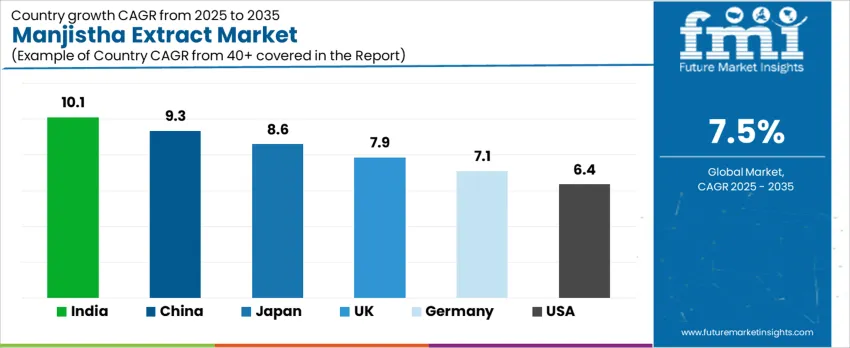
| Country | CAGR (%) |
|---|---|
| India | 10.1% |
| China | 9.3% |
| Japan | 8.6% |
| UK | 7.9% |
| Germany | 7.1% |
| USA | 6.4% |
How is India driving the Manjistha Extract Market?
India expands at 10.1% CAGR, driven by entrenched Ayurvedic use of manjistha as a blood purifier supporting skin clarity and inflammation management. Domestic nutraceutical producers manufacture capsules and syrups positioned for detox, circulatory support, acne-prone skin, and pigmentation management. Herbal skincare brands use manjistha extract in serums and creams marketed for tone correction, blemish reduction, and radiance. Contract manufacturers supply standardized extracts and finished formulations for exports to the United States, Europe, and East Asia. Regulatory compliance upgrades improve traceability, pesticide-residue monitoring, and microbial control to meet international requirements.
- Ayurveda-based demand sustaining core consumption
- Beauty-from-within and topical derma-care expanding applications
- Export-focused manufacturing supporting global supply
- Improved quality systems strengthening buyer confidence
How is China shaping commercial adoption of manjistha extract?
China demonstrates 9.3% CAGR, driven by inclusion of manjistha in beauty supplements, liver-detox blends, and herbal functional beverages. Consumer interest focuses on formulations supporting clearer skin and antioxidant resilience. Domestic brands import standardized extracts mainly from India and test for heavy-metal and solvent compliance under regulated supplement frameworks. Manjistha appears in oral beauty solutions alongside goji, green tea, and collagen ingredients. E-commerce and social commerce platforms accelerate awareness among urban wellness consumers seeking plant-based skincare support.
- Beauty-wellness crossovers stimulating demand
- Quality verification triggered by import-heavy sourcing
- Functional beverages and sachets growing uptake
- E-commerce channels expanding reach in urban populations
How is Japan supporting dermaceutical-grade applications?
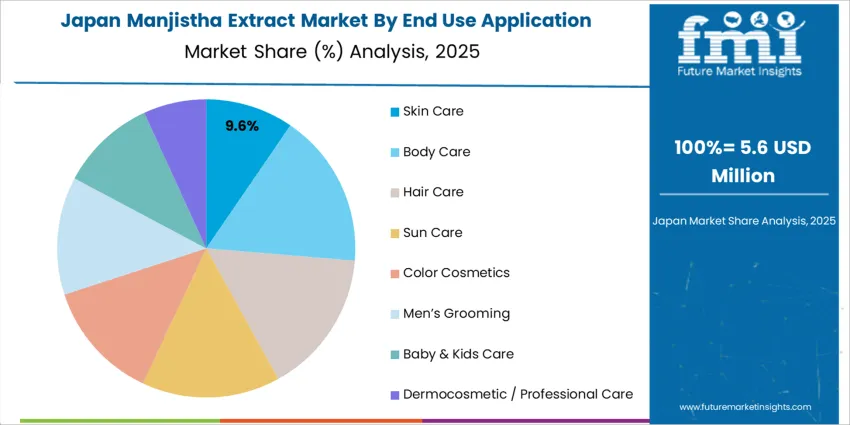
Japan grows at 8.6% CAGR, supported by its focus on high-quality botanical actives for skin maintenance. Manjistha extract is included in dermaceutical topicals for pigment regulation and in ingestible beauty supplements targeting blemish and redness control. Research-centered marketing emphasizes antioxidant and anti-inflammatory activity under mild formulations suited to sensitive skin. Retail channels prefer traceable sourcing from GACP-compliant suppliers in India. Ready-to-drink wellness beverages and powder sticks introduce manjistha in convenient daily routines.
- Dermaceutical skin-brightening formulations driving evaluations
- Sensitive-skin positioning shaping ingredient selection
- Traceability requirements guiding importer partnerships
- Convenient drinkable formats promoting daily adherence
How is the United Kingdom expanding manjistha extract use?
The United Kingdom posts 7.9% CAGR, led by natural beauty supplements and botanical detox product ranges. Heritage Ayurveda brands expand placements across specialty health retailers and online subscription services. Consumers associate manjistha with skin health, hormonal balance, and detox benefits, supporting recurring product purchases. Importers monitor organic-certification status and ethical sourcing claims. Co-formulation with turmeric, ashwagandha, and neem enhances multi-benefit positioning aligned with wellness-culture messaging.
- Detox and skin-health roles forming core marketing
- Subscription-based supplement models strengthening repeat demand
- Sourcing ethics and organic standards influencing procurement
- Botanical blends supporting premium-price positioning
How is Germany reinforcing controlled supplement adoption?
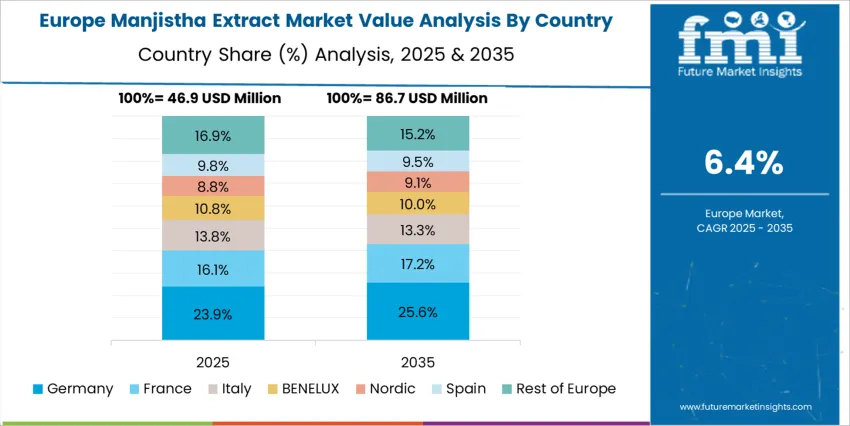
Germany achieves 7.1% CAGR, reflecting pharmacist-supervised interest in clinically supported botanicals. Manjistha extract is included in regulated supplement formats linked to skin-calming and detox support. Buyers require standardized active profiles, validated stability data, and compliance with EU contaminant limits. Consumers increasingly adopt plant-based derma-support as a preventive self-care practice. Functional herbal teas with manjistha are introduced cautiously, with clear communication avoiding medicinal claims.
- Regulated supplement structure guiding product approvals
- Standardization and compliance as critical sourcing criteria
- Preventive usage patterns supporting gradual expansion
- Tea and capsule formats aiding mainstream adoption
How is the United States diversifying manjistha extract applications?
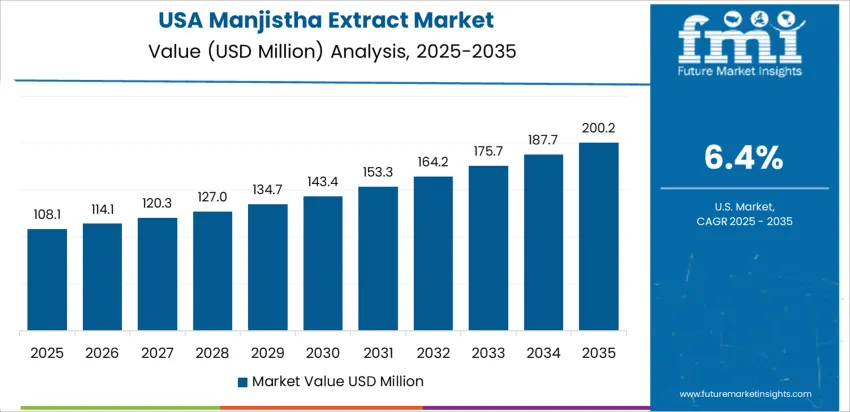
The United States grows at 6.4% CAGR, influenced by demand for clean skincare, detox supplements, and anti-inflammatory botanicals in integrative health routines. Brands position manjistha as a plant-based solution for complexion balance and metabolic clarity. Capsules, tinctures, and beauty-support blends integrate manjistha with collagen, zinc, and hormonal-support ingredients. Marketing messaging focuses on holistic skin wellness rather than claims tied to traditional blood-purification terminology. Clean-label certification, allergen-free formulation, and transparent sourcing contribute to buyer trust in regulated retail environments and e-commerce channels.
- Holistic beauty and detox applications driving interest
- Combination formulations expanding placement in wellness aisles
- Clean-label and third-party testing requirements shaping sourcing
- E-commerce platforms increasing ingredient visibility
What does the global competitive structure for manjistha extract demand show?
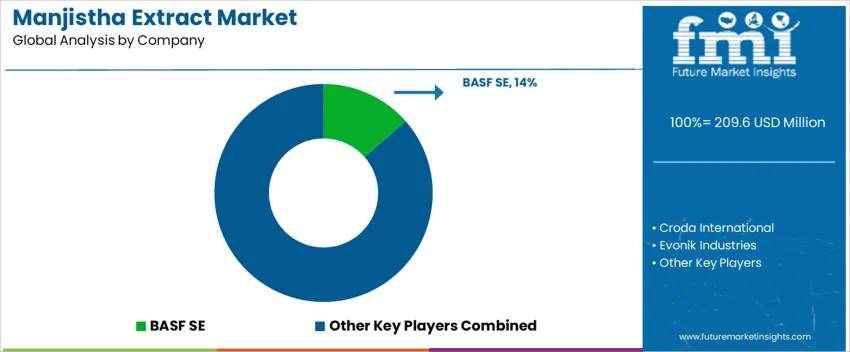
Global demand for manjistha extract focuses on skin-brightening, anti-inflammatory, and environmental-stress defense uses in topical and nutricosmetic formulations. Buyers prioritize guaranteed identity and consistent levels of rubiadin, purpurin, and linked flavonoids. Performance expectations include support for post-acne tone irregularities and pollution-related skin stress, which requires suppliers to provide analytical documentation, controlled-residue extraction, and compliance with international cosmetic-ingredient regulations across North America, Europe, and Asia.
BASF SE holds about 13.6% share. It serves regulated personal-care channels that require stability data and validated bioactivity for uniform pigmentation-control claims. Croda International supplies premium beauty brands seeking formulation flexibility with concentrated botanical actives. Evonik Industries and Symrise operate in dermocosmetic and sensitive-skin formats where delivery-system compatibility and preservative-strategy integration are important competitive elements.
Dow contributes through supply arrangements with high-volume facial-care lines that integrate manjistha into brightness-supporting blends. Ashland and Clariant sustain demand where sustainability documentation, environmental standards, and traceable sourcing influence procurement. Participation by Seppic, Lubrizol, Lonza, Inolex and other botanical specialists supports niche utilization in serums, ayurvedic-inspired routines, and nutraceutical dosage forms. Positioning depends on crop-quality oversight, extraction-solvent transparency, and evidence confirming compatibility with claims for pigment-pathway modulation and skin-tone uniformity.
Key Players in the Manjistha Extract Market
- BASF SE
- Croda International
- Evonik Industries
- Symrise (incl. IFF/Givaudan actives)
- Dow / Dow Inc.
- Ashland
- Clariant
- Others (Seppic, Lubrizol, Lonza, Inolex etc.)
Scope of the Report
| Items | Values |
|---|---|
| Quantitative Units | USD million |
| End Use Application | Skin Care, Body Care, Hair Care, Sun Care, Color Cosmetics, Men’s Grooming, Baby & Kids Care, Dermocosmetic / Professional Care |
| Product Form | Powder, Granules / Agglomerates, Flakes, Pellets / Prills, Liquid (Solution), Concentrate (High-active Liquid), Dispersion / Suspension, Emulsion, Paste, Gel, Wax / Solid Block, Oil |
| Regions Covered | Asia Pacific, Europe, North America, Latin America, Middle East & Africa |
| Countries Covered | India, China, USA, Germany, South Korea, Japan, Italy, and 40+ countries |
| Key Companies Profiled | BASF SE, Croda International, Evonik Industries, Symrise (incl. IFF/Givaudan actives), Dow / Dow Inc., Ashland, Clariant, Others (Seppic, Lubrizol, Lonza, Inolex etc.) |
| Additional Attributes | Dollar sales by end-use applications and formulation formats; adoption trends in Ayurvedic and botanical extracts for detoxifying and anti-inflammatory cosmetics; growth in "clean beauty" and vegan product claims supporting demand; regional sourcing strengths in India and Southeast Asia for Rubia cordifolia roots; R&D advancements in standardized active compounds such as purpurin and munjistin; regulatory compliance trends in EU cosmetics regulation and USA botanical ingredient labeling; competitive landscape among global ingredient manufacturers and natural personal care brands. |
Manjistha Extract Market by Segment
End Use Application:
- Skin Care
- Body Care
- Hair Care
- Sun Care
- Color Cosmetics
- Men’s Grooming
- Baby & Kids Care
- Dermocosmetic / Professional Care
Product Form:
- Powder
- Granules / Agglomerates
- Flakes
- Pellets / Prills
- Liquid (Solution)
- Concentrate (High-active Liquid)
- Dispersion / Suspension
- Emulsion
- Paste
- Gel
- Wax / Solid Block
- Oil
Region:
- Asia Pacific
- China
- Japan
- South Korea
- India
- Australia & New Zealand
- ASEAN
- Rest of Asia Pacific
- Europe
- Germany
- United Kingdom
- France
- Italy
- Spain
- Nordic
- BENELUX
- Rest of Europe
- North America
- United States
- Canada
- Mexico
- Latin America
- Brazil
- Chile
- Rest of Latin America
- Middle East & Africa
- Kingdom of Saudi Arabia
- Other GCC Countries
- Turkey
- South Africa
- Other African Union
- Rest of Middle East & Africa
Bibliography
- Japan Food Additives Association. (2023). Guidance on botanical extracts and their use in food and beverage applications. JFAA Technical Publications.
- International Organization of the Flavor Industry. (2023). Good manufacturing practice for plant extracts and natural ingredients used in consumables. IOFI Technical Guidance Documents.
- Food and Agriculture Organization of the United Nations and World Health Organization. (2023). Codex standards and guidelines relevant to botanical extracts and natural flavor preparations. Codex Alimentarius Publications.
- World Health Organization. (2023). Guidelines on quality, safety, and efficacy of herbal and botanical products. WHO Technical Guidance Documents.
Frequently Asked Questions
How big is the manjistha extract market in 2025?
The global manjistha extract market is estimated to be valued at USD 209.6 million in 2025.
What will be the size of manjistha extract market in 2035?
The market size for the manjistha extract market is projected to reach USD 431.2 million by 2035.
How much will be the manjistha extract market growth between 2025 and 2035?
The manjistha extract market is expected to grow at a 7.5% CAGR between 2025 and 2035.
What are the key product types in the manjistha extract market?
The key product types in manjistha extract market are skin care, body care, hair care, sun care, color cosmetics, men’s grooming, baby & kids care and dermocosmetic / professional care.
Which product form segment to contribute significant share in the manjistha extract market in 2025?
In terms of product form, powder segment to command 14.3% share in the manjistha extract market in 2025.
Preview the report firsthand - request a free sample
Get SampleGet the brochure for pricing and purchase details.
Get PDFTable of Content
- Executive Summary
- Global Market Outlook
- Demand-side Trends
- Supply-side Trends
- Technology Roadmap Analysis
- Analysis and Recommendations
- Market Overview
- Market Coverage / Taxonomy
- Market Definition / Scope / Limitations
- Market Background
- Market Dynamics
- Drivers
- Restraints
- Opportunity
- Trends
- Scenario Forecast
- Demand in Optimistic Scenario
- Demand in Likely Scenario
- Demand in Conservative Scenario
- Opportunity Map Analysis
- Product Life Cycle Analysis
- Supply Chain Analysis
- Investment Feasibility Matrix
- Value Chain Analysis
- PESTLE and Porter’s Analysis
- Regulatory Landscape
- Regional Parent Market Outlook
- Production and Consumption Statistics
- Import and Export Statistics
- Market Dynamics
- Global Market Analysis 2020 to 2024 and Forecast, 2025 to 2035
- Historical Market Size Value (USD Million) Analysis, 2020 to 2024
- Current and Future Market Size Value (USD Million) Projections, 2025 to 2035
- Y-o-Y Growth Trend Analysis
- Absolute $ Opportunity Analysis
- Global Market Pricing Analysis 2020 to 2024 and Forecast 2025 to 2035
- Global Market Analysis 2020 to 2024 and Forecast 2025 to 2035, By End Use Application
- Introduction / Key Findings
- Historical Market Size Value (USD Million) Analysis By End Use Application , 2020 to 2024
- Current and Future Market Size Value (USD Million) Analysis and Forecast By End Use Application , 2025 to 2035
- Skin Care
- Body Care
- Hair Care
- Sun Care
- Color Cosmetics
- Men’s Grooming
- Baby & Kids Care
- Dermocosmetic / Professional Care
- Y-o-Y Growth Trend Analysis By End Use Application , 2020 to 2024
- Absolute $ Opportunity Analysis By End Use Application , 2025 to 2035
- Global Market Analysis 2020 to 2024 and Forecast 2025 to 2035, By Product Form
- Introduction / Key Findings
- Historical Market Size Value (USD Million) Analysis By Product Form, 2020 to 2024
- Current and Future Market Size Value (USD Million) Analysis and Forecast By Product Form, 2025 to 2035
- Powder
- Granules / Agglomerates
- Flakes
- Pellets / Prills
- Liquid (Solution)
- Concentrate (High-active Liquid)
- Dispersion / Suspension
- Emulsion
- Paste
- Gel
- Wax / Solid Block
- Y-o-Y Growth Trend Analysis By Product Form, 2020 to 2024
- Absolute $ Opportunity Analysis By Product Form, 2025 to 2035
- Global Market Analysis 2020 to 2024 and Forecast 2025 to 2035, By Region
- Introduction
- Historical Market Size Value (USD Million) Analysis By Region, 2020 to 2024
- Current Market Size Value (USD Million) Analysis and Forecast By Region, 2025 to 2035
- North America
- Latin America
- Western Europe
- Eastern Europe
- East Asia
- South Asia and Pacific
- Middle East & Africa
- Market Attractiveness Analysis By Region
- North America Market Analysis 2020 to 2024 and Forecast 2025 to 2035, By Country
- Historical Market Size Value (USD Million) Trend Analysis By Market Taxonomy, 2020 to 2024
- Market Size Value (USD Million) Forecast By Market Taxonomy, 2025 to 2035
- By Country
- USA
- Canada
- Mexico
- By End Use Application
- By Product Form
- By Country
- Market Attractiveness Analysis
- By Country
- By End Use Application
- By Product Form
- Key Takeaways
- Latin America Market Analysis 2020 to 2024 and Forecast 2025 to 2035, By Country
- Historical Market Size Value (USD Million) Trend Analysis By Market Taxonomy, 2020 to 2024
- Market Size Value (USD Million) Forecast By Market Taxonomy, 2025 to 2035
- By Country
- Brazil
- Chile
- Rest of Latin America
- By End Use Application
- By Product Form
- By Country
- Market Attractiveness Analysis
- By Country
- By End Use Application
- By Product Form
- Key Takeaways
- Western Europe Market Analysis 2020 to 2024 and Forecast 2025 to 2035, By Country
- Historical Market Size Value (USD Million) Trend Analysis By Market Taxonomy, 2020 to 2024
- Market Size Value (USD Million) Forecast By Market Taxonomy, 2025 to 2035
- By Country
- Germany
- UK
- Italy
- Spain
- France
- Nordic
- BENELUX
- Rest of Western Europe
- By End Use Application
- By Product Form
- By Country
- Market Attractiveness Analysis
- By Country
- By End Use Application
- By Product Form
- Key Takeaways
- Eastern Europe Market Analysis 2020 to 2024 and Forecast 2025 to 2035, By Country
- Historical Market Size Value (USD Million) Trend Analysis By Market Taxonomy, 2020 to 2024
- Market Size Value (USD Million) Forecast By Market Taxonomy, 2025 to 2035
- By Country
- Russia
- Poland
- Hungary
- Balkan & Baltic
- Rest of Eastern Europe
- By End Use Application
- By Product Form
- By Country
- Market Attractiveness Analysis
- By Country
- By End Use Application
- By Product Form
- Key Takeaways
- East Asia Market Analysis 2020 to 2024 and Forecast 2025 to 2035, By Country
- Historical Market Size Value (USD Million) Trend Analysis By Market Taxonomy, 2020 to 2024
- Market Size Value (USD Million) Forecast By Market Taxonomy, 2025 to 2035
- By Country
- China
- Japan
- South Korea
- By End Use Application
- By Product Form
- By Country
- Market Attractiveness Analysis
- By Country
- By End Use Application
- By Product Form
- Key Takeaways
- South Asia and Pacific Market Analysis 2020 to 2024 and Forecast 2025 to 2035, By Country
- Historical Market Size Value (USD Million) Trend Analysis By Market Taxonomy, 2020 to 2024
- Market Size Value (USD Million) Forecast By Market Taxonomy, 2025 to 2035
- By Country
- India
- ASEAN
- Australia & New Zealand
- Rest of South Asia and Pacific
- By End Use Application
- By Product Form
- By Country
- Market Attractiveness Analysis
- By Country
- By End Use Application
- By Product Form
- Key Takeaways
- Middle East & Africa Market Analysis 2020 to 2024 and Forecast 2025 to 2035, By Country
- Historical Market Size Value (USD Million) Trend Analysis By Market Taxonomy, 2020 to 2024
- Market Size Value (USD Million) Forecast By Market Taxonomy, 2025 to 2035
- By Country
- Kingdom of Saudi Arabia
- Other GCC Countries
- Turkiye
- South Africa
- Other African Union
- Rest of Middle East & Africa
- By End Use Application
- By Product Form
- By Country
- Market Attractiveness Analysis
- By Country
- By End Use Application
- By Product Form
- Key Takeaways
- Key Countries Market Analysis
- USA
- Pricing Analysis
- Market Share Analysis, 2024
- By End Use Application
- By Product Form
- Canada
- Pricing Analysis
- Market Share Analysis, 2024
- By End Use Application
- By Product Form
- Mexico
- Pricing Analysis
- Market Share Analysis, 2024
- By End Use Application
- By Product Form
- Brazil
- Pricing Analysis
- Market Share Analysis, 2024
- By End Use Application
- By Product Form
- Chile
- Pricing Analysis
- Market Share Analysis, 2024
- By End Use Application
- By Product Form
- Germany
- Pricing Analysis
- Market Share Analysis, 2024
- By End Use Application
- By Product Form
- UK
- Pricing Analysis
- Market Share Analysis, 2024
- By End Use Application
- By Product Form
- Italy
- Pricing Analysis
- Market Share Analysis, 2024
- By End Use Application
- By Product Form
- Spain
- Pricing Analysis
- Market Share Analysis, 2024
- By End Use Application
- By Product Form
- France
- Pricing Analysis
- Market Share Analysis, 2024
- By End Use Application
- By Product Form
- India
- Pricing Analysis
- Market Share Analysis, 2024
- By End Use Application
- By Product Form
- ASEAN
- Pricing Analysis
- Market Share Analysis, 2024
- By End Use Application
- By Product Form
- Australia & New Zealand
- Pricing Analysis
- Market Share Analysis, 2024
- By End Use Application
- By Product Form
- China
- Pricing Analysis
- Market Share Analysis, 2024
- By End Use Application
- By Product Form
- Japan
- Pricing Analysis
- Market Share Analysis, 2024
- By End Use Application
- By Product Form
- South Korea
- Pricing Analysis
- Market Share Analysis, 2024
- By End Use Application
- By Product Form
- Russia
- Pricing Analysis
- Market Share Analysis, 2024
- By End Use Application
- By Product Form
- Poland
- Pricing Analysis
- Market Share Analysis, 2024
- By End Use Application
- By Product Form
- Hungary
- Pricing Analysis
- Market Share Analysis, 2024
- By End Use Application
- By Product Form
- Kingdom of Saudi Arabia
- Pricing Analysis
- Market Share Analysis, 2024
- By End Use Application
- By Product Form
- Turkiye
- Pricing Analysis
- Market Share Analysis, 2024
- By End Use Application
- By Product Form
- South Africa
- Pricing Analysis
- Market Share Analysis, 2024
- By End Use Application
- By Product Form
- USA
- Market Structure Analysis
- Competition Dashboard
- Competition Benchmarking
- Market Share Analysis of Top Players
- By Regional
- By End Use Application
- By Product Form
- Competition Analysis
- Competition Deep Dive
- BASF SE
- Overview
- Product Portfolio
- Profitability by Market Segments (Product/Age /Sales Channel/Region)
- Sales Footprint
- Strategy Overview
- Marketing Strategy
- Product Strategy
- Channel Strategy
- Croda International
- Evonik Industries
- Symrise (incl. IFF/Givaudan actives)
- Dow / Dow Inc.
- Ashland
- Clariant
- Others (Seppic, Lubrizol, Lonza, Inolex etc.)
- BASF SE
- Competition Deep Dive
- Assumptions & Acronyms Used
- Research Methodology


