

- Industry Size (2025)
- USD 298.1 Mn
- Forecast (2035)
- USD 587.9 Mn
- CAGR (2025 to 2035)
- 7.0%
Tulsi Extract Market Forecast and Outlook 2025 to 2035
The global tulsi extract market is valued at USD 298.1 million in 2025 and is forecasted to reach USD 587.9 million by 2035, reflecting a CAGR of 7.0%. Growth is supported by increased use of plant-derived actives in personal-care formulations and wider acceptance of traditional botanical ingredients in dermatology-focused products. Tulsi extract is adopted for its calming, antioxidant, and antimicrobial properties suited to routine skincare usage. Skin care represents the leading application area. Demand is influenced by product launches targeting irritation reduction, environmental-stress protection, and skin-balancing benefits. Manufacturers utilize extract standardization and controlled processing to ensure consistent bioactive performance in finished products.
Asia Pacific, Europe, and North America register the highest growth due to strong consumer awareness of herbal products and continued expansion of clean-beauty portfolios by multinational brands. These regions maintain established supply networks and regulatory frameworks that support safe integration of tulsi extract into personal-care applications. Key suppliers include BASF SE, Croda International, Evonik Industries, Symrise, and Dow. Their development priorities involve stability enhancement, compatibility with water- and oil-based formulations, and alignment with safety and sustainability guidelines for botanical ingredients.
Quick Stats for Global Tulsi Extract Demand
- Global Tulsi Extract Sales Value (2025): USD 298.1 million
- Global Tulsi Extract Forecast Value (2035): USD 587.9 million
- Global Tulsi Extract Forecast CAGR (2025–2035): 7.0%
- Leading Application in Global Tulsi Extract Demand: Skin Care
- Key Growth Regions in Global Tulsi Extract Demand: Asia Pacific, Europe, North America
- Top Players in Global Tulsi Extract Demand: BASF SE, Croda International, Evonik Industries, Symrise, Dow
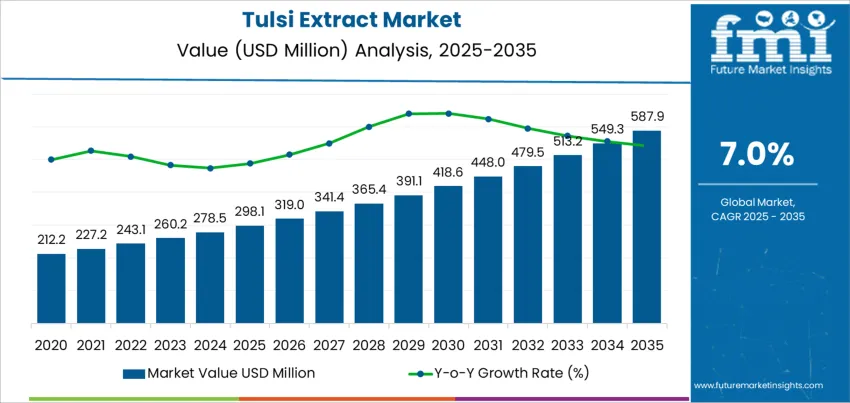
What is the Growth Forecast for the Tulsi Extract Market through 2035?
Acceleration and deceleration patterns within the global tulsi extract industry reflect shifts in demand drivers and application maturity. The acceleration phase is supported by increasing consumer preference for natural immunity boosters, herbal supplements, and clean label functional foods. Tulsi is widely recognized for its adaptogenic and anti-inflammatory properties, which encourages rapid adoption in nutraceuticals and wellness beverages. Entry of organized manufacturers, improved extraction standards, and expanding retail distribution increase early momentum and lift growth beyond traditional Ayurvedic use.
The deceleration pattern appears when specific application segments approach maturity, particularly in regions where tulsi-based supplements already have strong penetration. Competition from other botanical extracts such as ashwagandha and moringa may also moderate growth rates over time. Expansion into personal care and pharmaceutical formulations helps offset slowdown, but regulatory testing and validation requirements extend commercialization cycles and reduce short-term acceleration. Growth remains positive, but the speed of expansion becomes uneven. Early acceleration is driven by awareness and broadening product innovation, while future deceleration reflects normalization in core supplement categories. Maintaining momentum requires diversified applications, clinically supported claims, and wider global consumer education.
Tulsi Extract Market Key Takeaways
| Metric | Value |
|---|---|
| Market Value (2025) | USD 298.1 million |
| Market Forecast Value (2035) | USD 587.9 million |
| Forecast CAGR (2025-2035) | 7.0% |
Why is the Demand for Tulsi Extract Growing Globally?
Demand for tulsi extract is increasing worldwide because consumers seek herbal ingredients linked to immune support, stress balance and respiratory wellness. Tulsi, also known as Holy Basil, is recognized in traditional medicine for its calming and antioxidant properties, which aligns with growing interest in natural solutions for daily health management. Nutraceutical brands include tulsi extract in capsules, powders and functional beverages that target lifestyle stress, which encourages recurring use among wellness focused consumers. Personal care companies adopt tulsi extract for anti-inflammatory and antimicrobial benefits in oral care, skin care and scalp care products. Its botanical profile supports clean label formulations that avoid synthetic preservatives in sensitive skin categories. Herbal tea and beverage manufacturers expand product lines with tulsi blends that promote relaxation and regular consumption.
Global distribution improves as e commerce makes Ayurvedic products widely accessible in North America and Europe, where interest in traditional botanical remedies continues to rise. Standardized extracts help manufacturers maintain consistent quality across product batches. Constraints include the need for reliable cultivation and careful extraction to preserve active compounds. Regulatory compliance varies across regions, requiring precise labeling and safety data to support health related claims.
Which End-Use Applications and Product Forms Lead Global Demand for Tulsi Extract?
Global demand for tulsi extract is supported by its antimicrobial, antioxidant, and anti-inflammatory benefits, which align with consumer preferences for herbal, clean-label personal care actives. The ingredient is widely integrated into formulations tackling acne, skin stress, and scalp irritation. Tulsi extract adoption is reinforced by Ayurvedic product positioning, rising interest in traditional botanicals, and increased launches in premium and dermocosmetic segments.
By End-Use Application, Skin Care Holds the Largest Share
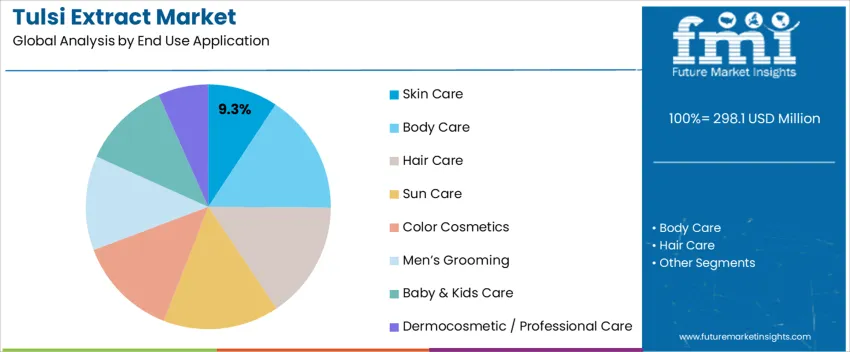
Skin care accounts for 9.3% of global tulsi extract consumption, driven by demand for anti-blemish, soothing, and detoxifying treatments suited to sensitive or stressed skin. Brands utilize tulsi in serums, micellar waters, spot correctors, and face washes where its phytochemical profile targets redness, breakouts, and environmental damage. Body-care applications continue to expand through hygiene washes and odor-control products. Hair-care adoption benefits from tulsi’s dandruff-control and scalp-purifying capabilities across shampoos and herbal hair oils. Men’s grooming and baby-care introductions emphasize mild antimicrobial protection with natural labeling. Dermocosmetic brands incorporate tulsi into irritation-management and pollution-defense product lines to support clinical positioning in urban markets.
Key Points:
- Strong placement in acne-control and detoxifying facial products
- Growth supported by scalp-care and sensitive-skin hygiene solutions
- Ayurvedic positioning enhances acceptance in premium clean-beauty formulations
By Product Form, Powder Leads Global Demand
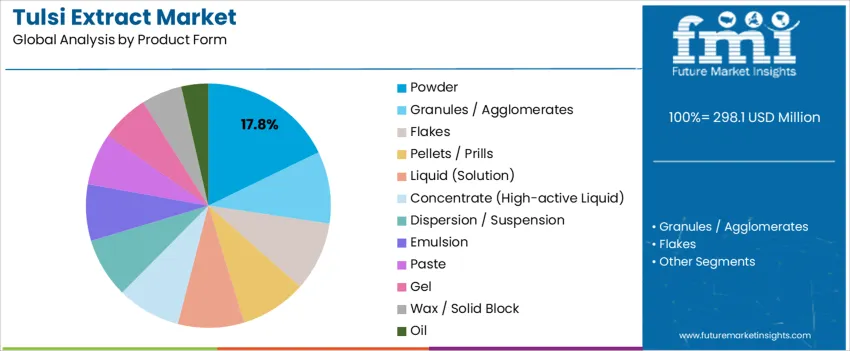
Powder form represents 17.8% of total demand, favored for its stability, versatile processing, and compatibility with water-based, solvent-free, or solid product formats. Powder tulsi extract is widely used in dry masks, bar cleansers, herbal pastes, and rinse-off scalp treatments. Liquid solutions and dispersions are incorporated into serums and sprays requiring smooth spreadability and controlled delivery of active molecules. Concentrate and emulsion formats gain attention in advanced personal-care applications targeting higher potency. Texture-specific forms such as gels and oils are applied in premium products where sensory differentiation matters. Form decisions depend on purity standardization, manufacturing preferences, and targeted product category benefits across global skincare and haircare portfolios.
Key Points:
- Powder ensures stable concentration and broad formulation flexibility
- Liquid formats support performance in serums and leave-on treatments
- Specialized forms used for sensorial and high-potency applications
What are the Drivers, Restraints, and Key Trends of the Global Tulsi Extract Market?
Rising demand for herbal supplements and natural wellness products, increased interest in immune-support botanicals, and growing popularity of functional beverages drive demand.
Globally, tulsi (holy basil) extract is widely adopted in dietary supplements, teas, wellness drinks and natural healthcare products targeting consumers focused on stress reduction, immune health and holistic well-being. Growing awareness of adaptogen herbs and clean-label ingredients supports inclusion of tulsi in capsules, powders, ready-to-drink blends and kombuchas. Markets across North America, Europe and Asia-Pacific show rising consumption of immune-boosting and stress-management products, sustaining demand for standardized tulsi extract. Health-conscious consumers layer tulsi into daily routines alongside vitamins and probiotics, reinforcing stable consumption growth worldwide.
Variability in phytochemical content, regulatory constraints on health claims and competition from established herbal extracts restrain market growth.
Tulus’ active compounds vary significantly with cultivation conditions, harvest time and extraction method, which complicates standardization across batches. Regulatory frameworks in many countries restrict medical or therapeutic claims for botanical supplements, limiting the ability of brands to promote benefits like stress relief or immunity support. Moreover, other well-known botanicals and vitamins remain dominant in global supplement markets, making it challenging for tulsi to displace entrenched categories. Price sensitivity among price-conscious consumers may also limit adoption in cost-sensitive regions.
Shift toward standardized high-rosmarinic-acid extracts, increased use in functional beverage formulations and rising integration in skin-care and natural personal-care products define key trends.
Ingredient suppliers emphasize extraction techniques that yield consistent levels of key actives such as rosmarinic acid and ursolic acid to support quality control and enabling better formulation outcomes. Beverage producers combine tulsi extract with other botanicals like ginger, turmeric or ginseng to create novel functional drinks that appeal to wellness consumers seeking natural stress and inflammation support. Cosmetic and personal-care brands increasingly include tulsi extract in lotions, cleansers and serums to leverage its antioxidant and soothing properties. Retail distribution through e-commerce and international wellness platforms helps tulsi-based products reach wider audiences beyond traditional supplement buyers. These developments point to steady, cross-category growth for tulsi extract globally within nutrition, beverage and personal-care sectors.
Analysis of the Tulsi Extract Market by Key Country
Global demand for tulsi (holy basil) extract is increasing through 2035 as manufacturers expand its use in herbal teas, respiratory-support formulations, stress and immunity supplements, oral-care products, and topical preparations. Standardized extracts rich in eugenol and other actives are used in both traditional and clinically oriented formulations. Clean-label positioning, plant-based wellness trends, and interest in botanical immunity support continue to shape global procurement. India registers a 9.5% CAGR, followed by China at 8.8% and Japan at 8.1%, driven by the structured herbal and functional-food industries. The United Kingdom grows at 7.4%, Germany at 6.7%, and the United States at 6.0%, reflecting wider adoption of adaptogenic and respiratory-support botanicals in regulated and retail wellness channels.
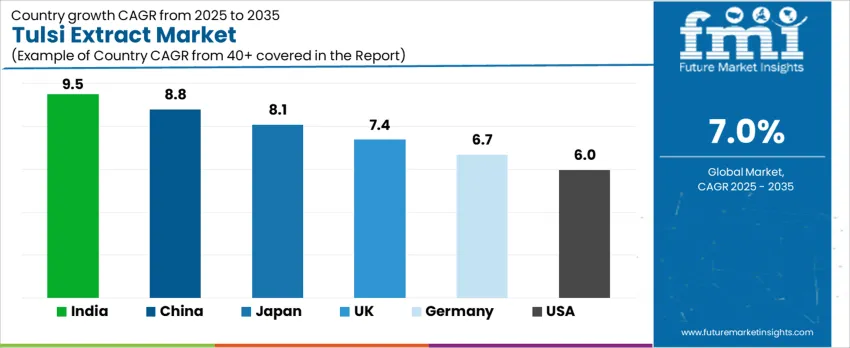
| Country | CAGR (%) |
|---|---|
| India | 9.5% |
| China | 8.8% |
| Japan | 8.1% |
| UK | 7.4% |
| Germany | 6.7% |
| USA | 6.0% |
How is India driving the Tulsi Extract Market?
India records 9.5% CAGR, supported by long-established cultural use of tulsi in Ayurveda and household remedies. Extraction facilities process tulsi leaves into liquid and powdered forms for use in immunity-support tablets, capsules, and herbal teas distributed domestically and abroad. Respiratory and throat-soothing formulations rely on tulsi in combination with ginger, mulethi, and honey-based preparations. Standardization of key phytoconstituents improves compatibility with regulated nutraceutical and OTC categories in export destinations. Contract manufacturers provide private-label finished dosage forms for global wellness brands. Documentation practices for pesticide residues and microbial control are strengthened to comply with international safety benchmarks.
- Ayurveda heritage sustaining consistent domestic consumption
- Standardized extracts supporting export-oriented nutraceutical lines
- Use in respiratory and immunity-support formulations
- Contract manufacturing enabling global private-label offerings
How is China shaping tulsi extract utilization?
China grows at 8.8% CAGR, driven by integration of tulsi extract into functional beverages, herbal blends, and stress-support supplements. Manufacturers evaluate tulsi alongside domestic botanicals for inclusion in calming and focus-support formulas aimed at working-age consumers. Extracts are incorporated into instant beverages and ready-to-drink herbal teas distributed through supermarkets and e-commerce. Importers source primarily from Indian processors, requiring traceability and batch-testing for heavy metals and contaminants. Some agricultural-input firms explore tulsi extracts in natural insect-repellent solutions. Blending expertise within traditional medicine companies supports positioning tulsi as a complementary adaptogen within multi-herb formulations.
- Functional beverages and instant teas expanding consumption
- Stress- and focus-support blends driving formulation interest
- Import-based sourcing requiring rigorous quality verification
- Multi-herb formulations leveraging adaptogenic positioning
How is Japan supporting standardized tulsi extract demand?
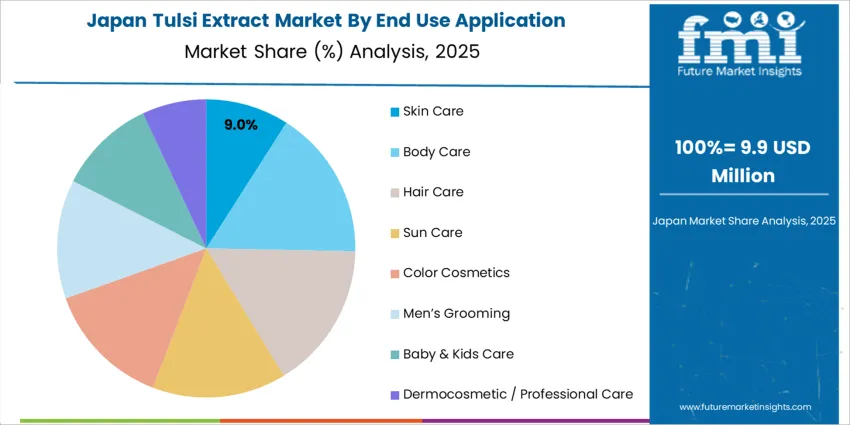
Japan posts 8.1% CAGR, influenced by careful positioning of tulsi extract in stress-relief, throat-comfort, and seasonal wellness products. Supplement and beverage manufacturers design low-flavor-impact formulations to align with Japanese taste preferences, frequently combining tulsi with green tea or mild herbal bases. Clinical-style communication emphasizes resilience and respiratory support for office workers and aging consumers. Pharmacist-associated retail channels prefer standardized extracts with detailed safety and stability data. Importers depend on consistent Indian supply, enforcing narrow specification ranges for active content and contaminant levels. Ready-to-drink teas and stick-sachet powders provide convenient daily-intake formats.
- Stress- and seasonal-wellness products guiding applications
- Taste-adapted formulations supporting consumer acceptance
- Pharmacy-linked retail requiring robust documentation
- Convenient beverage and sachet formats encouraging adherence
How is the United Kingdom expanding tulsi extract use?
The United Kingdom records 7.4% CAGR, led by herbal-tea brands, health-food retailers, and vegan supplement lines that promote tulsi for stress and immune support. Blends featuring tulsi with chamomile, hibiscus, or green tea are popular in urban wellness segments. Capsule and tincture products appear in specialist health stores and online channels targeting busy professionals managing lifestyle-related stress. Importers evaluate suppliers on organic certification, allergen-control measures, and fair-trade sourcing claims. Labelling emphasizes caffeine-free calming support and year-round resilience rather than therapeutic language.
- Herbal tea blends forming the core application base
- Vegan and clean-label supplements widening product range
- Organic and fair-trade criteria guiding procurement
- Online and specialist retail channels driving visibility
How is Germany reinforcing regulated tulsi extract positioning?
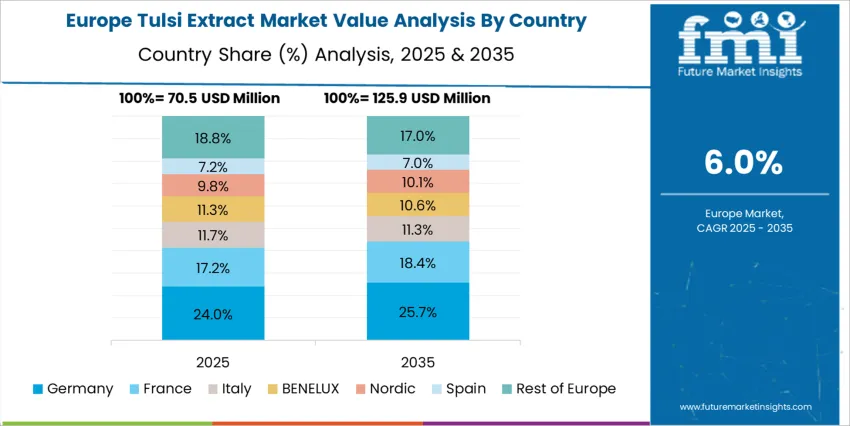
Germany advances at 6.7% CAGR, reflecting pharmacist-driven interest in botanicals for mild stress and respiratory support. Tulsi extract is incorporated into combination herbal supplements that target everyday resilience and seasonal upper-respiratory comfort. Manufacturers require standardized extracts with reproducible active profiles and stability data suitable for shelf-life claims. Phytopharmaceutical guidelines influence supplier qualifications, including solvent-residue limits and microbiological control. Teas and lozenges with tulsi content appear in drugstore and supermarket wellness ranges, promoted as daily support options rather than medicinal treatments.
- Pharmacy and drugstore channels shaping quality expectations
- Combination supplements focusing on resilience and respiratory comfort
- Phytopharmaceutical standards driving rigorous supplier selection
- Tea and lozenge formats supporting gradual, steady adoption
How is the United States diversifying tulsi extract applications?
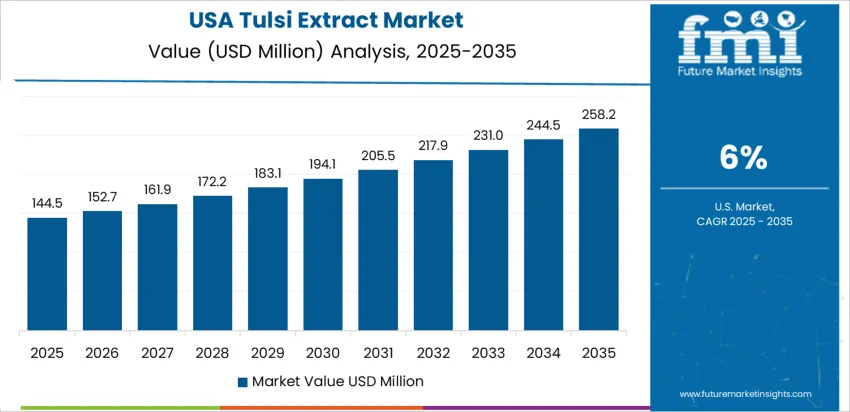
The United States grows at 6.0% CAGR, supported by interest in adaptogenic herbs, stress-management routines, and herbal tea consumption. Tulsi extract is used in capsules, gummies, liquid drops, and blends with ashwagandha, rhodiola, or magnesium for stress and mood-support products. Natural and organic retailers highlight tulsi teas positioned for calm and focus during workdays. Online brands emphasize transparent sourcing from Indian growers and third-party-tested extracts. Regulatory oversight encourages accurate labelling and avoidance of disease claims, shaping marketing language. Tulsi appears in some functional beverages targeting cognitive and emotional balance.
- Adaptogen-focused supplements incorporating tulsi with other botanicals
- Natural and organic retail supporting premium-positioned teas
- Sourcing transparency and third-party testing influencing trust
- Functional beverages expanding consumption occasions beyond teas
What does the global competitive structure for tulsi extract demand show?
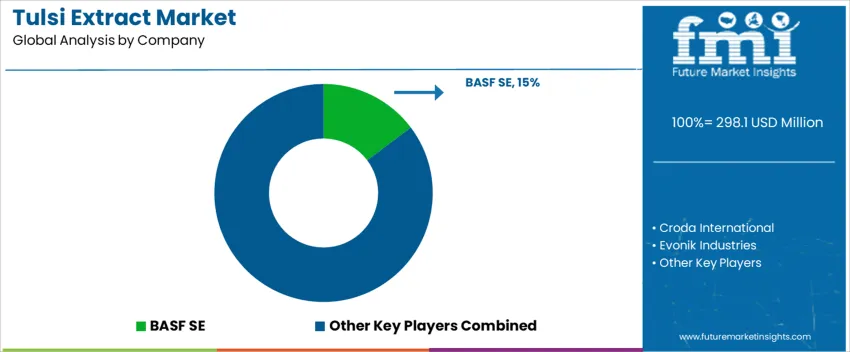
Global demand for tulsi extract centers on its use in skin-calming, antioxidant, and oral-care formulations, along with limited adoption in nutraceutical applications. Supply reliability and compound standardization, including rosmarinic acid and eugenol content, influence purchasing by major personal-care manufacturers. Agricultural sourcing remains concentrated in India, so suppliers prioritize traceability and pesticide-control programs to maintain access to regulated consumer sectors in North America, Europe, and East Asia.
BASF SE holds about 14.8% share. It supports dermocosmetic and hygiene formulations requiring accredited microbiological testing, physicochemical stability, and compliance with international extract regulations. Croda International contributes through controlled-origin botanical actives that target sensory comfort and barrier support in leave-on systems. Evonik Industries and Symrise participate through formulations that integrate tulsi with delivery technology and natural preservative strategies aligned with clean-label preferences.
Dow provides broader availability for high-volume personal-care ranges where tulsi contributes antimicrobial and scalp-care functionality. Ashland and Clariant maintain positions where environmental auditing and documentation depth are required by global brand owners. Additional participation from Seppic, Lubrizol, Lonza, Inolex and peers reflects ongoing development of concentrated grades for oral-care pastes, mild cleansing, and supplements. Competitive positioning depends on validated bioactivity profiles, low-residue extraction, and supply diversification strategies that reduce agricultural variability risk.
Key Players in the Tulsi Extract Market
- BASF SE
- Croda International
- Evonik Industries
- Symrise (incl. IFF/Givaudan actives)
- Dow / Dow Inc.
- Ashland
- Clariant
- Others (Seppic, Lubrizol, Lonza, Inolex etc.)
Scope of the Report
| Items | Values |
|---|---|
| Quantitative Units | USD million |
| End Use Application | Skin Care, Body Care, Hair Care, Sun Care, Color Cosmetics, Men’s Grooming, Baby & Kids Care, Dermocosmetic / Professional Care |
| Product Form | Powder, Granules / Agglomerates, Flakes, Pellets / Prills, Liquid (Solution), Concentrate (High-active Liquid), Dispersion / Suspension, Emulsion, Paste, Gel, Wax / Solid Block, Oil |
| Regions Covered | Asia Pacific, Europe, North America, Latin America, Middle East & Africa |
| Countries Covered | India, China, USA, Germany, South Korea, Japan, Italy, and 40+ countries |
| Key Companies Profiled | BASF SE, Croda International, Evonik Industries, Symrise (incl. IFF/Givaudan actives), Dow / Dow Inc., Ashland, Clariant, Others (Seppic, Lubrizol, Lonza, Inolex etc.) |
| Additional Attributes | Dollar sales by end-use application and formulation categories; rising demand for Ayurvedic and herbal actives in global personal care products; growing adoption of organic tulsi raw materials from India and Southeast Asia; product innovation for anti-pollution skin care, aromatherapy, and natural therapeutic cosmetics; regulatory considerations for botanical extracts in EU, US, and APAC markets; competitive landscape among global ingredient suppliers and natural cosmetic brands. |
Tulsi Extract Market by Segment
End Use Application:
- Skin Care
- Body Care
- Hair Care
- Sun Care
- Color Cosmetics
- Men’s Grooming
- Baby & Kids Care
- Dermocosmetic / Professional Care
Product Form:
- Powder
- Granules / Agglomerates
- Flakes
- Pellets / Prills
- Liquid (Solution)
- Concentrate (High-active Liquid)
- Dispersion / Suspension
- Emulsion
- Paste
- Gel
- Wax / Solid Block
- Oil
Region:
- Asia Pacific
- China
- Japan
- South Korea
- India
- Australia & New Zealand
- ASEAN
- Rest of Asia Pacific
- Europe
- Germany
- United Kingdom
- France
- Italy
- Spain
- Nordic
- BENELUX
- Rest of Europe
- North America
- United States
- Canada
- Mexico
- Latin America
- Brazil
- Chile
- Rest of Latin America
- Middle East & Africa
- Kingdom of Saudi Arabia
- Other GCC Countries
- Turkey
- South Africa
- Other African Union
- Rest of Middle East & Africa
Frequently Asked Questions
How big is the tulsi extract market in 2025?
The global tulsi extract market is estimated to be valued at USD 298.1 million in 2025.
What will be the size of tulsi extract market in 2035?
The market size for the tulsi extract market is projected to reach USD 587.9 million by 2035.
How much will be the tulsi extract market growth between 2025 and 2035?
The tulsi extract market is expected to grow at a 7.0% CAGR between 2025 and 2035.
What are the key product types in the tulsi extract market?
The key product types in tulsi extract market are skin care, body care, hair care, sun care, color cosmetics, men’s grooming, baby & kids care and dermocosmetic / professional care.
Which product form segment to contribute significant share in the tulsi extract market in 2025?
In terms of product form, powder segment to command 17.8% share in the tulsi extract market in 2025.
Preview the report firsthand - request a free sample
Get SampleGet the brochure for pricing and purchase details.
Get PDFTable of Content
- Executive Summary
- Global Market Outlook
- Demand-side Trends
- Supply-side Trends
- Technology Roadmap Analysis
- Analysis and Recommendations
- Market Overview
- Market Coverage / Taxonomy
- Market Definition / Scope / Limitations
- Market Background
- Market Dynamics
- Drivers
- Restraints
- Opportunity
- Trends
- Scenario Forecast
- Demand in Optimistic Scenario
- Demand in Likely Scenario
- Demand in Conservative Scenario
- Opportunity Map Analysis
- Product Life Cycle Analysis
- Supply Chain Analysis
- Investment Feasibility Matrix
- Value Chain Analysis
- PESTLE and Porter’s Analysis
- Regulatory Landscape
- Regional Parent Market Outlook
- Production and Consumption Statistics
- Import and Export Statistics
- Market Dynamics
- Global Market Analysis 2020 to 2024 and Forecast, 2025 to 2035
- Historical Market Size Value (USD Million) Analysis, 2020 to 2024
- Current and Future Market Size Value (USD Million) Projections, 2025 to 2035
- Y-o-Y Growth Trend Analysis
- Absolute $ Opportunity Analysis
- Global Market Pricing Analysis 2020 to 2024 and Forecast 2025 to 2035
- Global Market Analysis 2020 to 2024 and Forecast 2025 to 2035, By End Use Application
- Introduction / Key Findings
- Historical Market Size Value (USD Million) Analysis By End Use Application , 2020 to 2024
- Current and Future Market Size Value (USD Million) Analysis and Forecast By End Use Application , 2025 to 2035
- Skin Care
- Body Care
- Hair Care
- Sun Care
- Color Cosmetics
- Men’s Grooming
- Baby & Kids Care
- Dermocosmetic / Professional Care
- Y-o-Y Growth Trend Analysis By End Use Application , 2020 to 2024
- Absolute $ Opportunity Analysis By End Use Application , 2025 to 2035
- Global Market Analysis 2020 to 2024 and Forecast 2025 to 2035, By Product Form
- Introduction / Key Findings
- Historical Market Size Value (USD Million) Analysis By Product Form, 2020 to 2024
- Current and Future Market Size Value (USD Million) Analysis and Forecast By Product Form, 2025 to 2035
- Powder
- Granules / Agglomerates
- Flakes
- Pellets / Prills
- Liquid (Solution)
- Concentrate (High-active Liquid)
- Dispersion / Suspension
- Emulsion
- Paste
- Gel
- Wax / Solid Block
- Y-o-Y Growth Trend Analysis By Product Form, 2020 to 2024
- Absolute $ Opportunity Analysis By Product Form, 2025 to 2035
- Global Market Analysis 2020 to 2024 and Forecast 2025 to 2035, By Region
- Introduction
- Historical Market Size Value (USD Million) Analysis By Region, 2020 to 2024
- Current Market Size Value (USD Million) Analysis and Forecast By Region, 2025 to 2035
- North America
- Latin America
- Western Europe
- Eastern Europe
- East Asia
- South Asia and Pacific
- Middle East & Africa
- Market Attractiveness Analysis By Region
- North America Market Analysis 2020 to 2024 and Forecast 2025 to 2035, By Country
- Historical Market Size Value (USD Million) Trend Analysis By Market Taxonomy, 2020 to 2024
- Market Size Value (USD Million) Forecast By Market Taxonomy, 2025 to 2035
- By Country
- USA
- Canada
- Mexico
- By End Use Application
- By Product Form
- By Country
- Market Attractiveness Analysis
- By Country
- By End Use Application
- By Product Form
- Key Takeaways
- Latin America Market Analysis 2020 to 2024 and Forecast 2025 to 2035, By Country
- Historical Market Size Value (USD Million) Trend Analysis By Market Taxonomy, 2020 to 2024
- Market Size Value (USD Million) Forecast By Market Taxonomy, 2025 to 2035
- By Country
- Brazil
- Chile
- Rest of Latin America
- By End Use Application
- By Product Form
- By Country
- Market Attractiveness Analysis
- By Country
- By End Use Application
- By Product Form
- Key Takeaways
- Western Europe Market Analysis 2020 to 2024 and Forecast 2025 to 2035, By Country
- Historical Market Size Value (USD Million) Trend Analysis By Market Taxonomy, 2020 to 2024
- Market Size Value (USD Million) Forecast By Market Taxonomy, 2025 to 2035
- By Country
- Germany
- UK
- Italy
- Spain
- France
- Nordic
- BENELUX
- Rest of Western Europe
- By End Use Application
- By Product Form
- By Country
- Market Attractiveness Analysis
- By Country
- By End Use Application
- By Product Form
- Key Takeaways
- Eastern Europe Market Analysis 2020 to 2024 and Forecast 2025 to 2035, By Country
- Historical Market Size Value (USD Million) Trend Analysis By Market Taxonomy, 2020 to 2024
- Market Size Value (USD Million) Forecast By Market Taxonomy, 2025 to 2035
- By Country
- Russia
- Poland
- Hungary
- Balkan & Baltic
- Rest of Eastern Europe
- By End Use Application
- By Product Form
- By Country
- Market Attractiveness Analysis
- By Country
- By End Use Application
- By Product Form
- Key Takeaways
- East Asia Market Analysis 2020 to 2024 and Forecast 2025 to 2035, By Country
- Historical Market Size Value (USD Million) Trend Analysis By Market Taxonomy, 2020 to 2024
- Market Size Value (USD Million) Forecast By Market Taxonomy, 2025 to 2035
- By Country
- China
- Japan
- South Korea
- By End Use Application
- By Product Form
- By Country
- Market Attractiveness Analysis
- By Country
- By End Use Application
- By Product Form
- Key Takeaways
- South Asia and Pacific Market Analysis 2020 to 2024 and Forecast 2025 to 2035, By Country
- Historical Market Size Value (USD Million) Trend Analysis By Market Taxonomy, 2020 to 2024
- Market Size Value (USD Million) Forecast By Market Taxonomy, 2025 to 2035
- By Country
- India
- ASEAN
- Australia & New Zealand
- Rest of South Asia and Pacific
- By End Use Application
- By Product Form
- By Country
- Market Attractiveness Analysis
- By Country
- By End Use Application
- By Product Form
- Key Takeaways
- Middle East & Africa Market Analysis 2020 to 2024 and Forecast 2025 to 2035, By Country
- Historical Market Size Value (USD Million) Trend Analysis By Market Taxonomy, 2020 to 2024
- Market Size Value (USD Million) Forecast By Market Taxonomy, 2025 to 2035
- By Country
- Kingdom of Saudi Arabia
- Other GCC Countries
- Turkiye
- South Africa
- Other African Union
- Rest of Middle East & Africa
- By End Use Application
- By Product Form
- By Country
- Market Attractiveness Analysis
- By Country
- By End Use Application
- By Product Form
- Key Takeaways
- Key Countries Market Analysis
- USA
- Pricing Analysis
- Market Share Analysis, 2024
- By End Use Application
- By Product Form
- Canada
- Pricing Analysis
- Market Share Analysis, 2024
- By End Use Application
- By Product Form
- Mexico
- Pricing Analysis
- Market Share Analysis, 2024
- By End Use Application
- By Product Form
- Brazil
- Pricing Analysis
- Market Share Analysis, 2024
- By End Use Application
- By Product Form
- Chile
- Pricing Analysis
- Market Share Analysis, 2024
- By End Use Application
- By Product Form
- Germany
- Pricing Analysis
- Market Share Analysis, 2024
- By End Use Application
- By Product Form
- UK
- Pricing Analysis
- Market Share Analysis, 2024
- By End Use Application
- By Product Form
- Italy
- Pricing Analysis
- Market Share Analysis, 2024
- By End Use Application
- By Product Form
- Spain
- Pricing Analysis
- Market Share Analysis, 2024
- By End Use Application
- By Product Form
- France
- Pricing Analysis
- Market Share Analysis, 2024
- By End Use Application
- By Product Form
- India
- Pricing Analysis
- Market Share Analysis, 2024
- By End Use Application
- By Product Form
- ASEAN
- Pricing Analysis
- Market Share Analysis, 2024
- By End Use Application
- By Product Form
- Australia & New Zealand
- Pricing Analysis
- Market Share Analysis, 2024
- By End Use Application
- By Product Form
- China
- Pricing Analysis
- Market Share Analysis, 2024
- By End Use Application
- By Product Form
- Japan
- Pricing Analysis
- Market Share Analysis, 2024
- By End Use Application
- By Product Form
- South Korea
- Pricing Analysis
- Market Share Analysis, 2024
- By End Use Application
- By Product Form
- Russia
- Pricing Analysis
- Market Share Analysis, 2024
- By End Use Application
- By Product Form
- Poland
- Pricing Analysis
- Market Share Analysis, 2024
- By End Use Application
- By Product Form
- Hungary
- Pricing Analysis
- Market Share Analysis, 2024
- By End Use Application
- By Product Form
- Kingdom of Saudi Arabia
- Pricing Analysis
- Market Share Analysis, 2024
- By End Use Application
- By Product Form
- Turkiye
- Pricing Analysis
- Market Share Analysis, 2024
- By End Use Application
- By Product Form
- South Africa
- Pricing Analysis
- Market Share Analysis, 2024
- By End Use Application
- By Product Form
- USA
- Market Structure Analysis
- Competition Dashboard
- Competition Benchmarking
- Market Share Analysis of Top Players
- By Regional
- By End Use Application
- By Product Form
- Competition Analysis
- Competition Deep Dive
- BASF SE
- Overview
- Product Portfolio
- Profitability by Market Segments (Product/Age /Sales Channel/Region)
- Sales Footprint
- Strategy Overview
- Marketing Strategy
- Product Strategy
- Channel Strategy
- Croda International
- Evonik Industries
- Symrise (incl. IFF/Givaudan actives)
- Dow / Dow Inc.
- Ashland
- Clariant
- Others (Seppic, Lubrizol, Lonza, Inolex etc.)
- BASF SE
- Competition Deep Dive
- Assumptions & Acronyms Used
- Research Methodology


