

- Market Size (2026)
- USD 638.4 Mn
- Forecast (2036)
- USD 1039.9 Mn
- CAGR (2026 to 2036)
- 5.0%
How big is Medication Pouch Rolls Market in 2026?
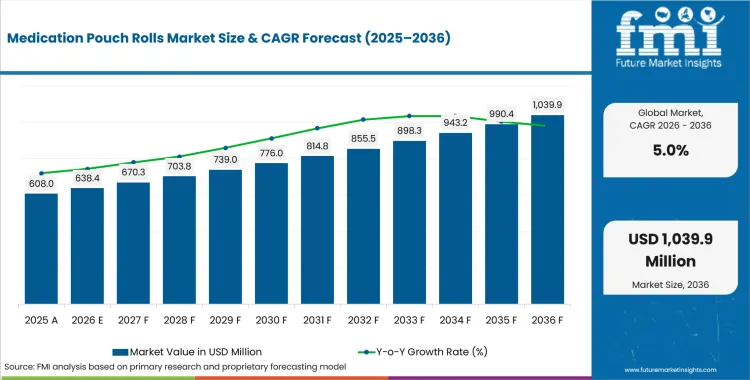
USD 638.4 million in 2026 and USD 1,039.9 million by 2036 at a 5.0% CAGR.
Demand for medication pouch rolls is projected to increase from USD 638.4 million in 2026 to USD 1,039.9 million by 2036 at a 5.0% CAGR. Pharmacies consume fresh roll stock whenever qualified automated lines form scheduled dose pouches for eligible prescriptions. Swisslog Healthcare launched the i-Rolly pouch rolling add-on in June 2025 to organize finished AutoPack pouch strings and reduce manual handling after packing.
Country growth depends on whether digital prescribing reduces intake work without weakening pharmacy control over medicines repackaged outside manufacturer containers. Gematik reported in January 2026 that Germany redeemed its one billionth electronic prescription on October 17 2025. Digital intake can make automated preparation easier to operate but roll qualification still depends on medicine stability and machine fit.
Key Takeaways
- Medication pouch rolls generate repeat material use whenever a qualified dispensing line forms patient-specific pouches for eligible prescriptions.
- Multi-dose strip rolls are estimated to hold 40.0% of product type in 2026 owing to scheduled dispensing of several medicines.
- Polymer systems are anticipated to represent 39.0% of material in 2026 because flexible films support sealing and printed dose information.
- Child-resistant formats are projected to account for 29.0% of compliance features in 2026 driven by controlled access for selected medicines.
- Stability after repackaging and line validation can delay material changes even when another roll offers a lower purchase price.
- Some of the key players in this market include va-Q-tec Thermal Solutions GmbH, Gerresheimer AG, Nelipak Corporation, West Pharmaceutical Services, Inc., ThermoSafe, SCHOTT Pharma, SGD Pharma, Amcor plc, Berry Global (integrated into Amcor plc since April 2025), and Aptar Pharma.
Analyst Perspective
"Medication pouch rolls earn repeat revenue after pharmacies approve the medicine and web construction for the installed dispensing line. Commercial value comes from stable sealing and credible drug protection because a cheaper roll loses its advantage after downtime or requalification."
- Nandini Roy Choudhury, Principal Consultant, Future Market Insights
How is the medication pouch rolls market segmented?
The market is segmented by Product Type, Material, Compliance Feature, End Use and Sales Channel.
Product type covers multi-dose strip rolls, unit-dose rolls, child-resistant rolls and printed compliance rolls. Material includes polymer systems, glass, aluminium & foil and fiber-based structures. Compliance feature includes child-resistant, tamper-evident, serialization-ready and cold chain assured formats. End use covers retail pharmacy, hospital & clinical, clinical trials and OTC & D2C health. Sales channel includes direct pharma contracts, specialty distributors and online B2B. Revenue covers the consumable pouch roll and included compliance features while dispensing equipment and finished medicines stay outside scope.
Why do multi-dose strip rolls hold the stated product type share?
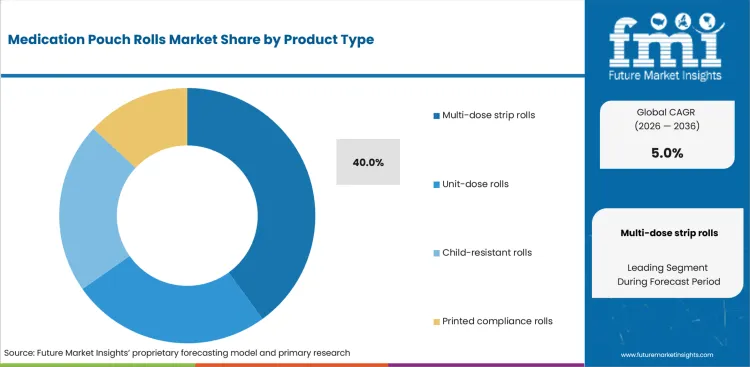
Multi-dose strip rolls turn a medication schedule into a continuous pouch sequence that pharmacy staff can verify before dispensing. The format fits adherence packaging programs that group scheduled doses without requiring a separate primary package for every administration time.
- By product type, multi-dose strip rolls are estimated to hold 40.0% in 2026 owing to their fit with scheduled multi-medication dispensing.
- JFCRx introduced TruPak Spark in October 2025 as a compact adherence pouch packaging system for pharmacies that need scalable multi-dose production across routine dispensing workflows.
Why do polymer systems hold the stated material share?
Polymer films suit roll-fed pouching because converters can tune sealing behavior and printable surfaces without giving up flexible web handling. Their use also aligns with pharmaceutical plastic packaging where barrier performance and processing stability determine whether a material can stay qualified on production equipment.
- In 2026, polymer systems are estimated to capture 39.0% of material owing to flexible web handling and adaptable sealing performance.
- Amcor launched AmSecure thermoformed trays and rollstock in October 2025 using qualified APET materials for current medical and pharmaceutical applications.
Why do child-resistant formats hold the stated compliance feature share?
Child-resistant pouch designs must restrict unintended access without disrupting the tear behavior and seal window required by automated packing lines. The same controlled-access problem shapes child-resistant containers used for medicines that require safety packaging under federal rules.
- Child-resistant formats are anticipated to represent 29.0% of compliance features in 2026 attributable to controlled-access requirements for selected medicines.
- The USA Consumer Product Safety Commission recalled about 14,250 noncompliant cough and cold blister packs in April 2025 because required child resistance was absent in practice.
Why does retail pharmacy hold the stated end use share?
Retail pharmacies control the point where medication review becomes repeated pouch production for patients enrolled in adherence or long-term care services. Investment in pharmacy automation can increase pouching capacity but each pharmacy still needs enough eligible prescriptions to keep automated equipment productive.
- Retail pharmacy is projected to account for 30.0% of end use in 2026 driven by repeated patient dispensing and direct control over pouch preparation.
- NCPA reported in October 2025 that independent pharmacies represented nearly 36% of USA retail pharmacies and many also served long-term care patients.
Why do direct pharma contracts hold the stated sales channel share?
Direct contracts fit qualified pouch rolls because material certificates and change control must remain consistent over repeated production cycles. That commercial model is common in regulated pharmaceutical packaging where technical teams resolve sealing and barrier issues before a material change reaches routine production.
- Direct pharma contracts are expected to hold 47.0% of sales channel in 2026 supported by repeat specifications and direct technical coordination.
- Nelipak expanded Asia-Pacific customer support in April 2025 through direct and partner channels for flexible healthcare packaging that includes coated rollstock.
What are the drivers, restraints and opportunities in the Medication Pouch Rolls Market?
Repeat dose-level dispensing sustains roll consumption while stability evidence limits eligible medicines and higher-barrier printable webs expand qualified use cases.
- Driver: Scheduled dose preparation consumes fresh pouch web during every packing cycle and turns qualified pharmacy dispensing into repeated material purchasing.
- Restraint: Medicine stability after repackaging and line-specific validation can delay material changes or narrow the prescriptions eligible for pouching.
- Opportunity: Barrier-enhanced printable webs can extend pouching to more demanding medicines provided the structure preserves seal and line performance.
Adherence packing turns dispensing cycles into repeated roll use
Scheduled pouch programs consume fresh web whenever pharmacies prepare another patient regimen for dispensing. Smurfit Westrock opened a dedicated adherence and clinical packaging facility in Dublin during November 2025 for regulated pharmaceutical programs. Dedicated capacity supports repeated packaging work but pharmacy roll demand still depends on enough eligible prescriptions to keep pouch lines productive.
Stability after repackaging limits medicine eligibility
Material qualification becomes restrictive after solid oral drugs leave manufacturer packaging because barrier performance and storage conditions can change. FDA reported in 2025 that a focused assignment followed recalls and postmarket reports involving stability failures in unit-dose repackaged products. No sampled product failed specification but the earlier reports explain why pharmacies require medicine-specific stability evidence before changing pouch materials.
Coated webs expand technically eligible pouch formats
Packaging teams can use higher-barrier structures to control moisture exposure while printable webs carry dose identity on the same consumable. Amcor completed an advanced healthcare packaging coating facility in Malaysia in April 2025 using online inspection and air-knife coating technology. Roll suppliers adapting comparable high-barrier packaging films to installed pouching equipment can pursue harder-to-pack medicines provided the web also meets seal and print requirements.
Which country CAGRs are profiled in the Medication Pouch Rolls Market?
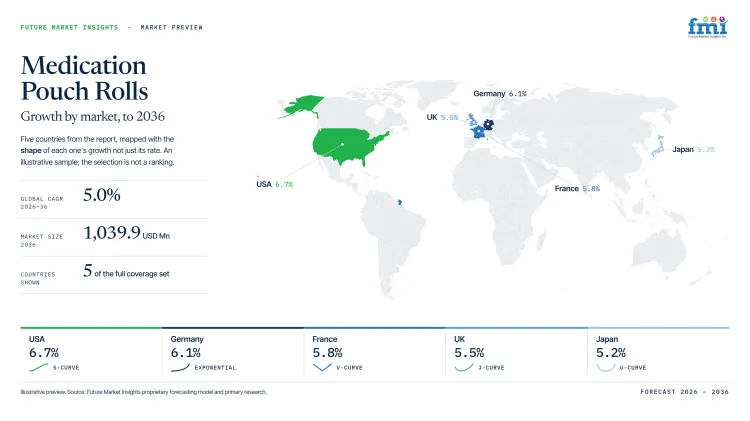
| Country | CAGR |
|---|---|
| USA | 6.7% |
| South Korea | 6.4% |
| Germany | 6.1% |
| France | 5.8% |
| UK | 5.5% |
| Japan | 5.2% |
How do country-level CAGRs compare in the Medication Pouch Rolls Market?
The country forecasts occupy a narrow 1.5 percentage-point range from USA at 6.7% to Japan at 5.2% through 2036. USA and South Korea form the upper pair while Germany and France fall in the middle and UK plus Japan follow within the same concentrated band of forecast growth.
- USA combines prescription volume and automation capacity but stability review governs which medicines enter pouch workflows.
- South Korea keeps small-package unit rules inside national pharmaceutical manufacturing and institutional dispensing decisions.
- Germany uses digital prescriptions to reduce intake work before pharmacy teams begin automated dose preparation.
- France documents hospital dose preparation where traceability rules and packaging waste influence material selection.
- UK practice reserves compliance aids for assessed need so routine pouch conversion serves fewer prescriptions.
- Japan is preparing controlled one-dose outsourcing with geographic and supervisory limits on contracted pharmacies.
The full report provides country-level CAGR analysis for North America, Latin America, Western Europe, Eastern Europe, East Asia, South Asia and Pacific, and Middle East and Africa.
Country-wise Analysis
- High-volume USA dispensing gives pouch programs a broad prescription base but each pharmacy still decides which medicines can safely leave manufacturer packaging. Medication pouch roll demand in USA is forecast to rise at 6.7% CAGR over the forecast period driven by repeat material use in qualified dose-level workflows. CMS reported in April 2026 that Medicare Part D recorded 53.3 million utilizing beneficiaries and 1.7 billion prescription drug events during 2024. Pharmacies using unit dose packaging can convert part of that volume into roll demand only after stability review while line downtime and material-change validation remain direct barriers to switching suppliers.
- German community pharmacies now receive prescriptions through a heavily digitized medication process that can feed automated packing without rekeying each order. In Germany, medication pouch roll demand is predicted to advance at 6.1% CAGR through 2036 supported by repeat pharmacy dispensing and digital medication records. Gematik reported in September 2025 that more than 93% of practices and pharmacies were expected to be technically equipped for the national ePA by October 1. The same infrastructure can reduce intake friction for pharmaceutical unit dose packaging programs while material validation and fast technical response remain necessary whenever a roll specification changes line behavior.
- French hospitals already document automated preparation of doses in polyethylene pouches for selected institutional workflows with traceability built into the packing process. Adoption of medication pouch rolls in France is estimated to expand at 5.8% CAGR through 2036 driven by hospital dose preparation and medication-safety requirements. In April 2025 the Ordre national des pharmaciens described automated dose preparation in some hospitals and noted that polyethylene pouch consumables also create recycling work. Medical packaging films can compete on printable traceability and lower material use yet each change must preserve sealing performance and fit the hospital automated preparation equipment in routine use.
- British pharmacists use monitored dosage systems selectively because professional assessment must establish that a patient needs additional support beyond the original medicine packs. Medication pouch roll sales in the UK are forecast to expand at 5.5% CAGR by 2036 attributable to assessed-need dispensing instead of routine conversion. NHS Specialist Pharmacy Service guidance published in April 2026 states that original packs and pharmaceutical support are preferred and that compliance aids are not endorsed for routine use. Packaging companies therefore face a narrower eligible pool and need stability information that lets pharmacy teams judge material suitability without weakening the intended medicine-use period.
- Japanese pharmacy policy is preparing a controlled route for outsourcing standardized one-dose preparation while keeping patient consent and supervisory boundaries inside the operating model. By 2036, Japan is projected to grow at 5.2% CAGR supported by labor-saving one-dose preparation under defined pharmacy controls. A July 2026 Ministry of Health Labour and Welfare meeting stated that planned outsourcing will initially cover one-dose packaging and related same-time medication tasks within the same prefecture. The rule can support larger preparation centers after implementation but limits geographic scale and does not currently treat direct shipment from the contracted pharmacy as appropriate under current policy.
- South Korean medicine supply rules keep small-package presentation inside national pharmaceutical regulation and make package-unit specifications familiar to manufacturers and institutional dispensaries. Medication pouch roll demand in South Korea is forecast to rise at 6.4% CAGR over the forecast period supported by disciplined unit presentation and repeat dispensing. MFDS announced in February 2026 that 18,600 medicines were subject to the national small-package supply list for that year. The rule does not measure pouch-roll volume but it reinforces package-unit discipline while material companies still need reliable local stock and machine-compatible specifications to turn repeat use into stable account revenue.
Who are the notable companies in the Medication Pouch Rolls Market?
va-Q-tec Thermal Solutions GmbH, Gerresheimer AG, Nelipak Corporation, West Pharmaceutical Services, Inc., ThermoSafe, SCHOTT Pharma, SGD Pharma, Amcor plc, Berry Global (integrated into Amcor plc since April 2025), and Aptar Pharma are notable companies serving this market.
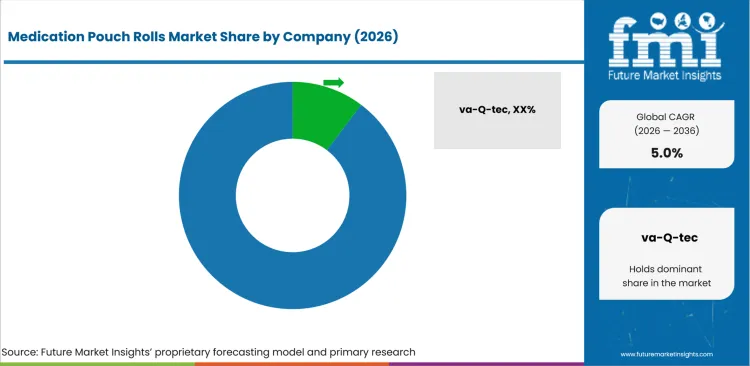
Direct flexible healthcare packaging is documented for Nelipak Corporation and Amcor plc while former Berry Global operations now sit within Amcor. Gerresheimer AG, West Pharmaceutical Services, Inc., SCHOTT Pharma, SGD Pharma and Aptar Pharma influence containment or qualification requirements through adjacent pharmaceutical packaging platforms. va-Q-tec Thermal Solutions GmbH and ThermoSafe remain outside core pouch-roll revenue but contribute temperature-assurance knowledge relevant to pharmaceutical cold chain packaging.
- Flexible healthcare packaging platforms include Nelipak Corporation and Amcor plc plus the former Berry Global operations integrated into Amcor since April 2025.
- Pharmaceutical containment and adherence platforms include Gerresheimer AG, West Pharmaceutical Services, Inc., SCHOTT Pharma, SGD Pharma and Aptar Pharma.
- Temperature-assurance specialists include va-Q-tec Thermal Solutions GmbH and ThermoSafe where cold-chain requirements influence adjacent pharmaceutical packaging decisions.
Competitive Benchmarking: Medication Pouch Rolls Market
| Company | Flexible Roll-Stock Capability | Barrier & Stability Engineering | Compliance & Traceability Support | Geographic Reach |
|---|---|---|---|---|
| va-Q-tec Thermal Solutions GmbH | Low | High | Medium | Europe with global pharma service activity |
| Gerresheimer AG | Low | High | High | Europe, Americas and Asia |
| Nelipak Corporation | High | High | High | North America, Europe and Asia-Pacific |
| West Pharmaceutical Services, Inc. | Low | High | High | North America, Europe and Asia |
| ThermoSafe | Low | High | High | Americas, EMEA and Asia |
| SCHOTT Pharma | Low | High | High | Europe, Americas and Asia |
| SGD Pharma | Low | High | High | Europe, Asia and Americas |
| Amcor plc | High | High | High | Global |
| Berry Global (integrated into Amcor plc since April 2025) | Medium | Medium | Medium | Integrated into Amcor global platform |
| Aptar Pharma | Low | High | High | North America, Europe, Asia and Latin America |
High flexible roll-stock capability requires current healthcare rollstock or flexible web production while Medium covers broader flexible healthcare platforms and Low marks documented adjacent formats. High barrier and stability engineering requires several protection technologies while Medium covers a narrower route and Low marks limited pouch-material relevance. High compliance and traceability support requires several current validation or regulated-packaging capabilities while Medium covers a narrower set and Low marks a documented adjacent role. These ratings address pouch-roll qualification evidence and do not establish medication pouch roll revenue or company market share.
Key Developments in the Medication Pouch Rolls Market
- West Pharmaceutical Services, Inc. opened a 165,000-square-foot Dublin expansion in March 2026 that extends packaging automation plus validation and drug-handling contract services for injectable therapies.
- Aptar Pharma acquired Sommaplast in December 2025 to expand Brazilian oral dosing packaging with closures and dispensers used in regulated medication presentation.
- Gerresheimer AG introduced Gx InMonit in March 2026 to support adherence during autoinjector-based home therapies and extend its adjacent connected patient-support capabilities.
Key Players in the Medication Pouch Rolls Market
Flexible Healthcare Packaging and Roll-Stock Platforms
- Nelipak Corporation
- Amcor plc
- Berry Global (integrated into Amcor plc since April 2025)
Pharmaceutical Containment, Adherence and Qualification Platforms
- Gerresheimer AG
- West Pharmaceutical Services, Inc.
- SCHOTT Pharma
- SGD Pharma
- Aptar Pharma
Temperature-Assurance Specialists
- va-Q-tec Thermal Solutions GmbH
- ThermoSafe
Medication Pouch Rolls Market - Report Scope
| Coverage field | Report scope |
|---|---|
| Market breakdown | By product type, material, compliance feature, end use, sales channel and region. |
| Quantitative Units | USD million. |
| Market Definition | Revenue from consumable medication pouch roll material sold for unit-dose, multi-dose, compliance, hospital, pharmacy, clinical-trial and permitted direct-to-consumer pouching workflows. Dispensing equipment and downstream medicine revenue are excluded. |
| Regions Covered | North America, Latin America, Western Europe, Eastern Europe, East Asia, South Asia and Pacific, and Middle East and Africa. |
| Countries Covered | USA, South Korea, Germany, France, UK, Japan, and 24+ countries included in the full report. |
| Key Companies | va-Q-tec Thermal Solutions GmbH, Gerresheimer AG, Nelipak Corporation, West Pharmaceutical Services, Inc., ThermoSafe, SCHOTT Pharma, SGD Pharma, Amcor plc, Berry Global (integrated into Amcor plc since April 2025), Aptar Pharma. |
| Forecast Period | 2026 to 2036. |
| Approach | Primary and secondary research with market triangulation. |
Medication Pouch Rolls Market - Research Methodology
| Method | Approach |
|---|---|
| Primary Research | FMI analysts gathered input from manufacturers, service providers, technology developers, distributors, end users, procurement teams, and subject-matter experts. Interviews examined purchasing decisions, product or service evaluation, adoption barriers, approval requirements, pricing considerations, and expectations for technical or commercial support. Respondents were also asked what evidence is required before a trial, pilot, or initial order develops into regular purchasing. |
| Desk Research | Desk research covered government statistics, regulatory publications, trade data, industry associations, technical literature, standards, company filings, product information, and official corporate announcements. Sources were reviewed for relevance, publication date, geographic coverage, and consistency with the defined market scope. Claims relating to performance, applications, approvals, capacity, investment, and commercial activity were retained only when supported by credible public evidence. |
| Market Sizing and Forecasting | The market model combined the baseline value with historical performance, segment structure, pricing and volume indicators, adoption levels, company participation, and country-level demand conditions. Forecast assumptions considered economic activity, investment trends, regulatory developments, technology adoption, purchasing cycles, supply availability, and barriers to wider market use. Segment and regional estimates were reconciled before the final market total was calculated. |
| Data Validation | Estimates were checked against multiple independent indicators, including public data, company activity, trade patterns, industry developments, and findings from primary interviews. Validation also tested whether products, services, applications, and company revenues fell within the defined market boundaries. Adjacent categories, unsupported claims, overlapping revenues, and activities without direct market relevance were excluded to reduce double counting and maintain consistency across segments and countries. |
Medication Pouch Rolls Market by Segments
Medication Pouch Rolls Market segmented by Product Type:
- Multi-dose strip rolls
- Unit-dose rolls
- Child-resistant rolls
- Printed compliance rolls
Medication Pouch Rolls Market segmented by Material:
- Polymer systems
- Glass
- Aluminium & foil
- Fiber-based
Medication Pouch Rolls Market segmented by Compliance Feature:
- Child-resistant
- Tamper-evident
- Serialization-ready
- Cold chain assured
Medication Pouch Rolls Market segmented by End Use:
- Retail pharmacy
- Hospital & clinical
- Clinical trials
- OTC & D2C health
Medication Pouch Rolls Market segmented by Sales Channel:
- Direct pharma contracts
- Specialty distributors
- Online B2B
Medication Pouch Rolls Market by Region:
- North America
- United States
- Canada
- Latin America
- Brazil
- Mexico
- Argentina
- Chile
- Western Europe
- Germany
- France
- United Kingdom
- Italy
- Spain
- Benelux
- Nordics
- Eastern Europe
- Poland
- Czech Republic
- Romania
- Hungary
- East Asia
- China
- Japan
- South Korea
- South Asia and Pacific
- India
- ASEAN
- Australia and New Zealand
- Middle East and Africa
- GCC Countries
- South Africa
- Türkiye
- Israel
Research Sources and Bibliography
- Swisslog Healthcare. (2025, June 4). Swisslog Healthcare launches i-Rolly for AutoPack automated oral solid packager.
- gematik. (2026, January 26). Wie wird der Nutzen des E-Rezepts von Versicherten und Leistungserbringenden eingeschätzt?
- JFCRx. (2025, October 16). JFCRx introduces TruPak Spark: A growth-ready adherence pouch packaging solution for pharmacies.
- Amcor. (2025, October 16). Amcor launches AmSecure thermoformed trays and rollstock, part of the HealthCare portfolio.
- USA Consumer Product Safety Commission. (2025, April 10). Kramer Laboratories recalls Safetussin Max Strength Multi-Symptom Cough, Cold and Flu blister packs due to risk of child poisoning; violation of federal regulation for child resistant packaging.
- National Community Pharmacists Association. (2025, October 19). NCPA releases 2025 Digest Report.
- Nelipak. (2025, April 7). Nelipak Healthcare Packaging expands commitment to serve customers in Asia-Pacific Region with its sterile barrier medical packaging products.
- Smurfit Westrock. (2025, November 4). Smurfit Westrock unveils world’s first dedicated clinical packaging facility.
- USA Food and Drug Administration. (2025). Report on the State of Pharmaceutical Quality FY2024.
- Amcor. (2025, April 10). Amcor builds cutting-edge coating facility, enhancing healthcare packaging access in Asia Pacific.
- Centers for Medicare & Medicaid Services. (2026, April). CMS Fast Facts April 2026.
- gematik. (2025, September 30). ePA für alle: Aktuelle Zahlen und Daten.
- Ordre national des pharmaciens. (2025, April 9). Transition écologique.
- NHS Specialist Pharmacy Service. (2026, April 29). Using the Medicines Compliance Aid Stability Tool.
- Ministry of Health, Labour and Welfare, Japan. (2026, July 23). 第4回薬局・薬剤師の機能強化等に関する検討会.
- Ministry of Food and Drug Safety, Republic of Korea. (2026, February 3). 2026년도 의약품 소량포장단위 공급 대상 품목 공고.
- West Pharmaceutical Services, Inc. (2026, March 31). West expands Dublin facility to support high-volume injectable therapies, including diabetes and obesity.
- Aptar. (2025, December 1). Aptar acquires Sommaplast, a specialized provider of oral dosing pharma packaging solutions.
- Gerresheimer AG. (2026, March 17). Gerresheimer introduces Gx InMonit - patient support for autoinjector-based home therapies.
- Nelipak. (2025, December 8). Nelipak acquires Merrill’s Packaging. Strengthens presence in growing healthcare manufacturing and innovation hubs.
- Amcor. (2026, June 3). Amcor expands production capability in India to meet growing healthcare packaging demand.
- Nelipak. (2025, July 24). Nelipak breaks ground on new healthcare packaging facility in Grecia, Alajuela.
- SCHOTT Pharma. (2025, April 10). Next expansion milestone achieved: SCHOTT Pharma opens production facility in Serbia to strengthen competitiveness in Europe.
- ThermoSafe. (2026, May 27). ThermoSafe expands USA based VIP manufacturing to strengthen cold chain supply assurance for life sciences customers.
- Gerresheimer AG. (2025, October 1). Gerresheimer expands Wertheim site with new production facility for ready-to-fill vials.
- va-Q-tec Thermal Solutions GmbH. (2025, September 16). Secure home delivery over the last mile.
- Gerresheimer AG. (2025, April 23). Centor launches smart pill organizer to support medication adherence.
- Nelipak. (2026, March 11). Nelipak announces opening of Asia-Pacific Technical Development Center.
- West Pharmaceutical Services, Inc. (2025, August 21). West opens new analytical laboratory in Stolberg, Germany.
- ThermoSafe. (2026, February 5). ThermoSafe expands Orion reusable platform with launch of Orion Express for right-duration, time-critical shipments.
- SCHOTT Pharma. (2025, August 11). SCHOTT Pharma launches ready-to-use polymer cartridge.
- SGD Pharma. (2025, October 22). SGD Pharma presents new innovations at CPHI Frankfurt 2025.
- Amcor. (2026, March 16). Amcor Winterbourne achieves ISO 13485:2016 certification, strengthening its commitment to healthcare packaging.
- Amcor plc. (2025, April 30). Amcor completes combination with Berry Global; positioned to significantly enhance value for customers and shareholders.
- Aptar Pharma. (2026, July 17). Aptar Pharma launches integrated system-level framework to support injectable drug development.
This bibliography is provided for reader reference and is not exhaustive. The full report contains the complete reference list and detailed citations.
This Report Answers
- What is the medication pouch rolls market size in 2026 and 2036?
- Which dispensing conditions support repeated medication pouch roll purchases?
- Why do multi-dose strip rolls hold 40.0% of product type in 2026?
- How do polymer systems affect barrier protection and pouch-line sealing?
- Why do child-resistant formats hold 29.0% of compliance features in 2026?
- How do the six country growth forecasts differ through 2036?
- Which companies provide direct or adjacent pharmaceutical packaging capabilities?
- Which stability requirements can delay medication pouch roll switching?
- What should pharmacies evaluate before approving medication pouch rolls?
Frequently Asked Questions
How big is the medication pouch rolls market in 2026?
The medication pouch rolls market is valued at USD 638.4 million in 2026 and is projected to reach USD 1,039.9 million by 2036. Repeat dose-level dispensing sustains qualified roll consumption during scheduled pharmacy packing cycles for eligible prescriptions.
What is the CAGR of the medication pouch rolls market from 2026 to 2036?
The medication pouch rolls market is projected to grow at a CAGR of 5.0% between 2026 and 2036. Expansion depends on pharmacy automation plus stability evidence and roll specifications suited to installed pouching equipment.
Which product type leads the medication pouch rolls market?
The multi-dose strip rolls segment is expected to hold 40.0% of the medication pouch rolls market by product type in 2026. Scheduled multi-medication dispensing aligns continuous strip production with repeated material use during patient packing cycles.
Which material holds the stated share in the medication pouch rolls market?
The polymer systems segment is expected to hold 39.0% of the medication pouch rolls market by material in 2026. Flexible films support seal control and printed dose information while maintaining web handling on pouching equipment.
Which countries are projected to record the country growth comparison in the medication pouch rolls market?
USA is projected to grow at 6.7% CAGR followed by South Korea at 6.4% and Germany at 6.1% through 2036. National dispensing systems and repackaging rules shape the pace of repeat roll purchasing.
Which companies are active in the medication pouch rolls market?
Companies serving the medication pouch rolls market include va-Q-tec Thermal Solutions GmbH, Gerresheimer AG, Nelipak Corporation, West Pharmaceutical Services, Inc., ThermoSafe, SCHOTT Pharma, SGD Pharma, Amcor plc, Berry Global within Amcor, and Aptar Pharma. Their roles include direct flexible packaging plus adjacent containment and temperature-assurance capabilities that shape qualification decisions.
Preview the report firsthand - request a free sample
Get SampleGet the brochure for pricing and purchase details.
Get PDFTable of Content
- Key Takeaways
- Market Size and CAGR
- Top Growth Driver
- Fastest Growing Segment
- Leading Region
- Key Companies
- Emerging Opportunities
- Executive Summary
- Global Market Outlook
- Demand-side Trends
- Supply-side Trends
- Technology Roadmap Analysis
- Analysis and Recommendations
- Analyst Perspective (What is happening? Why now? What should investors know?)
- Key Questions Answered
- How large is the market?
- What is the CAGR?
- What are key trends?
- Which region dominates?
- Who are the leaders?
- Market Overview
- Market Coverage / Taxonomy
- Market Definition / Scope / Limitations
- Research Methodology
- Chapter Orientation
- Analytical Lens and Working Hypotheses
- Market Structure, Signals, and Trend Drivers
- Benchmarking and Cross-market Comparability
- Market Sizing, Forecasting, and Opportunity Mapping
- Research Design and Evidence Framework
- Desk Research Programme (Secondary Evidence)
- Expert Input and Fieldwork (Primary Evidence)
- Tooling, Models, and Reference Databases
- Data Engineering and Model Build
- Quality Assurance and Audit Trail
- Market Background
- Market Dynamics (Drivers, Restraints, Opportunity, Trends)
- Scenario Forecast (Optimistic, Likely, Conservative)
- Impact Analysis
- AI Impact
- Sustainability Impact
- Regulatory Impact
- Technology Impact
- Consumer / Buyer Analysis
- Purchase Drivers
- Adoption Barriers
- Buyer Journey
- Opportunity Map Analysis
- Product Life Cycle Analysis
- Supply Chain Analysis
- Investment Feasibility Matrix
- Value Chain Analysis
- PESTLE and Porter's Analysis
- Regulatory Landscape
- Regional Parent Market Outlook
- Production and Consumption Statistics
- Import and Export Statistics
- Global Market Analysis and Forecast, 2021 to 2036
- Historical Market Size Value (USD Million) Analysis, 2021 to 2025
- Current and Future Market Size Value (USD Million) Projections, 2026 to 2036
- Y-o-Y Growth Trend Analysis
- Absolute $ Opportunity Analysis
- Global Market Pricing Analysis, 2021 to 2036
- Global Market Analysis and Forecast, By Product Type, 2021 to 2036
- Introduction / Key Findings
- Historical Market Size Value (USD Million) Analysis By Product Type, 2021 to 2025
- Current and Future Market Size Value (USD Million) Analysis and Forecast By Product Type, 2026 to 2036
- Multi-dose strip rolls
- Unit-dose rolls
- Child-resistant rolls
- Printed compliance rolls
- Multi-dose strip rolls
- Y-o-Y Growth Trend Analysis By Product Type, 2021 to 2025
- Absolute $ Opportunity Analysis By Product Type, 2026 to 2036
- Global Market Analysis and Forecast, By Material, 2021 to 2036
- Introduction / Key Findings
- Historical Market Size Value (USD Million) Analysis By Material, 2021 to 2025
- Current and Future Market Size Value (USD Million) Analysis and Forecast By Material, 2026 to 2036
- Polymer systems
- Glass
- Aluminium & foil
- Fiber-based
- Polymer systems
- Y-o-Y Growth Trend Analysis By Material, 2021 to 2025
- Absolute $ Opportunity Analysis By Material, 2026 to 2036
- Global Market Analysis and Forecast, By Compliance Feature, 2021 to 2036
- Introduction / Key Findings
- Historical Market Size Value (USD Million) Analysis By Compliance Feature, 2021 to 2025
- Current and Future Market Size Value (USD Million) Analysis and Forecast By Compliance Feature, 2026 to 2036
- Child-resistant
- Tamper-evident
- Serialization-ready
- Cold chain assured
- Child-resistant
- Y-o-Y Growth Trend Analysis By Compliance Feature, 2021 to 2025
- Absolute $ Opportunity Analysis By Compliance Feature, 2026 to 2036
- Global Market Analysis and Forecast, By End Use, 2021 to 2036
- Introduction / Key Findings
- Historical Market Size Value (USD Million) Analysis By End Use, 2021 to 2025
- Current and Future Market Size Value (USD Million) Analysis and Forecast By End Use, 2026 to 2036
- Retail pharmacy
- Hospital & clinical
- Clinical trials
- OTC & D2C health
- Retail pharmacy
- Y-o-Y Growth Trend Analysis By End Use, 2021 to 2025
- Absolute $ Opportunity Analysis By End Use, 2026 to 2036
- Global Market Analysis and Forecast, By Sales Channel, 2021 to 2036
- Introduction / Key Findings
- Historical Market Size Value (USD Million) Analysis By Sales Channel, 2021 to 2025
- Current and Future Market Size Value (USD Million) Analysis and Forecast By Sales Channel, 2026 to 2036
- Direct pharma contracts
- Specialty distributors
- Online B2B
- Direct pharma contracts
- Y-o-Y Growth Trend Analysis By Sales Channel, 2021 to 2025
- Absolute $ Opportunity Analysis By Sales Channel, 2026 to 2036
- Global Market Analysis and Forecast, By Region, 2021 to 2036
- Introduction
- Historical Market Size Value (USD Million) Analysis By Region, 2021 to 2025
- Current Market Size Value (USD Million) Analysis and Forecast By Region, 2026 to 2036
- North America
- Latin America
- Western Europe
- Eastern Europe
- East Asia
- South Asia and Pacific
- Middle East & Africa
- Market Attractiveness Analysis By Region
- North America Market Analysis and Forecast, By Country, 2021 to 2036
- Historical Market Size Value (USD Million) Trend Analysis By Market Taxonomy, 2021 to 2025
- Market Size Value (USD Million) Forecast By Market Taxonomy, 2026 to 2036
- By Country
- USA
- Canada
- By Product Type
- By Material
- By Compliance Feature
- By End Use
- By Sales Channel
- By Country
- Market Attractiveness Analysis
- By Country
- By Product Type
- By Material
- By Compliance Feature
- By End Use
- By Sales Channel
- Key Takeaways
- Latin America Market Analysis and Forecast, By Country
- Historical Market Size Value (USD Million) Trend Analysis By Market Taxonomy, 2021 to 2025
- Market Size Value (USD Million) Forecast By Market Taxonomy, 2026 to 2036
- By Country
- Brazil
- Mexico
- Chile
- Rest of Latin America
- By Product Type
- By Material
- By Compliance Feature
- By End Use
- By Sales Channel
- By Country
- Market Attractiveness Analysis
- By Country
- By Product Type
- By Material
- By Compliance Feature
- By End Use
- By Sales Channel
- Key Takeaways
- Western Europe Market Analysis and Forecast, By Country
- Historical Market Size Value (USD Million) Trend Analysis By Market Taxonomy, 2021 to 2025
- Market Size Value (USD Million) Forecast By Market Taxonomy, 2026 to 2036
- By Country
- Germany
- UK
- Italy
- Spain
- France
- Nordic
- BENELUX
- Rest of Western Europe
- By Product Type
- By Material
- By Compliance Feature
- By End Use
- By Sales Channel
- By Country
- Market Attractiveness Analysis
- By Country
- By Product Type
- By Material
- By Compliance Feature
- By End Use
- By Sales Channel
- Key Takeaways
- Eastern Europe Market Analysis and Forecast, By Country
- Historical Market Size Value (USD Million) Trend Analysis By Market Taxonomy, 2021 to 2025
- Market Size Value (USD Million) Forecast By Market Taxonomy, 2026 to 2036
- By Country
- Russia
- Poland
- Hungary
- Balkan & Baltic
- Rest of Eastern Europe
- By Product Type
- By Material
- By Compliance Feature
- By End Use
- By Sales Channel
- By Country
- Market Attractiveness Analysis
- By Country
- By Product Type
- By Material
- By Compliance Feature
- By End Use
- By Sales Channel
- Key Takeaways
- East Asia Market Analysis and Forecast, By Country
- Historical Market Size Value (USD Million) Trend Analysis By Market Taxonomy, 2021 to 2025
- Market Size Value (USD Million) Forecast By Market Taxonomy, 2026 to 2036
- By Country
- China
- Japan
- South Korea
- By Product Type
- By Material
- By Compliance Feature
- By End Use
- By Sales Channel
- By Country
- Market Attractiveness Analysis
- By Country
- By Product Type
- By Material
- By Compliance Feature
- By End Use
- By Sales Channel
- Key Takeaways
- South Asia and Pacific Market Analysis and Forecast, By Country
- Historical Market Size Value (USD Million) Trend Analysis By Market Taxonomy, 2021 to 2025
- Market Size Value (USD Million) Forecast By Market Taxonomy, 2026 to 2036
- By Country
- India
- ASEAN
- Australia & New Zealand
- Rest of South Asia and Pacific
- By Product Type
- By Material
- By Compliance Feature
- By End Use
- By Sales Channel
- By Country
- Market Attractiveness Analysis
- By Country
- By Product Type
- By Material
- By Compliance Feature
- By End Use
- By Sales Channel
- Key Takeaways
- Middle East & Africa Market Analysis and Forecast, By Country
- Historical Market Size Value (USD Million) Trend Analysis By Market Taxonomy, 2021 to 2025
- Market Size Value (USD Million) Forecast By Market Taxonomy, 2026 to 2036
- By Country
- Kingdom of Saudi Arabia
- Other GCC Countries
- Türkiye
- South Africa
- Other African Union
- Rest of Middle East & Africa
- By Product Type
- By Material
- By Compliance Feature
- By End Use
- By Sales Channel
- By Country
- Market Attractiveness Analysis
- By Country
- By Product Type
- By Material
- By Compliance Feature
- By End Use
- By Sales Channel
- Key Takeaways
- Key Countries Market Analysis
- USA
- Pricing Analysis
- Market Share Analysis, 2025
- By Product Type
- By Material
- By Compliance Feature
- By End Use
- By Sales Channel
- Canada
- Pricing Analysis
- Market Share Analysis, 2025
- By Product Type
- By Material
- By Compliance Feature
- By End Use
- By Sales Channel
- Mexico
- Pricing Analysis
- Market Share Analysis, 2025
- By Product Type
- By Material
- By Compliance Feature
- By End Use
- By Sales Channel
- Brazil
- Pricing Analysis
- Market Share Analysis, 2025
- By Product Type
- By Material
- By Compliance Feature
- By End Use
- By Sales Channel
- Chile
- Pricing Analysis
- Market Share Analysis, 2025
- By Product Type
- By Material
- By Compliance Feature
- By End Use
- By Sales Channel
- Germany
- Pricing Analysis
- Market Share Analysis, 2025
- By Product Type
- By Material
- By Compliance Feature
- By End Use
- By Sales Channel
- UK
- Pricing Analysis
- Market Share Analysis, 2025
- By Product Type
- By Material
- By Compliance Feature
- By End Use
- By Sales Channel
- Italy
- Pricing Analysis
- Market Share Analysis, 2025
- By Product Type
- By Material
- By Compliance Feature
- By End Use
- By Sales Channel
- Spain
- Pricing Analysis
- Market Share Analysis, 2025
- By Product Type
- By Material
- By Compliance Feature
- By End Use
- By Sales Channel
- France
- Pricing Analysis
- Market Share Analysis, 2025
- By Product Type
- By Material
- By Compliance Feature
- By End Use
- By Sales Channel
- India
- Pricing Analysis
- Market Share Analysis, 2025
- By Product Type
- By Material
- By Compliance Feature
- By End Use
- By Sales Channel
- ASEAN
- Pricing Analysis
- Market Share Analysis, 2025
- By Product Type
- By Material
- By Compliance Feature
- By End Use
- By Sales Channel
- Australia & New Zealand
- Pricing Analysis
- Market Share Analysis, 2025
- By Product Type
- By Material
- By Compliance Feature
- By End Use
- By Sales Channel
- China
- Pricing Analysis
- Market Share Analysis, 2025
- By Product Type
- By Material
- By Compliance Feature
- By End Use
- By Sales Channel
- Japan
- Pricing Analysis
- Market Share Analysis, 2025
- By Product Type
- By Material
- By Compliance Feature
- By End Use
- By Sales Channel
- South Korea
- Pricing Analysis
- Market Share Analysis, 2025
- By Product Type
- By Material
- By Compliance Feature
- By End Use
- By Sales Channel
- Russia
- Pricing Analysis
- Market Share Analysis, 2025
- By Product Type
- By Material
- By Compliance Feature
- By End Use
- By Sales Channel
- Poland
- Pricing Analysis
- Market Share Analysis, 2025
- By Product Type
- By Material
- By Compliance Feature
- By End Use
- By Sales Channel
- Hungary
- Pricing Analysis
- Market Share Analysis, 2025
- By Product Type
- By Material
- By Compliance Feature
- By End Use
- By Sales Channel
- Kingdom of Saudi Arabia
- Pricing Analysis
- Market Share Analysis, 2025
- By Product Type
- By Material
- By Compliance Feature
- By End Use
- By Sales Channel
- Türkiye
- Pricing Analysis
- Market Share Analysis, 2025
- By Product Type
- By Material
- By Compliance Feature
- By End Use
- By Sales Channel
- South Africa
- Pricing Analysis
- Market Share Analysis, 2025
- By Product Type
- By Material
- By Compliance Feature
- By End Use
- By Sales Channel
- USA
- Market Structure Analysis
- Competition Dashboard
- Competition Benchmarking
- Market Share Analysis of Top Players
- By Regional
- By Product Type
- By Material
- By Compliance Feature
- By End Use
- By Sales Channel
- Emerging Startups
- Innovation Benchmarking
- Competition Analysis
- Competition Deep Dive
- va-Q-tec
- Overview
- Product Portfolio
- Profitability by Market Segments
- Sales Footprint
- Strategy Overview
- Marketing Strategy
- Product Strategy
- Channel Strategy
- Gerresheimer
- Nelipak
- West Pharmaceutical
- Sonoco ThermoSafe
- Schott
- SGD Pharma
- Amcor
- Berry Global
- Aptar Pharma
- va-Q-tec
- Case Studies
- Success Stories
- Recent Developments
- Competition Deep Dive
- Assumptions & Acronyms Used


