

- Market Size (2026)
- USD 24.2 Mn
- Forecast (2036)
- USD 71.2 Mn
- CAGR (2026 to 2036)
- 11.4%
How big is Melibiose Prebiotic Sugars Market in 2026?
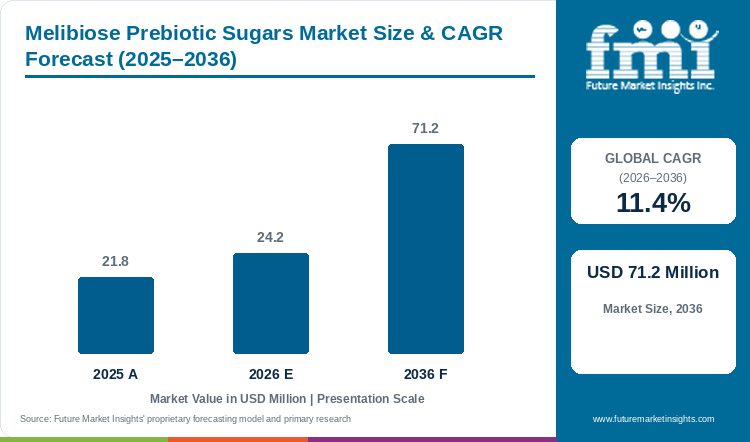
Worldwide melibiose prebiotic sugars procurement is estimated to move beyond USD 21.8 million for 2025 to register USD 24.2 million across 2026 before scaling toward a projected USD 71.2 million come 2036 under a predicted 11.4% annual clip.
July 2026 federal sweetener outlook reporting outlines North American sucrose utilization and industrial processor off-take across the 2025/26 and 2026/27 marketing cycles [1]. Nutrition researchers and dermocosmetic chemists increasingly evaluate alpha-1,6 galactosyl-glucose disaccharides across specialty nutrition and skin-barrier formulations because preclinical mouse models demonstrate melibiose-mediated regulatory T-cell oral immune tolerance while in-vitro assays show advanced glycation end-product inhibition. Supported by specialty oligosaccharide R&D and nutricosmetic launches, worldwide melibiose prebiotic sugars procurement is estimated to advance beyond USD 21.8 million across 2025 to register USD 24.2 million throughout 2026 and is forecast to scale toward USD 71.2 million come 2036 with a predicted 11.4% CAGR delivering a USD 47.0 million increase in annual market revenue. Within production sources, Raffinose Selective Yeast Fermentation / Hydrolysis is anticipated to hold 62.5% of 2026 supply because melibiase-negative yeast strains cleanly remove byproduct fructose alongside human milk oligosaccharides.
Key Market Trends & Insights
- By production source: Raffinose Selective Yeast Fermentation / Hydrolysis (anticipated at 62.5% in 2026) dominates industrial supply because melibiase-negative baker's yeast consumes cleaved fructose during fermentation and simplifies downstream melibiose crystallization.
- By physiological mechanism: Th2 Immune-Modulating Oral Tolerance Inducer (projected at 47.8% for 2026) heads mechanism positioning based on preclinical ovalbumin-transgenic mouse studies showing regulatory T-cell induction in mesenteric lymph nodes.
- By end-use vertical: Hypoallergenic Infant & Pediatric Nutrition (estimated at 49.4% for 2026) concentrates commercial off-take as specialty nutrition developers evaluate defined alpha-1,6 disaccharides free of soy-protein residue.
Regional Highlights
- Highest national growth rate: South Korea is forecast to head national growth with 13.1% annual expansion through 2036 on premium pediatric formula and anti-glycation supplement demand.
- Southeast Asian formulation hub: Singapore is expected to expand at 12.7% annually as multinational maternal and infant nutrition centers upgrade specialty oligosaccharide premixes.
- Established Western and East Asian hubs: Demand in the United States is projected to advance by 11.1% per year while Japan is anticipated to grow at 10.8% and France is predicted to expand at 10.4% on Hokkaido beet-raffinose extraction and Parisian dermocosmetic serums.
Market Size & Forecast
Table 1: Market Size and Forecast for the Melibiose Prebiotic Sugars Market (USD million and CAGR percentage), 2025 to 2036
| Metric | Value |
|---|---|
| 2025 Market Size | USD 21.8 million |
| Estimated Market Size in 2026 | USD 24.2 million |
| Projected Market Size by 2036 | USD 71.2 million |
| CAGR, 2026 to 2036 | 11.4% |
| Added Revenue, 2026 to 2036 | USD 47.0 million |
Growing preclinical and translational research into gut-microbiome modulation and dietary antigen tolerance is reshaping specialty oligosaccharide evaluation across East Asia and Western Europe. Whereas standard beta-linked galacto-oligosaccharide prebiotic ingredients primarily stimulate general colonic bifidobacteria, alpha-1,6 linked melibiose resists brush-border beta-galactosidase and directly modulates Th2 cytokine pathways alongside chaperone-mediated autophagy. In August 2026, the World Health Organization reported in its Infant and young child feeding fact sheet that only about 47% of infants aged 0 to 6 months worldwide are exclusively breastfed while 30.8% of children aged 6 to 23 months meet minimum dietary diversity standards [2].
Raffinose Bioconversion and Crystalline Yield Sizing
Table 2: Raffinose Bioconversion and Crystalline Yield Indicators for the Melibiose Prebiotic Sugars Market (USD million, metric tons, and USD per kilogram), mixed historical and forecast years from 2025 to 2036
| Metric | 2025 | 2026 | 2036 |
|---|---|---|---|
| Market size (USD million) | 21.8 | 24.2 | 71.2 |
| Global purified melibiose volume (metric tons) | 580 to 640 | 650 to 720 | 2,180 to 2,420 |
| Raffinose-derived fermentation volume (metric tons) | 360 to 400 | 405 to 450 | 1,360 to 1,510 |
| Blended realized B2B price (USD per kilogram) | 34.10 to 37.60 | 33.60 to 37.20 | 29.40 to 32.60 |
Operational note: Tonnage and price figures reflect food- and pediatric-grade crystalline melibiose (>98% assay) alongside ultra-pure analytical and dermocosmetic grades extracted from sugar-beet raffinose and leguminous whey.
Selective yeast invertase fermentation of Hokkaido and European beet raffinose is forecast to boost worldwide purified melibiose supply from 2026 deliveries of 650-720 tonnes up to a 2036 projection of 2,180-2,420 tonnes. May 2026 Sugar and Sweeteners Outlook analysis from the USDA Economic Research Service examined 2025/26 and 2026/27 sugar supply alongside a special article updating United States organic sugar supply [3]. With 2026 raffinose-fermented output of 405-450 tonnes rising toward an expected 2036 level of 1,360-1,510 tonnes across infant formula ingredients, blended B2B contract prices are anticipated to narrow from a 2026 band of USD 33.60-37.20/kg to USD 29.40-32.60/kg in 2036.
Per Capita & Pediatric-Plant Procurement Sizing
Table 3: Per Capita and Formulation-Facility Spending Indicators for the Melibiose Prebiotic Sugars Market (USD and milligram metrics), mixed historical and forecast years from 2025 to 2036
| Metric | 2025 | 2026 | 2036 |
|---|---|---|---|
| World population (billion) | 8.23 | 8.30 | 8.95 |
| Spend per 1,000 people (USD) | 2.65 | 2.92 | 7.96 |
| Annual spend per specialized formulation facility (USD thousand) | 51.0 to 56.5 | 55.0 to 61.0 | 134.0 to 148.0 |
| Typical daily bioactive dosage in nutrition & nutricosmetics (mg) | 500 to 2,000 | 500 to 2,200 | 750 to 2,500 |
Table 4: Beet-Refinery and Clinical-Vertical Benchmark Indicators for the Melibiose Prebiotic Sugars Market (USD and percentages), mixed reporting years from 2025 to 2026
| Benchmark Indicator | Reported / Modeled Value | Institutional Reference Basis |
|---|---|---|
| Market size, 2026 | USD 24.2 million | Report value |
| Qualified pediatric, nutraceutical, and cosmetic plants | 420 facilities | 2025 industry registry |
| Raffinose selective yeast fermentation revenue, 2026 | USD 15.1 million | 62.5% source share |
| Hypoallergenic infant & pediatric nutrition revenue, 2026 | USD 12.0 million | 49.4% vertical share |
As pilot formulation and translational evaluation expand across 420 qualified nutrition and cosmetic plants, yearly melibiose procurement is projected to climb from a 2026 level of USD 55.0-61.0 thousand per site to USD 134.0-148.0 thousand in 2036. Pediatric formulators frequently combine crystalline melibiose with probiotic infant formula systems, accounting for a projected 2026 hypoallergenic infant nutrition revenue of USD 12.0 million.
Analyst Perspective
"Selective yeast hydrolysis of sugar-beet raffinose gives Japanese and European refiners a clean route to high-purity crystalline melibiose. Capturing broader pediatric formula and anti-glycation supplement adoption requires expanding multi-center clinical trials across North American and ASEAN cohorts."
- Nandini Roy Choudhury, Principal Consultant, Future Market Insights.
How is the melibiose prebiotic sugars market segmented?
The melibiose prebiotic sugars market is segmented by production source, physiological mechanism, end-use vertical, and region. In 2026, Raffinose Selective Yeast Fermentation / Hydrolysis is projected at 62.5%, Th2 Immune-Modulating Oral Tolerance Inducer at 47.8%, and Hypoallergenic Infant & Pediatric Nutrition at 49.4%.
By production source: Raffinose Selective Yeast Fermentation / Hydrolysis, Soy Whey & Molasses Chromatographic Extraction, and Honey & Botanical Oligosaccharide Fractionation.
By physiological mechanism: Th2 Immune-Modulating Oral Tolerance Inducer, Autophagy-Enhancing & Advanced Glycation (AGE) Inhibitor, and Epidermal Tight-Junction Barrier Booster.
By end-use vertical: Hypoallergenic Infant & Pediatric Nutrition, Healthy-Aging Anti-Glycation Nutraceuticals, Microbiome-Friendly Dermocosmetic Serums, and Premium Functional Dairy Desserts.
Why Does Raffinose Selective Yeast Fermentation / Hydrolysis Dominate Production Source Supply?
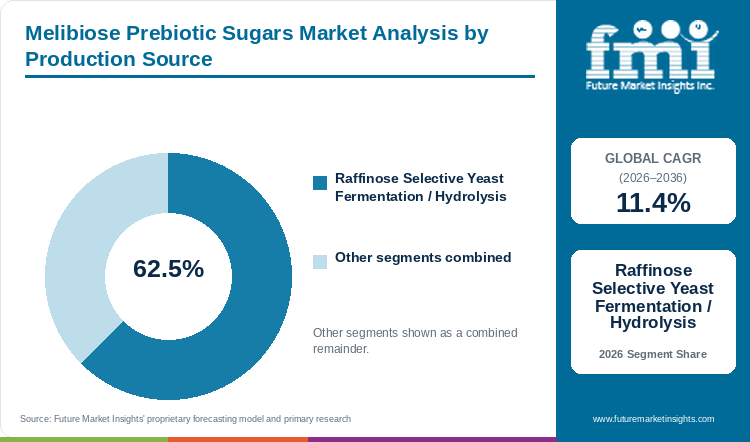
Raffinose Selective Yeast Fermentation / Hydrolysis is anticipated to reach 62.5% of 2026 production source supply, stemming from beet-molasses cleavage.
Table 5: Production Source Share for the Melibiose Prebiotic Sugars Market (percentage share), 2026
| Production Source | Share (2026) |
|---|---|
| Raffinose Selective Yeast Fermentation / Hydrolysis | 62.5% |
| Other Segments Combined | 37.5%* |
| Total | 100.0% |
*Note: Combined share of remaining production source categories totaling 100.0% of 2026 market demand.
Table 6: Production Source Leadership and Market Growth for the Melibiose Prebiotic Sugars Market (segment and CAGR percentage), 2026 to 2036
| Metric | Value |
|---|---|
| Global CAGR (2026 to 2036) | 11.4% |
| Leading Segment | Raffinose Selective Yeast Fermentation / Hydrolysis |
Fermenting beet-derived raffinose trisaccharides with invertase-expressing Saccharomyces cerevisiae strains that lack alpha-galactosidase (melibiase) cleaves the beta-1,2 fructose bond and metabolizes free fructose into carbon dioxide and ethanol, leaving pure alpha-1,6 melibiose in solution. Direct chromatographic extraction from soybean whey or cane molasses suffers from lower native melibiose concentrations and requires energy-intensive desalting to strip stachyose and verbascose oligomers. Beet-sugar biorefineries operating selective yeast hydrolysis lines alongside specialty baking ingredients recover crystalline melibiose at over 98% purity without organic solvent precipitation. Superior volumetric yield and clean allergen-free traceability are expected to keep raffinose selective yeast fermentation ahead of soy-whey and honey fractionation through 2036.
- Metabolic consumption of byproduct fructose during yeast fermentation is projected to enable Raffinose Selective Yeast Fermentation / Hydrolysis to capture 62.5% of 2026 source volume.
- Nippon Beet Sugar Manufacturing Co. Ltd. (Nitten) supplies over 40% of Japan's beet sugar from Hokkaido and is expanding functional beet oligosaccharides and DFA III to triple segment operating profit from JPY 400 million to JPY 1.2 billion [4].
How Does Th2 Immune-Modulating Oral Tolerance Inducer Lead Physiological Mechanisms?
Th2 Immune-Modulating Oral Tolerance Inducer is forecast to comprise 47.8% of 2026 physiological mechanism demand, aided by regulatory T-cell activation.
In preclinical ovalbumin-sensitized BALB/c and TCR-transgenic mouse models, oral co-administration of alpha-1,6 linked melibiose facilitates regulatory T-cell induction in mesenteric lymph nodes and attenuates experimental Th2 sensitization, although human infant efficacy requires dedicated clinical trials. This immunoregulatory pathway suppresses excessive T-helper 2 (Th2) interleukin-4 and immunoglobulin E responses against beta-lactoglobulin and ovalbumin without systemic immunosuppression. Specialty nutrition formulators evaluate melibiose alongside gut health bioactive ingredients to translate preclinical immune-modulation findings into commercial enteral and pediatric research programs. Autophagy induction via trehalose-like chaperone pathways and epidermal tight-junction claudin upregulation are forecast to represent rapidly expanding secondary mechanisms in longevity and skincare products.
- Suppressing IgE-mediated food sensitization via regulatory T-cell induction is estimated to give Th2 Immune-Modulating Oral Tolerance Inducer 47.8% of 2026 mechanism revenue.
- Meiji Holdings Co. Ltd. reported FYE March 2025 consolidated net sales of JPY 1,154,074 million (+4.4% year-on-year), including JPY 118.9 billion in Nutrition sales across infant formula and sports nutrition alongside JPY 195.1 billion in B2B Food Solutions [5].
What Positions Hypoallergenic Infant & Pediatric Nutrition as the Top End-Use Vertical?
Hypoallergenic Infant & Pediatric Nutrition is estimated to collect 49.4% of 2026 end-use vertical spending, benefiting from allergy sensitization reduction.
Specialty pediatric and growing-up milk developers seek high-purity prebiotic disaccharides refined from beet raffinose without soy-protein or dairy-allergen carryover to support in-vitro Bifidobacterium proliferation. Because human small-intestinal mucosa lacks endogenous alpha-galactosidase, ingested melibiose reaches the colon for bacterial fermentation, where human pediatric safety and gastrointestinal tolerance must be verified through age-specific clinical trials prior to infant-formula commercialization. Maternal and pediatric nutrition groups evaluate purified melibiose across pediatric infant formulas and stage-specific growing-up milk research programs in East Asia and Europe. Healthy-aging anti-glycation capsules and microbiome-friendly dermocosmetic serums alongside premium functional yogurts are anticipated to generate the remaining 50.6% of end-use vertical turnover.
- High inclusion value in hydrolyzed allergy-management formulas is expected to secure 49.4% of 2026 end-use vertical revenue for Hypoallergenic Infant & Pediatric Nutrition.
- Fuji Nihon Corporation manufactures enzymatically synthesized Fuji FF and short-chain Fuji FF HS functional fibers (>94.7% dry-basis fiber) that stimulate bifidogenic short-chain fatty acids while improving skin barrier moisture retention [6].
What are the drivers, restraints, and opportunities in the melibiose prebiotic sugars market?
Rising pediatric food-allergy prevalence and anti-glycation nutricosmetic launches are forecast to propel melibiose prebiotic sugars demand through 2036, whereas seasonal Hokkaido and European sugar-beet raffinose yields constrain feedstock elasticity, and epidermal autophagy serums create high-margin dermocosmetic opportunities.
- Driver: Expanding translational R&D on preclinical oral-tolerance prebiotics and in-vitro anti-glycation disaccharides is projected to accelerate B2B melibiose procurement.
- Restraint: Dependence on seasonal sugar-beet molasses raffinose extraction and strict infant-formula regulatory dossiers limit rapid spot-supply expansion.
- Opportunity: Formulating high-purity melibiose into epidermal tight-junction and autophagy-activating dermocosmetic serums is anticipated to capture luxury skincare margins.
Growth Analysis and Future Potential: Qualitative Demand Catalysts
Rising pediatric food-allergy incidence and adult metabolic glycation awareness are shifting prebiotic procurement from commodity fructans toward structure-specific alpha-galactooligosaccharides. Unlike high-dose prebiotic fibers that cause abdominal distension above 10 grams daily, melibiose delivers measurable Th2 immune modulation and advanced glycation end-product inhibition at 0.5 to 2.0 grams per day. Cosmetic chemists also blend melibiose with probiotic skincare ingredients to stimulate keratinocyte autophagy and epidermal moisture retention. June 2026 federal food-expenditure tabulations show total United States food spending reaching USD 2.51 trillion in 2025 across USD 1.10 trillion in retail food-at-home purchases and USD 1.41 trillion in foodservice outlays [7].
Risk Assessment of the Melibiose Prebiotic Sugars Market: Operational and Formulation Friction
June 2026 federal sweetener commodity reporting examined 2025/26 and 2026/27 North American supply projections alongside domestic honey production and pollination economics [8]. Commercial melibiose output remains structurally tied to upstream raffinose recovery from cold-climate sugar-beet molasses campaigns in Hokkaido and Northern Europe. When unseasonable summer heat or beet-yellows virus outbreaks reduce sucrose and raffinose accumulation in harvested roots, chromatographic raffinose feedstock costs rise sharply for downstream yeast-hydrolysis refiners. Furthermore, infant-formula manufacturers require multi-year neonatal clinical safety dossiers before adding novel disaccharides alongside fermented dairy products.
Commercial Opportunity Analysis: Formulation Differentiation and Value-Add Formats
Marketing pharmaceutical-purity melibiose as an anti-glycation and chaperone-autophagy activator is expected to allow ingredient suppliers to penetrate prestige healthy-aging nutraceuticals and French or Korean dermocosmetics. Biochemical assays confirm that melibiose inhibits ribose- and glucose-induced protein cross-linking while upregulating lysosomal clearance of damaged intracellular proteins in aged fibroblasts and hepatocytes. Refiners that supply endotoxin-tested crystalline melibiose for both oral capsules and functional dairy products are projected to capture premium multi-vertical supply contracts. In September 2026, Sinphar Pharmaceutical Co. Ltd. convened its 2026 Sinphar Pharmaceutical Investor Conference detailing its scientific health-promotion and functional nutrition pipeline [9].
Melibiose Prebiotic Sugars Market by Country (2026 to 2036)
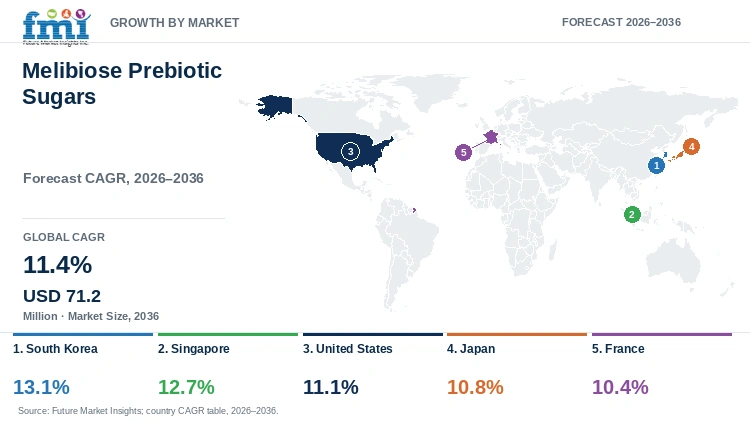
South Korean pediatric and nutricosmetic formulators are forecast to lead national melibiose prebiotic sugars growth by expanding 13.1% annually through 2036 just above Singaporean demand (expected at 12.7%). In parallel, American turnover (projected at 11.1%) followed by Japanese volume (anticipated at 10.8%) and French sales (predicted at 10.4%) progresses across infant nutrition and luxury dermocosmetic verticals.
Table 7: Country CAGR and Primary Growth Levers for the Melibiose Prebiotic Sugars Market (CAGR percentage and operational drivers), 2026 to 2036
| Country | CAGR (2026 to 2036) | Primary Growth Lever |
|---|---|---|
| South Korea | 13.1% | K-beauty epidermal barrier serums and MFDS-regulated health functional food adoption |
| Singapore | 12.7% | Regional APAC specialty nutrition R&D hubs and non-exempt Nutri-Grade beverage reformulation |
| United States | 11.1% | Hypoallergenic amino-acid infant formula fortification and longevity nutraceutical launches |
| Japan | 10.8% | Hokkaido beet-raffinose yeast fermentation scale and USD 174B food-processing base |
| France | 10.4% | Prestige dermocosmetic tight-junction serum formulation and French beet-refinery extraction |
Source: Future Market Insights analysis
South Korea Melibiose Prebiotic Sugars Market Outlook (2026 to 2036)
South Korea stands apart from Western markets because local demand is propelled simultaneously by ultra-premium post-natal care centers (Sanhujoriwon) specifying hypoallergenic infant formulas and K-beauty ampoule brands targeting skin glycation. Seoul dermocosmetic research laboratories and contract beauty packers formulate 1% to 3% crystalline melibiose into epidermal tight-junction facial ampoules and oral anti-glycation collagen jellies, lifting national sales by a forecast 13.1% annually until 2036. Regulatory oversight by South Korea's Ministry of Food and Drug Safety (MFDS) under its Food Safety Management System covers 35,000 food manufacturing sites and enforces Health Functional Foods ingredient recognition [10]. However, complete import reliance on Japanese and European purified melibiose crystals exposes Korean contract manufacturers to air-freight surcharges.
Key takeaway: In South Korea, dual demand from hypoallergenic pediatric nutrition and prestige K-beauty skin-barrier serums is forecast to drive a 13.1% CAGR.
Singapore Melibiose Prebiotic Sugars Market Outlook (2026 to 2036)
Singapore is expected to expand its melibiose prebiotic sugars consumption at a 12.7% annual pace from 2026 to 2036 as multinational early-life nutrition plants in Tuas upgrade Stage 1 through Stage 3 pediatric premixes. Unlike domestic-consumption markets, Singapore functions uniquely as an export-compliance and clinical trial formulation hub supplying hypoallergenic milk tins to pharmacy chains across ASEAN and China. Updated October 2026 Measures for Nutri-Grade Beverages enforced by Singapore's Health Promotion Board require clear sugar and saturated-fat grading marks across retail and freshly prepared drinks [11]. Commercial friction arises from stringent pre-market safety dossier evaluations for novel infant-formula oligosaccharides and elevated dehumidified warehousing expenses near Jurong Port.
Key takeaway: In Singapore, export-oriented early-life nutrition plants and clinical longevity supplement hubs are expected to sustain a 12.7% annual growth rate.
United States Melibiose Prebiotic Sugars Market Outlook (2026 to 2036)
January 2026 federal commodity balances highlight shifting industrial sweetener deliveries across United States packaged food kitchens and specialized hospital clinical nutrition formula producers across major metropolitan health networks [12]. What differentiates the United States from Asian dairy-led markets is the rapid rise of physician-dispensed cellular-autophagy longevity nutraceuticals alongside hospital elemental amino-acid formulas for cow-milk allergy infants. American pediatric nutrition formulators and longevity supplement brands incorporate alpha-1,6 disaccharides into hypoallergenic powders and anti-glycation metabolic capsules, driving a projected 11.1% yearly growth rate through 2036. Nonetheless, lengthy federal Infant Formula Act neonatal growth-monitoring clinical study requirements slow the commercial incorporation of novel alpha-galactooligosaccharides into standard state-contracted hospital maternity formulas.
Key takeaway: In the United States, specialty hypoallergenic infant formulas and cellular-autophagy nutraceuticals are projected to support an 11.1% yearly expansion pace.
Japan Melibiose Prebiotic Sugars Market Outlook (2026 to 2036)
Japan is uniquely positioned as the world's primary upstream producer of purified melibiose, anchored by Hokkaido beet-sugar refineries that extract raffinose directly from cold-climate sugar-beet molasses campaigns. Domestic dairy and functional dessert manufacturers formulate raffinose-derived melibiose into atopic-care pediatric milks and anti-glycation functional yogurts marketed to aging households, supporting an anticipated 10.8% yearly expansion clip over 2026-2036. In January 2026, the Global Nutrition Report Nutrition Accountability Framework recorded Nagase Viita's corporate commitment in Okayama to expand health-supporting functional carbohydrate ingredients across 100 commercial food and beverage products by March 2026 [13]. Even so, declining domestic birth cohorts and weather-induced yield fluctuations across Hokkaido sugar-beet harvests constrain raw molasses raffinose availability.
Key takeaway: In Japan, captive Hokkaido beet-raffinose bioconversion and clinical oral-tolerance research are anticipated to sustain a 10.8% annual expansion rate.
France Melibiose Prebiotic Sugars Market Outlook (2026 to 2036)
France differs from other European markets by combining northern European sugar-beet molasses refining with prestige pharmacy dermocosmetic laboratories in Paris and Chartres that specify melibiose for epidermal tight-junction repair. June 2026 European production statistics show French manufacturing recording a 2.8% year-on-year expansion in calendar-adjusted output during April 2026 alongside a seasonally adjusted index of 103.6 [14]. French pharmacy skincare houses and pediatric dairy cooperatives specify botanical and beet-derived melibiose crystals to boost claudin barrier proteins and infant colonic bifidobacteria counts, driving a predicted 10.4% compound annual pace until 2036. However, rising French production costs and strict European Union pediatric health-claim substantiation rules temper short-term volume acceleration.
Key takeaway: In France, prestige pharmacy dermocosmetic serums and specialized pediatric dairy nutrition are predicted to support 10.4% annual market growth until 2036.
Full report country CAGRs cover: North America; Latin America; Western Europe; Eastern Europe; East Asia; South Asia and Pacific; Middle East and Africa.
Who are the notable companies in the melibiose prebiotic sugars market?
Nippon Beet Sugar Manufacturing Co. Ltd. (Nitten), Meiji Holdings Co. Ltd., Sinphar Pharmaceutical Co. Ltd., Tokyo Chemical Industry Co. Ltd., Biosynth AG, Fuji Nihon Corporation (formerly Fuji Nihon Seito), Hokkaido Sugar Co. Ltd., and Pfanstiehl Inc. are the notable companies in the melibiose prebiotic sugars market.
Market participation across the melibiose prebiotic sugars sector is structured around upstream Hokkaido beet-raffinose extractors and high-purity glycoscience reagent synthesizers alongside clinical pediatric and nutraceutical formulators. Japanese sugar-beet refiners Nippon Beet Sugar Manufacturing Co. Ltd. (Nitten) alongside Fuji Nihon Corporation and Hokkaido Sugar Co. Ltd. control simulated-moving-bed raffinose recovery and selective yeast fermentation into food-grade melibiose. Fine carbohydrate specialists Tokyo Chemical Industry Co. Ltd. together with Biosynth AG and Pfanstiehl Inc. manufacture ultra-pure crystalline melibiose for bioprocess and dermocosmetic formulations. Downstream clinical nutrition and pharmaceutical innovators Meiji Holdings Co. Ltd. and Sinphar Pharmaceutical Co. Ltd. integrate prebiotic disaccharides into pediatric allergy formulas and healthy-aging supplements.
- Beet-Raffinose & Enzymatic Melibiose Extraction Leaders: Nippon Beet Sugar Manufacturing Co. Ltd. (Nitten), Fuji Nihon Corporation, and Hokkaido Sugar Co. Ltd. refine sugar-beet molasses trisaccharides into food-grade prebiotic sugars.
- High-Purity Glycoscience & Fine Carbohydrate Producers: Tokyo Chemical Industry Co. Ltd. alongside Biosynth AG and Pfanstiehl Inc. supplies analytical and cosmetic-grade alpha-1,6 disaccharides.
- Pediatric Nutrition, Nutraceutical & Dermocosmetic Formulators: Meiji Holdings Co. Ltd. and Sinphar Pharmaceutical Co. Ltd. commercialize clinical infant nutrition and anti-glycation health formulations.
Competitive Benchmarking: Melibiose Prebiotic Sugars Market
Table 8: Competitive Benchmarking for the Melibiose Prebiotic Sugars Market (qualitative capability ratings), 2026
| Company | Raffinose Feedstock Access | Selective Hydrolysis & Purity | Preclinical & Formulation Dossiers | International Reach |
|---|---|---|---|---|
| Nippon Beet Sugar Mfg. (Nitten) | High | High | High | Medium |
| Meiji Holdings Co., Ltd. | Medium | High | High | High |
| Sinphar Pharmaceutical Co., Ltd. | Medium | Medium | High | Medium |
| Tokyo Chemical Industry Co., Ltd. | Medium | High | Medium | High |
| Biosynth AG | Medium | High | Medium | High |
| Fuji Nihon Corporation | High | High | Medium | Medium |
| Hokkaido Sugar Co., Ltd. | High | Medium | Medium | Medium |
| Pfanstiehl, Inc. | Medium | High | High | High |
Scoring basis: Raffinose Feedstock Access earns a High mark where a producer controls captive sugar-beet molasses chromatography or direct agricultural contracting, and Medium for purchased trisaccharide intermediates. Selective Hydrolysis & Purity reflects documented yeast-invertase fermentation or chromatographic separation yielding >98% alpha-1,6 melibiose crystals. Preclinical & Formulation Dossiers evaluates published mouse oral-tolerance and in-vitro anti-glycation studies alongside nutritional profiling systems.
Key Developments in the Melibiose Prebiotic Sugars Market
- In April 2026, Fuji Nihon Corporation reported FY2026 consolidated net sales of JPY 28,491 million (+1.0% year-on-year) and operating profit of JPY 3,528 million (+9.2%), with Functional Materials net sales rising 4.7% to JPY 14,121 million and operating profit surging 28.0% to JPY 1,644 million [15].
- Pfanstiehl Inc. expanded its ICH-Q7 cGMP multi-compendial Trehalose dihydrate excipient platform (DMF 024122, glass-transition temperature around 115 degrees Celsius) in 2026 to prevent freeze-thaw aggregation in biologics and vaccines [16].
- In March 2026, Pfanstiehl Inc. advanced its cGMP high-purity low-endotoxin D-Galactose upstream feed platform (CAS 59-23-4) at its Waukegan facility to reduce lactate accumulation while modulating glycoprotein galactosylation [17].
Key Players in the Melibiose Prebiotic Sugars Market
Beet-Raffinose & Enzymatic Melibiose Extraction Leaders
- Nippon Beet Sugar Manufacturing Co., Ltd. (Nitten)
- Fuji Nihon Corporation (formerly Fuji Nihon Seito)
- Hokkaido Sugar Co., Ltd.
High-Purity Glycoscience & Fine Carbohydrate Producers
- Tokyo Chemical Industry Co., Ltd.
- Biosynth AG
- Pfanstiehl, Inc.
Pediatric Nutrition, Nutraceutical & Dermocosmetic Formulators
- Meiji Holdings Co., Ltd.
- Sinphar Pharmaceutical Co., Ltd.
Melibiose Prebiotic Sugars Market - Report Scope
Table 9: Report Scope for the Melibiose Prebiotic Sugars Market (coverage fields and definitions), 2026 to 2036
| Coverage field | Report scope |
|---|---|
| Market breakdown | Production Source; Physiological Mechanism; End-Use Vertical; Region |
| Quantitative Units | USD Million |
| Market Definition | Includes B2B supplier revenue from purified melibiose (alpha-D-galactopyranosyl-(1->6)-D-glucose) produced via selective raffinose yeast fermentation/hydrolysis, soy-whey/molasses chromatography, or botanical fractionation across the listed segmentation. Category Scope Note: The valuation measures bulk and specialty ingredient shipments where Raffinose Selective Yeast Fermentation / Hydrolysis is anticipated to account for 62.5% of 2026 source volume, excluding unhydrolyzed raffinose trisaccharides, crude soy molasses, and retail sales of finished infant formula tins, nutraceutical bottles, or cosmetic serums. |
| Regions Covered | North America; Latin America; Western Europe; Eastern Europe; East Asia; South Asia and Pacific; Middle East and Africa |
| Countries Covered | South Korea, Singapore, United States, Japan, France, and additional countries in the full report |
| Key Companies Covered | Nippon Beet Sugar Manufacturing Co., Ltd. (Nitten), Meiji Holdings Co., Ltd., Sinphar Pharmaceutical Co., Ltd., Tokyo Chemical Industry Co., Ltd., Biosynth AG, Fuji Nihon Corporation, Hokkaido Sugar Co., Ltd., Pfanstiehl, Inc. |
| Forecast Period | 2026 to 2036 |
| Approach | Primary and secondary research with rigorous market triangulation. |
Melibiose Prebiotic Sugars Market - Research Methodology
Table 10: Research Methodology for the Melibiose Prebiotic Sugars Market (research methods and approach), 2026 edition
| Method | Approach |
|---|---|
| Primary Research | Primary interviews were conducted with sugar-beet chromatographic separation engineers, yeast-fermentation bioprocess managers, pediatric allergy nutritionists, healthy-aging nutraceutical formulators, and dermocosmetic R&D directors to verify extraction yields and B2B price tiers. |
| Secondary Research | Secondary research included company annual reports, investor briefings, USDA ERS and USDA FAS sugar and food processing reports, WHO infant nutrition publications, MFDS functional food registries, and peer-reviewed oral-tolerance and autophagy studies. |
| Market Sizing and Forecasting | Market sizing and forecasting from 2026 to 2036 were built using top-down and bottom-up models linking beet-molasses raffinose recovery, selective yeast hydrolysis yields, and end-use formulation dosages across pediatric, nutraceutical, and cosmetic verticals. |
| Data Triangulation and Validation | Market figures are validated against Hokkaido and European beet-sugar production logs, specialty oligosaccharide import records, hypoallergenic infant formula launch volumes, and historical price-volume elasticities to prevent double counting with parent raffinose streams. |
| Country Forecasting Model | Country-level CAGRs are generated via FMI's bioactive oligosaccharide econometric model, calibrating national trajectories around the 11.4% global CAGR using pediatric allergy prevalence, per-infant premium formula spend, K-beauty/French dermocosmetic exports, and domestic beet-refining capacity. |
| Operational Benchmark Traceability | Operational benchmarks (purified melibiose metric tonnage, raffinose fermentation output, realized USD per kilogram pricing, and daily milligram dosages) represent modeled estimates synthesized from USDA FAS and USDA ERS sugar-beet statistics, clinical trial protocols, and corporate disclosures. |
Melibiose Prebiotic Sugars Market by Segments
Melibiose Prebiotic Sugars Market segmented by Production Source:
- Raffinose Selective Yeast Fermentation / Hydrolysis
- Soy Whey & Molasses Chromatographic Extraction
- Honey & Botanical Oligosaccharide Fractionation
Melibiose Prebiotic Sugars Market segmented by Physiological Mechanism:
- Th2 Immune-Modulating Oral Tolerance Inducer
- Autophagy-Enhancing & Advanced Glycation (AGE) Inhibitor
- Epidermal Tight-Junction Barrier Booster
Melibiose Prebiotic Sugars Market segmented by End-Use Vertical:
- Hypoallergenic Infant & Pediatric Nutrition
- Healthy-Aging Anti-Glycation Nutraceuticals
- Microbiome-Friendly Dermocosmetic Serums
- Premium Functional Dairy Desserts
Melibiose Prebiotic Sugars Market by Region
- North America
- United States
- Canada
- Latin America
- Brazil
- Mexico
- Argentina
- Chile
- Western Europe
- Germany
- France
- United Kingdom
- Italy
- Spain
- Benelux
- Nordics
- Eastern Europe
- Poland
- Czech Republic
- Romania
- Hungary
- East Asia
- China
- Japan
- South Korea
- South Asia and Pacific
- India
- ASEAN
- Australia and New Zealand
- Middle East and Africa
- GCC Countries
- South Africa
- Türkiye
- Israel
Research Sources and Bibliography
- [1] U.S. Department of Agriculture, Economic Research Service. (2026, July 16). Sugar and Sweeteners Outlook: July 2026. U.S. Department of Agriculture.
- [2] World Health Organization. (2026, August 04). Infant and young child feeding. World Health Organization.
- [3] U.S. Department of Agriculture, Economic Research Service. (2026, May 18). Sugar and Sweeteners Outlook: May 2026. U.S. Department of Agriculture.
- [4] Nippon Beet Sugar Manufacturing Co., Ltd. (2025, February 21). Hokkaido Beet Sugar Manufacturers Sweeten Agriculture. Nippon Beet Sugar Manufacturing Co., Ltd.
- [5] Meiji Holdings Co., Ltd. (2025, May 09). Consolidated Financial Results for the Fiscal Year Ended March 31, 2025 [Based on Japanese GAAP]. Meiji Holdings Co., Ltd.
- [6] Fuji Nihon Corporation. (2025, July 14). Inulin Business - Introducing Our Businesses - Fuji Nihon Corporation. Fuji Nihon Corporation.
- [7] U.S. Department of Agriculture, Economic Research Service. (2026, June 11). Total U.S. food spending reached $2.51 trillion in 2025. U.S. Department of Agriculture.
- [8] U.S. Department of Agriculture, Economic Research Service. (2026, June 17). Sugar and Sweeteners Outlook: June 2026. U.S. Department of Agriculture.
- [9] Sinphar Pharmaceutical Co., Ltd. (2026, September 16). Investor Conference Sinphar Group. Sinphar Pharmaceutical Co., Ltd.
- [10] Ministry of Food and Drug Safety. (2025, November 14). Food Safety Management System. Ministry of Food and Drug Safety Republic of Korea.
- [11] Health Promotion Board. (2026, October 03). Measures for Nutri-Grade. Health Promotion Board Singapore.
- [12] U.S. Department of Agriculture, Economic Research Service. (2026, January 16). Sugar and Sweeteners Outlook: January 2026. U.S. Department of Agriculture.
- [13] Global Nutrition Report. (2026, January 15). Nagase Viita (formerly Hayashibara Co., Ltd). Global Nutrition Report Nutrition Accountability Framework.
- [14] Eurostat. (2026, June 15). Industrial production up by 0.1% in both the euro area and the EU. Statistical Office of the European Union (Eurostat).
- [15] Fuji Nihon Corporation. (2026, April 30). Consolidated Financial Results for the Fiscal Year Ended March 31, 2026 (Under Japanese GAAP). Fuji Nihon Corporation.
- [16] Pfanstiehl, Inc. (2026, February 14). Trehalose dihydrate GMP Excipient- NF BP EP BP JP ChP. Pfanstiehl, Inc.
- [17] Pfanstiehl, Inc. (2026, March 10). D-Galactose GMP Upstream Feed Protein Production - Pfanstiehl, Inc. Pfanstiehl, Inc.
- [18] Meiji Holdings Co., Ltd. (2025, December 26). Meiji Group Sustainability Report_2025. Meiji Holdings Co., Ltd.
- [19] Biosynth AG. (2025, November 20). Oligosaccharides Toolbox. Biosynth AG.
This bibliography is provided for reader reference and is not exhaustive. The full report contains the complete reference list and detailed citations.
This Report Answers
- How large is the melibiose prebiotic sugars market in 2026 and what is forecast for 2036?
- Which oral-tolerance and anti-glycation mechanisms drive demand for melibiose prebiotic sugars?
- Why does Raffinose Selective Yeast Fermentation / Hydrolysis lead the production source category?
- Why does Th2 Immune-Modulating Oral Tolerance Inducer lead the physiological mechanism category?
- How do growth rates differ across South Korea, Singapore, the United States, Japan, and France?
- Which leading companies extract and purify melibiose prebiotic sugars today?
- What limits adoption or supplier switching in the melibiose prebiotic sugars market?
- What should pediatric and dermocosmetic buyers evaluate before procuring melibiose?
Frequently Asked Questions
How big is the melibiose prebiotic sugars market in 2026, and what is forecast for 2036?
Pediatric allergy nutrition and anti-glycation skincare procurement are estimated to lift worldwide melibiose prebiotic sugars turnover from USD 21.8 million in 2025 to USD 24.2 million across 2026, with sales forecast to attain USD 71.2 million by 2036.
What compound annual growth rate is expected for the melibiose prebiotic sugars market?
According to FMI, global melibiose prebiotic sugars sales are predicted to expand at an 11.4% CAGR between 2026 and 2036, yielding an estimated USD 47.0 million in incremental revenue across pediatric nutrition and dermocosmetic channels.
Which production source segment leads the melibiose prebiotic sugars market?
Raffinose Selective Yeast Fermentation / Hydrolysis is anticipated to supply 62.5% of 2026 source volume because invertase-positive yeast strains cleave and consume the fructose unit from beet raffinose while leaving high-purity melibiose in solution.
Which end-use vertical commands the largest share in 2026?
Hypoallergenic Infant & Pediatric Nutrition is estimated to capture 49.4% of 2026 vertical spending as specialty nutrition developers evaluate soy-free beet-derived melibiose based on preclinical regulatory T-cell oral-tolerance and in-vitro bifidogenic research.
Which country posts the fastest growth trajectory from 2026 to 2036?
FMI projections place South Korea at the top of national demand growth with a forecast 13.1% CAGR through 2036, supported by premium hypoallergenic infant milk powders and K-beauty epidermal barrier serums.
Who are the key players in the melibiose prebiotic sugars market?
Notable market participants include Nippon Beet Sugar Manufacturing Co., Ltd. (Nitten), Meiji Holdings Co., Ltd., Sinphar Pharmaceutical Co., Ltd., Tokyo Chemical Industry Co., Ltd., Biosynth AG, Fuji Nihon Corporation (formerly Fuji Nihon Seito), Hokkaido Sugar Co., Ltd., and Pfanstiehl, Inc.
Preview the report firsthand - request a free sample
Get SampleGet the brochure for pricing and purchase details.
Get PDFTable of Content
- Key Takeaways
- Market Size and CAGR
- Top Growth Driver
- Fastest Growing Segment
- Leading Region
- Key Companies
- Emerging Opportunities
- Executive Summary
- Global Market Outlook
- Demand-side Trends
- Supply-side Trends
- Technology Roadmap Analysis
- Analysis and Recommendations
- Analyst Perspective (What is happening? Why now? What should investors know?)
- Key Questions Answered
- How large is the market?
- What is the CAGR?
- What are key trends?
- Which region dominates?
- Who are the leaders?
- Market Overview
- Market Coverage / Taxonomy
- Market Definition / Scope / Limitations
- Research Methodology
- Chapter Orientation
- Analytical Lens and Working Hypotheses
- Market Structure, Signals, and Trend Drivers
- Benchmarking and Cross-market Comparability
- Market Sizing, Forecasting, and Opportunity Mapping
- Research Design and Evidence Framework
- Desk Research Programme (Secondary Evidence)
- Expert Input and Fieldwork (Primary Evidence)
- Tooling, Models, and Reference Databases
- Data Engineering and Model Build
- Quality Assurance and Audit Trail
- Market Background
- Market Dynamics (Drivers, Restraints, Opportunity, Trends)
- Scenario Forecast (Optimistic, Likely, Conservative)
- Impact Analysis
- AI Impact
- Sustainability Impact
- Regulatory Impact
- Technology Impact
- Consumer / Buyer Analysis
- Purchase Drivers
- Adoption Barriers
- Buyer Journey
- Opportunity Map Analysis
- Product Life Cycle Analysis
- Supply Chain Analysis
- Investment Feasibility Matrix
- Value Chain Analysis
- PESTLE and Porter's Analysis
- Regulatory Landscape
- Regional Parent Market Outlook
- Production and Consumption Statistics
- Import and Export Statistics
- Global Market Analysis and Forecast, 2021 to 2036
- Historical Market Size Value (USD Million) Analysis, 2021 to 2025
- Current and Future Market Size Value (USD Million) Projections, 2026 to 2036
- Y-o-Y Growth Trend Analysis
- Absolute $ Opportunity Analysis
- Global Market Pricing Analysis, 2021 to 2036
- Global Market Analysis and Forecast, By Production Source, 2021 to 2036
- Introduction / Key Findings
- Historical Market Size Value (USD Million) Analysis By Production Source, 2021 to 2025
- Current and Future Market Size Value (USD Million) Analysis and Forecast By Production Source, 2026 to 2036
- Raffinose Selective Yeast Fermentation / Hydrolysis
- Soy Whey & Molasses Chromatographic Extraction
- Honey & Botanical Oligosaccharide Fractionation
- Y-o-Y Growth Trend Analysis By Production Source, 2021 to 2025
- Absolute $ Opportunity Analysis By Production Source, 2026 to 2036
- Global Market Analysis and Forecast, By Physiological Mechanism, 2021 to 2036
- Introduction / Key Findings
- Historical Market Size Value (USD Million) Analysis By Physiological Mechanism, 2021 to 2025
- Current and Future Market Size Value (USD Million) Analysis and Forecast By Physiological Mechanism, 2026 to 2036
- Th2 Immune-Modulating Oral Tolerance Inducer
- Autophagy-Enhancing & Advanced Glycation (AGE) Inhibitor
- Epidermal Tight-Junction Barrier Booster
- Y-o-Y Growth Trend Analysis By Physiological Mechanism, 2021 to 2025
- Absolute $ Opportunity Analysis By Physiological Mechanism, 2026 to 2036
- Global Market Analysis and Forecast, By End-Use Vertical, 2021 to 2036
- Introduction / Key Findings
- Historical Market Size Value (USD Million) Analysis By End-Use Vertical, 2021 to 2025
- Current and Future Market Size Value (USD Million) Analysis and Forecast By End-Use Vertical, 2026 to 2036
- Hypoallergenic Infant & Pediatric Nutrition
- Healthy-Aging Anti-Glycation Nutraceuticals
- Microbiome-Friendly Dermocosmetic Serums
- Premium Functional Dairy Desserts
- Y-o-Y Growth Trend Analysis By End-Use Vertical, 2021 to 2025
- Absolute $ Opportunity Analysis By End-Use Vertical, 2026 to 2036
- Global Market Analysis and Forecast, By Region, 2021 to 2036
- Introduction
- Historical Market Size Value (USD Million) Analysis By Region, 2021 to 2025
- Current Market Size Value (USD Million) Analysis and Forecast By Region, 2026 to 2036
- North America
- Latin America
- Western Europe
- Eastern Europe
- East Asia
- South Asia and Pacific
- Middle East and Africa
- Market Attractiveness Analysis By Region
- North America Market Analysis and Forecast, By Country, 2021 to 2036
- Historical Market Size Value (USD Million) Trend Analysis By Market Taxonomy, 2021 to 2025
- Market Size Value (USD Million) Forecast By Market Taxonomy, 2026 to 2036
- By Country
- United States
- Canada
- By Production Source
- By Physiological Mechanism
- By End-Use Vertical
- By Country
- Market Attractiveness Analysis
- By Country
- By Production Source
- By Physiological Mechanism
- By End-Use Vertical
- Key Takeaways
- Latin America Market Analysis and Forecast, By Country
- Historical Market Size Value (USD Million) Trend Analysis By Market Taxonomy, 2021 to 2025
- Market Size Value (USD Million) Forecast By Market Taxonomy, 2026 to 2036
- By Country
- Brazil
- Mexico
- Argentina
- Chile
- By Production Source
- By Physiological Mechanism
- By End-Use Vertical
- By Country
- Market Attractiveness Analysis
- By Country
- By Production Source
- By Physiological Mechanism
- By End-Use Vertical
- Key Takeaways
- Western Europe Market Analysis and Forecast, By Country
- Historical Market Size Value (USD Million) Trend Analysis By Market Taxonomy, 2021 to 2025
- Market Size Value (USD Million) Forecast By Market Taxonomy, 2026 to 2036
- By Country
- Germany
- France
- United Kingdom
- Italy
- Spain
- Benelux
- Nordics
- By Production Source
- By Physiological Mechanism
- By End-Use Vertical
- By Country
- Market Attractiveness Analysis
- By Country
- By Production Source
- By Physiological Mechanism
- By End-Use Vertical
- Key Takeaways
- Eastern Europe Market Analysis and Forecast, By Country
- Historical Market Size Value (USD Million) Trend Analysis By Market Taxonomy, 2021 to 2025
- Market Size Value (USD Million) Forecast By Market Taxonomy, 2026 to 2036
- By Country
- Poland
- Czech Republic
- Romania
- Hungary
- By Production Source
- By Physiological Mechanism
- By End-Use Vertical
- By Country
- Market Attractiveness Analysis
- By Country
- By Production Source
- By Physiological Mechanism
- By End-Use Vertical
- Key Takeaways
- East Asia Market Analysis and Forecast, By Country
- Historical Market Size Value (USD Million) Trend Analysis By Market Taxonomy, 2021 to 2025
- Market Size Value (USD Million) Forecast By Market Taxonomy, 2026 to 2036
- By Country
- China
- Japan
- South Korea
- By Production Source
- By Physiological Mechanism
- By End-Use Vertical
- By Country
- Market Attractiveness Analysis
- By Country
- By Production Source
- By Physiological Mechanism
- By End-Use Vertical
- Key Takeaways
- South Asia and Pacific Market Analysis and Forecast, By Country
- Historical Market Size Value (USD Million) Trend Analysis By Market Taxonomy, 2021 to 2025
- Market Size Value (USD Million) Forecast By Market Taxonomy, 2026 to 2036
- By Country
- India
- ASEAN
- Australia and New Zealand
- By Production Source
- By Physiological Mechanism
- By End-Use Vertical
- By Country
- Market Attractiveness Analysis
- By Country
- By Production Source
- By Physiological Mechanism
- By End-Use Vertical
- Key Takeaways
- Middle East and Africa Market Analysis and Forecast, By Country
- Historical Market Size Value (USD Million) Trend Analysis By Market Taxonomy, 2021 to 2025
- Market Size Value (USD Million) Forecast By Market Taxonomy, 2026 to 2036
- By Country
- GCC Countries
- South Africa
- Türkiye
- Israel
- By Production Source
- By Physiological Mechanism
- By End-Use Vertical
- By Country
- Market Attractiveness Analysis
- By Country
- By Production Source
- By Physiological Mechanism
- By End-Use Vertical
- Key Takeaways
- Key Countries Market Analysis
- United States
- Pricing Analysis
- Market Share Analysis, 2025
- By Production Source
- By Physiological Mechanism
- By End-Use Vertical
- Canada
- Pricing Analysis
- Market Share Analysis, 2025
- By Production Source
- By Physiological Mechanism
- By End-Use Vertical
- Mexico
- Pricing Analysis
- Market Share Analysis, 2025
- By Production Source
- By Physiological Mechanism
- By End-Use Vertical
- Brazil
- Pricing Analysis
- Market Share Analysis, 2025
- By Production Source
- By Physiological Mechanism
- By End-Use Vertical
- Chile
- Pricing Analysis
- Market Share Analysis, 2025
- By Production Source
- By Physiological Mechanism
- By End-Use Vertical
- Germany
- Pricing Analysis
- Market Share Analysis, 2025
- By Production Source
- By Physiological Mechanism
- By End-Use Vertical
- United Kingdom
- Pricing Analysis
- Market Share Analysis, 2025
- By Production Source
- By Physiological Mechanism
- By End-Use Vertical
- Italy
- Pricing Analysis
- Market Share Analysis, 2025
- By Production Source
- By Physiological Mechanism
- By End-Use Vertical
- Spain
- Pricing Analysis
- Market Share Analysis, 2025
- By Production Source
- By Physiological Mechanism
- By End-Use Vertical
- France
- Pricing Analysis
- Market Share Analysis, 2025
- By Production Source
- By Physiological Mechanism
- By End-Use Vertical
- India
- Pricing Analysis
- Market Share Analysis, 2025
- By Production Source
- By Physiological Mechanism
- By End-Use Vertical
- ASEAN
- Pricing Analysis
- Market Share Analysis, 2025
- By Production Source
- By Physiological Mechanism
- By End-Use Vertical
- Australia and New Zealand
- Pricing Analysis
- Market Share Analysis, 2025
- By Production Source
- By Physiological Mechanism
- By End-Use Vertical
- China
- Pricing Analysis
- Market Share Analysis, 2025
- By Production Source
- By Physiological Mechanism
- By End-Use Vertical
- Japan
- Pricing Analysis
- Market Share Analysis, 2025
- By Production Source
- By Physiological Mechanism
- By End-Use Vertical
- South Korea
- Pricing Analysis
- Market Share Analysis, 2025
- By Production Source
- By Physiological Mechanism
- By End-Use Vertical
- Poland
- Pricing Analysis
- Market Share Analysis, 2025
- By Production Source
- By Physiological Mechanism
- By End-Use Vertical
- Hungary
- Pricing Analysis
- Market Share Analysis, 2025
- By Production Source
- By Physiological Mechanism
- By End-Use Vertical
- Türkiye
- Pricing Analysis
- Market Share Analysis, 2025
- By Production Source
- By Physiological Mechanism
- By End-Use Vertical
- South Africa
- Pricing Analysis
- Market Share Analysis, 2025
- By Production Source
- By Physiological Mechanism
- By End-Use Vertical
- Singapore
- Pricing Analysis
- Market Share Analysis, 2025
- By Production Source
- By Physiological Mechanism
- By End-Use Vertical
- United States
- Market Structure Analysis
- Competition Dashboard
- Competition Benchmarking
- Market Share Analysis of Top Players
- By Regional
- By Production Source
- By Physiological Mechanism
- By End-Use Vertical
- Emerging Startups
- Innovation Benchmarking
- Competition Analysis
- Competition Deep Dive
- Nippon Beet Sugar Mfg. (Nitten)
- Overview
- Product Portfolio
- Profitability by Market Segments
- Sales Footprint
- Strategy Overview
- Marketing Strategy
- Product Strategy
- Channel Strategy
- Meiji Holdings Co., Ltd.
- Sinphar Pharmaceutical Co., Ltd.
- Tokyo Chemical Industry Co., Ltd.
- Biosynth AG
- Fuji Nihon Corporation
- Hokkaido Sugar Co., Ltd.
- Pfanstiehl, Inc.
- Nippon Beet Sugar Manufacturing Co., Ltd. (Nitten)
- Fuji Nihon Corporation (formerly Fuji Nihon Seito)
- Nippon Beet Sugar Mfg. (Nitten)
- Case Studies
- Success Stories
- Recent Developments
- Competition Deep Dive
- Assumptions & Acronyms Used


