

- Market Size (2026)
- USD 101.4 Mn
- Forecast (2036)
- USD 267.8 Mn
- CAGR (2026 to 2036)
- 10.2%
How big is Metallopolymer Resins Market in 2026?
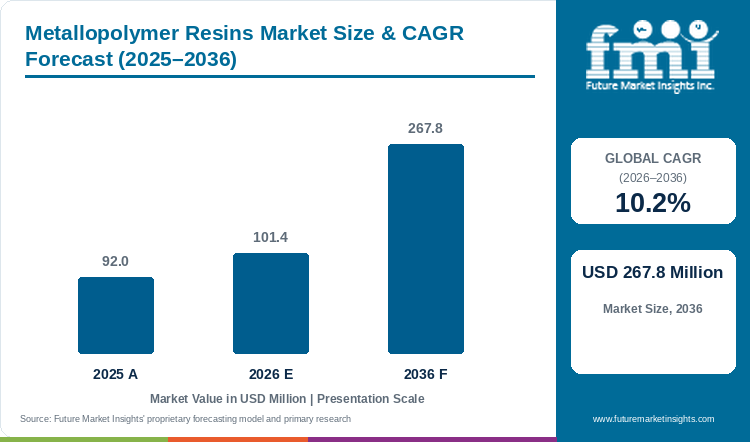
Assessed at USD 92.0 million in 2025 and progressing to USD 101.4 million in 2026, the Metallopolymer Resins Market valuation is on course to reach USD 267.8 million by 2036, supported by a forecast-period CAGR of 10.2%.
The global metallopolymer resins market was valued at USD 92.0 million in 2025 and is estimated to reach USD 101.4 million in 2026. The market is projected to reach USD 267.8 million by 2036, expanding at a compound annual growth rate (CAGR) of 10.2% between 2026 and 2036. Ferrocene and iron metallopolymers are projected to capture 38.4% of 2026 demand, since reversible Fe(II)/Fe(III) redox switching buys both etch contrast in lithography and mediator stability in electrochemical sensors on one polymer platform. Industry growth runs at nearly double the photoresist stripper market at 5.3% CAGR, because stripper volume rides installed wafer starts while metallopolymer resins ride the next node's design lock-ins, decided years before fabs open. Consolidation follows the lock-in, as Brewer Science closed its acquisition of Heraeus Epurio's semiconductor chemicals business in August 2026 to bring ultrapure monomers in-house under its Zero Defects program [19], while Tokyo Ohka Kogyo and Irresistible Materials partnered in February 2026 on PFAS-free multi-trigger EUV resists [20] and Merck KGaA committed EUR 11.5 billion in capital behind lithography materials. Fabs pay defect-floor premiums inside a node's first three qualification years, and suppliers embedded in those reference stacks hold the design positions.
Key Market Trends & Insights
- By metal center: Ferrocene & Iron Metallopolymers are projected to capture 38.4% in 2026 because iron metallocenes combine reversible Fe(II)/Fe(III) redox switching in biosensors with dense oxide hardmask formation under oxygen plasma.
- By polymer topology: Side-Chain Metallocene Polymers are estimated to command 51.0% in 2026 as diagnostic strip coaters and wafer spin-on tracks prioritize resins that dissolve cleanly in standard PGMEA and aqueous buffers.
- By functional property: Redox Charge-Transport Resins are expected to concentrate 42.7% in 2026 because implanted continuous glucose monitors and solid-state lithium batteries require permanently tethered electron and ion shuttles.
- By end-use sector: Semiconductor Copolymer Lithography is forecast to generate 36.8% in 2026 owing to High-NA EUV underlayer and directed self-assembly (DSA) block copolymer adoption at sub-2nm logic nodes.
Regional Highlights
- Top national expansion: Taiwan is projected to lead global growth at a 12.0% CAGR through 2036 as 300mm foundries scale 2nm Gate-All-Around (GAA) nanosheet logic and CoWoS 2.5D/3D advanced packaging.
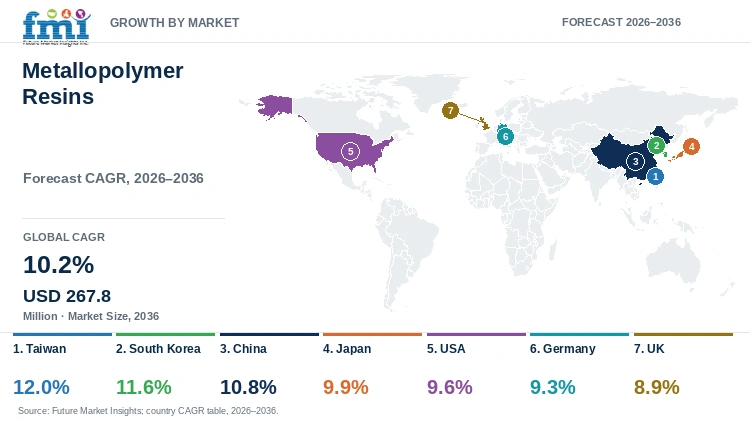
- Broader country progression: South Korea is expected to expand at an 11.6% CAGR ahead of China at 10.8% and Japan at 9.9%, while the USA is forecast to progress at 9.6%, Germany at 9.3% and the UK at 8.9%.
Market Size & Forecast
Table 1: Market Size and Forecast for the Metallopolymer Resins Market (USD million and CAGR percentage), 2025 to 2036
| Metric | Value |
|---|---|
| 2025 Market Size | USD 92.0 million |
| Estimated Market Size in 2026 | USD 101.4 million |
| Projected Market Size by 2036 | USD 267.8 million |
| CAGR, 2026 to 2036 | 10.2% |
| Added Value, 2026 to 2036 | USD 166.4 million |
Semiconductor logic foundries and wearable medical device manufacturers confront physical performance ceilings where purely organic polymers fail under extreme ultraviolet (EUV) photon flux or physiological fluid immersion. Organic chemically amplified resists experience capillary pattern collapse below 12nm half-pitch, while untethered small-molecule diagnostic mediators diffuse out of hydrogel electrodes within 48 hours. In July 2025, researchers at the Okinawa Institute of Science and Technology (OIST) demonstrated in Nature Communications that reversible nitrogen ligand coordination converts 18-electron ferrocene derivatives into 20-electron complexes with tunable Fe(II)/Fe(III)/Fe(IV) redox states [5]. So electronic and biomedical formulators within the parent specialty polymers market are scaling organometallic resin synthesis to capture a 10.2% CAGR through 2036.
Organometallic Monomer and Active Resin Sizing
Table 2: Organometallic Monomer and Active Resin Sizing for the Metallopolymer Resins Market (USD million and physical ranges), 2025 to 2036
| Metric | 2025 | 2026 | 2036 |
|---|---|---|---|
| Market size (USD million) | 92.0 | 101.4 | 267.8 |
| Sublimed metallocene & metal-chelate monomers (metric tons) | 71.0 to 78.0 | 78.0 to 85.5 | 195.0 to 215.0 |
| Active metallopolymer resin shipments (metric tons) | 55.0 to 59.0 | 60.4 to 64.5 | 156.0 to 168.0 |
| Weighted average selling price (USD per kg) | 1,650 to 1,710 | 1,660 to 1,720 | 1,690 to 1,760 |
Operational note: Active resin shipment ranges reconcile high-tonnage marine zinc/copper ionomers (USD 48/kg) with GMP biosensor redox hydrogels (USD 2,900/kg) and sub-ppb semiconductor lithography resists (>USD 7,200/kg) after 0.01 µm chelation filtration yields of 78% to 86%.
Producing electronic-grade metallopolymers requires eliminating unintended alkali metal ions (Na+ and K+ below 0.5 ppb) while preserving exact stoichiometric coordination of iron, ruthenium, or platinum centers. Resin suppliers widely integrate captive monomer synthesis with Class 10 cleanroom filtration to serve wafer fabs in the photoresist ancillary lithography chemicals market.
Wafer Foundry & Biosensor Production Sizing
Table 3: Wafer Foundry and Diagnostic Device Indicators for the Metallopolymer Resins Market (USD), 2025 to 2036
| Metric | 2025 | 2026 | 2036 |
|---|---|---|---|
| Advanced 300mm EUV & 3D packaging wafer passes (million) | 18.5 | 21.4 | 62.0 |
| Metallopolymer spend per 1,000 wafer passes (USD) | 4,973.0 | 4,738.3 | 4,319.4 |
| Annual resin spend per qualified 300mm fab line (USD thousand) | 310.0 to 380.0 | 340.0 to 420.0 | 620.0 to 780.0 |
| Process-of-Record (POR) contract retention share (%) | 78.0% to 82.0% | 80.0% to 84.0% | 85.0% to 89.0% |
Table 4: Fab & End-Use Allocation Indicators for the Metallopolymer Resins Market (USD and percentages), 2026
| Metric | Value | Institutional / Industrial Reference Basis |
|---|---|---|
| Market size, 2026 | USD 101.4 million | 2026 global market value baseline |
| Qualified 300mm fabs, OLED lines & CGM plants | 290 facilities | Global logic/memory foundry, display & medical registry |
| Average metallopolymer spend per facility | USD 349,655 | Annualized electronic & diagnostic resin expenditure |
| Semiconductor copolymer lithography value, 2026 | USD 37.3 million | 36.8% end-use sector allocation |
Integrating organometallic polymers into semiconductor wafer tracks requires balancing high EUV photon absorption against strict front-end metallic contamination budgets. Foundry process engineers pair spin-on metallopolymer hardmasks with specialized formulations in the photoresist stripper market to achieve zero-defect pattern transfer.
Analyst Perspective
"Sub-2nm semiconductor lithography and 14-day wearable glucose biosensors require polymers where transition metal centers are covalently locked into the macromolecular chain. Formulators that combine monodisperse living polymerization (Đ < 1.08) with sub-ppb alkali metal chelation filtration will capture high-margin foundry Process-of-Record and FDA diagnostic contracts through 2036."
- Nikhil Kaitwade, Principal Consultant, Future Market Insights.
How is the metallopolymer resins market segmented?
The metallopolymer resins market is segmented by metal center, polymer topology, functional property, and end-use sector. In 2026, Ferrocene & Iron Metallopolymers is projected at 38.4%, Side-Chain Metallocene Polymers at 51.0%, Redox Charge-Transport Resins at 42.7%, and Semiconductor Copolymer Lithography at 36.8%.
By metal center: Ferrocene & Iron Metallopolymers, Ruthenium & Platinum Polymers, Zinc & Copper Ionomers, Lanthanide Luminescent Polymers.
By polymer topology: Side-Chain Metallocene Polymers, Main-Chain Coordination Polymers, Block Copolymer Resins.
By functional property: Redox Charge-Transport Resins, Preceramic Nanopatterning Masks, Antifouling Marine Coatings, Self-Healing Metal-Ligand Networks.
By end-use sector: Semiconductor Copolymer Lithography, Organic Electronics & OLEDs, Electrochemical Biosensor Mediators, Naval Antifouling Coatings.
Why do Ferrocene & Iron Metallopolymers lead the metal center category?
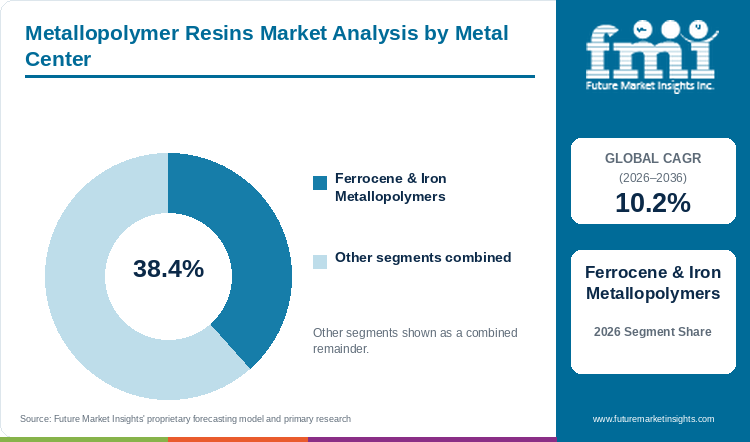
Ferrocene & Iron Metallopolymers are projected to capture 38.4% of metal center demand in 2026, supported by reversible Fe(II)/Fe(III) redox mediation and high oxygen-plasma etch resistance.
Table 5: Metal Center Share for the Metallopolymer Resins Market (percentage share), 2026
| Metal Center | Share (2026) |
|---|---|
| Ferrocene & Iron Metallopolymers | 38.4% |
| Other Segments Combined | 61.6%* |
| Total | 100.0% |
*Note: Remaining metal center categories sum to 100.0% of 2026 commercial volume.
Table 6: Metal Center Leadership and Market Growth for the Metallopolymer Resins Market (segment and CAGR percentage), 2026 to 2036
| Metric | Value |
|---|---|
| Global CAGR (2026 to 2036) | 10.2% |
| Leading Segment | Ferrocene & Iron Metallopolymers |
Biosensor and semiconductor buyers favor Ferrocene & Iron Metallopolymers (PFS, PVFc, and Fc-LPEI) because sandwiching an iron atom between cyclopentadienyl rings creates a thermally reliable; reversible electron shuttle (+0.20 V to +0.45 V vs. Ag/AgCl) that oxidizes into an etch-resistant iron-silicon oxide mask under oxygen plasma [9]. Unlike precious-metal alternatives in the photoresist chemical market iron precursors offer low raw material cost and biocompatible redox stability.
- Ferrocene & Iron Metallopolymers are projected to secure 38.4% of metal center market value in 2026 across lithography block copolymers, CGM biosensor hydrogels, and lithium-sulfur battery hosts.
- Clinical validation studies published in 2026 demonstrated that ferrocene-MOF bio-interfaces achieved a 0.006 ng/mL limit of detection for lactoferrin [3] and 0.1086 ng/mL for SMP30 antibodies [6], following OIST's July 2025 discovery of 20-electron ferrocene coordination complexes [5].
Why do Side-Chain Metallocene Polymers define the largest polymer topology segment?
Side-Chain Metallocene Polymers are estimated to secure 51.0% of the polymer topology category in 2026, driven by drop-in solubility in standard PGMEA spin-coating and aqueous biosensor inks.
High-speed roll-to-roll diagnostic strip coaters and wafer spin-coating tracks require organometallic resins that dissolve cleanly without precipitating during solvent evaporation. Side-Chain Metallocene Polymers synthesized via RAFT, ROMP, or post-polymerization grafting onto linear poly(ethylenimine) (Fc-LPEI) let the flexible organic backbone govern viscosity while placing dense redox-active metallocene pendants along the chain [9]; complementing UV-cured binders in the radiation curable coatings market.
- Side-Chain Metallocene Polymers are estimated to command 51.0% of the polymer topology segment in 2026 because they process on standard coating lines without requiring specialized organometallic solvents.
- Michigan State University researchers published a standardized synthesis and cross-linking protocol in 2026 (Methods in Molecular Biology) for dimethylferrocene-modified linear poly(ethylenimine) (Fc-LPEI) hydrogels that wire glucose oxidase directly to enzymatic bioanodes [9].
What keeps Redox Charge-Transport Resins ahead by functional property?
Redox Charge-Transport Resins are expected to command 42.7% of functional property volume in 2026, reflecting recurring demand for non-leaching electron mediators in CGM patches and solid-state batteries.
Implanted continuous glucose monitors (CGMs), lithium-sulfur cathodes, and solid-state lithium-metal batteries require polymer matrices that transport electrons or ions rapidly without dissolving into the surrounding electrolyte. Electron-hopping across adjacent ferrocene, ruthenium, or molybdenum centers in Redox Charge-Transport Resins anchors active sites permanently to the electrode [2]; complementing next-generation materials in the solid-state battery precursor-free cathodes market.
- Redox Charge-Transport Resins are expected to hold 42.7% of functional property market value in 2026 across electrochemical biosensors, solid-state battery electrolytes, and sulfur cathode hosts.
- A 2025 Angewandte Chemie study demonstrated that a molybdenum paddle-wheel coordination metallopolymer electrolyte achieved 0.712 mS/cm room-temperature ionic conductivity, a 0.625 Li+ transference number, and >5.0 V stability [2]; while ferrocene-MOF@Ti3C2 sulfur hosts delivered 1,162 mAh/g capacity [8].
Why does Semiconductor Copolymer Lithography lead the end-use sector category?
Semiconductor Copolymer Lithography is forecast to generate 36.8% of end-use sector demand in 2026, owing to High-NA EUV organometallic resist and directed self-assembly block copolymer qualifications.
Logic and DRAM wafer fabs transitioning to 2nm Gate-All-Around (GAA) nanosheet transistors and HBM4 memory stacks require ultra-thin photoresists and directed self-assembly (DSA) block copolymers with extreme dry-etch selectivity. Semiconductor Copolymer Lithography resins oxidize under oxygen plasma into dense ceramic FeOx/SiOx hardmasks while surrounding organic blocks volatilize cleanly, outpacing conventional thermal management polymers in the battery thermal interface gels market.
- Semiconductor Copolymer Lithography is forecast to account for 36.8% of end-use sector demand in 2026 as 300mm foundries replace multi-step CVD hardmasks with single-coat organometallic spin-on underlayers.
- Tokyo Ohka Kogyo (TOK) and Irresistible Materials formed a joint development partnership and equity investment in February 2026 to commercialize PFAS-free Multi-Trigger Resist (MTR) EUV platforms with molecular dimensions 10x smaller than conventional resist polymers [20].
What are the drivers, restraints, and opportunities in the metallopolymer resins market?
In the metallopolymer resins market, sub-2nm High-NA EUV lithography ramps and wearable continuous glucose monitor adoption expand high-margin resin demand whereas wafer-fab metallic cross-contamination controls restrain front-end adoption and solid-state battery electrolytes create new commercial opportunities.
- Driver: Sub-2nm High-NA EUV lithography hardmask qualifications, 2.5D/3D chiplet packaging growth (28%–35% CAGR), and non-leaching CGM redox hydrogel adoption drive high-value resin consumption.
- Restraint: Strict wafer-fab metallic contamination ceilings (<10¹⁰ atoms/cm² and <0.5 ppb alkali metals) and precious-metal (Ru, Pt) precursor volatility restrict metallopolymer spin-coating to dedicated back-end-of-line tracks.
- Opportunity: Halogen-free methanol-dispersed conjugated block copolymer inks, electrochromic smart glazing films, and ambient CO2-to-urea electrocatalytic porous polymers unlock new industrial revenue streams.
Growth Analysis and Future Potential: Qualitative Demand Catalysts
Semiconductor foundries and outsourced semiconductor assembly and test (OSAT) providers are rapidly expanding procurement of organometallic etch masks and ultrapure lithography chemicals because organic resists erode prematurely below 12nm half-pitch. Incorporating iron, ruthenium, or tin centers into block copolymers raises EUV photon absorption cross-sections by 3x to 5x while enabling sub-10nm line-space pitch multiplication via directed self-assembly (DSA). Future Market Insights notes that these advanced electronic polymers command a substantial premium over standard grades in the performance elastomer market. According to a November 2025 industry benchmark, polymeric materials for advanced electronic packaging exceed USD 1,500.0 million and expand at over 13% CAGR through 2036, with 2.5D/3D packaging polymers growing at 28% to 35% CAGR. In parallel, July 2025 clinical validation in Mikrochimica Acta confirmed that ferrocene-mediated ZIF-8/LIG blood glucose biosensors achieved a 0.62 to 20 mM linear range and 96.38% signal retention after 7 days [17].
Risk Assessment of the Metallopolymer Resins Market: Operational and Formulation Friction
Stringent wafer-fab tool segregation rules and batch polydispersity sensitivity during cryogenic living polymerization represent the primary barriers restricting commercial adoption. Semiconductor fabs enforce metallic contamination budgets below 10¹⁰ atoms/cm² to prevent deep-level carrier traps in silicon channels, forcing foundries to dedicate segregated spin-coaters, developer tracks and dry-etch chambers before introducing Ferrocene & Iron Metallopolymers into high-volume manufacturing. Qualifying a new metallopolymer underlayer into a foundry Process of Record (POR) requires 18 to 30 months of defectivity marathon testing and upfront metrology investments exceeding USD 4.0 million per resin grade. also trace moisture or oxygen during cryogenic (-78°C) living anionic ring-opening polymerization of strained silaferrocenophanes terminates propagating chains prematurely, widening molecular weight dispersity (Đ > 1.15) and causing pitch-walking defects during block copolymer self-assembly.
Commercial Opportunity Analysis: Formulation Differentiation and Value-Add Formats
Specialty resin formulators capture premium margins by engineering halogen-free optoelectronic nanoparticle inks, durable electrochromic films, and catalytic coordination networks that replace toxic chlorinated solvents and scarce platinum catalysts. Conventional organic photovoltaic and OLED coating lines rely on toxic chlorobenzene or chloroform solvents that face strict European workplace bans and fluoropolymer restrictions in the high performance fluoropolymer market. In November 2025, FAU Erlangen researchers demonstrated in Macromolecules that all-conjugated PM6-based block copolymers synthesized via Stille cross-coupling form stable 35 to 200 nm nanoparticle dispersions in halogen-free methanol with a zeta potential near 35 mV [13]. Similarly, December 2025 trials in Angewandte Chemie showed electropolymerized manganese(II) hexadentate chelate metallopolymer films achieving 73% optical contrast, 397.1 cm²/C coloration efficiency and 10,000-cycle electrochromic switching stability [14]; while 2026 cyclic trinuclear copper-ferrocene porous polymers (Cu3Fc-Pyz-POP) achieved an ambient electrocatalytic urea yield of 115.23 µg·h⁻¹·mg⁻¹ from CO2 and N2 [10].
Metallopolymer Resins Market by Country (2026 to 2036)
As per FMI, Taiwan is projected to lead metallopolymer resins expansion across analyzed national markets at a 12.0% CAGR through 2036, whereas the UK is forecast to progress at an 8.9% annual pace. Commercial performance across East Asia, North America, and Europe depends on 300mm High-NA EUV and CoWoS advanced packaging wafer starts; domestic organometallic monomer distillation capacity and FDA-cleared continuous glucose monitoring patch production.
Table 7: Country CAGR and Primary Growth Levers for the Metallopolymer Resins Market (CAGR percentage and operational drivers), 2026 to 2036
| Country | CAGR (2026 to 2036) | Primary Growth Lever |
|---|---|---|
| Taiwan | 12.0% | TSMC 2nm/1.4nm EUV logic fabs, CoWoS 2.5D/3D packaging and offshore wind coatings |
| South Korea | 11.6% | Samsung and SK Hynix HBM4/EUV DRAM lines, tandem OLED panels and ROS nanomedicine [12] |
| China | 10.8% | Domestic DUV pitch-multiplication DSA masks, solid-state battery hosts and ferrocene biosensors [2] [8] |
| Japan | 9.9% | JSR, TOK and Shin-Etsu photoresist resin synthesis hubs and OIST/Tsukuba metallocene R&D [5] [11] [20] |
| USA | 9.6% | Brewer Science/Heraeus Epurio Dayton plant, Gelest monomers and CGM biosensor patches [9] [19] |
| Germany | 9.3% | Merck KGaA (EMD), BASF, FAU Erlangen block copolymer inks and Dresden Silicon Saxony fabs [13] [18] |
| UK | 8.9% | Irresistible Materials EUV MTR platform, molecular electronics R&D and naval coatings [20] |
Source: Future Market Insights analysis
Taiwan Metallopolymer Resins Market Outlook (2026 to 2036)
Taiwan leads global growth at a 12.0% CAGR between 2026 and 2036, driven by the world's highest concentration of sub-2nm Gate-All-Around (GAA) logic foundries and CoWoS 2.5D/3D advanced packaging lines in Hsinchu, Tainan and Kaohsiung [22]. Unlike diversified chemical markets in Europe, demand in Taiwan is overwhelmingly anchored by Semiconductor Copolymer Lithography spin-on metal hardmasks and directed self-assembly (DSA) block copolymers that prevent pattern collapse at sub-12nm pitches. Merck KGaA (EMD Electronics), TOK, and Brewer Science have expanded local cleanroom application labs and sub-ppb filtration infrastructure in Taiwan to shorten foundry Process-of-Record qualification cycles. However, virtually all base metallocene monomers must be imported from Japan and the USA.
Key takeaway: In Taiwan, qualifying sub-ppb organometallic EUV underlayers and 3D packaging bonding resins into 300mm foundry Process-of-Record lines captures the world's fastest-growing demand pool at 12.0% CAGR.
South Korea Metallopolymer Resins Market Outlook (2026 to 2036)
Simultaneous high-volume manufacturing of HBM4 high-bandwidth DRAM memory in Pyeongtaek and Icheon and two-stack tandem AMOLED displays in Asan gives South Korea a dual semiconductor-and-display demand profile unmatched by any other nation. Market value in South Korea expands at an 11.6% CAGR from 2026 to 2036, propelled by organometallic EUV underlayers and solution-processed Ruthenium & Platinum Polymers for automotive OLED panels. In May 2025, Korea Institute of Ceramic Engineering and Technology (KICET) researchers validated ROS-responsive amphiphilic ferrocene polymer nanoparticles for wound regeneration [12], while shipbuilders in Ulsan consume multi-ton lots of Naval Antifouling Coatings. Strict foundry metal-contamination audits nevertheless require local cleanroom chelation polishing before wafer-track dispense.
Key takeaway: In South Korea, dual qualification across EUV DRAM/logic fabs and major LNG shipbuilding yards provides balanced high-margin and high-volume resin growth.
China Metallopolymer Resins Market Outlook (2026 to 2036)
Because US and European export controls restrict access to High-NA EUV exposure scanners, wafer fabs in Shanghai, Wuhan and Hefei rely heavily on Block Copolymer Resins and Preceramic Nanopatterning Masks for directed self-assembly (DSA) pitch multiplication on existing DUV immersion tools. In 2025 and 2026 breakthroughs, research institutes across China demonstrated molybdenum paddle-wheel metallopolymer electrolytes achieving 0.712 mS/cm conductivity for solid-state lithium batteries [2] and manganese(II) chelate films with 10,000-cycle electrochromic stability. Demand in China advances at a 10.8% CAGR over the 2026–2036 forecast period, reinforced by clinical ferrocene-tyramine immunosensors and microplastic water sensors [23]. Even so, batch-to-batch dispersity variations in domestic monomer synthesis still favor imported lithography grades.
Key takeaway: In China, domestic localization of block copolymer lithography masks, solid-state battery electrolytes and clinical biosensor inks drives a 10.8% CAGR through 2036.
Japan Metallopolymer Resins Market Outlook (2026 to 2036)
Tokyo Ohka Kogyo (TOK), JSR Corporation, Shin-Etsu Chemical and Mitsubishi Chemical (Gelest parent) control roughly 80% of global formulation capacity for advanced lithography and electronic packaging polymers; making Japan the primary synthesis and export hub for the entire industry. On February 23, 2026, TOK announced a strategic investment and joint development partnership with Irresistible Materials to commercialize PFAS-free Multi-Trigger Resist (MTR) EUV platforms with molecular dimensions 10x smaller than conventional polymers. Concurrently, 2025 research at OIST in Okinawa unlocked 20-electron ferrocene coordination complexes [5], while University of Tsukuba scientists synthesized room-temperature magnetic poly(aniline-co-ferrocene). Domestic consumption in Japan grows at a 9.9% CAGR through 2036, driven by Rapidus 2nm foundry pilot lines in Hokkaido.
Key takeaway: In Japan, partnering with domestic photoresist formulators (TOK, JSR; Shin-Etsu) is critical to access global 300mm wafer foundry distribution channels.
USA Metallopolymer Resins Market Outlook (2026 to 2036)
The USA expands at a 9.6% CAGR from 2026 to 2036, distinguished by vertical integration between organometallic monomer producers and FDA-cleared continuous glucose monitoring (CGM) device manufacturers. On August 3, 2026, Brewer Science completed the acquisition of Heraeus Epurio's semiconductor chemicals business in Dayton in Ohio; adding domestic manufacturing of ultrapure photoacid generators; monomers and crosslinkers and its Rolla and Chandler hubs [19]. In parallel, Columbia University demonstrated direct metal-metal bonds in ruthenocene single-molecule junctions in 2025 [1], while Michigan State University standardized cross-linked dimethylferrocene-modified LPEI hydrogels for enzymatic biosensors in 2026 [9]. Lengthy 24-month foundry qualification cycles at new Arizona and Ohio fabs remain the primary pacing variable.
Key takeaway: In the USA, CHIPS Act foundry spin-on hardmask qualifications and FDA-cleared CGM redox hydrogel supply contracts anchor high-margin specialty resin demand.
Germany Metallopolymer Resins Market Outlook (2026 to 2036)
Merck KGaA (EMD Electronics) in Darmstadt and BASF SE in Ludwigshafen anchor European synthesis of directed self-assembly (DSA) block copolymers, coordination polymer additives, and functional separation resins. Industry valuation in Germany grows at a 9.3% CAGR over 2026–2036, strengthen by Merck's October 2025 Capital Markets Day commitment to Semiconductor Materials and its April 1, 2026 closing of the JSR Life Sciences chromatography resin acquisition [18]. In November 2025, FAU Erlangen researchers proved that all-conjugated PM6-based block copolymers form stable 35–200 nm nanoparticle dispersions in halogen-free methanol for green printed optoelectronics [13]. Strict ECHA solvent and fluorochemical rules nevertheless compel Germany coaters to reformulate legacy spin-coating solvents.
Key takeaway: In Germany, Dresden wafer fab expansions and halogen-free organic optoelectronic ink commercialization drive steady 9.3% annual growth.
UK Metallopolymer Resins Market Outlook (2026 to 2036)
Rather than competing in high-volume 300mm wafer fabrication, the UK specializes in high-margin molecular EUV resist design, organometallic patent licensing and offshore marine coatings. In February 2026, Birmingham-based Irresistible Materials partnered with Tokyo Ohka Kogyo (TOK) to scale its PFAS-free Multi-Trigger Resist (MTR) platform for global High-NA EUV semiconductor manufacturing. Market value in the UK advances at an 8.9% CAGR between 2026 and 2036, supported by point-of-care electrochemical biosensor manufacturing and Royal Navy hull antifouling programs. Offshore wind farm operators in the Dogger Bank zone also specify Zinc & Copper Ionomers for subsea biofouling protection, although limited domestic semiconductor fab capacity caps local lithography volume.
Key takeaway: In the UK, licensing next-generation PFAS-free EUV resist architectures and supplying offshore wind antifouling resins sustain an 8.9% CAGR.
Full report country CAGRs cover: North America; Latin America; Western Europe; Eastern Europe; East Asia; South Asia and Pacific; Middle East and Africa.
Who are the notable companies in the metallopolymer resins market?
Merck KGaA (EMD Electronics), Brewer Science Inc., JSR Corporation, Arkema S.A., Tokyo Ohka Kogyo Co. Ltd. (TOK), Gelest Inc. (Mitsubishi Chemical Group), DuPont de Nemours Inc., Shin-Etsu Chemical Co. Ltd., Entegris Inc., and BASF SE are the notable companies in the metallopolymer resins market.
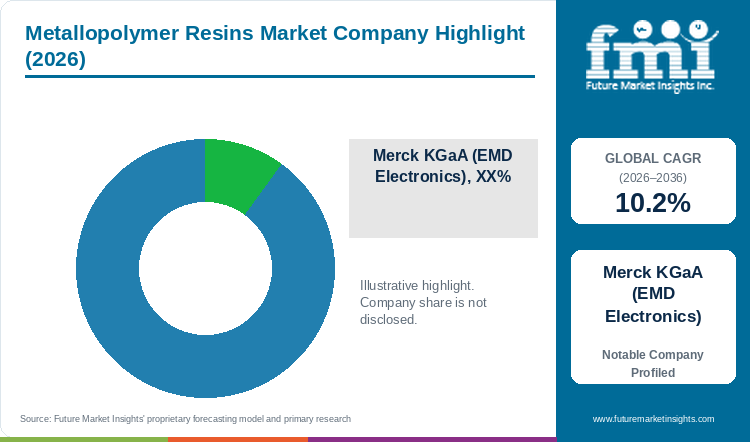
FMI analysis indicates that the competitive arena divides between semiconductor lithography and electronic resin formulators, organometallic monomer producers, and ultra-pure filtration and coordination polymer specialists. Tier-1 lithography chemical suppliers formulate sub-ppb organometallic EUV underlayers and directed self-assembly block copolymers for 300mm wafer foundries. Specialty monomer manufacturers synthesize strained silaferrocenophanes and vinylferrocene intermediates, whereas multinational chemical platforms supply marine antifouling ionomers and solid-state battery binders.
- Semiconductor Lithography & Electronic Resin Leaders: Merck KGaA (EMD Electronics), Brewer Science Inc., JSR Corporation and Tokyo Ohka Kogyo Co. Ltd. (TOK) supply High-NA EUV organometallic resists, spin-on metal hardmasks, and DSA block copolymers (52.0% combined share).
- Organometallic Monomer & Specialty Polymer Producers: Gelest Inc. (Mitsubishi Chemical Group), Arkema S.A., DuPont de Nemours Inc. and Shin-Etsu Chemical Co. Ltd. manufacture metallocene monomers, silicon/iron trilayer resists, and marine ionomers (34.5% share).
- Purification, Coordination & Diagnostic Specialists: Entegris Inc., BASF SE and specialty CGM hydrogel formulators provide 0.01 µm chelation filtration; coordination polymers and biosensor mediator inks (13.5% share).
Competitive Benchmarking: Metallopolymer Resins Market
Table 8: Competitive Benchmarking for the Metallopolymer Resins Market (qualitative capability ratings), 2026
| Company | EUV & DSA Lithography Breadth | Organometallic Monomer & Purity Depth | 300mm Foundry & Medical OEM Access | Geographic Reach |
|---|---|---|---|---|
| Merck KGaA (EMD Electronics) | High | High | High | High |
| Brewer Science Inc. | High | High | High | High |
| JSR Corporation | High | High | High | High |
| Arkema S.A. | Medium | High | Medium | High |
| Tokyo Ohka Kogyo Co. Ltd. (TOK) | High | Medium | High | High |
| Gelest Inc. (Mitsubishi Chemical Group) | Medium | High | High | High |
| DuPont de Nemours Inc. | High | Medium | High | High |
| Shin-Etsu Chemical Co. Ltd. | High | High | High | High |
| Entegris Inc. | Medium | High | High | High |
| BASF SE | Low | High | Medium | High |
Scoring basis: Capability tiers evaluate documented product breadth across sub-10nm DSA block copolymers and EUV spin-on metal hardmasks, captive silaferrocenophane/metallocene synthesis and <0.5 ppb alkali metal purification depth, direct Process-of-Record (POR) access at 300mm foundries and medical OEMs and global cleanroom manufacturing reach.
Key Developments in the Metallopolymer Resins Market
- Brewer Science Inc. completed the acquisition of Heraeus Epurio's semiconductor chemicals business in Dayton in Ohio in August 2026, adding in-house ultrapure lithography monomers, crosslinkers and photoacid generators under its Zero Defects program [19].
- Tokyo Ohka Kogyo Co. Ltd. (TOK) and Irresistible Materials formed a strategic investment and joint development partnership in February 2026 to commercialize PFAS-free Multi-Trigger Resist (MTR) EUV platforms with 10x smaller molecular dimensions [20].
- Merck KGaA (EMD Electronics) signed a definitive agreement at its October 2025 Capital Markets Day to acquire JSR Life Sciences' chromatography resin business (closed April 1, 2026) while committing over EUR 11.5 billion in Group CapEx and M&A [18].
Key Players in the Metallopolymer Resins Market
Semiconductor Lithography and Electronic Resin Leaders
- Merck KGaA (EMD Electronics)
- Brewer Science Inc.
- JSR Corporation
- Tokyo Ohka Kogyo Co. Ltd. (TOK)
Organometallic Monomer and Specialty Polymer Producers
- Gelest Inc. (Mitsubishi Chemical Group)
- Arkema S.A.
- DuPont de Nemours Inc.
- Shin-Etsu Chemical Co. Ltd.
Purification, Coordination and Diagnostic Polymer Specialists
- Entegris Inc.
- BASF SE
Metallopolymer Resins Market - Report Scope
Table 9: Report Scope for the Metallopolymer Resins Market (coverage fields and definitions), 2026 to 2036
| Coverage field | Report scope |
|---|---|
| Market breakdown | Metal Center; Polymer Topology; Functional Property; End-Use Sector |
| Quantitative Units | USD Million |
| Market Definition | Includes commercial supplier market value from homopolymers, random copolymers, and block copolymers containing covalently bound or coordination-chelated transition (Fe, Ru, Pt, Zn, Cu, Mo, Mn) or lanthanide (Eu, Tb, Yb, Dy) metal centers along the main chain or side chains. Category Scope Note: Excludes uncoordinated physical metal-oxide nanoparticle blends and commodity sodium/zinc ethylene-methacrylic acid packaging ionomers. |
| Regions Covered | North America; Latin America; Western Europe; Eastern Europe; East Asia; South Asia and Pacific; Middle East and Africa |
| Countries Covered | Taiwan, South Korea, China, Japan, USA, Germany, UK, and additional countries in the full report |
| Key Companies Covered | Merck KGaA (EMD Electronics), Brewer Science Inc., JSR Corporation, Arkema S.A., Tokyo Ohka Kogyo Co. Ltd. (TOK), Gelest Inc. (Mitsubishi Chemical Group), DuPont de Nemours Inc., Shin-Etsu Chemical Co. Ltd., Entegris Inc., BASF SE |
| Forecast Period | 2026 to 2036 |
| Approach | Primary and secondary research with top-down parent-market cap checks and bottom-up wafer-dispense and monomer-batch triangulation. |
Metallopolymer Resins Market - Research Methodology
Table 10: Research Methodology for the Metallopolymer Resins Market (research methods and approach), 2026 edition
| Method | Approach |
|---|---|
| Primary Research | Structured interviews with 300mm foundry lithography integration engineers, organometallic monomer synthesis directors, CGM biosensor chemistry leads, and marine coating formulators to validate sub-ppb purity specifications and ASP tiers. |
| Secondary Research | Analysis of corporate disclosures (Merck KGaA, Brewer Science, TOK, Arkema), PubMed and PMC organometallic polymer studies, and advanced electronic packaging market benchmarks. |
| Market Sizing and Forecasting | Top-down parent Specialty Polymers Market (USD 199,500.0 million in 2025) and Photoresist Electronic Chemical Market (USD 12,100.0 million in 2025) models reconciled against bottom-up silaferrocenophane/metallocene batch outputs and 300mm wafer spin-coat dispense volumes (~60.4 MT active resin equivalent at USD 1,680/kg weighted ASP = USD 101.4 million in 2026) from 2026 to 2036. |
| Country Forecasting Model | Econometric country projections weight sub-2nm EUV and 2.5D/3D packaging wafer capacity, AMOLED panel production, CGM patch manufacturing, and shipbuilding drydock activity across seven national markets. |
| Operational Benchmark Traceability | Monomer batch and wafer foundry indicators in Tables 2, 3, and 4 trace to Brewer Science and TOK lithography releases, Nature Communications and Angewandte Chemie organometallic studies, and Methods in Molecular Biology biosensor protocols. |
| Data Triangulation and Validation | Demand estimates are cross-checked against 300mm foundry Process-of-Record chemical dispense rates and clinical biosensor strip production without double counting physical metal-oxide sol-gels or bulk packaging ionomers. |
Metallopolymer Resins Market by Segments
Metallopolymer Resins Market segmented by Metal Center:
- Ferrocene & Iron Metallopolymers
- Ruthenium & Platinum Polymers
- Zinc & Copper Ionomers
- Lanthanide Luminescent Polymers
Metallopolymer Resins Market segmented by Polymer Topology:
- Side-Chain Metallocene Polymers
- Main-Chain Coordination Polymers
- Block Copolymer Resins
Metallopolymer Resins Market segmented by Functional Property:
- Redox Charge-Transport Resins
- Preceramic Nanopatterning Masks
- Antifouling Marine Coatings
- Self-Healing Metal-Ligand Networks
Metallopolymer Resins Market segmented by End-Use Sector:
- Semiconductor Copolymer Lithography
- Organic Electronics & OLEDs
- Electrochemical Biosensor Mediators
- Naval Antifouling Coatings
Metallopolymer Resins Market by Region
- North America
- United States
- Canada
- Latin America
- Brazil
- Mexico
- Argentina
- Chile
- Western Europe
- Germany
- France
- United Kingdom
- Italy
- Spain
- Benelux
- Nordics
- Eastern Europe
- Poland
- Czech Republic
- Romania
- Hungary
- East Asia
- China
- Japan
- South Korea
- Taiwan
- South Asia and Pacific
- India
- ASEAN
- Australia and New Zealand
- Middle East and Africa
- GCC Countries (UAE, Saudi Arabia)
- South Africa
- Türkiye
- Israel
Research Sources and Bibliography
- [1] Lee, W., Prindle, C. R., Shi, W., Louie, S., Steigerwald, M. L., & Venkataraman, L. (2025, February 12). Formation of Metallocene Single-Molecule Junctions Via Metal-Metal Bonds. Nano Letters, 25(8), 3316–3322.
- [2] Zhao, P. C., Wang, Y., Huang, Q. S., Jin, Z., & Li, C. H. (2025, January 28). Metal-Organic Coordination Enhanced Metallopolymer Electrolytes for Wide-Temperature Solid-State Lithium Metal Batteries. Angewandte Chemie International Edition, 64(5), e202416897.
- [3] Tahira, A., Hassan, A., Bakas, I., Butt, M. S., Jubeen, F., Ajab, H., Hussain, E., Mahmoud, E. R. I., Khan, R. R. M., & Hayat, A. (2026, April 18). Ferrocene-metal organic framework as a multifunctional electroactive bio-interface for immunosensing of lactoferrin in biomedical applications. Bioelectrochemistry, 174, 109471.
- [4] Mali, R. D., & Bhinge, S. (2026, March 15). Ferrocene-based Drug Molecules in Medicinal Chemistry: Comprehensive Insights into their Chemistry, Pharmacology, and Emerging Therapeutic Applications. Mini-Reviews in Medicinal Chemistry.
- [5] Takebayashi, S., Ariai, J., Kartashov, S. V., Fayzullin, R. R., Onoue, T., Mibu, K., Kang, H. B., & Ishizu, N. (2025, July 4). From 18- to 20-electron ferrocene derivatives via ligand coordination. Nature Communications, 16(1), 6124.
- [6] Xing, Y., Xie, X., Liu, J., Zhao, T., Liu, X., Wu, P., Lin, F., & Huang, Y. (2026, January 10). Split biosensor based on nano-enzymatic ferrocene-tyramine deposition reaction for detection of SMP30 antibody. Analytica Chimica Acta, 1382, 344834.
- [7] Al-Akhras, A., Ghazzy, A., Zakaraya, Z., Shraim, A. S., Sibai, O. A., Alsabbagh, L., & Taher, D. (2026, May 2). Ferrocene-Based Sensors for Green Analytical Applications in Environmental, Biomedical, Industrial, and Food Monitoring. ChemistryOpen, 15(5), e202500521.
- [8] Chang, B., Xu, T., Wang, D., Huang, J., Xie, X., Li, X., & Wang, R. (2025, August 5). The Polymeric Sulfur Hosts From Ferrocene-Based Metal-Organic Framework@Ti3C2 Array Structure for Upgrading Energy Density and Longevity of Lithium-Sulfur Batteries. Small, 21(31), e2504128.
- [9] Bruggeman, C., Carducci, N., Dey, S., Mtemeri, L., Servinski, D., & Hickey, D. P. (2026, March 22). Ferrocene-Modified Linear Poly(ethylenimine) for Enzymatic Immobilization and Electron Mediation. Methods in Molecular Biology, 3019, 145–155.
- [10] Biswas, C., Mukherjee, N., Brindavan, S., Paul, R., Karmodak, N., Ghorai, U. K., & Mondal, J. (2026, March 8). Ambient Electrocatalytic Urea Synthesis From CO2 and N2 Compartmentalized by Cyclic Cu-Trinuclear (Cu3)-Ferrocene (Fc) Networking Porous-Organic-Polymer. Small, e74009.
- [11] Miyashita, R., Kawakami, R., Kumai, R., Tomita, T., & Goto, H. (2025, January 20). Helical magnetism in poly(aniline-co-ferrocene): structure and magnetism. Nanoscale, 17(3), 1362–1370.
- [12] Yu, S., Lee, M., Seo, D., Kim, H., Park, C. S., & Sung, D. (2025, May 16). Enhanced wound healing via ROS-triggered release of ascorbyl tetraisopalmitate loaded in ferrocene-based polymer nanoparticles. Redox Biology, 84, 103659.
- [13] Daum, M., Alkan, E. A., Gubanov, K., Rocha-Ortiz, J. S., Maraslioglu, C., Cirpan, A., Fink, R. H., Hauch, J., Heumüller, T., & Brabec, C. J. (2025, November 25). An All-Conjugated, PM6-Based Block Copolymer Enables Stable Nanoparticle Dispersions in Methanol. Macromolecules, 58(22), 12327–12335.
- [14] Li, M. D., Zhang, L. Y., Wang, J. Y., Han, J. Y., Qian, X. Y., Ye, X. L., Dai, F. R., & Chen, Z. N. (2025, December 18). Metallopolymer Films of a Manganese(II) Chelate with Hexadentate Ligand for High-Performance Electrochromism. Angewandte Chemie International Edition, e25500.
- [15] Wang, Y., Wang, X., Liu, Y., Chen, Y., Chen, C., Liu, W., Pan, D., & Liu, W. (2025, September 24). Construction of Lanthanide Coordination Polymers Containing Water Hydrogen Bond Units for Ratiometric Luminescence Sensing of the H2O-D2O System. Inorganic Chemistry.
- [16] Flament, A., Duval, S., Henry, N., Volkringer, C., Salles, F., Tamain, C., & Loiseau, T. (2026, February 14). Series of Hydrated Lanthanide (La, Ce, Pr, Dy, Yb) Pyromellitate 3D Coordination Polymer with Tunnels Encapsulating Dimethylammonium Species and Its Crystal-to-Crystal Transformation upon Dehydration. Inorganic Chemistry.
- [17] Kuang, X., Zhao, G., Guo, J., Tang, Q., Yu, J., & Wang, F. (2025, June 20). Development of a ZIF-8/LIG-based electrochemical biosensor for accurate and reliable glucose monitoring in blood. Mikrochimica Acta, 192(7), 436.
- [18] Merck KGaA. (2025, October 16). Merck Capital Markets Day 2025: Ready for the Next Wave of Growth. Merck KGaA Darmstadt Investor Relations.
- [19] Brewer Science Inc. (2026, August 3). Brewer Science Strengthens America's Semiconductor Supply Chain with Acquisition of Heraeus Epurio's Semiconductor Chemicals Business. Brewer Science Inc. Corporate News Release.
- [20] Irresistible Materials & Tokyo Ohka Kogyo Co. Ltd. (2026, February 23). IRRESISTIBLE MATERIALS AND TOKYO OHKA KOGYO CO., LTD. (TOK) ANNOUNCE STRATEGIC INVESTMENT AND JOINT DEVELOPMENT PARTNERSHIP TO ADVANCE EUV LITHOGRAPHY. Tokyo Ohka Kogyo & Irresistible Materials Joint Release.
- [21] Arkema S.A. (2026, February 26). ARKEMA: Full-Year 2025 Results — High cash generation supported by strict management of operations. Arkema Group Financial Communications.
- [22] Research and Markets. (2025, November 14). Polymeric Materials for Advanced Electronic Packaging Market Report 2026-2036 with Detailed Profiles 91 Companies Across Material Suppliers, OSAT Providers, Semiconductor Manufacturers. Business Wire / Research and Markets.
- [23] Liu, Z., Lu, F., Cheng, Z., Tan, S., Duan, F., Qiu, F., Li, S., Wang, L., & Zhou, Z. (2026, April 5). Fe3O4 / lauric acid electrochemical sensor for rapid, selective and cost-effective microplastic detection in water. Talanta, 312(Pt B), 130483.
- [24] Justo-Tirado, M., Escorihuela, J., Zaballos-García, E., Mínguez Espallargas, G., & Pérez-Prieto, J. (2026, February 26). Self-Assembled Luminescent Au(I)-Adamantylamine Coordination Polymer Needles With Thermoresponsive Optical Properties. Chemistry – A European Journal, e03276.
This bibliography is provided for reader reference and is not exhaustive. The full report contains the complete reference list and detailed citations.
This Report Answers
- How large is the metallopolymer resins market in 2026 and what is forecast for 2036?
- Which sub-2nm EUV lithography and wearable biosensor pressures support demand for metallopolymer resins?
- Why do Ferrocene & Iron Metallopolymers lead the metal center category?
- Why do Side-Chain Metallocene Polymers lead the polymer topology category globally?
- How do growth rates differ across Taiwan, South Korea, China, and the USA?
- Which leading companies supply organometallic lithography resists, monomers, and biosensor hydrogels today?
- What limits adoption or supplier switching in the metallopolymer resins market?
- What should buyers evaluate before qualifying a metallopolymer resin grade?
Frequently Asked Questions
How big is the metallopolymer resins market in 2026, and what is forecast for 2036?
Assessed at USD 92.0 million in 2025 and progressing to USD 101.4 million in 2026, the global Metallopolymer Resins Market valuation is on course to reach USD 267.8 million by 2036, supported by a forecast-period CAGR of 10.2%.
What is the CAGR for the metallopolymer resins market from 2026 to 2036?
Future Market Insights projects a 10.2% compound annual growth rate between 2026 and 2036, representing USD 166.4 million in incremental market value over the 10-year forecast period.
Which metal center segment leads the metallopolymer resins market?
Ferrocene & Iron Metallopolymers are projected to capture 38.4% of metal center demand (USD 38.9 million) in 2026 and grow at a 10.5% CAGR through 2036 due to reversible Fe(II)/Fe(III) redox mediation in biosensors and high plasma etch resistance in wafer lithography.
Which polymer topology segment leads the metallopolymer resins market?
Side-Chain Metallocene Polymers are estimated to secure 51.0% of the polymer topology category (USD 51.7 million) in 2026 because they dissolve cleanly in standard spin-coating and diagnostic strip solvents.
Why are Block Copolymer Resins and Preceramic Nanopatterning Masks growing so rapidly in semiconductor fabs?
Block Copolymer Resins (10.6% CAGR) and Preceramic Nanopatterning Masks (10.7% CAGR) self-assemble into sub-10nm domains and oxidize under reactive-ion plasma into dense ceramic hardmasks, enabling sub-2nm EUV and 2.5D/3D chiplet patterning without costly multi-patterning exposure steps.
Which country has the fastest growth outlook during the assessment period?
Taiwan is projected to lead global growth at a 12.0% CAGR through 2036 due to TSMC 2nm/1.4nm EUV foundry ramps and CoWoS advanced packaging, ahead of South Korea at 11.6% and China at 10.8%.
Who are the key players in the market?
Merck KGaA (EMD Electronics), Brewer Science Inc., JSR Corporation; Arkema S.A.; Tokyo Ohka Kogyo Co. Ltd. (TOK), Gelest Inc. (Mitsubishi Chemical Group), DuPont de Nemours Inc., Shin-Etsu Chemical Co. Ltd., Entegris Inc., and BASF SE are the key players evaluated in the market.
Preview the report firsthand - request a free sample
Get SampleGet the brochure for pricing and purchase details.
Get PDFTable of Content
- Key Takeaways
- Market Size and CAGR
- Top Growth Driver
- Fastest Growing Segment
- Leading Region
- Key Companies
- Emerging Opportunities
- Executive Summary
- Global Market Outlook
- Demand-side Trends
- Supply-side Trends
- Technology Roadmap Analysis
- Analysis and Recommendations
- Analyst Perspective (What is happening? Why now? What should investors know?)
- Key Questions Answered
- How large is the market?
- What is the CAGR?
- What are key trends?
- Which region dominates?
- Who are the leaders?
- Market Overview
- Market Coverage / Taxonomy
- Market Definition / Scope / Limitations
- Research Methodology
- Chapter Orientation
- Analytical Lens and Working Hypotheses
- Market Structure, Signals, and Trend Drivers
- Benchmarking and Cross-market Comparability
- Market Sizing, Forecasting, and Opportunity Mapping
- Research Design and Evidence Framework
- Desk Research Programme (Secondary Evidence)
- Expert Input and Fieldwork (Primary Evidence)
- Tooling, Models, and Reference Databases
- Data Engineering and Model Build
- Quality Assurance and Audit Trail
- Market Background
- Market Dynamics (Drivers, Restraints, Opportunity, Trends)
- Scenario Forecast (Optimistic, Likely, Conservative)
- Impact Analysis
- AI Impact
- Sustainability Impact
- Regulatory Impact
- Technology Impact
- Consumer / Buyer Analysis
- Purchase Drivers
- Adoption Barriers
- Buyer Journey
- Opportunity Map Analysis
- Product Life Cycle Analysis
- Supply Chain Analysis
- Investment Feasibility Matrix
- Value Chain Analysis
- PESTLE and Porter's Analysis
- Regulatory Landscape
- Regional Parent Market Outlook
- Production and Consumption Statistics
- Import and Export Statistics
- Global Market Analysis and Forecast, 2021 to 2036
- Historical Market Size Value (USD Million) Analysis, 2021 to 2025
- Current and Future Market Size Value (USD Million) Projections, 2026 to 2036
- Y-o-Y Growth Trend Analysis
- Absolute $ Opportunity Analysis
- Global Market Pricing Analysis, 2021 to 2036
- Global Market Analysis and Forecast, By Metal Center, 2021 to 2036
- Introduction / Key Findings
- Historical Market Size Value (USD Million) Analysis By Metal Center, 2021 to 2025
- Current and Future Market Size Value (USD Million) Analysis and Forecast By Metal Center, 2026 to 2036
- Ferrocene & Iron Metallopolymers
- Ruthenium & Platinum Polymers
- Zinc & Copper Ionomers
- Lanthanide Luminescent Polymers
- Y-o-Y Growth Trend Analysis By Metal Center, 2021 to 2025
- Absolute $ Opportunity Analysis By Metal Center, 2026 to 2036
- Global Market Analysis and Forecast, By Polymer Topology, 2021 to 2036
- Introduction / Key Findings
- Historical Market Size Value (USD Million) Analysis By Polymer Topology, 2021 to 2025
- Current and Future Market Size Value (USD Million) Analysis and Forecast By Polymer Topology, 2026 to 2036
- Side-Chain Metallocene Polymers
- Main-Chain Coordination Polymers
- Block Copolymer Resins
- Y-o-Y Growth Trend Analysis By Polymer Topology, 2021 to 2025
- Absolute $ Opportunity Analysis By Polymer Topology, 2026 to 2036
- Global Market Analysis and Forecast, By Functional Property, 2021 to 2036
- Introduction / Key Findings
- Historical Market Size Value (USD Million) Analysis By Functional Property, 2021 to 2025
- Current and Future Market Size Value (USD Million) Analysis and Forecast By Functional Property, 2026 to 2036
- Redox Charge-Transport Resins
- Preceramic Nanopatterning Masks
- Antifouling Marine Coatings
- Self-Healing Metal-Ligand Networks
- Y-o-Y Growth Trend Analysis By Functional Property, 2021 to 2025
- Absolute $ Opportunity Analysis By Functional Property, 2026 to 2036
- Global Market Analysis and Forecast, By End-Use Sector, 2021 to 2036
- Introduction / Key Findings
- Historical Market Size Value (USD Million) Analysis By End-Use Sector, 2021 to 2025
- Current and Future Market Size Value (USD Million) Analysis and Forecast By End-Use Sector, 2026 to 2036
- Semiconductor Copolymer Lithography
- Organic Electronics & OLEDs
- Electrochemical Biosensor Mediators
- Naval Antifouling Coatings
- Y-o-Y Growth Trend Analysis By End-Use Sector, 2021 to 2025
- Absolute $ Opportunity Analysis By End-Use Sector, 2026 to 2036
- Global Market Analysis and Forecast, By Region, 2021 to 2036
- Introduction
- Historical Market Size Value (USD Million) Analysis By Region, 2021 to 2025
- Current Market Size Value (USD Million) Analysis and Forecast By Region, 2026 to 2036
- North America
- Latin America
- Western Europe
- Eastern Europe
- East Asia
- South Asia and Pacific
- Middle East and Africa
- Market Attractiveness Analysis By Region
- North America Market Analysis and Forecast, By Country, 2021 to 2036
- Historical Market Size Value (USD Million) Trend Analysis By Market Taxonomy, 2021 to 2025
- Market Size Value (USD Million) Forecast By Market Taxonomy, 2026 to 2036
- By Country
- United States
- Canada
- By Metal Center
- By Polymer Topology
- By Functional Property
- By End-Use Sector
- By Country
- Market Attractiveness Analysis
- By Country
- By Metal Center
- By Polymer Topology
- By Functional Property
- By End-Use Sector
- Key Takeaways
- Latin America Market Analysis and Forecast, By Country
- Historical Market Size Value (USD Million) Trend Analysis By Market Taxonomy, 2021 to 2025
- Market Size Value (USD Million) Forecast By Market Taxonomy, 2026 to 2036
- By Country
- Brazil
- Mexico
- Argentina
- Chile
- By Metal Center
- By Polymer Topology
- By Functional Property
- By End-Use Sector
- By Country
- Market Attractiveness Analysis
- By Country
- By Metal Center
- By Polymer Topology
- By Functional Property
- By End-Use Sector
- Key Takeaways
- Western Europe Market Analysis and Forecast, By Country
- Historical Market Size Value (USD Million) Trend Analysis By Market Taxonomy, 2021 to 2025
- Market Size Value (USD Million) Forecast By Market Taxonomy, 2026 to 2036
- By Country
- Germany
- France
- United Kingdom
- Italy
- Spain
- Benelux
- Nordics
- By Metal Center
- By Polymer Topology
- By Functional Property
- By End-Use Sector
- By Country
- Market Attractiveness Analysis
- By Country
- By Metal Center
- By Polymer Topology
- By Functional Property
- By End-Use Sector
- Key Takeaways
- Eastern Europe Market Analysis and Forecast, By Country
- Historical Market Size Value (USD Million) Trend Analysis By Market Taxonomy, 2021 to 2025
- Market Size Value (USD Million) Forecast By Market Taxonomy, 2026 to 2036
- By Country
- Poland
- Czech Republic
- Romania
- Hungary
- By Metal Center
- By Polymer Topology
- By Functional Property
- By End-Use Sector
- By Country
- Market Attractiveness Analysis
- By Country
- By Metal Center
- By Polymer Topology
- By Functional Property
- By End-Use Sector
- Key Takeaways
- East Asia Market Analysis and Forecast, By Country
- Historical Market Size Value (USD Million) Trend Analysis By Market Taxonomy, 2021 to 2025
- Market Size Value (USD Million) Forecast By Market Taxonomy, 2026 to 2036
- By Country
- China
- Japan
- South Korea
- Taiwan
- By Metal Center
- By Polymer Topology
- By Functional Property
- By End-Use Sector
- By Country
- Market Attractiveness Analysis
- By Country
- By Metal Center
- By Polymer Topology
- By Functional Property
- By End-Use Sector
- Key Takeaways
- South Asia and Pacific Market Analysis and Forecast, By Country
- Historical Market Size Value (USD Million) Trend Analysis By Market Taxonomy, 2021 to 2025
- Market Size Value (USD Million) Forecast By Market Taxonomy, 2026 to 2036
- By Country
- India
- ASEAN
- Australia and New Zealand
- By Metal Center
- By Polymer Topology
- By Functional Property
- By End-Use Sector
- By Country
- Market Attractiveness Analysis
- By Country
- By Metal Center
- By Polymer Topology
- By Functional Property
- By End-Use Sector
- Key Takeaways
- Middle East and Africa Market Analysis and Forecast, By Country
- Historical Market Size Value (USD Million) Trend Analysis By Market Taxonomy, 2021 to 2025
- Market Size Value (USD Million) Forecast By Market Taxonomy, 2026 to 2036
- By Country
- GCC Countries (UAE, Saudi Arabia)
- South Africa
- Türkiye
- Israel
- By Metal Center
- By Polymer Topology
- By Functional Property
- By End-Use Sector
- By Country
- Market Attractiveness Analysis
- By Country
- By Metal Center
- By Polymer Topology
- By Functional Property
- By End-Use Sector
- Key Takeaways
- Key Countries Market Analysis
- United States
- Pricing Analysis
- Market Share Analysis, 2025
- By Metal Center
- By Polymer Topology
- By Functional Property
- By End-Use Sector
- Canada
- Pricing Analysis
- Market Share Analysis, 2025
- By Metal Center
- By Polymer Topology
- By Functional Property
- By End-Use Sector
- Mexico
- Pricing Analysis
- Market Share Analysis, 2025
- By Metal Center
- By Polymer Topology
- By Functional Property
- By End-Use Sector
- Brazil
- Pricing Analysis
- Market Share Analysis, 2025
- By Metal Center
- By Polymer Topology
- By Functional Property
- By End-Use Sector
- Chile
- Pricing Analysis
- Market Share Analysis, 2025
- By Metal Center
- By Polymer Topology
- By Functional Property
- By End-Use Sector
- Germany
- Pricing Analysis
- Market Share Analysis, 2025
- By Metal Center
- By Polymer Topology
- By Functional Property
- By End-Use Sector
- United Kingdom
- Pricing Analysis
- Market Share Analysis, 2025
- By Metal Center
- By Polymer Topology
- By Functional Property
- By End-Use Sector
- Italy
- Pricing Analysis
- Market Share Analysis, 2025
- By Metal Center
- By Polymer Topology
- By Functional Property
- By End-Use Sector
- Spain
- Pricing Analysis
- Market Share Analysis, 2025
- By Metal Center
- By Polymer Topology
- By Functional Property
- By End-Use Sector
- France
- Pricing Analysis
- Market Share Analysis, 2025
- By Metal Center
- By Polymer Topology
- By Functional Property
- By End-Use Sector
- India
- Pricing Analysis
- Market Share Analysis, 2025
- By Metal Center
- By Polymer Topology
- By Functional Property
- By End-Use Sector
- ASEAN
- Pricing Analysis
- Market Share Analysis, 2025
- By Metal Center
- By Polymer Topology
- By Functional Property
- By End-Use Sector
- Australia and New Zealand
- Pricing Analysis
- Market Share Analysis, 2025
- By Metal Center
- By Polymer Topology
- By Functional Property
- By End-Use Sector
- China
- Pricing Analysis
- Market Share Analysis, 2025
- By Metal Center
- By Polymer Topology
- By Functional Property
- By End-Use Sector
- Japan
- Pricing Analysis
- Market Share Analysis, 2025
- By Metal Center
- By Polymer Topology
- By Functional Property
- By End-Use Sector
- South Korea
- Pricing Analysis
- Market Share Analysis, 2025
- By Metal Center
- By Polymer Topology
- By Functional Property
- By End-Use Sector
- Poland
- Pricing Analysis
- Market Share Analysis, 2025
- By Metal Center
- By Polymer Topology
- By Functional Property
- By End-Use Sector
- Hungary
- Pricing Analysis
- Market Share Analysis, 2025
- By Metal Center
- By Polymer Topology
- By Functional Property
- By End-Use Sector
- Türkiye
- Pricing Analysis
- Market Share Analysis, 2025
- By Metal Center
- By Polymer Topology
- By Functional Property
- By End-Use Sector
- South Africa
- Pricing Analysis
- Market Share Analysis, 2025
- By Metal Center
- By Polymer Topology
- By Functional Property
- By End-Use Sector
- Taiwan
- Pricing Analysis
- Market Share Analysis, 2025
- By Metal Center
- By Polymer Topology
- By Functional Property
- By End-Use Sector
- United States
- Market Structure Analysis
- Competition Dashboard
- Competition Benchmarking
- Market Share Analysis of Top Players
- By Regional
- By Metal Center
- By Polymer Topology
- By Functional Property
- By End-Use Sector
- Emerging Startups
- Innovation Benchmarking
- Competition Analysis
- Competition Deep Dive
- Merck KGaA (EMD Electronics)
- Overview
- Product Portfolio
- Profitability by Market Segments
- Sales Footprint
- Strategy Overview
- Marketing Strategy
- Product Strategy
- Channel Strategy
- Brewer Science Inc.
- JSR Corporation
- Arkema S.A.
- Tokyo Ohka Kogyo Co. Ltd. (TOK)
- Gelest Inc. (Mitsubishi Chemical Group)
- DuPont de Nemours Inc.
- Shin-Etsu Chemical Co. Ltd.
- Entegris Inc.
- BASF SE
- Merck KGaA (EMD Electronics)
- Case Studies
- Success Stories
- Recent Developments
- Competition Deep Dive
- Assumptions & Acronyms Used


