

- Market Size (2026)
- USD 36.2 Mn
- Forecast (2036)
- USD 224.1 Mn
- CAGR (2026 to 2036)
- 20.0%
How big is Vitrimer Resins Market in 2026?
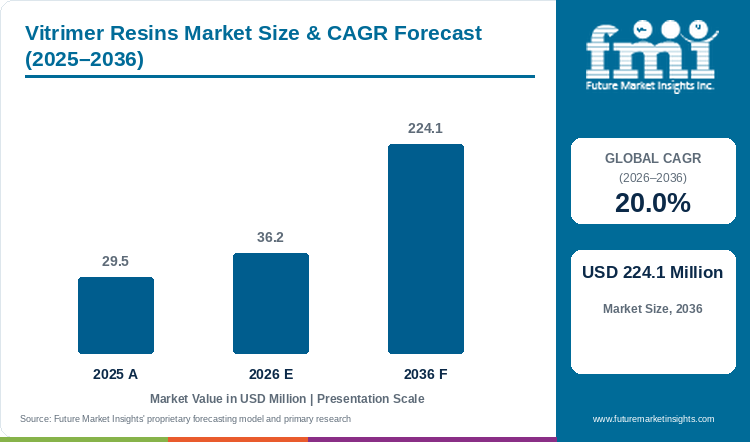
Valued at USD 29.5 million in 2025, global vitrimer resins revenue is estimated to reach USD 36.2 million in 2026 and is projected to reach USD 224.1 million in 2036 on an estimated 20.0% compound annual rate.
Decommissioning first-generation onshore wind turbines and repairing delaminated aircraft fairings have exposed the costly end-of-life liability of permanently cross-linked thermoset composites, prompting structural molders to qualify associative dynamic covalent networks. In January 2025, the Wind Energy Technologies Office at the federal energy department reported that while domestic infrastructure can recycle 90% of decommissioned wind turbine mass, the remaining 10% comprising fiberglass and carbon-fiber composite blades requires chemical dissolution and recyclable resin strategies backed by 20 million dollars in federal RD&D funding [1]. Owing to catalyst-free bond exchange across 150°C to 190°C alongside mild acid cleavability, Disulfide & Imine Exchange Vitrimers are projected to capture 42.6% of dynamic covalent exchange mechanism demand in 2026 across recyclable thermoset formulations. As per FMI, worldwide vitrimer resins sales progress from a 2025 valuation of USD 29.5 million to an estimated 2026 total of USD 36.2 million, and are forecast to reach a 2036 projection of USD 224.1 million at an expected 20.0% CAGR that lifts annual market turnover by USD 187.9 million between 2026 and 2036.
Key Market Trends & Insights
- By dynamic covalent exchange mechanism: Disulfide & Imine Exchange Vitrimers are slated to secure 42.6% of 2026 mechanism demand because catalyst-free disulfide metathesis and imine transamination permit rapid hot-press reprocessing and mild acid-triggered fiber reclamation.
- By base polymer backbone: Epoxy-Based Vitrimer Matrices are predicted to contribute 53.8% of 2026 backbone revenue since diglycidyl ether monomers maintain high interlaminar shear strength and drop directly into existing composite layup lines.
- By processing form: Unidirectional Prepreg Tapes are projected to represent 46.1% of 2026 form sales as pre-impregnated carbon and glass tapes allow post-cure thermoforming like thermoplastics while keeping thermoset creep stability.
- By end-use industry: Recyclable Wind Turbine Blades are estimated to capture 44.5% of 2026 end-use spending owing to European and East Asian wind farm decommissioning rules that prohibit composite blade landfilling.
- By glass transition temperature and recovery pathway: High-Tg (>120°C) Structural Aerospace/Wind Grade is forecast to represent 51.4% of 2026 thermal-tier volume while Thermal Compression Remolding & Thermoforming is predicted to account for 54.2% of end-of-life recovery demand.
Regional Highlights
- Top national growth pace: South Korea is projected to lead major composite-manufacturing nations at a 21.9% yearly rate between 2026 and 2036 on strong offshore wind blade and recyclable printed circuit board investments.
- Iberian and Japanese momentum: Spain is expected to expand by 20.9% annually through 2036 due to fleet-wide onshore wind repowering, while Japan is anticipated to grow at 20.5% on carbon-fiber prepreg and semiconductor substrate programs.
- European and North American baselines: German composite molders are predicted to advance by 19.6% per annum ahead of United States demand (estimated at 19.0%) and French orders (forecast at 18.5%) as aerospace and wind OEMs complete resin qualification trials.
Market Size & Forecast
Table 1: Market Size and Forecast for the Vitrimer Resins Market (USD million and CAGR percentage), 2025 to 2036
| Metric | Value |
|---|---|
| Market Value (2025) | USD 29.5 million |
| Estimated Market Size in 2026 | USD 36.2 million |
| Projected Market Size by 2036 | USD 224.1 million |
| CAGR (2026 to 2036) | 20.0% |
| Absolute Dollar Opportunity (2026 to 2036) | USD 187.9 million |
Decommissioning schedules for early-generation onshore wind farms across Western Europe and North America are accelerating commercial qualification of reversible thermoset binders. In February 2026, WindEurope reported that Europe installed 19.1 GW of new wind capacity during 2025 to reach 304 GW of cumulative wind power and is projected to build an additional 151 GW between 2026 and 2030 backed by EUR 45 billion in 2025 wind financing [2]. Consequently, blade fabricators and tier-one aerostructure suppliers are pairing dynamic covalent infusion matrices with protective wind-blade surface coatings across next-generation rotor shells and spar caps. Resin formulators that supply low-viscosity infusion systems alongside certified closed-loop solvolysis protocols secure multi-year supply agreements with composite manufacturers.
Formulated Resin Tonnage and Composite Reclamation Sizing
Table 2: Resin Tonnage and Composite Recovery Indicators for the Vitrimer Resins Market (USD million, metric tons, and USD per kilogram), mixed historical and forecast years from 2025 to 2036
| Metric | 2025 | 2026 | 2036 |
|---|---|---|---|
| Market size (USD million) | 29.5 | 36.2 | 224.1 |
| Formulated vitrimer resin volume (metric tons) | 1,180 to 1,310 | 1,480 to 1,640 | 10,800 to 12,100 |
| Reclaimed carbon and glass fiber output (metric tons) | 1,850 to 2,150 | 2,350 to 2,720 | 18,400 to 21,200 |
| Average realized resin price (USD per kilogram) | 22.50 to 25.00 | 22.10 to 24.50 | 18.50 to 20.75 |
Operational note: Formulated tonnage covers dynamic disulfide and imine networks alongside transesterification and boronic ester resins supplied as prepreg matrices or liquid infusion binders.
Scaling dynamic covalent hardener synthesis from pilot reactors to multi-ton commercial kettles is expected to narrow the price premium between vitrimers and conventional aerospace epoxies. Composite parts molded with reversible networks allow fabricators to recover woven and unidirectional structural carbon fiber composites at 94% to 100% of virgin tensile strength without high-temperature pyrolysis. Because aqueous acid solvolysis of imine vitrimer composites requires only 2.03 MJ per kilogram compared with 200 MJ per kilogram to manufacture virgin polyacrylonitrile carbon fiber, reclaiming intact fiber tows offsets the initial resin cost premium for automotive and wind tier-one molders.
Per Capita & Composite Molding Facility Sizing
Table 3: Per Capita and Composite Plant Spending Indicators for the Vitrimer Resins Market (USD), mixed historical and forecast years from 2025 to 2036
| Metric | 2025 | 2026 | 2036 |
|---|---|---|---|
| World population (billion) | 8.23 | 8.30 | 8.95 |
| Spend per 1,000 people (USD) | 3.58 | 4.36 | 25.04 |
| Qualifying composite & PCB plants worldwide | 1,420 | 1,560 | 3,100 |
| Annual vitrimer spend per qualifying plant (USD) | 20,775 | 23,205 | 72,290 |
Table 4: End-Use and Backbone Spending Indicators for the Vitrimer Resins Market (USD million and percentages), mixed reporting years from 2025 to 2026
| Benchmark Indicator | Reported / Modeled Value | Institutional Reference Basis |
|---|---|---|
| Market size, 2026 | USD 36.2 million | Report value |
| Epoxy-based vitrimer matrices revenue, 2026 | USD 19.5 million | 53.8% backbone share |
| Recyclable wind turbine blades revenue, 2026 | USD 16.1 million | 44.5% end-use share |
| Thermal compression remolding revenue, 2026 | USD 19.6 million | 54.2% recovery pathway share |
Commercial procurement is concentrated between wind rotor molding facilities and aerospace prepreg weavers alongside copper-clad laminate fabricators transitioning toward circular thermoset production. Qualifying dynamic covalent networks inside high-temperature composite matrices requires verifying zero creep deformation below the topology-freezing transition temperature alongside rapid stress relaxation during hot-press reshaping. Industrial molders adopting pre-formulated vitrimer tapes cut in-plant scrap rates by thermoforming trim offcuts into secondary structural brackets.
Analyst Perspective
"Dynamic covalent hardeners let composite molders thermoform cured laminates and reclaim full-length carbon fibers without pyrolysis. Suppliers must still prevent high-temperature creep and lower monomer synthesis costs to win high-volume automotive contracts."
- Nikhil Kaitwade, Principal Consultant, Future Market Insights.
How is the vitrimer resins market segmented?
The vitrimer resins market is segmented by dynamic covalent exchange mechanism, base polymer backbone, processing form, end-use industry, glass transition temperature (Tg), end-of-life recovery pathway, and region. In 2026, Disulfide & Imine Exchange Vitrimers are projected at 42.6%, Epoxy-Based Vitrimer Matrices at 53.8%, Unidirectional Prepreg Tapes at 46.1%, Recyclable Wind Turbine Blades at 44.5%, High-Tg (>120°C) Grade at 51.4%, and Thermal Compression Remolding at 54.2%.
By dynamic covalent exchange mechanism: Disulfide & Imine Exchange Vitrimers, Transesterification Epoxy Vitrimers, Boronic Ester & Dioxaborolane Networks, and Vinylogous Urethane Vitrimers.
By base polymer backbone: Epoxy-Based Vitrimer Matrices, Polyurethane & Polyurea Vitrimers, Polydimethylsiloxane (PDMS) Elastomer Vitrimers, and Bio-Based Lignin & Vanillin Vitrimers.
By processing form: Unidirectional Prepreg Tapes, Liquid Vacuum Infusion Resins, and Hot-Melt Structural Film Adhesives.
By end-use industry: Recyclable Wind Turbine Blades, Aerospace CFRP Secondary Structures, Automotive Repairable Composite Panels, Recyclable Printed Circuit Board Substrates, and High-Voltage Electrical Encapsulants.
By glass transition temperature (Tg): High-Tg (>120°C) Structural Aerospace/Wind Grade, Medium-Tg (60 - 120°C) Automotive & Sporting Grade, and Sub-Ambient Elastomeric Vitrimers (<25°C).
By end-of-life recovery pathway: Thermal Compression Remolding & Thermoforming, and Mild Chemical Solvolysis Carbon-Fiber Recovery.
Why Do Disulfide & Imine Exchange Vitrimers Lead Dynamic Covalent Exchange Mechanisms?
Disulfide & Imine Exchange Vitrimers capture 42.6% of dynamic covalent exchange mechanism demand in 2026, supported by catalyst-free bond rearrangement.
Table 5: Dynamic Covalent Exchange Mechanism Share for the Vitrimer Resins Market (percentage share), 2026
| Dynamic Covalent Exchange Mechanism Segment | Share (2026) |
|---|---|
| Disulfide & Imine Exchange Vitrimers | 42.6% |
| Other Segments Combined | 57.4%* |
| Total | 100.0% |
*Note: Combined share of remaining dynamic covalent exchange mechanism categories totaling 100.0% of 2026 market demand.
Table 6: Dynamic Covalent Exchange Mechanism Leadership and Market Growth for the Vitrimer Resins Market (segment and CAGR percentage), 2026 to 2036
| Metric | Value |
|---|---|
| Global CAGR (2026 to 2036) | 20.0% |
| Leading Segment | Disulfide & Imine Exchange Vitrimers |
Incorporating aromatic disulfide diamines or Schiff-base imine linkages into thermoset cross-links enables rapid radical-mediated or associative bond exchange without organometallic catalysts. Whereas classical hydroxy-ester transesterification networks require zinc acetate or tin octoate catalysts that leach or degrade at elevated service temperatures, disulfide and imine networks rearrange cleanly across the 150°C to 190°C window. Formulators blending dynamic hardeners with amine epoxy curing agents also achieve complete matrix dissolution in mild acidic or thiol solutions at end of life. This dual thermal reprocessability and room-temperature chemical recyclability makes disulfide and imine chemistries the preferred choice for wind and aerospace composites.
- Disulfide & Imine Exchange Vitrimers are pegged to generate 42.6% of 2026 mechanism revenue because catalyst-free exchange prevents metallic leaching inside structural laminates.
- In September 2025, an ACS Polymers Au study archived under PMC12511975 documented that EPCN-4 Schiff-base imine vitrimers achieve 51.8 MPa tensile strength and 47.9 kJ/mol activation energy with 8-minute self-repair at 150°C while vanillin-derived imine networks reach 76.6% acidic monomer recovery [3].
How Do Epoxy-Based Vitrimer Matrices Anchor Base Polymer Backbone Turnover?
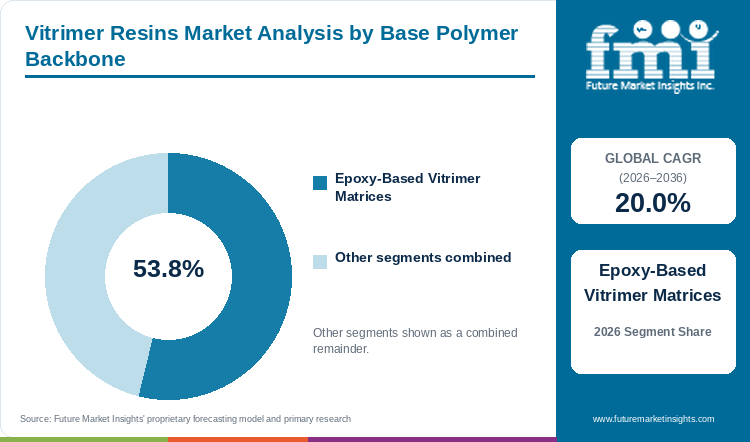
Epoxy-Based Vitrimer Matrices hold 53.8% of base polymer backbone sales in 2026, reflecting drop-in compatibility with autoclave curing lines.
Formulating dynamic covalent cross-links directly onto diglycidyl ether of bisphenol A and novolac epoxy prepolymers preserves the mechanical stiffness and chemical resistance required by structural composite engineers. Manufacturing plants do not need to replace heated platen presses or vacuum-assisted resin transfer molding tooling when transitioning from permanent thermosets to epoxy vitrimers. In addition to synthetic glycidyl ethers, chemical producers are developing bio-derived lignin resins and vanillin-derived imine epoxies to lower cradle-to-gate carbon footprints. Strong adhesion to sized carbon and E-glass fibers keeps epoxy backbones ahead of polyurethane and silicone elastomer networks in load-bearing parts.
- Direct equipment compatibility is projected to give Epoxy-Based Vitrimer Matrices a 53.8% share of 2026 base polymer backbone turnover.
- In September 2025, Huntsman Corporation launched six reformulated BPA-free and CMR-free ARALDITE epoxy adhesives (including 2014-3 and 2020-1 alongside AV 138 M-2) packaged in post-consumer recycled cartridges that cut carbon dioxide emissions by up to 36% across wind and industrial composites [4].
What Places Unidirectional Prepreg Tapes Ahead Across Processing Forms?
Unidirectional Prepreg Tapes secure 46.1% of processing form volume in 2026, driven by thermoformable C-stage composite stamping.
Pre-impregnating continuous carbon or glass fiber tows with B-staged or fully cured vitrimer matrices eliminates wet resin mixing on the shop floor and enables rapid stamp-forming of pre-consolidated laminates. Unlike conventional thermoset prepregs that require sub-zero freezer storage and multi-hour autoclave cycles, cured vitrimer prepreg sheets can be stored at ambient conditions and thermoformed in heated press cycles. Aerospace and automotive tier-one molders evaluate vitrimer tapes alongside unidirectional thermoplastic prepregs because vitrimers process at lower melt viscosities while resisting solvent stress cracking. Fusion-bonding capability also allows cured prepreg sub-components to be welded without mechanical fasteners.
- Ambient shelf stability and rapid thermoforming cycles are anticipated to enable Unidirectional Prepreg Tapes to claim 46.1% of 2026 processing form demand.
- In January 2026, University of Southern California composite researchers demonstrated that composite tubes fabricated with Mallinda Vitrimax VHM Prepreg (1.5:1 imine-to-epoxy ratio) and Huntsman Jeffamine T-403 on Toray T700S and Teijin HTS40 carbon fibers recover 100% single-fiber tensile strength after aqueous acid solvolysis at pH 1.9 and 90°C for 2 hours [5].
Why Do Recyclable Wind Turbine Blades Dominate End-Use Industry Procurement?
Recyclable Wind Turbine Blades command 44.5% of end-use industry revenue in 2026, owing to zero-landfill wind repowering rules.
Multi-megawatt offshore and onshore wind turbine blades consume 15 to 35 metric tons of infusion resin and spar-cap prepreg per rotor, making wind energy the largest commercial volume driver for vitrimer formulations. European wind farm developers face strict national bans on landfilling decommissioned glass-fiber and carbon-fiber blades, which forces turbine OEMs to qualify dissolvable epoxy infusion resins. When a vitrimer-infused blade reaches decommissioning, mild chemical cleavage in warm dilute acid or glycol solutions separates clean glass and carbon fabrics from the oligomerized resin matrix. Recovered resin oligomers can then be neutralized and repolymerized into new composite parts or industrial coatings.
- Large per-blade resin consumption and European landfill bans are expected to lift Recyclable Wind Turbine Blades to 44.5% of 2026 end-use industry sales.
- Under the Horizon Europe EOLIAN project (Grant 101147532, running from June 2024 to May 2028 with EUR 3.65 million in EU funding), an eight-partner European consortium is validating a 14-meter bio-based repairable and recyclable vitrimer wind blade to address the 2.5 million tonnes of composite blade material in global wind service [6].
How Do High-Tg (>120°C) Grades and Thermal Compression Remolding Shape Performance Tiers?
High-Tg (>120°C) Structural Aerospace/Wind Grade accounts for 51.4% of glass transition temperature demand in 2026, reinforced by creep stability.
Structural composite components in aircraft nacelles and wind spar caps alongside multilayer circuit boards must maintain dimensional rigidity under continuous aerodynamic and thermal loads below 120°C. Formulators achieve glass transition temperatures above 120°C by combining multifunctional epoxy monomers with rigid aromatic disulfide or transesterification catalysts that suppress sub-Tg segmental creep. At end of life or during assembly repair, Thermal Compression Remolding & Thermoforming is projected to capture 54.2% of recovery pathway demand because production trim scrap and damaged panels can be hot-pressed directly into secondary parts without chemical solvents. Mild chemical solvolysis is estimated to account for the remaining 45.8% recovery share where full-length continuous carbon fiber architectures must be preserved intact.
- High-Tg (>120°C) Structural Aerospace/Wind Grade is pegged to retain 51.4% of 2026 Tg volume while Thermal Compression Remolding & Thermoforming leads recovery pathways at 54.2%.
- In February 2025, polymer researchers in Frontiers in Materials demonstrated that incorporating internal triazabicyclodecene catalyst into commercial DGEAC/MTHPA epoxy-anhydride vitrimers raises cross-linking density from 265 to 1,358 mol/m3 and lifts glass transition temperature from 94°C to 132°C while achieving 100% carbon-fiber composite degradation in monoethanolamine at 160°C within 65 minutes [7].
What are the drivers, restraints, and opportunities in the vitrimer resins market?
Wind blade circularity mandates and copper-clad laminate recycling rules are projected to boost vitrimer resins demand through 2036, while elevated dynamic-monomer synthesis costs and high-temperature creep sensitivity restrain commodity applications.
- Driver: European and East Asian wind blade landfill bans alongside electronics circularity targets compel composite molders to adopt chemically cleavable and thermoformable vitrimer matrices.
- Restraint: Elevated synthesis costs for specialty disulfide and boronic ester hardeners alongside potential creep deformation near the topology-freezing temperature slow commodity thermoset replacement.
- Opportunity: Formulating halogen-free vitrimer matrices for recyclable copper-clad laminates and debondable structural adhesives creates high-margin growth avenues.
Growth Analysis and Future Potential: Qualitative Demand Catalysts
Original equipment manufacturers across wind power and aviation alongside electronics manufacturing face escalating Extended Producer Responsibility penalties for non-recyclable thermoset waste. Pyrolysis and mechanical grinding destroy the economic value of expensive carbon fibers and leave charred resin residue, prompting procurement teams to mandate closed-loop dynamic covalent resins. In March 2026, an RSC Applied Polymers review noted that thermosets account for roughly 18% of global polymer production while bio-based polymers represent only 0.7%, accelerating industrial qualification of vanillin-derived and eugenol-derived alongside itaconic-acid bio-based vitrimers [8]. In addition to wind blades, electronics fabricators are testing disulfide and imine epoxy vitrimers in printed circuit board substrates to delaminate copper foils and recover glass cloth without toxic incineration.
Risk Assessment of the Vitrimer Resins Market: Operational and Formulation Friction
Balancing rapid bond-exchange kinetics above the reprocessing temperature against zero creep deformation under continuous structural load remains the primary engineering hurdle for vitrimer formulators. If the topology-freezing transition temperature sits too close to the operational service window, aerodynamic or mechanical stress can induce gradual dimensional distortion in load-bearing beams. Furthermore, specialty monomers like bis(4-aminophenyl) disulfide and vanillin-derived dialdehydes cost three to five times more than commodity bisphenol-A epoxies used in electrical potting compounds. In July 2025, a Nanoscale Advances review documented that nanofiller reinforcement is frequently required to balance sub-Tg creep resistance with 84% to 100% tensile strength recovery during 180°C thermal hot-pressing and 60°C disulfide exchange cycles [9].
Commercial Opportunity Analysis: Formulation Differentiation and Value-Add Formats
Formulators can capture premium margins by supplying latent, shelf-stable vitrimer adhesives and pre-formulated infusion kits that bond dissimilar metals and composites while permitting non-destructive debonding on demand. Electric vehicle battery pack assemblers and aircraft cabin builders increasingly require one-component structural epoxy adhesives and reversible primers that can be thermally debonded for cell replacement or crash repair without tearing aluminum or carbon-fiber skins. In February 2025, Arkema S.A. unveiled its Bostik Prep DB thermally activated debonding primer at JEC World 2025 as an adjacent composite-disassembly technology alongside recyclable wind turbine blade and aerospace demonstrators [10]. Licensing closed-loop solvolysis solvents alongside virgin resin supply also lets chemical producers generate recurring chemical-recovery service revenues from wind and PCB customers.
Vitrimer Resins Market by Country (2026 to 2036)
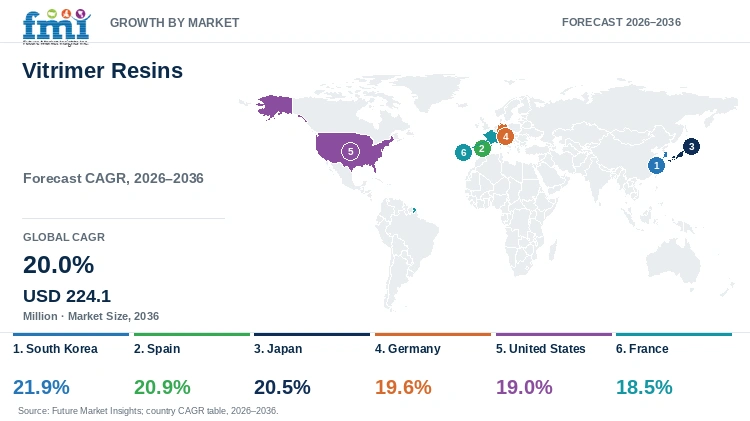
Offshore wind blade localization and recyclable PCB laminate investments are projected to propel South Korea at a 21.9% CAGR through 2036, outpacing expected expansion in Spain (20.9%) and Japan (20.5%). Meanwhile, demand in Germany (anticipated at 19.6%) and the United States (estimated at 19.0%) alongside France (forecast at 18.5%) scales steadily as composite molders replace permanent epoxies under circularity rules.
Table 7: Country CAGR and Primary Growth Levers for the Vitrimer Resins Market (CAGR percentage and operational drivers), 2026 to 2036
| Country | CAGR (2026 to 2036) | Primary Growth Lever |
|---|---|---|
| South Korea | 21.9% | Offshore wind blade localization and recyclable copper-clad laminate PCB substrate fabrication |
| Spain | 20.9% | Onshore wind fleet repowering mandates and Horizon Europe aerospace/wind vitrimer consortia |
| Japan | 20.5% | High-modulus carbon-fiber prepreg innovation and dismantlable polyrotaxane vitrimer adhesives |
| Germany | 19.6% | Vacuum-assisted disulfide epoxy laminate reuse and chemical elastomer/plastics recycling plants |
| United States | 19.0% | DOE circular wind material grants and imine-network prepreg tube and copolyester vitrimer R&D |
| France | 18.5% | Bio-based vitrimer building-block synthesis and Horizon Europe circular composite consortia |
Source: Future Market Insights analysis
South Korea Vitrimer Resins Market Outlook (2026 to 2036)
Unlike Western markets where wind rotor infusion dominates demand, South Korea's vitrimer uptake is uniquely dual-anchored by high-density semiconductor packaging substrates alongside sustainable infrastructure and offshore wind localization. Electronics material divisions and composite fabricators across Seoul and Incheon are integrating disulfide and boronic ester epoxy vitrimers to recover circuit components and woven glass fabrics without thermal incineration. In January 2025, researchers at Seoul National University of Science and Technology and Jeonju University demonstrated solvent-free high-shear reactive mixing of transesterification and disulfide alongside eugenol-derived boronic ester epoxy vitrimers reshaped at 150°C [11]. Backed by domestic offshore wind auctions, South Korean vitrimer resins sales are projected to expand at a 21.9% CAGR through 2036.
Key takeaway: In South Korea, high-density PCB substrate recycling and offshore wind blade localization are projected to fuel a 21.9% yearly expansion through 2036.
Spain Vitrimer Resins Market Outlook (2026 to 2036)
Whereas global composite resin growth relies heavily on greenfield wind installations, Spain stands apart because Europe's oldest fleet of early-2000s onshore turbines requires immediate repowering alongside Basque Country aerostructure vitrimer R&D. Composite plants in Navarre and San Sebastian are qualifying dynamic covalent infusion resins and automated fiber placement tapes so decommissioned shells and aircraft parts can be chemically cleaved. In January 2025, San Sebastian-based Fundacion CIDETEC launched the EUR 4.52 million Horizon Europe TOSCA project (Grant 101191394) to develop epoxy vitrimer resins with glass transition temperatures above 170°C for sustainable composite aerostructures [12]. Repowering and aerospace programs are expected to lift Spanish vitrimer resins consumption by 20.9% annually through 2036.
Key takeaway: In Spain, large-scale onshore wind repowering and Basque aerospace vitrimer programs are expected to sustain a 20.9% compound annual expansion through 2036.
Japan Vitrimer Resins Market Outlook (2026 to 2036)
When compared with liquid vacuum-infusion markets in Europe, Japan's commercial vitrimer sector is uniquely weighted toward upstream polyacrylonitrile carbon-fiber prepreg weaving and dismantlable structural adhesives for electronics and automotive assemblies. Domestic chemical groups and prepreg weavers in Tokyo and Tsukuba formulate high-Tg transesterification epoxy networks that bond strongly at ambient temperature yet dismantle cleanly upon heating. During January 2026, polymer scientists from The University of Tokyo and NIMS Tsukuba alongside Mitsubishi Chemical Corporation (under NEDO Grant JPNP18016) developed polyrotaxane-toughened DGEBA/glutaric anhydride vitrimer adhesives achieving 27.1 MPa lap-shear strength at 25°C and full ethylene glycol removal at 180°C [13]. Japanese vitrimer resins turnover is anticipated to progress at 20.5% per annum until 2036.
Key takeaway: In Japan, domestic carbon-fiber prepreg leadership and NEDO dismantlable vitrimer adhesive programs are anticipated to support a 20.5% annual growth pace to 2036.
Germany Vitrimer Resins Market Outlook (2026 to 2036)
Distinct from global markets focused solely on chemical solvolysis, Germany pairs strict federal composite landfill bans with direct thermo-mechanical reuse of unidirectional vacuum-infused laminates across automotive and wind manufacturing. North Rhine-Westphalian and Bavarian composite molders specify aromatic disulfide epoxy vitrimers to reconsolidate end-of-life unidirectional panels without dissolving the matrix into liquid waste streams. In January 2026, RWTH Aachen University engineers demonstrated vacuum-assisted resin infusion at 130 mbar using bis(4-aminophenyl) disulfide and Westlake Epoxy EPON 0162 resin (Tg of 134°C and Tv of 110°C), achieving full second-generation laminate reconsolidation via hot pressing at 190°C and 8.5 MPa for 45 minutes [14]. German vitrimer resins expenditure is predicted to scale at a 19.6% yearly rate through 2036.
Key takeaway: In Germany, vacuum-infused disulfide laminate reconsolidation and automotive CFRP repairability requirements are foreseen to sustain a 19.6% yearly expansion rate until 2036.
United States Vitrimer Resins Market Outlook (2026 to 2036)
In contrast to regulatory-driven European adoption, United States vitrimer demand is uniquely shaped by defense and sporting goods prepreg rapid-stamping economics alongside closed-loop carbon and para-aramid fiber reclamation. Domestic innovators in Colorado and California alongside Texas are scaling imine-linked Vitrimax prepreg tapes that allow cured composite laminates to be hot-stamped on metal-forming presses and chemically depolymerized at end of life. In May 2024, Teijin Aramid and Colorado-based Mallinda Inc. demonstrated closed-loop chemical depolymerization of Twaron para-aramid and Vitrimax imine-epoxy composites, achieving 92% to 95% resin removal across three recycling cycles [15]. United States vitrimer resins demand is expected to compound by 19.0% annually until 2036, while low landfill tipping fees slow utility mandates.
Key takeaway: In the United States, wind blade circularity grants and closed-loop Vitrimax prepreg stamping are estimated to support a 19.0% annual expansion through 2036.
France Vitrimer Resins Market Outlook (2026 to 2036)
France differentiates itself from the wider global vitrimer market through statutory wind-rotor and composite recycling mandates paired with domestic synthesis of bio-based dynamic covalent thermoset building blocks across southern and Atlantic clusters. Aerospace subcontractors and composite formulators in Montpellier and Toulouse alongside Nantes are qualifying reversible imine and disulfide epoxy resins, with French vitrimer resins revenue forecast to advance 18.5% annually through 2036. In December 2025, Castries-based SPECIFIC POLYMERS announced its 2026 Horizon Europe collaborative portfolio supplying vanillin-derived and bisphenol-free vitrimer building blocks alongside reversible disulfide cross-linkers scaled from gram quantities up to 50-kilogram pilot batches [16]. Strict aviation airworthiness qualification cycles nonetheless lengthen serial aircraft onboarding.
Key takeaway: In France, bio-based vitrimer monomer synthesis and Horizon Europe circular composite consortia are forecast to sustain an 18.5% compound annual growth rate through 2036.
Full report country CAGRs cover: North America; Latin America; Western Europe; Eastern Europe; East Asia; South Asia and Pacific; Middle East and Africa.
Who are the notable companies in the vitrimer resins market?
Mallinda, Inc., Swancor Holding Co., Ltd., ATSP Innovations, Inc., SPECIFIC POLYMERS, Huntsman International LLC, Westlake Epoxy (Westlake Corporation), Covestro AG, and Evonik Industries AG are the notable companies in the vitrimer resins market.
Supplier rivalry in the vitrimer resins sector spans dedicated dynamic-covalent polymer producers alongside upstream epoxy monomer suppliers and circular curing-network groups. Dedicated vitrimer pioneers including Mallinda Inc. and Swancor Holding alongside ATSP Innovations and SPECIFIC POLYMERS commercialize imine-linked prepreg tapes and cleavable infusion epoxies alongside interchain transesterification copolyesters and bio-based vitrimer building blocks. Upstream epoxy leaders Huntsman International LLC and Westlake Epoxy (part of Westlake Corporation following its February 2022 acquisition of Hexion's global epoxy business) supply ARALDITE and Jeffamine curatives alongside EPON 0162 glycidyl ether resins validated in disulfide vitrimer infusion systems. Meanwhile, Covestro AG and Evonik Industries AG provide circular polyurethane depolymerization technologies and renewable-powered amine curing agents.
- Dedicated Dynamic Covalent & Vitrimer Resin Producers: Mallinda Inc. and Swancor Holding alongside ATSP Innovations and SPECIFIC POLYMERS supply commercial imine prepregs and cleavable wind infusion resins alongside aromatic copolyester vitrimers and bio-based building blocks.
- Upstream Epoxy Monomer & Composite Matrix Suppliers: Huntsman International LLC and Westlake Epoxy (Westlake Corporation) supply world-scale ARALDITE and EPON 0162 / EPIKOTE epoxy monomers alongside amine curatives compounded into disulfide vitrimer laminates.
- Circular Elastomer & Crosslinker Innovators: Covestro AG and Evonik Industries AG develop chemical depolymerization processes for cross-linked polyurethanes and supply low-carbon diamine and anhydride curing agents.
Competitive Benchmarking: Vitrimer Resins Market
Table 8: Competitive Benchmarking for the Vitrimer Resins Market (qualitative capability ratings), 2026
| Company | Dynamic Network Breadth | Composite Prepreg & Infusion Fit | Solvolysis & Recovery Readiness | Global OEM Qualification |
|---|---|---|---|---|
| Mallinda, Inc. | High | High | High | Medium |
| Swancor Holding Co., Ltd. | High | High | High | High |
| ATSP Innovations, Inc. | High | High | Medium | Medium |
| SPECIFIC POLYMERS | High | Medium | High | Medium |
| Huntsman International LLC | Medium | High | Medium | High |
| Westlake Epoxy (Westlake Corporation) | Medium | High | Medium | High |
| Covestro AG | Medium | Medium | High | High |
| Evonik Industries AG | Medium | Medium | High | High |
Scoring basis: Dynamic Network Breadth earns a High mark where a formulator commercializes dedicated imine or disulfide vitrimer resins alongside transesterification networks (Mallinda and Swancor alongside ATSP Innovations and SPECIFIC POLYMERS), while Medium denotes upstream epoxy monomer or polyurethane suppliers whose resins serve as base precursors for vitrimer compounding. Composite Prepreg & Infusion Fit reflects documented compatibility with automated tape layup and heated compression stamping alongside vacuum-assisted resin transfer molding. Solvolysis & Recovery Readiness evaluates industrial demonstration of mild chemical fiber reclamation or multi-cycle thermal remolding across wind and aerospace supply chains.
Key Developments in the Vitrimer Resins Market
- In May 2026, Houston-based ATSP Innovations, Inc. secured United States Patent US12569591B2 covering its aromatic thermosetting copolyester (ATSP) and Estherm vitrimer resin nanocomposite reinforced with titanium carbide MXene for high-temperature aerospace and tribological structures [17].
- In June 2026, Evonik Industries AG launched its Purocel 505 and Purocel 510 catalytic adsorbents alongside modular Rocket Technology columns that remove up to three times more chlorides from pyrolysis oils during chemical plastics recycling [18].
- In July 2025, Evonik Industries AG switched its global epoxy curing agent plants in Marl and Clayton alongside Isehara and Singapore to 100% renewable electricity, cutting Crosslinkers business line Scope 1 and 2 emissions by roughly 30% per year [19].
Key Players in the Vitrimer Resins Market
Dedicated Dynamic Covalent & Vitrimer Resin Producers
- Mallinda, Inc.
- Swancor Holding Co., Ltd.
- ATSP Innovations, Inc.
- SPECIFIC POLYMERS
Upstream Epoxy Monomer & Composite Matrix Suppliers
- Huntsman International LLC
- Westlake Epoxy (Westlake Corporation)
Circular Elastomer & Crosslinker Innovators
- Covestro AG
- Evonik Industries AG
Vitrimer Resins Market - Report Scope
Table 9: Report Scope for the Vitrimer Resins Market (coverage fields and definitions), 2026 to 2036
| Coverage field | Report scope |
|---|---|
| Market breakdown | Dynamic Covalent Exchange Mechanism; Base Polymer Backbone; Processing Form; End-Use Industry; Glass Transition Temperature (Tg); End-of-Life Recovery Pathway; Region |
| Quantitative Units | USD Million |
| Market Definition | Includes merchant and captive-transfer revenue from covalent adaptable network (CAN) thermoset resins and associative vitrimer matrices sold as unidirectional prepreg binders, liquid vacuum-infusion resins, and structural film adhesives. Category Scope Note: The valuation measures formulated dynamic covalent resin systems (disulfide, imine, transesterification, boronic ester, and vinylogous urethane networks), excluding conventional non-reversible thermoset epoxies, linear recyclable thermoplastics (such as liquid acrylic Elium resins), and downstream finished wind blades or aircraft structures. |
| Regions Covered | North America; Latin America; Western Europe; Eastern Europe; East Asia; South Asia and Pacific; Middle East and Africa |
| Countries Covered | South Korea, Spain, Japan, Germany, United States, France, and additional countries in the full report |
| Key Companies Covered | Mallinda, Inc., Swancor Holding Co., Ltd., ATSP Innovations, Inc., SPECIFIC POLYMERS, Huntsman International LLC, Westlake Epoxy (Westlake Corporation), Covestro AG, Evonik Industries AG |
| Forecast Period | 2026 to 2036 |
| Approach | Primary and secondary research with rigorous market triangulation. |
Vitrimer Resins Market - Research Methodology
Table 10: Research Methodology for the Vitrimer Resins Market (research methods and approach), 2026 edition
| Method | Approach |
|---|---|
| Primary Research | Primary interviews were conducted with polymer chemists, wind-blade infusion engineers, aerospace prepreg fabricators, copper-clad laminate buyers, and composite recycling operators to validate bond-exchange kinetics, qualification hurdles, and resin pricing. |
| Secondary Research | Secondary research included U.S. Department of Energy wind recycling reports, WindEurope 2025/2026 fleet statistics, Horizon Europe CORDIS EOLIAN and CIDETEC TOSCA project disclosures, peer-reviewed ACS/RSC/MDPI vitrimer studies, and official company disclosures. |
| Market Sizing and Forecasting | Market sizing and forecasting from 2026 to 2036 combined bottom-up tracking of pilot and commercial vitrimer reactor capacities with top-down adoption modeling across wind, aerospace, automotive, and PCB manufacturing. |
| Data Triangulation and Validation | Estimates were cross-checked against wind blade resin intensity per megawatt, aerospace CFRP prepreg qualification timelines, and specialty diamine/monomer cost curves to prevent double counting with standard epoxy or linear thermoplastic markets. |
| Country Forecasting Model | Country CAGRs (18.5% to 21.9%) are calibrated around the 20.0% global CAGR using national wind-turbine repowering schedules, statutory composite landfill bans, domestic carbon-fiber prepreg capacity, and PCB laminate output. |
| Operational Benchmark Traceability | Operational indicators in Tables 2, 3, and 4 (formulated vitrimer tonnage, reclaimed fiber tonnage, and plant spending) are synthesized from DOE wind material benchmarks, WindEurope installation data, and USC/Teijin solvolysis recovery yields. |
Vitrimer Resins Market by Segments
Vitrimer Resins Market segmented by Dynamic Covalent Exchange Mechanism:
- Disulfide & Imine Exchange Vitrimers
- Transesterification Epoxy Vitrimers
- Boronic Ester & Dioxaborolane Networks
- Vinylogous Urethane Vitrimers
Vitrimer Resins Market segmented by Base Polymer Backbone:
- Epoxy-Based Vitrimer Matrices
- Polyurethane & Polyurea Vitrimers
- Polydimethylsiloxane (PDMS) Elastomer Vitrimers
- Bio-Based Lignin & Vanillin Vitrimers
Vitrimer Resins Market segmented by Processing Form:
- Unidirectional Prepreg Tapes
- Liquid Vacuum Infusion Resins
- Hot-Melt Structural Film Adhesives
Vitrimer Resins Market segmented by End-Use Industry:
- Recyclable Wind Turbine Blades
- Aerospace CFRP Secondary Structures
- Automotive Repairable Composite Panels
- Recyclable Printed Circuit Board Substrates
- High-Voltage Electrical Encapsulants
Vitrimer Resins Market segmented by Glass Transition Temperature (Tg):
- High-Tg (>120°C) Structural Aerospace/Wind Grade
- Medium-Tg (60 - 120°C) Automotive & Sporting Grade
- Sub-Ambient Elastomeric Vitrimers (<25°C)
Vitrimer Resins Market segmented by End-of-Life Recovery Pathway:
- Thermal Compression Remolding & Thermoforming
- Mild Chemical Solvolysis Carbon-Fiber Recovery
Vitrimer Resins Market by Region
- North America
- United States
- Canada
- Latin America
- Brazil
- Mexico
- Argentina
- Chile
- Western Europe
- Germany
- France
- United Kingdom
- Italy
- Spain
- Benelux
- Nordics
- Eastern Europe
- Poland
- Czech Republic
- Romania
- Hungary
- East Asia
- China
- Japan
- South Korea
- South Asia and Pacific
- India
- ASEAN
- Australia and New Zealand
- Middle East and Africa
- GCC Countries
- South Africa
- Türkiye
- Israel
Research Sources and Bibliography
- [1] U.S. Department of Energy Wind Energy Technologies Office. (2025, January 06). America Can Recycle 90% of Wind Turbine Mass, According to New DOE Report. U.S. Department of Energy.
- [2] WindEurope. (2026, February 26). Wind energy in Europe: 2025 Statistics and the outlook for 2026-2030. WindEurope.
- [3] Ye, G., Wang, C., Guo, Y., Yang, Q., & Huo, S. (2025, September 11). Vitrimer as a Sustainable Alternative to Traditional Thermoset: Recent Progress and Future Prospective. ACS Polymers Au / U.S. National Library of Medicine (PMC12511975).
- [4] Huntsman Corporation. (2025, September 17). Huntsman Launches New Range of Safer, More Sustainable ARALDITE® Epoxy Adhesives. Huntsman Corporation News Releases.
- [5] Kennedy, A., Ghafafian, C., & Nutt, S. (2026, January 01). Production and Remanufacturing of Vitrimer Matrix Composite Tubes. Journal of Composites Science (Vol. 10, Issue 1, 14).
- [6] European Commission CORDIS. (2024, June 01). Bio-based, repairable and recyclable vitrimer composites and advanced sensors for highly reliable and sustainable wind blades. Publications Office of the European Union (Horizon Europe Grant 101147532 - EOLIAN).
- [7] Gao, L., Wang, H., Yao, X., Zheng, Z., Wang, L., Wang, Z., Wang, Y., Zhang, B., Jing, X., & Wu, J. (2025, February 18). High-performance epoxy vitrimer from commercial epoxy-anhydride with reprocessable and chemical degradable properties. Frontiers in Materials (Vol. 12, 1552713).
- [8] Albertini, E., Dalle Vacche, S., & Vitale, A. (2026, March 13). Bio-based vitrimers: chemistry, performance and applications. RSC Applied Polymers (Vol. 4, Issue 3, 892-922).
- [9] Ghosh, S., Chatterjee, A., Dey, N., Mishra, S., Bhardwaj, S., Singh, S., Tewary, U., Sahay, S., Maiti, M., & Maji, P. K. (2025, July 23). Impact of nanofillers on vitrimerization and recycling strategies: a review. Nanoscale Advances (Vol. 7, Issue 19, 5842-5887).
- [10] Arkema S.A. (2025, February 25). Arkema at JEC World 2025: lighter, more efficient, and sustainable innovations in specialty materials. Arkema Global Media.
- [11] Lee, M. K., Kim, M. O., Lee, T., Cho, S., Kim, D., Chang, W., Kwon, Y., Lee, S. M., Kim, J. K., & Son, B. C. (2025, January 29). Epoxy-Based Vitrimers for Sustainable Infrastructure: Emphasizing Recycling and Self-Healing Properties. Polymers (Vol. 17, Issue 3, 373).
- [12] Fundación CIDETEC. (2025, January 01). TOSCA: Manufacturing Processes and Digital Tools for more Sustainable Composite Aerostructures. CIDETEC Surface Engineering (Horizon Europe Grant 101191394).
- [13] Hanafusa, A., Ando, S., Ozawa, S., Hasegawa, R., & Ito, K. (2026, January 25). Environmentally Adaptive Vitrimer Adhesives: Enhancing Dismantlability and Recyclability by Introducing Polyrotaxane Networks. ACS Omega (Vol. 11, Issue 5, 7545-7552).
- [14] Fuchs, J., Schuhmann, N., Alms, J., & Hopmann, C. (2026, January 22). Advancing Circular Composite Strategies by Vitrimer-Enabled Reuse of Unidirectional Laminates. Polymers (Vol. 18, Issue 2, 300).
- [15] Teijin Aramid B.V. (2024, May 21). Collaboration With Mallinda Achieves Sustainable Recovery of Twaron® and Vitrimax Resin Materials. Teijin Aramid Stories.
- [16] SPECIFIC POLYMERS. (2025, December 01). SPECIFIC POLYMERS: Accelerating Innovation through Collaborative Projects – 2026 Calls for Proposals. SPECIFIC POLYMERS R&D News.
- [17] ATSP Innovations, Inc. (2026, May 06). ATSP Innovations Secures U.S. Patent for Wear-Resistant ATSP–MXene Nanocomposite Technology. ATSP Innovations News (U.S. Patent US12569591B2).
- [18] Evonik Industries AG. (2026, June 10). Evonik facilitates the chemical recycling of plastics. Evonik Industries Press Releases.
- [19] Evonik Industries AG. (2025, July 30). Evonik transitions its epoxy curing agent production to run on renewable electricity. Evonik Industries Press Releases.
- [20] Covestro AG. (2026, September 16). Toward circular elastomers: Covestro opens pilot plant in Leverkusen. Covestro AG Press Center.
- [21] Lin, H., Dong, K., Luan, J., Li, C., Zhao, D., Zhao, C., & Li, X. (2025, August 31). Repairable, Degradable and Recyclable Carbon Fiber-Reinforced Bio-Based Epoxy Vitrimer Composites Enabled by Facile Transesterification. Polymers (Vol. 17, Issue 17, 2387).
- [22] Westlake Corporation. (2026, February 17). Westlake Epoxy Expands Distribution Relationship with Brenntag to India. Westlake Corporation Investor Relations.
This bibliography is provided for reader reference and is not exhaustive. The full report contains the complete reference list and detailed citations.
This Report Answers
- How large is the vitrimer resins market in 2026 and what is forecast for 2036?
- Which composite circularity and regulatory pressures support demand for vitrimer resins?
- Why do Disulfide & Imine Exchange Vitrimers lead the dynamic covalent exchange mechanism category?
- Why do Epoxy-Based Vitrimer Matrices command the largest base polymer backbone share globally?
- How do growth rates differ across South Korea, Spain, Japan, Germany, the United States, and France?
- Which notable companies formulate dynamic covalent monomer and vitrimer resin systems today?
- What technical and economic factors restrain faster adoption of vitrimer resins?
- What mechanical and solvolysis benchmarks should composite buyers verify before qualifying a vitrimer resin?
Frequently Asked Questions
How big is the vitrimer resins market in 2026, and what is forecast for 2036?
Global vitrimer resins revenue is estimated to reach USD 36.2 million in 2026 (up from USD 29.5 million in 2025) and is projected to climb to USD 224.1 million by 2036 as wind blade and composite fabricators adopt reprocessable thermoset matrices.
What is the CAGR for the vitrimer resins market from 2026 to 2036?
As per FMI, worldwide vitrimer resins sales are anticipated to expand at a 20.0% compound annual growth rate between 2026 and 2036, lifting annual market turnover by USD 187.9 million across wind and electronics sectors.
Which dynamic covalent exchange mechanism leads the vitrimer resins market?
Disulfide & Imine Exchange Vitrimers are projected to capture 42.6% of 2026 mechanism demand because aromatic disulfide and Schiff-base imine networks rearrange rapidly under heat without metallic catalysts and cleave cleanly in mild acidic solutions.
Which base polymer backbone and processing form lead the vitrimer resins market in 2026?
Epoxy-Based Vitrimer Matrices are expected to hold 53.8% of 2026 backbone revenue due to drop-in compatibility with existing composite tooling, while Unidirectional Prepreg Tapes are estimated to secure 46.1% of processing form volume.
Which country registers the fastest growth outlook during the forecast period?
FMI analysis indicates that South Korea is projected to lead major composite-manufacturing nations at a 21.9% CAGR from 2026 to 2036, driven by offshore wind rotor localization and recyclable copper-clad laminate PCB substrates.
Who are the key players operating in the vitrimer resins market?
Leading suppliers include Mallinda, Inc., Swancor Holding Co., Ltd., ATSP Innovations, Inc., SPECIFIC POLYMERS, Huntsman International LLC, Westlake Epoxy (Westlake Corporation), Covestro AG, and Evonik Industries AG, competing across cleavable infusion epoxies and thermoformable prepreg tapes.
Preview the report firsthand - request a free sample
Get SampleGet the brochure for pricing and purchase details.
Get PDFTable of Content
- Key Takeaways
- Market Size and CAGR
- Top Growth Driver
- Fastest Growing Segment
- Leading Region
- Key Companies
- Emerging Opportunities
- Executive Summary
- Global Market Outlook
- Demand-side Trends
- Supply-side Trends
- Technology Roadmap Analysis
- Analysis and Recommendations
- Analyst Perspective (What is happening? Why now? What should investors know?)
- Key Questions Answered
- How large is the market?
- What is the CAGR?
- What are key trends?
- Which region dominates?
- Who are the leaders?
- Market Overview
- Market Coverage / Taxonomy
- Market Definition / Scope / Limitations
- Research Methodology
- Chapter Orientation
- Analytical Lens and Working Hypotheses
- Market Structure, Signals, and Trend Drivers
- Benchmarking and Cross-market Comparability
- Market Sizing, Forecasting, and Opportunity Mapping
- Research Design and Evidence Framework
- Desk Research Programme (Secondary Evidence)
- Expert Input and Fieldwork (Primary Evidence)
- Tooling, Models, and Reference Databases
- Data Engineering and Model Build
- Quality Assurance and Audit Trail
- Market Background
- Market Dynamics (Drivers, Restraints, Opportunity, Trends)
- Scenario Forecast (Optimistic, Likely, Conservative)
- Impact Analysis
- AI Impact
- Sustainability Impact
- Regulatory Impact
- Technology Impact
- Consumer / Buyer Analysis
- Purchase Drivers
- Adoption Barriers
- Buyer Journey
- Opportunity Map Analysis
- Product Life Cycle Analysis
- Supply Chain Analysis
- Investment Feasibility Matrix
- Value Chain Analysis
- PESTLE and Porter's Analysis
- Regulatory Landscape
- Regional Parent Market Outlook
- Production and Consumption Statistics
- Import and Export Statistics
- Global Market Analysis and Forecast, 2021 to 2036
- Historical Market Size Value (USD Million) Analysis, 2021 to 2025
- Current and Future Market Size Value (USD Million) Projections, 2026 to 2036
- Y-o-Y Growth Trend Analysis
- Absolute $ Opportunity Analysis
- Global Market Pricing Analysis, 2021 to 2036
- Global Market Analysis and Forecast, By Dynamic Covalent Exchange Mechanism, 2021 to 2036
- Introduction / Key Findings
- Historical Market Size Value (USD Million) Analysis By Dynamic Covalent Exchange Mechanism, 2021 to 2025
- Current and Future Market Size Value (USD Million) Analysis and Forecast By Dynamic Covalent Exchange Mechanism, 2026 to 2036
- Disulfide & Imine Exchange Vitrimers
- Transesterification Epoxy Vitrimers
- Boronic Ester & Dioxaborolane Networks
- Vinylogous Urethane Vitrimers
- Y-o-Y Growth Trend Analysis By Dynamic Covalent Exchange Mechanism, 2021 to 2025
- Absolute $ Opportunity Analysis By Dynamic Covalent Exchange Mechanism, 2026 to 2036
- Global Market Analysis and Forecast, By Base Polymer Backbone, 2021 to 2036
- Introduction / Key Findings
- Historical Market Size Value (USD Million) Analysis By Base Polymer Backbone, 2021 to 2025
- Current and Future Market Size Value (USD Million) Analysis and Forecast By Base Polymer Backbone, 2026 to 2036
- Epoxy-Based Vitrimer Matrices
- Polyurethane & Polyurea Vitrimers
- Polydimethylsiloxane (PDMS) Elastomer Vitrimers
- Bio-Based Lignin & Vanillin Vitrimers
- Y-o-Y Growth Trend Analysis By Base Polymer Backbone, 2021 to 2025
- Absolute $ Opportunity Analysis By Base Polymer Backbone, 2026 to 2036
- Global Market Analysis and Forecast, By Processing Form, 2021 to 2036
- Introduction / Key Findings
- Historical Market Size Value (USD Million) Analysis By Processing Form, 2021 to 2025
- Current and Future Market Size Value (USD Million) Analysis and Forecast By Processing Form, 2026 to 2036
- Unidirectional Prepreg Tapes
- Liquid Vacuum Infusion Resins
- Hot-Melt Structural Film Adhesives
- Y-o-Y Growth Trend Analysis By Processing Form, 2021 to 2025
- Absolute $ Opportunity Analysis By Processing Form, 2026 to 2036
- Global Market Analysis and Forecast, By End-Use Industry, 2021 to 2036
- Introduction / Key Findings
- Historical Market Size Value (USD Million) Analysis By End-Use Industry, 2021 to 2025
- Current and Future Market Size Value (USD Million) Analysis and Forecast By End-Use Industry, 2026 to 2036
- Recyclable Wind Turbine Blades
- Aerospace CFRP Secondary Structures
- Automotive Repairable Composite Panels
- Recyclable Printed Circuit Board Substrates
- High-Voltage Electrical Encapsulants
- Y-o-Y Growth Trend Analysis By End-Use Industry, 2021 to 2025
- Absolute $ Opportunity Analysis By End-Use Industry, 2026 to 2036
- Global Market Analysis and Forecast, By Glass Transition Temperature (Tg), 2021 to 2036
- Introduction / Key Findings
- Historical Market Size Value (USD Million) Analysis By Glass Transition Temperature (Tg), 2021 to 2025
- Current and Future Market Size Value (USD Million) Analysis and Forecast By Glass Transition Temperature (Tg), 2026 to 2036
- High-Tg (>120°C) Structural Aerospace/Wind Grade
- Medium-Tg (60 - 120°C) Automotive & Sporting Grade
- Sub-Ambient Elastomeric Vitrimers (<25°C)
- Y-o-Y Growth Trend Analysis By Glass Transition Temperature (Tg), 2021 to 2025
- Absolute $ Opportunity Analysis By Glass Transition Temperature (Tg), 2026 to 2036
- Global Market Analysis and Forecast, By End-of-Life Recovery Pathway, 2021 to 2036
- Introduction / Key Findings
- Historical Market Size Value (USD Million) Analysis By End-of-Life Recovery Pathway, 2021 to 2025
- Current and Future Market Size Value (USD Million) Analysis and Forecast By End-of-Life Recovery Pathway, 2026 to 2036
- Thermal Compression Remolding & Thermoforming
- Mild Chemical Solvolysis Carbon-Fiber Recovery
- Y-o-Y Growth Trend Analysis By End-of-Life Recovery Pathway, 2021 to 2025
- Absolute $ Opportunity Analysis By End-of-Life Recovery Pathway, 2026 to 2036
- Global Market Analysis and Forecast, By Region, 2021 to 2036
- Introduction
- Historical Market Size Value (USD Million) Analysis By Region, 2021 to 2025
- Current Market Size Value (USD Million) Analysis and Forecast By Region, 2026 to 2036
- North America
- Latin America
- Western Europe
- Eastern Europe
- East Asia
- South Asia and Pacific
- Middle East and Africa
- Market Attractiveness Analysis By Region
- North America Market Analysis and Forecast, By Country, 2021 to 2036
- Historical Market Size Value (USD Million) Trend Analysis By Market Taxonomy, 2021 to 2025
- Market Size Value (USD Million) Forecast By Market Taxonomy, 2026 to 2036
- By Country
- United States
- Canada
- By Dynamic Covalent Exchange Mechanism
- By Base Polymer Backbone
- By Processing Form
- By End-Use Industry
- By Glass Transition Temperature (Tg)
- By End-of-Life Recovery Pathway
- By Country
- Market Attractiveness Analysis
- By Country
- By Dynamic Covalent Exchange Mechanism
- By Base Polymer Backbone
- By Processing Form
- By End-Use Industry
- By Glass Transition Temperature (Tg)
- By End-of-Life Recovery Pathway
- Key Takeaways
- Latin America Market Analysis and Forecast, By Country
- Historical Market Size Value (USD Million) Trend Analysis By Market Taxonomy, 2021 to 2025
- Market Size Value (USD Million) Forecast By Market Taxonomy, 2026 to 2036
- By Country
- Brazil
- Mexico
- Argentina
- Chile
- By Dynamic Covalent Exchange Mechanism
- By Base Polymer Backbone
- By Processing Form
- By End-Use Industry
- By Glass Transition Temperature (Tg)
- By End-of-Life Recovery Pathway
- By Country
- Market Attractiveness Analysis
- By Country
- By Dynamic Covalent Exchange Mechanism
- By Base Polymer Backbone
- By Processing Form
- By End-Use Industry
- By Glass Transition Temperature (Tg)
- By End-of-Life Recovery Pathway
- Key Takeaways
- Western Europe Market Analysis and Forecast, By Country
- Historical Market Size Value (USD Million) Trend Analysis By Market Taxonomy, 2021 to 2025
- Market Size Value (USD Million) Forecast By Market Taxonomy, 2026 to 2036
- By Country
- Germany
- France
- United Kingdom
- Italy
- Spain
- Benelux
- Nordics
- By Dynamic Covalent Exchange Mechanism
- By Base Polymer Backbone
- By Processing Form
- By End-Use Industry
- By Glass Transition Temperature (Tg)
- By End-of-Life Recovery Pathway
- By Country
- Market Attractiveness Analysis
- By Country
- By Dynamic Covalent Exchange Mechanism
- By Base Polymer Backbone
- By Processing Form
- By End-Use Industry
- By Glass Transition Temperature (Tg)
- By End-of-Life Recovery Pathway
- Key Takeaways
- Eastern Europe Market Analysis and Forecast, By Country
- Historical Market Size Value (USD Million) Trend Analysis By Market Taxonomy, 2021 to 2025
- Market Size Value (USD Million) Forecast By Market Taxonomy, 2026 to 2036
- By Country
- Poland
- Czech Republic
- Romania
- Hungary
- By Dynamic Covalent Exchange Mechanism
- By Base Polymer Backbone
- By Processing Form
- By End-Use Industry
- By Glass Transition Temperature (Tg)
- By End-of-Life Recovery Pathway
- By Country
- Market Attractiveness Analysis
- By Country
- By Dynamic Covalent Exchange Mechanism
- By Base Polymer Backbone
- By Processing Form
- By End-Use Industry
- By Glass Transition Temperature (Tg)
- By End-of-Life Recovery Pathway
- Key Takeaways
- East Asia Market Analysis and Forecast, By Country
- Historical Market Size Value (USD Million) Trend Analysis By Market Taxonomy, 2021 to 2025
- Market Size Value (USD Million) Forecast By Market Taxonomy, 2026 to 2036
- By Country
- China
- Japan
- South Korea
- By Dynamic Covalent Exchange Mechanism
- By Base Polymer Backbone
- By Processing Form
- By End-Use Industry
- By Glass Transition Temperature (Tg)
- By End-of-Life Recovery Pathway
- By Country
- Market Attractiveness Analysis
- By Country
- By Dynamic Covalent Exchange Mechanism
- By Base Polymer Backbone
- By Processing Form
- By End-Use Industry
- By Glass Transition Temperature (Tg)
- By End-of-Life Recovery Pathway
- Key Takeaways
- South Asia and Pacific Market Analysis and Forecast, By Country
- Historical Market Size Value (USD Million) Trend Analysis By Market Taxonomy, 2021 to 2025
- Market Size Value (USD Million) Forecast By Market Taxonomy, 2026 to 2036
- By Country
- India
- ASEAN
- Australia and New Zealand
- By Dynamic Covalent Exchange Mechanism
- By Base Polymer Backbone
- By Processing Form
- By End-Use Industry
- By Glass Transition Temperature (Tg)
- By End-of-Life Recovery Pathway
- By Country
- Market Attractiveness Analysis
- By Country
- By Dynamic Covalent Exchange Mechanism
- By Base Polymer Backbone
- By Processing Form
- By End-Use Industry
- By Glass Transition Temperature (Tg)
- By End-of-Life Recovery Pathway
- Key Takeaways
- Middle East and Africa Market Analysis and Forecast, By Country
- Historical Market Size Value (USD Million) Trend Analysis By Market Taxonomy, 2021 to 2025
- Market Size Value (USD Million) Forecast By Market Taxonomy, 2026 to 2036
- By Country
- GCC Countries
- South Africa
- Türkiye
- Israel
- By Dynamic Covalent Exchange Mechanism
- By Base Polymer Backbone
- By Processing Form
- By End-Use Industry
- By Glass Transition Temperature (Tg)
- By End-of-Life Recovery Pathway
- By Country
- Market Attractiveness Analysis
- By Country
- By Dynamic Covalent Exchange Mechanism
- By Base Polymer Backbone
- By Processing Form
- By End-Use Industry
- By Glass Transition Temperature (Tg)
- By End-of-Life Recovery Pathway
- Key Takeaways
- Key Countries Market Analysis
- United States
- Pricing Analysis
- Market Share Analysis, 2025
- By Dynamic Covalent Exchange Mechanism
- By Base Polymer Backbone
- By Processing Form
- By End-Use Industry
- By Glass Transition Temperature (Tg)
- By End-of-Life Recovery Pathway
- Canada
- Pricing Analysis
- Market Share Analysis, 2025
- By Dynamic Covalent Exchange Mechanism
- By Base Polymer Backbone
- By Processing Form
- By End-Use Industry
- By Glass Transition Temperature (Tg)
- By End-of-Life Recovery Pathway
- Mexico
- Pricing Analysis
- Market Share Analysis, 2025
- By Dynamic Covalent Exchange Mechanism
- By Base Polymer Backbone
- By Processing Form
- By End-Use Industry
- By Glass Transition Temperature (Tg)
- By End-of-Life Recovery Pathway
- Brazil
- Pricing Analysis
- Market Share Analysis, 2025
- By Dynamic Covalent Exchange Mechanism
- By Base Polymer Backbone
- By Processing Form
- By End-Use Industry
- By Glass Transition Temperature (Tg)
- By End-of-Life Recovery Pathway
- Chile
- Pricing Analysis
- Market Share Analysis, 2025
- By Dynamic Covalent Exchange Mechanism
- By Base Polymer Backbone
- By Processing Form
- By End-Use Industry
- By Glass Transition Temperature (Tg)
- By End-of-Life Recovery Pathway
- Germany
- Pricing Analysis
- Market Share Analysis, 2025
- By Dynamic Covalent Exchange Mechanism
- By Base Polymer Backbone
- By Processing Form
- By End-Use Industry
- By Glass Transition Temperature (Tg)
- By End-of-Life Recovery Pathway
- United Kingdom
- Pricing Analysis
- Market Share Analysis, 2025
- By Dynamic Covalent Exchange Mechanism
- By Base Polymer Backbone
- By Processing Form
- By End-Use Industry
- By Glass Transition Temperature (Tg)
- By End-of-Life Recovery Pathway
- Italy
- Pricing Analysis
- Market Share Analysis, 2025
- By Dynamic Covalent Exchange Mechanism
- By Base Polymer Backbone
- By Processing Form
- By End-Use Industry
- By Glass Transition Temperature (Tg)
- By End-of-Life Recovery Pathway
- Spain
- Pricing Analysis
- Market Share Analysis, 2025
- By Dynamic Covalent Exchange Mechanism
- By Base Polymer Backbone
- By Processing Form
- By End-Use Industry
- By Glass Transition Temperature (Tg)
- By End-of-Life Recovery Pathway
- France
- Pricing Analysis
- Market Share Analysis, 2025
- By Dynamic Covalent Exchange Mechanism
- By Base Polymer Backbone
- By Processing Form
- By End-Use Industry
- By Glass Transition Temperature (Tg)
- By End-of-Life Recovery Pathway
- India
- Pricing Analysis
- Market Share Analysis, 2025
- By Dynamic Covalent Exchange Mechanism
- By Base Polymer Backbone
- By Processing Form
- By End-Use Industry
- By Glass Transition Temperature (Tg)
- By End-of-Life Recovery Pathway
- ASEAN
- Pricing Analysis
- Market Share Analysis, 2025
- By Dynamic Covalent Exchange Mechanism
- By Base Polymer Backbone
- By Processing Form
- By End-Use Industry
- By Glass Transition Temperature (Tg)
- By End-of-Life Recovery Pathway
- Australia and New Zealand
- Pricing Analysis
- Market Share Analysis, 2025
- By Dynamic Covalent Exchange Mechanism
- By Base Polymer Backbone
- By Processing Form
- By End-Use Industry
- By Glass Transition Temperature (Tg)
- By End-of-Life Recovery Pathway
- China
- Pricing Analysis
- Market Share Analysis, 2025
- By Dynamic Covalent Exchange Mechanism
- By Base Polymer Backbone
- By Processing Form
- By End-Use Industry
- By Glass Transition Temperature (Tg)
- By End-of-Life Recovery Pathway
- Japan
- Pricing Analysis
- Market Share Analysis, 2025
- By Dynamic Covalent Exchange Mechanism
- By Base Polymer Backbone
- By Processing Form
- By End-Use Industry
- By Glass Transition Temperature (Tg)
- By End-of-Life Recovery Pathway
- South Korea
- Pricing Analysis
- Market Share Analysis, 2025
- By Dynamic Covalent Exchange Mechanism
- By Base Polymer Backbone
- By Processing Form
- By End-Use Industry
- By Glass Transition Temperature (Tg)
- By End-of-Life Recovery Pathway
- Poland
- Pricing Analysis
- Market Share Analysis, 2025
- By Dynamic Covalent Exchange Mechanism
- By Base Polymer Backbone
- By Processing Form
- By End-Use Industry
- By Glass Transition Temperature (Tg)
- By End-of-Life Recovery Pathway
- Hungary
- Pricing Analysis
- Market Share Analysis, 2025
- By Dynamic Covalent Exchange Mechanism
- By Base Polymer Backbone
- By Processing Form
- By End-Use Industry
- By Glass Transition Temperature (Tg)
- By End-of-Life Recovery Pathway
- Türkiye
- Pricing Analysis
- Market Share Analysis, 2025
- By Dynamic Covalent Exchange Mechanism
- By Base Polymer Backbone
- By Processing Form
- By End-Use Industry
- By Glass Transition Temperature (Tg)
- By End-of-Life Recovery Pathway
- South Africa
- Pricing Analysis
- Market Share Analysis, 2025
- By Dynamic Covalent Exchange Mechanism
- By Base Polymer Backbone
- By Processing Form
- By End-Use Industry
- By Glass Transition Temperature (Tg)
- By End-of-Life Recovery Pathway
- United States
- Market Structure Analysis
- Competition Dashboard
- Competition Benchmarking
- Market Share Analysis of Top Players
- By Regional
- By Dynamic Covalent Exchange Mechanism
- By Base Polymer Backbone
- By Processing Form
- By End-Use Industry
- By Glass Transition Temperature (Tg)
- By End-of-Life Recovery Pathway
- Emerging Startups
- Innovation Benchmarking
- Competition Analysis
- Competition Deep Dive
- Mallinda, Inc.
- Overview
- Product Portfolio
- Profitability by Market Segments
- Sales Footprint
- Strategy Overview
- Marketing Strategy
- Product Strategy
- Channel Strategy
- Swancor Holding Co., Ltd.
- ATSP Innovations, Inc.
- SPECIFIC POLYMERS
- Huntsman International LLC
- Westlake Epoxy (Westlake Corporation)
- Covestro AG
- Evonik Industries AG
- Mallinda, Inc.
- Case Studies
- Success Stories
- Recent Developments
- Competition Deep Dive
- Assumptions & Acronyms Used


