

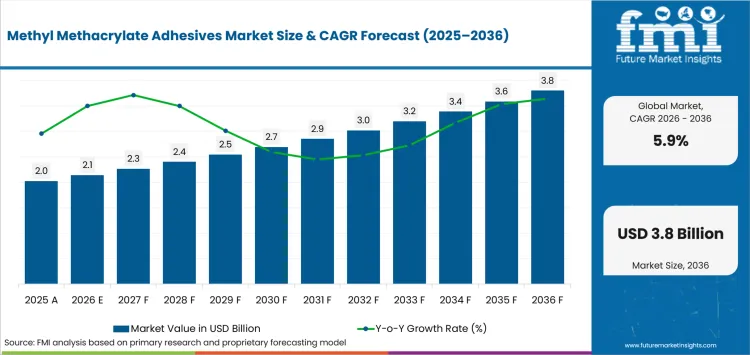
- Market Size (2026)
- USD 2.1 Bn
- Forecast (2036)
- USD 3.8 Bn
- CAGR (2026 to 2036)
- 5.9%
How big is Methyl Methacrylate Adhesives Market in 2026?
USD 2.1 billion in 2026 and USD 3.8 billion by 2036 at a 5.9% CAGR.
Demand for methyl methacrylate adhesives is projected to expand at a 5.9% CAGR between 2026 and 2036. Valuation rises from USD 2.1 billion to USD 3.8 billion during the forecast period. H.B. Fuller stated in July 2025 that some MMA products can replace welding and shorten assembly time. Production approval still requires cure behavior that matches the actual substrate stack and line sequence.
Vehicle assembly density affects how quickly adhesive trials move into serial production. ACEA counted 260 automobile assembly and powertrain plants in the EU and United Kingdom in June 2026. Its inventory identified 127 battery-electric vehicle assembly sites during the same review. Germany and Spain therefore need denser plant-level qualification coverage, whereas Australia depends more on dispersed marine and wind fabrication.
Key Takeaways
- Mixed-material assembly increases MMA adhesive use because manufacturers need structural joints without welding heat or concentrated fastener loads.
- By product type, two-part MMA adhesives are estimated to hold 36.0% in 2026 owing to controlled resin-to-activator mixing during structural assembly.
- In 2026, composites are expected to lead substrate demand with 28.0% share because bonded joints spread load over molded structures.
- Transportation is set to lead the end use category with 27.0% share in 2026 due to line-speed pressure in mixed-material assembly.
- Plant qualification and methyl methacrylate exposure controls can delay conversion even after structural performance meets the engineering target.
- Some of the key players in this market include ITW Plexus, Arkema / Bostik, Sika, H.B. Fuller, 3M, Henkel, Scott Bader, Permabond, Parson Adhesives, and Matrix Adhesives Group's IPS Adhesives.
Analyst Perspective
"MMA adhesives earn serial-production status only after engineers prove that faster room-temperature cure saves enough line time to justify qualification. The decisive comparison is the actual joint because substrate preparation and meter-mix stability must work with fixture time before a plant changes its approved joining process."
- Nikhil Kaitwade, Principal Consultant, Future Market Insights
How is the methyl methacrylate adhesives market segmented?
The methyl methacrylate adhesives market is segmented by product type, substrate, end use, cure speed, sales channel, and region. Product types cover two-part, structural, low-odor, flexible, and rapid-cure MMA adhesives. Substrates include composites, metals, plastics, painted surfaces, and mixed substrates. End uses cover transportation, marine, wind energy, construction, and industrial assembly. Cure speed ranges from below five minutes to above thirty minutes. Sales channels include direct OEM supply, industrial distributors, composite fabricators, and aftermarket repair.
What makes two-part MMA adhesives central to the product type category?
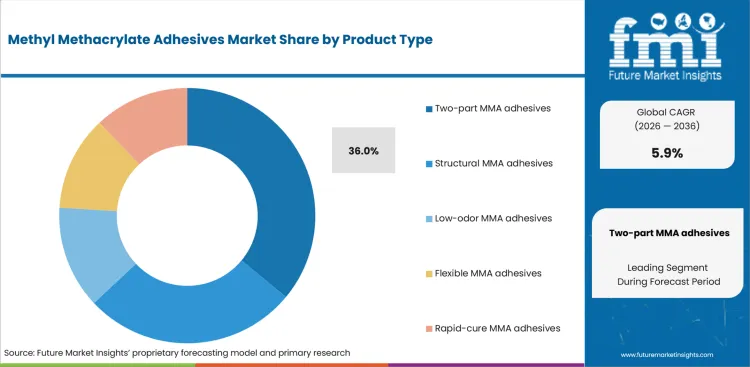
Two-part systems keep resin and activator separate until dispensing, giving production lines a defined work-life window before strength develops. Acrylic structural adhesives fit cartridges and automated meter-mix equipment because the mixing ratio stays fixed during production.
- By product type, two-part MMA adhesives are estimated to hold 36.0% in 2026 owing to repeatable mixing and adjustable work-life options.
- In August 2025 3M scheduled DP8507NS for September commercial release as the replacement for DP8407NS. The two-part structural acrylic transition preserved a familiar mixing route while updating environmental and supply requirements.
Why do composites hold the stated share in the substrate category?
Composite parts can lose design margin when drilling concentrates stress near molded reinforcement. Automotive composite bonding favors adhesives that spread load and join composites to metal without welding heat.
- Composites are projected to represent 28.0% of substrate demand in 2026, attributable to load-spreading joints on molded and mixed-material structures.
- At JEC World in March 2026 Bostik presented its SAF&FIT structural MMA range for composite parts. Arkema’s program tied methacrylate chemistry directly to composite assembly without requiring heat-intensive joining.
How does transportation shape the end use category?
Transportation programs balance fixture time against fatigue performance because bonded subassemblies must reach handling strength before the next operation. Automotive adhesives and sealants become more valuable as electrified platforms pair coated metals with composite structures.
- By end use, transportation is forecast to represent 27.0% in 2026 driven by mixed-material structures that need bonding with limited heat input.
- ACEA reported in January 2026 that battery-electric vehicles reached 17.4% of EU new-car registrations during 2025. Electrified platforms change material choices and expand qualification work for joints that cannot accept welding heat.
What supports below 5 minutes in the cure speed category?
Sub-five-minute cure windows reduce fixture occupancy only if operators can place the part before workable flow ends. Structural adhesive systems gain line-speed value once early handling strength shortens clamping without increasing mix errors.
- Below 5 minutes is likely to capture 21.0% share in 2026 attributable to short handling windows in repetitive assembly cells.
- Permabond stated in March 2025 that TA4230 was developed with rapid strength development for demanding panel assembly. The fire-retardant MMA example shows why fast-cure programs still need enough application time for complete bead placement.
Why does direct OEM supply hold the stated share in the sales channel category?
Direct supply becomes important after an adhesive enters an OEM drawing or validated manufacturing specification. Comparable industrial adhesive programs require application engineers to control dispensing parameters before routine production.
- Direct OEM supply is projected to hold 34.0% share in 2026 owing to account-specific qualification and repeated production requirements.
- 3M launched its Adhesive Mix Monitor in December 2025 for two-part systems requiring a recorded component-ratio check. The device makes fluid dispensing equipment part of qualification because engineers can verify mix consistency before routine release.
What are the drivers, restraints and opportunities in the Methyl Methacrylate Adhesives Market?
Mixed-material assembly raises structural bonding demand, worker-exposure controls slow conversion, and lower-preparation formulations can widen practical substrate coverage.
- Driver: Vehicle and equipment manufacturers need joining methods that bond dissimilar materials without welding heat or drilling concentrated load points.
- Restraint: Methyl methacrylate handling and ventilation requirements add site controls before reactive adhesive systems enter routine production.
- Opportunity: Lower-preparation formulations can reduce treatment steps on difficult plastics that otherwise extend qualification and assembly time.
Electrified vehicle programs increase the number of mixed-material joints that must meet fixed line-cycle requirements. VDA reported in February 2026 that Germany produced 1.67 million electric passenger cars during 2025, up 23% from 2024. Polyurethane adhesive systems compete with MMA where joint movement changes stiffness requirements, so qualification must use the actual substrate stack.
Methyl methacrylate exposure adds a site constraint because ventilation must fit the dispensing operation. NIOSH’s April 2026 IDLH table lists methyl methacrylate at 1,000 ppm. Plant approval therefore covers worker protection and spill response alongside cure testing before routine use.
Lower-preparation grades can widen MMA use on surfaces that otherwise need another treatment step. The USA Department of Energy included composites and specialized joining in its March 2026 vehicle-materials review. The program reinforces joint-specific validation and gives adhesive companies a route to shorten substrate trials with better application data.
Which country CAGRs are covered in the Methyl Methacrylate Adhesives Market?
| Country | CAGR |
|---|---|
| Brazil | 6.7% |
| Mexico | 6.2% |
| Australia | 5.8% |
| USA | 5.4% |
| Spain | 5.3% |
| Germany | 5.0% |
| Japan | 4.7% |
How do country-level CAGRs compare in the Methyl Methacrylate Adhesives Market?
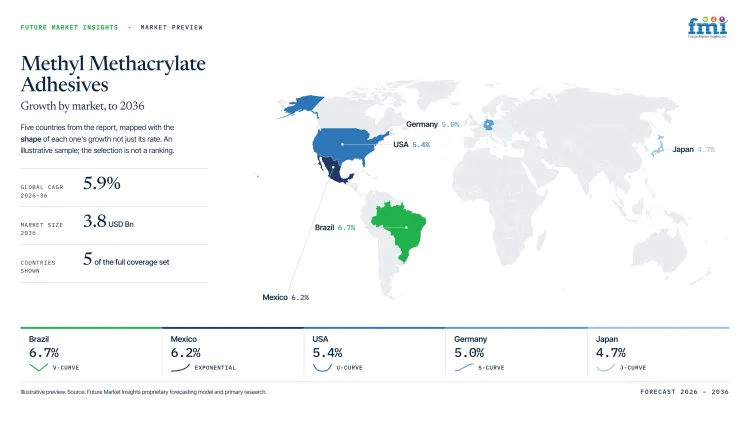
Brazil and Mexico form the upper-growth pair before Australia marks a transition into the middle group. USA and Spain follow closely before Germany and Japan close the range. The 2.0-point spread means plant density and application mix matter more than rate rank alone.
- Brazil’s 6.7% CAGR prioritizes export-linked automotive clusters before smaller industrial accounts requiring the same local technical coverage.
- Mexico’s 6.2% CAGR makes cross-border documentation continuity more important during approved material changes in export-oriented plants.
- Australia’s 5.8% CAGR shifts commercial attention toward marine yards and wind contractors instead of passenger-car assembly programs.
- USA growth at 5.4% rewards process records that can transfer between plants using common OEM quality systems.
- Spain’s 5.3% CAGR leaves model-change timing as a stronger sales constraint than its modest rate gap.
- Germany’s 5.0% CAGR favors dispensing support that fits automated lines without extending existing takt-time controls during trials.
- Japan’s 4.7% CAGR keeps supplier-change discipline central because validated vehicle platforms resist unnecessary chemistry substitutions during production.
Comparable CAGRs can still require different service models because qualification work follows each country’s manufacturing structure. The full report provides country-level CAGR analysis across North America, Latin America, Western Europe, Eastern Europe, East Asia, South Asia and Pacific, and Middle East and Africa.
Country-wise Analysis
- Brazilian vehicle and component plants tie adhesive approval to local line trials because export programs use fixed OEM quality routines. Demand for methyl methacrylate adhesives in Brazil is forecast to rise at 6.7% CAGR over the assessment period, driven by expanding vehicle output. ANFAVEA reported in January 2026 that Brazil produced 2.644 million vehicles in 2025 and increased exports by 32.1%. High financing costs can slow new programs, so nearby stock and plant-side application engineers shorten response time during mixed-material qualification. Brazilian fabricators serving transportation and construction adhesive applications gain more from local test support after model or substrate changes require another production approval.
- Mexico’s automotive plants sit inside North American programs that move approved materials through tightly coordinated cross-border production schedules. Local inventories protect those schedules from transport delays during formulation changes and short line trials. Adoption of methyl methacrylate adhesives in Mexico is estimated to expand at 6.2% CAGR through 2036, supported by its broad OEM manufacturing base. USA International Trade Administration data published in February 2026 identified 37 light-vehicle manufacturing plants distributed through twelve Mexican states. Trade-policy changes can disrupt material planning, so an entrant needs technical support that uses the same test records accepted by the customer’s regional plants.
- Marine yards and wind projects give Australia a different demand base because domestic passenger-car assembly no longer supplies large serial volumes. DCCEEW reported in January 2026 that nine offshore-wind feasibility licenses were active in the Gippsland declared area. Australia is estimated to post 5.8% CAGR over the forecast period, attributable to composite structures that require room-temperature bonding outside automotive lines. Long approvals and large travel distances can postpone adhesive consumption even after a project passes early design reviews. Regional distributors gain an advantage by holding suitable cartridges locally and providing field guidance for composite repairs with limited workshop access. Field support therefore has to reach project sites without assuming daily access to a large automotive service base.
- USA manufacturers place high value on reproducible process records because structural adhesive changes must survive several production shifts. Methyl methacrylate adhesive demand in USA is forecast to rise at 5.4% CAGR over the forecast period, driven by transportation and industrial mixed-material programs. JAMA stated in June 2025 that its member automakers produced 3,280,717 vehicles at United States plants during 2024. Long validation cycles slow specification changes while 2K epoxy alternatives remain credible where joint movement or thermal exposure favors a different chemistry. Winning accounts therefore requires substrate data and dispensing records that production engineers can reproduce on the actual line.
- Spanish factories schedule adhesive trials during vehicle-model changeovers because new platforms often change paint systems and composite content. Spain is estimated to post 5.3% CAGR over the forecast period, supported by continuing transportation assembly and mixed-material joining requirements. ANFAC reported in January 2026 that Spain produced 2,274,026 vehicles during 2025 and manufactured 225,206 electrified vehicles. Output volatility can defer nonessential material changes even where laboratory performance already meets the technical specification. Adhesive companies improve conversion by timing plant trials with planned retooling and proving handling strength on painted metals before serial release. Model timing therefore affects trial windows as much as the laboratory result itself.
- German vehicle plants use automated assembly and fixed takt times that make fixture behavior visible immediately during adhesive trials. VDA documented in January 2026 that German plants produced 4.15 million passenger cars during 2025. The German methyl methacrylate adhesives sector is projected to record 5.0% CAGR during the assessment period, supported by serial vehicle and electric-platform production. Cost pressure lengthens material changes while UV adhesive technologies compete for selected joints that use different curing equipment and process controls. A technically credible entrant therefore needs dispensing data that fits automated cells without forcing additional holding time between operations. Local engineering coverage is particularly valuable during scheduled line changes and automated dispensing trials.
- Japanese OEM programs use disciplined supplier-change controls because material substitutions can affect vehicle platforms that stay in production for years. In Japan methyl methacrylate adhesive demand is predicted to advance at 4.7% CAGR through 2036, supported by transportation and industrial bonding requirements. JAMA’s April 2026 market survey placed passenger-car household ownership at 71.9% and multiple-car ownership at 30.5%. Extended validation can slow chemistry changes even after laboratory performance meets the joint specification. Companies entering Japan need long-duration cure consistency and documentation that local engineering teams can apply without changing their existing approval sequence. Long supplier relationships make consistency during revalidation more important than a rapid catalog expansion.
Who are the notable companies in the Methyl Methacrylate Adhesives Market?
ITW Plexus, Arkema / Bostik, Sika, H.B. Fuller, 3M, Henkel, Scott Bader, Permabond, Parson Adhesives, and Matrix Adhesives Group's IPS Adhesives are the notable companies serving this market.
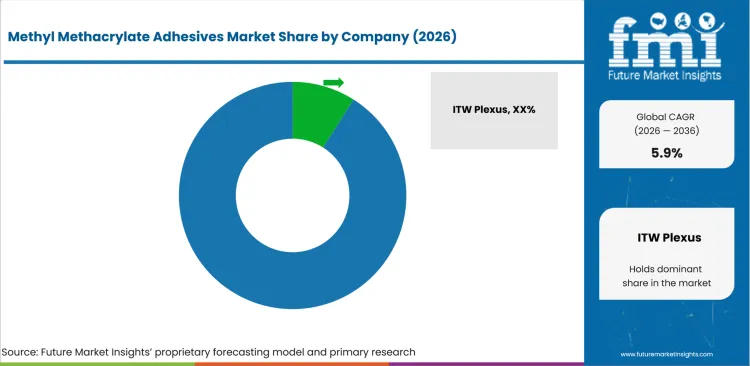
Competition separates dedicated methacrylate formulators from diversified structural-adhesive groups serving the same assembly programs. Explicit MMA portfolios offer deeper cure-window choices, while broad platforms can substitute other chemistries where joint movement or temperature requirements differ.
- MMA-focused structural bonding: ITW Plexus and Scott Bader maintain explicit methacrylate ranges, while Parson Adhesives and Matrix Adhesives Group's IPS Adhesives serve similar mixed-material programs.
- Diversified structural adhesive platforms: Arkema / Bostik and 3M sell structural acrylic systems, while Henkel and H.B. Fuller serve broad accounts with several bonding routes.
- Application-led structural bonding: Sika and Permabond address assemblies where chemistry choice and local application support matter more than MMA specialization.
Competitive Benchmarking: Methyl Methacrylate Adhesives Market
| Company | Reactive Adhesive Breadth | Mixed-Material Application Evidence | Process Support | Geographic Reach |
|---|---|---|---|---|
| ITW Plexus | High | High | High | North America, Europe and Asia-Pacific |
| Arkema / Bostik | High | High | Medium | Global industrial network |
| Sika | High | Medium | High | Global industrial network |
| H.B. Fuller | High | Medium | High | Global industrial network |
| 3M | High | High | High | Global industrial network |
| Henkel | High | High | High | Global industrial network |
| Scott Bader | Medium | High | Medium | Europe, Americas and Asia-Pacific |
| Permabond | Medium | High | Medium | Americas, Europe and Asia-Pacific |
| Parson Adhesives | Medium | High | Low | North America and international sales |
| Matrix Adhesives Group's IPS Adhesives | Medium | High | Medium | North America, Europe and distributor markets |
High reactive-adhesive breadth requires several documented chemistry families used in structural assembly. Medium identifies a narrower verified set, while Low identifies one documented route. High mixed-material evidence requires documented use on composites and metals plus another substrate class. Process-support ratings use published dispensing or preparation guidance with qualification tools. Geographic reach follows official company materials.
Key Developments in the Methyl Methacrylate Adhesives Market
- In July 2026, Permabond launched TA4213 with a 20-minute open time and rapid strength development after joining. The product gives larger bond areas more alignment time without leaving the structural acrylic route.
- In January 2026, Scott Bader announced a Sandtech distribution partnership for structural adhesives and composite materials in France. The agreement places local technical support closer to fabricators during qualification and repeat production.
- In June 2026, Arkema / Bostik detailed 2K MMA structural adhesives for battery assembly at Battery Show Europe. The announcement linked MMA directly to tightly packaged electric-vehicle battery structures.
Key Players in the Methyl Methacrylate Adhesives Market
Methacrylate-Focused Structural Bonding
- ITW Plexus
- Scott Bader
- Parson Adhesives
- Matrix Adhesives Group's IPS Adhesives
Diversified Structural Adhesive Platforms
- Arkema / Bostik
- 3M
- Henkel
- H.B. Fuller
- Sika
Structural Acrylic Specialist
- Permabond
Methyl Methacrylate Adhesives Market - Report Scope
| Coverage field | Report scope |
|---|---|
| Market breakdown | By product type, substrate, end use, cure speed, sales channel and region. |
| Quantitative Units | USD billion. |
| Market Definition | Commercial methyl methacrylate adhesive formulations and kits sold for structural bonding within the defined product, substrate, end-use, cure-speed, sales-channel and regional scope. |
| Regions Covered | North America, Latin America, Western Europe, Eastern Europe, East Asia, South Asia and Pacific, and Middle East and Africa. |
| Countries Covered | Brazil, Mexico, Australia, USA, Spain, Germany, Japan, and 20+ countries included in the full report. |
| Key Companies | ITW Plexus, Arkema / Bostik, Sika, H.B. Fuller, 3M, Henkel, Scott Bader, Permabond, Parson Adhesives, Matrix Adhesives Group's IPS Adhesives. |
| Forecast Period | 2026 to 2036. |
| Approach | Primary and secondary research with market triangulation. |
Methyl Methacrylate Adhesives Market - Research Methodology
| Method | Approach |
|---|---|
| Primary Research | FMI analysts gathered input from manufacturers, service providers, technology developers, distributors, end users, procurement teams, and subject-matter experts. Interviews examined purchasing decisions, product or service evaluation, adoption barriers, approval requirements, pricing considerations, and expectations for technical or commercial support. Respondents were also asked what evidence is required before a trial, pilot, or initial order develops into regular purchasing. |
| Desk Research | Desk research covered government statistics, regulatory publications, trade data, industry associations, technical literature, standards, company filings, product information, and official corporate announcements. Sources were reviewed for relevance, publication date, geographic coverage, and consistency with the defined market scope. Claims relating to performance, applications, approvals, capacity, investment, and commercial activity were retained only when supported by credible public evidence. |
| Market Sizing and Forecasting | The market model combined the baseline value with historical performance, segment structure, pricing and volume indicators, adoption levels, company participation, and country-level demand conditions. Forecast assumptions considered economic activity, investment trends, regulatory developments, technology adoption, purchasing cycles, supply availability, and barriers to wider market use. Segment and regional estimates were reconciled before the final market total was calculated. |
| Data Validation | Estimates were checked against multiple independent indicators, including public data, company activity, trade patterns, industry developments, and findings from primary interviews. Validation also tested whether products, services, applications, and company revenues fell within the defined market boundaries. Adjacent categories, unsupported claims, overlapping revenues, and activities without direct market relevance were excluded to reduce double counting and maintain consistency across segments and countries. |
Methyl Methacrylate Adhesives Market by Segments
Methyl Methacrylate Adhesives Market segmented by Product Type:
- Two-part MMA adhesives
- Structural MMA adhesives
- Low-odor MMA adhesives
- Flexible MMA adhesives
- Rapid-cure MMA adhesives
Methyl Methacrylate Adhesives Market segmented by Substrate:
- Composites
- Metals
- Plastics
- Painted surfaces
- Mixed substrates
Methyl Methacrylate Adhesives Market segmented by End Use:
- Transportation
- Marine
- Wind energy
- Construction
- Industrial assembly
Methyl Methacrylate Adhesives Market segmented by Cure Speed:
- Below 5 minutes
- 5-15 minutes
- 15-30 minutes
- Above 30 minutes
Methyl Methacrylate Adhesives Market segmented by Sales Channel:
- Direct OEM supply
- Industrial distributors
- Composite fabricators
- Aftermarket repair
Methyl Methacrylate Adhesives Market by Region:
- North America
- United States
- Canada
- Latin America
- Brazil
- Mexico
- Argentina
- Chile
- Western Europe
- Germany
- France
- United Kingdom
- Italy
- Spain
- Benelux
- Nordics
- Eastern Europe
- Poland
- Czech Republic
- Romania
- Hungary
- East Asia
- China
- Japan
- South Korea
- South Asia and Pacific
- India
- ASEAN
- Australia and New Zealand
- Middle East and Africa
- GCC Countries
- South Africa
- Türkiye
- Israel
Research Sources and Bibliography
- H.B. Fuller. (2025, July 11). Smarter Bonding as a Secret Weapon for Improving Industrial Assembly.
- European Automobile Manufacturers’ Association. (2026, June 28). Interactive map - Automobile assembly and production plants in Europe.
- 3M. (2025, August). Notice: New 3M Scotch-Weld Acrylic Adhesive DP8507NS/8507NS - Coming September 2025.
- Arkema. (2026, March). At JEC trade show 2026, discover Arkema product ranges for composites applications.
- European Automobile Manufacturers’ Association. (2026, January 27). New car registrations: +1.8% in 2025; battery-electric 17.4% market share.
- Permabond. (2025, March 17). Permabond TA4230: More than just a fire-retardant adhesive.
- 3M. (2025, December 30). 3M Adhesive Mix Monitor reimagines two-part adhesive dispensing for manufacturers.
- German Association of the Automotive Industry. (2026, February 3). New record: 40% electric share of passenger car production in 2025.
- National Institute for Occupational Safety and Health. (2026, April 1). Immediately Dangerous to Life or Health.
- USA Department of Energy. (2026, March 27). Transportation Technologies Office 2026 Annual Merit Review - Materials Technology Composites and Joining.
- ANFAVEA. (2026, January 15). Produção e venda de autoveículos crescem em 2025 e Anfavea projeta nova alta em 2026.
- USA International Trade Administration. (2026, February 11). Mexico - Automotive Industry.
- Australian Department of Climate Change, Energy, the Environment and Water. (2026, January 23). Gippsland, Victoria declared offshore wind area.
- Japan Automobile Manufacturers Association. (2025, June 12). Moving American Manufacturing Forward.
- ANFAC. (2026, January 21). La producción de vehículos cae un 4,3% en 2025, con 2.274.026 unidades.
- German Association of the Automotive Industry. (2026, January 5). Passenger car production in 2025 slightly above previous year’s level.
- Japan Automobile Manufacturers Association. (2026, April 14). 2025年度乗用車市場動向調査について.
- Permabond. (2026, July 28). Permabond launches long open time adhesive, TA4213.
- Scott Bader. (2026, January 8). Scott Bader and Sandtech announce distribution partnership across France.
- Arkema. (2026, June 1). Arkema showcases innovative materials at the Battery Show Europe 2026.
- DNV Business Assurance. (2025, August 14). IATF 16949 certificate: ITW Performance Polymers.
- Arkema. (2025, February 25). Arkema at JEC WORLD 2025.
- Sika. (2026, September 3). Sika closes acquisition of Akkim - Accelerating global expansion in adhesives and sealants.
- H.B. Fuller. (2025, May 16). H.B. Fuller Expands Manufacturing Capabilities in IMEA Region.
- 3M. (2025, October). Notice: Update on Certain 3M Scotch-Weld Acrylic Adhesive Products.
- Henkel. (2026, May 12). New Henkel automotive adhesive: one product, twice the power.
- Scott Bader. (2025, May 15). Large supermarket chain install flexible solar PV with Crestabond structural adhesives.
- Permabond. (2026, June 18). Permabond launches new multi-purpose adhesive, TA4551.
- Industrial Products Finder. (2026, January 26). Innovation is the lifeblood of our long-term success: Biplav Nayak.
- Matrix Adhesives Group. (2026, July 27). Matrix Adhesives Group Acquires IPS Adhesives to Expand its Technology, Branded Portfolio, and Market Reach.
- Henkel. (2026, April 15). Henkel launches Loctite Solve to enable fast, flexible and AI-assisted simulation of adhesive performance.
- Sika. (2025, June 18). Sika strengthens global presence with strategic investments across all regions.
- H.B. Fuller. (2026, May 6). H.B. Fuller Announces Aerospace Manufacturing Center of Excellence.
- Permabond. (2025, July 14). Permabond launches cold-resistant adhesive, UV6357.
- Henkel. (2025, December 12). Henkel launches Loctite MS 9650 for durable, lightweight structural bonding for automotive display.
This bibliography is provided for reader reference and is not exhaustive. The full report contains the complete reference list and detailed citations.
This Report Answers
- How large is the methyl methacrylate adhesives market in 2026 and 2036?
- Which mixed-material assembly requirements support methyl methacrylate adhesive demand?
- Why do two-part MMA adhesives account for 36.0% of product type demand in 2026?
- How do composite substrates change structural adhesive selection and surface preparation requirements?
- Why does transportation represent 27.0% of end-use demand in 2026?
- How do the seven country CAGRs differ through 2036?
- Which companies supply dedicated MMA products or broader structural adhesive platforms within the defined competitive set?
- What handling and qualification requirements can delay methyl methacrylate adhesive conversion?
Frequently Asked Questions
How big is the methyl methacrylate adhesives market in 2026?
The methyl methacrylate adhesives market is valued at USD 2.1 billion in 2026 and projected to reach USD 3.8 billion by 2036. Mixed-material assembly expands use where room-temperature bonds can replace selected welding or fastening steps.
What is the CAGR of the methyl methacrylate adhesives market from 2026 to 2036?
The methyl methacrylate adhesives market is projected to grow at a CAGR of 5.9% between 2026 and 2036. Transportation and composite assembly raise demand for structural bonds that reach handling strength without welding heat.
Which product type leads the methyl methacrylate adhesives market?
The two-part MMA adhesives segment is expected to hold 36.0% of the methyl methacrylate adhesives market in 2026, driven by controlled resin-to-activator mixing. Adjustable work-life options let production teams match cure timing with manual or automated dispensing.
Which substrate leads the methyl methacrylate adhesives market?
The composites segment is expected to hold 28.0% of the methyl methacrylate adhesives market in 2026, attributable to load-spreading joints on molded parts. Composite fabricators also avoid welding heat that can damage reinforcement or distort adjoining materials.
Which companies are active in the methyl methacrylate adhesives market?
Key companies operating in the methyl methacrylate adhesives market include ITW Plexus, Arkema / Bostik, Sika, H.B. Fuller, 3M, Henkel, Scott Bader, Permabond, Parson Adhesives, and Matrix Adhesives Group's IPS Adhesives. Their competitive separation comes from MMA portfolio depth and mixed-material application support during qualification.
Preview the report firsthand - request a free sample
Get SampleGet the brochure for pricing and purchase details.
Get PDFTable of Content
- Key Takeaways
- Market Size and CAGR
- Top Growth Driver
- Fastest Growing Segment
- Leading Region
- Key Companies
- Emerging Opportunities
- Executive Summary
- Global Market Outlook
- Demand-side Trends
- Supply-side Trends
- Technology Roadmap Analysis
- Analysis and Recommendations
- Analyst Perspective (What is happening? Why now? What should investors know?)
- Key Questions Answered
- How large is the market?
- What is the CAGR?
- What are key trends?
- Which region dominates?
- Who are the leaders?
- Market Overview
- Market Coverage / Taxonomy
- Market Definition / Scope / Limitations
- Research Methodology
- Chapter Orientation
- Analytical Lens and Working Hypotheses
- Market Structure, Signals, and Trend Drivers
- Benchmarking and Cross-market Comparability
- Market Sizing, Forecasting, and Opportunity Mapping
- Research Design and Evidence Framework
- Desk Research Programme (Secondary Evidence)
- Expert Input and Fieldwork (Primary Evidence)
- Tooling, Models, and Reference Databases
- Data Engineering and Model Build
- Quality Assurance and Audit Trail
- Market Background
- Market Dynamics (Drivers, Restraints, Opportunity, Trends)
- Scenario Forecast (Optimistic, Likely, Conservative)
- Impact Analysis
- AI Impact
- Sustainability Impact
- Regulatory Impact
- Technology Impact
- Consumer / Buyer Analysis
- Purchase Drivers
- Adoption Barriers
- Buyer Journey
- Opportunity Map Analysis
- Product Life Cycle Analysis
- Supply Chain Analysis
- Investment Feasibility Matrix
- Value Chain Analysis
- PESTLE and Porter's Analysis
- Regulatory Landscape
- Regional Parent Market Outlook
- Production and Consumption Statistics
- Import and Export Statistics
- Global Market Analysis and Forecast, 2021 to 2036
- Historical Market Size Value (USD Billion) Analysis, 2021 to 2025
- Current and Future Market Size Value (USD Billion) Projections, 2026 to 2036
- Y-o-Y Growth Trend Analysis
- Absolute $ Opportunity Analysis
- Global Market Pricing Analysis, 2021 to 2036
- Global Market Analysis and Forecast, By Product Type, 2021 to 2036
- Introduction / Key Findings
- Historical Market Size Value (USD Billion) Analysis By Product Type, 2021 to 2025
- Current and Future Market Size Value (USD Billion) Analysis and Forecast By Product Type, 2026 to 2036
- Two-part MMA adhesives
- Structural MMA adhesives
- Low-odor MMA adhesives
- Flexible MMA adhesives
- Rapid-cure MMA adhesives
- Two-part MMA adhesives
- Y-o-Y Growth Trend Analysis By Product Type, 2021 to 2025
- Absolute $ Opportunity Analysis By Product Type, 2026 to 2036
- Global Market Analysis and Forecast, By Substrate, 2021 to 2036
- Introduction / Key Findings
- Historical Market Size Value (USD Billion) Analysis By Substrate, 2021 to 2025
- Current and Future Market Size Value (USD Billion) Analysis and Forecast By Substrate, 2026 to 2036
- Composites
- Metals
- Plastics
- Painted surfaces
- Mixed substrates
- Composites
- Y-o-Y Growth Trend Analysis By Substrate, 2021 to 2025
- Absolute $ Opportunity Analysis By Substrate, 2026 to 2036
- Global Market Analysis and Forecast, By End Use, 2021 to 2036
- Introduction / Key Findings
- Historical Market Size Value (USD Billion) Analysis By End Use, 2021 to 2025
- Current and Future Market Size Value (USD Billion) Analysis and Forecast By End Use, 2026 to 2036
- Transportation
- Marine
- Wind energy
- Construction
- Industrial assembly
- Transportation
- Y-o-Y Growth Trend Analysis By End Use, 2021 to 2025
- Absolute $ Opportunity Analysis By End Use, 2026 to 2036
- Global Market Analysis and Forecast, By Cure Speed, 2021 to 2036
- Introduction / Key Findings
- Historical Market Size Value (USD Billion) Analysis By Cure Speed, 2021 to 2025
- Current and Future Market Size Value (USD Billion) Analysis and Forecast By Cure Speed, 2026 to 2036
- Below 5 minutes
- 5-15 minutes
- 15-30 minutes
- Above 30 minutes
- Below 5 minutes
- Y-o-Y Growth Trend Analysis By Cure Speed, 2021 to 2025
- Absolute $ Opportunity Analysis By Cure Speed, 2026 to 2036
- Global Market Analysis and Forecast, By Sales Channel, 2021 to 2036
- Introduction / Key Findings
- Historical Market Size Value (USD Billion) Analysis By Sales Channel, 2021 to 2025
- Current and Future Market Size Value (USD Billion) Analysis and Forecast By Sales Channel, 2026 to 2036
- Direct OEM supply
- Industrial distributors
- Composite fabricators
- Aftermarket repair
- Direct OEM supply
- Y-o-Y Growth Trend Analysis By Sales Channel, 2021 to 2025
- Absolute $ Opportunity Analysis By Sales Channel, 2026 to 2036
- Global Market Analysis and Forecast, By Region, 2021 to 2036
- Introduction
- Historical Market Size Value (USD Billion) Analysis By Region, 2021 to 2025
- Current Market Size Value (USD Billion) Analysis and Forecast By Region, 2026 to 2036
- North America
- Latin America
- Western Europe
- Eastern Europe
- East Asia
- South Asia and Pacific
- Middle East & Africa
- Market Attractiveness Analysis By Region
- North America Market Analysis and Forecast, By Country, 2021 to 2036
- Historical Market Size Value (USD Billion) Trend Analysis By Market Taxonomy, 2021 to 2025
- Market Size Value (USD Billion) Forecast By Market Taxonomy, 2026 to 2036
- By Country
- USA
- Canada
- By Product Type
- By Substrate
- By End Use
- By Cure Speed
- By Sales Channel
- By Country
- Market Attractiveness Analysis
- By Country
- By Product Type
- By Substrate
- By End Use
- By Cure Speed
- By Sales Channel
- Key Takeaways
- Latin America Market Analysis and Forecast, By Country
- Historical Market Size Value (USD Billion) Trend Analysis By Market Taxonomy, 2021 to 2025
- Market Size Value (USD Billion) Forecast By Market Taxonomy, 2026 to 2036
- By Country
- Brazil
- Mexico
- Chile
- Rest of Latin America
- By Product Type
- By Substrate
- By End Use
- By Cure Speed
- By Sales Channel
- By Country
- Market Attractiveness Analysis
- By Country
- By Product Type
- By Substrate
- By End Use
- By Cure Speed
- By Sales Channel
- Key Takeaways
- Western Europe Market Analysis and Forecast, By Country
- Historical Market Size Value (USD Billion) Trend Analysis By Market Taxonomy, 2021 to 2025
- Market Size Value (USD Billion) Forecast By Market Taxonomy, 2026 to 2036
- By Country
- Germany
- UK
- Italy
- Spain
- France
- Nordic
- BENELUX
- Rest of Western Europe
- By Product Type
- By Substrate
- By End Use
- By Cure Speed
- By Sales Channel
- By Country
- Market Attractiveness Analysis
- By Country
- By Product Type
- By Substrate
- By End Use
- By Cure Speed
- By Sales Channel
- Key Takeaways
- Eastern Europe Market Analysis and Forecast, By Country
- Historical Market Size Value (USD Billion) Trend Analysis By Market Taxonomy, 2021 to 2025
- Market Size Value (USD Billion) Forecast By Market Taxonomy, 2026 to 2036
- By Country
- Russia
- Poland
- Hungary
- Balkan & Baltic
- Rest of Eastern Europe
- By Product Type
- By Substrate
- By End Use
- By Cure Speed
- By Sales Channel
- By Country
- Market Attractiveness Analysis
- By Country
- By Product Type
- By Substrate
- By End Use
- By Cure Speed
- By Sales Channel
- Key Takeaways
- East Asia Market Analysis and Forecast, By Country
- Historical Market Size Value (USD Billion) Trend Analysis By Market Taxonomy, 2021 to 2025
- Market Size Value (USD Billion) Forecast By Market Taxonomy, 2026 to 2036
- By Country
- China
- Japan
- South Korea
- By Product Type
- By Substrate
- By End Use
- By Cure Speed
- By Sales Channel
- By Country
- Market Attractiveness Analysis
- By Country
- By Product Type
- By Substrate
- By End Use
- By Cure Speed
- By Sales Channel
- Key Takeaways
- South Asia and Pacific Market Analysis and Forecast, By Country
- Historical Market Size Value (USD Billion) Trend Analysis By Market Taxonomy, 2021 to 2025
- Market Size Value (USD Billion) Forecast By Market Taxonomy, 2026 to 2036
- By Country
- India
- ASEAN
- Australia & New Zealand
- Rest of South Asia and Pacific
- By Product Type
- By Substrate
- By End Use
- By Cure Speed
- By Sales Channel
- By Country
- Market Attractiveness Analysis
- By Country
- By Product Type
- By Substrate
- By End Use
- By Cure Speed
- By Sales Channel
- Key Takeaways
- Middle East & Africa Market Analysis and Forecast, By Country
- Historical Market Size Value (USD Billion) Trend Analysis By Market Taxonomy, 2021 to 2025
- Market Size Value (USD Billion) Forecast By Market Taxonomy, 2026 to 2036
- By Country
- Kingdom of Saudi Arabia
- Other GCC Countries
- Türkiye
- South Africa
- Other African Union
- Rest of Middle East & Africa
- By Product Type
- By Substrate
- By End Use
- By Cure Speed
- By Sales Channel
- By Country
- Market Attractiveness Analysis
- By Country
- By Product Type
- By Substrate
- By End Use
- By Cure Speed
- By Sales Channel
- Key Takeaways
- Key Countries Market Analysis
- USA
- Pricing Analysis
- Market Share Analysis, 2025
- By Product Type
- By Substrate
- By End Use
- By Cure Speed
- By Sales Channel
- Canada
- Pricing Analysis
- Market Share Analysis, 2025
- By Product Type
- By Substrate
- By End Use
- By Cure Speed
- By Sales Channel
- Mexico
- Pricing Analysis
- Market Share Analysis, 2025
- By Product Type
- By Substrate
- By End Use
- By Cure Speed
- By Sales Channel
- Brazil
- Pricing Analysis
- Market Share Analysis, 2025
- By Product Type
- By Substrate
- By End Use
- By Cure Speed
- By Sales Channel
- Chile
- Pricing Analysis
- Market Share Analysis, 2025
- By Product Type
- By Substrate
- By End Use
- By Cure Speed
- By Sales Channel
- Germany
- Pricing Analysis
- Market Share Analysis, 2025
- By Product Type
- By Substrate
- By End Use
- By Cure Speed
- By Sales Channel
- UK
- Pricing Analysis
- Market Share Analysis, 2025
- By Product Type
- By Substrate
- By End Use
- By Cure Speed
- By Sales Channel
- Italy
- Pricing Analysis
- Market Share Analysis, 2025
- By Product Type
- By Substrate
- By End Use
- By Cure Speed
- By Sales Channel
- Spain
- Pricing Analysis
- Market Share Analysis, 2025
- By Product Type
- By Substrate
- By End Use
- By Cure Speed
- By Sales Channel
- France
- Pricing Analysis
- Market Share Analysis, 2025
- By Product Type
- By Substrate
- By End Use
- By Cure Speed
- By Sales Channel
- India
- Pricing Analysis
- Market Share Analysis, 2025
- By Product Type
- By Substrate
- By End Use
- By Cure Speed
- By Sales Channel
- ASEAN
- Pricing Analysis
- Market Share Analysis, 2025
- By Product Type
- By Substrate
- By End Use
- By Cure Speed
- By Sales Channel
- Australia & New Zealand
- Pricing Analysis
- Market Share Analysis, 2025
- By Product Type
- By Substrate
- By End Use
- By Cure Speed
- By Sales Channel
- China
- Pricing Analysis
- Market Share Analysis, 2025
- By Product Type
- By Substrate
- By End Use
- By Cure Speed
- By Sales Channel
- Japan
- Pricing Analysis
- Market Share Analysis, 2025
- By Product Type
- By Substrate
- By End Use
- By Cure Speed
- By Sales Channel
- South Korea
- Pricing Analysis
- Market Share Analysis, 2025
- By Product Type
- By Substrate
- By End Use
- By Cure Speed
- By Sales Channel
- Russia
- Pricing Analysis
- Market Share Analysis, 2025
- By Product Type
- By Substrate
- By End Use
- By Cure Speed
- By Sales Channel
- Poland
- Pricing Analysis
- Market Share Analysis, 2025
- By Product Type
- By Substrate
- By End Use
- By Cure Speed
- By Sales Channel
- Hungary
- Pricing Analysis
- Market Share Analysis, 2025
- By Product Type
- By Substrate
- By End Use
- By Cure Speed
- By Sales Channel
- Kingdom of Saudi Arabia
- Pricing Analysis
- Market Share Analysis, 2025
- By Product Type
- By Substrate
- By End Use
- By Cure Speed
- By Sales Channel
- Türkiye
- Pricing Analysis
- Market Share Analysis, 2025
- By Product Type
- By Substrate
- By End Use
- By Cure Speed
- By Sales Channel
- South Africa
- Pricing Analysis
- Market Share Analysis, 2025
- By Product Type
- By Substrate
- By End Use
- By Cure Speed
- By Sales Channel
- USA
- Market Structure Analysis
- Competition Dashboard
- Competition Benchmarking
- Market Share Analysis of Top Players
- By Regional
- By Product Type
- By Substrate
- By End Use
- By Cure Speed
- By Sales Channel
- Emerging Startups
- Innovation Benchmarking
- Competition Analysis
- Competition Deep Dive
- ITW Plexus
- Overview
- Product Portfolio
- Profitability by Market Segments
- Sales Footprint
- Strategy Overview
- Marketing Strategy
- Product Strategy
- Channel Strategy
- Arkema / Bostik
- Sika
- H.B. Fuller
- 3M
- Henkel
- Scott Bader
- Permabond
- Parson Adhesives
- IPS Adhesives
- ITW Plexus
- Case Studies
- Success Stories
- Recent Developments
- Competition Deep Dive
- Assumptions & Acronyms Used


