

- Market Size (2026)
- USD 980.7 Mn
- Forecast (2036)
- USD 3073.2 Mn
- CAGR (2026 to 2036)
- 12.1%
Mono-Material Adhesives Market Size, Market Forecast and Outlook By FMI
USD 980.7 million in 2026 and USD 3,073.2 million by 2036 at a 12.1% CAGR.
The mono-material adhesives industry value is forecast to grow from USD 874.8 million in 2025 to USD 3,073.2 million by 2036 at 12.1% CAGR as recyclable packaging redesign moves adhesive selection into converter trials and brand approval. Direct to Converters is forecast to represent 64.0% share in 2026 because laminator validation and recycling evidence are usually needed before commercial approval. Flexible Packaging is expected to secure 58.0% share in 2026, led by mono-PE and mono-PP pouches replacing mixed-material laminates.
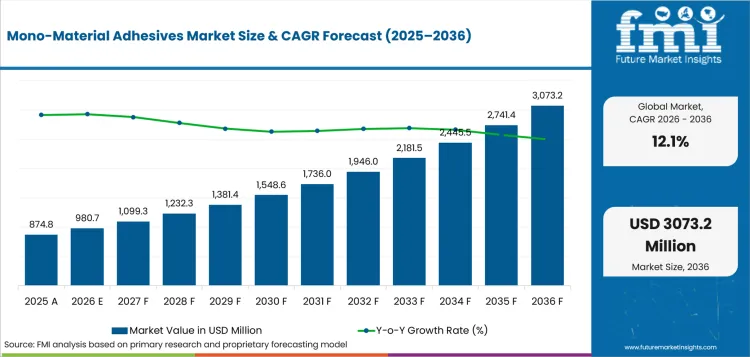
Mono-Material Adhesives Market Overview: Size and Forecast
- 2026 Market Size: USD 980.7 million
- 2036 Market Size: USD 3,073.2 million
- Forecast CAGR: 12.1% from 2026 to 2036
- Leading Sales Channel: Direct to Converters
- Direct to Converters Share in 2026: 64.0%
- Leading Application: Flexible Packaging
- Flexible Packaging Share in 2026: 58.0%
- Fastest-growing Country: China
- China CAGR: 13.4% by 2036
Summary of the Mono-Material Adhesives Market
- Demand and Growth Drivers
- Packaging redesign programs are pushing converters to qualify adhesive systems that support mono-PE, mono-PP, PET, paper, and board structures.
- Brand owners are giving more attention to adhesive layers that can support recyclability claims without weakening pack handling.
- Suppliers are extending recyclable adhesive portfolios through laminating systems, wash-off labels, and solvent-free technologies.
- Product and Segment View
- Direct to Converters is forecast to represent 64.0% share in 2026, led by direct technical validation and commercial line trials.
- Flexible Packaging is projected to hold 58.0% share in 2026, influenced by pouch and wrap structures shifting toward single-polymer designs.
- Food Packaging is expected to secure 51.0% share in 2026, supported by shelf-life protection needs and stricter pack approval steps.
- Geography and Competitive Outlook
- China is projected to record 13.4% CAGR by 2036, backed by converter scale and local recyclable packaging trials.
- India is expected to expand at 13.1% CAGR by 2036 through plastic packaging EPR compliance and flexible packaging demand.
- Arkema, Bostik, Henkel, and H.B. Fuller compete through laminating adhesive portfolios and converter support.
- Avery Dennison, Jowat, and artience Group focus on label adhesives, hot melts, deinking systems, and delamination technologies.
- Analyst Opinion
- Nikhil Kaitwade, Principal Consultant, Packaging and Materials at FMI, says, “Mono-material adhesives are becoming a qualification market before they become a volume market. Buyers are not asking only whether an adhesive bonds two films. They are asking whether the full pack can survive filling, transport, shelf life, sorting, washing, and recycling without contaminating recovered polymer. The pressure comes from EPR fees, food-contact safety, and brand claims that must stand up to audit. Suppliers with pilot laminators, recyclability-ready chemistries, and local technical teams will gain share faster than suppliers selling only resin chemistry.”
Regulatory pressure is moving mono-material adhesive demand from trial activity into structured packaging qualification. The EU Packaging and Packaging Waste Regulation entered into force on 11 February 2025 and will generally apply from 12 August 2026, covering packaging and packaging waste placed on the EU market. The United Kingdom's packaging recycling obligations set the plastic packaging target at 57.0% for 2026. India’s plastic packaging EPR portal recorded 60,128 registered producers, importers, and brand owners along with 3,012 plastic waste processors in March 2026. These signals make adhesive compatibility a practical buying requirement for converters and brand owners.
Which factors support expansion in the mono-material adhesives market?
Recyclable packaging SKU revenue and converter qualification programs support market value across regulated packaging channels.
- Market value is supported by laminating adhesives before labels and board lamination add incremental demand.
- Supplier pricing reflects polymer compatibility and recycling proof before application support affects repeat orders.
- Revenue improves as brands convert mixed-material laminates into recyclable mono-polymer structures.
- Converter trust rises as adhesive suppliers document bond strength, wash-off behavior, and end-of-life compatibility.
Why is the mono-material adhesives market growing?
Converters are moving toward adhesive systems that make recyclable packaging claims easier to prove.
Growth outlook has become more structured as recyclability targets move from voluntary brand claims into compliance programs. The USA Plastics Pact reported in its 2024-25 impact report that 54.0% of plastic packaging placed on the market by its activators was reusable, recyclable, or compostable. It also reported average use of postconsumer recycled or responsibly sourced biobased content at 14.0%. These figures show that packaging users are still converting portfolios, which keeps adhesive compatibility central to pack redesign. Mono-material adhesives gain value when they help converters reduce contamination risk, protect pack performance, and support recycling documentation.
How is the mono-material adhesives market segmented?
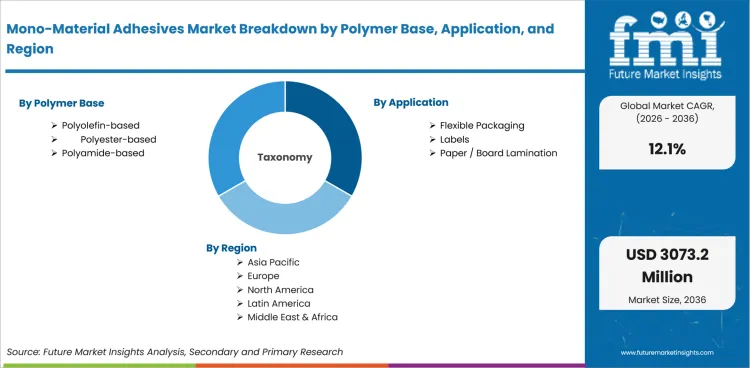
The mono-material adhesives industry is segmented by polymer base, application, adhesive technology, end use, and sales channel.
- Polyolefin-based adhesives are projected to secure 47.5% share in 2026, led by PE and PP packaging structures becoming the main redesign route for recyclable flexible packs.
- Flexible Packaging is expected to represent 58.0% share in 2026, supported by pouches and wraps needing adhesive systems that preserve bond performance and recyclability.
- Solvent-free technology is anticipated to hold 42.0% share in 2026, guided by converter interest in lower-emission lamination and fewer solvent recovery steps.
- Food Packaging is forecast to account for 51.0% share in 2026, reflected by stronger validation needs for shelf life, odor control, and food-contact safety.
- Direct to Converters is projected to capture 64.0% share in 2026, shaped by trial waste reviews, laminator testing, and supplier-led technical support.
Why do polyolefin-based adhesives dominate the mono-material adhesives market?
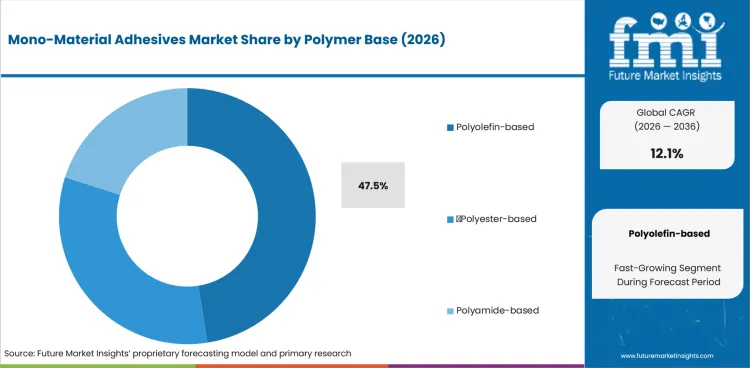
- Polyolefin-based adhesives are projected to account for 47.5% share in 2026, influenced by PE and PP mono-web packaging that needs bonding layers compatible with existing recycling streams.
- Polyester-based adhesives gain selective use in PET and paper-adjacent structures, although polyolefin formats lead early adoption because flexible packaging converters already run PE and PP films at scale.
Which application leads the mono-material adhesives market?
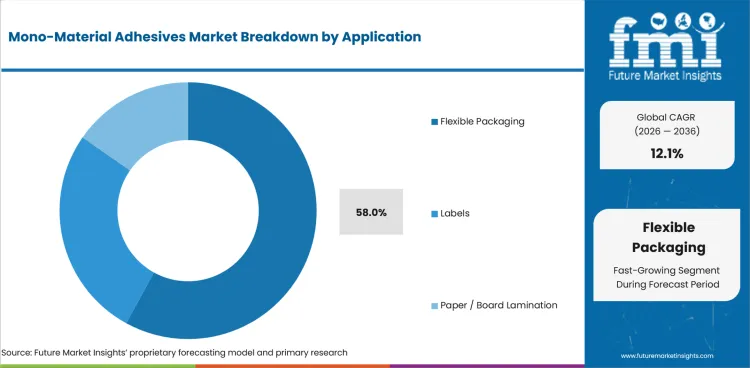
- Flexible Packaging is estimated to hold 58.0% share in 2026, supported by mono-PE and mono-PP pouches that require adhesives surviving filling, sealing, shelf handling, and recycling assessment.
- Labels create a secondary demand pool as wash-off and clean-separation adhesives help bottles, crates, jars, and fiber-based packs avoid residue-related recycling problems.
Which adhesive technology leads the mono-material adhesives market?
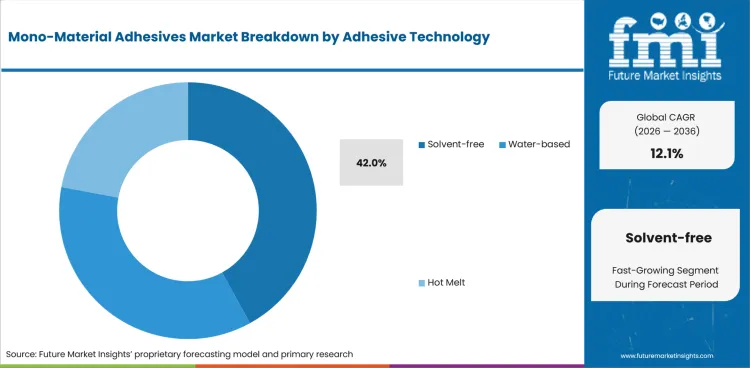
- Solvent-free technology is anticipated to hold 42.0% share in 2026, as converters prefer lower-emission lamination routes with fewer solvent handling and recovery requirements.
- Water-based systems remain relevant for paper, board, and label applications where coating weight, wash-off behavior, and drying control shape adhesive selection.
Which end use leads the mono-material adhesives market?
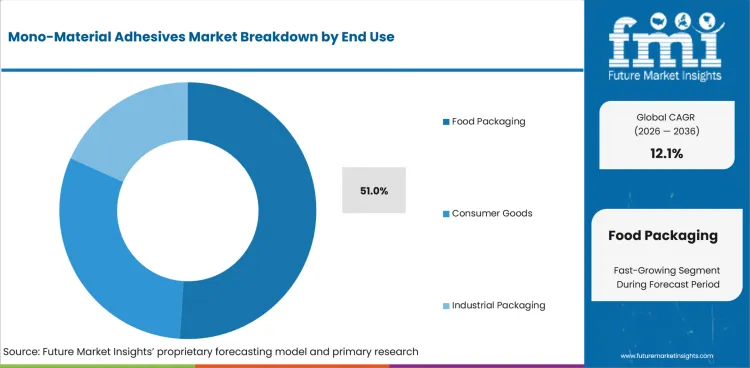
- Food Packaging is expected to account for 51.0% share in 2026, led by snacks, dry foods, and shelf-stable pouches that need recyclable structures without weaker pack performance.
- Consumer goods packaging gains demand as home-care, personal-care, and refill formats require adhesives that protect appearance while supporting recycling claims.
Which sales channel leads the mono-material adhesives market?
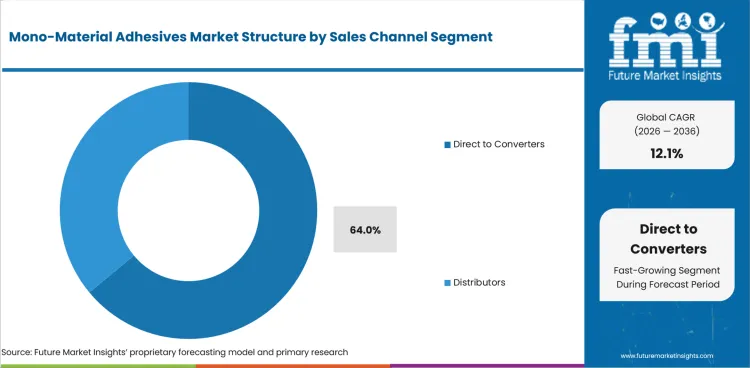
- Direct to Converters is projected to represent 64.0% share in 2026, because formulation approval normally happens on laminators before a brand owner accepts a pack redesign.
- Distributors support smaller converters and regional users, although complex recyclability claims often require direct supplier involvement during testing and troubleshooting.
What are the drivers, restraints, and opportunities in the mono-material adhesives market?
Design-for-recycling rules support adoption while food-contact validation and line-trial risk slow faster conversion.
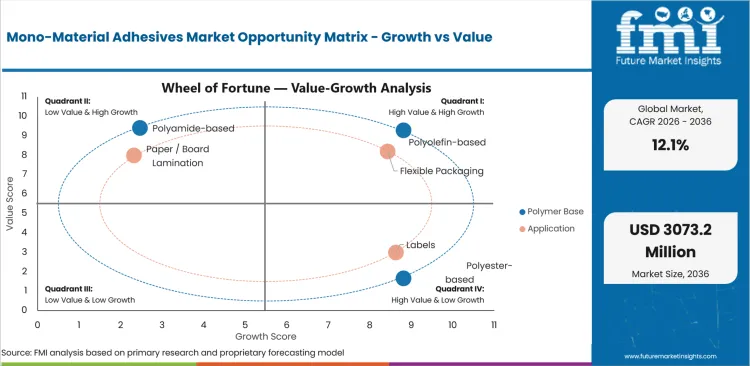
- Driver: Packaging rules are turning adhesive validation into a formal part of recyclability approval.
- Restraint: Food-contact safety and recycling proof extend approval cycles before commercial conversion.
- Opportunity: Solvent-free, wash-off, and clean-separation systems can open wider use across flexible packs, labels, and reusable containers.
Mono-Material Adhesives Market Demand Outlook
Demand outlook is moving toward adhesives that can prove packaging compatibility before channel expansion. The UK packaging recycling obligations table sets the plastic packaging target at 59.0% for 2027, giving suppliers a clear reason to support recyclable pack documentation. This matters for mono-material adhesives because the adhesive layer can influence whether a pack is accepted as recyclable by converters, retailers, and compliance teams. Suppliers serving flexible packaging can use this pressure to promote adhesive grades that support certification, lower residue risk, and work on commercial laminators.
Converter Qualification and Purchase Behavior Analysis
Converter qualification remains a restraint because adhesive systems must run on existing equipment without increasing downtime. France's environmental product-information guidance uses a recyclability condition requiring more than 50.0% recycled material by mass when the relevant criterion applies. That shows why buyers ask for evidence beyond simple bond strength. Mono-material adhesive suppliers must prove compatibility with washing, sorting, and recovered-material quality before converters can justify higher testing costs. Purchase decisions therefore depend on technical service, migration control, pack appearance, and the supplier’s ability to reduce trial risk.
Recyclability Proof and Decision-driver Analysis
Recyclability proof is becoming a practical opportunity because adhesive systems can improve clean separation across labels, pouches, and reusable packaging. OECD analysis published in 2025 found that ambitious regional plastics action could cut plastic waste by 23.0% and reduce plastic leakage by more than 95.0% in Southeast and East Asia. This policy direction supports adhesive demand in packaging systems that need cleaner sorting and lower contamination. Suppliers with wash-off proof, substrate guidance, and converter training can win buyers that need clean separation without changing the full pack design.
Which countries are growing fastest in the mono-material adhesives market?
China 13.4% CAGR, India 13.1% CAGR, South Korea 12.6% CAGR, Germany 12.2% CAGR, France 11.9% CAGR, United States 11.8% CAGR, United Kingdom 11.5% CAGR, and Japan 10.7% CAGR through 2036.
.webp "Top Country Growth Comparison Mono Material Adhesives Market Cagr (2026 2036)")
| Country | CAGR |
|---|---|
| China | 13.4% |
| India | 13.1% |
| South Korea | 12.6% |
| Germany | 12.2% |
| France | 11.9% |
| United States | 11.8% |
| United Kingdom | 11.5% |
| Japan | 10.7% |
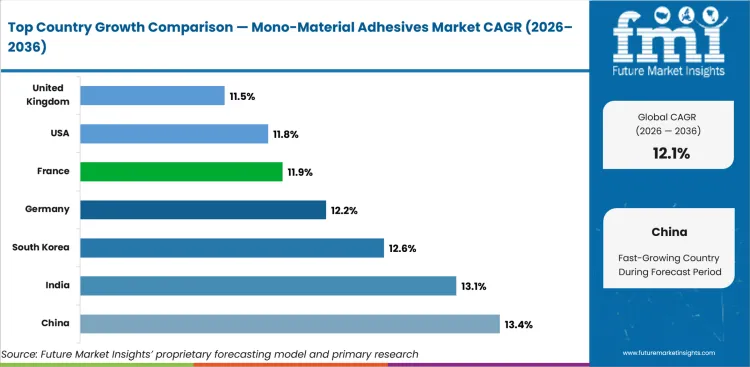
Source: Future Market Insights, 2026.
How do country-level CAGRs compare in the mono-material adhesives market?
China leads country growth while Japan records the most cautious expansion outlook among profiled markets.
- China is forecast to record 13.4% CAGR by 2036 as converter scale supports faster recyclable packaging trials.
- India is expected to expand at 13.1% CAGR from 2026 to 2036 due to plastic packaging EPR compliance and flexible packaging use.
- South Korea is projected to grow at 12.6% CAGR through 2036 as plastic reduction targets strengthen packaging redesign.
- Germany is estimated to rise at 12.2% CAGR by 2036 with dual-system recycling expectations shaping adhesive approval.
- France is expected to advance at 11.9% CAGR over the forecast period as EPR reporting and reuse goals influence packaging decisions.
- The United States is forecast to grow at 11.8% CAGR through 2036 as state-level EPR laws and retailer scorecards influence converters.
- The United Kingdom is projected to post 11.5% CAGR by 2036 as pEPR fees sharpen recyclable packaging selection.
- Japan is expected to grow at 10.7% CAGR through 2036 as high pack-quality expectations make adoption more selective.
How fast is the mono-material adhesives market growing in China?
A 13.4% CAGR through 2036 reflects converter scale and wider recyclable flexible packaging trials across export-facing packaging networks.
Country Market Snapshot Table
| Parameter | Value |
|---|---|
| Market Size in 2025 (Value) | USD 163.1 million |
| Market Size in 2026 (Value) | USD 185.0 million |
| Market Forecast in 2036 (Value) | USD 650.6 million |
| CAGR (2026 to 2036) | 13.4% |
| Years Considered | 2021 to 2036 |
| Base Year | 2025 |
| Forecast Period | 2026 to 2036 |
| Units Considered | Value (USD million) |
| Leading Sub-Region | East China and Greater Bay Area converter belts |
China Mono-Material Adhesives Market Outlook
China mono-material adhesive demand is influenced by flexible packaging scale and export-facing converter networks. Adhesive suppliers can gain stronger access when they support local testing for PE and PP structures.
Converters are expected to favor systems that work on existing assets and help improve recycling evidence. Local technical support should gain importance as brands ask for end-of-life proof and cleaner material streams.
Key Growth Drivers
- Local converter clusters can move mono-material pouch and label trials from pilot runs into larger commercial production.
- China’s rubber and plastics products manufacturing value added increased by 8.3% across 2024, supporting a strong production base for packaging adhesive trials.
- OECD projected China’s plastic waste rising from 76 Mt in 2022 to 160 Mt by 2050, making recyclable packaging and compatible adhesive design more important.
- Export-facing brands need recyclable pack structures that can satisfy EU and North American buyer expectations.
Key Restraints
- Regional recycling infrastructure differences make national packaging claims harder to support across provinces and cities.
- Low-margin consumer packs can delay certified adhesive adoption when buyers compare chemistry cost against conventional grades.
- The World Bank’s May 2025 restructuring paper showed only 8.81% disbursement for the China Plastic Waste Reduction Project, reflecting implementation friction in waste-system upgrades.
What makes China unique
China is unique due to converter scale and faster movement from qualified adhesive trials into high-volume flexible packaging production.
Key Companies
- Henkel
- Bostik
- H.B. Fuller
- Avery Dennison
- Arkema
- artience Group
- Toyo Ink
Sales & Marketing Channels
- Direct sales to major converters
- Local testing labs
- Machinery partner trials
- Export packaging programs
- Distributor networks
- Brand-owner technical centers
Country Segment Breakdown Table
| Segment | Sub-Segments |
|---|---|
| By Polymer Base | Polyolefin-based · Polyester-based · Polyamide-based · Other |
| By Application | Flexible Packaging · Labels · Paper / Board Lamination · Other |
| By Adhesive Technology | Water-based · Solvent-free · Hot Melt · Other |
| By End Use | Food Packaging · Consumer Goods · Industrial Packaging · Other |
| By Sales Channel | Direct to Converters · Distributors |
| Key Sub-Regions Covered, Converter and Packaging Clusters | Shanghai · Jiangsu · Zhejiang · Guangdong · Shandong · Fujian |
Frequently Asked Questions
How fast is China mono-material adhesives market growing?
Sales in China are ready to scale at 13.4% CAGR from 2026 to 2036, guided by converter scale and packaging redesign.
Who leads China mono-material adhesives market?
Henkel, Bostik, H.B. Fuller, Avery Dennison, Arkema, and artience Group compete through recyclable packaging adhesive support.
What is driving adoption in China mono-material adhesives market?
Flexible packaging scale and export-linked recyclability requirements are moving converters toward mono-material adhesive systems.
What is driving mono-material adhesives growth in India?
A 13.1% CAGR through 2036 is supported by EPR compliance and large flexible packaging demand across food and consumer goods.
Country Market Snapshot Table
| Parameter | Value |
|---|---|
| Market Size in 2025 (Value) | USD 84.0 million |
| Market Size in 2026 (Value) | USD 95.0 million |
| Market Forecast in 2036 (Value) | USD 325.3 million |
| CAGR (2026 to 2036) | 13.1% |
| Years Considered | 2021 to 2036 |
| Base Year | 2025 |
| Forecast Period | 2026 to 2036 |
| Units Considered | Value (USD million) |
| Leading Sub-Region | West and South India flexible packaging clusters |
India Mono-Material Adhesives Market Outlook
India demand is shaped by formal EPR compliance and broad flexible packaging use. Food, personal care, and household brands are expected to test adhesives that support recyclable pouches and labels.
Adhesive suppliers with local technical teams should gain stronger access to large converters. Documentation support will matter as buyers connect adhesive selection with packaging responsibility and recyclability claims.
Key Growth Drivers
- India’s EPR portal had 60,128 registered producers, importers, and brand owners in March 2026, supporting formal packaging responsibility.
- The same official update reported 3,012 registered plastic waste processors, improving the compliance setting for recyclable packaging redesign.
- Dry-food and snack brands need recyclable pouches that protect shelf life under hot distribution conditions.
- Large Indian converters can scale mono-material adhesive systems after brand qualification and repeat line validation.
Key Restraints
- Cost-sensitive sachet and pouch formats can resist higher certified adhesive costs when margins are narrow.
- Recycling infrastructure gaps can limit confidence in actual material recovery outcomes across cities and regions.
- India’s EPR portal recorded 51,838 registered producers, importers, and brand owners in August 2025, showing the coordination burden behind uniform compliance.
What makes India unique
India is unique because very large flexible packaging use meets a fast-formalizing EPR compliance system.
Key Companies
- Henkel Adhesives Technologies India
- H.B. Fuller India
- Bostik India
- Avery Dennison India
- Jowat India
- Pidilite Industries
- UFlex Chemicals
Sales & Marketing Channels
- Direct converter sales
- Brand-owner packaging teams
- Distributor networks
- Export packaging programs
- Compliance consultant channels
- Food packaging trials
Country Segment Breakdown Table
| Segment | Sub-Segments |
|---|---|
| By Polymer Base | Polyolefin-based · Polyester-based · Polyamide-based · Other |
| By Application | Flexible Packaging · Labels · Paper / Board Lamination · Other |
| By Adhesive Technology | Water-based · Solvent-free · Hot Melt · Other |
| By End Use | Food Packaging · Consumer Goods · Industrial Packaging · Other |
| By Sales Channel | Direct to Converters · Distributors |
| Key Sub-Regions Covered, Flexible Packaging Clusters | Maharashtra · Gujarat · Tamil Nadu · Karnataka · Delhi NCR · Telangana |
Frequently Asked Questions
How fast is India mono-material adhesives market growing?
Demand in India is ready to rise at 13.1% CAGR from 2026 to 2036 with EPR compliance and converter expansion.
Who leads India mono-material adhesives market?
Henkel, H.B. Fuller, Bostik, Avery Dennison, Jowat, Pidilite, and UFlex Chemicals compete through packaging adhesive supply.
What is driving adoption in India mono-material adhesives market?
Plastic packaging EPR and flexible packaging converter trials are moving adhesive demand toward recyclable mono-material structures.
How is the mono-material adhesives market performing in South Korea?
A 12.6% CAGR through 2036 reflects plastic reduction policy and high packaging quality expectations.
Country Market Snapshot Table
| Parameter | Value |
|---|---|
| Market Size in 2025 (Value) | USD 40.9 million |
| Market Size in 2026 (Value) | USD 46.0 million |
| Market Forecast in 2036 (Value) | USD 150.7 million |
| CAGR (2026 to 2036) | 12.6% |
| Years Considered | 2021 to 2036 |
| Base Year | 2025 |
| Forecast Period | 2026 to 2036 |
| Units Considered | Value (USD million) |
| Leading Sub-Region | Seoul Metropolitan Area and Gyeonggi manufacturing belt |
South Korea Mono-Material Adhesives Market Outlook
South Korea demand is shaped by plastic reduction policy and premium packaging quality expectations. Adhesive suppliers must prove that mono-material structures preserve appearance, bond strength, and recovery compatibility.
Food, cosmetics, and household packaging users are expected to prefer adhesives that support recyclable designs without harming pack finish. Local partnerships with converters and packaging material suppliers will remain important for qualification.
Key Growth Drivers
- South Korea aims to reduce plastic waste by 50.0% by 2030, creating policy support for recyclable packaging inputs.
- The country also aims to recycle 70.0% of waste plastics, making adhesive-backed recyclability evidence more important.
- Cosmetics and food brands need labels and pouches that support clean sorting outcomes.
- Fee-linked recyclability assessment encourages suppliers to document packaging material compatibility.
Key Restraints
- Strict quality expectations can extend approval timelines for new laminating and label adhesive systems.
- Reduction and reuse priorities may compete with adhesive-enabled recyclable single-use formats.
- South Korea’s 2025 plastic strategy targets a 30.0% reduction from projected plastic waste generation by 2030, raising scrutiny for material claims.
What makes South Korea unique
South Korea is unique because fee-linked recyclability assessment creates a direct cost signal for adhesive-backed packaging design.
Key Companies
- Henkel Korea
- H.B. Fuller Korea
- Bostik Korea
- Avery Dennison Korea
- Toyo Ink Korea
- DIC Korea
- LG Chem
Sales & Marketing Channels
- Direct converter qualification
- Label material distributors
- Consumer goods packaging teams
- Recycling fee advisory routes
- Packaging machinery channels
- Global supplier technical centers
Country Segment Breakdown Table
| Segment | Sub-Segments |
|---|---|
| By Polymer Base | Polyolefin-based · Polyester-based · Polyamide-based · Other |
| By Application | Flexible Packaging · Labels · Paper / Board Lamination · Other |
| By Adhesive Technology | Water-based · Solvent-free · Hot Melt · Other |
| By End Use | Food Packaging · Consumer Goods · Industrial Packaging · Other |
| By Sales Channel | Direct to Converters · Distributors |
| Key Sub-Regions Covered, Packaging Manufacturing Areas | Seoul · Gyeonggi · Incheon · Busan · Daegu · Daejeon |
Frequently Asked Questions
How fast is South Korea mono-material adhesives market growing?
Industry in South Korea is projected to increase at 12.6% CAGR from 2026 to 2036 through recyclable packaging redesign.
Who leads South Korea mono-material adhesives market?
Henkel Korea, H.B. Fuller Korea, Bostik Korea, Avery Dennison Korea, Toyo Ink Korea, and DIC Korea compete through adhesive technologies.
What is driving adoption in South Korea mono-material adhesives market?
Plastic reduction policy and premium packaging standards are moving converters toward validated mono-material adhesive systems.
What is the mono-material adhesives market forecast for Germany?
A 12.2% CAGR through 2036 reflects strict packaging recycling expectations and strong local adhesive technology depth.
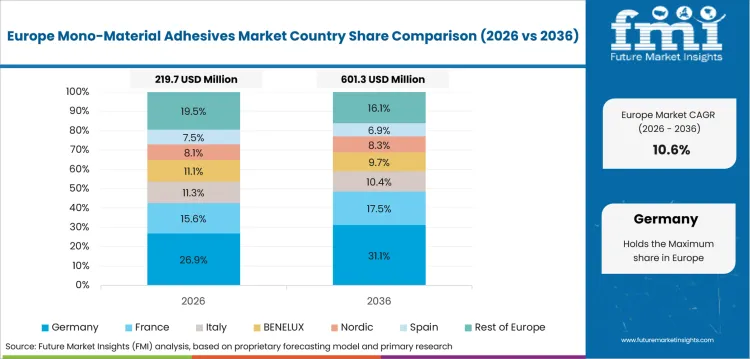
Country Market Snapshot Table
| Parameter | Value |
|---|---|
| Market Size in 2025 (Value) | USD 75.8 million |
| Market Size in 2026 (Value) | USD 85.0 million |
| Market Forecast in 2036 (Value) | USD 268.7 million |
| CAGR (2026 to 2036) | 12.2% |
| Years Considered | 2021 to 2036 |
| Base Year | 2025 |
| Forecast Period | 2026 to 2036 |
| Units Considered | Value (USD million) |
| Leading Sub-Region | North Rhine-Westphalia and Bavaria packaging clusters |
Germany Mono-Material Adhesives Market Outlook
Germany demand is guided by recycling discipline, dual-system cost signals, and a mature adhesive supplier base. Packaging converters are expected to require evidence that adhesive layers do not weaken sorting, washing, and recovered polymer quality.
Food, home-care, and discount retail packaging programs should support recyclable adhesive trials. Suppliers with local R&D, certification knowledge, and converter support should gain better access to commercial qualification.
Key Growth Drivers
- Germany recycled around 5.5 million tonnes of packaging waste collected by dual systems in 2024, creating a strong demand setting for recoverable packaging.
- Germany reported a plastic packaging recycling rate of around 70.0% in 2024, keeping technical recyclability expectations high.
- Local adhesive suppliers give converters faster access to trials and technical support.
- Discount retail packaging programs place pressure on private-label food and household packs.
Key Restraints
- High certification expectations can extend product qualification cycles for new adhesive systems.
- German recyclers may reject formats that show residue or incompatible layer behavior after sorting.
- Five of 8 statutory recycling targets were met in 2024, leaving missed targets for some packaging types and keeping compliance scrutiny active.
What makes Germany unique
Germany is unique because recycling infrastructure and fee design create a tougher test for adhesive-backed recyclability claims.
Key Companies
- Henkel
- Jowat SE
- Bostik
- Arkema
- H.B. Fuller
- Avery Dennison
- tesa SE
Sales & Marketing Channels
- Direct sales to converters
- Dual-system advisory routes
- Food-packaging R&D teams
- Trade-fair technical selling
- Distributor-backed trials
- Certification-driven sales support
Country Segment Breakdown Table
| Segment | Sub-Segments |
|---|---|
| By Polymer Base | Polyolefin-based · Polyester-based · Polyamide-based · Other |
| By Application | Flexible Packaging · Labels · Paper / Board Lamination · Other |
| By Adhesive Technology | Water-based · Solvent-free · Hot Melt · Other |
| By End Use | Food Packaging · Consumer Goods · Industrial Packaging · Other |
| By Sales Channel | Direct to Converters · Distributors |
| Key Sub-Regions Covered, Packaging and Adhesive Clusters | North Rhine-Westphalia · Bavaria · Baden-Württemberg · Hesse · Lower Saxony · Saxony |
Frequently Asked Questions
How fast is Germany mono-material adhesives market growing?
Sales in Germany are expected to grow at 12.2% CAGR from 2026 to 2036, led by strict recycling expectations.
Who leads Germany mono-material adhesives market?
Henkel, Jowat, Bostik, Arkema, H.B. Fuller, Avery Dennison, and tesa compete through adhesive technology and converter service.
What is driving adoption in Germany mono-material adhesives market?
Dual-system pressure and strong recycling evidence requirements are moving converters toward certified recyclable adhesive systems.
What is the mono-material adhesives market outlook in France?
An 11.9% CAGR through 2036 is supported by EPR reporting, reuse targets, and demand from food and beauty packaging.
Country Market Snapshot Table
| Parameter | Value |
|---|---|
| Market Size in 2025 (Value) | USD 62.6 million |
| Market Size in 2026 (Value) | USD 70.0 million |
| Market Forecast in 2036 (Value) | USD 215.5 million |
| CAGR (2026 to 2036) | 11.9% |
| Years Considered | 2021 to 2036 |
| Base Year | 2025 |
| Forecast Period | 2026 to 2036 |
| Units Considered | Value (USD million) |
| Leading Sub-Region | Île-de-France and Auvergne-Rhône-Alpes packaging corridors |
France Mono-Material Adhesives Market Outlook
France demand is shaped by household packaging EPR systems, refill ambitions, and strong consumer-goods packaging activity. Adhesive suppliers are expected to support recyclable laminates, wash-off labels, and packaging structures that can align with sorting information.
Beauty, food, and household brands will likely test adhesives that protect pack appearance while improving end-of-life outcomes. Suppliers with local technical credibility and recyclability documentation should gain stronger converter access.
Key Growth Drivers
- Citeo works with more than 98,000 clients, supporting a structured EPR route for household packaging decisions.
- Citeo reported a 69.0% household packaging recycling rate in 2024, supporting demand for better packaging recovery evidence.
- Beauty and food packaging users need adhesives that can support clean labels, refill formats, and recyclable laminates.
- Domestic adhesive capabilities create faster routes for converter trials and packaging redesign work.
Key Restraints
- Reuse and recyclability priorities can split packaging budgets across different format strategies.
- Smaller consumer brands may find recyclability testing and documentation costs harder to absorb.
- France’s reuse declaration guide supports a national trajectory toward 10.0% reused packaging placed on the market by 2027, which can divert attention from some single-use recyclable flexible structures.
What makes France unique
France is unique because reuse and recyclability are both active design pressures in consumer packaging decisions.
Key Companies
- Arkema
- Bostik
- Henkel France
- Avery Dennison France
- H.B. Fuller France
- Jowat France
- Sika France
Sales & Marketing Channels
- Direct converter sales
- Citeo compliance advisory networks
- Beauty packaging suppliers
- Food packaging R&D programs
- Distributor supply routes
- Trade-show technical meetings
Country Segment Breakdown Table
| Segment | Sub-Segments |
|---|---|
| By Polymer Base | Polyolefin-based · Polyester-based · Polyamide-based · Other |
| By Application | Flexible Packaging · Labels · Paper / Board Lamination · Other |
| By Adhesive Technology | Water-based · Solvent-free · Hot Melt · Other |
| By End Use | Food Packaging · Consumer Goods · Industrial Packaging · Other |
| By Sales Channel | Direct to Converters · Distributors |
| Key Sub-Regions Covered, Consumer Packaging Areas | Île-de-France · Auvergne-Rhône-Alpes · Hauts-de-France · Grand Est · Nouvelle-Aquitaine · Provence-Alpes-Côte d’Azur |
Frequently Asked Questions
How fast is France mono-material adhesives market growing?
Demand in France is projected to rise at 11.9% CAGR from 2026 to 2036, supported by EPR reporting and reuse-linked packaging redesign.
Who leads France mono-material adhesives market?
Arkema, Bostik, Henkel France, Avery Dennison France, H.B. Fuller France, and Jowat France compete through packaging adhesive portfolios.
What is driving adoption in France mono-material adhesives market?
EPR systems, beauty packaging trials, and recyclable flexible structures are moving buyers toward mono-material adhesive qualification.
What is the mono-material adhesives market outlook in the United States?
An 11.8% CAGR through 2036 is supported by state-level EPR laws, retailer pressure, and large converter networks.
Country Market Snapshot Table
| Parameter | Value |
|---|---|
| Market Size in 2025 (Value) | USD 200.4 million |
| Market Size in 2026 (Value) | USD 224.0 million |
| Market Forecast in 2036 (Value) | USD 683.4 million |
| CAGR (2026 to 2036) | 11.8% |
| Years Considered | 2021 to 2036 |
| Base Year | 2025 |
| Forecast Period | 2026 to 2036 |
| Units Considered | Value (USD million) |
| Leading Sub-Region | Midwest and West Coast converter networks |
United States Mono-Material Adhesives Market Outlook
United States demand is shaped by retailer scorecards, state packaging laws, and brand-owner pressure to improve recyclable packaging design. Adhesive suppliers must support converters with technical trials and food-contact documentation.
The country’s converter base gives suppliers a broad testing route across food, beverage, personal care, and e-commerce packaging. National scale remains complex because compliance expectations vary across states and retail programs.
Key Growth Drivers
- The USA Plastics Pact reported a national plastic packaging recycling rate of 13.3%, showing why brands still need packaging redesign support.
- Circular Action Alliance states that obligated producers must register to comply with packaging EPR laws in 4 states, including California, Colorado, Oregon, and Minnesota.
- Large flexible packaging converters require line trials before switching from conventional lamination systems to mono-material adhesive structures.
- Retailer scorecard pressure encourages suppliers to document recyclability, food-contact suitability, and converter performance in one approval package.
Key Restraints
- State-by-state EPR differences create extra legal review for national brand packaging teams.
- Film collection weakness limits the speed of flexible packaging claims in many municipal systems.
- EPA’s August 2025 recycling infrastructure assessment said investments could recover an additional 82 to 89 million tons of packaging and organic waste, showing the scale of infrastructure gaps.
What makes the United States unique
The United States is unique because retailer pressure, state policy, and recycler acceptance influence adhesive qualification at the same time.
Key Companies
- H.B. Fuller
- Arkema
- Bostik Inc.
- Henkel Corporation
- Avery Dennison Corporation
- Dow
- 3M
Sales & Marketing Channels
- Direct converter sales
- Brand-owner sustainability teams
- Packaging design agencies
- Distributor networks
- APR-oriented technical trials
- Retailer packaging scorecard programs
Country Segment Breakdown Table
| Segment | Sub-Segments |
|---|---|
| By Polymer Base | Polyolefin-based · Polyester-based · Polyamide-based · Other |
| By Application | Flexible Packaging · Labels · Paper / Board Lamination · Other |
| By Adhesive Technology | Water-based · Solvent-free · Hot Melt · Other |
| By End Use | Food Packaging · Consumer Goods · Industrial Packaging · Other |
| By Sales Channel | Direct to Converters · Distributors |
| Key Sub-Regions Covered, Converter and Brand-Owner Networks | Midwest · West Coast · Southeast · Texas · Northeast · Pacific Northwest |
Frequently Asked Questions
How fast is United States mono-material adhesives market growing?
Sector in the United States is anticipated to grow at 11.8% CAGR from 2026 to 2036, reflecting EPR and retailer-led packaging redesign.
Who leads United States mono-material adhesives market?
H.B. Fuller, Arkema, Bostik, Henkel, Avery Dennison, Dow, and 3M compete through adhesive portfolios and converter service.
What is driving adoption in United States mono-material adhesives market?
State-level packaging policy and retailer recyclability programs are moving converters toward validated mono-material adhesive systems.
What is driving mono-material adhesives growth in the United Kingdom?
An 11.5% CAGR through 2036 is supported by pEPR fees, recycling targets, and retailer-led packaging specification changes.
Country Market Snapshot Table
| Parameter | Value |
|---|---|
| Market Size in 2025 (Value) | USD 58.3 million |
| Market Size in 2026 (Value) | USD 65.0 million |
| Market Forecast in 2036 (Value) | USD 193.0 million |
| CAGR (2026 to 2036) | 11.5% |
| Years Considered | 2021 to 2036 |
| Base Year | 2025 |
| Forecast Period | 2026 to 2036 |
| Units Considered | Value (USD million) |
| Leading Sub-Region | England retail and converter corridors |
United Kingdom Mono-Material Adhesives Market Outlook
United Kingdom demand is shaped by packaging EPR reform, grocery retailer governance, and private-label packaging redesign. Adhesive suppliers are expected to help converters align recyclable pack structures with retailer tests and recycling-label expectations.
Flexible packaging, labels, and paper-board formats should remain active testing areas. Buyers will likely favor suppliers that can support documentation, application trials, and practical recyclability evidence.
Key Growth Drivers
- GOV.UK reported that 75.2% of UK packaging waste was recycled under methodology 2 in 2024, keeping packaging recovery performance in focus.
- The UK recycling obligation table sets a plastic packaging target of 55.0% for 2025, encouraging suppliers to support difficult-to-recycle formats with better design evidence.
- Grocery private-label teams are reviewing flexible packaging, label formats, and paper-board structures with direct converter input.
- Retailer approval programs give technically supported adhesive suppliers a clearer route into mono-material packaging specifications.
Key Restraints
- Differing recycling methodologies can slow claims approval for plastic packaging redesign.
- Local collection limitations reduce confidence in film recycling claims outside controlled systems.
- Year 2 illustrative waste disposal fees cover the 2026 to 2027 EPR period, showing the data burden behind pEPR compliance.
What makes the United Kingdom unique
The United Kingdom is unique because retailer governance can move packaging specifications faster than formal regulation alone.
Key Companies
- Bostik UK
- Henkel UK
- H.B. Fuller UK
- Avery Dennison UK
- Arkema UK
- Jowat UK
- Beardow Adams
Sales & Marketing Channels
- Retailer packaging programs
- Direct converter qualification
- Distributor-led technical supply
- Label converter networks
- Brand-owner packaging teams
- Compliance consultant referrals
Country Segment Breakdown Table
| Segment | Sub-Segments |
|---|---|
| By Polymer Base | Polyolefin-based · Polyester-based · Polyamide-based · Other |
| By Application | Flexible Packaging · Labels · Paper / Board Lamination · Other |
| By Adhesive Technology | Water-based · Solvent-free · Hot Melt · Other |
| By End Use | Food Packaging · Consumer Goods · Industrial Packaging · Other |
| By Sales Channel | Direct to Converters · Distributors |
| Key Sub-Regions Covered, Retailer and Converter Clusters | London · Midlands · Manchester · Leeds · Glasgow · Bristol |
Frequently Asked Questions
How fast is United Kingdom mono-material adhesives market growing?
Industry in the United Kingdom is projected to increase at 11.5% CAGR from 2026 to 2036 through pEPR-led packaging redesign.
Who leads United Kingdom mono-material adhesives market?
Bostik UK, Henkel UK, H.B. Fuller UK, Avery Dennison UK, Arkema UK, Jowat UK, and Beardow Adams compete through adhesive supply.
What is driving adoption in United Kingdom mono-material adhesives market?
pEPR fees, retailer packaging targets, and converter documentation needs are moving buyers toward mono-material adhesive systems.
What is the mono-material adhesives market forecast for Japan?
A 10.7% CAGR through 2036 reflects high pack-quality expectations and gradual adoption of recyclable flexible structures.
Country Market Snapshot Table
| Parameter | Value |
|---|---|
| Market Size in 2025 (Value) | USD 47.0 million |
| Market Size in 2026 (Value) | USD 52.0 million |
| Market Forecast in 2036 (Value) | USD 143.7 million |
| CAGR (2026 to 2036) | 10.7% |
| Years Considered | 2021 to 2036 |
| Base Year | 2025 |
| Forecast Period | 2026 to 2036 |
| Units Considered | Value (USD million) |
| Leading Sub-Region | Kanto and Kansai converter corridors |
Japan Mono-Material Adhesives Market Outlook
Japan demand is smaller than China but technically demanding due to strong pack appearance, hygiene, and performance expectations. Adhesive approval must satisfy recyclability goals without harming seal quality, print clarity, or consumer-facing packaging finish.
Refill pouches, convenience foods, and personal-care packs are likely to remain important trial areas. Suppliers with local testing capacity and long converter relationships should gain better access to recyclable adhesive specifications.
Key Growth Drivers
- Japan’s Plastic Waste Management Institute reported 7,690 kt of total plastic waste discharge in 2024, keeping packaging recovery in focus.
- Japan’s effective plastic utilization rate reached 89.0% in 2024, supporting careful review of mechanical and thermal recovery routes.
- Refill pouch use in personal care and home care creates a practical demand setting for mono-material flexible structures.
- Local packaging buyers prefer adhesives that can preserve appearance while improving recyclability performance.
Key Restraints
- Thermal recovery practices can reduce short-term urgency for mechanical recycling conversion.
- Strict pack appearance standards make film haze, odor, and adhesive residue major approval risks.
- Japan’s plastic resource circulation policy targets 60.0% reuse and recycling of containers and packaging by 2030, raising proof expectations before claims are accepted.
What makes Japan unique
Japan is unique because adhesive approval must satisfy both high pack aesthetics and recyclability performance.
Key Companies
- artience Group
- Toyo Ink
- Toyochem
- Bostik-Nitta
- Henkel Japan
- H.B. Fuller Japan
- Nitto Denko
Sales & Marketing Channels
- Direct technical selling
- Converter laboratory trials
- Packaging machinery partners
- Brand-owner R&D teams
- Distributor networks
- Food packaging qualification programs
Country Segment Breakdown Table
| Segment | Sub-Segments |
|---|---|
| By Polymer Base | Polyolefin-based · Polyester-based · Polyamide-based · Other |
| By Application | Flexible Packaging · Labels · Paper / Board Lamination · Other |
| By Adhesive Technology | Water-based · Solvent-free · Hot Melt · Other |
| By End Use | Food Packaging · Consumer Goods · Industrial Packaging · Other |
| By Sales Channel | Direct to Converters · Distributors |
| Key Sub-Regions Covered, Technical Packaging Areas | Tokyo · Osaka · Aichi · Kanagawa · Hyogo · Fukuoka |
Frequently Asked Questions
How fast is Japan mono-material adhesives market growing?
Demand in Japan is expected to grow at 10.7% CAGR from 2026 to 2036, shaped by technical packaging requirements.
Who leads Japan mono-material adhesives market?
artience Group, Toyo Ink, Toyochem, Bostik-Nitta, Henkel Japan, H.B. Fuller Japan, and Nitto Denko compete through packaging material expertise.
What is driving adoption in Japan mono-material adhesives market?
Refill pouch demand and plastic resource circulation goals are moving converters toward recyclable adhesive validation.
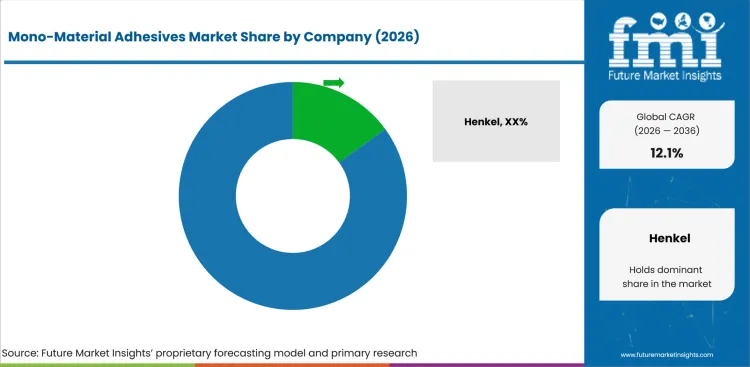
Who are the leading companies in the mono-material adhesives market?
Henkel, H.B. Fuller, Arkema, Bostik and Avery Dennison.
- Established adhesive formulators hold an advantage through flexible packaging portfolios and converter trial support.
- Label and specialty adhesive suppliers gain relevance by offering wash-off, clean-separation, and deinking technologies.
- Packaging system partners influence adhesive selection when brand owners approve mono-material pouch and label structures.
- Retail-ready and compliance-ready documentation supports adoption through recyclability evidence and food-contact support.
Adhesive companies in the market compete by combining chemistry development with converter support. Henkel and H.B. Fuller hold strong positions through packaging adhesive portfolios and technical service. Arkema and Bostik gained added scale after the Dow flexible packaging laminating adhesives business acquisition. Avery Dennison competes through label materials and wash-off technologies. artience Group and Toyo Ink add deinking and delamination know-how for multilayer mono-material packaging.
Manufacturing and testing capability has become a competitive separator as packaging redesign moves beyond laboratory samples. Suppliers with local testing labs can shorten qualification cycles and help converters solve bond strength, haze, odor, and recyclability problems. Global adhesive companies also gain from food-contact documentation and application support. Scale alone is not enough if adhesive systems fail recycling checks or disrupt commercial line speed.
Smaller and regional players can win through local service and faster troubleshooting. Jowat, Toyochem, and regional distributors can serve converters that need practical adhesive adjustments before formal brand approval. Packaging system partners such as Mondi influence specifications through mono-material packaging designs. Companies with proof of recyclability and converter training should gain more durable listing decisions. Suppliers relying only on conventional adhesive performance are expected to face weaker acceptance.
How do top mono-material adhesives companies compare?
Henkel and H.B. Fuller score strongest on converter trial support while Arkema and Bostik gain scale in flexible packaging adhesives.
| Company | Relevance to Market Title | Recyclability Proof Depth | Converter Trial Support | Mono-Polymer Fit | Channel Reach | Geographic Footprint |
|---|---|---|---|---|---|---|
| Henkel | Very High | Very Strong | Very Strong | Very Strong | Very Strong | Global |
| H.B. Fuller | Very High | Very Strong | Very Strong | Strong | Very Strong | Global |
| Arkema | Very High | Strong | Strong | Very Strong | Very Strong | Global |
| Bostik | Very High | Very Strong | Strong | Very Strong | Strong | Global |
| Avery Dennison | High | Strong | Moderate | Strong | Very Strong | Global |
| Jowat | High | Moderate | Strong | Moderate | Strong | Europe and Global |
| artience Group | High | Strong | Moderate | Strong | Strong | Asia and Global |
| Toyo Ink | High | Strong | Moderate | Strong | Strong | Asia and Global |
| Mondi | Moderate to High | Moderate | Strong | Strong | Strong | Europe and Global |
| Dow | Moderate | Moderate | Moderate | Strong | Strong | Global |
Source: Future Market Insights competitive analysis, 2026.
Who are the key players in the mono-material adhesives market?
Henkel, H.B. Fuller and Arkema are listed with Bostik and Avery Dennison among other suppliers.
Key global companies leading the mono-material adhesives market include:
- Henkel
- H.B. Fuller
- Arkema
- Bostik
- Avery Dennison
- Jowat
- artience Group
- Toyo Ink
- Mondi
- Dow
Key Developments in Mono-Material Adhesives Market
- In December 2024, Arkema finalized the acquisition of Dow’s flexible packaging laminating adhesives business.
- In October 2025, Henkel launched Packaging RecycLab in China to evaluate adhesive solutions for packaging recycling.
- In October 2024, artience Group completed a demonstration test of horizontal recycling for multilayer mono-material packaging into film.
Key Players in the Mono-Material Adhesives Market
Global Adhesive Formulators
- Henkel
- H.B. Fuller
- Arkema
- Bostik
- Jowat
Label and Specialty Adhesive Suppliers
- Avery Dennison
- artience Group
- Toyo Ink
- Toyochem
Packaging System Partners
- Mondi
- Dow
- 3M
- Nitto Denko
- tesa SE
Mono-Material Adhesives Market - Report Scope
| Parameter | Details |
|---|---|
| Forecast period | 2026 to 2036 |
| Historical period | 2021 to 2025 |
| Quantitative unit | Revenue in USD million |
| By polymer base | Polyolefin-based, polyester-based, polyamide-based, other |
| By application | Flexible packaging, labels, paper / board lamination, other |
| By adhesive technology | Water-based, solvent-free, hot melt, other |
| By end use | Food packaging, consumer goods, industrial packaging, other |
| By sales channel | Direct to converters, distributors |
| Regions covered | North America, Latin America, Europe, East Asia, South Asia and Pacific, Middle East and Africa |
| Countries covered | China, India, South Korea, Germany, France, United States, United Kingdom, Japan |
| Key companies profiled | Henkel, H.B. Fuller, Arkema, Bostik, Avery Dennison, Jowat, artience Group, Toyo Ink, Mondi, Dow |
| Approach | Hybrid bottom-up and top-down methodology using converter trials, adhesive consumption, segment penetration, and country policy signals |
Source: Future Market Insights, 2026.
Mono-Material Adhesives Market - Scope & Definition
| Attribute | Detail |
|---|---|
| Market Definition | Bonding systems designed for recyclable packaging structures made mainly from one material family, including adhesives used in films, labels, paper, board, and mono-polymer packaging formats. |
| Functions Covered | Lamination, pressure-sensitive bonding, label attachment, board bonding, wash-off support, clean separation, and recyclability compatibility. |
| Applications Covered | Flexible packaging, labels, paper / board lamination, food packaging, consumer goods packaging, and industrial packaging. |
| End-Use Industries | Food packaging, beverage packaging, personal care, household products, industrial goods, e-commerce packaging, and retail packaging. |
| Grades Covered | Polyolefin-based, polyester-based, polyamide-based, water-based, solvent-free, hot melt, and other packaging adhesive systems. |
| Inclusions | All commercially traded mono-material packaging adhesive systems across polymer base, application, adhesive technology, end use, sales channel, and selected country coverage. |
| Exclusions | Construction adhesives, medical device adhesives, electronics adhesives, films sold without adhesive chemistry, mechanical fasteners, coating-only products, and unrelated industrial bonding products. |
Mono-Material Adhesives Market - Research Methodology
| Method | Description |
|---|---|
| Primary Research | FMI analyst interviews with adhesive formulators, packaging converters, brand-owner packaging teams, distributors, label suppliers, and sustainability managers across key markets. |
| Desk Research | Review of regulatory data from EU, UK, India, Germany, France, Japan, South Korea, and company publications related to packaging adhesives and recyclability. |
| Market Sizing & Forecasting | Hybrid bottom-up and top-down approach using converter trial volumes, adhesive consumption, technology mix, application penetration, and country-level policy signals. |
| Data Validation | Cross-verification using recycling targets, EPR evidence, company portfolios, adhesive technology approvals, and country-level packaging redesign indicators. |
Mono-Material Adhesives Market Breakdown by Polymer Base, Application, Adhesive Technology, End Use, Sales Channel, and Region
Mono-Material Adhesives Market Segmented by Polymer Base
- Polyolefin-based
- Polyester-based
- Polyamide-based
- Other
Mono-Material Adhesives Market Segmented by Application
- Flexible Packaging
- Labels
- Paper / Board Lamination
- Other
Mono-Material Adhesives Market Segmented by Adhesive Technology
- Water-based
- Solvent-free
- Hot Melt
- Other
Mono-Material Adhesives Market Segmented by End Use
- Food Packaging
- Consumer Goods
- Industrial Packaging
- Other
Mono-Material Adhesives Market Segmented by Sales Channel
- Direct to Converters
- Distributors
Mono-Material Adhesives Market by Region
- North America
- Latin America
- Europe
- East Asia
- South Asia and Pacific
- Middle East and Africa
Research Sources and Bibliography
- Arkema. (2024, December 2). Arkema finalizes the acquisition of Dow’s flexible packaging laminating adhesives business.
- artience Group. (2024, October 23). Successful demonstration test of horizontal recycling of multi-layer mono-material packaging into film.
- Avery Dennison. (2025, September 4). Avery Dennison launches new labeling solutions advancing recycling, connectivity and safety at Labelexpo Europe 2025.
- Circular Action Alliance. (2026). Producer registration.
- Citeo. (2026). Why join Citeo?
- Colorado Department of Public Health and Environment. (2025). Producer Responsibility Program.
- European Commission. (2026). Packaging waste.
- FEICA. (2024, March). Adhesives in the recycling of packaging.
- Federal Ministry for the Environment, Nature Conservation, Nuclear Safety and Consumer Protection. (2025, January 22). European legislation on packaging and packaging waste.
- GOV.UK. (2025, July 23). UK statistics on waste.
- GOV.UK. (2025, December 19). Year 2 illustrative waste disposal fees: Extended producer responsibility for packaging.
- GOV.UK. (2026, February 12). Extended producer responsibility for packaging: Recycling obligations and waste disposal fees.
- H.B. Fuller. (2025, June 23). H.B. Fuller announces 2024 sustainability report.
- Henkel. (2025, October 27). Henkel launches RecycLab in China to pioneer a new packaging ecosystem.
- Ministry of Climate, Energy and Environment, Republic of Korea. (2025, December 23). Toward a sustainable, plastic-free circular economy.
- Ministry of Environment, Government of Japan. (2024). Japan’s policy related to plastic resource circulation.
- National Bureau of Statistics of China. (2025, January 24). Industrial production operation in December 2024.
- OECD. (2025, July 30). Regional plastics outlook for Southeast and East Asia.
- Plastic Waste Management Institute. (2025, December 24). Material flow diagram for plastic products production, disposal, recycling and treatment in 2024.
- Press Information Bureau. (2025, August 4). One nation one mission: End plastic pollution.
- Press Information Bureau. (2026, March 23). Circular economy framework and extended producer responsibility.
- Press Information Bureau. (2026, March 23). Plastic waste management.
- USA Environmental Protection Agency. (2025, August 6). USA recycling infrastructure assessment and state data collection reports.
- USA Plastics Pact. (2026). 2024-25 impact report.
- Umweltbundesamt. (2026, January 27). Packaging waste recycling in Germany is working.
- World Bank. (2025, May 19). China Plastic Waste Reduction Project: Restructuring paper.
This bibliography is provided for reader reference and is not exhaustive. The full report contains the complete reference list and detailed citations.
This Report Answers
- Market size estimates for 2026 and forecasts through 2036 for the mono-material adhesives market.
- Insights across more than 30 regional and country-level markets.
- Analysis of demand drivers, converter adoption patterns, packaging redesign trends, and purchasing behavior.
- Evaluation of key polymer bases and adhesive technologies, including solvent-free and water-based systems.
- Assessment of regulatory frameworks, EPR requirements, and recycling proof requirements on market development.
- Identification of growth opportunities across flexible packaging, labels, paper / board lamination, and food packaging.
- Evaluation of supply chain dynamics, product innovation trends, and converter qualification structures.
- Country-level growth analysis covering China, India, South Korea, Germany, France, United States, United Kingdom, and Japan.
- Assessment of the competitive landscape, including leading adhesive formulators and packaging material suppliers.
- Analysis of converter preferences, qualification cycles, and emerging adhesive compatibility requirements.
- Regional outlooks across North America, Europe, East Asia, and South Asia and Pacific.
- Delivery of market data, forecasts, and supporting analysis in PDF and Excel formats.
Frequently Asked Questions
What is the growth prospect for mono-material adhesives?
Demand for mono-material adhesives is expected to rise at a considerable pace as converters shift toward recyclable flexible packaging and label systems.
Which companies are expected to shape the mono-material adhesives market?
Henkel, H.B. Fuller, Arkema, Bostik, Avery Dennison, Jowat, artience Group, and Toyo Ink are expected to shape market competition through packaging adhesive portfolios.
Why are leading adhesive companies investing in mono-material adhesives?
Leading adhesive companies are investing in mono-material adhesives to support recyclable packaging design and converter-led qualification programs.
Why are converter channels important in the mono-material adhesives market?
Converter channels are important because adhesive approval usually happens through laminator trials, pack testing, and brand-owner technical review.
Which product formats are gaining attention in mono-material adhesives?
Polyolefin-based systems and solvent-free laminating adhesives are gaining attention as PE and PP flexible packaging structures expand.
How do regulations influence mono-material adhesive launches?
Regulations influence product launches through recyclability requirements, EPR fees, food-contact validation, and documentation needs.
Why is packaging performance important for mono-material adhesives?
Packaging performance is important because adhesive systems must protect bond strength, shelf handling, print appearance, and recovered material quality.
What role do labels play in mono-material adhesive adoption?
Labels support adoption by creating demand for wash-off and clean-separation adhesives that reduce residue during recycling.
How do direct sales channels support mono-material adhesives?
Direct sales channels support mono-material adhesives by helping suppliers provide testing, troubleshooting, and application guidance during converter approval.
Preview the report firsthand - request a free sample
Get SampleGet the brochure for pricing and purchase details.
Get PDFTable of Content
- Key Takeaways
- Market Size and CAGR
- Top Growth Driver
- Fastest Growing Segment
- Leading Region
- Key Companies
- Emerging Opportunities
- Executive Summary
- Global Market Outlook
- Demand-side Trends
- Supply-side Trends
- Technology Roadmap Analysis
- Analysis and Recommendations
- Analyst Perspective (What is happening? Why now? What should investors know?)
- Key Questions Answered
- How large is the market?
- What is the CAGR?
- What are key trends?
- Which region dominates?
- Who are the leaders?
- Market Overview
- Market Coverage / Taxonomy
- Market Definition / Scope / Limitations
- Research Methodology
- Chapter Orientation
- Analytical Lens and Working Hypotheses
- Market Structure, Signals, and Trend Drivers
- Benchmarking and Cross-market Comparability
- Market Sizing, Forecasting, and Opportunity Mapping
- Research Design and Evidence Framework
- Desk Research Programme (Secondary Evidence)
- Expert Input and Fieldwork (Primary Evidence)
- Tooling, Models, and Reference Databases
- Data Engineering and Model Build
- Quality Assurance and Audit Trail
- Market Background
- Market Dynamics (Drivers, Restraints, Opportunity, Trends)
- Scenario Forecast (Optimistic, Likely, Conservative)
- Impact Analysis
- AI Impact
- Sustainability Impact
- Regulatory Impact
- Technology Impact
- Consumer / Buyer Analysis
- Purchase Drivers
- Adoption Barriers
- Buyer Journey
- Opportunity Map Analysis
- Product Life Cycle Analysis
- Supply Chain Analysis
- Investment Feasibility Matrix
- Value Chain Analysis
- PESTLE and Porter's Analysis
- Regulatory Landscape
- Regional Parent Market Outlook
- Production and Consumption Statistics
- Import and Export Statistics
- Global Market Analysis and Forecast, 2021 to 2036
- Historical Market Size Value (USD Million) & Volume (Unit) Analysis, 2021 to 2025
- Current and Future Market Size Value (USD Million) & Volume (Unit) Projections, 2026 to 2036
- Y-o-Y Growth Trend Analysis
- Absolute $ Opportunity Analysis
- Global Market Pricing Analysis, 2021 to 2036
- Global Market Analysis and Forecast, By Polymer Base, 2021 to 2036
- Introduction / Key Findings
- Historical Market Size Value (USD Million) & Volume (Unit) Analysis By Polymer Base, 2021 to 2025
- Current and Future Market Size Value (USD Million) & Volume (Unit) Analysis and Forecast By Polymer Base, 2026 to 2036
- Polyolefin-based
- Polyester-based
- Polyamide-based
- Other
- Polyolefin-based
- Y-o-Y Growth Trend Analysis By Polymer Base, 2021 to 2025
- Absolute $ Opportunity Analysis By Polymer Base, 2026 to 2036
- Global Market Analysis and Forecast, By Application, 2021 to 2036
- Introduction / Key Findings
- Historical Market Size Value (USD Million) & Volume (Unit) Analysis By Application, 2021 to 2025
- Current and Future Market Size Value (USD Million) & Volume (Unit) Analysis and Forecast By Application, 2026 to 2036
- Flexible Packaging
- Labels
- Paper / Board Lamination
- Other
- Flexible Packaging
- Y-o-Y Growth Trend Analysis By Application, 2021 to 2025
- Absolute $ Opportunity Analysis By Application, 2026 to 2036
- Global Market Analysis and Forecast, By Adhesive Technology, 2021 to 2036
- Introduction / Key Findings
- Historical Market Size Value (USD Million) & Volume (Unit) Analysis By Adhesive Technology, 2021 to 2025
- Current and Future Market Size Value (USD Million) & Volume (Unit) Analysis and Forecast By Adhesive Technology, 2026 to 2036
- Water-based
- Solvent-free
- Hot Melt
- Other
- Water-based
- Y-o-Y Growth Trend Analysis By Adhesive Technology, 2021 to 2025
- Absolute $ Opportunity Analysis By Adhesive Technology, 2026 to 2036
- Global Market Analysis and Forecast, By End Use, 2021 to 2036
- Introduction / Key Findings
- Historical Market Size Value (USD Million) & Volume (Unit) Analysis By End Use, 2021 to 2025
- Current and Future Market Size Value (USD Million) & Volume (Unit) Analysis and Forecast By End Use, 2026 to 2036
- Food Packaging
- Consumer Goods
- Industrial Packaging
- Other
- Food Packaging
- Y-o-Y Growth Trend Analysis By End Use, 2021 to 2025
- Absolute $ Opportunity Analysis By End Use, 2026 to 2036
- Global Market Analysis and Forecast, By Sales Channel, 2021 to 2036
- Introduction / Key Findings
- Historical Market Size Value (USD Million) & Volume (Unit) Analysis By Sales Channel, 2021 to 2025
- Current and Future Market Size Value (USD Million) & Volume (Unit) Analysis and Forecast By Sales Channel, 2026 to 2036
- Direct to Converters
- Distributors
- Direct to Converters
- Y-o-Y Growth Trend Analysis By Sales Channel, 2021 to 2025
- Absolute $ Opportunity Analysis By Sales Channel, 2026 to 2036
- Global Market Analysis and Forecast, By Region, 2021 to 2036
- Introduction
- Historical Market Size Value (USD Million) & Volume (Unit) Analysis By Region, 2021 to 2025
- Current Market Size Value (USD Million) & Volume (Unit) Analysis and Forecast By Region, 2026 to 2036
- North America
- Latin America
- Western Europe
- Eastern Europe
- East Asia
- South Asia and Pacific
- Middle East & Africa
- Market Attractiveness Analysis By Region
- North America Market Analysis and Forecast, By Country, 2021 to 2036
- Historical Market Size Value (USD Million) & Volume (Unit) Trend Analysis By Market Taxonomy, 2021 to 2025
- Market Size Value (USD Million) & Volume (Unit) Forecast By Market Taxonomy, 2026 to 2036
- By Country
- USA
- Canada
- Mexico
- By Polymer Base
- By Application
- By Adhesive Technology
- By End Use
- By Sales Channel
- By Country
- Market Attractiveness Analysis
- By Country
- By Polymer Base
- By Application
- By Adhesive Technology
- By End Use
- By Sales Channel
- Key Takeaways
- Latin America Market Analysis and Forecast, By Country
- Historical Market Size Value (USD Million) & Volume (Unit) Trend Analysis By Market Taxonomy, 2021 to 2025
- Market Size Value (USD Million) & Volume (Unit) Forecast By Market Taxonomy, 2026 to 2036
- By Country
- Brazil
- Chile
- Rest of Latin America
- By Polymer Base
- By Application
- By Adhesive Technology
- By End Use
- By Sales Channel
- By Country
- Market Attractiveness Analysis
- By Country
- By Polymer Base
- By Application
- By Adhesive Technology
- By End Use
- By Sales Channel
- Key Takeaways
- Western Europe Market Analysis and Forecast, By Country
- Historical Market Size Value (USD Million) & Volume (Unit) Trend Analysis By Market Taxonomy, 2021 to 2025
- Market Size Value (USD Million) & Volume (Unit) Forecast By Market Taxonomy, 2026 to 2036
- By Country
- Germany
- UK
- Italy
- Spain
- France
- Nordic
- BENELUX
- Rest of Western Europe
- By Polymer Base
- By Application
- By Adhesive Technology
- By End Use
- By Sales Channel
- By Country
- Market Attractiveness Analysis
- By Country
- By Polymer Base
- By Application
- By Adhesive Technology
- By End Use
- By Sales Channel
- Key Takeaways
- Eastern Europe Market Analysis and Forecast, By Country
- Historical Market Size Value (USD Million) & Volume (Unit) Trend Analysis By Market Taxonomy, 2021 to 2025
- Market Size Value (USD Million) & Volume (Unit) Forecast By Market Taxonomy, 2026 to 2036
- By Country
- Russia
- Poland
- Hungary
- Balkan & Baltic
- Rest of Eastern Europe
- By Polymer Base
- By Application
- By Adhesive Technology
- By End Use
- By Sales Channel
- By Country
- Market Attractiveness Analysis
- By Country
- By Polymer Base
- By Application
- By Adhesive Technology
- By End Use
- By Sales Channel
- Key Takeaways
- East Asia Market Analysis and Forecast, By Country
- Historical Market Size Value (USD Million) & Volume (Unit) Trend Analysis By Market Taxonomy, 2021 to 2025
- Market Size Value (USD Million) & Volume (Unit) Forecast By Market Taxonomy, 2026 to 2036
- By Country
- China
- Japan
- South Korea
- By Polymer Base
- By Application
- By Adhesive Technology
- By End Use
- By Sales Channel
- By Country
- Market Attractiveness Analysis
- By Country
- By Polymer Base
- By Application
- By Adhesive Technology
- By End Use
- By Sales Channel
- Key Takeaways
- South Asia and Pacific Market Analysis and Forecast, By Country
- Historical Market Size Value (USD Million) & Volume (Unit) Trend Analysis By Market Taxonomy, 2021 to 2025
- Market Size Value (USD Million) & Volume (Unit) Forecast By Market Taxonomy, 2026 to 2036
- By Country
- India
- ASEAN
- Australia & New Zealand
- Rest of South Asia and Pacific
- By Polymer Base
- By Application
- By Adhesive Technology
- By End Use
- By Sales Channel
- By Country
- Market Attractiveness Analysis
- By Country
- By Polymer Base
- By Application
- By Adhesive Technology
- By End Use
- By Sales Channel
- Key Takeaways
- Middle East & Africa Market Analysis and Forecast, By Country
- Historical Market Size Value (USD Million) & Volume (Unit) Trend Analysis By Market Taxonomy, 2021 to 2025
- Market Size Value (USD Million) & Volume (Unit) Forecast By Market Taxonomy, 2026 to 2036
- By Country
- Kingdom of Saudi Arabia
- Other GCC Countries
- Türkiye
- South Africa
- Other African Union
- Rest of Middle East & Africa
- By Polymer Base
- By Application
- By Adhesive Technology
- By End Use
- By Sales Channel
- By Country
- Market Attractiveness Analysis
- By Country
- By Polymer Base
- By Application
- By Adhesive Technology
- By End Use
- By Sales Channel
- Key Takeaways
- Key Countries Market Analysis
- USA
- Pricing Analysis
- Market Share Analysis, 2025
- By Polymer Base
- By Application
- By Adhesive Technology
- By End Use
- By Sales Channel
- Canada
- Pricing Analysis
- Market Share Analysis, 2025
- By Polymer Base
- By Application
- By Adhesive Technology
- By End Use
- By Sales Channel
- Mexico
- Pricing Analysis
- Market Share Analysis, 2025
- By Polymer Base
- By Application
- By Adhesive Technology
- By End Use
- By Sales Channel
- Brazil
- Pricing Analysis
- Market Share Analysis, 2025
- By Polymer Base
- By Application
- By Adhesive Technology
- By End Use
- By Sales Channel
- Chile
- Pricing Analysis
- Market Share Analysis, 2025
- By Polymer Base
- By Application
- By Adhesive Technology
- By End Use
- By Sales Channel
- Germany
- Pricing Analysis
- Market Share Analysis, 2025
- By Polymer Base
- By Application
- By Adhesive Technology
- By End Use
- By Sales Channel
- UK
- Pricing Analysis
- Market Share Analysis, 2025
- By Polymer Base
- By Application
- By Adhesive Technology
- By End Use
- By Sales Channel
- Italy
- Pricing Analysis
- Market Share Analysis, 2025
- By Polymer Base
- By Application
- By Adhesive Technology
- By End Use
- By Sales Channel
- Spain
- Pricing Analysis
- Market Share Analysis, 2025
- By Polymer Base
- By Application
- By Adhesive Technology
- By End Use
- By Sales Channel
- France
- Pricing Analysis
- Market Share Analysis, 2025
- By Polymer Base
- By Application
- By Adhesive Technology
- By End Use
- By Sales Channel
- India
- Pricing Analysis
- Market Share Analysis, 2025
- By Polymer Base
- By Application
- By Adhesive Technology
- By End Use
- By Sales Channel
- ASEAN
- Pricing Analysis
- Market Share Analysis, 2025
- By Polymer Base
- By Application
- By Adhesive Technology
- By End Use
- By Sales Channel
- Australia & New Zealand
- Pricing Analysis
- Market Share Analysis, 2025
- By Polymer Base
- By Application
- By Adhesive Technology
- By End Use
- By Sales Channel
- China
- Pricing Analysis
- Market Share Analysis, 2025
- By Polymer Base
- By Application
- By Adhesive Technology
- By End Use
- By Sales Channel
- Japan
- Pricing Analysis
- Market Share Analysis, 2025
- By Polymer Base
- By Application
- By Adhesive Technology
- By End Use
- By Sales Channel
- South Korea
- Pricing Analysis
- Market Share Analysis, 2025
- By Polymer Base
- By Application
- By Adhesive Technology
- By End Use
- By Sales Channel
- Russia
- Pricing Analysis
- Market Share Analysis, 2025
- By Polymer Base
- By Application
- By Adhesive Technology
- By End Use
- By Sales Channel
- Poland
- Pricing Analysis
- Market Share Analysis, 2025
- By Polymer Base
- By Application
- By Adhesive Technology
- By End Use
- By Sales Channel
- Hungary
- Pricing Analysis
- Market Share Analysis, 2025
- By Polymer Base
- By Application
- By Adhesive Technology
- By End Use
- By Sales Channel
- Kingdom of Saudi Arabia
- Pricing Analysis
- Market Share Analysis, 2025
- By Polymer Base
- By Application
- By Adhesive Technology
- By End Use
- By Sales Channel
- Türkiye
- Pricing Analysis
- Market Share Analysis, 2025
- By Polymer Base
- By Application
- By Adhesive Technology
- By End Use
- By Sales Channel
- South Africa
- Pricing Analysis
- Market Share Analysis, 2025
- By Polymer Base
- By Application
- By Adhesive Technology
- By End Use
- By Sales Channel
- USA
- Market Structure Analysis
- Competition Dashboard
- Competition Benchmarking
- Market Share Analysis of Top Players
- By Regional
- By Polymer Base
- By Application
- By Adhesive Technology
- By End Use
- By Sales Channel
- Emerging Startups
- Innovation Benchmarking
- Competition Analysis
- Competition Deep Dive
- Henkel
- Overview
- Product Portfolio
- Profitability by Market Segments (Product/Region/Sales Channel)
- Sales Footprint
- Strategy Overview
- Marketing Strategy
- Product Strategy
- Channel Strategy
- H.B. Fuller
- Arkema
- Bostik
- Avery Dennison
- Jowat
- artience Group
- Toyo Ink
- Mondi
- Dow
- Henkel
- Case Studies
- Success Stories
- Recent Developments
- Competition Deep Dive
- Assumptions & Acronyms Used


