

- Market Size (2026)
- USD 1.1 Bn
- Forecast (2036)
- USD 1.9 Bn
- CAGR (2026 to 2036)
- 5.5%
How big is Glulam Adhesives Market in 2026?
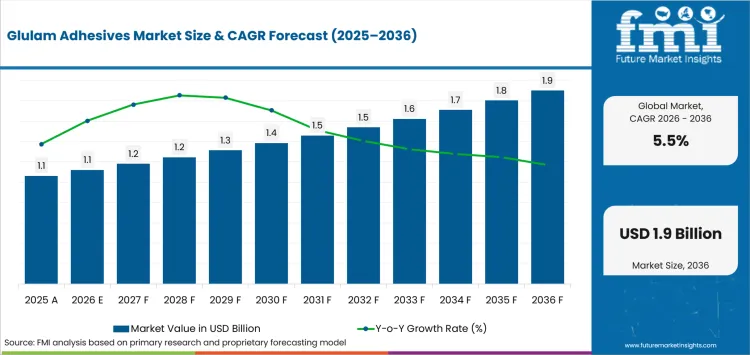
USD 1.1 billion in 2026 and USD 1.9 billion by 2036 at a 5.5% CAGR.
Demand for glulam adhesives is projected to expand at a 5.5% CAGR between 2026 and 2036, lifting valuation from USD 1.1 billion to USD 1.9 billion. Each structural member consumes qualified structural adhesives once the plant validates bond strength and line conditions. Element5 opened a new glulam production line in September 2025 and doubled annual CLT-and-glulam capacity to 100,000 cubic metres. That expansion places additional bond-line volume behind a documented manufacturing increase instead of a general construction forecast.
Country demand depends on how quickly cross-laminated timber and glulam projects convert into repeat factory output. Natural Resources Canada recorded 19 mass-timber manufacturing facilities in its 2024-25 program reporting. A larger installed production base can shorten the route from structural design to adhesive trials. Local codes and timber conditions still change qualification work, so similar project activity can produce different approval cycles by country.
Key Takeaways
- Structural timber capacity raises adhesive demand as each certified glulam member requires a controlled bond line during manufacturing.
- By adhesive type, PUR adhesives are estimated to hold 29.0% in 2026 owing to one-component handling and line-cycle control.
- In 2026, interior dry is expected to lead service class with 28.0% share because protected structures limit direct weather exposure.
- Softwood is projected to hold 62.0% share in 2026 owing to familiar grading and lamination practices.
- Structural certification and species testing can delay switching even if another adhesive offers lower cost or faster cure.
- Some of the key players in this market include Henkel, H.B. Fuller, AkzoNobel, Dynea, Prefere Resins, Sika, BASF, Jowat, Franklin International, and Hexion.
Analyst Perspective
"Glulam plants do not buy adhesive chemistry in isolation. They buy a validated press window that holds bond integrity as timber species, moisture and production speed change."
- Nikhil Kaitwade, Principal Consultant, Future Market Insights
How is the glulam adhesives market segmented?
The market is assessed by adhesive type, service class, timber type, application, sales channel and region.
Market taxonomy covers adhesive type, service class, timber type, application, sales channel and region. Adhesive types include PUR, MUF, PRF, EPI and bio-based glulam adhesives. Service classes cover interior dry, covered exterior, exterior structural and marine - high-moisture. Timber types include softwood, hardwood, hybrid timber and engineered timber blanks. Applications include beams, columns, arches, mass timber panels and specialty structures. Sales channels cover glulam manufacturers, direct adhesive producers, technical service contracts and distributors.
What makes PUR adhesives central to the adhesive type category?
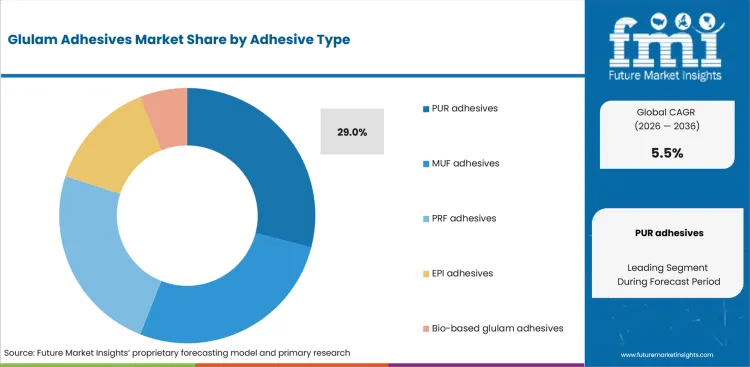
One-component PUR reduces resin-hardener handling on glulam lines but cure speed must fit the validated press cycle. APA published ANSI 117-2025 in November 2025 with updated requirements for softwood glulam design and layup. That standard keeps polyurethane adhesives inside a finished-member performance test instead of a chemistry-only purchasing decision. Line managers gain little from faster chemistry if its cure profile forces a longer validated cycle.
- By adhesive type, PUR adhesives are estimated to hold 29.0% in 2026 owing to simpler handling and controlled press cycles in high-throughput production.
- Plants qualify PUR against bond integrity and actual line timing prior to regular structural volume assignment.
Why does interior dry lead the service class category?
Interior dry members operate inside protected building envelopes that reduce weather exposure in service. Lower weather exposure reduces one qualification burden but does not remove structural quality control. APA issued the 2025 edition of ANSI/APA PRG 320 in January with updated qualification and quality-assurance requirements for structural mass timber. Protected service also lets producers focus more trial work on bond integrity than weather resistance.
- In 2026, interior dry is expected to lead service class with 28.0% share since protected applications limit direct weather exposure.
- Manufacturers still verify moisture limits and bond durability ahead of routine production for beams or columns.
How does softwood support the timber type category?
Softwood gives glulam plants a large base of graded spruce and pine that already fits established lamination routines. Statistics Norway's August 2026 forest inventory recorded 448.0 million cubic metres of spruce growing stock in 2025. That supply depth reduces species-characterisation work for wood adhesives used in regular production. Mill crews already know how these species respond to planing and moisture control ahead of adhesive application.
- Softwood is projected to hold 62.0% share in 2026 owing to familiar grading and lamination practices.
- Hardwood widens design options but each species needs fresh evidence for wetting and bond-line durability.
What supports beams in the application category?
Beam production turns repeated face-bonded laminations directly into adhesive volume during normal structural manufacturing. Unlike wood-based panel production, long beam presses keep cure time tied to the full structural member cycle. APA revised the Rosboro glulam product report in June 2026 with current qualification and code-compliance criteria for structural members. Long members magnify small cycle delays as each press load occupies equipment for the full cure window.
- Beams are set to lead the application category with 34.0% share in 2026 due to repeated bonding on long load-bearing laminations.
- High-volume lines compare open time and cure speed against accepted structural performance prior to an adhesive change.
Why do glulam manufacturers lead the sales channel category?
Glulam manufacturers control the bond line and carry responsibility for the finished structural member. Direct technical access carries more weight than distribution convenience during a formulation trial. The February 2025 MPA Stuttgart adhesive list states that listed structural adhesives must follow the current approved processing instructions. Direct producer contact becomes most useful in wood adhesives and binders that require structural qualification.
- The sales channel is forecast to be led by glulam manufacturers at 46.0% share in 2026 due to direct control of lamination quality.
- Plant-facing technical service shortens troubleshooting by letting one team compare application settings with qualification records.
What are the drivers, restraints and opportunities in the Glulam Adhesives Market?
Mass-timber manufacturing expands qualified adhesive volume, structural approval slows chemistry changes and broader timber use widens specification demand.
- Driver: Factory-made mass timber increases the number of load-bearing members that require controlled adhesive bond lines during production.
- Restraint: Fire performance and species qualification can extend validation prior to routine glulam production with a different adhesive.
- Opportunity: Adhesives that qualify on more timber species without longer press cycles can enter new structural programs.
Mass-Timber Production Expands the Qualified Adhesive Base
Structural timber construction converts into adhesive demand once projects reach repeat manufacturing. France linked off-site wood construction to industrialised prefabrication in February 2025 under a government plan covering 15,000 student homes. Factory glulam bonding differs from general construction adhesives because load-bearing qualification occurs during member production. Repeated assemblies therefore favor adhesives that hold the validated cycle without introducing new variation into bond performance.
Qualification Requirements Slow Adhesive Switching
Adhesive price alone rarely compensates fully for a new structural qualification program. Japan amended national building notices in July 2025 covering quality and durability criteria for glulam used in primary structural members. A chemistry change therefore carries documentation work alongside trials for fire exposure and timber-specific bond performance.
Broader Timber Compatibility Expands Specification Routes
Growth outside conventional softwood depends on adhesives that keep structural performance on a broader species set. Austria reported in August 2025 that its wood-construction program had supported 194 projects since 2021. The same qualification gate applies to bio-based structural wood adhesives proposed for structural timber. Hardwood and hybrid programs become commercially attractive if broader species coverage does not lengthen press cycles or force repeated qualification work.
Which country CAGRs are profiled in the Glulam Adhesives Market?
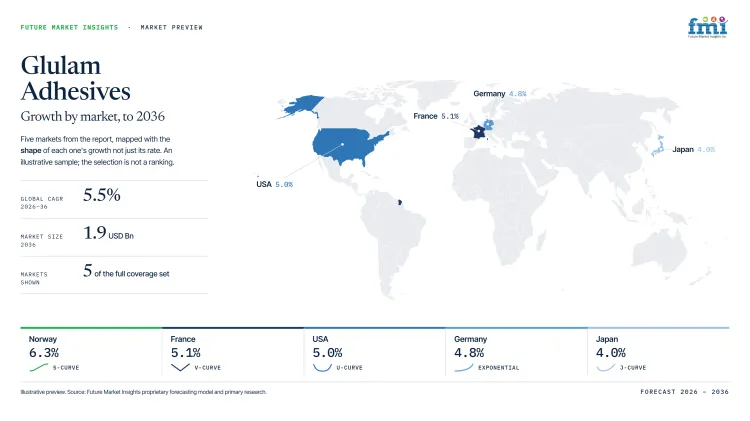
| Country | CAGR |
|---|---|
| Norway | 6.3% |
| Austria | 5.8% |
| Canada | 5.3% |
| France | 5.1% |
| USA | 5.0% |
| Germany | 4.8% |
| Japan | 4.0% |
How do country-level CAGRs compare in the Glulam Adhesives Market?
The seven forecasts split into an upper timber-processing pair and a five-country group with tighter growth. Norway and Austria lead the range as engineered-wood production reduces the distance between structural design and factory qualification. Canada, France and the USA form the middle band. Germany and Japan progress more slowly under mature specifications and longer approval routes.
- Norway's mill concentration shortens the path from formulation trial to production decision.
- Austria's compact producer base keeps application support close to structural timber plants.
- Canada's provincial code differences can lengthen commercial rollout between manufacturing clusters.
- France's off-site construction model rewards repeatable factory bonding on standardized assemblies.
- USA code adoption varies by jurisdiction even as domestic mass-timber capacity expands.
- Germany's mature specifications reduce basic learning but raise expectations for documented process fit.
- Japan's prefabricated building channels place tight tolerances on approved materials and workmanship.
Similar CAGRs therefore conceal different qualification costs and service priorities. The full report provides country-level CAGR analysis across North America, Latin America, Western Europe, Eastern Europe, East Asia, South Asia and Pacific, and the Middle East and Africa.
Country-wise Analysis
- Norwegian glulam plants draw on a large domestic forest-products base with mills that already understand structural lamination. Norway is projected to grow at 6.3% CAGR over the forecast period, supported by strong industrial timber availability and local engineered-wood competence. The Norwegian Agriculture Agency stated in January 2026 that 13.47 million cubic metres of timber were sold for industrial purposes during 2025. High timber input costs can still make formulation trials difficult to justify during tighter operating periods. Adhesive companies gain an edge by shortening qualification work at the plant without asking producers to trade validated bond performance for faster cure.
- Austria's dense timber-processing network keeps adhesive trials close to experienced beam and mass-timber production sites. Public wood-building programs give mills a steady stream of references for larger structural applications. The Austrian government published in May 2026 that timber accounted for 11.6% of newly completed floor area during 2024. Austria is forecast to rise at 5.8% CAGR through 2036, owing to deep wood-engineering expertise and continuing timber use in larger buildings. Multi-storey construction is still less developed than single-family timber building. Companies entering Austria therefore need application support that proves throughput and fire performance on the specific structural program under review.
- Canadian mass-timber manufacturing spans several provinces and long service distances that can separate a plant from specialist adhesive support. Natural Resources Canada documented 24 new GCWood projects in its 2024-25 results and tied them to building demonstrations plus code work. Canada is anticipated to advance at 5.3% CAGR during the assessment period, helped by an expanding project base and domestic manufacturing. Insurance constraints and restrictive codes can still delay project conversion despite available plant capacity. Adhesive companies with rapid regional troubleshooting can turn trials into repeat specifications more effectively during early production ramp-up than firms relying on broad national coverage alone.
- French timber processors are investing in modern equipment that makes repeat factory production more important than one-off structural work. France is expected to register 5.1% CAGR between 2026 and 2036, tied to modernization of first-stage and second-stage wood processing. In December 2025 the Ministry for Ecological Transition named 40 winners in an IPPB call focused on modernizing wood-processing equipment. Larger production runs give adhesive companies a clearer route to repeat volume. Fire and structural documentation still slow chemistry changes. Companies entering France need plant support that fits local production methods and shortens trials without weakening the evidence required for load-bearing use.
- USA glulam producers are adding manufacturing capacity while public programs expand domestic wood-product investment. Mills can absorb more adhesive volume once new lines complete structural qualification and reach routine output. The USDA announced in July 2025 that Wood Innovation Grants would provide USD 80 million to expand timber markets and wood-products manufacturing. The USA is projected to record 5.0% CAGR during the forecast period, driven by broader engineered-wood use and new processing investment. Faster formulations still must match validated cure behavior and structural performance. Suppliers with experience in structural adhesives are better placed to convert capacity additions into repeat orders when plant-level support is available.
- German glulam demand comes from a mature timber-building base where producers already work within detailed structural specifications. Input availability and construction economics can still narrow the range of species or grades a mill prefers during normal production. Germany is forecast to expand at 4.8% CAGR over the assessment period, reflecting steady engineered-wood use instead of a sudden capacity surge. Destatis recorded 14,305 completed new residential buildings with wood as the predominant material in 2025. Adhesive companies compete most effectively by adjusting application settings inside proven production systems without forcing long shutdowns or a fresh qualification route for every change.
- Japanese structural timber purchasing gives formal material specifications a larger role than general sustainability claims during adhesive selection. Japan is estimated to post 4.0% CAGR through 2036, attributable to continuing wooden-building policy and strict qualification expectations. In March 2025 the Ministry of Land Infrastructure Transport and Tourism adopted the 2025 standard specification for public wooden building works. The common specification gives public projects a defined basis for materials and workmanship. Adhesive companies still need evidence that fits the stated structural system and production route. The slower forecast therefore describes a demanding approval path instead of weak interest in timber construction.
Who are the notable companies in the Glulam Adhesives Market?
Henkel, H.B. Fuller, AkzoNobel, Dynea, Prefere Resins, Sika, BASF, Jowat, Franklin International, and Hexion are notable companies serving this market.
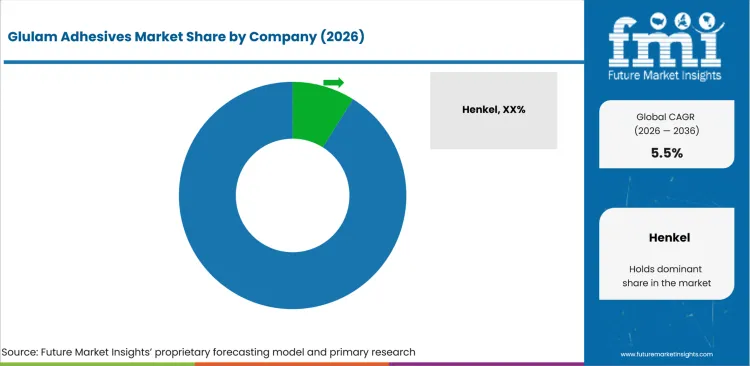
Qualification depth divides the competitive outlook more clearly than corporate size. Structural specialists carry current load-bearing approvals whereas broader industrial adhesives groups enter with adjacent wood or construction portfolios. A glulam producer still has to match chemistry with species and plant conditions to displace an approved incumbent.
- Henkel, AkzoNobel and Dynea hold the clearest positions beside BASF under current structural timber qualification requirements.
- Hexion, Jowat and Prefere Resins bring resin chemistry and engineered-wood experience into mill qualification.
- Sika, H.B. Fuller and Franklin International enter from broader adhesives and sealants portfolios with wood and construction applications.
Competitive Benchmarking: Glulam Adhesives Market
| Company | Structural Glulam Qualification | Structural Wood Chemistry Breadth | Production-Line Technical Support | Geographic Reach |
|---|---|---|---|---|
| Henkel | High | Low | High | Europe with global engineered-wood reach |
| H.B. Fuller | Low | Medium | Medium | Global woodworking and construction network |
| AkzoNobel | High | High | Medium | Europe, Asia and international wood-adhesive markets |
| Dynea | High | High | High | Europe with international timber customers |
| Prefere Resins | Low | High | High | Pan-European base with engineered-wood customers |
| Sika | Low | Medium | Medium | Global construction materials network |
| BASF | High | Medium | High | Europe with global materials reach |
| Jowat | High | Low | Medium | Europe, Americas and Asia |
| Franklin International | Low | Medium | Medium | International woodworking distribution |
| Hexion | Medium | High | High | North America with international engineered-wood reach |
Scoring basis: High structural-glulam qualification requires multiple documented load-bearing routes. Medium identifies one direct route with broader structural evidence and Low indicates narrower or adjacent coverage. High chemistry breadth means three or more verified structural wood chemistries. Medium means two and Low means one. High technical support requires plant-facing process tools plus application service. Medium and Low indicate progressively narrower support.
Key Developments in the Glulam Adhesives Market
- In November 2025, Dynea announced certification of Prefere 4546/5096 for several hardwood species. The approval gives load-bearing timber producers a documented route beyond conventional softwood programs.
- In March 2025, AkzoNobel appeared on the Norwegian Institute of Wood Technology's revised JAS-approved glulam adhesive list with multiple structural systems. The certification record keeps current Japanese-market qualification visible to engineered-wood plants.
- In February 2025, Henkel introduced Loctite HB XE for CLT and GLT surface bonding. The line pairs documented fire performance with shorter open and press times.
Key Players in the Glulam Adhesives Market
Qualified Structural Timber Systems
- Henkel
- AkzoNobel
- Dynea
- BASF
Structural Resin and Specialty Wood Bonding
- Hexion
- Jowat
- Prefere Resins
Broader Wood and Construction Adhesive Platforms
- Sika
- H.B. Fuller
- Franklin International
Glulam Adhesives Market - Report Scope
| Coverage field | Report scope |
|---|---|
| Market breakdown | By adhesive type, service class, timber type, application, sales channel and region. |
| Quantitative Units | USD billion. |
| Market Definition | Revenue includes glulam adhesive products sold for structural or production bonding within the specified adhesive type, service class, timber type, application and sales channel universe. Downstream finished glulam or building revenue and adjacent adhesive revenue outside glulam use are excluded. |
| Regions Covered | North America, Latin America, Western Europe, Eastern Europe, East Asia, South Asia and Pacific, and Middle East and Africa. |
| Countries Covered | Norway, Austria, Canada, France, USA, Germany, Japan, and 20+ countries included in the full report. |
| Key Companies Profiled | Henkel, H.B. Fuller, AkzoNobel, Dynea, Prefere Resins, Sika, BASF, Jowat, Franklin International, and Hexion. |
| Forecast Period | 2026 to 2036. |
| Approach | Primary and secondary research with market triangulation. |
Glulam Adhesives Market - Research Methodology
| Method | Approach |
|---|---|
| Primary Research | FMI analysts gathered input from manufacturers, service providers, technology developers, distributors, end users, procurement teams, and subject-matter experts. Interviews examined purchasing decisions, product or service evaluation, adoption barriers, approval requirements, pricing considerations, and expectations for technical or commercial support. Respondents were also asked what evidence is required before a trial, pilot, or initial order develops into regular purchasing. |
| Desk Research | Desk research covered government statistics, regulatory publications, trade data, industry associations, technical literature, standards, company filings, product information, and official corporate announcements. Sources were reviewed for relevance, publication date, geographic coverage, and consistency with the defined market scope. Claims relating to performance, applications, approvals, capacity, investment, and commercial activity were retained only when supported by credible public evidence. |
| Market Sizing and Forecasting | The market model combined the baseline value with historical performance, segment structure, pricing and volume indicators, adoption levels, company participation, and country-level demand conditions. Forecast assumptions considered economic activity, investment trends, regulatory developments, technology adoption, purchasing cycles, supply availability, and barriers to wider market use. Segment and regional estimates were reconciled before the final market total was calculated. |
| Data Validation | Estimates were checked against multiple independent indicators, including public data, company activity, trade patterns, industry developments, and findings from primary interviews. Validation also tested whether products, services, applications, and company revenues fell within the defined market boundaries. Adjacent categories, unsupported claims, overlapping revenues, and activities without direct market relevance were excluded to reduce double counting and maintain consistency across segments and countries. |
Glulam Adhesives Market by Segments
Glulam Adhesives Market segmented by Adhesive Type:
- PUR adhesives
- MUF adhesives
- PRF adhesives
- EPI adhesives
- Bio-based glulam adhesives
Glulam Adhesives Market segmented by Service Class:
- Interior dry
- Covered exterior
- Exterior structural
- Marine - high-moisture
Glulam Adhesives Market segmented by Timber Type:
- Softwood
- Hardwood
- Hybrid timber
- Engineered timber blanks
Glulam Adhesives Market segmented by Application:
- Beams
- Columns
- Arches
- Mass timber panels
- Specialty structures
Glulam Adhesives Market segmented by Sales Channel:
- Glulam manufacturers
- Direct adhesive producers
- Technical service contracts
- Distributors
Glulam Adhesives Market by Region:
- North America
- United States
- Canada
- Latin America
- Brazil
- Mexico
- Argentina
- Chile
- Western Europe
- Germany
- France
- United Kingdom
- Italy
- Spain
- Benelux
- Nordics
- Eastern Europe
- Poland
- Czech Republic
- Romania
- Hungary
- East Asia
- China
- Japan
- South Korea
- South Asia and Pacific
- India
- ASEAN
- Australia and New Zealand
- Middle East and Africa
- GCC Countries
- South Africa
- Türkiye
- Israel
Research Sources and Bibliography
- Element5. (2025, September 17). Element5 Mass Timber Celebrates Grand Opening of Expanded Manufacturing Plant in St. Thomas, Ontario.
- Natural Resources Canada. (2026, January 26). Natural Resource Canada's 2024-25 Departmental results report.
- APA - The Engineered Wood Association. (2025, January 27). ANSI/APA PRG 320-2025 Standard for Performance-Rated Cross-Laminated Timber.
- APA - The Engineered Wood Association. (2025, November 3). ANSI 117-2025: Standard Specification for Structural Glued Laminated Timber of Softwood Species.
- APA - The Engineered Wood Association. (2026, June 21). Product Report PR-L275: Rosboro - Glulam.
- Materialprüfungsanstalt, Universität Stuttgart. (2025, February 10). Klebstoffliste der MPA Universität Stuttgart.
- Statistics Norway. (2026, August 28). The National Forest Inventory.
- Ministères de la Transition écologique. (2025, February 20). Construction hors-site bois : une avancée majeure pour une construction abordable et respectueuse de l’environnement.
- Ministry of Land, Infrastructure, Transport and Tourism, Japan. (2025, July 30). Building Standards Act notices: amendment covering quality, strength and durability criteria for glulam and other structural wood.
- Federal Ministry for Agriculture and Forestry, Austria. (2025, August 20). Totschnig präsentiert Bilanz Holzbauoffensive: 2021 bis 2025 rund 70.000 Tonnen CO₂ eingespart.
- Norwegian Agriculture Agency. (2026, January 12). Nok et rekordår for avvirkning i 2025 - men tømmerprisene er på tur ned.
- Federal Ministry for Agriculture and Forestry, Austria. (2026, May 21). Totschnig: BOKU startet im Holzbau durch.
- Ministères de la Transition écologique. (2025, December 12). Soutien à la croissance et à la modernisation de la filière forêt-bois française : les lauréats de trois appels à projets dévoilés.
- USA Department of Agriculture. (2025, July 17). USDA Invests $80 Million to Expand Timber Markets, Protect Forests, Fuel Economic Growth.
- Federal Statistical Office of Germany. (2026, July 22). Baufertigstellungen neuer Gebäude: Deutschland, Jahre, Gebäudeart, überwiegend verwendeter Baustoff.
- Ministry of Land, Infrastructure, Transport and Tourism, Japan. (2025, March 27). Public Building Wooden Construction Standard Specifications, 2025 edition.
- Henkel. (2025, February 25). Setting new standards for sustainable timber construction.
- Norwegian Institute of Wood Technology. (2025, March 25). Adhesives approved by NTI for bonding of structural glued laminated timber according to Japanese Agricultural Standard.
- Dynea. (2025, November 19). MUF Adhesive Opens New Perspectives for Hardwood Construction.
- H.B. Fuller. (2025, May 16). H.B. Fuller Expands Manufacturing Capabilities in IMEA Region.
- Sika. (2025, June 18). Sika strengthens global presence with strategic investments across all regions.
- Sika. (2026, September 3). Sika closes acquisition of Akkim - Accelerating global expansion in adhesives and sealants.
- Hexion. (2025, June 23). Hexion and Bloom Pioneer Industry-First Renewable Adhesive Technology.
- Dynea. (2025, September 23). Successful Start-up of BASF Zhanjiang Formaldehyde Plant.
This bibliography is provided for reader reference and is not exhaustive. The full report contains the complete reference list and detailed citations.
This Report Answers
- What is the glulam adhesives market size in 2026 and 2036?
- Which production conditions support repeat glulam adhesive demand?
- Why do PUR adhesives lead the adhesive type category?
- How does interior dry service affect adhesive qualification?
- Why does softwood lead glulam adhesive consumption?
- How do country growth rates compare through 2036?
- Which companies provide structural timber adhesive platforms?
- What should manufacturers compare before changing structural adhesives?
Frequently Asked Questions
How big is the glulam adhesives market in 2026?
The glulam adhesives market is valued at USD 1.1 billion in 2026 and is projected to reach USD 1.9 billion by 2036. Expansion follows additional mass-timber manufacturing and repeat structural bond-line demand.
What is the CAGR of the glulam adhesives market from 2026 to 2036?
The glulam adhesives market is projected to grow at a CAGR of 5.5% between 2026 and 2036. Factory-made structural timber raises adhesive volume once each formulation clears plant and performance qualification.
Which adhesive type leads the glulam adhesives market?
The PUR adhesives segment is expected to hold 29.0% of the glulam adhesives market in 2026, driven by one-component handling and press-cycle control. Structural qualification still determines whether a formulation enters routine production.
Which service class holds the largest share in the glulam adhesives market?
The interior dry segment is expected to hold 28.0% of the glulam adhesives market in 2026, attributable to protected building applications with lower weather exposure. Producers still document bond durability for the specified service conditions.
Which countries are projected to record the highest growth in the glulam adhesives market?
Norway is projected to grow at 6.3% CAGR, followed by Austria at 5.8% and Canada at 5.3% through 2036. Their growth routes differ through timber supply and the cost of structural qualification.
Which companies are active in the glulam adhesives market?
Key companies operating in the glulam adhesives market include Henkel, H.B. Fuller, AkzoNobel, Dynea, Prefere Resins, Sika, BASF, Jowat, Franklin International, and Hexion. Qualification evidence and plant support separate their structural positions.
Preview the report firsthand - request a free sample
Get SampleGet the brochure for pricing and purchase details.
Get PDFTable of Content
- Key Takeaways
- Market Size and CAGR
- Top Growth Driver
- Fastest Growing Segment
- Leading Region
- Key Companies
- Emerging Opportunities
- Executive Summary
- Global Market Outlook
- Demand-side Trends
- Supply-side Trends
- Technology Roadmap Analysis
- Analysis and Recommendations
- Analyst Perspective (What is happening? Why now? What should investors know?)
- Key Questions Answered
- How large is the market?
- What is the CAGR?
- What are key trends?
- Which region dominates?
- Who are the leaders?
- Market Overview
- Market Coverage / Taxonomy
- Market Definition / Scope / Limitations
- Research Methodology
- Chapter Orientation
- Analytical Lens and Working Hypotheses
- Market Structure, Signals, and Trend Drivers
- Benchmarking and Cross-market Comparability
- Market Sizing, Forecasting, and Opportunity Mapping
- Research Design and Evidence Framework
- Desk Research Programme (Secondary Evidence)
- Expert Input and Fieldwork (Primary Evidence)
- Tooling, Models, and Reference Databases
- Data Engineering and Model Build
- Quality Assurance and Audit Trail
- Market Background
- Market Dynamics (Drivers, Restraints, Opportunity, Trends)
- Scenario Forecast (Optimistic, Likely, Conservative)
- Impact Analysis
- AI Impact
- Sustainability Impact
- Regulatory Impact
- Technology Impact
- Consumer / Buyer Analysis
- Purchase Drivers
- Adoption Barriers
- Buyer Journey
- Opportunity Map Analysis
- Product Life Cycle Analysis
- Supply Chain Analysis
- Investment Feasibility Matrix
- Value Chain Analysis
- PESTLE and Porter's Analysis
- Regulatory Landscape
- Regional Parent Market Outlook
- Production and Consumption Statistics
- Import and Export Statistics
- Global Market Analysis and Forecast, 2021 to 2036
- Historical Market Size Value (USD Billion) Analysis, 2021 to 2025
- Current and Future Market Size Value (USD Billion) Projections, 2026 to 2036
- Y-o-Y Growth Trend Analysis
- Absolute $ Opportunity Analysis
- Global Market Pricing Analysis, 2021 to 2036
- Global Market Analysis and Forecast, By Adhesive Type, 2021 to 2036
- Introduction / Key Findings
- Historical Market Size Value (USD Billion) Analysis By Adhesive Type, 2021 to 2025
- Current and Future Market Size Value (USD Billion) Analysis and Forecast By Adhesive Type, 2026 to 2036
- PUR adhesives
- MUF adhesives
- PRF adhesives
- EPI adhesives
- Bio-based glulam adhesives
- PUR adhesives
- Y-o-Y Growth Trend Analysis By Adhesive Type, 2021 to 2025
- Absolute $ Opportunity Analysis By Adhesive Type, 2026 to 2036
- Global Market Analysis and Forecast, By Service Class, 2021 to 2036
- Introduction / Key Findings
- Historical Market Size Value (USD Billion) Analysis By Service Class, 2021 to 2025
- Current and Future Market Size Value (USD Billion) Analysis and Forecast By Service Class, 2026 to 2036
- Interior dry
- Covered exterior
- Exterior structural
- Marine / high-moisture
- Interior dry
- Y-o-Y Growth Trend Analysis By Service Class, 2021 to 2025
- Absolute $ Opportunity Analysis By Service Class, 2026 to 2036
- Global Market Analysis and Forecast, By Timber Type, 2021 to 2036
- Introduction / Key Findings
- Historical Market Size Value (USD Billion) Analysis By Timber Type, 2021 to 2025
- Current and Future Market Size Value (USD Billion) Analysis and Forecast By Timber Type, 2026 to 2036
- Softwood
- Hardwood
- Hybrid timber
- Engineered timber blanks
- Softwood
- Y-o-Y Growth Trend Analysis By Timber Type, 2021 to 2025
- Absolute $ Opportunity Analysis By Timber Type, 2026 to 2036
- Global Market Analysis and Forecast, By Application, 2021 to 2036
- Introduction / Key Findings
- Historical Market Size Value (USD Billion) Analysis By Application, 2021 to 2025
- Current and Future Market Size Value (USD Billion) Analysis and Forecast By Application, 2026 to 2036
- Beams
- Columns
- Arches
- Mass timber panels
- Specialty structures
- Beams
- Y-o-Y Growth Trend Analysis By Application, 2021 to 2025
- Absolute $ Opportunity Analysis By Application, 2026 to 2036
- Global Market Analysis and Forecast, By Sales Channel, 2021 to 2036
- Introduction / Key Findings
- Historical Market Size Value (USD Billion) Analysis By Sales Channel, 2021 to 2025
- Current and Future Market Size Value (USD Billion) Analysis and Forecast By Sales Channel, 2026 to 2036
- Glulam manufacturers
- Direct adhesive producers
- Technical service contracts
- Distributors
- Glulam manufacturers
- Y-o-Y Growth Trend Analysis By Sales Channel, 2021 to 2025
- Absolute $ Opportunity Analysis By Sales Channel, 2026 to 2036
- Global Market Analysis and Forecast, By Region, 2021 to 2036
- Introduction
- Historical Market Size Value (USD Billion) Analysis By Region, 2021 to 2025
- Current Market Size Value (USD Billion) Analysis and Forecast By Region, 2026 to 2036
- North America
- Latin America
- Western Europe
- Eastern Europe
- East Asia
- South Asia and Pacific
- Middle East & Africa
- Market Attractiveness Analysis By Region
- North America Market Analysis and Forecast, By Country, 2021 to 2036
- Historical Market Size Value (USD Billion) Trend Analysis By Market Taxonomy, 2021 to 2025
- Market Size Value (USD Billion) Forecast By Market Taxonomy, 2026 to 2036
- By Country
- USA
- Canada
- By Adhesive Type
- By Service Class
- By Timber Type
- By Application
- By Sales Channel
- By Country
- Market Attractiveness Analysis
- By Country
- By Adhesive Type
- By Service Class
- By Timber Type
- By Application
- By Sales Channel
- Key Takeaways
- Latin America Market Analysis and Forecast, By Country
- Historical Market Size Value (USD Billion) Trend Analysis By Market Taxonomy, 2021 to 2025
- Market Size Value (USD Billion) Forecast By Market Taxonomy, 2026 to 2036
- By Country
- Brazil
- Mexico
- Chile
- Rest of Latin America
- By Adhesive Type
- By Service Class
- By Timber Type
- By Application
- By Sales Channel
- By Country
- Market Attractiveness Analysis
- By Country
- By Adhesive Type
- By Service Class
- By Timber Type
- By Application
- By Sales Channel
- Key Takeaways
- Western Europe Market Analysis and Forecast, By Country
- Historical Market Size Value (USD Billion) Trend Analysis By Market Taxonomy, 2021 to 2025
- Market Size Value (USD Billion) Forecast By Market Taxonomy, 2026 to 2036
- By Country
- Germany
- UK
- Italy
- Spain
- France
- Nordic
- BENELUX
- Rest of Western Europe
- By Adhesive Type
- By Service Class
- By Timber Type
- By Application
- By Sales Channel
- By Country
- Market Attractiveness Analysis
- By Country
- By Adhesive Type
- By Service Class
- By Timber Type
- By Application
- By Sales Channel
- Key Takeaways
- Eastern Europe Market Analysis and Forecast, By Country
- Historical Market Size Value (USD Billion) Trend Analysis By Market Taxonomy, 2021 to 2025
- Market Size Value (USD Billion) Forecast By Market Taxonomy, 2026 to 2036
- By Country
- Russia
- Poland
- Hungary
- Balkan & Baltic
- Rest of Eastern Europe
- By Adhesive Type
- By Service Class
- By Timber Type
- By Application
- By Sales Channel
- By Country
- Market Attractiveness Analysis
- By Country
- By Adhesive Type
- By Service Class
- By Timber Type
- By Application
- By Sales Channel
- Key Takeaways
- East Asia Market Analysis and Forecast, By Country
- Historical Market Size Value (USD Billion) Trend Analysis By Market Taxonomy, 2021 to 2025
- Market Size Value (USD Billion) Forecast By Market Taxonomy, 2026 to 2036
- By Country
- China
- Japan
- South Korea
- By Adhesive Type
- By Service Class
- By Timber Type
- By Application
- By Sales Channel
- By Country
- Market Attractiveness Analysis
- By Country
- By Adhesive Type
- By Service Class
- By Timber Type
- By Application
- By Sales Channel
- Key Takeaways
- South Asia and Pacific Market Analysis and Forecast, By Country
- Historical Market Size Value (USD Billion) Trend Analysis By Market Taxonomy, 2021 to 2025
- Market Size Value (USD Billion) Forecast By Market Taxonomy, 2026 to 2036
- By Country
- India
- ASEAN
- Australia & New Zealand
- Rest of South Asia and Pacific
- By Adhesive Type
- By Service Class
- By Timber Type
- By Application
- By Sales Channel
- By Country
- Market Attractiveness Analysis
- By Country
- By Adhesive Type
- By Service Class
- By Timber Type
- By Application
- By Sales Channel
- Key Takeaways
- Middle East & Africa Market Analysis and Forecast, By Country
- Historical Market Size Value (USD Billion) Trend Analysis By Market Taxonomy, 2021 to 2025
- Market Size Value (USD Billion) Forecast By Market Taxonomy, 2026 to 2036
- By Country
- Kingdom of Saudi Arabia
- Other GCC Countries
- Türkiye
- South Africa
- Other African Union
- Rest of Middle East & Africa
- By Adhesive Type
- By Service Class
- By Timber Type
- By Application
- By Sales Channel
- By Country
- Market Attractiveness Analysis
- By Country
- By Adhesive Type
- By Service Class
- By Timber Type
- By Application
- By Sales Channel
- Key Takeaways
- Key Countries Market Analysis
- USA
- Pricing Analysis
- Market Share Analysis, 2025
- By Adhesive Type
- By Service Class
- By Timber Type
- By Application
- By Sales Channel
- Canada
- Pricing Analysis
- Market Share Analysis, 2025
- By Adhesive Type
- By Service Class
- By Timber Type
- By Application
- By Sales Channel
- Mexico
- Pricing Analysis
- Market Share Analysis, 2025
- By Adhesive Type
- By Service Class
- By Timber Type
- By Application
- By Sales Channel
- Brazil
- Pricing Analysis
- Market Share Analysis, 2025
- By Adhesive Type
- By Service Class
- By Timber Type
- By Application
- By Sales Channel
- Chile
- Pricing Analysis
- Market Share Analysis, 2025
- By Adhesive Type
- By Service Class
- By Timber Type
- By Application
- By Sales Channel
- Germany
- Pricing Analysis
- Market Share Analysis, 2025
- By Adhesive Type
- By Service Class
- By Timber Type
- By Application
- By Sales Channel
- UK
- Pricing Analysis
- Market Share Analysis, 2025
- By Adhesive Type
- By Service Class
- By Timber Type
- By Application
- By Sales Channel
- Italy
- Pricing Analysis
- Market Share Analysis, 2025
- By Adhesive Type
- By Service Class
- By Timber Type
- By Application
- By Sales Channel
- Spain
- Pricing Analysis
- Market Share Analysis, 2025
- By Adhesive Type
- By Service Class
- By Timber Type
- By Application
- By Sales Channel
- France
- Pricing Analysis
- Market Share Analysis, 2025
- By Adhesive Type
- By Service Class
- By Timber Type
- By Application
- By Sales Channel
- India
- Pricing Analysis
- Market Share Analysis, 2025
- By Adhesive Type
- By Service Class
- By Timber Type
- By Application
- By Sales Channel
- ASEAN
- Pricing Analysis
- Market Share Analysis, 2025
- By Adhesive Type
- By Service Class
- By Timber Type
- By Application
- By Sales Channel
- Australia & New Zealand
- Pricing Analysis
- Market Share Analysis, 2025
- By Adhesive Type
- By Service Class
- By Timber Type
- By Application
- By Sales Channel
- China
- Pricing Analysis
- Market Share Analysis, 2025
- By Adhesive Type
- By Service Class
- By Timber Type
- By Application
- By Sales Channel
- Japan
- Pricing Analysis
- Market Share Analysis, 2025
- By Adhesive Type
- By Service Class
- By Timber Type
- By Application
- By Sales Channel
- South Korea
- Pricing Analysis
- Market Share Analysis, 2025
- By Adhesive Type
- By Service Class
- By Timber Type
- By Application
- By Sales Channel
- Russia
- Pricing Analysis
- Market Share Analysis, 2025
- By Adhesive Type
- By Service Class
- By Timber Type
- By Application
- By Sales Channel
- Poland
- Pricing Analysis
- Market Share Analysis, 2025
- By Adhesive Type
- By Service Class
- By Timber Type
- By Application
- By Sales Channel
- Hungary
- Pricing Analysis
- Market Share Analysis, 2025
- By Adhesive Type
- By Service Class
- By Timber Type
- By Application
- By Sales Channel
- Kingdom of Saudi Arabia
- Pricing Analysis
- Market Share Analysis, 2025
- By Adhesive Type
- By Service Class
- By Timber Type
- By Application
- By Sales Channel
- Türkiye
- Pricing Analysis
- Market Share Analysis, 2025
- By Adhesive Type
- By Service Class
- By Timber Type
- By Application
- By Sales Channel
- South Africa
- Pricing Analysis
- Market Share Analysis, 2025
- By Adhesive Type
- By Service Class
- By Timber Type
- By Application
- By Sales Channel
- USA
- Market Structure Analysis
- Competition Dashboard
- Competition Benchmarking
- Market Share Analysis of Top Players
- By Regional
- By Adhesive Type
- By Service Class
- By Timber Type
- By Application
- By Sales Channel
- Emerging Startups
- Innovation Benchmarking
- Competition Analysis
- Competition Deep Dive
- Henkel
- Overview
- Product Portfolio
- Profitability by Market Segments
- Sales Footprint
- Strategy Overview
- Marketing Strategy
- Product Strategy
- Channel Strategy
- H.B. Fuller
- AkzoNobel
- Dynea
- Prefere Resins
- Sika
- BASF
- Jowat
- Franklin International
- Hexion
- Henkel
- Case Studies
- Success Stories
- Recent Developments
- Competition Deep Dive
- Assumptions & Acronyms Used


