

- Market Size (2026)
- USD 1.3 Bn
- Forecast (2036)
- USD 2.4 Bn
- CAGR (2026 to 2036)
- 6.5%
How big is Non Conducting Adhesives Market in 2026?
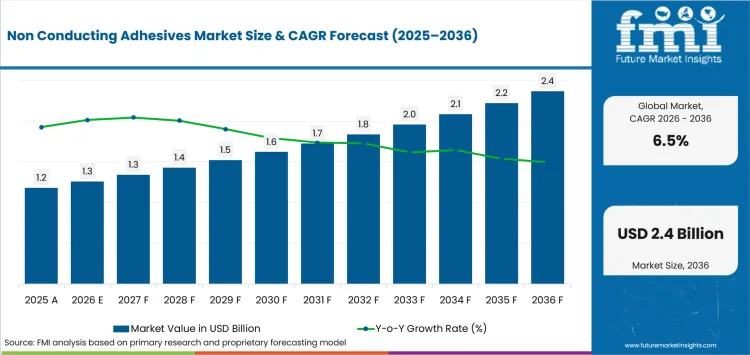
USD 1.3 billion in 2026 and USD 2.4 billion by 2036 at a 6.5% CAGR.
Sales of non conducting adhesives are expected to expand at a 6.5% CAGR during the forecast period, pushing the valuation from USD 1.3 billion in 2026 and USD 2.4 billion by 2036 as denser advanced packaging architectures place more value around every bonded semiconductor interface. NIST finalized USD 1.4 billion of advanced-packaging awards in January 2025 to move new package technologies toward scaled USA manufacturing. The program increases qualification work for electrically insulating materials used beside fine interconnects and supports higher-value die-attach adhesives in repeat production.
Country demand follows each manufacturing footprint because adhesive approval remains tied to local packaging and test programs. MIDA reported in February 2025 that ASE opened its fifth Penang plant and planned to expand Malaysian floor space from 1.0 million to about 3.4 million square feet. That expansion pulls electronics adhesives into high-volume back-end production while Taiwan and the United States place greater weight on local semiconductor packaging validation.
Key Takeaways of Non Conducting Adhesives Market
- Advanced semiconductor packages increase the value of electrically insulating bonds because small dispense or cure failures can damage high-value assemblies.
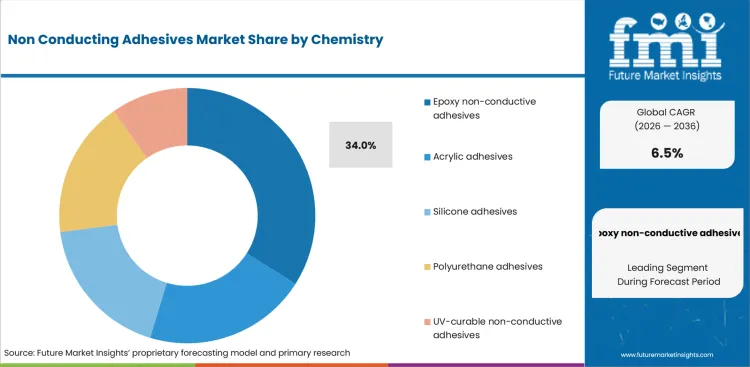
- By chemistry, epoxy non-conductive adhesives are estimated to hold 34.0% in 2026 owing to reinforcement strength across qualified semiconductor and board-level bonds.
- In 2026, one-part liquid is expected to lead form with 29.0% share because automated lines avoid ratio errors before precision dispensing.
- By application, semiconductor packaging is forecast to represent 29.0% in 2026 driven by fine-pitch assemblies that require controlled flow beside sensitive interconnects.
- Long reliability qualification restrains switching because electronics manufacturers must validate insulation and ionic cleanliness before production approval. Aging behavior and cure repeatability also require evidence before a formulation enters a controlled bill of materials.
- Some of the key players in this market include Henkel, 3M, Dow, H.B. Fuller, Master Bond, Panacol-Elosol GmbH, DELO Industrial Adhesives, and NAMICS Corporation.
Analyst Perspective
“Non conducting adhesive economics are decided during qualification rather than at the point of purchase. Process engineers should compare insulation stability, ionic cleanliness, dispense repeatability and cure exposure against the cost of yield loss or a repeated qualification cycle.”
- Nikhil Kaitwade, Principal Consultant, Future Market Insights
How is the Non Conducting Adhesives Market segmented?
The market is analyzed by chemistry, form, application, cure method, sales channel, and region.
Chemistry includes epoxy, acrylic, silicone, polyurethane and UV-curable non-conductive formulations used across different electronics bonds. Form covers one-part liquid, two-part liquid, paste, film or tape and dispensed microdot formats for different placement routines. Applications include semiconductor packaging, PCB assembly, display bonding, sensor assembly and medical electronics across device production. Cure methods include thermal, room-temperature, UV, moisture and dual cure for different thermal budgets. Sales channels cover electronics OEM direct, adhesive distributors, EMS or contract manufacturer supply and semiconductor materials channels.
What makes epoxy non-conductive adhesives central to the chemistry category?
Epoxy formulations reinforce rigid electronics bonds without creating unintended current paths reliably. Master Bond released EP29LPSPND-3 in March 2025 as an electrically non-conductive epoxy for electronics and high-reliability assemblies.
- Based on chemistry, epoxy non-conductive adhesives are projected to account for 34.0% in 2026 due to reinforcement strength across qualified semiconductor and board-level uses.
- Process engineers screen viscosity and ionic cleanliness alongside cure temperature plus thermal expansion before repeating an epoxy formulation across package geometries. Qualification becomes harder when package stress cannot be relieved by a softer adhesive layer without sacrificing electrical isolation.
Why does one-part liquid lead the form category?
One-part liquids remove ratio control and simplify handling at the production station. Panacol-Elosol GmbH introduced Vitralit UD 8060 F in July 2025 as a one-component dual-cure acrylate for electronics and sensors.
- The one-part liquid segment is likely to capture 29.0% share in 2026 attributable to automated dispensing routines that remove on-line mixing and ratio control.
- Production teams compare liquid placement with adhesive films when bond geometry changes because liquids suit narrow or irregular spaces while films offer fixed material thickness. Storage controls remain a tradeoff because production simplicity shifts handling discipline upstream from the dispensing station.
How does semiconductor packaging lead the application category?
Semiconductor packaging places adhesive beside fine interconnects where flow boundaries and insulation determine reliability. NIST announced letters of intent totaling USD 874 million in July 2026 for seven projects covering advanced-packaging materials and manufacturing infrastructure.
- Semiconductor packaging is set to lead the application category with 29.0% share in 2026 due to chiplet underfills requiring precise reinforcement and keep-out control.
- Qualification work focuses on rheology and void control alongside contamination plus cured stress because small material deviations can reduce yield across expensive package builds. Material consistency gains value as rework costs rise on packages containing valuable devices.
What drives electronics OEM direct in the sales channel category?
Direct supply matters when adhesives require testing inside equipment before commercial release. Henkel opened a Chennai engineering center in February 2025 with dispensing and material-analysis resources plus reliability testing.
- Electronics OEM direct is projected to hold 38.0% share in 2026 owing to device-specific qualification that requires rapid exchange between material specialists and process engineers.
- Direct engagement is especially valuable around precision underfill dispensing because equipment settings and substrate condition determine whether laboratory performance survives volume production. Direct channels also protect formulation knowledge during device changes that require confidential process data for renewed customer qualification.
What are the drivers, restraints and opportunities in the Non Conducting Adhesives Market?
Denser electronics increase demand as qualification slows material switching and faster low-temperature cure routes widen heat-sensitive assembly options.
- Driver: Semiconductor volume growth raises the number of high-value assemblies requiring electrically isolating reinforcement and component attachment.
- Restraint: Reliability standards and customer-specific process validation extend commercial approval cycles for replacement adhesive formulations in established electronics programs.
- Opportunity: Low-temperature and light-activated cure routes reduce component heat exposure while shortening handling time on high-throughput electronics lines.
Semiconductor sales expanded sharply during 2025 and enlarged the production base that consumes packaging and assembly materials. The Semiconductor Industry Association reported in February 2026 that global semiconductor sales reached USD 791.7 billion in 2025 after rising 25.6% year over year. Higher device output increases recurring use of electrically insulating bonds across package reinforcement and board-level underfill materials.
Material substitution remains slow because electronics assemblers must keep qualification records aligned with current acceptance criteria and customer-specific reliability requirements. The Global Electronics Association lists the J-STD-001JA and IPC-A-610JA automotive addendum as revised in September 2025, reinforcing formal process control for soldered electronic assemblies. Adhesive makers therefore need cleanliness data, cured-property evidence and customer validation before an established bill of materials changes.
Faster cure routes can remove a production bottleneck without increasing thermal exposure on sensitive electronics. DELO reported in May 2026 that its light-activatable LiDAR adhesives reached handling strength within minutes and supported throughput up to five times higher than traditional routes. Similar cure economics can extend to sensor assembly and temporary bonding adhesives when shorter handling cycles release equipment capacity without changing the bonded device.
Which country CAGRs are profiled in the Non Conducting Adhesives Market?
| Country | CAGR |
|---|---|
| Taiwan | 7.2% |
| South Korea | 6.8% |
| Malaysia | 6.5% |
| USA | 6.2% |
| Mexico | 5.9% |
How do country-level CAGRs compare in the Non Conducting Adhesives Market?
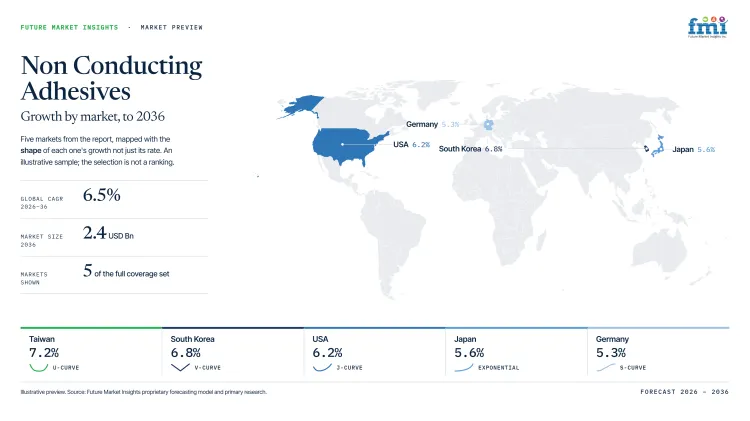
The profiled countries span 1.3 percentage points and form a narrow band with distinct qualification routes. Taiwan and South Korea occupy the upper tier because packaging clusters place engineers near production lines. Malaysia follows through Penang’s OSAT base while USA and Mexico rely more on capacity expansion and cross-border electronics programs.
- Taiwan rewards material validation around Hsinchu’s advanced packaging pilot infrastructure.
- South Korea concentrates qualification around Yongin fabs requiring rapid technical response.
- Malaysia’s Penang OSAT base favors nearby support during recurring packaging trials.
- USA programs pair domestic packaging investment with formal reliability evidence.
- Mexico depends on bilingual engineering and stable cross-border qualification support.
Qualification access separates commercial opportunity more clearly than small CAGR differences. The full report provides country-level CAGR analysis across North America, Latin America, Europe, East Asia, South Asia, Oceania and the Middle East and Africa.
Country-wise Analysis
- Taiwan electronics materials move through Hsinchu qualification networks where package yield and rapid engineering feedback determine whether new adhesive formulations reach production across fine-pitch packaging programs and repeated customer-specific reliability reviews at local sites. Non conducting adhesive sales in Taiwan are forecast to expand at 7.2% CAGR by 2036, supported by local pilot infrastructure despite strict process windows that require tight lot control. Taiwan’s Ministry of Economic Affairs reported in February 2026 that a NT$3.77 billion semiconductor R&D center would include the country’s first 12-inch research pilot line and on-site material validation, favoring formulators with nearby technical support.
- South Korean electronics manufacturers qualify new materials around concentrated semiconductor campuses where line stability and response speed determine whether formulations reach memory and advanced packaging production across high-volume customer programs. Invest Korea reported in May 2025 that construction of SK hynix’s first Yongin fab had started and 32 companies had confirmed relocation to the cluster, giving adhesive makers closer access to component and equipment partners during rapid process changes. South Korea’s non conducting adhesives outlook is anticipated to advance at 6.8% CAGR over the assessment period, driven by cluster-scale packaging activity despite high-volume validation requirements that raise entry costs.
- Malaysia’s Penang corridor places adhesive formulators beside mature outsourced semiconductor assembly and test operations where local trial support matters during recurring packaging qualification and production transfers for multinational electronics programs. Adoption of non conducting adhesives in Malaysia is estimated to expand at 6.5% CAGR through 2036, influneced by packaging investment and established OSAT demand locally despite competition for specialized process engineers. MIDA reported in February 2026 that Chipbond Technology was establishing a Penang semiconductor facility and extending the local packaging base, favoring formulators that staff application support near qualification lines and maintain regional inventory for repeated production orders reliably.
- United States electronics programs increasingly require domestic material support near semiconductor fabs and packaging sites where adhesive changes affect reliability documentation and equipment settings during high-value production transfers and customer requalification. NIST reported in July 2026 that TSMC’s planned semiconductor investment in the United States had reached USD 265 billion across 12 planned facilities, enlarging the production base while lengthy customer qualification still slows formulation switching. The United States non conducting adhesives sector is projected to record 6.2% CAGR during the assessment period, owing to domestic capacity and application laboratories that shorten transfer from prototype trials to approved production programs.
- Mexican electronics plants operate within cross-border manufacturing programs where delivery continuity and bilingual technical service determine whether a new adhesive reaches an approved bill of materials across recurring EMS production runs. Mexico is estimated to post 5.9% CAGR over the forecast period, attributable to semiconductor planning and established electronics manufacturing despite uneven local packaging and materials depth across major manufacturing corridors. Mexico’s Secretaría de Ciencia, Humanidades, Tecnología e Innovación reported in September 2025 that the semiconductor trade deficit reached USD 3.274 billion in 2024, keeping import continuity and regional logistics important for adhesive formulators serving EMS plants while domestic semiconductor capacity remains limited.
Who are the notable companies in the Non Conducting Adhesives Market?
Henkel, 3M, Dow, H.B. Fuller, Master Bond, Panacol-Elosol GmbH, DELO Industrial Adhesives, and NAMICS Corporation.
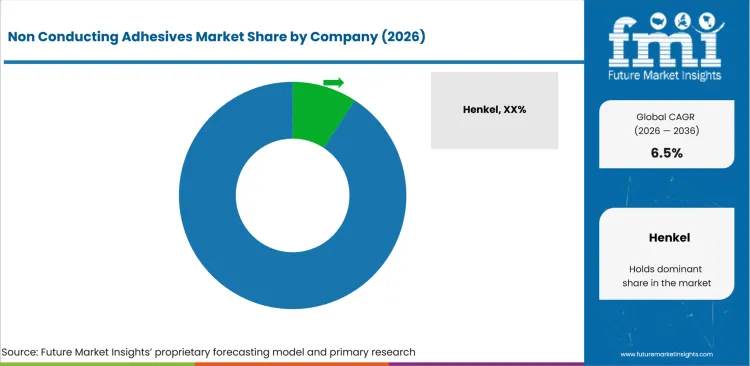
Henkel and 3M compete with broad electronics-material portfolios, while Dow and H.B. Fuller extend silicone and engineering-adhesive platforms into device assembly. Master Bond, Panacol-Elosol GmbH, DELO Industrial Adhesives and NAMICS Corporation focus on narrower formulation or semiconductor requirements. Entry barriers come from customer qualification access, process-control evidence and application support near electronics manufacturing centers rather than corporate scale alone.
- Broad electronics platforms: Henkel and 3M cover multiple electronics materials, while Dow and H.B. Fuller extend silicone and engineering-adhesive portfolios into device assembly.
- Specialist formulation groups: Master Bond and Panacol-Elosol GmbH focus on precision chemistry, while DELO Industrial Adhesives and NAMICS Corporation emphasize demanding electronics and semiconductor applications.
Competitive Benchmarking: Non Conducting Adhesives Market
| Company | Electronics Assembly Fit | Cure / Process Breadth | Qualification Support | Geographic Reach |
|---|---|---|---|---|
| Henkel | High | High | High | Global |
| 3M | High | Medium | High | Global |
| Dow | Medium | High | High | Global |
| H.B. Fuller | High | Medium | Medium | Global |
| Master Bond | Medium | High | Medium | North America and international sales |
| Panacol-Elosol GmbH | Medium | High | Medium | Europe, Asia and North America |
| DELO Industrial Adhesives | High | High | High | Europe, Asia and North America |
| NAMICS Corporation | High | Medium | High | East Asia, North America and Europe |
Key Developments in the Non Conducting Adhesives Market
- In June 2026, Dow announced approximately USD 100 million of specialty-silicones investments through 2027 covering added capacity for semiconductor packaging and electrical protection applications.
- In January 2026, Master Bond launched EP54TC as an electrically insulating epoxy with thermal conductivity exceeding 6 W/(m·K) for heat-management bonding applications.
- In September 2025, 3M joined the JOINT3 next-generation semiconductor packaging consortium that evaluates materials and equipment for panel-level organic interposer development.
Key Players in the Non Conducting Adhesives Market
Broad Electronics Materials Platforms
- Henkel
- 3M
- Dow
- H.B. Fuller
Precision Adhesive Formulators
- Master Bond
- Panacol-Elosol GmbH
- DELO Industrial Adhesives
Semiconductor Materials Specialist
- NAMICS Corporation
Non Conducting Adhesives Market - Report Scope
| Coverage field | Report scope |
|---|---|
| Market breakdown | By chemistry, form, application, cure method, sales channel and region. |
| Quantitative Units | Revenue in USD billion and CAGR in %. |
| Market Definition | Revenue from electrically non-conducting adhesive materials sold within the stated chemistry, form, application, cure-method, and sales-channel universe. Downstream finished electronics revenue, conductive adhesive revenue, dispensing equipment, and adjacent substitute material revenue are excluded. |
| Regions Covered | North America, Latin America, Western Europe, Eastern Europe, East Asia, South Asia and Pacific, and Middle East and Africa. |
| Countries Covered | Taiwan, South Korea, Malaysia, USA, Mexico, and 20+ additional countries in the full report. |
| Key Companies Profiled | Henkel, 3M, Dow, H.B. Fuller, Master Bond, Panacol-Elosol GmbH, DELO Industrial Adhesives, NAMICS Corporation. |
| Forecast Period | 2026 to 2036. |
| Approach | Primary and secondary research with market triangulation. |
Non Conducting Adhesives Market - Research Methodology
| Method | Approach |
|---|---|
| Primary Research | FMI analysts gathered input from manufacturers, service providers, technology developers, distributors, end users, procurement teams, and subject-matter experts. Interviews examined purchasing decisions, product or service evaluation, adoption barriers, approval requirements, pricing considerations, and expectations for technical or commercial support. Respondents were also asked what evidence is required before a trial, pilot, or initial order develops into regular purchasing. |
| Desk Research | Desk research covered government statistics, regulatory publications, trade data, industry associations, technical literature, standards, company filings, product information, and official corporate announcements. Sources were reviewed for relevance, publication date, geographic coverage, and consistency with the defined market scope. Claims relating to performance, applications, approvals, capacity, investment, and commercial activity were retained only when supported by credible public evidence. |
| Market Sizing and Forecasting | The market model combined the baseline value with historical performance, segment structure, pricing and volume indicators, adoption levels, company participation, and country-level demand conditions. Forecast assumptions considered economic activity, investment trends, regulatory developments, technology adoption, purchasing cycles, supply availability, and barriers to wider market use. Segment and regional estimates were reconciled before the final market total was calculated. |
| Data Validation | Estimates were checked against multiple independent indicators, including public data, company activity, trade patterns, industry developments, and findings from primary interviews. Validation also tested whether products, services, applications, and company revenues fell within the defined market boundaries. Adjacent categories, unsupported claims, overlapping revenues, and activities without direct market relevance were excluded to reduce double counting and maintain consistency across segments and countries. |
Non Conducting Adhesives Market by Segments
Non Conducting Adhesives Market segmented by Chemistry:
- Epoxy non-conductive adhesives
- Acrylic adhesives
- Silicone adhesives
- Polyurethane adhesives
- UV-curable non-conductive adhesives
Non Conducting Adhesives Market segmented by Form:
- One-part liquid
- Two-part liquid
- Paste
- Film / tape
- Dispensed microdot
Non Conducting Adhesives Market segmented by Application:
- Semiconductor packaging
- PCB assembly
- Display bonding
- Sensor assembly
- Medical electronics
Non Conducting Adhesives Market segmented by Cure Method:
- Thermal cure
- Room temperature cure
- UV cure
- Moisture cure
- Dual cure
Non Conducting Adhesives Market segmented by Sales Channel:
- Electronics OEM direct
- Adhesive distributors
- EMS / contract manufacturer supply
- Semiconductor materials channel
Non Conducting Adhesives Market by Region:
- North America
- United States
- Canada
- Latin America
- Brazil
- Mexico
- Argentina
- Chile
- Western Europe
- Germany
- France
- United Kingdom
- Italy
- Spain
- Benelux
- Nordics
- Eastern Europe
- Poland
- Czech Republic
- Romania
- Hungary
- East Asia
- China
- Japan
- South Korea
- South Asia and Pacific
- India
- ASEAN
- Australia and New Zealand
- Middle East and Africa
- GCC Countries
- South Africa
- Türkiye
- Israel
Research Sources and Bibliography
- National Institute of Standards and Technology. (2025, January 16). USA Department of Commerce announces $1.4 billion in final awards to support the next generation of USA semiconductor advanced packaging
- Malaysian Investment Development Authority. (2025, February 18). ASE expands its chip packaging and testing facility to enable next-gen applications
- Master Bond. (2025, March 24). Non-Drip Cryogenic Epoxy Offers Electrical and Thermal Insulation
- Panacol-Elosol GmbH. (2025, July 7). New UV/moisture potting material for electronics and sensor assembly
- National Institute of Standards and Technology. (2026, July 29). Department of Commerce Announces Letters of Intent With 7 Companies for $874 Million to Accelerate Semiconductor R&D for the Compute Supply Chain
- Henkel. (2025, February 27). Henkel strengthens its electronics footprint in India
- Semiconductor Industry Association. (2026, February 6). Global annual semiconductor sales increase 25.6% to $791.7 billion in 2025
- Global Electronics Association. (2025, September). IPC Standards Revision Table
- DELO Industrial Adhesives. (2026, May 20). DELO introduces next-generation light-activatable adhesives for high-volume LiDAR production
- Ministry of Economic Affairs, Taiwan. (2026, February 11). MOEA Breaks Ground on Advanced Semiconductor R&D Center: Taiwan’s First 12-Inch Pilot Line to Target AI, Silicon Photonics, and Quantum Technology
- Invest Korea. (2025, May 9). Yongin Semiconductor Cluster General Industrial Complex: Set to Rise as a Global Semiconductor Leader
- Malaysian Investment Development Authority. (2026, February 9). Chipbond Technology strengthens Malaysia’s advanced semiconductor ecosystem with new Penang facility
- National Institute of Standards and Technology. (2026, July 16). Trump Administration Secures an Additional $100 Billion USA Semiconductor Manufacturing Investment for a Total of $265 Billion from TSMC
- Secretaría de Ciencia, Humanidades, Tecnología e Innovación. (2025, September 17). PROGRAMA Sectorial de Ciencia, Humanidades, Tecnología e Innovación 2025-2030
- Dow. (2026, June 23). Dow expands product and innovation capabilities to support continued growth in specialty silicones markets
- Master Bond. (2026, January 14). Electrically insulating epoxy features ultra-high thermal conductivity
- 3M. (2025, September 30). 3M participates in JOINT3, a next-generation semiconductor packaging consortium
- 3M. (2025, February 3). 3M joins consortium to accelerate semiconductor technology in the US
- Meridian Adhesives Group. (2025, March 20). Meridian Adhesives Group expands technical capabilities in Asia with the launch of the Penang Application Development Center
- Henkel. (2026, March 24). Henkel launches advanced customer application center for electronics solutions in India
- Henkel. (2026, July 31). Henkel marks Silicon Valley Application Center growth with move to larger site with expanded technology
- Dow. (2025, November 4). Dow opens first Cooling Science Studio in Shanghai
- DELO Industrial Adhesives. (2026, April 15). IATF certification confirms highest standards
- Epoxy Technology Inc. (2025, July 8). Epoxy Technology Inc. launches EPO-TEK 353NDP to propel forward next-gen connectivity
- NAMICS Corporation. (2025, October 3). Announcement of our Taiwan sales subsidiary’s Hsinchu Office opening
- 3M. (2025, January 7). At CES 2025, 3M invites you to …
- H.B. Fuller. (2025, May 16). H.B. Fuller expands manufacturing capabilities in IMEA region
- Resonac Corporation. (2025, September 3). Resonac launches 27-member JOINT3 consortium to develop next-generation semiconductor packaging
This bibliography is provided for reader reference and is not exhaustive. The full report contains the complete reference list and detailed citations.
This Report Answers
- What is the non conducting adhesives market size in 2026 and how large is it forecast to be by 2036?
- Which chemistry holds the largest current share within non conducting adhesives?
- Why do one-part liquid formats suit automated electronics production?
- How does semiconductor packaging influence adhesive qualification requirements?
- Why does direct supply remain important for electronics OEM qualification?
- How do profiled country CAGRs differ across Taiwan, South Korea, Malaysia, USA, and Mexico?
- Which companies have meaningful positions in non conducting adhesives and electronics bonding?
- Which recent company developments are changing competitive investment and application support?
Frequently Asked Questions
What is the size of the Non Conducting Adhesives Market in 2026?
The non conducting adhesives market is expected to be valued at USD 1.3 billion in 2026 and reach USD 2.4 billion by 2036. Dense semiconductor packages raise demand for electrically insulating bonds that protect yield during fine-pitch assembly and repeated reliability testing.
What is the projected CAGR for the Non Conducting Adhesives Market?
The non conducting adhesives market is forecast to expand at 6.5% CAGR from 2026 to 2036. Semiconductor packaging investment supports growth, while lengthy qualification cycles restrain material switching inside established electronics programs.
Which chemistry leads the Non Conducting Adhesives Market?
The epoxy non-conductive adhesives segment is expected to hold 34.0% of the non conducting adhesives market in 2026, driven by reinforcement strength and established electronics qualification. Its insulation performance suits semiconductor and board-level bonds that must remain electrically isolated after cure.
Which cure method is projected to grow at the significant pace in the Non Conducting Adhesives Market?
The UV cure segment is projected to grow at the notable pace in the non conducting adhesives market through 2036, supported by lower thermal exposure and faster fixture strength. Dual-cure routes also address shadowed geometries that need a secondary reaction after light exposure.
Who are the key companies in the Non Conducting Adhesives Market?
Key companies in the non conducting adhesives market include Henkel, 3M, Dow, H.B. Fuller and Master Bond. Panacol-Elosol GmbH, DELO Industrial Adhesives and NAMICS Corporation focus on specialized formulations or semiconductor application support.
Preview the report firsthand - request a free sample
Get SampleGet the brochure for pricing and purchase details.
Get PDFTable of Content
- Key Takeaways
- Market Size and CAGR
- Top Growth Driver
- Fastest Growing Segment
- Leading Region
- Key Companies
- Emerging Opportunities
- Executive Summary
- Global Market Outlook
- Demand-side Trends
- Supply-side Trends
- Technology Roadmap Analysis
- Analysis and Recommendations
- Analyst Perspective (What is happening? Why now? What should investors know?)
- Key Questions Answered
- How large is the market?
- What is the CAGR?
- What are key trends?
- Which region dominates?
- Who are the leaders?
- Market Overview
- Market Coverage / Taxonomy
- Market Definition / Scope / Limitations
- Research Methodology
- Chapter Orientation
- Analytical Lens and Working Hypotheses
- Market Structure, Signals, and Trend Drivers
- Benchmarking and Cross-market Comparability
- Market Sizing, Forecasting, and Opportunity Mapping
- Research Design and Evidence Framework
- Desk Research Programme (Secondary Evidence)
- Expert Input and Fieldwork (Primary Evidence)
- Tooling, Models, and Reference Databases
- Data Engineering and Model Build
- Quality Assurance and Audit Trail
- Market Background
- Market Dynamics (Drivers, Restraints, Opportunity, Trends)
- Scenario Forecast (Optimistic, Likely, Conservative)
- Impact Analysis
- AI Impact
- Sustainability Impact
- Regulatory Impact
- Technology Impact
- Consumer / Buyer Analysis
- Purchase Drivers
- Adoption Barriers
- Buyer Journey
- Opportunity Map Analysis
- Product Life Cycle Analysis
- Supply Chain Analysis
- Investment Feasibility Matrix
- Value Chain Analysis
- PESTLE and Porter's Analysis
- Regulatory Landscape
- Regional Parent Market Outlook
- Production and Consumption Statistics
- Import and Export Statistics
- Global Market Analysis and Forecast, 2021 to 2036
- Historical Market Size Value (USD Billion) Analysis, 2021 to 2025
- Current and Future Market Size Value (USD Billion) Projections, 2026 to 2036
- Y-o-Y Growth Trend Analysis
- Absolute $ Opportunity Analysis
- Global Market Pricing Analysis, 2021 to 2036
- Global Market Analysis and Forecast, By Chemistry, 2021 to 2036
- Introduction / Key Findings
- Historical Market Size Value (USD Billion) Analysis By Chemistry, 2021 to 2025
- Current and Future Market Size Value (USD Billion) Analysis and Forecast By Chemistry, 2026 to 2036
- Epoxy non-conductive adhesives
- Acrylic adhesives
- Silicone adhesives
- Polyurethane adhesives
- UV-curable non-conductive adhesives
- Epoxy non-conductive adhesives
- Y-o-Y Growth Trend Analysis By Chemistry, 2021 to 2025
- Absolute $ Opportunity Analysis By Chemistry, 2026 to 2036
- Global Market Analysis and Forecast, By Form, 2021 to 2036
- Introduction / Key Findings
- Historical Market Size Value (USD Billion) Analysis By Form, 2021 to 2025
- Current and Future Market Size Value (USD Billion) Analysis and Forecast By Form, 2026 to 2036
- One-part liquid
- Two-part liquid
- Paste
- Film / tape
- Dispensed microdot
- One-part liquid
- Y-o-Y Growth Trend Analysis By Form, 2021 to 2025
- Absolute $ Opportunity Analysis By Form, 2026 to 2036
- Global Market Analysis and Forecast, By Application, 2021 to 2036
- Introduction / Key Findings
- Historical Market Size Value (USD Billion) Analysis By Application, 2021 to 2025
- Current and Future Market Size Value (USD Billion) Analysis and Forecast By Application, 2026 to 2036
- Semiconductor packaging
- PCB assembly
- Display bonding
- Sensor assembly
- Medical electronics
- Semiconductor packaging
- Y-o-Y Growth Trend Analysis By Application, 2021 to 2025
- Absolute $ Opportunity Analysis By Application, 2026 to 2036
- Global Market Analysis and Forecast, By Cure Method, 2021 to 2036
- Introduction / Key Findings
- Historical Market Size Value (USD Billion) Analysis By Cure Method, 2021 to 2025
- Current and Future Market Size Value (USD Billion) Analysis and Forecast By Cure Method, 2026 to 2036
- Thermal cure
- Room temperature cure
- UV cure
- Moisture cure
- Dual cure
- Thermal cure
- Y-o-Y Growth Trend Analysis By Cure Method, 2021 to 2025
- Absolute $ Opportunity Analysis By Cure Method, 2026 to 2036
- Global Market Analysis and Forecast, By Sales Channel, 2021 to 2036
- Introduction / Key Findings
- Historical Market Size Value (USD Billion) Analysis By Sales Channel, 2021 to 2025
- Current and Future Market Size Value (USD Billion) Analysis and Forecast By Sales Channel, 2026 to 2036
- Electronics OEM direct
- Adhesive distributors
- EMS / contract manufacturer supply
- Semiconductor materials channel
- Electronics OEM direct
- Y-o-Y Growth Trend Analysis By Sales Channel, 2021 to 2025
- Absolute $ Opportunity Analysis By Sales Channel, 2026 to 2036
- Global Market Analysis and Forecast, By Region, 2021 to 2036
- Introduction
- Historical Market Size Value (USD Billion) Analysis By Region, 2021 to 2025
- Current Market Size Value (USD Billion) Analysis and Forecast By Region, 2026 to 2036
- North America
- Latin America
- Western Europe
- Eastern Europe
- East Asia
- South Asia and Pacific
- Middle East & Africa
- Market Attractiveness Analysis By Region
- North America Market Analysis and Forecast, By Country, 2021 to 2036
- Historical Market Size Value (USD Billion) Trend Analysis By Market Taxonomy, 2021 to 2025
- Market Size Value (USD Billion) Forecast By Market Taxonomy, 2026 to 2036
- By Country
- USA
- Canada
- By Chemistry
- By Form
- By Application
- By Cure Method
- By Sales Channel
- By Country
- Market Attractiveness Analysis
- By Country
- By Chemistry
- By Form
- By Application
- By Cure Method
- By Sales Channel
- Key Takeaways
- Latin America Market Analysis and Forecast, By Country
- Historical Market Size Value (USD Billion) Trend Analysis By Market Taxonomy, 2021 to 2025
- Market Size Value (USD Billion) Forecast By Market Taxonomy, 2026 to 2036
- By Country
- Brazil
- Mexico
- Chile
- Rest of Latin America
- By Chemistry
- By Form
- By Application
- By Cure Method
- By Sales Channel
- By Country
- Market Attractiveness Analysis
- By Country
- By Chemistry
- By Form
- By Application
- By Cure Method
- By Sales Channel
- Key Takeaways
- Western Europe Market Analysis and Forecast, By Country
- Historical Market Size Value (USD Billion) Trend Analysis By Market Taxonomy, 2021 to 2025
- Market Size Value (USD Billion) Forecast By Market Taxonomy, 2026 to 2036
- By Country
- Germany
- UK
- Italy
- Spain
- France
- Nordic
- BENELUX
- Rest of Western Europe
- By Chemistry
- By Form
- By Application
- By Cure Method
- By Sales Channel
- By Country
- Market Attractiveness Analysis
- By Country
- By Chemistry
- By Form
- By Application
- By Cure Method
- By Sales Channel
- Key Takeaways
- Eastern Europe Market Analysis and Forecast, By Country
- Historical Market Size Value (USD Billion) Trend Analysis By Market Taxonomy, 2021 to 2025
- Market Size Value (USD Billion) Forecast By Market Taxonomy, 2026 to 2036
- By Country
- Russia
- Poland
- Hungary
- Balkan & Baltic
- Rest of Eastern Europe
- By Chemistry
- By Form
- By Application
- By Cure Method
- By Sales Channel
- By Country
- Market Attractiveness Analysis
- By Country
- By Chemistry
- By Form
- By Application
- By Cure Method
- By Sales Channel
- Key Takeaways
- East Asia Market Analysis and Forecast, By Country
- Historical Market Size Value (USD Billion) Trend Analysis By Market Taxonomy, 2021 to 2025
- Market Size Value (USD Billion) Forecast By Market Taxonomy, 2026 to 2036
- By Country
- China
- Japan
- South Korea
- By Chemistry
- By Form
- By Application
- By Cure Method
- By Sales Channel
- By Country
- Market Attractiveness Analysis
- By Country
- By Chemistry
- By Form
- By Application
- By Cure Method
- By Sales Channel
- Key Takeaways
- South Asia and Pacific Market Analysis and Forecast, By Country
- Historical Market Size Value (USD Billion) Trend Analysis By Market Taxonomy, 2021 to 2025
- Market Size Value (USD Billion) Forecast By Market Taxonomy, 2026 to 2036
- By Country
- India
- ASEAN
- Australia & New Zealand
- Rest of South Asia and Pacific
- By Chemistry
- By Form
- By Application
- By Cure Method
- By Sales Channel
- By Country
- Market Attractiveness Analysis
- By Country
- By Chemistry
- By Form
- By Application
- By Cure Method
- By Sales Channel
- Key Takeaways
- Middle East & Africa Market Analysis and Forecast, By Country
- Historical Market Size Value (USD Billion) Trend Analysis By Market Taxonomy, 2021 to 2025
- Market Size Value (USD Billion) Forecast By Market Taxonomy, 2026 to 2036
- By Country
- Kingdom of Saudi Arabia
- Other GCC Countries
- Türkiye
- South Africa
- Other African Union
- Rest of Middle East & Africa
- By Chemistry
- By Form
- By Application
- By Cure Method
- By Sales Channel
- By Country
- Market Attractiveness Analysis
- By Country
- By Chemistry
- By Form
- By Application
- By Cure Method
- By Sales Channel
- Key Takeaways
- Key Countries Market Analysis
- USA
- Pricing Analysis
- Market Share Analysis, 2025
- By Chemistry
- By Form
- By Application
- By Cure Method
- By Sales Channel
- Canada
- Pricing Analysis
- Market Share Analysis, 2025
- By Chemistry
- By Form
- By Application
- By Cure Method
- By Sales Channel
- Mexico
- Pricing Analysis
- Market Share Analysis, 2025
- By Chemistry
- By Form
- By Application
- By Cure Method
- By Sales Channel
- Brazil
- Pricing Analysis
- Market Share Analysis, 2025
- By Chemistry
- By Form
- By Application
- By Cure Method
- By Sales Channel
- Chile
- Pricing Analysis
- Market Share Analysis, 2025
- By Chemistry
- By Form
- By Application
- By Cure Method
- By Sales Channel
- Germany
- Pricing Analysis
- Market Share Analysis, 2025
- By Chemistry
- By Form
- By Application
- By Cure Method
- By Sales Channel
- UK
- Pricing Analysis
- Market Share Analysis, 2025
- By Chemistry
- By Form
- By Application
- By Cure Method
- By Sales Channel
- Italy
- Pricing Analysis
- Market Share Analysis, 2025
- By Chemistry
- By Form
- By Application
- By Cure Method
- By Sales Channel
- Spain
- Pricing Analysis
- Market Share Analysis, 2025
- By Chemistry
- By Form
- By Application
- By Cure Method
- By Sales Channel
- France
- Pricing Analysis
- Market Share Analysis, 2025
- By Chemistry
- By Form
- By Application
- By Cure Method
- By Sales Channel
- India
- Pricing Analysis
- Market Share Analysis, 2025
- By Chemistry
- By Form
- By Application
- By Cure Method
- By Sales Channel
- ASEAN
- Pricing Analysis
- Market Share Analysis, 2025
- By Chemistry
- By Form
- By Application
- By Cure Method
- By Sales Channel
- Australia & New Zealand
- Pricing Analysis
- Market Share Analysis, 2025
- By Chemistry
- By Form
- By Application
- By Cure Method
- By Sales Channel
- China
- Pricing Analysis
- Market Share Analysis, 2025
- By Chemistry
- By Form
- By Application
- By Cure Method
- By Sales Channel
- Japan
- Pricing Analysis
- Market Share Analysis, 2025
- By Chemistry
- By Form
- By Application
- By Cure Method
- By Sales Channel
- South Korea
- Pricing Analysis
- Market Share Analysis, 2025
- By Chemistry
- By Form
- By Application
- By Cure Method
- By Sales Channel
- Russia
- Pricing Analysis
- Market Share Analysis, 2025
- By Chemistry
- By Form
- By Application
- By Cure Method
- By Sales Channel
- Poland
- Pricing Analysis
- Market Share Analysis, 2025
- By Chemistry
- By Form
- By Application
- By Cure Method
- By Sales Channel
- Hungary
- Pricing Analysis
- Market Share Analysis, 2025
- By Chemistry
- By Form
- By Application
- By Cure Method
- By Sales Channel
- Kingdom of Saudi Arabia
- Pricing Analysis
- Market Share Analysis, 2025
- By Chemistry
- By Form
- By Application
- By Cure Method
- By Sales Channel
- Türkiye
- Pricing Analysis
- Market Share Analysis, 2025
- By Chemistry
- By Form
- By Application
- By Cure Method
- By Sales Channel
- South Africa
- Pricing Analysis
- Market Share Analysis, 2025
- By Chemistry
- By Form
- By Application
- By Cure Method
- By Sales Channel
- USA
- Market Structure Analysis
- Competition Dashboard
- Competition Benchmarking
- Market Share Analysis of Top Players
- By Regional
- By Chemistry
- By Form
- By Application
- By Cure Method
- By Sales Channel
- Emerging Startups
- Innovation Benchmarking
- Competition Analysis
- Competition Deep Dive
- Henkel
- Overview
- Product Portfolio
- Profitability by Market Segments
- Sales Footprint
- Strategy Overview
- Marketing Strategy
- Product Strategy
- Channel Strategy
- 3M
- Dow
- H.B. Fuller
- Master Bond
- Panacol-Elosol
- DELO Industrial Adhesives
- Nagase ChemteX
- Namics
- Ablestik / Henkel
- Henkel
- Case Studies
- Success Stories
- Recent Developments
- Competition Deep Dive
- Assumptions & Acronyms Used


