

- Market Size (2026)
- USD 920.6 Mn
- Forecast (2036)
- USD 2260.7 Mn
- CAGR (2026 to 2036)
- 9.4%
How big is Obstacle Avoidance Systems Market in 2026?
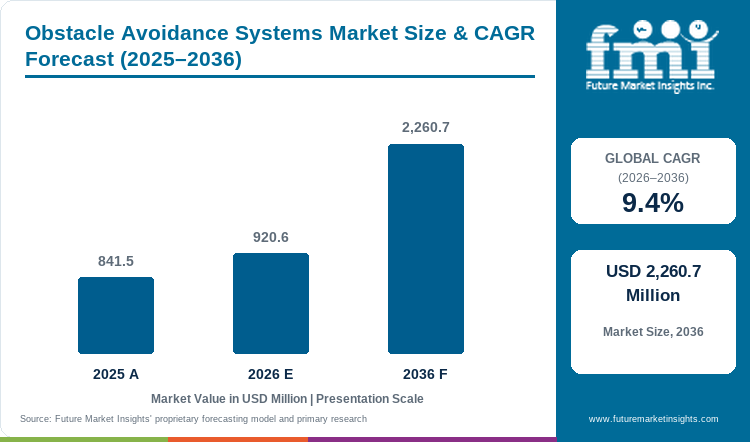
USD 920.6 million in 2026 and USD 2,260.7 million by 2036, expanding at 9.4% CAGR.
Demand for obstacle avoidance systems is projected to expand at 9.4% CAGR between 2026 and 2036, growing from USD 841.5 million in 2025 to USD 920.6 million in 2026, and escalating to USD 2,260.7 million by 2036. Autonomous vessels now require perception and maneuvering functions that can be documented inside a complete safety case before operators expand automated control. The International Maritime Organization adopted the MASS Code on May 22, 2026 to establish a goal-based safety framework for remotely controlled and autonomous cargo ships. The framework gives system integrators a defined basis for proving navigation behavior before vessel operators commit to broader autonomous operation.
Norway converts remote-vessel testing into certified operation under a national approval route that supports the projected CAGR of 9.5% by 2036. The Norwegian Maritime Authority certified Reach Remote 1 for full unmanned operation on February 27, 2026 after more than three months of testing and verification. Japan is expected to rise at a 6.9% CAGR and follows a more vessel-specific certification path with continuing crew oversight. The gap does not establish national market size because installed vessel fleets and electronics replacement cycles differ materially. It does show why suppliers need country-specific approval evidence before autonomy interest becomes recurring obstacle-avoidance orders.
Key Takeaways
- Autonomous and remotely operated vessel programs increase demand when obstacle detection can pass directly into documented course and speed decisions.
- Based on system type, camera-based avoidance is projected to account for 24.0% in 2026, supported by visual classification that adds context for small craft and uncooperative targets.
- By detection range, short range is estimated to hold 23.0% in 2026, driven by docking and close-quarter maneuvering that require immediate local geometry.
- In 2026, autonomous boats are expected to lead vessel type with 22.0% share, attributable to unattended transit requiring continuous risk assessment and route correction.
- Qualification work can delay installation because operators must validate sensor limits and control behavior against vessel-specific operating conditions before broader deployment.
- Some of the key players in this market include Sea Machines Robotics, Orca AI, Avikus (HD Hyundai), Kongsberg Maritime, NACOS Marine, Furuno, Garmin, Raymarine (Teledyne FLIR), Marine AI, and Buffalo Automation.
Analyst Perspective
"Vessel operators will pay for avoidance functions that move cleanly from perception into predictable steering or propulsion responses under documented limits. Suppliers therefore need to prove the complete control chain on the installed vessel instead of selling object detection as an isolated electronics feature."
- Nikhil Kaitwade, Principal Consultant, Future Market Insights.
How is the obstacle avoidance systems market segmented?
The obstacle avoidance systems market is analyzed by system type, detection range, vessel type, function, sales channel and region.
System type covers camera-based avoidance, radar-assisted avoidance, LiDAR-assisted avoidance, sensor fusion systems and autonomous avoidance controllers. Detection range covers short range, medium range, long range and multi-range fused systems. Vessel type includes autonomous boats, yachts, workboats, ferries and unmanned surface vessels. Function covers floating object detection, collision warning, path replanning, dock - marina protection and night operation support. Sales channels comprise autonomy platform OEMs, boat OEMs, retrofit integrators and defense - research programs.
What operating condition supports camera-based avoidance demand in the system type category?
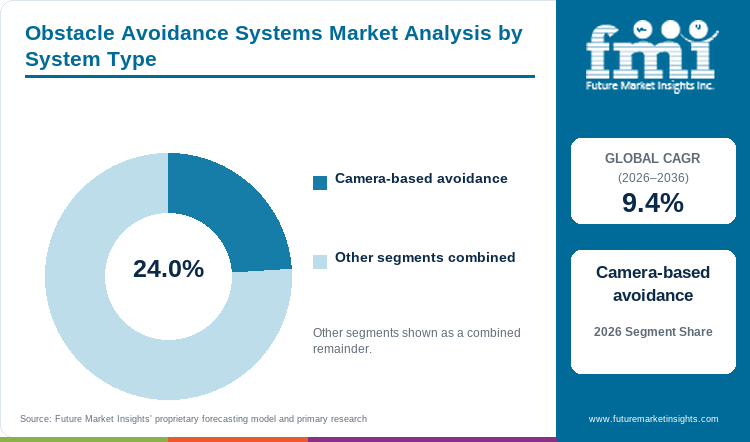
Camera systems earn a larger role when bridge electronics must identify small craft or targets that carry weak electronic identification. Orca AI states that SeaPod uses visual and thermal cameras with computer vision plus available navigation data to detect and classify contacts in real time. That architecture turns marine electronics into a perception layer that can support earlier encounter assessment instead of passive recording. Operators still test glare and low-visibility performance because image quality becomes a safety input once software influences collision decisions. Camera systems therefore move into repeat orders after classifications remain stable inside the vessel operating envelope.
- By system type, camera-based avoidance is forecast to represent 24.0% in 2026, owing to visual classification that distinguishes targets electronic data may not describe completely.
- Orca AI documents SeaPod detection and classification of surrounding contacts by combining visual and thermal cameras with computer vision and available navigation data.
How does short range secure its position within the detection range category?
Short-range sensing carries immediate value because docking and marina transit leave little distance for delayed target classification or course changes. Raymarine documents DockSense using stereo vision to measure nearby docks and vessels before escalating visual and audible warnings. DockSense Control can also connect object recognition with propulsion control to reduce collision risk during assisted docking. These functions place marine radar beside local vision rather than treating one sensor as sufficient in every close-quarter setting. Integrators therefore compare update speed and false alarms against the exact maneuvering space where steering or throttle corrections must occur.
- The detection range category is forecast to be led by short range at 23.0% share in 2026, driven by close-quarter maneuvers that require fast local geometry before control actions begin.
- Raymarine documents DockSense Alert detecting nearby obstacles and DockSense Control linking object recognition with vessel propulsion during assisted docking operations.
What makes autonomous boats the main vessel type choice in this market?
Autonomous boats cannot treat avoidance as a separate alarm because their navigation software must resolve hazards without constant helm intervention. Sea Machines documents its SM300 system fusing radar and AIS with GPS plus computer vision before the controller changes course or speed around obstacles. This control path is especially relevant to unmanned surface vehicles that execute repeat missions with remote supervision. Operators still define safeguard distances and manual override conditions because the same vessel may face different traffic densities during one mission. The segment therefore purchases avoidance as a continuous control function rather than an optional bridge display.
- Autonomous boats are set to lead the vessel type category with 22.0% share in 2026, supported by unattended transit that requires continuous collision assessment and safe course correction.
- Sea Machines documents dynamic obstacle avoidance that fuses radar and AIS with GPS plus computer vision before autonomously rerouting or changing vessel speed.
Why does floating object detection hold the stated function share?
Floating hazards create a difficult recognition problem because debris and small craft may provide no cooperative electronic identity for bridge systems. Furuno describes an autonomous-navigation approach that combines camera information with radar and AIS so software can classify objects before navigation decisions begin. That fusion improves the value of collision avoidance sensors because each input contributes different information about object presence or identity. Operators still need false-alert control since repeated warnings can reduce trust during dense traffic or poor visibility. Floating object detection therefore remains the first functional gate before warning and route replanning can produce a safe response.
- Floating object detection is projected to hold 29.0% of function demand in 2026, because non-cooperative hazards must be recognized before warning or replanning can begin.
- Furuno documents camera recognition combined with radar and AIS as part of its autonomous-navigation work for identifying vessels and navigation objects more reliably.
Why are autonomy platform OEMs favored within the sales channel mix?
Autonomy platform OEMs control the point where perception results become a maneuver command that must match the vessel control interface. Avikus reported DNV Type Approval for HiNAS Control in April 2026 after evaluation of collision avoidance alarms and ship-control performance. The system combines perception and decision logic with control so integrators can qualify one connected architecture instead of several unrelated devices. This structure aligns with autonomous marine navigation programs that need clear evidence from sensor input to commanded action. Boatbuilders and retrofit specialists remain important channels but platform OEMs carry more of the system-level validation burden.
- The sales channel category is forecast to be led by autonomy platform OEMs at 34.0% share in 2026, attributable to one supplier coordinating perception and vessel-control qualification.
- Avikus reported DNV Type Approval for HiNAS Control after verification covered collision avoidance alarms and the system performance used for vessel control.
What are the drivers, restraints and opportunities in the Obstacle Avoidance Systems Market?
Operational autonomous-vessel programs expand demand, system qualification slows installations and retrofit-ready control packages widen the addressable installed fleet.
- Driver: Contracted autonomous-vessel programs require perception and maneuvering functions that operate as one documented control chain.
- Restraint: Independent verification and vessel integration lengthen the path from a working sensor demonstration to approved operational use.
- Opportunity: Retrofit packages can add collision avoidance to existing vessels without waiting for complete fleet replacement cycles.
Contracted autonomous operations pull avoidance into vessel control
Fleet operators spend on avoidance when autonomous vessels move from isolated demonstrations into contracted operational programs with defined mission requirements. Kongsberg Maritime signed for two additional Reach Remote uncrewed vessels in 2025 and its supply scope includes situation awareness plus maneuvering and thruster control. That order connects perception with the vessel actions needed for remote offshore operation instead of treating awareness as a standalone display. Similar marine ADAS systems become commercially relevant when operators can connect hazard recognition with an approved response path. The driver is therefore operational deployment that assigns obstacle avoidance a required control role on a funded vessel.
Qualification work extends the sales cycle before autonomous control expands
Classification evidence becomes expensive after obstacle assessment begins influencing steering because evaluators must test alerts and the resulting control behavior together. Avikus received DNV Type Approval Design Certification for HiNAS Control in June 2025 after a structured system qualification process for autonomous and remotely operated vessels. That process covered collision avoidance decision support and track control within one integrated system. Remote supervision also adds marine communication systems that must remain dependable when shore operators participate in the operating concept. Suppliers therefore face longer conversion cycles whenever software interfaces and failure responses need independent verification before vessel approval.
Retrofit control packages extend autonomy to existing vessel fleets
Existing vessels create a practical expansion route when integrators can reuse installed navigation hardware and connect avoidance software to approved control interfaces. Marine AI announced a January 2025 partnership with Water Witch for autonomous litter-collection vessels and stated that its technology can be refitted to existing Trash Skimmers. That approach lets operators add perception and control without replacing a serviceable hull before its normal retirement date. Retrofit demand also supports adjacent marine steering systems because collision logic only produces value after a vessel can execute safe course or thrust changes. Revenue therefore follows packages that reduce installation work while preserving verifiable control behavior.
Which country CAGRs are profiled in the Obstacle Avoidance Systems Market?
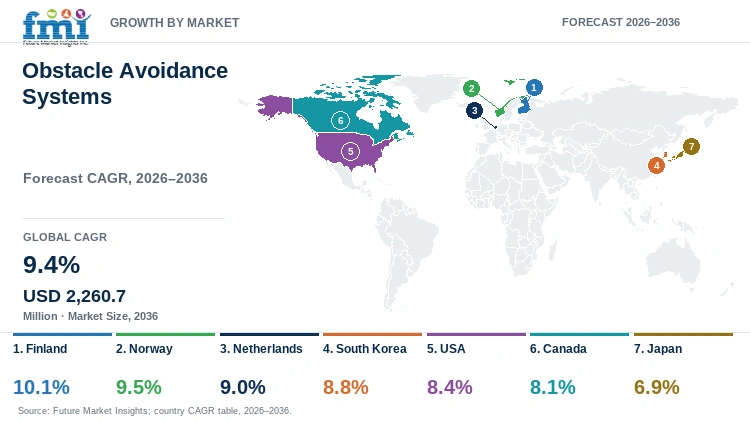
| Country | CAGR |
|---|---|
| Finland | 10.1% |
| Norway | 9.5% |
| Netherlands | 9.0% |
| South Korea | 8.8% |
| USA | 8.4% |
| Canada | 8.1% |
| Japan | 6.9% |
How do country-level CAGRs compare in the Obstacle Avoidance Systems Market?
The country forecasts span 3.2 percentage points from Finland at 10.1% CAGR to Japan at 6.9%. Finland and Norway form the upper group while the Netherlands and South Korea follow closely behind them. The USA and Canada occupy a narrower North American band before Japan closes the displayed range.
- Finland’s nationwide digital-navigation infrastructure provides autonomy developers with richer operational data for route planning and situational awareness.
- Norway benefits from real-world autonomous-vessel deployments and regulatory experience gained through the evaluation of remote-vessel projects.
- In the Netherlands, inland-waterway operating frameworks create a practical pathway for highly automated vessels to advance through controlled trials.
- South Korea’s autonomous-shipping initiatives are supported by a structured commercialization framework that formalizes development, testing, and verification activities.
- The USA has established review processes for unmanned and remote-controlled vessels, providing greater clarity for operators and technology developers.
- Canada combines regulatory engagement with research programs that test autonomous-vessel sensors under challenging environmental and operating conditions.
- Japan is advancing automated navigation through a gradual deployment model built around vessel inspections, safety validation, and defined crew-oversight requirements.
- Comparable growth rates can still produce different sales conditions because each country assigns a different approval burden to testing and operational deployment. The full report provides country-level CAGR analysis across North America, Latin America, Western Europe, Eastern Europe, East Asia, South Asia and Pacific, and the Middle East and Africa.
Country-wise Analysis
- Finnish maritime authorities are moving navigation data toward the S-100 standard before autonomous control becomes routine in national waters. By 2036, Finland is projected to grow at 10.1% CAGR, supported by digital navigation services that improve the information available to vessel systems. Traficom stated in November 2025 that S-101 electronic nautical charts are planned for every Finnish sea area before the end of 2026. That infrastructure supports software integration but does not remove winter conditions or mixed-traffic validation requirements. Integrators must therefore prove that perception and maneuvering logic remain dependable with national navigation data and the operating limits used by each vessel.
- Norwegian operators already work with a regulator that has practical experience from autonomous vessels in service and international MASS development. Norway's obstacle avoidance systems outlook is anticipated to advance at 9.5% CAGR over the assessment period, supported by operating autonomous vessels and regulator experience with remote-vessel projects. The Norwegian Maritime Authority stated in May 2025 that Norway was among the countries with the most operational autonomous vessels. That operating base shortens the learning curve for project sponsors but still leaves vessel-specific verification and remote-supervision duties. Suppliers need evidence that collision logic interacts safely with steering and propulsion before operators can scale one design into a wider fleet.
- Dutch inland shipping gives automation developers a dense operating environment with locks and bridges plus mixed commercial traffic. Obstacle avoidance systems demand in the Netherlands is forecast to rise at 9.0% CAGR over the forecast period, supported by a national exemption route for highly automated inland navigation. A ministerial regulation published on April 15, 2025 sets the application procedure for exemptions under the Binnenvaartpolitiereglement. That route can support controlled trials but applicants still need operating limits and technical documentation suited to constrained waterways. Integrators that pair short-range perception with reliable remote oversight can address existing inland vessels without waiting for a complete fleet renewal.
- South Korea connects major shipbuilding capacity with a national legal framework dedicated to autonomous-ship development and commercialization. Adoption of obstacle avoidance systems in South Korea is estimated to expand at 8.8% CAGR through 2036, supported by national verification rules for autonomous-ship development and commercialization. The Ministry of Oceans and Fisheries published the enforcement decree for the Autonomous Ships Act on January 10, 2025 after the law took effect that month. Suppliers still need performance evidence that fits approved operating areas and vessel-control requirements. Companies that work directly with shipyards can integrate perception and collision logic earlier in the build or retrofit specification cycle.
- US operators span defense vessels and commercial workboats plus research craft that use different oversight routes for unmanned operation. The USA obstacle avoidance systems sector is projected to record 8.4% CAGR during the assessment period, influenced by Coast Guard review practices for unmanned and remote-control vessel operations. The Coast Guard published a new work instruction on June 5, 2026 for unmanned and remote-control operations within the Marine Transportation System. Integrators also need dependable maritime satellite communication when shore supervision forms part of the approved operating concept. The fragmented vessel base keeps retrofit interfaces important because one avoidance package must connect with several generations of bridge and propulsion equipment.
- Canadian research programs emphasize autonomous-vessel sensing under harsh marine conditions before broad operational adoption becomes routine. In Canada, obstacle avoidance systems demand is predicted to advance at 8.1% CAGR through 2036, aided by national regulatory review and applied testing for maritime autonomous surface ships. The National Research Council stated in May 2025 that MASS was a focus area in Canada’s Blue Economy Targeted Regulatory Review and described a Transport Canada supported sensor testbed for harsh environments. Cold-weather operation still raises validation requirements for cameras and other perception hardware. Suppliers that document environmental limits and remote-operation safeguards can convert research experience into stronger commercial proposals for working vessels.
- Japanese deployment is moving through formal vessel inspection with crews retaining defined oversight during early automated operations. Japan is estimated to post 6.9% CAGR over the forecast period, supported by national vessel inspection procedures for certified automated navigation. The Ministry of Land Infrastructure Transport and Tourism issued the country’s first ship inspection certificate for an automated navigation system in December 2025. The approved system includes perception and collision or grounding avoidance route decisions plus steering control. Crew oversight still limits fully unattended use so suppliers need marine GNSS modules and explainable maneuvering logic to integrate cleanly before similar systems can enter other regulated vessel classes.
Who are the notable companies in the Obstacle Avoidance Systems Market?
Sea Machines Robotics, Orca AI, Avikus (HD Hyundai), Kongsberg Maritime, NACOS Marine, Furuno, Garmin, Raymarine (Teledyne FLIR), Marine AI, and Buffalo Automation serve the obstacle avoidance systems market.
Competition divides between autonomy-control companies and bridge-electronics suppliers that already own important vessel interfaces. Entry depends on proving how perception data reaches steering or propulsion while preserving operator override and documented failure behavior. Current company identity matters because NACOS Marine now carries the former Wärtsilä ANCS navigation and automation activities under its current brand.
- Sea Machines Robotics, Avikus (HD Hyundai), Marine AI and Buffalo Automation provide autonomy software that can connect obstacle assessment with vessel-control actions.
- Orca AI and Furuno concentrate heavily on situational awareness and perception while supporting wider autonomous-navigation programs through bridge integration.
- Kongsberg Maritime, NACOS Marine, Garmin and Raymarine (Teledyne FLIR) bring installed navigation or control interfaces that can shorten integration work on compatible vessels.
Competitive Benchmarking: Obstacle Avoidance Systems Market
| Company | Multi-Sensor Perception | Automated Control Integration | Retrofit Adaptability | Geographic Reach |
|---|---|---|---|---|
| Sea Machines Robotics | High | High | High | North America and Europe with international programs |
| Orca AI | High | Medium | High | International commercial shipping |
| Avikus (HD Hyundai) | High | High | High | South Korea and international shipping |
| Kongsberg Maritime | High | High | High | Global marine markets |
| NACOS Marine | High | Medium | High | Global marine markets |
| Furuno | High | Medium | Medium | Global marine markets |
| Garmin | Medium | Low | High | Global recreational marine markets |
| Raymarine (Teledyne FLIR) | Medium | High | High | Global recreational and commercial boating |
| Marine AI | High | High | High | United Kingdom and international projects |
| Buffalo Automation | Medium | High | High | North America and selected international projects |
Scoring basis: High multi-sensor perception requires at least three documented sensing or navigation inputs while Medium requires two and Low identifies one primary input. High automated control requires documented steering or propulsion action while Medium covers route or decision support and Low covers warning only. High retrofit adaptability requires explicit integration with existing vessels or controls while Medium shows narrower retrofit evidence and Low is mainly platform-specific.
Key Developments in the Obstacle Avoidance Systems Market
- In September 2026, Sea Machines Robotics secured a five-year IDIQ contract to supply rapidly deployable autonomy kits for United States Special Operations Forces vessels of opportunity.
- In September 2026, NACOS Marine launched Vision Assist to fuse camera and radar with AIS plus chart data inside its integrated bridge display environment.
- In July 2026, Avikus signed an agreement with Korea Marine Transport to install HiNAS Control on three additional container vessels and increase that fleet deployment to fourteen ships.
Key Players in the Obstacle Avoidance Systems Market
Autonomy and Perception Control Platforms
- Sea Machines Robotics
- Orca AI
- Avikus (HD Hyundai)
- Marine AI
- Buffalo Automation
Integrated Navigation and Vessel-Control Specialists
- Kongsberg Maritime
- NACOS Marine
- Furuno
Recreational and Assisted-Docking Electronics
- Garmin
- Raymarine (Teledyne FLIR)
Obstacle Avoidance Systems Market - Report Scope
| Coverage field | Report scope |
|---|---|
| Market breakdown | By system type, detection range, vessel type, function, sales channel and region. |
| Quantitative Units | USD million. |
| Market Definition | Revenue includes vessel obstacle detection, collision warning, path replanning, docking protection and night-operation avoidance systems sold within the stated segmentation. |
| Regions Covered | North America, Latin America, Western Europe, Eastern Europe, East Asia, South Asia and Pacific, and Middle East and Africa. |
| Countries Covered | Finland, Norway, Netherlands, South Korea, USA, Canada, Japan, and 20+ countries included in the full report. |
| Key Companies Profiled | Sea Machines Robotics, Orca AI, Avikus (HD Hyundai), Kongsberg Maritime, NACOS Marine, Furuno, Garmin, Raymarine (Teledyne FLIR), Marine AI, and Buffalo Automation. |
| Forecast Period | 2026 to 2036. |
| Approach | Primary and secondary research with market triangulation. |
Obstacle Avoidance Systems Market - Research Methodology
| Method | Approach |
|---|---|
| Primary Research | FMI analysts gathered input from manufacturers, service providers, technology developers, distributors, end users, procurement teams, and subject-matter experts. Interviews examined purchasing decisions, product or service evaluation, adoption barriers, approval requirements, pricing considerations, and expectations for technical or commercial support. Respondents were also asked what evidence is required before a trial, pilot, or initial order develops into regular purchasing. |
| Desk Research | Desk research covered government statistics, regulatory publications, trade data, industry associations, technical literature, standards, company filings, product information, and official corporate announcements. Sources were reviewed for relevance, publication date, geographic coverage, and consistency with the defined market scope. Claims relating to performance, applications, approvals, capacity, investment, and commercial activity were retained only when supported by credible public evidence. |
| Market Sizing and Forecasting | The market model combined the baseline value with historical performance, segment structure, pricing and volume indicators, adoption levels, company participation, and country-level demand conditions. Forecast assumptions considered economic activity, investment trends, regulatory developments, technology adoption, purchasing cycles, supply availability, and barriers to wider market use. Segment and regional estimates were reconciled before the final market total was calculated. |
| Data Validation | Estimates were checked against multiple independent indicators, including public data, company activity, trade patterns, industry developments, and findings from primary interviews. Validation also tested whether products, services, applications, and company revenues fell within the defined market boundaries. Adjacent categories, unsupported claims, overlapping revenues, and activities without direct market relevance were excluded to reduce double counting and maintain consistency across segments and countries. |
Obstacle Avoidance Systems Market by Segments
Obstacle Avoidance Systems Market segmented by System Type:
- Camera-based avoidance
- Radar-assisted avoidance
- LiDAR-assisted avoidance
- Sensor fusion systems
- Autonomous avoidance controllers
Obstacle Avoidance Systems Market segmented by Detection Range:
- Short range
- Medium range
- Long range
- Multi-range fused
Obstacle Avoidance Systems Market segmented by Vessel Type:
- Autonomous boats
- Yachts
- Workboats
- Ferries
- Unmanned surface vessels
Obstacle Avoidance Systems Market segmented by Function:
- Floating object detection
- Collision warning
- Path replanning
- Dock - marina protection
- Night operation support
Obstacle Avoidance Systems Market segmented by Sales Channel:
- Autonomy platform OEMs
- Boat OEMs
- Retrofit integrators
- Defense - research programs
Obstacle Avoidance Systems Market by Region:
- North America
- United States
- Canada
- Latin America
- Brazil
- Mexico
- Argentina
- Chile
- Western Europe
- Germany
- France
- United Kingdom
- Italy
- Spain
- Benelux
- Nordics
- Eastern Europe
- Poland
- Czech Republic
- Romania
- Hungary
- East Asia
- China
- Japan
- South Korea
- South Asia and Pacific
- India
- ASEAN
- Australia and New Zealand
- Middle East and Africa
- GCC Countries
- South Africa
- Türkiye
- Israel
Research Sources and Bibliography
- International Maritime Organization. (2026, May 22). IMO adopts first global Code for autonomous ships.
- Norwegian Maritime Authority. (2026, February 27). Først i verden med ubemannet 24 metersfartøy.
- Orca AI. (2026). Your 24/7 digital watchkeeper for enhanced situational awareness. Retrieved September 16, 2026.
- Raymarine. (2026). Boat docking camera solutions. Retrieved September 16, 2026.
- Sea Machines Robotics. (2026). Collision & obstacle avoidance. Retrieved September 16, 2026.
- Furuno. (2025, May 21). Towards the digital transformation of ships, Full Ahead.
- Avikus. (2026, April 6). HD Hyundai Avikus Spearheads Global Standards of Autonomous Navigation Support.
- Kongsberg Maritime. (2025). Kongsberg Maritime to deliver two more uncrewed vessels to REACH Subsea.
- Avikus. (2025, June 5). Avikus Achieves DNV Type Approval Design Certification (TADC) for HiNAS Control.
- Marine AI. (2025, January 15). Water Witch, pioneering manufacturer of marine litter collection workboats, announces partnership with Marine AI to develop next generation autonomous vessels.
- Finnish Transport and Communications Agency Traficom. (2025, November 20). A new era in navigation is approaching - the implementation of the S-100 standards begins in early 2026.
- Norwegian Maritime Authority. (2025, May 16). Invitation to a professional event in London.
- Ministry of Infrastructure and Water Management of the Netherlands. (2025, April 15). Regeling ontheffingsmogelijkheid ter bevordering van vergaand geautomatiseerd varen.
- Ministry of Oceans and Fisheries of the Republic of Korea. (2025, January 10). Enactment of the Enforcement Decree of the Act on the Promotion of Development and Commercialization of Autonomous Ships.
- United States Coast Guard. (2026, June 5). Coast Guard Assistant Commandant for Prevention Policy (CG-5P) Publishes Guidance on Oversight of Unmanned, Autonomous and Remote-Control Operations.
- National Research Council Canada. (2025, May 22). How Canada is advancing autonomous ships and smart ocean technology.
- Ministry of Land, Infrastructure, Transport and Tourism of Japan. (2025, December 10). 我が国で初めて「自動運航船」の船舶検査に合格!
- Kongsberg Maritime. (2026). SeaAware AR 50 USV. Retrieved September 16, 2026.
- NACOS Marine. (2026). Advanced Dynamic Positioning Systems for Offshore Operations. Retrieved September 16, 2026.
- Garmin. (2025, April 3). Garmin expands boater warning capabilities with new AIS warning messaging feature.
- Marine AI. (2026). GuardianAI Autonomy. Retrieved September 16, 2026.
- Buffalo Automation. (2026). AutoMate autonomous navigation. Retrieved September 16, 2026.
- Sea Machines Robotics. (2026, September 8). Sea Machines secures IDIQ Contract with US Special Operations Forces (SOF) for Universal Autonomy Systems.
- NACOS Marine. (2026, September 1). NACOS Marine Launches Vision Assist, Bringing Augmented Reality Situational Awareness to the Bridge.
- Avikus. (2026, July 6). KMTC Expands Deployment of Avikus’ AI-Powered HiNAS Control with Additional Three-Vessel Agreement.
- Orca AI. (2026, March 4). Orca AI extends situational awareness to full 360° Field of View.
- Furuno. (2026, April 24). Four demonstration vessels obtain Japanese government certification as autonomous ships in MEGURI2040 Stage 2.
- Kongsberg Maritime. (2026). K-Bridge Autopilot: optimal steering control in all conditions. Retrieved September 16, 2026.
- NACOS Marine. (2026). SmartDock. Retrieved September 16, 2026.
- Raymarine. (2026). DockSense Control. Retrieved September 16, 2026.
- Marine AI. (2026). GuardianAI Lite. Retrieved September 16, 2026.
- Buffalo Automation. (2026). Retrofit AutoMate. Retrieved September 16, 2026.
This bibliography is provided for reader reference and is not exhaustive. The full report contains the complete reference list and detailed citations.
This Report Answers
- How large is the obstacle avoidance systems market through the 2036 forecast?
- Which operating changes are converting maritime autonomy into obstacle-avoidance purchases?
- Why does camera-based avoidance hold the stated system type share?
- How does short-range sensing change docking and close-quarter control decisions?
- Why do autonomous boats require continuous perception and maneuvering control?
- Which national approval routes shape the seven profiled country forecasts?
- How do system qualification requirements delay wider autonomous-vessel deployment?
- Which companies connect perception with navigation and vessel-control functions?
- Where can retrofit integration extend obstacle avoidance into existing vessel fleets?
Frequently Asked Questions
How big is the obstacle avoidance systems market in 2026?
The obstacle avoidance systems market is valued at USD 920.6 million in 2026 and is projected to reach USD 2,260.7 million by 2036. Autonomous vessel programs increase spending when perception and maneuvering functions enter one documented safety case.
What is the CAGR of the obstacle avoidance systems market from 2026 to 2036?
The obstacle avoidance systems market is projected to grow at 9.4% CAGR between 2026 and 2036. Regulatory frameworks and funded autonomous-vessel programs move collision assessment closer to steering and propulsion decisions on working vessels.
Which system type holds the stated 2026 share in the obstacle avoidance systems market?
The camera-based avoidance segment is estimated to hold 24.0% of system type demand in 2026 because visual classification identifies contacts that electronic target data may not describe completely. Integration with radar and AIS improves context before collision decisions.
How much value does the obstacle avoidance systems market add through 2036?
The obstacle avoidance systems market is expected to add USD 1,340.1 million between 2026 and 2036 based on the authorized forecast values. Revenue expands as qualification-ready perception and control packages move from trials into repeat vessel installations.
Which companies are active in the obstacle avoidance systems market?
Key companies in the obstacle avoidance systems market include Sea Machines Robotics, Orca AI, Avikus (HD Hyundai), Kongsberg Maritime, NACOS Marine, Furuno, Garmin, Raymarine (Teledyne FLIR), Marine AI, and Buffalo Automation. Their roles differ between perception, bridge integration, vessel control and retrofit supply.
Preview the report firsthand - request a free sample
Get SampleGet the brochure for pricing and purchase details.
Get PDFTable of Content
- Key Takeaways
- Market Size and CAGR
- Top Growth Driver
- Fastest Growing Segment
- Leading Region
- Key Companies
- Emerging Opportunities
- Executive Summary
- Global Market Outlook
- Demand-side Trends
- Supply-side Trends
- Technology Roadmap Analysis
- Analysis and Recommendations
- Analyst Perspective (What is happening? Why now? What should investors know?)
- Key Questions Answered
- How large is the market?
- What is the CAGR?
- What are key trends?
- Which region dominates?
- Who are the leaders?
- Market Overview
- Market Coverage / Taxonomy
- Market Definition / Scope / Limitations
- Research Methodology
- Chapter Orientation
- Analytical Lens and Working Hypotheses
- Market Structure, Signals, and Trend Drivers
- Benchmarking and Cross-market Comparability
- Market Sizing, Forecasting, and Opportunity Mapping
- Research Design and Evidence Framework
- Desk Research Programme (Secondary Evidence)
- Expert Input and Fieldwork (Primary Evidence)
- Tooling, Models, and Reference Databases
- Data Engineering and Model Build
- Quality Assurance and Audit Trail
- Market Background
- Market Dynamics (Drivers, Restraints, Opportunity, Trends)
- Scenario Forecast (Optimistic, Likely, Conservative)
- Impact Analysis
- AI Impact
- Sustainability Impact
- Regulatory Impact
- Technology Impact
- Consumer / Buyer Analysis
- Purchase Drivers
- Adoption Barriers
- Buyer Journey
- Opportunity Map Analysis
- Product Life Cycle Analysis
- Supply Chain Analysis
- Investment Feasibility Matrix
- Value Chain Analysis
- PESTLE and Porter's Analysis
- Regulatory Landscape
- Regional Parent Market Outlook
- Production and Consumption Statistics
- Import and Export Statistics
- Global Market Analysis and Forecast, 2021 to 2036
- Historical Market Size Value (USD Million) Analysis, 2021 to 2025
- Current and Future Market Size Value (USD Million) Projections, 2026 to 2036
- Y-o-Y Growth Trend Analysis
- Absolute $ Opportunity Analysis
- Global Market Pricing Analysis, 2021 to 2036
- Global Market Analysis and Forecast, By System Type, 2021 to 2036
- Introduction / Key Findings
- Historical Market Size Value (USD Million) Analysis By System Type, 2021 to 2025
- Current and Future Market Size Value (USD Million) Analysis and Forecast By System Type, 2026 to 2036
- Camera-based avoidance
- Radar-assisted avoidance
- LiDAR-assisted avoidance
- Sensor fusion systems
- Autonomous avoidance controllers
- Y-o-Y Growth Trend Analysis By System Type, 2021 to 2025
- Absolute $ Opportunity Analysis By System Type, 2026 to 2036
- Global Market Analysis and Forecast, By Detection Range, 2021 to 2036
- Introduction / Key Findings
- Historical Market Size Value (USD Million) Analysis By Detection Range, 2021 to 2025
- Current and Future Market Size Value (USD Million) Analysis and Forecast By Detection Range, 2026 to 2036
- Short range
- Medium range
- Long range
- Multi-range fused
- Y-o-Y Growth Trend Analysis By Detection Range, 2021 to 2025
- Absolute $ Opportunity Analysis By Detection Range, 2026 to 2036
- Global Market Analysis and Forecast, By Vessel Type, 2021 to 2036
- Introduction / Key Findings
- Historical Market Size Value (USD Million) Analysis By Vessel Type, 2021 to 2025
- Current and Future Market Size Value (USD Million) Analysis and Forecast By Vessel Type, 2026 to 2036
- Autonomous boats
- Yachts
- Workboats
- Ferries
- Unmanned surface vessels
- Y-o-Y Growth Trend Analysis By Vessel Type, 2021 to 2025
- Absolute $ Opportunity Analysis By Vessel Type, 2026 to 2036
- Global Market Analysis and Forecast, By Function, 2021 to 2036
- Introduction / Key Findings
- Historical Market Size Value (USD Million) Analysis By Function, 2021 to 2025
- Current and Future Market Size Value (USD Million) Analysis and Forecast By Function, 2026 to 2036
- Floating object detection
- Collision warning
- Path replanning
- Dock - marina protection
- Night operation support
- Y-o-Y Growth Trend Analysis By Function, 2021 to 2025
- Absolute $ Opportunity Analysis By Function, 2026 to 2036
- Global Market Analysis and Forecast, By Sales Channel, 2021 to 2036
- Introduction / Key Findings
- Historical Market Size Value (USD Million) Analysis By Sales Channel, 2021 to 2025
- Current and Future Market Size Value (USD Million) Analysis and Forecast By Sales Channel, 2026 to 2036
- Autonomy platform OEMs
- Boat OEMs
- Retrofit integrators
- Defense - research programs
- Y-o-Y Growth Trend Analysis By Sales Channel, 2021 to 2025
- Absolute $ Opportunity Analysis By Sales Channel, 2026 to 2036
- Global Market Analysis and Forecast, By Region, 2021 to 2036
- Introduction
- Historical Market Size Value (USD Million) Analysis By Region, 2021 to 2025
- Current Market Size Value (USD Million) Analysis and Forecast By Region, 2026 to 2036
- North America
- Latin America
- Western Europe
- Eastern Europe
- East Asia
- South Asia and Pacific
- Middle East and Africa
- Market Attractiveness Analysis By Region
- North America Market Analysis and Forecast, By Country, 2021 to 2036
- Historical Market Size Value (USD Million) Trend Analysis By Market Taxonomy, 2021 to 2025
- Market Size Value (USD Million) Forecast By Market Taxonomy, 2026 to 2036
- By Country
- United States
- Canada
- By System Type
- By Detection Range
- By Vessel Type
- By Function
- By Sales Channel
- By Country
- Market Attractiveness Analysis
- By Country
- By System Type
- By Detection Range
- By Vessel Type
- By Function
- By Sales Channel
- Key Takeaways
- Latin America Market Analysis and Forecast, By Country
- Historical Market Size Value (USD Million) Trend Analysis By Market Taxonomy, 2021 to 2025
- Market Size Value (USD Million) Forecast By Market Taxonomy, 2026 to 2036
- By Country
- Brazil
- Mexico
- Argentina
- Chile
- By System Type
- By Detection Range
- By Vessel Type
- By Function
- By Sales Channel
- By Country
- Market Attractiveness Analysis
- By Country
- By System Type
- By Detection Range
- By Vessel Type
- By Function
- By Sales Channel
- Key Takeaways
- Western Europe Market Analysis and Forecast, By Country
- Historical Market Size Value (USD Million) Trend Analysis By Market Taxonomy, 2021 to 2025
- Market Size Value (USD Million) Forecast By Market Taxonomy, 2026 to 2036
- By Country
- Germany
- France
- United Kingdom
- Italy
- Spain
- Benelux
- Nordics
- By System Type
- By Detection Range
- By Vessel Type
- By Function
- By Sales Channel
- By Country
- Market Attractiveness Analysis
- By Country
- By System Type
- By Detection Range
- By Vessel Type
- By Function
- By Sales Channel
- Key Takeaways
- Eastern Europe Market Analysis and Forecast, By Country
- Historical Market Size Value (USD Million) Trend Analysis By Market Taxonomy, 2021 to 2025
- Market Size Value (USD Million) Forecast By Market Taxonomy, 2026 to 2036
- By Country
- Poland
- Czech Republic
- Romania
- Hungary
- By System Type
- By Detection Range
- By Vessel Type
- By Function
- By Sales Channel
- By Country
- Market Attractiveness Analysis
- By Country
- By System Type
- By Detection Range
- By Vessel Type
- By Function
- By Sales Channel
- Key Takeaways
- East Asia Market Analysis and Forecast, By Country
- Historical Market Size Value (USD Million) Trend Analysis By Market Taxonomy, 2021 to 2025
- Market Size Value (USD Million) Forecast By Market Taxonomy, 2026 to 2036
- By Country
- China
- Japan
- South Korea
- By System Type
- By Detection Range
- By Vessel Type
- By Function
- By Sales Channel
- By Country
- Market Attractiveness Analysis
- By Country
- By System Type
- By Detection Range
- By Vessel Type
- By Function
- By Sales Channel
- Key Takeaways
- South Asia and Pacific Market Analysis and Forecast, By Country
- Historical Market Size Value (USD Million) Trend Analysis By Market Taxonomy, 2021 to 2025
- Market Size Value (USD Million) Forecast By Market Taxonomy, 2026 to 2036
- By Country
- India
- ASEAN
- Australia and New Zealand
- By System Type
- By Detection Range
- By Vessel Type
- By Function
- By Sales Channel
- By Country
- Market Attractiveness Analysis
- By Country
- By System Type
- By Detection Range
- By Vessel Type
- By Function
- By Sales Channel
- Key Takeaways
- Middle East and Africa Market Analysis and Forecast, By Country
- Historical Market Size Value (USD Million) Trend Analysis By Market Taxonomy, 2021 to 2025
- Market Size Value (USD Million) Forecast By Market Taxonomy, 2026 to 2036
- By Country
- GCC Countries
- South Africa
- Türkiye
- Israel
- By System Type
- By Detection Range
- By Vessel Type
- By Function
- By Sales Channel
- By Country
- Market Attractiveness Analysis
- By Country
- By System Type
- By Detection Range
- By Vessel Type
- By Function
- By Sales Channel
- Key Takeaways
- Key Countries Market Analysis
- United States
- Pricing Analysis
- Market Share Analysis, 2025
- By System Type
- By Detection Range
- By Vessel Type
- By Function
- By Sales Channel
- Canada
- Pricing Analysis
- Market Share Analysis, 2025
- By System Type
- By Detection Range
- By Vessel Type
- By Function
- By Sales Channel
- Mexico
- Pricing Analysis
- Market Share Analysis, 2025
- By System Type
- By Detection Range
- By Vessel Type
- By Function
- By Sales Channel
- Brazil
- Pricing Analysis
- Market Share Analysis, 2025
- By System Type
- By Detection Range
- By Vessel Type
- By Function
- By Sales Channel
- Chile
- Pricing Analysis
- Market Share Analysis, 2025
- By System Type
- By Detection Range
- By Vessel Type
- By Function
- By Sales Channel
- Germany
- Pricing Analysis
- Market Share Analysis, 2025
- By System Type
- By Detection Range
- By Vessel Type
- By Function
- By Sales Channel
- United Kingdom
- Pricing Analysis
- Market Share Analysis, 2025
- By System Type
- By Detection Range
- By Vessel Type
- By Function
- By Sales Channel
- Italy
- Pricing Analysis
- Market Share Analysis, 2025
- By System Type
- By Detection Range
- By Vessel Type
- By Function
- By Sales Channel
- Spain
- Pricing Analysis
- Market Share Analysis, 2025
- By System Type
- By Detection Range
- By Vessel Type
- By Function
- By Sales Channel
- France
- Pricing Analysis
- Market Share Analysis, 2025
- By System Type
- By Detection Range
- By Vessel Type
- By Function
- By Sales Channel
- India
- Pricing Analysis
- Market Share Analysis, 2025
- By System Type
- By Detection Range
- By Vessel Type
- By Function
- By Sales Channel
- ASEAN
- Pricing Analysis
- Market Share Analysis, 2025
- By System Type
- By Detection Range
- By Vessel Type
- By Function
- By Sales Channel
- Australia and New Zealand
- Pricing Analysis
- Market Share Analysis, 2025
- By System Type
- By Detection Range
- By Vessel Type
- By Function
- By Sales Channel
- China
- Pricing Analysis
- Market Share Analysis, 2025
- By System Type
- By Detection Range
- By Vessel Type
- By Function
- By Sales Channel
- Japan
- Pricing Analysis
- Market Share Analysis, 2025
- By System Type
- By Detection Range
- By Vessel Type
- By Function
- By Sales Channel
- South Korea
- Pricing Analysis
- Market Share Analysis, 2025
- By System Type
- By Detection Range
- By Vessel Type
- By Function
- By Sales Channel
- Poland
- Pricing Analysis
- Market Share Analysis, 2025
- By System Type
- By Detection Range
- By Vessel Type
- By Function
- By Sales Channel
- Hungary
- Pricing Analysis
- Market Share Analysis, 2025
- By System Type
- By Detection Range
- By Vessel Type
- By Function
- By Sales Channel
- Türkiye
- Pricing Analysis
- Market Share Analysis, 2025
- By System Type
- By Detection Range
- By Vessel Type
- By Function
- By Sales Channel
- South Africa
- Pricing Analysis
- Market Share Analysis, 2025
- By System Type
- By Detection Range
- By Vessel Type
- By Function
- By Sales Channel
- Finland
- Pricing Analysis
- Market Share Analysis, 2025
- By System Type
- By Detection Range
- By Vessel Type
- By Function
- By Sales Channel
- Norway
- Pricing Analysis
- Market Share Analysis, 2025
- By System Type
- By Detection Range
- By Vessel Type
- By Function
- By Sales Channel
- Netherlands
- Pricing Analysis
- Market Share Analysis, 2025
- By System Type
- By Detection Range
- By Vessel Type
- By Function
- By Sales Channel
- United States
- Market Structure Analysis
- Competition Dashboard
- Competition Benchmarking
- Market Share Analysis of Top Players
- By Regional
- By System Type
- By Detection Range
- By Vessel Type
- By Function
- By Sales Channel
- Emerging Startups
- Innovation Benchmarking
- Competition Analysis
- Competition Deep Dive
- Sea Machines Robotics
- Overview
- Product Portfolio
- Profitability by Market Segments
- Sales Footprint
- Strategy Overview
- Marketing Strategy
- Product Strategy
- Channel Strategy
- Orca AI
- Avikus (HD Hyundai)
- Kongsberg Maritime
- NACOS Marine
- Furuno
- Garmin
- Raymarine (Teledyne FLIR)
- Marine AI
- Buffalo Automation
- Sea Machines Robotics
- Case Studies
- Success Stories
- Recent Developments
- Competition Deep Dive
- Assumptions & Acronyms Used


