

- Market Size (2026)
- USD 268.4 Mn
- Forecast (2036)
- USD 721.9 Mn
- CAGR (2026 to 2036)
- 10.4%
How big is Optical Network Jitter Attenuators Market in 2026?
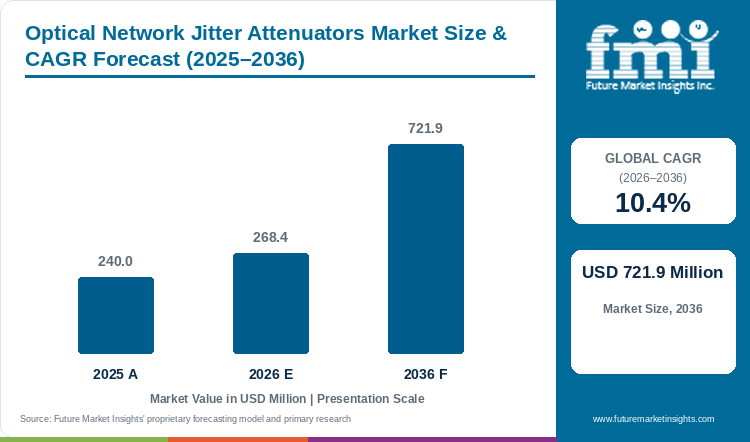
Valued at USD 240.0 million during 2025, the optical network jitter attenuators market reached USD 268.4 million during 2026 and will hit USD 721.9 million by 2036 on a 10.4% CAGR.
Cloud data center operators and telecom carriers are buying precision clock-cleaning chips in rising volume to prevent timing noise from corrupting 800-gigabit and 1.6-terabit fiber transmissions. Hardware releases by Skyworks Solutions in July 2026 introducing NetSync network synchronizers for 800G and 1.6T optical switches show that board architects now place low-noise reference clocks on every high-speed switch blade and pluggable transceiver [1]. Faster optical data lanes leave almost no margin for clock timing drift across switch ports. To keep bit-error rates within strict limits, Sub-55 fs RMS Grade devices are projected to capture 54.8% of phase-jitter demand in 2026 and outpace standard jitter attenuators deployed in legacy telecom shelves. Global optical network jitter attenuators market size stood at USD 240.0 million during 2025 and reached USD 268.4 million during 2026, while FMI projects USD 721.9 million by 2036 on a 10.4% CAGR, yielding USD 453.5 million in cumulative expansion. Even so, costly wafer-level phase-noise screening and heat buildup inside dense server racks remain major hurdles for optical module makers.
Key Market Trends & Insights
- By phase jitter tier: Sub-55 fs RMS Grade is projected to capture 54.8% in 2026 because 224G and 448G PAM4 SerDes lanes in 1.6T switches require ultra-low 12 kHz to 20 MHz phase noise.
- By synchronization compliance: Dual SyncE & PTP is estimated to command 63.5% in 2026 as ITU-T G.8262.1 boundary clocks enforce sub-5-nanosecond packet time alignment.
- By oscillator integration: External Crystal Cleaner is expected to concentrate 49.2% in 2026 while Co-Packaged MEMS & BAW expands at an 11.8% CAGR inside 1MW AI racks.
- By end-use system: Data Center Optical Switches are forecast to generate 57.6% in 2026 owing to high socket density across 51.2T switch blades and retimed OSFP transceivers.
- By sales channel: Direct OEM & Hyperscale accounts for a projected 66.8% during 2026 via custom timing IC qualification programs with cloud switch and optical transport vendors.
Regional Highlights
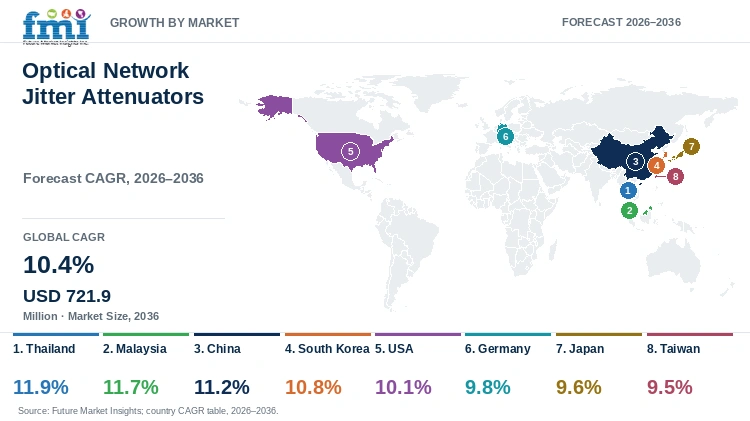
- ASEAN transceiver packaging lead: Thailand paces national optical timing expansion by posting an 11.9% CAGR through 2036 ahead of Malaysia at 11.7% as contract optical transceiver packaging scales.
- East Asian & Western buildout: China registers an 11.2% CAGR until 2036 as South Korea logs 10.8% and the USA records 10.1% with Taiwan at 9.5%.
Market Size & Forecast
Table 1: Market Size and Forecast for the Optical Network Jitter Attenuators Market (USD million and CAGR percentage), 2025 to 2036
| Metric | Value |
|---|---|
| 2025 Market Size | USD 240.0 million |
| Estimated Market Size in 2026 | USD 268.4 million |
| Projected Market Size by 2036 | USD 721.9 million |
| CAGR, 2026 to 2036 | 10.4% |
| Added Valuation, 2026 to 2036 | USD 453.5 million |
High-density artificial intelligence switch fabrics and coherent dense wavelength-division multiplexing links suffer severe signal-eye degradation whenever reference clock phase jitter exceeds 0.015 unit intervals RMS. In September 2026, the Optical Internetworking Forum released its 1600ZR Coherent Interface Implementation Agreement, doubling single-wavelength data center interconnect capacity to 1.6 Tbps and tightening reference clock phase-noise masks [2]. As switch interconnects transition from 112G PAM4 to 224G PAM4 SerDes, line-card architects deploy multi-channel digital phase-locked loops across optical communication and networking equipment. Consequently, merchant timing billings are set to expand from a 2026 valuation of USD 268.4 million up to USD 721.9 million by 2036.
Optical Switch & Transceiver Socket Sizing
Table 2: Global Optical Network Jitter Attenuator Socket Shipments and Blended ASP (USD million and unit ranges), 2025 to 2036
| Metric | 2025 | 2026 | 2036 |
|---|---|---|---|
| Annual Attenuator IC Shipments (Million Units) | 38.7 | 42.6 | 106.2 |
| Blended Average Selling Price (USD per IC) | USD 6.20 | USD 6.30 | USD 6.80 |
| Sub-55 fs Multi-Port Synchronizer ASP (USD) | USD 9.80 | USD 10.40 | USD 11.60 |
| 800G/1.6T Optical Module Attach Rate (%) | 64.0% | 71.5% | 89.0% |
Operational note: Socket shipments reconcile 1-to-2 attenuator ICs per retimed 800G/1.6T pluggable transceiver and 2-to-4 multi-channel network synchronizers per 51.2T/102.4T switch blade or OTN line card.
Unit average selling prices move from a 2025 mean of USD 6.20 up to USD 6.80 in 2036 because higher-priced Co-Packaged MEMS & BAW cleaners and multi-port IEEE 1588 boundary clocks capture a larger slice of shipments. Internal bulk acoustic wave or silicon resonator integration inside the synchronizer package eliminates external quartz crystal board routing and complements standalone precision frequency oscillators across high-vibration server racks.
Line-Card Density & Wafer Test Economics
Table 3: Timing Silicon Content per 51.2 Tbps Switch Rack and OSFP Module (USD and femtoseconds), 2025 to 2036
| Metric | 2025 | 2026 | 2036 |
|---|---|---|---|
| Timing Silicon Value per 51.2T AI Switch Blade (USD) | USD 48.50 | USD 54.20 | USD 76.80 |
| Timing Silicon Value per Retimed 800G/1.6T OSFP (USD) | USD 5.40 | USD 5.80 | USD 6.60 |
| Cross-Correlation Wafer Test Time per Die (Seconds) | 1.45 s | 1.60 s | 2.10 s |
| Average RMS Phase Jitter Floor (12 kHz to 20 MHz) | 68 fs | 52 fs | 24 fs |
Table 4: Manufacturing Cost Structure and Wafer-Level Economics for Optical Jitter Attenuators (USD million and percentage share), 2026
| Metric | Value | Institutional Reference Basis |
|---|---|---|
| Market size, 2026 | USD 268.4 million | 2026 global valuation baseline |
| Mixed-Signal CMOS / SiGe BiCMOS Die | 29.5% of unit cost | Multi-core VCO & fractional-N DPLL wafer die |
| Internal or Co-Packaged BAW / MEMS / Quartz | 22.0% of unit cost | Integrated acoustic or MEMS resonator element |
| Phase-Noise Probe & IEEE 1588 Firmware | 32.0% of unit cost | Cross-correlation wafer sort & PTP servo IP |
Wafer probe and cross-correlation phase-noise screening account for 14.0% to 19.5% of unit manufacturing cost, creating a high barrier to entry against commodity analog suppliers. Every sub-55 fs die requires dual-channel cross-correlation spectrum analyzer verification coupled with fiber optics testing systems to certify 12 kHz to 20 MHz RMS jitter limits before BGA tape-and-reel shipment.
Analyst Perspective
"Transitioning switch SerDes lanes to 224G PAM4 and coherent links to 1600ZR turns the jitter attenuator from a commodity board clock into the primary eye-opening gatekeeper. Suppliers that co-package BAW or silicon MEMS resonators inside the QFN package capture both the synchronizer socket and the quartz crystal bill of materials."
- Sudip Saha, Co-founder, FMI
How is the optical network jitter attenuators market segmented?
The optical network jitter attenuators market is segmented by phase jitter tier, synchronization compliance, oscillator integration, end-use system, and sales channel. In 2026, Sub-55 fs RMS Grade is projected at 54.8%, Dual SyncE & PTP at 63.5%, External Crystal Cleaner at 49.2%, Data Center Optical Switches at 57.6%, and Direct OEM & Hyperscale at 66.8%.
By phase jitter tier: Sub-55 fs RMS Grade, 55-100 fs RMS Grade, 100-150 fs RMS Grade, and Sub-25 fs Coherent Grade.
By synchronization compliance: Dual SyncE & PTP, Free-Running Any-Rate PLL, and OTN Desynchronizer Clocks.
By oscillator integration: External Crystal Cleaner, Co-Packaged MEMS & BAW, and Integrated OCXO & TCXO.
By end-use system: Data Center Optical Switches, O-RAN Fronthaul Radios, OTN & Subsea Terminals, and Coherent Pluggable Modules.
By sales channel: Direct OEM & Hyperscale; Authorized Electronics Distribution; Contract OSAT & EMS; Optical Module ODM Supply; plus Telecom System Integrators.
Why does Sub-55 fs RMS Grade lead the phase jitter tier category?
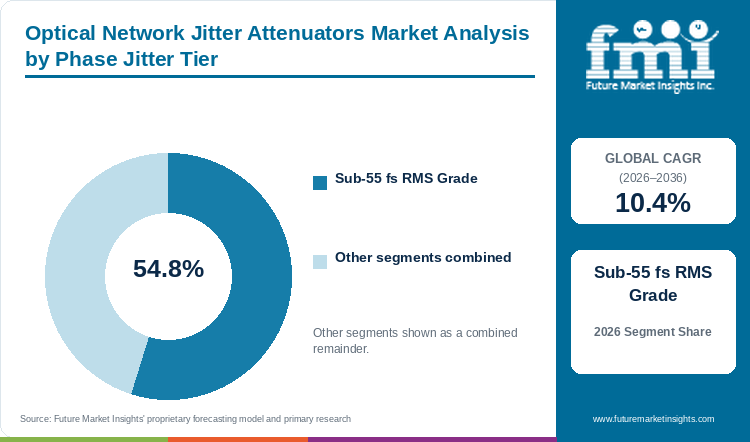
Sub-55 fs RMS Grade tops phase jitter tier demand during 2026 at 54.8% (worth USD 147.1 million) and compounds at an 11.2% CAGR until 2036.
Table 5: Phase Jitter Tier Share for the Optical Network Jitter Attenuators Market (percentage share), 2026
| Phase Jitter Tier | Share (2026) |
|---|---|
| Sub-55 fs RMS Grade | 54.8% |
| Other Segments Combined | 45.2% |
| Total | 100.0% |
*Note: Remaining phase jitter tier categories sum to 100.0% of 2026 market volume.
Table 6: Phase Jitter Tier Leadership and Market Growth for the Optical Network Jitter Attenuators Market (segment and CAGR percentage), 2026 to 2036
| Metric | Value |
|---|---|
| Global CAGR (2026 to 2036) | 10.4% |
| Leading Segment | Sub-55 fs RMS Grade |
Cloud switch architects specify Sub-55 fs RMS Grade multi-channel jitter attenuators delivering 18 fs to 54 fs integrated phase noise across the IEEE 802.3 12 kHz to 20 MHz band so 224G and 448G PAM4 SerDes channels tolerate higher copper trace insertion loss. Multi-core LC voltage-controlled oscillators and isolated on-die low-dropout regulators work with silicon MEMS oscillators to keep transmitter clock jitter below 0.015 UI RMS across 1.6T optical ports.
- Sub-55 fs RMS Grade captures an estimated 54.8% of phase jitter tier billings during 2026 at USD 147.1 million and compounds at 11.2% annually through 2036.
- Quarterly SEC filings from Skyworks Solutions in February 2026 documented USD 1,035.4 million in first-quarter fiscal 2026 revenue and USD 203.4 million in research and development investment supporting sub-55 fs NetSync optical timing platforms [3].
Why does Dual SyncE & PTP define the largest synchronization compliance segment?
Dual SyncE & PTP anchors the synchronization compliance category by capturing 63.5% for 2026 at USD 170.4 million and recording a 10.9% CAGR until 2036.
Converged AI backend fabrics and 5G-Advanced transport rings require simultaneous physical-layer Synchronous Ethernet frequency locking and IEEE 1588v2 Precision Time Protocol nanosecond phase alignment on the same line card. Multi-loop synchronizers embedding three to five independent digital PLL channels pair with optical fiber network latency and time synchronization test equipment to satisfy ITU-T G.8273.2 Class C and Class D boundary clock masks.
- Dual SyncE & PTP holds 63.5% within synchronization compliance for 2026 at USD 170.4 million while recording a 10.9% CAGR through 2036.
- Updated standards published by the International Telecommunication Union in November 2025 under Recommendation ITU-T G.8262.1 mandate passband phase gain below 0.2 dB and limit short-term 15-second phase transients for synchronous equipment clocks [4].
What keeps External Crystal Cleaner ahead by oscillator integration?
External Crystal Cleaner holds 49.2% of 2026 oscillator integration volume (equivalent to USD 132.1 million) while posting an 8.9% CAGR until 2036.
Board layout teams mount the 48 MHz to 156.25 MHz fundamental AT-cut quartz crystal or reference oscillator outside the heat-dissipating 1.2-watt multi-channel DPLL package to minimize self-heating frequency drift and optimize bill-of-materials cost per line card. Meanwhile, Co-Packaged MEMS & BAW cleaners (31.8% share) post the steepest 11.8% annual gain by eliminating exposed PCB crystal traces and complementing high-reliability oscillators in high-vibration 1MW AI racks.
- External Crystal Cleaner concentrates 49.2% of 2026 oscillator integration demand (valued at USD 132.1 million) across core routers and optical transport shelves.
- Financial disclosures in Analog Devices' August 2026 Form 10-Q showed Q3 FY26 revenue reaching USD 4,021.9 million (rising 39.6% over the prior year) on optical communications and AI data center orders for HMC7044 clock cleaners [5].
Why do Data Center Optical Switches lead the end-use system category?
Data Center Optical Switches represent 57.6% of 2026 end-use hardware revenue at USD 154.6 million while logging an 11.3% CAGR until 2036.
Each 51.2 Tbps and 102.4 Tbps AI Ethernet or InfiniBand switch blade integrates two to four multi-channel jitter attenuators on the host motherboard plus one compact clock cleaner inside each of its 32 to 64 retimed 800G or 1.6T OSFP optical transceivers. Beyond cellular fronthaul radios that rely on GPS-disciplined references, cloud switch fabrics represent the highest-volume socket multiplier in optical timing.
- Data Center Optical Switches represent 57.6% of 2026 end-use hardware installations at USD 154.6 million and sustain an 11.3% CAGR until 2036.
- September 2026 Global Summit technical sessions from the Open Compute Project Foundation prioritized 800G/1.6T optical fabrics and Time Appliances Project NIC clock synchronization [6].
What gives Direct OEM & Hyperscale the leading position in sales channel?
Direct OEM & Hyperscale channels capture 66.8% of 2026 sales channel procurement (worth USD 179.3 million), supported by custom OTP frequency plans and multi-year switch qualification.
Switch ASIC vendors and cloud hyperscalers qualify multi-channel network synchronizers 12 to 18 months ahead of blade mass production through direct application-engineering partnerships with mixed-signal IC manufacturers. Direct supply contracts lock in custom OTP frequency plans and IEEE 1588 servo firmware licenses across multi-year rack deployments.
- Direct OEM & Hyperscale commands 66.8% of 2026 sales channel procurement at USD 179.3 million, leaving 33.2% to franchised distributors and OSAT or module partners.
- Synchronization software updates from Microchip Technology in June 2026 introduced the TimePictra 12 management platform for direct carrier and hyperscale timing infrastructure orchestration [7].
What are the drivers, restraints, and opportunities in the optical network jitter attenuators market?
Demand expansion is anchored by 224G/448G PAM4 SerDes eye-margin compression and ITU-T G.8262.1 eOEC synchronization mandates, moderated by cross-correlation wafer-test costs, and accelerated by co-packaged BAW and silicon MEMS resonators.
- Driver: Migration to 224G/448G PAM4 SerDes and OIF 1600ZR coherent DWDM interfaces makes sub-55 fs RMS clock cleaning and ITU-T G.8262.1 boundary clocks mandatory across optical switches and transceivers.
- Restraint: Dual-channel cross-correlation phase-noise wafer probe testing and localized 1MW AI rack thermal airflow gradients raise unit test cost and free-running frequency drift.
- Opportunity: Co-packaging thin-film bulk acoustic wave (BAW) and titanium-doped silicon MEMS resonators inside the DPLL package eliminates discrete quartz crystals inside 800G and 1.6T OSFP modules.
Growth Analysis and Future Potential: Qualitative Demand Catalysts
Four-level pulse amplitude modulation at 106.25 GBaud and 212.5 GBaud symbol rates introduces a 9.54 dB vertical eye-opening penalty compared with non-return-to-zero transmission, leaving less than 150 femtoseconds of total transmitter clock jitter margin. In September 2026, the National Institute of Standards and Technology released its O-RAN Cybersecurity and Synchronization Profile (Draft NIST IR 8623), enforcing strict time-error budgets across 5G-Advanced fronthaul networks [8]. Simultaneously, the Optical Internetworking Forum's 1600ZR Coherent Interface Implementation Agreement doubles single-wavelength data center interconnect capacity to 1.6 Tbps over 120 kilometers and requires ultra-pure any-rate reference clocks linked with wireless synchronized clocks.
Risk Assessment of the Optical Network Jitter Attenuators Market: Operational and Engineering Friction
Localized thermal transients inside high-density pluggable optical cages and the capital intensity of 100% phase-noise wafer probing represent the primary barriers restraining margin expansion. Wafer-level verification of sub-55 fs RMS phase jitter requires 1.6 to 2.1 seconds of cross-correlation measurement per die across all-digital RF and mixed-signal test benches, consuming nearly one-fifth of total manufacturing cost [9]. When 64 pluggable 800G or 1.6T modules operate beside liquid-cooled AI accelerators inside a 1MW rack, airflow switching creates 5°C-per-second thermal gradients across high-speed optical transceivers that induce transient frequency wander in external quartz crystals.
Commercial Opportunity Analysis: Architecture Differentiation and Value-Add Formats
Mixed-signal timing semiconductor vendors earn 35% to 50% average selling price premiums by co-packaging bulk acoustic wave (BAW) or silicon MEMS resonators directly inside the multi-channel jitter attenuator BGA package. Following SiTime Corporation's July 2026 completion of its USD 1,500.0 million acquisition of Renesas Electronics' timing division, integrated MEMS-plus-ClockMatrix synchronizers are being cross-sold across more than 10,000 cloud and telecom customers [10]. Elimination of external quartz crystal footprints saves 15 to 25 square millimeters of printed circuit board area inside cramped 8.5-millimeter-wide optical transmitter modules while improving shock and vibration immunity tenfold.
Optical Network Jitter Attenuators Market by Country (2026 to 2036)
High-volume contract optical transceiver packaging puts Thailand first among national optical timing markets by posting an 11.9% CAGR through 2036, whereas Taiwan logs a 9.5% CAGR. Global consumption divides between OSAT and white-box switch assembly hubs in ASEAN and East Asia and hyperscale architecture engineering centers in the USA and Germany.
Table 7: Country CAGR and Primary Growth Levers for the Optical Network Jitter Attenuators Market (CAGR percentage and operational drivers), 2026 to 2036
| Country | CAGR (2026 to 2036) | Primary Growth Lever |
|---|---|---|
| Thailand | 11.9% | 800G & 1.6T Pluggable Optical Transceiver OSAT Assembly |
| Malaysia | 11.7% | Co-Packaged MEMS/BAW Packaging & Optical Switch Blades |
| China | 11.2% | Metro DWDM OTN Upgrades & 5G-Advanced O-RAN Radios |
| South Korea | 10.8% | 5G-Advanced O-RAN Boundary Clocks & AI Optical Transceivers |
| USA | 10.1% | Sub-55 fs AI Switch Blades & 1600ZR Coherent DSPs |
| Germany | 9.8% | Industrial Packet-Optical Rings & Carrier SyncE Clocks |
| Japan | 9.6% | IOWN All-Photonics Network & Ultra-Pure Quartz Cleaners |
| Taiwan | 9.5% | White-Box 800G/1.6T Switch ODM Line Cards |
Source: Future Market Insights analysis
Thailand Optical Network Jitter Attenuators Market Outlook (2026 to 2036)
Unlike design-led countries that consume multi-port host switch synchronizers, contract optical packaging campuses in Pathum Thani and Chonburi predominantly procure bare-die and ultra-small QFN any-rate clock cleaners mounted beside coherent digital signal processor dies inside OSFP housings. Audited Form 10-K disclosures filed by Diodes Incorporated in February 2026 documented USD 1,482.1 million in full-year 2025 revenue with 78.0% of billings concentrated across Asian optical module and electronics assembly corridors [11]. Specialized 800G and 1.6T pluggable transceiver assembly propels Thailand at a top-ranked 11.9% CAGR spanning 2026 through 2036. Duty-free customs zones for imported mixed-signal wafers and automated active optical alignment lines push unit volume upward, whereas shortages of radio-frequency test engineers moderate surface-mount throughput across local plants.
Key takeaway: In Thailand, contract optical transceiver factories in Pathum Thani drive industry-leading unit consumption of compact sub-55 fs clock cleaners.
Malaysia Optical Network Jitter Attenuators Market Outlook (2026 to 2036)
What differentiates Malaysia from pure box-build hubs is the co-location of outsourced flip-chip BGA timing IC packaging and automated wafer-test floors in Penang and Kulim with optical switch board assembly. July 2026 earnings releases from Texas Instruments showing Q2 2026 revenue at USD 5,463.0 million (up 23.0% year-on-year) reflected high-volume 300mm BAW synchronizer fabrication and backend test throughput in Malaysia [12]. Optical timing shipments across Malaysia climb at an 11.7% CAGR spanning 2026 to 2036 through co-packaging of silicon MEMS and bulk acoustic wave resonators with CMOS digital phase-locked loop dies. Direct bonded-warehouse transfers from local OSAT test houses to Bayan Lepas switch plants cut freight lead times by three weeks, although rising cleanroom electricity tariffs constrain packaging yields.
Key takeaway: In Malaysia, co-located OSAT phase-noise test floors and optical switch EMS plants in Penang accelerate multi-port synchronizer consumption.
China Optical Network Jitter Attenuators Market Outlook (2026 to 2036)
Consumption across China splits between export-oriented 800G DR8 transceiver factories in Wuhan and Suzhou and state-directed 400G/800G dense wavelength-division multiplexing backbone tenders awarded by provincial telecom carriers. SiTime Corporation's Form 10-K filed in February 2026 documented USD 261.6 million in fiscal 2025 revenue (up 29.0% year-on-year) driven by optical transceiver and AI data center timing demand across Asian contract assembly hubs [13]. Domestic optical transport vendors design high-channel-count ITU-T G.8262.1 clock cleaners into metro packet-optical cross-connects and 5G-Advanced base-station timing cards, lifting China at an 11.2% CAGR across the ten-year horizon. High-volume 800G optical module shipments sustain baseline orders, although export licensing rules on 224G SerDes test instruments temper top-tier switch line-card upgrades.
Key takeaway: In China, optical module hubs in Wuhan and Shenzhen pair with provincial DWDM tenders to sustain high-volume synchronizer procurement.
South Korea Optical Network Jitter Attenuators Market Outlook (2026 to 2036)
Telecom equipment manufacturers and hyperscale memory-cluster builders in Seoul and Gyeonggi-do are scaling 5G-Advanced O-RAN fronthaul radios and 800G optical switch fabrics, lifting South Korea at a 10.8% CAGR until 2036. Amendment 3 to Recommendation ITU-T G.8271.1 published by the International Telecommunication Union in May 2025 tightened network time-synchronization limits across packet networks with full timing support, driving mobile carrier adoption of Class C boundary clocks across dense urban cloud-RAN nodes [14]. Simultaneously, domestic optical transceiver suppliers qualifying 800G DR8 and 1.6T pluggable modules for artificial intelligence data centers procure compact sub-55 fs QFN clock cleaners. Heavy dependence on imported United States and Japan mixed-signal timing dies remains the primary domestic component supply bottleneck for local optical module assemblers.
Key takeaway: In South Korea, 5G-Advanced O-RAN fronthaul synchronization and AI data center optical module assembly anchor a 10.8% CAGR through 2036.
USA Optical Network Jitter Attenuators Market Outlook (2026 to 2036)
Unlike contract manufacturing hubs in Asia, the USA is the global specification and premium-ASP anchor where cloud hyperscalers in California and Virginia lock in reference designs for 51.2 Tbps and 102.4 Tbps switch blades. Federal timing initiatives under NIST Draft IR 8623 in September 2026 and NIST microchip optical frequency comb advances in October 2026 simultaneously push defense and O-RAN operators toward GPS-independent IEEE 1588v2 boundary clocks [15]. Skyworks Solutions generated USD 805.7 million of its USD 1,035.4 million Q1 FY26 revenue in the USA while Texas Instruments received USD 850.0 million in CHIPS Act cash benefits. Optical timing demand across the USA posts a 10.1% CAGR to 2036.
Key takeaway: In the USA, cloud switch reference designs and federal O-RAN timing profiles anchor premium sub-55 fs design-ins.
Germany Optical Network Jitter Attenuators Market Outlook (2026 to 2036)
Strict sovereign cloud timing mandates in Frankfurt am Main and nationwide High-Accuracy Time Transfer optical fiber ring deployments lift Germany at a 9.8% CAGR during 2026 through 2036. Product announcements from Diodes Incorporated in May 2026 introducing sub-30-femtosecond PCIe 7.0 and optical interconnect clock generators reflect accelerating server and packet-optical hardware upgrades across European colocation hubs [16]. Rather than competing on pluggable module assembly volume, telecom carriers and industrial automation firms in Munich and Berlin specify multi-loop SyncE and PTP synchronizers that hold sub-5-nanosecond time error across power-grid and railway fiber backbones. This regulatory focus on terrestrial GNSS backup pushes average selling prices 25% above the global mean, although protracted carrier qualification cycles and elevated industrial electricity tariffs slow brownfield central-office retrofits.
Key takeaway: In Germany, Frankfurt hyperscale interconnect hubs and carrier HA-TT optical rings drive demand for dual SyncE and PTP synchronizers.
Japan Optical Network Jitter Attenuators Market Outlook (2026 to 2036)
Vertical control over ultra-pure synthetic quartz autoclaves and the national rollout of the IOWN all-photonics transport architecture across Tokyo and Osaka set Japan apart within the global optical timing supply chain. Corporate disclosures from Renesas Electronics in February 2026 announcing the definitive agreement to transfer its ClockMatrix timing division to SiTime Corporation established a strategic partnership to embed MEMS resonators inside Renesas network processors [17]. Network synchronizer shipments across Japan progress at a 9.6% CAGR during 2026 through 2036 inside low-latency metropolitan optical cross-connects and international transpacific submarine cable landing stations. Multi-year domestic supply contracts lock in high-reliability optical line-card sockets, even while aging field-engineering workforces slow rural cellular base-station fiber timing upgrades across regional prefectures.
Key takeaway: In Japan, all-photonics metro network upgrades and domestic synthetic quartz expertise sustain high-reliability optical clock cleaner adoption.
Taiwan Optical Network Jitter Attenuators Market Outlook (2026 to 2036)
White-box switch contract engineers in Hsinchu and Taoyuan assemble more than 65% of global 800G and 1.6T data center Ethernet switches shipped to cloud service providers in the USA. August 2026 Nature Communications findings by Ko and colleagues demonstrated hybrid piezoelectric acoustic resonator integration with CMOS power and timing stages, reinforcing wafer-level co-packaging across Hsinchu and Tainan foundries [18]. Optical clock cleaner demand in Taiwan rises at a 9.5% CAGR over 2026 to 2036 across bare-metal artificial intelligence switch motherboards and Open Compute Project Gen 7 network interface cards. High-density switch blade production sustains multi-port synchronizer orders across Taipei ODMs, though tight 28nm and 65nm foundry wafer allocation against AI processors occasionally extends delivery lead times.
Key takeaway: In Taiwan, white-box AI switch ODMs in Hsinchu and Taoyuan anchor board-level integration for multi-output synchronizers.
Full report country CAGRs cover: North America; Latin America; Western Europe; Eastern Europe; East Asia; South Asia and Pacific; Middle East and Africa.
Who are the notable companies in the optical network jitter attenuators market?
Skyworks Solutions, Inc.; SiTime Corporation (including Renesas Timing); Texas Instruments Incorporated; Microchip Technology Inc.; Analog Devices, Inc.; Diodes Incorporated; Seiko Epson Corporation; and Abracon LLC are the notable companies in the optical network jitter attenuators market.
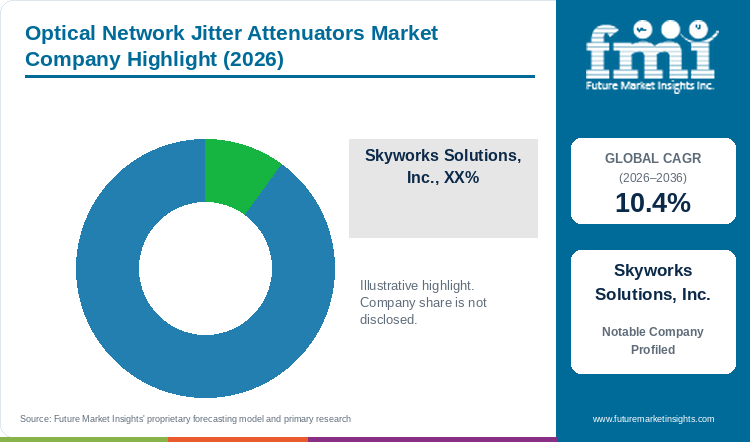
FMI analysis shows a tightly consolidated supplier hierarchy where the top five mixed-signal timing chipmakers hold 78.5% of 2026 global billings across hyperscale switch and carrier OTN accounts. Competition centers on sub-55 fs RMS 224G PAM4 phase-noise floors and ITU-T G.8262.1 boundary clock servo firmware.
- Tier 1 Hyperscale & Coherent Timing Leaders (64.5% Combined Share): Skyworks Solutions (23.5%) and SiTime including Renesas Timing (21.0%) with Microchip Technology (20.0%) dominate sub-55 fs multi-port network synchronizers.
- Tier 2 Integrated Resonator & Mixed-Signal Challengers (20.5% Group Share): Texas Instruments at 13.0% and Diodes Incorporated at 7.5% specialize in co-packaged BAW cleaners and PCIe Gen 6 or Ethernet optical clock generators.
- Tier 3 Specialty Rubidium & Telecom Holdover Vendors (15.0% Combined Share): Analog Devices and Seiko Epson with Abracon supply specialized defense and subsea DWDM synchronization sockets.
Competitive Benchmarking: Optical Network Jitter Attenuators Market
Table 8: Competitive Benchmarking for the Optical Network Jitter Attenuators Market (qualitative capability ratings), 2026
| Company | Sub-55 fs 224G PAM4 IP | Co-Packaged MEMS/BAW Depth | ITU-T G.8262.1 & PTP Servo | Geographic Reach |
|---|---|---|---|---|
| Skyworks Solutions, Inc. | High | Medium | High | High |
| SiTime Corporation | High | High | High | High |
| Texas Instruments Inc. | High | High | Medium | High |
| Microchip Technology Inc. | High | Medium | High | High |
| Analog Devices, Inc. | High | Medium | Medium | High |
| Diodes Incorporated | Medium | Low | Medium | High |
| Seiko Epson Corporation | High | High | Low | High |
| Abracon LLC | Medium | Medium | Low | Medium |
Scoring basis: Capability scores and vendor shares are cross-checked against audited 2025 and 2026 corporate SEC filings and OIF 1600ZR pluggable interoperability rosters.
Key Developments in the Optical Network Jitter Attenuators Market
- Renesas Electronics Corporation and SiTime Corporation completed the USD 1,500.0 million transfer of Renesas' timing business in July 2026, integrating 8A34001 ClockMatrix network synchronizers with silicon MEMS resonators [19].
- Analog Devices, Inc. announced in July 2026 its third-quarter fiscal 2026 financial release schedule following strong communications and AI data center demand across HMC7044 and ADF4382A ultra-low-jitter clock cleaners [20].
- In May 2026, Diodes Incorporated posted over 20% year-on-year first-quarter top-line growth supported by sub-30 fs PCIe Gen 7 and optical switch clock generators [21].
Key Players in the Optical Network Jitter Attenuators Market
Tier 1 Multi-Port Network Synchronizer Leaders
- Skyworks Solutions, Inc.
- SiTime Corporation (including Renesas Timing)
- Microchip Technology Inc.
Tier 2 Co-Packaged BAW & Mixed-Signal Clock Leaders
- Texas Instruments Incorporated
- Analog Devices, Inc.
- Diodes Incorporated
Tier 3 Precision Quartz & Holdover Oscillator Specialists
- Seiko Epson Corporation
- Abracon LLC
Optical Network Jitter Attenuators Market - Report Scope
Table 9: Report Scope for the Optical Network Jitter Attenuators Market (coverage fields and definitions), 2026 to 2036
| Coverage field | Report scope |
|---|---|
| Market breakdown | Phase Jitter Tier; Synchronization Compliance; Oscillator Integration; End-Use System; Sales Channel |
| Quantitative Units | USD Million |
| Market Definition | Includes merchant mixed-signal jitter attenuator ICs, network synchronizers (SyncE/IEEE 1588), and co-packaged MEMS/BAW optical clock cleaners deployed in optical switches, pluggable transceivers, O-RAN fronthaul, and DWDM transport. Category Scope Note: Excludes un-attenuated standalone quartz crystal blanks and non-optical consumer audio/video clock generators. |
| Regions Covered | North America; Latin America; Western Europe; Eastern Europe; East Asia; South Asia and Pacific; Middle East and Africa |
| Countries Covered | Thailand, Malaysia, China, South Korea, USA, Germany, Japan, Taiwan, and additional countries in the full report |
| Key Companies Covered | Skyworks Solutions, Inc.; SiTime Corporation; Texas Instruments Incorporated; Microchip Technology Inc.; Analog Devices, Inc.; Diodes Incorporated; Seiko Epson Corporation; Abracon LLC |
| Forecast Period | 2026 to 2036 |
| Approach | Primary and secondary research with top-down parent-market cap checks and bottom-up optical switch and transceiver socket triangulation. |
Optical Network Jitter Attenuators Market - Research Methodology
Table 10: Research Methodology for the Optical Network Jitter Attenuators Market (research methods and approach), 2026 edition
| Method | Approach |
|---|---|
| Primary Research | Structured interviews with hyperscale switch hardware architects, 800G/1.6T optical module DSP engineers, carrier synchronization directors, and OSAT phase-noise test managers to validate socket density and unit pricing. |
| Secondary Research | Analysis of SEC Form 10-K/10-Q filings (Skyworks, SiTime, TI, Microchip, Analog Devices, Diodes), ITU-T G.8262.1/G.8271.1 standards, OIF 1600ZR implementation agreements, and OCP Time Appliances Project specifications. |
| Market Sizing and Forecasting | Top-down parent Jitter Attenuators Market (USD 501.9 million in 2025; optical network share = 47.8%) models reconciled against bottom-up 51.2T/102.4T switch blades, 800G/1.6T OSFP ports, and O-RAN/DWDM line cards from 2026 to 2036. |
| Country Forecasting Model | Econometric country projections weight optical transceiver OSAT packaging capacity, white-box switch ODM assembly, carrier O-RAN fronthaul rollouts, and sovereign DWDM upgrades across eight national markets. |
| Operational Benchmark Traceability | Socket shipment, ASP, and wafer test cost indicators in Tables 2, 3, and 4 trace to Skyworks NetSync disclosures, SiTime-Renesas transaction filings, OIF 1600ZR documentation, and IEEE phase-noise test benchmarks. |
| Data Triangulation and Validation | Demand estimates are cross-checked against merchant timing segment billings without double counting standalone un-attenuated quartz crystals or host SerDes CDR blocks. |
Optical Network Jitter Attenuators Market by Segments
Optical Network Jitter Attenuators Market segmented by Phase Jitter Tier:
- Sub-55 fs RMS Grade
- 55-100 fs RMS Grade
- 100-150 fs RMS Grade
- Sub-25 fs Coherent Grade
Optical Network Jitter Attenuators Market segmented by Synchronization Compliance:
- Dual SyncE & PTP
- Free-Running Any-Rate PLL
- OTN Desynchronizer Clocks
Optical Network Jitter Attenuators Market segmented by Oscillator Integration:
- External Crystal Cleaner
- Co-Packaged MEMS & BAW
- Integrated OCXO & TCXO
Optical Network Jitter Attenuators Market segmented by End-Use System:
- Data Center Optical Switches
- O-RAN Fronthaul Radios
- OTN & Subsea Terminals
- Coherent Pluggable Modules
Optical Network Jitter Attenuators Market segmented by Sales Channel:
- Direct OEM & Hyperscale
- Authorized Electronics Distribution
- Contract OSAT & EMS
- Optical Module ODM Supply
- Telecom System Integrators
Optical Network Jitter Attenuators Market by Region
- North America
- United States
- Canada
- Latin America
- Brazil
- Mexico
- Argentina
- Chile
- Western Europe
- Germany
- France
- United Kingdom
- Italy
- Spain
- Benelux
- Nordics
- Eastern Europe
- Poland
- Czech Republic
- Romania
- Hungary
- East Asia
- China
- Japan
- South Korea
- South Asia and Pacific
- India
- ASEAN
- Australia and New Zealand
- Middle East and Africa
- GCC Countries
- South Africa
- Türkiye
- Israel
Research Sources and Bibliography
- [1] Skyworks Solutions, Inc. (2026, July 23). Skyworks Introduces New NetSync™ Network Synchronizers Available Now For AI Data Centers and Time-Sensitive Infrastructure. Skyworks Investor Relations.
- [2] Optical Internetworking Forum. (2026, September 9). OIF Releases Critical 1600ZR Coherent Interface IA, Doubling Capacity per Wavelength for Data Center Interconnects. Optical Internetworking Forum.
- [3] Skyworks Solutions, Inc. (2026, February 5). Form 10-Q Quarterly Report for the Quarterly Period Ended January 2, 2026. U.S. Securities and Exchange Commission EDGAR.
- [4] International Telecommunication Union. (2025, November 29). Recommendation ITU-T G.8262.1 (11/2025): Timing characteristics of enhanced synchronous equipment clocks. ITU Publications.
- [5] Analog Devices, Inc. (2026, August 18). Form 10-Q Quarterly Report for the Quarterly Period Ended August 1, 2026. U.S. Securities and Exchange Commission EDGAR.
- [6] Open Compute Project Foundation. (2026, September 30). Explore 22 Tracks at the 2026 OCP Global Summit. Open Compute Project News.
- [7] Microchip Technology Inc. (2026, June 9). Microchip Announces the TimePictra® 12 Platform to Strengthen Synchronization Management for Critical Infrastructure. Microchip Investor Relations.
- [8] National Institute of Standards and Technology. (2026, September 17). Cybersecurity Framework 2.0 Community Profile for Federal Agency O-RAN Deployment (Initial Public Draft NIST IR 8623). NIST Computer Security Resource Center.
- [9] Long, B., Chen, W., Hu, Z., Bai, Y., Liu, D., & Liu, H. (2025, March 19). An all-digital RF transmitter architecture based on jitter-enhanced PWM for flexible frequency applications. Scientific Reports, 15, Article 9433 (PMC11923068).
- [10] SiTime Corporation. (2026, July 1). SiTime Completes Acquisition of Renesas' Timing Business. SiTime Newsroom.
- [11] Diodes Incorporated. (2026, February 12). Form 10-K Annual Report for the Fiscal Year Ended December 31, 2025. U.S. Securities and Exchange Commission EDGAR.
- [12] Texas Instruments Incorporated. (2026, July 22). TI reports second quarter 2026 financial results and shareholder returns. Texas Instruments Newsroom.
- [13] SiTime Corporation. (2026, February 18). Form 10-K Annual Report for the Fiscal Year Ended December 31, 2025. U.S. Securities and Exchange Commission EDGAR.
- [14] International Telecommunication Union. (2025, May 14). Recommendation ITU-T G.8271.1/Y.1366.1 Amendment 3 (05/2025): Network limits for time synchronization in packet networks with full timing support from the network. ITU Publications.
- [15] National Institute of Standards and Technology. (2026, October 16). New Chip-Based 'Tape Measure' for Light Could Transform Mobile Timekeeping and Improve National Security. NIST News.
- [16] Diodes Incorporated. (2026, May 6). PCIe® 7.0 Clock Generator from Diodes Incorporated Delivers Sub-30fs Jitter. Diodes Investor Relations.
- [17] Renesas Electronics Corporation. (2026, February 5). SiTime to Acquire Renesas' Timing Business. Renesas Newsroom.
- [18] Ko, J. Y., et al. (2026, August 7). A hybrid piezoelectric resonator-based DC-DC converter. Nature Communications, 17(1), 4054 (PMC13139477).
- [19] Renesas Electronics Corporation. (2026, July 1). UPDATE: Notice Regarding Completion of Business Transfer of Consolidated Subsidiary. Renesas Newsroom.
- [20] Analog Devices, Inc. (2026, July 23). Analog Devices to Report Third Quarter Fiscal Year 2026 Financial Results on Wednesday, August 19, 2026. Analog Devices Newsroom.
- [21] Diodes Incorporated. (2026, May 7). Diodes Incorporated Reports First Quarter 2026 Financial Results. Diodes Investor Relations.
- [22] Seiko Epson Corporation. (2026, February 12). Epson Develops Compact TG1210SRN and TG1210STN TCXOs for High-Precision Communication and GNSS Systems. Seiko Epson Newsroom.
- [23] Abracon LLC. (2025, December 8). Abracon Strengthens Global Supply Chain and Quick-Turn Capabilities to Support Growing MEMS Oscillator Demand. Abracon Newsroom.
This bibliography is provided for reader reference and is not exhaustive. The full report contains the complete reference list and detailed citations.
This Report Answers
- How big is the global optical network jitter attenuators market in 2025, 2026, and 2036, and what is the 10-year CAGR?
- Why does migrating from 112G to 224G PAM4 SerDes make sub-55 fs RMS jitter attenuation mandatory?
- Why does Dual SyncE & PTP lead the synchronization compliance taxonomy in 2026?
- How did SiTime Corporation's July 2026 acquisition of Renesas Electronics' timing business reshape supplier market shares?
- Which ASEAN and East Asian contract packaging corridors record the fastest country-level growth through 2036?
- How much board area and phase-hit risk do co-packaged BAW and MEMS resonators eliminate inside 1MW AI racks?
- What technical constraints does ITU-T Recommendation G.8262.1 impose on optical timing ICs?
- What qualification gates protect incumbent timing socket share on 800G and 1.6T switch blades?
Frequently Asked Questions
What is the size of the global optical network jitter attenuators market in 2025, 2026, and 2036?
Optical network jitter attenuator billings stood at USD 240.0 million in 2025 and reach USD 268.4 million in 2026, before climbing to USD 721.9 million by 2036 on a 10.4% CAGR.
How does the optical network jitter attenuators market relate to the broader jitter attenuators parent market?
Optical timing chips account for 47.8% of the broader Jitter Attenuators Market (USD 501.9 million in 2025 and projected at USD 1,005.9 million by 2035 on a 7.2% CAGR) due to 800G and 1.6T optical SerDes upgrades.
Which phase jitter tier holds the largest market share in 2026?
Sub-55 fs RMS Grade clock cleaners capture 54.8% of 2026 demand (USD 147.1 million) because 224G PAM4 SerDes lanes and OIF 1600ZR coherent DSPs require sub-55 fs RMS phase noise over 12 kHz to 20 MHz.
Why does Dual SyncE & PTP dominate the synchronization compliance taxonomy?
Dual SyncE & PTP holds 63.5% of 2026 valuation (USD 170.4 million) because cloud and telecom operators require simultaneous ITU-T G.8262.1 physical-layer frequency locking and IEEE 1588v2 nanosecond phase alignment on one chip.
How did the July 2026 SiTime-Renesas acquisition change the competitive market?
Completed in July 2026 for USD 1,500.0 million in cash plus 4.13 million SiTime shares, the transaction combined Renesas' 8A34001 ClockMatrix network synchronizers with SiTime's MEMS resonators to form a USD 300.0 million timing unit.
Which countries record the fastest CAGR between 2026 and 2036?
Thailand ranks first at an 11.9% CAGR and Malaysia follows at 11.7%, supported by outsourced 800G and 1.6T optical transceiver assembly and backend OSAT phase-noise testing in Pathum Thani and Penang.
Preview the report firsthand - request a free sample
Get SampleGet the brochure for pricing and purchase details.
Get PDFTable of Content
- Key Takeaways
- Market Size and CAGR
- Top Growth Driver
- Fastest Growing Segment
- Leading Region
- Key Companies
- Emerging Opportunities
- Executive Summary
- Global Market Outlook
- Demand-side Trends
- Supply-side Trends
- Technology Roadmap Analysis
- Analysis and Recommendations
- Analyst Perspective (What is happening? Why now? What should investors know?)
- Key Questions Answered
- How large is the market?
- What is the CAGR?
- What are key trends?
- Which region dominates?
- Who are the leaders?
- Market Overview
- Market Coverage / Taxonomy
- Market Definition / Scope / Limitations
- Research Methodology
- Chapter Orientation
- Analytical Lens and Working Hypotheses
- Market Structure, Signals, and Trend Drivers
- Benchmarking and Cross-market Comparability
- Market Sizing, Forecasting, and Opportunity Mapping
- Research Design and Evidence Framework
- Desk Research Programme (Secondary Evidence)
- Expert Input and Fieldwork (Primary Evidence)
- Tooling, Models, and Reference Databases
- Data Engineering and Model Build
- Quality Assurance and Audit Trail
- Market Background
- Market Dynamics (Drivers, Restraints, Opportunity, Trends)
- Scenario Forecast (Optimistic, Likely, Conservative)
- Impact Analysis
- AI Impact
- Sustainability Impact
- Regulatory Impact
- Technology Impact
- Consumer / Buyer Analysis
- Purchase Drivers
- Adoption Barriers
- Buyer Journey
- Opportunity Map Analysis
- Product Life Cycle Analysis
- Supply Chain Analysis
- Investment Feasibility Matrix
- Value Chain Analysis
- PESTLE and Porter's Analysis
- Regulatory Landscape
- Regional Parent Market Outlook
- Production and Consumption Statistics
- Import and Export Statistics
- Global Market Analysis and Forecast, 2021 to 2036
- Historical Market Size Value (USD Million) Analysis, 2021 to 2025
- Current and Future Market Size Value (USD Million) Projections, 2026 to 2036
- Y-o-Y Growth Trend Analysis
- Absolute $ Opportunity Analysis
- Global Market Pricing Analysis, 2021 to 2036
- Global Market Analysis and Forecast, By Phase Jitter Tier, 2021 to 2036
- Introduction / Key Findings
- Historical Market Size Value (USD Million) Analysis By Phase Jitter Tier, 2021 to 2025
- Current and Future Market Size Value (USD Million) Analysis and Forecast By Phase Jitter Tier, 2026 to 2036
- Sub-55 fs RMS Grade
- 55-100 fs RMS Grade
- 100-150 fs RMS Grade
- Sub-25 fs Coherent Grade
- Y-o-Y Growth Trend Analysis By Phase Jitter Tier, 2021 to 2025
- Absolute $ Opportunity Analysis By Phase Jitter Tier, 2026 to 2036
- Global Market Analysis and Forecast, By Synchronization Compliance, 2021 to 2036
- Introduction / Key Findings
- Historical Market Size Value (USD Million) Analysis By Synchronization Compliance, 2021 to 2025
- Current and Future Market Size Value (USD Million) Analysis and Forecast By Synchronization Compliance, 2026 to 2036
- Dual SyncE & PTP
- Free-Running Any-Rate PLL
- OTN Desynchronizer Clocks
- Y-o-Y Growth Trend Analysis By Synchronization Compliance, 2021 to 2025
- Absolute $ Opportunity Analysis By Synchronization Compliance, 2026 to 2036
- Global Market Analysis and Forecast, By Oscillator Integration, 2021 to 2036
- Introduction / Key Findings
- Historical Market Size Value (USD Million) Analysis By Oscillator Integration, 2021 to 2025
- Current and Future Market Size Value (USD Million) Analysis and Forecast By Oscillator Integration, 2026 to 2036
- External Crystal Cleaner
- Co-Packaged MEMS & BAW
- Integrated OCXO & TCXO
- Y-o-Y Growth Trend Analysis By Oscillator Integration, 2021 to 2025
- Absolute $ Opportunity Analysis By Oscillator Integration, 2026 to 2036
- Global Market Analysis and Forecast, By End-Use System, 2021 to 2036
- Introduction / Key Findings
- Historical Market Size Value (USD Million) Analysis By End-Use System, 2021 to 2025
- Current and Future Market Size Value (USD Million) Analysis and Forecast By End-Use System, 2026 to 2036
- Data Center Optical Switches
- O-RAN Fronthaul Radios
- OTN & Subsea Terminals
- Coherent Pluggable Modules
- Y-o-Y Growth Trend Analysis By End-Use System, 2021 to 2025
- Absolute $ Opportunity Analysis By End-Use System, 2026 to 2036
- Global Market Analysis and Forecast, By Sales Channel, 2021 to 2036
- Introduction / Key Findings
- Historical Market Size Value (USD Million) Analysis By Sales Channel, 2021 to 2025
- Current and Future Market Size Value (USD Million) Analysis and Forecast By Sales Channel, 2026 to 2036
- Direct OEM & Hyperscale
- Authorized Electronics Distribution
- Contract OSAT & EMS
- Optical Module ODM Supply
- Telecom System Integrators
- Y-o-Y Growth Trend Analysis By Sales Channel, 2021 to 2025
- Absolute $ Opportunity Analysis By Sales Channel, 2026 to 2036
- Global Market Analysis and Forecast, By Region, 2021 to 2036
- Introduction
- Historical Market Size Value (USD Million) Analysis By Region, 2021 to 2025
- Current Market Size Value (USD Million) Analysis and Forecast By Region, 2026 to 2036
- North America
- Latin America
- Western Europe
- Eastern Europe
- East Asia
- South Asia and Pacific
- Middle East and Africa
- Market Attractiveness Analysis By Region
- North America Market Analysis and Forecast, By Country, 2021 to 2036
- Historical Market Size Value (USD Million) Trend Analysis By Market Taxonomy, 2021 to 2025
- Market Size Value (USD Million) Forecast By Market Taxonomy, 2026 to 2036
- By Country
- United States
- Canada
- By Phase Jitter Tier
- By Synchronization Compliance
- By Oscillator Integration
- By End-Use System
- By Sales Channel
- By Country
- Market Attractiveness Analysis
- By Country
- By Phase Jitter Tier
- By Synchronization Compliance
- By Oscillator Integration
- By End-Use System
- By Sales Channel
- Key Takeaways
- Latin America Market Analysis and Forecast, By Country
- Historical Market Size Value (USD Million) Trend Analysis By Market Taxonomy, 2021 to 2025
- Market Size Value (USD Million) Forecast By Market Taxonomy, 2026 to 2036
- By Country
- Brazil
- Mexico
- Argentina
- Chile
- By Phase Jitter Tier
- By Synchronization Compliance
- By Oscillator Integration
- By End-Use System
- By Sales Channel
- By Country
- Market Attractiveness Analysis
- By Country
- By Phase Jitter Tier
- By Synchronization Compliance
- By Oscillator Integration
- By End-Use System
- By Sales Channel
- Key Takeaways
- Western Europe Market Analysis and Forecast, By Country
- Historical Market Size Value (USD Million) Trend Analysis By Market Taxonomy, 2021 to 2025
- Market Size Value (USD Million) Forecast By Market Taxonomy, 2026 to 2036
- By Country
- Germany
- France
- United Kingdom
- Italy
- Spain
- Benelux
- Nordics
- By Phase Jitter Tier
- By Synchronization Compliance
- By Oscillator Integration
- By End-Use System
- By Sales Channel
- By Country
- Market Attractiveness Analysis
- By Country
- By Phase Jitter Tier
- By Synchronization Compliance
- By Oscillator Integration
- By End-Use System
- By Sales Channel
- Key Takeaways
- Eastern Europe Market Analysis and Forecast, By Country
- Historical Market Size Value (USD Million) Trend Analysis By Market Taxonomy, 2021 to 2025
- Market Size Value (USD Million) Forecast By Market Taxonomy, 2026 to 2036
- By Country
- Poland
- Czech Republic
- Romania
- Hungary
- By Phase Jitter Tier
- By Synchronization Compliance
- By Oscillator Integration
- By End-Use System
- By Sales Channel
- By Country
- Market Attractiveness Analysis
- By Country
- By Phase Jitter Tier
- By Synchronization Compliance
- By Oscillator Integration
- By End-Use System
- By Sales Channel
- Key Takeaways
- East Asia Market Analysis and Forecast, By Country
- Historical Market Size Value (USD Million) Trend Analysis By Market Taxonomy, 2021 to 2025
- Market Size Value (USD Million) Forecast By Market Taxonomy, 2026 to 2036
- By Country
- China
- Japan
- South Korea
- By Phase Jitter Tier
- By Synchronization Compliance
- By Oscillator Integration
- By End-Use System
- By Sales Channel
- By Country
- Market Attractiveness Analysis
- By Country
- By Phase Jitter Tier
- By Synchronization Compliance
- By Oscillator Integration
- By End-Use System
- By Sales Channel
- Key Takeaways
- South Asia and Pacific Market Analysis and Forecast, By Country
- Historical Market Size Value (USD Million) Trend Analysis By Market Taxonomy, 2021 to 2025
- Market Size Value (USD Million) Forecast By Market Taxonomy, 2026 to 2036
- By Country
- India
- ASEAN
- Australia and New Zealand
- By Phase Jitter Tier
- By Synchronization Compliance
- By Oscillator Integration
- By End-Use System
- By Sales Channel
- By Country
- Market Attractiveness Analysis
- By Country
- By Phase Jitter Tier
- By Synchronization Compliance
- By Oscillator Integration
- By End-Use System
- By Sales Channel
- Key Takeaways
- Middle East and Africa Market Analysis and Forecast, By Country
- Historical Market Size Value (USD Million) Trend Analysis By Market Taxonomy, 2021 to 2025
- Market Size Value (USD Million) Forecast By Market Taxonomy, 2026 to 2036
- By Country
- GCC Countries
- South Africa
- Türkiye
- Israel
- By Phase Jitter Tier
- By Synchronization Compliance
- By Oscillator Integration
- By End-Use System
- By Sales Channel
- By Country
- Market Attractiveness Analysis
- By Country
- By Phase Jitter Tier
- By Synchronization Compliance
- By Oscillator Integration
- By End-Use System
- By Sales Channel
- Key Takeaways
- Key Countries Market Analysis
- United States
- Pricing Analysis
- Market Share Analysis, 2025
- By Phase Jitter Tier
- By Synchronization Compliance
- By Oscillator Integration
- By End-Use System
- By Sales Channel
- Canada
- Pricing Analysis
- Market Share Analysis, 2025
- By Phase Jitter Tier
- By Synchronization Compliance
- By Oscillator Integration
- By End-Use System
- By Sales Channel
- Mexico
- Pricing Analysis
- Market Share Analysis, 2025
- By Phase Jitter Tier
- By Synchronization Compliance
- By Oscillator Integration
- By End-Use System
- By Sales Channel
- Brazil
- Pricing Analysis
- Market Share Analysis, 2025
- By Phase Jitter Tier
- By Synchronization Compliance
- By Oscillator Integration
- By End-Use System
- By Sales Channel
- Chile
- Pricing Analysis
- Market Share Analysis, 2025
- By Phase Jitter Tier
- By Synchronization Compliance
- By Oscillator Integration
- By End-Use System
- By Sales Channel
- Germany
- Pricing Analysis
- Market Share Analysis, 2025
- By Phase Jitter Tier
- By Synchronization Compliance
- By Oscillator Integration
- By End-Use System
- By Sales Channel
- United Kingdom
- Pricing Analysis
- Market Share Analysis, 2025
- By Phase Jitter Tier
- By Synchronization Compliance
- By Oscillator Integration
- By End-Use System
- By Sales Channel
- Italy
- Pricing Analysis
- Market Share Analysis, 2025
- By Phase Jitter Tier
- By Synchronization Compliance
- By Oscillator Integration
- By End-Use System
- By Sales Channel
- Spain
- Pricing Analysis
- Market Share Analysis, 2025
- By Phase Jitter Tier
- By Synchronization Compliance
- By Oscillator Integration
- By End-Use System
- By Sales Channel
- France
- Pricing Analysis
- Market Share Analysis, 2025
- By Phase Jitter Tier
- By Synchronization Compliance
- By Oscillator Integration
- By End-Use System
- By Sales Channel
- India
- Pricing Analysis
- Market Share Analysis, 2025
- By Phase Jitter Tier
- By Synchronization Compliance
- By Oscillator Integration
- By End-Use System
- By Sales Channel
- ASEAN
- Pricing Analysis
- Market Share Analysis, 2025
- By Phase Jitter Tier
- By Synchronization Compliance
- By Oscillator Integration
- By End-Use System
- By Sales Channel
- Australia and New Zealand
- Pricing Analysis
- Market Share Analysis, 2025
- By Phase Jitter Tier
- By Synchronization Compliance
- By Oscillator Integration
- By End-Use System
- By Sales Channel
- China
- Pricing Analysis
- Market Share Analysis, 2025
- By Phase Jitter Tier
- By Synchronization Compliance
- By Oscillator Integration
- By End-Use System
- By Sales Channel
- Japan
- Pricing Analysis
- Market Share Analysis, 2025
- By Phase Jitter Tier
- By Synchronization Compliance
- By Oscillator Integration
- By End-Use System
- By Sales Channel
- South Korea
- Pricing Analysis
- Market Share Analysis, 2025
- By Phase Jitter Tier
- By Synchronization Compliance
- By Oscillator Integration
- By End-Use System
- By Sales Channel
- Poland
- Pricing Analysis
- Market Share Analysis, 2025
- By Phase Jitter Tier
- By Synchronization Compliance
- By Oscillator Integration
- By End-Use System
- By Sales Channel
- Hungary
- Pricing Analysis
- Market Share Analysis, 2025
- By Phase Jitter Tier
- By Synchronization Compliance
- By Oscillator Integration
- By End-Use System
- By Sales Channel
- Türkiye
- Pricing Analysis
- Market Share Analysis, 2025
- By Phase Jitter Tier
- By Synchronization Compliance
- By Oscillator Integration
- By End-Use System
- By Sales Channel
- South Africa
- Pricing Analysis
- Market Share Analysis, 2025
- By Phase Jitter Tier
- By Synchronization Compliance
- By Oscillator Integration
- By End-Use System
- By Sales Channel
- Thailand
- Pricing Analysis
- Market Share Analysis, 2025
- By Phase Jitter Tier
- By Synchronization Compliance
- By Oscillator Integration
- By End-Use System
- By Sales Channel
- Malaysia
- Pricing Analysis
- Market Share Analysis, 2025
- By Phase Jitter Tier
- By Synchronization Compliance
- By Oscillator Integration
- By End-Use System
- By Sales Channel
- Taiwan
- Pricing Analysis
- Market Share Analysis, 2025
- By Phase Jitter Tier
- By Synchronization Compliance
- By Oscillator Integration
- By End-Use System
- By Sales Channel
- United States
- Market Structure Analysis
- Competition Dashboard
- Competition Benchmarking
- Market Share Analysis of Top Players
- By Regional
- By Phase Jitter Tier
- By Synchronization Compliance
- By Oscillator Integration
- By End-Use System
- By Sales Channel
- Emerging Startups
- Innovation Benchmarking
- Competition Analysis
- Competition Deep Dive
- Skyworks Solutions, Inc.
- Overview
- Product Portfolio
- Profitability by Market Segments
- Sales Footprint
- Strategy Overview
- Marketing Strategy
- Product Strategy
- Channel Strategy
- SiTime Corporation
- Texas Instruments Inc.
- Microchip Technology Inc.
- Analog Devices, Inc.
- Diodes Incorporated
- Seiko Epson Corporation
- Abracon LLC
- SiTime Corporation (including Renesas Timing)
- Texas Instruments Incorporated
- Skyworks Solutions, Inc.
- Case Studies
- Success Stories
- Recent Developments
- Competition Deep Dive
- Assumptions & Acronyms Used


