

- Market Size (2026)
- USD 2.9 Bn
- Forecast (2036)
- USD 4.8 Bn
- CAGR (2026 to 2036)
- 5.4%
How big is Oriented Strand Board Adhesives Market in 2026?
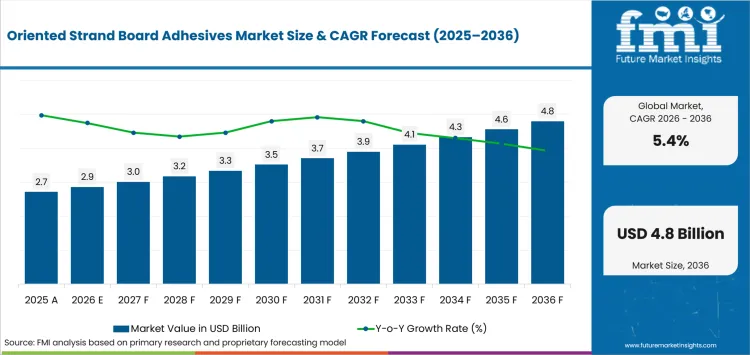
USD 2.9 billion in 2026 and USD 4.8 billion by 2036 at a 5.4% CAGR.
Demand for oriented strand board adhesives is projected to rise at a 5.4% CAGR through 2036, increasing valuation from USD 2.9 billion in 2026 to USD 4.8 billion. Resin consumption follows OSB production because every panel requires a controlled binder load before pressing. West Fraser reported 2025 North American OSB production of 6.351 billion square feet against 8.060 billion square feet of capacity. That utilization gap keeps adhesive programs focused on saleable-board yield and stable press performance instead of nominal resin price.
Regional growth differs because OSB production and qualification are concentrated in a limited set of mill networks. APA documented in July 2026 that its quarterly production report tracks OSB output and cross-border trade between the United States and Canada. Concentrated production rewards resin companies that can service several large mills without changing qualified chemistry between sites. Smaller or slower markets require a tighter technical-sales case because trial cost can exceed near-term volume.
Key Takeaways
- Recurring adhesive demand follows OSB mill throughput because every saleable panel requires a controlled resin application before pressing.
- Based on adhesive type, PMDI adhesives are projected to account for 38.0% in 2026 due to fast cure and moisture tolerance.
- By OSB layer, core-layer applications are estimated to hold 43.0% in 2026 owing to concentrated strand mass and internal-bond duty.
- In 2026, structural OSB is expected to lead board grade with 32.0% share because load-bearing panels require qualified bond performance.
- Recipe qualification and raw-material interruptions can extend switching cycles because mill teams protect press stability before accepting new resin chemistry.
- Key players in the oriented strand board adhesives market include Huntsman, Hexion, BASF, Arclin, Bakelite Synthetics, Prefere Resins, Dynea, Kronospan, Solenis, and Momentive.
Analyst Perspective
"OSB mills should compare adhesives by saleable-board cost because resin price alone misses press speed and reject losses. A program earns repeat business after mill trials confirm stable cure and responsive technical service during recipe changes."
- Nikhil Kaitwade, Principal Consultant, Future Market Insights
How is the oriented strand board adhesives market segmented?
The market is segmented by Adhesive Type, OSB Layer, Board Grade, End Use, and Sales Channel.
Adhesive type covers PMDI adhesives, phenol formaldehyde resins, melamine-urea-formaldehyde, urea formaldehyde blends, and bio-based resin systems. OSB layer covers core layer, face layer, edge sealing, and wax-resin blended application routes. Board grade includes structural OSB, sheathing panels, flooring panels, roofing panels, and specialty moisture-resistant boards. End use covers residential construction, commercial construction, packaging - crating, furniture substrate, and industrial panels. Sales channel includes direct mill contracts, resin producers, panel chemical distributors, and integrated chemical service.
What makes PMDI adhesives central to the adhesive type category?
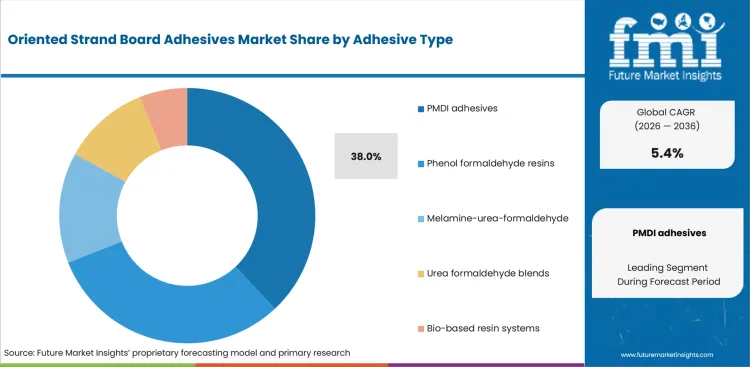
PMDI chemistry suits high-throughput OSB lines because isocyanate curing tolerates furnish-moisture variation without requiring formaldehyde-based chemistry. The same chemistry links OSB production to broader polyurethane adhesives applications but mill trials still determine the qualified resin window.
- PMDI adhesives are set to lead the adhesive type category with 38.0% share in 2026 due to fast cure and moisture tolerance.
- Huntsman’s February 2026 annual filing states that formulated MDI serves wood binders and can substitute phenol formaldehyde in composite-wood applications.
Why does the core layer hold the largest OSB layer share?
Core-layer bonding consumes a large portion of panel resin because most strand mass lies between the thinner face zones. Accurate distribution determines internal-bond consistency in wood-based panels before the mat enters the press.
- By OSB layer, core-layer applications are forecast to represent 43.0% in 2026 driven by concentrated strand mass and internal-bond requirements.
- Hexion and CitroTech formed an April 2026 joint venture for fire-protected plywood and OSB technologies, linking binder selection to whole-panel qualification.
How does structural OSB shape the board grade category?
Structural OSB requires adhesive performance that survives load-bearing qualification and moisture exposure without destabilizing press throughput. Mill teams evaluate resin changes within reconstituted wood specifications because board properties must remain repeatable after production adjustments.
- Structural OSB is likely to capture 32.0% share in 2026 attributable to demand for qualified load-bearing panels in wall and roof assemblies.
- APA revised its West Fraser Treated OSB product report in June 2025 under PS 2-18 based in-plant quality requirements for structural panels.
What supports residential construction as the leading end use?
Residential construction converts wall sheathing and roof decking output into repeat resin consumption because each OSB panel carries a specified binder load. Building programs also compare green building materials against structural performance and installed cost before changing panel systems.
- Residential construction is projected to hold 42.0% share in 2026 owing to repeated use in wall sheathing and roof or subfloor panels.
- Louisiana-Pacific reported total OSB sales volume of 3.075 billion square feet during 2025 from its panel operations. Structural Solutions contributed 1.535 billion square feet and provided a direct measure of structural panel activity.
Why do direct mill contracts hold the largest sales channel share?
OSB resin contracts require line-specific technical service because furnish moisture and press settings change formulation performance at each mill. Direct relationships resemble complex industrial adhesives programs more than interchangeable spot purchases from a catalog.
- Direct mill contracts are projected to hold 48.0% share in 2026 owing to qualification work and ongoing production-line support.
- Arclin completed its Willamette Valley Company acquisition in February 2026 and added eight manufacturing and research facilities to its technical-service footprint.
What are the drivers, restraints and opportunities in the Oriented Strand Board Adhesives Market?
Mill throughput supports recurring resin demand while qualification risk slows switching and drop-in lower-carbon chemistry provides an additional route to growth.
- Driver: OSB mill reinvestment raises the value of adhesives that protect throughput and saleable-board yield during construction cycles.
- Restraint: Supply interruptions and recipe qualification can delay switching because mills avoid changes that threaten press stability or board properties.
- Opportunity: Bio-based binders can gain orders after they preserve cure behavior and fit existing application equipment without a costly mill conversion.
Mill reinvestment keeps resin economics tied to saleable-board output
OSB mill economics depend on stable throughput because downtime raises unit cost across capital-intensive continuous production lines. APA’s May 2026 Q1 production report tracks OSB production and trade flows across the United States and Canada. That direct production view keeps qualified construction adhesives tied to operating rates rather than headline building activity. Resin producers protect mill accounts when formulations maintain press output as production schedules change.
Supply continuity and qualification extend resin switching cycles
A proven OSB recipe is costly to replace because new binder chemistry can change cure behavior and board properties during qualification. APA’s July 2026 Q2 report tracks regional OSB production and cross-border trade across the United States and Canada. Quarterly output changes can narrow near-term resin requirements before a mill revisits a qualified formulation. Flexible wood adhesives supply plans need to preserve trial continuity without forcing mills into unwanted inventory.
Drop-in bio-based chemistry can convert sustainability goals into orders
Lower-carbon binders become commercially useful once mills can run them without major changes to application equipment or press conditions. Bakelite Synthetics reported in March 2026 that its Poland R&D team had developed commercially available natural adhesives for the wood-panel industry and completed large-scale customer trials. That work broadens the bio-based adhesives route by linking renewable chemistry to production testing on existing wood-panel equipment.
Which country CAGRs are profiled in the Oriented Strand Board Adhesives Market?
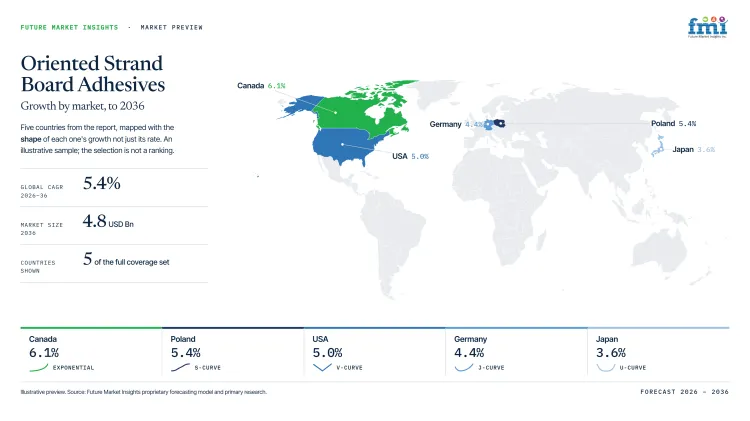
| Country | CAGR |
|---|---|
| Canada | 6.1% |
| Mexico | 5.5% |
| Poland | 5.4% |
| Brazil | 5.2% |
| USA | 5.0% |
| Germany | 4.4% |
| Japan | 3.6% |
How do country-level CAGRs compare in the Oriented Strand Board Adhesives Market?
Country forecasts span 2.5 percentage points from Canada at 6.1% to Japan at 3.6% CAGR from 2026 to 2036. Mexico and Poland sit near the upper band because broad mill access can offset modest differences in headline growth. Brazil and the USA depend more heavily on qualification economics across established panel-production networks. Germany and Japan require selective technical selling where slower growth raises the cost of an unsuccessful formulation change.
- Canada’s large structural-panel industry supports longer-term resin partnerships, where supply reliability and service continuity are key competitive factors.
- In Mexico, resin demand is closely linked to the pace at which panel-based construction gains acceptance alongside traditional concrete building methods.
- Poland’s established panel-manufacturing base provides a solid foundation for resin consumption, though slower production growth can moderate expansion opportunities.
- Brazil relies on the gradual adoption of industrialized wood-construction systems to expand resin demand beyond conventional masonry-focused building practices.
- The USA’s extensive OSB production capacity sustains significant resin requirements, even as housing-market cycles influence mill operating rates.
- Germany places strong emphasis on documented qualification and proven performance, making manufacturers cautious when evaluating formulation changes.
- Japan favors technically validated resin solutions, with buyers prioritizing consistent board quality and repeatable performance over frequent recipe modifications.
Comparable country CAGRs produce different account economics once mill scale and qualification access are considered together. The full report provides country-level CAGR analysis across North America, Latin America, Western Europe, Eastern Europe, East Asia, South Asia and Pacific, and the Middle East and Africa.
Country-wise Analysis
- Canadian OSB producers operate large structural-panel lines where direct technical service can reduce the cost of recipe changes. Canada is projected to grow at 6.1% CAGR through 2036 supported by its wood-frame construction base and panel capacity. Statistics Canada maintains a national table for production and shipments of particleboard, oriented strandboard and fibreboard with data updated through September 2026. That direct production record gives resin suppliers a country-scale signal for mill activity without relying on housing starts as a proxy. Mills can consider renewable isocyanates only after trials confirm cure stability and regional supply continuity across qualified recipes.
- Mexico's housing program can widen construction activity without guaranteeing a switch from masonry to panelized building systems. Oriented strand board adhesive demand is forecast to rise at 5.5% CAGR over the forecast period aided by housing construction and furniture applications. SEDATU reported in June 2026 that 604 thousand homes were contracted and 274 thousand were under construction under the Housing for Wellbeing Program. Concrete remains familiar for many builders and installer knowledge still varies materially by region. Adhesive companies need mill partnerships that prove board economics under local heat and moisture before construction activity converts into resin volume.
- Polish panel producers serve domestic construction and wider European wood-product flows from a substantial manufacturing base. Poland is estimated to post 5.4% CAGR during the assessment period owing to its panel capacity and regional distribution. Statistics Poland reported in February 2026 that sold production of wood or ligneous-material fibreboard was 12.7% lower than one year earlier. That immediate-family panel decline makes near-term resin conversion more price-sensitive despite the positive long forecast. Local technical teams need full-scale production evidence that lowers application cost without destabilizing pressing.
- Brazilian OSB selling depends on proving wood-panel economics in a construction system where masonry remains deeply established. Brazil is anticipated to record 5.2% CAGR between 2026 and 2036 reinforced by national panel demand and selective industrialized-wood use. Ibá reported in June 2026 that domestic wood-panel sales increased 6% during the first half and reached 4.2 million cubic meters. The broader panel gain expands the reachable adhesive base but does not guarantee OSB conversion. Resin producers need local supply and moisture-resistant board performance before system builders expand panelized construction programs.
- USA resin programs serve a deep structural-panel network where mill scale can support specialized field service and long supply agreements. The USA is forecast to grow at 5.0% CAGR during the forecast period owing to sustained OSB use despite housing volatility. APA’s 2026 Structural Panel and Engineered Wood Yearbook analyzes USA demand and production conditions with OSB included among the covered products. That country-scale production framework gives adhesive suppliers a direct operating signal for mill planning instead of a housing-sales proxy. Resin producers can defend accounts by protecting press output and offering contract flexibility that fits operating-rate changes.
- German panel producers operate under formal structural qualification while current OSB pricing keeps formulation economics visible during resin reviews. Germany is predicted to advance at 4.4% CAGR through 2036 supported by technical qualification and gradual construction recovery. Destatis tracks oriented strand board separately in its 2026 producer-price index under product code GP19-162113. The dedicated series gives mills a direct OSB cost reference during resin contract discussions. Related phenolic resins remain commercially relevant where qualified systems continue to meet line conditions. Slower building activity limits volume expansion so resin producers need concise documentation and a delivered-cost case that survives selective project conversion.
- Japanese panel customers place strong weight on repeatable dimensions and formal quality documentation before changing an established production recipe. Japan is expected to maintain 3.6% CAGR over the assessment period attributable to selective structural-panel demand and moisture-resistant grades. Japan's agriculture ministry reported in December 2025 that ordinary plywood production was 5.2% lower year over year during November. Softer adjacent-panel output further limits broad resin expansion and conservative qualification extends selling cycles. Resin producers should focus on production consistency and technical accounts where verified board performance can justify a formulation change.
Who are the notable companies in the Oriented Strand Board Adhesives Market?
Huntsman, Hexion, BASF, Arclin, Bakelite Synthetics, Prefere Resins, Dynea, Kronospan, Solenis, and Momentive are significant companies serving this market.
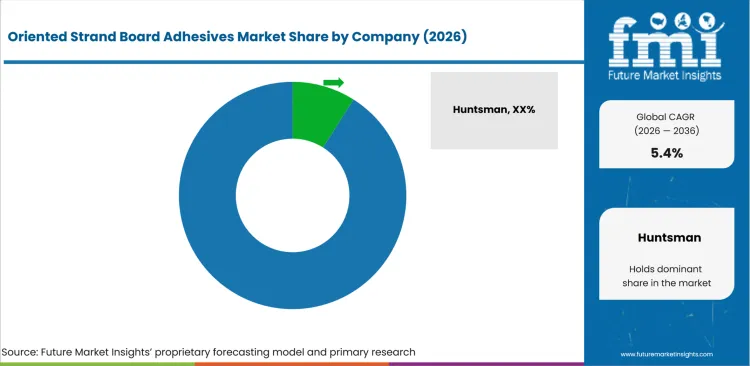
Competition depends on direct OSB chemistry and mill qualification support across several distinct supplier models. Huntsman and Hexion document engineered-wood binder activity with BASF supplying broader MDI chemistry for wood bonding. Arclin, Bakelite Synthetics, Prefere Resins, and Dynea focus on panel-resin chemistry with different service and manufacturing positions. Kronospan combines panel manufacturing with chemical supply across vertically integrated wood-products operations in multiple regions. Solenis and Momentive participate more narrowly through specialty adhesive and process inputs used in engineered-wood applications.
- Huntsman and Hexion form the direct isocyanate and engineered-wood group with BASF supplying broader MDI chemistry for wood-bonding applications.
- Arclin and Bakelite Synthetics join Prefere Resins and Dynea in wood-panel resin chemistry with different manufacturing and service positions.
- Kronospan brings integrated panel manufacturing and chemical supply while Solenis and Momentive participate through narrower specialty adhesive inputs.
Competitive Benchmarking: Oriented Strand Board Adhesives Market
| Company | Direct OSB Chemistry Fit | Mill Application Support | Lower-Emission Route | Geographic Reach |
|---|---|---|---|---|
| Huntsman | High | High | High | Global; North America, Europe, and Asia |
| Hexion | High | High | High | North America, Europe, Asia, and Latin America |
| BASF | Medium | Medium | Medium | Global |
| Arclin | High | High | Medium | North America with international expansion |
| Bakelite Synthetics | Medium | High | High | North America and Europe with wider international reach |
| Prefere Resins | Medium | Medium | High | Europe-led with international sales |
| Dynea | Medium | High | High | Europe-led with international wood-panel customers |
| Kronospan | Medium | High | Medium | Europe and North America with integrated panel operations |
| Solenis | Low | Medium | High | Global specialty-chemical network |
| Momentive | Low | Medium | Medium | Global specialty-materials network |
High ratings require direct OSB evidence for the assessed capability and a current commercial role. Medium ratings require documented Immediate Family evidence with the same function, buyer or specification route, and purchase path. Low ratings indicate limited exact-market evidence despite documented participation in adjacent engineered-wood chemistry applications and supply routes. Geographic reach records verified operating regions and does not rank overall competitive strength between companies.
Key Developments in the Oriented Strand Board Adhesives Market
- In May 2026, Dynea reported demanding tests in which low-emission Prefere 4570 and 4571 MUF adhesives met tighter EU formaldehyde limits. Those tests covered structural-wood bonding rather than OSB-specific recipes and therefore support only adjacent engineered-wood qualification.
- In February 2026 BASF reported that its Geismar MDI expansion remained on schedule for 2026 startup. The project would raise annual MDI capacity toward 600,000 metric tons at the Louisiana site.
- In April 2026, Arclin reported that its Firepoint fire-resistant sheathing was named a Green Builder Media Sustainable Product of the Year after the platform added 4x9 and 4x10 panel sizes.
Key Players in the Oriented Strand Board Adhesives Market
Isocyanate and Engineered-Wood Binder Platforms
- Huntsman
- Hexion
- BASF
Wood-Panel Resin and Materials Specialists
- Arclin
- Bakelite Synthetics
- Prefere Resins
- Dynea
Integrated and Specialty Chemistry Platforms
- Kronospan
- Solenis
- Momentive
Oriented Strand Board Adhesives Market - Report Scope
| Coverage field | Report scope |
|---|---|
| Market breakdown | By adhesive type, OSB layer, board grade, end use, sales channel, and region. |
| Quantitative Units | USD billion. |
| Market Definition | Revenue from PMDI, phenol formaldehyde, melamine-urea-formaldehyde, urea formaldehyde blends, and bio-based resin systems sold for OSB core, face, edge sealing, and wax-resin blended applications. Finished OSB panel revenue and adhesives sold only for adjacent panel categories are excluded. |
| Regions Covered | North America, Latin America, Western Europe, Eastern Europe, East Asia, South Asia and Pacific, and Middle East and Africa. |
| Countries Covered | Canada, Mexico, Poland, Brazil, USA, Germany, Japan, and more than twenty-five additional countries in the full report. |
| Key Companies Profiled | Huntsman, Hexion, BASF, Arclin, Bakelite Synthetics, Prefere Resins, Dynea, Kronospan, Solenis, and Momentive. |
| Forecast Period | 2026 to 2036. |
| Approach | Primary and secondary research with market triangulation and country-level demand checks. |
Oriented Strand Board Adhesives Market - Research Methodology
| Method | Approach |
|---|---|
| Primary Research | FMI analysts gathered input from manufacturers, service providers, technology developers, distributors, end users, procurement teams, and subject-matter experts. Interviews examined purchasing decisions, product or service evaluation, adoption barriers, approval requirements, pricing considerations, and expectations for technical or commercial support. Respondents were also asked what evidence is required before a trial, pilot, or initial order develops into regular purchasing. |
| Desk Research | Desk research covered government statistics, regulatory publications, trade data, industry associations, technical literature, standards, company filings, product information, and official corporate announcements. Sources were reviewed for relevance, publication date, geographic coverage, and consistency with the defined market scope. Claims relating to performance, applications, approvals, capacity, investment, and commercial activity were retained only when supported by credible public evidence. |
| Market Sizing and Forecasting | The market model combined the baseline value with historical performance, segment structure, pricing and volume indicators, adoption levels, company participation, and country-level demand conditions. Forecast assumptions considered economic activity, investment trends, regulatory developments, technology adoption, purchasing cycles, supply availability, and barriers to wider market use. Segment and regional estimates were reconciled before the final market total was calculated. |
| Data Validation | Estimates were checked against multiple independent indicators, including public data, company activity, trade patterns, industry developments, and findings from primary interviews. Validation also tested whether products, services, applications, and company revenues fell within the defined market boundaries. Adjacent categories, unsupported claims, overlapping revenues, and activities without direct market relevance were excluded to reduce double counting and maintain consistency across segments and countries. |
Oriented Strand Board Adhesives Market by Segments
Oriented Strand Board Adhesives Market segmented by Adhesive Type:
- PMDI adhesives
- Phenol formaldehyde resins
- Melamine-urea-formaldehyde
- Urea formaldehyde blends
- Bio-based resin systems
Oriented Strand Board Adhesives Market segmented by OSB Layer:
- Core layer
- Face layer
- Edge sealing
- Wax-resin blended application
Oriented Strand Board Adhesives Market segmented by Board Grade:
- Structural OSB
- Sheathing panels
- Flooring panels
- Roofing panels
- Specialty moisture-resistant boards
Oriented Strand Board Adhesives Market segmented by End Use:
- Residential construction
- Commercial construction
- Packaging - crating
- Furniture substrate
- Industrial panels
Oriented Strand Board Adhesives Market segmented by Sales Channel:
- Direct mill contracts
- Resin producers
- Panel chemical distributors
- Integrated chemical service
Oriented Strand Board Adhesives Market by Region:
- North America
- United States
- Canada
- Latin America
- Brazil
- Mexico
- Argentina
- Chile
- Western Europe
- Germany
- France
- United Kingdom
- Italy
- Spain
- Benelux
- Nordics
- Eastern Europe
- Poland
- Czech Republic
- Romania
- Hungary
- East Asia
- China
- Japan
- South Korea
- South Asia and Pacific
- India
- ASEAN
- Australia and New Zealand
- Middle East and Africa
- GCC Countries
- South Africa
- Türkiye
- Israel
Research Sources and Bibliography
- West Fraser Timber Co. Ltd. (2026, February 11). 2025 Annual Report.
- APA - The Engineered Wood Association. (2026, July 1). Quarterly Production Report Q2-26.
- Huntsman Corporation. (2026, February 18). Annual Report on Form 10-K for the year ended December 31, 2025.
- APA - The Engineered Wood Association. (2025, June 12). West Fraser Treated OSB.
- Louisiana-Pacific Corporation. (2026, February 17). LP Building Solutions Reports Fourth Quarter and Full Year 2025 Results, and Provides First Quarter and Full Year Outlook for 2026.
- Arclin. (2026, February 2). Arclin Completes Acquisition of The Willamette Valley Company, Strengthening Materials Science Portfolio & Expanding Global Presence.
- Secretaría de Desarrollo Agrario, Territorial y Urbano. (2026, June 15). Reporta Sedatu 604 mil viviendas contratadas para iniciar obras y 274 mil en construcción a través del PVB.
- Statistics Poland. (2026, February 24). Production of major industrial products in January 2026.
- Indústria Brasileira de Árvores. (2026, August 24). Setor brasileiro de árvores cultivadas exporta US$ 7,5 bilhões no primeiro semestre de 2026.
- Federal Statistical Office of Germany. (2026). Producer price index of commercial products: Germany, months, product classification GP2019.
- Ministry of Agriculture, Forestry and Fisheries, Japan. (2025, December 25). Plywood statistics, November 2025.
- Smartech. (2025, May 26). Hexion and Smartech Unveil SmartQuality, the Latest Offering in their AI-Powered Operating Platform that Transforms Wood Panel Manufacturing.
- Kronospan. (2025, December 11). Kronospan completes the acquisition of Hexion's Chemical Plant in La Grande, Oregon.
- Dynea. (2025, November 19). MUF Adhesive Opens New Perspectives for Hardwood Construction.
- Hexion. (2025, June 23). Hexion and Bloom Pioneer Industry-First Renewable Adhesive Technology.
- Arclin. (2025, October 2). Arclin Accelerates Growth Through Acquisition of Polymer Solutions Group, Unlocking New Markets and Complementary Chemistries.
- Smartech. (2025, March 11). SMARTECH and ANDRITZ Strengthen Collaboration to Deliver SMARTWAX ECO System with Localized Production in China.
- Arclin. (2025, February 24). Arclin to acquire new assets to support growing demand for Firepoint product.
- Kronospan. (2025, November 18). Kronospan completes acquisition of ZG Timber's Sebeș sawmill, preserving over 500 jobs and expanding product portfolio.
- Huntsman Corporation. (2025, April 24). Huntsman to launch bio-based I-BOND resins for composite wood products at LIGNA.
- Hexion. (2026, April 21). CitroTech and Hexion launch global joint venture.
- BASF. (2026, February 27). Investments: Geismar MDI Expansion.
- Arclin. (2026, February 5). Arclin Expands Firepoint Portfolio with New 10-Foot OSB Panel at IBS 2026.
- Bakelite Synthetics. (2025, April 22). Bakelite Synthetics Achieves Responsible Care Certification.
- Prefere Resins. (2025, May 26). Press release - Prefere Resins-EcoVadis GOLD.
- Dynea. (2025, October 31). Successful ISCC PLUS & ISO45001 Audits.
- Kronospan. (2025, July 1). Kronospan becomes sole owner of Danish chemical producer Nordalim A/S.
- Solenis. (2025, October 15). Solenis Opens New Global Research Center in Delaware.
- Momentive. (2025, February 25). Momentive and Jiangxi Hungpai New Material Co., Ltd Announce Strategic Joint Venture Agreement in Asia Pacific.
- Dynea. (2026, May 19). On the safe side with MUF adhesives / by Mr. Günther Jauk, Holzkurier.
- APA - The Engineered Wood Association. (2026, May 1). Quarterly Production Report Q1-26.
- Bakelite Synthetics. (2026, March 26). Women’s History Month Spotlight: Anna Sieranc on Curiosity, Innovation, and Leading with Creativity.
- Statistics Canada. (2026, September 11). Production and shipments of particleboard, oriented strandboard and fibreboard.
- APA - The Engineered Wood Association. (2026, April 1). 2026 Structural Panel & Engineered Wood Yearbook.
- Arclin. (2026, April 20). Arclin Firepoint® Named a Green Builder Media 2026 Sustainable Product of the Year.
- Prefere Resins. (2026). Certificates and Downloads of our Production Sites.
This bibliography is provided for reader reference and is not exhaustive. The full report contains the complete reference list and detailed citations.
This Report Answers
- How large is the oriented strand board adhesives market in 2026 and 2036?
- Which operating conditions convert OSB panel output into recurring adhesive demand?
- Why do PMDI adhesives account for 38.0% of adhesive type demand in 2026?
- How does the core layer influence resin consumption during OSB production?
- Why does structural OSB hold 32.0% of the board grade category?
- How do country CAGRs differ among Canada, Mexico, Poland, Brazil, USA, Germany, and Japan?
- How do qualification risk and supply continuity affect switching decisions at OSB mills?
- Which lower-carbon resin routes can enter existing wood-panel production without major equipment changes?
Frequently Asked Questions
How big is the oriented strand board adhesives market in 2026?
The oriented strand board adhesives market is valued at USD 2.9 billion in 2026 and is projected to reach USD 4.8 billion by 2036. Resin consumption follows OSB panel output because every production run requires a controlled binder load before pressing.
What is the CAGR of the oriented strand board adhesives market from 2026 to 2036?
The oriented strand board adhesives market is projected to grow at a CAGR of 5.4% between 2026 and 2036. Mill output and operating investment support expansion by raising the value of stable cure behavior during production.
Which adhesive type leads the oriented strand board adhesives market?
The PMDI adhesives segment is expected to hold 38.0% of the oriented strand board adhesives market in 2026, driven by fast cure and moisture tolerance. Mills value that chemistry where stable bond performance must survive routine changes in furnish moisture.
Which OSB layer leads the oriented strand board adhesives market?
The core-layer segment is expected to hold 43.0% of the oriented strand board adhesives market in 2026, attributable to concentrated strand mass and internal-bond requirements. Accurate resin distribution becomes critical before pressing because the core carries much of the panel's bonded structure.
Which companies are active in the oriented strand board adhesives market?
Key companies operating in the oriented strand board adhesives market include Huntsman, Hexion, BASF, Arclin, Bakelite Synthetics, Prefere Resins, Dynea, Kronospan, Solenis, and Momentive. Their positions differ according to binder chemistry and mill support as well as regional manufacturing and direct OSB participation.
Preview the report firsthand - request a free sample
Get SampleGet the brochure for pricing and purchase details.
Get PDFTable of Content
- Key Takeaways
- Market Size and CAGR
- Top Growth Driver
- Fastest Growing Segment
- Leading Region
- Key Companies
- Emerging Opportunities
- Executive Summary
- Global Market Outlook
- Demand-side Trends
- Supply-side Trends
- Technology Roadmap Analysis
- Analysis and Recommendations
- Analyst Perspective (What is happening? Why now? What should investors know?)
- Key Questions Answered
- How large is the market?
- What is the CAGR?
- What are key trends?
- Which region dominates?
- Who are the leaders?
- Market Overview
- Market Coverage / Taxonomy
- Market Definition / Scope / Limitations
- Research Methodology
- Chapter Orientation
- Analytical Lens and Working Hypotheses
- Market Structure, Signals, and Trend Drivers
- Benchmarking and Cross-market Comparability
- Market Sizing, Forecasting, and Opportunity Mapping
- Research Design and Evidence Framework
- Desk Research Programme (Secondary Evidence)
- Expert Input and Fieldwork (Primary Evidence)
- Tooling, Models, and Reference Databases
- Data Engineering and Model Build
- Quality Assurance and Audit Trail
- Market Background
- Market Dynamics (Drivers, Restraints, Opportunity, Trends)
- Scenario Forecast (Optimistic, Likely, Conservative)
- Impact Analysis
- AI Impact
- Sustainability Impact
- Regulatory Impact
- Technology Impact
- Consumer / Buyer Analysis
- Purchase Drivers
- Adoption Barriers
- Buyer Journey
- Opportunity Map Analysis
- Product Life Cycle Analysis
- Supply Chain Analysis
- Investment Feasibility Matrix
- Value Chain Analysis
- PESTLE and Porter's Analysis
- Regulatory Landscape
- Regional Parent Market Outlook
- Production and Consumption Statistics
- Import and Export Statistics
- Global Market Analysis and Forecast, 2021 to 2036
- Historical Market Size Value (USD Billion) Analysis, 2021 to 2025
- Current and Future Market Size Value (USD Billion) Projections, 2026 to 2036
- Y-o-Y Growth Trend Analysis
- Absolute $ Opportunity Analysis
- Global Market Pricing Analysis, 2021 to 2036
- Global Market Analysis and Forecast, By Adhesive Type, 2021 to 2036
- Introduction / Key Findings
- Historical Market Size Value (USD Billion) Analysis By Adhesive Type, 2021 to 2025
- Current and Future Market Size Value (USD Billion) Analysis and Forecast By Adhesive Type, 2026 to 2036
- PMDI adhesives
- Phenol formaldehyde resins
- Melamine-urea-formaldehyde
- Urea formaldehyde blends
- Bio-based resin systems
- PMDI adhesives
- Y-o-Y Growth Trend Analysis By Adhesive Type, 2021 to 2025
- Absolute $ Opportunity Analysis By Adhesive Type, 2026 to 2036
- Global Market Analysis and Forecast, By OSB Layer, 2021 to 2036
- Introduction / Key Findings
- Historical Market Size Value (USD Billion) Analysis By OSB Layer, 2021 to 2025
- Current and Future Market Size Value (USD Billion) Analysis and Forecast By OSB Layer, 2026 to 2036
- Core layer
- Face layer
- Edge sealing
- Wax-resin blended application
- Core layer
- Y-o-Y Growth Trend Analysis By OSB Layer, 2021 to 2025
- Absolute $ Opportunity Analysis By OSB Layer, 2026 to 2036
- Global Market Analysis and Forecast, By Board Grade, 2021 to 2036
- Introduction / Key Findings
- Historical Market Size Value (USD Billion) Analysis By Board Grade, 2021 to 2025
- Current and Future Market Size Value (USD Billion) Analysis and Forecast By Board Grade, 2026 to 2036
- Structural OSB
- Sheathing panels
- Flooring panels
- Roofing panels
- Specialty moisture-resistant boards
- Structural OSB
- Y-o-Y Growth Trend Analysis By Board Grade, 2021 to 2025
- Absolute $ Opportunity Analysis By Board Grade, 2026 to 2036
- Global Market Analysis and Forecast, By End Use, 2021 to 2036
- Introduction / Key Findings
- Historical Market Size Value (USD Billion) Analysis By End Use, 2021 to 2025
- Current and Future Market Size Value (USD Billion) Analysis and Forecast By End Use, 2026 to 2036
- Residential construction
- Commercial construction
- Packaging/crating
- Furniture substrate
- Industrial panels
- Residential construction
- Y-o-Y Growth Trend Analysis By End Use, 2021 to 2025
- Absolute $ Opportunity Analysis By End Use, 2026 to 2036
- Global Market Analysis and Forecast, By Sales Channel, 2021 to 2036
- Introduction / Key Findings
- Historical Market Size Value (USD Billion) Analysis By Sales Channel, 2021 to 2025
- Current and Future Market Size Value (USD Billion) Analysis and Forecast By Sales Channel, 2026 to 2036
- Direct mill contracts
- Resin producers
- Panel chemical distributors
- Integrated chemical service
- Direct mill contracts
- Y-o-Y Growth Trend Analysis By Sales Channel, 2021 to 2025
- Absolute $ Opportunity Analysis By Sales Channel, 2026 to 2036
- Global Market Analysis and Forecast, By Region, 2021 to 2036
- Introduction
- Historical Market Size Value (USD Billion) Analysis By Region, 2021 to 2025
- Current Market Size Value (USD Billion) Analysis and Forecast By Region, 2026 to 2036
- North America
- Latin America
- Western Europe
- Eastern Europe
- East Asia
- South Asia and Pacific
- Middle East & Africa
- Market Attractiveness Analysis By Region
- North America Market Analysis and Forecast, By Country, 2021 to 2036
- Historical Market Size Value (USD Billion) Trend Analysis By Market Taxonomy, 2021 to 2025
- Market Size Value (USD Billion) Forecast By Market Taxonomy, 2026 to 2036
- By Country
- USA
- Canada
- By Adhesive Type
- By OSB Layer
- By Board Grade
- By End Use
- By Sales Channel
- By Country
- Market Attractiveness Analysis
- By Country
- By Adhesive Type
- By OSB Layer
- By Board Grade
- By End Use
- By Sales Channel
- Key Takeaways
- Latin America Market Analysis and Forecast, By Country
- Historical Market Size Value (USD Billion) Trend Analysis By Market Taxonomy, 2021 to 2025
- Market Size Value (USD Billion) Forecast By Market Taxonomy, 2026 to 2036
- By Country
- Brazil
- Mexico
- Chile
- Rest of Latin America
- By Adhesive Type
- By OSB Layer
- By Board Grade
- By End Use
- By Sales Channel
- By Country
- Market Attractiveness Analysis
- By Country
- By Adhesive Type
- By OSB Layer
- By Board Grade
- By End Use
- By Sales Channel
- Key Takeaways
- Western Europe Market Analysis and Forecast, By Country
- Historical Market Size Value (USD Billion) Trend Analysis By Market Taxonomy, 2021 to 2025
- Market Size Value (USD Billion) Forecast By Market Taxonomy, 2026 to 2036
- By Country
- Germany
- UK
- Italy
- Spain
- France
- Nordic
- BENELUX
- Rest of Western Europe
- By Adhesive Type
- By OSB Layer
- By Board Grade
- By End Use
- By Sales Channel
- By Country
- Market Attractiveness Analysis
- By Country
- By Adhesive Type
- By OSB Layer
- By Board Grade
- By End Use
- By Sales Channel
- Key Takeaways
- Eastern Europe Market Analysis and Forecast, By Country
- Historical Market Size Value (USD Billion) Trend Analysis By Market Taxonomy, 2021 to 2025
- Market Size Value (USD Billion) Forecast By Market Taxonomy, 2026 to 2036
- By Country
- Russia
- Poland
- Hungary
- Balkan & Baltic
- Rest of Eastern Europe
- By Adhesive Type
- By OSB Layer
- By Board Grade
- By End Use
- By Sales Channel
- By Country
- Market Attractiveness Analysis
- By Country
- By Adhesive Type
- By OSB Layer
- By Board Grade
- By End Use
- By Sales Channel
- Key Takeaways
- East Asia Market Analysis and Forecast, By Country
- Historical Market Size Value (USD Billion) Trend Analysis By Market Taxonomy, 2021 to 2025
- Market Size Value (USD Billion) Forecast By Market Taxonomy, 2026 to 2036
- By Country
- China
- Japan
- South Korea
- By Adhesive Type
- By OSB Layer
- By Board Grade
- By End Use
- By Sales Channel
- By Country
- Market Attractiveness Analysis
- By Country
- By Adhesive Type
- By OSB Layer
- By Board Grade
- By End Use
- By Sales Channel
- Key Takeaways
- South Asia and Pacific Market Analysis and Forecast, By Country
- Historical Market Size Value (USD Billion) Trend Analysis By Market Taxonomy, 2021 to 2025
- Market Size Value (USD Billion) Forecast By Market Taxonomy, 2026 to 2036
- By Country
- India
- ASEAN
- Australia & New Zealand
- Rest of South Asia and Pacific
- By Adhesive Type
- By OSB Layer
- By Board Grade
- By End Use
- By Sales Channel
- By Country
- Market Attractiveness Analysis
- By Country
- By Adhesive Type
- By OSB Layer
- By Board Grade
- By End Use
- By Sales Channel
- Key Takeaways
- Middle East & Africa Market Analysis and Forecast, By Country
- Historical Market Size Value (USD Billion) Trend Analysis By Market Taxonomy, 2021 to 2025
- Market Size Value (USD Billion) Forecast By Market Taxonomy, 2026 to 2036
- By Country
- Kingdom of Saudi Arabia
- Other GCC Countries
- Türkiye
- South Africa
- Other African Union
- Rest of Middle East & Africa
- By Adhesive Type
- By OSB Layer
- By Board Grade
- By End Use
- By Sales Channel
- By Country
- Market Attractiveness Analysis
- By Country
- By Adhesive Type
- By OSB Layer
- By Board Grade
- By End Use
- By Sales Channel
- Key Takeaways
- Key Countries Market Analysis
- USA
- Pricing Analysis
- Market Share Analysis, 2025
- By Adhesive Type
- By OSB Layer
- By Board Grade
- By End Use
- By Sales Channel
- Canada
- Pricing Analysis
- Market Share Analysis, 2025
- By Adhesive Type
- By OSB Layer
- By Board Grade
- By End Use
- By Sales Channel
- Mexico
- Pricing Analysis
- Market Share Analysis, 2025
- By Adhesive Type
- By OSB Layer
- By Board Grade
- By End Use
- By Sales Channel
- Brazil
- Pricing Analysis
- Market Share Analysis, 2025
- By Adhesive Type
- By OSB Layer
- By Board Grade
- By End Use
- By Sales Channel
- Chile
- Pricing Analysis
- Market Share Analysis, 2025
- By Adhesive Type
- By OSB Layer
- By Board Grade
- By End Use
- By Sales Channel
- Germany
- Pricing Analysis
- Market Share Analysis, 2025
- By Adhesive Type
- By OSB Layer
- By Board Grade
- By End Use
- By Sales Channel
- UK
- Pricing Analysis
- Market Share Analysis, 2025
- By Adhesive Type
- By OSB Layer
- By Board Grade
- By End Use
- By Sales Channel
- Italy
- Pricing Analysis
- Market Share Analysis, 2025
- By Adhesive Type
- By OSB Layer
- By Board Grade
- By End Use
- By Sales Channel
- Spain
- Pricing Analysis
- Market Share Analysis, 2025
- By Adhesive Type
- By OSB Layer
- By Board Grade
- By End Use
- By Sales Channel
- France
- Pricing Analysis
- Market Share Analysis, 2025
- By Adhesive Type
- By OSB Layer
- By Board Grade
- By End Use
- By Sales Channel
- India
- Pricing Analysis
- Market Share Analysis, 2025
- By Adhesive Type
- By OSB Layer
- By Board Grade
- By End Use
- By Sales Channel
- ASEAN
- Pricing Analysis
- Market Share Analysis, 2025
- By Adhesive Type
- By OSB Layer
- By Board Grade
- By End Use
- By Sales Channel
- Australia & New Zealand
- Pricing Analysis
- Market Share Analysis, 2025
- By Adhesive Type
- By OSB Layer
- By Board Grade
- By End Use
- By Sales Channel
- China
- Pricing Analysis
- Market Share Analysis, 2025
- By Adhesive Type
- By OSB Layer
- By Board Grade
- By End Use
- By Sales Channel
- Japan
- Pricing Analysis
- Market Share Analysis, 2025
- By Adhesive Type
- By OSB Layer
- By Board Grade
- By End Use
- By Sales Channel
- South Korea
- Pricing Analysis
- Market Share Analysis, 2025
- By Adhesive Type
- By OSB Layer
- By Board Grade
- By End Use
- By Sales Channel
- Russia
- Pricing Analysis
- Market Share Analysis, 2025
- By Adhesive Type
- By OSB Layer
- By Board Grade
- By End Use
- By Sales Channel
- Poland
- Pricing Analysis
- Market Share Analysis, 2025
- By Adhesive Type
- By OSB Layer
- By Board Grade
- By End Use
- By Sales Channel
- Hungary
- Pricing Analysis
- Market Share Analysis, 2025
- By Adhesive Type
- By OSB Layer
- By Board Grade
- By End Use
- By Sales Channel
- Kingdom of Saudi Arabia
- Pricing Analysis
- Market Share Analysis, 2025
- By Adhesive Type
- By OSB Layer
- By Board Grade
- By End Use
- By Sales Channel
- Türkiye
- Pricing Analysis
- Market Share Analysis, 2025
- By Adhesive Type
- By OSB Layer
- By Board Grade
- By End Use
- By Sales Channel
- South Africa
- Pricing Analysis
- Market Share Analysis, 2025
- By Adhesive Type
- By OSB Layer
- By Board Grade
- By End Use
- By Sales Channel
- USA
- Market Structure Analysis
- Competition Dashboard
- Competition Benchmarking
- Market Share Analysis of Top Players
- By Regional
- By Adhesive Type
- By OSB Layer
- By Board Grade
- By End Use
- By Sales Channel
- Emerging Startups
- Innovation Benchmarking
- Competition Analysis
- Competition Deep Dive
- Huntsman
- Overview
- Product Portfolio
- Profitability by Market Segments
- Sales Footprint
- Strategy Overview
- Marketing Strategy
- Product Strategy
- Channel Strategy
- Hexion
- BASF
- Arclin
- Georgia-Pacific Chemicals
- Prefere Resins
- Dynea
- Kronospan Chemical
- Solenis
- Momentive
- Huntsman
- Case Studies
- Success Stories
- Recent Developments
- Competition Deep Dive
- Assumptions & Acronyms Used


