

- Market Size (2026)
- USD 336.0 Mn
- Forecast (2036)
- USD 686.1 Mn
- CAGR (2026 to 2036)
- 7.4%
How big is Pandan Extract Market in 2026?
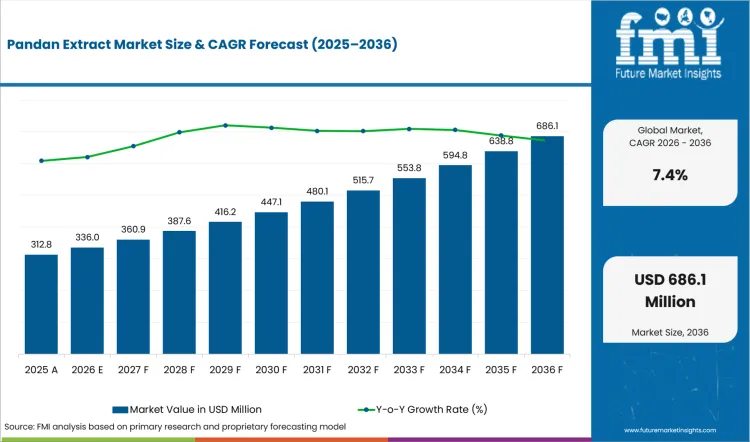
USD 336.0 million in 2026 and USD 686.1 million by 2036 at a 7.4% CAGR.
Demand for pandan extract is projected to expand at a 7.4% CAGR between 2026 and 2036, increasing valuation from USD 336.0 million in 2026 to USD 686.1 million by 2036. Manufacturers are replacing fresh-leaf preparation with standardized flavor ingredients because repeatable aroma reduces formulation variability across commercial plants. The Philippine FDA registered Givaudan ST6969/01 pandan as a raw material in June 2025 with approval valid until June 2031, giving beverage applications a documented route for repeatable specification.
Country growth diverges as familiar pandan demand meets different classification and documentation rules across regulated food production. Thailand is forecast at 8.6% CAGR and Indonesia at 8.4% compared with 6.2% CAGR in the USA, so compliant ingredient systems face different approval timelines. Thailand’s Food Division opened a flavoring-substance review in July 2026 and requested technical information from industry, making current documentation essential for stable extract formats entering commercial specifications.
Key Takeaways of Pandan Extract Market
- Food developers use standardized pandan extracts for beverage and dessert concepts that require repeatable aroma performance across commercial production.
- By extract type, natural pandan extract is estimated to hold 34.0% in 2026 owing to recognizable leaf-derived character.
- In 2026, water-soluble formats are expected to lead solubility with 62.0% share because aqueous systems simplify formulation trials.
- Bakery & desserts are projected to hold 34.0% share in 2026 owing to familiar sweet occasions and flexible product formats.
- Aroma volatility and country-specific ingredient rules extend qualification by requiring stable sensory performance plus compliant documentation before routine production.
- The profiled supplier set includes Kerry Group plc, Givaudan SA, Symrise AG, DSM-Firmenich AG, International Flavors & Fragrances Inc., Sensient Technologies Corporation, V. MANE FILS and McCormick & Company, Incorporated.
Analyst Perspective
“Pandan extract earns repeat business by keeping its leaf aroma stable during shipping, storage and the customer’s production process. Commercial teams should compare sensory stability with format fit and documentation first because reformulation during scale-up can erase a lower ingredient cost.”
- Nandini Roy Choudhury, Principal Consultant, Future Market Insights
How is the Pandan Extract Market segmented?
The pandan extract market is segmented by extract type, solubility, application, source and sales channel.
Extract type covers natural pandan extract, concentrate, paste, powder and essential oil. Solubility covers water-soluble, oil-soluble and emulsion-based formats. Applications include bakery & desserts, beverages, dairy & ice cream, sauces & ready meals and fragrance / personal care. Source covers fresh leaves, dried leaves, cultivated / contract farming and wild / smallholder sourcing. Sales channels include flavor houses, food ingredient distributors, direct processor supply and retail / foodservice packs.
Why does natural pandan extract lead demand within the extract type category?
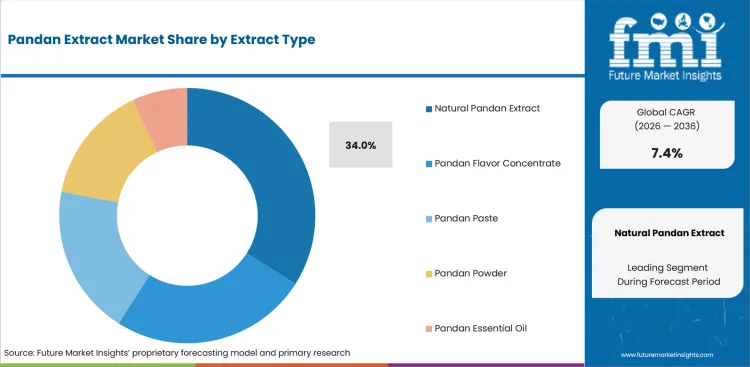
Natural pandan extract gives formulators a plant-linked aroma profile without requiring fresh leaves at production sites. Standardized extraction separates aroma delivery from the narrow handling window that fresh leaves impose during industrial production. The Philippine FDA registered pandan extract powder 63046T1 in February 2025 with approval valid until February 2028, establishing a documented raw-material route for industrial formulation.
- By extract type, natural pandan extract is estimated to hold 34.0% in 2026 owing to demand for recognizable leaf-derived character in standardized form.
- Processors compare aroma consistency across storage and production trials since standardized extract reduces variation introduced by fresh-leaf preparation.
Why do water-soluble formats lead demand within the solubility category?
Water-soluble pandan formats fit beverage syrups and dairy mixes without a separate oil phase during formulation. Product teams can compare dosage and aroma inside the intended aqueous base during repeated commercial formulation trials.
- In 2026, water-soluble formats are expected to lead solubility with 62.0% share because many beverage and dairy systems already use aqueous bases.
- Kerry identified pandan among Asia Pacific refreshing beverage botanicals in January 2026 and made its Taste Charts flavors sample-ready for product teams. Water-soluble delivery lets formulators dose pandan directly into aqueous bases during trials without adding a separate oil phase.
Why do bakery & desserts lead demand within the application category?
Bakery and dessert formulations give pandan a familiar setting because sweet products already accommodate floral and nut-like profiles. Product teams can test pandan in cakes and frozen desserts before evaluating wider commercial scale-up. The Philippine FDA registered Top Creamery’s buko pandan flavor soft serve ice cream powder in July 2025 with approval valid until July 2028.
- Bakery & desserts are set to lead the application category with 34.0% share in 2026 due to familiar sweet occasions and finished-product formats.
- Commercial trials must preserve pandan character after baking or frozen storage because repeatable performance determines whether a concept reaches routine production.
Why do flavor houses lead demand within the sales channel category?
Flavor houses combine ingredient access with sensory matching and documentation before manufacturers issue production specifications for commercial recipes. Pandan application work changes with solubility, dosage and labeling across product bases during customer scale-up.
- The sales channel category is forecast to be led by flavor houses at 38.0% share in 2026 due to formulation support and repeatable sensory specification work.
- The Philippine FDA registered Sensient Technologies (Philippines), Inc.’s 952712 pandan flavor in October 2025 with approval valid until October 2030. The registration documents a current flavor-house route for regulated pandan raw materials used in commercial formulation.
What are the drivers, restraints and opportunities in the Pandan Extract Market?
Modern flavor development broadens pandan use beyond fresh preparation, but documentation and sensory stability slow qualification as suppliers expand protected application-ready formats.
- Driver: Food and beverage teams are adapting familiar Asian flavor cues into scalable beverage and sweet-product concepts that require standardized ingredients.
- Restraint: Country-specific certification and labeling rules can delay routine production by extending documentation and formulation review for pandan systems.
- Opportunity: Extract processors can serve more applications by pairing stable liquid, powder and oil formats with product-specific testing and regulatory support.
Application Development Broadens Commercial Use
Food manufacturers need a registered pandan ingredient before a successful flavor concept can become a repeatable production specification. The Philippine FDA registered Flavorites Enterprises’ pandan flavor 888374 as a raw material in October 2025 with approval valid until October 2030. The registration gives product developers a traceable input for commercial trials and repeat orders once the flavor performs consistently in the finished product.
Regulatory Reformulation Extends Qualification
National certification rules can stall a pandan specification even after successful flavor trials by adding documentation requirements. BPJPH confirmed in January 2026 that Indonesia’s October 2026 halal obligation covers food and beverages plus raw materials and additives sold nationally. Food manufacturers need complete composition and traceability records early enough to clear certification without delaying routine ingredient orders.
Protected Formats Expand Usable Applications
Commercial product bases need pandan formats that retain the intended aroma in water, fat and heated recipes during repeated scale-up. The Philippine FDA registered Ferna Corporation’s pandan flavor oil FGC-8110 as a raw material in June 2025 with approval valid until June 2031. Stable liquid and oil formats expand usable applications once testing confirms the intended sensory performance in each product base.
Which country CAGRs are profiled in the Pandan Extract Market?
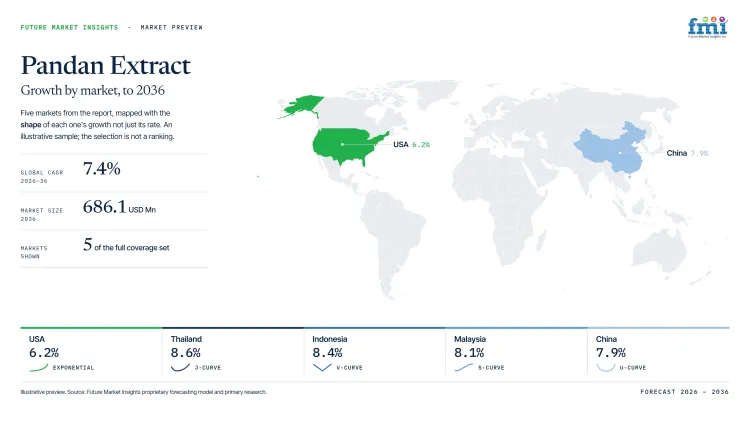
| Country | CAGR |
|---|---|
| Thailand | 8.6% |
| Indonesia | 8.4% |
| Malaysia | 8.1% |
| Singapore | 6.7% |
| USA | 6.2% |
How do country-level CAGRs compare in the Pandan Extract Market?
The 2.4 percentage-point profiled range separates a tight Southeast Asian upper group from two slower commercialization markets. Thailand and Indonesia form the upper pair, with Malaysia close enough that local sourcing and compliance matter more than numerical gaps. Singapore and the USA require concept differentiation before interest converts into regular ingredient purchasing.
- Thailand’s flavoring review makes classification timing central to industrial pandan specification and documentation.
- Indonesia halal timetable raises certification and traceability requirements for pandan ingredient qualification.
- Malaysia’s certified cultivation gives extractors a documented local sourcing route for pandan.
- Singapore labeling rules increase documentation before imported pandan systems reach packaged-food launch.
- USA foodservice gives pandan concepts trial exposure before packaged-product specifications are finalized.
Similar CAGRs mask different entry conditions across sourcing, compliance and commercialization routes. The full report provides country-level CAGR analysis across North America, Latin America, Europe, East Asia, South Asia, Oceania and the Middle East and Africa.
Country-wise Analysis
- Thai food formulators already use pandan in beverages and desserts, giving industrial extracts a familiar sensory target that shortens early concept work for regional retail and foodservice brands across recurring regional commercial product launches. The Food Division clarified in April 2026 that aroma-only essential oils are flavoring agents, defining an oil-based pandan classification route that still requires accurate specifications and commercial label preparation during repeated customer qualification. Adoption of pandan extract in Thailand is estimated to expand at 8.6% CAGR through 2036, supported by culinary familiarity as continuing regulatory review rewards complete technical dossiers and local application teams during scale-up.
- Indonesian food manufacturers already know pandan well, but the October 2026 halal timetable makes ingredient certification a direct operating condition across domestic and imported supply routes for routine commercial food and beverage production. BPJPH confirmed in June 2026 that raw materials and food additives enter the mandate, requiring flavor houses to provide traceable composition and certification records before processors approve repeat recipes for domestic and export programs. By 2036, Indonesia is projected to grow at 8.4% CAGR, reinforced by familiar local use as incomplete halal documentation can delay approval and make certification-ready distribution support more valuable across national processor networks.
- Malaysian extractors can source pandan from domestic farms, shortening raw-material routes and reducing dependence on imported leaves while preserving traceable origin and aroma stability for beverage and bakery processors during regular commercial production runs. The Department of Agriculture’s myGAP register lists a 1.15-hectare Pasir Mas holding certified in December 2025 with pandan among its crops, giving processors a documented source of cultivated pandan leaves within the country. Malaysia is estimated to post 8.1% CAGR over the forecast period, aided by domestic sourcing as volatile aroma makes nearby extraction and stabilization important for repeatable performance across storage and industrial production runs.
- Singapore product teams test Southeast Asian flavor concepts inside a compact foodservice and packaged-food market, with nearby regional application laboratories helping beverage and dessert teams move quickly from bench trials into commercial review. Singapore’s pandan extract outlook is anticipated to advance at 6.7% CAGR over the assessment period, supported by concentrated regional product development despite a small domestic customer base that limits volume per concept nationally. The Singapore Food Agency stated that the Food (Amendment) Regulations 2025 took effect in January 2026 and changed prepacked-food labeling, so imported pandan systems need precise ingredient statements before brands complete commercial launch documentation.
- US foodservice gives flavor developers a large early-stage commercial testing channel for unfamiliar botanical profiles across national restaurant and beverage programs, giving pandan concepts exposure before packaged-food teams commit to wider production cycles. Pandan extract sales in the USA are forecast to expand at 6.2% CAGR by 2036, influenced by menu experimentation and cross-cultural beverage concepts that build familiarity before packaged-food manufacturers commit to broader commercial production. USDA reported in June 2026 that food-away-from-home represented 56.3% of US food expenditures in 2025, confirming a large trial channel that still requires stable formats and clear use guidance for commercial repeat orders.
Who are the notable companies in the Pandan Extract Market?
Notable companies include Kerry Group plc, Givaudan SA, Symrise AG, DSM-Firmenich AG, International Flavors & Fragrances Inc., Sensient Technologies Corporation, V. MANE FILS and McCormick & Company, Incorporated.
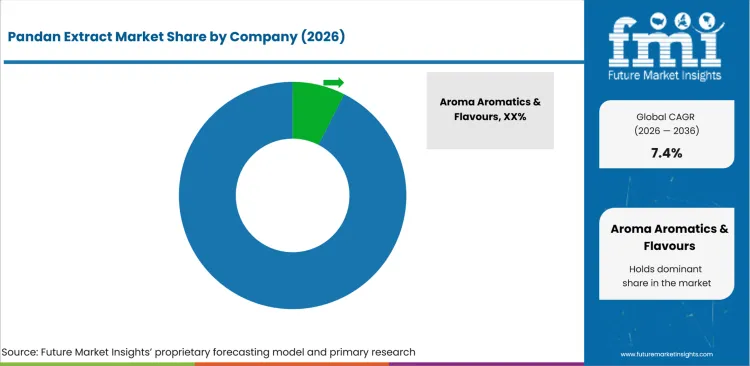
Competition is fragmented between global flavor houses and regional ingredient specialists because pandan remains a narrow flavor category beside larger mainstream profiles. Entry requires botanical sourcing control and stable delivery formats before manufacturers approve a repeatable pandan specification. Application laboratories and country documentation then determine how quickly a qualified specification reaches recurring production.
- Kerry Group plc, Givaudan SA and DSM-Firmenich AG combine broad taste portfolios with multi-region application support.
- International Flavors & Fragrances Inc., Symrise AG and McCormick & Company, Incorporated compete with food-category formulation programs and regulatory support.
- Sensient Technologies Corporation and V. MANE FILS add ingredient and flavor expertise with manufacturing or logistics support across several regions.
Competitive Benchmarking: Pandan Extract Market
| Company | Format Breadth | Botanical Capability | Application Support | Geographic Reach |
|---|---|---|---|---|
| Kerry Group plc | High | High | High | Global |
| Givaudan SA | High | High | High | Global |
| Symrise AG | High | High | Medium | Global |
| DSM-Firmenich AG | High | High | High | Global |
| International Flavors & Fragrances Inc. | High | High | High | Global |
| Sensient Technologies Corporation | High | Medium | High | North America, Europe and Asia Pacific |
| V. MANE FILS | Medium | High | Medium | Global with Southeast Asia logistics |
| McCormick & Company, Incorporated | High | Medium | High | North America and international flavor customers |
Key Developments in the Pandan Extract Market
- In July 2026, Givaudan SA opened a 24,000-square-metre Cikarang facility for Southeast Asian customer programs. The site produces sweet and savory flavor powders plus snack flavor systems closer to regional application teams.
- In June 2026, V. MANE FILS inaugurated its Cikarang logistics expansion to improve ingredient and sample movement across Indonesia and Southeast Asia.
- In November 2025, Symrise AG expanded Symvision AI with sensory-prediction tools intended to narrow formulation changes before physical validation.
Key Players in the Pandan Extract Market
Global Taste and Application Platforms
- Kerry Group plc
- Givaudan SA
- Symrise AG
Integrated Flavor and Extract Specialists
- DSM-Firmenich AG
- International Flavors & Fragrances Inc.
- Sensient Technologies Corporation
Specialty Flavor and Regional Support
- V. MANE FILS
- McCormick & Company, Incorporated
Pandan Extract Market - Report Scope
| Coverage field | Report scope |
|---|---|
| Market breakdown | By extract type, solubility, application, source, sales channel and region. |
| Quantitative Units | Revenue USD million and CAGR in %. |
| Market Definition | Commercial pandan extracts, concentrates, pastes, powders and essential-oil formats supplied for food, beverage and selected fragrance or personal-care applications. |
| Regions Covered | North America, Latin America, Europe, East Asia, South Asia and Pacific, and Middle East and Africa. |
| Countries Covered | Thailand, Indonesia, Malaysia, Singapore, USA, and 20+ countries included in the full report. |
| Key Companies Profiled | Kerry Group plc, Givaudan SA, Symrise AG, DSM-Firmenich AG, International Flavors & Fragrances Inc., Sensient Technologies Corporation, V. MANE FILS, McCormick & Company, Incorporated. |
| Forecast Period | 2026 to 2036. |
| Approach | Primary and secondary research with market triangulation. |
Pandan Extract Market - Research Methodology
| Method | Approach |
|---|---|
| Primary Research | FMI analysts gathered input from manufacturers, service providers, technology developers, distributors, end users, procurement teams, and subject-matter experts. Interviews examined purchasing decisions, product or service evaluation, adoption barriers, approval requirements, pricing considerations, and expectations for technical or commercial support. Respondents were also asked what evidence is required before a trial, pilot, or initial order develops into regular purchasing. |
| Desk Research | Desk research covered government statistics, regulatory publications, trade data, industry associations, technical literature, standards, company filings, product information, and official corporate announcements. Sources were reviewed for relevance, publication date, geographic coverage, and consistency with the defined market scope. Claims relating to performance, applications, approvals, capacity, investment, and commercial activity were retained only when supported by credible public evidence. |
| Market Sizing and Forecasting | The market model combined the baseline value with historical performance, segment structure, pricing and volume indicators, adoption levels, company participation, and country-level demand conditions. Forecast assumptions considered economic activity, investment trends, regulatory developments, technology adoption, purchasing cycles, supply availability, and barriers to wider market use. Segment and regional estimates were reconciled before the final market total was calculated. |
| Data Validation | Estimates were checked against multiple independent indicators, including public data, company activity, trade patterns, industry developments, and findings from primary interviews. Validation also tested whether products, services, applications, and company revenues fell within the defined market boundaries. Adjacent categories, unsupported claims, overlapping revenues, and activities without direct market relevance were excluded to reduce double counting and maintain consistency across segments and countries. |
Pandan Extract Market by Segments
Pandan Extract Market segmented by Extract Type:
- Natural Pandan Extract
- Pandan Flavor Concentrate
- Pandan Paste
- Pandan Powder
- Pandan Essential Oil
Pandan Extract Market segmented by Solubility:
- Water-soluble
- Oil-soluble
- Emulsion-based
Pandan Extract Market segmented by Application:
- Bakery & Desserts
- Beverages
- Dairy & Ice Cream
- Sauces & Ready Meals
- Fragrance / Personal Care
Pandan Extract Market segmented by Source:
- Fresh Pandan Leaves
- Dried Pandan Leaves
- Cultivated / Contract Farming
- Wild / Smallholder Sourcing
Pandan Extract Market segmented by Sales Channel:
- Flavor Houses
- Food Ingredient Distributors
- Direct Processor Supply
- Retail / Foodservice Packs
Pandan Extract Market by Region:
- North America
- United States
- Canada
- Latin America
- Brazil
- Mexico
- Chile
- Rest of Latin America
- Western Europe
- Germany
- United Kingdom
- Italy
- Spain
- France
- Nordics
- Benelux
- Rest of Western Europe
- Eastern Europe
- Russia
- Poland
- Hungary
- Balkan and Baltic States
- Rest of Eastern Europe
- East Asia
- China
- Japan
- South Korea
- South Asia and Pacific
- India
- ASEAN
- Australia and New Zealand
- Rest of South Asia and Pacific
- Middle East and Africa
- Kingdom of Saudi Arabia
- Other GCC Countries
- Türkiye
- South Africa
- Other African Union Countries
- Rest of Middle East and Africa
Research Sources and Bibliography
- Food and Drug Administration Philippines. (2025, June 25). All Food Products [GIVAUDAN ST6969/01 PANDAN registration record].
- Thailand Food and Drug Administration, Food Division. (2026, July 9).
- Food and Drug Administration Philippines. (2025, February 10). All Food Products [PANDAN EXTRACT POWDER 63046T1 registration record].
- Gilsenan, F. (2026, January 12). Driving Flavour Innovation in 2026 with Taste Charts.
- Food and Drug Administration Philippines. (2025, July 3). High Risk Food Products [BUKO PANDAN FLAVOR SOFT SERVE ICE CREAM POWDER registration record].
- Food and Drug Administration Philippines. (2025, October 29). Raw Material Food Products [952712 PANDAN FLAVOR registration record].
- Food and Drug Administration Philippines. (2025, October 7). All Food Products [PANDAN FLAVOR 888374 registration record].
- Badan Penyelenggara Jaminan Produk Halal. (2026, January 22). BPJPH Pastikan Wajib Halal Oktober 2026 Tingkatkan Kepercayaan Konsumen dan Daya Saing Produk Nasional.
- Food and Drug Administration Philippines. (2025, June 2). Raw Material Food Products [PANDAN FLAVOR OIL FGC-8110 registration record].
- Thailand Food and Drug Administration, Food Division. (2026, April 29).
- Badan Penyelenggara Jaminan Produk Halal. (2026, June 10). Raker dengan DPR, Kepala BPJPH Pastikan Implementasi Wajib Halal Oktober 2026 Sesuai Tahapan.
- Department of Agriculture Malaysia. (2026, June 1). myGAP Tanaman Makanan [myGAP.25.2272/D-21251].
- Singapore Food Agency. (2025, January 31). Food (Amendment) Regulations 2025.
- Zeballos, E., & Sinclair, W. (2026, June 11). Total USA food spending reached $2.51 trillion in 2025.
- Kerry Group plc. (2026, March 19). Kerry Group - Annual Report 2025.
- Givaudan. (2026, July 3). Givaudan inaugurates new production facility in Indonesia.
- Symrise AG. (2026, March 4). Symrise delivered solid organic sales growth and strong profitability improvement for 2025.
- dsm-firmenich. (2026, February 20). The year in review - dsm-firmenich Integrated Annual Report 2025.
- International Flavors & Fragrances Inc. (2026, February 27). 2025 Annual Report.
- Sensient Technologies Corporation. (2026, February 13). 2025 Annual Report.
- MANE. (2025, March 28). MANE at FlavourTalk 2025.
- McCormick & Company, Incorporated. (2025, January 23). 0000063754-25-000005 | 10-K | McCormick & Company, Inc.
- MANE. (2026, June 16). MANE Cikarang Site Expansion.
- Symrise AG. (2025, November 11). Prediction meets taste: Symrise expands Symvision AI™ to proprietary taste development tools.
- Kerry Group plc. (2025, December 3). Kerry Unveils New Philippines Customer Co-Creation Centre to Meet Evolving Consumer Demands.
- dsm-firmenich. (2025, August 26). dsm-firmenich unveils major plant investments, emphasizing commitment to shaping the future of flavor in India.
- International Flavors & Fragrances Inc. (2025, July 10). IFF Expands Innovation Center in Singapore with New Immersive Experience Hub.
- Givaudan. (2026, February 12). Givaudan launches the House of Lime in Mexico, offering customers new opportunities for co-creation, inspiration, and innovation.
- Symrise AG. (2026, May 13). Symrise opens Northwest Arkansas Food Studio: expanding customer collaboration & culinary innovation in North America.
- Sensient Technologies Corporation. (2026, July 24). Sensient Technologies Corporation Reports Results for the Quarter Ended June 30, 2026.
- Food and Drug Administration Philippines. (2025, December 4). Raw Material Food Products [951578 BUKO PANDAN FLAVOCOL registration record].
- MANE. (2026, May 6). MANE acquires FROMATECH ingredients B.V., an international flavour player.
- McCormick & Company, Incorporated. (2026, June 25). MCCORMICK REPORTS STRONG SECOND QUARTER PERFORMANCE AND REAFFIRMS 2026 OUTLOOK.
This bibliography is provided for reader reference and is not exhaustive. The full report contains the complete reference list and detailed citations
This Report Answers
- How large is the pandan extract market in 2026 and what value is projected by 2036?
- Which operating conditions move pandan from fresh-leaf preparation into repeatable industrial ingredients?
- Why does natural pandan extract account for 34.0% of extract type demand in 2026?
- How does water solubility affect formulation work across beverage and aqueous applications?
- Why do bakery & desserts represent 34.0% of application demand in 2026?
- How do growth rates differ across the five profiled pandan extract markets?
- Which compliance requirements shape supplier qualification in Thailand, Indonesia and Singapore?
- How do flavor companies compete on botanical capability, application support and regional access?
Frequently Asked Questions
How big is the Pandan Extract Market in 2026?
The pandan extract market is expected to be valued at USD 336.0 million in 2026. Standardized ingredients help manufacturers reproduce pandan aroma across commercial beverage and dessert production without preparing fresh leaves at every site.
What is the CAGR of the Pandan Extract Market from 2026 to 2036?
The pandan extract market is projected to expand at a 7.4% CAGR between 2026 and 2036. Growth depends on familiar flavor demand converting into qualified formulations with stable sensory performance and country-ready documentation.
Which extract type is projected to account for 34.0% of the Pandan Extract Market?
The pandan extract market is estimated to allocate 34.0% of 2026 extract type demand to natural pandan extract. The segment combines plant-linked sensory identity with a standardized ingredient form suited to repeatable industrial dosing and storage.
Which solubility segment is projected to account for 62.0% of the Pandan Extract Market?
The pandan extract market is projected to allocate 62.0% of 2026 solubility demand to water-soluble formats. Their fit with aqueous beverage and dairy systems reduces dispersion work during trials and supports more repeatable scale-up decisions.
Which companies are active in the Pandan Extract Market?
The pandan extract market includes Kerry Group plc, Givaudan SA, Symrise AG and DSM-Firmenich AG, International Flavors & Fragrances Inc., Sensient Technologies Corporation, V. MANE FILS and McCormick & Company, Incorporated.
Preview the report firsthand - request a free sample
Get SampleGet the brochure for pricing and purchase details.
Get PDFTable of Content
- Key Takeaways
- Market Size and CAGR
- Top Growth Driver
- Fastest Growing Segment
- Leading Region
- Key Companies
- Emerging Opportunities
- Executive Summary
- Global Market Outlook
- Demand-side Trends
- Supply-side Trends
- Technology Roadmap Analysis
- Analysis and Recommendations
- Analyst Perspective (What is happening? Why now? What should investors know?)
- Key Questions Answered
- How large is the market?
- What is the CAGR?
- What are key trends?
- Which region dominates?
- Who are the leaders?
- Market Overview
- Market Coverage / Taxonomy
- Market Definition / Scope / Limitations
- Research Methodology
- Chapter Orientation
- Analytical Lens and Working Hypotheses
- Market Structure, Signals, and Trend Drivers
- Benchmarking and Cross-market Comparability
- Market Sizing, Forecasting, and Opportunity Mapping
- Research Design and Evidence Framework
- Desk Research Programme (Secondary Evidence)
- Expert Input and Fieldwork (Primary Evidence)
- Tooling, Models, and Reference Databases
- Data Engineering and Model Build
- Quality Assurance and Audit Trail
- Market Background
- Market Dynamics (Drivers, Restraints, Opportunity, Trends)
- Scenario Forecast (Optimistic, Likely, Conservative)
- Impact Analysis
- AI Impact
- Sustainability Impact
- Regulatory Impact
- Technology Impact
- Consumer / Buyer Analysis
- Purchase Drivers
- Adoption Barriers
- Buyer Journey
- Opportunity Map Analysis
- Product Life Cycle Analysis
- Supply Chain Analysis
- Investment Feasibility Matrix
- Value Chain Analysis
- PESTLE and Porter's Analysis
- Regulatory Landscape
- Regional Parent Market Outlook
- Production and Consumption Statistics
- Import and Export Statistics
- Global Market Analysis and Forecast, 2021 to 2036
- Historical Market Size Value (USD Million) & Volume (Unit) Analysis, 2021 to 2025
- Current and Future Market Size Value (USD Million) & Volume (Unit) Projections, 2026 to 2036
- Y-o-Y Growth Trend Analysis
- Absolute $ Opportunity Analysis
- Global Market Pricing Analysis, 2021 to 2036
- Global Market Analysis and Forecast, By Extract Type, 2021 to 2036
- Introduction / Key Findings
- Historical Market Size Value (USD Million) & Volume (Unit) Analysis By Extract Type, 2021 to 2025
- Current and Future Market Size Value (USD Million) & Volume (Unit) Analysis and Forecast By Extract Type, 2026 to 2036
- Natural Pandan Extract
- Pandan Flavor Concentrate
- Pandan Paste
- Pandan Powder
- Pandan Essential Oil
- Natural Pandan Extract
- Y-o-Y Growth Trend Analysis By Extract Type, 2021 to 2025
- Absolute $ Opportunity Analysis By Extract Type, 2026 to 2036
- Global Market Analysis and Forecast, By Solubility, 2021 to 2036
- Introduction / Key Findings
- Historical Market Size Value (USD Million) & Volume (Unit) Analysis By Solubility, 2021 to 2025
- Current and Future Market Size Value (USD Million) & Volume (Unit) Analysis and Forecast By Solubility, 2026 to 2036
- Water-soluble
- Oil-soluble
- Emulsion-based
- Water-soluble
- Y-o-Y Growth Trend Analysis By Solubility, 2021 to 2025
- Absolute $ Opportunity Analysis By Solubility, 2026 to 2036
- Global Market Analysis and Forecast, By Application, 2021 to 2036
- Introduction / Key Findings
- Historical Market Size Value (USD Million) & Volume (Unit) Analysis By Application, 2021 to 2025
- Current and Future Market Size Value (USD Million) & Volume (Unit) Analysis and Forecast By Application, 2026 to 2036
- Bakery & Desserts
- Beverages
- Dairy & Ice Cream
- Sauces & Ready Meals
- Fragrance / Personal Care
- Bakery & Desserts
- Y-o-Y Growth Trend Analysis By Application, 2021 to 2025
- Absolute $ Opportunity Analysis By Application, 2026 to 2036
- Global Market Analysis and Forecast, By Source, 2021 to 2036
- Introduction / Key Findings
- Historical Market Size Value (USD Million) & Volume (Unit) Analysis By Source, 2021 to 2025
- Current and Future Market Size Value (USD Million) & Volume (Unit) Analysis and Forecast By Source, 2026 to 2036
- Fresh Pandan Leaves
- Dried Pandan Leaves
- Cultivated / Contract Farming
- Wild / Smallholder Sourcing
- Fresh Pandan Leaves
- Y-o-Y Growth Trend Analysis By Source, 2021 to 2025
- Absolute $ Opportunity Analysis By Source, 2026 to 2036
- Global Market Analysis and Forecast, By Sales Channel, 2021 to 2036
- Introduction / Key Findings
- Historical Market Size Value (USD Million) & Volume (Unit) Analysis By Sales Channel, 2021 to 2025
- Current and Future Market Size Value (USD Million) & Volume (Unit) Analysis and Forecast By Sales Channel, 2026 to 2036
- Flavor Houses
- Food Ingredient Distributors
- Direct Processor Supply
- Retail / Foodservice Packs
- Flavor Houses
- Y-o-Y Growth Trend Analysis By Sales Channel, 2021 to 2025
- Absolute $ Opportunity Analysis By Sales Channel, 2026 to 2036
- Global Market Analysis and Forecast, By Region, 2021 to 2036
- Introduction
- Historical Market Size Value (USD Million) & Volume (Unit) Analysis By Region, 2021 to 2025
- Current Market Size Value (USD Million) & Volume (Unit) Analysis and Forecast By Region, 2026 to 2036
- North America
- Latin America
- Western Europe
- Eastern Europe
- East Asia
- South Asia and Pacific
- Middle East & Africa
- Market Attractiveness Analysis By Region
- North America Market Analysis and Forecast, By Country, 2021 to 2036
- Historical Market Size Value (USD Million) & Volume (Unit) Trend Analysis By Market Taxonomy, 2021 to 2025
- Market Size Value (USD Million) & Volume (Unit) Forecast By Market Taxonomy, 2026 to 2036
- By Country
- USA
- Canada
- By Extract Type
- By Solubility
- By Application
- By Source
- By Sales Channel
- By Country
- Market Attractiveness Analysis
- By Country
- By Extract Type
- By Solubility
- By Application
- By Source
- By Sales Channel
- Key Takeaways
- Latin America Market Analysis and Forecast, By Country
- Historical Market Size Value (USD Million) & Volume (Unit) Trend Analysis By Market Taxonomy, 2021 to 2025
- Market Size Value (USD Million) & Volume (Unit) Forecast By Market Taxonomy, 2026 to 2036
- By Country
- Brazil
- Mexico
- Chile
- Rest of Latin America
- By Extract Type
- By Solubility
- By Application
- By Source
- By Sales Channel
- By Country
- Market Attractiveness Analysis
- By Country
- By Extract Type
- By Solubility
- By Application
- By Source
- By Sales Channel
- Key Takeaways
- Western Europe Market Analysis and Forecast, By Country
- Historical Market Size Value (USD Million) & Volume (Unit) Trend Analysis By Market Taxonomy, 2021 to 2025
- Market Size Value (USD Million) & Volume (Unit) Forecast By Market Taxonomy, 2026 to 2036
- By Country
- Germany
- UK
- Italy
- Spain
- France
- Nordic
- BENELUX
- Rest of Western Europe
- By Extract Type
- By Solubility
- By Application
- By Source
- By Sales Channel
- By Country
- Market Attractiveness Analysis
- By Country
- By Extract Type
- By Solubility
- By Application
- By Source
- By Sales Channel
- Key Takeaways
- Eastern Europe Market Analysis and Forecast, By Country
- Historical Market Size Value (USD Million) & Volume (Unit) Trend Analysis By Market Taxonomy, 2021 to 2025
- Market Size Value (USD Million) & Volume (Unit) Forecast By Market Taxonomy, 2026 to 2036
- By Country
- Russia
- Poland
- Hungary
- Balkan & Baltic
- Rest of Eastern Europe
- By Extract Type
- By Solubility
- By Application
- By Source
- By Sales Channel
- By Country
- Market Attractiveness Analysis
- By Country
- By Extract Type
- By Solubility
- By Application
- By Source
- By Sales Channel
- Key Takeaways
- East Asia Market Analysis and Forecast, By Country
- Historical Market Size Value (USD Million) & Volume (Unit) Trend Analysis By Market Taxonomy, 2021 to 2025
- Market Size Value (USD Million) & Volume (Unit) Forecast By Market Taxonomy, 2026 to 2036
- By Country
- China
- Japan
- South Korea
- By Extract Type
- By Solubility
- By Application
- By Source
- By Sales Channel
- By Country
- Market Attractiveness Analysis
- By Country
- By Extract Type
- By Solubility
- By Application
- By Source
- By Sales Channel
- Key Takeaways
- South Asia and Pacific Market Analysis and Forecast, By Country
- Historical Market Size Value (USD Million) & Volume (Unit) Trend Analysis By Market Taxonomy, 2021 to 2025
- Market Size Value (USD Million) & Volume (Unit) Forecast By Market Taxonomy, 2026 to 2036
- By Country
- India
- ASEAN
- Australia & New Zealand
- Rest of South Asia and Pacific
- By Extract Type
- By Solubility
- By Application
- By Source
- By Sales Channel
- By Country
- Market Attractiveness Analysis
- By Country
- By Extract Type
- By Solubility
- By Application
- By Source
- By Sales Channel
- Key Takeaways
- Middle East & Africa Market Analysis and Forecast, By Country
- Historical Market Size Value (USD Million) & Volume (Unit) Trend Analysis By Market Taxonomy, 2021 to 2025
- Market Size Value (USD Million) & Volume (Unit) Forecast By Market Taxonomy, 2026 to 2036
- By Country
- Kingdom of Saudi Arabia
- Other GCC Countries
- Türkiye
- South Africa
- Other African Union
- Rest of Middle East & Africa
- By Extract Type
- By Solubility
- By Application
- By Source
- By Sales Channel
- By Country
- Market Attractiveness Analysis
- By Country
- By Extract Type
- By Solubility
- By Application
- By Source
- By Sales Channel
- Key Takeaways
- Key Countries Market Analysis
- USA
- Pricing Analysis
- Market Share Analysis, 2025
- By Extract Type
- By Solubility
- By Application
- By Source
- By Sales Channel
- Canada
- Pricing Analysis
- Market Share Analysis, 2025
- By Extract Type
- By Solubility
- By Application
- By Source
- By Sales Channel
- Mexico
- Pricing Analysis
- Market Share Analysis, 2025
- By Extract Type
- By Solubility
- By Application
- By Source
- By Sales Channel
- Brazil
- Pricing Analysis
- Market Share Analysis, 2025
- By Extract Type
- By Solubility
- By Application
- By Source
- By Sales Channel
- Chile
- Pricing Analysis
- Market Share Analysis, 2025
- By Extract Type
- By Solubility
- By Application
- By Source
- By Sales Channel
- Germany
- Pricing Analysis
- Market Share Analysis, 2025
- By Extract Type
- By Solubility
- By Application
- By Source
- By Sales Channel
- UK
- Pricing Analysis
- Market Share Analysis, 2025
- By Extract Type
- By Solubility
- By Application
- By Source
- By Sales Channel
- Italy
- Pricing Analysis
- Market Share Analysis, 2025
- By Extract Type
- By Solubility
- By Application
- By Source
- By Sales Channel
- Spain
- Pricing Analysis
- Market Share Analysis, 2025
- By Extract Type
- By Solubility
- By Application
- By Source
- By Sales Channel
- France
- Pricing Analysis
- Market Share Analysis, 2025
- By Extract Type
- By Solubility
- By Application
- By Source
- By Sales Channel
- India
- Pricing Analysis
- Market Share Analysis, 2025
- By Extract Type
- By Solubility
- By Application
- By Source
- By Sales Channel
- ASEAN
- Pricing Analysis
- Market Share Analysis, 2025
- By Extract Type
- By Solubility
- By Application
- By Source
- By Sales Channel
- Australia & New Zealand
- Pricing Analysis
- Market Share Analysis, 2025
- By Extract Type
- By Solubility
- By Application
- By Source
- By Sales Channel
- China
- Pricing Analysis
- Market Share Analysis, 2025
- By Extract Type
- By Solubility
- By Application
- By Source
- By Sales Channel
- Japan
- Pricing Analysis
- Market Share Analysis, 2025
- By Extract Type
- By Solubility
- By Application
- By Source
- By Sales Channel
- South Korea
- Pricing Analysis
- Market Share Analysis, 2025
- By Extract Type
- By Solubility
- By Application
- By Source
- By Sales Channel
- Russia
- Pricing Analysis
- Market Share Analysis, 2025
- By Extract Type
- By Solubility
- By Application
- By Source
- By Sales Channel
- Poland
- Pricing Analysis
- Market Share Analysis, 2025
- By Extract Type
- By Solubility
- By Application
- By Source
- By Sales Channel
- Hungary
- Pricing Analysis
- Market Share Analysis, 2025
- By Extract Type
- By Solubility
- By Application
- By Source
- By Sales Channel
- Kingdom of Saudi Arabia
- Pricing Analysis
- Market Share Analysis, 2025
- By Extract Type
- By Solubility
- By Application
- By Source
- By Sales Channel
- Türkiye
- Pricing Analysis
- Market Share Analysis, 2025
- By Extract Type
- By Solubility
- By Application
- By Source
- By Sales Channel
- South Africa
- Pricing Analysis
- Market Share Analysis, 2025
- By Extract Type
- By Solubility
- By Application
- By Source
- By Sales Channel
- USA
- Market Structure Analysis
- Competition Dashboard
- Competition Benchmarking
- Market Share Analysis of Top Players
- By Regional
- By Extract Type
- By Solubility
- By Application
- By Source
- By Sales Channel
- Emerging Startups
- Innovation Benchmarking
- Competition Analysis
- Competition Deep Dive
- Aroma Aromatics & Flavours
- Overview
- Product Portfolio
- Profitability by Market Segments
- Sales Footprint
- Strategy Overview
- Marketing Strategy
- Product Strategy
- Channel Strategy
- McCormick
- Kerry Group
- Givaudan
- Symrise
- Firmenich
- Silesia Flavours
- Apex Flavours
- Naturalin Bio-Resources
- Kanegrade
- Aroma Aromatics & Flavours
- Case Studies
- Success Stories
- Recent Developments
- Competition Deep Dive
- Assumptions & Acronyms Used


