

- Market Size (2026)
- USD 747.4 Mn
- Forecast (2036)
- USD 1389.9 Mn
- CAGR (2026 to 2036)
- 6.4%
How big is Paper Food Buckets Market in 2026?
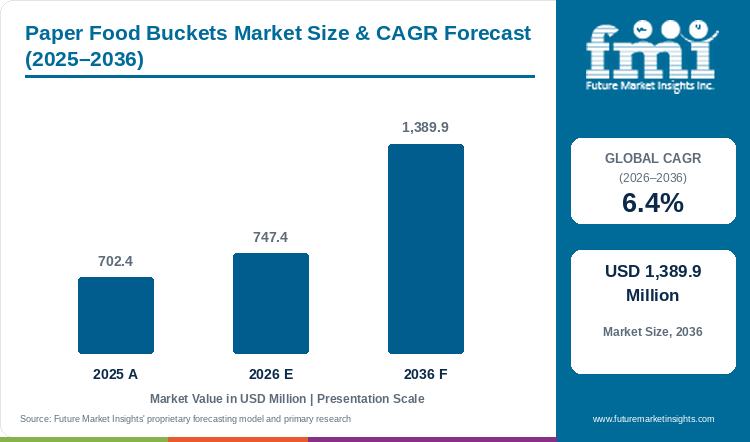
The global paper food buckets market demonstrated steady progress from USD 702.4 million in 2025 to USD 747.4 million in 2026, building toward a targeted valuation of USD 1,389.9 million by 2036 at a CAGR of 6.4%.
Strong reliance on drive-thru and home-delivery channels for family poultry meals is compelling restaurant operators to replace thin folding cartons with rigid, grease-resistant paper buckets that protect food texture during transit. In fact, April 2025 survey data from the National Restaurant Association confirms that nearly 75% of restaurant traffic in the USA moves through off-premises takeout and drive-thru plus delivery lanes [1]. Because packing 80-degree-Celsius bone-in chicken generates steam pressure and hot oil that soften ordinary cartons, paper buckets with vented paperboard lids are expected to hold a 44.6% product-type share in 2026 across buyers of paperboard foodservice packaging, propelling global paper food buckets market value from USD 702.4 million in 2025 to USD 747.4 million in 2026 and USD 1,389.9 million by 2036 at a 6.4% CAGR (USD 642.5 million in incremental expansion). However, higher coating costs and extended grease-holdout qualification trials for non-fluorinated barriers continue to restrain rapid supplier switching among regional franchise groups.
Key Market Trends & Insights
- By product type: Paper buckets with vented paperboard lids are set to command a 44.6% share in 2026, driven by double-fold rim locking and steam-vent crispness retention during stacked delivery.
- By material: PE-coated virgin kraft paperboard is estimated to hold a 38.4% share in 2026, owing to high wet-tensile caliper stiffness and leak-tight bottom curl sealing.
- By format size: Standard family meal buckets (64 oz to 130 oz) are predicted to record a 47.2% share in 2026, attributable to standardized eight-to-twelve-piece poultry combo portions.
- By end use: Quick-service restaurants are anticipated to garner a 53.8% share in 2026, supported by high-throughput drive-thru chicken menus and multi-store promotional bucket campaigns.
- By sales channel: Broadline foodservice distributors are forecast to register a 45.6% share in 2026, enabled by consolidated weekly store replenishment of nested buckets and matched lids.
Regional Highlights
- Fastest national expansion: South Korea is projected to pace national growth at a 7.8% CAGR through 2036 due to dense urban fried-chicken delivery networks, ahead of the UAE at 7.4%.
- Major Western and Asian progression: The USA is forecast to expand at a 6.9% CAGR and Saudi Arabia at 6.6%, whereas the UK (6.1%) and Germany (5.8%) plus France (5.4%) and Japan (4.9%) reflect regulatory transitions.
Market Size & Forecast
Table 1: Market Size and Forecast for the Paper Food Buckets Market (USD million and CAGR percentage), 2025 to 2036
| Metric | Value |
|---|---|
| 2025 Market Size | USD 702.4 million |
| Estimated Market Size in 2026 | USD 747.4 million |
| Projected Market Size by 2036 | USD 1,389.9 million |
| CAGR, 2026 to 2036 | 6.4% |
| Added Revenue, 2026 to 2036 | USD 642.5 million |
Repeat off-premises meal orders depend heavily on whether hot fried poultry arrives at the household table with a crisp crust rather than soggy breading caused by trapped moisture. According to consumer research published by the National Restaurant Association in May 2025, 90% of surveyed off-premises diners stated they would order a wider variety of menu items if restaurants utilized packaging engineered to preserve food temperature and quality during delivery [2]. Due to this direct link between container thermal performance and menu ticket size, restaurant purchasing cooperatives are shifting procurement away from single-wall cartons toward heavy-caliper tapered buckets and coated paper packaging boxes that maintain structural hoop strength for 35 minutes after packing.
Bucket-Forming Throughput and Cupstock Tonnage Sizing
Table 2: Bucket-Forming Throughput and Cupstock Tonnage Sizing for the Paper Food Buckets Market (USD million and operational ranges), 2025 to 2036
| Metric | 2025 | 2026 | 2036 |
|---|---|---|---|
| Market size (USD million) | 702.4 | 747.4 | 1,389.9 |
| Converted paper bucket assemblies shipped (billion units) | 14.2 to 15.1 | 15.1 to 16.0 | 26.2 to 27.8 |
| Barrier-coated cupstock and molded fiber input (thousand metric tons) | 345.0 to 370.0 | 365.0 to 392.0 | 620.0 to 665.0 |
| Average wholesale converter price per 1,000 bucket-and-lid sets (USD) | 46.5 to 49.5 | 46.7 to 49.8 | 50.0 to 53.0 |
Operational note: Converted unit and tonnage ranges reconcile high-speed rotary bucket-forming machine outputs (80 to 130 buckets per minute) using 280 to 380 gsm virgin and recycled cupstock blanks plus matched paperboard or polymer dome lids.
Converter profitability in the paper food buckets market depends on minimizing cupstock trim waste and preventing bottom-curl seal failures when high-speed forming lines run above 100 buckets per minute. When board moisture or caliper varies across rolls, rim roundness distorts and causes lid pop-offs during restaurant packing, which is why tier-one converters integrate high-stiffness virgin kraft body stock with corrugated and folding carton packaging quality controls to guarantee uniform snap-fit closure seating.
Per Capita & Foodservice Outlet Sizing
Table 3: Per Capita and QSR Outlet Spending Indicators for the Paper Food Buckets Market (USD), 2025 to 2036
| Metric | 2025 | 2026 | 2036 |
|---|---|---|---|
| Global population (billion) | 8.2 | 8.3 | 9.0 |
| Market value per 1,000 people (USD) | 85.7 | 90.0 | 154.4 |
| Annual bucket procurement per fried-chicken QSR outlet (USD) | 1,850 to 2,150 | 1,940 to 2,260 | 2,880 to 3,350 |
| PFAS-free aqueous and bio-barrier bucket share of shipments (%) | 31.0% to 34.0% | 36.0% to 39.5% | 68.0% to 73.0% |
Table 4: Foodservice Channel & Segment Allocation Indicators for the Paper Food Buckets Market (USD and percentages), 2026
| Metric | Value | Institutional Reference Basis |
|---|---|---|
| Market size, 2026 | USD 747.4 million | 2026 global paper food buckets baseline |
| QSR chicken and hot-deli outlets globally | 340,000 outlets | Global quick-service poultry and grocery hot-deli footprint |
| Vented paperboard-lid bucket allocation, 2026 | USD 333.3 million | 44.6% product type segment allocation |
| Quick-service restaurant end-use allocation, 2026 | USD 402.1 million | 53.8% end-use segment allocation |
Labor bottlenecks at quick-service prep stations make smooth sleeve denesting and one-hand lid application critical variables in franchise packaging procurement. If nested buckets stick together or require excessive force to close during dinner rushes, service times suffer, prompting multi-regional converters to pair precision taper angles with water-based barrier dispersions on compostable greaseproof papers that satisfy municipal recovery audits without slowing kitchen throughput.
Analyst Perspective
"Quick-service poultry chains no longer judge a paper food bucket by board basis weight alone; procurement approval hinges on whether the bucket-and-lid assembly passes 45-minute hot-oil holdout and stack-crush tests using PFAS-free barrier chemistry. Converters that combine captive cupstock mill integration with audible-lock vented paperboard lids will capture multi-year national chain contracts."
- Nandini Roy Choudhury, Principal Consultant, Future Market Insights.
How is the paper food buckets market segmented?
The paper food buckets market is segmented by product type, material, format size, end use, and sales channel. In 2026, paper buckets with vented paperboard lids are expected at 44.6%, PE-coated virgin kraft paperboard at 38.4%, standard family meal at 47.2%, quick-service restaurants at 53.8%, and broadline foodservice distributors at 45.6%.
By product type: Paper buckets with vented paperboard lids, paper buckets with clear anti-fog dome lids, integrated fold-top & tab-lock paper buckets, and compartmentalized & insert-equipped meal buckets.
By material: PE-coated virgin kraft paperboard, aqueous & PFAS-free dispersion-coated paperboard, PLA & bio-polymer laminated paperboard, and molded fiber & thermoformed bagasse.
By format size: Standard family meal (64 oz to 130 oz), individual & snack combo (24 oz to 60 oz), and large party & catering tub (above 130 oz).
By end use: Quick-service restaurants (QSR chains), supermarket hot delis & prepared food counters, fast-casual & independent chicken restaurants, and institutional catering, stadiums & cinema concessions.
By sales channel: Broadline foodservice distributors, direct QSR chain & national account contracts, specialty packaging & disposables distributors, and online B2B foodservice portals.
Why do Paper buckets with vented paperboard lids lead the Product Type category?
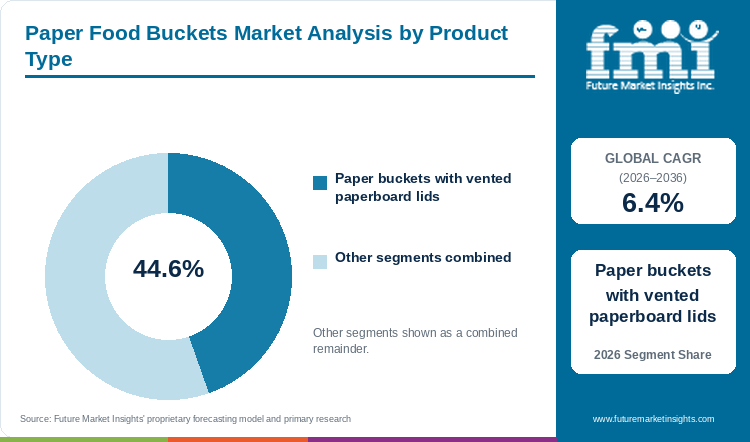
Paper buckets with vented paperboard lids are expected to hold a 44.6% share of the product type segment in 2026, driven by stackable steam-venting closures.
Table 5: Product Type Share for the Paper Food Buckets Market (percentage share), 2026
| Product Type | Share (2026) |
|---|---|
| Paper buckets with vented paperboard lids | 44.6% |
| Other Segments Combined | 55.4%* |
| Total | 100.0% |
*Calculated as the balance remaining after deducting the leading segment's reported share from 100.0%.
Table 6: Product Type Leadership and Market Growth for the Paper Food Buckets Market (segment and CAGR percentage), 2026 to 2036
| Metric | Value |
|---|---|
| Global CAGR (2026 to 2036) | 6.4% |
| Leading Segment | Paper buckets with vented paperboard lids |
Stacked courier delivery bags subject the bottom container to heavy vertical compression while rising steam from hot poultry threatens to soften the lid, driving restaurant buyers toward recessed paperboard plug closures with die-cut steam vents. Substitution of snap-on plastic domes with vented paperboard lids also eliminates single-use plastic tax exposure across folding carton and paperboard packaging supply programs. For instance, Graphic Packaging Holding Company documented in its June 2026 Impact Report that its fiber-based foodservice innovations replaced 880 million plastic packages across customer menus in 2025 to help chains meet plastic-reduction targets [3].
- Vertical stacking strength during courier transit gives the paper buckets with vented paperboard lids sub-segment an expected 44.6% share in 2026 ahead of dome-lid and tab-lock designs.
- Packaging manufacturers are actively acquiring specialized paperboard formers and expanding fiber closure catalogs to capture chain conversions away from plastic dome lids; for instance, Sabert Corporation reported in April 2026 that it launched 481 new paper and molded-fiber items in 2025 and acquired UK paperboard specialist Colpac Limited [4].
How does PE-coated virgin kraft paperboard anchor the Material category?
Within the material segment, PE-coated virgin kraft paperboard is estimated to hold a 38.4% share in 2026, owing to hot-oil holdout.
Protection against hot cooking oil penetrating paperboard fibers during a 45-minute delivery window requires a continuous internal barrier that does not crack along the bottom knurled chime. Although water-based dispersion coatings are gaining traction under PFAS bans across water-based barrier coatings for food packaging, PE-coated virgin kraft paperboard remains the primary volume choice because polyethylene melts cleanly on high-speed ultrasonic side-seam formers without requiring costly machine retrofits.
- Dependable mandrel forming speeds and zero seam wicking under hot frying oil place the PE-coated virgin kraft paperboard sub-segment at an estimated 38.4% material share in 2026.
- Converters are simultaneously developing low-polymer and mono-material takeaway lines to help foodservice buyers lower extended producer responsibility disposal fees, as seen in June 2025 when Duni Group launched its recyclable Vista takeaway packaging series [5].
What keeps Standard family meal at the center of Format Size?
Demand pattern analysis places the standard family meal (64 oz to 130 oz) segment at a projected 47.2% share in 2026, linked to shared poultry bundles.
Menu profitability in quick-service poultry chains centers on high-ticket eight-piece to twelve-piece family meal bundles that raise average order value while using a single 64-ounce to 130-ounce bucket instead of multiple small cartons. Concentrating volume in this standard family meal geometry reduces converter mold changeovers and lets franchise kitchens pair one primary bucket sleeve with portion sauce cups with lids for dipping sides.
- Shared eight-piece to twelve-piece dinner bundles enable the standard family meal sub-segment to account for a projected 47.2% share of format size in 2026.
- High mill utilization for heavy-caliper folding and cupstock grades supports steady board supply for large family-meal bucket runs; according to July 2026 American Forest & Paper Association data, second-quarter 2026 solid bleached boxboard output rose 4% year-over-year as unbleached kraft and recycled boxboard operating rates hit 92.6% [6].
Why do Quick-service restaurants lead the End Use classification?
High-volume poultry chains position the quick-service restaurants segment for an anticipated 53.8% share in 2026 across end use channels.
High-volume fried-chicken chains drive over half of global bucket consumption because promotional family meal campaigns rely on custom-printed buckets to reinforce household brand recall. Even when orders are placed through third-party delivery apps, the quick-service restaurant franchisor controls technical qualification of board caliper and PFAS-free aqueous food packaging coatings to ensure uniform grease holdout across thousands of franchised kitchens.
- Year-round promotional meal buckets and drive-thru store expansion support an anticipated 53.8% end-use share in 2026 for the quick-service restaurants sub-segment.
- To win national quick-service restaurant contracts, global converters are localizing bucket and bag forming near major franchise distribution hubs; for instance, Detmold Group's Detpak division opened a new manufacturing facility in Spartanburg within South Carolina in July 2026 to cut lead times for accounts across the USA [7].
How do Broadline foodservice distributors maintain Sales Channel leadership?
Consolidated store-door replenishment enables the broadline foodservice distributors segment to register a forecast 45.6% share in 2026.
Tapered paper buckets occupy substantial cubic volume in shipping cartons, making direct full-truckload factory deliveries impractical for individual restaurant storefronts with cramped storage rooms. Franchisees instead rely on broadline foodservice distributors to bundle weekly case quantities of nested buckets and matched lids with frozen poultry and cooking oil, shifting inventory carrying costs from the restaurant operator to the regional distributor.
- Multi-temperature route delivery and guaranteed lid-to-bucket SKU matching give the broadline foodservice distributors sub-segment a forecast 45.6% sales channel share in 2026.
- Commercializing new fiber bucket and cup formats through broadline and chain accounts generates measurable revenue gains for integrated board converters, as reflected in Graphic Packaging Holding Company's May 2026 report showing first-quarter 2026 net sales of USD 2,156 million and USD 42 million in packaging innovation growth [8].
What are the drivers, restraints, and opportunities in the paper food buckets market?
In the paper food buckets market, recurring off-premises fried-chicken and family-bundle orders drive replenishment whereas PFAS-free grease-barrier qualification restrains rapid substrate switching and aqueous dispersion coatings create mono-material conversion opportunities.
- Driver: High off-premises drive-thru and courier delivery traffic for bone-in poultry and hot shared sides sustains recurring case orders for rigid, grease-tight paper buckets.
- Restraint: Regulatory phaseouts of fluorinated grease-proofing agents and single-use plastic components lengthen technical qualification cycles and raise converter coating costs.
- Opportunity: Water-based dispersion barriers and molded-fiber bucket assemblies open mono-material kerbside recycling claims across quick-service and supermarket hot-deli accounts.
Growth Analysis and Future Potential: Qualitative Demand Catalysts
Speed of order assembly at drive-thru windows and courier pickup counters is a primary operational driver for paper food bucket demand because packing one family bucket is significantly faster than closing four separate clamshell boxes during dinner rushes. To ensure uninterrupted board availability and stabilize raw-material costs for these high-volume foodservice programs, major converters are investing in large-scale domestic paperboard capacity. For instance, in November 2025, Graphic Packaging International started commercial production at its Waco recycled paperboard mill in Texas to expand board supply across foodservice and recycled paper packaging accounts [9]. This vertical board integration allows converters to guarantee consistent caliper stiffness and secure multi-year supply agreements with expanding poultry chains.
Risk Assessment of the Paper Food Buckets Market: Operational and Formulation Friction
Phaseout of fluorinated grease-proofing chemicals without driving up polymer coating weight or per-unit container cost is the sharpest technical restraint challenging the paper food buckets market. As a matter of fact, the U.S. Food and Drug Administration in January 2025 revoked 35 Food Contact Notifications for PFAS grease-proofing agents [10], while European Commission rules under Regulation (EU) 2025/40 took effect in August 2026 to enforce strict food-contact PFAS bans and mandatory recyclability grades [11]. Because replacing legacy fluorochemicals with thicker polyethylene layers can disqualify buckets from paper-stream recovery and increase extended producer responsibility fees, converters face higher formulation costs that restrain rapid adoption among price-sensitive independent chicken shops.
Commercial Opportunity Analysis: Formulation Differentiation and Value-Add Formats
High-margin growth opportunities are emerging for converters that engineer fluorochemical-free aqueous dispersion coatings and high-density molded-fiber buckets capable of withstanding 85-degree-Celsius frying oil while passing standard mill repulping audits. For instance, Sabert Corporation won two 2026 AmeriStar Awards in August 2026 from the Institute of Packaging Professionals for its GreenScreen Silver certified Pulp Ultra molded-fiber formulation that resists oil up to 185 degrees Fahrenheit and its r-PRO recycled polypropylene line [12]. Similarly, in February 2025, Huhtamaki Oyj commercialized single-coated ProDairy paper cups that cut polymer weight while preserving leak-tight rim sealing [13]. Deployment of these low-polymer dispersion and precision rim-forming technologies across PFAS-free barrier coatings for food paper enables bucket manufacturers to capture sustainability-driven contract renewals from multinational quick-service chains.
Paper Food Buckets Market by Country (2026 to 2036)
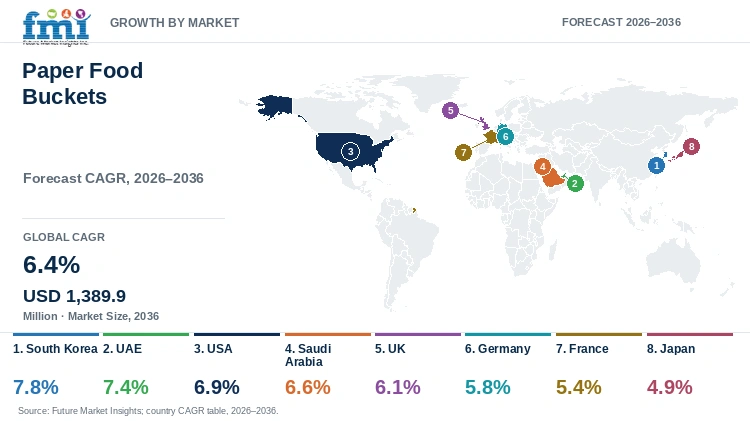
High-frequency urban poultry delivery and municipal plastic phaseouts place South Korea at the top of national paper food bucket growth with a 7.8% CAGR from 2026 to 2036, followed closely by the UAE at 7.4% plus the USA at 6.9% and Saudi Arabia at 6.6%. Mature foodservice markets across the UK (6.1%) and Germany (5.8%) along with France (5.4%) and Japan (4.9%) advance steadily owing to extended producer responsibility fee modulation and PFAS-free barrier mandates.
Table 7: Country CAGR and Primary Growth Levers for the Paper Food Buckets Market (CAGR percentage and operational drivers), 2026 to 2036
| Country | CAGR (2026 to 2036) | Primary Growth Lever |
|---|---|---|
| South Korea | 7.8% | High-density fried-chicken delivery franchises and lightweight fiber bucket substitution |
| UAE | 7.4% | Dubai single-use plastic food container phaseout and rapid cloud-kitchen expansion |
| USA | 6.9% | 75% off-premises QSR meal share, FDA PFAS FCN revocation, and domestic mill capacity additions |
| Saudi Arabia | 6.6% | Vision 2030 QSR poultry chain rollout and SFDA.FD/GSO 839 food-contact compliance |
| UK | 6.1% | England expanded polystyrene takeaway ban and EPR recyclability fee modulation |
| Germany | 5.8% | August 2026 EU PPWR PFAS restrictions and mono-material fiber bucket redesigns |
| France | 5.4% | Separation of AGEC dine-in reusable tableware from off-premises takeaway buckets |
| Japan | 4.9% | Plastics Resource Circulation Act lightweighting and convenience-store hot-food buckets |
Source: Future Market Insights analysis
South Korea Paper Food Buckets Market Outlook (2026 to 2036)
Unlike western drive-thru markets, demand in South Korea is shaped by ultra-dense urban apartment delivery of glazed and soy-garlic fried chicken where trapped steam quickly ruins crust crispness during motorcycle transit. To solve condensation softening while complying with national waste reduction rules, franchise operators in South Korea are shifting toward die-cut vented kraft buckets, propelling national demand at a leading 7.8% CAGR from 2026 to 2036. For instance, the Ministry of Climate, Energy and Environment in December 2025 held a public forum in South Korea to finalize its comprehensive plastic-reduction roadmap targeting delivery containers [14]. However, intense price competition among neighborhood chicken franchises in Seoul and Busan restrains converter ability to pass through higher dispersion-coating costs.
Key takeaway: In South Korea, high-frequency fried-chicken delivery orders and the December 2025 national plastic-reduction plan are projected to drive rapid adoption of lightweight vented paper buckets.
UAE Paper Food Buckets Market Outlook (2026 to 2036)
Rapid expansion of virtual cloud kitchens and multi-brand delivery aggregators across Dubai and Abu Dhabi makes the UAE uniquely reliant on rigid takeaway containers that survive 30-minute courier rides in high coastal heat and humidity. Municipal plastic bans are accelerating this shift from polypropylene tubs to heavy-caliper paper buckets, lifting demand in the UAE at an anticipated 7.4% CAGR between 2026 and 2036. As a matter of fact, in December 2025, Dubai Municipality confirmed that the final phase of its single-use plastic ban would take effect from January 2026 across plastic foodservice containers [15]. Even so, reliance on imported virgin cupstock rolls exposes converters serving the UAE to maritime freight rate fluctuations.
Key takeaway: In the UAE, Dubai's January 2026 single-use plastic food container phaseout and expanding cloud-kitchen delivery volume are anticipated to accelerate paperboard bucket procurement.
USA Paper Food Buckets Market Outlook (2026 to 2036)
Menu economics across multi-unit poultry chains and supermarket hot delis make the USA the largest volume buyer of paper food buckets globally, driven by high-margin eight-piece to sixteen-piece family bundle promotions. Sustained household spending on convenient off-premises meals keeps bucket replenishment growing even when menu prices rise; according to July 2026 U.S. Department of Agriculture Economic Research Service data, per-capita food-away-from-home expenditure remained elevated across all states in 2025 [16]. Following the January 2025 FDA revocation of 35 PFAS grease-proofing notifications and domestic mill expansions in Texas and South Carolina, demand in the USA is estimated to advance at a 6.9% CAGR through 2036, though state-level compostability laws complicate national SKU standardization.
Key takeaway: In the USA, high per-capita food-away-from-home spending and domestic PFAS-free paperboard capacity additions are estimated to sustain multi-year chain bucket replenishment.
Saudi Arabia Paper Food Buckets Market Outlook (2026 to 2036)
Large household sizes and late-evening group dining culture differentiate Saudi Arabia from smaller-portion European markets, generating strong year-round demand for 85-ounce to 130-ounce family chicken buckets across Riyadh and Jeddah plus Dammam. Domestic poultry chains and international quick-service franchises are expanding store networks rapidly while facing stricter municipal food-contact and delivery hygiene audits. In June 2025, the Saudi Food and Drug Authority introduced updated food technical regulations for restaurants and delivery platforms [17], followed by 17,096 field inspection visits reported in July 2026 to enforce compliance across Saudi Arabia [18]. Owing to these store additions and strict hygiene standards, consumption in Saudi Arabia is forecast to rise at a 6.6% CAGR from 2026 to 2036.
Key takeaway: In Saudi Arabia, rapid quick-service poultry franchise expansion and active SFDA technical enforcement are forecast to favor certified paperboard bucket suppliers.
UK Paper Food Buckets Market Outlook (2026 to 2036)
In the UK, procurement of takeaway packaging by high-street chicken shops and supermarket hot counters is increasingly governed by extended producer responsibility disposal fee calculations rather than container unit price alone. Because composite containers with heavy plastic liners face higher fee assessments and red recyclability ratings, operators are converting to aqueous dispersion-coated kraft buckets and paperboard lids. In June 2025, the UK Department for Environment, Food and Rural Affairs published the 2025 base fees for packaging extended producer responsibility and confirmed recyclability fee modulation from 2026 under the Recyclability Assessment Methodology [19]. Attributable to these fee incentives, paper food bucket demand in the UK is expected to progress at a 6.1% CAGR between 2026 and 2036.
Key takeaway: In the UK, PackUK extended producer responsibility base fees and recyclability modulation are expected to sustain mono-material paper bucket adoption.
Germany Paper Food Buckets Market Outlook (2026 to 2036)
Strict dual-system fiber recovery thresholds and municipal single-use packaging taxes in cities across Germany force quick-service chains to evaluate paper buckets on verified repulpability in standard paper mills. If a bucket utilizes a thick polyethylene laminate or plastic dome closure, it incurs higher dual-system licensing costs under national packaging rules. For instance, in August 2026, the Zentrale Stelle Verpackungsregister and the Federal Environment Agency published the 2026 edition of the minimum standard for determining packaging recyclability in Germany ahead of European recovery targets [20]. Reinforced by chain conversions toward certified repulpable dispersion-coated fiber buckets that avoid composite penalties, demand in Germany is projected to register a 5.8% CAGR from 2026 to 2036.
Key takeaway: In Germany, the August 2026 ZSVR recyclability minimum standard and European PFAS limits are projected to accelerate chain transitions toward dispersion-coated paper buckets.
France Paper Food Buckets Market Outlook (2026 to 2036)
Mandatory reusable tableware enforcement for dine-in fast-food service in France has concentrated disposable paper food bucket consumption entirely within suburban drive-thru lanes and home-delivery aggregators plus supermarket rotisserie counters. Because dine-in meals cannot use single-use buckets, converters serving France focus on high-stiffness takeaway buckets engineered with fluorochemical-free aqueous barriers. Across France, the paper food buckets market is anticipated to expand at a 5.4% CAGR over the 2026 to 2036 forecast period through chain standardization on fiber-only delivery packs. In January 2026, the European Commission highlighted how cellulose-based meal packaging under the CIRC-PACK and FRESH initiatives cut retail plastic waste by nearly 40% ahead of 2026 Packaging and Packaging Waste Regulation enforcement [21].
Key takeaway: In France, expanding suburban drive-thru poultry sales and 2026 European circular packaging rules are anticipated to concentrate PFAS-free paper bucket demand in takeaway channels.
Japan Paper Food Buckets Market Outlook (2026 to 2036)
Demand for paper food buckets in Japan is uniquely anchored by convenience-store hot-snack counters and seasonal holiday fried-chicken campaigns where consumers expect immaculate print graphics and zero paper odor plus clean household disposal. Because municipal waste rules in Japan penalize oil-soaked paperboard in recyclable paper streams, converters engineer virgin cupstock buckets with ultra-thin, easy-release internal barriers. Policy guidance from the Ministry of Agriculture, Forestry and Fisheries in March 2025 details food-industry plastic resource circulation measures encouraging foodservice operators in Japan to reduce single-use plastic weight and adopt renewable fiber containers [22]. Supported by convenience-store hot-food merchandising and corporate plastic-reduction targets, demand in Japan is estimated to grow at a 4.9% CAGR from 2026 to 2036.
Key takeaway: In Japan, MAFF food-industry plastic circulation guidelines and convenience-store hot-food merchandising are estimated to support steady adoption of reduced-polymer paper buckets.
Full report country CAGRs cover: North America; Latin America; Western Europe; Eastern Europe; East Asia; South Asia and Pacific; Middle East and Africa.
Who are the notable companies in the paper food buckets market?
Graphic Packaging International, Detmold Group (Detpak), Huhtamaki Oyj, Novolex (incorporating Pactiv Evergreen), Sabert Corporation, Dart Container Corporation, Duni Group, Genpak LLC, and Amcor plc (incorporating Berry Global) are the notable companies in the paper food buckets market.
Supplier positioning in the global paper food buckets sector spans integrated paperboard bucket converters, broadline foodservice container platforms, and hybrid closure specialists. Graphic Packaging International and Detmold Group (through its Detpak brand) manufacture dedicated tapered paper food buckets and flat-packed integrated-lid bucket ranges for multinational quick-service chains. Huhtamaki Oyj and Sabert Corporation along with Dart Container Corporation engineer barrier-coated paperboard cups and molded-fiber bowls plus high-speed rim-forming systems across foodservice channels. Corporate consolidation reshaped supplier structures in April 2025 when Novolex completed its combination with Pactiv Evergreen and Amcor plc completed its combination with Berry Global to unite paperboard and rigid dome-lid capabilities under common ownership.
- Dedicated Paperboard Bucket & Cupstock Converters: Graphic Packaging International and Detmold Group (Detpak) along with Huhtamaki Oyj operate high-speed rotary bucket-forming lines and virgin or recycled barrier board platforms for global quick-service poultry chains.
- Broadline Foodservice Container & Molded-Fiber Platforms: Novolex (incorporating Pactiv Evergreen) and Sabert Corporation along with Dart Container Corporation and Genpak LLC supply grease-resistant molded-fiber tubs and broadline-distributed hot-food containers.
- Mixed-Material Closure & Takeaway Systems Specialists: Duni Group and Amcor plc (incorporating Berry Global) engineer anti-fog rPET and PP dome closures as well as paper-forward takeaway packs and cardboard-polymer hybrid containers.
Competitive Benchmarking: Paper Food Buckets Market
Table 8: Competitive Benchmarking for the Paper Food Buckets Market (qualitative capability ratings), 2026
| Company | Tapered Paper Bucket Range | PFAS-Free Grease & Steam Barrier | Matched Paper & Dome Lid Systems | Geographic Reach |
|---|---|---|---|---|
| Graphic Packaging International | High | High | High | High |
| Detmold Group (Detpak) | High | High | High | High |
| Huhtamaki Oyj | Medium | High | High | High |
| Novolex (Pactiv Evergreen) | Medium | High | High | High |
| Sabert Corporation | Medium | High | High | Medium |
| Dart Container Corporation | Medium | High | Medium | Medium |
| Duni Group | Medium | Medium | High | Medium |
| Genpak LLC | Low | Medium | Medium | Medium |
| Amcor plc (Berry Global) | Low | Medium | High | High |
Scoring basis: Capability ratings evaluate documented tapered paperboard bucket SKUs (42 oz to 190 oz) and flat-packed bucket structures, non-fluorinated hot-oil barrier coating depth, and fitted vented paperboard or anti-fog dome lid compatibility across global foodservice regions.
Key Developments in the Paper Food Buckets Market
- Major paperboard converters are introducing low-polymer barrier containers to help foodservice chains avoid European plastic-tax penalties; for instance, in May 2025, Graphic Packaging International launched a recyclable paperboard foodservice range in Europe engineered for high fiber recovery [23].
- To capture surging quick-service poultry store openings across emerging Asian markets and reduce cross-border freight lead times, Detmold Group announced a major investment in August 2026 to establish a new Detpak paper foodservice manufacturing plant in India [24].
- Broadline container manufacturers are scaling domestic molded-fiber capacity to replace foam and rigid plastic tubs across restaurant accounts, as demonstrated in October 2026 when Dart Container Corporation brought its Lancaster molded-fiber plant in Pennsylvania to full operating capacity [25].
Key Players in the Paper Food Buckets Market
Dedicated Paperboard Bucket and Cupstock Converters
- Graphic Packaging International
- Detmold Group (Detpak)
- Huhtamaki Oyj
Broadline Foodservice Container and Molded-Fiber Platforms
- Novolex (incorporating Pactiv Evergreen)
- Sabert Corporation
- Dart Container Corporation
- Genpak LLC
Mixed-Material Closure and Takeaway Systems Specialists
- Duni Group
- Amcor plc (incorporating Berry Global)
Paper Food Buckets Market - Report Scope
Table 9: Report Scope for the Paper Food Buckets Market (coverage fields and definitions), 2026 to 2036
| Coverage field | Report scope |
|---|---|
| Market breakdown | Product Type; Material; Format Size; End Use; Sales Channel; Region |
| Quantitative Units | USD Million |
| Market Definition | Includes commercial converter revenue from paperboard and molded-fiber food buckets (24 oz to 190 oz) sold into foodservice and retail hot-deli applications, including matched vented paperboard lids, anti-fog dome closures, and internal divider inserts sold as part of the bucket assembly. Category Scope Note: Excludes cooked food sales, all-plastic injection-molded pails, metal tins, standalone beverage cups, and flat folding cartons. |
| Regions Covered | North America; Latin America; Western Europe; Eastern Europe; East Asia; South Asia and Pacific; Middle East and Africa |
| Countries Covered | South Korea, UAE, USA, Saudi Arabia, UK, Germany, France, Japan, and additional countries in the full report |
| Key Companies Covered | Graphic Packaging International, Detmold Group (Detpak), Huhtamaki Oyj, Novolex (Pactiv Evergreen), Sabert Corporation, Dart Container Corporation, Duni Group, Genpak LLC, Amcor plc (Berry Global) |
| Forecast Period | 2026 to 2036 |
| Approach | Primary and secondary research with top-down and bottom-up market triangulation. |
Paper Food Buckets Market - Research Methodology
Table 10: Research Methodology for the Paper Food Buckets Market (research methods and approach), 2026 edition
| Method | Approach |
|---|---|
| Primary Research | Structured interviews with rotary paperboard bucket converting engineers, quick-service poultry chain packaging procurement directors, barrier-coating chemists, and broadline foodservice distributors across North America, Europe, Asia, and the Middle East. |
| Secondary Research | Analysis of Graphic Packaging, Huhtamaki, Detmold Group, Novolex, Sabert, Duni, and Amcor corporate disclosures, National Restaurant Association off-premises traffic reports, U.S. FDA FCN phaseout notices, and EU PPWR regulatory texts. |
| Market Sizing and Forecasting | Top-down foodservice paperboard converting revenues reconciled against bottom-up annual converted bucket shipments (15.1 to 16.0 billion assemblies in 2026) and wholesale realization per thousand bucket-and-lid sets from 2026 to 2036. |
| Country Forecasting Model | Econometric national projections weight quick-service poultry outlet density, off-premises delivery penetration, single-use plastic bans, and PFAS-free barrier conversion timelines across eight core countries. |
| Operational Benchmark Traceability | Bucket-forming throughput, cupstock tonnage, and per-outlet spending indicators in Tables 2, 3, and 4 trace to rotary forming machine speed ratings, virgin/recycled cupstock basis weights, and QSR poultry store registries. |
| Data Triangulation and Validation | Demand estimates are cross-checked against foodservice cupstock mill deliveries and QSR chain promotional bucket volumes while excluding standalone beverage cups, rigid plastic tubs, and unconverted parent board reels. |
Paper Food Buckets Market by Segments
Paper Food Buckets Market segmented by Product Type:
- Paper buckets with vented paperboard lids
- Paper buckets with clear anti-fog dome lids
- Integrated fold-top & tab-lock paper buckets
- Compartmentalized & insert-equipped meal buckets
Paper Food Buckets Market segmented by Material:
- PE-coated virgin kraft paperboard
- Aqueous & PFAS-free dispersion-coated paperboard
- PLA & bio-polymer laminated paperboard
- Molded fiber & thermoformed bagasse
Paper Food Buckets Market segmented by Format Size:
- Standard family meal (64 oz to 130 oz)
- Individual & snack combo (24 oz to 60 oz)
- Large party & catering tub (above 130 oz)
Paper Food Buckets Market segmented by End Use:
- Quick-service restaurants (QSR chains)
- Supermarket hot delis & prepared food counters
- Fast-casual & independent chicken restaurants
- Institutional catering, stadiums & cinema concessions
Paper Food Buckets Market segmented by Sales Channel:
- Broadline foodservice distributors
- Direct QSR chain & national account contracts
- Specialty packaging & disposables distributors
- Online B2B foodservice portals
Paper Food Buckets Market by Region
- North America
- USA
- Canada
- Latin America
- Brazil
- Mexico
- Argentina
- Chile
- Western Europe
- Germany
- France
- UK
- Italy
- Spain
- Benelux
- Nordics
- Eastern Europe
- Poland
- Czech Republic
- Romania
- Hungary
- East Asia
- China
- Japan
- South Korea
- South Asia and Pacific
- India
- ASEAN
- Australia and New Zealand
- Middle East and Africa
- GCC Countries
- South Africa
- Türkiye
- Israel
Research Sources and Bibliography
- [1] National Restaurant Association. (2025, April 16). From Trend to Transformation: Off-Premises Dining Now Essential for Restaurant Consumers, Operators. National Restaurant Association.
- [2] National Restaurant Association. (2025, May 21). Increased sales come in the right packages. National Restaurant Association.
- [3] Graphic Packaging Holding Company. (2026, June 30). Graphic Packaging 2025 Impact Report. Graphic Packaging Newsroom.
- [4] Sabert Corporation. (2026, April 30). Sabert Corporation Releases 2025 Sustainability Report and Announces New 2030 Goal, Signaling Shift Toward End-of-Life Outcomes. Sabert Corporation Newsroom.
- [5] Duni Group. (2025, June 4). Duni launches new take-away series with improved recyclability and enhanced functionality. Duni Group Press Releases.
- [6] American Forest & Paper Association. (2026, July 31). AF&PA Releases Q2 2026 Boxboard Quarterly Report. American Forest & Paper Association.
- [7] Detmold Group. (2026, July 20). Detpak Is Now Manufacturing in the USA. Detmold Group Newsroom.
- [8] Graphic Packaging Holding Company. (2026, May 5). Graphic Packaging Holding Company Reports First Quarter 2026 Financial Results. Graphic Packaging Investor Relations.
- [9] Graphic Packaging International. (2025, November 5). Graphic Packaging Launches Advanced Recycled Paperboard Facility in Waco, Texas. Graphic Packaging International.
- [10] U.S. Food and Drug Administration. (2025, January 3). FDA Determines Authorization for 35 Food Contact Notifications Related to PFAS Are No Longer Effective. U.S. Food and Drug Administration.
- [11] European Commission. (2026, August 11). New EU rules on packaging enter into application. European Commission Directorate-General for Environment.
- [12] Sabert Corporation. (2026, August 13). Sabert Wins Two 2026 AmeriStar Awards for r-PRO™ and Pulp Ultra®. Sabert Corporation Newsroom.
- [13] Huhtamaki Oyj. (2025, February 28). Huhtamaki launches recyclable single coated paper cups for yogurt and dairy. Huhtamaki Press Releases.
- [14] Ministry of Climate, Energy and Environment, Republic of Korea. (2025, December 23). Public Forum for the Formulation of a Comprehensive Plastic Reduction Plan. Ministry of Climate, Energy and Environment.
- [15] Dubai Municipality. (2025, December 24). Dubai to enforce final phase of single-use plastic ban from 2026. Dubai Municipality Newsroom.
- [16] U.S. Department of Agriculture, Economic Research Service. (2026, July 8). Per capita food-away-from-home sales by U.S. State, 2025. USDA Economic Research Service.
- [17] Saudi Food and Drug Authority. (2025, June 18). SFDA to Implement New Food Rules for Transparency and Consumer Health. Saudi Food and Drug Authority.
- [18] Saudi Food and Drug Authority. (2026, July 23). SFDA Intercepts Over 301 Tons of Non-Compliant Food Products in Q2 2026. Saudi Food and Drug Authority.
- [19] UK Department for Environment, Food & Rural Affairs. (2025, June 30). Extended producer responsibility for packaging: 2025 base fees. UK Government.
- [20] Zentrale Stelle Verpackungsregister (ZSVR). (2026, August 31). Simple, data-efficient, fair: ZSVR and UBA publish the 2026 edition of the minimum standard. Stiftung Zentrale Stelle Verpackungsregister.
- [21] European Commission, Directorate-General for Environment. (2026, January 22). Pioneering EU solutions for plastic waste. European Commission.
- [22] Ministry of Agriculture, Forestry and Fisheries, Japan. (2025, March 10). Plastic resource circulation in the food industry. MAFF Japan.
- [23] Graphic Packaging International. (2025, May 14). Graphic Packaging launches new portfolio of paperboard sushi packaging to support regulatory compliance of European foodservice operators. Graphic Packaging International.
- [24] Detmold Group. (2026, August 18). Detmold Group Invests in New Manufacturing Facility in India. Detmold Group Newsroom.
- [25] Dart Container Corporation. (2026, October 13). Dart Expands Molded Fiber Packaging Capacity at Pennsylvania Facility. Dart Container Newsroom.
- [26] Duni Group. (2026, May 5). Duni Group launches black paper-based packaging collection that facilitates sorting and contributes to lower climate impact. Duni Group Newsroom.
- [27] Amcor plc. (2025, April 30). Amcor completes combination with Berry Global. Amcor Newsroom.
This bibliography is provided for reader reference and is not exhaustive. The full report contains the complete reference list and detailed citations.
This Report Answers
- How large is the paper food buckets market in 2026, and what value is projected for 2036?
- Which off-premises restaurant pressures underpin paper food bucket replenishment?
- Why do paper buckets with vented paperboard lids lead the product type category?
- What keeps PE-coated virgin kraft paperboard ahead in the material classification?
- How do national growth rates differ across South Korea, the UAE, the USA, and Saudi Arabia?
- Which companies manufacture tapered paper food buckets and compatible closure systems?
- Which PFAS-free coating and waste-sorting hurdles restrict rapid supplier switching?
- What technical tests should foodservice buyers complete before approving a bucket assembly?
Frequently Asked Questions
How big is the paper food buckets market in 2026, and what is projected for 2036?
Rotary bucket-forming shipments stood at USD 702.4 million in 2025 and reach an estimated USD 747.4 million in 2026, while off-premises poultry meal orders push projected demand to USD 1,389.9 million by 2036.
What is the paper food buckets market CAGR from 2026 to 2036?
Global converter revenues from paper food buckets are projected to compound at a 6.4% annual rate from 2026 through 2036, adding USD 642.5 million in ten-year incremental turnover.
Which Product Type segment leads the paper food buckets market?
Paper buckets with vented paperboard lids are expected to hold a 44.6% share of the product type category in 2026, driven by stackable delivery containment and steam-venting crust protection.
Which Material segment holds the leading share?
PE-coated virgin kraft paperboard is estimated to hold a 38.4% share of the material category in 2026, owing to high wet-hoop stiffness and leak-free ultrasonic side-seam bonding.
Which countries have the highest forecast growth rates?
Fried-chicken delivery chains put South Korea at a 7.8% CAGR, the UAE at 7.4%, and the USA at 6.9% at the top of the national growth table through 2036.
Which companies are profiled in the paper food buckets market?
Tapered bucket forming and foodservice board supply center on Graphic Packaging International, Detmold Group (Detpak), Huhtamaki Oyj, Novolex (incorporating Pactiv Evergreen), Sabert Corporation, Dart Container Corporation, Duni Group, Genpak LLC, and Amcor plc (incorporating Berry Global).
Preview the report firsthand - request a free sample
Get SampleGet the brochure for pricing and purchase details.
Get PDFTable of Content
- Key Takeaways
- Market Size and CAGR
- Top Growth Driver
- Fastest Growing Segment
- Leading Region
- Key Companies
- Emerging Opportunities
- Executive Summary
- Global Market Outlook
- Demand-side Trends
- Supply-side Trends
- Technology Roadmap Analysis
- Analysis and Recommendations
- Analyst Perspective (What is happening? Why now? What should investors know?)
- Key Questions Answered
- How large is the market?
- What is the CAGR?
- What are key trends?
- Which region dominates?
- Who are the leaders?
- Market Overview
- Market Coverage / Taxonomy
- Market Definition / Scope / Limitations
- Research Methodology
- Chapter Orientation
- Analytical Lens and Working Hypotheses
- Market Structure, Signals, and Trend Drivers
- Benchmarking and Cross-market Comparability
- Market Sizing, Forecasting, and Opportunity Mapping
- Research Design and Evidence Framework
- Desk Research Programme (Secondary Evidence)
- Expert Input and Fieldwork (Primary Evidence)
- Tooling, Models, and Reference Databases
- Data Engineering and Model Build
- Quality Assurance and Audit Trail
- Market Background
- Market Dynamics (Drivers, Restraints, Opportunity, Trends)
- Scenario Forecast (Optimistic, Likely, Conservative)
- Impact Analysis
- AI Impact
- Sustainability Impact
- Regulatory Impact
- Technology Impact
- Consumer / Buyer Analysis
- Purchase Drivers
- Adoption Barriers
- Buyer Journey
- Opportunity Map Analysis
- Product Life Cycle Analysis
- Supply Chain Analysis
- Investment Feasibility Matrix
- Value Chain Analysis
- PESTLE and Porter's Analysis
- Regulatory Landscape
- Regional Parent Market Outlook
- Production and Consumption Statistics
- Import and Export Statistics
- Global Market Analysis and Forecast, 2021 to 2036
- Historical Market Size Value (USD Million) Analysis, 2021 to 2025
- Current and Future Market Size Value (USD Million) Projections, 2026 to 2036
- Y-o-Y Growth Trend Analysis
- Absolute $ Opportunity Analysis
- Global Market Pricing Analysis, 2021 to 2036
- Global Market Analysis and Forecast, By Product Type, 2021 to 2036
- Introduction / Key Findings
- Historical Market Size Value (USD Million) Analysis By Product Type, 2021 to 2025
- Current and Future Market Size Value (USD Million) Analysis and Forecast By Product Type, 2026 to 2036
- Paper buckets with vented paperboard lids
- Paper buckets with clear anti-fog dome lids
- Integrated fold-top & tab-lock paper buckets
- Compartmentalized & insert-equipped meal buckets
- Y-o-Y Growth Trend Analysis By Product Type, 2021 to 2025
- Absolute $ Opportunity Analysis By Product Type, 2026 to 2036
- Global Market Analysis and Forecast, By Material, 2021 to 2036
- Introduction / Key Findings
- Historical Market Size Value (USD Million) Analysis By Material, 2021 to 2025
- Current and Future Market Size Value (USD Million) Analysis and Forecast By Material, 2026 to 2036
- PE-coated virgin kraft paperboard
- Aqueous & PFAS-free dispersion-coated paperboard
- PLA & bio-polymer laminated paperboard
- Molded fiber & thermoformed bagasse
- Y-o-Y Growth Trend Analysis By Material, 2021 to 2025
- Absolute $ Opportunity Analysis By Material, 2026 to 2036
- Global Market Analysis and Forecast, By Format Size, 2021 to 2036
- Introduction / Key Findings
- Historical Market Size Value (USD Million) Analysis By Format Size, 2021 to 2025
- Current and Future Market Size Value (USD Million) Analysis and Forecast By Format Size, 2026 to 2036
- Standard family meal (64 oz to 130 oz)
- Individual & snack combo (24 oz to 60 oz)
- Large party & catering tub (above 130 oz)
- Y-o-Y Growth Trend Analysis By Format Size, 2021 to 2025
- Absolute $ Opportunity Analysis By Format Size, 2026 to 2036
- Global Market Analysis and Forecast, By End Use, 2021 to 2036
- Introduction / Key Findings
- Historical Market Size Value (USD Million) Analysis By End Use, 2021 to 2025
- Current and Future Market Size Value (USD Million) Analysis and Forecast By End Use, 2026 to 2036
- Quick-service restaurants (QSR chains)
- Supermarket hot delis & prepared food counters
- Fast-casual & independent chicken restaurants
- Institutional catering, stadiums & cinema concessions
- Y-o-Y Growth Trend Analysis By End Use, 2021 to 2025
- Absolute $ Opportunity Analysis By End Use, 2026 to 2036
- Global Market Analysis and Forecast, By Sales Channel, 2021 to 2036
- Introduction / Key Findings
- Historical Market Size Value (USD Million) Analysis By Sales Channel, 2021 to 2025
- Current and Future Market Size Value (USD Million) Analysis and Forecast By Sales Channel, 2026 to 2036
- Broadline foodservice distributors
- Direct QSR chain & national account contracts
- Specialty packaging & disposables distributors
- Online B2B foodservice portals
- Y-o-Y Growth Trend Analysis By Sales Channel, 2021 to 2025
- Absolute $ Opportunity Analysis By Sales Channel, 2026 to 2036
- Global Market Analysis and Forecast, By Region, 2021 to 2036
- Introduction
- Historical Market Size Value (USD Million) Analysis By Region, 2021 to 2025
- Current Market Size Value (USD Million) Analysis and Forecast By Region, 2026 to 2036
- North America
- Latin America
- Western Europe
- Eastern Europe
- East Asia
- South Asia and Pacific
- Middle East and Africa
- Market Attractiveness Analysis By Region
- North America Market Analysis and Forecast, By Country, 2021 to 2036
- Historical Market Size Value (USD Million) Trend Analysis By Market Taxonomy, 2021 to 2025
- Market Size Value (USD Million) Forecast By Market Taxonomy, 2026 to 2036
- By Country
- USA
- Canada
- By Product Type
- By Material
- By Format Size
- By End Use
- By Sales Channel
- By Country
- Market Attractiveness Analysis
- By Country
- By Product Type
- By Material
- By Format Size
- By End Use
- By Sales Channel
- Key Takeaways
- Latin America Market Analysis and Forecast, By Country
- Historical Market Size Value (USD Million) Trend Analysis By Market Taxonomy, 2021 to 2025
- Market Size Value (USD Million) Forecast By Market Taxonomy, 2026 to 2036
- By Country
- Brazil
- Mexico
- Argentina
- Chile
- By Product Type
- By Material
- By Format Size
- By End Use
- By Sales Channel
- By Country
- Market Attractiveness Analysis
- By Country
- By Product Type
- By Material
- By Format Size
- By End Use
- By Sales Channel
- Key Takeaways
- Western Europe Market Analysis and Forecast, By Country
- Historical Market Size Value (USD Million) Trend Analysis By Market Taxonomy, 2021 to 2025
- Market Size Value (USD Million) Forecast By Market Taxonomy, 2026 to 2036
- By Country
- Germany
- France
- UK
- Italy
- Spain
- Benelux
- Nordics
- By Product Type
- By Material
- By Format Size
- By End Use
- By Sales Channel
- By Country
- Market Attractiveness Analysis
- By Country
- By Product Type
- By Material
- By Format Size
- By End Use
- By Sales Channel
- Key Takeaways
- Eastern Europe Market Analysis and Forecast, By Country
- Historical Market Size Value (USD Million) Trend Analysis By Market Taxonomy, 2021 to 2025
- Market Size Value (USD Million) Forecast By Market Taxonomy, 2026 to 2036
- By Country
- Poland
- Czech Republic
- Romania
- Hungary
- By Product Type
- By Material
- By Format Size
- By End Use
- By Sales Channel
- By Country
- Market Attractiveness Analysis
- By Country
- By Product Type
- By Material
- By Format Size
- By End Use
- By Sales Channel
- Key Takeaways
- East Asia Market Analysis and Forecast, By Country
- Historical Market Size Value (USD Million) Trend Analysis By Market Taxonomy, 2021 to 2025
- Market Size Value (USD Million) Forecast By Market Taxonomy, 2026 to 2036
- By Country
- China
- Japan
- South Korea
- By Product Type
- By Material
- By Format Size
- By End Use
- By Sales Channel
- By Country
- Market Attractiveness Analysis
- By Country
- By Product Type
- By Material
- By Format Size
- By End Use
- By Sales Channel
- Key Takeaways
- South Asia and Pacific Market Analysis and Forecast, By Country
- Historical Market Size Value (USD Million) Trend Analysis By Market Taxonomy, 2021 to 2025
- Market Size Value (USD Million) Forecast By Market Taxonomy, 2026 to 2036
- By Country
- India
- ASEAN
- Australia and New Zealand
- By Product Type
- By Material
- By Format Size
- By End Use
- By Sales Channel
- By Country
- Market Attractiveness Analysis
- By Country
- By Product Type
- By Material
- By Format Size
- By End Use
- By Sales Channel
- Key Takeaways
- Middle East and Africa Market Analysis and Forecast, By Country
- Historical Market Size Value (USD Million) Trend Analysis By Market Taxonomy, 2021 to 2025
- Market Size Value (USD Million) Forecast By Market Taxonomy, 2026 to 2036
- By Country
- GCC Countries
- South Africa
- Türkiye
- Israel
- By Product Type
- By Material
- By Format Size
- By End Use
- By Sales Channel
- By Country
- Market Attractiveness Analysis
- By Country
- By Product Type
- By Material
- By Format Size
- By End Use
- By Sales Channel
- Key Takeaways
- Key Countries Market Analysis
- USA
- Pricing Analysis
- Market Share Analysis, 2025
- By Product Type
- By Material
- By Format Size
- By End Use
- By Sales Channel
- Canada
- Pricing Analysis
- Market Share Analysis, 2025
- By Product Type
- By Material
- By Format Size
- By End Use
- By Sales Channel
- Mexico
- Pricing Analysis
- Market Share Analysis, 2025
- By Product Type
- By Material
- By Format Size
- By End Use
- By Sales Channel
- Brazil
- Pricing Analysis
- Market Share Analysis, 2025
- By Product Type
- By Material
- By Format Size
- By End Use
- By Sales Channel
- Chile
- Pricing Analysis
- Market Share Analysis, 2025
- By Product Type
- By Material
- By Format Size
- By End Use
- By Sales Channel
- Germany
- Pricing Analysis
- Market Share Analysis, 2025
- By Product Type
- By Material
- By Format Size
- By End Use
- By Sales Channel
- UK
- Pricing Analysis
- Market Share Analysis, 2025
- By Product Type
- By Material
- By Format Size
- By End Use
- By Sales Channel
- Italy
- Pricing Analysis
- Market Share Analysis, 2025
- By Product Type
- By Material
- By Format Size
- By End Use
- By Sales Channel
- Spain
- Pricing Analysis
- Market Share Analysis, 2025
- By Product Type
- By Material
- By Format Size
- By End Use
- By Sales Channel
- France
- Pricing Analysis
- Market Share Analysis, 2025
- By Product Type
- By Material
- By Format Size
- By End Use
- By Sales Channel
- India
- Pricing Analysis
- Market Share Analysis, 2025
- By Product Type
- By Material
- By Format Size
- By End Use
- By Sales Channel
- ASEAN
- Pricing Analysis
- Market Share Analysis, 2025
- By Product Type
- By Material
- By Format Size
- By End Use
- By Sales Channel
- Australia and New Zealand
- Pricing Analysis
- Market Share Analysis, 2025
- By Product Type
- By Material
- By Format Size
- By End Use
- By Sales Channel
- China
- Pricing Analysis
- Market Share Analysis, 2025
- By Product Type
- By Material
- By Format Size
- By End Use
- By Sales Channel
- Japan
- Pricing Analysis
- Market Share Analysis, 2025
- By Product Type
- By Material
- By Format Size
- By End Use
- By Sales Channel
- South Korea
- Pricing Analysis
- Market Share Analysis, 2025
- By Product Type
- By Material
- By Format Size
- By End Use
- By Sales Channel
- Poland
- Pricing Analysis
- Market Share Analysis, 2025
- By Product Type
- By Material
- By Format Size
- By End Use
- By Sales Channel
- Hungary
- Pricing Analysis
- Market Share Analysis, 2025
- By Product Type
- By Material
- By Format Size
- By End Use
- By Sales Channel
- Türkiye
- Pricing Analysis
- Market Share Analysis, 2025
- By Product Type
- By Material
- By Format Size
- By End Use
- By Sales Channel
- South Africa
- Pricing Analysis
- Market Share Analysis, 2025
- By Product Type
- By Material
- By Format Size
- By End Use
- By Sales Channel
- UAE
- Pricing Analysis
- Market Share Analysis, 2025
- By Product Type
- By Material
- By Format Size
- By End Use
- By Sales Channel
- Saudi Arabia
- Pricing Analysis
- Market Share Analysis, 2025
- By Product Type
- By Material
- By Format Size
- By End Use
- By Sales Channel
- USA
- Market Structure Analysis
- Competition Dashboard
- Competition Benchmarking
- Market Share Analysis of Top Players
- By Regional
- By Product Type
- By Material
- By Format Size
- By End Use
- By Sales Channel
- Emerging Startups
- Innovation Benchmarking
- Competition Analysis
- Competition Deep Dive
- Graphic Packaging International
- Overview
- Product Portfolio
- Profitability by Market Segments
- Sales Footprint
- Strategy Overview
- Marketing Strategy
- Product Strategy
- Channel Strategy
- Detmold Group (Detpak)
- Huhtamaki Oyj
- Novolex (Pactiv Evergreen)
- Sabert Corporation
- Dart Container Corporation
- Duni Group
- Genpak LLC
- Amcor plc (Berry Global)
- Novolex (incorporating Pactiv Evergreen)
- Amcor plc (incorporating Berry Global)
- Graphic Packaging International
- Case Studies
- Success Stories
- Recent Developments
- Competition Deep Dive
- Assumptions & Acronyms Used


