

- Market Size (2026)
- USD 173.2 Mn
- Forecast (2036)
- USD 384.4 Mn
- CAGR (2026 to 2036)
- 8.3%
How big is Petit Fours Market in 2026?
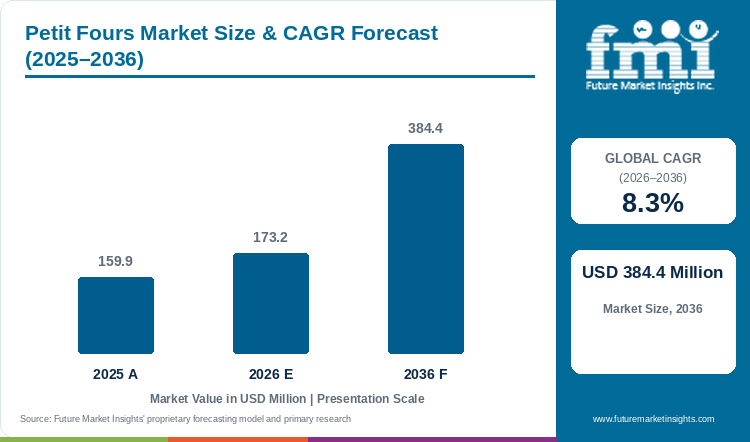
Valued at USD 159.9 million in 2025, the global petit fours market is estimated to reach USD 173.2 million in 2026 and is projected to hit USD 384.4 million by 2036, expanding at a CAGR of 8.3% during the forecast period.
Consumer demand for portion-controlled sweet treats and pre-assembled event platters is reshaping how supermarkets and hotel caterers buy finished patisserie. Instead of slicing full celebration cakes that leave unsold counter waste, retail grocers and banquet managers are ordering count-defined miniature assortments where biscuit treats hold a 36.0% product type share in 2026. Ready-to-plate multipack tubs and catering trays let operators serve varied dessert flavors without back-of-house decorating staff. According to FMI, global petit fours demand is projected to rise from USD 159.9 million in 2025 to USD 173.2 million in 2026 and reach USD 384.4 million by 2036 at an 8.3% CAGR, outpacing the 5.4% CAGR in ready-to-finish bakery products. October 2026 food price figures from the U.S. Department of Agriculture Economic Research Service (USDA ERS) show restaurant meal prices climbing 3.5% year over year [1], which pushes households toward fixed-price grocery dessert tubs for home gatherings. Even so, short five-day post-thaw display windows and delicate icing surfaces still limit repeat orders at smaller independent stores.
Key Market Trends & Insights
- By product type: Biscuit treats are projected to account for a 36.0% share in 2026, supported by low crumb breakage inside compartmented retail trays.
- By claim / nature: Conventional recipes are estimated to hold a 56.0% share in 2026, driven by familiar butter and sugar glazing specifications.
- By format: Frozen assortments are expected to hold a 30.0% share in 2026, stemming from banquet kitchens thawing exact tray counts per event booking.
- By packaging format: Multipack tubs and trays are predicted to record a 39.0% share in 2026, associated with household sharing occasions and clear unit pricing.
- By sales channel: Supermarkets & hypermarkets are anticipated to capture a 37.0% share in 2026, aided by perimeter bakery display tables and seasonal promotions.
Regional Highlights
- Top national expansion: Five-star hotel banquet buffets and corporate gifting programs place the UAE first among evaluated countries at a 9.6% CAGR through 2036.
- Broader country progression: Resort hospitality growth lifts Saudi Arabia to a 9.3% CAGR while cafe dessert pairing drives South Korea to 9.0% and supermarket clamshell tubs support an 8.6% CAGR in the USA ahead of Japan at 7.4%.
Market Size & Forecast
Table 1: Market Size and Forecast for the Petit Fours Market (USD million and CAGR percentage), 2025 to 2036
| Metric | Value |
|---|---|
| 2025 Market Size | USD 159.9 million |
| Estimated Market Size in 2026 | USD 173.2 million |
| Projected Market Size by 2036 | USD 384.4 million |
| CAGR, 2026 to 2036 | 8.3% |
| Added Revenue, 2026 to 2036 | USD 211.2 million |
Hotel banquet kitchens and supermarket in-store bakeries face persistent shortages of skilled pastry decorators, making hand-piping and glazing miniature cakes in-house too expensive for daily service. Centralized bakeries solve this staffing gap by cutting and glazing uniform bite-sized pieces on automated lines before packing them into protective trays. In November 2025, Premier Foods reported in its half-year trading results that Sweet Treats branded sales rose 9.4%, supported by newly launched Mr Kipling cake-bites tubs across UK grocery stores [2]. Retailers and caterers are shifting dessert budgets toward finished miniature tubs and compact bento cakes that staff can place directly on display tables with zero finishing work.
Event-Cover and Multipack-Unit Sizing
Table 2: Event-Cover and Multipack-Unit Sizing for the Petit Fours Market (USD million and operational ranges), 2025 to 2036
| Metric | 2025 | 2026 | 2036 |
|---|---|---|---|
| Market size (USD million) | 159.9 | 173.2 | 384.4 |
| Commercial petit fours sold (million pieces) | 640.0 to 710.0 | 690.0 to 770.0 | 1,420.0 to 1,580.0 |
| Retail multipack & catering trays (million units) | 58.0 to 65.0 | 63.0 to 70.0 | 130.0 to 145.0 |
| Average wholesale price per piece (USD) | 0.22 to 0.25 | 0.23 to 0.26 | 0.25 to 0.28 |
Operational note: Unit-volume ranges apply commercial banquet plating standards (3 to 4 miniature pieces per guest cover) and retail multipack tub counts (8 to 12 pieces per pack) across covered grocery and hospitality channels.
Hotel banqueting managers require uniform piece height and intact chocolate or fondant icing across 500-cover conference buffets. Centralized dessert manufacturers pair frozen miniature éclairs with sliced pound cakes to consolidate refrigerated distributor deliveries and cut kitchen plating waste.
Per Capita & Commercial Outlet Sizing
Table 3: Per Capita and Outlet Spending Indicators for the Petit Fours Market (USD), 2025 to 2036
| Metric | 2025 | 2026 | 2036 |
|---|---|---|---|
| Global urban consumer pool (million) | 4,620.0 | 4,710.0 | 5,340.0 |
| Spend per 1,000 urban consumers (USD) | 34.6 | 36.8 | 72.0 |
| Annual spend per catering & bakery account (USD) | 1,180.0 to 1,350.0 | 1,250.0 to 1,430.0 | 2,350.0 to 2,680.0 |
| Frozen & thaw-and-serve contract share (%) | 46.0% to 50.0% | 48.0% to 52.0% | 56.0% to 60.0% |
Table 4: Facility & Retail Bakery Spending Indicators for the Petit Fours Market (USD and percentages), 2026
| Metric | Value | Institutional Reference Basis |
|---|---|---|
| Market size, 2026 | USD 173.2 million | 2026 global petit fours revenue baseline |
| Supermarket & hotel catering accounts globally | 132,000 outlets | Global grocery in-store bakery & banquet venue registry |
| Market spend per commercial outlet | USD 1,312.1 | Annualized wholesale miniature dessert procurement |
| Supermarkets & hypermarkets allocation, 2026 | USD 64.1 million | 37.0% sales channel segment allocation |
Keeping poured sugar glazes glossy and pastry shells crisp requires tight humidity control across multi-stop grocery distribution. Retail bakery category managers bundle miniature patisserie trays with commercial eggless cakes to serve diverse party hosts without expanding back-of-store freezer space.
Analyst Perspective
"Commercial success in miniature patisserie depends on surviving the five-day post-thaw display window without glaze sweating or biscuit softening. Suppliers that combine consistent portioning with compartmented blister trays protect retailer gross margin after shrink and secure permanent supermarket shelf space."
- Nandini Roy Choudhury, Principal Consultant, Future Market Insights.
How is the petit fours market segmented?
The petit fours market is segmented by product type, claim / nature, format, packaging format, and sales channel. In 2026, Biscuit Treats are projected at 36.0%, Conventional at 56.0%, Frozen at 30.0%, Multipack at 39.0%, and Supermarkets & Hypermarkets at 37.0%.
By product type: Biscuit treats, soft-baked treats, celebration cakes & cookies, and functional treats.
By claim / nature: Conventional, clean label, organic, and gluten-free & fortified.
By format: Frozen, fresh & chilled, and ambient & par-baked.
By packaging format: Multipack, single-serve, family / loaf pack, and bulk foodservice.
By sales channel: Supermarkets & hypermarkets, artisan & specialty bakeries, convenience & forecourt, online & DTC, and foodservice distributors.
Why do Biscuit Treats lead the product type category?
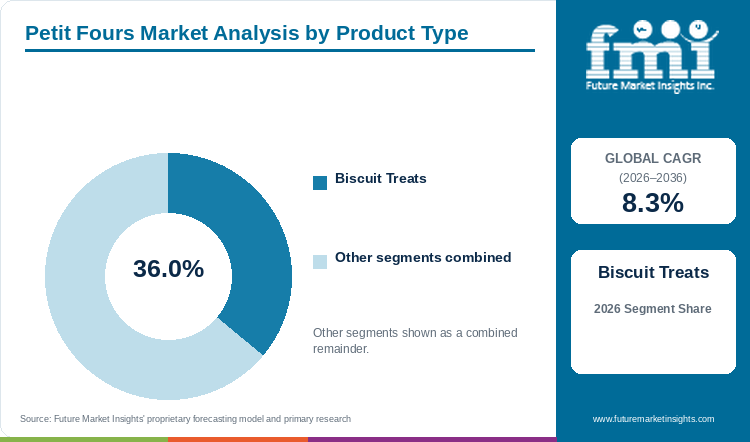
Biscuit treats are projected to account for a 36.0% share of the product type segment in 2026, supported by low transit breakage.
Table 5: Product Type Share for the Petit Fours Market (percentage share), 2026
| Product Type | Share (2026) |
|---|---|
| Biscuit Treats | 36.0% |
| Other Segments Combined* | 64.0% |
| Total | 100.0% |
*Calculated as the balance remaining after deducting the leading segment's reported share from 100.0%.
Table 6: Product Type Leadership and Market Growth for the Petit Fours Market (segment and CAGR percentage), 2026 to 2036
| Metric | Value |
|---|---|
| Global CAGR (2026 to 2036) | 8.3% |
| Leading Segment | Biscuit Treats |
Retail bakery buyers favor biscuit-based petit fours (`petits fours secs` and miniature sandwich cookies) because dry shortbread and almond biscuit bases travel well without the refrigeration costs of cream-filled pastry. Firm cookie bases also resist crushing on high-speed packing lines, complementing lunchbox mini bakery snacks on supermarket shelves.
- Biscuit treats are projected to account for a 36.0% share of the product type segment in 2026, attributable to low transit breakage and simple ambient shelf replenishment.
- In July 2026, Rich Products introduced a new line of ready-to-serve miniature cakes in a freezer-to-shelf format that helps in-store bakery operators capture impulse dessert sales while cutting preparation time [3].
Why does Conventional define the largest claim / nature segment?
Conventional formulations are estimated to hold a 56.0% share of the claim / nature segment in 2026, driven by repeatable sugar-glaze and sponge performance.
Traditional petit fours recipes rely on standard wheat flour and whole eggs with butter and sugar to deliver familiar sponge softness and smooth poured icing. Multi-site bakery chains prefer conventional recipes because switching to gluten-free or vegan substitutes requires separate production lines and raises unit costs across assortments paired with spiced cookie butter fillings.
- Conventional products are estimated to hold a 56.0% share of the claim / nature segment in 2026, reinforced by predictable ingredient costs and repeatable baking results.
- European Commission mandatory food information rules under Regulation (EU) No 1169/2011 require clear ingredient and allergen declarations on all prepacked bakery items, making accurate specification sheets a baseline purchasing requirement [4].
What keeps Frozen ahead by format?
Frozen assortments are expected to hold a 30.0% share of the format segment in 2026, owing to 365-day sub-zero storage and on-demand banquet thawing.
Freezing finished petit fours separates factory decoration from the day of final sale or event service. Hotel caterers and grocers thaw only the tray count needed for booked banquets or weekend traffic, reducing daily throwaway losses across frozen baked goods programs.
- Frozen assortments are expected to hold a 30.0% share of the format segment in 2026, driven by long freezer storage life and controlled post-thaw display scheduling.
- Sara Lee Frozen Bakery's commercial specification for its Superior on Main five-count mini éclairs documents a 365-day frozen shelf life and a five-day thawed display life, giving buyers a clear window to manage counter waste [5].
Why does Multipack lead the packaging format category?
Multipack units are predicted to record a 39.0% share of the packaging format segment in 2026, reinforced by thermoformed cavity protection and household sharing.
Compartmented 8-count to 18-count plastic tubs and window boxes turn delicate miniature pastries into a single scan-ready grocery unit. Recessed tray cavities keep decorated pieces from rubbing against each other during warehouse shipping and home delivery.
- Multipack units are predicted to record a 39.0% share of the packaging format segment in 2026, supported by household sharing occasions and straightforward shelf pricing.
- Finsbury Food Group expanded its multipack and direct-to-consumer miniature cake reach in August 2025 by acquiring a 70% majority stake in Lola's Cupcakes across 45 UK kiosks and collection lockers [6].
What gives Supermarkets & Hypermarkets the leading position in sales channel?
Supermarkets & hypermarkets are anticipated to capture a 37.0% share of the sales channel segment in 2026, enabled by perimeter bakery display tables.
Large grocery chains anchor category demand by displaying branded cake-bite tubs and thaw-and-serve patisserie platters in high-traffic perimeter bakery zones. Centralized warehouse distribution lets supermarket buyers test seasonal holiday assortments across hundreds of stores before committing permanent shelf space.
- Supermarkets & hypermarkets are anticipated to capture a 37.0% share of the sales channel segment in 2026, supported by weekly household grocery trips and cross-merchandising with coffee and party supplies.
- In September 2026, the U.S. Census Bureau reported in its 2024 Annual Integrated Economic Survey that U.S. food and beverage stores employed 3,395,400 people nationwide, providing wide retail merchandising capacity for packaged bakery treats [7].
What are the drivers, restraints, and opportunities in the petit fours market?
In the petit fours market, hotel banquet outsourcing and supermarket sharing tubs are projected to expand unit volumes whereas glaze weeping and allergen washdowns restrain margins and single-serve packs create cafe opportunities.
- Driver: Hotel banquet outsourcing and supermarket bite-sized sharing tubs convert hand-finished patisserie into repeatable factory orders.
- Restraint: Allergen labeling obligations, cold-chain losses, and retail promotional restrictions on sweet snacks narrow operating margins.
- Opportunity: Single-serve indulgence packs and protective cavity trays open new sales in coffee chains and corporate gifting programs.
Growth Analysis and Future Potential: Qualitative Demand Catalysts
Shoppers and event planners are shifting from single-flavor large cakes toward bite-sized assortments that let guests sample several flavors without leftover waste. To serve this demand without hiring trained pastry chefs at every location, grocery bakeries and hotel caterers buy ready-made frozen assortments with predictable per-piece costs. Packaged snack brands are also expanding bite-sized tub lines and twice-baked cake rusks to capture afternoon coffee and family snacking occasions. In May 2025, Dessert Holdings presented its Steven Charles bite-sized cake balls and miniature patisserie assortments at the IDDBA trade show to help North America grocers build perimeter dessert tables [8]. Retailers renew contracts when portions sell through at full price and maintain neat icing appearance until the end of the display window.
Risk Assessment of the Petit Fours Market: Operational and Formulation Friction
Commercial buyers face strict food-safety and margin hurdles between an initial product tasting and repeat store orders. Miniature assortments combine almond paste and liquid eggs with dairy and wheat on shared decorating lines, while condensation inside plastic tubs can ruin sugar glazes during delivery. The UK Food Standards Agency's Prepacked for Direct Sale guidance requires retail bakeries packing items on site to print full ingredient lists with emphasized allergens on every package [9]. When smaller bakeries invest in precision pastry cutters and dedicated allergen washdown schedules, longer line changeovers raise minimum order quantities for seasonal assortments. High display waste or damaged decorations can quickly wipe out store margins.
Commercial Opportunity Analysis: Formulation Differentiation and Value-Add Formats
Growing consumer appetite for small everyday treats gives manufacturers a clear opening to supply portion-controlled desserts adapted to specific retail and foodservice workflows. Supermarkets want stackable clamshell tubs that protect icing during self-service shopping, whereas coffee chains and hotels prefer thaw-and-serve trays that plate in seconds. Bakers pairing soft sponge recipes made from low-protein cake flour with individual cavity trays can guarantee uniform portion weights and clean presentation. In May 2025, Sara Lee Frozen Bakery launched Cyrus O'Leary's Mini Cheesecakes for grocery in-store bakeries, through the brand's in-store bakery program [10]. Suppliers that prove low transit breakage and reliable five-day shelf life win year-round space in grocery and cafe counters.
Petit Fours Market by Country (2026 to 2036)
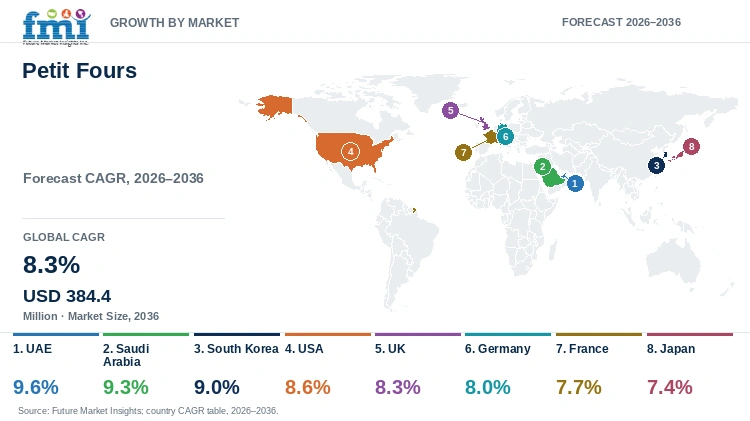
As per FMI, the UAE is projected to lead petit fours market expansion across evaluated national markets at a 9.6% CAGR through 2036, whereas Japan is forecast to register a 7.4% CAGR. Commercial performance across Middle Eastern hospitality hubs, East Asian cafe networks, and Western grocery channels depends on cold-chain glaze preservation and compliant allergen labeling.
Table 7: Country CAGR and Primary Growth Levers for the Petit Fours Market (CAGR percentage and operational drivers), 2026 to 2036
| Country | CAGR (2026 to 2036) | Primary Growth Lever |
|---|---|---|
| UAE | 9.6% | Five-star hotel banquet buffets, aviation lounges, and luxury corporate gifting |
| Saudi Arabia | 9.3% | Giga-project resort openings and 122.6 million tourist catering arrivals |
| South Korea | 9.0% | Specialty coffee shops pairing miniature patisserie with espresso orders |
| USA | 8.6% | Supermarket perimeter clamshell multipacks and national warehouse distribution |
| UK | 8.3% | Branded cake-bite sharing tubs and afternoon-tea foodservice procurement |
| Germany | 8.0% | Frozen bake-off substitution offsetting Konditorei cocoa and labor inflation |
| France | 7.7% | Event traiteur procurement of all-butter frozen mignardises and sablés |
| Japan | 7.4% | Convenience-store chilled patisserie rotation and nitrogen-flushed gift packs |
Source: Future Market Insights analysis
UAE Petit Fours Market Outlook (2026 to 2036)
Five-star hotel banqueting and corporate gifting boutiques propel the UAE market at a leading 9.6% CAGR from 2026 to 2036. Unlike Western European markets that rely on supermarket self-service tubs, the UAE concentrates commercial demand in luxury hotel banquet buffets and international airport lounges where visual presentation governs supplier selection. In February 2026, the Dubai Department of Economy and Tourism reported that Dubai welcomed a record 19.59 million international overnight visitors in 2025, with hotel occupancy reaching 80.7% across 827 establishments [11]. Because summer temperatures exceed 45 degrees Celsius, distributors use refrigerated trucks and protective blister trays so chocolate and fondant miniatures reach resorts without melting.
Key takeaway: In the UAE, five-star hotel banquet catering and luxury corporate gifting programs are projected to drive demand for blast-frozen miniature patisserie assortments.
Saudi Arabia Petit Fours Market Outlook (2026 to 2036)
New Red Sea and Riyadh luxury resort openings combined with large family wedding hospitality platters anchor commercial miniature patisserie demand across Saudi Arabia. Sales in Saudi Arabia are expected to advance at a 9.3% CAGR between 2026 and 2036 as international hotel operators expand banquet ballroom capacity in Riyadh and Jeddah. In June 2026, the Saudi Press Agency reported Ministry of Tourism figures showing 2025 domestic and inbound tourism reached 122.6 million visitors with record hospitality catering activity across the Kingdom [12]. Mandatory Arabic ingredient declarations and Saudi Food and Drug Authority shelf-life verification rules require international frozen pastry exporters to validate sub-zero storage dates prior to port clearance.
Key takeaway: In Saudi Arabia, expanding resort banqueting capacity and 122.6 million annual tourist arrivals are expected to accelerate institutional orders for thaw-and-serve miniature desserts.
South Korea Petit Fours Market Outlook (2026 to 2036)
Over 100,000 specialty coffee shops across South Korea pair individual almond financiers and glazed miniature sponge cakes with iced espresso beverages to raise afternoon cafe ticket averages. An August 2026 KNHANES dietary analysis published in Nutrients documented high daily coffee consumption frequency among urban adults in South Korea, supporting espresso-bar procurement of single-serve patisserie pairings [13]. Rapid seasonal menu rotation across Seoul and Busan cafe chains forces commercial bakery commissaries to supply low-minimum frozen tray drops instead of large bulk catering cartons. Petit fours sales in South Korea are therefore forecast to register a 9.0% CAGR from 2026 to 2036, aided by convenience-store chilled dessert launches and mobile gifting vouchers.
Key takeaway: In South Korea, dense specialty coffee-shop networks and mobile dessert gifting platforms are forecast to sustain rapid turnover of individually portioned patisserie bites.
USA Petit Fours Market Outlook (2026 to 2036)
Warehouse clubs and supermarket perimeter bakeries in the USA drive high-volume sales of 12-count to 24-count clamshell multipacks and thaw-and-serve catering trays. In June 2026, The J. M. Smucker Company documented in its fiscal 2026 Form 10-K filing that its Sweet Baked Snacks segment relies on centralized bakery automation and national warehouse distribution for portioned snack cakes [14]. Federal sesame allergen cross-contact mandates and retailer shrink audits compel suppliers in the USA to ship break-resistant biscuit and cake bites with a 365-day frozen shelf life. Commercial petit fours demand in the USA is anticipated to record an 8.6% CAGR between 2026 and 2036 across grocery perimeter tables and convention catering.
Key takeaway: In the USA, supermarket perimeter bakery clamshells and national foodservice distributor programs are anticipated to anchor volume for freeze-thaw-stable miniature desserts.
UK Petit Fours Market Outlook (2026 to 2036)
Branded supermarket cake-bite sharing tubs and hotel afternoon-tea foodservice contracts propel the UK petit fours market at an 8.3% CAGR from 2026 to 2036. Household shoppers across the UK purchase ambient and chilled compartmented sharing tubs through national grocery chains operating under statutory store placement and volume-promotion rules for sweet foods. UK Department of Health and Social Care guidance restricts checkout, aisle-end, and multi-buy volume promotions on qualifying high-fat and high-sugar sweet bakery products across retailers in England [15]. Commercial cake manufacturers in the UK are therefore resizing multipack tubs and updating nutritional profiles to hold prime grocery shelf space while meeting Prepacked for Direct Sale allergen rules.
Key takeaway: In the UK, branded supermarket cake-bite tub innovation and compliant pack sizing are projected to sustain retail sales under statutory promotional rules.
Germany Petit Fours Market Outlook (2026 to 2036)
Discount-grocer private-label seasonal tenders and strict unit-cost discipline govern commercial miniature bakery procurement across Germany, contrasting sharply with brand-led merchandising in neighboring markets. Commercial petit fours demand across Germany is estimated to grow at an 8.0% CAGR between 2026 and 2036 across supermarket in-store bakery counters and regional Konditorei foodservice wholesalers. In January 2025, the Federal Association of the German Confectionery Industry (BDSI) reported that 2024 fine baked goods production in Germany fell 3.8% in volume to 728,000 metric tons while rising 3.7% in value amid cocoa and labor inflation [16]. Hotel banquet chefs and grocery buyers in Germany therefore favor centrally frozen biscuit and marzipan miniatures that cut decorating labor.
Key takeaway: In Germany, persistent labor cost pressure across fine bakeries is estimated to shift wholesale buyers toward centrally frozen miniature assortments.
France Petit Fours Market Outlook (2026 to 2036)
Consumers in France judge miniature patisserie (`petits fours frais` and `petits fours secs`) against artisanal choux and pure-butter sablé standards. In March 2026, a NutriNet-Santé cohort study of 75,775 adults in France published in the European Journal of Nutrition validated the updated Nutri-Score nutrient profile model, increasing retailer scrutiny of sugar and saturated fat in packaged pastries [17]. Because event traiteurs and independent patisseries face severe recruitment shortages for manual glazing and piping, premium frozen specialists supply all-butter tartlet bases and pre-assembled mignardises trays. Accordingly, the petit fours market in France is predicted to expand at a 7.7% CAGR from 2026 to 2036 across metropolitan event catering and gourmet grocery chains.
Key takeaway: In France, culinary labor shortages among event traiteurs are predicted to expand wholesale procurement of all-butter frozen mignardises and sablé assortments.
Japan Petit Fours Market Outlook (2026 to 2036)
Precision single-serve packaging and formal seasonal gift-box (`omiyage`) etiquette define demand in Japan, setting it apart from bulk Western party platters. In April 2026, the Ministry of Economy and Trade and Industry reported in its 2025 Retail Trade Review that supermarket sales in Japan rose 4.7% and convenience-store sales increased 3.4% for the fifth consecutive year [18]. Department store basement food halls (`depachika`) and convenience chains require miniature Baumkuchen and financier sponge bites sealed in nitrogen-flushed barrier film with oxygen-absorber sachets to guarantee crumb softness. Sales of petit fours in Japan are slated to advance at a 7.4% CAGR between 2026 and 2036, moderated by high multi-layer packaging costs.
Key takeaway: In Japan, convenience-store chilled dessert rotation and department-store gifting standards are slated to support steady demand for individually wrapped miniature patisserie.
Full report country CAGRs cover: North America; Latin America; Western Europe; Eastern Europe; East Asia; South Asia and Pacific; Middle East and Africa.
Who are the notable companies in the petit fours market?
Rich Products, Sara Lee Frozen Bakery, Dessert Holdings, Mademoiselle Desserts, Finsbury Food Group, Premier Foods, Bauli, and Dr. Oetker are the notable companies in the petit fours market.
FMI analysis indicates that competition divides between frozen foodservice patisserie specialists and European retail cake-bite manufacturers as well as international packaged pastry groups. Frozen dessert suppliers make thaw-and-serve éclairs and sponge cubes that cut back-of-house pastry labor for hotels and supermarket counters. Retail-focused bakery groups use high-speed tub packing lines and nationwide grocery distribution to serve everyday household sharing occasions.
- Foodservice and Frozen Miniature Patisserie Platforms: Rich Products and Sara Lee Frozen Bakery with Dessert Holdings supply blast-frozen miniature éclairs and cake bites for hotel catering and in-store bakery tables.
- European Sweet-Bakery and Retail Cake Producers: Mademoiselle Desserts and Finsbury Food Group with Premier Foods manufacture branded cake-bite tubs and private-label grocery assortments across Western Europe.
- International Packaged Pastry and Dessert Groups: Bauli and Dr. Oetker combine ambient leavened mini-cakes with frozen Coppenrath & Wiese patisserie lines across continental retail and export channels.
Competitive Benchmarking: Petit Fours Market
Table 8: Competitive Benchmarking for the Petit Fours Market (qualitative capability ratings), 2026
| Company | Finished Miniature Assortment | Frozen / Thaw-and-Serve Supply | Retail Multipack Access | Geographic Reach |
|---|---|---|---|---|
| Rich Products | High | High | Medium | High |
| Sara Lee Frozen Bakery | High | High | Medium | Medium |
| Dessert Holdings | High | High | Medium | Medium |
| Mademoiselle Desserts | High | High | Medium | High |
| Finsbury Food Group | High | Medium | High | Medium |
| Premier Foods | Medium | Medium | High | Medium |
| Bauli | Medium | Medium | High | High |
| Dr. Oetker | High | High | High | High |
Scoring basis: Capability tiers evaluate documented product breadth across finished miniature patisserie and biscuit treats, sub-zero freeze-thaw coating stability, and national grocery multipack distribution reach.
Key Developments in the Petit Fours Market
- Emmi Group reported in its March 2026 Annual Report that its Mademoiselle Desserts division expanded premium frozen mini-beignet and tartlet patisserie distribution across European foodservice and retail bakery accounts [19].
- Dessert Holdings acquired Willamette Valley Pie Co. in July 2025 to broaden its North America premium artisanal dessert manufacturing platform and Steven Charles bite-sized patisserie offerings [20].
- Bauli Group announced a strategic product program in April 2025 focused on everyday small-format sweet pastry snacks and portion-controlled Pandorì bakery extensions beyond seasonal celebration cakes [21].
Key Players in the Petit Fours Market
Foodservice and Frozen Miniature Patisserie Platforms
- Rich Products
- Sara Lee Frozen Bakery
- Dessert Holdings
European Sweet-Bakery and Retail Cake Producers
- Mademoiselle Desserts
- Finsbury Food Group
- Premier Foods
International Packaged Pastry and Dessert Groups
- Bauli
- Dr. Oetker
Petit Fours Market - Report Scope
Table 9: Report Scope for the Petit Fours Market (coverage fields and definitions), 2026 to 2036
| Coverage field | Report scope |
|---|---|
| Market breakdown | Product Type; Claim / Nature; Format; Packaging Format; Sales Channel |
| Quantitative Units | USD Million |
| Market Definition | Includes commercial wholesale and retail supplier revenue from finished miniature cakes, biscuit treats, glacé/frais/sec petit fours, and bite-sized patisserie (typically 15g to 35g per piece). Category Scope Note: Excludes full-size celebration cakes, standard large muffins, dry home-baking mixes, and restaurant table-service markups. |
| Regions Covered | North America; Latin America; Western Europe; Eastern Europe; East Asia; South Asia and Pacific; Middle East and Africa |
| Countries Covered | UAE, Saudi Arabia, South Korea, USA, UK, Germany, France, Japan, and additional countries in the full report |
| Key Companies Covered | Rich Products, Sara Lee Frozen Bakery, Dessert Holdings, Mademoiselle Desserts, Finsbury Food Group, Premier Foods, Bauli, Dr. Oetker |
| Forecast Period | 2026 to 2036 |
| Approach | Primary and secondary research with top-down and bottom-up market triangulation. |
Petit Fours Market - Research Methodology
Table 10: Research Methodology for the Petit Fours Market (research methods and approach), 2026 edition
| Method | Approach |
|---|---|
| Primary Research | Structured interviews with hotel executive pastry chefs, supermarket in-store bakery buyers, airline catering directors, and frozen dessert distributors to validate post-thaw shelf life and per-piece pricing. |
| Secondary Research | Analysis of SEC Form 10-K filings, USDA ERS food-away-from-home indices, BDSI Germany confectionery data, NutriNet-Sante cohort records, and commercial product specifications. |
| Market Sizing and Forecasting | Top-down commercial patisserie and sweet-biscuit expenditure models reconciled against bottom-up banquet cover counts and supermarket multipack scan volumes from 2026 to 2036. |
| Country Forecasting Model | Econometric national projections weight hotel room inventory growth, specialty coffee-shop density, organized grocery penetration, and statutory HFSS/PPDS labeling rules across eight markets. |
| Operational Benchmark Traceability | Piece-volume and outlet spending indicators in Tables 2, 3, and 4 trace to USDA ERS, U.S. Census Bureau AIES, KNHANES South Korea, METI Japan, and commercial frozen shelf-life specifications. |
| Data Triangulation and Validation | Demand estimates are cross-checked against commercial frozen bakery line capacities and branded sweet-treat tub revenues without double counting full-size cakes or dry mixes. |
Petit Fours Market by Segments
Petit Fours Market segmented by Product Type:
- Biscuit Treats
- Soft-Baked Treats
- Celebration Cakes & Cookies
- Functional Treats
Petit Fours Market segmented by Claim / Nature:
- Conventional
- Clean Label & Organic
- Gluten-Free & Fortified
Petit Fours Market segmented by Format:
- Frozen
- Fresh & Chilled
- Ambient & Par-Baked
Petit Fours Market segmented by Packaging Format:
- Multipack
- Single-Serve
- Family / Loaf Pack
- Bulk Foodservice
Petit Fours Market segmented by Sales Channel:
- Supermarkets & Hypermarkets
- Artisan & Specialty Bakeries
- Convenience & Forecourt
- Online & DTC
- Foodservice Distributors
Petit Fours Market by Region
- North America
- United States
- Canada
- Latin America
- Brazil
- Mexico
- Argentina
- Chile
- Western Europe
- Germany
- France
- United Kingdom
- Italy
- Spain
- Benelux
- Nordics
- Eastern Europe
- Poland
- Czech Republic
- Romania
- Hungary
- East Asia
- China
- Japan
- South Korea
- South Asia and Pacific
- India
- ASEAN
- Australia and New Zealand
- Middle East and Africa
- GCC Countries
- South Africa
- Türkiye
- Israel
Research Sources and Bibliography
- [1] U.S. Department of Agriculture Economic Research Service. (2026, October 23). Food Price Outlook: Summary Findings for Food-Away-From-Home and Bakery Retail Indices. U.S. Department of Agriculture.
- [2] Premier Foods plc. (2025, November 13). Half Year Results for Premier Foods for the 26 Weeks Ended 27 September 2025: Sweet Treats and Mr Kipling Cake Bites Tubs. Premier Foods Corporate Releases.
- [3] Rich Products Corporation. (2026, July 6). Rich Products Introduces Mini Cakes to Help In-Store Bakery Operators Save Time Without Sacrificing Quality. Rich Products Newsroom.
- [4] European Commission Directorate-General for Health and Food Safety. (2025, June 12). Mandatory Food Information and Allergen Labelling Rules Under Regulation (EU) No 1169/2011. European Commission Official Publications.
- [5] Sara Lee Frozen Bakery, LLC. (2026, January 15). Superior on Main Mini Éclairs 5ct (SKU 701754): Frozen and Post-Thaw Commercial Shelf-Life Specifications. Sara Lee Frozen Bakery Foodservice Catalog.
- [6] Finsbury Food Group. (2025, August 15). Finsbury Food Group Acquires Majority Stake in Direct-to-Consumer Patisserie Brand Lola's Cupcakes. Finsbury Food Group Corporate Releases.
- [7] U.S. Census Bureau. (2026, September 3). Census Bureau Releases New 2024 Annual Integrated Economic Survey (AIES) Data for Food and Beverage Stores. U.S. Department of Commerce.
- [8] Dessert Holdings. (2025, May 30). Dessert Holdings Returns to IDDBA Presenting Steven Charles Bite-Sized Patisserie and Layer Cake Assortments. Dessert Holdings Corporate Announcements.
- [9] UK Food Standards Agency. (2025, October 4). Labelling Guidance for Prepacked for Direct Sale (PPDS) Food Products in Retail Bakeries and Catering. Food Standards Agency Regulatory Guidance.
- [10] Sara Lee Frozen Bakery, LLC. (2025). In-Store Bakery Program: Cyrus O'Leary's Mini Cheesecakes and Single-Serve Desserts. Sara Lee Frozen Bakery.
- [11] Dubai Department of Economy and Tourism. (2026, February 9). Dubai Welcomes 19.59 Million International Overnight Visitors in Third Record Year. Government of Dubai Media Office.
- [12] Saudi Press Agency & Ministry of Tourism. (2026, June 18). Ministry of Tourism Releases 2025 Annual Statistical Report Announcing Record Tourism Hospitality Spending. Saudi Press Agency Official Dispatches.
- [13] Lee, J., & Kim, Y. (2026, August 1). Beverage-Derived Caffeine Intake, Sleep Duration, and Dietary Patterns Among Adults in South Korea: KNHANES 2021-2024. Nutrients, 18(15), 2488 (PubMed PMID 42588110).
- [14] The J. M. Smucker Company. (2026, June 16). Form 10-K Annual Report Pursuant to Section 13 or 15(d) for the Fiscal Year Ended April 30, 2026: Sweet Baked Snacks Segment. U.S. Securities and Exchange Commission EDGAR.
- [15] UK Department of Health and Social Care. (2025, October 1). Restricting Promotions of Products High in Fat, Sugar or Salt by Location and by Volume Price: Implementation Guidance. GOV.UK Statutory Guidance.
- [16] Bundesverband der Deutschen Süßwarenindustrie e.V. (BDSI). (2025, January 29). Produktion von Süßwaren und Feinen Backwaren 2024 in Deutschland. BDSI-Journal Branchenbericht.
- [17] Sarda, B., Manneville, F., & Julia, C. (2026, March 24). Associations of the Updated Nutrient Profiling System Underlying the Nutri-Score Label with Weight Gain and Obesity Risk in the NutriNet-Sante Cohort in France. European Journal of Nutrition, 65(3), 101 (PubMed PMID 41874736).
- [18] Ministry of Economy, Trade and Industry. (2026, April 14). 2025 Retail Trade Review: Five Consecutive Years of Supermarket and Convenience Store Sales Increases. METI Japan Commercial Statistics.
- [19] Emmi Group. (2026, March 2). An Innovative Leader in Selected Niches: Mademoiselle Desserts Premium Patisserie Integration in Annual Report 2025. Emmi AG Financial Publications.
- [20] Dessert Holdings. (2025, July 14). Dessert Holdings Acquires Willamette Valley Pie Co. to Expand Premium Retail and Foodservice Portfolio. Dessert Holdings Corporate Announcements.
- [21] Bauli Group. (2025, April 9). The Bauli Group Focuses on Miniaturized Pastry Innovation as a Strategic Growth Lever. Bauli S.p.A. Corporate Communications.
- [22] Finsbury Food Group. (2026, April 30). Finsbury Food Group Acquires Portion-Controlled Sweet Snacking Specialist Flower & White. Finsbury Food Group Corporate Releases.
- [23] Dr. August Oetker KG. (2025, April 16). Business Year 2025: Dr. Oetker and Coppenrath & Wiese Expand Cake and Frozen Patisserie Operations. Dr. Oetker Press Portal.
This bibliography is provided for reader reference and is not exhaustive. The full report contains the complete reference list and detailed citations.
This Report Answers
- How large is the petit fours market in 2026 and what is forecast for 2036?
- Which hospitality and retail labor pressures support demand for finished petit fours?
- Why do Biscuit Treats lead the product type category in 2026?
- Why does Conventional lead the claim / nature category globally?
- How do growth rates differ across the UAE and Saudi Arabia versus Western Europe?
- Which leading companies supply miniature patisserie and cake-bite categories today?
- What limits adoption or supplier switching in the petit fours market?
- What should buyers evaluate before purchasing commercial petit fours assortments?
Frequently Asked Questions
How big is the petit fours market in 2026, and what is forecast for 2036?
According to FMI, the global petit fours market size is estimated to reach USD 173.2 million in 2026 from USD 159.9 million in 2025. Valuation is forecast to hit USD 384.4 million by 2036 as grocery chains and hotel caterers expand portioned dessert assortments.
What is the CAGR for the petit fours market from 2026 to 2036?
Future Market Insights projects an 8.3% compound annual growth rate between 2026 and 2036, generating USD 211.2 million in incremental market value across retail multipacks and foodservice trays.
Which product type segment leads the petit fours market?
Biscuit treats are projected to account for a 36.0% share of the product type segment in 2026 because low-moisture shortbread and cookie bases resist transit breakage inside multipacks.
Which claim / nature segment leads the petit fours market?
Conventional formulations are estimated to hold a 56.0% share of the claim / nature segment in 2026 as commercial patisseries rely on standard wheat and egg-sugar glazes for uniform piece geometry.
Which country has a notable growth outlook during the assessment period?
The UAE is projected to lead evaluated national growth at a 9.6% CAGR through 2036, supported by five-star hotel banquet catering and luxury corporate gifting demand.
Who are the key players in the market?
Rich Products, Sara Lee Frozen Bakery, Dessert Holdings, Mademoiselle Desserts, Finsbury Food Group, Premier Foods, Bauli, and Dr. Oetker lead commercial supply across foodservice and retail bakery networks.
Preview the report firsthand - request a free sample
Get SampleGet the brochure for pricing and purchase details.
Get PDFTable of Content
- Key Takeaways
- Market Size and CAGR
- Top Growth Driver
- Fastest Growing Segment
- Leading Region
- Key Companies
- Emerging Opportunities
- Executive Summary
- Global Market Outlook
- Demand-side Trends
- Supply-side Trends
- Technology Roadmap Analysis
- Analysis and Recommendations
- Analyst Perspective (What is happening? Why now? What should investors know?)
- Key Questions Answered
- How large is the market?
- What is the CAGR?
- What are key trends?
- Which region dominates?
- Who are the leaders?
- Market Overview
- Market Coverage / Taxonomy
- Market Definition / Scope / Limitations
- Research Methodology
- Chapter Orientation
- Analytical Lens and Working Hypotheses
- Market Structure, Signals, and Trend Drivers
- Benchmarking and Cross-market Comparability
- Market Sizing, Forecasting, and Opportunity Mapping
- Research Design and Evidence Framework
- Desk Research Programme (Secondary Evidence)
- Expert Input and Fieldwork (Primary Evidence)
- Tooling, Models, and Reference Databases
- Data Engineering and Model Build
- Quality Assurance and Audit Trail
- Market Background
- Market Dynamics (Drivers, Restraints, Opportunity, Trends)
- Scenario Forecast (Optimistic, Likely, Conservative)
- Impact Analysis
- AI Impact
- Sustainability Impact
- Regulatory Impact
- Technology Impact
- Consumer / Buyer Analysis
- Purchase Drivers
- Adoption Barriers
- Buyer Journey
- Opportunity Map Analysis
- Product Life Cycle Analysis
- Supply Chain Analysis
- Investment Feasibility Matrix
- Value Chain Analysis
- PESTLE and Porter's Analysis
- Regulatory Landscape
- Regional Parent Market Outlook
- Production and Consumption Statistics
- Import and Export Statistics
- Global Market Analysis and Forecast, 2021 to 2036
- Historical Market Size Value (USD Million) Analysis, 2021 to 2025
- Current and Future Market Size Value (USD Million) Projections, 2026 to 2036
- Y-o-Y Growth Trend Analysis
- Absolute $ Opportunity Analysis
- Global Market Pricing Analysis, 2021 to 2036
- Global Market Analysis and Forecast, By Product Type, 2021 to 2036
- Introduction / Key Findings
- Historical Market Size Value (USD Million) Analysis By Product Type, 2021 to 2025
- Current and Future Market Size Value (USD Million) Analysis and Forecast By Product Type, 2026 to 2036
- Biscuit Treats
- Soft-Baked Treats
- Celebration Cakes & Cookies
- Functional Treats
- Y-o-Y Growth Trend Analysis By Product Type, 2021 to 2025
- Absolute $ Opportunity Analysis By Product Type, 2026 to 2036
- Global Market Analysis and Forecast, By Claim / Nature, 2021 to 2036
- Introduction / Key Findings
- Historical Market Size Value (USD Million) Analysis By Claim / Nature, 2021 to 2025
- Current and Future Market Size Value (USD Million) Analysis and Forecast By Claim / Nature, 2026 to 2036
- Conventional
- Clean Label & Organic
- Gluten-Free & Fortified
- Y-o-Y Growth Trend Analysis By Claim / Nature, 2021 to 2025
- Absolute $ Opportunity Analysis By Claim / Nature, 2026 to 2036
- Global Market Analysis and Forecast, By Format, 2021 to 2036
- Introduction / Key Findings
- Historical Market Size Value (USD Million) Analysis By Format, 2021 to 2025
- Current and Future Market Size Value (USD Million) Analysis and Forecast By Format, 2026 to 2036
- Frozen
- Fresh & Chilled
- Ambient & Par-Baked
- Y-o-Y Growth Trend Analysis By Format, 2021 to 2025
- Absolute $ Opportunity Analysis By Format, 2026 to 2036
- Global Market Analysis and Forecast, By Packaging Format, 2021 to 2036
- Introduction / Key Findings
- Historical Market Size Value (USD Million) Analysis By Packaging Format, 2021 to 2025
- Current and Future Market Size Value (USD Million) Analysis and Forecast By Packaging Format, 2026 to 2036
- Multipack
- Single-Serve
- Family / Loaf Pack
- Bulk Foodservice
- Y-o-Y Growth Trend Analysis By Packaging Format, 2021 to 2025
- Absolute $ Opportunity Analysis By Packaging Format, 2026 to 2036
- Global Market Analysis and Forecast, By Sales Channel, 2021 to 2036
- Introduction / Key Findings
- Historical Market Size Value (USD Million) Analysis By Sales Channel, 2021 to 2025
- Current and Future Market Size Value (USD Million) Analysis and Forecast By Sales Channel, 2026 to 2036
- Supermarkets & Hypermarkets
- Artisan & Specialty Bakeries
- Convenience & Forecourt
- Online & DTC
- Foodservice Distributors
- Y-o-Y Growth Trend Analysis By Sales Channel, 2021 to 2025
- Absolute $ Opportunity Analysis By Sales Channel, 2026 to 2036
- Global Market Analysis and Forecast, By Region, 2021 to 2036
- Introduction
- Historical Market Size Value (USD Million) Analysis By Region, 2021 to 2025
- Current Market Size Value (USD Million) Analysis and Forecast By Region, 2026 to 2036
- North America
- Latin America
- Western Europe
- Eastern Europe
- East Asia
- South Asia and Pacific
- Middle East and Africa
- Market Attractiveness Analysis By Region
- North America Market Analysis and Forecast, By Country, 2021 to 2036
- Historical Market Size Value (USD Million) Trend Analysis By Market Taxonomy, 2021 to 2025
- Market Size Value (USD Million) Forecast By Market Taxonomy, 2026 to 2036
- By Country
- United States
- Canada
- By Product Type
- By Claim / Nature
- By Format
- By Packaging Format
- By Sales Channel
- By Country
- Market Attractiveness Analysis
- By Country
- By Product Type
- By Claim / Nature
- By Format
- By Packaging Format
- By Sales Channel
- Key Takeaways
- Latin America Market Analysis and Forecast, By Country
- Historical Market Size Value (USD Million) Trend Analysis By Market Taxonomy, 2021 to 2025
- Market Size Value (USD Million) Forecast By Market Taxonomy, 2026 to 2036
- By Country
- Brazil
- Mexico
- Argentina
- Chile
- By Product Type
- By Claim / Nature
- By Format
- By Packaging Format
- By Sales Channel
- By Country
- Market Attractiveness Analysis
- By Country
- By Product Type
- By Claim / Nature
- By Format
- By Packaging Format
- By Sales Channel
- Key Takeaways
- Western Europe Market Analysis and Forecast, By Country
- Historical Market Size Value (USD Million) Trend Analysis By Market Taxonomy, 2021 to 2025
- Market Size Value (USD Million) Forecast By Market Taxonomy, 2026 to 2036
- By Country
- Germany
- France
- United Kingdom
- Italy
- Spain
- Benelux
- Nordics
- By Product Type
- By Claim / Nature
- By Format
- By Packaging Format
- By Sales Channel
- By Country
- Market Attractiveness Analysis
- By Country
- By Product Type
- By Claim / Nature
- By Format
- By Packaging Format
- By Sales Channel
- Key Takeaways
- Eastern Europe Market Analysis and Forecast, By Country
- Historical Market Size Value (USD Million) Trend Analysis By Market Taxonomy, 2021 to 2025
- Market Size Value (USD Million) Forecast By Market Taxonomy, 2026 to 2036
- By Country
- Poland
- Czech Republic
- Romania
- Hungary
- By Product Type
- By Claim / Nature
- By Format
- By Packaging Format
- By Sales Channel
- By Country
- Market Attractiveness Analysis
- By Country
- By Product Type
- By Claim / Nature
- By Format
- By Packaging Format
- By Sales Channel
- Key Takeaways
- East Asia Market Analysis and Forecast, By Country
- Historical Market Size Value (USD Million) Trend Analysis By Market Taxonomy, 2021 to 2025
- Market Size Value (USD Million) Forecast By Market Taxonomy, 2026 to 2036
- By Country
- China
- Japan
- South Korea
- By Product Type
- By Claim / Nature
- By Format
- By Packaging Format
- By Sales Channel
- By Country
- Market Attractiveness Analysis
- By Country
- By Product Type
- By Claim / Nature
- By Format
- By Packaging Format
- By Sales Channel
- Key Takeaways
- South Asia and Pacific Market Analysis and Forecast, By Country
- Historical Market Size Value (USD Million) Trend Analysis By Market Taxonomy, 2021 to 2025
- Market Size Value (USD Million) Forecast By Market Taxonomy, 2026 to 2036
- By Country
- India
- ASEAN
- Australia and New Zealand
- By Product Type
- By Claim / Nature
- By Format
- By Packaging Format
- By Sales Channel
- By Country
- Market Attractiveness Analysis
- By Country
- By Product Type
- By Claim / Nature
- By Format
- By Packaging Format
- By Sales Channel
- Key Takeaways
- Middle East and Africa Market Analysis and Forecast, By Country
- Historical Market Size Value (USD Million) Trend Analysis By Market Taxonomy, 2021 to 2025
- Market Size Value (USD Million) Forecast By Market Taxonomy, 2026 to 2036
- By Country
- GCC Countries
- South Africa
- Türkiye
- Israel
- By Product Type
- By Claim / Nature
- By Format
- By Packaging Format
- By Sales Channel
- By Country
- Market Attractiveness Analysis
- By Country
- By Product Type
- By Claim / Nature
- By Format
- By Packaging Format
- By Sales Channel
- Key Takeaways
- Key Countries Market Analysis
- United States
- Pricing Analysis
- Market Share Analysis, 2025
- By Product Type
- By Claim / Nature
- By Format
- By Packaging Format
- By Sales Channel
- Canada
- Pricing Analysis
- Market Share Analysis, 2025
- By Product Type
- By Claim / Nature
- By Format
- By Packaging Format
- By Sales Channel
- Mexico
- Pricing Analysis
- Market Share Analysis, 2025
- By Product Type
- By Claim / Nature
- By Format
- By Packaging Format
- By Sales Channel
- Brazil
- Pricing Analysis
- Market Share Analysis, 2025
- By Product Type
- By Claim / Nature
- By Format
- By Packaging Format
- By Sales Channel
- Chile
- Pricing Analysis
- Market Share Analysis, 2025
- By Product Type
- By Claim / Nature
- By Format
- By Packaging Format
- By Sales Channel
- Germany
- Pricing Analysis
- Market Share Analysis, 2025
- By Product Type
- By Claim / Nature
- By Format
- By Packaging Format
- By Sales Channel
- United Kingdom
- Pricing Analysis
- Market Share Analysis, 2025
- By Product Type
- By Claim / Nature
- By Format
- By Packaging Format
- By Sales Channel
- Italy
- Pricing Analysis
- Market Share Analysis, 2025
- By Product Type
- By Claim / Nature
- By Format
- By Packaging Format
- By Sales Channel
- Spain
- Pricing Analysis
- Market Share Analysis, 2025
- By Product Type
- By Claim / Nature
- By Format
- By Packaging Format
- By Sales Channel
- France
- Pricing Analysis
- Market Share Analysis, 2025
- By Product Type
- By Claim / Nature
- By Format
- By Packaging Format
- By Sales Channel
- India
- Pricing Analysis
- Market Share Analysis, 2025
- By Product Type
- By Claim / Nature
- By Format
- By Packaging Format
- By Sales Channel
- ASEAN
- Pricing Analysis
- Market Share Analysis, 2025
- By Product Type
- By Claim / Nature
- By Format
- By Packaging Format
- By Sales Channel
- Australia and New Zealand
- Pricing Analysis
- Market Share Analysis, 2025
- By Product Type
- By Claim / Nature
- By Format
- By Packaging Format
- By Sales Channel
- China
- Pricing Analysis
- Market Share Analysis, 2025
- By Product Type
- By Claim / Nature
- By Format
- By Packaging Format
- By Sales Channel
- Japan
- Pricing Analysis
- Market Share Analysis, 2025
- By Product Type
- By Claim / Nature
- By Format
- By Packaging Format
- By Sales Channel
- South Korea
- Pricing Analysis
- Market Share Analysis, 2025
- By Product Type
- By Claim / Nature
- By Format
- By Packaging Format
- By Sales Channel
- Poland
- Pricing Analysis
- Market Share Analysis, 2025
- By Product Type
- By Claim / Nature
- By Format
- By Packaging Format
- By Sales Channel
- Hungary
- Pricing Analysis
- Market Share Analysis, 2025
- By Product Type
- By Claim / Nature
- By Format
- By Packaging Format
- By Sales Channel
- Türkiye
- Pricing Analysis
- Market Share Analysis, 2025
- By Product Type
- By Claim / Nature
- By Format
- By Packaging Format
- By Sales Channel
- South Africa
- Pricing Analysis
- Market Share Analysis, 2025
- By Product Type
- By Claim / Nature
- By Format
- By Packaging Format
- By Sales Channel
- UAE
- Pricing Analysis
- Market Share Analysis, 2025
- By Product Type
- By Claim / Nature
- By Format
- By Packaging Format
- By Sales Channel
- Saudi Arabia
- Pricing Analysis
- Market Share Analysis, 2025
- By Product Type
- By Claim / Nature
- By Format
- By Packaging Format
- By Sales Channel
- United States
- Market Structure Analysis
- Competition Dashboard
- Competition Benchmarking
- Market Share Analysis of Top Players
- By Regional
- By Product Type
- By Claim / Nature
- By Format
- By Packaging Format
- By Sales Channel
- Emerging Startups
- Innovation Benchmarking
- Competition Analysis
- Competition Deep Dive
- Rich Products
- Overview
- Product Portfolio
- Profitability by Market Segments
- Sales Footprint
- Strategy Overview
- Marketing Strategy
- Product Strategy
- Channel Strategy
- Sara Lee Frozen Bakery
- Dessert Holdings
- Mademoiselle Desserts
- Finsbury Food Group
- Premier Foods
- Bauli
- Dr. Oetker
- Rich Products
- Case Studies
- Success Stories
- Recent Developments
- Competition Deep Dive
- Assumptions & Acronyms Used


