

- Market Size (2026)
- USD 269.0 Mn
- Forecast (2036)
- USD 672.8 Mn
- CAGR (2026 to 2036)
- 9.6%
How big is Lunchbox Mini Bakery Market in 2026?
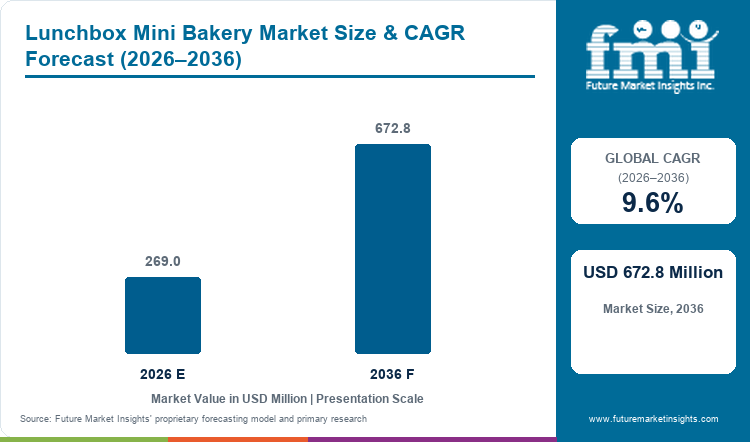
USD 269.0 million in 2026 and USD 672.8 million by 2036 at a 9.6% CAGR.
Sales of lunchbox mini bakery products are projected to rise at a 9.6% CAGR between 2026 and 2036, lifting market value from USD 269.0 million to USD 672.8 million. Portable portions fit repeated meal occasions by allowing bread or pastry to travel without extra cutting or plating. USDA Food and Nutrition Service data for fiscal 2025 recorded 30.0 million average daily participants in the National School Lunch Program. That national meal base favors bakery formats that meet meal specifications and arrive in portions kitchens can serve efficiently.
Commercial accounts judge small bakery formats against food cost and reimbursement limits that affect menu economics. USDA Food and Nutrition Service reported in July 2025 that national school lunch payment rates increased 3.85% for school year 2025-26 as food-away-from-home costs rose. Higher reimbursement does not remove price pressure because portion size and ingredient cost still determine whether a bakery item fits the meal budget. The ten-year forecast therefore represents USD 403.8 million of incremental value between 2026 and 2036.
Key Takeaways
- Portable portions support repeat purchases by reducing cutting and repacking work during household or commercial meal preparation.
- By product type, classic - original is estimated to hold 39.0% in 2026 owing to familiar taste and broad meal compatibility.
- The conventional segment is likely to capture 48.0% of claim - nature in 2026 attributable to flexible sourcing and fewer specialist certification requirements.
- Fresh is set to lead the format category with 40.0% share in 2026 due to immediate eating quality at retail and foodservice counters.
- Nutrition rules and storage limits increase specification work for bakery items sold in more than one commercial channel.
- Some of the key players in this market include ARYZTA AG, Europastry, Vandemoortele, Lantmännen Unibake, Rich Products Corporation, BRIDOR, Grupo Bimbo, General Mills, Cérélia, and Sara Lee Frozen Bakery.
Analyst Perspective
"Lunchbox mini bakery portfolios convert reliably when portion size, storage life and eating quality are designed for one selling route. Commercial margin improves when smaller formats reduce handling waste without weakening texture or familiar taste during storage and service."
- Nandini Roy Choudhury, Principal Consultant, Future Market Insights
How is the lunchbox mini bakery market segmented?
The lunchbox mini bakery market is segmented by product type, claim - nature, format, packaging format, sales channel and region.
Product type includes classic - original, whole grain & seeded, flavored & filled, mini & snacking formats and premium - artisan products and five claim - nature categories. Format covers fresh, frozen, ambient packaged, chilled and par-baked - thaw-and-serve options with four packaging formats ranging from multipack to bulk foodservice. Sales channels include supermarkets & hypermarkets, artisan & specialty bakeries, convenience & forecourt, online & DTC and foodservice distributors.
What makes Classic - original central to the Product Type category?
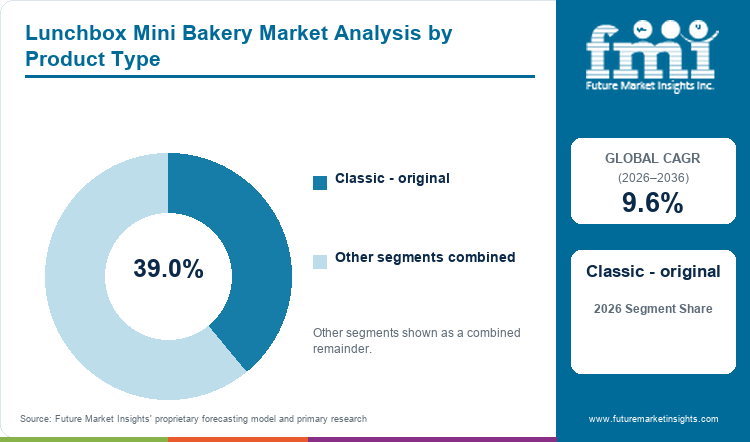
Classic products give meal planners a neutral bakery base for sweet or savory fillings without narrowing the eating occasion. Familiar bakery ingredients let manufacturers control flavor and texture without relying on novelty to secure repeat household purchase.
- By product type, classic - original is estimated to hold 39.0% in 2026 owing to familiar taste and broad compatibility with packed lunches and routine snacks.
- Rich Products Corporation introduced ready-to-serve mini cakes in July 2026 for in-store bakery and foodservice accounts. The launch puts smaller frozen desserts into service formats that require no on-site preparation.
Why does Conventional lead the Claim - Nature category?
Conventional formulations let bakeries adjust flour systems and shelf-life aids without carrying specialist certification requirements. Demand for clean-label ingredients pressures mainstream recipes to simplify ingredient declarations where shoppers compare price and familiar taste.
- The conventional segment is likely to capture 48.0% share in 2026 attributable to flexible ingredient sourcing and fewer specialist certification requirements.
- Grupo Bimbo stated in June 2026 that its daily-consumption portfolio had been free from artificial colors since 2024. Removing certified colors lets mainstream bakery simplify selected ingredients without placing every product inside a specialist claim tier.
How does Fresh support the Format category?
Softness and aroma keep fresh presentation commercially relevant at the point of purchase or service. Fresh products also let retail bakeries time replenishment to expected traffic without asking shoppers to accept ambient texture. Upstream frozen bakery systems can feed that presentation if operators have freezer capacity and disciplined bake-off or thawing routines.
- Fresh is set to lead the format category with 40.0% share in 2026 due to immediate eating quality at retail counters and foodservice service points.
- Vandemoortele acquired Lizzi in February 2025 and added four Italian plants serving frozen bread and pastry into retail and HoReCa channels.
What supports Multipack leadership in the Packaging Format category?
Multipacks fit planned household use by letting one purchase cover several planned eating occasions. Operators using frozen dough formats apply similar portion discipline upstream by holding prepared units until service or bake-off timing requires them.
- Multipack is projected to hold 36.0% share in 2026 owing to planned purchasing and portion control during repeated lunchbox or snack occasions.
- General Mills Foodservice introduced new K-12 bakery options in July 2026 including individually wrapped and small-portioned items for school service. The additions place portion-ready formats inside school service where pack integrity reduces handling before distribution.
What drives Supermarkets & hypermarkets in the Sales Channel category?
Supermarkets place fresh counters and packaged bakery within one shopping trip, letting small formats compete on price and convenience together. Their breadth gives industrial bakery mixes access to private-label and in-store programs that require repeatable production at scale.
- By sales channel, supermarkets & hypermarkets are forecast to represent 40.0% in 2026 driven by frequent shopper traffic and broad bakery assortment.
- ARYZTA AG announced in June 2026 that its Coup de Pates business acquired a frozen-products distributor in southwest France. The acquisition gives professional bakery accounts a shorter controlled delivery route for frozen assortment changes.
What are the drivers, restraints and opportunities in the Lunchbox Mini Bakery Market?
Portable portioning supports repeat use while labeling and storage complexity raise operating costs. Nutrition-led formats can widen eligible accounts if they remain simple to handle.
- Driver: Small bakery portions reduce preparation and dividing work for households or operators without changing familiar bread and pastry eating occasions.
- Restraint: Country labeling rules and specialist formulation requirements increase artwork control and specification work for companies selling the same concept internationally.
- Opportunity: Nutrition-led recipes can widen institutional and family use provided better formulation is paired with portion-ready packaging and practical storage formats.
Portable Portions Reduce Preparation Work
Packed lunches reward bakery products that arrive in a usable portion and need little preparation before service. USDA Food and Nutrition Service states that at least 80% of weekly grains in US school lunch and breakfast programs must be whole grain-rich. Portable bread and muffin formats can meet grain-crediting requirements without adding preparation work for school kitchens.
National Labels Raise SKU Work
International ranges become harder to standardize if one recipe and label must satisfy different national requirements. South Korea's Ministry of Food and Drug Safety issued Notice 2025-27 in April 2025 with updated food-labeling requirements. Specialist gluten-free food lines require separate ingredient segregation and claim controls for every package sold in the commercial range.
Nutrition Reformulation Extends Portable Use
Nutrition-led reformulation earns commercial space only if texture and handling remain familiar to the account. Abu Dhabi Quality and Conformity Council launched its nutrition labeling initiative in March 2025 and identified bakery products in the first rollout group. Clean label bakery enzymes can support selected recipes where manufacturers need softness or shelf-life control with fewer conventional processing aids.
Which country CAGRs are profiled in the Lunchbox Mini Bakery Market?
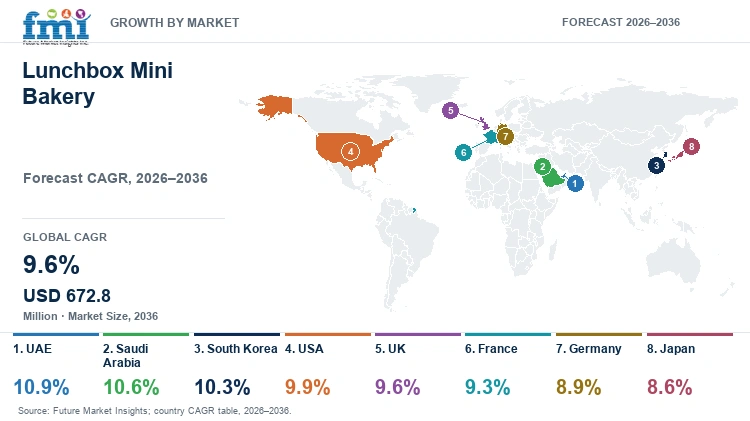
| Country | CAGR |
|---|---|
| UAE | 10.9% |
| Saudi Arabia | 10.6% |
| South Korea | 10.3% |
| USA | 9.9% |
| UK | 9.6% |
| France | 9.3% |
| Germany | 8.9% |
| Japan | 8.6% |
How do country-level CAGRs compare in the Lunchbox Mini Bakery Market?
Forecast growth stays tightly grouped among eight countries, with only 2.3 percentage points separating UAE at 10.9% from Japan at 8.6%. Gulf markets occupy the upper band before South Korea and the USA. UK and France form the middle group, with Germany and Japan advancing at a steadier pace for supplier planning.
- UAE growth rewards cold-chain execution for imports.
- Saudi growth rewards durable bakery outside metropolitan hubs.
- South Korean convenience rewards protected softness during turnover.
- US multipacks compete on visible per-portion economics.
- UK private label keeps serving prices visible.
- French boulangeries raise expectations for packaged bakery.
- German discounters intensify price comparison with rolls.
- Japanese convenience rewards compact packs during turnover.
CAGR measures forecast pace but account selection still depends on channel economics and product fit. The full report retains North America, Latin America, Western Europe, Eastern Europe, East Asia, South Asia and Pacific and Middle East and Africa.
Country-wise Analysis
- US school and grocery channels ask for different pack sizes because one serves regulated meal portions and the other competes on household convenience. Lunchbox mini bakery demand in the USA is forecast to rise at 9.9% CAGR over the forecast period, driven by institutional and household use. USDA updated its Whole Grain Resource in May 2025 with national guidance for crediting whole grain-rich products in school meal programs. Manufacturers using USA bakery ingredients can protect softness during recipe changes, yet repeat purchase depends on student acceptance and an affordable served portion.
- German retailers sell portable bakery beside a deeply established bread category where shoppers compare price and portion value during routine weekly household shopping. The German Bakers' Confederation reported that private households bought about 1.519 million tonnes of bread during 2025 nationwide. Germany is estimated to post 8.9% CAGR over the forecast period attributable to frequent bread purchasing and broad grocery access. Documented flour improver products can protect texture during high-volume production, though smaller packs must justify a higher per-serving price against familiar rolls and household packs during private-label promotion cycles.
- French mini bakery competes beside fresh boulangerie staples and indulgent pastries, so packaged products must preserve taste before nutrition claims influence repeat purchase. The French lunchbox mini bakery sector is projected to record 9.3% CAGR during the assessment period attributable to broad bakery use and grocery distribution. France adopted the revised Nutri-Score framework under a national order published in March 2025 with an updated scoring method for packaged foods. Manufacturers can review sugar and salt before launch, but reformulation loses commercial value if improved scores weaken texture or familiar flavor during routine bakery purchases.
- UK bakeries using common wheat flour face a national composition change that directly affects mainstream bread recipes and ingredient declarations. The Department for Environment, Food & Rural Affairs published UK-wide bread and flour guidance in April 2025 covering mandatory fortification and revised nutrient levels. In the UK, lunchbox mini bakery demand is predicted to advance at 9.6% CAGR through 2036 supported by retail and institutional routes. Flexible baking ingredients let manufacturers adjust school-ready bread or grocery bakery recipes, but reformulation must preserve familiar texture and a workable per-serving cost for routine purchasing.
- Saudi national retail and foodservice networks need portable bakery that tolerates long distribution distances and arrives with Arabic-ready nutrition information. By 2036, Saudi Arabia is projected to grow at 10.6% CAGR supported by modern retail and restaurant placement for portioned bakery. The Saudi Food and Drug Authority announced in June 2025 that new menu nutrition-disclosure rules would take effect on July 1. Clear portion data can improve restaurant account readiness, but imported ranges carry artwork and localization costs that must be absorbed without disrupting distributor inventory during seasonal demand peaks.
- UAE grocery shoppers compare bread prices and pack sizes inside supermarket and cooperative networks that carry a wide imported assortment. The Ministry of Economy launched a national price-monitoring platform in February 2025 covering retailers responsible for more than 90% of domestic trade in listed goods. Lunchbox mini bakery sales in the UAE are forecast to expand at 10.9% CAGR by 2036 tied to modern retail access and convenience purchasing. Bread remains inside the monitored basket, so premium mini formats need a visible portion or quality advantage that survives frequent promotions and imported-brand price comparison.
- Japanese convenience and grocery channels reward compact portions with exact pack communication during rapid single-serve turnover where product presentation influences selection. Adoption of lunchbox mini bakery products in Japan is estimated to expand at 8.6% CAGR through 2036 influenced by convenience distribution and localized packaging. The Consumer Affairs Agency added cashew to Japan's mandatory allergen labeling from April 1 2026 for packaged foods sold nationwide. Localized labels reduce rework during assortment changes, but shared production lines need allergen segregation that protects softness and flavor during frequent small-format turnover in stores.
- South Korean bakery competes on convenience and nutrition cues in dense café and convenience channels where bread and pastry assortments rotate quickly. The Ministry of Food and Drug Safety revised sodium-reduction labeling criteria in October 2025 to include bagels and croissants. South Korea's lunchbox mini bakery outlook is anticipated to advance at 10.3% CAGR over the assessment period owing to frequent convenience purchasing and product renovation. The revised criteria give qualifying bread a lower-sodium positioning route, though manufacturers must preserve soft texture and familiar flavor before retailers can expect repeat purchases.
Who are the notable companies in the Lunchbox Mini Bakery Market?
Key companies serving this market include ARYZTA AG, Europastry, Vandemoortele, Lantmännen Unibake, Rich Products Corporation, BRIDOR, Grupo Bimbo, General Mills, Cérélia and Sara Lee Frozen Bakery.
Competition separates into frozen bake-off groups, branded bakery manufacturers and ready-to-bake specialists with different channel strengths. Food-safety records and predictable production raise entry requirements for commercial accounts using different storage and finishing routines.
- ARYZTA AG, Europastry, Vandemoortele, Lantmännen Unibake and BRIDOR focus on frozen or bake-off bakery requiring final preparation.
- Rich Products Corporation, Grupo Bimbo and General Mills use broader bakery portfolios across retail or foodservice channels.
- Cérélia and Sara Lee Frozen Bakery focus on ready-to-bake or frozen portioned products for selected commercial channels.
Competitive Benchmarking: Lunchbox Mini Bakery Market
| Company | Portable Format Breadth | Preparation Flexibility | Channel Coverage | Geographic Reach |
|---|---|---|---|---|
| ARYZTA AG | Medium | High | High | Europe, Asia, Australia and New Zealand |
| Europastry | High | High | High | Europe, Americas and Asia-Pacific |
| Vandemoortele | Medium | High | High | Europe, USA and export markets |
| Lantmännen Unibake | Medium | High | High | Europe and international markets |
| Rich Products Corporation | High | High | High | Global |
| BRIDOR | High | High | High | Europe, Americas and Asia-Pacific |
| Grupo Bimbo | High | Medium | High | Americas, Europe, Asia and Africa |
| General Mills | Medium | High | High | North America and international retail |
| Cérélia | Medium | High | High | Europe, North America and Asia |
| Sara Lee Frozen Bakery | High | High | Medium | North America |
Scoring basis: High portable-format breadth requires three documented bakery families and Medium requires two and Low identifies one. High preparation flexibility requires three verified handling routes with Medium requiring two routes and Low identifying one. High channel coverage requires three commercial channels with Medium requiring two channels and Low identifying one. Geographic reach records verified commercial territories and does not represent a corporate reputation score.
Key Developments in the Lunchbox Mini Bakery Market
- In September 2025, Grupo Bimbo received regulatory approval to acquire Wickbold in Brazil and extend branded bakery distribution using an established local portfolio.
- In September 2025, Lantmännen Unibake acquired Boboli Benelux and gained a Netherlands bakery serving bake-off and chilled savory products in several European markets.
- In January 2026, BRIDOR inaugurated its expanded Vineland bakery in New Jersey after adding production capacity for bread and viennoiserie serving US retail and foodservice accounts.
Key Players in the Lunchbox Mini Bakery Market
Frozen and Bake-Off Bakery Platforms
- ARYZTA AG
- Europastry
- Vandemoortele
- Lantmännen Unibake
- BRIDOR
Scaled Retail and Foodservice Bakery Portfolios
- Rich Products Corporation
- Grupo Bimbo
- General Mills
Ready-to-Bake and Portioned Bakery Specialists
- Cérélia
- Sara Lee Frozen Bakery
Lunchbox Mini Bakery Market - Report Scope
| Coverage field | Report scope |
|---|---|
| Market breakdown | By product type, claim - nature, format, packaging format, sales channel and region. |
| Quantitative Units | USD million. |
| Market Definition | Commercial small-format bakery products designed for packed lunches, portable snacking and portion-ready retail or foodservice use. |
| Regions Covered | North America, Latin America, Western Europe, Eastern Europe, East Asia, South Asia and Pacific and Middle East and Africa. |
| Countries Covered | UAE, Saudi Arabia, South Korea, USA, UK, France, Germany, Japan, and 25+ countries included in the full report. |
| Key Companies Profiled | ARYZTA AG, Europastry, Vandemoortele, Lantmännen Unibake, Rich Products Corporation, BRIDOR, Grupo Bimbo, General Mills, Cérélia, Sara Lee Frozen Bakery. |
| Forecast Period | 2026 to 2036. |
| Approach | Primary and secondary research with market triangulation. |
Lunchbox Mini Bakery Market - Research Methodology
| Method | Approach |
|---|---|
| Primary Research | FMI analysts gathered input from manufacturers, service providers, technology developers, distributors, end users, procurement teams, and subject-matter experts. Interviews examined purchasing decisions, product or service evaluation, adoption barriers, approval requirements, pricing considerations, and expectations for technical or commercial support. Respondents were also asked what evidence is required before a trial, pilot, or initial order develops into regular purchasing. |
| Desk Research | Desk research covered government statistics, regulatory publications, trade data, industry associations, technical literature, standards, company filings, product information, and official corporate announcements. Sources were reviewed for relevance, publication date, geographic coverage, and consistency with the defined market scope. Claims relating to performance, applications, approvals, capacity, investment, and commercial activity were retained only when supported by credible public evidence. |
| Market Sizing and Forecasting | The market model combined the baseline value with historical performance, segment structure, pricing and volume indicators, adoption levels, company participation, and country-level demand conditions. Forecast assumptions considered economic activity, investment trends, regulatory developments, technology adoption, purchasing cycles, supply availability, and barriers to wider market use. Segment and regional estimates were reconciled before the final market total was calculated. |
| Data Validation | Estimates were checked against multiple independent indicators, including public data, company activity, trade patterns, industry developments, and findings from primary interviews. Validation also tested whether products, services, applications, and company revenues fell within the defined market boundaries. Adjacent categories, unsupported claims, overlapping revenues, and activities without direct market relevance were excluded to reduce double counting and maintain consistency across segments and countries. |
Lunchbox Mini Bakery Market by Segments
Lunchbox Mini Bakery Market segmented by Product Type:
- Classic - original
- Whole grain & seeded
- Flavored & filled
- Mini & snacking formats
- Premium - artisan
Lunchbox Mini Bakery Market segmented by Claim - Nature:
- Conventional
- Clean label
- Organic
- Gluten-free
- High-protein - fortified
Lunchbox Mini Bakery Market segmented by Format:
- Fresh
- Frozen
- Ambient packaged
- Chilled
- Par-baked - thaw-and-serve
Lunchbox Mini Bakery Market segmented by Packaging Format:
- Multipack
- Single-serve
- Family - loaf pack
- Bulk foodservice
Lunchbox Mini Bakery Market segmented by Sales Channel:
- Supermarkets & hypermarkets
- Artisan & specialty bakeries
- Convenience & forecourt
- Online & DTC
- Foodservice distributors
Lunchbox Mini Bakery Market by Region:
- North America
- United States
- Canada
- Latin America
- Brazil
- Mexico
- Argentina
- Chile
- Western Europe
- Germany
- France
- United Kingdom
- Italy
- Spain
- Benelux
- Nordics
- Eastern Europe
- Poland
- Czech Republic
- Romania
- Hungary
- East Asia
- China
- Japan
- South Korea
- South Asia and Pacific
- India
- ASEAN
- Australia and New Zealand
- Middle East and Africa
- GCC Countries
- South Africa
- Türkiye
- Israel
Research Sources and Bibliography
- USA Department of Agriculture, Food and Nutrition Service. (2026, January 23). National School Lunch Program: Participation and Lunches Served
- USA Department of Agriculture, Food and Nutrition Service. (2025, July 24). National School Lunch, Special Milk, and School Breakfast Programs, National Average Payments/Maximum Reimbursement Rates SY 2025-26
- Zentralverband des Deutschen Bäckerhandwerks e.V.. (2026). Zahlen & Fakten
- Rich Products Corporation. (2026, July 6). Rich Products Introduces Mini Cakes
- Grupo Bimbo. (2026, June 10). Portfolio Free from Artificial Colors
- Groupe LE DUFF. (2025, April 23). LE DUFF Group is accelerating its global growth
- General Mills. (2026, July 29). General Mills Foodservice Serves Up New and Renovated K-12 Solutions for a Tasty Start to the School Year
- ARYZTA AG. (2026, June 23). ARYZTA acquires French distribution business
- USA Department of Agriculture, Food and Nutrition Service. (2025). School Nutrition Standards Updates: Whole Grains
- Ministry of Food and Drug Safety, Republic of Korea. (2025, April 21). Standards for Labeling of Foods, Notice No. 2025-27
- USA Department of Agriculture, Food and Nutrition Service. (2025, May 1). The Whole Grain Resource for the National School Lunch and Breakfast Programs
- Légifrance. (2025, March 14). Arrêté du 14 mars 2025 fixant la forme de présentation complémentaire à la déclaration nutritionnelle recommandée par l’Etat
- Department for Environment, Food & Rural Affairs and Food Standards Agency. (2025, April 23). Bread and flour: labelling and composition
- Saudi Food and Drug Authority. (2025, June 18). SFDA Announces New Food Nutrition Disclosure Rules Effective July 1
- Abu Dhabi Quality and Conformity Council. (2025, March 27). Nutri-Mark Initiative Covers Bakery and Children’s Food in First Phase
- UAE Ministry of Economy and Tourism. (2025, February 20). Ministry of Economy launches national platform for monitoring prices of essential commodities to enhance government oversight of markets and real-time price tracking
- Consumer Affairs Agency, Japan. (2026, April 1). 食物アレルギー表示に関する情報
- Ministry of Food and Drug Safety, Republic of Korea. (2025, October 20). 「나트륨·당류 저감 표시기준」 일부개정고시
- Lantmännen Unibake. (2025, September 1). Lantmännen Unibake expands in savoury with acquisition of Boboli Benelux B.V.
- Groupe LE DUFF. (2026, February 27). BRIDOR poursuit son expansion aux États-Unis et double la capacité de production de Vineland
- ARYZTA AG. (2026, January 22). Full year 2025 targets achieved; Revenue growth & improved performance expected in 2026; New €40m bun bakery in Portugal
- Vandemoortele. (2026, August 3). Vandemoortele USA completes final phase of acquisition of New Jersey-based Banneton Bakery
- Grupo Bimbo. (2026, March 26). Inauguramos NOVABES y reforzamos nuestra apuesta por la inversión y desarrollo en El Salvador
- Rich Products Corporation. (2025, March 19). Rich Products launches Roman-Style Pizza Dough Ball
- General Mills. (2025, September 16). The Pillsbury Doughboy Is Headed to the Big Apple to Roll Out His Biggest Bakes Yet
- Danish Competition and Consumer Authority. (2025, July 8). Approval of Cérélia Participation Holding SAS acquisition of sole control over Humlum A/S
- ARYZTA AG. (2026, August 26). New Perth bakery officially opened
- Minor International PCL. (2025, May 27). MINT, Srifa Frozen Food and Europastry Form Strategic Bakery Production Partnership
- Competition and Markets Authority. (2026, August 20). Vandemoortele required to sell UK plant following pastry merger investigation
- Lantmännen. (2025, May 28). Lantmännen makes strategic and long-term investment in new production facility for bread
- Rich Products Corporation. (2025, April 10). Rich Products, Funfetti extend partnership
- Groupe LE DUFF. (2025, April 23). Investments, targeted acquisitions and BRIDOR global growth program
- Grupo Bimbo. (2025, September 17). GRUPO BIMBO Receives Regulatory Approval to Acquire Wickbold in Brazil
- Cal-Maine Foods. (2026, May 12). Cal-Maine Foods and Sara Lee Frozen Bakery Announce Cal-Maine Foods’ Acquisition of Van’s Foods Brand
- Vandemoortele. (2025, February 14). Vandemoortele acquires Lizzi in Italy, a specialty player in frozen Bakery
- General Mills. (2026, June 15). Pillsbury Launches Grands!™ Poppin’ Flavor Lineup with Mike’s Hot Honey® Biscuits and All-New Fruit Rolls
- Competition and Markets Authority. (2025, March 7). Cérélia / Jus-Rol merger inquiry
- Art of Baking Co., Ltd.. (2026). About us
This bibliography is provided for reader reference and is not exhaustive. The full report contains the complete reference list and detailed citations
This Report Answers
- How does portioning support lunchbox mini bakery purchases?
- Why does classic - original hold 39.0% in 2026?
- How does conventional formulation affect mini bakery production?
- Why does fresh presentation retain share beside frozen handling?
- How do multipacks change household portion economics?
- Which national rules alter the eight country forecasts?
- How do key companies differ in format and channel coverage?
- Which bakery investments are changing competition?
Frequently Asked Questions
How big is the lunchbox mini bakery market in 2026?
The lunchbox mini bakery market is valued at USD 269.0 million in 2026 and is projected to reach USD 672.8 million by 2036. Portable portions fit familiar household and foodservice bakery occasions without adding preparation or dividing larger products.
What is the CAGR of the lunchbox mini bakery market from 2026 to 2036?
The lunchbox mini bakery market is projected to grow at a CAGR of 9.6% between 2026 and 2036. Portion-ready products support retail and foodservice use where storage and handling remain practical for repeated service.
Which product type leads the lunchbox mini bakery market?
The classic - original segment is expected to hold 39.0% of product type in 2026, attributable to familiar taste and broad meal compatibility. Retailers can use this familiar format without limiting mini bakery to one eating occasion or filling profile.
How much value will the lunchbox mini bakery market add between 2026 and 2036?
The lunchbox mini bakery market is expected to add USD 403.8 million in value between 2026 and 2036. Portable formats support repeat purchases where portioning and storage remain practical for familiar bakery occasions.
Which companies are active in the lunchbox mini bakery market?
Key companies operating in the lunchbox mini bakery market include ARYZTA AG, Europastry, Vandemoortele, Lantmännen Unibake, Rich Products Corporation, BRIDOR, Grupo Bimbo, General Mills, Cérélia and Sara Lee Frozen Bakery. Their participation spans frozen bake-off, ready-to-bake and portioned formats serving retail or foodservice accounts internationally.
Preview the report firsthand - request a free sample
Get SampleGet the brochure for pricing and purchase details.
Get PDFTable of Content
- Key Takeaways
- Market Size and CAGR
- Top Growth Driver
- Fastest Growing Segment
- Leading Region
- Key Companies
- Emerging Opportunities
- Executive Summary
- Global Market Outlook
- Demand-side Trends
- Supply-side Trends
- Technology Roadmap Analysis
- Analysis and Recommendations
- Analyst Perspective (What is happening? Why now? What should investors know?)
- Key Questions Answered
- How large is the market?
- What is the CAGR?
- What are key trends?
- Which region dominates?
- Who are the leaders?
- Market Overview
- Market Coverage / Taxonomy
- Market Definition / Scope / Limitations
- Research Methodology
- Chapter Orientation
- Analytical Lens and Working Hypotheses
- Market Structure, Signals, and Trend Drivers
- Benchmarking and Cross-market Comparability
- Market Sizing, Forecasting, and Opportunity Mapping
- Research Design and Evidence Framework
- Desk Research Programme (Secondary Evidence)
- Expert Input and Fieldwork (Primary Evidence)
- Tooling, Models, and Reference Databases
- Data Engineering and Model Build
- Quality Assurance and Audit Trail
- Market Background
- Market Dynamics (Drivers, Restraints, Opportunity, Trends)
- Scenario Forecast (Optimistic, Likely, Conservative)
- Impact Analysis
- AI Impact
- Sustainability Impact
- Regulatory Impact
- Technology Impact
- Consumer / Buyer Analysis
- Purchase Drivers
- Adoption Barriers
- Buyer Journey
- Opportunity Map Analysis
- Product Life Cycle Analysis
- Supply Chain Analysis
- Investment Feasibility Matrix
- Value Chain Analysis
- PESTLE and Porter's Analysis
- Regulatory Landscape
- Regional Parent Market Outlook
- Production and Consumption Statistics
- Import and Export Statistics
- Global Market Analysis and Forecast, 2021 to 2036
- Historical Market Size Value (USD Million) Analysis, 2021 to 2025
- Current and Future Market Size Value (USD Million) Projections, 2026 to 2036
- Y-o-Y Growth Trend Analysis
- Absolute $ Opportunity Analysis
- Global Market Pricing Analysis, 2021 to 2036
- Global Market Analysis and Forecast, By Product Type, 2021 to 2036
- Introduction / Key Findings
- Historical Market Size Value (USD Million) Analysis By Product Type, 2021 to 2025
- Current and Future Market Size Value (USD Million) Analysis and Forecast By Product Type, 2026 to 2036
- Classic - original
- Whole grain & seeded
- Flavored & filled
- Mini & snacking formats
- Premium - artisan
- Y-o-Y Growth Trend Analysis By Product Type, 2021 to 2025
- Absolute $ Opportunity Analysis By Product Type, 2026 to 2036
- Global Market Analysis and Forecast, By Claim - Nature, 2021 to 2036
- Introduction / Key Findings
- Historical Market Size Value (USD Million) Analysis By Claim - Nature, 2021 to 2025
- Current and Future Market Size Value (USD Million) Analysis and Forecast By Claim - Nature, 2026 to 2036
- Conventional
- Clean label
- Organic
- Gluten-free
- High-protein - fortified
- Y-o-Y Growth Trend Analysis By Claim - Nature, 2021 to 2025
- Absolute $ Opportunity Analysis By Claim - Nature, 2026 to 2036
- Global Market Analysis and Forecast, By Format, 2021 to 2036
- Introduction / Key Findings
- Historical Market Size Value (USD Million) Analysis By Format, 2021 to 2025
- Current and Future Market Size Value (USD Million) Analysis and Forecast By Format, 2026 to 2036
- Fresh
- Frozen
- Ambient packaged
- Chilled
- Par-baked - thaw-and-serve
- Y-o-Y Growth Trend Analysis By Format, 2021 to 2025
- Absolute $ Opportunity Analysis By Format, 2026 to 2036
- Global Market Analysis and Forecast, By Packaging Format, 2021 to 2036
- Introduction / Key Findings
- Historical Market Size Value (USD Million) Analysis By Packaging Format, 2021 to 2025
- Current and Future Market Size Value (USD Million) Analysis and Forecast By Packaging Format, 2026 to 2036
- Multipack
- Single-serve
- Family - loaf pack
- Bulk foodservice
- Y-o-Y Growth Trend Analysis By Packaging Format, 2021 to 2025
- Absolute $ Opportunity Analysis By Packaging Format, 2026 to 2036
- Global Market Analysis and Forecast, By Sales Channel, 2021 to 2036
- Introduction / Key Findings
- Historical Market Size Value (USD Million) Analysis By Sales Channel, 2021 to 2025
- Current and Future Market Size Value (USD Million) Analysis and Forecast By Sales Channel, 2026 to 2036
- Supermarkets & hypermarkets
- Artisan & specialty bakeries
- Convenience & forecourt
- Online & DTC
- Foodservice distributors
- Y-o-Y Growth Trend Analysis By Sales Channel, 2021 to 2025
- Absolute $ Opportunity Analysis By Sales Channel, 2026 to 2036
- Global Market Analysis and Forecast, By Region, 2021 to 2036
- Introduction
- Historical Market Size Value (USD Million) Analysis By Region, 2021 to 2025
- Current Market Size Value (USD Million) Analysis and Forecast By Region, 2026 to 2036
- North America
- Latin America
- Western Europe
- Eastern Europe
- East Asia
- South Asia and Pacific
- Middle East and Africa
- Market Attractiveness Analysis By Region
- North America Market Analysis and Forecast, By Country, 2021 to 2036
- Historical Market Size Value (USD Million) Trend Analysis By Market Taxonomy, 2021 to 2025
- Market Size Value (USD Million) Forecast By Market Taxonomy, 2026 to 2036
- By Country
- United States
- Canada
- By Product Type
- By Claim - Nature
- By Format
- By Packaging Format
- By Sales Channel
- By Country
- Market Attractiveness Analysis
- By Country
- By Product Type
- By Claim - Nature
- By Format
- By Packaging Format
- By Sales Channel
- Key Takeaways
- Latin America Market Analysis and Forecast, By Country
- Historical Market Size Value (USD Million) Trend Analysis By Market Taxonomy, 2021 to 2025
- Market Size Value (USD Million) Forecast By Market Taxonomy, 2026 to 2036
- By Country
- Brazil
- Mexico
- Argentina
- Chile
- By Product Type
- By Claim - Nature
- By Format
- By Packaging Format
- By Sales Channel
- By Country
- Market Attractiveness Analysis
- By Country
- By Product Type
- By Claim - Nature
- By Format
- By Packaging Format
- By Sales Channel
- Key Takeaways
- Western Europe Market Analysis and Forecast, By Country
- Historical Market Size Value (USD Million) Trend Analysis By Market Taxonomy, 2021 to 2025
- Market Size Value (USD Million) Forecast By Market Taxonomy, 2026 to 2036
- By Country
- Germany
- France
- United Kingdom
- Italy
- Spain
- Benelux
- Nordics
- By Product Type
- By Claim - Nature
- By Format
- By Packaging Format
- By Sales Channel
- By Country
- Market Attractiveness Analysis
- By Country
- By Product Type
- By Claim - Nature
- By Format
- By Packaging Format
- By Sales Channel
- Key Takeaways
- Eastern Europe Market Analysis and Forecast, By Country
- Historical Market Size Value (USD Million) Trend Analysis By Market Taxonomy, 2021 to 2025
- Market Size Value (USD Million) Forecast By Market Taxonomy, 2026 to 2036
- By Country
- Poland
- Czech Republic
- Romania
- Hungary
- By Product Type
- By Claim - Nature
- By Format
- By Packaging Format
- By Sales Channel
- By Country
- Market Attractiveness Analysis
- By Country
- By Product Type
- By Claim - Nature
- By Format
- By Packaging Format
- By Sales Channel
- Key Takeaways
- East Asia Market Analysis and Forecast, By Country
- Historical Market Size Value (USD Million) Trend Analysis By Market Taxonomy, 2021 to 2025
- Market Size Value (USD Million) Forecast By Market Taxonomy, 2026 to 2036
- By Country
- China
- Japan
- South Korea
- By Product Type
- By Claim - Nature
- By Format
- By Packaging Format
- By Sales Channel
- By Country
- Market Attractiveness Analysis
- By Country
- By Product Type
- By Claim - Nature
- By Format
- By Packaging Format
- By Sales Channel
- Key Takeaways
- South Asia and Pacific Market Analysis and Forecast, By Country
- Historical Market Size Value (USD Million) Trend Analysis By Market Taxonomy, 2021 to 2025
- Market Size Value (USD Million) Forecast By Market Taxonomy, 2026 to 2036
- By Country
- India
- ASEAN
- Australia and New Zealand
- By Product Type
- By Claim - Nature
- By Format
- By Packaging Format
- By Sales Channel
- By Country
- Market Attractiveness Analysis
- By Country
- By Product Type
- By Claim - Nature
- By Format
- By Packaging Format
- By Sales Channel
- Key Takeaways
- Middle East and Africa Market Analysis and Forecast, By Country
- Historical Market Size Value (USD Million) Trend Analysis By Market Taxonomy, 2021 to 2025
- Market Size Value (USD Million) Forecast By Market Taxonomy, 2026 to 2036
- By Country
- GCC Countries
- South Africa
- Türkiye
- Israel
- By Product Type
- By Claim - Nature
- By Format
- By Packaging Format
- By Sales Channel
- By Country
- Market Attractiveness Analysis
- By Country
- By Product Type
- By Claim - Nature
- By Format
- By Packaging Format
- By Sales Channel
- Key Takeaways
- Key Countries Market Analysis
- United States
- Pricing Analysis
- Market Share Analysis, 2025
- By Product Type
- By Claim - Nature
- By Format
- By Packaging Format
- By Sales Channel
- Canada
- Pricing Analysis
- Market Share Analysis, 2025
- By Product Type
- By Claim - Nature
- By Format
- By Packaging Format
- By Sales Channel
- Mexico
- Pricing Analysis
- Market Share Analysis, 2025
- By Product Type
- By Claim - Nature
- By Format
- By Packaging Format
- By Sales Channel
- Brazil
- Pricing Analysis
- Market Share Analysis, 2025
- By Product Type
- By Claim - Nature
- By Format
- By Packaging Format
- By Sales Channel
- Chile
- Pricing Analysis
- Market Share Analysis, 2025
- By Product Type
- By Claim - Nature
- By Format
- By Packaging Format
- By Sales Channel
- Germany
- Pricing Analysis
- Market Share Analysis, 2025
- By Product Type
- By Claim - Nature
- By Format
- By Packaging Format
- By Sales Channel
- United Kingdom
- Pricing Analysis
- Market Share Analysis, 2025
- By Product Type
- By Claim - Nature
- By Format
- By Packaging Format
- By Sales Channel
- Italy
- Pricing Analysis
- Market Share Analysis, 2025
- By Product Type
- By Claim - Nature
- By Format
- By Packaging Format
- By Sales Channel
- Spain
- Pricing Analysis
- Market Share Analysis, 2025
- By Product Type
- By Claim - Nature
- By Format
- By Packaging Format
- By Sales Channel
- France
- Pricing Analysis
- Market Share Analysis, 2025
- By Product Type
- By Claim - Nature
- By Format
- By Packaging Format
- By Sales Channel
- India
- Pricing Analysis
- Market Share Analysis, 2025
- By Product Type
- By Claim - Nature
- By Format
- By Packaging Format
- By Sales Channel
- ASEAN
- Pricing Analysis
- Market Share Analysis, 2025
- By Product Type
- By Claim - Nature
- By Format
- By Packaging Format
- By Sales Channel
- Australia and New Zealand
- Pricing Analysis
- Market Share Analysis, 2025
- By Product Type
- By Claim - Nature
- By Format
- By Packaging Format
- By Sales Channel
- China
- Pricing Analysis
- Market Share Analysis, 2025
- By Product Type
- By Claim - Nature
- By Format
- By Packaging Format
- By Sales Channel
- Japan
- Pricing Analysis
- Market Share Analysis, 2025
- By Product Type
- By Claim - Nature
- By Format
- By Packaging Format
- By Sales Channel
- South Korea
- Pricing Analysis
- Market Share Analysis, 2025
- By Product Type
- By Claim - Nature
- By Format
- By Packaging Format
- By Sales Channel
- Poland
- Pricing Analysis
- Market Share Analysis, 2025
- By Product Type
- By Claim - Nature
- By Format
- By Packaging Format
- By Sales Channel
- Hungary
- Pricing Analysis
- Market Share Analysis, 2025
- By Product Type
- By Claim - Nature
- By Format
- By Packaging Format
- By Sales Channel
- Türkiye
- Pricing Analysis
- Market Share Analysis, 2025
- By Product Type
- By Claim - Nature
- By Format
- By Packaging Format
- By Sales Channel
- South Africa
- Pricing Analysis
- Market Share Analysis, 2025
- By Product Type
- By Claim - Nature
- By Format
- By Packaging Format
- By Sales Channel
- UAE
- Pricing Analysis
- Market Share Analysis, 2025
- By Product Type
- By Claim - Nature
- By Format
- By Packaging Format
- By Sales Channel
- Saudi Arabia
- Pricing Analysis
- Market Share Analysis, 2025
- By Product Type
- By Claim - Nature
- By Format
- By Packaging Format
- By Sales Channel
- United States
- Market Structure Analysis
- Competition Dashboard
- Competition Benchmarking
- Market Share Analysis of Top Players
- By Regional
- By Product Type
- By Claim - Nature
- By Format
- By Packaging Format
- By Sales Channel
- Emerging Startups
- Innovation Benchmarking
- Competition Analysis
- Competition Deep Dive
- ARYZTA AG
- Overview
- Product Portfolio
- Profitability by Market Segments
- Sales Footprint
- Strategy Overview
- Marketing Strategy
- Product Strategy
- Channel Strategy
- Europastry
- Vandemoortele
- Lantmännen Unibake
- Rich Products Corporation
- BRIDOR
- Grupo Bimbo
- General Mills
- Cérélia
- Sara Lee Frozen Bakery
- ARYZTA AG
- Case Studies
- Success Stories
- Recent Developments
- Competition Deep Dive
- Assumptions & Acronyms Used


