

- Industry Size (2026)
- USD 217.6 Mn
- Forecast (2036)
- USD 652.9 Mn
- CAGR (2026 to 2036)
- 11.6%
Photochromic Temperature Labels Market Forecast and Outlook 2026 to 2036
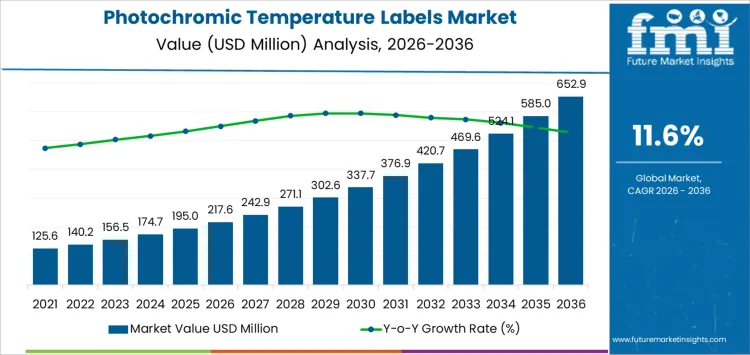
In 2026, the photochromic temperature labels market is valued at USD 217.6 million and is projected to reach USD 652.9 million by 2036, reflecting a CAGR of 11.6%. The first five-year growth block from 2026 to 2031 lifts the market to approximately USD 376.6 million. This phase is driven by the expanding use in cold-chain pharmaceutical logistics and fresh-food distribution, where visual temperature indication supports compliance and quality assurance. Adoption during this block is supported by wider deployment of photochromic ink activation and micro-capsule printing within smart temperature label formats.
The second growth block from 2031 to 2036 advances the market from about USD 376.6 million to USD 652.9 million, marking a phase of accelerated absolute value creation. Penetration deepens across e-commerce fresh delivery and industrial monitoring as digital smart labeling gains traction. Annual increments widen as production scales and labels become embedded into standard packaging workflows. Growth in this block reflects repeat procurement, broader material standardization, and increased reliance on real-time visual indicators rather than pilot deployments or limited use cases.
Quick Stats of the Photochromic Temperature Labels Market:
- Photochromic Temperature Labels Market Value (2026): USD 217.6 million
- Photochromic Temperature Labels Market Forecast Value (2036): USD 652.9 million
- Photochromic Temperature Labels Market Forecast CAGR (2026-2036): 11.6%
- Leading End Use: Cold Chain Pharma (45%)
- Key Growth Regions: India, China, USA, Brazil, Germany, Japan
- Top Players: Avery Dennison, Toppan, Schreiner Group, Smartrac, UFlex, Brady Corp
What is the Growth Forecast for the Photochromic Temperature Labels Market through 2036?
From 2026 to 2031, the photochromic temperature labels market expands from USD 217.6 million to about USD 337.4 million, reflecting a transition from niche indicator use to broader functional deployment. Growth in this phase is driven by adoption in cold-chain monitoring, food packaging, and pharmaceutical logistics where visual temperature cues support rapid compliance checks. Early demand is concentrated in premium and regulated applications, with buyers prioritizing color-change accuracy, response speed, and durability under variable handling conditions. YeAR-on-year gains widen as label performance stabilizes across diverse substrates and printing processes.
Between 2031 and 2036, the market grows from approximately USD 337.4 million to USD 652.9 million, indicating a sharp acceleration in value expansion. This phase reflects wider normalization of photochromic labels across mass-market food distribution, vaccine logistics, and smart packaging programs. Growth is reinforced by higher label usage per shipment, integration into automated packaging lines, and repeat procurement as temperature visibility becomes a standard quality-control layer. Earlier growth relied on selective deployment, while later expansion is driven by scale adoption, broader regulatory alignment, and deeper integration into end-to-end supply chain monitoring systems.
Photochromic Temperature Labels Market Key Takeaways
| Metric | Value |
|---|---|
| Market Value (2026) | USD 217.6 million |
| Forecast Value (2036) | USD 652.9 million |
| Forecast CAGR (2026–2036) | 11.6% |
How Is Visual Compliance Monitoring Influencing the Photochromic Temperature Labels Market from 2026 to 2036?
Photochromic temperature labels found adoption where users needed immediate visual confirmation of temperature exposure without scanning or data retrieval. Food processors, pharmaceutical distributors, and laboratory suppliers applied these labels to cartons, vials, and secondary packaging to flag handling deviations. Historical demand grew from quality control practices that relied on manual checks during storage, loading, and delivery. Labels supported quick decision making at receiving points by indicating whether products remained within acceptable temperature ranges. Buyers focused on color change precision, ease of interpretation, and adhesion reliability across paper, plastic, and glass surfaces. Use expanded where inspection speed and low unit cost mattered more than continuous data logging.
From 2026 to 2036 demand is expected to increase as distribution networks handle higher volumes of temperature sensitive goods with limited inspection windows. Growth aligns with expansion of home delivery, decentralized storage, and last mile distribution where electronic sensors are impractical. Manufacturers refine formulations to deliver sharper color contrast and defined activation thresholds. Buyers assess label stability under light exposure, humidity, and repeated handling. Demand depends on regulatory acceptance, integration into packaging lines, and preference for low complexity monitoring tools that support visible compliance across food, healthcare, and specialty logistics operations.
What Is the Demand for the Photochromic Temperature Labels Market by End Use and Packaging Format for 2026 to 2036?
Between 2026 and 2036, the photochromic temperature labels market develops as temperature visibility becomes a routine requirement across regulated and perishable supply chains. Cold chain pharma represents 45% of end-use demand as visual confirmation of temperature exposure remains critical for product release and acceptance. Smart temperature labels account for 48% of packaging format adoption due to their compact size, clear color transition, and ease of application on cartons, vials, and secondary packs. Demand reflects preference for passive indicators that provide immediate, on-pack temperature status without electronic components or data retrieval systems.
Why does cold chain pharma represent 45% of demand in the photochromic temperature labels market by end use from 2026 to 2036?
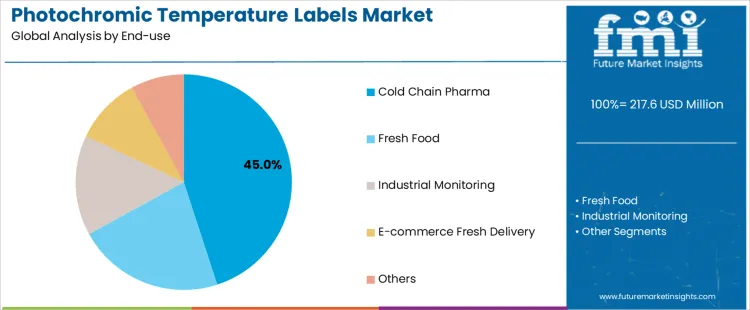
Cold chain pharma represents 45% of demand because pharmaceutical products such as vaccines, biologics, and injectable therapies rely on strict temperature ranges to preserve stability. Consumption intensity remains high across manufacturing release, distribution hubs, hospital pharmacies, and clinical storage areas. Usage stays consistent as photochromic labels enable frontline staff to visually verify thermal exposure during receipt and handling. Procurement decisions focus on labels calibrated to narrow temperature thresholds relevant to refrigerated and frozen drugs. Buyers favor indicators that maintain clarity under condensation and variable humidity. Price sensitivity remains moderate since labels mitigate batch rejection and compliance risk. Specification control emphasizes activation accuracy, color permanence after trigger, and storage stability prior to use. Demand continues through 2036 as cold-chain-dependent therapies expand and quality oversight across pharmaceutical logistics becomes more stringent.
Why do smart temperature labels account for 48% of demand in the photochromic temperature labels market by packaging format from 2026 to 2036?
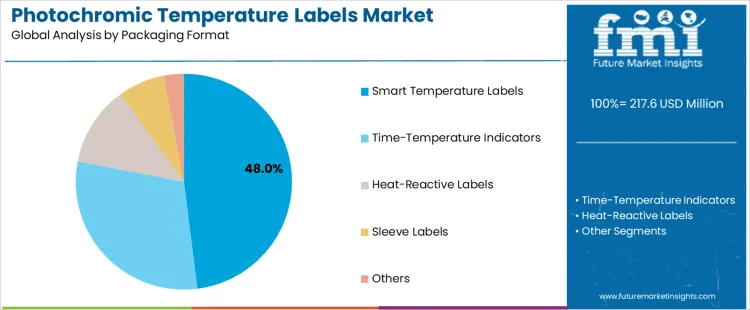
Smart temperature labels account for 48% of demand because they deliver clear visual alerts within a thin, flexible format suitable for high-volume packaging operations. Consumption is strong where labels must integrate into automated application lines without altering pack design. Usage remains steady as these labels respond reliably to defined thermal events without requiring batteries or scanning devices. Procurement favors formats that adhere securely to paperboard, plastic, and insulated packaging surfaces. Buyers prioritize color contrast that remains visible under varied lighting conditions. Price sensitivity stays moderate since smart labels provide condition assurance at a lower cost than electronic loggers. Specification control centers on adhesive durability, activation consistency, and resistance to abrasion. Demand persists from 2026 to 2036 as supply chains standardize visual temperature indicators for scalable, non-intrusive monitoring across pharma, food, and express delivery segments.
How Are Photochromic Temperature Labels Being Integrated Into Handling and Quality Control Processes?
Use is evident in workflows where rapid visual confirmation of temperature exposure supports routine checks. Cold chain operators apply labels on outer packaging to assist staff during manual inspections at transfer points. Food service distributors place them on crates to identify temperature stress before storage. Clinical trial teams use labels on sample kits to verify handling conditions during site transport. Catering suppliers attach them to insulated containers for short duration delivery routes. These applications reflect reliance on immediate visual cues embedded into handling steps rather than continuous digital monitoring systems.
What Operational Requirements Are Supporting Use of Photochromic Temperature Labels? Adoption aligns with needs for simple, passive indicators that fit existing packaging without added infrastructure. Logistics teams favor labels that provide instant feedback during unloading. Quality teams use them to support go no go decisions without opening cartons. High volume shippers rely on low cost labels where electronic loggers are not feasible. Training requirements remain minimal since color change interpretation is straightforward. These requirements stem from operational efficiency, cost control, and ease of integration within manual inspection routines.
Which Factors Shape Practical Limits on Broader Use of Photochromic Temperature Labels? Interpretation depends on lighting and user familiarity with color thresholds. Labels typically show exposure events rather than cumulative temperature duration. One time activation limits reuse in returnable packaging systems. Long storage before use can affect responsiveness. Some applications require documented data rather than visual confirmation. Disposal considerations also arise when labels contain specialty coatings. These factors result in selective use where simple indication is sufficient and detailed traceability is not required.
What is the Demand for Photochromic Temperature Labels by Country?
| Country | CAGR (%) |
|---|---|
| USA | 9.5% |
| Japan | 6.0% |
| Germany | 7.2% |
| China | 11.0% |
| India | 11.8% |
| Brazil | 7.3% |
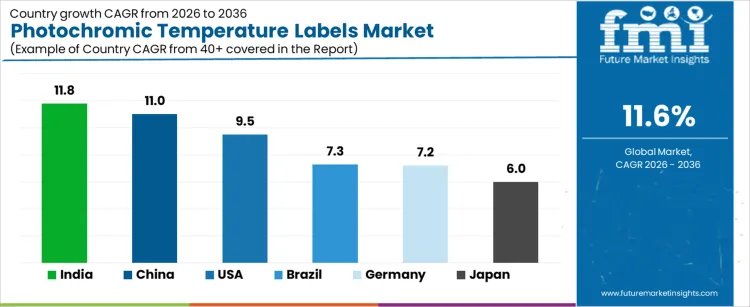
The demand for photochromic temperature labels differs across countries based on cold chain monitoring needs, regulatory oversight, and packaged goods distribution. India leads with an 11.8% CAGR, supported by expanding pharmaceutical logistics and food distribution requiring visual temperature indicators. China follows at 11.0%, driven by large scale vaccine transport, perishable food exports, and adoption of smart labeling in supply chains. The USA grows at 9.5%, reflecting use across healthcare, diagnostics, and refrigerated food packaging. Brazil records 7.3%, shaped by cold chain expansion in food and healthcare. Germany posts 7.2%, supported by structured logistics standards, while Japan grows at 6.0%, reflecting mature monitoring systems and stable demand.
How Is Cold Chain Monitoring Demand Driving Adoption in the United States?
In the United States, revenue from the Photochromic Temperature Labels Market is expanding at a CAGR of 9.5% through 2035, driven by rising demand for visual temperature monitoring across food, pharmaceutical, and medical logistics. Distributors and manufacturers are using photochromic labels to indicate temperature exposure during storage and transport without electronic systems. Demand is concentrated in vaccines, biologics, and perishable food shipments requiring clear compliance indicators. Domestic label converters supply standardized formats compatible with existing packaging lines. Regulatory oversight and growing emphasis on shipment integrity are sustaining consistent procurement across cold chain operators nationwide.
- Pharmaceutical cold chain requirements support label adoption.
- Visual temperature indication improves handling compliance.
- Domestic converters ensure scalable label supply.
- Logistics monitoring needs sustain recurring demand.
How Does Precision Handling Support Market Stability in Japan?
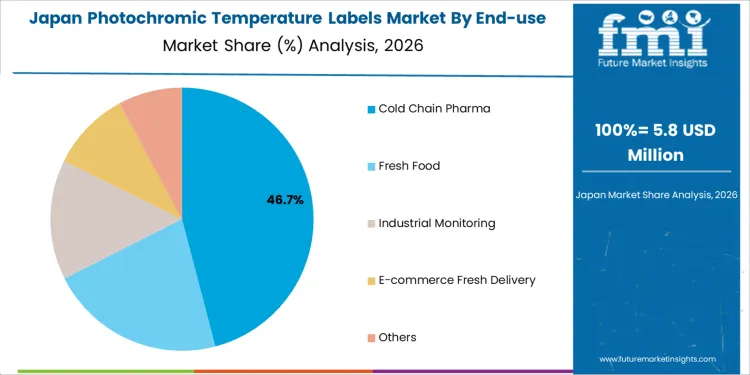
Japan is maintaining steady growth in the Photochromic Temperature Labels Market at a CAGR of 6% through 2035, supported by precision focused logistics and strict quality control practices. Manufacturers apply photochromic labels to monitor temperature exposure in food, medical, and specialty chemical shipments. Demand remains concentrated in pharmaceutical distribution and high value food products. Domestic suppliers emphasize accuracy and consistency in color change performance. Stable shipment volumes and replacement driven usage are sustaining predictable procurement across established logistics and distribution networks nationwide.
- Precision handling standards support selective adoption.
- Pharmaceutical logistics anchor baseline demand.
- Domestic suppliers ensure performance consistency.
- Replacement cycles sustain procurement stability.
How Are Regulated Supply Chains Supporting Growth in Germany?
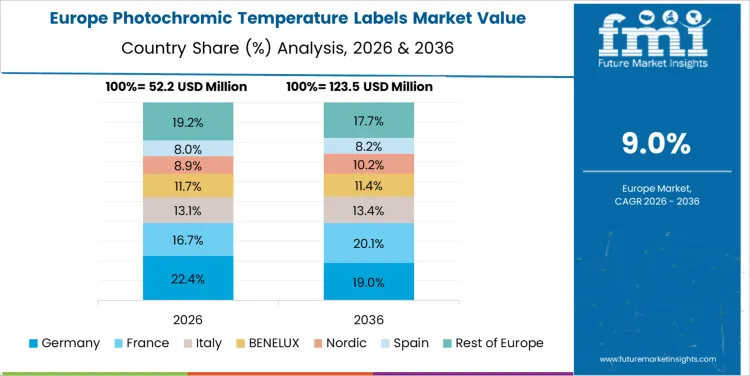
Germany continues to record expansion in the Photochromic Temperature Labels Market at a CAGR of 7.2% through 2035, supported by regulated supply chains and strong compliance requirements. Food processors and pharmaceutical distributors use photochromic labels to verify temperature conditions during transit and storage. Demand is centered on refrigerated foods, biologics, and specialty chemicals. Technical expertise in label manufacturing supports reliable color response and material durability. Stable industrial output and structured procurement practices are sustaining measured adoption across domestic supply networks nationwide.
- Compliance driven logistics support label usage.
- Refrigerated food distribution drives demand.
- Technical manufacturing expertise ensures reliability.
- Structured procurement sustains adoption consistency.
How Is Expanding Cold Chain Infrastructure Accelerating Growth in China?
In China, revenue from the Photochromic Temperature Labels Market is growing at a CAGR of 11% through 2035, driven by expansion of cold chain infrastructure and rising distribution of temperature sensitive goods. Food producers and pharmaceutical companies are adopting photochromic labels to improve shipment visibility across complex logistics networks. Demand is strong across vaccines, fresh foods, and imported perishables. Domestic manufacturers are scaling production to supply high volume requirements. Rapid logistics development and increasing regulatory oversight are sustaining fast paced adoption nationwide.
- Cold chain expansion drives label demand.
- Temperature sensitive goods support usage growth.
- Domestic production scaling improves availability.
- Regulatory attention sustains procurement momentum.
How Is Pharmaceutical Distribution Expansion Driving Demand in India?
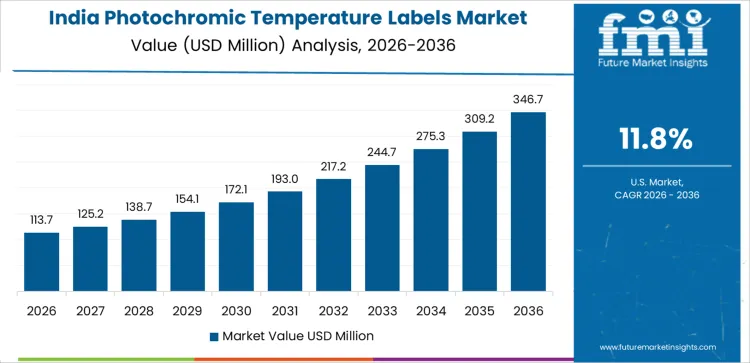
India is witnessing strong growth in the Photochromic Temperature Labels Market at a CAGR of 11.8% through 2035, supported by expansion of pharmaceutical manufacturing and distribution networks. Companies are using photochromic labels to monitor temperature exposure during storage and last mile delivery. Demand is rising across vaccines, injectable medicines, and biologics. Domestic label suppliers offer cost aligned solutions suitable for high volume shipments. Growth in healthcare logistics and export oriented pharmaceutical supply chains is sustaining robust adoption nationwide.
- Pharmaceutical distribution growth supports label adoption.
- Vaccine logistics drive temperature monitoring needs.
- Domestic suppliers improve cost accessibility.
- Export supply chains sustain demand growth.
How Are Perishable Goods Shipments Supporting Adoption in Brazil?
Brazil is seeing steady growth in the Photochromic Temperature Labels Market at a CAGR of 7.3% through 2035, supported by rising shipment of perishable food and temperature sensitive products. Distributors are using photochromic labels to indicate exposure risks during regional transport. Demand is concentrated in fresh foods, dairy products, and healthcare shipments. Imports supply some advanced label materials, while local converters expand basic production capacity. Growth in organized distribution and cold storage facilities is sustaining recurring procurement across logistics operators nationwide.
- Perishable food transport supports label usage.
- Exposure monitoring improves shipment handling.
- Imports supply advanced label materials.
- Cold storage expansion sustains procurement activity.
What Is Driving the Demand for Photochromic Temperature Labels and Which Companies Shape Smart Packaging Adoption?
Photochromic temperature labels are gaining use as manufacturers seek simple visual indicators that signal temperature exposure without electronics or power sources. Food and beverage producers apply these labels to monitor cold chain integrity for chilled and frozen products during transport and retail display. Pharmaceutical and clinical supply chains use them for quick visual checks on storage compliance in secondary packaging. Avery Dennison supports adoption through pressure sensitive label constructions that integrate photochromic inks into scalable formats. Toppan contributes through printed functional labels used in consumer packaging and healthcare logistics. Schreiner Group participates through high precision labels designed for regulated environments that require consistent color change behavior. These suppliers align label performance with packaging line speeds and traceability needs.
Label selection is governed by activation temperature range, color change clarity, reversibility, and stability under light exposure. Smartrac supports demand through inlay and smart label integration where temperature indication complements tracking functions. UFlex contributes through cost efficient printed label solutions used in large volume food packaging. Brady Corp supports industrial and laboratory applications where visual temperature alerts aid handling and storage compliance. Brand owners value labels that provide instant interpretation without training. Usage spans dairy, seafood, vaccines, biologics, and specialty chemicals. Demand visibility tracks expansion of cold chain distribution, regulatory scrutiny on temperature excursions, and wider adoption of low cost visual monitoring tools across logistics and quality assurance workflows.
Key Players in the Photochromic Temperature Labels Market
- Avery Dennison
- Toppan
- Schreiner Group
- Smartrac
- UFlex
- Brady Corp
Scope of the Report
| Items | Values |
|---|---|
| Quantitative Units (2026) | USD million |
| End Use | Cold Chain Pharma; Fresh Food; Industrial Monitoring; E-commerce Fresh Delivery; Other End Uses |
| Packaging Format | Smart Temperature Labels; Time Temperature Indicators; Heat Reactive Labels; Sleeve Labels; Other Formats |
| Material | PET with Dye Layer; Polymeric Films; PVC Free Films; Synthetic Paper; Other Materials |
| Technology | Photochromic Ink Activation; Micro Capsule Printing; Digital Smart Labeling; UV Sensitive Layering; Other Technologies |
| Regions Covered | Asia Pacific; Europe; North America; Latin America; Middle East and Africa |
| Countries Covered | China; Japan; South Korea; India; Australia and New Zealand; ASEAN; Germany; United Kingdom; France; Italy; Spain; Nordic; BENELUX; United States; Canada; Mexico; Brazil; Chile; Kingdom of Saudi Arabia; Turkey; South Africa; plus additional countries across Asia Pacific, Europe, Latin America, and Middle East and Africa |
| Key Companies Profiled | Avery Dennison; Toppan; Schreiner Group; Smartrac; UFlex; Brady Corp |
| Additional Attributes | Dollar by sales across end use segments and packaging formats; role of visual temperature indication in cold chain pharmaceutical compliance and fresh food quality assurance; importance of color change accuracy and activation threshold consistency in photochromic labels; integration of temperature labels into automated packaging and labeling lines; use of photochromic indicators as passive alternatives to electronic data loggers; influence of regulatory inspection practices on repeat procurement of temperature labels; impact of material stability under light, humidity, and handling stress on label performance; adoption of photochromic temperature labels in last mile delivery and decentralized storage environments |
Photochromic Temperature Labels Market Segmentation
End-use
- Cold Chain Pharma
- Fresh Food
- Industrial Monitoring
- E-commerce Fresh Delivery
- Others
Packaging Format
- Smart Temperature Labels
- Time-Temperature Indicators
- Heat-Reactive Labels
- Sleeve Labels
- Others
Material
- PET + Dye Layer
- Polymeric Films
- PVC-Free Films
- Synthetic Paper
- Others
Technology
- Photochromic Ink Activation
- Micro-capsule Printing
- Digital Smart Labeling
- UV-sensitive Layering
- Others
Region
- Asia Pacific
- China
- Japan
- South Korea
- India
- Australia & New Zealand
- ASEAN
- Rest of Asia Pacific
- Europe
- Germany
- United Kingdom
- France
- Italy
- Spain
- Nordic
- BENELUX
- Rest of Europe
- North America
- United States
- Canada
- Mexico
- Latin America
- Brazil
- Chile
- Rest of Latin America
- Middle East & Africa
- Kingdom of Saudi Arabia
- Other GCC Countries
- Turkey
- South Africa
- Other African Union
- Rest of Middle East & Africa
Bibliography
- International Organization for Standardization. (2023). Time temperature indicators and smart label performance standards. ISO Standards Publications.
- ASTM International. (2023). Test methods for temperature indicating labels and color change materials. ASTM Standards Publications.
- International Air Transport Association. (2023). Temperature monitoring and labelling requirements for sensitive goods. IATA Technical Guidance.
- European Commission. (2023). Cold chain monitoring and intelligent labelling requirements for food and pharmaceutical logistics. European Commission Technical Documents.
Frequently Asked Questions
How big is the photochromic temperature labels market in 2026?
The global photochromic temperature labels market is estimated to be valued at USD 217.6 million in 2026.
What will be the size of photochromic temperature labels market in 2036?
The market size for the photochromic temperature labels market is projected to reach USD 652.9 million by 2036.
How much will be the photochromic temperature labels market growth between 2026 and 2036?
The photochromic temperature labels market is expected to grow at a 11.6% CAGR between 2026 and 2036.
What are the key product types in the photochromic temperature labels market?
The key product types in photochromic temperature labels market are cold chain pharma, fresh food, industrial monitoring, e-commerce fresh delivery and others.
Which packaging format segment to contribute significant share in the photochromic temperature labels market in 2026?
In terms of packaging format, smart temperature labels segment to command 48.0% share in the photochromic temperature labels market in 2026.
Preview the report firsthand - request a free sample
Get SampleGet the brochure for pricing and purchase details.
Get PDFTable of Content
- Executive Summary
- Global Market Outlook
- Demand-side Trends
- Supply-side Trends
- Technology Roadmap Analysis
- Analysis and Recommendations
- Market Overview
- Market Coverage / Taxonomy
- Market Definition / Scope / Limitations
- Market Background
- Market Dynamics
- Drivers
- Restraints
- Opportunity
- Trends
- Scenario Forecast
- Demand in Optimistic Scenario
- Demand in Likely Scenario
- Demand in Conservative Scenario
- Opportunity Map Analysis
- Product Life Cycle Analysis
- Supply Chain Analysis
- Investment Feasibility Matrix
- Value Chain Analysis
- PESTLE and Porter’s Analysis
- Regulatory Landscape
- Regional Parent Market Outlook
- Production and Consumption Statistics
- Import and Export Statistics
- Market Dynamics
- Global Market Analysis 2021 to 2025 and Forecast, 2026 to 2036
- Historical Market Size Value (USD Million) Analysis, 2021 to 2025
- Current and Future Market Size Value (USD Million) Projections, 2026 to 2036
- Y-o-Y Growth Trend Analysis
- Absolute $ Opportunity Analysis
- Global Market Pricing Analysis 2021 to 2025 and Forecast 2026 to 2036
- Global Market Analysis 2021 to 2025 and Forecast 2026 to 2036, By End-use
- Introduction / Key Findings
- Historical Market Size Value (USD Million) Analysis By End-use , 2021 to 2025
- Current and Future Market Size Value (USD Million) Analysis and Forecast By End-use , 2026 to 2036
- Cold Chain Pharma
- Fresh Food
- Industrial Monitoring
- E-commerce Fresh Delivery
- Others
- Y-o-Y Growth Trend Analysis By End-use , 2021 to 2025
- Absolute $ Opportunity Analysis By End-use , 2026 to 2036
- Global Market Analysis 2021 to 2025 and Forecast 2026 to 2036, By Packaging Format
- Introduction / Key Findings
- Historical Market Size Value (USD Million) Analysis By Packaging Format, 2021 to 2025
- Current and Future Market Size Value (USD Million) Analysis and Forecast By Packaging Format, 2026 to 2036
- Smart Temperature Labels
- Time-Temperature Indicators
- Heat-Reactive Labels
- Sleeve Labels
- Others
- Y-o-Y Growth Trend Analysis By Packaging Format, 2021 to 2025
- Absolute $ Opportunity Analysis By Packaging Format, 2026 to 2036
- Global Market Analysis 2021 to 2025 and Forecast 2026 to 2036, By Material
- Introduction / Key Findings
- Historical Market Size Value (USD Million) Analysis By Material, 2021 to 2025
- Current and Future Market Size Value (USD Million) Analysis and Forecast By Material, 2026 to 2036
- PET + Dye Layer
- Polymeric Films
- PVC-Free Films
- Synthetic Paper
- Others
- Y-o-Y Growth Trend Analysis By Material, 2021 to 2025
- Absolute $ Opportunity Analysis By Material, 2026 to 2036
- Global Market Analysis 2021 to 2025 and Forecast 2026 to 2036, By Technology
- Introduction / Key Findings
- Historical Market Size Value (USD Million) Analysis By Technology, 2021 to 2025
- Current and Future Market Size Value (USD Million) Analysis and Forecast By Technology, 2026 to 2036
- Photochromic Ink Activation
- Micro-capsule Printing
- Digital Smart Labeling
- UV-sensitive Layering
- Others
- Y-o-Y Growth Trend Analysis By Technology, 2021 to 2025
- Absolute $ Opportunity Analysis By Technology, 2026 to 2036
- Global Market Analysis 2021 to 2025 and Forecast 2026 to 2036, By Region
- Introduction
- Historical Market Size Value (USD Million) Analysis By Region, 2021 to 2025
- Current Market Size Value (USD Million) Analysis and Forecast By Region, 2026 to 2036
- North America
- Latin America
- Western Europe
- Eastern Europe
- East Asia
- South Asia and Pacific
- Middle East & Africa
- Market Attractiveness Analysis By Region
- North America Market Analysis 2021 to 2025 and Forecast 2026 to 2036, By Country
- Historical Market Size Value (USD Million) Trend Analysis By Market Taxonomy, 2021 to 2025
- Market Size Value (USD Million) Forecast By Market Taxonomy, 2026 to 2036
- By Country
- USA
- Canada
- Mexico
- By End-use
- By Packaging Format
- By Material
- By Technology
- By Country
- Market Attractiveness Analysis
- By Country
- By End-use
- By Packaging Format
- By Material
- By Technology
- Key Takeaways
- Latin America Market Analysis 2021 to 2025 and Forecast 2026 to 2036, By Country
- Historical Market Size Value (USD Million) Trend Analysis By Market Taxonomy, 2021 to 2025
- Market Size Value (USD Million) Forecast By Market Taxonomy, 2026 to 2036
- By Country
- Brazil
- Chile
- Rest of Latin America
- By End-use
- By Packaging Format
- By Material
- By Technology
- By Country
- Market Attractiveness Analysis
- By Country
- By End-use
- By Packaging Format
- By Material
- By Technology
- Key Takeaways
- Western Europe Market Analysis 2021 to 2025 and Forecast 2026 to 2036, By Country
- Historical Market Size Value (USD Million) Trend Analysis By Market Taxonomy, 2021 to 2025
- Market Size Value (USD Million) Forecast By Market Taxonomy, 2026 to 2036
- By Country
- Germany
- UK
- Italy
- Spain
- France
- Nordic
- BENELUX
- Rest of Western Europe
- By End-use
- By Packaging Format
- By Material
- By Technology
- By Country
- Market Attractiveness Analysis
- By Country
- By End-use
- By Packaging Format
- By Material
- By Technology
- Key Takeaways
- Eastern Europe Market Analysis 2021 to 2025 and Forecast 2026 to 2036, By Country
- Historical Market Size Value (USD Million) Trend Analysis By Market Taxonomy, 2021 to 2025
- Market Size Value (USD Million) Forecast By Market Taxonomy, 2026 to 2036
- By Country
- Russia
- Poland
- Hungary
- Balkan & Baltic
- Rest of Eastern Europe
- By End-use
- By Packaging Format
- By Material
- By Technology
- By Country
- Market Attractiveness Analysis
- By Country
- By End-use
- By Packaging Format
- By Material
- By Technology
- Key Takeaways
- East Asia Market Analysis 2021 to 2025 and Forecast 2026 to 2036, By Country
- Historical Market Size Value (USD Million) Trend Analysis By Market Taxonomy, 2021 to 2025
- Market Size Value (USD Million) Forecast By Market Taxonomy, 2026 to 2036
- By Country
- China
- Japan
- South Korea
- By End-use
- By Packaging Format
- By Material
- By Technology
- By Country
- Market Attractiveness Analysis
- By Country
- By End-use
- By Packaging Format
- By Material
- By Technology
- Key Takeaways
- South Asia and Pacific Market Analysis 2021 to 2025 and Forecast 2026 to 2036, By Country
- Historical Market Size Value (USD Million) Trend Analysis By Market Taxonomy, 2021 to 2025
- Market Size Value (USD Million) Forecast By Market Taxonomy, 2026 to 2036
- By Country
- India
- ASEAN
- Australia & New Zealand
- Rest of South Asia and Pacific
- By End-use
- By Packaging Format
- By Material
- By Technology
- By Country
- Market Attractiveness Analysis
- By Country
- By End-use
- By Packaging Format
- By Material
- By Technology
- Key Takeaways
- Middle East & Africa Market Analysis 2021 to 2025 and Forecast 2026 to 2036, By Country
- Historical Market Size Value (USD Million) Trend Analysis By Market Taxonomy, 2021 to 2025
- Market Size Value (USD Million) Forecast By Market Taxonomy, 2026 to 2036
- By Country
- Kingdom of Saudi Arabia
- Other GCC Countries
- Turkiye
- South Africa
- Other African Union
- Rest of Middle East & Africa
- By End-use
- By Packaging Format
- By Material
- By Technology
- By Country
- Market Attractiveness Analysis
- By Country
- By End-use
- By Packaging Format
- By Material
- By Technology
- Key Takeaways
- Key Countries Market Analysis
- USA
- Pricing Analysis
- Market Share Analysis, 2025
- By End-use
- By Packaging Format
- By Material
- By Technology
- Canada
- Pricing Analysis
- Market Share Analysis, 2025
- By End-use
- By Packaging Format
- By Material
- By Technology
- Mexico
- Pricing Analysis
- Market Share Analysis, 2025
- By End-use
- By Packaging Format
- By Material
- By Technology
- Brazil
- Pricing Analysis
- Market Share Analysis, 2025
- By End-use
- By Packaging Format
- By Material
- By Technology
- Chile
- Pricing Analysis
- Market Share Analysis, 2025
- By End-use
- By Packaging Format
- By Material
- By Technology
- Germany
- Pricing Analysis
- Market Share Analysis, 2025
- By End-use
- By Packaging Format
- By Material
- By Technology
- UK
- Pricing Analysis
- Market Share Analysis, 2025
- By End-use
- By Packaging Format
- By Material
- By Technology
- Italy
- Pricing Analysis
- Market Share Analysis, 2025
- By End-use
- By Packaging Format
- By Material
- By Technology
- Spain
- Pricing Analysis
- Market Share Analysis, 2025
- By End-use
- By Packaging Format
- By Material
- By Technology
- France
- Pricing Analysis
- Market Share Analysis, 2025
- By End-use
- By Packaging Format
- By Material
- By Technology
- India
- Pricing Analysis
- Market Share Analysis, 2025
- By End-use
- By Packaging Format
- By Material
- By Technology
- ASEAN
- Pricing Analysis
- Market Share Analysis, 2025
- By End-use
- By Packaging Format
- By Material
- By Technology
- Australia & New Zealand
- Pricing Analysis
- Market Share Analysis, 2025
- By End-use
- By Packaging Format
- By Material
- By Technology
- China
- Pricing Analysis
- Market Share Analysis, 2025
- By End-use
- By Packaging Format
- By Material
- By Technology
- Japan
- Pricing Analysis
- Market Share Analysis, 2025
- By End-use
- By Packaging Format
- By Material
- By Technology
- South Korea
- Pricing Analysis
- Market Share Analysis, 2025
- By End-use
- By Packaging Format
- By Material
- By Technology
- Russia
- Pricing Analysis
- Market Share Analysis, 2025
- By End-use
- By Packaging Format
- By Material
- By Technology
- Poland
- Pricing Analysis
- Market Share Analysis, 2025
- By End-use
- By Packaging Format
- By Material
- By Technology
- Hungary
- Pricing Analysis
- Market Share Analysis, 2025
- By End-use
- By Packaging Format
- By Material
- By Technology
- Kingdom of Saudi Arabia
- Pricing Analysis
- Market Share Analysis, 2025
- By End-use
- By Packaging Format
- By Material
- By Technology
- Turkiye
- Pricing Analysis
- Market Share Analysis, 2025
- By End-use
- By Packaging Format
- By Material
- By Technology
- South Africa
- Pricing Analysis
- Market Share Analysis, 2025
- By End-use
- By Packaging Format
- By Material
- By Technology
- USA
- Market Structure Analysis
- Competition Dashboard
- Competition Benchmarking
- Market Share Analysis of Top Players
- By Regional
- By End-use
- By Packaging Format
- By Material
- By Technology
- Competition Analysis
- Competition Deep Dive
- Toppan
- Overview
- Product Portfolio
- Profitability by Market Segments (Product/Age /Sales Channel/Region)
- Sales Footprint
- Strategy Overview
- Marketing Strategy
- Product Strategy
- Channel Strategy
- Schreiner Group
- Smartrac
- UFlex
- Brady Corp
- Toppan
- Competition Deep Dive
- Assumptions & Acronyms Used
- Research Methodology


