

- Market Size (2026)
- USD 733.5 Mn
- Forecast (2036)
- USD 1902.5 Mn
- CAGR (2026 to 2036)
- 10.0%
How big is Pita Bread Market in 2026?
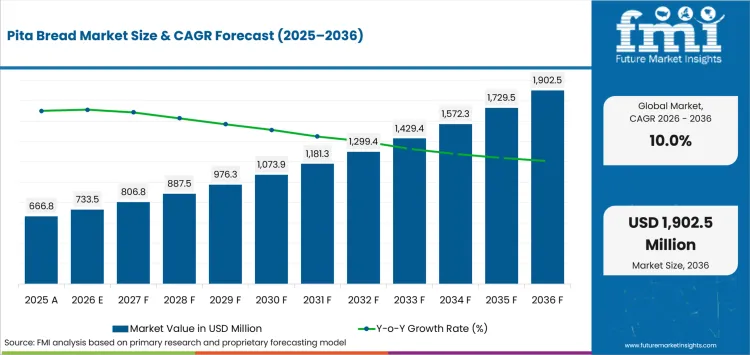
USD 733.5 million in 2026 and USD 1902.5 million by 2036 at a 10.0% CAGR.
Demand for pita bread is projected to expand at 10.0% CAGR between 2026 and 2036, increasing valuation from USD 733.5 million in 2026 to USD 1902.5 million by 2036. Restaurants purchase pita as a pocket bread or meal accompaniment without changing basic kitchen equipment. The National Restaurant Association projected USA restaurant and foodservice sales at USD 1.5 trillion in 2025. That commercial scale keeps bread purchasing substantial, provided pita meets case-level requirements for softness and pocket integrity.
Country conversion differs because outlet formation changes replenishment density and shelf-life requirements. Dubai Municipality said on July 30 2025 that about 2,336 new food establishments opened during the first half of 2025. A wider outlet base raises potential order frequency for pita, but bakeries still need pack sizes and delivery schedules that preserve softness between drops.
Key Takeaways
- Foodservice operators and households use pita for filled meals plus plated bread and dipping occasions, which broadens repeat purchase occasions.
- Based on product type, classic - original pita is projected to account for 37.0% in 2026 due to broad menu compatibility.
- By claim - nature, conventional pita is estimated to hold 61.0% in 2026 owing to mainstream price points and familiar sensory performance.
- In 2026, fresh pita is expected to lead format with 29.0% share because immediate pliability suits frequent-turn outlets.
- Short selling windows reduce realized margin because softness loss raises markdowns and foodservice waste before the next replenishment cycle.
- Some of the key players in this market include GRUMA, S.A.B. de C.V., Mission Foods, Olé Mexican Foods, Inc., Toufayan Bakeries, Kontos Foods, Inc., FGF Brands, Signature Flatbreads, Angel Bakeries, Grupo Bimbo, S.A.B. de C.V., and Europastry, S.A.
Analyst Perspective
"Pita margins depend on how long the bread keeps pocket strength through baking plus transport and opening at the account. Stronger offers match pack count and storage route to actual turnover so restaurants and retailers discard fewer usable pieces."
- Nandini Roy Choudhury, Principal Consultant, Future Market Insights
How is the pita bread market segmented?
The pita bread market is segmented by product type, claim - nature, format, packaging format and sales channel.
Product type covers classic - original, whole grain & seeded, flavored & filled, mini & snacking formats and premium - artisan pita. Claim - nature covers conventional, clean label, organic, gluten-free and high-protein - fortified products. Format covers fresh, frozen, ambient packaged, chilled and par-baked - thaw-and-serve bread. Packaging format covers multipack, single-serve, family - loaf pack and bulk foodservice. Sales channels cover supermarkets & hypermarkets, artisan & specialty bakeries, convenience & forecourt, online & DTC and foodservice distributors.
Why does conventional lead the claim - nature category?
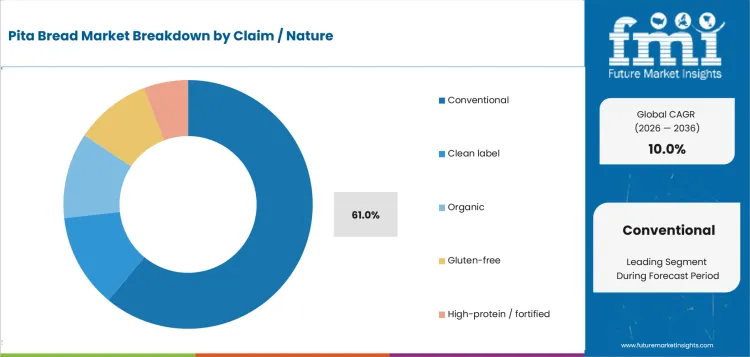
Conventional formulations let industrial bakers balance softness and pocket strength without qualifying a specialized nutrition claim. In February 2025 the FDA postponed the updated healthy claim rule to April 28, keeping claim use tied to defined nutrient criteria for packaged bread labeling.
- By claim - nature, conventional pita is estimated to hold 61.0% in 2026 owing to mainstream price points and familiar sensory performance.
- Gluten-free formulations can widen choice for specific diets, but separate ingredient controls and validation steps keep those products narrower than conventional lines in routine bakery production.
Why does classic - original lead the product type category?
Classic - original pita gives restaurants and households a neutral bread carrier that accepts savory fillings without changing the meal brief. In March 2025 Toufayan Bakeries documented USA production in New Jersey and Florida for pita sold to retailers plus foodservice accounts through domestic wholesale distribution.
- Based on product type, classic - original pita is projected to account for 37.0% in 2026 due to broad menu compatibility.
- Domestic production shortens replenishment for bakery product formats serving high-turn accounts, while flavored variants need tighter ingredient planning and slower assortment rotation.
Why does fresh lead the format category?
Fresh pita performs best near the baking point because pliability declines as storage time lengthens. Stores can protect that advantage with frequent replenishment or disciplined chilled handling. The USA Bureau of Labor Statistics recorded a 3.6% increase in prices for fresh biscuits plus rolls and muffins during 2025.
- In 2026, fresh pita is expected to lead format with 29.0% share because immediate softness supports frequent-turn restaurant and bakery service.
- Longer distribution routes make frozen bakery channels more practical because controlled thawing can preserve usable texture without requiring daily local baking at every account.
Why does multipack lead the packaging format category?
Multipacks give households enough pita for several meals without forcing the case quantities used by professional kitchens. The format also gives retailers one price point without requiring shoppers to buy foodservice quantities. FDA allergen guidance issued in January 2025 addressed labeling for individual units inside multiunit packages.
- By packaging format, multipack is forecast to represent 30.0% in 2026 driven by household frequency and manageable unit counts.
- Packaged food channels reward packs that balance storage convenience with clear unit information, while oversized counts can increase household waste before the next purchase.
Why do supermarkets & hypermarkets lead the sales channel category?
Supermarkets can place classic and claim-led pita in one trip while separating fresh or packaged formats by shelf condition. Channel breadth lets brands test variant depth without relying on specialist bakeries or direct ordering. USDA ERS found grocery stores accounted for 56.2% of USA food-at-home sales in 2025.
- Supermarkets & hypermarkets are set to lead the sales channel with 31.0% share in 2026 due to routine household traffic.
- Bakery ingredients and flour improvers can extend assortment options, but each listing still needs enough turnover to protect texture and shelf economics after opening.
What are the drivers, restraints and opportunities in the Pita Bread Market?
Foodservice purchasing increases order frequency while bakery-price pressure tightens margins because pack sizing and shelf-life control determine how much pita sells before staling.
- Driver: Restaurants can use pita as a filled carrier or plated bread from one case specification, increasing repeat ordering without dedicated equipment.
- Restraint: Short usable life magnifies bakery-cost pressure because wasted units raise the effective cost of every successful sale.
- Opportunity: Pack sizes and storage formats matched to outlet turnover reduce unsold pita and protect realized margin without changing the core meal proposition.
Foodservice scale raises repeat order frequency
Restaurants purchase pita repeatedly because one bread format can serve filled meals or plated service without dedicated equipment. USDA ERS reported in 2026 that USA food-away-from-home spending reached USD 1.41 trillion in 2025. Commercial scale makes frequent bread replenishment meaningful, provided pita keeps pocket strength and portion yield during service.
Bakery inflation increases the cost of staling
Pita staling turns ingredient cost into a yield problem because unsold bread cannot recover its purchase price. USDA ERS found prices for cereal and bakery products increased 1.0% in 2025. Higher bakery costs raise the penalty for weak stock rotation, so short shelf life can reduce realized margin even where menu demand stays stable.
Pack sizing can reduce unsold bread
Pack sizing can improve realized margin before a bakery invests in more complex preservation. WRAP reported a 2025 self-reported waste rate of 18.8% for its four tracked foods and identified bread as the strongest improver. Formats that fit actual turnover reduce unsold units, while bread preservative options remain relevant for routes that need longer selling windows.
Which country CAGRs are profiled in the Pita Bread Market?
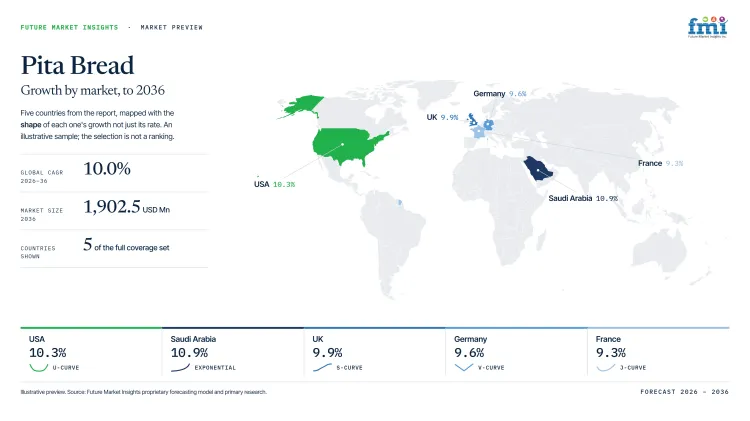
| Country | CAGR |
|---|---|
| UAE | 11.2% |
| Saudi Arabia | 10.9% |
| South Korea | 10.6% |
| USA | 10.3% |
| UK | 9.9% |
| Germany | 9.6% |
| France | 9.3% |
| Japan | 9.0% |
How do country-level CAGRs compare in the Pita Bread Market?
The 2.2-point range separates four markets above 10.0% from four mature markets below that threshold. UAE and Saudi Arabia lead on outlet formation plus visitor-led dining. South Korea and the USA follow through digital ordering or national grocery reach. Western European markets and Japan rely more on established distribution, so growth depends on winning share inside mature bread choices.
- Dubai food-establishment openings widen formal ordering points.
- Saudi halal requirements shape national account screening.
- Korean convenience retail rewards compact portable packs.
- USA club retail intensifies multipack price comparison.
- UK private-label bread sharpens shelf-price comparison.
- German bakery density raises the novelty threshold.
- French specialty bread culture raises differentiation costs.
- Japanese convenience formats favor compact serving counts.
Comparable CAGRs therefore do not imply comparable route economics or qualification burdens for manufacturers entering these eight countries.
The full report provides country-level CAGR analysis across North America, Latin America, Western Europe, Eastern Europe, East Asia, South Asia and Pacific, and the Middle East and Africa.
Country-wise Analysis
- Dubai hotel and restaurant menus turn quickly because international visitors keep Mediterranean and Middle Eastern meal formats visible. In January 2026 Dubai DET said the emirate received 19.59 million international overnight visitors in 2025, 5% above 2024. Pita bread sales in the UAE are forecast to expand at 11.2% CAGR by 2036, aided by tourism-led menu turnover. Compact urban service routes support frequent replenishment, but hot-weather handling narrows the time available to preserve softness after delivery. Brands with local stock rotation can protect texture without carrying excessive frozen inventory, which improves conversion in premium hotel and casual-dining accounts.
- Saudi restaurant capacity is widening and gives flatbread distributors more formal delivery points outside the largest city centers. In March 2026 GASTAT reported 5.4% year-over-year growth in wholesale and retail trade plus restaurants and hotels during Q4 2025. Pita bread demand in Saudi Arabia is predicted to advance at 10.9% CAGR through 2036, propelled by expanding dining capacity. Familiar regional meal use makes pita easy to list on menus, though long road routes and heat exposure can shorten usable softness. Distributors that keep replenishment close to outlet turnover gain an advantage because quality loss can appear before price differences become decisive.
- Dense delivery networks make package durability and portion consistency more important than shelf presence alone for handheld international meals. Statistics Korea documented 13.6% year-over-year growth in online food-service transaction value during October 2025. The South Korean pita bread sector is projected to record 10.6% CAGR during the assessment period, tied to delivery-heavy foodservice and wider international menus. Mobile ordering gives new pita formats an urban route, while imported bread loses quality if thaw control or last-mile handling slips. Nearby production or disciplined frozen baked goods distribution is more defensible for chains that cannot absorb inconsistent pocket strength at service.
- National grocers and foodservice distributors make the United States a dual-channel market for household multipacks and higher-count restaurant cases. USDA ERS stated in June 2026 that consumers spent 9.7% of disposable personal income on food during 2025. Pita bread demand in the USA is forecast to rise at 10.3% CAGR over the forecast period, attributable to broad retail reach and away-from-home meals. Extensive store coverage supports repeat listings, but long shipping distances raise the value of bakery improver systems that protect handling performance. Regional inventory lets manufacturers separate household pack economics from restaurant case requirements instead of forcing one specification through both channels.
- UK supermarkets already carry broad flatbread assortments, so pita must compete on turnover and shelf life instead of novelty. DEFRA reported on September 3 2026 that real expenditure on food and drink eaten out increased 2.3% in 2025. Pita bread sales in the UK are forecast to expand at 9.9% CAGR by 2036, reflecting mature grocery access and steady eating-out demand. Established distribution supports replenishment, although dense bread choice leaves little tolerance for stale packs or unclear differentiation. Bread improver systems can protect texture through ordinary store handling without asking retailers to carry unusually long stock cycles.
- German foodservice accounts operate in a mature bread market where case yield and predictable thaw performance carry more weight than novelty. Destatis found real hospitality turnover in March 2026 was 5.2% below March 2025, exposing pressure on operator economics. Adoption of pita bread in Germany is estimated to expand at 9.6% CAGR through 2036, helped by international menus and retail availability. Lower service turnover raises scrutiny of unsold units, while local production or shorter replenishment cycles reduce texture loss. Baking enzyme systems can improve line consistency, but new listings still depend on case economics that hold after distribution.
- French retailers can place pita beside many familiar breads, so the product needs a distinct meal role instead of simple bakery presence. Insee published in June 2026 that spending on restaurants and accommodation services during 2025 was more than 20% above 2019 levels. France is estimated to post 9.3% CAGR over the forecast period, driven by restaurant diversity and convenient packaged meal use. Foodservice breadth supports trial, but traditional bread habits raise the hurdle for repeat household purchase once novelty fades. Products that turn reliably before softness declines have a stronger grocery case than variants relying mainly on new flavor cues.
- Japanese retailers and foodservice operators place tight limits on portion variation plus pack presentation and texture inconsistency. The Statistics Bureau recorded a 0.9% real increase in household consumption expenditure during 2025. Pita bread demand in Japan is projected to expand at 9.0% CAGR between 2026 and 2036, because international meal formats are entering established routines. Careful specification control supports listings, but imported bread carries freight-time and stock-rotation risk before it reaches the shelf. Smaller packs plus conservative replenishment reduce waste for new entrants and make execution quality more important than oversized assortment breadth.
Who are the notable companies in the Pita Bread Market?
GRUMA, S.A.B. de C.V., Mission Foods, Olé Mexican Foods, Inc., Toufayan Bakeries, Kontos Foods, Inc., FGF Brands, Signature Flatbreads, Angel Bakeries, Grupo Bimbo, S.A.B. de C.V., and Europastry, S.A. are the notable companies serving this market.
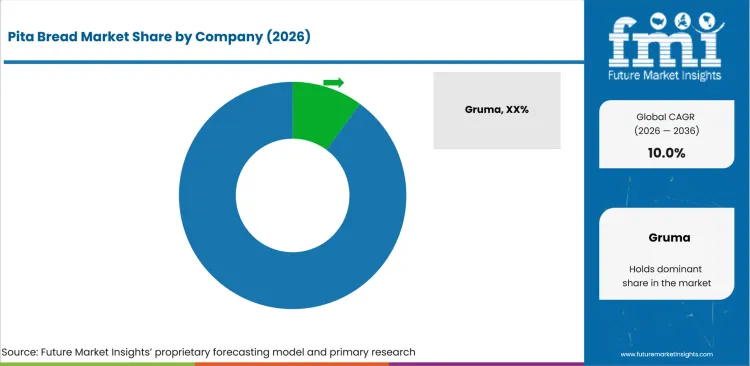
Competition is fragmented between dedicated pita bakeries and larger flatbread or bakery platforms. Entry barriers come from repeatable pocket formation plus shelf-life control and distribution density. Company size alone does not secure a listing if texture fails after transport or thawing.
- GRUMA, S.A.B. de C.V., Mission Foods and Olé Mexican Foods, Inc. bring scaled tortilla or carrier-bread platforms with established retail distribution.
- Toufayan Bakeries, Kontos Foods, Inc., Signature Flatbreads and Angel Bakeries compete more directly on pita depth plus foodservice fit.
- FGF Brands, Grupo Bimbo, S.A.B. de C.V. and Europastry, S.A. approach the category from wider bakery platforms with substantial production or channel infrastructure.
Competitive Benchmarking: Pita Bread Market
| Company | Pita / Flatbread Specialization | Retail & Foodservice Coverage | Manufacturing / Distribution Control | Geographic Reach |
|---|---|---|---|---|
| GRUMA, S.A.B. de C.V. | High | High | High | Global |
| Mission Foods | High | High | High | More than 50 countries |
| Olé Mexican Foods, Inc. | Low | Medium | Medium | United States |
| Toufayan Bakeries | High | High | Medium | United States nationwide |
| Kontos Foods, Inc. | High | High | Medium | United States with international customers |
| FGF Brands | Medium | High | High | North America with global clients |
| Signature Flatbreads | High | High | High | More than 70 countries |
| Angel Bakeries | High | High | Medium | North America and selected international foodservice |
| Grupo Bimbo, S.A.B. de C.V. | Medium | High | High | Global |
| Europastry, S.A. | Medium | High | High | More than 90 countries |
Scoring basis: High specialization requires documented pita plus several flatbread formats. Medium denotes a wider flatbread platform with limited pita emphasis and Low identifies an adjacent carrier-bread platform. High channel coverage requires documented retail and foodservice routes. Medium requires one primary route plus wholesale access and Low identifies one documented route. High manufacturing control requires multiple owned production sites plus broad distribution. Medium identifies regional owned production and Low identifies a narrower operating base. Geographic reach reflects verified commercial presence and not market share.
Key Developments in the Pita Bread Market
- In December 2025, Toufayan Bakeries introduced seed-oil-free wraps made with avocado oil and planned nationwide USA retail rollout during 2026, extending its carrier-bread portfolio beside pita.
- In April 2026, GRUMA, S.A.B. de C.V. filed its 2025 annual report with the Mexican stock exchange and documented pitta production within Mission Foods Europe’s six-plant flatbread network.
- In June 2025, Kontos Foods, Inc. received IFANCA halal certification covering Pocket-Less Pita plus PitaBunz and Flex-Pita products through September 2026, widening qualification for halal-screened accounts.
Key Players in the Pita Bread Market
Scaled Tortilla and Flatbread Platforms
- GRUMA, S.A.B. de C.V.
- Mission Foods
- Olé Mexican Foods, Inc.
Pita Specialists
- Toufayan Bakeries
- Kontos Foods, Inc.
Flatbread and Bakery Specialists
- FGF Brands
- Signature Flatbreads
- Angel Bakeries
Broad Bakery Platforms
- Grupo Bimbo, S.A.B. de C.V.
- Europastry, S.A.
Pita Bread Market - Report Scope
| Coverage field | Report scope |
|---|---|
| Market breakdown | By product type, claim - nature, format, packaging format, sales channel and region. |
| Quantitative Units | USD million. |
| Market Definition | Revenue from pita bread sold within the defined product, claim, format, packaging and sales-channel universe. Downstream finished-food revenue and substitute bread categories are excluded. |
| Regions Covered | North America, Latin America, Western Europe, Eastern Europe, East Asia, South Asia and Pacific, and Middle East and Africa. |
| Countries Covered | UAE, Saudi Arabia, South Korea, USA, UK, Germany, France, Japan and more than twenty-five additional countries in the full report. |
| Key Companies Profiled | GRUMA, S.A.B. de C.V., Mission Foods, Olé Mexican Foods, Inc., Toufayan Bakeries, Kontos Foods, Inc., FGF Brands, Signature Flatbreads, Angel Bakeries, Grupo Bimbo, S.A.B. de C.V., and Europastry, S.A. |
| Forecast Period | 2026 to 2036. |
| Approach | Primary and secondary research with market triangulation. |
Pita Bread Market - Research Methodology
| Method | Approach |
|---|---|
| Primary Research | FMI analysts gathered input from manufacturers, service providers, technology developers, distributors, end users, procurement teams, and subject-matter experts. Interviews examined purchasing decisions, product or service evaluation, adoption barriers, approval requirements, pricing considerations, and expectations for technical or commercial support. Respondents were also asked what evidence is required before a trial, pilot, or initial order develops into regular purchasing. |
| Desk Research | Desk research covered government statistics, regulatory publications, trade data, industry associations, technical literature, standards, company filings, product information, and official corporate announcements. Sources were reviewed for relevance, publication date, geographic coverage, and consistency with the defined market scope. Claims relating to performance, applications, approvals, capacity, investment, and commercial activity were retained only when supported by credible public evidence. |
| Market Sizing and Forecasting | The market model combined the baseline value with historical performance, segment structure, pricing and volume indicators, adoption levels, company participation, and country-level demand conditions. Forecast assumptions considered economic activity, investment trends, regulatory developments, technology adoption, purchasing cycles, supply availability, and barriers to wider market use. Segment and regional estimates were reconciled before the final market total was calculated. |
| Data Validation | Estimates were checked against multiple independent indicators, including public data, company activity, trade patterns, industry developments, and findings from primary interviews. Validation also tested whether products, services, applications, and company revenues fell within the defined market boundaries. Adjacent categories, unsupported claims, overlapping revenues, and activities without direct market relevance were excluded to reduce double counting and maintain consistency across segments and countries. |
Pita Bread Market by Segments
Pita Bread Market segmented by Product Type:
- Classic - original
- Whole grain & seeded
- Flavored & filled
- Mini & snacking formats
- Premium - artisan
Pita Bread Market segmented by Claim - Nature:
- Conventional
- Clean label
- Organic
- Gluten-free
- High-protein - fortified
Pita Bread Market segmented by Format:
- Fresh
- Frozen
- Ambient packaged
- Chilled
- Par-baked - thaw-and-serve
Pita Bread Market segmented by Packaging Format:
- Multipack
- Single-serve
- Family - loaf pack
- Bulk foodservice
Pita Bread Market segmented by Sales Channel:
- Supermarkets & hypermarkets
- Artisan & specialty bakeries
- Convenience & forecourt
- Online & DTC
- Foodservice distributors
Pita Bread Market by Region:
- North America
- United States
- Canada
- Latin America
- Brazil
- Mexico
- Argentina
- Chile
- Western Europe
- Germany
- France
- United Kingdom
- Italy
- Spain
- Benelux
- Nordics
- Eastern Europe
- Poland
- Czech Republic
- Romania
- Hungary
- East Asia
- China
- Japan
- South Korea
- South Asia and Pacific
- India
- ASEAN
- Australia and New Zealand
- Middle East and Africa
- GCC Countries
- South Africa
- Türkiye
- Israel
Research Sources and Bibliography
- National Restaurant Association. (2025, February 6). Restaurant Industry Poised for Growth in 2025: Industry Expected to Employ 15.9 Million People and Reach $1.5 Trillion in Sales.
- Dubai Municipality. (2025, July 30). Dubai Municipality Conducts Over 34,700 Food Inspections in First Half of 2025.
- Toufayan Bakeries. (2025, March 13). Looking for a USA-Based Wholesale Bakery? Meet Toufayan!
- USA Food and Drug Administration. (2025, February 24). FDA Finalizes Updated “Healthy” Nutrient Content Claim.
- USA Bureau of Labor Statistics. (2026, January 13). Consumer Price Index News Release - 2025 M12 Results.
- USA Food and Drug Administration. (2025, January). Guidance for Industry: Questions and Answers Regarding Food Allergen Labeling (Edition 5).
- USA Department of Agriculture, Economic Research Service. (2026, August 17). Retailing & Wholesaling - Retail Trends.
- WRAP. (2026, March 9). Understanding household food waste in the UK: the Household Food Management Survey 2025.
- Dubai Department of Economy and Tourism. (2026, January 7). Tourism Performance Report January - December 2025.
- General Authority for Statistics. (2026, March 9). GASTAT: Saudi economy records 4.5% growth in 2025.
- Statistics Korea. (2025, December 1).
- USA Department of Agriculture, Economic Research Service. (2026, June 1). USA consumers spent 9.7 percent of their disposable personal income on food in 2025.
- Department for Environment, Food & Rural Affairs. (2026, September 3). Chapter 14: The food chain.
- Statistisches Bundesamt. (2026, May 20). Gastgewerbeumsatz im März 2026 real 2,2 % niedriger als im Vormonat.
- Insee. (2026, June 16). Household Consumption in 2025.
- Statistics Bureau of Japan. (2026, February 6). Family Income and Expenditure Survey: 2025 Yearly Average.
- Toufayan Bakeries. (2025, December 17). Introducing Seed Oil-Free Wraps.
- Grupo Bimbo. (2025, September 17). GRUPO BIMBO Receives Regulatory Approval to Acquire Wickbold in Brazil.
- Islamic Food and Nutrition Council of America. (2025, June 17). Halal Product Certificate for Kontos Foods, Inc.
- GRUMA. (n.d.). Company Overview.
- GRUMA. (n.d.). Mission Foods Corporation.
- Olé Mexican Foods. (n.d.). From Our Family To Your Kitchen.
- Angel Bakeries. (n.d.). Wholesale.
- Europastry. (2025). Annual Report 2024.
- Grupo Bimbo. (2025, July 29). We are committed to removing artificial colorants from all our products by the end of 2026.
- Grupo Bimbo. (2026, May 5). Grupo Bimbo Announces Approximately US $1 Billion Investment in the United States Between 2026 and 2028.
- Bolsa Mexicana de Valores. (2026, April 29). Reporte Anual en formato XBRL del año 2025 - GRUMA.
- GRUMA. (2026). 2025 Annual Report.
- Signature Flatbreads. (2025, August 27). Curious Kids Club | Deli Kitchen x Rethink Food.
- USA Department of Agriculture, Economic Research Service. (2026, April 30). USA food-at-home prices increased 2.3 percent in 2025, compared with 2024.
- Canadian Intellectual Property Office. (2025, November 21). OLÉ MEXICAN FOODS & DESIGN - 2129025.
- Companies House. (2025, September 4). MISSION FOODS UK LIMITED filing history.
This bibliography is provided for reader reference and is not exhaustive. The full report contains the complete reference list and detailed citations.
This Report Answers
- What is the pita bread market value in 2026 and what value is forecast for 2036?
- Which operating conditions make pita useful to restaurants and household meal occasions?
- Why does classic - original pita hold the leading product type share?
- How do conventional formulations retain the largest claim - nature share?
- Why does fresh pita lead format demand despite its shorter selling window?
- How do UAE, Saudi Arabia, South Korea, USA, UK, Germany, France and Japan differ in growth conditions?
- Which companies compete directly in pita and which participate through wider flatbread platforms?
- How do bakery-price pressure and food waste affect realized margin?
- Which pack, storage and distribution choices protect softness and case yield?
Frequently Asked Questions
How big is the pita bread market in 2026?
The pita bread market is valued at USD 733.5 million in 2026 and is projected to reach USD 1,902.5 million by 2036. Repeat restaurant use plus broad grocery access support the forecast.
What is the CAGR of the pita bread market from 2026 to 2036?
The pita bread market is projected to grow at a CAGR of 10.0% between 2026 and 2036. Expansion depends on foodservice purchasing plus retail formats that preserve softness through the selling window.
Which product type leads the pita bread market?
The classic - original segment is expected to hold 37.0% of the pita bread market in 2026, driven by neutral flavor and broad menu compatibility. Its familiar formulation fits household meals plus restaurant service.
Which claim - nature category leads the pita bread market?
The conventional segment is expected to hold 61.0% of the pita bread market in 2026, attributable to familiar taste and mainstream formulation economics. Specialized claims require additional ingredient or labeling controls.
Which format leads the pita bread market?
The fresh segment is expected to hold 29.0% of the pita bread market in 2026, supported by immediate softness and pocket performance at high-turn outlets. Longer distribution routes increase the appeal of frozen alternatives.
Which countries are projected to record the highest growth in the pita bread market?
The UAE is projected to grow at 11.2% CAGR, followed by Saudi Arabia at 10.9% and South Korea at 10.6% through 2036. Their growth routes differ between tourism-led menus and restaurant expansion plus digital ordering.
Which companies are active in the pita bread market?
Key companies operating in the market include GRUMA, S.A.B. de C.V., Mission Foods, Olé Mexican Foods, Inc., Toufayan Bakeries, Kontos Foods, Inc., FGF Brands, Signature Flatbreads, Angel Bakeries, Grupo Bimbo, S.A.B. de C.V., and Europastry, S.A. They span pita specialists and wider flatbread platforms.
Preview the report firsthand - request a free sample
Get SampleGet the brochure for pricing and purchase details.
Get PDFTable of Content
- Key Takeaways
- Market Size and CAGR
- Top Growth Driver
- Fastest Growing Segment
- Leading Region
- Key Companies
- Emerging Opportunities
- Executive Summary
- Global Market Outlook
- Demand-side Trends
- Supply-side Trends
- Technology Roadmap Analysis
- Analysis and Recommendations
- Analyst Perspective (What is happening? Why now? What should investors know?)
- Key Questions Answered
- How large is the market?
- What is the CAGR?
- What are key trends?
- Which region dominates?
- Who are the leaders?
- Market Overview
- Market Coverage / Taxonomy
- Market Definition / Scope / Limitations
- Research Methodology
- Chapter Orientation
- Analytical Lens and Working Hypotheses
- Market Structure, Signals, and Trend Drivers
- Benchmarking and Cross-market Comparability
- Market Sizing, Forecasting, and Opportunity Mapping
- Research Design and Evidence Framework
- Desk Research Programme (Secondary Evidence)
- Expert Input and Fieldwork (Primary Evidence)
- Tooling, Models, and Reference Databases
- Data Engineering and Model Build
- Quality Assurance and Audit Trail
- Market Background
- Market Dynamics (Drivers, Restraints, Opportunity, Trends)
- Scenario Forecast (Optimistic, Likely, Conservative)
- Impact Analysis
- AI Impact
- Sustainability Impact
- Regulatory Impact
- Technology Impact
- Consumer / Buyer Analysis
- Purchase Drivers
- Adoption Barriers
- Buyer Journey
- Opportunity Map Analysis
- Product Life Cycle Analysis
- Supply Chain Analysis
- Investment Feasibility Matrix
- Value Chain Analysis
- PESTLE and Porter's Analysis
- Regulatory Landscape
- Regional Parent Market Outlook
- Production and Consumption Statistics
- Import and Export Statistics
- Global Market Analysis and Forecast, 2021 to 2036
- Historical Market Size Value (USD Million) Analysis, 2021 to 2025
- Current and Future Market Size Value (USD Million) Projections, 2026 to 2036
- Y-o-Y Growth Trend Analysis
- Absolute $ Opportunity Analysis
- Global Market Pricing Analysis, 2021 to 2036
- Global Market Analysis and Forecast, By Product Type, 2021 to 2036
- Introduction / Key Findings
- Historical Market Size Value (USD Million) Analysis By Product Type, 2021 to 2025
- Current and Future Market Size Value (USD Million) Analysis and Forecast By Product Type, 2026 to 2036
- Classic / original
- Whole grain & seeded
- Flavored & filled
- Mini & snacking formats
- Premium / artisan
- Classic / original
- Y-o-Y Growth Trend Analysis By Product Type, 2021 to 2025
- Absolute $ Opportunity Analysis By Product Type, 2026 to 2036
- Global Market Analysis and Forecast, By Claim / Nature, 2021 to 2036
- Introduction / Key Findings
- Historical Market Size Value (USD Million) Analysis By Claim / Nature, 2021 to 2025
- Current and Future Market Size Value (USD Million) Analysis and Forecast By Claim / Nature, 2026 to 2036
- Conventional
- Clean label
- Organic
- Gluten-free
- High-protein / fortified
- Conventional
- Y-o-Y Growth Trend Analysis By Claim / Nature, 2021 to 2025
- Absolute $ Opportunity Analysis By Claim / Nature, 2026 to 2036
- Global Market Analysis and Forecast, By Format, 2021 to 2036
- Introduction / Key Findings
- Historical Market Size Value (USD Million) Analysis By Format, 2021 to 2025
- Current and Future Market Size Value (USD Million) Analysis and Forecast By Format, 2026 to 2036
- Fresh
- Frozen
- Ambient packaged
- Chilled
- Par-baked / thaw-and-serve
- Fresh
- Y-o-Y Growth Trend Analysis By Format, 2021 to 2025
- Absolute $ Opportunity Analysis By Format, 2026 to 2036
- Global Market Analysis and Forecast, By Packaging Format, 2021 to 2036
- Introduction / Key Findings
- Historical Market Size Value (USD Million) Analysis By Packaging Format, 2021 to 2025
- Current and Future Market Size Value (USD Million) Analysis and Forecast By Packaging Format, 2026 to 2036
- Multipack
- Single-serve
- Family / loaf pack
- Bulk foodservice
- Multipack
- Y-o-Y Growth Trend Analysis By Packaging Format, 2021 to 2025
- Absolute $ Opportunity Analysis By Packaging Format, 2026 to 2036
- Global Market Analysis and Forecast, By Sales Channel, 2021 to 2036
- Introduction / Key Findings
- Historical Market Size Value (USD Million) Analysis By Sales Channel, 2021 to 2025
- Current and Future Market Size Value (USD Million) Analysis and Forecast By Sales Channel, 2026 to 2036
- Supermarkets & hypermarkets
- Artisan & specialty bakeries
- Convenience & forecourt
- Online & DTC
- Foodservice distributors
- Supermarkets & hypermarkets
- Y-o-Y Growth Trend Analysis By Sales Channel, 2021 to 2025
- Absolute $ Opportunity Analysis By Sales Channel, 2026 to 2036
- Global Market Analysis and Forecast, By Region, 2021 to 2036
- Introduction
- Historical Market Size Value (USD Million) Analysis By Region, 2021 to 2025
- Current Market Size Value (USD Million) Analysis and Forecast By Region, 2026 to 2036
- North America
- Latin America
- Western Europe
- Eastern Europe
- East Asia
- South Asia and Pacific
- Middle East & Africa
- Market Attractiveness Analysis By Region
- North America Market Analysis and Forecast, By Country, 2021 to 2036
- Historical Market Size Value (USD Million) Trend Analysis By Market Taxonomy, 2021 to 2025
- Market Size Value (USD Million) Forecast By Market Taxonomy, 2026 to 2036
- By Country
- USA
- Canada
- By Product Type
- By Claim / Nature
- By Format
- By Packaging Format
- By Sales Channel
- By Country
- Market Attractiveness Analysis
- By Country
- By Product Type
- By Claim / Nature
- By Format
- By Packaging Format
- By Sales Channel
- Key Takeaways
- Latin America Market Analysis and Forecast, By Country
- Historical Market Size Value (USD Million) Trend Analysis By Market Taxonomy, 2021 to 2025
- Market Size Value (USD Million) Forecast By Market Taxonomy, 2026 to 2036
- By Country
- Brazil
- Mexico
- Chile
- Rest of Latin America
- By Product Type
- By Claim / Nature
- By Format
- By Packaging Format
- By Sales Channel
- By Country
- Market Attractiveness Analysis
- By Country
- By Product Type
- By Claim / Nature
- By Format
- By Packaging Format
- By Sales Channel
- Key Takeaways
- Western Europe Market Analysis and Forecast, By Country
- Historical Market Size Value (USD Million) Trend Analysis By Market Taxonomy, 2021 to 2025
- Market Size Value (USD Million) Forecast By Market Taxonomy, 2026 to 2036
- By Country
- Germany
- UK
- Italy
- Spain
- France
- Nordic
- BENELUX
- Rest of Western Europe
- By Product Type
- By Claim / Nature
- By Format
- By Packaging Format
- By Sales Channel
- By Country
- Market Attractiveness Analysis
- By Country
- By Product Type
- By Claim / Nature
- By Format
- By Packaging Format
- By Sales Channel
- Key Takeaways
- Eastern Europe Market Analysis and Forecast, By Country
- Historical Market Size Value (USD Million) Trend Analysis By Market Taxonomy, 2021 to 2025
- Market Size Value (USD Million) Forecast By Market Taxonomy, 2026 to 2036
- By Country
- Russia
- Poland
- Hungary
- Balkan & Baltic
- Rest of Eastern Europe
- By Product Type
- By Claim / Nature
- By Format
- By Packaging Format
- By Sales Channel
- By Country
- Market Attractiveness Analysis
- By Country
- By Product Type
- By Claim / Nature
- By Format
- By Packaging Format
- By Sales Channel
- Key Takeaways
- East Asia Market Analysis and Forecast, By Country
- Historical Market Size Value (USD Million) Trend Analysis By Market Taxonomy, 2021 to 2025
- Market Size Value (USD Million) Forecast By Market Taxonomy, 2026 to 2036
- By Country
- China
- Japan
- South Korea
- By Product Type
- By Claim / Nature
- By Format
- By Packaging Format
- By Sales Channel
- By Country
- Market Attractiveness Analysis
- By Country
- By Product Type
- By Claim / Nature
- By Format
- By Packaging Format
- By Sales Channel
- Key Takeaways
- South Asia and Pacific Market Analysis and Forecast, By Country
- Historical Market Size Value (USD Million) Trend Analysis By Market Taxonomy, 2021 to 2025
- Market Size Value (USD Million) Forecast By Market Taxonomy, 2026 to 2036
- By Country
- India
- ASEAN
- Australia & New Zealand
- Rest of South Asia and Pacific
- By Product Type
- By Claim / Nature
- By Format
- By Packaging Format
- By Sales Channel
- By Country
- Market Attractiveness Analysis
- By Country
- By Product Type
- By Claim / Nature
- By Format
- By Packaging Format
- By Sales Channel
- Key Takeaways
- Middle East & Africa Market Analysis and Forecast, By Country
- Historical Market Size Value (USD Million) Trend Analysis By Market Taxonomy, 2021 to 2025
- Market Size Value (USD Million) Forecast By Market Taxonomy, 2026 to 2036
- By Country
- Kingdom of Saudi Arabia
- Other GCC Countries
- Türkiye
- South Africa
- Other African Union
- Rest of Middle East & Africa
- By Product Type
- By Claim / Nature
- By Format
- By Packaging Format
- By Sales Channel
- By Country
- Market Attractiveness Analysis
- By Country
- By Product Type
- By Claim / Nature
- By Format
- By Packaging Format
- By Sales Channel
- Key Takeaways
- Key Countries Market Analysis
- USA
- Pricing Analysis
- Market Share Analysis, 2025
- By Product Type
- By Claim / Nature
- By Format
- By Packaging Format
- By Sales Channel
- Canada
- Pricing Analysis
- Market Share Analysis, 2025
- By Product Type
- By Claim / Nature
- By Format
- By Packaging Format
- By Sales Channel
- Mexico
- Pricing Analysis
- Market Share Analysis, 2025
- By Product Type
- By Claim / Nature
- By Format
- By Packaging Format
- By Sales Channel
- Brazil
- Pricing Analysis
- Market Share Analysis, 2025
- By Product Type
- By Claim / Nature
- By Format
- By Packaging Format
- By Sales Channel
- Chile
- Pricing Analysis
- Market Share Analysis, 2025
- By Product Type
- By Claim / Nature
- By Format
- By Packaging Format
- By Sales Channel
- Germany
- Pricing Analysis
- Market Share Analysis, 2025
- By Product Type
- By Claim / Nature
- By Format
- By Packaging Format
- By Sales Channel
- UK
- Pricing Analysis
- Market Share Analysis, 2025
- By Product Type
- By Claim / Nature
- By Format
- By Packaging Format
- By Sales Channel
- Italy
- Pricing Analysis
- Market Share Analysis, 2025
- By Product Type
- By Claim / Nature
- By Format
- By Packaging Format
- By Sales Channel
- Spain
- Pricing Analysis
- Market Share Analysis, 2025
- By Product Type
- By Claim / Nature
- By Format
- By Packaging Format
- By Sales Channel
- France
- Pricing Analysis
- Market Share Analysis, 2025
- By Product Type
- By Claim / Nature
- By Format
- By Packaging Format
- By Sales Channel
- India
- Pricing Analysis
- Market Share Analysis, 2025
- By Product Type
- By Claim / Nature
- By Format
- By Packaging Format
- By Sales Channel
- ASEAN
- Pricing Analysis
- Market Share Analysis, 2025
- By Product Type
- By Claim / Nature
- By Format
- By Packaging Format
- By Sales Channel
- Australia & New Zealand
- Pricing Analysis
- Market Share Analysis, 2025
- By Product Type
- By Claim / Nature
- By Format
- By Packaging Format
- By Sales Channel
- China
- Pricing Analysis
- Market Share Analysis, 2025
- By Product Type
- By Claim / Nature
- By Format
- By Packaging Format
- By Sales Channel
- Japan
- Pricing Analysis
- Market Share Analysis, 2025
- By Product Type
- By Claim / Nature
- By Format
- By Packaging Format
- By Sales Channel
- South Korea
- Pricing Analysis
- Market Share Analysis, 2025
- By Product Type
- By Claim / Nature
- By Format
- By Packaging Format
- By Sales Channel
- Russia
- Pricing Analysis
- Market Share Analysis, 2025
- By Product Type
- By Claim / Nature
- By Format
- By Packaging Format
- By Sales Channel
- Poland
- Pricing Analysis
- Market Share Analysis, 2025
- By Product Type
- By Claim / Nature
- By Format
- By Packaging Format
- By Sales Channel
- Hungary
- Pricing Analysis
- Market Share Analysis, 2025
- By Product Type
- By Claim / Nature
- By Format
- By Packaging Format
- By Sales Channel
- Kingdom of Saudi Arabia
- Pricing Analysis
- Market Share Analysis, 2025
- By Product Type
- By Claim / Nature
- By Format
- By Packaging Format
- By Sales Channel
- Türkiye
- Pricing Analysis
- Market Share Analysis, 2025
- By Product Type
- By Claim / Nature
- By Format
- By Packaging Format
- By Sales Channel
- South Africa
- Pricing Analysis
- Market Share Analysis, 2025
- By Product Type
- By Claim / Nature
- By Format
- By Packaging Format
- By Sales Channel
- USA
- Market Structure Analysis
- Competition Dashboard
- Competition Benchmarking
- Market Share Analysis of Top Players
- By Regional
- By Product Type
- By Claim / Nature
- By Format
- By Packaging Format
- By Sales Channel
- Emerging Startups
- Innovation Benchmarking
- Competition Analysis
- Competition Deep Dive
- Gruma
- Overview
- Product Portfolio
- Profitability by Market Segments
- Sales Footprint
- Strategy Overview
- Marketing Strategy
- Product Strategy
- Channel Strategy
- Mission Foods
- Ole Mexican Foods
- Toufayan Bakeries
- Kontos Foods
- FGF Brands
- Signature Flatbreads
- Angel Bakeries
- Grupo Bimbo
- Europastry
- Gruma
- Case Studies
- Success Stories
- Recent Developments
- Competition Deep Dive
- Assumptions & Acronyms Used


