

- Market Size (2026)
- USD 117.2 Mn
- Forecast (2036)
- USD 255.4 Mn
- CAGR (2026 to 2036)
- 8.1%
How big is Pizzelle Market in 2026?
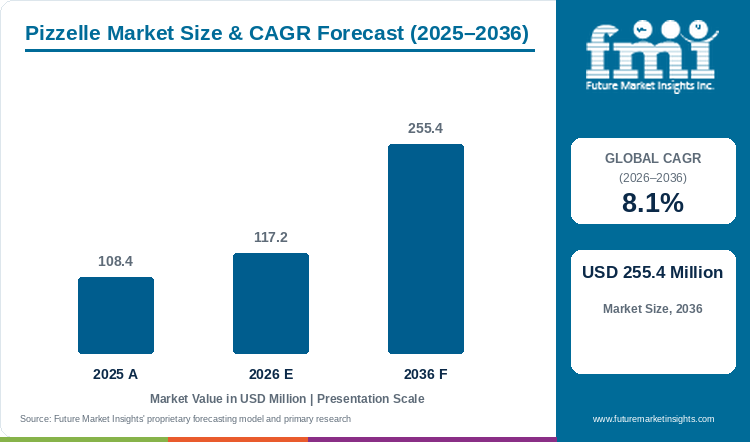
Assessed at USD 108.4 million in 2025 and progressing to USD 117.2 million in 2026, the pizzelle market valuation is on course to reach USD 255.4 million by 2036, supported by a forecast-period CAGR of 8.1%.
Global demand for pizzelle reached a market value of USD 108.4 million in 2025 and an estimated USD 117.2 million in 2026, with FMI projecting the market size to reach USD 255.4 million by 2036 at an 8.1% CAGR. Supermarket bakery buyers and specialty coffee chains still anchor core shelf space in classic / original vanilla and aniseed wafers, which are forecast to register a 35.0% share in 2026. Portioned single-serve packs are turning a seasonal holiday cookie into an everyday coffee snack. Once a household opens a traditional 200-gram plastic tub, thin 2-millimeter wafers absorb room humidity and lose their crisp snap within days, pushing grocers and cafés toward sealed 80-calorie twin-wafer pouches. In February 2025, NuStef Baking expanded its Reko pizzelle business by launching TeaFusions fruit-and-tea waffle cookies in 80-calorie single-serve packets and 12-count retail boxes plus 72-count and 180-count foodservice cases across North America [1]. That low-calorie portion control and crisp griddle texture allow pizzelle to outpace the 4.9% CAGR of the soft-baked cookies category by 320 basis points, where heavier sugar and fat loads limit daily snacking. However, fragile wafer edges and slower baking speeds on cast-iron griddles still require protective inner trays and disciplined freight handling.
Key Market Trends & Insights
- By product type: Classic / original is forecast to register a 35.0% share in 2026 driven by vanilla and aniseed iron-pressed wafers that anchor repeat perimeter bakery purchases.
- By claim / nature: Conventional is estimated to hold a 45.0% share in 2026 resulting from clean release off embossed cast-iron griddles and lower ingredient cost than gluten-free blends.
- By format: Fresh is predicted to record a 33.0% share in 2026 linked to Italian specialty bakeries selling warm aromatic wafers for festive gifting and immediate consumption.
- By packaging format: Single-serve is projected to account for a 29.0% share in 2026 enabled by 80-calorie barrier pouches that block humidity absorption after package opening.
- By sales channel: Supermarkets & hypermarkets are expected to hold a 37.0% share in 2026 in line with perimeter bakery table displays and seasonal holiday gifting end-caps.
Regional Highlights
- Top national expansion: Gourmet imported-bakery merchandising and luxury hospitality coffee service place the UAE in the lead for national expansion with a forecast 9.5% CAGR through 2036.
- Broader country progression: Ten-year growth is anticipated to reach 9.1% CAGR in Saudi Arabia, followed by the USA at 8.8% and South Korea at 8.5%, with Japan progressing at 7.2%.
Market Size & Forecast
Table 1: Market Size and Forecast for the Pizzelle Market (USD million and CAGR percentage), 2025 to 2036
| Metric | Value |
|---|---|
| 2025 Market Size | USD 108.4 million |
| Estimated Market Size in 2026 | USD 117.2 million |
| Projected Market Size by 2036 | USD 255.4 million |
| CAGR, 2026 to 2036 | 8.1% |
| Added Revenue, 2026 to 2036 | USD 138.2 million |
Café accompaniment programs and 80-calorie single-serve multipacks will generate USD 138.2 million in incremental value between 2026 and 2036. Unbuffered bulk tubs allow thin rosette wafers to snap during parcel and less-than-truckload transit while raw-material inflation in eggs and butter pressures producer margins. In January 2025, the Association of the Confectionery Industry in Germany (BDSI) reported that domestic fine-baked-goods production value rose 3.7% to EUR 2,900 million in 2024 while tonnage declined 3.8% [2]. Bakers that combine automated dual-drum cast-iron griddles with compartmentalized barrier trays capture year-round grocery perimeter and hospitality distribution.
Wafer Griddle Output and Portion-Pack Sizing
Table 2: Wafer Griddle Output and Portion-Pack Sizing for the Pizzelle Market (USD million and operational ranges), 2025 to 2036
| Metric | 2025 | 2026 | 2036 |
|---|---|---|---|
| Market size (USD million) | 108.4 | 117.2 | 255.4 |
| Commercial pizzelle volume (thousand tonnes) | 14.2 to 15.4 | 15.3 to 16.6 | 31.5 to 34.2 |
| Retail & foodservice portion packs (million units) | 71.0 to 77.0 | 76.5 to 83.0 | 157.5 to 171.0 |
| Average wholesale price per kg (USD) | 7.10 to 7.60 | 7.15 to 7.65 | 7.45 to 8.05 |
Operational note: Volume and pack counts reflect 5-to-12 gram embossed pizzelle wafers packed across 22-gram (80-calorie) single-serve coffee packets and 140g-to-200g retail clamshells as well as 1.8-kilogram foodservice catering cases.
Automated carousel wafer ovens press liquid flour-egg-sugar batters between engraved cast-iron plates at 180 to 200 degrees Celsius for 35 to 45 seconds to bake a thin crisp wafer. Producers coordinate soft-baked cookies and crisp-wafer line scheduling with dry cooling tunnels so wafers enter barrier film wrappers before absorbing room humidity.
Per Capita & Specialty Retail Facility Sizing
Table 3: Per Capita and Specialty Retail Spending Indicators for the Pizzelle Market (USD), 2025 to 2036
| Metric | 2025 | 2026 | 2036 |
|---|---|---|---|
| World population (million) | 8,200 | 8,300 | 9,000 |
| Spend per 1,000 people (USD) | 13.2 | 14.1 | 28.4 |
| Annual pizzelle spend per specialty store / café (USD) | 680.0 to 790.0 | 720.0 to 840.0 | 1,380.0 to 1,620.0 |
| Protected clamshell & single-serve share (%) | 54.0% to 57.0% | 56.0% to 59.0% | 65.0% to 69.0% |
Table 4: Facility & Grocery Channel Spending Indicators for the Pizzelle Market (USD and percentages), 2026
| Metric | Value | Institutional Reference Basis |
|---|---|---|
| Market size, 2026 | USD 117.2 million | 2026 global revenue baseline |
| Specialty grocers, Italian delis & espresso chains | 152,000 outlets | Global specialty food & café beverage-pairing registry |
| Market spend per outlet | USD 771.1 | Annualized embossed wafer cookie expenditure |
| Supermarkets & hypermarkets allocation, 2026 | USD 43.4 million | 37.0% sales channel segment allocation |
Broader pizzelle distribution beyond regional Italian enclaves requires pairing artisanal rosette embossing with everyday snacking and functional ingredient cues. Specialty bakers benchmark thin pressed wafers against communion wafers and Belgian waffle crisps while formulating lower-glycemic and clean-label variants for modern grocery perimeters.
Analyst Perspective
"Supermarket bakery buyers do not drop pizzelle for lack of shopper interest; they drop suppliers when thin embossed wafers arrive cracked in unbuffered cartons or turn soft in humid display aisles. Bakers combining cast-iron griddle authenticity with 80-calorie metallized portion packs and verified gluten-free options win year-round grocery and café reorders."
- Nandini Roy Choudhury, Principal Consultant, Future Market Insights.
How is the pizzelle market segmented?
The pizzelle market is segmented by product type, claim / nature, format, packaging format, and sales channel. In 2026, Classic / original is projected at 35.0%, Conventional at 45.0%, Fresh at 33.0%, Single-serve at 29.0%, and Supermarkets & hypermarkets at 37.0%.
By product type: Classic / original, Whole grain & seeded, Flavored & filled, Mini & snacking formats, and Premium / artisan.
By claim / nature: Conventional, Clean label, Organic, Gluten-free, and High-protein / fortified.
By format: Fresh, Frozen, Ambient packaged, Chilled, and Par-baked / thaw-and-serve.
By packaging format: Single-serve, Multipack, Family / loaf pack, and Bulk foodservice.
By sales channel: Supermarkets & hypermarkets, Artisan & specialty bakeries, Convenience & forecourt, Online & DTC, and Foodservice distributors.
Why does Classic / original lead the product type category?
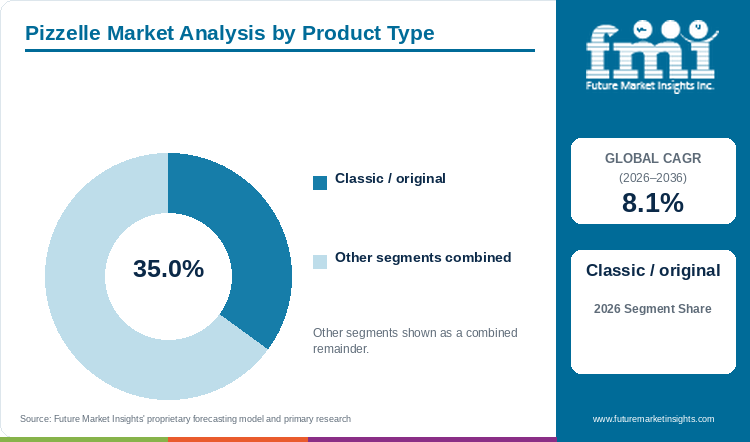
Classic / original is forecast to register a 35.0% share in 2026, resulting from household recognition of traditional vanilla and aniseed rosette wafers.
Table 5: Product Type Share for the Pizzelle Market (percentage share), 2026
| Product Type | Share (2026) |
|---|---|
| Classic / original | 35.0% |
| Other Segments Combined* | 65.0% |
| Total | 100.0% |
*Calculated as the balance remaining after deducting the leading segment's reported share from 100.0%.
Table 6: Product Type Leadership and Market Growth for the Pizzelle Market (segment and CAGR percentage), 2026 to 2036
| Metric | Value |
|---|---|
| Global CAGR (2026 to 2036) | 8.1% |
| Leading Segment | Classic / original |
Retail grocery buyers and Italian foodservice distributors prioritize classic vanilla and aniseed pizzelle because these heritage profiles require zero consumer education and run on continuous cast-iron griddles without flavor-carryover purge stops. While chocolate-dipped and fruit-tea infused wafers expand impulse trial, classic flat wafers anchor baseline replenishment near artisan bread and specialty Italian pastry tables.
- Classic / original is expected to hold a 35.0% share in 2026 attributable to uninterrupted griddle run lengths and year-round espresso-pairing demand.
- A June 2025 biscuit thermomechanical study in the International Journal of Food Science confirmed that controlled fiber and flavor additions preserve dough rheology and low water activity in crisp baked wafers [3].
Why does Conventional define the largest claim / nature segment?
Conventional is estimated to hold a 45.0% share in 2026, enabled by clean cast-iron plate release and established wheat-and-egg cost economics.
Conventional pizzelle batters combine soft wheat flour and whole eggs with sugar and vegetable oil to form a smooth batter that releases cleanly from engraved iron plates in 40 seconds without tearing the rosette pattern. Alternative gluten-free or high-protein flours change batter stickiness on hot iron grooves unless sunflower lecithin and gums are added, keeping conventional recipes ahead of teff flour and ancient-grain wafer variants in unit volume.
- Conventional is projected to account for a 45.0% share in 2026 supported by lower raw-material cost and lower griddle scrap rates than specialty claim formulations.
- An August 2026 biscuit rheology study in Foods (PubMed PMID 42650638) demonstrated that controlled polyphenol and flavor additions between 0.2% and 0.6% preserve conventional wheat dough stability and crisp spread factor [4].
What keeps Fresh ahead by format?
Fresh is predicted to record a 33.0% share in 2026, associated with perimeter bakery aromatics and holiday gift-platter merchandising.
In-store supermarket bakeries and Italian pasticcerie press fresh pizzelle in small batches to capitalize on warm vanilla-anise aroma and immediate brittle snap that packaged shelf stock must replicate through barrier films. Although ambient packaged clamshells and single-serve packets drive cross-border grocery expansion, fresh counter sales anchor premium seasonal pricing beside focaccia and regional Italian baked specialties.
- Fresh is predicted to record a 33.0% share in 2026 linked to custom holiday cookie trays and warm hand-rolled cannoli-shell preparation at specialty bakeries.
- A December 2025 study in Foods (PubMed PMID 41464943) applied machine-learning shelf-life modeling across traditional bakery products, confirming that storage temperature and modified-atmosphere barrier packaging account for 77% of textural preservation variance [5].
Why does Single-serve lead the packaging format category?
Single-serve is projected to account for a 29.0% share in 2026, in line with 80-calorie barrier packets that eliminate open-tub humidity staling.
Once a consumer unseals a family tub of 30 thin wafers, ambient kitchen moisture softens the remaining pizzelle within 48 hours and causes edges to crumble during handling. Individually sealed two-wafer or three-wafer packets (typically 20 to 24 grams at 80 to 100 calories) lock out humidity until the moment of consumption and let cafés and office pantries merchandise pizzelle beside gut-friendly cookies and portioned coffee snacks.
- Single-serve is forecast to register a 29.0% share in 2026 resulting from portion-controlled calorie labeling and zero open-pack moisture degradation.
- Deli Business reported in February 2025 that NuStef Baking rolled out single-serve 80-calorie packets and multi-count retail boxes plus foodservice bulk cases to capture café beverage pairings [6].
What gives Supermarkets & hypermarkets the leading position in sales channel?
Supermarkets & hypermarkets are expected to hold a 37.0% share in 2026, supported by perimeter bakery tables and seasonal holiday end-caps.
National supermarket chains drive the largest pizzelle volume by displaying clear reclosable clamshells on perimeter bakery tables year-round while building high-velocity Italian holiday end-caps during winter and spring festivities. Retailers enforce strict scan-rate and damaged-return thresholds, favoring automated wafer producers that ship crush-protected retail cases near phyllo pastry and international dessert assortments.
- Supermarkets & hypermarkets are estimated to hold a 37.0% share in 2026 due to weekly household grocery traffic and multi-flavor display shippers.
- A February 2026 clinical nutrition study in Acta Medica Philippina confirmed that date-sweetened functional biscuits distributed through retail channels improve micronutrient intake among working adults [7].
What are the drivers, restraints, and opportunities in the pizzelle market?
In the pizzelle market, café beverage-pairing occasions and portion-controlled 80-calorie packs drive recurring retail velocity whereas thin-wafer transit breakage and allergen labeling rules restrain cross-border scale and gluten-free cast-iron formulations open up natural-channel and café distribution.
- Driver: Expansion of coffee-shop accompaniment programs and 80-calorie single-serve barrier pouches converts pizzelle from a seasonal holiday cookie into a year-round snack.
- Restraint: Ultra-thin 2-millimeter embossed wafer geometry fractures under pallet shock while wheat-and-egg allergen and bilingual label laws delay cross-border listings.
- Opportunity: Rice-and-sorghum gluten-free pizzelle and natural fruit-and-tea infused assortments capture health-conscious grocery shoppers and hospitality gift baskets.
Growth Analysis and Future Potential: Qualitative Demand Catalysts
Specialty food merchandisers and café chains are expanding pizzelle orders because an embossed 80-calorie wafer pair delivers artisanal appearance and portion control at a lower calorie count than frosted cookies or pastries. By infusing traditional cast-iron wafer batters with real fruit powders and botanical teas, producers move pizzelle from once-a-year Christmas tins into everyday afternoon tea and espresso routines. Future Market Insights notes that flavor and portion updates are lifting pizzelle sales across specialty grocers near savory muffins and scones in café display cases. In July 2026, functional biscuit research published in Molecules confirmed that enriching wheat biscuit batters with peach and sour-cherry fruit pomace raised iron and potassium as well as natural polyphenols [8]. Retail category buyers therefore allocate permanent perimeter shelf space to flavor-varied, portion-wrapped pizzelle lines.
Risk Assessment of the Pizzelle Market: Operational and Formulation Friction
Wafer breakage during pallet shipping and humidity-induced loss of crispness represent the main commercial risks cutting supplier margins in the pizzelle market. Because cast-iron pizzelle are pressed to roughly 2 millimeters and baked to a very low moisture level, unbuffered bulk stacks suffer edge chipping whenever cartons experience warehouse drop shocks. In January 2025, the U.S. Food and Drug Administration released its finalized Edition 5 Food Allergen Labeling Guidance and draft sanitation rules for low-moisture ready-to-eat foods containing wheat or eggs [9]. When bakers switch to gluten-free or plant-based batters to avoid allergen hurdles, wafer release from hot iron griddles slows down and requires higher oil inclusion with spelt flour or ancient-grain blends.
Commercial Opportunity Analysis: Formulation Differentiation and Value-Add Formats
Wafer manufacturers that commercialize dedicated gluten-free and low-glycemic pizzelle in crush-resistant single-serve multipacks can capture high-margin natural-channel and foodservice accounts. Consumers with celiac disease or gluten sensitivity frequently seek light, crispy wafer cookies to replace heavy rice cakes, yet very few industrial bakers operate gluten-free cast-iron griddle lines. Formulators now combine rice flour and sorghum flour with tiger-nut flour and sunflower lecithin to achieve clean iron release and crisp honeycomb snap while cross-selling into clean label flour bakery sets. In June 2026, a functional optimization study in the International Journal of Food Science demonstrated that adding lecithin and nutritional sweeteners to gluten-free crispy cookie batters improved spread uniformity and low-glycemic performance [10]. Producers validating certified gluten-free pizzelle in 80-calorie barrier pouches secure premium natural-grocery and hospitality minibar contracts.
Pizzelle Market by Country (2026 to 2036)
Across evaluated national markets, the UAE is forecast to register the fastest pizzelle expansion at a 9.5% CAGR from 2026 to 2036, whereas Japan progresses at a 7.2% annual rate. Revenue realization across Gulf specialty grocers and supermarket perimeter bakeries in the USA and Europe hinges on barrier-film humidity protection and crush-resistant tray engineering.
Table 7: Country CAGR and Primary Growth Levers for the Pizzelle Market (CAGR percentage and operational drivers), 2026 to 2036
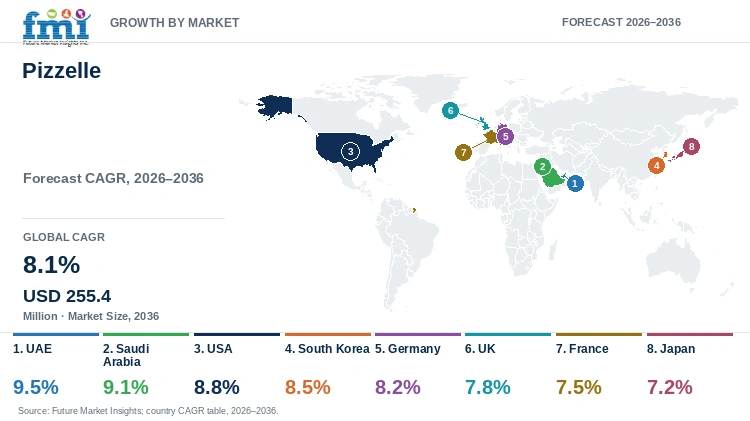
| Country | CAGR (2026 to 2036) | Primary Growth Lever |
|---|---|---|
| UAE | 9.5% | 77,700 H1 2025 registered food products, gourmet hospitality gifting, and humidity-barrier packs |
| Saudi Arabia | 9.1% | Specialty café espresso-pairing demand and SFDA Arabic prepackaged nutrition compliance |
| USA | 8.8% | Established domestic specialist griddle bakers, 80-calorie TeaFusions rollout, and grocery perimeters |
| South Korea | 8.5% | Imported café dessert-cookie culture and April 2025 MFDS nutrition-labeling amendment compliance |
| Germany | 8.2% | 3.7% fine-baked-goods value growth and seasonal Italian specialty end-cap promotions |
| UK | 7.8% | GBP 68M biscuit-sector automation benchmark and specialty deli coffee-accompaniment packs |
| France | 7.5% | Gourmet épicerie fine gifting assortments competing alongside domestic gaufrettes and sablés |
| Japan | 7.2% | CAA June 2025 food-labeling standards and zero-breakage department-store gift-tin engineering |
Source: Future Market Insights analysis
UAE Pizzelle Market Outlook (2026 to 2036)
The UAE pizzelle market is projected to expand at a 9.5% CAGR from 2026 to 2036, the highest growth rate among evaluated countries. Unlike domestic production markets in North America and Italy, the UAE is a high-velocity re-export and luxury hospitality hub where gourmet food halls and specialty coffee roasters drive imported wafer demand. In July 2025 Dubai Municipality reported registering 77,700 new food products and conducting over 34,000 food inspections during the first half of 2025 across retail and import ports [11]. Extreme coastal humidity requires metallized BOPP single-serve pouches so imported pizzelle retain brittle snap throughout warehouse staging and hotel VIP amenity service.
Key takeaway: In the UAE, luxury hotel coffee service and Dubai's rapid food-import registration infrastructure propel demand for moisture-sealed gourmet pizzelle.
Saudi Arabia Pizzelle Market Outlook (2026 to 2036)
Unlike European markets where pizzelle are bought primarily during winter holidays, Saudi Arabia channels demand through year-round specialty espresso lounges and corporate hospitality gifting as well as modern hypermarket imported-biscuit aisles. Commercial sales in the Saudi Arabia pizzelle market are forecast to grow at a 9.1% CAGR between 2026 and 2036. In September 2025, a formulation study in Frontiers in Nutrition confirmed that blending date fruit pulp and pit powder into rice-based gluten-free cookies improved dietary fiber and mineral profiles for regional consumers [12]. Strict Food and Drug Authority rules in Saudi Arabia for prepackaged foods require printed Arabic ingredient and allergen panels before importers can clear specialty Italian wafer containers.
Key takeaway: In Saudi Arabia, expanding specialty coffee-shop culture and mandatory Arabic food-label compliance govern imported pizzelle retail onboarding.
USA Pizzelle Market Outlook (2026 to 2036)
What sets the USA apart from purely import-reliant markets is its established base of domestic and Canadian cast-iron griddle specialists such as Reko Pizzelle (NuStef Baking) and Bella Lucia as well as DeLallo supplying national supermarket perimeters and club stores. In July 2025, analytical research in Foods demonstrated that incorporating sorghum flour into gluten-free cookie batters elevated polyphenolic gallic acid and apigenin levels while preserving crisp bite [13]. Supported by domestic single-serve and gluten-free line extensions, the USA pizzelle market is estimated to advance at an 8.8% CAGR from 2026 to 2036. Supermarket category managers still enforce strict scan-rate and breakage-allowance audits on perimeter bakery tubs across regional grocery distribution centers.
Key takeaway: In the USA, domestic specialist griddle manufacturers and 80-calorie single-serve flavor extensions drive year-round supermarket perimeter velocity.
South Korea Pizzelle Market Outlook (2026 to 2036)
Whereas Western shoppers often buy pizzelle in 200-gram family tubs, South Korea centers demand on individually wrapped café accompaniment wafers and department-store food halls as well as premium e-commerce snack curations. In January 2025, baking research from Sungshin Women's University in Seoul published in Food Science and Biotechnology demonstrated that supplementing rice cookies with 5.0% red-beet extract significantly increased antioxidant activity without reducing consumer sensory acceptance [14]. Under these functional and specialty snacking trends, the South Korea pizzelle market is anticipated to register an 8.5% CAGR over the 2026 to 2036 forecast period. Importers in South Korea favor 80-calorie twin-wafer packets with localized nutrition stickers that survive parcel delivery without edge chipping.
Key takeaway: In South Korea, premium espresso-café pairing trends and updated MFDS nutrition-labeling rules favor individually wrapped imported pizzelle packets.
Germany Pizzelle Market Outlook (2026 to 2036)
Germany differs from emerging import markets because Italian pizzelle must compete directly against a massive domestic fine-baked-goods (Feine Backwaren) and seasonal waffle-biscuit manufacturing base. Demand in the Germany pizzelle market is expected to progress at an 8.2% CAGR from 2026 to 2036 across Italian delicatessens and ice-cream parlors (Eiscafés) plus supermarket Mediterranean promotional weeks. In May 2026, a biscuit formulation study in Food Science & Nutrition confirmed that combining tiger-nut flour with balanced lipid blends lowers glycemic load while maintaining crisp biscuit snap [15]. Because retail buyers in Germany separate price inflation from unit volume growth, suppliers must prove distinct artisanal rosette presentation and zero transit damage.
Key takeaway: In Germany, seasonal supermarket Italian promotions and Eiscafé accompaniment channels support demand for differentiated artisan pizzelle.
UK Pizzelle Market Outlook (2026 to 2036)
Unlike continental markets with widespread local wafer irons, the UK channels pizzelle through specialty Italian delicatessens and premium grocery chains as well as garden-center food halls where shoppers seek giftable tea-and-coffee biscuits. Commercial revenue in the UK pizzelle market is predicted to expand at a 7.9% CAGR between 2026 and 2036 across specialty retail and café channels. In February 2025, multi-criteria AHP-TOPSIS biscuit optimization published in Food Science & Nutrition confirmed that incorporating 12% tomato-paste by-product powder increased total dietary fiber 2.2-fold and phenolic content 5.6-fold while preserving sensory hardness [16]. Distributors in the UK must comply with Food Standards Agency prepacked allergen declarations for wheat and egg while protecting thin wafers from damp maritime storage.
Key takeaway: In the UK, specialty food-hall gifting and tea-pairing occasions drive demand for barrier-packed Italian pizzelle with clear allergen declarations.
France Pizzelle Market Outlook (2026 to 2036)
In contrast to markets lacking thin wafer traditions, France evaluates Italian pizzelle against traditional regional gaufrettes from Lille and artisanal butter sablés across specialty retail shelves. In April 2026, a formulation review in Foods examined the addition of botanical extracts into bakery products to improve natural aroma and shelf stability for clean-label positioning [17]. Against this established domestic biscuit benchmark, the France pizzelle market is slated to grow at a 7.5% CAGR from 2026 to 2036 across fine-food shops and Italian restaurant chains. Successful suppliers differentiate pizzelle in France through authentic Abruzzo cast-iron rosette embossing and natural aniseed or citrus oils packed inside recyclable compartmentalized trays.
Key takeaway: In France, competition from domestic gaufrettes requires pizzelle importers to emphasize authentic Italian rosette embossing and natural botanical flavors.
Japan Pizzelle Market Outlook (2026 to 2036)
Whereas grocers in the USA and Canada stack clear plastic clamshells on open tables, Japan requires zero-defect individual pillow wrapping and rigid gift boxes comparable to domestic Kawara senbei and Yatsuhashi wafer standards. In June 2025, the Consumer Affairs Agency (CAA) of Japan convened its First Food Labeling Roundtable of Fiscal 2025 to review food-labeling clarity and shelf-life expiration-date guidelines [18]. Under these strict quality and labeling expectations, the Japan pizzelle market is forecast to advance at a 7.2% CAGR from 2026 to 2036. Exporters serving department stores and specialty coffee chains in Japan must guarantee 100% intact wafer edges through custom-molded inner blister trays and humidity-barrier films.
Key takeaway: In Japan, department-store gifting standards and CAA food-labeling reviews require individual pillow packs and zero-fracture blister trays.
Full report country CAGRs cover: North America; Latin America; Western Europe; Eastern Europe; East Asia; South Asia and Pacific; Middle East and Africa.
Who are the notable companies in the pizzelle market?
NuStef Baking (Reko Pizzelle), Bella Lucia, DeLallo, Mondelez International, pladis, Bahlsen, Lotus Bakeries, Walkers Shortbread, Kellanova, Arnott's, Ferrero, Grupo Bimbo, and Campbell Company are the notable companies evaluated in this market.
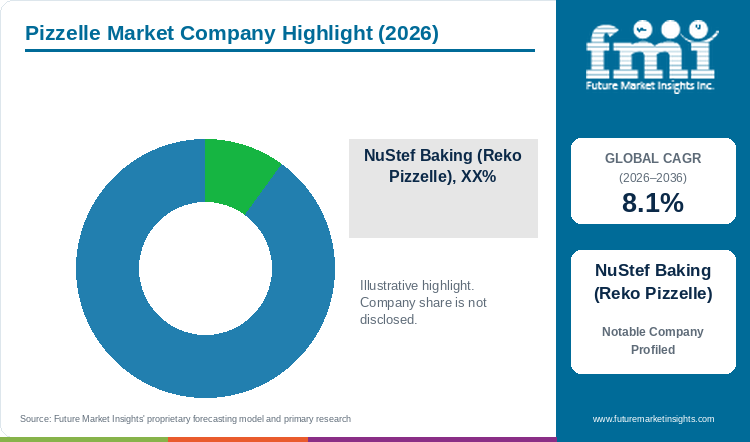
FMI analysis indicates that commercial competition divides between dedicated cast-iron griddle pizzelle manufacturers in North America and Italy and multinational biscuit and sweet-bakery groups managing global retail biscuit fixtures. Specialist pizzelle bakers operate proprietary embossed cast-iron carousel ovens and dedicated gluten-free wafer rooms supplying supermarket perimeters and Italian specialty distributors. Multinational biscuit and confectionery corporations control mass-grocery shelf facings and direct-store-delivery routes for beverage-pairing snack portfolios across international markets.
- Dedicated Cast-Iron Pizzelle Specialists: NuStef Baking (Reko Pizzelle) and Bella Lucia along with DeLallo manufacture and market authentic embossed Italian waffle cookies across conventional and gluten-free formats.
- Global Biscuit & Cookie Brand Networks: Mondelez International and pladis as well as Bahlsen and Lotus Bakeries operate high-speed European and global biscuit plants and coffee-pairing brand franchises.
- Premium Sweet-Baked & Snack Platforms: Walkers Shortbread and Ferrero along with Campbell Company plus Kellanova and Grupo Bimbo manage specialty gifting and commercial bakery distribution networks.
Competitive Benchmarking: Pizzelle Market
Table 8: Competitive Benchmarking for the Pizzelle Market (qualitative capability ratings), 2026
| Company | Embossed Wafer / Pizzelle Line | Cookie or Biscuit Range | Route-to-Market Evidence | Geographic Reach |
|---|---|---|---|---|
| NuStef Baking (Reko Pizzelle) | High | High | High | Canada, USA, and international retail and foodservice channels |
| Bella Lucia | High | Medium | Medium | USA specialty grocery, gluten-free retail, and direct online channels |
| DeLallo | High | High | High | USA national supermarket Italian aisles and foodservice distribution |
| Mondelez International | Medium | High | High | North America, Europe, and global grocery biscuit channels |
| pladis | Medium | High | High | UK, Europe, Middle East, and international biscuit markets |
| Bahlsen | Medium | High | Medium | Germany, Europe, and international fine-bakery channels |
| Lotus Bakeries | Medium | High | High | Europe, USA, and Asia-Pacific coffee-pairing biscuit channels |
| Walkers Shortbread | Medium | Medium | High | UK, North America, and global travel-retail and gifting markets |
| Kellanova | Medium | Medium | High | USA and international portable snack and cracker channels |
| Arnott's | Medium | High | Medium | Australia, New Zealand, and Asia-Pacific biscuit markets |
| Ferrero | Medium | High | High | Europe, Americas, and global sweet-packaged and wafer channels |
| Grupo Bimbo | Medium | High | High | Americas, Europe, and Asia-Pacific commercial bakery networks |
| Campbell Company | Medium | High | High | USA and North American premium packaged-cookie channels |
Scoring basis: Capability tiers evaluate documented cast-iron pizzelle or specialty wafer production and multi-flavor cookie assortment breadth as well as verified grocery and foodservice distribution reach.
Key Developments in the Pizzelle Market
- In March 2025, Ferrero International S.A. approved its consolidated fiscal 2023/2024 financial statements reporting EUR 18,400 million in revenue (+8.9% year-over-year) and an 18% capital expenditure increase to EUR 958 million across global biscuit and confectionery plants [19].
- In October 2025, European Commission Joint Research Centre baking trials across 24 biscuit batches in Food Chemistry: X confirmed that controlling dough and oven moisture kept acrylamide between 2.4 and 37 micrograms per kilogram, well below the 350 microgram EU benchmark [20].
- In April 2026, a functional bakery review in Foods confirmed that blending naturally gluten-free buckwheat and quinoa pseudocereal flours into biscuit batters elevates protein and dietary fiber density for celiac shoppers [21].
Key Players in the Pizzelle Market
Dedicated Cast-Iron Pizzelle Specialists
- NuStef Baking (Reko Pizzelle)
- Bella Lucia
- DeLallo
Global Biscuit and Cookie Brand Networks
- Mondelez International
- pladis
- Bahlsen
- Lotus Bakeries
Heritage Sweet-Baked Goods and Adjacent Snack Platforms
- Walkers Shortbread
- Ferrero
- Campbell Company
- Kellanova
- Arnott's
- Grupo Bimbo
Pizzelle Market - Report Scope
Table 9: Report Scope for the Pizzelle Market (coverage fields and definitions), 2026 to 2036
| Coverage field | Report scope |
|---|---|
| Market breakdown | Product Type; Claim / Nature; Format; Packaging Format; Sales Channel |
| Quantitative Units | USD Million |
| Market Definition | Revenue from sweet Italian-style embossed pizzelle waffle cookies sold across retail grocery, specialty bakery, online, and foodservice channels at first commercial sale. Category Scope Note: Excludes ice-cream sugar cones, thick Belgian yeast waffles, non-wafer biscuits, and downstream plated restaurant dessert prices. |
| Regions Covered | North America; Latin America; Western Europe; Eastern Europe; East Asia; South Asia and Pacific; Middle East and Africa |
| Countries Covered | UAE, Saudi Arabia, USA, South Korea, Germany, UK, France, Japan, and additional countries in the full report |
| Key Companies Covered | NuStef Baking (Reko Pizzelle), Bella Lucia, DeLallo, Mondelez International, pladis, Bahlsen, Lotus Bakeries, Walkers Shortbread, Kellanova, Arnott's, Ferrero, Grupo Bimbo, Campbell Company |
| Forecast Period | 2026 to 2036 |
| Approach | Primary and secondary research with top-down and bottom-up market triangulation. |
Pizzelle Market - Research Methodology
Table 10: Research Methodology for the Pizzelle Market (research methods and approach), 2026 edition
| Method | Approach |
|---|---|
| Primary Research | Structured interviews with cast-iron wafer oven manufacturers, specialty Italian bakery directors, supermarket perimeter category buyers, and foodservice coffee-chain merchandisers to validate breakage tolerances and portion-pack pricing. |
| Secondary Research | Analysis of BDSI fine-baked-goods production statistics, FDA, SFDA, MFDS, and Japan CAA food-labeling notices, PubMed biscuit rheology and water-sorption studies, and corporate financial releases. |
| Market Sizing and Forecasting | Top-down specialty biscuit and Italian baked-goods expenditure models reconciled against bottom-up carousel griddle output, clamshell scan velocity, and single-serve café case volumes from 2026 to 2036. |
| Country Forecasting Model | Econometric national projections weight specialty coffee-shop density, Italian-food retail facings, imported-food registration throughput, and bilingual allergen compliance costs across eight evaluated countries. |
| Operational Benchmark Traceability | Wafer tonnage and specialty-outlet spending indicators in Tables 2, 3, and 4 trace to commercial 22-gram single-serve and 140g-to-200g clamshell pack specifications and specialty grocery registries. |
| Data Triangulation and Validation | Demand estimates are cross-checked against specialist pizzelle producer capacities and imported biscuit customs data while excluding non-wafer cookies and ice-cream cones to prevent double counting. |
Pizzelle Market by Segments
Pizzelle Market segmented by Product Type:
- Classic / original
- Whole grain & seeded
- Flavored & filled
- Mini & snacking formats
- Premium / artisan
Pizzelle Market segmented by Claim / Nature:
- Conventional
- Clean label
- Organic
- Gluten-free
- High-protein / fortified
Pizzelle Market segmented by Format:
- Fresh
- Frozen
- Ambient packaged
- Chilled
- Par-baked / thaw-and-serve
Pizzelle Market segmented by Packaging Format:
- Single-serve
- Multipack
- Family / loaf pack
- Bulk foodservice
Pizzelle Market segmented by Sales Channel:
- Supermarkets & hypermarkets
- Artisan & specialty bakeries
- Convenience & forecourt
- Online & DTC
- Foodservice distributors
Pizzelle Market by Region
- North America
- United States
- Canada
- Latin America
- Brazil
- Mexico
- Argentina
- Chile
- Western Europe
- Germany
- France
- United Kingdom
- Italy
- Spain
- Benelux
- Nordics
- Eastern Europe
- Poland
- Czech Republic
- Romania
- Hungary
- East Asia
- China
- Japan
- South Korea
- South Asia and Pacific
- India
- ASEAN
- Australia and New Zealand
- Middle East and Africa
- GCC Countries
- South Africa
- Türkiye
- Israel
Research Sources and Bibliography
- [1] NuStef Baking Ltd. (2025, February 25). NuStef Baking Launches TeaFusions Waffle Cookies: Real Fruit & Tea Infused Cookies Available in Four Fusion Flavors. Business Wire Corporate Product Launch Release.
- [2] Bundesverband der Deutschen Süßwarenindustrie e.V. (BDSI). (2025, January 29). Produktion von Süßwaren erstmalig und Export in Folge rückläufig: Konjunkturentwicklung Feine Backwaren. BDSI-Journal Official Industry Statistics.
- [3] Garcia-Amezquita, L. E., Tejada-Ortigoza, V., Ramírez-Aguirre, M. D., Cantu-Cantu, A., Pérez-Carrillo, E., & Welti-Chanes, J. (2025, June 19). Substitution of Wheat Flour by Extrudate Orange Peel Dietary Fiber Concentrate in Biscuits: Changes in Mixolab Thermomechanical Behavior, Flour Technofunctionality, and Water Sorption Isotherm Properties. International Journal of Food Science, 2025, 1657293 (PubMed PMID 40575081).
- [4] Jiao, R., Zhang, F., Yang, L., & Wang, C. (2026, August 21). Development of Grape Seed Extract-Fortified Biscuits: Effects on Dough Rheology, Biscuit Quality, Antioxidant Activity, and Sensory Evaluation. Foods, 15(16), 2944 (PubMed PMID 42650638).
- [5] Marianelli, A., Offei, C. A., Macaluso, M., Mercanti, N., Casu, B., & Zinnai, A. (2025, December 10). A Machine Learning Model to Reframe the Concept of Shelf-Life in Bakery Products: PDO Sourdough as a Technological Preservation Model. Foods, 14(24), 4236 (PMCID PMC12732183 / PMID 41464943).
- [6] Deli Business / NuStef Baking Ltd. (2025, February 25). NuStef Baking Launches TeaFusions Waffle Cookies in Individual 80-Calorie Packets, Multipacks, and Foodservice Cases. Deli Business Retail & Foodservice Merchandising Report.
- [7] Ibrahim, H., Kurniati, Y., Haerana, B. T., Ibrahim, I. A., Widiastuty, L., & Syahrir, S. (2026, February 27). Effectiveness of Biscuit Formulations with Different Dates Substitutes in Treating Anemia among Female Workers in Makassar, Indonesia. Acta Medica Philippina, 60(4), 89-96 (PubMed PMID 41890336).
- [8] Cosmulescu, S., & Mandache, M. B. (2026, July 29). Fruit Pomace as a Functional Ingredient in Wheat Biscuits: Mineral Composition, Colour Characteristics, and Quality Evaluation of Peach Pomace-Enriched Biscuits. Molecules, 31(15), 2633 (PubMed PMID 42588482).
- [9] U.S. Food and Drug Administration. (2025, January 6). FDA Releases Allergen, Food Safety, and Plant-Based Alternative Labeling Guidances (HFP Constituent Update). U.S. FDA Human Foods Program.
- [10] Sutanto, T. A., Belinda, G. A., Erawati, C. M., Dewi, A. D. R., & Purwanto, M. G. M. (2026, June 12). Optimization of Gluten-Free and Low-GI Crispy Cookies From Agrowaste Flours Using Nutritional Sweetener and Lecithin: A Qualitative and Functional Assessment. International Journal of Food Science, 2026, 9974154 (PubMed PMID 42293326).
- [11] Dubai Municipality. (2025, July 30). Over 34,000 food inspections conducted in first half of 2025, supporting rapid sector growth and 77,700 new product registrations. Government of Dubai Media Center.
- [12] Akram, S., Chatha, A., Abid, J., Farooq, U., & Ahmad, A. M. R. (2025, September 2). Development and quality assessment of gluten-free cookies using rice flour and date fruit. Frontiers in Nutrition, 12, 1645063 (PubMed PMID 40964681).
- [13] Bukonja, S., Tomić, J., Pestorić, M., Maravić, N., Despotović, S., Tomičić, Z., Kiprovski, B., & Pantelić, N. Đ. (2025, July 29). Exploring Sorghum Flour as a Sustainable Ingredient in Gluten-Free Cookie Production. Foods, 14(15), 2668 (PMCID PMC12346720 / PMID 40807606).
- [14] Kim, S. H., Kim, E., Nam, J.-K., & Jang, H. W. (2025, January 15). Quality characteristics and antioxidant activities of rice cookies supplemented with red beet extracts. Food Science and Biotechnology, 34(9), 1889-1896 (PubMed PMID 40196337).
- [15] Tazoho, G. M., Tchassi, B., Bossi, D. S. D., Tene, S. T., Womeni, H. M., & Gouado, I. (2026, May 3). Formulation of Gluten-Free Biscuits Based on Tiger Nut, Dana, and Mixture of Avocado and Margarine: Nutritional Composition and Glycemic Index of Optimal Sample. Food Science & Nutrition, 14(5), e71852 (PubMed PMID 42088465).
- [16] Ozgoren Capraz, E., Capraz, O., Turan, F., & Isik, F. (2025, February 19). Development of Biscuit Formulation Enriched With Tomato Paste Waste Using Integrated AHP-TOPSIS Method. Food Science & Nutrition, 13(2), e70051 (PubMed PMID 39974507).
- [17] Gheorghiu, D.-A., Tudoreanu, L., Gaceu, L., Peticilă, A., Tăpăloagă, D., Hădărugă, N., & Neacșu, A. (2026, April 27). A Holistic Approach to Enhancing Bakery Products' Quality and Health Benefits with Saffron Petals-A Review. Foods, 15(9), 1521 (PubMed PMID 42121464).
- [18] Consumer Affairs Agency, Government of Japan. (2025, June 5). First Food Labeling Roundtable of Fiscal 2025: Food Labeling Standards and Expiration Date Guidelines. Consumer Affairs Agency Food Labeling Division.
- [19] Ferrero International S.A. (2025, March 18). Ferrero Group Reports Consolidated Financial Statements for Fiscal Year 2023/2024: Revenue Reaches EUR 18.4 Billion. Ferrero Group Corporate Communications.
- [20] El Hadri, H., Blažević, I., Bianchi, I., Geiss, O., & Barrero-Moreno, J. (2025, October 15). Variations in acrylamide content of homemade biscuits with the addition of chia (ground seeds and flour). Food Chemistry: X, 31, 103172 (PubMed PMID 41146689).
- [21] Atudorei, O., Atudorei, D., & Codină, G. G. (2026, April 8). Pseudocereals in Bakery Products: A Review of Nutritional Composition, Health Benefits and Bakery Applications. Foods, 15(8), 1283 (PubMed PMID 42073170).
- [22] Borşa, A. R., Păucean, A., Fogarasi, M., Ranga, F., Borșa, A., Tanislav, A. E., Mureșan, V., & Semeniuc, C. A. (2025, January 1). Utilisation of Rosehip Waste Powder as a Functional Ingredient to Enrich Waffle Cones with Fibres, Polyphenols, and Carotenoids. Foods, 14(1), 90 (PMCID PMC11719886 / PMID 39796377).
- [23] Zhang, R., Tang, T., Yang, Y., Li, J., Su, Y., Gu, L., & Chang, C. (2026, May 1). Role of Enzymatic Hydrolysis-Induced Macromolecular Interactions of Egg Yolk Plasma in Regulating Texture and Flavor of Gluten-Free Biscuits. Journal of Food Science, 91(5), e71116 (PubMed PMID 42104754).
This bibliography is provided for reader reference and is not exhaustive. The full report contains the complete reference list and detailed citations.
This Report Answers
- How large is the pizzelle market in 2026 and what value is forecast for 2036?
- Which café beverage-pairing and single-serve packaging trends support pizzelle demand?
- Why does Classic / original hold the largest share in the Product Type segment?
- Why does Conventional lead the Claim / Nature segment across wafer bakeries?
- How do projected CAGRs compare across the UAE, Saudi Arabia, the USA, and South Korea?
- Which cast-iron pizzelle specialists and global biscuit platforms participate in this market?
- What wafer transit breakage and bilingual allergen labeling hurdles slow retail onboarding?
- What water-activity and drop-test benchmarks should buyers verify before contracting?
Frequently Asked Questions
How big is the pizzelle market in 2026, and what is forecast for 2036?
Global pizzelle demand is estimated at USD 117.2 million in 2026, rising from USD 108.4 million in 2025. The market is on course to reach USD 255.4 million by 2036 as portion-wrapped waffle cookies expand across supermarkets and cafés.
What is the CAGR for the pizzelle market from 2026 to 2036?
An 8.1% compound annual growth rate is projected from 2026 to 2036, creating USD 138.2 million in new industry value across retail and foodservice channels.
Which product type segment leads the pizzelle market?
Classic / original is forecast to register a 35.0% share of the Product Type segment in 2026 because traditional vanilla and aniseed rosette wafers anchor repeat household and café orders.
Which claim / nature segment holds the largest share?
Conventional is estimated to hold a 45.0% share of the Claim / Nature category in 2026 owing to reliable iron-plate release and lower raw-material cost than specialty gluten-free batters.
Which country exhibits the fastest growth outlook through 2036?
The UAE leads evaluated countries with a forecast 9.5% CAGR from 2026 to 2036, supported by specialty imported-food retail and luxury hotel coffee service.
Who are the key players evaluated in the pizzelle market?
NuStef Baking (Reko Pizzelle), Bella Lucia, DeLallo, Mondelez International, pladis, Bahlsen, Lotus Bakeries, Walkers Shortbread, Kellanova, Arnott's, Ferrero, Grupo Bimbo, and Campbell Company participate across specialist griddle production and biscuit distribution.
Preview the report firsthand - request a free sample
Get SampleGet the brochure for pricing and purchase details.
Get PDFTable of Content
- Key Takeaways
- Market Size and CAGR
- Top Growth Driver
- Fastest Growing Segment
- Leading Region
- Key Companies
- Emerging Opportunities
- Executive Summary
- Global Market Outlook
- Demand-side Trends
- Supply-side Trends
- Technology Roadmap Analysis
- Analysis and Recommendations
- Analyst Perspective (What is happening? Why now? What should investors know?)
- Key Questions Answered
- How large is the market?
- What is the CAGR?
- What are key trends?
- Which region dominates?
- Who are the leaders?
- Market Overview
- Market Coverage / Taxonomy
- Market Definition / Scope / Limitations
- Research Methodology
- Chapter Orientation
- Analytical Lens and Working Hypotheses
- Market Structure, Signals, and Trend Drivers
- Benchmarking and Cross-market Comparability
- Market Sizing, Forecasting, and Opportunity Mapping
- Research Design and Evidence Framework
- Desk Research Programme (Secondary Evidence)
- Expert Input and Fieldwork (Primary Evidence)
- Tooling, Models, and Reference Databases
- Data Engineering and Model Build
- Quality Assurance and Audit Trail
- Market Background
- Market Dynamics (Drivers, Restraints, Opportunity, Trends)
- Scenario Forecast (Optimistic, Likely, Conservative)
- Impact Analysis
- AI Impact
- Sustainability Impact
- Regulatory Impact
- Technology Impact
- Consumer / Buyer Analysis
- Purchase Drivers
- Adoption Barriers
- Buyer Journey
- Opportunity Map Analysis
- Product Life Cycle Analysis
- Supply Chain Analysis
- Investment Feasibility Matrix
- Value Chain Analysis
- PESTLE and Porter's Analysis
- Regulatory Landscape
- Regional Parent Market Outlook
- Production and Consumption Statistics
- Import and Export Statistics
- Global Market Analysis and Forecast, 2021 to 2036
- Historical Market Size Value (USD Million) Analysis, 2021 to 2025
- Current and Future Market Size Value (USD Million) Projections, 2026 to 2036
- Y-o-Y Growth Trend Analysis
- Absolute $ Opportunity Analysis
- Global Market Pricing Analysis, 2021 to 2036
- Global Market Analysis and Forecast, By Product Type, 2021 to 2036
- Introduction / Key Findings
- Historical Market Size Value (USD Million) Analysis By Product Type, 2021 to 2025
- Current and Future Market Size Value (USD Million) Analysis and Forecast By Product Type, 2026 to 2036
- Classic / original
- Whole grain & seeded
- Flavored & filled
- Mini & snacking formats
- Premium / artisan
- Y-o-Y Growth Trend Analysis By Product Type, 2021 to 2025
- Absolute $ Opportunity Analysis By Product Type, 2026 to 2036
- Global Market Analysis and Forecast, By Claim / Nature, 2021 to 2036
- Introduction / Key Findings
- Historical Market Size Value (USD Million) Analysis By Claim / Nature, 2021 to 2025
- Current and Future Market Size Value (USD Million) Analysis and Forecast By Claim / Nature, 2026 to 2036
- Conventional
- Clean label
- Organic
- Gluten-free
- High-protein / fortified
- Y-o-Y Growth Trend Analysis By Claim / Nature, 2021 to 2025
- Absolute $ Opportunity Analysis By Claim / Nature, 2026 to 2036
- Global Market Analysis and Forecast, By Format, 2021 to 2036
- Introduction / Key Findings
- Historical Market Size Value (USD Million) Analysis By Format, 2021 to 2025
- Current and Future Market Size Value (USD Million) Analysis and Forecast By Format, 2026 to 2036
- Fresh
- Frozen
- Ambient packaged
- Chilled
- Par-baked / thaw-and-serve
- Y-o-Y Growth Trend Analysis By Format, 2021 to 2025
- Absolute $ Opportunity Analysis By Format, 2026 to 2036
- Global Market Analysis and Forecast, By Packaging Format, 2021 to 2036
- Introduction / Key Findings
- Historical Market Size Value (USD Million) Analysis By Packaging Format, 2021 to 2025
- Current and Future Market Size Value (USD Million) Analysis and Forecast By Packaging Format, 2026 to 2036
- Single-serve
- Multipack
- Family / loaf pack
- Bulk foodservice
- Y-o-Y Growth Trend Analysis By Packaging Format, 2021 to 2025
- Absolute $ Opportunity Analysis By Packaging Format, 2026 to 2036
- Global Market Analysis and Forecast, By Sales Channel, 2021 to 2036
- Introduction / Key Findings
- Historical Market Size Value (USD Million) Analysis By Sales Channel, 2021 to 2025
- Current and Future Market Size Value (USD Million) Analysis and Forecast By Sales Channel, 2026 to 2036
- Supermarkets & hypermarkets
- Artisan & specialty bakeries
- Convenience & forecourt
- Online & DTC
- Foodservice distributors
- Y-o-Y Growth Trend Analysis By Sales Channel, 2021 to 2025
- Absolute $ Opportunity Analysis By Sales Channel, 2026 to 2036
- Global Market Analysis and Forecast, By Region, 2021 to 2036
- Introduction
- Historical Market Size Value (USD Million) Analysis By Region, 2021 to 2025
- Current Market Size Value (USD Million) Analysis and Forecast By Region, 2026 to 2036
- North America
- Latin America
- Western Europe
- Eastern Europe
- East Asia
- South Asia and Pacific
- Middle East and Africa
- Market Attractiveness Analysis By Region
- North America Market Analysis and Forecast, By Country, 2021 to 2036
- Historical Market Size Value (USD Million) Trend Analysis By Market Taxonomy, 2021 to 2025
- Market Size Value (USD Million) Forecast By Market Taxonomy, 2026 to 2036
- By Country
- United States
- Canada
- By Product Type
- By Claim / Nature
- By Format
- By Packaging Format
- By Sales Channel
- By Country
- Market Attractiveness Analysis
- By Country
- By Product Type
- By Claim / Nature
- By Format
- By Packaging Format
- By Sales Channel
- Key Takeaways
- Latin America Market Analysis and Forecast, By Country
- Historical Market Size Value (USD Million) Trend Analysis By Market Taxonomy, 2021 to 2025
- Market Size Value (USD Million) Forecast By Market Taxonomy, 2026 to 2036
- By Country
- Brazil
- Mexico
- Argentina
- Chile
- By Product Type
- By Claim / Nature
- By Format
- By Packaging Format
- By Sales Channel
- By Country
- Market Attractiveness Analysis
- By Country
- By Product Type
- By Claim / Nature
- By Format
- By Packaging Format
- By Sales Channel
- Key Takeaways
- Western Europe Market Analysis and Forecast, By Country
- Historical Market Size Value (USD Million) Trend Analysis By Market Taxonomy, 2021 to 2025
- Market Size Value (USD Million) Forecast By Market Taxonomy, 2026 to 2036
- By Country
- Germany
- France
- United Kingdom
- Italy
- Spain
- Benelux
- Nordics
- By Product Type
- By Claim / Nature
- By Format
- By Packaging Format
- By Sales Channel
- By Country
- Market Attractiveness Analysis
- By Country
- By Product Type
- By Claim / Nature
- By Format
- By Packaging Format
- By Sales Channel
- Key Takeaways
- Eastern Europe Market Analysis and Forecast, By Country
- Historical Market Size Value (USD Million) Trend Analysis By Market Taxonomy, 2021 to 2025
- Market Size Value (USD Million) Forecast By Market Taxonomy, 2026 to 2036
- By Country
- Poland
- Czech Republic
- Romania
- Hungary
- By Product Type
- By Claim / Nature
- By Format
- By Packaging Format
- By Sales Channel
- By Country
- Market Attractiveness Analysis
- By Country
- By Product Type
- By Claim / Nature
- By Format
- By Packaging Format
- By Sales Channel
- Key Takeaways
- East Asia Market Analysis and Forecast, By Country
- Historical Market Size Value (USD Million) Trend Analysis By Market Taxonomy, 2021 to 2025
- Market Size Value (USD Million) Forecast By Market Taxonomy, 2026 to 2036
- By Country
- China
- Japan
- South Korea
- By Product Type
- By Claim / Nature
- By Format
- By Packaging Format
- By Sales Channel
- By Country
- Market Attractiveness Analysis
- By Country
- By Product Type
- By Claim / Nature
- By Format
- By Packaging Format
- By Sales Channel
- Key Takeaways
- South Asia and Pacific Market Analysis and Forecast, By Country
- Historical Market Size Value (USD Million) Trend Analysis By Market Taxonomy, 2021 to 2025
- Market Size Value (USD Million) Forecast By Market Taxonomy, 2026 to 2036
- By Country
- India
- ASEAN
- Australia and New Zealand
- By Product Type
- By Claim / Nature
- By Format
- By Packaging Format
- By Sales Channel
- By Country
- Market Attractiveness Analysis
- By Country
- By Product Type
- By Claim / Nature
- By Format
- By Packaging Format
- By Sales Channel
- Key Takeaways
- Middle East and Africa Market Analysis and Forecast, By Country
- Historical Market Size Value (USD Million) Trend Analysis By Market Taxonomy, 2021 to 2025
- Market Size Value (USD Million) Forecast By Market Taxonomy, 2026 to 2036
- By Country
- GCC Countries
- South Africa
- Türkiye
- Israel
- By Product Type
- By Claim / Nature
- By Format
- By Packaging Format
- By Sales Channel
- By Country
- Market Attractiveness Analysis
- By Country
- By Product Type
- By Claim / Nature
- By Format
- By Packaging Format
- By Sales Channel
- Key Takeaways
- Key Countries Market Analysis
- United States
- Pricing Analysis
- Market Share Analysis, 2025
- By Product Type
- By Claim / Nature
- By Format
- By Packaging Format
- By Sales Channel
- Canada
- Pricing Analysis
- Market Share Analysis, 2025
- By Product Type
- By Claim / Nature
- By Format
- By Packaging Format
- By Sales Channel
- Mexico
- Pricing Analysis
- Market Share Analysis, 2025
- By Product Type
- By Claim / Nature
- By Format
- By Packaging Format
- By Sales Channel
- Brazil
- Pricing Analysis
- Market Share Analysis, 2025
- By Product Type
- By Claim / Nature
- By Format
- By Packaging Format
- By Sales Channel
- Chile
- Pricing Analysis
- Market Share Analysis, 2025
- By Product Type
- By Claim / Nature
- By Format
- By Packaging Format
- By Sales Channel
- Germany
- Pricing Analysis
- Market Share Analysis, 2025
- By Product Type
- By Claim / Nature
- By Format
- By Packaging Format
- By Sales Channel
- United Kingdom
- Pricing Analysis
- Market Share Analysis, 2025
- By Product Type
- By Claim / Nature
- By Format
- By Packaging Format
- By Sales Channel
- Italy
- Pricing Analysis
- Market Share Analysis, 2025
- By Product Type
- By Claim / Nature
- By Format
- By Packaging Format
- By Sales Channel
- Spain
- Pricing Analysis
- Market Share Analysis, 2025
- By Product Type
- By Claim / Nature
- By Format
- By Packaging Format
- By Sales Channel
- France
- Pricing Analysis
- Market Share Analysis, 2025
- By Product Type
- By Claim / Nature
- By Format
- By Packaging Format
- By Sales Channel
- India
- Pricing Analysis
- Market Share Analysis, 2025
- By Product Type
- By Claim / Nature
- By Format
- By Packaging Format
- By Sales Channel
- ASEAN
- Pricing Analysis
- Market Share Analysis, 2025
- By Product Type
- By Claim / Nature
- By Format
- By Packaging Format
- By Sales Channel
- Australia and New Zealand
- Pricing Analysis
- Market Share Analysis, 2025
- By Product Type
- By Claim / Nature
- By Format
- By Packaging Format
- By Sales Channel
- China
- Pricing Analysis
- Market Share Analysis, 2025
- By Product Type
- By Claim / Nature
- By Format
- By Packaging Format
- By Sales Channel
- Japan
- Pricing Analysis
- Market Share Analysis, 2025
- By Product Type
- By Claim / Nature
- By Format
- By Packaging Format
- By Sales Channel
- South Korea
- Pricing Analysis
- Market Share Analysis, 2025
- By Product Type
- By Claim / Nature
- By Format
- By Packaging Format
- By Sales Channel
- Poland
- Pricing Analysis
- Market Share Analysis, 2025
- By Product Type
- By Claim / Nature
- By Format
- By Packaging Format
- By Sales Channel
- Hungary
- Pricing Analysis
- Market Share Analysis, 2025
- By Product Type
- By Claim / Nature
- By Format
- By Packaging Format
- By Sales Channel
- Türkiye
- Pricing Analysis
- Market Share Analysis, 2025
- By Product Type
- By Claim / Nature
- By Format
- By Packaging Format
- By Sales Channel
- South Africa
- Pricing Analysis
- Market Share Analysis, 2025
- By Product Type
- By Claim / Nature
- By Format
- By Packaging Format
- By Sales Channel
- UAE
- Pricing Analysis
- Market Share Analysis, 2025
- By Product Type
- By Claim / Nature
- By Format
- By Packaging Format
- By Sales Channel
- Saudi Arabia
- Pricing Analysis
- Market Share Analysis, 2025
- By Product Type
- By Claim / Nature
- By Format
- By Packaging Format
- By Sales Channel
- United States
- Market Structure Analysis
- Competition Dashboard
- Competition Benchmarking
- Market Share Analysis of Top Players
- By Regional
- By Product Type
- By Claim / Nature
- By Format
- By Packaging Format
- By Sales Channel
- Emerging Startups
- Innovation Benchmarking
- Competition Analysis
- Competition Deep Dive
- NuStef Baking (Reko Pizzelle)
- Overview
- Product Portfolio
- Profitability by Market Segments
- Sales Footprint
- Strategy Overview
- Marketing Strategy
- Product Strategy
- Channel Strategy
- Bella Lucia
- DeLallo
- Mondelez International
- pladis
- Bahlsen
- Lotus Bakeries
- Walkers Shortbread
- Kellanova
- Arnott's
- Ferrero
- Grupo Bimbo
- Campbell Company
- NuStef Baking (Reko Pizzelle)
- Case Studies
- Success Stories
- Recent Developments
- Competition Deep Dive
- Assumptions & Acronyms Used


