

- Market Size (2026)
- USD 306.7 Mn
- Forecast (2036)
- USD 810.1 Mn
- CAGR (2026 to 2036)
- 10.2%
How big is Teff Flour Market in 2026?
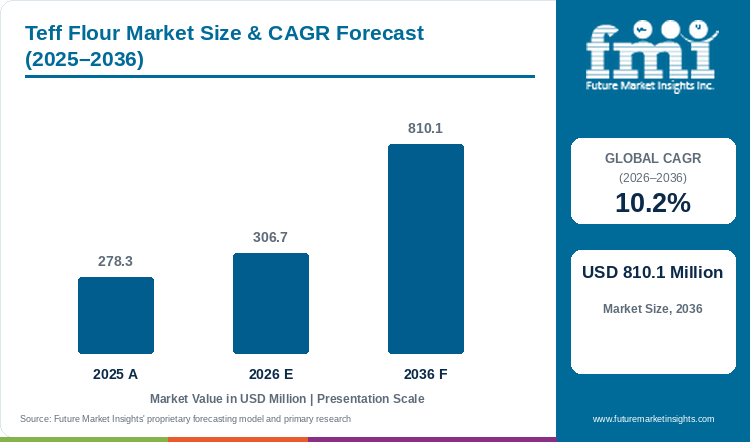
With a valuation of USD 278.3 million in 2025 and moving to USD 306.7 million in 2026, the global teff flour market is positioned to attain USD 810.1 million by 2036, exhibiting a CAGR of 10.2%.
Commercial free-from bakeries are replacing refined rice and tapioca starches with whole-grain Eragrostis tef flour to fix the low fiber and mineral density of first-generation gluten-free loaves, expanding global teff flour industry valuation beyond its USD 278.3 million mark in 2025 to reach USD 306.7 million in 2026 while scaling toward USD 810.1 million by 2036 via a 10.2% decade CAGR. This outlook was reinforced in September 2025 when a review in IJMS (PMCID PMC12524473) detailed how teff's naturally gluten-free essential amino acids and bioavailable iron upgrade the dietary profile of commercial breads and pasta [1]. Because teff's tiny seed size makes bran separation uneconomical and preserves whole-seed nutrients across gluten-free flours blending lines in 2026, Standard Whole-Grain Milled Teff Flour accounts for an estimated 46.2% Milling Grade segment share and underpins USD 503.4 million in ten-year market growth. Even so, mandatory batch ELISA testing below 20 parts per million of gluten and higher grain-cleaning costs still slow vendor qualification among mid-sized bakeries.
Key Market Trends & Insights
- By milling grade: Standard Whole-Grain Milled Teff Flour holds an estimated 46.2% of the Milling Grade segment in 2026 through intact whole-seed grinding efficiency and high calcium and iron retention.
- By botanical variety & format: Brown / Red Whole-Grain Teff Flour represents a projected 52.8% Botanical Variety & Format segment share in 2026, aided by roasted-hazelnut flavor notes that mask hydrocolloid off-tastes.
- By application: Within the Application segment in 2026, Gluten-Free & Multigrain Bread, Rolls & Flatbreads hold a forecast 36.4% share via structured 15% to 30% teff inclusion in commercial pan loaves.
- By label claim: Certified Gluten-Free (<20 ppm Verified) garners an anticipated 54.6% Label Claim segment share in 2026 under mandatory FDA and European Union allergen thresholds for free-from retail shelves.
- By sales channel: Contracted Gluten-Free & Commercial Bakeries capture an expected 57.3% of the Sales Channel segment in 2026 through direct palletized bag and intermediate bulk tote replenishment.
Regional Highlights
- North America and UK free-from velocity: The USA leads the eight covered national markets via an 11.5% annual CAGR ending 2036 on expanding Idaho and Nevada irrigated teff milling, trailed by the UK posting 10.9%.
- Middle East and Europe plus East Asia adoption: Demand in the UAE compounds at 10.6% per year ahead of Saudi Arabia posting 10.3% and Germany recording 9.9%, whereas South Korea logs 9.5% above France (9.1%) and Japan (8.6%) on specialized allergen-controlled bakery demand.
Market Size & Forecast
Table 1: Market Size and Forecast for the Teff Flour Market (USD million and CAGR percentage), 2025 to 2036
| Metric | Value |
|---|---|
| 2025 Market Size | USD 278.3 million |
| Estimated Market Size in 2026 | USD 306.7 million |
| Projected Market Size by 2036 | USD 810.1 million |
| CAGR, 2026 to 2036 | 10.2% |
| Added Revenue, 2026 to 2036 | USD 503.4 million |
Realization of the USD 503.4 million in ten-year expansion between 2026 and 2036 requires solving the rapid crumb staling and structural collapse that occur when wheat-free batters lack a viscoelastic gluten network. Without gluten proteins to trap carbon dioxide during yeast proofing, high-teff doughs can turn dense and crumbly; to address this formulation barrier, May 2026 baking rheology trials in Scientific Reports demonstrated that combining plant mucilage with xanthan gum hydrocolloids stabilizes gas cells and retains loaf softness during storage [2]. Building on these hydration findings, industrial bakery formulators now pair fine-milled teff with specialty baking enzymes and cellulose hydrocolloids so commercial pan loaves slice cleanly without crumbling on retail shelves.
Dedicated Gluten-Free Milling and Lot-Tested Tonnage Sizing
Table 2: Dedicated Milling Throughput and Lot-Tested Tonnage Sizing for the Teff Flour Market (USD million and operational ranges), 2025 to 2036
| Metric | 2025 | 2026 | 2036 |
|---|---|---|---|
| Market size (USD million) | 278.3 | 306.7 | 810.1 |
| Commercial milled teff flour shipments (thousand metric tons) | 118.0 to 129.0 | 129.5 to 141.5 | 318.0 to 348.0 |
| Cleaned food-grade teff grain input (thousand metric tons) | 122.0 to 134.0 | 134.0 to 147.0 | 328.0 to 360.0 |
| Average B2B contract price per metric ton (USD) | 2,160 to 2,360 | 2,170 to 2,370 | 2,330 to 2,550 |
Operational note: Whole-seed grinding balances reflect 96% to 98% whole-grain flour yield after optical destoning and aspirator cleaning, as teff's 0.8-to-1.0-millimeter seed diameter is milled whole without bran sifting.
Unlike hulled grains that lose a quarter of their mass during debranning, teff converts 96% to 98% of cleaned grain weight directly into commercial whole-grain flour as tracked in Table 2. Yet that high milling extraction yield comes with strict upstream cleaning requirements because teff kernels measure less than 1 millimeter across and cannot be separated from field sand or stray wheat kernels on standard cereal gravity tables. To support 2026 wholesale contract pricing between USD 2,170 and USD 2,370 per ton, dedicated teff millers invest in fine-mesh vibratory sifters and optical destoners that guarantee <20 ppm allergen purity for gluten-free products manufacturers.
Per Capita & Free-From Bakery Facility Sizing
Table 3: Per Capita and Bakery Facility Procurement Indicators for the Teff Flour Market (USD), 2025 to 2036
| Metric | 2025 | 2026 | 2036 |
|---|---|---|---|
| World population (billion) | 8.2 | 8.3 | 9.0 |
| Global teff flour spend per 1,000 people (USD) | 33.9 | 37.0 | 90.0 |
| Annual teff flour spend per qualified gluten-free bakery (USD thousand) | 48.0 to 61.0 | 52.0 to 66.0 | 108.0 to 136.0 |
| ELISA batch-certified <20 ppm lot share (%) | 69.0% to 73.0% | 71.5% to 75.5% | 81.0% to 85.0% |
Table 4: Milling & Certification Allocation Benchmarks for the Teff Flour Market (USD and percentages), 2026
| Metric | Value | Institutional Reference Basis |
|---|---|---|
| Global market size, 2026 | USD 306.7 million | 2026 commercial teff flour baseline |
| Statutory gluten-free labeling ceiling | 20 ppm (20 mg/kg) | US FDA 21 CFR 101.91 and EU Reg 828/2014 |
| Brown / red whole-grain teff allocation, 2026 | 52.8% share | High-iron malted-flavor bakery and retail grade |
| Certified gluten-free (<20 ppm) allocation, 2026 | 54.6% share | Dedicated wheat-free mill and ELISA-verified lots |
The rising share of ELISA batch-certified <20 ppm lots in Tables 3 and 4 reflects strict supermarket audit rules that penalize any undeclared cereal cross-contact in health-food aisles. Beyond celiac-safe bread, snack and breakfast manufacturers want plant protein fortification that avoids both wheat gluten and soy allergens on front-of-pack labels. This dual clean-label and nutrition requirement prompts food formulators to blend brown or ivory teff flour with sorghum flour in extruded wafers and pancake mixes to balance lysine and mineral levels naturally.
Analyst Perspective
"Securing recurring industrial bakery contracts for teff flour requires more than ancient-grain marketing appeal; suppliers must prove sub-180-micron particle granulation that eliminates sandy crumb mouthfeel along with audited <20 ppm gluten cross-contact records. Millers offering both earthy brown and neutral ivory teff varieties in bulk totes will lead commercial reformulation."
- Nandini Roy Choudhury, Principal Consultant, Future Market Insights.
How is the teff flour market segmented?
The teff flour market is segmented by milling grade, botanical variety & format, application, label claim, sales channel, and region. In 2026, Standard Whole-Grain Milled Teff Flour is estimated at 46.2%, Brown / Red Whole-Grain Teff Flour is projected at 52.8%, Gluten-Free & Multigrain Bread, Rolls & Flatbreads are forecast at 36.4%, Certified Gluten-Free (<20 ppm Verified) is anticipated at 54.6%, and Contracted Gluten-Free & Commercial Bakeries are expected at 57.3%.
By milling grade: Standard Whole-Grain Milled Teff Flour, Ultra-Fine / Micronized Patisserie Teff Flour, Thermally Debittered & Pre-Gelatinized Teff Flour, and Traditional Fermented-Starter Grade Teff Flour.
By botanical variety & format: Brown / Red Whole-Grain Teff Flour, Ivory / White Mild-Flavor Teff Flour, Functional Gluten-Free Teff & Hydrocolloid Premix Bases, and Multi-Ancient-Grain Teff Inclusion Blends.
By application: Gluten-Free & Multigrain Bread, Rolls & Flatbreads, Cakes, Muffins, Brownies & Quick Breads, Biscuits, Cookies, Wafers & Crisp Snacks, Breakfast Pancakes, Waffles & Porridge Mixes, and Gluten-Free Pasta, Extruded Snacks & Batter Systems.
By label claim: Certified Gluten-Free (<20 ppm Verified), Dual Certified Organic & Gluten-Free, Conventional Multi-Grain Bakery Grade, and Non-GMO & Identity-Preserved Origin Verified.
By sales channel: Contracted Gluten-Free & Commercial Bakeries, Specialty Food Ingredient Distributors, Foodservice, Hotel & Ethnic Bakery Supply, and Specialty Retail & B2B Online Channels.
What keeps Standard Whole-Grain Milled Teff Flour central to the milling grade segment?
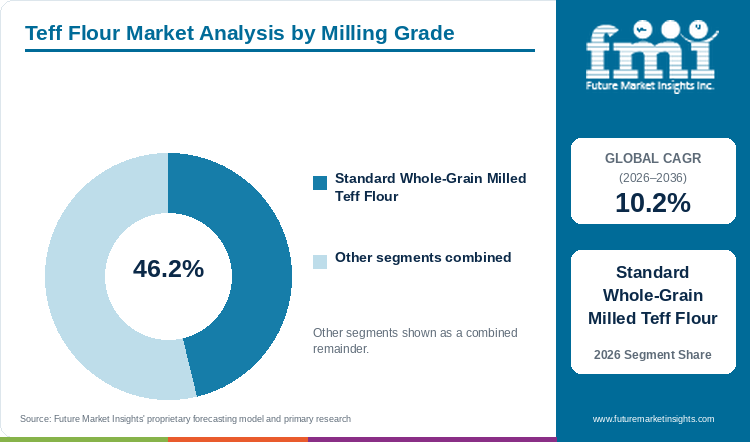
Within the Milling Grade segment in 2026, Standard Whole-Grain Milled Teff Flour accounts for an estimated 46.2% share on intact whole-seed grinding yield.
Table 5: Milling Grade Share for the Teff Flour Market (percentage share), 2026
| Milling Grade | Share (2026) |
|---|---|
| Standard Whole-Grain Milled Teff Flour | 46.2% |
| Other Segments Combined | 53.8%* |
| Total | 100.0% |
*Calculated as the balance remaining after deducting the leading segment's reported share from 100.0%.
Table 6: Milling Grade Leadership and Market Growth for the Teff Flour Market (segment and CAGR percentage), 2026 to 2036
| Metric | Value |
|---|---|
| Global CAGR (2026 to 2036) | 10.2% |
| Leading Segment | Standard Whole-Grain Milled Teff Flour |
Commercial bakery buyers choose Standard Whole-Grain Milled Teff Flour over micronized or thermally pre-gelatinized grades because single-pass stone and impact grinding avoids air-classification surcharges while preserving 100% of the kernel's bran and germ nutrients. By blending this baseline whole-grain grade with millet flour, industrial bread plants qualify for front-of-pack whole-grain stamps and boost dietary iron without adding synthetic fortificants.
- Standard Whole-Grain Milled Teff Flour secures an estimated 46.2% Milling Grade segment share for the 2026 base year because whole-seed impact milling retains 96% to 98% of cleaned grain weight.
- Demonstrating why whole-grain teff outperforms refined starch in composite batters, a February 2025 D-optimal mixture study in Scientific Reports confirmed that whole-grain teff flour elevates iron and calcium plus protein density while fermentation reduces phytic acid [3].
Why does Brown / Red Whole-Grain Teff Flour lead the botanical variety & format segment?
Brown / Red Whole-Grain Teff Flour commands a projected 52.8% of the Botanical Variety & Format segment in 2026 from natural malted-cocoa flavor notes.
While mild Ivory Teff Flour is preferred for light-colored sandwich loaves, Brown / Red Whole-Grain Teff Flour captures the majority of commercial volume because its toasted malted-cocoa aroma masks the grassy off-notes of pea protein and xanthan gum in gluten-free formulations. Furthermore, brown teff cultivars deliver more consistent field yields and allow bakeries running ancient-grain flour blends to achieve rich dark-bread and brownie crumb color without caramel dye.
- Within the Botanical Variety & Format segment in 2026, Brown / Red Whole-Grain Teff Flour represents a projected 52.8% share through field yield stability and strong sensory appeal in dark baked goods.
- Highlighting the bioactive compounds that differentiate teff varieties, in February 2026 phytochemical profiling in Molecules characterized the phenolic acid and flavonoid composition of Eragrostis tef flour extracts used in functional foods [4].
How do Gluten-Free & Multigrain Bread, Rolls & Flatbreads retain the lead in the application segment?
Gluten-Free & Multigrain Bread, Rolls & Flatbreads secure a forecast 36.4% Application segment share in 2026 across commercial free-from loaf and injera production.
Unlike sweet cakes or extruded snacks where teff is used at low 5% to 10% dusting ratios, Gluten-Free & Multigrain Bread, Rolls & Flatbreads incorporate 15% to 30% teff in pan loaves and up to 100% in traditional fermented injera flatbreads. To prevent loaf collapse at these higher inclusion rates, commercial bakeries combine milled teff with hydrocolloids and fermented sourdough ingredients that improve gas retention and slow crumb staling.
- Gluten-Free & Multigrain Bread, Rolls & Flatbreads hold a forecast 36.4% Application segment share in 2026 on daily household bread consumption and foodservice flatbread programs.
- Confirming the role of fermentation in flatbread quality, in March 2026 trials published in Food Science & Nutrition demonstrated that controlled blending ratios and multi-hour fermentation intervals govern crumb eye formation and rollability in teff flatbreads [5].
What supports Certified Gluten-Free (<20 ppm Verified) as the leading label claim segment?
Across the Label Claim segment in 2026, Certified Gluten-Free (<20 ppm Verified) holds an anticipated 54.6% share under statutory 20 ppm allergen thresholds.
Even though Eragrostis tef contains zero botanical gluten, uncertified teff grain harvested or milled on shared wheat equipment frequently suffers cross-contact that disqualifies it from free-from grocery aisles. Per federal FDA Gluten-Free Labeling of Foods enforcement guidance updated in March 2026, finished foods and ingredient flours bearing a gluten-free claim must contain fewer than 20 parts per million of unavoidable gluten [6]. That statutory threshold forces industrial buyers across gluten-free pasta and bread plants to purchase exclusively from dedicated gluten-free mills providing batch ELISA certificates.
- Certified Gluten-Free (<20 ppm Verified) represents an anticipated 54.6% of the Label Claim segment in 2026 under strict retailer audit protocols and celiac association licensing rules.
- To guide standardized processing for commercial gluten-free lines, October 2025 research in Scientific Reports quantified thermal drying and moisture-control parameters for shelf-stable teff bakery distribution [7].
Why are Contracted Gluten-Free & Commercial Bakeries the core sales channel segment?
Across the Sales Channel segment in 2026, Contracted Gluten-Free & Commercial Bakeries hold an expected 57.3% share via multi-ton palletized bag and bulk tote contracts.
Because a single wheat cross-contact incident can trigger a nationwide product recall, packaged free-from bread and snack manufacturers bypass spot-market brokers and contract directly with dedicated specialty flour mills. Direct mill-to-bakery contracts allow quality-assurance teams to audit upstream optical grain cleaning and lock in sub-180-micron granulation across 50-pound multiwall sacks and 1,000-kilogram bulk totes.
- In 2026, Contracted Gluten-Free & Commercial Bakeries account for an expected 57.3% share within the Sales Channel segment from high-volume production runs and custom blend specification support.
- To scale dedicated grain-cleaning capacity for commercial bakeries, Ardent Mills signed a July 2025 purchase contract for Stone Mill in Richardton, North Dakota [8].
What are the drivers, restraints, and opportunities in the teff flour market?
In the teff flour market, whole-grain reformulation of gluten-free baked goods drives recurring mill demand, whereas supply-chain adulteration risks and gritty hull texture restrain high inclusion rates and micronized organic grades open new contracts.
- Driver: Gluten-free bakery brands replace refined rice and potato starches with whole-grain teff flour to upgrade fiber and iron plus protein nutrition panels.
- Restraint: Supply-chain adulteration risks in informal grain channels and wheat cross-contact hazards plus gritty mouthfeel above 30% inclusion slow industrial qualification.
- Opportunity: Certified organic brown and ivory teff flours paired with ultra-fine micronization expand adoption in clean-label wafers and brownies plus pasta.
Growth Analysis and Future Potential: Qualitative Demand Catalysts
The central demand driver propelling the teff flour market is consumer dissatisfaction with first-generation gluten-free breads made from refined white rice flour and tapioca starch that lack dietary fiber and micronutrients. Blending milled teff into free-from doughs introduces bioavailable iron and calcium plus eight essential amino acids while supporting clean-label whole-grain claims across specialty ethnic food and retail bakery aisles. Substantiating this functional nutrition positioning, a July 2025 synthesis in Foods highlighted teff and companion ancient grains as nutrient-dense whole-grain replacements for refined starches in celiac-safe bakery diets [9].
Risk Assessment of the Teff Flour Market: Operational and Formulation Friction
Procurement teams scaling teff flour face two persistent operational risks: economically motivated adulteration in unverified spot grain channels and gritty crumb mouthfeel when coarse outer pericarp fibers exceed 30% of flour weight. Highlighting the supply-chain integrity risk, a March 2026 quality-assurance dataset published in Data in Brief documented adulteration of commercial teff flour with calcium sulfate gypsum powder and cellulose sawdust in unverified trading markets [10]. To prevent adulterated consignments and sandy loaf texture, industrial buyers mandate audited single-origin mill cleaning and pair fine-milled teff with cereal fiber texturizers.
Commercial Opportunity Analysis: Formulation Differentiation and Value-Add Formats
Specialty millers are capturing higher contract margins by combining dual certified organic and gluten-free credentials with ultra-fine micronization and sourdough-ready ancient-grain blends. Evidence for this value-add formulation route emerged in October 2025 when gluten-free sourdough baking research in Foods demonstrated that fortifying wheat-free sourdough matrices with high-protein plant and ancient-grain flours elevates antioxidant activity and mineral retention without sacrificing loaf volume [11]. Supplying sub-180-micron ivory and brown teff grades enables millers to win new commercial accounts in delicate gluten-free wafers and crepes plus extruded snacks.
Teff Flour Market by Country (2026 to 2036)
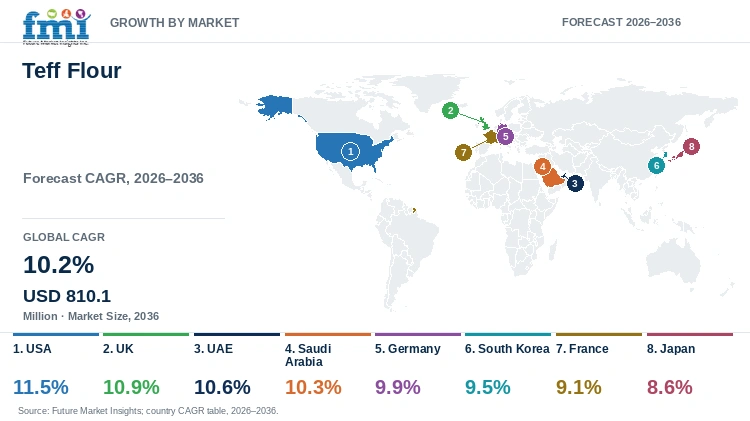
Irrigated domestic teff origination and dedicated gluten-free mill capacity place the USA first among the eight covered national markets via an 11.5% annual CAGR ending 2036, trailed by the UK posting 10.9% and the UAE recording 10.6%, while Japan compounds at 8.6% per year. National growth differentials reflect bulk commercial tote contracting in North America and Free-From aisle reformulation in the UK, coupled with hospitality catering in the Middle East and strict allergen-labeling rules across Europe and East Asia.
Table 7: Country CAGR and Primary Growth Levers for the Teff Flour Market (CAGR percentage and operational drivers), 2026 to 2036
| Country | CAGR (2026 to 2036) | Primary Growth Lever |
|---|---|---|
| USA | 11.5% | Domestic Idaho and Nevada irrigated teff milling, organic expansion, and FDA <20 ppm free-from bakery demand |
| UK | 10.9% | Supermarket Free-From aisle reformulation, Crossed Grain certification, and Doves Farm organic teff milling |
| UAE | 10.6% | Dubai Municipality digital food registration framework and hospitality and East Africa culinary catering growth |
| Saudi Arabia | 10.3% | SFDA.FD 1021 gluten-free food technical regulations and Certificate of Analysis import qualification |
| Germany | 9.9% | Celiac clinical awareness and EU Regulation 828/2014 20 mg/kg free-from bakery compliance |
| South Korea | 9.5% | MFDS mandatory wheat-allergen disclosure driving alternative-flour bakery R&D in Seoul and Gyeonggi |
| France | 9.1% | AFDIAG Logo Epi Barre crossed-grain facility audits and residual-gluten testing in specialty patisseries |
| Japan | 8.6% | Consumer Affairs Agency mandatory 8-allergen wheat labeling and rice-and-teff gluten-free bakery blending |
Source: Future Market Insights analysis
USA Teff Flour Market Outlook (2026 to 2036)
Ingredient shipments across the USA are projected to compound at an 11.5% annual CAGR into 2036, driven by domestic irrigated teff farming in Idaho and Nevada and dedicated <20 ppm gluten-free industrial mills. Unlike import-reliant markets facing ocean freight delays, commercial bakeries in the USA contract 50-pound sacks and bulk totes of teff flour directly from Ardent Mills and Maskal Teff. In May 2026, cereal rheology investigators at the University of Kentucky and USDA-ARS published gluten-free breadmaking trials in Foods showing how cultivar starch amylose ratios govern dough viscoelasticity across free-from bakeries in the USA [12]. Higher hydrocolloid binder costs still cap teff inclusion at 15% to 30% in mainstream loaves.
Key takeaway: In the USA, domestic irrigated teff origination and dedicated gluten-free industrial milling will power an 11.5% decade CAGR.
UK Teff Flour Market Outlook (2026 to 2036)
Supermarket Free-From bakery aisles in the UK are among the most consolidated globally, where private-label bread manufacturers reformulate white-starch loaves with whole-grain teff to improve fiber and iron nutrition scores. Across the UK, teff flour expenditure will register a forecast 10.9% annual CAGR ending 2036, supported by contract bakers upgrading nutrient density under strict <20 ppm Crossed Grain allergen audits. Confirming this formulation shift, USDA-FAS GAIN report UK2026-0008 documented in March 2026 that food and bakery processors across the UK prioritize clean-label and allergen-controlled specialty ingredients for retail Free-From shelves [13]. Because the UK climate cannot support commercial teff cultivation, domestic specialty millers remain exposed to ocean-freight swings on imported whole teff grain.
Key takeaway: In the UK, Free-From aisle loaf reformulation and domestic organic teff milling are forecast to generate a 10.9% yearly expansion.
UAE Teff Flour Market Outlook (2026 to 2036)
What makes the UAE distinct from Western markets is its dual demand engine: five-star hotel pastry kitchens in Dubai and Abu Dhabi order neutral ivory teff flour for gluten-free guest menus, while a large East Africa diaspora and restaurant sector procures bulk brown teff flour for daily fermented injera flatbreads. In August 2026, USDA-FAS GAIN report TC2026-0009 documented expanding hotel foodservice and domestic bakery processing capacity across the UAE reliant on imported specialty flours [14]. This combination of luxury hospitality and traditional flatbread catering is anticipated to lift teff flour turnover in the UAE at a 10.6% annual CAGR through 2036, owing to five-star hotel and foodservice procurement. Importers must still navigate strict Dubai Municipality digital barcode registration rules.
Key takeaway: In the UAE, digital food-import registration and dual hospitality and ethnic-bakery demand are anticipated to support a 10.6% yearly rate.
Saudi Arabia Teff Flour Market Outlook (2026 to 2036)
Urban diet diversification and rising clinical diagnosis of celiac and gluten sensitivity in Riyadh and Jeddah are transforming teff flour from an unfamiliar import into a sought-after health-bakery ingredient across Saudi Arabia. Market entry is governed by Saudi Food and Drug Authority regulation SFDA.FD 1021, requiring imported gluten-free flours to meet residual gluten ceilings and carry an accredited Certificate of Analysis at port clearance. While these inspection gates block informal spot traders, they create a protected channel for established millers in North America and Europe supplying batch ELISA certificates. Modern supermarket health aisles and specialty bakery commissaries are expected to advance teff flour sales in Saudi Arabia via a 10.3% decade CAGR toward 2036, reinforced by SFDA-compliant distribution.
Key takeaway: In Saudi Arabia, statutory SFDA.FD 1021 gluten-free regulations and mandatory Certificate of Analysis clearance are expected to anchor a 10.3% compound pace.
Germany Teff Flour Market Outlook (2026 to 2036)
Teff flour procurement in Germany is estimated to rise via a 9.9% annual CAGR into 2036, linked to Western Europe's largest network of Reformhaus health-food stores and industrial gluten-free bakeries operating under EU Regulation 828/2014 (maximum 20 mg/kg gluten). Unlike consumers who accept pale starch-based gluten-free bread, shoppers in Germany expect dark and hearty sourdough-fermented loaves that mimic traditional rye and wholegrain textures. To validate this sourdough approach, July 2025 baking research in Scientific Reports demonstrated that targeted Lactobacillus fermentation improves specific loaf volume and crumb softness in gluten-free breads [15]. High product-recall liability if shared mill lines exceed 20 mg/kg of wheat gluten still forces bakeries in Germany to pay premiums for dedicated allergen-segregated teff lots.
Key takeaway: In Germany, celiac clinical awareness and strict 20 mg/kg EU free-from bakery audits are estimated to drive a 9.9% annual growth pace.
South Korea Teff Flour Market Outlook (2026 to 2036)
Mandatory front- and back-of-pack wheat-allergen disclosure rules enforced by South Korea's Ministry of Food and Drug Safety are pushing bakery R&D teams in Seoul and Gyeonggi province to develop wheat-free breads and functional snacks. Teff flour billings in South Korea are projected to compound at a 9.5% annual CAGR through 2036, enabled by specialty cafés and health-food brands blending imported brown and ivory teff into rice-flour (ssal-ppang) loaves and cookies. Adding 15% to 25% teff flour corrects the low iron and dietary fiber profile of pure rice flour while imparting a roasted nutty aroma that appeals to health-conscious urban shoppers. Small batch import volumes through Incheon and Busan ports still keep wholesale teff prices above domestic rice flour and moderate mass-market switching.
Key takeaway: In South Korea, mandatory MFDS wheat-allergen labeling and premium café bakery innovation will support a 9.5% yearly expansion.
France Teff Flour Market Outlook (2026 to 2036)
Culinary expectations in France create a distinct technical hurdle for teff millers because pastry chefs and biscuit manufacturers in Paris and Lyon reject any sandy hull grittiness in gluten-free madeleines and sablés. At the same time, domestic free-from brands licensing the Crossed Grain symbol in France must pass annual facility audits and laboratory checks confirming residual gluten below 20 mg/kg across raw flour silos. Supplying ultra-fine micronized ivory and brown teff flours that satisfy both patisserie mouthfeel and organic grocery (magasins bio) audit standards is forecast to expand expenditure in France via a 9.1% decade CAGR ending 2036, attributed to certified free-from patisserie adoption. Energy-intensive fine classification milling required to reach sub-180-micron particle sizes adds processing cost for local distributors.
Key takeaway: In France, crossed-grain facility audits and patisserie demand for micronized flour textures are forecast to support a 9.1% CAGR.
Japan Teff Flour Market Outlook (2026 to 2036)
In Japan, commercial gluten-free baking has traditionally relied on ultra-fine rice flour (komeko), which produces soft white loaves but lacks iron and calcium plus natural crust browning. To upgrade the mineral profile and crust color of allergen-free breads under mandatory wheat-allergen labeling rules, bakeries in Tokyo and Osaka blend imported teff flour into rice-flour batters. However, April 2026 USDA-FAS GAIN report JA2026-0012 noted that food manufacturers in Japan enforce strict quality and allergen-segregation audits on imported specialty flours [16]. While strict quarantine checks for foreign seed and moisture uniformity lengthen initial vendor onboarding, allergen-free bakery orders across Japan are forecast to register an 8.6% annual CAGR through 2036, stemming from rice-flour bread fortification.
Key takeaway: In Japan, mandatory wheat-allergen labeling and nutrient fortification of rice-flour bakery products are projected to produce an 8.6% compound rate.
Full report country CAGRs cover: North America; Latin America; Western Europe; Eastern Europe; East Asia; South Asia and Pacific; Middle East and Africa.
Who are the notable companies in the teff flour market?
Ardent Mills, LLC, Maskal Teff (The Teff Company), Bob's Red Mill Natural Foods, Inc., Doves Farm Foods Ltd., King Arthur Baking Company, Inc., Archer Daniels Midland Company (ADM), Bay State Milling Company, and Tobia Teff UK are the notable companies in the teff flour market.
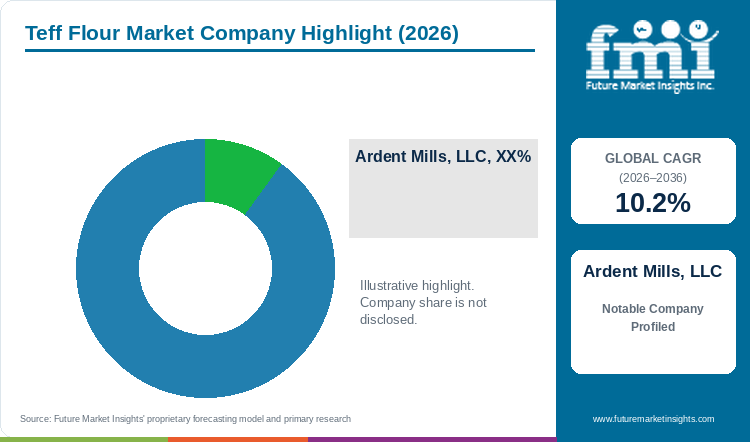
Supplier positioning across teff flour producers divides between dedicated teff originators that control irrigated seed varieties and batch ELISA testing, and multinational grain-milling platforms that bundle teff into industrial bakery contracts. Ardent Mills and Maskal Teff with Doves Farm Foods and Tobia Teff UK plus stone-miller Bob's Red Mill supply verified standalone brown and ivory teff flours across bulk tote and retail formats. Archer Daniels Midland Company (ADM) and Bay State Milling with King Arthur Baking complement standalone flours through whole brown teff origination and certified gluten-free ancient-grain milling infrastructure.
- Dedicated Teff Originators & Certified Gluten-Free Millers: Maskal Teff (The Teff Company) and Doves Farm Foods Ltd. with Tobia Teff UK and stone-miller Bob's Red Mill specialize in varietal brown and ivory teff milling under strict gluten-free and organic controls.
- Industrial Bulk Ancient-Grain & Bakery Milling Platforms: Ardent Mills, LLC and Archer Daniels Midland Company (ADM) along with Bay State Milling Company supply commercial 50-pound sacks and bulk totes plus thermally treated ancient-grain flours to plant bakeries.
- Technical Bakery Formulation & Multigrain Blend Specialists: King Arthur Baking Company, Inc. integrates teff into commercial multigrain bread systems and publishes validated inclusion protocols for professional and craft bakers.
Competitive Benchmarking: Teff Flour Market
Table 8: Competitive Benchmarking for the Teff Flour Market (qualitative capability ratings), 2026
| Company | Teff Variety & Flour Portfolio | Gluten-Free (<20 ppm) & Organic Controls | Industrial Bakery Formulation Support | Geographic Reach |
|---|---|---|---|---|
| Ardent Mills, LLC | High | High | High | USA, Canada, and Puerto Rico industrial bakery channels |
| Maskal Teff (The Teff Company) | High | High | Medium | USA and North America retail, foodservice, and B2B ingredient accounts |
| Bob's Red Mill Natural Foods, Inc. | High | High | Medium | USA, Canada, and international gluten-free retail and foodservice |
| Doves Farm Foods Ltd. | High | High | Medium | UK, European Union, and GCC specialty trade and retail channels |
| King Arthur Baking Company, Inc. | Medium | Medium | High | USA professional baking, artisan foodservice, and specialty retail |
| Archer Daniels Midland Company (ADM) | Medium | Medium | High | North America, Europe, and global B2B bakery ingredient networks |
| Bay State Milling Company | Medium | High | High | USA certified gluten-free industrial milling and bakery accounts |
| Tobia Teff UK | High | High | Medium | UK and Europe bakery, foodservice, and retail channels |
Scoring basis: Qualitative comparisons examine active brown and ivory teff flour SKUs and dedicated <20 ppm gluten-free lot controls as well as technical bakery application support for commercial dough and batter systems.
Key Developments in the Teff Flour Market
- In July 2025, Ardent Mills signed a transaction to purchase Stone Mill in Richardton, North Dakota to add dedicated gluten-free and identity-preserved cleaning capacity to its Emerging Nutrition portfolio.
- In 2026, Ardent Mills expanded commercial baker access to its Ancient Grains Plus baking flour blend and standalone Ivory and Brown Teff Flours across commercial bakery sacks and bulk totes.
- In 2025, Maskal Teff expanded retail and foodservice distribution in the USA for its Idaho-milled Brown and Ivory Teff Flours and certified organic ancient-grain offerings.
Key Players in the Teff Flour Market
Dedicated Teff Originators and Certified Gluten-Free Millers
- Maskal Teff (The Teff Company)
- Bob's Red Mill Natural Foods, Inc.
- Doves Farm Foods Ltd.
- Tobia Teff UK
Industrial Bulk Ancient-Grain and Bakery Milling Platforms
- Ardent Mills, LLC
- Archer Daniels Midland Company (ADM)
- Bay State Milling Company
Technical Bakery Formulation and Multigrain Blend Specialists
- King Arthur Baking Company, Inc.
Teff Flour Market - Report Scope
Table 9: Report Scope for the Teff Flour Market (coverage fields and definitions), 2026 to 2036
| Coverage field | Report scope |
|---|---|
| Market breakdown | Milling Grade; Botanical Variety & Format; Application; Label Claim; Sales Channel |
| Quantitative Units | USD Million |
| Market Definition | Commercial supplier revenue from dry milled teff (Eragrostis tef) flour and separable teff-flour bakery ingredient preparations sold across the five segmentation axes. Category Scope Note: Excludes retail value of finished baked bread/injera/cakes/snacks and unmilled whole teff grain sold without milling plus non-teff ancient-grain flours. |
| Regions Covered | North America; Latin America; Western Europe; Eastern Europe; East Asia; South Asia and Pacific; Middle East and Africa |
| Countries Covered | USA, UK, UAE, Saudi Arabia, Germany, South Korea, France, Japan, and additional countries in the full report |
| Key Companies Covered | Ardent Mills, LLC, Maskal Teff (The Teff Company), Bob's Red Mill Natural Foods, Inc., Doves Farm Foods Ltd., King Arthur Baking Company, Inc., Archer Daniels Midland Company (ADM), Bay State Milling Company, Tobia Teff UK |
| Forecast Period | 2026 to 2036 |
| Approach | Primary and secondary research with top-down and bottom-up market triangulation. |
Teff Flour Market - Research Methodology
Table 10: Research Methodology for the Teff Flour Market (research methods and approach), 2026 edition
| Method | Approach |
|---|---|
| Primary Research | Structured interviews with dedicated gluten-free flour millers and industrial free-from bakery formulators plus allergen quality-control directors and specialty grain importers to validate milling yields and <20 ppm ELISA testing costs. |
| Secondary Research | Analysis of U.S. FDA 21 CFR 101.91 and EU Regulation 828/2014 gluten-free labeling rules plus USDA Foreign Agricultural Service food-processing annuals and peer-reviewed cereal-science journals. |
| Market Sizing and Forecasting | Top-down gluten-free specialty flour expenditure models reconciled against bottom-up cleaned teff milling tonnage and brown-versus-ivory variety splits plus industrial tote versus packaged retail realization from 2025 to 2036. |
| Country Forecasting Model | Econometric national projections weight celiac and gluten-avoidance prevalence and supermarket Free-From shelf space plus mandatory wheat-allergen disclosure laws across eight countries. |
| Operational Benchmark Traceability | Milling mass balances and facility spending indicators in Tables 2 and 3 plus Table 4 trace to International Journal of Molecular Sciences and Molecules with Scientific Reports baking and drying studies. |
| Data Triangulation and Validation | Segment and country revenue estimates are cross-checked against dedicated gluten-free mill capacity and verified product catalogues while excluding unmilled teff grain and finished baked goods. |
Teff Flour Market by Segments
Teff Flour Market segmented by Milling Grade:
- Standard Whole-Grain Milled Teff Flour
- Ultra-Fine / Micronized Patisserie Teff Flour
- Thermally Debittered & Pre-Gelatinized Teff Flour
- Traditional Fermented-Starter Grade Teff Flour
Teff Flour Market segmented by Botanical Variety & Format:
- Brown / Red Whole-Grain Teff Flour
- Ivory / White Mild-Flavor Teff Flour
- Functional Gluten-Free Teff & Hydrocolloid Premix Bases
- Multi-Ancient-Grain Teff Inclusion Blends
Teff Flour Market segmented by Application:
- Gluten-Free & Multigrain Bread, Rolls & Flatbreads
- Cakes, Muffins, Brownies & Quick Breads
- Biscuits, Cookies, Wafers & Crisp Snacks
- Breakfast Pancakes, Waffles & Porridge Mixes
- Gluten-Free Pasta, Extruded Snacks & Batter Systems
Teff Flour Market segmented by Label Claim:
- Certified Gluten-Free (<20 ppm Verified)
- Dual Certified Organic & Gluten-Free
- Conventional Multi-Grain Bakery Grade
- Non-GMO & Identity-Preserved Origin Verified
Teff Flour Market segmented by Sales Channel:
- Contracted Gluten-Free & Commercial Bakeries
- Specialty Food Ingredient Distributors
- Foodservice, Hotel & Ethnic Bakery Supply
- Specialty Retail & B2B Online Channels
Teff Flour Market by Region
- North America
- United States
- Canada
- Latin America
- Brazil
- Mexico
- Argentina
- Chile
- Western Europe
- Germany
- France
- United Kingdom
- Italy
- Spain
- Benelux
- Nordics
- Eastern Europe
- Poland
- Czech Republic
- Romania
- Hungary
- East Asia
- China
- Japan
- South Korea
- South Asia and Pacific
- India
- ASEAN
- Australia and New Zealand
- Middle East and Africa
- GCC Countries
- South Africa
- Türkiye
- Israel
Research Sources and Bibliography
- [1] Abebe, B. S., Aprodu, I., Istrati, D. I., & Vizireanu, C. (2025, September 23). Nutritional Characteristics, Health-Related Properties, and Food Application of Teff (Eragrostis tef): An Overview. International Journal of Molecular Sciences, 26(19), 9293 (PMCID: PMC12524473).
- [2] Maphaha, V., & Tabit, F. T. (2026, May 20). Impact of mucilage incorporation into xanthan gum on the physical and textural characteristics of gluten-free bread during short-term storage. Scientific Reports, 16, 23014 (PMCID: PMC13392376).
- [3] Amtataw, M., Kassahun, E., Tibebu, S., Andargie, T., Ayanaw, T., Agazie, A., et al. (2025, February 1). Nutritional and anti-nutritional evaluation of injera made from Sorghum, Rice, Teff, and Flaxseed flours using D-optimal mixture design. Scientific Reports, 15, 3959 (PMCID: PMC11787393).
- [4] Ferențiu, I., Pop, T. I., Pârvu, A. E., Morar, I. I., Bolunduț, D., Pârvu, M., et al. (2026, February 13). White Teff Flour Ethanolic Extract: Phytochemical Profile, Antioxidant and Anti-Inflammatory Activity. Molecules, 31(4), 644 (PMCID: PMC12942821).
- [5] Cherinet, Y. L., Tenagasahw, M. W., Ambaw, B. A., Asemu, A. M., Hilemeskel, W. H., Mossie, B. B., & Sendekie, Z. B. (2026, March 8). Effect of Blending Ratio and Fermentation Time on the Quality and Acceptability of Injera Produced from a Composite of Teff, Maize, and Potato Flours. Food Science & Nutrition, 14(3), e71606 (PMCID: PMC12967572).
- [6] U.S. Food and Drug Administration. (2026, March 17). Gluten-Free Labeling of Foods. U.S. Food and Drug Administration.
- [7] Asrate, D. A., Ali, A. N., & Tadle, F. B. (2025, October 8). Comparative analysis of drying methods and optimization of Teff Injera drying parameters using RSM and SLP approach. Scientific Reports, 15, 35206 (PMCID: PMC12508459).
- [8] Ardent Mills, LLC. (2025, July 31). Ardent Mills Enters Agreement to Acquire Stone Mill in North Dakota, Expanding Emerging Nutrition Portfolio. Ardent Mills News.
- [9] Aweya, J. J., Sharma, D., Bajwa, R. K., Earnest, B., Krache, H., & Moghadasian, M. H. (2025, July 18). Ancient Grains as Functional Foods: Integrating Traditional Knowledge with Contemporary Nutritional Science. Foods, 14(14), 2529 (PMCID: PMC12294667).
- [10] Bochera, Z. A., Gizaw, S., & Onime, C. (2026, March 6). Images dataset of pure and adulterated Teff (Eragrostis tef (Zucc.) Trotter) flour with wood flour (sawdust) and gypsum (calcium sulfate) powder for machine learning based identification of Teff flour adulteration and prediction of the level adulteration. Data in Brief, 66, 112656 (PMCID: PMC13247584).
- [11] Nakov, G., Jukić, M., Soler, F., Syleimanova, S., Lukinac, J., Estivi, L., et al. (2025, October 20). Enhancing the Antioxidant and Nutritional Profile of Gluten-Free Sourdough Bread Using Hemp Press Cake Meal. Foods, 14(20), 3571 (PMCID: PMC12564878).
- [12] Singh, M., & Adedeji, A. A. (2026, May 13). Proso Millet Cultivar Effects on Rheology of Dough and Quality Characteristics of Gluten-Free Breads. Foods, 15(10), 1711 (PMCID: PMC13206684).
- [13] USDA Foreign Agricultural Service. (2026, March 24). United Kingdom: Food Processing Ingredients Annual. USDA GAIN Report UK2026-0008.
- [14] USDA Foreign Agricultural Service. (2026, August 4). United Arab Emirates: Food Processing Ingredients Annual. USDA GAIN Report TC2026-0009.
- [15] Seyedahmadi, S., Gharekhani, M., Tariverdi, S., & Bakhshabadi, H. (2025, July 22). Enhancing the quality of rice-based gluten-free bread using sourdoughs fermented with Lactobacillus fermentum and Lactobacillus plantarum. Scientific Reports, 15, 26543 (PMCID: PMC12280017).
- [16] USDA Foreign Agricultural Service. (2026, April 1). Japan: Food Processing Ingredients Annual. USDA GAIN Report JA2026-0012.
This bibliography is provided for reader reference and is not exhaustive. The full report contains the complete reference list and detailed citations.
This Report Answers
- What is the global teff flour market valuation in 2026 and what is forecast by 2036?
- Why do gluten-free bakeries replace refined starches with whole-grain Eragrostis tef flour?
- Why does Standard Whole-Grain Milled Teff Flour lead the Milling Grade segment?
- Why does Brown / Red Whole-Grain Teff Flour hold the largest Botanical Variety & Format segment share?
- How do national growth rates compare across the USA and the UK plus the UAE and Saudi Arabia?
- Which millers supply batch-tested <20 ppm gluten-free and organic teff flour today?
- Where do grain adulteration risks and coarse hull grittiness restrict formulation scale-up?
- Which ELISA gluten-residual and micronization specs should bakery buyers audit before ordering?
Frequently Asked Questions
How big is the teff flour market in 2026, and what is forecast for 2036?
Dedicated free-from milling carries global teff flour sales from USD 278.3 million in 2025 to USD 306.7 million in 2026, while 10-year projections reach USD 810.1 million by 2036 across gluten-free bread and snack makers.
What is the CAGR for the teff flour market from 2026 to 2036?
Forecast modeling projects a 10.2% annual growth rate across 2026 to 2036, generating USD 503.4 million in additional yearly revenue by the end of the decade.
Which milling grade segment leads the teff flour market?
In 2026, Standard Whole-Grain Milled Teff Flour accounts for an estimated 46.2% Milling Grade segment share through intact whole-seed impact grinding and high dietary fiber retention.
Which botanical variety & format segment leads the teff flour market?
In 2026, Brown / Red Whole-Grain Teff Flour represents a projected 52.8% Botanical Variety & Format segment share from its natural cocoa-hazelnut aroma and iron density in dark breads and brownies.
Which country records the strongest growth outlook during the assessment period?
The USA paces all covered countries via an 11.5% annual CAGR ending 2036, supported by domestic irrigated teff cultivation in Idaho and Nevada plus FDA <20 ppm gluten-free bakery reformulation.
Who are the key players in the teff flour market?
Active suppliers profile Ardent Mills, LLC and Maskal Teff (The Teff Company) with Doves Farm Foods Ltd., Tobia Teff UK, King Arthur Baking Company, Inc., Archer Daniels Midland Company (ADM), Bay State Milling Company, and Oregon stone-miller Bob's Red Mill.
Preview the report firsthand - request a free sample
Get SampleGet the brochure for pricing and purchase details.
Get PDFTable of Content
- Key Takeaways
- Market Size and CAGR
- Top Growth Driver
- Fastest Growing Segment
- Leading Region
- Key Companies
- Emerging Opportunities
- Executive Summary
- Global Market Outlook
- Demand-side Trends
- Supply-side Trends
- Technology Roadmap Analysis
- Analysis and Recommendations
- Analyst Perspective (What is happening? Why now? What should investors know?)
- Key Questions Answered
- How large is the market?
- What is the CAGR?
- What are key trends?
- Which region dominates?
- Who are the leaders?
- Market Overview
- Market Coverage / Taxonomy
- Market Definition / Scope / Limitations
- Research Methodology
- Chapter Orientation
- Analytical Lens and Working Hypotheses
- Market Structure, Signals, and Trend Drivers
- Benchmarking and Cross-market Comparability
- Market Sizing, Forecasting, and Opportunity Mapping
- Research Design and Evidence Framework
- Desk Research Programme (Secondary Evidence)
- Expert Input and Fieldwork (Primary Evidence)
- Tooling, Models, and Reference Databases
- Data Engineering and Model Build
- Quality Assurance and Audit Trail
- Market Background
- Market Dynamics (Drivers, Restraints, Opportunity, Trends)
- Scenario Forecast (Optimistic, Likely, Conservative)
- Impact Analysis
- AI Impact
- Sustainability Impact
- Regulatory Impact
- Technology Impact
- Consumer / Buyer Analysis
- Purchase Drivers
- Adoption Barriers
- Buyer Journey
- Opportunity Map Analysis
- Product Life Cycle Analysis
- Supply Chain Analysis
- Investment Feasibility Matrix
- Value Chain Analysis
- PESTLE and Porter's Analysis
- Regulatory Landscape
- Regional Parent Market Outlook
- Production and Consumption Statistics
- Import and Export Statistics
- Global Market Analysis and Forecast, 2021 to 2036
- Historical Market Size Value (USD Million) Analysis, 2021 to 2025
- Current and Future Market Size Value (USD Million) Projections, 2026 to 2036
- Y-o-Y Growth Trend Analysis
- Absolute $ Opportunity Analysis
- Global Market Pricing Analysis, 2021 to 2036
- Global Market Analysis and Forecast, By Milling Grade, 2021 to 2036
- Introduction / Key Findings
- Historical Market Size Value (USD Million) Analysis By Milling Grade, 2021 to 2025
- Current and Future Market Size Value (USD Million) Analysis and Forecast By Milling Grade, 2026 to 2036
- Standard Whole-Grain Milled Teff Flour
- Ultra-Fine / Micronized Patisserie Teff Flour
- Thermally Debittered & Pre-Gelatinized Teff Flour
- Traditional Fermented-Starter Grade Teff Flour
- Y-o-Y Growth Trend Analysis By Milling Grade, 2021 to 2025
- Absolute $ Opportunity Analysis By Milling Grade, 2026 to 2036
- Global Market Analysis and Forecast, By Botanical Variety & Format, 2021 to 2036
- Introduction / Key Findings
- Historical Market Size Value (USD Million) Analysis By Botanical Variety & Format, 2021 to 2025
- Current and Future Market Size Value (USD Million) Analysis and Forecast By Botanical Variety & Format, 2026 to 2036
- Brown / Red Whole-Grain Teff Flour
- Ivory / White Mild-Flavor Teff Flour
- Functional Gluten-Free Teff & Hydrocolloid Premix Bases
- Multi-Ancient-Grain Teff Inclusion Blends
- Y-o-Y Growth Trend Analysis By Botanical Variety & Format, 2021 to 2025
- Absolute $ Opportunity Analysis By Botanical Variety & Format, 2026 to 2036
- Global Market Analysis and Forecast, By Application, 2021 to 2036
- Introduction / Key Findings
- Historical Market Size Value (USD Million) Analysis By Application, 2021 to 2025
- Current and Future Market Size Value (USD Million) Analysis and Forecast By Application, 2026 to 2036
- Gluten-Free & Multigrain Bread, Rolls & Flatbreads
- Cakes, Muffins, Brownies & Quick Breads
- Biscuits, Cookies, Wafers & Crisp Snacks
- Breakfast Pancakes, Waffles & Porridge Mixes
- Gluten-Free Pasta, Extruded Snacks & Batter Systems
- Y-o-Y Growth Trend Analysis By Application, 2021 to 2025
- Absolute $ Opportunity Analysis By Application, 2026 to 2036
- Global Market Analysis and Forecast, By Label Claim, 2021 to 2036
- Introduction / Key Findings
- Historical Market Size Value (USD Million) Analysis By Label Claim, 2021 to 2025
- Current and Future Market Size Value (USD Million) Analysis and Forecast By Label Claim, 2026 to 2036
- Certified Gluten-Free (<20 ppm Verified)
- Dual Certified Organic & Gluten-Free
- Conventional Multi-Grain Bakery Grade
- Non-GMO & Identity-Preserved Origin Verified
- Y-o-Y Growth Trend Analysis By Label Claim, 2021 to 2025
- Absolute $ Opportunity Analysis By Label Claim, 2026 to 2036
- Global Market Analysis and Forecast, By Sales Channel, 2021 to 2036
- Introduction / Key Findings
- Historical Market Size Value (USD Million) Analysis By Sales Channel, 2021 to 2025
- Current and Future Market Size Value (USD Million) Analysis and Forecast By Sales Channel, 2026 to 2036
- Contracted Gluten-Free & Commercial Bakeries
- Specialty Food Ingredient Distributors
- Foodservice, Hotel & Ethnic Bakery Supply
- Specialty Retail & B2B Online Channels
- Y-o-Y Growth Trend Analysis By Sales Channel, 2021 to 2025
- Absolute $ Opportunity Analysis By Sales Channel, 2026 to 2036
- Global Market Analysis and Forecast, By Region, 2021 to 2036
- Introduction
- Historical Market Size Value (USD Million) Analysis By Region, 2021 to 2025
- Current Market Size Value (USD Million) Analysis and Forecast By Region, 2026 to 2036
- North America
- Latin America
- Western Europe
- Eastern Europe
- East Asia
- South Asia and Pacific
- Middle East and Africa
- Market Attractiveness Analysis By Region
- North America Market Analysis and Forecast, By Country, 2021 to 2036
- Historical Market Size Value (USD Million) Trend Analysis By Market Taxonomy, 2021 to 2025
- Market Size Value (USD Million) Forecast By Market Taxonomy, 2026 to 2036
- By Country
- United States
- Canada
- By Milling Grade
- By Botanical Variety & Format
- By Application
- By Label Claim
- By Sales Channel
- By Country
- Market Attractiveness Analysis
- By Country
- By Milling Grade
- By Botanical Variety & Format
- By Application
- By Label Claim
- By Sales Channel
- Key Takeaways
- Latin America Market Analysis and Forecast, By Country
- Historical Market Size Value (USD Million) Trend Analysis By Market Taxonomy, 2021 to 2025
- Market Size Value (USD Million) Forecast By Market Taxonomy, 2026 to 2036
- By Country
- Brazil
- Mexico
- Argentina
- Chile
- By Milling Grade
- By Botanical Variety & Format
- By Application
- By Label Claim
- By Sales Channel
- By Country
- Market Attractiveness Analysis
- By Country
- By Milling Grade
- By Botanical Variety & Format
- By Application
- By Label Claim
- By Sales Channel
- Key Takeaways
- Western Europe Market Analysis and Forecast, By Country
- Historical Market Size Value (USD Million) Trend Analysis By Market Taxonomy, 2021 to 2025
- Market Size Value (USD Million) Forecast By Market Taxonomy, 2026 to 2036
- By Country
- Germany
- France
- United Kingdom
- Italy
- Spain
- Benelux
- Nordics
- By Milling Grade
- By Botanical Variety & Format
- By Application
- By Label Claim
- By Sales Channel
- By Country
- Market Attractiveness Analysis
- By Country
- By Milling Grade
- By Botanical Variety & Format
- By Application
- By Label Claim
- By Sales Channel
- Key Takeaways
- Eastern Europe Market Analysis and Forecast, By Country
- Historical Market Size Value (USD Million) Trend Analysis By Market Taxonomy, 2021 to 2025
- Market Size Value (USD Million) Forecast By Market Taxonomy, 2026 to 2036
- By Country
- Poland
- Czech Republic
- Romania
- Hungary
- By Milling Grade
- By Botanical Variety & Format
- By Application
- By Label Claim
- By Sales Channel
- By Country
- Market Attractiveness Analysis
- By Country
- By Milling Grade
- By Botanical Variety & Format
- By Application
- By Label Claim
- By Sales Channel
- Key Takeaways
- East Asia Market Analysis and Forecast, By Country
- Historical Market Size Value (USD Million) Trend Analysis By Market Taxonomy, 2021 to 2025
- Market Size Value (USD Million) Forecast By Market Taxonomy, 2026 to 2036
- By Country
- China
- Japan
- South Korea
- By Milling Grade
- By Botanical Variety & Format
- By Application
- By Label Claim
- By Sales Channel
- By Country
- Market Attractiveness Analysis
- By Country
- By Milling Grade
- By Botanical Variety & Format
- By Application
- By Label Claim
- By Sales Channel
- Key Takeaways
- South Asia and Pacific Market Analysis and Forecast, By Country
- Historical Market Size Value (USD Million) Trend Analysis By Market Taxonomy, 2021 to 2025
- Market Size Value (USD Million) Forecast By Market Taxonomy, 2026 to 2036
- By Country
- India
- ASEAN
- Australia and New Zealand
- By Milling Grade
- By Botanical Variety & Format
- By Application
- By Label Claim
- By Sales Channel
- By Country
- Market Attractiveness Analysis
- By Country
- By Milling Grade
- By Botanical Variety & Format
- By Application
- By Label Claim
- By Sales Channel
- Key Takeaways
- Middle East and Africa Market Analysis and Forecast, By Country
- Historical Market Size Value (USD Million) Trend Analysis By Market Taxonomy, 2021 to 2025
- Market Size Value (USD Million) Forecast By Market Taxonomy, 2026 to 2036
- By Country
- GCC Countries
- South Africa
- Türkiye
- Israel
- By Milling Grade
- By Botanical Variety & Format
- By Application
- By Label Claim
- By Sales Channel
- By Country
- Market Attractiveness Analysis
- By Country
- By Milling Grade
- By Botanical Variety & Format
- By Application
- By Label Claim
- By Sales Channel
- Key Takeaways
- Key Countries Market Analysis
- United States
- Pricing Analysis
- Market Share Analysis, 2025
- By Milling Grade
- By Botanical Variety & Format
- By Application
- By Label Claim
- By Sales Channel
- Canada
- Pricing Analysis
- Market Share Analysis, 2025
- By Milling Grade
- By Botanical Variety & Format
- By Application
- By Label Claim
- By Sales Channel
- Mexico
- Pricing Analysis
- Market Share Analysis, 2025
- By Milling Grade
- By Botanical Variety & Format
- By Application
- By Label Claim
- By Sales Channel
- Brazil
- Pricing Analysis
- Market Share Analysis, 2025
- By Milling Grade
- By Botanical Variety & Format
- By Application
- By Label Claim
- By Sales Channel
- Chile
- Pricing Analysis
- Market Share Analysis, 2025
- By Milling Grade
- By Botanical Variety & Format
- By Application
- By Label Claim
- By Sales Channel
- Germany
- Pricing Analysis
- Market Share Analysis, 2025
- By Milling Grade
- By Botanical Variety & Format
- By Application
- By Label Claim
- By Sales Channel
- United Kingdom
- Pricing Analysis
- Market Share Analysis, 2025
- By Milling Grade
- By Botanical Variety & Format
- By Application
- By Label Claim
- By Sales Channel
- Italy
- Pricing Analysis
- Market Share Analysis, 2025
- By Milling Grade
- By Botanical Variety & Format
- By Application
- By Label Claim
- By Sales Channel
- Spain
- Pricing Analysis
- Market Share Analysis, 2025
- By Milling Grade
- By Botanical Variety & Format
- By Application
- By Label Claim
- By Sales Channel
- France
- Pricing Analysis
- Market Share Analysis, 2025
- By Milling Grade
- By Botanical Variety & Format
- By Application
- By Label Claim
- By Sales Channel
- India
- Pricing Analysis
- Market Share Analysis, 2025
- By Milling Grade
- By Botanical Variety & Format
- By Application
- By Label Claim
- By Sales Channel
- ASEAN
- Pricing Analysis
- Market Share Analysis, 2025
- By Milling Grade
- By Botanical Variety & Format
- By Application
- By Label Claim
- By Sales Channel
- Australia and New Zealand
- Pricing Analysis
- Market Share Analysis, 2025
- By Milling Grade
- By Botanical Variety & Format
- By Application
- By Label Claim
- By Sales Channel
- China
- Pricing Analysis
- Market Share Analysis, 2025
- By Milling Grade
- By Botanical Variety & Format
- By Application
- By Label Claim
- By Sales Channel
- Japan
- Pricing Analysis
- Market Share Analysis, 2025
- By Milling Grade
- By Botanical Variety & Format
- By Application
- By Label Claim
- By Sales Channel
- South Korea
- Pricing Analysis
- Market Share Analysis, 2025
- By Milling Grade
- By Botanical Variety & Format
- By Application
- By Label Claim
- By Sales Channel
- Poland
- Pricing Analysis
- Market Share Analysis, 2025
- By Milling Grade
- By Botanical Variety & Format
- By Application
- By Label Claim
- By Sales Channel
- Hungary
- Pricing Analysis
- Market Share Analysis, 2025
- By Milling Grade
- By Botanical Variety & Format
- By Application
- By Label Claim
- By Sales Channel
- Türkiye
- Pricing Analysis
- Market Share Analysis, 2025
- By Milling Grade
- By Botanical Variety & Format
- By Application
- By Label Claim
- By Sales Channel
- South Africa
- Pricing Analysis
- Market Share Analysis, 2025
- By Milling Grade
- By Botanical Variety & Format
- By Application
- By Label Claim
- By Sales Channel
- UAE
- Pricing Analysis
- Market Share Analysis, 2025
- By Milling Grade
- By Botanical Variety & Format
- By Application
- By Label Claim
- By Sales Channel
- Saudi Arabia
- Pricing Analysis
- Market Share Analysis, 2025
- By Milling Grade
- By Botanical Variety & Format
- By Application
- By Label Claim
- By Sales Channel
- United States
- Market Structure Analysis
- Competition Dashboard
- Competition Benchmarking
- Market Share Analysis of Top Players
- By Regional
- By Milling Grade
- By Botanical Variety & Format
- By Application
- By Label Claim
- By Sales Channel
- Emerging Startups
- Innovation Benchmarking
- Competition Analysis
- Competition Deep Dive
- Ardent Mills, LLC
- Overview
- Product Portfolio
- Profitability by Market Segments
- Sales Footprint
- Strategy Overview
- Marketing Strategy
- Product Strategy
- Channel Strategy
- Maskal Teff (The Teff Company)
- Bob's Red Mill Natural Foods, Inc.
- Doves Farm Foods Ltd.
- King Arthur Baking Company, Inc.
- Archer Daniels Midland Company (ADM)
- Bay State Milling Company
- Tobia Teff UK
- Ardent Mills, LLC
- Case Studies
- Success Stories
- Recent Developments
- Competition Deep Dive
- Assumptions & Acronyms Used


