

- Market Size (2026)
- USD 425.3 Mn
- Forecast (2036)
- USD 844.5 Mn
- CAGR (2026 to 2036)
- 7.1%
How big is Wheat Bran & Cereal Sidestream Texturizers Market in 2026?
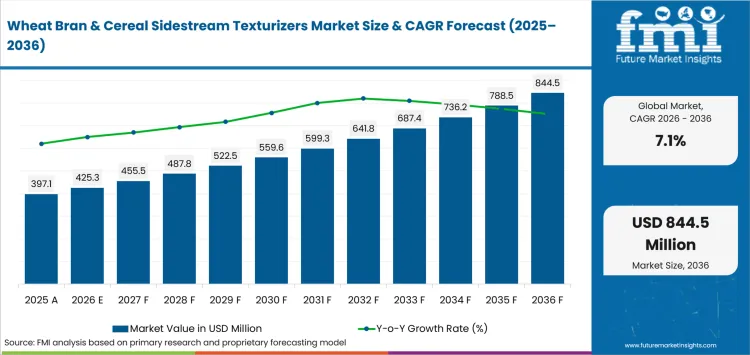
USD 425.3 million in 2026 and USD 844.5 million by 2036 at a 7.1% CAGR.
Sales of wheat bran & cereal sidestream texturizers are projected to expand at 7.1% CAGR from 2026 to 2036 and raise industry value from USD 425.3 million in 2026 to USD 844.5 million by 2036. The market is supported by the abundant supply of cereal-processing byproducts that can be recovered and converted into value-added fiber and texturizing ingredients. USDA reported in May 2026 that American flour mills produced 6.471 million tons of wheat millfeed during 2025. That volume creates substantial recovery potential in dietary fiber segment although food-grade conversion requires segregation and validated treatment.
German milling corridors combine substantial grain throughput with industrial bakery customers across several regional clusters. Finland supports smaller development programs through concentrated cereal processors and transparent national grain record systems. Germany's federal agriculture statistics reported in March 2026 that mills processed 4.6 million tonnes of grain from July through December 2025. Large German programs require consistent output across multiple production sites and several established recipe systems. Finnish programs can coordinate specifications across fewer industrial partners although longer service routes increase pilot costs outside major processing centers. Both countries require traceable food-grade controls that support comparison with established food texturing agents products.
Key Takeaways of Wheat Bran & Cereal Sidestream Texturizers Market
- Demand increases as mills and brewers seek higher returns from cereal fractions that deliver verified texture and water-management performance across commercial recipes.
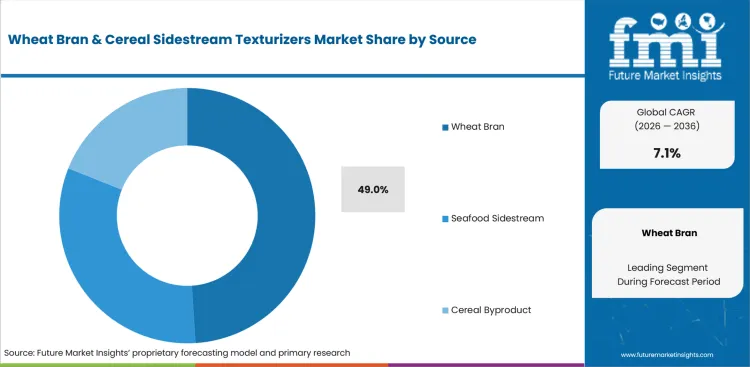
- By source, wheat bran is expected to lead with 49.0% share in 2026 driven by established milling access and food-grade segregation routes.
- Hydrocolloid is projected to capture 45.5% of function in 2026 owing to recipes that require predictable hydration and stable finished-product structure.
- Plant-based is anticipated to represent 45.5% of application in 2026 supported by formulations that need moisture control beside concentrated protein systems.
- Variable feedstock composition and incomplete processing records remain material barriers to repeat orders across regulated food applications and recurring production programs.
- Competition includes COMET Bio and Agrain across specialized sidestream ingredients with Upcycled Foods and EverGrain adding spent-grain commercialization. Bühler and Alfa Laval provide process development and separation technology for commercial recovery routes across cereal streams.
Analyst Perspective
“Repeat orders depend on cereal processors controlling arabinoxylan content and particle size across variable bran and brewing-residue lots. Bakery and prepared-food developers should test dough handling or finished texture under actual mixing and cooking conditions rather than fiber content alone. Strong commercial programs pair food-grade segregation with allergen documentation and local technical support that converts cereal sidestreams into dependable formulation inputs.”
- Nandini Roy Choudhury, Principal Analyst, Future Market Insights
How is the Wheat Bran & Cereal Sidestream Texturizers Market segmented?
The market is segmented by Source, Function, Application, and Region.
Source separates wheat bran, brewing sidestream and cereal byproduct according to feedstock identity and processing history. Function compares hydrocolloid with fiber and texture through measured water binding and finished-product structure across commercial formulations. Application groups plant-based foods with bakery and meat alternatives according to recipe requirements and validation methods. Regional analysis considers grain availability and food-law routes beside technical support for qualifying functional flour ingredients.
Why does wheat bran lead the source category?
Wheat bran becomes available beside flour production and therefore carries lower collection costs than purpose-grown texturizer inputs. In July 2025, COMET Bio introduced Arrabina L as a fully soluble fiber made from upcycled wheat crop leftovers for lighter foods. The launch shows that extraction can convert a bulky sidestream into a standardized ingredient with defined solubility and controlled color. Commercial qualification focuses on wheat identity and lot-level arabinoxylan content beside moisture management and contaminant control.
- Based on source, wheat bran is projected to account for 49.0% in 2026 due to direct access across established flour-milling networks. Its position relies on food-grade segregation and controlled particle size across recurring production lots and different wheat varieties. Processors strengthen qualification through composition records and water-absorption tests conducted under the intended recipe conditions.
- Bakery and nutrition formulation teams adopt wheat-bran texturizers through staged trials that compare dough handling and sensory effects under commercial mixing conditions. The arabinoxylan fiber market provides a related benchmark for soluble fractions used at lower inclusion levels across beverages and nutrition products. Adoption weakens if recipe performance changes across lots or product claims exceed the available composition records.
How does hydrocolloid shape the function category?
Hydrocolloid performance depends on controlled water uptake and dispersion instead of cereal fiber content alone. In March 2025, Upcycled Foods launched two commercial breads containing ReGrained SuperGrain+ from brewer's spent grain and Puratos sourdough. The finished-product launch demonstrates that cereal sidestream fractions can support texture and flavor within a repeatable bakery formulation. Functional testing must separate useful moisture binding from ordinary fiber addition that increases grit or dough stiffness.
- By function, hydrocolloid is forecast to represent 45.5% in 2026 driven by recipes that require controlled water binding and stable structure. Fine fractions gain value through predictable dispersion across dough and protein systems under industrial mixing conditions. Specifications must distinguish measurable thickening from ordinary fiber addition across complete processing and storage conditions.
- Bakery and plant-based development teams use hydrocolloid-like cereal fractions to improve machinability and moisture retention without adding a separate gum system. The food hydrocolloids market offers comparison points for viscosity and thermal tolerance across complex recipes and different processing temperatures. Many bran powders increase grit or water demand without forming a stable matrix across finished products and production cycles.
What supports plant-based within the application category?
Plant-based foods need texturizers that manage moisture without masking protein structure or creating harsh cereal notes during cooking. In July 2025, Klüh Catering began using Brew Bites made with protein recovered from brewing spent grain across selected hospitals and elderly care facilities. The deployment shows that cereal sidestream ingredients can enter recurring prepared-food service through a defined commercial application. Texture developers must confirm compatibility with protein blends and production systems across each planned meal format.
- Plant-based is projected to hold 45.5% share in 2026 owing to recipes that need moisture retention beside fibrous protein structure. Suitable fractions must preserve bite and juiciness beside established wheat protein ingredients through industrial mixing and repeated cooking conditions. Commercial adoption depends on stable texture and compliant cereal-allergen labeling across finished meals and snack formats.
- Meat-alternative developers use cereal sidestream fractions to adjust juiciness and cooking yield across blended protein systems and several processing formats. The plant-based food market broadens the application context across prepared meals and snack products with different moisture requirements. Pilot trials must confirm sensory value and line performance instead of relying on environmental positioning as the main commercial argument.
What are the drivers, restraints, and opportunities in the Wheat Bran & Cereal Sidestream Texturizers Market?
Recurring milling and brewing streams provide dependable feedstock volumes for controlled food-grade recovery across several applications. Variable composition raises qualification costs yet documented processing creates revenue opportunities through repeatable texture and traceable source identity.
- Driver: Recurring milling and brewing streams provide dependable feedstock volumes for controlled food-grade recovery across several commercial applications.
- Restraint: Variable composition and unclear processing history increase qualification work across allergen control and finished-product performance requirements.
- Opportunity: Documented recovery programs convert cereal-processing sidestreams into functional ingredients with traceable source identity and application-specific value.
Large milling streams support growth through bran volumes generated beside existing flour production without requiring a separate agricultural supply chain. Germany's federal agriculture statistics reported in March 2026 that soft wheat represented 3.9 million tonnes of first-half grain milling. That scale gives ingredient companies recurring access to bran for pilot and commercial production across several bakery clusters. Food-grade segregation and controlled milling convert available material into consistent functional ingredients with higher commercial value.
Unclear production history constrains adoption by changing the applicable novel-food route and supporting documentation required for commercialization. Regulation (EU) 2015/2283 established the European Union authorization framework for novel foods in November 2015. The framework treats cereal fractions according to processing history and prior food use rather than one broad source label. Ingredient companies must document raw material identity and processing steps to support the correct legal assessment. Food manufacturers delay broader use if gluten controls or prior-use evidence remain incomplete during qualification.
Documented recovery creates an opportunity through binding food-waste targets and existing food-safety obligations across European processing sites. The European Commission confirmed in October 2025 that Member States must reduce processing and manufacturing food waste by 10% by 2030. Cereal sidestream projects can support that target if recovered fractions remain suitable for human food and carry complete traceability. Revenue expands through upcycled food products that combine measured functionality with application support and repeatable quality controls.
Which country CAGRs are profiled in the Wheat Bran & Cereal Sidestream Texturizers Market?
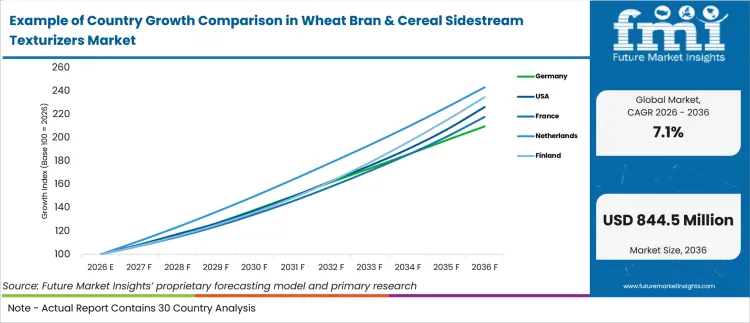
| Country | CAGR |
|---|---|
| Netherlands | 9.3% |
| Finland | 8.9% |
| USA | 8.5% |
| France | 8.1% |
| Germany | 7.7% |
How do country-level CAGRs compare in the Wheat Bran & Cereal Sidestream Texturizers Market?
The country comparison spans 1.6 percentage points and forms a compact band without sharply separated growth groups. The Netherlands and Finland form an upper pair separated by 0.4 percentage points across the profiled outlook. The USA occupies the center with equal 0.4-point gaps to Finland and France across the comparison. France and Germany form a lower pair separated by another 0.4 percentage points across the assessment. Technical service coverage and feedstock control explain these differences more clearly than cereal availability alone. Smaller networks can coordinate qualification quickly whereas larger markets require validation across more plants and recipes.
- The Netherlands defines the upper edge through port access and several cereal or brewing sidestream routes. Changing domestic wheat output increases reliance on cross-border sourcing and strict incoming specifications across recurring ingredient lots.
- Finland remains close to the upper edge through transparent grain-use data and concentrated industrial networks. Long service distances create material friction for pilot support outside major processing locations and specialized technical centers.
- The USA occupies the center through national milling scale and diverse bakery or nutrition applications. Food-grade segregation remains decisive across facilities that handle animal-feed materials beside human-food ingredient streams during commercial production.
- France begins the lower pair through a strong soft-wheat base and established bakery development capacity. Crop timing changes grain properties and increases formulation work across successive harvests and regional milling programs.
- Germany defines the lower edge within the narrow comparison despite substantial milling throughput and advanced food-processing capability. Mature customer systems require detailed validation for replacing established texturizers across large production programs and several recipes.
Comparable CAGRs can produce different entry conditions across national milling networks and food-development systems with distinct service requirements. Ingredient companies should compare feedstock control and technical service coverage during the selection of commercial trial locations. The full report provides country analysis across North America and Latin America; Europe and East Asia; South Asia and Oceania; the Middle East and Africa.
Country-wise Analysis
- Dutch processors operate within a trade-oriented food system that combines port logistics with brewery and milling sidestreams from nearby markets. Statistics Netherlands reported in January 2025 that national wheat output fell 38.6% during 2024 to 682 thousand tonnes. Wheat bran and cereal sidestream texturizer sales in the Netherlands are forecast to expand at 9.3% CAGR by 2036, supported by cross-border sourcing and concentrated food manufacturing. The production decline increases the value of diversified sourcing and strict incoming specifications across recurring ingredient lots. Port access enables commercial trials across several processing partners although changing domestic output complicates long-term source consistency. Contracts should define source identity and application support across recurring production volumes and alternative cereal origins.
- Finnish cereal processors work through concentrated industrial networks that support clear lot tracing across a limited number of organizations. The Finnish wheat bran and cereal sidestream texturizers sector is projected to record 8.9% CAGR during the assessment period, aided by transparent grain-use data and technically focused food companies. Natural Resources Institute Finland reported in February 2026 that industry used 461 million kilograms of wheat during 2025. The recorded volume supports bran recovery and application trials across established processing sites with known production histories. Concentrated partnerships simplify specification control although long service distances raise pilot support costs outside major processing centers. Remote technical service and documented production lots remain necessary for broader commercial use across regional food companies.
- American processors access large flour-milling networks and diverse bakery or alternative-protein manufacturers across several regional clusters. National distribution channels provide broad application reach but require consistent specifications across distant production sites. Adoption of wheat bran and cereal sidestream texturizers in the USA is estimated to expand at 8.5% CAGR through 2036, reinforced by feedstock scale and established ingredient distribution. USDA reported in May 2026 that mills ground 907 million bushels of wheat for flour during 2025. The national base supports recurring recovery volumes across multiple regions and several large commercial milling systems. Wheat-allergen controls remain a material qualification step across national brand formulations and shared manufacturing facilities.
- French ingredient programs benefit from established soft-wheat production and bakery applications that reveal texture differences during customer trials. FranceAgriMer reported in September 2025 that strong June heat shortened grain filling and advanced harvesting by fifteen days from 2024. Wheat bran and cereal sidestream texturizer demand in France is forecast to rise at 8.1% CAGR over the forecast period, underpinned by milling expertise and established formulation capability. The earlier harvest calendar increases the need for lot-specific checks across regional milling and ingredient programs. The functional fiber bakery market supports rapid application testing across breads and pastries with different water-management requirements. Crop-linked variation requires updated processing records for every commercial release and each recurring customer specification.
- German milling corridors connect substantial wheat throughput with industrial bakery and plant-based manufacturers across several regional clusters. Nearby development centers provide texture design and scale-up support across established national food-processing systems and recurring commercial programs. Germany's wheat bran and cereal sidestream texturizers outlook is anticipated to advance at 7.7% CAGR over the assessment period, influenced by mature qualification standards and broad technical capacity. Federal statistics reported in March 2026 that soft wheat represented 85% of first-half grain milling during 2025/26. Large throughput provides a clear feedstock enabler although established customers require detailed evidence for replacing existing texturizers. Commercial programs should separate source consistency from application performance across each recipe and processing line.
Who are the notable companies in the Wheat Bran & Cereal Sidestream Texturizers Market?
COMET Bio, Agrain by Circular Food Technology, Upcycled Foods, EverGrain, Bühler and Alfa Laval are the notable companies profiled in this market.
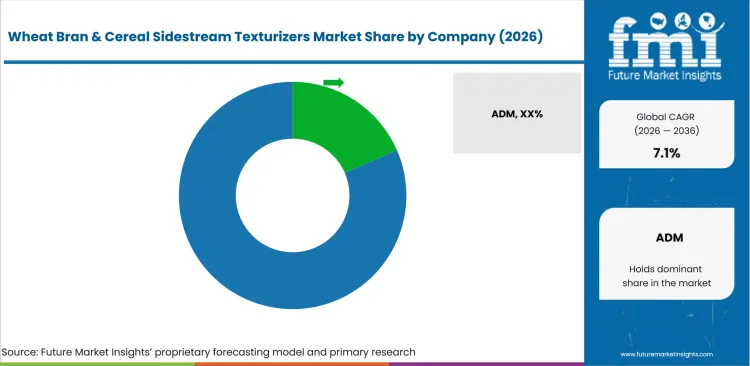
Competition separates into sidestream ingredient specialists and process-technology companies that support commercial conversion across several cereal sources. COMET Bio processes wheat residues and Agrain converts brewer's grain into specialized food ingredients for commercial applications. Upcycled Foods and EverGrain commercialize brewer's spent grain through bakery ingredients or soluble protein and fiber systems. Bühler and Alfa Laval provide process development and separation technology for industrial recovery routes at commercial scale. Food developers should compare direct source control and verified performance across the intended production application. The plant-based meat market provides another comparison for hydration and texture support across industrial formulations.
- COMET Bio and Agrain convert wheat residues or brewer's spent grain into specialized ingredients for commercial foods. Their value comes from controlled extraction or fermentation that preserves source identity and repeatable ingredient behavior. Bakery formulators should compare batch composition and technical support across recurring production lots and different application systems.
- Upcycled Foods and EverGrain commercialize brewer's spent grain through fiber-rich flours and soluble protein ingredients. Their market positions reflect different application routes across bakery products and nutrition beverages with distinct processing requirements. Commercial comparisons should distinguish moisture-binding flour systems from purified proteins with separate texture and labeling requirements.
- Bühler and Alfa Laval provide equipment and technical centers that support cereal recovery and industrial scale-up. Their roles center on process validation and separation performance rather than branded sidestream ingredient supply. Engineering managers should confirm local trial capacity and service coverage across planned commercial volumes and target product formats.
Competitive Benchmarking: Wheat Bran & Cereal Sidestream Texturizers Market
| Company | Source Specification Fit | Function Application Support | Validation and Scale Support | Geographic Reach |
|---|---|---|---|---|
| COMET Bio | High | Medium | Medium | North America and Europe |
| Agrain by Circular Food Technology | High | Medium | Medium | Europe |
| Upcycled Foods, Inc. | High | High | High | North America |
| EverGrain | High | Medium | High | North America and Europe |
| Bühler | Medium | High | High | Global |
| Alfa Laval | Medium | Medium | High | Global |
Key Developments in the Wheat Bran & Cereal Sidestream Texturizers Market
- In January 2025, COMET Bio announced NutraStrong verification for Arrabina and described it as a gluten-free wheat fiber extract containing arabinoxylans. The official review covered laboratory consistency and manufacturing quality beside label compliance across commercial ingredient production. The development gives food formulators a clearer quality framework for soluble wheat-derived fiber without replacing recipe-specific performance testing.
- In March 2025, Carlsberg Sverige joined the Brewed & Renewed project with RISE and several bakery or retail partners. The program evaluates brewer's spent grain as a food ingredient across bread and breakfast cereal applications. The collaboration addresses processing and scale-up barriers that limit consistent texture across commercial cereal sidestream formulations and recurring bakery production systems.
- In June 2025, Bühler opened a Puffing Application Center in Switzerland with industrial-scale testing for grain and pulse products. The center enables food companies to test and optimize recipes without committing their own factory capacity. The development reduces scale-up risk across cereal processing routes that require controlled texture and repeatable production throughput during recurring product development programs.
- In December 2025, Agrain described a dry sourdough series made mainly from brewer's spent grain and tested under scale-up conditions with CNTA. The process uses controlled fermentation followed by drying and milling into a homogeneous flour-like ingredient. The development expands commercial routes for cereal sidestreams that need repeatable flavor and reliable integration across industrial bakery systems.
Key Players in the Wheat Bran & Cereal Sidestream Texturizers Market
Wheat and Cereal Sidestream Ingredient Specialists
- COMET Bio
- Agrain by Circular Food Technology
Brewing Sidestream Ingredient Platforms
- Upcycled Foods, Inc.
- EverGrain
Processing and Scale-up Platforms
- Bühler
- Alfa Laval
Wheat Bran & Cereal Sidestream Texturizers Market - Report Scope
| Coverage field | Report scope |
|---|---|
| Market breakdown | Source, Function, Application, and Region. |
| Quantitative Units | Revenue in USD Million and CAGR in %. |
| Market Definition | Food-grade texturizing ingredients recovered from wheat bran and cereal-processing sidestreams through controlled milling and fractionation or through extraction and enzymatic treatment across commercial processing routes. |
| Regions Covered | North America, Latin America, Western Europe, Eastern Europe, East Asia, South Asia and Pacific, Middle East and Africa. |
| Countries Covered | Germany, USA, France, Netherlands, Finland, and 30+ additional countries. |
| Key Companies Profiled | COMET Bio, Agrain by Circular Food Technology, Upcycled Foods, EverGrain, Bühler and Alfa Laval |
| Forecast Period | 2026 to 2036. |
| Approach | Hybrid bottom-up and top-down market sizing used primary market interviews and official secondary research across the defined forecast period. |
Wheat Bran & Cereal Sidestream Texturizers Market - Research Methodology
| Method | Approach |
|---|---|
| Primary Research | FMI analysts gathered input from manufacturers, service providers, technology developers, distributors, end users, procurement teams, and subject-matter experts. Interviews examined purchasing decisions, product or service evaluation, adoption barriers, approval requirements, pricing considerations, and expectations for technical or commercial support. Respondents were also asked what evidence is required before a trial, pilot, or initial order develops into regular purchasing. |
| Desk Research | Desk research covered government statistics, regulatory publications, trade data, industry associations, technical literature, standards, company filings, product information, and official corporate announcements. Sources were reviewed for relevance, publication date, geographic coverage, and consistency with the defined market scope. Claims relating to performance, applications, approvals, capacity, investment, and commercial activity were retained only when supported by credible public evidence. |
| Market Sizing and Forecasting | The market model combined the baseline value with historical performance, segment structure, pricing and volume indicators, adoption levels, company participation, and country-level demand conditions. Forecast assumptions considered economic activity, investment trends, regulatory developments, technology adoption, purchasing cycles, supply availability, and barriers to wider market use. Segment and regional estimates were reconciled before the final market total was calculated. |
| Data Validation | Estimates were checked against multiple independent indicators, including public data, company activity, trade patterns, industry developments, and findings from primary interviews. Validation also tested whether products, services, applications, and company revenues fell within the defined market boundaries. Adjacent categories, unsupported claims, overlapping revenues, and activities without direct market relevance were excluded to reduce double counting and maintain consistency across segments and countries. |
Wheat Bran & Cereal Sidestream Texturizers Market by Segments
Wheat Bran & Cereal Sidestream Texturizers Market segmented by Source:
- Wheat Bran
- Brewing Sidestream
- Cereal Byproduct
Wheat Bran & Cereal Sidestream Texturizers Market segmented by Function:
- Hydrocolloid
- Fiber
- Texture
Wheat Bran & Cereal Sidestream Texturizers Market segmented by Application:
- Plant-based
- Bakery
- Meat Alt
Wheat Bran & Cereal Sidestream Texturizers Market by Region:
- North America
- United States
- Canada
- Latin America
- Brazil
- Mexico
- Argentina
- Chile
- Western Europe
- Germany
- France
- United Kingdom
- Italy
- Spain
- Benelux
- Nordics
- Eastern Europe
- Poland
- Czech Republic
- Romania
- Hungary
- East Asia
- China
- Japan
- South Korea
- South Asia and Pacific
- India
- ASEAN
- Australia and New Zealand
- Middle East and Africa
- GCC Countries
- South Africa
- Türkiye
- Israel
Research Sources and Bibliography
- USA Department of Agriculture, National Agricultural Statistics Service. (2026, May). Flour Milling Products 2025 Summary.
- Federal Ministry of Agriculture, Food and Regional Identity. (2026, March 19). 20. März: Tag des Mehls.
- Natural Resources Institute Finland. (2026, February 13). Cereals purchased, used and stockpiled, Q4 2025 and year 2025.
- FranceAgriMer. (2025, September 29). Qualité des blés tendres.
- Statistics Netherlands. (2025, January 29). Lowest wheat harvest in 25 years.
- USA Food and Drug Administration. (2025, January). Guidance for Industry: Questions and Answers Regarding Food Allergen Labeling (Edition 5).
- European Parliament and Council of the European Union. (2015, November 25). Regulation (EU) 2015/2283 of the European Parliament and of the Council of 25 November 2015 on novel foods, amending Regulation (EU) No 1169/2011 of the European Parliament and of the Council and repealing Regulation (EC) No 258/97 of the European Parliament and of the Council and Commission Regulation (EC) No 1852/2001.
- European Commission, Directorate-General for Environment. (2025, October 16). Revised Waste Framework Directive enters into force to boost circularity of textile sector and slash food waste.
- COMET Bio. (2025, July 18). IFT First 2025: Comet Bio unveils Arrabina L for modern functional foods.
- Upcycled Foods, Inc. (2025, March 3). UPCYCLED FOODS, INC. AND MISFITS MARKET LAUNCH FIRST UPCYCLED BREADS FOR GROCER’S PRIVATE LABEL.
- Klüh Catering. (2025, July 29). Klüh Catering integrates plant based protein source from food upcycling into its menu.
- COMET Bio. (2025, January 21). ARRABINA® GAINS FODMAP FRIENDLY CERTIFICATION.
- Alfa Laval. (2025, May 19). Here for the beer: upcycling sustainable protein from brewer’s spent grain.
- Bühler Group. (2025, June 12). Where grains get their volume - Bühler opens puffing technology center.
- Brandi, M., Lisic, A., & Kosova, E. (2025, December 1). Tradition Meets Innovation with Agrain's Spent Grain Dry Sourdough. Agrain by Circular Food Technology.
- Carlsberg Sverige. (2025, March 25). Carlsberg Sverige i nytt forskningsprojekt - vill göra mat i stor skala av bryggerirester.
Official publications and corporate announcements support the statistical and commercial evidence presented throughout this market assessment. Additional references support the complete report's country and segment analysis across the defined market boundary.
This Report Answers
- How large is the wheat bran & cereal sidestream texturizers market in 2026 and 2036?
- Which operating conditions support investment in food-grade cereal sidestream recovery and texturizer development?
- Why does wheat bran hold the leading source share during 2026?
- How does hydrocolloid influence water management and structure across food formulations?
- Why does plant-based hold the leading application position during 2026?
- How do growth rates differ across Netherlands, Finland, the USA, France and Germany?
- Which companies provide cereal sidestream ingredients, wheat texturizers or scale-up support?
- What limits qualification across allergen control, process history and variable feedstock composition?
- How do official food-waste targets influence commercial recovery programs for cereal sidestreams?
- What should ingredient developers evaluate before expanding a successful pilot into recurring production?
Frequently Asked Questions
How big is the Wheat Bran & Cereal Sidestream Texturizers Market in 2026?
The wheat bran & cereal sidestream texturizers market is valued at USD 425.3 million in 2026 and is forecast to reach USD 844.5 million by 2036. Growth is supported by abundant cereal-processing byproduct volumes from milling and brewing operations that sustain food-grade recovery and conversion into value-added fiber and texturizing ingredients globally.
What is the CAGR of the Wheat Bran & Cereal Sidestream Texturizers Market from 2026 to 2036?
The wheat bran & cereal sidestream texturizers market grows at a CAGR of 7.1% between 2026 and 2036, supported by recurring milling and brewing streams that provide dependable feedstock volumes for controlled food-grade recovery across bakery, plant-based, and meat-alternative applications worldwide.
Which source leads the Wheat Bran & Cereal Sidestream Texturizers Market?
Wheat bran accounts for 49.0% of the wheat bran & cereal sidestream texturizers market by source in 2026, driven by direct access across established flour-milling networks and food-grade segregation routes that enable controlled particle size and consistent arabinoxylan composition across recurring commercial production lots.
How much will the Wheat Bran & Cereal Sidestream Texturizers Market add between 2026 and 2036?
The wheat bran & cereal sidestream texturizers market is set to add USD 419.2 million between 2026 and 2036, growing from USD 425.3 million to USD 844.5 million as documented recovery programs convert cereal-processing sidestreams into traceable functional ingredients across bakery, plant-based, and nutrition applications globally.
Who are the leading companies in the Wheat Bran & Cereal Sidestream Texturizers Market?
Six companies lead the wheat bran & cereal sidestream texturizers market, including COMET Bio, Agrain by Circular Food Technology, Upcycled Foods, EverGrain, Bühler, and Alfa Laval, competing through controlled sidestream extraction, fermentation-based flour systems, brewer's spent grain commercialization, and industrial-scale processing and separation technology globally.
Preview the report firsthand - request a free sample
Get SampleGet the brochure for pricing and purchase details.
Get PDFTable of Content
- Key Takeaways
- Market Size and CAGR
- Top Growth Driver
- Fastest Growing Segment
- Leading Region
- Key Companies
- Emerging Opportunities
- Executive Summary
- Global Market Outlook
- Demand-side Trends
- Supply-side Trends
- Technology Roadmap Analysis
- Analysis and Recommendations
- Analyst Perspective (What is happening? Why now? What should investors know?)
- Key Questions Answered
- How large is the market?
- What is the CAGR?
- What are key trends?
- Which region dominates?
- Who are the leaders?
- Market Overview
- Market Coverage / Taxonomy
- Market Definition / Scope / Limitations
- Research Methodology
- Chapter Orientation
- Analytical Lens and Working Hypotheses
- Market Structure, Signals, and Trend Drivers
- Benchmarking and Cross-market Comparability
- Market Sizing, Forecasting, and Opportunity Mapping
- Research Design and Evidence Framework
- Desk Research Programme (Secondary Evidence)
- Expert Input and Fieldwork (Primary Evidence)
- Tooling, Models, and Reference Databases
- Data Engineering and Model Build
- Quality Assurance and Audit Trail
- Market Background
- Market Dynamics (Drivers, Restraints, Opportunity, Trends)
- Scenario Forecast (Optimistic, Likely, Conservative)
- Impact Analysis
- AI Impact
- Sustainability Impact
- Regulatory Impact
- Technology Impact
- Consumer / Buyer Analysis
- Purchase Drivers
- Adoption Barriers
- Buyer Journey
- Opportunity Map Analysis
- Product Life Cycle Analysis
- Supply Chain Analysis
- Investment Feasibility Matrix
- Value Chain Analysis
- PESTLE and Porter's Analysis
- Regulatory Landscape
- Regional Parent Market Outlook
- Production and Consumption Statistics
- Import and Export Statistics
- Global Market Analysis and Forecast, 2021 to 2036
- Historical Market Size Value (USD Million) Analysis, 2021 to 2025
- Current and Future Market Size Value (USD Million) Projections, 2026 to 2036
- Y-o-Y Growth Trend Analysis
- Absolute $ Opportunity Analysis
- Global Market Pricing Analysis, 2021 to 2036
- Global Market Analysis and Forecast, By Source, 2021 to 2036
- Introduction / Key Findings
- Historical Market Size Value (USD Million) Analysis By Source, 2021 to 2025
- Current and Future Market Size Value (USD Million) Analysis and Forecast By Source, 2026 to 2036
- Wheat Bran
- Seafood Sidestream
- Cereal Byproduct
- Wheat Bran
- Y-o-Y Growth Trend Analysis By Source, 2021 to 2025
- Absolute $ Opportunity Analysis By Source, 2026 to 2036
- Global Market Analysis and Forecast, By Function, 2021 to 2036
- Introduction / Key Findings
- Historical Market Size Value (USD Million) Analysis By Function, 2021 to 2025
- Current and Future Market Size Value (USD Million) Analysis and Forecast By Function, 2026 to 2036
- Hydrocolloid
- Fiber
- Texture
- Hydrocolloid
- Y-o-Y Growth Trend Analysis By Function, 2021 to 2025
- Absolute $ Opportunity Analysis By Function, 2026 to 2036
- Global Market Analysis and Forecast, By Application, 2021 to 2036
- Introduction / Key Findings
- Historical Market Size Value (USD Million) Analysis By Application, 2021 to 2025
- Current and Future Market Size Value (USD Million) Analysis and Forecast By Application, 2026 to 2036
- Plant-based
- Bakery
- Meat Alt
- Plant-based
- Y-o-Y Growth Trend Analysis By Application, 2021 to 2025
- Absolute $ Opportunity Analysis By Application, 2026 to 2036
- Global Market Analysis and Forecast, By Region, 2021 to 2036
- Introduction
- Historical Market Size Value (USD Million) Analysis By Region, 2021 to 2025
- Current Market Size Value (USD Million) Analysis and Forecast By Region, 2026 to 2036
- North America
- Latin America
- Western Europe
- Eastern Europe
- East Asia
- South Asia and Pacific
- Middle East & Africa
- Market Attractiveness Analysis By Region
- North America Market Analysis and Forecast, By Country, 2021 to 2036
- Historical Market Size Value (USD Million) Trend Analysis By Market Taxonomy, 2021 to 2025
- Market Size Value (USD Million) Forecast By Market Taxonomy, 2026 to 2036
- By Country
- USA
- Canada
- By Source
- By Function
- By Application
- By Country
- Market Attractiveness Analysis
- By Country
- By Source
- By Function
- By Application
- Key Takeaways
- Latin America Market Analysis and Forecast, By Country
- Historical Market Size Value (USD Million) Trend Analysis By Market Taxonomy, 2021 to 2025
- Market Size Value (USD Million) Forecast By Market Taxonomy, 2026 to 2036
- By Country
- Brazil
- Mexico
- Chile
- Rest of Latin America
- By Source
- By Function
- By Application
- By Country
- Market Attractiveness Analysis
- By Country
- By Source
- By Function
- By Application
- Key Takeaways
- Western Europe Market Analysis and Forecast, By Country
- Historical Market Size Value (USD Million) Trend Analysis By Market Taxonomy, 2021 to 2025
- Market Size Value (USD Million) Forecast By Market Taxonomy, 2026 to 2036
- By Country
- Germany
- UK
- Italy
- Spain
- France
- Nordic
- BENELUX
- Rest of Western Europe
- By Source
- By Function
- By Application
- By Country
- Market Attractiveness Analysis
- By Country
- By Source
- By Function
- By Application
- Key Takeaways
- Eastern Europe Market Analysis and Forecast, By Country
- Historical Market Size Value (USD Million) Trend Analysis By Market Taxonomy, 2021 to 2025
- Market Size Value (USD Million) Forecast By Market Taxonomy, 2026 to 2036
- By Country
- Russia
- Poland
- Hungary
- Balkan & Baltic
- Rest of Eastern Europe
- By Source
- By Function
- By Application
- By Country
- Market Attractiveness Analysis
- By Country
- By Source
- By Function
- By Application
- Key Takeaways
- East Asia Market Analysis and Forecast, By Country
- Historical Market Size Value (USD Million) Trend Analysis By Market Taxonomy, 2021 to 2025
- Market Size Value (USD Million) Forecast By Market Taxonomy, 2026 to 2036
- By Country
- China
- Japan
- South Korea
- By Source
- By Function
- By Application
- By Country
- Market Attractiveness Analysis
- By Country
- By Source
- By Function
- By Application
- Key Takeaways
- South Asia and Pacific Market Analysis and Forecast, By Country
- Historical Market Size Value (USD Million) Trend Analysis By Market Taxonomy, 2021 to 2025
- Market Size Value (USD Million) Forecast By Market Taxonomy, 2026 to 2036
- By Country
- India
- ASEAN
- Australia & New Zealand
- Rest of South Asia and Pacific
- By Source
- By Function
- By Application
- By Country
- Market Attractiveness Analysis
- By Country
- By Source
- By Function
- By Application
- Key Takeaways
- Middle East & Africa Market Analysis and Forecast, By Country
- Historical Market Size Value (USD Million) Trend Analysis By Market Taxonomy, 2021 to 2025
- Market Size Value (USD Million) Forecast By Market Taxonomy, 2026 to 2036
- By Country
- Kingdom of Saudi Arabia
- Other GCC Countries
- Türkiye
- South Africa
- Other African Union
- Rest of Middle East & Africa
- By Source
- By Function
- By Application
- By Country
- Market Attractiveness Analysis
- By Country
- By Source
- By Function
- By Application
- Key Takeaways
- Key Countries Market Analysis
- USA
- Pricing Analysis
- Market Share Analysis, 2025
- By Source
- By Function
- By Application
- Canada
- Pricing Analysis
- Market Share Analysis, 2025
- By Source
- By Function
- By Application
- Mexico
- Pricing Analysis
- Market Share Analysis, 2025
- By Source
- By Function
- By Application
- Brazil
- Pricing Analysis
- Market Share Analysis, 2025
- By Source
- By Function
- By Application
- Chile
- Pricing Analysis
- Market Share Analysis, 2025
- By Source
- By Function
- By Application
- Germany
- Pricing Analysis
- Market Share Analysis, 2025
- By Source
- By Function
- By Application
- UK
- Pricing Analysis
- Market Share Analysis, 2025
- By Source
- By Function
- By Application
- Italy
- Pricing Analysis
- Market Share Analysis, 2025
- By Source
- By Function
- By Application
- Spain
- Pricing Analysis
- Market Share Analysis, 2025
- By Source
- By Function
- By Application
- France
- Pricing Analysis
- Market Share Analysis, 2025
- By Source
- By Function
- By Application
- India
- Pricing Analysis
- Market Share Analysis, 2025
- By Source
- By Function
- By Application
- ASEAN
- Pricing Analysis
- Market Share Analysis, 2025
- By Source
- By Function
- By Application
- Australia & New Zealand
- Pricing Analysis
- Market Share Analysis, 2025
- By Source
- By Function
- By Application
- China
- Pricing Analysis
- Market Share Analysis, 2025
- By Source
- By Function
- By Application
- Japan
- Pricing Analysis
- Market Share Analysis, 2025
- By Source
- By Function
- By Application
- South Korea
- Pricing Analysis
- Market Share Analysis, 2025
- By Source
- By Function
- By Application
- Russia
- Pricing Analysis
- Market Share Analysis, 2025
- By Source
- By Function
- By Application
- Poland
- Pricing Analysis
- Market Share Analysis, 2025
- By Source
- By Function
- By Application
- Hungary
- Pricing Analysis
- Market Share Analysis, 2025
- By Source
- By Function
- By Application
- Kingdom of Saudi Arabia
- Pricing Analysis
- Market Share Analysis, 2025
- By Source
- By Function
- By Application
- Türkiye
- Pricing Analysis
- Market Share Analysis, 2025
- By Source
- By Function
- By Application
- South Africa
- Pricing Analysis
- Market Share Analysis, 2025
- By Source
- By Function
- By Application
- USA
- Market Structure Analysis
- Competition Dashboard
- Competition Benchmarking
- Market Share Analysis of Top Players
- By Regional
- By Source
- By Function
- By Application
- Emerging Startups
- Innovation Benchmarking
- Competition Analysis
- Competition Deep Dive
- ADM
- Overview
- Product Portfolio
- Profitability by Market Segments
- Sales Footprint
- Strategy Overview
- Marketing Strategy
- Product Strategy
- Channel Strategy
- Cargill
- Roquette
- CP Kelco
- Ingredion
- Herbafood
- ADM
- Case Studies
- Success Stories
- Recent Developments
- Competition Deep Dive
- Assumptions & Acronyms Used


