

- Market Size (2026)
- USD 319.5 Mn
- Forecast (2036)
- USD 791.8 Mn
- CAGR (2026 to 2036)
- 9.5%
How big is Spelt Flour Market in 2026?
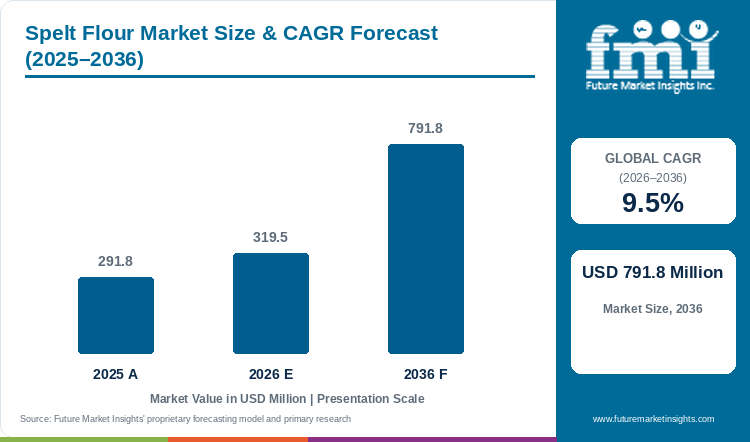
Assessed at USD 291.8 million in 2025 and progressing to USD 319.5 million in 2026, the global spelt flour market valuation is on course to reach USD 791.8 million by 2036, supported by a forecast-period CAGR of 9.5%.
Commercial bread plants and supermarket in-store bakeries are reformulating standard wheat loaves with heritage Triticum spelta flour to command higher retail loaf prices, propelling global spelt flour market value past a 2025 baseline of USD 291.8 million to a 2026 estimate of USD 319.5 million and a 2036 projection of USD 791.8 million under a 9.5% CAGR. High-speed bakery adoption of spelt has historically been slowed by harvest-to-harvest swings in gliadin extensibility, which is why a December 2025 study in the Journal of Applied Genetics mapped 21,955 DArTseq polymorphic markers across spelt genotypes to help breeders select cultivars with stable milling and dough performance [1]. As seed breeders and industrial mills standardize kernel protein quality across low-gluten emmer and einkorn flour blends and specialty grain programs, Light / White Spelt Flour (Type 630) commands an estimated 2026 share of 43.8% in the Milling Grade segment and anchors USD 472.3 million in net decade growth. Even with improved cultivar uniformity, mechanical dehulling losses of 24% to 28% during spikelet hulling keep wholesale spelt flour prices well above common bread wheat and limit adoption in economy bread tiers.
Key Market Trends & Insights
- By milling grade: Light / White Spelt Flour (Type 630) secures an estimated 2026 share of 43.8% in the Milling Grade segment as low-ash endosperm extraction prevents dough tearing during spiral mixing.
- By ingredient format: Within the Ingredient Format segment in 2026, Single-Origin Straight Milled Spelt Flour garners an anticipated 56.4% share via direct pneumatic tanker and 25-kilogram bag deliveries to commercial bakeries.
- By application: Artisan & Industrial Bread & Rolls account for a forecast 38.6% of the Application segment in 2026 from high-frequency retail replenishment of crusted Dinkel loaves and rolls.
- By production claim: Conventional Traceable Spelt secures an expected 58.2% Production Claim segment share in 2026 because farmgate grain premiums remain lower than certified organic lots.
- By sales channel: For the 2026 Sales Channel segment, Mill-Direct Industrial & In-Store Bakeries represent a projected 51.4% share under contracted protein-band and falling-number specifications.
Regional Highlights
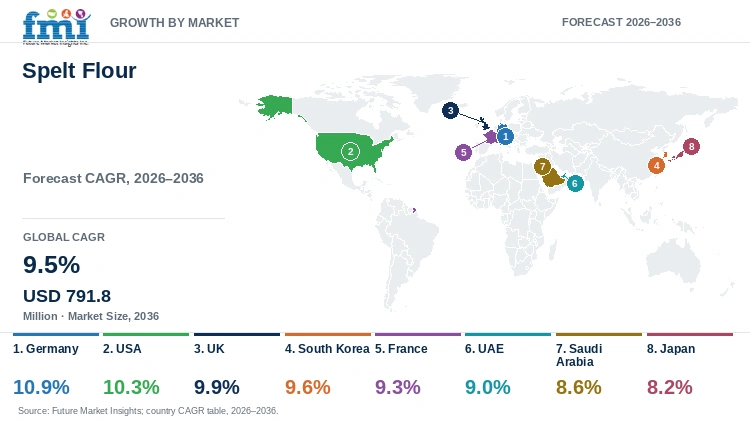
- Central Europe and North America leadership: Germany heads the eight profiled national markets on a 10.9% yearly CAGR up to 2036 on expanding domestic Dinkel cultivation, followed closely by the USA (10.3%) and the UK (9.9%).
- East Asia and Gulf specialty expansion: Demand in South Korea logs a forecast 9.6% annual pace above France (9.3%) and the UAE (9.0%), whereas Saudi Arabia (8.6%) and Japan (8.2%) reflect selective import-channel growth.
Market Size & Forecast
Table 1: Market Size and Forecast for the Spelt Flour Market (USD million and CAGR percentage), 2025 to 2036
| Metric | Value |
|---|---|
| 2025 Market Size | USD 291.8 million |
| Estimated Market Size in 2026 | USD 319.5 million |
| Projected Market Size by 2036 | USD 791.8 million |
| CAGR, 2026 to 2036 | 9.5% |
| Added Revenue, 2026 to 2036 | USD 472.3 million |
Realizing the USD 472.3 million in added decade revenue projected in Table 1 requires solving spelt dough's tendency to slacken and tear on automated industrial dividers and rounders. Because spelt gluten carries a higher gliadin-to-glutenin ratio than common wheat, unconditioned dough loses gas-cell tenacity during mechanical proofing; however, April 2025 cereal-chemistry trials in the Journal of Food Science proved that pairing hydrothermally extruded ancient-grain flour fractions with emulsifier conditioning restores loaf volume and crumb structure [2]. Armed with these processing adjustments, commercial flour millers now pre-blend Oberkulmer and Franckenkorn spelt grades with baking enzymes so plant bakeries can run spelt pan loaves at standard line speeds without manual dough handling.
Dehulled Grain Milling and Flour Extraction Tonnage Sizing
Table 2: Dehulled Spelt Milling Throughput and Flour Tonnage Sizing for the Spelt Flour Market (USD million and operational ranges), 2025 to 2036
| Metric | 2025 | 2026 | 2036 |
|---|---|---|---|
| Market size (USD million) | 291.8 | 319.5 | 791.8 |
| Milled commercial spelt flour volume (thousand metric tons) | 188.0 to 204.0 | 204.5 to 222.0 | 465.0 to 508.0 |
| Raw in-glume spelt paddy harvest input (thousand metric tons) | 275.0 to 302.0 | 298.0 to 328.0 | 675.0 to 742.0 |
| Average B2B contract flour price per metric ton (USD) | 1,430 to 1,550 | 1,440 to 1,565 | 1,560 to 1,700 |
Operational note: Dehulling conversions account for a 24% to 28% husk removal loss during spikelet hulling followed by a 74% to 82% flour extraction rate across Type 630 white and Type 1050 partial-bran roller passes.
The gap between raw in-glume harvest tonnage and finished flour volume in Table 2 reflects the capital and yield cost of removing spelt's tightly bound outer chaff before roller milling. Unlike free-threshing wheat that enters cleaning bins ready for tempering, spelt spikelets must pass through dedicated rubber-roll or impact hullers and optical color sorters, which removes roughly a quarter of incoming grain weight as hull byproduct. To offset this dehulling cost and justify B2B contract prices of USD 1,440 to 1,565 per metric ton in 2026, specialty millers supply bakeries with pre-calibrated endosperm fractions paired with bakery ingredients and flour improvers that reduce bakery waste during cold retardation.
Per Capita & Commercial Bakery Procurement Sizing
Table 3: Per Capita and Bakery Account Spending Indicators for the Spelt Flour Market (USD), 2025 to 2036
| Metric | 2025 | 2026 | 2036 |
|---|---|---|---|
| World population (billion) | 8.2 | 8.3 | 9.0 |
| Global spelt flour spend per 1,000 people (USD) | 35.6 | 38.5 | 88.0 |
| Annual spelt flour procurement per industrial bakery (USD thousand) | 62.0 to 78.0 | 66.5 to 84.0 | 128.0 to 162.0 |
| Bulk silo & tote contract delivery share (%) | 54.0% to 58.0% | 56.0% to 60.0% | 66.0% to 71.0% |
Table 4: Milling & Bakery Allocation Benchmarks for the Spelt Flour Market (USD and percentages), 2026
| Metric | Value | Institutional Reference Basis |
|---|---|---|
| Global market size, 2026 | USD 319.5 million | 2026 commercial spelt flour baseline |
| Commercial spelt protein band | 12.5% to 15.5% dry basis | Roller and stone-milled bakery flour specifications |
| Light / white spelt (Type 630) allocation, 2026 | 43.8% share | Low-ash roller-milled bakery extraction |
| Mill-direct industrial bakery allocation, 2026 | 51.4% share | Contracted bulk tanker, tote, and pallet volume |
The rise in bulk silo and tote contract deliveries shown in Tables 3 and 4 is driven by retail bakery chains seeking to insulate their annual flour budgets from seasonal European harvest volatility. When wet autumn weather reduces Hagberg falling numbers in regional spelt harvests, spot-market buyers face sudden price spikes and inconsistent water absorption in their dough mixers. To prevent batch failures across hundreds of retail bake-off locations, procurement directors lock in 6-to-12-month mill contracts and blend stone-ground spelt fractions with whole-wheat flour for consistent artisan boule volume.
Analyst Perspective
"Converting consumer enthusiasm for heritage spelt into multi-year industrial flour contracts requires overcoming crop-to-crop gluten extensibility swings on high-speed dough makeup lines. Millers that deliver protein-standardized Type 630 and micronized wholegrain spelt flours with verified lot rheology will capture supermarket in-store bakery programs."
- Nandini Roy Choudhury, Principal Consultant, Future Market Insights.
How is the spelt flour market segmented?
The spelt flour market is segmented by milling grade, ingredient format, application, production claim, sales channel, and region. In 2026, Light / White Spelt Flour (Type 630) is estimated at 43.8%, Single-Origin Straight Milled Spelt Flour is anticipated at 56.4%, Artisan & Industrial Bread & Rolls are forecast at 38.6%, Conventional Traceable Spelt is expected at 58.2%, and Mill-Direct Industrial & In-Store Bakeries are projected at 51.4%.
By milling grade: Light / White Spelt Flour (Type 630), Wholegrain / Wholemeal Spelt Flour (Type 1050 & Full-Bran), Fine Pastry & High-Protein Stabilized Spelt Flour, and Sprouted & Bioprocessed Specialty Spelt Flour.
By ingredient format: Single-Origin Straight Milled Spelt Flour, Pre-Blended Multigrain & Ancient-Grain Bakery Flour Bases, Hydrothermally Stabilized & Enzyme-Conditioned Spelt Flour, and Stone-Ground Coarse & Micro-Granulated Wholemeal Fractions.
By application: Artisan & Industrial Bread & Rolls, Biscuits, Crackers & Savory Baked Snacks, Viennoiserie, Croissants & Laminated Pastries, Cakes, Muffins & Sweet Patisserie, and Fresh & Dry Artisanal Pasta & Noodles.
By production claim: Conventional Traceable Spelt, Certified Organic (EU-Bio, USDA Organic & Organic JAS), Identity-Preserved Heritage & Pure Oberkulmer Rotkorn, and Clean-Label Unbleached & Additive-Free.
By sales channel: Mill-Direct Industrial & In-Store Bakeries, Specialty Bakery & Foodservice Ingredient Distributors, Artisan Mill Direct & Craft Bakery Cooperatives, and Specialty Retail & B2B Digital Replenishment.
Why does Light / White Spelt Flour (Type 630) lead the milling grade segment?
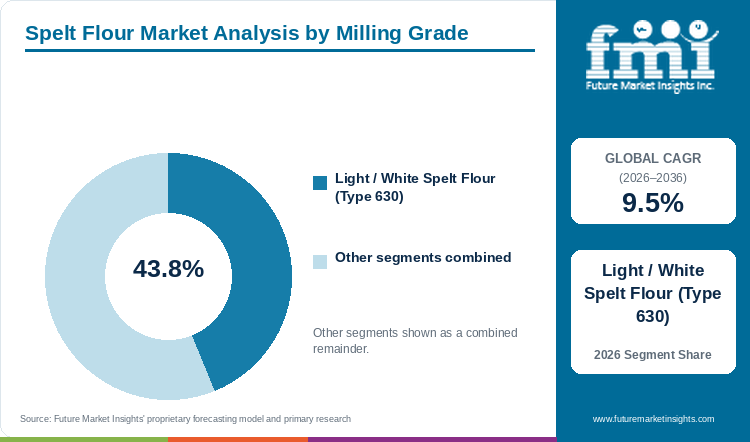
Light / White Spelt Flour (Type 630) attains an estimated 2026 share of 43.8% in the Milling Grade segment through predictable dough elasticity during spiral mixing.
Table 5: Milling Grade Share for the Spelt Flour Market (percentage share), 2026
| Milling Grade | Share (2026) |
|---|---|
| Light / White Spelt Flour (Type 630) | 43.8% |
| Other Segments Combined | 56.2%* |
| Total | 100.0% |
*Calculated as the balance remaining after deducting the leading segment's reported share from 100.0%.
Table 6: Milling Grade Leadership and Market Growth for the Spelt Flour Market (segment and CAGR percentage), 2026 to 2036
| Metric | Value |
|---|---|
| Global CAGR (2026 to 2036) | 9.5% |
| Leading Segment | Light / White Spelt Flour (Type 630) |
Commercial plant bakeries favor Light / White Spelt Flour (Type 630) over full-bran wholemeal grades because sharp outer pericarp particles in unbolted spelt flour slice through fragile gliadin-rich gluten films and depress loaf volume. By sifting out coarse bran during roller milling, Type 630 gives industrial bakers a low-ash endosperm carrier that runs smoothly across Western European whole-wheat flour substitution lines while still allowing 100% spelt front-of-pack labeling.
- Light / White Spelt Flour (Type 630) posts an estimated 2026 share of 43.8% within the Milling Grade segment, aided by reliable gas retention during proofing and smooth slicing performance in packaged sandwich loaves.
- Confirming why sourdough bakeries specify roller-milled spelt grades, in September 2025 experimental baking research in Foods showed that fermenting spelt flour with selected lactic acid bacteria releases bioactive intestinal-barrier peptides while preserving crumb elasticity [3].
What keeps Single-Origin Straight Milled Spelt Flour ahead in the ingredient format segment?
Single-Origin Straight Milled Spelt Flour holds an anticipated 56.4% Ingredient Format segment share in 2026 on bulk pneumatic tanker and bakery bag replenishment.
Purchasing directors at multi-line bakeries prefer Single-Origin Straight Milled Spelt Flour over pre-blended multigrain bases because buying 100% unblended spelt flour avoids third-party premix markups and lets internal R&D teams adjust wheat and rye blend ratios across multiple SKUs. Straight-milled flour also discharges directly from existing pneumatic silos into automated scale hoppers with sourdough ingredients micro-dosers without requiring separate premix bins.
- Across the Ingredient Format segment in 2026, Single-Origin Straight Milled Spelt Flour reaches an anticipated 56.4% share because unblended flour supports clean front-of-pack 100% spelt ingredient declarations.
- Demonstrating the flavor advantage of straight spelt flour in bakery starters, a February 2025 sensory and rheological study in Foods showed that wholegrain spelt sourdough starters generate distinct nutty aroma compounds and tenderize cookie crumb structure [4].
How do Artisan & Industrial Bread & Rolls anchor the application segment?
In the Application segment for the 2026 base year, Artisan & Industrial Bread & Rolls register a forecast 38.6% share through daily retail turnover of crusted Dinkel loaves.
While biscuits and pasta use spelt in smaller specialty batches, Artisan & Industrial Bread & Rolls anchor commercial tonnage because hearth boules and Kaiser rolls are high-frequency household purchases replenished daily in supermarket bake-off aisles. Once an industrial bakery calibrates slow spiral mixing and water absorption for spelt bread dough, weekly flour draw-downs become a recurring baseline across par-baked bread and fresh loaf lines.
- Artisan & Industrial Bread & Rolls capture a forecast 38.6% of the Application segment in 2026 as grocery chains in Europe and North America expand nutty aromatic hearth breads.
- Reinforcing consumer health interest in ancient-cereal loaves, in February 2026 a functional bread study in International Journal of Molecular Sciences evaluated sourdough bread enriched with ancient cereals including spelt and documented elevated polyphenol bioavailability [5].
Why does Conventional Traceable Spelt lead the production claim segment?
Across the Production Claim segment in 2026, Conventional Traceable Spelt holds an expected 58.2% share under mainstream grocery cost ceilings.
Although certified organic spelt commands strong loyalty in specialty health stores, mainstream supermarket in-store bakeries and packaged bread brands choose Conventional Traceable Spelt to keep retail loaf prices within everyday family grocery budgets. Sourcing identity-traced conventional spelt avoids the 30% to 45% organic farmgate grain premium and mandatory organic mill-line purge fees while still supporting heritage grain claims across commercial sourdough bread assortments.
- Conventional Traceable Spelt represents an expected 58.2% of the Production Claim segment in 2026 through abundant conventional contract farming in Germany and Austria alongside simplified plant auditing.
- Because U.S. Food and Drug Administration gluten-free food labeling rules updated in March 2026 classify spelt as a gluten-containing wheat species, both conventional and organic spelt packages must carry explicit wheat-allergen disclosures [6].
What sustains Mill-Direct Industrial & In-Store Bakeries in the sales channel segment?
Within the 2026 Sales Channel segment, Mill-Direct Industrial & In-Store Bakeries account for a projected 51.4% share via contracted bulk tanker and tote logistics.
High-speed plant bakeries cannot risk unannounced shifts in dough extensibility or falling numbers that occur when buying spot-market bags through general foodservice wholesalers. Mill-Direct Industrial & In-Store Bakeries lead channel revenue because direct contracting between mill cereal chemists and plant master bakers locks in custom alveograph curves and moisture limits below 14.0% across scheduled bulk tanker and 1,000-kilogram tote deliveries.
- Across the 2026 Sales Channel segment, Mill-Direct Industrial & In-Store Bakeries command a projected 51.4% share on multi-ton weekly order volumes and co-developed rheology specifications.
- Strengthening upstream supply assurance for direct bakery contracts, in July 2025 Ardent Mills agreed to purchase North Dakota grain-cleaning operator Stone Mill to expand its emerging nutrition and ancient-grain portfolio [7].
What are the drivers, restraints, and opportunities in the spelt flour market?
Within the spelt flour market, retail bakery differentiation and expanding European Union cultivation drive commercial adoption, whereas fragile gliadin dough rheology restrains high-speed line conversion and enzyme-stabilized spelt flours open new industrial contracts.
- Driver: Supermarket in-store bakeries and packaged bread brands adopt named spelt flour to capture premium ancient-grain and sourdough consumer spending.
- Restraint: Higher gliadin-to-glutenin ratios cause lower mixing tolerance and sticky dough machinability plus loaf-volume variability across harvest lots.
- Opportunity: High-protein standardized spelt flours and micro-granulated wholegrain concentrates allow industrial bakeries to run 100% spelt loaves on automated lines.
Growth Analysis and Future Potential: Qualitative Demand Catalysts
The primary commercial driver lifting spelt flour demand is retail bakery trade-up, as supermarket chains across Europe and North America replace low-margin white pan bread with varietal ancient-grain loaves that command 25% to 45% higher retail price points. In March 2025, breadmaking trials published in Foods demonstrated that incorporating finely milled ancient-grain bran fractions enriches dietary fiber and mineral density in hearth loaves when dough hydration rates are properly calibrated [8]. To capitalize on this nutritional and sensory premium, commercial bakeries pair roller-milled and stone-ground spelt flour with sourdough starter cultures across core grocery aisles.
Risk Assessment of the Spelt Flour Market: Operational and Formulation Friction
Two factors continue to restrain faster industrial switching to spelt flour: fragile dough tenacity during high-speed mechanical mixing and agronomic yield vulnerability during wet growing seasons. Because spelt gluten is rich in extensible gliadins, over-mixing causes sticky dough pieces to hang up on automated rounder belts; on the supply side, an August 2025 study in BMC Plant Biology characterizing powdery mildew resistance in spelt accession Lsy-93 highlighted the ongoing breeding effort required to protect field yields and kernel weight against fungal disease [9]. Bakers comparing spelt against wheat bran and cereal sidestream texturizers must also maintain strict wheat-allergen segregation across shared packaging lines.
Commercial Opportunity Analysis: Formulation Differentiation and Value-Add Formats
Milling innovators are winning new multi-plant bakery contracts by engineering protein-standardized spelt flours and ultra-fine wholegrain concentrates that eliminate dough slacking and coarse bran grittiness. For example, in August 2026 GoodMills Innovation unveiled its südback 2026 bakery trade portfolio featuring high-protein SMART Spelt and micronized SNOW Spelt Wholegrain Microgranulate to stabilize dough handling on automated bakery lines [10]. Supplying ready-to-bake rheologically standardized spelt flour enables millers to convert artisan bakery concepts into national supermarket sandwich-bread and soft-roll programs.
Spelt Flour Market by Country (2026 to 2036)
Expanded domestic Dinkel cultivation and functional roller-mill upgrades place Germany at the front of national spelt flour expansion on a 10.9% yearly CAGR up to 2036, ahead of the USA (10.3%) and the UK (9.9%), whereas Japan progresses on an 8.2% annual pace. National performance reflects everyday Type 630 and Type 1050 bread consumption in Central Europe, pneumatic tanker and multiwall bakery bag contracting in North America, and import-dependent specialty bakery demand across East Asia and the Middle East.
Table 7: Country CAGR and Primary Growth Levers for the Spelt Flour Market (CAGR percentage and operational drivers), 2026 to 2036
| Country | CAGR (2026 to 2036) | Primary Growth Lever |
|---|---|---|
| Germany | 10.9% | Domestic Dinkel cultivation expansion and industrial SMART Spelt and SNOW Spelt bakery standardization |
| USA | 10.3% | Commercial bulk and 25-to-50 lb spelt flour distribution via Ardent Mills, King Arthur Baking, and Bob's Red Mill |
| UK | 9.9% | Supermarket sourdough boule expansion and Doves Farm organic white and wholemeal trade flour programs |
| South Korea | 9.6% | Premium Seoul artisan bakery chains importing European Union and North America specialty ancient-grain flours |
| France | 9.3% | Traditional grand epeautre boulangerie positioning supported by Limagrain Ingredients specialty milling |
| UAE | 9.0% | Luxury hotel foodservice and gourmet retail bakeries across Dubai and Abu Dhabi importing specialty flours |
| Saudi Arabia | 8.6% | Urban artisan bakery diversification within an import-reliant commercial wheat milling economy |
| Japan | 8.2% | Selective craft bakery adoption governed by strict MAFF Organic JAS certification and ash-tolerance audits |
Source: Future Market Insights analysis
Germany Spelt Flour Market Outlook (2026 to 2036)
Bakery flour shipments in Germany are projected to climb on a 10.9% yearly CAGR up to 2036, driven by the unique status of Dinkel (spelt) Type 630 and Type 1050 breads and Brötchen rolls in daily household bread baskets rather than niche health aisles. According to the April 2026 USDA Foreign Agricultural Service European Union Grain and Feed Annual report, specialty wheat and spelt milling rotations in Germany and neighboring Central Europe anchor regional food-use cereal demand [11]. Domestic milling leaders are expanding industrial adoption by supplying protein-standardized spelt flours and micronized wholegrain concentrates that prevent dough slacking on automated supermarket bake-off lines. Higher industrial electricity tariffs for mechanical spikelet dehulling across southern Germany still pressure mill conversion margins.
Key takeaway: In Germany, expanding domestic Dinkel harvest acreage and rheologically standardized milling grades are projected to generate a 10.9% yearly CAGR.
USA Spelt Flour Market Outlook (2026 to 2036)
Unlike Central Europe where spelt is a traditional bread staple, demand in the USA is split between automated pan-bread plants buying bulk pneumatic tanker loads and regional craft sourdough bakeries ordering 25-to-50-pound multiwall sacks. This dual B2B distribution structure is forecast to lift commercial spelt flour sales across the USA on a 10.3% annual CAGR across 2026 to 2036, aided by identity-preserved contract cleaning and milling in the Midwest and Great Plains. Ardent Mills and regional stone millers help commercial bakeries in the USA hold consistent 13% protein targets so multigrain loaves maintain uniform slice height. Because federal labeling rules classify spelt as a wheat allergen, brands cannot market spelt in gluten-free aisles and compete instead on heritage flavor.
Key takeaway: In the USA, bulk industrial milling specifications and professional 25-to-50-pound bakery sacks are forecast to maintain a 10.3% yearly pace.
UK Spelt Flour Market Outlook (2026 to 2036)
Commercial demand in the UK centers on supermarket Tier-1 own-label sourdough boules and gastro-pub bread service, where shoppers pay a premium for named stone-ground heritage grains. Confirming this retail pull, Soil Association Certification documented in its October 2026 Organic Market Report that certified organic grocery and bakery staples continue to gain supermarket shelf space across the UK [12]. Dedicated mill supply of roller-milled white and stone-ground wholemeal spelt sacks to these retail programs is projected to generate a 9.9% yearly CAGR in the UK until 2036, owing to sustained sourdough boule turnover. Limited domestic organic arable land in Wiltshire and the Cotswolds still forces millers in the UK to import certified European Union grain when wet harvests reduce local yields.
Key takeaway: In the UK, own-label artisan sourdough programs and specialty trade flour catalogues are projected to deliver a 9.9% compound rate.
South Korea Spelt Flour Market Outlook (2026 to 2036)
Consumer migration away from sweet confectionery pastries toward low-sugar artisan meal breads across Seoul and Gyeonggi province has created a distinct import market for spelt flour in South Korea. According to the May 2026 USDA Foreign Agricultural Service South Korea Food Processing Ingredients Annual report, domestic food and bakery manufacturers rely heavily on imported raw materials [13]. Boutique bakery chains and hotel commissaries in South Korea import Type 630 spelt flour from Germany and organic whole spelt flour from North America for sourdough Campagne loaves. While refrigerated container freight and import duties elevate landed bag costs, specialty distributor billings in South Korea are anticipated to log a 9.6% yearly CAGR through 2036, linked to healthy meal-bread adoption.
Key takeaway: In South Korea, consumer migration toward low-sugar artisan meal breads and imported specialty baking inputs is anticipated to yield a 9.6% annual rate.
France Spelt Flour Market Outlook (2026 to 2036)
Boulangerie orders for spelt flour in France are estimated to post a 9.3% yearly CAGR up to 2036, reinforced by artisan bakers and biscuit makers using grand epeautre and petit epeautre to differentiate rustic hearth loaves and sablés. Consumers in France strongly associate spelt with regional terroir in Provence and Bourgogne-Franche-Comte, allowing independent boulangeries to charge higher per-loaf prices for amber-crusted heritage breads. However, wet autumn sowing seasons and narrower farmgate organic premiums have periodically tightened certified organic spelt harvests across eastern France. To prevent supply gaps for supermarket and artisan accounts, cereal ingredient millers in France are expanding conventional traceable contract farming with guaranteed alveograph baking specifications.
Key takeaway: In France, artisanal boulangerie demand and conventional traceable mill contracting are estimated to hold a 9.3% annual compound pace.
UAE Spelt Flour Market Outlook (2026 to 2036)
With zero domestic spelt cultivation, the UAE operates as the specialty bakery and re-export hub for the Gulf Cooperation Council, driven by five-star hotel pastry kitchens and airline catering in Dubai and Abu Dhabi. Foodservice and gourmet retail demand across the UAE is expected to register a 9.0% yearly CAGR through 2036, enabled by international bakery chains introducing European artisan sourdough menus. The August 2026 USDA Foreign Agricultural Service United Arab Emirates Food Processing Ingredients Annual report confirmed that domestic food processors and hospitality commissaries depend on imported specialty baking ingredients to serve tourism and retail growth [14]. High summer warehouse temperatures in the Gulf can accelerate germ-lipid rancidity in wholemeal spelt flour, requiring climate-controlled storage and barrier-lined 25-kilogram sacks.
Key takeaway: In the UAE, five-star hospitality bakery procurement and temperature-controlled specialty ingredient distribution are expected to produce a 9.0% compound pace.
Saudi Arabia Spelt Flour Market Outlook (2026 to 2036)
Bakery consumption in Saudi Arabia has historically centered on state-subsidized white wheat flatbreads, but rapid expansion of specialty café chains and modern supermarkets in Riyadh and Jeddah is shifting urban demand toward wholegrain and ancient-grain toast loaves. Per the April 2026 USDA Foreign Agricultural Service Saudi Arabia Grain and Feed Annual report, commercial milling in Saudi Arabia remains structurally reliant on international grain imports [15]. Palletized spelt flour imports paired with enzymatic dough conditioners for hotel and retail commissaries are forecast to lift wholesale turnover in Saudi Arabia on an 8.6% yearly CAGR until 2036, attributed to retail bakery expansion. Wide price gaps between subsidized standard white flour and imported specialty bags still confine spelt to upper-tier urban bakery channels.
Key takeaway: In Saudi Arabia, modern retail bakery premiumization and specialty foodservice imports in Riyadh and Jeddah are forecast to support an 8.6% CAGR.
Japan Spelt Flour Market Outlook (2026 to 2036)
In Japan, craft boulangeries and department-store basement (depachika) patisseries in Tokyo and Osaka use imported spelt flour not as a bulk wheat replacement, but as a flavor-enhancing inclusion in country boules and butter biscuits. Commercial flour buyers in Japan enforce some of the tightest specification tolerances globally, auditing every imported lot for ash uniformity and falling-number stability plus moisture below 14.0%. Furthermore, any organic spelt flour sold in Japan must carry accredited Organic JAS certification verified at port of entry under MAFF standards, filtering out spot exporters. Once overseas millers pass these audit gates, repeat craft bakery procurement across Japan is slated to advance on an 8.2% annual CAGR from 2026 to 2036, stemming from pre-qualified Dinkel flour lines.
Key takeaway: In Japan, high-end craft boulangerie formulation and strict Organic JAS import compliance will underpin an 8.2% yearly rate through 2036.
Full report country CAGRs cover: North America; Latin America; Western Europe; Eastern Europe; East Asia; South Asia and Pacific; Middle East and Africa.
Who are the notable companies in the spelt flour market?
GoodMills Group GmbH (GoodMills Innovation), Ardent Mills, LLC, Doves Farm Foods Ltd., King Arthur Baking Company, Inc., Limagrain Ingredients, Bob's Red Mill Natural Foods, Inc., Bay State Milling Company, and Grain Millers, Inc. are the notable companies in the spelt flour market.
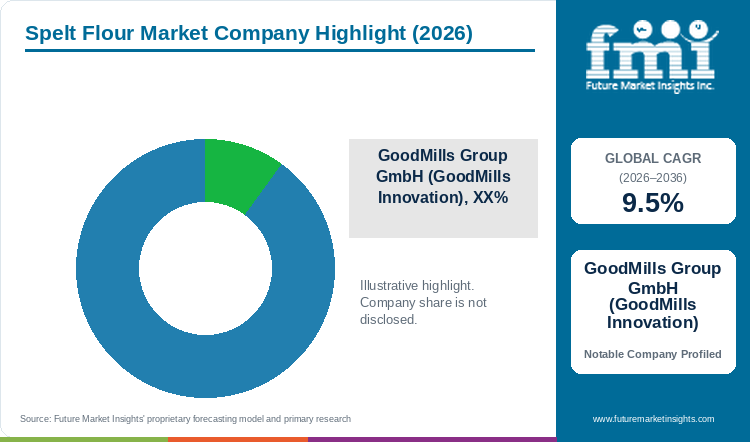
Commercial leadership in the global spelt flour market divides between large industrial flour-milling groups that supply bulk rheology-standardized spelt flours and heritage-grain specialists that distribute certified organic trade and retail bags. Milling leader GoodMills Group (through GoodMills Innovation) and Limagrain Ingredients engineer functional Type 630 and high-protein plus micro-granulated wholegrain spelt ingredients for automated bakeries in Europe. In North America and the UK, Ardent Mills and Bay State Milling plus Grain Millers serve bulk industrial accounts, whereas Doves Farm Foods and King Arthur Baking with Oregon-based Bob's Red Mill anchor professional 25-to-50-pound sack and specialty retail channels.
- Industrial Spelt Milling & Rheological Standardization Platforms: GoodMills Group GmbH (GoodMills Innovation) and Ardent Mills, LLC along with Limagrain Ingredients supply bulk tanker and tote plus functionally stabilized spelt flours for plant bakeries.
- Certified Organic & Professional Bakery Sack Specialists: Doves Farm Foods Ltd. and King Arthur Baking Company, Inc. with Oregon miller Bob's Red Mill provide stone-ground and roller-milled organic spelt flours for craft bakeries and foodservice.
- Identity-Preserved Ancient-Grain & Specialty Millers: Bay State Milling Company and Grain Millers, Inc. operate North America dehulling and cleaning plus custom whole-grain spelt milling facilities.
Competitive Benchmarking: Spelt Flour Market
Table 8: Competitive Benchmarking for the Spelt Flour Market (qualitative capability ratings), 2026
| Company | Spelt Extraction & Grade Breadth | Organic & Identity Traceability | Industrial Bakery Rheology Support | Geographic Reach |
|---|---|---|---|---|
| GoodMills Group GmbH (GoodMills Innovation) | High | High | High | Germany, Austria, Central Europe, and Western Europe export channels |
| Ardent Mills, LLC | High | High | High | USA, Canada, and Puerto Rico industrial bakery network |
| Doves Farm Foods Ltd. | High | High | Medium | UK, European Union, and Middle East specialty retail and foodservice |
| King Arthur Baking Company, Inc. | Medium | High | High | USA foodservice, artisan bakery distributors, and national retail |
| Limagrain Ingredients | High | Medium | High | France, Western Europe, and international bakery ingredient accounts |
| Bob's Red Mill Natural Foods, Inc. | Medium | High | Medium | USA, Canada, and international specialty grocery and foodservice |
| Bay State Milling Company | Medium | High | High | USA specialty grain milling and commercial bakery accounts |
| Grain Millers, Inc. | High | High | Medium | USA and Canada organic and conventional whole-grain channels |
Scoring basis: Benchmark tiers assess verified spelt extraction grades and organic chain-of-custody records as well as technical dough-rheology formulation support for commercial bakeries.
Key Developments in the Spelt Flour Market
- In August 2026, GoodMills Innovation unveiled its südback 2026 baking trade portfolio featuring SMART Spelt high-protein flour and SNOW Spelt Wholegrain Microgranulate to stabilize industrial spelt dough processing.
- In July 2025, Ardent Mills entered a definitive agreement to acquire North Dakota specialty-grain cleaning specialist Stone Mill to expand identity-preserved and organic ancient-grain supply chains across North America.
- In January 2026, the Soil Association published updated regulatory guidance for organic flour millers in the UK confirming that wholemeal and ancient-grain spelt flours remain exempt from mandatory folic acid fortification rules taking effect in December 2026 [16].
Key Players in the Spelt Flour Market
Industrial Spelt Milling and Rheological Standardization Platforms
- GoodMills Group GmbH (GoodMills Innovation)
- Ardent Mills, LLC
- Limagrain Ingredients
Certified Organic and Professional Bakery Sack Specialists
- Doves Farm Foods Ltd.
- King Arthur Baking Company, Inc.
- Bob's Red Mill Natural Foods, Inc.
Identity-Preserved Ancient-Grain and Specialty Millers
- Bay State Milling Company
- Grain Millers, Inc.
Spelt Flour Market - Report Scope
Table 9: Report Scope for the Spelt Flour Market (coverage fields and definitions), 2026 to 2036
| Coverage field | Report scope |
|---|---|
| Market breakdown | Milling Grade; Ingredient Format; Application; Production Claim; Sales Channel |
| Quantitative Units | USD Million |
| Market Definition | Commercial supplier revenue from dry milled spelt (Triticum spelta) flour and separable spelt-flour bakery ingredient preparations sold across the five segmentation axes. Category Scope Note: Excludes retail sales of finished baked bread/pastries/pasta and unmilled in-glume or dehulled spelt grain sold without milling plus common bread wheat (Triticum aestivum) flours. |
| Regions Covered | North America; Latin America; Western Europe; Eastern Europe; East Asia; South Asia and Pacific; Middle East and Africa |
| Countries Covered | Germany, USA, UK, South Korea, France, UAE, Saudi Arabia, Japan, and additional countries in the full report |
| Key Companies Covered | GoodMills Group GmbH (GoodMills Innovation), Ardent Mills, LLC, Doves Farm Foods Ltd., King Arthur Baking Company, Inc., Limagrain Ingredients, Bob's Red Mill Natural Foods, Inc., Bay State Milling Company, Grain Millers, Inc. |
| Forecast Period | 2026 to 2036 |
| Approach | Primary and secondary research with top-down and bottom-up market triangulation. |
Spelt Flour Market - Research Methodology
Table 10: Research Methodology for the Spelt Flour Market (research methods and approach), 2026 edition
| Method | Approach |
|---|---|
| Primary Research | Structured interviews with specialty flour millers in Europe and North America plus industrial bakery R&D directors and grain dehulling plant managers to validate extraction yields and B2B contract pricing. |
| Secondary Research | Analysis of USDA Foreign Agricultural Service grain and food-processing annuals and U.S. FDA allergen labeling rules plus Soil Association organic market reports and peer-reviewed cereal-chemistry literature. |
| Market Sizing and Forecasting | Top-down specialty ancient-grain milling revenue models reconciled against bottom-up dehulled spelt milling tonnage and Type 630 versus wholegrain extraction yields plus bulk-versus-bagged channel realization from 2025 to 2036. |
| Country Forecasting Model | Econometric national projections weight domestic spelt harvest area and artisan plus in-store bakery store counts with organic farmland trends and imported specialty flour tariffs across eight evaluated countries. |
| Operational Benchmark Traceability | Dehulling mass balances and bakery spending indicators in Tables 2 and 3 plus Table 4 trace to DArTseq genotype studies in Journal of Applied Genetics and extrusion trials in Journal of Food Science plus USDA FAS country reports. |
| Data Triangulation and Validation | Segment and country revenue estimates are cross-checked against commercial mill grinding capacity and trade catalogue SKUs while excluding unmilled grain and finished bakery retail sales. |
Spelt Flour Market by Segments
Spelt Flour Market segmented by Milling Grade:
- Light / White Spelt Flour (Type 630)
- Wholegrain / Wholemeal Spelt Flour (Type 1050 & Full-Bran)
- Fine Pastry & High-Protein Stabilized Spelt Flour
- Sprouted & Bioprocessed Specialty Spelt Flour
Spelt Flour Market segmented by Ingredient Format:
- Single-Origin Straight Milled Spelt Flour
- Pre-Blended Multigrain & Ancient-Grain Bakery Flour Bases
- Hydrothermally Stabilized & Enzyme-Conditioned Spelt Flour
- Stone-Ground Coarse & Micro-Granulated Wholemeal Fractions
Spelt Flour Market segmented by Application:
- Artisan & Industrial Bread & Rolls
- Biscuits, Crackers & Savory Baked Snacks
- Viennoiserie, Croissants & Laminated Pastries
- Cakes, Muffins & Sweet Patisserie
- Fresh & Dry Artisanal Pasta & Noodles
Spelt Flour Market segmented by Production Claim:
- Conventional Traceable Spelt
- Certified Organic (EU-Bio, USDA Organic & Organic JAS)
- Identity-Preserved Heritage & Pure Oberkulmer Rotkorn
- Clean-Label Unbleached & Additive-Free
Spelt Flour Market segmented by Sales Channel:
- Mill-Direct Industrial & In-Store Bakeries
- Specialty Bakery & Foodservice Ingredient Distributors
- Artisan Mill Direct & Craft Bakery Cooperatives
- Specialty Retail & B2B Digital Replenishment
Spelt Flour Market by Region
- North America
- United States
- Canada
- Latin America
- Brazil
- Mexico
- Argentina
- Chile
- Western Europe
- Germany
- France
- United Kingdom
- Italy
- Spain
- Benelux
- Nordics
- Eastern Europe
- Poland
- Czech Republic
- Romania
- Hungary
- East Asia
- China
- Japan
- South Korea
- South Asia and Pacific
- India
- ASEAN
- Australia and New Zealand
- Middle East and Africa
- GCC Countries
- South Africa
- Türkiye
- Israel
Research Sources and Bibliography
- [1] Pietrusińska-Radzio, A., Bilska-Kos, A., & Bocianowski, J. (2025, December 27). Characterization of spelt wheat (Triticum spelta L.) genotypes using DArTseq technology. Journal of Applied Genetics, 67(2), 285-299 (PMCID: PMC13079525).
- [2] Valsalan, A., Swaminathan, I., Kadam, A., Koksel, F., & Malalgoda, M. (2025, April 22). Enhancing the breadmaking quality of ancient grains through synergistic emulsifier treatment and extrusion processing. Journal of Food Science, 90(4), e70206 (PMCID: PMC12012863).
- [3] Cicchi, C., Leri, M., Bucciantini, M., Galli, V., Guerrini, S., Jiménez-Ortas, Á., et al. (2025, September 12). Sourdough Breads Made with Selected Lactobacillus Strains and Spelt Flour Contain Peptides That Positively Impact Intestinal Barrier. Foods, 14(18), 3184 (PMCID: PMC12470101).
- [4] Škrobot, D., Maravić, N., Hadnađev, M., Dapčević-Hadnađev, T., Pestorić, M., & Tomić, J. (2025, February 12). Exploring the Sensory Odor Profile of Sourdough Starter from Ancient Whole-Wheat Flours in the Development of Cookies with Enhanced Quality. Foods, 14(4), 613 (PMCID: PMC11854415).
- [5] Amodeo, G., Franchi, S., Galimberti, G., Pignatelli, A., Giacomoni, C., Solari, E., et al. (2026, February 17). Reduced Neuroinflammation and Pain with a Functional Sourdough Bread Enriched with Legumes and Ancient Cereals in a Mouse Model of LPS-Induced Inflammation. International Journal of Molecular Sciences, 27(4), 1932 (PMCID: PMC12940292).
- [6] U.S. Food and Drug Administration. (2026, March 17). Gluten-Free Labeling of Foods. U.S. Food and Drug Administration.
- [7] Ardent Mills, LLC. (2025, July 31). Ardent Mills Enters Agreement to Acquire Stone Mill in North Dakota, Expanding Emerging Nutrition Portfolio. Ardent Mills News.
- [8] Toumi, O., Fadda, C., Del Caro, A., & Conte, P. (2025, March 3). Using Bran of Ancient and Old Grains for Wheat Bread Production. Foods, 14(5), 860 (PMCID: PMC11898424).
- [9] Sun, N., Li, J., Lu, J., Yu, N., Xu, H., Sun, Q., et al. (2025, August 18). Identification and characterization of the powdery mildew resistance in a spelt accession Lsy-93. BMC Plant Biology, 25, 1089 (PMCID: PMC12359869).
- [10] GoodMills Innovation GmbH. (2026, August 25). Anreicherung, Natürlichkeit, Prozesseffizienz: GoodMills Innovation zeigt zeitgemäße Lösungen für das Bäckerhandwerk auf der südback 2026. GoodMills Innovation Presse.
- [11] USDA Foreign Agricultural Service. (2026, April 20). European Union: Grain and Feed Annual. USDA GAIN Report E42026-0034.
- [12] Soil Association Certification. (2026, October 14). Organic Market Report. Soil Association.
- [13] USDA Foreign Agricultural Service. (2026, May 27). South Korea: Food Processing Ingredients Annual. USDA GAIN Report KS2026-0013.
- [14] USDA Foreign Agricultural Service. (2026, August 4). United Arab Emirates: Food Processing Ingredients Annual. USDA GAIN Report TC2026-0009.
- [15] USDA Foreign Agricultural Service. (2026, April 6). Saudi Arabia: Grain and Feed Annual. USDA GAIN Report SA2026-0003.
- [16] Soil Association. (2026, January 6). Flours are being fortified with folic acid - what does it mean for organic?. Soil Association News.
This bibliography is provided for reader reference and is not exhaustive. The full report contains the complete reference list and detailed citations.
This Report Answers
- What is the global spelt flour market size in 2026 and what valuation is projected by 2036?
- How does expanding Dinkel cultivation in Germany reshape industrial flour contracting?
- Why does Light / White Spelt Flour (Type 630) lead the Milling Grade segment?
- Why does Single-Origin Straight Milled Spelt Flour lead the Ingredient Format segment?
- How do national growth rates compare across Germany and the USA plus the UK and South Korea?
- Which industrial and organic flour millers supply verified spelt flour grades today?
- Why do high gliadin extensibility and mandatory wheat-allergen labeling constrain switching?
- Which alveograph and falling-number plus dehulling metrics should bakery buyers audit before contracting?
Frequently Asked Questions
How big is the spelt flour market in 2026, and what is forecast for 2036?
Commercial bakery demand lifts global spelt flour market size from USD 291.8 million in 2025 to an estimated USD 319.5 million in 2026, while 2036 projections reach USD 791.8 million across industrial and artisan bread lines.
What is the CAGR for the spelt flour market from 2026 to 2036?
Over the ten-year horizon from 2026 through 2036, spelt flour sales expand at a 9.5% CAGR and contribute USD 472.3 million in incremental yearly turnover.
Which milling grade segment leads the spelt flour market?
Light / White Spelt Flour (Type 630) holds an estimated 2026 share of 43.8% in the Milling Grade segment through smooth dough handling and reliable loaf volume on automated baking lines.
Which ingredient format segment leads the spelt flour market?
Single-Origin Straight Milled Spelt Flour captures an anticipated 2026 share of 56.4% within the Ingredient Format segment via direct silo and multiwall sack purchasing by commercial bakeries.
Which country leads national growth during the assessment period?
Germany heads the eight evaluated countries on a 10.9% yearly CAGR up to 2036, supported by expanding domestic Dinkel cultivation and rheologically standardized roller-mill grades.
Who are the key players in the spelt flour market?
Commercial spelt milling features GoodMills Group GmbH (GoodMills Innovation) and Ardent Mills, LLC along with Doves Farm Foods Ltd., King Arthur Baking Company, Inc., Limagrain Ingredients, Bob's Red Mill, Bay State Milling Company, and Grain Millers, Inc.
Preview the report firsthand - request a free sample
Get SampleGet the brochure for pricing and purchase details.
Get PDFTable of Content
- Key Takeaways
- Market Size and CAGR
- Top Growth Driver
- Fastest Growing Segment
- Leading Region
- Key Companies
- Emerging Opportunities
- Executive Summary
- Global Market Outlook
- Demand-side Trends
- Supply-side Trends
- Technology Roadmap Analysis
- Analysis and Recommendations
- Analyst Perspective (What is happening? Why now? What should investors know?)
- Key Questions Answered
- How large is the market?
- What is the CAGR?
- What are key trends?
- Which region dominates?
- Who are the leaders?
- Market Overview
- Market Coverage / Taxonomy
- Market Definition / Scope / Limitations
- Research Methodology
- Chapter Orientation
- Analytical Lens and Working Hypotheses
- Market Structure, Signals, and Trend Drivers
- Benchmarking and Cross-market Comparability
- Market Sizing, Forecasting, and Opportunity Mapping
- Research Design and Evidence Framework
- Desk Research Programme (Secondary Evidence)
- Expert Input and Fieldwork (Primary Evidence)
- Tooling, Models, and Reference Databases
- Data Engineering and Model Build
- Quality Assurance and Audit Trail
- Market Background
- Market Dynamics (Drivers, Restraints, Opportunity, Trends)
- Scenario Forecast (Optimistic, Likely, Conservative)
- Impact Analysis
- AI Impact
- Sustainability Impact
- Regulatory Impact
- Technology Impact
- Consumer / Buyer Analysis
- Purchase Drivers
- Adoption Barriers
- Buyer Journey
- Opportunity Map Analysis
- Product Life Cycle Analysis
- Supply Chain Analysis
- Investment Feasibility Matrix
- Value Chain Analysis
- PESTLE and Porter's Analysis
- Regulatory Landscape
- Regional Parent Market Outlook
- Production and Consumption Statistics
- Import and Export Statistics
- Global Market Analysis and Forecast, 2021 to 2036
- Historical Market Size Value (USD Million) Analysis, 2021 to 2025
- Current and Future Market Size Value (USD Million) Projections, 2026 to 2036
- Y-o-Y Growth Trend Analysis
- Absolute $ Opportunity Analysis
- Global Market Pricing Analysis, 2021 to 2036
- Global Market Analysis and Forecast, By Milling Grade, 2021 to 2036
- Introduction / Key Findings
- Historical Market Size Value (USD Million) Analysis By Milling Grade, 2021 to 2025
- Current and Future Market Size Value (USD Million) Analysis and Forecast By Milling Grade, 2026 to 2036
- Light / White Spelt Flour (Type 630)
- Wholegrain / Wholemeal Spelt Flour (Type 1050 & Full-Bran)
- Fine Pastry & High-Protein Stabilized Spelt Flour
- Sprouted & Bioprocessed Specialty Spelt Flour
- Y-o-Y Growth Trend Analysis By Milling Grade, 2021 to 2025
- Absolute $ Opportunity Analysis By Milling Grade, 2026 to 2036
- Global Market Analysis and Forecast, By Ingredient Format, 2021 to 2036
- Introduction / Key Findings
- Historical Market Size Value (USD Million) Analysis By Ingredient Format, 2021 to 2025
- Current and Future Market Size Value (USD Million) Analysis and Forecast By Ingredient Format, 2026 to 2036
- Single-Origin Straight Milled Spelt Flour
- Pre-Blended Multigrain & Ancient-Grain Bakery Flour Bases
- Hydrothermally Stabilized & Enzyme-Conditioned Spelt Flour
- Stone-Ground Coarse & Micro-Granulated Wholemeal Fractions
- Y-o-Y Growth Trend Analysis By Ingredient Format, 2021 to 2025
- Absolute $ Opportunity Analysis By Ingredient Format, 2026 to 2036
- Global Market Analysis and Forecast, By Application, 2021 to 2036
- Introduction / Key Findings
- Historical Market Size Value (USD Million) Analysis By Application, 2021 to 2025
- Current and Future Market Size Value (USD Million) Analysis and Forecast By Application, 2026 to 2036
- Artisan & Industrial Bread & Rolls
- Biscuits, Crackers & Savory Baked Snacks
- Viennoiserie, Croissants & Laminated Pastries
- Cakes, Muffins & Sweet Patisserie
- Fresh & Dry Artisanal Pasta & Noodles
- Y-o-Y Growth Trend Analysis By Application, 2021 to 2025
- Absolute $ Opportunity Analysis By Application, 2026 to 2036
- Global Market Analysis and Forecast, By Production Claim, 2021 to 2036
- Introduction / Key Findings
- Historical Market Size Value (USD Million) Analysis By Production Claim, 2021 to 2025
- Current and Future Market Size Value (USD Million) Analysis and Forecast By Production Claim, 2026 to 2036
- Conventional Traceable Spelt
- Certified Organic (EU-Bio, USDA Organic & Organic JAS)
- Identity-Preserved Heritage & Pure Oberkulmer Rotkorn
- Clean-Label Unbleached & Additive-Free
- Y-o-Y Growth Trend Analysis By Production Claim, 2021 to 2025
- Absolute $ Opportunity Analysis By Production Claim, 2026 to 2036
- Global Market Analysis and Forecast, By Sales Channel, 2021 to 2036
- Introduction / Key Findings
- Historical Market Size Value (USD Million) Analysis By Sales Channel, 2021 to 2025
- Current and Future Market Size Value (USD Million) Analysis and Forecast By Sales Channel, 2026 to 2036
- Mill-Direct Industrial & In-Store Bakeries
- Specialty Bakery & Foodservice Ingredient Distributors
- Artisan Mill Direct & Craft Bakery Cooperatives
- Specialty Retail & B2B Digital Replenishment
- Y-o-Y Growth Trend Analysis By Sales Channel, 2021 to 2025
- Absolute $ Opportunity Analysis By Sales Channel, 2026 to 2036
- Global Market Analysis and Forecast, By Region, 2021 to 2036
- Introduction
- Historical Market Size Value (USD Million) Analysis By Region, 2021 to 2025
- Current Market Size Value (USD Million) Analysis and Forecast By Region, 2026 to 2036
- North America
- Latin America
- Western Europe
- Eastern Europe
- East Asia
- South Asia and Pacific
- Middle East and Africa
- Market Attractiveness Analysis By Region
- North America Market Analysis and Forecast, By Country, 2021 to 2036
- Historical Market Size Value (USD Million) Trend Analysis By Market Taxonomy, 2021 to 2025
- Market Size Value (USD Million) Forecast By Market Taxonomy, 2026 to 2036
- By Country
- United States
- Canada
- By Milling Grade
- By Ingredient Format
- By Application
- By Production Claim
- By Sales Channel
- By Country
- Market Attractiveness Analysis
- By Country
- By Milling Grade
- By Ingredient Format
- By Application
- By Production Claim
- By Sales Channel
- Key Takeaways
- Latin America Market Analysis and Forecast, By Country
- Historical Market Size Value (USD Million) Trend Analysis By Market Taxonomy, 2021 to 2025
- Market Size Value (USD Million) Forecast By Market Taxonomy, 2026 to 2036
- By Country
- Brazil
- Mexico
- Argentina
- Chile
- By Milling Grade
- By Ingredient Format
- By Application
- By Production Claim
- By Sales Channel
- By Country
- Market Attractiveness Analysis
- By Country
- By Milling Grade
- By Ingredient Format
- By Application
- By Production Claim
- By Sales Channel
- Key Takeaways
- Western Europe Market Analysis and Forecast, By Country
- Historical Market Size Value (USD Million) Trend Analysis By Market Taxonomy, 2021 to 2025
- Market Size Value (USD Million) Forecast By Market Taxonomy, 2026 to 2036
- By Country
- Germany
- France
- United Kingdom
- Italy
- Spain
- Benelux
- Nordics
- By Milling Grade
- By Ingredient Format
- By Application
- By Production Claim
- By Sales Channel
- By Country
- Market Attractiveness Analysis
- By Country
- By Milling Grade
- By Ingredient Format
- By Application
- By Production Claim
- By Sales Channel
- Key Takeaways
- Eastern Europe Market Analysis and Forecast, By Country
- Historical Market Size Value (USD Million) Trend Analysis By Market Taxonomy, 2021 to 2025
- Market Size Value (USD Million) Forecast By Market Taxonomy, 2026 to 2036
- By Country
- Poland
- Czech Republic
- Romania
- Hungary
- By Milling Grade
- By Ingredient Format
- By Application
- By Production Claim
- By Sales Channel
- By Country
- Market Attractiveness Analysis
- By Country
- By Milling Grade
- By Ingredient Format
- By Application
- By Production Claim
- By Sales Channel
- Key Takeaways
- East Asia Market Analysis and Forecast, By Country
- Historical Market Size Value (USD Million) Trend Analysis By Market Taxonomy, 2021 to 2025
- Market Size Value (USD Million) Forecast By Market Taxonomy, 2026 to 2036
- By Country
- China
- Japan
- South Korea
- By Milling Grade
- By Ingredient Format
- By Application
- By Production Claim
- By Sales Channel
- By Country
- Market Attractiveness Analysis
- By Country
- By Milling Grade
- By Ingredient Format
- By Application
- By Production Claim
- By Sales Channel
- Key Takeaways
- South Asia and Pacific Market Analysis and Forecast, By Country
- Historical Market Size Value (USD Million) Trend Analysis By Market Taxonomy, 2021 to 2025
- Market Size Value (USD Million) Forecast By Market Taxonomy, 2026 to 2036
- By Country
- India
- ASEAN
- Australia and New Zealand
- By Milling Grade
- By Ingredient Format
- By Application
- By Production Claim
- By Sales Channel
- By Country
- Market Attractiveness Analysis
- By Country
- By Milling Grade
- By Ingredient Format
- By Application
- By Production Claim
- By Sales Channel
- Key Takeaways
- Middle East and Africa Market Analysis and Forecast, By Country
- Historical Market Size Value (USD Million) Trend Analysis By Market Taxonomy, 2021 to 2025
- Market Size Value (USD Million) Forecast By Market Taxonomy, 2026 to 2036
- By Country
- GCC Countries
- South Africa
- Türkiye
- Israel
- By Milling Grade
- By Ingredient Format
- By Application
- By Production Claim
- By Sales Channel
- By Country
- Market Attractiveness Analysis
- By Country
- By Milling Grade
- By Ingredient Format
- By Application
- By Production Claim
- By Sales Channel
- Key Takeaways
- Key Countries Market Analysis
- United States
- Pricing Analysis
- Market Share Analysis, 2025
- By Milling Grade
- By Ingredient Format
- By Application
- By Production Claim
- By Sales Channel
- Canada
- Pricing Analysis
- Market Share Analysis, 2025
- By Milling Grade
- By Ingredient Format
- By Application
- By Production Claim
- By Sales Channel
- Mexico
- Pricing Analysis
- Market Share Analysis, 2025
- By Milling Grade
- By Ingredient Format
- By Application
- By Production Claim
- By Sales Channel
- Brazil
- Pricing Analysis
- Market Share Analysis, 2025
- By Milling Grade
- By Ingredient Format
- By Application
- By Production Claim
- By Sales Channel
- Chile
- Pricing Analysis
- Market Share Analysis, 2025
- By Milling Grade
- By Ingredient Format
- By Application
- By Production Claim
- By Sales Channel
- Germany
- Pricing Analysis
- Market Share Analysis, 2025
- By Milling Grade
- By Ingredient Format
- By Application
- By Production Claim
- By Sales Channel
- United Kingdom
- Pricing Analysis
- Market Share Analysis, 2025
- By Milling Grade
- By Ingredient Format
- By Application
- By Production Claim
- By Sales Channel
- Italy
- Pricing Analysis
- Market Share Analysis, 2025
- By Milling Grade
- By Ingredient Format
- By Application
- By Production Claim
- By Sales Channel
- Spain
- Pricing Analysis
- Market Share Analysis, 2025
- By Milling Grade
- By Ingredient Format
- By Application
- By Production Claim
- By Sales Channel
- France
- Pricing Analysis
- Market Share Analysis, 2025
- By Milling Grade
- By Ingredient Format
- By Application
- By Production Claim
- By Sales Channel
- India
- Pricing Analysis
- Market Share Analysis, 2025
- By Milling Grade
- By Ingredient Format
- By Application
- By Production Claim
- By Sales Channel
- ASEAN
- Pricing Analysis
- Market Share Analysis, 2025
- By Milling Grade
- By Ingredient Format
- By Application
- By Production Claim
- By Sales Channel
- Australia and New Zealand
- Pricing Analysis
- Market Share Analysis, 2025
- By Milling Grade
- By Ingredient Format
- By Application
- By Production Claim
- By Sales Channel
- China
- Pricing Analysis
- Market Share Analysis, 2025
- By Milling Grade
- By Ingredient Format
- By Application
- By Production Claim
- By Sales Channel
- Japan
- Pricing Analysis
- Market Share Analysis, 2025
- By Milling Grade
- By Ingredient Format
- By Application
- By Production Claim
- By Sales Channel
- South Korea
- Pricing Analysis
- Market Share Analysis, 2025
- By Milling Grade
- By Ingredient Format
- By Application
- By Production Claim
- By Sales Channel
- Poland
- Pricing Analysis
- Market Share Analysis, 2025
- By Milling Grade
- By Ingredient Format
- By Application
- By Production Claim
- By Sales Channel
- Hungary
- Pricing Analysis
- Market Share Analysis, 2025
- By Milling Grade
- By Ingredient Format
- By Application
- By Production Claim
- By Sales Channel
- Türkiye
- Pricing Analysis
- Market Share Analysis, 2025
- By Milling Grade
- By Ingredient Format
- By Application
- By Production Claim
- By Sales Channel
- South Africa
- Pricing Analysis
- Market Share Analysis, 2025
- By Milling Grade
- By Ingredient Format
- By Application
- By Production Claim
- By Sales Channel
- UAE
- Pricing Analysis
- Market Share Analysis, 2025
- By Milling Grade
- By Ingredient Format
- By Application
- By Production Claim
- By Sales Channel
- Saudi Arabia
- Pricing Analysis
- Market Share Analysis, 2025
- By Milling Grade
- By Ingredient Format
- By Application
- By Production Claim
- By Sales Channel
- United States
- Market Structure Analysis
- Competition Dashboard
- Competition Benchmarking
- Market Share Analysis of Top Players
- By Regional
- By Milling Grade
- By Ingredient Format
- By Application
- By Production Claim
- By Sales Channel
- Emerging Startups
- Innovation Benchmarking
- Competition Analysis
- Competition Deep Dive
- GoodMills Group GmbH (GoodMills Innovation)
- Overview
- Product Portfolio
- Profitability by Market Segments
- Sales Footprint
- Strategy Overview
- Marketing Strategy
- Product Strategy
- Channel Strategy
- Ardent Mills, LLC
- Doves Farm Foods Ltd.
- King Arthur Baking Company, Inc.
- Limagrain Ingredients
- Bob's Red Mill Natural Foods, Inc.
- Bay State Milling Company
- Grain Millers, Inc.
- GoodMills Group GmbH (GoodMills Innovation)
- Case Studies
- Success Stories
- Recent Developments
- Competition Deep Dive
- Assumptions & Acronyms Used


