

- Market Size (2026)
- USD 1.5 Bn
- Forecast (2036)
- USD 2.6 Bn
- CAGR (2026 to 2036)
- 6.0%
How big is Pneumatic Grippers Market in 2026?
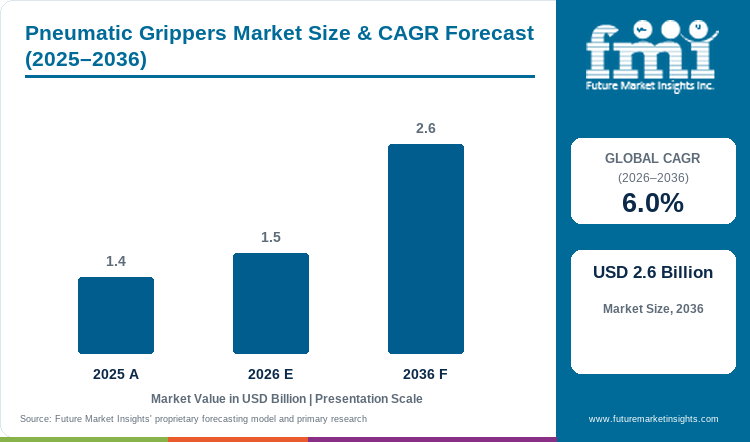
USD 1.5 billion in 2026 and USD 2.6 billion by 2036 at a 6.0% CAGR.
Demand for pneumatic grippers is projected to expand at the authorized 6.0% CAGR between 2026 and 2036, with rounded market values rising from USD 1.5 billion to USD 2.6 billion. The market was valued at USD 1.4 billion in 2025. Robot-cell investment becomes gripper demand when handling stations need part-specific jaws and repeatable workpiece control. The International Federation of Robotics recorded 542,000 industrial robot installations in 2024 in its September 2025 World Robotics release. Pneumatic designs fit plants with compressed air where binary jaw motion meets cycle requirements.
Country adoption diverges as integrator availability and capital thresholds determine how fast robot projects reach equipment orders. France's Directorate General for Enterprise reported in April 2026 that 26% of manufacturing firms with ten or more employees used an industrial or service robot in 2022. The same analysis found that high entry costs and organizational adaptation remain barriers for many industrial SMEs. Smaller plants need local application engineering to convert viable robot cells into approved equipment specifications.
Key Takeaways
- Robot-cell investment raises pneumatic gripper demand because each automated handling point needs workpiece-specific end-of-arm hardware.
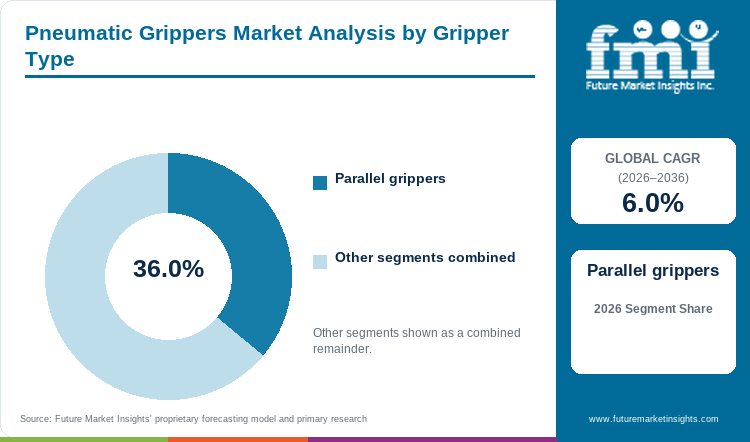
- Parallel grippers are estimated at 36.0% of gripper type demand in 2026 owing to repeatable straight jaw travel.
- Single acting is set to represent 23.0% of actuation demand in 2026 supported by defined return states and simpler control hardware.
- Below 1 kg units are expected to hold 24.0% of payload demand in 2026 attributable to compact robot wrist-load limits.
- Compressed-air generation and leakage can raise lifecycle cost enough for high-duty cells to justify electric gripping alternatives.
- Some of the key players in this market include Schunk, SMC, Festo, Zimmer Group, DESTACO, Parker Hannifin, PHD Inc., IAI, Camozzi, and Gimatic.
Analyst Perspective
"Automation engineers should compare pneumatic grippers by application fit and commissioning effort before considering unit price. Reusable mounting logic and service procedures reduce recommissioning work without sacrificing required grip force or cycle reliability."
- Nikhil Kaitwade, Principal Consultant, Future Market Insights
How is the pneumatic grippers market segmented?
The pneumatic grippers market is segmented by gripper type, actuation, payload, end use, sales channel and region.
The pneumatic grippers market is segmented by gripper type, actuation, payload, end use, sales channel and region. Gripper type covers parallel, angular, three-jaw, needle and adaptive pneumatic designs while actuation includes single acting, double acting, self-centering and long-stroke formats. Payload spans below 1 kg to above 20 kg while end use covers assembly, packaging, electronics, automotive and food and beverage operations. Sales channels comprise automation distributors, direct OEM supply, robot integrators and catalog - e-commerce routes for equipment access and replacement support.
How do parallel grippers shape the gripper type category?
Parallel jaw motion gives integrators a reusable centering geometry for machine tending and assembly. Engineers can reuse finger designs in robotic gripping systems that depend on repeatable part presentation. Standard jaw motion also simplifies replacement because mounting dimensions can be checked before finger tooling is remade.
- By gripper type, parallel grippers are estimated to hold 36.0% in 2026 owing to straight jaw travel that supports repeatable part centering and reusable tooling.
- Festo introduced the HPPH pneumatic parallel gripper in May 2026 with integrated control and sensing for constrained collaborative-robot installations.
What supports single acting within the actuation category?
Single acting grippers provide a defined spring return or retention state without maintaining pressure in both directions. The arrangement suits selected collaborative robot deployments that need compact utilities and predictable safe states. Spring return also preserves a defined jaw state during pressure loss for applications requiring passive workpiece retention.
- Single acting is set to represent 23.0% of actuation demand in 2026 supported by defined return states and simpler control hardware.
- A3 documented 1,637 North American collaborative robot orders in the first quarter of 2026 and expanded the installed base for compact end effectors.
How do below 1 kg units shape the payload category?
Light grippers preserve more robot payload for the workpiece and reduce inertia during repeated acceleration. Low wrist mass suits packaging machinery designs that repeat short pick-and-place cycles with small products. Lower end-effector mass also leaves more rated robot payload available for tooling fingers and the handled product.
- Below 1 kg units are expected to hold 24.0% of payload demand in 2026 because compact automation limits robot wrist mass.
- Festo introduced the HPSX pneumatic soft gripper in March 2026 for delicate products weighing up to 0.5 kg.
What supports assembly automation within the end use category?
Assembly stations repeat gripping during loading and insertion before transferring parts to the next production step. Integrators can reuse approved end effectors when industrial robot cells share air and mounting practices. Repeated station layouts also let maintenance teams carry common spares instead of qualifying different grippers for every fixture.
- Assembly automation is forecast to capture 29.0% of end use in 2026 supported by repeated grip-and-transfer tasks at defined production stations.
- A3 documented 8,940 North American robot orders in the second quarter of 2026 and expanded the pool of assembly and handling cells.
What supports automation distributors within the sales channel category?
Engineers compare jaw travel and grip force before checking sensing and mounting compatibility with the robot platform. Local distributors shorten replacement work by stocking compatible fittings and sensors for recurring robot-cell maintenance.
- Automation distributors are projected to hold 36.0% of sales channel demand in 2026 attributable to local selection support and replacement availability.
- SMC began full-scale operations at its Japan Technical Center in March 2026 to expand engineering and application support for automation customers.
What are the drivers, restraints and opportunities in the pneumatic grippers market?
Robot-cell investment expands gripping demand, compressed-air economics raise lifecycle scrutiny and integrated end-effectors reduce commissioning work for flexible automation projects.
- Driver: New robot orders expand end-effector specifications because every automated handling point needs workpiece-specific gripping hardware and application engineering.
- Restraint: Compressed-air generation losses and leaks can raise lifetime operating cost enough to weaken pneumatic economics in high-duty applications.
- Opportunity: Integrated valves and sensing can reduce engineering between gripper selection and commissioning for robot cells that require repeatable setup.
A3 recorded 36,766 North American robot orders during 2025 as manufacturers invested in new and redesigned production cells. Each new or redesigned machine needs end-of-arm hardware before the industrial automation system can handle a specific workpiece. Reusing a common jaw family reduces engineering during later maintenance and retooling of approved automation cells.
Compressed air simplifies actuator installation, but plant teams still track generation losses and leaks as lifecycle costs. The USA Department of Energy recognized Boardman Foods in 2025 after compressed-air upgrades cut demand by 70%. Energy managers can apply the same scrutiny to high-duty pneumatic actuator systems before approving continuously cycled grippers.
Robot integrators can reduce commissioning work by standardizing pneumatic control near the end effector. Festo expanded VTUX in July 2026 with integrated vacuum and adaptive pressure control for robotic handling. Standardized interfaces reduce programming rework in industrial robot controllers during tooling changes on existing cells.
Which country CAGRs are profiled in the pneumatic grippers market?
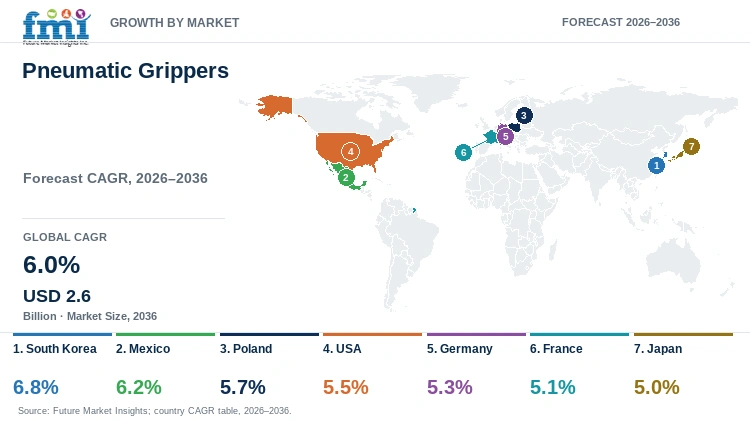
| Country | CAGR |
|---|---|
| South Korea | 6.8% |
| Mexico | 6.2% |
| Poland | 5.7% |
| USA | 5.5% |
| Germany | 5.3% |
| France | 5.1% |
| Japan | 5.0% |
How do country-level CAGRs compare in the pneumatic grippers market?
The country forecasts span 1.8 percentage points between South Korea and Japan through 2036. Faster growth in South Korea and Mexico reflects different investment cycles from mature Germany, France and Japan.
- South Korea’s electronics and automotive manufacturers frequently retool compact automation cells, sustaining demand for flexible robotic handling solutions.
- In Mexico, robot deployment remains concentrated around machine-tending, transfer, and other repeatable tasks within automotive production facilities.
- Poland benefits from investment incentives that lower the effective cost of industrial robot adoption and accelerate automation projects.
- The USA’s diverse automation ecosystem relies on machine builders and system integrators to develop application-specific robotic cells for end users.
- Germany’s mature manufacturing base prioritizes retrofit compatibility and measurable productivity improvements when upgrading production lines.
- In France, public support for robotics adoption is helping smaller manufacturers overcome investment and implementation barriers.
- Japan’s established automation landscape favors proven technologies, with replacement decisions often guided by interface continuity and operational reliability.
Comparable CAGRs produce different commercial conditions because service networks and installed standards affect how automation spending becomes gripper orders. The full report covers North America, Latin America, Western Europe, Eastern Europe, East Asia, South Asia and Pacific and the Middle East and Africa.
Country-wise Analysis
- South Korean electronics and vehicle plants use dense automation that makes replacement compatibility as important as greenfield equipment selection. In South Korea, pneumatic gripper demand is predicted to advance at 6.8% CAGR through 2036 driven by compact cells that need repeatable end effectors. MOTIR convened the AI Robot M.AX Alliance in March 2026 and identified robotic hands and actuators as domestic component priorities for industrial field demonstrations. Local technical partners are available through industrial robotics programs, yet approved line standards raise interchangeability testing costs. Companies entering these programs need cycle-life data and replacement-fit support before plants change an approved end effector on operating lines.
- Mexican automotive plants concentrate robot demand in production clusters where integrators repeat machine-tending and transfer designs for successive vehicle programs. Mexico is projected to expand at 6.2% CAGR by 2036 as automotive capital spending triggers new handling specifications. The International Federation of Robotics recorded 5,600 robot installations in 2024 with automotive accounting for 63% of the country total. Local inventory and integrator access remain important as production programs change and plants requalify tooling for new models.
- Polish manufacturers can claim national robotization tax relief for industrial robots and functionally connected peripheral equipment during 2026. Poland is forecast to grow at 5.7% CAGR through 2036 as manufacturers modernize handling cells and test new automation before purchase. The Ministry of Finance confirms an additional deduction equal to 50% of eligible robotization costs. Integrators still need to prove gripper fit and service access before plants standardize new tooling.
- US plants rely on machine builders and integrators to turn site-specific handling requirements into repeatable robot cells. Demand for pneumatic grippers in USA is forecast to rise at 5.5% CAGR over the forecast period with growth tied to recurring line changes. The International Federation of Robotics reported in June 2026 that factories installed 38,000 industrial robots during 2025 following an 11% annual increase. Integrator reach improves customer access, but specifications can differ between robot brands and plant standards. Companies addressing robotic CNC tending need local inventory and CAD support that let maintenance teams replace approved grippers without redesigning the cell.
- German machine builders evaluate grippers against cell performance because automotive and machinery plants already operate dense automation. The International Federation of Robotics reported in June 2025 that Germany accounted for about 30% of European robot installations during 2024. Pneumatic gripper demand in Germany is forecast to rise at 5.3% CAGR over the forecast period driven by replacement and retooling in a mature robot base. Existing factory automation controls reduce integration uncertainty, though any new gripper must justify downtime and prove mechanical compatibility. Rapid service and documented sizing data give automation vendors better access to incremental line upgrades at mature plants.
- French manufacturers operate in a market where public robotics investment is expanding while smaller factories still face adoption costs. Pneumatic gripper demand is anticipated to record 5.1% CAGR through 2036 as integrators package automation into smaller capital projects. France's Directorate General for Enterprise reported in April 2026 that 26% of manufacturing firms with at least ten employees used industrial or service robots in 2022. Local application support remains important because smaller plants often lack large internal automation teams.
- Japanese factories operate a mature automation base where long equipment life and stable interfaces influence end-effector replacement decisions. Japan is projected to grow at 5.0% CAGR through 2036 as replacement work favors proven interfaces and compact designs. The Japan Robot Association published 2025 production and shipment statistics in June 2026 for manipulators and industrial robots. Suppliers need continuity in mounting and service documentation before plants change hardware on established lines.
Who are the notable companies in the pneumatic grippers market?
Schunk, SMC, Festo, Zimmer Group, DESTACO, Parker Hannifin, PHD Inc., IAI, Camozzi and Gimatic are notable companies serving this market.
Dedicated gripping specialists compete with broader pneumatic automation manufacturers that package grippers beside air-control hardware. Entry still requires application engineering because grippers must fit robot interfaces and workpiece geometry.
- Schunk and Zimmer Group join DESTACO and Gimatic as specialists centered on gripping technology and end-of-arm tooling for industrial automation.
- SMC and Festo join Parker Hannifin and Camozzi as broader pneumatic suppliers placing grippers beside valves and related controls.
- PHD Inc. supplies pneumatic actuator and gripper families while IAI mainly competes with electric motion and programmable end effectors.
Competitive Benchmarking: Pneumatic Grippers Market
| Company | Pneumatic Gripper Breadth | Robot-Cell Integration Support | Application Documentation Depth | Geographic Reach |
|---|---|---|---|---|
| Schunk | High | High | High | Europe, North America, Asia-Pacific |
| SMC | High | High | High | Americas, Europe, Asia-Pacific |
| Festo | High | High | High | Americas, Europe, Asia-Pacific |
| Zimmer Group | High | High | High | Europe, North America, Asia |
| DESTACO | High | Medium | High | North America, Europe, Asia-Pacific |
| Parker Hannifin | Medium | Medium | Medium | Global industrial distribution |
| PHD Inc. | High | Medium | High | North America and international distribution |
| IAI | Low | High | Medium | Japan, North America, Europe, Asia |
| Camozzi | High | High | High | Europe, Americas, Asia-Pacific |
| Gimatic | High | Medium | High | Europe, Americas, Asia-Pacific |
Scoring basis: High pneumatic-gripper breadth requires three documented families while Medium requires two and Low identifies one. High robot-cell integration requires documented robot interfaces plus sensing or controls and application support while Medium reflects two elements and Low one. High application documentation requires three end-use groups while Medium requires two and Low identifies one.
Key Developments in the pneumatic grippers market
- In June 2026, Schunk began a development cooperation with Bosch Robotics for an industrial-grade humanoid robot hand intended for manufacturing and logistics applications.
- In May 2026, Camozzi Automation introduced the Series CSPT smart parallel collaborative gripper with integrated sensing and pneumatic control functions.
- In January 2026, Zimmer Group expanded its GPP5000AL and GPD5000AL pneumatic gripper families with additional two-jaw and three-jaw sizes.
Key Players in the pneumatic grippers market
Dedicated Gripping and End-of-Arm Specialists
- Schunk
- Zimmer Group
- DESTACO
- Gimatic
Pneumatic Automation Platforms
- SMC
- Festo
- Parker Hannifin
- Camozzi
Configured Motion and Gripping Providers
- PHD Inc.
- IAI
Pneumatic Grippers Market - Report Scope
| Coverage field | Report scope |
|---|---|
| Market breakdown | By gripper type, actuation, payload, end use, sales channel and region. |
| Quantitative Units | USD billion. |
| Market Definition | Commercial pneumatic grippers and jaw-based end effectors that use compressed air for automated workpiece handling. |
| Regions Covered | North America, Latin America, Western Europe, Eastern Europe, East Asia, South Asia and Pacific and Middle East and Africa. |
| Countries Covered | South Korea, Mexico, Poland, USA, Germany, France, Japan and 30+ countries covered in the full report. |
| Key Companies Profiled | Schunk, SMC, Festo, Zimmer Group, DESTACO, Parker Hannifin, PHD Inc., IAI, Camozzi, Gimatic. |
| Forecast Period | 2026 to 2036. |
| Approach | Primary and secondary research with market triangulation. |
Pneumatic Grippers Market - Research Methodology
| Method | Approach |
|---|---|
| Primary Research | FMI analysts gathered input from manufacturers, service providers, technology developers, distributors, end users, procurement teams, and subject-matter experts. Interviews examined purchasing decisions, product or service evaluation, adoption barriers, approval requirements, pricing considerations, and expectations for technical or commercial support. Respondents were also asked what evidence is required before a trial, pilot, or initial order develops into regular purchasing. |
| Desk Research | Desk research covered government statistics, regulatory publications, trade data, industry associations, technical literature, standards, company filings, product information, and official corporate announcements. Sources were reviewed for relevance, publication date, geographic coverage, and consistency with the defined market scope. Claims relating to performance, applications, approvals, capacity, investment, and commercial activity were retained only when supported by credible public evidence. |
| Market Sizing and Forecasting | The market model combined the baseline value with historical performance, segment structure, pricing and volume indicators, adoption levels, company participation, and country-level demand conditions. Forecast assumptions considered economic activity, investment trends, regulatory developments, technology adoption, purchasing cycles, supply availability, and barriers to wider market use. Segment and regional estimates were reconciled before the final market total was calculated. |
| Data Validation | Estimates were checked against multiple independent indicators, including public data, company activity, trade patterns, industry developments, and findings from primary interviews. Validation also tested whether products, services, applications, and company revenues fell within the defined market boundaries. Adjacent categories, unsupported claims, overlapping revenues, and activities without direct market relevance were excluded to reduce double counting and maintain consistency across segments and countries. |
Pneumatic Grippers Market by Segments
Pneumatic Grippers Market segmented by Gripper Type:
- Parallel grippers
- Angular grippers
- Three-jaw grippers
- Needle grippers
- Adaptive pneumatic grippers
Pneumatic Grippers Market segmented by Actuation:
- Single acting
- Double acting
- Self-centering
- Long-stroke pneumatic
Pneumatic Grippers Market segmented by Payload:
- Below 1 kg
- 1-5 kg
- 5-20 kg
- Above 20 kg
Pneumatic Grippers Market segmented by End Use:
- Assembly automation
- Packaging machinery
- Electronics handling
- Automotive plants
- Food and beverage
Pneumatic Grippers Market segmented by Sales Channel:
- Automation distributors
- Direct OEM supply
- Robot integrators
- Catalog - e-commerce
Pneumatic Grippers Market by Region:
- North America
- United States
- Canada
- Latin America
- Brazil
- Mexico
- Argentina
- Chile
- Western Europe
- Germany
- France
- United Kingdom
- Italy
- Spain
- Benelux
- Nordics
- Eastern Europe
- Poland
- Czech Republic
- Romania
- Hungary
- East Asia
- China
- Japan
- South Korea
- South Asia and Pacific
- India
- ASEAN
- Australia and New Zealand
- Middle East and Africa
- GCC Countries
- South Africa
- Türkiye
- Israel
Research Sources and Bibliography
- Association for Advancing Automation. (2026, February 6). Robot orders grow 6.6% in 2025 as general industries drive broader automation adoption.
- Association for Advancing Automation. (2026, May 13). Robot orders hold steady in Q1 2026 as demand broadens across non-automotive industries.
- Association for Advancing Automation. (2026, August 11). Robot orders increase in Q2 as automation demand broadens across industries.
- Camozzi Automation. (2026, January 29). NEW Smart flow sensor | Series FSX.
- Camozzi Automation. (2026, May 6). Series CSPT: Smart Parallel Collaborative Gripper.
- SCHUNK SE & Co. KG. (2026, May). Bundled strength for AI-powered robotics.
- DESTACO. (2026, August). New uRDH Series Universal Grippers for Demanding Industrial Automation Applications.
- Direction générale des Entreprises. (2026, April 8). Le suramortissement, un levier efficace pour la modernisation industrielle des PME et ETI.
- Direction générale des Entreprises. (2026, June 18). France 2030 : 31 nouveaux projets pour accélérer l’émergence d’une filière française d’excellence en robotique et en drones souverains.
- Festo SE & Co. KG. (2026, March 24). Festo Introduces the HPSX Universal Adaptive Gripper.
- Festo SE & Co. KG. (2026, May 26). Festo Introduces Two-Finger Pneumatic Gripper for Cobot Applications.
- Festo SE & Co. KG. (2026, June 8). Festo launches GripperAI software.
- Festo SE & Co. KG. (2026, July 14). Festo Cuts EOAT Air Use and Improves Grip Control with VTUX Eco Functions.
- Festo SE & Co. KG. (2026, July 17). Festo Once Again Named Bosch’s Preferred Supplier.
- Gimatic. (2026, June). DHG: The evolution of parallel pneumatic grippers.
- IAI Corporation. (2026, April 15). 小型3ツ爪グリッパーが登場.
- International Federation of Robotics. (2025, September 25). World Robotics 2025: Americas industrial robot installations.
- International Federation of Robotics. (2025, September 25). Global Robot Demand in Factories Doubles Over 10 Years.
- International Federation of Robotics. (2026, June 18). US Robot Industry Returns to Double Digit Growth.
- Japan Robot Association. (2026, June 1). Manipulator and robot statistics: Orders, production and shipments for calendar year 2025.
- Ministry of Finance, Republic of Poland. (2025, December 15; updated 2026, August 26). Ulga na robotyzację CIT.
- Ministry of Trade, Industry and Resources, Republic of Korea. (2026, March 5). MOTIR Maps Out the Future of K-Humanoid Robotics.
- Parker-Hannifin Corporation. (2026, August 21). Annual Report on Form 10-K.
- Zimmer Group. (2026, August 4). Compact clamping element for pneumatic cylinders.
- PHD, Inc. (2026, March 10). PFD01 - Pneumatic Frame Clamp.
- SCHUNK SE & Co. KG. (2026, March). Cooperation between SCHUNK and DLR strengthens technology transfer for humanoid robotics.
- SCHUNK SE & Co. KG. (2026, June). SCHUNK and Bosch launch development cooperation for humanoid robot hands.
- SMC Corporation. (2026, July 9). SMC Receives Cybersecurity Certification from TÜV SÜD.
- SMC Corporation. (2026, February). Vacuum Gripper System (Suction Cup Type/Foam Type) ZGP/ZGS Series.
- SMC Corporation. (2026, March 2). SMC has begun the operation of Japan Technical Center.
- USA Department of Energy, Better Buildings & Better Plants Initiative. (2025). Industrial Better Project and Better Practice Award Winners.
- International Federation of Robotics. (2025, June 17). Europe’s Auto Industry Installed 23,000 new Robots.
- Zimmer Group. (2026, August 26). Multiple Functions in a Single Component.
- Zimmer Group. (2026, January 19). Expansion of the gripper portfolio.
- Zimmer Group. (2026, March 6). Heavy loads safely under control.
- SCHUNK SE & Co. KG. (2026). Certificates and declarations.
- DESTACO. (2026). Quality and environmental certifications.
- Parker Hannifin. (2026). Pneumatic Division 3D CAD Library.
This bibliography is provided for reader reference and is not exhaustive. The full report contains the complete reference list and detailed citations
This Report Answers
- How will robot-cell investment affect pneumatic gripper demand through 2036?
- Which gripper, actuation, payload, end-use and sales-channel categories define the report?
- Why do parallel grippers hold 36.0% of gripper type demand in 2026?
- How do compressed-air lifecycle costs affect pneumatic gripper selection in high-duty cells?
- Why do country CAGRs differ among South Korea, Mexico, Poland, USA, Germany, France and Japan?
- How do distributors and integrators affect specification, replacement access and application support?
- How do gripper specialists compete with broader pneumatic and motion-control suppliers?
- What should engineers compare before selecting a pneumatic gripper for an operating robot cell?
Frequently Asked Questions
How big is the pneumatic grippers market in 2026?
The pneumatic grippers market is valued at USD 1.5 billion in 2026 and is projected to reach USD 2.6 billion by 2036. Robot-cell investment supports expansion because each automated handling point needs a workpiece-matched end effector.
What is the CAGR of the pneumatic grippers market from 2026 to 2036?
The pneumatic grippers market is projected to grow at a CAGR of 6.0% between 2026 and 2036. Factory automation and line reconfiguration support expansion where installed compressed-air systems keep pneumatic actuation practical.
What share do parallel grippers hold in the pneumatic grippers market?
The parallel grippers segment is expected to hold 36.0% of gripper type demand in 2026, owing to repeatable straight jaw travel. Engineers can reuse finger designs more easily in assembly and machine-tending cells with similar part geometry.
What share does single acting hold within actuation demand for pneumatic grippers?
The single acting segment is expected to hold 23.0% of actuation demand in 2026, supported by defined spring-return states. Spring return or retention can reduce pneumatic control complexity in suitable automated handling cells.
Which companies are active in the pneumatic grippers market?
Active companies include Schunk and SMC as well as Festo and Zimmer Group, with DESTACO and Parker Hannifin also present. PHD Inc. and IAI join Camozzi and Gimatic, spanning dedicated gripping specialists and broader pneumatic or motion-control suppliers.
Preview the report firsthand - request a free sample
Get SampleGet the brochure for pricing and purchase details.
Get PDFTable of Content
- Key Takeaways
- Market Size and CAGR
- Top Growth Driver
- Fastest Growing Segment
- Leading Region
- Key Companies
- Emerging Opportunities
- Executive Summary
- Global Market Outlook
- Demand-side Trends
- Supply-side Trends
- Technology Roadmap Analysis
- Analysis and Recommendations
- Analyst Perspective (What is happening? Why now? What should investors know?)
- Key Questions Answered
- How large is the market?
- What is the CAGR?
- What are key trends?
- Which region dominates?
- Who are the leaders?
- Market Overview
- Market Coverage / Taxonomy
- Market Definition / Scope / Limitations
- Research Methodology
- Chapter Orientation
- Analytical Lens and Working Hypotheses
- Market Structure, Signals, and Trend Drivers
- Benchmarking and Cross-market Comparability
- Market Sizing, Forecasting, and Opportunity Mapping
- Research Design and Evidence Framework
- Desk Research Programme (Secondary Evidence)
- Expert Input and Fieldwork (Primary Evidence)
- Tooling, Models, and Reference Databases
- Data Engineering and Model Build
- Quality Assurance and Audit Trail
- Market Background
- Market Dynamics (Drivers, Restraints, Opportunity, Trends)
- Scenario Forecast (Optimistic, Likely, Conservative)
- Impact Analysis
- AI Impact
- Sustainability Impact
- Regulatory Impact
- Technology Impact
- Consumer / Buyer Analysis
- Purchase Drivers
- Adoption Barriers
- Buyer Journey
- Opportunity Map Analysis
- Product Life Cycle Analysis
- Supply Chain Analysis
- Investment Feasibility Matrix
- Value Chain Analysis
- PESTLE and Porter's Analysis
- Regulatory Landscape
- Regional Parent Market Outlook
- Production and Consumption Statistics
- Import and Export Statistics
- Global Market Analysis and Forecast, 2021 to 2036
- Historical Market Size Value (USD Billion) Analysis, 2021 to 2025
- Current and Future Market Size Value (USD Billion) Projections, 2026 to 2036
- Y-o-Y Growth Trend Analysis
- Absolute $ Opportunity Analysis
- Global Market Pricing Analysis, 2021 to 2036
- Global Market Analysis and Forecast, By Gripper Type, 2021 to 2036
- Introduction / Key Findings
- Historical Market Size Value (USD Billion) Analysis By Gripper Type, 2021 to 2025
- Current and Future Market Size Value (USD Billion) Analysis and Forecast By Gripper Type, 2026 to 2036
- Parallel grippers
- Angular grippers
- Three-jaw grippers
- Needle grippers
- Adaptive pneumatic grippers
- Y-o-Y Growth Trend Analysis By Gripper Type, 2021 to 2025
- Absolute $ Opportunity Analysis By Gripper Type, 2026 to 2036
- Global Market Analysis and Forecast, By Actuation, 2021 to 2036
- Introduction / Key Findings
- Historical Market Size Value (USD Billion) Analysis By Actuation, 2021 to 2025
- Current and Future Market Size Value (USD Billion) Analysis and Forecast By Actuation, 2026 to 2036
- Single acting
- Double acting
- Self-centering
- Long-stroke pneumatic
- Y-o-Y Growth Trend Analysis By Actuation, 2021 to 2025
- Absolute $ Opportunity Analysis By Actuation, 2026 to 2036
- Global Market Analysis and Forecast, By Payload, 2021 to 2036
- Introduction / Key Findings
- Historical Market Size Value (USD Billion) Analysis By Payload, 2021 to 2025
- Current and Future Market Size Value (USD Billion) Analysis and Forecast By Payload, 2026 to 2036
- Below 1 kg
- 1-5 kg
- 5-20 kg
- Above 20 kg
- Y-o-Y Growth Trend Analysis By Payload, 2021 to 2025
- Absolute $ Opportunity Analysis By Payload, 2026 to 2036
- Global Market Analysis and Forecast, By End Use, 2021 to 2036
- Introduction / Key Findings
- Historical Market Size Value (USD Billion) Analysis By End Use, 2021 to 2025
- Current and Future Market Size Value (USD Billion) Analysis and Forecast By End Use, 2026 to 2036
- Assembly automation
- Packaging machinery
- Electronics handling
- Automotive plants
- Food and beverage
- Y-o-Y Growth Trend Analysis By End Use, 2021 to 2025
- Absolute $ Opportunity Analysis By End Use, 2026 to 2036
- Global Market Analysis and Forecast, By Sales Channel, 2021 to 2036
- Introduction / Key Findings
- Historical Market Size Value (USD Billion) Analysis By Sales Channel, 2021 to 2025
- Current and Future Market Size Value (USD Billion) Analysis and Forecast By Sales Channel, 2026 to 2036
- Automation distributors
- Direct OEM supply
- Robot integrators
- Catalog - e-commerce
- Y-o-Y Growth Trend Analysis By Sales Channel, 2021 to 2025
- Absolute $ Opportunity Analysis By Sales Channel, 2026 to 2036
- Global Market Analysis and Forecast, By Region, 2021 to 2036
- Introduction
- Historical Market Size Value (USD Billion) Analysis By Region, 2021 to 2025
- Current Market Size Value (USD Billion) Analysis and Forecast By Region, 2026 to 2036
- North America
- Latin America
- Western Europe
- Eastern Europe
- East Asia
- South Asia and Pacific
- Middle East and Africa
- Market Attractiveness Analysis By Region
- North America Market Analysis and Forecast, By Country, 2021 to 2036
- Historical Market Size Value (USD Billion) Trend Analysis By Market Taxonomy, 2021 to 2025
- Market Size Value (USD Billion) Forecast By Market Taxonomy, 2026 to 2036
- By Country
- United States
- Canada
- By Gripper Type
- By Actuation
- By Payload
- By End Use
- By Sales Channel
- By Country
- Market Attractiveness Analysis
- By Country
- By Gripper Type
- By Actuation
- By Payload
- By End Use
- By Sales Channel
- Key Takeaways
- Latin America Market Analysis and Forecast, By Country
- Historical Market Size Value (USD Billion) Trend Analysis By Market Taxonomy, 2021 to 2025
- Market Size Value (USD Billion) Forecast By Market Taxonomy, 2026 to 2036
- By Country
- Brazil
- Mexico
- Argentina
- Chile
- By Gripper Type
- By Actuation
- By Payload
- By End Use
- By Sales Channel
- By Country
- Market Attractiveness Analysis
- By Country
- By Gripper Type
- By Actuation
- By Payload
- By End Use
- By Sales Channel
- Key Takeaways
- Western Europe Market Analysis and Forecast, By Country
- Historical Market Size Value (USD Billion) Trend Analysis By Market Taxonomy, 2021 to 2025
- Market Size Value (USD Billion) Forecast By Market Taxonomy, 2026 to 2036
- By Country
- Germany
- France
- United Kingdom
- Italy
- Spain
- Benelux
- Nordics
- By Gripper Type
- By Actuation
- By Payload
- By End Use
- By Sales Channel
- By Country
- Market Attractiveness Analysis
- By Country
- By Gripper Type
- By Actuation
- By Payload
- By End Use
- By Sales Channel
- Key Takeaways
- Eastern Europe Market Analysis and Forecast, By Country
- Historical Market Size Value (USD Billion) Trend Analysis By Market Taxonomy, 2021 to 2025
- Market Size Value (USD Billion) Forecast By Market Taxonomy, 2026 to 2036
- By Country
- Poland
- Czech Republic
- Romania
- Hungary
- By Gripper Type
- By Actuation
- By Payload
- By End Use
- By Sales Channel
- By Country
- Market Attractiveness Analysis
- By Country
- By Gripper Type
- By Actuation
- By Payload
- By End Use
- By Sales Channel
- Key Takeaways
- East Asia Market Analysis and Forecast, By Country
- Historical Market Size Value (USD Billion) Trend Analysis By Market Taxonomy, 2021 to 2025
- Market Size Value (USD Billion) Forecast By Market Taxonomy, 2026 to 2036
- By Country
- China
- Japan
- South Korea
- By Gripper Type
- By Actuation
- By Payload
- By End Use
- By Sales Channel
- By Country
- Market Attractiveness Analysis
- By Country
- By Gripper Type
- By Actuation
- By Payload
- By End Use
- By Sales Channel
- Key Takeaways
- South Asia and Pacific Market Analysis and Forecast, By Country
- Historical Market Size Value (USD Billion) Trend Analysis By Market Taxonomy, 2021 to 2025
- Market Size Value (USD Billion) Forecast By Market Taxonomy, 2026 to 2036
- By Country
- India
- ASEAN
- Australia and New Zealand
- By Gripper Type
- By Actuation
- By Payload
- By End Use
- By Sales Channel
- By Country
- Market Attractiveness Analysis
- By Country
- By Gripper Type
- By Actuation
- By Payload
- By End Use
- By Sales Channel
- Key Takeaways
- Middle East and Africa Market Analysis and Forecast, By Country
- Historical Market Size Value (USD Billion) Trend Analysis By Market Taxonomy, 2021 to 2025
- Market Size Value (USD Billion) Forecast By Market Taxonomy, 2026 to 2036
- By Country
- GCC Countries
- South Africa
- Türkiye
- Israel
- By Gripper Type
- By Actuation
- By Payload
- By End Use
- By Sales Channel
- By Country
- Market Attractiveness Analysis
- By Country
- By Gripper Type
- By Actuation
- By Payload
- By End Use
- By Sales Channel
- Key Takeaways
- Key Countries Market Analysis
- United States
- Pricing Analysis
- Market Share Analysis, 2025
- By Gripper Type
- By Actuation
- By Payload
- By End Use
- By Sales Channel
- Canada
- Pricing Analysis
- Market Share Analysis, 2025
- By Gripper Type
- By Actuation
- By Payload
- By End Use
- By Sales Channel
- Mexico
- Pricing Analysis
- Market Share Analysis, 2025
- By Gripper Type
- By Actuation
- By Payload
- By End Use
- By Sales Channel
- Brazil
- Pricing Analysis
- Market Share Analysis, 2025
- By Gripper Type
- By Actuation
- By Payload
- By End Use
- By Sales Channel
- Chile
- Pricing Analysis
- Market Share Analysis, 2025
- By Gripper Type
- By Actuation
- By Payload
- By End Use
- By Sales Channel
- Germany
- Pricing Analysis
- Market Share Analysis, 2025
- By Gripper Type
- By Actuation
- By Payload
- By End Use
- By Sales Channel
- United Kingdom
- Pricing Analysis
- Market Share Analysis, 2025
- By Gripper Type
- By Actuation
- By Payload
- By End Use
- By Sales Channel
- Italy
- Pricing Analysis
- Market Share Analysis, 2025
- By Gripper Type
- By Actuation
- By Payload
- By End Use
- By Sales Channel
- Spain
- Pricing Analysis
- Market Share Analysis, 2025
- By Gripper Type
- By Actuation
- By Payload
- By End Use
- By Sales Channel
- France
- Pricing Analysis
- Market Share Analysis, 2025
- By Gripper Type
- By Actuation
- By Payload
- By End Use
- By Sales Channel
- India
- Pricing Analysis
- Market Share Analysis, 2025
- By Gripper Type
- By Actuation
- By Payload
- By End Use
- By Sales Channel
- ASEAN
- Pricing Analysis
- Market Share Analysis, 2025
- By Gripper Type
- By Actuation
- By Payload
- By End Use
- By Sales Channel
- Australia and New Zealand
- Pricing Analysis
- Market Share Analysis, 2025
- By Gripper Type
- By Actuation
- By Payload
- By End Use
- By Sales Channel
- China
- Pricing Analysis
- Market Share Analysis, 2025
- By Gripper Type
- By Actuation
- By Payload
- By End Use
- By Sales Channel
- Japan
- Pricing Analysis
- Market Share Analysis, 2025
- By Gripper Type
- By Actuation
- By Payload
- By End Use
- By Sales Channel
- South Korea
- Pricing Analysis
- Market Share Analysis, 2025
- By Gripper Type
- By Actuation
- By Payload
- By End Use
- By Sales Channel
- Poland
- Pricing Analysis
- Market Share Analysis, 2025
- By Gripper Type
- By Actuation
- By Payload
- By End Use
- By Sales Channel
- Hungary
- Pricing Analysis
- Market Share Analysis, 2025
- By Gripper Type
- By Actuation
- By Payload
- By End Use
- By Sales Channel
- Türkiye
- Pricing Analysis
- Market Share Analysis, 2025
- By Gripper Type
- By Actuation
- By Payload
- By End Use
- By Sales Channel
- South Africa
- Pricing Analysis
- Market Share Analysis, 2025
- By Gripper Type
- By Actuation
- By Payload
- By End Use
- By Sales Channel
- United States
- Market Structure Analysis
- Competition Dashboard
- Competition Benchmarking
- Market Share Analysis of Top Players
- By Regional
- By Gripper Type
- By Actuation
- By Payload
- By End Use
- By Sales Channel
- Emerging Startups
- Innovation Benchmarking
- Competition Analysis
- Competition Deep Dive
- Schunk
- Overview
- Product Portfolio
- Profitability by Market Segments
- Sales Footprint
- Strategy Overview
- Marketing Strategy
- Product Strategy
- Channel Strategy
- SMC
- Festo
- Zimmer Group
- DESTACO
- Parker Hannifin
- PHD Inc.
- IAI
- Camozzi
- Gimatic
- Schunk
- Case Studies
- Success Stories
- Recent Developments
- Competition Deep Dive
- Assumptions & Acronyms Used


